The size distribution of a tree species gives important information about its regeneration strategy. For example, a tree species that regenerates primarily by sprouting will, in theory, have fewer seedlings than species that regenerate from seedlings, which generally form an L-shaped population size structure because of trade-offs in resource allocation between vegetative sprouting and sexual reproduction (Bellingham & Sparrow Reference BELLINGHAM and SPARROW2000, Loehle Reference LOEHLE2000). The results of some field studies suggest that the number of seedlings decreases with increasing dominance of multi-stemmed sprouters (Kruger et al. Reference KRUGER, MIDGLEY and COWLING1997, Zimmerman et al. Reference ZIMMERMAN, EVERHAM, WAIDE, LODGE, TAYLOR and BROKAW1994). In their study of four co-occurring species of Castanopsis (Fagaceae), Nanami et al. (Reference NANAMI, KAWAGUCHI, TATENO, LI and KATAGIRI2004) showed that species with a high frequency of sprouting adults had fewer juveniles and vice versa. This suggested that these species were able to co-exist as a result of trade-offs between investment in seedlings and sprouting. In this study, we investigated the sprouting trait of 17 co-occurring Fagaceae species in a Sumatran hill forest. The forest stand at this site shows a varied population structure across species, and hence, should have a varied life history. We tested the correlation between population skewness and proportion of sprouting trees, following the methods of Nanami et al. (Reference NANAMI, KAWAGUCHI, TATENO, LI and KATAGIRI2004). We hypothesized that the species that frequently form multi-stemmed sprouts will show a lower turnover of individuals because multi-stemmed architecture favours persistence (Bellingham & Sparrow Reference BELLINGHAM and SPARROW2009).
This study was conducted in a 6.55-ha plot in a well-developed mid-elevation (600 m asl) hill dipterocarp forest in Ulu Gadut, West Sumatra. The remarkable feature of this site is its humid climate with mean annual precipitation of approximately 6000 mm. In this area, no particular species is outstandingly dominant. In terms of basal area, the five dominant families are the Fagaceae, Euphorbiaceae, Moraceae, Sapindaceae and Dipterocarpaceae (Nishimura et al. Reference NISHIMURA, YONEDA, FUJII, MUKHTAR, ABE and KANZAKI2006). This forest stand has been damaged by small-scale hand logging, which is one of the reasons why dipterocarps are not dominant in the forest. At the present time, the forest structure is fairly mature. There are 64 plant families in this plot and the Fagaceae ranks sixth both in number of species and number of stems. The plot contains at least 23 species of Fagaceae (Nishimura et al. Reference NISHIMURA, YONEDA, FUJII, MUKHTAR and KANZAKI2008), most of which are canopy-layer species approximately 30–40 m in height. Of these 23 species, 17 were used for this study; two Castanopsis, 11 Lithocarpus and four Quercus. Scientific names used follow those in the revision by Soepadmo (Reference SOEPADMO and van Steenis1972) and the check-list by Govaerts & Frodin (Reference GOVAERTS and FRODIN1998).
For each target species, we mapped all individuals in the plot (including newly emerged seedlings), and measured their diameter at breast height (dbh) and height in December 1996 and 1998. We classified the target species into two developmental stages based on size; tree stage (dbh ≥ 1 cm) and sapling stage (dbh < 1 cm). The minimum height of trees used in this study was 4 cm. Individual trees were categorized as ‘single-stemmed’ or ‘sprouters’ on the basis of their stem number. ‘Sprouters’ comprised two or more stems that were physically connected at the base.
To evaluate whether the regeneration of each species was continuous, the coefficient of skewness of the tree height distribution around the midpoint of the tree height range was calculated as the size distribution index (Hubbell Reference HUBBELL1979; referred to hereafter as ‘skewness’). To evaluate the sprouting ability of each species, the proportion of sprouters was calculated and the number of stems per sprouter was counted at each developmental stage. To evaluate the persistence of each species, we calculated the turnover rate (Sheil & May Reference SHEIL and MAY1996) of individuals between December 1996 and December 1998.
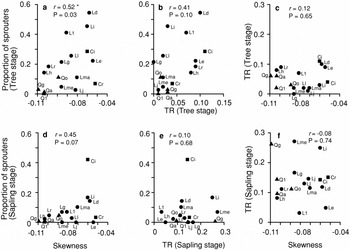
Correlations among skewness, proportion of sprouters (tree stage and sapling stage) and turnover rate (tree stage and sapling stage) are shown in Figure 1. Quercus species tended to have more seedlings while Lithocarpus species showed various size distributions. The average skewness of Quercus species (–0.101) was significantly lower than that of Lithocarpus (–0.077) (Mann–Whitney U test, U = 3.0, P < 0.05). The average proportion of sprouters was higher for Lithocarpus species (23.5%) than for Quercus species (3.8%) at the tree stage (U = 3.0, P < 0.05), while the difference was not significant at the sapling stage (Lithocarpus: 5.6%, Quercus: 1.5%; U = 13.0, P = 0.23). The low proportion of sprouters among Quercus species is a trait that is also observed in some of the other co-dominant dipterocarp species in this forest.
Relationships between skewness and proportion of sprouters at two developmental stages (a, d), between turnover rate (TR%) and proportion of sprouters at two developmental stages (b, e) and between skewness and turnover rate at two developmental stages (c, f). Trees were located in a 6.55-ha plot in a mid-elevation hill dipterocarp forest, Ulu Gadut, West Sumatra. Solid square, circle and triangle indicate Castanopsis, Lithocarpus and Quercus, respectively. Abbreviations are follows: Ci, Castanopsis inermis; Cr, C. rhamnifolia; Le, Lithocarpus encleisocarpus; Ld, L. daphnoideus; Lg, L. gracilis; Lh, L. hystrix; Li, L. indutus; Lj, L. javensis; Ll, L. lucidus; Lma, L. macphailii; Lme, L. meijeri; Lr, L. reinwarditii; L1, L. sp. 1 (cf. ewykii); Qa, Quercus argentata; Qg, Q. gemelliflora; Qo, Q. oidocarpa; Q1, Q. sp. 1 (cf. subsericea).

Skewness was significantly positively correlated with the proportion of sprouters at the tree stage (r = 0.52, n = 17, P = 0.03, Figure 1a), but not at the sapling stage (r = 0.45, n = 17, P = 0.07, Figure 1d). Therefore, the interspecific variation in the sprouting trait was consistent with the population structure of each species at the tree stage. Some of the species with apparently low levels of seedling regeneration are sprouters, and therefore, may compensate for their unstable population structure by producing multi-stemmed individuals, rather than producing more seedlings. Thus, our results support the theoretical predictions proposed by Bellingham & Sparrow (Reference BELLINGHAM and SPARROW2000) and Loehle (Reference LOEHLE2000), and are also consistent with the results of previous field studies (Kruger et al. Reference KRUGER, MIDGLEY and COWLING1997, Nanami et al. Reference NANAMI, KAWAGUCHI, TATENO, LI and KATAGIRI2004, Zimmerman et al. Reference ZIMMERMAN, EVERHAM, WAIDE, LODGE, TAYLOR and BROKAW1994). The reason why so many Fagaceae species co-exist in this forest may be due, at least in part, to their different life history strategies, i.e. the trade-off between persistence by sprouting and regeneration via seedlings. The populations of some species of Fagaceae in the Sumatran forest are unstable, and these species tend to be multi-stemmed sprouters. This sprouting ability, which generally promotes survival in situ, may enable long-term persistence of species that have unstable populations. We should note that at this site, multi-stemmed sprouts develop at the tree stage, rather than at the sapling stage. This implies that sprouting of Sumatran Fagaceae does not support their population at early stages in their life histories, but rather that they must reach a certain size or developmental stage before resources are allocated to the development of multiple stems. In 10 out of 17 species, the number of stems per sprouter was higher at the tree stage than at the sapling stage. However, when averaged across all 17 species, the average number of sprouts at the tree stage (1.7) was not significantly greater than that at the sapling stage (1.0) (t-test, t = 1.92, P = 0.06). Bond & Midgley (Reference BOND and MIDGLEY2001) reported that forest trees show diverse sprouting behaviour, with many species sprouting as juveniles and then losing the ability to sprout as adults. Other studies have reported that smaller stems sprout more readily than larger stems (Bellingham et al. Reference BELLINGHAM, TANNER and HEALEY1994, Paciorek et al. Reference PACIOREK, CONDIT, HUBBELL and FOSTER2000, Peterson & Rebertus Reference PETERSON and REBERTUS1997). Those studies included only trees with dbh ≥ 1 cm, while in this study we compared trees with dbh < 1cm and dbh ≥ 1 cm. The use of different size classes in the present study may explain some of the inconsistencies in the results. It should be noted the sprouting ability of species should be compared only within the same tree size category. In the present study, the role of sprouting was in persistence, i.e. to extend the life of the individual following damage (Bond & Midgley Reference BOND and MIDGLEY2001). This function differs to that of sprouting during the sapling stage, which promotes survival of the individual in a variety of stressed conditions, including suppression by canopy trees, herbivory, site exposure and desiccation (Tredici Reference TREDICI2001).
At each stage, neither skewness nor the proportion of sprouters was correlated with turnover rate (Figure 1b, c, e, f). A previous study demonstrated that the turnover rates of multi-stemmed trees were lower than those of co-occurring single-stemmed trees in temperate montane rain forest in New Zealand and in tropical montane forests in Jamaica (Bellingham & Sparrow Reference BELLINGHAM and SPARROW2009). This could be interpreted such that species with strong sprouting ability show lower turnover rates, while species with weak sprouting ability show higher turnover rates. Our results were not consistent with this interpretation, in that we did not observe any correlation between turnover rates and the proportion of sprouters. The well-known masting of this family (Ashton Reference ASHTON1988) may affect the turnover rate for the short-term observation, in particular. Tredici (Reference TREDICI2001) suggested that sprouting studies based on a single year of observation do not present an accurate picture of the long-term implications of the sprouting response. Therefore, our results on turnover rate in particular should be interpreted carefully. Continuous observations over a longer time period should be carried out to determine long-term trends, and to clarify whether the proportion of sprouters at the tree stage is correlated with turnover rates at this stage.
ACKNOWLEDGEMENTS
The authors thank the late Emeritus Prof. S. Kawamura, M. Rahman, A. Bakar, Prof. K. Abe and Dr Y. Kiyono for their support and encouragement. We also thank two anonymous reviewers for their constructive comments. The study was financially supported in part by the Global Environment Research Fund (B-082).