Introduction
The General Medical Council (GMC) guidance on consent acquisition is clear and up to date: the individual providing the treatment is responsible for ensuring that valid consent has been obtained.1 This task may be delegated to an individual who is (a) suitably trained and qualified, (b) has sufficient knowledge of the proposed investigation or treatment, and understands the risks involved, and (c) understands, and agrees to act in accordance with, current GMC guidance on consent. The validity of consent requires that these conditions be met; thus, consent obtained by individuals lacking the experience, information and/or training in correct consent procedure may not be acceptable from a legal point of view, as well as clearly representing a substandard level of care.
Consent practices have been the focus of changes in good practice in the UK since the National Health Service (NHS) Plan was published by the Department of Health (DoH) in 2000.2 Until that point, the acquisition of consent had historically been the task of the most junior members of surgical teams. As such, when the DoH introduced standardised NHS consent forms in 2002, the overwhelming majority of pre-operative consenting in otolaryngology, for instance, was being carried out by senior house officers (SHOs), as presented by Chadha et al., who conducted a survey of consent practices among SHOs in 40 ENT units in the UK.3, Reference Chadha, Pratap and Narula4 This study showed that the responsibility for routine consenting fell to SHOs (junior doctors typically one to four years post-qualification) in 95 per cent of departments surveyed. Furthermore, in 2002 the DoH issued model consent forms and recommended consent policy for use throughout the NHS. In addition to standardised consent forms, patient information leaflets were recommended as adjuncts. According to Chadha and colleagues' 2002 survey, model NHS consent forms were used in 72.5 per cent of departments, and information sheets given to patients in just 25 per cent.Reference Chadha, Pratap and Narula4
A follow-up study by McDonald et al. in 2005, with matched methodology, showed a reduction in routine consenting by SHOs (to 82 per cent; p = 0.2), an increase in the use of standardised NHS consent forms (to 77.5 per cent; p = 0.4) and a significant improvement in the use of information sheets (to 57.5 per cent; p = 0.0002), since the 2002 study.Reference McDonald, Chadha and Mills5 There were perceptible and occasionally significant reductions in the incidence of SHOs undertaking routine consenting for five of the most common ENT procedures, representing a probable shift towards the recommended practice of consent being obtained by senior members of the surgical team (i.e. those carrying out the procedures).
Two changes to junior doctors' training and working conditions have recently taken place.
The first, major change in junior doctors' training has been the implementation of the Modernising Medical Careers 6 changes as part of the NHS Plan. Amongst other aims, Modernising Medical Careers set out to ‘modernise the SHO grade’ into a two-year, generic foundation programme followed by specialty training, which broadly resembled the old SHO grades of core trainee one and two (i.e. CT1 and CT2) and specialist registrar grades of specialty trainee three onwards (i.e. ST3 to ST7) in structure and timeframe. The effect of this modernisation on frontline services has been the subject of considerable conjecture. One aim of Modernising Medical Careers has been to improve training for junior doctors in order to promote patient care and safety, and this has been measured by competency assessment tools since the inception of the programme.
The second change has been the implementation, on 1 August 2009, of the European Working Time Directive 48-hour week, which limits junior doctors' time available to carry out ward duties, such as consenting pre-operative patients, owing to the proximity of a previous work shift. Although this Directive became legally binding in 2009, NHS Trusts in the UK had already altered work patterns for junior doctors in the preceeding years and it is likely that this survey carried out in 2008 broadly reflects the impact of these alterations.
The aim of the current study was to investigate the impact of such changes on consenting practices over the past three years, by repeating the survey carried out by Chadha et al. and McDonald et al., using the same methodology. The study also aimed to identify any shifts in practice which may relate to recent changes in junior doctor training and service provision.Reference Chadha, Pratap and Narula4, Reference McDonald, Chadha and Mills5
Methods
A telephone questionnaire of SHOs working in 40 randomly-selected UK ENT departments was conducted during December 2008, using the same departments and methodology as previously published.Reference Chadha, Pratap and Narula4 A 100 per cent participation rate was achieved.
The questionnaire consisted of a series of closed questions about consent practice within the department, followed by an opportunity to list specific complications for five common nose and throat procedures without prompting by the interviewer. These five procedures were tonsillectomy, septoplasty, functional endoscopic sinus surgery (FESS), total thyroidectomy and microlaryngoscopy. The results were compared with those of earlier surveys; differences were analysed using Fisher's exact test for two independent proportions.Reference Chadha, Pratap and Narula4, Reference McDonald, Chadha and Mills5
In addition to previous analyses, we also asked about SHOs' experience (i.e. number of months of ENT work, and receipt of training in obtaining consent) and grade (i.e. foundation year one or two, fixed term specialty training appointment, specialty trainee one or two, or staff grade). We also asked about respondents' career aspirations in general (i.e. ENT or not ENT).
Results
General questions on consent procedure
All respondents were able to respond to questions regarding consent in general. The survey revealed that 77.5 per cent of respondents in the 40 departments were routinely responsible for consenting patients prior to surgery, compared with 92.5 per cent in 2002 (p = 0.06) (Table I). The use of patient information sheets has increased significantly, from 25 per cent of departments in 2002, to 65 per cent of departments in 2008 (p = 0.0002). There was no significant change in the use of NHS consent forms, with usage remaining approximately 75 per cent, as in 2002. Likewise, there was no significant change in the number of SHOs who reported receiving consent training or specific information regarding departmental consent protocols. Figure 1 presents information on SHOs' answers to general questions about consent procedure, together with equivalent data from 2002 and 2005.
Proportion of senior house officers (SHOs) responding ‘yes’ to questions about general departmental consent procedure: results for 2002, 2005 and 2008. NHS = National Health Service

SHOs' answering ‘yes’ to general questions on consent procedures: 2002, 2005 and 2008

*n = 40. SHO = senior house officer; DoH = Department of Health; NHS = National Health Service
Senior house officers routinely consenting
We found a statistically significant reduction in the number of SHOs routinely obtaining consent for all five procedures, compared with 2002 (Table II). We also found statistically significant reductions in the number of SHOs routinely obtaining consent for tonsillectomy, microlaryngoscopy and total thyroidectomy, compared with 2005 (Figure 2). These changes are in line with DoH and GMC guidelines.
Proportion of senior house officers (SHOs) routinely responsible for obtaining patient consent for specific ENT procedures: results for 2002, 2005 and 2008. FESS = functional endoscopic sinus surgery

SHOs routinely consenting for specific ENT procedures

*n = 40. p < 0.05. SHO = senior house office; FESS = functional endoscopic sinus surgery
Specific risks and complications
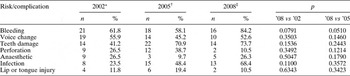
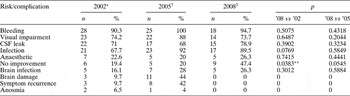
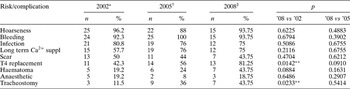
Respondents were asked to name the risks and complications they routinely described when consenting patients for tonsillectomy, septoplasty, microlaryngoscopy, FESS and total thyroidectomy. Their answers are presented in Tables III to VII. For the most part, these answers were unchanged from 2002 and 2005. However, there was a significant increase in the proportion of SHOs warning patients about the possibility of tracheostomy (p = 0.0233) and thyroxine replacement (p = 0.0142) following total thyroidectomy, and also in the number of SHOs warning patients prior to FESS that they may not experience an improvement in their symptoms (p = 0.0383).
SHOs naming specific risks or complications for tonsillectomy

*n = 36; †n = 36; ‡n = 29. SHO = senior house officer
SHOs naming specific risks or complications for septoplasty

*n = 36; †n = 29; ‡n = 25. SHO = senior house officer
SHOs naming specific risks or complications for microlaryngoscopy

*n = 34; †n = 31; ‡n = 19. SHO = senior house officer
SHOs naming specific risks or complications for functional endoscopic sinus surgery

*n = 31; †n = 25; ‡n = 19. **p < 0.05. SHO = senior house officer; CSF = cerebrospinal fluid
SHOs naming specific risks or complications for total thyroidectomy

*n = 26; †n = 25; ‡n = 16. **p < 0.05. SHO = senior house officer; suppl = supplementation; T4 = thyroxine
Population characteristics
Respondents were asked about their experience in ENT, their specific grade (as per Modernising Medical Careers stratification) and their career aspirations. Of the 40 SHOs surveyed, 15 were foundation year doctors (37.5 per cent) and 22 specialty trainees (55 per cent). In addition, there was a single doctor on a fixed term specialty training appointment and two staff grade doctors (7.5 per cent).
A total of 67.5 per cent of respondents had less than six months' ENT experience (27 out of 40). Overall, 27.5 per cent of SHOs questioned wished to pursue ENT surgery as a career or were staff surgeons (11 out of 40).
Discussion
An essential feature of this project is its unchanged methodology over three iterations (2002, 2005 and 2008).Reference Chadha, Pratap and Narula4, Reference McDonald, Chadha and Mills5 Forty departments represents a good sample size, and on-call SHOs are in general a good barometer for departmental practices.
The current study findings indicate a significant reduction in the number of SHOs regularly consenting for the five common ENT procedures in question, compared with 2002 (Table II), and also significant reductions in the numbers consenting for tonsillectomy, microlaryngoscopy and total thyroidectomy since 2005. Encouragingly, there was a significant increase in the use of patient information sheets (p = 0.0002), compared with 2002. More departments were using NHS-issue consent forms than in 2002, although this number had remained broadly constant since 2005.
A broader aim of Modernising Medical Careers was to ensure that ‘a higher proportion of care would be delivered by an appropriately skilled workforce,’ which is in keeping with the changes to consenting practice proposed by the Department of Health (DoH) and the General Medical Council (GMC).6 The current study findings appear initially to support this aim. However, disappointingly, there appears to have been little shift in the level of training in either consenting practice or departmental consent protocols, suggesting the persistence of ad hoc, unstructured systems in up to 75 per cent of departments surveyed. Given that 78 per cent of SHO respondents felt responsible for consenting patients, there needs to be an improvement in consent training if this ongoing service responsibility is to satisfy GMC and DoH requirements for patient care, and to uphold the Modernising Medical Careers commitment for care to be delivered by appropriately skilled doctors.
The reduction in the proportion of ENT SHOs consenting patients has a potential corollary, in that ENT SHOs may not acquire the skills to obtain adequate patient consent. This potential reduction in consent quality has not been shown in this study, however. When the results concerning the proportion of SHOs mentioning specific risks for key ENT operations are analysed, there are only three that show a statistically significant change at the p < 0.05 level. These are the requirement for thyroxine replacement and the potential for tracheostomy in patients undergoing total thyroidectomy, and the possibility that FESS may not improve symptoms. In all three examples, there is an increase in the proportion of SHOs mentioning these points when the 2002 results are compared with the present study (2008 results). An interpretation of this finding is that although SHOs may be less likely to obtain consent for these procedures, those that do may be better informed regarding the kind of information that should be given to patients. It is important not to over-emphasise the significance of these results, given the large number of potential risks or complications that could have been mentioned by the SHOs questioned. What it does seem to indicate, however, is that the shorter time spent working in an ENT department by SHO-level staff does not necessarily impair the quality of informed consent they provide, on the occasions that they carry out this task.
This survey found that 37.5 per cent of doctors questioned were in the 'foundation years', having just graduated from medical school. A major change to working practice that accompanied the introduction of this grade of junior doctor is that the these doctors tend to spend three or four months working in each department, rather than six months, as used to occur prior to ‘Modernising Medical Careers’. For ENT Departments, there is a greater chance that these doctors will have been assigned their ENT placement without having a specific interest in careers in ENT or in any surgical specialty, and may therefore not perceive the acquisition of certain skills as relevant to them. Being present in the department for such a short time may also serve to limit enthusiasm to extend their skills beyond the minimum requirements.
• Senior house officers (SHOs) are responsible for obtaining informed patient consent for routine elective procedures in the majority of ENT departments
• Although the number of SHOs with this responsibility is reducing, SHO consenting is not encouraged by the General Medical Council, the Department of Health or the Modernising Medical Careers guidelines
• A minor decrease in the number of departments routinely requiring SHOs to obtain consent for elective surgery has occurred since 2002, but with no change since 2005
• More ENT departments are routinely providing patient information leaflets
• Senior house officers' knowledge of specific operative complications remains variable and poor, and ENT SHOs are less experienced in the wake of the Modernising Medical Careers changes
Such potential problems are likely to be surmountable, however, with the use of high quality induction training and continuing education within ENT departments.7 Regarding the improvement of the consent processes specifically, it is possible that sticky labels listing risks and complications could be used to serve as adjuncts to consent form text, to act as an aide memoire and to provide consistency regarding information provided. Such a system could still be subject to human error, however, and vigilance would be required to prevent omission of labels or use of incorrect labels. An alternative is a filing cabinet full of consent forms printed for specific operations; specific consent forms for tonsillectomy have been used to enable tissue collection for national Creutzfeldt-Jakob disease auditing.
Conclusions
Findings from a December 2008 telephone survey of ENT SHOs suggest that there has been some improvement in the delivery of information to patients during the consent procedure. However, SHO knowledge of complications remained poor, despite the fact that 77.5 per cent of surveyed departments required SHOs to obtain patient consent. The reduction in the numbers of SHOs consenting is in line with the GMC, DoH and Modernising Medical Careers guidelines. Modernising Medical Careers has generated a cohort of doctors that is less experienced than previously, but adequate induction and ongoing training should help to preserve and improve the quality of service provided to ENT patients.