Introduction
Over the last several decades, the incidence of twin pregnancies has increased significantly. This trend can be attributed to both increased maternal age and the increased use of assisted reproductive technologies Reference Alrahmani, Abdelsattar, Adekola, Gonik and Awonuga1,Reference Okby, Druyan and Sonenklar2 . In the United States, twin birth rate rose by 76% from 1980 to 2009, later leading to twin births accounting for about 3.3% of live births in the United States in 2017 Reference Martin, Hamilton, Osterman, Driscoll and Drake3 . Various studies have demonstrated that twin pregnancies are associated with a greater risk of many obstetrical complications including preterm delivery, gestational hypertension and preeclampsia, gestational diabetes mellitus, low birth weight, neonatal respiratory distress syndrome, and intrauterine death Reference Weiner, Barber and Feldstein4,Reference Okby, Harlev, Sacks, Sergienko and Sheiner5 . For instance, the increased rate of prematurity among twin deliveries is a well-studied topic with roughly half of the pregnancies ending before term (prior to 37 weeks) Reference Spong6 .
Twin pregnancies vary by type, with dichorionic–diamniotic cases being the most common type, carrying the lowest incidence of complications in comparison to other types of twin pregnancies Reference Baghdadi, Gee, Whittle and Khan7 . Optimal delivery time in a pregnancy is calculated by determining when the risk for neonatal mortality and morbidity and of maternal operative delivery is lowest but before the risk for stillbirth begins to rise from continued pregnancy Reference Lee8 .
In singleton pregnancies, accumulating data now suggest early-term delivery (defined as delivery between 37 and 39 weeks’ gestation) to impact on the short- and long-term health of the offspring. Suggested short-term consequences include higher rates of neonatal mortality Reference Machado, Passini, Rosa and Carvalho9 , respiratory morbidity, and increased neonatal intensive care unit admissions Reference Clark, Miller and Belfort10 . Long-term adverse outcome of early-term delivery was reported to include respiratory morbidity Reference Walfisch, Beharier and Wainstock11 and developmental disorders Reference Chan, Leong, Malouf and Quigley12,Reference Noble, Fifer, Rauh, Nomura and Andrews13 .
In the absence of complications, optimal length of gestation appears to be shorter for twins compared to singleton pregnancies. Reluctance to delay twin delivery beyond 39 0/7 weeks is based on older data suggesting that twins attain pulmonary maturation earlier than singletons and therefore postmaturity complications may arise sooner in twins than in singletons Reference Luke14,Reference Leveno, Quirk, Whalley, Herbert and Trubey15 . In addition, the perinatal mortality rate increases at 39 weeks’ gestation in multiple gestations, similar to the pattern observed in post-term singleton pregnancies Reference Minakami and Sato16 . However, perinatal morbidity could be minimized by allowing uncomplicated dichorionic twin pregnancies to continue to 38 weeks’ gestation. In the ESPRIT dichorionic cohort study Reference Breathnach, McAuliffe and Geary17 , this change has led to a fall in perinatal morbidity from 7% at 36 weeks’ to 1% at 38 weeks’ gestation.
Major societies present inconsistent recommendation for optimal delivery timing for uncomplicated dichorionic, diamniotic twin pregnancies. For instance, the American College of Obstetricians and Gynecologists recommends to plan delivery at 38 0/7 to 39 0/7 gestational weeks 18 , and the French College of Gynecologists and Obstetricians recommends 40 0/7 weeks’ gestation Reference Vayssière, Benoist and Blondel19 . On the other hand, the British NICE guidelines quote that they could not find any evidence in relation to the optimal surveillance strategy for dichorionic, diamniotic twin pregnancies that continue beyond 37 0/7 weeks’ gestation 20 .
A systematic review and meta-analysis found increased perinatal death in delivery of dichorionic twins after 38 weeks of gestation as compared with the previous week Reference Cheong-See, Schuit and Arroyo-Manzano21 . In addition, fetal growth restriction incidence appears to increase in twins beyond 38 weeks’ gestation Reference Kiely22 . However, other epidemiological evidence suggests that the lowest rate of perinatal mortality occurs at 37 to 39 weeks in twin pregnancies Reference Minakami and Sato16,Reference Kahn, Lumey and Zybert23 .
As current guidelines advise for early-term delivery in twin gestation, and as data suggest early-term delivery to be associated with short- and long-term morbidity in singletons, we sought to assess the impact of delivery in dizygotic twins at different gestational ages (including the different weeks within term gestation) with a specific focus on short- and long-term morbidity rates.
Methods
A retrospective cohort study of all women who delivered dizygotic (sex discordant) twins, at 37 0/7 weeks and on, at the Soroka University Medical Center (SUMC), between the years 1991 and 2014, was conducted. SUMC is the sole hospital of the Negev (southern Israel), which occupies 65.5% of the country’s land and 14.4% of Israel’s population (approximately 1,200,000 inhabitants) 24 . During the 23-year study period, the annual number of deliveries managed at SUMC increased from roughly 10,000 to 15,000. Since the early 1990s, the Negev region is characterized by positive immigration 25 . Thus, the study is based on nonselective population data.
The primary exposure was defined as gestational age at birth of 37 0/7 to 37 + 6/7 weeks, while delivery at 38 0/7 weeks’ gestation and on was considered the reference. Gestational age was based on the best obstetric estimate determined by providers and used for clinical decision-making. The standard criteria used involved consideration of the clinical history and earliest ultrasound measurements. If the last menstrual period was certain and consistent with the first trimester ultrasound, dating was based on last menstrual period. If the ultrasound was not consistent with the last menstrual period (difference of more than 1 week in a first trimester ultrasound and of 2 weeks in a second trimester ultrasound), or the last menstrual period was unknown, ultrasound data were used for determination of gestational age. Due to the well-established association of multiple gestations with congenital malformations on one hand, and the association of several malformations with different morbidities on the other hand, we excluded fetuses with congenital malformations from the cohort. Additionally, we excluded twins of the same sex to insure dizygocity.
The primary objective of the study was to investigate the association between gestational age upon delivery within term (dependent variable) and the risk of short- and long-term offspring morbidity during a follow-up period and until the age of 18 years. The incidences of childhood hospitalization in the offspring were compared between the different gestational age groups.
Perinatal mortality included intrauterine (ante- and intrapartum fetal death) and postpartum (neonatal) death. These cases were excluded from the long-term analyses.
Maternal and neonatal demographic characteristics and pregnancy course were assessed. These included maternal age, maternal diabetes mellitus and hypertensive disorders, parity, mode of delivery, induction of labor, and fertility treatment (ovulation induction or in vitro fertilization).
Perinatal outcomes included meconium-stained amniotic fluid, neonatal sex, Apgar scores at 1 and 5 min, birthweight and low birthweight (defined as birthweight <2500 grams), small for gestational age birthweight (defined as <5th centile birthweight for gestational age and gender), and perinatal mortality.
Long-term outcomes included all hospitalizations of offspring at SUMC, up to the age of 18 years, involving cardiac, respiratory, infectious, hematological, and neurological-related morbidities. All diagnoses were predefined according to a set of ICD-9-related procedures and diagnoses codes detailed in the Supplementary Table. Of note, several different diagnoses could have been assigned to the same offspring in different health categories.
Follow-up time was defined as time to an event (hospitalization for any of the above detailed diagnosis) or until censored. Censoring occurred in case of death or at the age of 18 years (which was calculated based on date of birth). Only the first hospitalization for each child in each morbidity category was included in the analyses. We have also censored at the end of data availability for each child.
Data were collected from two databases that were cross-linked and merged: the computerized hospitalization database of the SUMC (“Demog-ICD9”) and the computerized perinatal database of the SUMC Obstetrics and Gynecology Department. The perinatal database consists of information recorded immediately following delivery by an obstetrician. Experienced medical secretaries routinely review the information prior to entering it into the database to insure its maximal completeness and accuracy. Coding is performed after assessing medical prenatal care records as well as routine hospital documentation. The Demog-ICD9 database includes demographic information and ICD-9 codes for all medical diagnoses made during hospitalizations at SUMC.
Statistical analysis
Statistical analysis was performed using STATA (version 12.0, College Station, TX, USA) and SPSS (version 23.0, Chicago, IL, USA) software. Assumptions were two sided with α = 0.05 and β = 0.2. Initial analysis compared background, pregnancy, and perinatal characteristics between the different gestational age groups, using Fischer exact χ2 test for categorical variables and t-tests for continuous variables.
Kaplan–Meier survival curves were constructed, and the cumulative hospitalization incidence for each health category was compared between the gestational age groups using the Cox–Mantel Log rank test. Only the first hospitalization for each child in each morbidity category was included.
In order to account for dependence among siblings and to control for familial aggregation, mothers in the cohort were entered as clusters in the multivariable Cox regression analysis for total hospitalization. In order to adjust for length of follow-up, the multivariable Cox regression analysis was performed for each of the different morbidity categories. Other variables with clinical importance (such as maternal hypertensive disorders, maternal diabetes, and small-for-gestational-age neonates) were considered in the Cox models as well. The models compared the independent risk for each of the different morbidities as well as for total hospitalizations in any of the selected morbidities. The final model was selected based on the best model fit and lowest −2 log likelihood.
The study protocol was approved by the SUMC institutional review board and informed consent was exempt.
Results
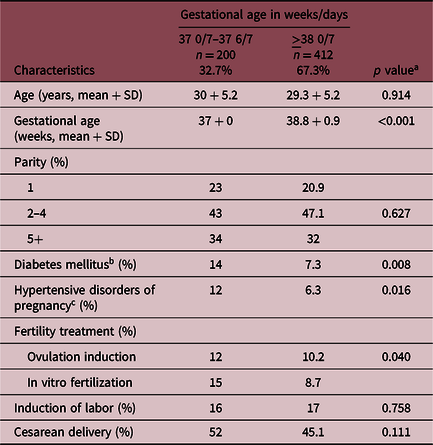
During the study period, 612 dizygotic sex discordant twin deliveries met the inclusion criteria. Of them, 200 (31.3%) occurred at 37 0/7–37 6/7 weeks’ gestation (exposed group), and 412 (68.7%) were delivered at ≥38 0/7 weeks’ gestation (comparison group). Table 1 compares demographic characteristics and pregnancy course in the two gestational age groups. Pregnancies delivered in the exposed group were significantly more likely to be complicated by maternal diabetes (both gestational and pregestational) and hypertensive disorders (including chronic hypertension, gestational hypertension, and preeclampsia with or without severe features) as compared with the comparison group. In addition, fertility treatments (ovulation induction or in vitro fertilization) were significantly more common in the exposed group. Maternal parity, labor induction rates, and mode of delivery were all comparable between the groups.
Maternal demographic characteristics and pregnancy course in the different gestational age groups

a Calculated for all using the chi-square test for trends.
b Including pre-gestational and gestational diabetes.
c Including chronic hypertension, gestational hypertension, and preeclampsia with or without severe features.
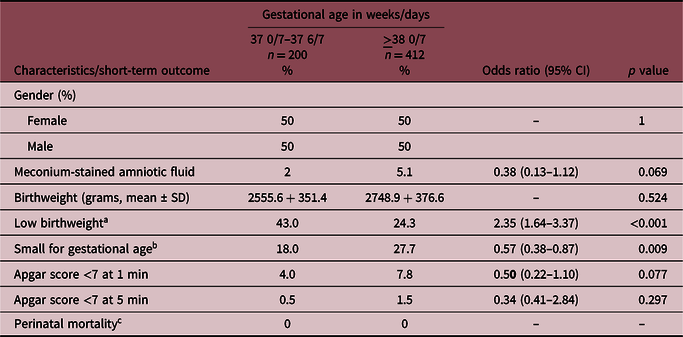
Table 2 depicts the neonatal outcomes. No perinatal mortality cases were documented. Rates of low (<7) Apgar scores at 1 and 5 min, and meconium-stained amniotic fluid, were comparable. Although mean birthweight was similar, low birthweight (defined as birthweight of <2500 grams) rate was significantly higher in the exposed group (43% vs 24.3% in controls, odds ratio (OR) 2.4, 95% confidence interval (CI) 1.6–3.4, p < 0.001), while small-for-gestational-age (defined as <5th centile birthweight for gestational age and for gender) rate was significantly higher in the comparison group (18% vs 27.7% in controls, OR 0.57, 95% CI 0.38–0.87, p = 0.009).
Selected neonatal demographic characteristics and short-term outcomes in the different gestational age groups

a Defined as birthweight < 2500 grams.
b Small for gestational age, defined as <5th centile birthweight for gestational age and for gender.
c Including intrauterine (ante- and intrapartum fetal death) and postpartum (neonatal) death.
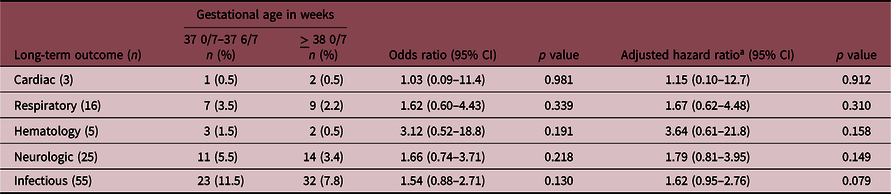
In the sub-analysis according to the different long-term outcomes assessed, no differences were noted between the study groups in hospitalization rates with all morbidity categories (Table 3).
Incidence rates and Cox regression model of selected long-term morbidities in children (up to age 18 years) in the different gestational age groups

a Controlled for follow-up length.
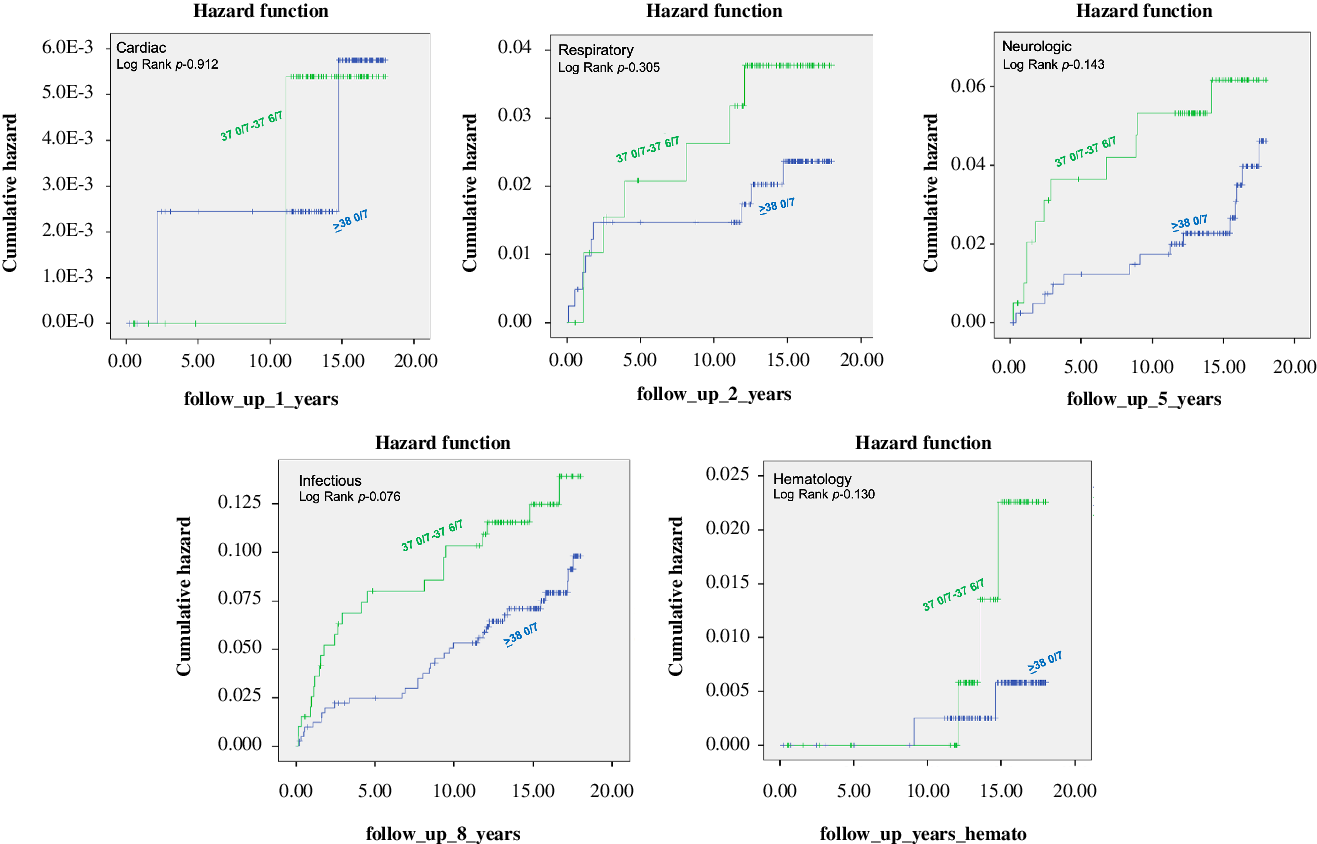
The Kaplan–Meier survival curve (Fig. 1) demonstrates the cumulative incidence of pediatric hospitalizations according to gestational age at delivery. Only the first hospitalization for each child in each morbidity category was included in the survival curve. Cumulative hospitalization incidence in the different groups was comparable for all morbidities.
The cumulative hospitalizations incidence per each selected major-system category over the study period (years) according to gestational age within term.

A Cox regression model (Table 3) was employed to establish an independent association between any selected categories of pediatric hospitalizations assessed (up to the age of 18 years) and gestational age at birth. Gestational age at delivery did not exhibit an independent association with any or all of the later major pediatric hospitalizations in offspring (total hospitalizations adjusted HR 1.33, 95% CI 0.77–2.29, p = 0.308).
Discussion
In our unique cohort of dizygotic sex discordant twin offspring, born at term, and followed for up to 18 years, we have not shown a significant difference in major short- and long-term outcomes between those born at 37 0/7–37 6/7 and those born at a later gestational age. Importantly, no perinatal mortality cases were documented in our cohort, probably stemming from the size of our cohort and the fact that preterm deliveries were excluded. Our cohort is unique due to the fact that dizygosity was confirmed and the fact that for the first time, long-term health outcome was studied specifically in this population.
The idea that gestational age at birth has an impact on childhood morbidity is not new. The early-term (37 0/7–38 6/7) born singleton population of infants has received growing attention in the last decade, with accumulating data now suggesting a pattern of morbidity similar to those of late preterm born children Reference Gouyon, Vintejoux and Sagot26 .Our group has published several studies confirming the association between early-term delivery in singletons and later pediatric respiratory, cardiovascular, metabolic, sleep-related abnormalities, and middle ear infections Reference Walfisch, Beharier and Wainstock11,Reference Imterat, Wainstock, Moran-Gilad, Sheiner and Walfisch27–Reference Walfisch, Wainstock, Beharier, Landau and Sheiner30 . However, our results in this twin cohort suggest otherwise. There was a trend toward higher hospitalization rates (in respiratory, hematological, neurological, and infectious-related hospitalizations) in the exposed group (born prior to 38 0/7 weeks), but this was far from statistical significance in both the uni- and the multivariable analyses.
Other authors have shown similar results. Stern et al. have shown that long-term morbidity in twin pregnancies is inversely related to gestational age at delivery and that neonatal mortality and severe long-term morbidity are rare in offspring born after 28 weeks’ gestation Reference Stern, Cohen and Odom31 .The main reason for neonatal death was prematurity, occurring in roughly 30% of the cohort.
A multicenter randomized controlled trial of uncomplicated twin pregnancies studied the short- and long-term morbidities of infants in two term groups – elective birth group, planned for 37 weeks of gestation, and standard care group, planned for delivery after 38 weeks of gestation. The authors found that infants in the elective birth group were at a statistically significant lower risk of birthweight less than the third centile (for gestational age and infant sex), when compared with infants in the standard care group (3.0% vs 10.1%, respectively; RR 0.30; 95% CI 0.13–0.67; p = 0.004). There were no other statistically significant differences identified in the individual components of the short- and long-term morbidity outcomes between the two treatment groups Reference Dodd, Crowther, Haslam and Robinson32 .
Some population‐based data indicate that for women whose twin gestation continues beyond 37 weeks of gestation, a higher risk of perinatal mortality is noted Reference Minakami and Sato16,Reference Hartley, Emanuel and Hitti33 . However, these studies mostly have not differentiated between monochorionic and dichorionic twin pregnancies.
Bellizzii et al. found around three times increased odds of neonatal death in twins in low- and middle-income countries compared to singletons after adjusting for birthweight Reference Bellizzi, Sobel, Betran and Temmerman34 . Cheong-See et al. concluded that delivery should be considered before 38 weeks of gestation in order to minimize the perinatal death risk in uncomplicated dichorionic twin pregnancies Reference Cheong-See, Schuit and Arroyo-Manzano21 .
In terms of maternal background characteristics, we observed the exposed group to exhibit significantly higher rates of maternal diabetes and hypertensive disorders as compared to later term gestational ages (14.7% vs 7.3% for diabetes, and 12% vs 6.3% for hypertension). These increased rates must be considered, as maternal comorbidities may potentially mediate the cause of increased iatrogenically induced early-term births. In addition, pregnancies following fertility treatments were more common in the exposed group. It is well established that fertility treatments are associated with increased rates of prematurity and other pregnancy complications in singleton pregnancies Reference Welmerink, Voigt, Daling and Mueller35 . Therefore, we adjusted for maternal diabetes and hypertensive disorders, as well as for small-for-gestational-age birthweight in the regression model and observed no impact on long-term childhood hospitalization rate in exposed infants.
Uniquely for our study population, SUMC is the only tertiary medical center treating the entire population of the Negev region, allowing thus true long-term follow-up of offspring health. The long-term follow-up allowed us to closely examine any hospitalizations during childhood. In addition, our dataset combines maternal, neonatal, and long-term childhood data, enabling us to examine the long-term outcomes of offspring with the ability to control for many parameters and potential confounders surrounding pregnancy and delivery. That said, the main limitation of our study lies within its retrospective design. As a population-level analysis, our study can support or refute only an association but not causation, or underlying pathogenesis. Additionally, we included only twins with discordant sexes to insure dizygotic pregnancies. Thus, we excluded a large number of twin pregnancies from our cohort, many of which were probably dizygotic but sex concordant. We focused only on hospitalization at SUMC. Thus, any medical encounters occurring at an ambulatory setting or at a different hospital, for any reason, were not accounted for. It is possible that some hospital encounters occurred outside of this large tertiary regional medical center due to immigration. We can see no reason, however, that immigration rates would be different across the gestational age groups and thus believe that its specific impact on our results is probably minor.
To the best of our knowledge, we are the first to evaluate long-term outcomes, via childhood hospitalization incidence, related to different gestational ages within term gestation in a pure cohort of established dizygotic twin pregnancies.
To conclude, different term gestational ages at birth in dizygotic twin pregnancies do not appear to be associated with significantly different perinatal mortality rates or with a significantly increased long-term risk of pediatric hospitalizations in different major health categories. We believe that our results are reassuring and should be incorporated into the discussion surrounding delivery timing in these pregnancies.
Supplementary material
To view supplementary material for this article, please visit https://doi.org/10.1017/S2040174420000100
Acknowledgements
None.
Financial Support
This research received no specific grant from any funding agency, commercial or not-for-profit sectors.
Conflict of Interest
None.
Ethical Standards
None.