




No CrossRef data available.
Psychological profiles and adolescent adjustment: A person-centered approach
Published online by Cambridge University Press: 10 February 2006
Abstract
The association between young adolescents' psychological profiles and their subsequent adjustment was examined in a sample of 606 adolescents (ages 12–13) drawn from the mother–child data set of the National Longitudinal Survey of Youth. Cluster analysis was used to identify distinct groups of youth based on self-regulation, proneness to risk, self-worth, and perceived academic competence. Five replicable clusters were identified corresponding to optimal, average, behavioral risk, low self-regulation, and emotional risk groups. These clusters were associated with distinct patterns of adjustment 4 years later. At ages 16–17, youth in the optimal group tended to report better academic performance, less problem behavior, and less depression than youth in the three risk groups; however, their functioning did not differ significantly from youth in the average group. The three risk groups differed in self-reported depression symptoms and academic performance but not in levels of problem behavior. Differences among the five groups persisted when demographic and contextual variables were controlled. These results support the existence of different groups of youth who follow distinct developmental trajectories and may experience different patterns of adjustment.
This research was funded by a grant to M. Raffaelli and L. Crockett from the National Institute of Mental Health (R01-MH62977). We thank Rebecca Colman, Yuh-Ling Shen, Sam Hardy, Rebecca Goodvin, Myesha Albert, Andy Peytchev, Jenenne Geske, Jennifer Bowers, Devan Starks, and Brett Avila for their contributions to the project. We also thank Cal Garbin for his statistical advice and several anonymous reviewers for their suggestions.
Information
- Type
- Research Article
- Information
- Copyright
- © 2006 Cambridge University Press
In recent years, increased attention has focused on self-regulation and its role in children's adaptation. Defined as the capacity to regulate emotions, attention, and behavior (Bagozzi, 1992; Kopp, 1982; Zimmerman, 2000), self-regulation is implicated in multiple aspects of children's functioning, including their psychosocial adjustment and academic competence (Barkley, 1997; Eisenberg & Fabes, 1992; Miller & Byrnes, 1997; Shunk & Zimmerman, 1997). Yet, empirical data are surprisingly sparse, particularly regarding the role of self-regulation in adolescence. Although adolescents would seem to be especially vulnerable to negative consequences of poor self-regulation (e.g., auto accidents, unintended pregnancy), most self-regulation research has focused on younger children. Nonetheless, the available literature supports a link between self-regulatory abilities and adolescents' externalizing and internalizing problems (e.g., Brody & Ge, 2001; Feldman & Brown, 1993). The present study builds on this emerging body of research by examining self-regulation as part of a constellation of psychological variables predicting adolescent psychosocial and behavioral adjustment.
Self-Regulation
The theoretical concept of self-regulation draws on the notions of “ego control” and “ego resilience” in the developmental literature (Block & Block, 1980), as well as the related notion of “self-control” in the criminology literature (Gottfredson & Hirschi, 1990). According to Block and Block (1980), ego control refers to “impulse control and modulation” (p. 41), whereas ego resilience refers to the capacity to vary one's pattern of adaptation in response to environmental demands. Our concept of self-regulation encompasses both dimensions, reflecting a capacity for the regulation of behavior as well as the ability to regulate attention and affect in ways attuned to internal and contextual demands (Kopp, 1982). Gottfredson and Hirschi (1990) define self-control in terms of self-discipline and the ability to defer gratification, which corresponds to the behavioral component of self-regulation.
Several studies have documented an association between indicators of self-regulation and adolescents' participation in problem behavior. Adolescent substance use has been linked to “undercontrol” (Block, Block, & Keyes, 1988), poor self-regulation (Brody & Ge, 2001), and “impulsivity” (Colder & Chassin, 1997). Caspi, Henry, McGee, Moffitt, and Silva (1995) reported an association between “lack of control,” assessed with behavior ratings in early childhood, and externalizing behavior in adolescence. Along similar lines, Feldman and Brown (1993) found that boys low in self-restraint reported greater misconduct and more sexual partners 4 years later. Using a national data set, Raffaelli and Crockett (2003) found an association between self-regulation in early adolescence and risky sexual behavior in midadolescence.
Fewer studies have examined the role of self-regulation in internalizing problems, but some evidence exists. Brody and Ge (2001) reported that childhood self-regulation, which is indexed by goal setting, planning, and forethought, negatively predicted a latent variable incorporating depression, hostility, and low self-esteem in early adolescence. In other studies, better self-regulatory skills have been linked to greater social and cognitive competence (Barkley, 1997; Eisenberg et al., 1995). Self-regulation also has implications for academic competence (Shunk & Zimmerman, 1997). Concentrating on schoolwork requires focused attention, often in the presence of distractors (i.e., regulation of attention). It also requires persistence, delay of gratification, and putting long-term goals before short-term ones (e.g., studying for a test instead of going out with friends). Empirical research indicates that children who are able to delay gratification ex perience greater academic success (Mischel, Shoda, & Rodriguez, 1989; Wulfert, Block, Ana, Rodriguez, & Colsman, 2002). Thus, the available literature suggests that self-regulation could play a pivotal role in adolescents' behavioral and emotional adjustment.
A Person-Centered Approach
Most studies examining the role of self-regulation have utilized a variable-level approach, in which self-regulation (or a related construct) is used to predict specific aspects of competence or adjustment (e.g., risky behavior). Such analyses separate psychological processes from the individuals in whom they occur and typically ignore the organization of traits within individuals (Hart, Atkins, & Fegley, 2003). Thus, they often obscure the fact that psychological processes do not operate independently but as part of an integrated system of traits within the person. Moreover, variable-level analyses are inappropriate for drawing conclusions about single individuals because the results are at the level of variables, not persons, and ignore the relations of parts to the whole (Bergman & Magnusson, 1997). In support of this argument, von Eye and Bergman (2003) have shown that statistics based on variable-oriented analyses can fail to describe many (perhaps most) individuals in a given sample. They conclude that average scores and correlations aggregated over individuals do not permit conclusions about individual scores or the relations between variables within individuals.
In contrast, in a person-centered approach, the individual is viewed as an “organized whole, functioning and developing as a totality” wherein “each aspect of the various structures and processes … takes on meaning from the role it plays in the total functioning of the individual” (Bergman & Magnusson, 1997, p. 291). Individuals are grouped according to their scores on multiple characteristics or variables. Thus, the person-centered approach focuses attention on “configurations of traits within individuals” and “the intraindividual structure of personality” (Robins & Tracy, 2003, p. 112). This approach allows for the identification of types that are conceptually richer for describing persons than are isolated traits. For example, it may be more useful to identify “antisocial youth” than to focus on particular behaviors such as stealing, lying, setting fires or getting into fights. From this perspective, self-regulation is best studied as part of a system of psychological characteristics operating within the person as a whole.
Accordingly, in the present study we identified multiple psychological characteristics (including self-regulation) that together might influence adolescents' subsequent adjustment. Because our interest was in identifying precursors of future adaptation, we selected constructs that (a) have been found to predict adjustment in variable-level studies and (b) could be expected to modulate the impact of self-regulation on functioning, resulting in different adjustment outcomes. Based on the literature, two kinds of psychological variables appeared to be central precursors to adolescent adjustment problems: negative self-evaluations and proclivities for risky behavior. Three variables (besides self-regulation) captured these domains: low self-worth and perceived academic competence (i.e., negative self-evaluations), and “risk proneness.” Although linked empirically to internalizing and externalizing problems, these characteristics do not constitute pathology. They are best viewed as markers or precursors of later adjustment problems (i.e., as risk factors). From a theoretical perspective, all three characteristics fit within the personality system described in problem behavior theory (Costa, Jessor, Donovan, & Fortenberry, 1995; Jessor, 1998). Specifically, academic self-perceptions reflect the “motivational–instigational” dimension, self-worth the “personal belief” dimension, and risk-proneness the “personal control structure.” We used these variables, along with self-regulation, to identify adolescents who might develop distinct kinds of adjustment problems over time.
Risk proneness
Risk proneness or risk tolerance is characterized by attraction to excitement and ineffective decision making. Individuals who seek excitement are more likely to engage in dangerous or risky behavior; they also tend to focus on the positive consequences of such behavior (e.g., fun) without full consideration of possible negative consequences. Risk proneness is distinguished from poor self-regulation by its motivational component: risk prone adolescents may have self-regulatory skills but choose not to use them when opportunities for excitement present themselves; in contrast, adolescents with poor self-regulatory skills are simply unable to regulate their affect, attention, or behavior sufficiently to avoid trouble. A related construct, “sensation seeking” (defined as “the need for varied, novel, and complex sensations and experiences and the willingness to take physical and social risks for the sake of such experiences,” Zuckerman, 1979, p. 10) has been linked to substance use, sexual risk taking, and other forms of risky behavior (Arnett, 1992; Zuckerman, 1991). Farley (1991) found that adolescents characterized as arousal seekers initiated sexual intercourse on average a year earlier than arousal reducers and reported more sexual partners. In a review of the predictors of substance use and abuse, Tarter (2002) identified sensation seeking and poor self-regulation as important influences. Similarly, Arnett (1992) cited sensation-seeking and cognitive factors (e.g., faulty reasoning about the probability of negative consequences) as core elements leading to “reckless behavior” in adolescence, including substance use, antisocial behavior, and drunk driving. These findings support the contention that risk proneness represents an important individual-level predictor of adolescent risk behavior.
The role of risk proneness in academic performance and internalizing problems is less obvious. Adolescents who are very low in risk proneness may refrain from social activities, potentially resulting in loneliness and depression. At the same time, high risk proneness could contribute to depression if risky behavior results in negative consequences. Similarly, risk proneness could impact academic success in both positive and negative ways. For example, a preference for spontaneity over planning could lead to poor study habits and ineffective time use. Alternatively, a willingness to take risks could be associated with innovation and creativity. Although promising, these potential links have not been systematically explored.
Self-worth
Numerous studies have demonstrated an association between poor self-esteem and depression (e.g., Aunola, Stattin, & Nurmi, 2000; Ohannessian, Lerner, Lerner, & von Eye, 1999). Low self-esteem has also been linked to problem behavior. For example, Kaplan (1980) hypothesized that rejection by groups who support normative behaviors (e.g., parents, schools, conventional peers) impairs self-esteem. In a bid for acceptance and self-enhancement, youth turn to other groups, such as deviant peers, who support misconduct. Empirical studies have documented connections between low self-esteem and greater participation in delinquent activities (Kaplan, 1980; Mason, 2001) and substance use (Kaplan, Martin, & Robbins, 1982; Kumpulainen & Roine, 2002). Low self-esteem has also been linked to sexual behavior. In a cross-sectional study, young adolescents (seventh to eighth graders) with lower self-esteem reported an earlier sexual debut and more sexual activity than adolescents with higher self-esteem; however, this association did not hold for older adolescents in Grades 9–12 (Lynch, 2001). Thus, low self-worth is implicated in both internalizing and externalizing problems.
Perceived academic competence
Self-perceptions in the academic domain also have implications for adolescent adjustment. Children with higher perceived academic competence report fewer depressive symptoms concurrently (Epkins, 1998) and in adolescence (Cole, Jacquez, & Maschman, 2001). Furthermore, several theoretical perspectives posit a link between low academic investment and problem behavior. According to Hirschi's (1969) social control theory, attachment to conventional institutions such as school deters involvement in deviant activities, because adolescents who are attached to conventional persons (e.g., parents and teachers) and have a stake in conventional society do not wish to jeopardize valued relationships and future opportunities by engaging in deviant behavior. The Problem Behavior Theory (Jessor & Jessor, 1977) makes a similar prediction: adolescents who value school and have high educational expectations should show less involvement in socially disapproved activities such as substance use, precocious sex, and delinquency. These relations have been supported in empirical work by Jessor (e.g., Costa et al., 1995; Jessor & Jessor, 1977) and others (Ohannessian & Crockett, 1993; Pisecco, Wristers, Swank, Silva, & Baker, 2001). Thus, perceived academic competence has been linked to internalizing problems and, insofar as it reflects academic investment, also predicts problem behavior.
The Present Study
Although each of the four psychological characteristics selected for study has been linked individually to aspects of adolescent adjustment, most research has used a variable-level approach (analyzing the associations between specific variables) rather than a person-centered one (comparing adolescents with distinct configurations of attributes). Therefore, we do not know how these characteristics cluster within individuals or whether particular configurations of characteristics set the stage for later development and functioning. The present study was designed to identify naturally occurring psychological configurations in early adolescence and examine their implications for subsequent adaptation. We hoped to find distinct types of young people who may be predisposed to differing patterns of psychosocial adjustment. Based on a person-centered perspective, we expected that configurations of self-regulation, risk proneness, self-worth, and academic self-perceptions would predict the adolescent's subsequent functioning.
We grouped young adolescents (ages 12–13) using their scores on the four psychological variables and examined the extent to which distinct psychological profiles were associated with depression, risk behaviors, and academic competence in midadolescence. We focused on early adolescence, because by this period many psychological proclivities should have crystallized, resulting in relatively stable individual profiles (Caspi et al., 1995; Crockett & Crouter, 1995). Moreover, compared to younger children, teenagers have greater freedom to act in accordance with their personal preferences: they can choose their academic courses, their friends, and their activities (Lerner, 1982). Thus, in early adolescence there is increased opportunity for young people's psychological profiles to influence their behavioral choices and, by extension, their developmental trajectories. For these reasons, psychological configurations in early adolescence could predispose youth to different kinds of adjustment problems later on.
The outcome variables were chosen to reflect a broad spectrum of adjustment indictors, including substance use, sexual risk taking, delinquency, depression, and academic performance. The first three outcomes are common “problem behaviors” in adolescence; in addition, depression reflects internalizing problems and academic performance is an indicator of competence. Risky behaviors such as substance use, sexual risk taking, and delinquency tend to increase in adolescence (Johnston, O'Malley, & Bachman, 2003; Kann et al., 2000). Rates of depression also increase during the teenage years (Cicchetti & Toth, 1998; Rutter, 1991).
We expected to find several types of youth with distinct profiles. One group was expected to have low self-regulation and low self-evaluations; another would show low self-regulation along with high risk proneness. We also anticipated a group of competent adolescents with healthy scores on all psychological indicators and a contrasting group characterized by vulnerabilities in multiple areas. These groups were expected to show different patterns of subsequent emotional and behavioral adjustment. Extrapolating from bivariate associations reported in the literature, low self-regulation in combination with high risk proneness and low academic self-efficacy should be related to higher levels of substance use, delinquency, and sexual risk taking. In contrast, poor self-regulation coupled with low self-worth should increase vulnerability to depression. Finally, high self-regulation combined with high self-worth, perceived academic competence, and moderate to low risk proneness should be associated with good academic performance and low levels of externalizing and internalizing problems.
Gender differences in associations between profiles and outcomes were also explored. Adolescent boys show higher rates of delinquency and heavy substance use compared to adolescent girls (Johnston et al., 2003; Loeber & Stouthamer-Loeber, 1998), whereas girls show higher rates of depressive symptoms (Nolen-Hoeksema & Girgus, 1994). If psychological inclinations are expressed in gender-typical behaviors, some psychological configurations might predict distinct outcomes for girls and boys.
In summary, the present study was designed to elucidate the relations between psychological profiles identified in early adolescence and psychosocial adaptation in midadolescence. Four interrelated questions were addressed. First, do the four psychological variables cluster in meaningful ways to characterize distinct types of early adolescents? Second, do youth with distinct profiles in early adolescence show different psychological and behavioral outcomes in midadolescence? Third, do relations hold with demographic and contextual variables controlled? To address this question, we included variables found to be associated with internalizing and externalizing problems in prior research, including maternal education, mother–child relationship quality, negative peer influences, and decision-making autonomy (Brown, Clasen, & Eicher, 1986; Dornbusch et al., 1985; Ge, Best, Conger, & Simons, 1996). Fourth, do relations between psychological profiles and adjustment outcomes vary by gender?
Method
Sample
Data came from the mother–child data set of the National Longitudinal Survey of Youth (NLSY). The NLSY began in 1979, with a national probability sample of 12,686 youth who were between the ages of 14 and 21 in January, 1979 (Zagorsky & White, 1999). Blacks, Hispanics, and economically disadvantaged non-Hispanic Whites were oversampled initially (the economically disadvantaged White oversample was later dropped). Participants have been surveyed on an annual basis since 1979. Beginning in 1986, the children of female participants were added to the study and assessed at 2-year intervals. The sample for the present study was based on a cohort of 735 children (48.5% female) aged 12–13 in 1994 (Time 1). In cases where multiple siblings participated in the study, one sibling from each family was randomly selected for inclusion in the cohort.
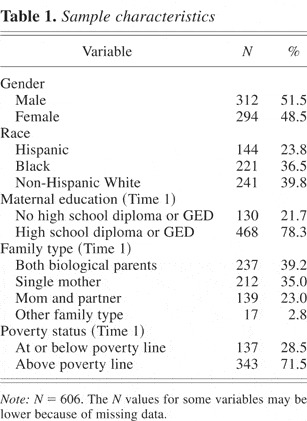
Of the 735 young adolescents in our cohort, 606 had complete data on the four psychological variables and comprised the analytic sample for Time 1 analyses. Sample characteristics are provided in Table 1. Longitudinal analyses were based on 553 of these youth who were also present in 1998 (Time 2) at ages 16–17. Sample sizes for longitudinal analyses varied somewhat owing to missing data on outcome variables.
Sample characteristics

Sample bias analyses compared the longitudinal sample (n = 553) with those who were excluded from analysis (n = 182) because they were missing data on the psychological variables at Time 1 or were absent at Time 2. The retained and excluded groups were compared on Time 1 demographic variables (gender, ethnicity, maternal education, poverty status, and family structure), contextual variables (mother–child relationship quality, child decision making, and negative peer pressure) and the four psychological variables. Analysis of variance (ANOVA) and chi-square tests revealed no significant differences.
Measures
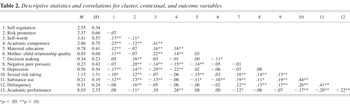
The four psychological variables, demographic characteristics, and contextual variables were measured in 1994 (Time 1). Outcome variables were measured in 1998 (Time 2). Demographic and self-regulation measures were based on maternal report; other psychological variables, contextual variables, and outcome variables were based on adolescent report. For multiitem scales, scale scores were computed only for adolescents with data on at least 75% of the items. Descriptive statistics and intercorrelations for the primary study variables are provided in Table 2.
Descriptive statistics and correlations for cluster, contextual, and outcome variables

Time 1 demographic characteristics
Demographic characteristics of the adolescents included gender, age (in years), and race/ethnicity (Black, Hispanic, or non-Hispanic White/other). Family demographics included maternal education (less than high school degree vs. high school diploma/GED received), family poverty status (below vs. above poverty level), and family structure. Family structure was coded into four categories: two biological parents, single mother, mother plus partner (spouse or boyfriend), and other living arrangements.
Time 1 psychological variables
Self-regulation
The self-regulation measure consisted of 13 conceptually identified items from the 28-item Behavior Problems Index (Peterson & Zill, 1986; Zill, 1990). Consistent with our conceptualization of self-regulation as a multidimensional construct, we included items reflecting regulation of affect, attention, and behavior. Affect items tapped into both emotional volatility (e.g., “he/she has sudden changes in mood or feeling”) and intensity of expressed emotion (e.g., “he/she has a very strong temper and loses it easily”). “He/she has difficulty concentrating, cannot pay attention for long” was an indicator of attention regulation, and “he/she is restless or overly active, cannot sit still” was an indicator of behavior regulation. To ensure that the measure of self-regulation did not overlap with preexisting externalizing problems, we excluded items indicative of antisocial behavior, peer problems, and oppositional behavior. Similar items to those included in the self-regulation measure have been used in research that examines emotionality and self-regulation (e.g., Eisenberg et al., 1995; Lengua, 2002), self-restraint (Feldman & Brown, 1993), and impulsiveness (Eysenck & Eysenck, 1978). Mothers reported how well each item described their child's behavior in the last 3 months, using a 3-point scale from 1 (often true) to 3 (not true). The 13 items were reverse scored and averaged so that a higher score indicated better self-regulation (α = .85).
Risk proneness
Adolescents responded to six self-report items assessing their attraction to excitement (e.g., “I enjoy taking risks”) and their tendency to follow this inclination without fully considering the consequences (e.g., “I often get in a jam because I do things without thinking”; Little Known Variables in the NLS, 2000). Responses were made on a 4-point scale ranging from 1 (strongly disagree) to 4 (strongly agree). Items were averaged to create a risk-proneness scale (α = .67), with higher scores indicating a greater inclination to engage in risky behavior.
Self-worth and perceived academic competence
Two six-item subscales from the Perceived Self Competence Scale (Harter, 1982) were included in the 1994 assessment: perceived academic competence and global self-worth. Each item consisted of a statement describing two kinds of youth (e.g., for academic competence, “Some kids feel they are very good at their school work but other kids worry about whether they can do the school work assigned to them”; for global self-worth, “Some kids are happy with themselves as a person but other kids are often not happy with themselves as a person”). Adolescents selected the descriptor that was more true of them and marked whether it was “really true for me” or “sort of true for me.” Items were rated on a 4-point scale, ranging from 1 to 4. Scale scores were created by averaging across the responses (α = .72 for global self-worth and .79 for academic competence). A higher score indicated more positive self-evaluations.
Time 1 contextual variables
Mother–child relationship quality
Four adolescent-report items were used to tap mother–adolescent closeness and communication (e.g., “How well do you and [your mother] share ideas or talk about things that really matter?”). Two items were coded on a scale from 1 (not very well) to 4 (extremely well), and two additional items were coded on a scale from 1 (often) to 3 (hardly ever), these latter two items were reversed. Item scores were standardized and averaged to create a total score, with a higher score corresponding to better relationship quality (α = .67).
Decision-making autonomy
A measure of the extent to which adolescents were allowed to make decisions without parent input was created from seven self-report questions assessing who made decisions for the child (e.g., “Who usually makes the decisions about how to spend your money?”). Possible responses were the child, mother, father, stepfather, friend(s), someone else, or any possible combination of these responses. Following Dornbusch and colleagues (Dornbusch et al., 1985; Dornbusch, Ritter, Mont-Reynaud, & Chen, 1990), we summed the “child only” responses; we then divided that score by the number of valid items to create a proportion score, with possible scores ranging from 0 to 1.
Negative peer pressure
Self-reported peer pressure to engage in misconduct was assessed with five yes–no items (e.g., “Do you ever feel pressure from your friends to skip school?”). Initially a scale score was computed by averaging across the responses (α = .72). Because the distribution was highly skewed (few adolescents reported peer pressure on any given item), a dichotomous variable was created indicating whether children reported experiencing any negative peer pressure (0 = no, 1 = yes).
Time 2 outcome variables
Depression
The adolescent depression measure was drawn from two subscales (somatization and depression) of the Center for Epidemiologic Studies Depression Scale (Radloff, 1977). Adolescents responded to six self-report items concerning how much they had experienced specific symptoms in the past week (e.g., “I did not feel like eating; my appetite was poor”). Responses were scored on a 4-point scale, ranging from 0 (rarely, none of the time, 1 day) to 3 (most, all of the time, 5–7 days). The six items were averaged to create a total depression score (α = .73), with higher scores indicating greater depression.
Risky sexual behavior
Adolescents completed self-administered measures of sexual experience. Adolescents were asked whether they had ever had intercourse; those who responded “yes” were asked to report their age at first intercourse, number of sex partners in the last 12 months, and condom use at last intercourse. Risky sexual behavior is multidimensional, reflecting a number of different behaviors; therefore, we examined a composite variable indexing the overall degree of sexual risk taking (Raffaelli & Crockett, 2003). The measure of cumulative sexual risk was derived by scoring the different sexual behavior variables dichotomously and summing. Scores ranged from 0 (no risk; i.e., never had sex) to 4 (high risk; i.e., sexually active, sexual debut before age 15, two or more sex partners in last 12 months, no condom use at last intercourse).
Substance use
The substance use measure consisted of eight self-report items assessing lifetime use of alcohol, tobacco, marijuana, inhalants, cocaine, crack, hallucinogens and sedatives (e.g., “Have you ever smoked a cigarette?”). For each substance, adolescents responded 0 (no) or 1 (yes). A total score was computed by averaging across all eight items (α = .70). A higher score indicated more substances tried.
Delinquency
Adolescents responded to 16 self-report items (e.g., “In the last year, have you ever intentionally damaged or destroyed property that did not belong to you?”). The items were scored dichotomously as 0 (no) or 1 (yes) and averaged to yield a composite score (α = .82). A square root transformation was applied to the resulting scale score to reduce skewness and kurtosis (Tabachnick & Fidell, 2000). (Skewness was reduced from 1.59 to 0.22; kurtosis was reduced from −2.72 to −0.67.) A higher delinquency score indicated participation in a greater number of delinquent behaviors.
Academic performance
Adolescents reported their average grade for the previous year of high school. Responses ranged from 1 (A) to 12 (E/F), but were reversed so that a higher value indicated better grades. The mean score of 8.03 corresponds to an average grade of B−.
Results
Preliminary analyses
Intercorrelations among the main study variables are provided in Table 2. The associations among the four psychological variables tended to be small, with most r values ranging from −.07 (for self-regulation and risk proneness) to .23 (for self-regulation and perceived academic competence). The only moderate correlation was between global self-worth and perceived academic competence (r = .41). Associations between the psychological variables and the outcome variables were modest, ranging from r = −.29 to .28. Correlations among the contextual variables and between contextual variables and outcomes were small.
Identification of types
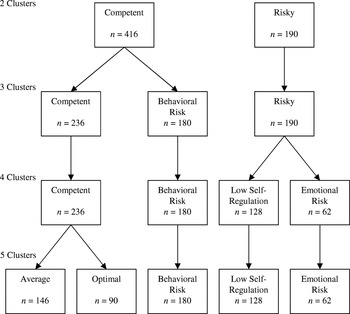
Hierarchical cluster analysis was used to identify groups of adolescents with distinct profiles of self-regulation, risk proneness, perceived academic competence, and global self-worth at Time 1. Ward's method was used, with squared Euclidian distance as the proximity measure. Because response formats differed across the four variables, scores for each variable were standardized prior to analysis (Everitt, Landau, & Leese, 2001). To identify replicable clusters, the total sample at Time 1 was divided into random thirds and the cluster analysis repeated on each third. The selection of clusters was based on inspection of the dendrogram and the agglomeration index for each subsample as well as the agglomeration history within each subsample, the coherence of the resulting clusters, and the replicability of clusters across subsamples.
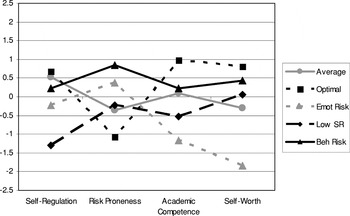
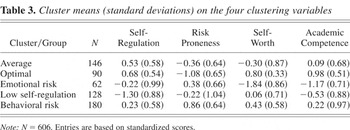
In each of the three subsamples, the agglomeration index indicated three to five possible clusters. The three- and four-cluster solutions differed across subsamples. However, the five-cluster solution yielded consistent clusters in each random third. The cluster analysis was repeated on the full sample with five clusters selected, and the same five clusters emerged. As shown in Figure 1, the five clusters included an average group characterized by moderately high self-regulation but average risk proneness, self-worth, and perceived academic competence; an optimal group distinguished by moderately high self-regulation, low risk proneness, and moderately high self-perceptions; an emotional risk group characterized by low self-worth and low perceived academic competence; a low self-regulation group distinguished by low self-regulation and moderately low academic competence; and a behavioral risk group characterized by high risk proneness but average self-regulation and self-perceptions.1
For descriptive purposes, a score within 0.5 SD of the mean was considered average; a score from 0.5 to 1 SD above (below) the mean was considered moderately high (moderately low); a score greater than 1 SD above (below) the mean was considered high (low).
The agglomeration history for each of the three random thirds is available from the first author.

Cluster profiles based on four psychological variables. Low SR, low self-regulation.

A graphical depiction of agglomeration history.
To examine cluster distinctness, the five groups were compared on the four psychological variables used in the clustering procedure. Means and standard deviations by cluster are provided in Table 3. An ANOVA revealed significant cluster differences for self-regulation, F (4, 601) = 160.81, p < .001, risk proneness, F (4, 601) = 120.99, p < .001, perceived academic competence F (4, 601) = 88.82, p < .001, and global self-worth, F (4, 601) = 163.89, p < .001. Pairwise comparisons using least significant difference (LSD) tests indicated that all groups differed significantly in self-regulation, with the exception of the average and optimal groups, who differed from all other groups but not each other. All groups differed significantly on risk proneness, with the exception of the average and low self-regulation groups, who did not differ from each other. All groups also differed in perceived academic competence, with the exception of the average and behavioral risk groups, who did not differ from each other. Finally, all groups differed in global self-worth.
Cluster means (standard deviations) on the four clustering variables

As a check on the hierarchical cluster solution, we conducted a k-means cluster analysis (using SPSS Quick Cluster), with a five-cluster solution specified (Adlenderfer & Blashfield, 1984). The means of the cluster variables for each hierarchical cluster group (centroids) were used as the initial cluster centers for the k-means analysis. The k-means clusters matched those from the hierarachical cluster analysis, supporting the five-cluster solution. Further analyses were based on the original hierarchical cluster solution.
Finally, to examine replicability of the cluster solution, we identified a second NLSY cohort in which the study variables were available at the same ages as in the original cohort. The second cohort was born 2 years later than the original cohort, and included the children of later childbearers; it also had a somewhat different racial distribution. A hierarchical cluster analysis of this second cohort at ages 12–13 years yielded a five-cluster solution that largely corresponded to the solution identified in the initial cohort.3
Four of the five clusters were highly similar in the two cohorts. However, the “optimal” group was less consistent, showing lower means on self-worth and academic competence in the second cohort than in the first cohort and looking more like an “average” group.
Association of types with behavioral outcomes and depression
A set of 5 × 2 (Cluster × Gender) ANOVAs was conducted to examine the association between cluster membership at Time 1 and psychosocial adjustment at Time 2. Gender was included to examine the possibility that cluster profiles (i.e., types) were differentially related to outcomes for boys and girls. Group means and SDs for outcome variables appear in Table 4; for easy comparison, mean scores on (standardized) outcome variables are charted by cluster in Figure 3. Results revealed significant cluster differences on four of five outcomes (ps < .05). There were no significant interactions between gender and cluster. Pairwise follow-up comparisons were based on LSD t tests.
Comparisons of cluster means (standard deviations) on behavioral outcomes and depression


The means of standardized outcome variables by cluster. Low SR, low self-regulation.
For depression, effects of cluster, F (4, 541) = 13.90, p < .001, η2 = .09, and gender, F (1, 541) = 21.23, p < .001, η2 = .04, were significant. Follow-up tests (LSD) indicated that the emotional risk group reported significantly higher levels of depression than all other groups. The low self-regulation group reported more depression than the average, optimal and behavioral risk groups, and the behavioral risk group scored higher than the optimal group. Consistent with prior literature, girls were more depressed than boys.
Turning to the problem behaviors, for sexual risk taking, only cluster was significant, F (4, 547) = 3.87, p < .01, η2 = .03. The average group reported less sexual risk taking than the three risk groups, who did not differ from each other. For substance use, cluster was significant, F (4, 475) = 3.02, p < .05, η2 = .03: the optimal group reported less substance use than the three risk groups, who did not differ from each other. The average group also reported significantly less substance use than the emotional risk group. For delinquency, gender, F (1, 503) = 16.43, p < .001, η2 = .03, was significant, with boys engaging in more delinquency than girls. There was also a trend for cluster, F (4, 503) = 2.04, p < .07, η2 = .02; in pairwise comparisons, the emotional risk and behavioral risk groups reported significantly more delinquent behavior than the average group (ps < .05).
Finally, academic performance differed significantly by cluster, F (4, 483) = 5.48, p < .001, η2 = .04, and gender, F (1, 483) = 119.76, p < .001, η2 = .04. The emotional risk group reported lower grades than the optimal, average, and behavioral risk groups; in addition, the low self-regulation group had poorer grades than the optimal and behavioral risk groups. The average group also had higher grades than the emotional risk group. Girls reported higher grades than boys.
Association of type with demographic and contextual variables
To determine whether cluster differences might be a function of differences in background factors, we examined associations between cluster and demographic and contextual variables. Chi-square tests indicated a significant association between cluster and gender, χ2 (4, N = 606) = 17.35, p < .01. Girls were overrepresented in the average (54% female), optimal (62%), and emotional risk groups (55%), whereas boys were overrepresented in the behavioral risk (59% male) and low self-regulation groups (59% male). Cluster was also significantly associated with maternal education, χ2 (4, N = 598) = 18.36, p < .001: youth in the emotional risk group were least likely (62%), and those in the optimal group most likely (90%), to have mothers with a high school degree. Cluster was not associated with poverty status, χ2 (4, N = 480) = 3.39, p > .05, family structure, χ2 (12, N = 605) = 12.86, p > .05, or race/ethnicity, χ2 (8, N = 606) = 14.20, p > .05.
A second set of analyses examined the associations between cluster and the three contextual variables: maternal–child relationship quality, decision-making autonomy, and peer pressure to engage in misconduct (Table 5). The contextual variables were minimally intercorrelated (r range = −.01 to −.10; see Table 2). One-way ANOVA revealed a significant difference between clusters on mother–child relationship quality, F (4, 548) = 5.39, p < .001, η2 = .04. Follow-up LSD t tests revealed that adolescents in the optimal group reported closer mother–child relationships than those in the emotional risk, low self-regulation, and average groups. In addition, adolescents in the behavioral risk group reported closer mother–child relationships than youth in the emotional risk and average groups. There was also a significant cluster difference in decision-making autonomy, F (4, 554) = 3.19, p < .05, χ2 = .02. Adolescents in the behavioral risk group reported making more decisions themselves than adolescents in the average, optimal, and low self-regulation groups, who did not differ from each other. Finally, a significant association was found between cluster and negative peer pressure, χ2 (4, N = 590) = 4.93, p < .01, η2 = .03. A greater proportion of adolescents in the emotional risk group reported experiencing negative peer pressure compared to adolescents in the other groups. In addition, youth in the behavioral risk group were more likely to report negative peer pressure than were youth in the optimal group.
Comparisons of cluster means (standard deviations) on contextual variables

Association between cluster and outcomes with background variables controlled
As noted earlier, gender and maternal education were associated with the cluster variables. In addition, several background variables were significantly correlated with particular outcome variables. As shown in Table 2, mother–child relationship quality was negatively associated with substance use, decision-making autonomy was positively associated with all outcomes except depression, and negative peer pressure was associated with sexual risk taking, substance use, and delinquency. In addition, maternal education was negatively associated with sexual risk taking and substance use. To examine the possibility that background variables were responsible for the observed associations between cluster and outcomes, we included background variables as covariates in 5 × 2 (Cluster × Gender) analyses of covariance (ANCOVAs) that examined associations between cluster and outcomes. A separate ANCOVA was conducted for each contextual variable found to be significantly associated with a particular dependent variable. The addition of covariates did not alter the initial associations between cluster and outcome variables except in one case: the association between cluster and substance use became nonsignificant once peer pressure was included as a covariate.4
Including multiple covariates in the same analysis did not alter these results.
In summary, youth in the optimal group showed significantly better adaptation than most other groups across all adjustment indicators except risky sexual behavior and delinquency; however, they never differed from the average group. The three risk groups (emotional risk, behavioral risk, low self-regulation) showed similar patterns of functioning except for depression, which was significantly higher in the emotional risk group than the other two groups, and average school grades, which were higher in the behavioral risk than the other groups. Notably, the three risk groups did not differ on any of the problem behavior outcomes (sex, substance use, or delinquency). Gender differences were all in the expected direction, and no interactions between gender and cluster emerged.
Discussion
The purpose of this study was to examine the relations between psychological profiles in early adolescence and subsequent emotional, behavioral, and academic adjustment. Building on prior theory and research (e.g., Magnusson, 1988), we identified groups of youth with distinct configurations of self-regulation, risk proneness, self-worth, and perceived academic competence. Notably, the psychological profiles identified in early adolescence were associated with distinct patterns of functioning 4 years later, in midadolescence. These relations were largely maintained when background variables were controlled. The results support the presence of identifiable groups of young adolescents with distinct psychological profiles who appear to be predisposed to different patterns of adaptation.
The approach taken here is similar to that of several earlier explorations of the associations between psychological or behavioral profiles and adolescent adjustment (Tubman, Lerner, Lerner, & von Eye, 1992; Tubman, Vicary, von Eye, & Lerner, 1990, 1991). In those studies, like this one, cluster analysis was used to identify distinct patterns of behaviors characterizing groups of adolescents, and the groups were then compared on multiple adjustment indicators. Those studies also revealed linkages between psychological or behavioral types and subsequent adjustment. For example, Tubman et al. (1992) showed that adolescents with a profile indicative of very difficult temperament showed inflated levels of psychological problems in early adulthood. These studies highlight the value of person-centered analyses for characterizing groups of adolescents and following their adjustment trajectories. Building on this work, the present study showed that youth with particular psychological profiles in early adolescence exhibited different levels of internalizing and externalizing problems 4 years later.
The cluster analysis supported the existence of five types of young adolescents: two whose profiles reflected substantial psychological resources (optimal and average) and three whose profiles suggested possible vulnerability (i.e., behavioral risk, emotional risk, and low self-regulation). The identification of these psychological types reveals the power of a person-centered approach. Identifying types requires attention to the configuration of psychological characteristics within individuals rather than isolated traits; complex types cannot be identified in variable-level analyses, which abstract the trait from the person as a whole (Hart et al., 2003).
The cluster results partially replicate a recent study of marijuana users in the United Kingdom (Miller & Plant, 2002). In that study, a cluster analysis of heavy marijuana users (lifetime use 40 times or more) aged 15–16 revealed three groups of youth, one distinguished by antisocial behavior (aggression and delinquency), one by negative affect (high depressed mood and low self-esteem), and a large group of “ordinary” youth who were less likely to use other illicit drugs. Although the present analysis was not confined to marijuana users, some similar clusters emerged, notably the emotional risk and average groups. In addition, we were able to identify an optimal group, a psychologically advantaged type that may have been underrepresented among heavy marijuana users. The optimal group is of considerable interest, as they appear to have a constellation of psychological resources that could promote resilience in the face of future challenges. Examining this group's capacity to cope with life stress during the transition to adulthood would be an exciting direction for future research. It is also noteworthy that we found an optimal group but no contrasting group with pervasive vulnerabilities. This suggests that young adolescents in the general population typically have some psychological resources at their disposal. Our results are consistent with studies showing that most youth weather the challenges of adolescence without persistent problems (Offer & Schonert-Reichl, 1992).
The present study also revealed important associations between early adolescent psychological profiles and later functioning. As might be expected, the emotional risk group, which had the lowest self-esteem and perceived academic competence in early adolescence, reported the highest levels of depressive symptoms in midadolescence. Furthermore, the optimal and average groups, which had the most positive profiles in early adolescence, tended to report lower internalizing and externalizing behaviors and better academic performance than youth in the three risk groups. Beyond this, three important patterns emerged. First, the average and optimal groups did not differ significantly from each other on any of the adjustment indicators examined at Time 2, although the mean scores for the average youth tended to fall between those of the optimal group and the three risk groups. This suggests that the optimal psychological profile is not required for healthy adolescent adaptation; an average profile is good enough. At the same time, the intermediate scores of the average group meant that this group did not always differ significantly from the three risk groups: they differed from the emotional risk group on all five outcomes but differed from the behavioral risk and low self-regulation groups on only two outcomes each. Over time, it is conceivable that some average youth will show more internalizing or externalizing behaviors and chart a more negative developmental course.
Second, the three risk groups tended to show similar patterns of problem behavior involvement (substance use, delinquency, and sexual risk-taking) at Time 2, despite their distinct psychological profiles at Time 1. This pattern exemplifies the principle of equifinality (multiple pathways to the same outcome) prevalent in the literature on developmental psychopathology (Cicchetti & Toth, 1998; Sroufe & Rutter, 1984), and suggests that different processes may underlie the problem behaviors exhibited by youth in distinct risk groups. For example, in the behavioral risk group, problem behavior may reflect an attraction to risk (e.g., sensation seeking), whereas in the low self-regulation group it may reflect impulsivity. For youth in the emotional risk group, problem behavior may represent attempts to cope with negative affect. Prior studies have supported an association between depression and substance use (e.g., Paton, Kessler, & Kandel, 1977), and some research has identified a subgroup of depressed substance users (Chassin, Pitts, & Prost, 2002). The emotional risk profile identified in the present study may capture this subgroup before they start to engage in heavy substance use; if so, early detection and intervention may be possible.
Third, the emotional risk group appears to be at increased risk of multiple problems. These youth tended to report more problem behavior and poorer grades than those in the average and optimal groups and showed the highest levels of depression of any group. In fact, if we focus on the lowest levels functioning (the upper 25% of the distribution for depression and problem behaviors; the lowest 25% for grades), we find that 43% of those in the emotional risk group reported high substance use, 41% reported high delinquency, 41% reported low grades, 43% reported sexual risk taking, and 51% reported high depression. In most cases these are the highest or second highest percentages of all the groups. Other analyses (not shown) indicate that this group was already more depressed than other groups at Time 1. The combination of internalizing and externalizing problems suggests that youth with this psychological profile may be predisposed to developing multiple problems. Other person-centered research has shown that multiproblem adolescents have a poorer prognosis than youth with single problems who tend to “mature” out of their difficulties (Bergman & Magnusson, 1997). Thus, youth in the emotional risk group could be on a path to long-term difficulties.
Psychological type was also associated with specific demographic and contextual factors. For example, having a mother with at least a high school degree/GED was most common among youth in the optimal group and least common among youth in the emotional risk group; youth in the optimal group also reported better mother–child relationships than those in most other groups. In addition, the emotional risk group reported the most negative peer pressure, and the behavioral risk group reported a greater tendency than most other youth to make decisions by themselves. These differences in background variables may provide insights into the development of different psychological profiles. For example, maternal education and positive mother–child relationships could contribute to the development of an optimal psychological profile. Along these lines, empirical studies show an association between supportive parenting and adolescent psychological well being (Ge et al., 1996; Sheeber, Hops, Alpert, Davis, & Andrews, 1997). Other contextual variables could reinforce existing vulnerabilities. For example, negative peer pressure is associated with problem behavior (Brown et al., 1986) and could contribute to the tendency of youth in the emotional risk group to experiment with substances. Similarly, lack of parental involvement in decision making has been linked to adolescent problem behavior (Dornbusch et al., 1985), and may exacerbate such behavior among youth in the behavioral risk group, who also showed the highest levels of risk proneness. Left to their own devices, these youth may make risky choices.
The link between psychological profiles and social context suggests the potential utility of developing distinct intervention strategies tailored to different risk groups. For example, the behavioral risk group should benefit from interventions designed to increase parental involvement in decision making to counteract the negative impact of high risk proneness. The emotional risk group might benefit from interventions that enhance parent–child relationships, improve self-worth, and increase resistance to negative peer pressure. The distinct needs of different types of youth might be accommodated through targeted interventions or, alternatively, through multifaceted, comprehensive interventions that address the needs of diverse youth (e.g., Dryfoos, 1997; Hawkins, Catalano, & Miller, 1992). At the same time it is important to note that with one exception (substance use), cluster effects remained significant when background variables were controlled; thus, although associated with cluster, these background variables did not appear to explain the cluster differences in adjustment.
Some results were not anticipated. First, self-regulation did not operate as expected. Based on a definition of self-regulation as the capacity to regulate emotion, attention, and behavior (Bagozzi, 1992; Kopp, 1982; Zimmerman, 2000), we expected to find a group characterized by a combination of poor self-regulation and low self-worth and another characterized by poor self-regulation and high risk proneness. Although a low self-regulation group was identified that group did not report high risk proneness or low self-perceptions. In addition, based on variable-level studies we expected to see poorer functioning in groups with low self-regulation. The low self-regulation group did show poorer grades and higher depression than some other groups but generally showed intermediate scores on outcomes. Thus, the hypothesized link between poor self-regulation and poor adjustment (e.g., Baumeister, Leith, Muraven, & Bratslavsky, 1998; Shunk & Zimmerman, 1997) was partially supported, but the expected risk groups were not found. Studies with more fine-tuned measures of self-regulation may be needed to clarify these patterns. Second, although we anticipated gender differences in the association between psychological profiles and outcomes, no significant interactions between gender and cluster were found for any outcome variable. Thus, similar psychological profiles predicted similar competencies and adjustment problems for the two genders. However, boys and girls were disproportionately represented in several clusters. The gender differences were generally in the expected direction (e.g., boys were over represented in the behavioral risk and low self-regulation groups). Thus, boys and girls may be differentially likely to show particular psychological profiles, but youth with these profiles report similar outcomes regardless of gender.
Third, the effect sizes associated with psychological profiles were modest. Perhaps this is to be expected, given that the study spanned a 4-year interval during adolescence, a period characterized by physical, psychological, and social changes. Instability of the clusters or changes in cluster membership over the study period could have attenuated associations between psychological type and the outcome variables. In a study of younger children of the NLSY, Hart et al. (2003) found that personality types were only moderately stable, with about half the children shifting their status over a 2-year period. Given such instability, modest longitudinal associations are not surprising. Our results are in line with those of Hart et al. (2003), who reported small associations between personality type and concurrent measures of behavior and achievement, controlling for contextual factors. In addition, depressed affect, poor academic performance, and experimentation with problem behaviors are complex phenomena and are probably influenced by contextual variables as well as psychological characteristics. If so, prediction would be maximized by considering contextual variables in addition to psychological types. However, the goal of the present study was to examine the possible role of psychological types in setting the stage for future adaptation. From this perspective, the important finding of this study is that psychological types assessed in early adolescence predicted later functioning, even with contextual variables controlled.
Several limitations of the present study should be kept in mind. First, whereas the measures of self-regulation and demographic characteristics were based on mother report, other variables were based on adolescent self-report. Although it can be argued that psychological variables such as self-worth and risk proneness are best captured by self-report, reliance on a single reporter increases the risk that associations among variables will be inflated by shared method variance. Future research would benefit from a multi-informant design. Second, although the large, multiethnic sample was an advantage, the present sample was not nationally representative of adolescents because the NLSY cohort selected for analysis was comprised disproportionately of children of early child bearers who may be at increased risk of poor outcomes. As it turned out, levels of internalizing and externalizing behavior were relatively low5
A comparison between this cohort and 10th–11th graders from the national Youth Risk Behavior Survey (YRBSS) in 2003 indicated that youth in our sample reported slightly higher rates of depressed affect (feeling sad or hopeless) compared to YRBSS youth but somewhat lower rates of sexual intercourse and sex without a condom and lower lifetime prevalence of cigarette, alcohol, and marijuana use (Grunbaum et al., 2004).
Despite these limitations, the present study contributes to the small but growing body of literature linking adolescent personality profiles to subsequent patterns of adjustment. The results support the existence of distinct types of young adolescents who tend to show different patterns of functioning and who may be vulnerable to different kinds of problems. Moreover, they document a unique impact of psychological types on subsequent adjustment. Whether the same five psychological profiles characterize older youth and whether initial group differences in functioning persist in to adulthood are important questions for future research.
References
REFERENCES
Arnett, J.
(1992).
Reckless behavior in adolescence: A developmental
perspective.
Developmental Review,
12,
339–373.CrossRefGoogle Scholar
Aunola, K.,
Stattin, H., &
Nurmi, J. E.
(2000).
Adolescents' achievement strategies, school adjustment, and
externalizing and internalizing problem behaviors.
Journal of Youth and Adolescence,
29,
389–306.Google Scholar
Bagozzi, R. P.
(1992).
The self-regulation of attitudes, intentions, and behavior.
Social Psychology Quarterly,
55,
178–204.CrossRefGoogle Scholar
Barkley, R. A.
(1997).
ADHD and the nature of self-control.
New York:
Guildford Press.
Baumeister, R. F.,
Leith, K. P.,
Muraven, M., &
Bratslavsky, E.
(1998).
Self-regulation as a key to success in life. In
D. Pushkar,
W. M. Bukowski,
A. E. Schwartzman,
D. M. Stack, &
D. R. White (Eds.),
Improving competence across the lifespan (pp.
117–132).
New York:
Plenum Press.
Bergman, L. R., &
Magnusson, D.
(1997).
A person-oriented approach in research on developmental
psychopathology.
Development and Psychopathology,
9,
291–319.Google Scholar
Block, J. H., &
Block, J.
(1980).
The role of ego-control and ego-resiliency in the organization of
behavior. In
W. A. Collins (Ed.),
Development of cognition, affect and social relations: The Minnesota
symposia on child psychology
(Vol. 13, pp.
39–101).
Hillsdale, NJ:
Erlbaum.
Block, J.,
Block, J. H., &
Keyes, S.
(1988).
Longitudinally foretelling drug usage in adolescence: Early
childhood personality and environmental precursors.
Child Development,
59,
336–355.CrossRefGoogle Scholar
Brody, G. H., &
Ge, X.
(2001).
Linking parenting processes and self-regulation to psychological
functioning and alcohol use during adolescence.
Journal of Family Psychology,
15,
82–94.CrossRefGoogle Scholar
Brown, B. B.,
Clasen, D. R., &
Eicher, S.
(1986).
Perceptions of peer pressure, peer conformity dispositions, and
self-reported behavior among adolescents.
Developmental Psychology,
22,
521–530.CrossRefGoogle Scholar
Caspi, A.,
Henry, B.,
McGee, R. O.,
Moffitt, T. E., &
Silva, P. A.
(1995).
Temperamental origins of child and adolescent behavior problems:
From age three to age fifteen.
Child Development,
66,
55–68.CrossRefGoogle Scholar
Chassin, L.,
Pitts, S., &
Prost, J.
(2002).
Binge drinking trajectories from adolescence to emerging adulthood
in a high-risk sample: Predictors and substance abuse outcomes.
Journal of Consulting and Clinical Psychology,
70,
67–78.CrossRefGoogle Scholar
Cicchetti, D., &
Toth, S. L.
(1998).
The development of depression in children.
American Psychologist,
53,
221–241.CrossRefGoogle Scholar
Colder, C. R., &
Chassin, L.
(1997).
Affectivity and impulsivity: Temperament risk for adolescent alcohol
involvement.
Psychology of Addictive Behaviors,
11,
83–97.CrossRefGoogle Scholar
Cole, D. A.,
Jacquez, F. M., &
Maschman, T. L.
(2001).
Social origins of depressive cognitions: A longitudinal study of
self-perceived competence in children.
Cognitive Therapy and Research,
25,
377–395.CrossRefGoogle Scholar
Costa, F. M.,
Jessor, R.,
Donovan, J. E., &
Fortenberry, J. D.
(1995).
Early initiation of sexual intercourse: The influence of
psychosocial unconventionality.
Journal of Research on Adolescence,
5,
93–121.CrossRefGoogle Scholar
Crockett, L. J., &
Crouter, A. C.
(1995).
Pathways through adolescence: An overview. In
L. J. Crockett &
A. C. Crouter (Eds.),
Pathways through adolescence: Individual development in relation to
social contexts (pp.
1–12).
Mahwah, NJ:
Erlbaum.
Dornbusch, S. M.,
Carlsmith, J. M.,
Bushwall, S. J.,
Ritter, P. L.,
Leiderman, H.,
Hastorf, A. H.,
et al.
(1985).
Single parents, extended households, and the control of
adolescents.
Child Development,
56,
326–341.CrossRefGoogle Scholar
Dornbusch, S. M.,
Ritter, P. L.,
Mont-Reynaud, R., &
Chen, Z.
(1990).
Family decision making and academic performance in a diverse high
school population.
Journal of Adolescent Research,
5,
143–160.CrossRefGoogle Scholar
Dryfoos, J. G.
(1997).
The prevalence of problems behaviors: Implications for
programs. In
R. P. Weissberg,
T. P. Gullotta,
B. L. Hampton,
B. A. Ryan, &
G. R. Adams (Eds.),
Enhancing children's wellness (pp.
17–46).
Thousand Oaks, CA:
Sage.
Eisenberg, N., &
Fabes, R. A.
(1992).
Emotion, regulation, and the development of social
competence. In
M. S. Clark (Ed.),
Emotion and social behavior. Review of personality and social
psychology
(Vol. 14, pp.
119–150).
Thousand Oaks, CA:
Sage.
Eisenberg, N.,
Fabes, R. A.,
Murphy, B.,
Maszk, P.,
Smith, M., &
Karbon, M.
(1995).
The role of emotionality and regulation in children's social
functioning: A longitudinal study.
Child Development,
66,
1360–1384.CrossRefGoogle Scholar
Epkins, C. C.
(1998).
Mother- and father-rated competence, child-perceived competence, and
cognitive distortions: Unique relations with children's depressive
symptoms.
Journal of Clinical Child Psychology,
27,
442–451.CrossRefGoogle Scholar
Everitt, B. S.,
Landau, S., &
Leese, M.
(2001).
Cluster analysis
(4th ed.).
London:
Arnold.
Eysenck, S. B. G., &
Eysenck, H. J.
(1978).
Impulsiveness and venturesomeness: Their position in a dimensional
system of personality description.
Psychological Reports,
43,
1247–1255.CrossRefGoogle Scholar
Farley, F.
(1991).
The Type-t personality. In
L. P. Lipsitt &
L. L. Mitnick (Eds.),
Self-regulatory behavior and risk taking: Causes and
consequences (pp.
371–382).
Norwood, NJ:
Ablex.
Feldman, S. S., &
Brown, N.
(1993).
Family influences on adolescent male sexuality: The mediational role
of self-restraint.
Social Development,
2,
15–31.CrossRefGoogle Scholar
Ge, X.,
Best, K. M.,
Conger, R. D., &
Simons, R. L.
(1996).
Parenting behaviors and the occurrence and co-occurrence of
adolescent depressive symptoms and conduct problems.
Developmental Psychology,
32,
717–731.CrossRefGoogle Scholar
Gottfredson, M. R., &
Hirschi, T.
(1990).
A general theory of crime.
Chicago, IL:
Stanford University Press.
Grunbaum, J. A.,
Kann, L.,
Kinchen, S.,
Ross, J.,
Hawkins, J.,
Lowry, R.,
et al.
(2004).
Youth risk behavior surveillance—United States, 2003.
Surveillance Summaries, Morbidity and Mortality Weekly
Report,
53(No. SS-2).CrossRefGoogle Scholar
Hart, D.,
Atkins, R., &
Fegley, S.
(2003).
Personality and development in childhood: A person-centered
approach.
Monographs of the Society for Research in Child Development,
68(No. 1, Serial No. 272).Google Scholar
Harter, S.
(1982).
The Perceived Competence Scale for Children.
Child Development,
53,
7–97.CrossRefGoogle Scholar
Hawkins, J. D.,
Catalano, R. F., &
Miller, J. Y.
(1992).
Risk and protective factors for alcohol and other drug problems in
adolescence and early adulthood: Implications for substance abuse
prevention.
Psychological Bulletin,
112,
64–105.CrossRefGoogle Scholar
Hirschi, T.
(1969).
Causes of delinquency.
Berkeley, CA:
University of California Press.
Jessor, R., &
Jessor, S. L.
(1977).
Problem behavior and psychosocial development: A longitudinal study
of youth.
New York:
Academic Press.
Jessor, R.
(1998).
New perspectives on adolescent risk behavior. In
R. Jessor (Ed.),
New perspectives on adolescent risk behavior (pp.
1–10).
New York:
Cambridge University Press.CrossRef
Johnston, L. D.,
O'Malley, P. M., &
Bachman, J. G.
(2003).
Monitoring the Future national survey results on adolescent drug
use: Overview of key findings, 2002 (NIH Publication No. 03-5374).
Bethesda, MD:
National Institute on Drug Abuse.
Kann, L.,
Kinchen, S. A.,
Williams, B. I.,
Ross, J. G.,
Lowry, R.,
Grunbaum, J. A.,
et al.
(2000).
Youth risk behavior surveillance—United States, 1999.
In
Surveillance Summaries, Morbidity and Mortality Weekly
Report,
49(No. SS-5).Google Scholar
Kaplan, H. B.
(1980).
Deviant behavior in defense of self.
New York:
Academic Press.
Kaplan, H. B.,
Martin, S. S., &
Robbins, C.
(1982).
Application of a general theory of deviant behavior: Self derogation
and adolescent drug use.
Journal of Health and Social Behavior,
23,
274–294.Google Scholar
Kopp, C. B.
(1982).
Antecedents of self-regulation: A developmental perspective.
Developmental Psychology,
18,
199–214.Google Scholar
Kumpulainen, K., &
Roine, S.
(2002).
Depressive symptoms at the age of 12 years and future heavy alcohol
use.
Addictive Behaviors,
27,
425–436.Google Scholar
Lengua, L.
(2002).
The contribution of emotionality and self-regulation to the
understanding of children's response to multiple risk.
Child Development,
73,
144–161.Google Scholar
Lerner, R. M.
(1982).
Children and adolescents as producers of their own
development.
Developmental Review,
2,
342–370.Google Scholar
Little Known Variables in the NLS: Risk Tolerance.
(2000).
NLS News,
00-100,
6–7.
Loeber, R., &
Stouthamer-Loeber, M.
(1998).
Development of juvenile aggression and violence: Some common
misconceptions and controversies.
American Psychologist,
53,
242–259.Google Scholar
Lynch, C. O.
(2001).
Risk and protective factors associated with adolescent sexual
activity.
Adolescent and Family Health,
3,
99–107.Google Scholar
Magnusson, D.
(1988).
Individual development from an interactional perspective: A
longitudinal study.
Hillsdale, NJ:
Erlbaum.
Mason, W. A.
(2001).
Self-esteem and delinquency revisited (again): A test of
Kaplan's self-derogation theory of delinquency using latent growth
curve modeling.
Journal of Youth and Adolescence,
30,
83–102.Google Scholar
Miller, D. C., &
Byrnes, J. P.
(1997).
The role of contextual and personal factors in children's risk
taking.
Developmental Psychology,
33,
814–823.Google Scholar
Miller, P., &
Plant, M.
(2002).
Heavy cannabis use among UK teenagers: An exploration.
Drug and Alcohol Dependence,
65,
235–242.Google Scholar
Mischel, W.,
Shoda, Y., &
Rodriguez, M. L.
(1989).
Delay of gratification in children.
Science,
244,
933–938.Google Scholar
Nolen-Hoeksema, S., &
Girgus, J. S.
(1994).
The emergence of gender differences in depression during
adolescence.
Psychological Bulletin,
115,
424–443.Google Scholar
Offer, D., &
Schonert-Reichl, K. A.
(1992).
Debunking the myths of adolescence: Findings from recent
research.
Journal of the American Academy of Child and Adolescent
Psychiatry,
31,
1003–1014.Google Scholar
Ohannessian, C. M., &
Crockett, L. J.
(1993).
A longitudinal investigation of the relation between educational
investment and adolescent sexual activity.
Journal of Adolescent Research,
8,
167–182.Google Scholar
Ohannessian, C. M.,
Lerner, R. M.,
Lerner, J. V., &
von Eye, A.
(1999).
Does self-competence predict gender differences in adolescent
depression and anxiety?
Journal of Adolescence,
22,
397–411.Google Scholar
Paton, S.,
Kessler, R. C., &
Kandel, D. B.
(1977).
Depressive mood and illegal drug use: A longitudinal
analysis.
Journal of Genetic Psychology,
131,
267–289.Google Scholar
Peterson, J. L., &
Zill, N.
(1986).
Marital disruption, parent–child relationships, and behavioral
problems in children.
Journal of Marriage and the Family,
48,
295–307.Google Scholar
Pisecco, S.,
Wristers, K.,
Swank, P.,
Silva, P. A., &
Baker, D. B.
(2001).
The effect of academic self-concept on ADHD and antisocial behaviors
in early adolescence.
Journal of Learning Disabilities,
34,
450–461.Google Scholar
Radloff, L. S.
(1977).
The CES-D Scale: A self-report depression scale for research in the
general population.
Applied Psychological Measurement,
1,
385–401.Google Scholar
Raffaelli, M., &
Crockett, L.
(2003).
Predicting sexual risk-taking: The role of self-regulation and
attraction to risk.
Developmental Psychology,
39,
1036–1046.Google Scholar
Robins, R. W., &
Tracy, J. L.
(2003).
Commentary: Setting the stage for a person-centered approach to
personality development.
Monographs of the Society for Research in Child Development,
68(No. 1, Serial No. 272),
110–122.Google Scholar
Rutter, M.
(1991).
Age changes in depressive disorders: Some developmental
considerations. In
J. Garber &
K. A. Dodge (Eds.),
The development of emotion regulation and dysregulation. Cambridge
studies in social and emotional development.
New York:
Cambridge University Press.
Sheeber, L.,
Hops, H.,
Alpert, A.,
Davis, B., &
Andrews, J.
(1997).
Family support and conflict: Prospective relations to adolescent
depression.
Journal of Abnormal Child Psychology,
25,
333–344.Google Scholar
Shunk, D. H., &
Zimmerman, B. J.
(1997).
Social origins of self-regulatory competence.
Educational Psychologist,
32,
195–208.Google Scholar
Sroufe, L. A., &
Rutter, M.
(1984).
The domain of developmental psychopathology.
Child Development,
55,
17–29.Google Scholar
Tabachnick, B. G., &
Fidell, L. S.
(2000).
Using multivariate statistics
(4th ed.).
Boston:
Allyn & Bacon.
Tarter, R. E.
(2002).
Etiology of adolescent substance abuse: A developmental
perspective.
The American Journal on Addictions,
11,
171–191.Google Scholar
Tubman, J. G.,
Lerner, R. M.,
Lerner, J. V., &
von Eye, A.
(1992).
Temperament and adjustment in young adulthood: A 15-year
longitudinal analysis.
American Journal of Orthopsychiatry,
62,
564–573.Google Scholar
Tubman, J. G.,
Vicary, J. R.,
von Eye, A., &
Lerner, J. V.
(1990).
Longitudinal substance use and adult adjustment.
Journal of Substance Abuse,
2,
317–334.Google Scholar
Tubman, J. G.,
Vicary, J. R.,
von Eye, A., &
Lerner, J. V.
(1991).
Qualitative changes in relationships between substance use and
adjustment during adolescence.
Journal of Substance Abuse,
3,
405–414.Google Scholar
von Eye, A., &
Bergman, L. R.
(2003).
Research strategies in developmental psychopathology: Dimensional
identity and the person-oriented approach.
Development and Psychopathology,
15,
553–580.Google Scholar
Wulfert, E.,
Block, J. A.,
Ana, E. S.,
Rodriguez, M. L., &
Colsman, M.
(2002).
Delay of gratification: Impulsive choices and problem behaviors in
early and late adolescence.
Journal of Personality,
70,
533–552.Google Scholar
Zagorsky, J. L., &
White, L.
(1999).
NLSY79 user's guide: A guide to the 1979–1998 National
Longitudinal Survey of Youth data.
Washington, DC:
US Department of Labor.
Zill, N.
(1990).
Behavioral problems index based on parent report
(Publication No. 9103).
Washington, DC:
Child Trends.
Zimmerman, B. J.
(2000).
Attaining self-regulation: A social cognitive perspective.
In
M. Boekaerts,
P. R. Pintrich, &
M. Zeidner (Eds.),
Handbook of self-regulation (pp.
13–39).
San Diego, CA:
Academic Press.
Zuckerman, M.
(1979).
Sensation seeking: Beyond the optimal level of arousal.
Hillsdale, NJ:
Erlbaum.
Zuckerman, M.
(1991).
Sensation seeking: The balance between risk and reward. In
L. P. Lipsitt &
L. L. Mitnick (Eds.),
Self-regulatory behavior and risk taking: Causes and
consequences (pp.
143–152).
Norwood, NJ:
Ablex.
Sample characteristics
Descriptive statistics and correlations for cluster, contextual, and outcome variables
Cluster profiles based on four psychological variables. Low SR, low self-regulation.
A graphical depiction of agglomeration history.
Cluster means (standard deviations) on the four clustering variables
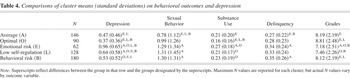
Comparisons of cluster means (standard deviations) on behavioral outcomes and depression
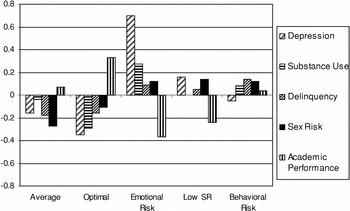
The means of standardized outcome variables by cluster. Low SR, low self-regulation.
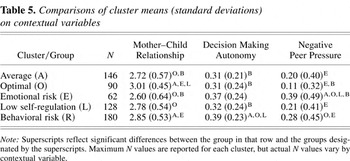
Comparisons of cluster means (standard deviations) on contextual variables
 You have
Access
- 43
- Cited by