Introduction
Teff (Eragrostis tef (Zucc) Trotter) is a small-grained cereal crop grown in Ethiopia for its grain and straw. It has wide agro-ecological adaptation and grows best in the mid-altitude range of 1500–2300 m a.s.l. (IFPRI, 2006; Ketema, Reference Ketema1997). Ethiopian farmers have a long history of teff production, and the crop is a major part of the daily diet and is an important livestock feed in the country. The area and amount of production has steadily increased from year to year. In 2016, around 3.2 million hectares of land or 27.4% of the total area devoted to cereals was under teff production, and teff accounts for around 4.5 million tons or 18% of the cereal production harvested annually in Ethiopia (CSA, 2016).
Though tolerant to extreme environmental conditions, teff is poor competitor against weeds and can suffer yield losses ranging from 35% to 65% (Kassahun and Tebkew, Reference Kassahun, Tebkew, Kebebew, Solomon and Zerihun2013, Rezene and Zerihun, Reference Rezene, Zerihun, Hailu, Getachew and Mark2001). Its fields are ploughed more frequently than other cereal crops in order to create a fine seedbed that allows the tiny seeds to germinate and to control weeds (Haftamu et al., Reference Haftamu, Mitiku and Yamoah2009, Tesfa et al., Reference Tesfa, Solomon, Yifru, Minale, Waga, Kebebew, Solomon and Zerihun2013). Furthermore, tillage frequency depends on weed type and weed infestation, soil type, climatic condition, and the availability of oxen as traction animals. If no herbicides are used, intensive tillage is required to control perennial weeds (Bergkvist et al., Reference Bergkvist, Ringselle, Magnuski, Mangerud and Brandsæter2017), and with increasing weed infestation more frequent tillage is needed. Tillage intensity also depends on soil type. Higher tillage frequency is required for vertic soils in high rainfall areas because of its clayey nature, which needs more pulverization to create a fine seedbed for teff (Tesfa et al., Reference Tesfa, Solomon, Yifru, Minale, Waga, Kebebew, Solomon and Zerihun2013). Studies report different tillage frequencies, including three times in a season (Haftamu et al., Reference Haftamu, Mitiku and Yamoah2009), three to six times (Leye, Reference Leye2007), four times (Habtegebrial et al., Reference Habtegebrial, Singh and Haile2007, Nyssen et al., Reference Nyssen, Poesen, Haile, Moeyersons and Deckers2000), and up to six times (Aune et al., Reference Aune, Matewos, Fenta and Abyie2001). In high rainfall areas, up to 9–12 tillings have been reported to control severe weed infestations (Deckers et al., Reference Deckers, Nachtergaele and Spaargaren1998, Tarekegne et al., Reference Tarekegne, Gebre, Tanner, Mandefro, Tanner, Payne and Abdalla1996). In areas with less weed incidence, the farmers keep their land undisturbed until the onset of the rain (Fufa et al., Reference Fufa, Tesfa, Hailu, Kebebew, Tiruneh, Aberra, Seyfu, HAILU, GETACHEW and MARK2001).
Generally, the main reason for frequent ard ploughing is weed control. Not only the number of passes but also the depth of the tillage has a significant role in diminishing weed density and biomass, especially for perennial weeds (Brandsæter et al., Reference Brandsæter, Bakken, Mangerud, Riley, Eltun and Fykse2011). However, increasing ard ploughing intensity increases soil erosion, reduces soil bulk density, diminishes soil water-holding capacity and soil water productivity, and aggravates nutrient and water losses from the soil (Assefa et al., Reference Assefa, Liben, Tadesse and Yeshalem2008; Habtegebrial et al., Reference Habtegebrial, Singh and Haile2007; Leye, Reference Leye2007; Nyssen et al., Reference Nyssen, Poesen, Haile, Moeyersons and Deckers2000; Salem et al., Reference Salem, Valero, Muñoz, Rodríguez and Silva2015; Tigist et al., Reference Tigist, Cornelis, Verplancke, Nyssen, Govaerts, Behailu, Haile and Deckers2010). These authors also showed that conventional tillage results in higher teff and maize yields. In some instances, such a higher yield is not significant when compared with conservation tillage in both Vertisol and Nitosol soil types (Balesh et al., Reference Balesh, Aune, Johnsen and Vanlauwe2008). Conservation tillage also significantly increased maize yield especially during a medium rainfall season, ranging from 500 to 800 mm (Mupangwa et al., Reference Mupangwa, Mutenje, Thierfelder and Nyagumbo2017). However, conservation tillage increases weed density and exposes the crops to weed competition (Balesh et al., Reference Balesh, Aune, Johnsen and Vanlauwe2008; Habtegebrial et al., Reference Habtegebrial, Singh and Haile2007; Salem et al., Reference Salem, Valero, Muñoz, Rodríguez and Silva2015; Tigist et al., Reference Tigist, Cornelis, Verplancke, Nyssen, Govaerts, Behailu, Haile and Deckers2010).
Studying the potential of preventive and direct weed control measures is therefore crucial for maximizing the use of water and nutrients and thus increasing teff yield in Ethiopia in both conventional and conservation agriculture. Improving the crop competitiveness by using varieties that are more competitive with higher seed rates are among the preventive measures in practice. Most studies have found that teff yield is high at a relatively low seed rate (5 kg ha−1) even though the recommended rate is 25–30 kg ha−1. A low seed rate can be used because it fosters teff’s tillering ability (Amare and Adane, Reference Amare and Adane2015; Bekalu and Arega, Reference Bekalu and Arega2016; Sakatu and Adane, Reference Sakatu and Adane2017). Such a seed rate together with recommended application rates of di-ammonium phosphate (DAP) and urea yielded benefits for teff farmers in both Vertisol and Cambisol soil types in the central zone of Tigray (Teklay and Girmay, Reference Teklay and Girmay2016).
Glyphosate is one of the most common herbicides used in Ethiopia to control early emerging weeds before crop sowing, and its demand is increasing from year to year (Seneshaw et al., Reference Seneshaw, Minten, Alemu and Bachewe2017). Teff smallholder farmers use glyphosate to minimize land preparation and weeding costs as well as to create relatively weed-free fields for the crop (Assefa et al., Reference Assefa, Liben, Tadesse and Yeshalem2008; Astatke et al., Reference Astatke, Jabbar and Tanner2003; Kassahun and Tebkew, Reference Kassahun, Tebkew, Kebebew, Solomon and Zerihun2013; Seneshaw et al., Reference Seneshaw, Minten, Alemu and Bachewe2017). In Tigray, more than 68% of the teff farmers use glyphosate to control grass and other perennial weeds in conservation agriculture (Teamti and Tesfay, Reference Teamti and Tesfay2016). However, weed species resistant to glyphosate have been reported globally and pose a threat to the continued use of glyphosate (Boerboom and Owen, Reference Boerboom and Owen2013; Duke and Powles, Reference Duke and Powles2009; Heap, Reference Heap1997; Johnson and Gibson, Reference Johnson and Gibson2006; Nandula et al., Reference Nandula, Reddy, Duke and Poston2005; Powles, Reference Powles2008a; Powles, Reference Powles2008b). Among the teff weed species, Cyperus esculentus is registered as resistant to glyphosate in the USA and the monocot weed Snowdenia polystachya is resistant to glyphosate in wheat fields of the Oromia region, Ethiopia (ISHRW, 2013). In addition, a recent report has shown that glyphosate affects soil’s physical, chemical, and biological properties and might reduce soil quality (Neli et al., Reference Neli, María and Verónica2017).
Herein, we hypothesized that (i) frequent tillage reduces weed incidence and enhances teff vegetative and reproductive performance; (ii) higher seed rate reduces weed incidence and enhances teff vegetative and reproductive performance; (iii) applying glyphosate before teff sowing reduces weed incidence and enhances teff vegetative and reproductive performance; and (iv) there is a synergy among the effects of tillage frequency, seed rate, and glyphosate application.
Materials and Methods
Description of the study areas
The experimental sites were selected based on their suitability for teff production. They are found in the same altitudinal range but with different soil types. Axum is located 245 km northwest of the Mekelle. The research site is located 4 km east of Axum town, and the experiments were laid on deep black Vertisols with small patches of Cambisol with sandy clay texture (the soil description was made based on World Reference Base for Soil Resources (IUSS Working Group WRB, 2015). The experimental fields were located at 14°07′37″N and 38°45′51″E at an altitude of 2098 m a.s.l. It has a tepid to cool sub-moist mid-highlands with an annual rainfall ranging from 401 mm to 800 mm, and the average temperature ranges from 15 °C to 28 °C. Mekelle research site was situated at the Mekelle University, at 13°28′48″N and 39°29′25″E and altitude of 2224 m a.s.l. The soil at the site is characterized as Cambisol dominated by sandy loam texture with patches of Vertisols; the soil description was made based on World Reference Base for Soil Resources (IUSS Working Group WRB, 2015). It has a moderate temperature ranging from 12 °C to 30 °C with an average around 20°C. The site receives an annual rainfall ranging from 400 mm to 600 mm.
In both Axum and Mekelle, the highest rainfall during the experiment period was recorded in July and August with the warmest months being April, May, and June (Supplementary Material Table S1). In 2015 and 2016, the average annual rainfall in Axum was 700 mm with minimum and maximum average annual temperature of 11 oC and 27 oC, respectively. In the same years, Mekelle had an average annual rainfall of 570 mm with temperature ranging from 11 oC to 28 oC. Weather reports of both research sites were taken from the Ethiopian National Meteorological Agency (NMA, 2017).
Field experimental design and treatments
The experiment was laid in a split plot design arranged in three replications with three levels of tillage (zero, minimum, and conventional) on the main plots, and seed rate (5, 15, and 25 kg ha−1) and glyphosate (with and without) were put on the sub plots. Conventional tillage refers to the number of ard ploughings (three times in Mekelle and four times in Axum) performed by the farmers in the experimental sites using the traditional Ethiopian ard plough. Minimum tillage refers to ard ploughing only once, and zero tillage refers to shallow light disturbance of the soil using a hoe. The plot sizes were 7 × 17 m for the main plot and 2 × 2 m for the sub plots. There was a 1 m (border) space between the subplots, 1 m between main plots within blocks, and 1.5 m between blocks to control for the border effect. Glyphosate was applied at a recommended rate of 4 L ha−1 (1,440 g a.i. ha−1) 7–10 days before teff sowing.
The teff (E. tef (Zucc) Trotter) variety DZ-Cr-387 or ‘Quncho’ was used during the experiment. The teff management operations during production were done based on the farmers’ practice and national recommendations (Table S2). The teff experimental fields were fertilized by applying DAP and urea at a rate of 60 kg N and 60 kg P2O5 per ha for black clayey soil types and 40 kg N and 40 kg P2O5 per ha for light sandy loam soils. Axum has Vertisol, and Mekelle has Cambisol soil types.
Data collection
The crop data include days to emergence, heading, maturity, tiller number/plant, plant height, biomass yield, and grain yield. The teff phenology, including days to emergence, heading, and maturity, was recorded by registering the dates at which crop covering 50% of the plot area had emerged, flowered, and matured. Tiller number/plant and plant height were measured by taking ten teff plants randomly from each plot. Tiller number/plant was recorded by counting the number of tillers in a single teff plant. Plant height, which is the height of the teff plant from the node separating the root and shoot up to the tip of the panicle, was measured using a meter stick. Biomass yield was the sum of the straw and grain yield of the crop.
Weed shoot density and aboveground weed biomass were assessed three times before harvest in one randomly placed quadrate (25 × 25 cm) per plot. Weed density or infestation was estimated visually (coverage) by weeding time (first, second, and third weeding). The space occupied by the crop and weeds on all small plots was expressed as a percentage of ground coverage. The area covered by crop, weeds, and bare soil was summed up to 100%. The biomass samples were dried at 65°C for 48 h to determine the dry weight. Weed species were taken randomly using a 50 × 50 cm frame before sowing. There were 12 samples per experimental field. The weed species were identified and counted for each sample. Six weed species from Axum and five weed species from Mekelle were identified, and their frequency, abundance, and dominance were calculated based on the most commonly used procedures (Assefa et al., Reference Assefa, Theodrose and Alemu2016; Esayas et al., Reference Esayas, Abraham and Mashila2013; Jaccard, Reference Jaccard1912; Taye and Yohanes, Reference Taye and Yohanes1998). The first three weed species from each location having the highest values of frequency, abundance, and dominance were considered to be the dominant weed species in the experimental areas of both locations. The estimation of time used for hand weeding was based on the time required for a single person to hand weed the 4 m2 subplots. This was recorded as minutes/person/plot and was averaged over all blocks and weeding times for the experiments in both locations. This average value of the weeding time was converted into hours/ha.
Data analysis
Combined analysis of the teff tillage experiments was carried out by year and location. The MIXED procedure of SAS (version 9.4) was used. The crop data included tillage frequency, seed rate, glyphosate use, year, and location as factors, and all factors from both data groups were considered as fixed. Weed assessment was conducted on three weeding occasions in both years. A repeated measurement mixed model was used for weed data analysis to account for correlation among the assessments from the same plot recorded at different times. For the correlation analysis, unstructured (un) and first-order autoregressive (ar(1)) covariance structures were used. The final model for the analysis was chosen based on the Akaike information criterion (AIC) and Schwarz Bayesian information criterion (BIC). The model with the lowest AIC and BIC values was considered to be the final model for analysis. Model assumptions were checked with usual residual plots. The least square means of different groups were compared using the Tukey–Kramer multiple comparison method at 5% levels of significance.
Results
Tillage frequency and application of glyphosate did not show any significant interaction effects with locations and years on teff and weeds (Tables S3 and S5). Unlike the other factors, seed rate had a significant interaction effect with locations and years on teff vegetative and reproductive performance (Table S3). The only significant main effect of seed rate was observed on weed density, biomass, and cover. Generally, there were no significant synergistic effects between the three factors on teff and weeds (Tables S3 and S5).
Effects of tillage frequency, seed rate, and application of glyphosate on teff
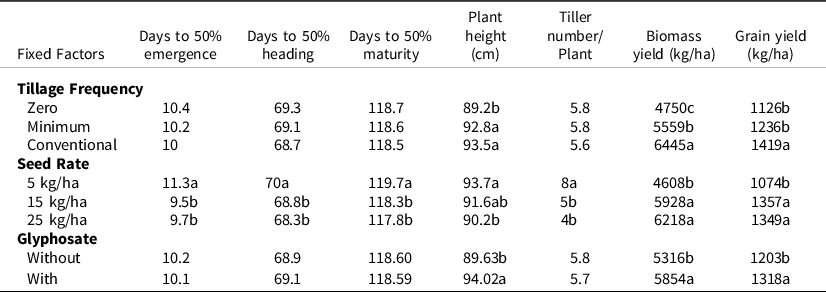
Tillage frequency did not significantly influence days to emergence, heading, maturity, or tiller number per teff plant (Table S3). However, it significantly influenced plant height, biomass yield, and grain yield. The tallest and highest-yielding teff plants were observed under conventional tillage. Zero tillage reduced crop biomass yield by 14.6% compared to minimum tillage and by 26.3% compared to conventional tillage (Table 1). Zero tillage and minimum tillage reduced grain yield by 20.6% and 12.9%, respectively, compared to conventional tillage. (Table 1).
Tillage frequency, seed rate, and glyphosate’s main effects on the agronomic traits of teff

p < 0.05, means with the same letter and those with no letters were not significantly different at the 5% level using Tukey’s multiple comparison method.
Seed rate significantly influenced all agronomic traits (Table S3). In fact, the 5 kg ha−1 seed rate caused late emergence, heading, and maturity but resulted in the tallest plants with the highest tiller number per plant (Table 1). This low seed rate reduced biomass yield by 22.3% compared to the 15 kg ha−1 seed rate and by 26% compared to the 25 kg ha−1 seed rate. The 5 kg ha−1 seed rate also reduced the grain yield by about 21% compared to both higher seed rates. There were no significant differences for agronomic traits between the 15 and 25 kg ha−1 seed rates (Table S3).
Application of glyphosate significantly affected plant height, biomass yield, and grain yields, but did not have any effect on phenology or tiller number per teff plant (Table S3). Glyphosate significantly increased teff plant height by 5%, biomass yield by 10.1%, and grain yield by 9.6% (Table 1).
Interaction effects of seed rate, location, and year on teff
In both years and locations, there were no significant effects of tillage frequency and application of glyphosate on the agronomic traits of teff (Table S3). In other words, their effects were consistent and the same in both Axum and Mekelle research sites. The interaction effects between seed rate and location and between seed rate, location, and year were significant for most of the teff responses (Table S3). The results of the seed rate were therefore separated and presented for both locations and years (Table S4, Figures 1 and 2). Although not always significant, many of the comparisons showed that teff had earlier emergence, flowering, and maturity at the two highest seed rates (15 and 25 kg ha−1) (Figure 1). In some cases, the highest seed rate (25 kg ha−1) gave earlier development than the 15 kg ha−1 seed rate. Teff needed longer time to emergence, flower, and mature in plots receiving a seed rate of 5 kg ha−1.
Effect of seed rate on days to 50% emergence, 50% heading, and 50% maturity at Axum (as indicated in a, c, and e) and Mekelle (as indicated in b, d, and f) in the years 2015 and 2016. Values with the same letters within each sub-figure and years were not significantly different at the 5% level using Tukey’s multiple comparison method.

Effect of seed rate on plant height, total tiller No./plant, biomass yield, and grain yield of teff at Axum (as indicated in a, c, e, & g) and Mekelle (as indicated in b, d, f & h) in the years 2015 and 2016. Values with the same letters within the sub-figures and years were not significantly different at the 5% level using Tukey’s multiple comparison method.

Seed rate caused significant differences in teff plant height at Mekelle in both years. The lowest seed rate resulted in the tallest teff plants in both locations and years with the highest average value of 118.1 cm (Figure 2a). The general picture is that the lowest seed rate gave less teff biomass and yield compared to the two highest seed rates but that exceptions also occurred, as in Mekelle in 2015 where no effect of seed rates was found (Table S4 and Figure 2). The highest biomass and grain yields were recorded in Axum in 2015.
Effects of tillage frequency, seed rate, and glyphosate on weeds
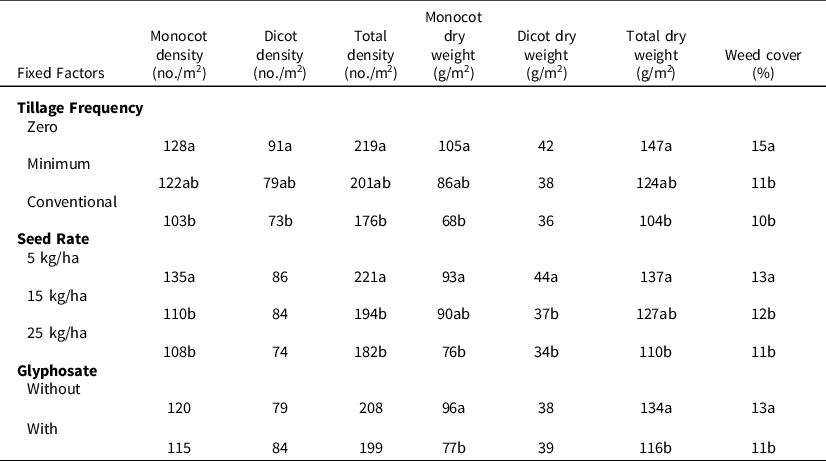
In general, there was a significant effect of tillage frequency, seed rate, and application of glyphosate on weeds (Table S5), but very few of the interactions were significant. Hence, the presentation of the results focuses on the effect of the main factors and not the interactions. Tillage frequency significantly affected weed density, dry weight, and cover (Table S5). However, for dicot weeds, there was lower weed density in conventional tillage compared to zero tillage, but no similar effect on dicot dry weight (Table 2). The general picture is less weed density, biomass, and cover in conventional versus zero tillage. Furthermore, there was no significant difference between conventional and minimum tillage practices in overall weed density, biomass, or cover. Conventional tillage diminished total density, total dry weight, and total cover by 19%, 29%, and 33%, respectively, compared to zero tillage. Conventional tillage reduced monocot density by 20% and monocot dry weight by 35% compared to zero tillage, and it diminished dicot density by 20% compared to zero tillage.
Tillage frequency, seed rate, and glyphosate’s main effects on weeds

p < 0.05, means with the same letter and those with no letters were not significantly different at the 5% level using Tukey’s multiple comparison method.
Seed rates significantly influenced weed density, dry weight, and cover (Table S5). They also affected the density of monocot weeds and the dry weight of all types of weeds (Table 2). There was no significant difference between 15 and 25 kg ha−1 seed rates on their effects on weed density, dry weight, and cover. The highest seed rate (25 kg ha−1) significantly reduced total weed density, total dry weight, and total cover by 18%, 19%, and 15%, respectively, compared to the 5 kg ha−1 seed rate. Similarly, it decreased monocot and dicot weed dry weights by 18% and 23%, respectively, compared to the lowest seed rate. Although it had a significant effect on weed cover, the application of glyphosate did not significantly affect weed density (Table S5). However, the use of the herbicide significantly reduced monocot dry weight by 20%, total dry weight by 14%, and cover by 15% compared to plots without glyphosate (Table 2).
Time required for hand weeding and dominant weeds
Weeding time was reduced by frequent tillage, longest time for zero tillage, intermediate for minimum and lowest for conventional, in Axum 2015. Weeding time was also reduced by application of glyphosate in Axum 2015 (Figure S1). The average weeding time with conventional, minimum, and zero tillage was 3,109, 3,355.3, and 3,743.2 h ha−1, respectively. Zero tillage increased weeding time by 10% compared to minimum tillage and by 17% compared to conventional tillage in Axum 2015.
The most dominant weeds identified in the research sites were Plantago lanceolate L. (dicot), Cyperus esculentus (monocot), and Setaria pumila (poir.) Roem. & Schult (monocot) in Axum and Avena abyssinica Hochst (monocot), Galinsoga parviflora Ca (dicot), and Plantago lanceolata L. (dicot) in Mekelle.
Discussion
Effects of tillage frequency, seed rate, and application of glyphosate on teff
Days to 50% emergence, 50% heading, and 50% maturity were not influenced by tillage frequency (Table 1). The small teff seeds are sown onto the upper surface of the soil, and one might expect that more intensive tillage might make the seed bed drier and thus cause reduced or delayed seed germination. The seeds in our study, however, were sown in moist soil, and water was not a constraint for germination and emergence. This is also probably the normal condition for farmers sowing teff seeds and is consistent with reports from other parts of Ethiopia where the crop is produced following almost the same agronomic procedures (Fufa et al., Reference Fufa, Tesfa, Hailu, Kebebew, Tiruneh, Aberra, Seyfu, HAILU, GETACHEW and MARK2001; Tesfa et al., Reference Tesfa, Solomon, Yifru, Minale, Waga, Kebebew, Solomon and Zerihun2013).
Higher plant height, biomass yield, and grain yield (Table 1) were obtained with conventional tillage most likely because of reduced weed infestation compared to reduced tillage frequency. Tillage intensity can, however, also influence the soil’s physical, chemical, and biological properties and hence can affect plant height, biomass yield, and grain yield (Habtegebrial et al., Reference Habtegebrial, Singh and Haile2007; Haftamu et al., Reference Haftamu, Mitiku and Yamoah2009; Leye, Reference Leye2007; Salem et al., Reference Salem, Valero, Muñoz, Rodríguez and Silva2015; Tesfahunegn, Reference Tesfahunegn2015). In fact, lower yields with zero and reduced tillage compared to traditional tillage have been reported in other studies conducted on teff and other cereal crops in Ethiopia (Assefa et al., Reference Assefa, Liben, Tadesse and Yeshalem2008; Balesh et al., Reference Balesh, Aune, Johnsen and Vanlauwe2008; Sime et al., Reference Sime, Aune and Mohammed2015).
The difference in teff seed rate significantly affected all crop traits including grain yield (Table 1, Figures 1 and 2), and this is consistent with the results obtained from Bekalu and Arega (Reference Bekalu and Arega2016) and Amare and Adane (Reference Amare and Adane2015). From our study, the use of the lowest seed rate delayed teff emergence, flowering, and maturity (Figure 1). However, there were taller plants with higher tiller number in plots with the 5 kg ha−1 seed rate, and this might be the result of less intra-species competition among teff plants for space allowing them to use the soil’s water and nutrients more efficiently. Faster germination at higher seed rates might be explained by greater strength to break through the soil surface crust when there is higher number of emerging shoots. As far as we know, there have been no previous experiments looking at the effect of different seed rates of teff on weeds. A research group at the University of Copenhagen, however, has performed many studies of seed rates and different sowing pattern in other cereal species like wheat (Kristensen et al., Reference Kristensen, Olsen and Weiner2008; Olsen et al., Reference Olsen, Kristensen, Weiner and Griepentrog2005; Olsen and Weiner, Reference Olsen and Weiner2007; Olsen et al., Reference Olsen, Griepentrog, Nielsen and Weiner2012). In their studies, both increased seed rates and the use of uniform sowing patterns significantly increased grain yield and reduced weed growth.
The application of glyphosate did not significantly change days to emergence, days to heading, days to maturity, or tiller number per plant but did increase biomass yield by 538 kg ha−1 and grain yield by 115.1 kg ha−1 (Table 1), most likely due to fewer weeds in plots treated with glyphosate. Glyphosate thus enhanced teff yields by about 10%, although such an increase in yield was less compared to other studies stating that higher yields could be achieved from using glyphosate as described in Brookes et al. (Reference Brookes, Taheripour and Tyner2017).
Effects of tillage frequency, seed rate, and application of glyphosate on weeds
In general, our data showed more weeds at zero tillage compared to conventional tillage (Table 2). This result is consistent with a large number of previous reports showing that weed incidence and infestation are higher in zero and minimum tillage (Assefa et al., Reference Assefa, Liben, Tadesse and Yeshalem2008; Balesh et al., Reference Balesh, Aune, Johnsen and Vanlauwe2008; Sime et al., Reference Sime, Aune and Mohammed2015) compared to more frequent soil tillage. Comparing the two weed classes, monocot weeds had a higher density and dry weight than dicot weeds, which might be connected to their generally higher tolerance to soil tillage. Tørresen et al. (Reference Tørresen, Skuterud, Tandsæther and Hagemo2003) found that the monocots Elymus repens and Poa annua are particularly troublesome weeds in reduced tillage. Weed species such as Cyperus esculentus and Setaria pumila in Axum and Avena abyssinica in Mekelle regenerated after frequent ard ploughing in the conventional tillage, and previous studies have shown that these species are tolerant to frequent tillage (Nichols et al., Reference Nichols, Verhulst, Cox and Govaerts2015; Santín-Montanyá and Catalán, Reference Santín-Montanyá, Catalán, Cantero-Martínez and Arrue Ugarte2006; Santín-Montanyá et al., Reference Santín-Montanyá, Catalán, Tenor, io and García-Baudín2018; Swanton et al., Reference Swanton, David and Douglas1993).
Seed rate significantly influenced weed density, dry weight, and cover (Table 2). The highest weed density, dry weight, and cover were recorded from plots with the lowest seed rate of 5 kg ha−1. Although there were a greater number of tillers per plant in the 5 kg ha−1 (Table 1) than the other seed rates (15 and 25 kg ha−1), they could not cover their space to sufficiently suppress the weed species. To achieve a comparable plot cover as with the higher seed rates, the number of tillers per plant from the lowest seed rate would have needed to increase by 3–5 times. However, the number of tillers from the lowest teff plant density (8 tillers/plant) was higher by only 2.8 and 3.7 tillers compared to the tillers from 15 and 25 kg ha−1. This opened up space for the weeds to grow and thereby increased weed density, dry weight, and cover in the lowest teff plant density. Our result was consistent with studies on other pulses (field pea) and cereal crops (winter and spring wheat) showing that increasing seed rate enhances their weed suppression and competition ability and results in reduced aboveground dry weight (Korres and Froud-Williams, Reference Korres and Froud-Williams2002; Kristensen et al., Reference Kristensen, Olsen and Weiner2008; Townley-Smith and Wright, Reference Townley-Smith and Wright1994).
There was a significant difference in weed dry weight and cover due to glyphosate application, but no effect was observed on weed density (Table 2). Late-emerging weed species probably reduced the effect of glyphosate on weed density. The weed species Plantago lanceolata and Cyperus esculentus, which have been found to be glyphosate-resistant in other places (ISHRW, 2013; Powles, Reference Powles2008a), emerged after spraying the herbicide in both years and in both locations. However, we are highly certain that these were not resistant in our research sites. In any case, the herbicide was successful in weakening the ability of the weeds to utilize soil water and nutrients efficiently and hindered them from accumulating biomass (dry weight). This resulted in significant reduction of dry weight and cover of weeds.
Time used for hand weeding
Since frequent tillage, higher seed rate, and application of glyphosate generally reduced weed number and biomass, a related effect also on hand weeding time could be expected. Somewhat surprisingly, this was only shown in Axum 2015, where increasing tillage frequency, as well as the use of glyphosate, reduced time for hand weeding (Figure S1).
Conclusion
Frequent tillage reduced weed density, dry weight, and cover and increased teff performance in terms of its phenology, plant height, biomass, and grain yields, which supports the first hypothesis. The second hypothesis of this study was also corroborated as higher seed rate reduced weed incidence and enhanced teff vegetative and reproductive performance. Applying glyphosate before sowing, teff reduced weed incidence and enhanced teff biomass accumulation and grain production. This supports the third hypothesis. There was no synergy among the effects of tillage frequency, seed rate, and glyphosate application because the interaction of these three factors did not significantly influence teff or weeds. In this case, the fourth hypothesis was not supported.
Supplementary material
To view supplementary material for this article, please visit https://doi.org/10.1017/S001447972200028X
Acknowledgements
Technicians in Mekelle University, college of dryland agriculture and natural resources, department of crop and horticultural sciences contributed substantially to the fieldwork. We thank teff farmers in Tigray, Northern Ethiopia for their heartfelt cooperation during data collection.
Funding
The study received financial support from NORHED (Norwegian Programme for Capacity Development in Higher Education and Research for Development) through the project ‘Research and capacity building in the Horn of Africa’.
Conflicts of Interest
The authors declare no conflict of interest.