Processing instruction (PI) is an input-based pedagogical intervention stemming from VanPatten’s model of input processing (VanPatten, Reference VanPatten1996, Reference VanPatten and VanPatten2004, Reference VanPatten, VanPatten and Williams2007a) and is designed to alter second language (L2) learners’ nonoptimal processing strategies. The effectiveness of PI has been demonstrated in languages such as English, French, German, Italian, Japanese, and Spanish with native speakers of English, German, Italian, Korean, Chinese, Greek, and Polish. There are three essential components to PI: (a) explicit information (EI), which includes (b) form-related explicit information (FREI) and processing-strategy information, and (c) structured input (SI). Processing instruction has been used in its entirety in some studies, and, in other studies, its components have been isolated with the goal of determining the effectiveness of the individual components (i.e., SI or EI) of PI (e.g., Benati, Reference Benati and VanPatten2004; Benati & Lee, Reference Benati and Lee2008; Farley, Reference Farley and VanPatten2004; Fernández, Reference Fernández2008; Henry, Culman, & VanPatten, Reference Henry, Culman and VanPatten2009; Leeser & DeMil, in press; Sanz & Morgan-Short, Reference Sanz and Morgan-Short2004; VanPatten & Cadierno, Reference VanPatten and Cadierno1993; VanPatten & Oikkenon, Reference VanPatten and Oikkenon1996; Wong, Reference Wong and VanPatten2004).
When addressing PI and SI, it is important to keep in mind what distinguishes them from other types of instruction. Processing instruction and SI are directed at altering L2 learners’ incorrect processing strategies, as identified by the principles of input processing (see VanPatten Reference VanPatten, VanPatten and Williams2007a, for details on input processing). During these instructional interventions, L2 learners undergo training to alter their nonoptimal (i.e., default) processing strategies. In isolation, the SI component of PI has consistently been shown to be effective in the interpretation as well as in the production of various target forms pertaining to various processing strategies (see VanPatten, Reference VanPatten1996, Reference VanPatten2002, Reference VanPatten and VanPatten2004, for summaries of these findings).
Henry and colleagues (2009) point out that “the role of explicit information (EI)—providing learners with information on a target structure—as an independent variable in instructed SLA is largely under researched (VanPatten, Reference VanPatten and Gascoigne2007b) and has sometimes been conflated with the issue of explicit versus implicit learning (see, e.g., DeKeyser, Reference DeKeyser, Doughty and Long2003; Hulstijn, Reference Hulstijn2005)” (p. 560). For example, Scott (Reference Scott1989) found positive effects for a treatment involving EI compared to a group receiving only input passages; however, the EI was also paired with form-focused practice, whereas the input-only group did not receive this practice. Therefore, on the basis of the design of his study, it is not clear whether it was the exposure to rules or the type of practice that caused the results. Thus, because these variables were confounded, it is not possible to determine the role EI played in this case.
The EI component of PI in previous PI research has been isolated and operationalized by investigating the role of FREI along with processing-strategy information. The purpose of isolating this variable has been to determine both the effectiveness of EI and SI in isolation and the effectiveness of PI in its entirety (i.e., PI, SI, and EI). In this regard, the goals of the current study—and, subsequently, the operationalization of FREI—are slightly different: We tease apart the variables of EI to look at the effects of the isolated FREI without processing-strategy information. Recently, some studies have found that EI, as operationalized with both target-structure information and information on processing strategies, has suggested positive findings (Fernández, Reference Fernández2008; Henry et al., Reference Henry, Culman and VanPatten2009). It is important to consider if the positive effects found for EI are due to the pairing of FREI and processing-strategy information, or if FREI has similar effects alone.
The current study thus investigates the effects on the acquisition of the primary target form (i.e., third-person accusative clitics in Spanish) of the interventions used in this study (i.e., PI, SI, and FREI). In addition to primary effects, this study investigates transfer-of-training (TOT) effects in which L2 learners are trained on one target form (i.e., accusative clitics in Spanish) and are tested to determine if their strategy training carries over to a second target form (i.e., dative clitics in Spanish). Therefore, the current study aims to expand the body of research on TOT effects with PI, which currently is limited to only a few studies, and pushes it in new directions by investigating whether or not the effects of SI alone are comparable with those of PI.
BACKGROUND AND MOTIVATION
Nearly two decades ago, VanPatten and Cadierno (Reference VanPatten and Cadierno1993) kicked off a research agenda that investigated the processing problem of the first noun principle (FNP), which predicts that beginning L2 learners will interpret the first noun or pronoun they encounter in an utterance as the subject when, in fact, it may be the object (see VanPatten, Reference VanPatten, VanPatten and Williams2007a, for a detailed account of the FNP). Their results sparked questions regarding the causative variable on learners’ performance when exposed to PI; that is, was EI, SI, or a combination of the two responsible for improved performance? To further investigate the cause of the improved performance, VanPatten and Oikkenon (Reference VanPatten and Oikkenon1996) isolated PI, SI, and EI to determine their respective effects on the processing of Spanish accusative clitics. In their study, the PI group served as the control because SI and EI are both components of PI. They found that the PI group and the SI-only group outperformed the EI-only group on the interpretation posttest (on the production measure, PI outperformed EI, but SI did not). These findings support those of VanPatten and Cadierno (Reference VanPatten and Cadierno1993) and suggest that the gains made by the PI group might not have been due to the EI given to learners but rather might have been attributable to SI activities.
Benati (Reference Benati and VanPatten2004) found that, with another target form (i.e., the future tense in Italian) and with another processing strategy (i.e., the lexical preference principle), both the PI and SI groups outperformed the EI group on the posttest and delayed posttest, thereby lending support to the generalizability of the effectiveness of SI alone. However, Farley (Reference Farley and VanPatten2004) investigated the processing problem of the sentence location principle along with the role of EI with the subjunctive mood in Spanish and found that, although both the PI and the SI groups made significant gains, the PI group outperformed the SI group on interpretation and production measures on both the posttest and delayed posttest. In this case, even if both groups made gains, the PI group improved more.
Due to the fact that Farley’s (Reference Farley and VanPatten2004) findings contrast with those of VanPatten and Oikkenon (Reference VanPatten and Oikkenon1996) and Benati (Reference Benati and VanPatten2004), Farley concluded that, with some language features (e.g., the Spanish subjunctive), EI may be more beneficial to L2 learners than with other forms (e.g., Spanish accusative clitics or the future tense in Italian). Even though no group received EI information alone, Farley still concluded that EI may help by possibly speeding up the acquisition process, but SI functions as the necessary component that leads to making the necessary form-meaning connections.
Wong (Reference Wong and VanPatten2004) revisited the original VanPatten and Cadierno (Reference VanPatten and Cadierno1993) study via conceptual replication and investigated the French de versus un distinction (i.e., the lexical preference principle) in negative sentences, a structure that is low in communicative value. Although the structure is lower in communicative value, she found that PI and SI outperformed EI. However, PI and SI were comparable in that there were no differences between the PI group and the SI group regarding production. The author thus concluded that if EI, in fact, played more of a role, then the PI group would have been expected to perform better than the SI group in both modalities. Sanz and Morgan-Short (Reference Sanz and Morgan-Short2004) drew similar conclusions in their investigation of the role that EI plays in PI. By providing EI at various points throughout PI (i.e., before and during task-essential practice along with feedback), they found that all treatment groups made significant gains regardless of the intervention. This suggests that their improvements in performance must have been due to exposure to the SI activities, the constant, input-based variable.
These studies all look at pre- and posttest data, whereas Fernández (Reference Fernández2008) tracked L2 learners’ behavior during sentence processing in SI activities—with and without EI—to determine if and at what point learners begin to correctly process the input. Her studies targeted the Spanish accusative clitics and the FNP as well as the subjunctive mood and the sentence location principle. The results showed that no differences were found—both with and without EI—in the number of participants who reached criterion for either structure (as measured by four correct answers in a row). However, the group that received EI with the subjunctive mood demonstrated quicker processing than the group that did not receive EI (as measured by how many trials it took for learners to get four correct answers in a row). The most interesting finding, and one that partially motivates the current study, is that, although unnecessary, EI may still be working to speed up processing.
Findings from a conceptual replication of VanPatten and Cadierno (Reference VanPatten and Cadierno1993) by Henry et al. (Reference Henry, Culman and VanPatten2009) also suggest a facilitative role for EI with German accusative case markings on articles with either subject-verb-object (SVO) or object-verb-subject (OVS) word orders. Their results are similar to Fernández’s (Reference Fernández2008) findings with the Spanish subjunctive, although they differ with respect to results for the accusative clitics and word order. The results showed that 63% of the L2 learners who were not exposed to EI did not reach criterion, whereas only 16% of the L2 learners exposed to EI did not reach criterion. Henry and colleagues concluded that “not all EI is the same, not all structures are the same, and the interaction of EI, structure, and processing problem may yield different results in different studies.” (p. 573). VanPatten, Borst, Collopy, Qualin, and Price (in press) tracked L2 learner behavior in an investigation that targeted FNP with Spanish, German, Russian, and French. They also found that EI may be beneficial in learners’ reaching trials to criterion but that this is not necessary. Although the PI research to date suggests that the role of EI is secondary to that of SI with some forms, EI may still play a role in language acquisition on other forms—as indicated by the findings of Fernández, Henry et al., and VanPatten et al.—and therefore merits further investigation.
It is important to note that SI and EI are qualitatively different in that SI pushes L2 learners to make form-meaning connections, whereas EI provides learners with information about the target structure. Structured input has consistently pushed learners to make form-meaning connections. Not until recently have we seen that EI has an effect on processing (e.g., Fernández, Reference Fernández2008; Henry et al., Reference Henry, Culman and VanPatten2009; VanPatten et al., in press). On the basis of these findings, the role of EI cannot be discounted completely in that it seems to produce some sort of an effect when combined with SI. As Henry and colleagues point out, “the door is open to continued research in which EI is isolated as a variable in instructed SLA—not just in PI, but in all interventions” (p. 573).
Thus, on the basis of the findings of Fernández (Reference Fernández2008), Henry et al. (Reference Henry, Culman and VanPatten2009), VanPatten et al. (in press) and in conjunction with the call for more research on the role of target-structure information by VanPatten, Farmer, and Clardy (Reference VanPatten, Farmer and Clardy2009), the current study, in part, looks at the role of FREI in L2 acquisition. To isolate one of the variables of EI in accordance with previous operationalizations in PI research (which includes both explicit target-form information and processing-strategy information), the current study looks at the explicit target-structure information void of processing-strategy information.
The first part of this study is a simple replication of VanPatten and Oikkenon (Reference VanPatten and Oikkenon1996) with some methodological differences. This research will establish the baseline for the second part of our study, which examines TOT effects. In other words, to investigate TOT, we will first need to show effects on the primary target form of the treatment, Spanish accusative clitics. In the next section we review research related to TOT effects and discuss the motivation for the second part of the current study.
TOT: SECONDARY EFFECTS
Since VanPatten and Cadierno’s (Reference VanPatten and Cadierno1993) study, research has shown effectiveness for PI and SI with what are considered primary effects (Benati & Lee, Reference Benati and Lee2008). Primary effects refer to the effects of instructing L2 learners on a target grammar form and then testing them on this same structure. Historically, primary effects have been the focus of research in PI, and, as of late, researchers are beginning to investigate the secondary effects of PI. Secondary effects refer to training L2 learners on a given structure with a certain processing strategy and then testing learners on a different structure that uses the same underlying processing strategy. Recent research suggests that using PI and SI may have secondary effects.
In Benati and Lee (Reference Benati and Lee2008), the authors present three studies that investigate the TOT effects of PI on the following structures: (a) PI on noun-adjective agreement in Italian to secondary effects on Italian future tense morphology, (b) PI on the English simple past tense morpheme -ed to secondary effects for the English present tense, third-person singular morpheme -s, and (c) PI on the French imperfect tense to secondary effects of subjunctive and causative constructions. These three studies targeted two principles: the meaning-before-nonmeaning principle (i.e., noun-adjective agreement in Italian) and the lexical preference principle (i.e., English simple past tense and French imperfect tense). They all included PI, traditional instruction (TI), and control groups and measured interpretation and production of both primary and secondary forms. The findings for each study revealed that learners who received PI showed significant improvement in performance on the primary target form, which was part of the instructional treatment, as well as on the secondary target form on which they did not receive instruction. Those exposed to PI consistently outperformed TI and control groups on interpretation of the primary and secondary forms, and PI was as effective—if not more effective—for these groups on production of both primary and secondary forms. These findings suggest that PI is an effective form of processing-strategy training for learners and results in both positive primary and secondary effects.
Leeser and DeMil (in press) investigated primary effects and secondary TOT effects with the FNP on third-person Spanish accusative (i.e., the primary form) and dative clitics (i.e., the secondary form). Participants received PI, TI, or no instruction. For primary effects, the results for PI were the most robust. They also found that TOT effects occurred for the interpretation of the secondary form—dative clitics—for those exposed to PI. Although TOT effects occurred for interpretation, no significant TOT effects occurred with any group for the production of the secondary form. Their findings suggest that TOT effects can be seen by training learners with PI on accusative clitics and testing them on dative clitics. It is important to note that their materials included a reduced token set of 38 tokens, which was one third of the amount of tokens in the VanPatten and Cadierno (Reference VanPatten and Cadierno1993) and VanPatten and Oikkenon (Reference VanPatten and Oikkenon1996) studies. As such, these results suggest that even with a reduced token set, PI is an effective instructional intervention for primary and secondary target forms.
Because PI and SI target learners’ processing strategies, it is appropriate to question whether grammatical forms that are not included in instruction but that are related to the same processing strategy may induce secondary effects. In other words, TOT effects are to be expected on forms that are not targeted in the treatment but that involve the same processing strategy invoked by the learner. Furthermore, given the convincing body of research that finds that SI alone is sufficient to alter primary-form processing, the question arises as to whether or not training with SI alone also transfers to a secondary target form on which participants do not receive instruction.
THE CURRENT STUDY
One of the goals of the current study is to investigate the effects of PI, SI, and FREI on the interpretation of the third-person Spanish accusative clitics. Following Leeser and DeMil (in press), VanPatten et al. (in press), VanPatten, Farmer, et al. (2009), and VanPatten, Inclezan, Salazar, and Farley (Reference VanPatten, Farmer and Clardy2009), this study uses reduced tokens (i.e., 38 tokens compared to the 120 tokens used in VanPatten & Cadierno, Reference VanPatten and Cadierno1993, and in VanPatten & Oikkenon, Reference VanPatten and Oikkenon1996), which were then modified to address only the third-person singular and plural forms, instead of the entire paradigm, as in the original studies. Additionally, the current study explores new issues in PI—namely, secondary effects on processing strategies. In addition to secondary effects of PI, this study also addresses the issue of (a) the secondary effects of SI activities alone and (b) the secondary effects of FREI in isolation, without processing-strategy training, which, to the authors’ knowledge, has not been previously investigated.
The present study includes three treatment groups: PI, SI, and FREI. Following VanPatten and Oikkenon (Reference VanPatten and Oikkenon1996), the PI group serves as control. The reason for not including a traditional control group is because PI includes both SI and FREI, which are the other instructional interventions investigated in the current study. The present study was thus guided by the following research questions:
1. Will the primary effects of instruction on L2 learners’ interpretation of the Spanish third-person accusative clitics be replicated (e.g., VanPatten & Oikkenon, Reference VanPatten and Oikkenon1996) when fewer tokens are used and FREI is substituted for EI?
2. Will training with PI, SI, and FREI on Spanish third-person accusative clitics transfer to dative clitics?
Primary Target Form: Spanish Accusative Clitics
The target form investigated for primary effects in this study was third-person Spanish accusative clitics. The accusative clitics have been the central focus of previous studies (e.g., Fernández, Reference Fernández2008; Leeser & DeMil, in press; Sanz & Morgan-Short, Reference Sanz and Morgan-Short2004; VanPatten et al., in press; VanPatten & Cadierno, Reference VanPatten and Cadierno1993; VanPatten & Oikkenon, Reference VanPatten and Oikkenon1996; VanPatten & Sanz, Reference VanPatten, Sanz, Eckman, Highland, Lee, Milham and Weber1995; White, in press) due to beginning-level L2 learners’ nonoptimal processing strategy (i.e., the FNP) associated with this form. Previous research has shown that L2 learners incorrectly assign the role of agent (i.e., subject) to the first noun or pronoun they encounter. For example, Spanish has flexible word order, and the accusative clitic can be located preverbally in OVS-type sentences, as the example in (1) illustrates.
(1) La ve Juan.
Her-acc. clitic see Juan-subject
“Juan sees her.”
When a L2 learner, at least in the beginning stages, interprets a sentence such as the example shown in (1), the tendency is to erroneously interpret the object (la) as the subject and to interpret this sentence as “She sees Juan,” instead of the correct interpretation, “Juan sees her” (see VanPatten, Reference VanPatten and VanPatten2004, for an overview of this research).
Secondary Target Form: Spanish Dative Clitics
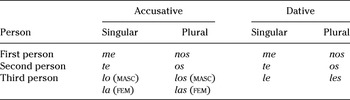
The secondary form in this study was third-person dative clitics (i.e., indirect object pronouns) with psych verbs. We chose third-person dative clitics because the processing strategy for both the primary form and the secondary form can be explained by the FNP. Both the primary and the secondary forms investigated in this study (i.e., accusative and dative clitics) in Spanish appear before finite verbs, and they cannot be separated from their host verb. Both of these target forms share the same forms, except for third-person singular and plural, as shown in Table 1.
Spanish pronominal clitics

The dative clitics were paired with verbs such as molestar “bother,” horrorizar “terrify,” and sorprender “surprise.” With these verbs, an experiencer reacts emotionally or psychologically to a theme. In Spanish, the theme of these verbs is the subject, whereas the experiencer is the indirect object, as in examples (2) and (3). The dative clitics (le and les) can be both feminine and masculine in the same form and only vary in number (i.e., singular or plural). Therefore, L2 learners may also have processing difficulties when assigning roles to the agent and patient. Furthermore, because dative clitics precede finite verbs, English-speaking Spanish learners often misinterpret the experiencer as the subject (e.g., Montrul, Reference Montrul, Leow and Sanz2000).
(2) Al tigre le horroriza el león.
tigre-dat to him-dat is horrifying the lion-nom
“The lion horrifies the tiger.”
*“The tiger horrifies the lion.”
(3) Le molesta el chico.
to her-dat is bothersome the boy-nom
“The boy bothers her.”
*“She bothers the boy.”
METHODS AND PROCEDURES
Participants
The participants in this study came from 12 sections of a first-semester, beginning Spanish course at a Southern U.S. university. Each course section was assigned to one of three treatment groups: PI, SI, or FREI. For participants’ data to be included in the analyses, they had to meet the following criteria: (a) They were present for all tasks on all days (i.e., pretest, treatment and posttest, and delayed posttest), (b) their pretest interpretation scores were less than 70% (i.e., 7 out of 10), (c) their native language was English, and (d) no auditory or visual difficulties were reported on the language history questionnaire. The initial participant pool consisted of 288 participants but was reduced to 151 because some subjects did not participate during all three test times. The breakdown for the treatment groups is as follows: PI (n = 50), SI (n = 46), and FREI (n = 55).
The course in which students were enrolled is based on the communicative approach and uses the textbook Sol y viento (VanPatten, Leeser, & Keating, Reference VanPatten, Farmer and Clardy2009). Normal class time is dedicated to moving from an input to an output sequence that emphasizes all four language skills (i.e., reading, writing, listening, and speaking). Participants were chosen from this level for two reasons: (a) Learners do not receive formal, explicit instruction on the target forms in this course; and (b) they likely have not received formal instruction on this form at all (because they are enrolled in a first-semester course with safeguards such as a placement exam to restrict enrollment to true beginners).Footnote 1 The section of the textbook (and online activities) on the primary form was not covered until after the treatment ended, and the lesson that targeted the secondary form was scheduled for the lesson following the primary form. The instructors were explicitly asked not to discuss the form with the students outside of the experimental treatment.
Procedure
All treatments took place during the regular 50 min class time. During Day 1, students read and signed the consent form and completed the pretest. Participants were not told the nature of the study but, instead, were informed that the researchers were interested in how well students could learn via particular techniques. On Day 2, one week later, students were exposed to one of the three treatments; then, immediately following treatment (during the same class session), they completed the posttest. The PI and SI treatments lasted approximately 25–30 min, and the EI treatment lasted approximately 10 min. On Day 3 (three weeks after treatment), participants completed the delayed posttest and a language history questionnaire. All of the treatments were presented in paper-and-pencil format, the tests were delivered on the drop-down projection screen in the front of the classroom, and students recorded their answers on a paper-and-pencil answer sheet. During treatment, the research assistants (RAs) followed a script that detailed the instructions and either called on students or read answers, depending on the treatment. The participants did not produce the target forms at any time during any of the treatments. Participants were told that they would be debriefed regarding the purpose of the study about a week after the conclusion of the study.
Instructional Materials
In addition to a consent form and language history questionnaire, three packets of instructional materials were used for accusative clitics: one for the PI group, one for the SI group, and one for the FREI group. The instructional materials for PI and SI were those used in the VanPatten and Cadierno (Reference VanPatten and Cadierno1993) study; however, they addressed only the third-person singular and plural forms instead of the entire paradigm, as in the original study. Appendix A and Appendix B contain sample SI and PI activities.
Processing Instruction
The instructional materials for PI included EI on the following topics: (a) FREI on the Spanish accusative clitics, (b) word order and the object marker a in Spanish, and (c) processing strategies. Processing instruction materials also included seven SI activities (i.e., four referential and three affective) and contained a total of 38 target-form tokens. The FREI component on formation and placement of the Spanish accusative clitics included 10 target-form tokens in context in addition to the full verb paradigm. Learners were also informed about the FNP and were instructed that the first noun or pronoun they encountered in a sentence was not always or necessarily the subject. The only feedback given to the participants was the correct answer. For example, if the learner selected the incorrect picture or made other mistakes, the RA would respond by stating “the correct answer is A (or B).”
Structured Input Only
The instructional materials for SI included materials identical to those of PI with the principal exceptions that they did not receive (a) EI of any sort, (b) guidance for processing strategies, or (c) the target-form exemplars included in the EI portion of the PI materials. Structured input materials solely consisted of the seven SI activities constituting 38 target-form tokens (the same as those used in the PI materials). Feedback was operationalized in the same way as the PI treatment for this treatment group.
Form-Related Explicit Information
The instructional materials consisted solely of FREI about the formation and placement of accusative clitics in Spanish; however, the FREI materials did not contain information on processing strategies. The FREI materials included information about the formation of the Spanish accusative clitics as well as information about the object marker a and flexible word order in Spanish. The isolation of this variable of FREI varies from previous research that investigated the role of EI in PI. Again, this is because one of the goals of the current study was slightly different from that of previous studies in that the purpose of isolating FREI (and not including processing-strategy information) was to investigate the role of FREI alone when not paired with processing-strategy information. By teasing apart the variables of EI, FREI is a viable variable to implement in a research design to measure results, whereas if learners were only exposed to processing-strategy information, they would not be prepared to take any posttreatment assessment measures.Footnote 2 During this treatment, participants studied the FREI packets for the duration of the treatment session and were then directed to the posttest.
ASSESSMENT
Pretests, posttests, and delayed posttests were used to measure learners’ interpretation of the Spanish third-person accusative and dative clitics. A split-block design was used that included three versions of the assessment measures. To minimize any test effect, students did not repeat the same test version at any of the test times during the study. Following previous PI research, all test versions consisted of a vocabulary familiarity sheet, an interpretation test, and a distracter section. Prior to completing the interpretation tasks on the primary and the secondary target forms, participants were given 2 min to familiarize themselves with 16 words and their meanings on a vocabulary familiarity list. The distracter section was used in between the primary-target-form task and the secondary-target-form task.
Although the VanPatten and Cadierno (Reference VanPatten and Cadierno1993) and the VanPatten and Oikkenon (Reference VanPatten and Oikkenon1996) studies measured production, following recent research that did not measure production (e.g., Henry et al., Reference Henry, Culman and VanPatten2009; VanPatten et al., in press), the current study did not include production tasks. We were primarily interested in the effects on learners’ processing of the primary target form and the TOT effects to secondary forms. In other words, the focus of the present study is on how learners process a novel form in the input that shares a processing difficulty with a secondary form. We would not expect learners to produce a form to which they had no prior exposure. Therefore, this study focused exclusively on interpretation and not on production.
Interpretation
The picture-selection interpretation measure in the current study was the same as the one used in VanPatten and Cadierno (Reference VanPatten and Cadierno1993), VanPatten and Oikkenon (Reference VanPatten and Oikkenon1996), and Leeser and DeMil (in press) and consisted of 15 aural sentences paired with two pictures, each labeled either A or B. The sentence described one of the pictures only, and the picture that did not match up with the sentence represented the incorrect processing of the sentence. Participants were instructed to select the picture that matched with the sentence by circling either A or B on their answer sheet. Ten items were critical OVS sentences, five of which included a full noun as the object (e.g., A Juan lo besa María “María kisses him [Juan]”), and five of which contained an accusative clitic as the object (e.g., La saluda el hombre “The man greets her”). The five remaining sentences were SVO distracter sentences (e.g., Miguel llama a su padre “Miguel calls his father”). The appendices contain sample items from the interpretation test for primary and secondary target forms. The interpretation task was administered via a PowerPoint presentation that consisted of 15 slides shown for 8 s each. Participants were given two interpretation practice items (i.e., SVO sentences) to ensure that they understood the nature of the task. The same test format for the secondary effects on the dative clitic target form was used. Appendix C and Appendix D contain sample test items.
Previous research has used recordings of the sentences to control for uniformity; however, in this case, given that not all of the classroom facilities had the required audio equipment, we opted to train the RAs to recite the sentences at normal speed, without placing emphasis on the target features in the sentences. The RAs performed the training by meeting with the primary researcher for 1 hr to discuss the materials involved in the treatments. During this session, one of the primary researchers modeled how to read the test script to the RAs so that no emphasis was given to any one part of the sentences. The RAs then read the test scripts to the researcher as modeled. There were no predicted complications due to their reading of the material.
Immediately following the interpretation test for the primary form, there was a distracter section that consisted of three open-ended questions in Spanish (e.g., “What is your favorite color?” or “What is the name of your favorite restaurant?”). The purpose of this section was to give participants a short rest prior to the interpretation task of the secondary forms and to clear their working memory of the target items from the primary form interpretation test.
Scoring and Analyses
For both interpretation tasks (measuring primary and secondary effects), there was only one correct answer for each item and no possibility for variation on this task. Participants received 1 point for answering the question correctly and 0 points for either answering the question incorrectly or not answering the question at all; a total of 10 points was possible.
The scores for all tests were submitted to separate 3 × 3 ANOVAs with repeated measures (p = .05). Instruction (PI, SI, and FREI) served as the between-subjects independent variable, and time (pretest, Posttest 1, and Posttest 2) served as the within-subjects variable. Simple main effects analyses with a Bonferroni adjustment for multiple comparisons were conducted to explore significant Instruction × Time interactions.
RESULTS
Primary Effects: Accusative Clitic Interpretation
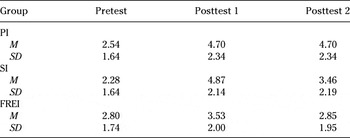
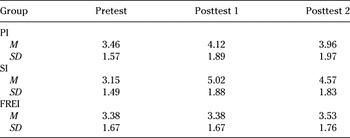
Table 2 presents the descriptive statistics for the interpretation task of the accusative clitics. To ensure that there were no preexisting differences among the treatment groups, the pretest scores for all groups were submitted to an ANOVA. The ANOVA revealed no main effect for group, F(2, 148) = 1.20, p = .31. For this reason, it can be assumed that any gains in performance were due to instructional treatment type.
Descriptive statistics for instruction type on the interpretation task (accusative clitics)

Note.
PI = processing instruction; SI = structured input; FREI = form-related explicit information.
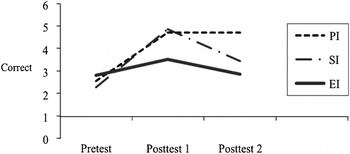
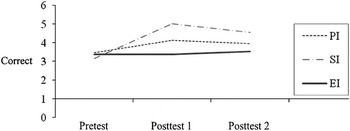
The 3 × 3 ANOVA for the interpretation of accusative clitics revealed a main effect for instruction, F(2, 148) = 5.86, p = .004, η 2p = .073, and time, F(2, 148) = 39.52, p < .001, η 2p = .21, and a significant Instruction × Time interaction, F(4, 296) = 6.79, p < .001, η 2p = .08. This interaction is displayed in Figure 1.
Instruction × Time interaction on the interpretation test (accusative clitics).

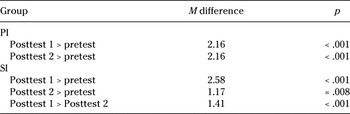
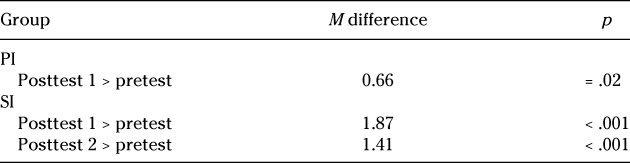
To examine the effect for time for each of the treatment groups, pairwise comparisons with a Bonferroni adjustment for multiple comparisons were conducted to determine the differences among groups. The significant findings are displayed in Table 3. The pairwise comparisons revealed some interesting findings. First, only PI treatment types and SI treatment types led to increased performance over time, whereas FREI did not. Second, both the PI treatment type and the SI treatment type led to increased performance from pretest to Posttest 1 and pretest to Posttest 2. Finally, the SI treatment type showed a decrease in performance at Posttest 2 from Posttest 1. That said, the SI groups’ scores on Posttest 2 were still greater than on the pretest.
Pairwise comparisons between interpretation tests by instruction type (accusative clitics)

Note.
PI = processing instruction; SI = structured input.
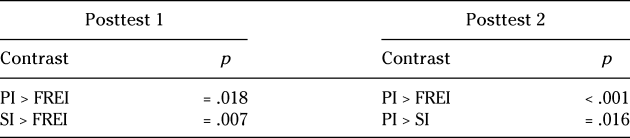
In the exploration of the Instruction × Time interaction, the Bonferroni tests revealed the following differences among groups at each test time: There was no difference among groups at pretest (FREI and PI: p = 1.00; FREI and SI: p = .38; PI and SI: p = 1.00); PI and SI outperformed FREI at Posttest 1 (PI: p = .018; SI: p = .007), but there was no difference between PI and SI; PI outperformed both FREI and SI groups at Posttest 2 (PI and FREI: p < .001; PI and SI: p = .016), but there was no difference between SI and FREI at Posttest 2. The FREI group did not outperform either PI or SI at any time. A summary of these findings is displayed in Table 4.
Summary of comparisons between instruction types on interpretation posttests (accusative clitics)

Note.
PI = processing instruction; FREI = form-related explicit information; SI = structured input.
Summary of Interpretation Test Results: Accusative Clitics
In general, the findings for the interpretation results on primary effects revealed that both PI and SI made gains after treatment exposure and maintained those gains at Posttest 2 (3 weeks after treatment) in the correct interpretation of the third-person Spanish accusative clitics. In terms of differences among the treatment groups, the findings for PI are the most robust. There were no significant differences between Posttest 1 and Posttest 2, which indicates that participants made gains after treatment and also maintained those gains when tested 3 weeks after treatment. However, the SI group showed a decrease in performance at Posttest 2 from Posttest 1, even though they made gains from pretest to Posttest 1 and to Posttest 2. It is important to keep in mind that, although there are differences between these two test times, the group exposed to SI still demonstrated gains between the pretest and Posttest 2. At no time did the FREI group demonstrate gains at either posttest time from the pretest or between posttests. In other words, there were no observable effects demonstrated by the group exposed to FREI alone at any time after treatment.
Secondary Effects: Dative Clitic Interpretation
Table 5 presents the descriptive statistics for the interpretation task of the third-person dative clitics. To ensure that there were no preexisting differences among the treatment groups, the pretest scores for all groups were submitted to an ANOVA. The ANOVA revealed no main effect for group, F(2, 148) = .486, p = .616. For this reason, it can be assumed that any gains in performance were due to instructional treatment.
Descriptive statistics for instruction type on the interpretation task (dative clitics)

Note.
PI = processing instruction; SI = structured input; FREI = form-related explicit information.
The 3 × 3 ANOVA for the interpretation of the dative clitics revealed a main effect for instruction, F(2, 148) = 5.35, p = .006, η 2p = .07, and time, F(2, 148) = 13.33, p < .001, η 2p = .08, and a significant Instruction × Time interaction, F(4, 296) = 5.14, p < .001, η 2p = .065.
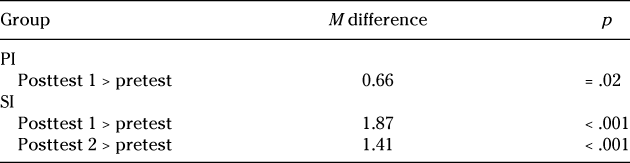
To examine the effect of time for each of the treatment groups, pairwise comparisons with a Bonferroni adjustment for multiple comparisons were conducted to determine the differences between each time. The significant findings are displayed in Table 6 and in Figure 2. The pairwise comparisons revealed that (a) only PI treatment types and SI treatment types led to increased performance over time and (b) the FREI treatment type did not show increased performance among any of the test times. More specifically, both the PI and SI treatment types led to increased performance from pretest to Posttest 1. Additionally, the SI group demonstrated increased performance from pretest to Posttest 2.
Pairwise comparisons between interpretation tests by instruction type (dative clitics)
Note.
PI = processing instruction; SI = structured input.
Instruction × Time interaction on the interpretation test (dative clitics).

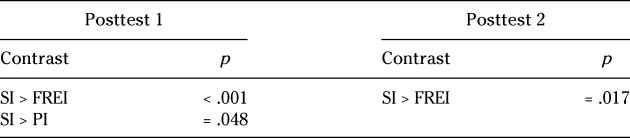
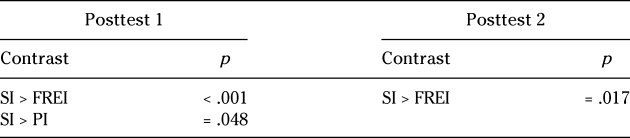
In the exploration of the Instruction × Time interaction, the Bonferroni tests revealed the differences among groups at each test time. Specifically, although there was no difference among groups at pretest (ps = 1.00), SI outperformed both FREI and PI at Posttest 1 (SI and FREI: p < .001; SI and PI: p = .048), and SI also outperformed FREI at Posttest 2 (p = .017). However, there was no significant difference between PI and FREI at any time. Additionally, SI outperformed FREI at Posttest 2, but SI did not outperform PI at Posttest 2. A summary of these findings is displayed in Table 7.
Summary of comparisons between instruction types on interpretation posttests (dative clitics)
Note.
SI = structured input; FREI = form-related explicit information; PI = processing instruction.
Summary of Interpretation Test Results: Dative Clitics
In general, the findings for the secondary form interpretation results revealed that both PI and SI made gains after treatment exposure, and SI maintained those gains at Posttest 2 (3 weeks after treatment). The FREI group did not show any increased performance among the test times, which indicates that no observable demonstration of gains was attributable to the FREI treatment type. In terms of differences among the treatment groups, the findings for SI are the most consistent: SI outperformed both PI and FREI at Posttest 1, and SI outperformed FREI at Posttest 2. At neither of the posttest times did PI or FREI outperform each other or SI.
DISCUSSION
The principal objectives of this study were to investigate (a) the primary effects of PI, SI, and FREI (alone, without processing-strategy information) and (b) the TOT effects of the three treatment types. The primary effects refer to the impact of the instructional treatments on participants’ interpretation of the Spanish third-person accusative clitics, whereas the TOT effects refer to the impact that the instructional intervention (PI, SI, or FREI) had on the interpretation of a form not taught in the treatment (i.e., Spanish third-person dative clitics) but on which participants were tested. In this study, the FNP can predict and explain both the primary form and the secondary form.
Regarding primary effects, the interpretation findings reported here are comparable to the findings of VanPatten and Oikkenon (Reference VanPatten and Oikkenon1996). At Posttest 1, there were no differences between PI and SI, and both the PI and SI groups outperformed the group exposed to FREI. Because SI outperformed FREI at Posttest 1 (as did PI), it is suggestive of the fact that it is the SI component of PI that is driving the immediate test results. This outcome thereby supports the findings of VanPatten and Oikkenon (Reference VanPatten and Oikkenon1996) in that “significant improvement on the interpretation test is due to the presence of structured input activities and not to the explicit information provided during the explanation phase” (p. 505). This is remarkable considering that the number of target-form exemplars that the learners were exposed to in this study was 38, whereas VanPatten and Oikkenon used three times this amount. This finding suggests that the robustness of the results, at least immediately after treatment, is due to the treatment type alone and not merely the amount of tokens. These findings also suggest that SI is working to push L2 learners to adopt more optimal processing strategies and to alter their default (nonoptimal) processing strategy. If FREI were playing more of a role, then we would expect to see either the FREI or PI group outperform the SI group at the immediate posttest, which they did not.
The current study also included a delayed posttest (i.e., Posttest 2) completed 3 weeks after treatment. Three interesting findings were revealed at the delayed posttest: (a) There was no difference between SI and FREI, (b) PI outperformed SI, and (c) SI showed a decrease in performance from Posttest 1 to Posttest 2 (although performance was still better than on the pretest). Why might this have been the case? We conclude that these findings are attributable to the reduced number of tokens compared with previous research. Although the FREI group did not make gains (and their Posttest 2 scores were similar to their pretest scores), it is surprising that PI did not outperform the FREI group at Posttest 2, as they did at Posttest 1. It may be that the FREI component of PI shows up here (i.e., PI outperforming SI and no difference between PI and FREI) because the tokens are so reduced as compared to the original VanPatten and Cadierno (Reference VanPatten and Cadierno1993) study. When you have more tokens (as in the original study) to process and to strengthen the new strategy being developed, FREI becomes less important and will play less of a role in assessment.Footnote 3 VanPatten, Inclezan, et al. (2009) found similar effects for their PI group. Although the members of the PI group demonstrated gains immediately after treatment, they showed a decrease from Posttest 1 to Posttest 2 (although they still performed better than on the pretest). This decrease was attributed to the reduced token set in the treatment.
Given that the findings for FREI without processing-strategy information were similar to those of VanPatten and Oikkenon (Reference VanPatten and Oikkenon1996), we suggest that the processing-strategy information included along with the FREI does not facilitate positive effects for these interventions. Again, in the original study, FREI was paired with processing-strategy information to compose the EI component of PI, whereas in the current study, FREI was isolated and constituted an instructional intervention void of processing-strategy information. The comparison of findings suggests that—with or without processing-strategy information (i.e., EI or FREI)—it is not enough to facilitate comparable effects to PI or SI.
In discussing the findings on TOT effects, it is important to keep in mind that participants did not receive instruction on the secondary form during treatment. Therefore, we expect the results to differ from the primary findings. In the interpretation of the secondary (or unknown) form, learners must be reliant not only on the training they received on the primary target form but also on the transfer of the processing strategy during treatment to a form on which they did not receive instruction. In the current study, the processing strategy associated with both the primary and secondary target forms is the same. In other words, the TOT effects are caused by the altering of an incorrect processing strategy (i.e., the FNP in this case) due to exposure to an intervention (i.e., PI, SI, or FREI) and their altered processing strategy transferring to the secondary form.
The findings regarding secondary TOT effects on the interpretation of the dative clitics are not so straightforward. The PI group demonstrated increased gains from the pretest to the immediate posttest but did not maintain those gains one month after treatment. These findings differ slightly from Leeser and DeMil (in press), in which the PI group not only demonstrated immediate gains but also maintained these gains at the time of the delayed posttest. In the current study, the results for SI are the most robust because (a) SI was the only group to maintain its gains on the delayed posttest, (b) SI outperformed PI and FREI on the immediate posttest, and (c) SI outperformed FREI at the delayed posttest. In this case, for TOT effects, PI in its entirety did not outperform FREI, whereas SI in isolation did. In other words, SI alone is doing something that PI or FREI is not.
It is not clear why the results for PI are not as robust as those for SI on TOT effects considering the fact that PI includes SI in its composition. In fact, research suggests that both PI and SI would perform similarly (or that PI would outperform SI) on the immediate posttest; however, in this case, SI actually outperformed PI at this test time. At best, we can speculate that the learners’ processing may be taxed by the added EI in PI, which thereby inhibits the TOT effects of the structured input in PI. This would suggest that when learners are working with meaning-bearing input and transferring strategy training, FREI seems to get in the way and inhibit their correct processing of the secondary target form. The question we are left with is the following: Why, then, is this not the case for primary effects? Whatever the reason may be, for now, we are left to consider that the findings suggest that SI alone is effective at TOT strategies.
LIMITATIONS, DIRECTIONS FOR FUTURE RESEARCH, AND CONCLUSIONS
In light of the findings of the robustness of SI compared to PI (i.e., SI outperforming PI at the immediate posttest), future research could investigate using online methods of assessment on TOT effects to track learners’ behavior in reaching criterion (e.g., Fernández, Reference Fernández2008; VanPatten, Inclezan, et al., Reference VanPatten, Farmer and Clardy2009, regarding primary effects). This may shed some light into what may be causing these effects. Additionally, as an anonymous reviewer suggested, interpreting a known versus unknown target could affect the results. Thus, could including an unknown form somehow throw off learners in their interpretation (and, for that matter, their production) of the primary target form? The only way to know is to include a primary-effects-only group in the research design. Future research will have to examine this.
Appendix A SAMPLE MATERIALS
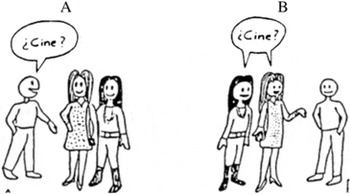
Following is a sample referential SI activity. There were a total of eight items in this activity; translations were not provided to participants.
Select the picture that best corresponds with the sentence you read.
1. Sus padres lo llaman por teléfono. “His parents call him by phone.”

2. Las invita Manuel al cine. “Manuel invites them to the movies.”
APPENDIX B SAMPLE MATERIALS
Following is a sample affective PI activity. There were a total of seven items in this activity; translations were not provided to participants.
Indicate whether or not each statement about your parents applies to you. Share your responses with a classmate.

APPENDIX C SAMPLE MATERIALS
Following are sample items from the accusative clitic test. The sentences were read to participants, and translations were not provided.
Select the picture that best corresponds with the sentence you hear.

APPENDIX D SAMPLE MATERIALS
Following are sample items from the dative clitic test. The sentences were read to participants, and translations were not provided.