On 17 February 1911 Congress passed and President Taft later signed into law what came to be known as the Locomotive Boiler Inspection Act.Footnote 1 As a result of the new law the Interstate Commerce Commission (ICC) set up the Bureau of Locomotive Inspection (here-after, the bureau), which opened for business later that year. The act and the bureau were examples of the new impulse toward social regulation—that is, laws and policies governing health, safety, and the environment—that characterized Progressive Era America. As economists and historians have begun to document, during these years states and the federal government began to regulate food and drug safety, work safety, lead paint, water quality, locomotive smoke, and phosphorous matches, among other things. Although many of these regulations were the subject of popular concern and conflict, seemingly pitting “the people” vs. “the interests,” modern scholarship has been more skeptical, emphasizing the importance of business interests in motivating legislation and (less frequently) delving into the implementation of the laws and regulations themselves.Footnote 2 Railroad safety figured prominently in these new concerns. Although states had regulated certain aspects of railroad safety for decades, federal involvement began with the Safety Appliance Act of 1893 mandating safety couplers and air brakes on freight trains. Other federal laws followed. A 1901 law required accident reporting under oath; in 1907 and 1908 Congress regulated the hours of service for trainmen and telegraphers and the dangers from locomotive ash pans. In 1910 a second accident reporting act was passed along with the bill requiring locomotive inspection. As Barbara Welke has perceptively noted, collectively these regulations reflected a shift in the meaning of the word freedom; rather than freedom to, it now began to mean freedom from.Footnote 3
Although federal locomotive inspection had been the subject of intense conflict between the railroads and their labor unions, the popular press largely ignored the act. Neither the New York Times nor the Washington Post even mentioned its passage. Coming at the peak of Progressive Era legislation, it was simply overshadowed by other, seemingly more important, events. Similarly, locomotive inspection has largely escaped the scrutiny of modern historians. Yet inspection of locomotives was an important extension of federal regulatory power and—now under the Federal Railroad Administration—it continues to this day. Locomotives were the single most important piece of capital equipment the railroads owned, and their maintenance, which cost some $148 million in 1911, accounted for roughly 8 percent of total expenses. The law created a new federal bureaucracy that extended regulatory influence deep into these matters, shaping locomotive technology, operating practices, and labor relations.Footnote 4
The bureau was the most important federal agency charged with regulating work safety formed during these years; the procedures it adopted foreshadowed those later implemented in aviation inspection. Locomotives were a source of risk for a significant fraction of the labor force. Those most exposed were the trainmen (enginemen, firemen, and brakemen), and there were 311,000 of them in 1911—almost half as many as the number of coal miners at that time—while another 348,000 shop men were also exposed. Other workers and even occasionally bystanders and passengers were sometimes injured by a misbehaving iron horse. In 1925, in one such case, the cylinder plug on a Pennsylvania Railroad freight locomotive blew out while passing a passenger train, scalding 12 passengers. For the trainmen, locomotives were a spectacular but moderate source of risk. Between 1904 and 1908, boiler explosions alone accounted for about 2 percent of trainmen's mortality while other locomotive dangers would have no doubt added to these totals.Footnote 5
Beginning in fiscal 1912 the bureau regularly published an annual report that provides a rich source of information on its operations and on locomotive safety. The data show that accidents declined somewhat from 1912 to World War I, fluctuated during the war and immediate postwar years, and then fell sharply. By the 1920s each annual report began to contain an identical graph that charted the downward trend in defective locomotives, accidents, and casualties from 1912 on. The bureau took full credit for these developments, ignoring the likely impact that a decline in the number of locomotives might be expected to have, and claiming that the chart “illustrates the effect of operating locomotives in defective condition [i.e., in violation of its rules].” Testifying to Congress after the act had been in force about 13 years, I.C.C. Commissioner John J. Esch was even more forthright. “No one will question who looks over the statistics,” he proclaimed in a burst of tortured prose, “the wonderful results which have been accomplished since the act of February, 1911 was put in the statue books in the saving of human life.”Footnote 6
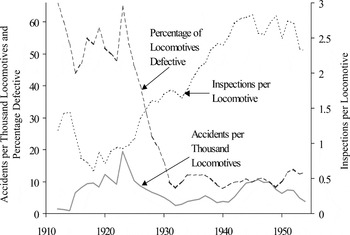
Perhaps; but glowing self-evaluations are hardly strong evidence. Fragmentary data from private sources suggest that locomotive safety improved steadily during the last third of the nineteenth century. Nor do the bureau's own data entirely support its conclusion. Figure 1 modifies that presented by the bureau by adjusting accidents for the number of locomotives and by including inspections per locomotive as well. As can be seen, safety improved briefly after 1912 and then deteriorated during World War I; it improved dramatically for a decade after 1923, and then, essentially stagnated. Inspection intensiveness rose sharply as safety improved during the 1920s but it continued to rise thereafter, with no apparent affect. In addition, casualties (fatalities and injuries) to trainmen from locomotive accidents remained about 2.5 percent of those from all causes between 1912 and 1940, implying that they fell at the same rate as casualties from unregulated causes.Footnote 7
ACCIDENTS, INSPECTIONS, AND DEFECTIVE STEAM LOCOMOTIVES, 1912–1954

Even during the 1920s—the period when accidents and injuries fell most sharply—the bureau's role in improving locomotive safety is open to question. Writing on locomotive conditions in 1936, the Federal Coordinator of Transportation reproduced the bureau's data on the decline in defective locomotives from 1923–1932 but concluded that “this showing is unquestionably the result of the decline in business and the tendency to use the newer more modern power and to concentrate the limited maintenance expenditures thereon.”Footnote 8
Could it be that the bureau simply presided over an improvement in locomotive safety, taking full credit for what was in fact an achievement of private enterprise? Employing previously unused data as well as archival resources, this article investigates the implementation of the Locomotive Inspection Act. We test the hypothesis that the bureau's inspections played an important role in the improvement in steam locomotive safety that occurred before World War II. As will be seen, like other regulations of the day, locomotive inspection yielded unintended consequences that must have surprised its advocates. And its successes, while not trivial, were both expensive and more limited than its supporters claimed.Footnote 9
THE BEGINNINGS OF FEDERAL LOCOMOTIVE INSPECTION
Although it is not the purpose of this article to delve in depth into the political origins of locomotive inspection, some brief description is necessary. By the early twentieth century the railroad brotherhoods had grown immensely in power, and they had been deeply influenced by the safety gains that had seemingly flowed from the federal Safety Appliance Act of 1893. Extending this legislative reach to locomotives seemed like an obvious idea to their engineers and firemen. Federal inspection became an official legislative goal of the Brotherhood of Locomotive Engineers in 1904 and, with the brotherhoods' backing, bills were submitted to Congress in 1909. The Locomotive Firemen and Enginemen reported that “national legislative representative A. A. Roe is exerting every effort for the passage of this bill.” As initially written, early bills would have required federal inspection of the boilers of all of the more than 60,000 locomotives in interstate commerce. Not surprisingly testimony for the bills came from the unions. They acknowledged that many lines had proper procedures but they made two key points: on some small carriers inspection was a much more slapdash affair and on all the roads it was slighted under the press of traffic. Both were later borne out by the evidence.Footnote 10
The railroads and their allies in the trade press vehemently opposed the proposed legislation, and they assembled a Special Committee on the Relations of Railway Operation to Legislation to fight it. At Senate hearings in early 1910, representatives of the carriers claimed that such laws were unnecessary for they had strong incentives to keep locomotives in good shape and, in fact, had excellent procedures already in place. “We object to the principle that underlies this bill,” Charles Paulding of the New York Central informed the senators. In fact, he pronounced, “if we thought that one life could be saved by government inspection. . . we would not be here.” The most spectacular and expensive form of accident was a boiler explosion, and the Special Committee assembled evidence purporting to demonstrate that these were nearly all due to the carelessness of engineers in letting boiler water levels drop too low. Although the carriers claimed that they were already doing all the law would require, they also complained that it would be expensive, costing the railroads an additional $3 million a year in inspection time alone, according to F. H. Clark of the Chicago, Burlington & Quincy. The carriers also argued that federal inspection would require an army of bureaucrats and would blur responsibility for locomotive safety, leading the Railroad Gazette to warn that it would become a “positive menace.”Footnote 11
Despite the carriers' opposition they had some incentive to compromise, for New York State, Pennsylvania, and Ohio had already passed boiler inspection laws, and federal legislation must have seemed preferable to the prospect of 46 different state regulations. After much horse trading, the parties finally reached an accommodation in late 1910. The Locomotive Firemen and Enginemen's Magazine called the bill “a signal victory” for the workers, while the journal of the locomotive engineers claimed that the “credit of pushing this bill to passage” belonged to their legislative representative H. E. Wills.Footnote 12
Steven Usselman has argued that both the railroads and their regulators became increasingly focused on engineering approaches to problem solving during these years, and that focus is evident in the approach to locomotive safety. As finally written, the act required the carriers to file their inspection rules with the ICC and it required that body to approve them and allowed it to prescribe rules for carriers that had none and to propose new rules as well. It provided for a chief inspector and two assistants appointed by the president, and 50 district inspectors who were civil servants. And, in a crucial concession to the carriers, the latter were not to inspect locomotives but rather to supervise the carriers' own inspections. Thus the “first duty” of inspectors was “to see that the carriers make inspections in accordance with the rules and regulations.” Violations of the rules were punishable by fines of $100 each, but more importantly inspectors were given the power to order defective locomotives immediately out of service. There were also provisions for accident inspection and reporting.Footnote 13
IMPLEMENTING LOCOMOTIVE INSPECTION
Responding to its new duties, the ICC set up the Bureau of Locomotive Inspection. Its first chief inspector, John F. Ensign, and his assistant Frank McManamy, were both union men, but they had been approved by the railroads.Footnote 14 The bureau's first acts were to appoint inspectors and request company boiler inspection rules. Out of 2,200 lines queried only 170 large carriers sent in rules—evidence that the unions' critique of small carriers may not have been wide of the mark. The ICC then met with representatives of both the railroads and the brotherhoods to agree on a common set of rules and these were promulgated on 1 July 1911. The rules generally followed existing best practice on the large carriers. They required specification cards to be filed with the chief inspector describing working strength and a host of other technical details on every locomotive boiler covered by the law. All boilers were to be equipped with water glasses. The rules also required periodic inspections, and records of the results were to be filed with inspectors and kept in the locomotive cab. As other writers have emphasized, regulation can yield benefits to the regulated industry, and as the bureau's records reveal, its published inspection rules immediately proved educational to small carriers, some of whom seemed to know little about proper procedures. Especially on small lines, bureau rules prevented a host of dangerous practices such as washing boilers so infrequently that cleanout plugs froze shut. The bureau also demonstrated its entrepreneurial skills as it decided on a policy of reporting all defects, not just those covered by the law and of requiring companies to fix defects before they became violations of the law. Thus an inspector might report broken wheel spokes, although they were not illegal because they were unrelated to the boiler, and he might require a company to fix a leaky steam valve although it had not yet become a danger.Footnote 15
One early result of the policy of reporting all defects was pressure to expand the coverage of the law. As written, it pertained only to the locomotive boiler and its appurtenances. However as inspectors began to find a host of dangerous defects in wheels, tires, driving gear, and the various parts of tenders, the bureau noted these in its annual reports and urged Congress to extend the law to govern all parts of the locomotive. Regulation begets more regulation and the rules were broadened to govern the entire locomotive and tender beginning in September 1916.Footnote 16
Passage of the law and its implementation yielded virtually no complaints to the trade press or in extant archival sources. This is somewhat surprising given the strength of the carriers' opposition to the initial legislation. By November of 1912 the journal Railway and Locomotive Engineering, which watched these matters carefully, had concluded “the beneficial results of the wise measure are already apparent.” A year later another railroad journal decided that federal inspection “has resulted in much good, undoubtedly.”Footnote 17
That implementation went so smoothly reflected conscious efforts by the bureau to ease the regulatory transition. Thus its approach to enforcement was similar to that of the Food and Drug Administration (FDA). Both downplayed deterrence and emphasized the benefits of the new rules to the companies. The bureau's first chief, John Ensign, died in early 1913 and was replaced by Frank McManamy who had once been a fireman and then engineman on the Père Marquette before becoming an inspector for the ICC's Bureau of Safety. Later he would go on to an important position within the United States Railroad Administration and then become an ICC Commissioner. Although an ex-union man, he sympathized with the railroads, understood their problems, and could talk the language of their master mechanics. Accordingly, he stressed cooperation rather than confrontation to achieve compliance with the new law and emphasized the value of the rules to the carriers. In addition, McManamy understood that carrier cooperation was crucial for the bureau's powers were limited. The process of fining companies for violations was expensive of inspector time and cumbersome; the full ICC had to approve a court action and then the attorney general had to bring (and win) the case, which then might be appealed. And while the ability to order a locomotive out of service was a real threat, it could backfire if disruption of service aroused public opinion.Footnote 18
To “sell” the new rules to skeptical railroad top management, McManamy and subsequent chief inspectors argued that compliance was largely a matter of improving efficiency—that is, of reducing agency problems—and, more broadly, that federal inspection was a net benefit to them. Such arguments appeared in both the bureau's annual reports and especially in the various public pronouncements of its personnel. In late 1913 and again in 1915 and 1916 McManamy spoke to the Western Railway Club. His audience included general managers and master mechanics of the New York Central, the Chicago, Burlington & Quincy, and other large lines that had opposed the original legislation. McManamy pointed out that the bureau's accident statistics had pinpointed the large number of injector steam pipe failures. These reflected a design flaw to which the bureau had called the manufacturer's attention. Inspection had also found ten new locomotives with water glasses positioned so that the lowest reading was below the top of the boiler crown sheet, making them potentially lethally misleading. Such bureau activities were costless to the carriers and, lest anyone miss the point, McManamy observed that they were “beneficial to the railroads as well.” He noted that in the hearings the carriers had blamed boiler explosions that resulted from low water on errors by the engineman, implying that they were unpreventable. In fact such disasters had fallen sharply since federal inspection—a result of the bureau's pressure for “proper application and maintenance of boiler appurtenances,” he claimed.Footnote 19
McManamy also knew that his audience was well aware of just how little control they had over enginemen and shopmen. He reported that inspection had discovered that enginemen often employed large numbers of flue plugs—a fact, as he observed, members of his audience might not know. Flue plugs (which sealed off flues leaking steam) were not only unsafe; as McManamy stressed, they reduced locomotive fuel economy as well. This was a shrewd argument for, as McManamy knew, the carriers had recently founded the Railway Fuel Association and most were experimenting with various schemes to economize on coal. Similarly, the bureau's requirement to wash and de-scale boilers not only reduced both risks and repair costs, it too saved fuel. McManamy also sounded another theme that must have been congenial to his audience, noting the difficulties the bureau sometimes had in getting foremen to obey the law. “If I were to be asked. . . the principal cause of locomotive. . . defects. . . I would without hesitation say. . . [it] is the lack of proper supervision.”Footnote 20
Thus in public pronouncements, bureau representatives claimed that the federal inspection was comparatively costless, and in fact benefited the railroads. Its annual reports with their accident and defect statistics allowed the discovery of patterns that might yield design improvements, while its inspections were really doing the carriers' work for them, yielding a more efficient organization and backing up their own authority. There were three key reasons why such claims did not get laughed off the stage. First, railroad accounting largely precluded accurate costing of the new rules, Second the bureau went about achieving compliance with the new law as painlessly as possible. Finally, appealing to the need for improved supervision and to reduce agency problems appealed to managers' self interest, while as will be seen, the bureau's claims that it stimulated efficiencies contained a good deal of truth.
Although most carriers knew at least approximately the direct cost of “heavy” repairs, more detailed data did not exist. Thus they had no idea what it cost to test a staybolt, turn a tire, or fix a leaky flue. An exception was in matters such as boiler washing, which the new rules required once a month rather than once every three months as had been typical. While the carriers did not know the dollar cost of boiler washing or whether there were net benefits or costs from additional washings, they did know—as the Union Pacific informed one inspector—that it would require “increased roundhouse room and additional motive power.” The inspector responded by reminding the company of a recent boiler explosion on one of its locomotives that had not been properly washed. The point, of course, was that failure to comply with the new rules was dangerous and expensive.Footnote 21
The bureau's efforts to ease the transition to the new regulatory regime as well as the effects of its inspections and statistics are revealed in trade publications, in correspondence preserved in its own archives, and in unpublished company records. Although the rules were largely a codification of best practice on the larger carriers, as Frederic Delano, receiver of the Wabash observed in 1913 “it is a very different thing for an Association to adopt rules or standards. . . from which they may themselves vary, and having a law which the federal government in Washington may enforce literally and absolutely.” The saving grace, Delano went on to note, was that the bureau “exercise[d] the most conservative judgment in enforcing the law.”Footnote 22
Thus, in 1912 company specification cards initially showed that over 1,400 locomotives had a boiler factor of safety of less than three when five was required by the new rules, and many others needed major shoring up. In response companies scrapped some older equipment and reduced pressure on the rest. In order to minimize disruption and costs the bureau phased in the new requirements so that upgrading might occur during a period of years. Inspectors were also urged to be flexible. Typically inspectors did two things when they arrived at a locomotive terminal. They inspected the paper work to see if it was in order, and they looked over locomotives that were ready for service. They did not inspect locomotives on the road, which might have caused chaos, and they ignored those under repair unless the repairs were being improperly done. Where possible they interpreted requirements in performance rather than specification terms. For example, the rules required water glass shields, and in 1913 when C. E. Gossett of the Minneapolis & St. Louis wrote the bureau inquiring about a particular model he was informed “we are not approving any particular design,” and anything that would prevent flying glass would be acceptable “if you can prove that by test.”
Each month inspectors reported all defects in writing to upper management, usually the chief mechanical officer, thus providing an independent check on the work of divisional mechanics and foremen. Bureau records demonstrate that compliance was generally achieved by badgering company officials, sometimes with the threat of court proceedings and fines.Footnote 23 But court actions were rare. In its first annual report the bureau listed over 74,000 locomotive inspections that found nearly 49,000 defective locomotives, some 3,400 of which it ordered out of service for immediate repairs, but it never had to take a company to court. Later reports also indicate that court suits were not common, probably because McManamy and subsequent chief inspectors were sympathetic to the carriers' problems. In addition, the bureau found the procedures time consuming, and companies discovered that they had little chance in court. Usually all that was necessary to induce compliance was a message, of which this one from A. G. Pack (Chief Inspector, 1918–1935) to the little Missouri & North Arkansas in 1930 was typical and unmistakably clear. “The federal courts have construed the law very broadly[;] however we would prefer to have it complied with through cooperation rather than by coercive methods and I respectfully request that I may have your advice in this matter, so that I may determine what further action may be necessary in having the law complied with.”Footnote 24
The real threat, which could be levied by any inspector at any time, was to order a locomotive out of service. Such actions were expensive to the carriers for they disrupted traffic, and so inspectors used their power sparingly. From 1912–1916 only about 4 percent of all inspections resulted in the removal of a locomotive from service.Footnote 25 Sometimes the mere threat produced results. In 1916 inspector Frank Siebert wrote of the Cornwall & Lebanon “they are not acquainted with the rules,” and “I threatened to tie up every engine they had. . . if they didn't get busy.” In 1920 inspector C. W. Chidester wrote a scorching letter to W. H. Comstock, General Manager of the Los Angeles & Salt Lake, explaining the large number of locomotives he had ordered out and suggesting the extent of agency problems on that carrier. After a lengthy recitation of dangerous conditions and practices (such as putting bran in the boiler water to stop leaks), he informed Comstock in capital letters: “IF PROPER REPAIRS WERE MADE THE FIRST TIME THE DEFECT WAS REPAIRED THESE REPEATERS SHOULD NOT APPEAR SO OFTEN, this would be a great saving in cost.”Footnote 26
Whereas both the carriers mentioned were comparatively small, the bureau also took on the giants. The Pennsylvania Railroad was the largest railroad in the country. In 1912 inspectors described its inspection policy as “systematic, extensive and expensive,” but, by 1918 conditions had deteriorated sharply with the inspectors describing the “general condition of yard power not good.” Similar reports led Chief Inspector Pack to write J. T. Wallis, the Pennsylvania's Chief of Motive Power in 1921 complaining of the “defective conditions in which locomotives were being operated.” The shopmen's strike of 1922 worsened matters and, in fiscal 1923, the bureau found defects in 76 percent of the Pennsylvania's locomotives inspected, ordering 9 percent of them out of service. In mid-January 1924, in what the Indianapolis Star termed a “government attack,” a team of inspectors removed so many locomotives from service it essentially shut down the Pennsylvania's operations around Indianapolis, Fort Wayne, and other Indiana locations. The operation forced the company to cancel some crack passenger trains and closed some coal mines for lack of cars. Pennsy executives viewed the inspections as union-inspired payback for its role in breaking the shopmen's strike. Local newspaper editorials sided with the railroad and the operation so stirred up the Indianapolis Chamber of Commerce that it petitioned Senator John Watson, who obtained an investigation by the full ICC. The bureau fought off these pressures, however, and in a blistering letter Pack informed Wallis that if he did not want another inspection blitz he should inform subordinates to obey the law.Footnote 27
However much the Pennsy's top managers disliked the bureau's actions, the notion that locomotive failures reflected agency problems and the need for improved supervision struck a responsive chord. There-after, company records reveal an almost obsessive effort to reduce defects. The Pennsy kept detailed records of bureau inspections by division, and in the 1920s and 1930s corporate files are full of hectoring letters to responsible divisional mechanics announcing “This will not do. When are you going to get into action?” Failure to improve performance led to demotions and firings. In none of these letters are resources or costs mentioned. In 1930 Vice President Martin Clement set a corporate goal of no more than 15 percent defective locomotives, also apparently without reference to costs.Footnote 28
As this evidence suggests, both inspectors and companies saw locomotive defects not as a reflection of inadequate resources, but rather the result of inefficient behavior on the part of the men, foremen, or low-ranked officials such as district managers and maintenance supervisors. Even small lines such as the Cornwall & Lebanon sported considerable bureaucracies. Locomotive maintenance was the province of the master mechanic or superintendent of motive power who reported to the general manager; he might be largely indifferent to the impact of better maintenance on cost savings elsewhere (for example in trainmen's hours on the road). Compounding these difficulties was the decentralization of repair. Minor repairs occurred at every roundhouse; more serious “class” repairs went on in the shops, of which large carriers might have several. These were only loosely supervised from above, making the local superintendent and sometimes the local foreman or mechanic a law unto himself.
Under such circumstances agency problems flourished, leading to hoarding of tools and men, poor machine and work layout, inadequate scheduling, shoddy work, and a host of other inefficiencies. Indeed, in the early twentieth century such concerns led some carriers to experiment with various schemes of scientific management. In 1904 the Santa Fe had hired Harrington Emerson to improve the efficiency of its shop work and his procedures slowly spread to a few other lines as well. By the 1920s a considerable literature emphasized the inefficiency of railroad repair shops.Footnote 29
Thus, when McManamy referred to problems of supervision, he knew what he was talking about and he knew his audience did too, for bureau inspections uncovered a host of lax, sometimes dishonest practices. Bureau policy of sending reports to top management operated as an independent monitoring system, providing a check on such behavior. On the Michigan Central in 1921 the bureau uncovered evidence of a company inspector who neglected repairs and falsified reports. He was then demoted. Bureau files record a number of other instances of false reporting, usually by foremen or local mechanics. However, on the Gulf, Mobile & Northern inspectors found clear evidence that the superintendent of motive power was ordering employees to falsify reports of boiler tests.Footnote 30
The more usual problem was simply inefficiency. Discussing his blast to W. H. Comstock noted previously, Inspector Chidester explained that the general manager “has been kept in the dark” by the superintendent of machinery. “I am of the opinion your mechanical department does not keep you informed. . . [of] the true conditions of the motive power,” he informed Comstock. By 1924 the bureau's efforts to improve the Los Angeles & Salt Lake had involved the parent Union Pacific. A representative of that company reviewed the situation and promised “drastic recommendations.” Ultimately a foreman was removed. On the New Haven, until 1923 company inspectors had reported to the shop superintendent in charge of locomotive repairs—a clear conflict of interest. Rule changes that year requiring that they sign for all ICC-mandated repairs and report to the master mechanic improved matters. On the Minneapolis, St. Paul & Sault St. Marie, bureau inspections resulted in a shorter leash for enginemen. That carrier suffered from bad water that would foam in the boiler, leading some enginemen to carry very little water. When bureau inspectors pressured General Superintendent T. A. Fogue to rectify matters he explained “we have a few [enginemen] who will claim that trains cannot be handled if they keep the water at safe levels. . . . To these men we are going to give special attention.”Footnote 31
In the early 1920s inspectors found the motive power on the Missouri, Kansas & Texas (MKT), then in receivership, to be dilapidated and dangerous. Officials at some shops had lied about repairs while Mechanical Superintendent Frank Tutt fought the inspectors at every step. By early 1923 Chief Inspector Pack had had enough. In a 24 page letter to Chief Operating Officer, C. N. Whitehead, Pack detailed the company's sins ending with a thinly veiled threat. Pack explained that he had tried to avoid court action “however, the rapid deterioration of motive power on your railroad passes the bounds of administrative discretion.” Thereafter matters slowly improved; in July the company appointed a chief locomotive inspector who bypassed Tutt and reported directly to Whitehead and in September bureau inspectors met jointly with both men. The inspectors again detailed the problems to Whitehead, informing him that on other lines when a “real endeavor” was made conditions rapidly improved. Whitehead responded that “they were spending the money, had plenty of engines. . . and that the conditions on the Katy [MKT] were going to be corrected.” Turning to Tutt he inquired “Frank, how long will it take us to bring about an improvement?” to which Tutt replied “we'll bring it about right away.”Footnote 32
By October the inspectors were reporting that Tutt was a changed man and was threatening to fire those who would not cooperate with the new regime. By 1925 engine failures, which had run one every 5,200 miles in 1922 were down to one every 57,000 miles, and by 1928 Pack was writing letters congratulating the company that the November inspections had discovered no defects.Footnote 33
Regulations often yield unintended consequences, and it seems almost certain than in 1910 when companies had opposed federal inspection they did not imagine that it would provide legal support for their efforts to improve efficiency. Nor, one suspects, did the unions representing the firemen and enginemen suspect that the federal legislation they advocated would result in more strict supervision and tighter discipline for both them and their foremen and mid managers.
While inspections led to organizational tightening, the bureau's published investigations and statistics also provided a public good that benefited the companies, as McManamy had predicted. In another example of entrepreneurship, in 1920 the bureau initiated tests of boiler water gauges, and discovered that proper installation was crucial to achieve accurate readings. Accordingly, boiler explosion from low water might be the result of design flaws rather than engineer incompetence, as the carriers had claimed in their original opposition to federal legislation. The finding was widely reported in the technical press—Locomotive Engineering termed it “probably the most valuable [report] that has ever been issued by the department”—and it must have prevented many boiler explosions. The bureau also publicized the many problems that had resulted from the use of autogeneous welding of boilers, thereby helping to improve practice. The Pennsylvania employed bureau data on comparative locomotive defects among large carriers as a measure of its shops' efficiency, while the Union Pacific employed accident data to pinpoint danger spots.Footnote 34
Collectively this direct evidence from the trade press and the bureau yields important, if tentative conclusions about the nature of federal locomotive inspection. First, the bureau's published record of defects was not simply a compilation of trivia, despite occasional company grumblings to the contrary. There is, thus, a presumption that their reduction improved safety. Second, bureau research and statistics provided an industry public good that companies learned to value. Finally, both the railroads and the bureau believed that improving locomotive safety could largely be achieved by reducing inefficiencies that resulted from the carriers' chronic agency problems thereby benefiting the carriers at small cost. For quantitative evidence on the effects of bureau inspections on both safety and costs, I now turn to econometric analysis.
QUANTITATIVE ANALYSIS OF LOCOMOTIVE INSPECTION
To model the effects of locomotive inspections on defects and accidents I employ a model similar to that first developed by Walter Oi. Footnote 35 Thus, I hypothesize that whereas more inspections will usually find more defects in the short run, in equilibrium defects are inversely related to inspection intensiveness. In addition, inspections will be subject to diminishing returns as defects become scarcer and perhaps less important or more costly to reduce. Direct evidence also reveals that the allocation of inspections was itself dependent upon defects. The bureau's raid on the Pennsylvania provides one example. And when the MKT's C. N. Whitehead complained to the bureau that 92 percent of his locomotives had been inspected versus only 62 percent on the Texas Pacific, Chief Inspector Pack explained bureau policy to him. “Where conditions are approximately the same we endeavor to inspect the same percentage of locomotives on each railroad. Deviations. . . are made when conditions are unusually bad on any line.”Footnote 36
One approach to the problem of distinguishing short-from long-run effects of inspections as well as difficulties due to endogeneity follows in the spirit of recent studies of OSHA by Wayne Gray and others, and employs the change in (the log of) defects along with the level of lagged inspections.Footnote 37 Such a model also has the plausible implication that a constant level of inspection would yield diminishing declines in defects over a number of years. Other determinants of defects include real revenues and real expenditures on locomotive repairs, which measure resources available for and devoted to defect reduction. In addition, locomotive purchases and retirement are employed as a proxy for technological changes in the stock of locomotives although measurement problems reduce their value (see below).
These variables are contained in equation 1 below. Here Def is the number of steam locomotive defects, and Loc is the number of company steam locomotives in service. Insp is the number of ICC inspections of steam locomotives, New and Ret are the number of annual new and retired steam locomotives. Rrep is real repair costs, Rrev is real revenues lagged one year, and the T i are a set of time dummiesFootnote 38 Because repair costs, inspections, and revenues are all strongly correlated (r = 0.9+) they are normalized by the number of locomotives (Loc); to reduce problems of serial correlation first differences are employed for control variables. Again following studies of OSHA inspections, equation 1 also contains autoregressive errors (u it−1, uit−2) as an unexpectedly large increase in defects in any one year would be likely to increase company efforts, leading to a comparatively large decrease in defects in subsequent years.

In equation 2 real repair costs depend on inspections and locomotive purchases and retirements. Recent research on the important of railroad financial constraints suggests real revenues and bankruptcy also shape repair spending. For reasons already noted, changes rather than levels of variables are employed, and equation 2 also contains a set of autoregressive errors.Footnote 39 Taken together the two equations imply that inspections can reduce defects because they reduce agency problems and also by forcing carriers to devote additional resources of locomotive maintenances.

Finally, in equation 3 steam locomotive accidents reflect defects, changes in the composition of the locomotive stock, and the revenue payoff to use. Again, changes in variables are employed, and 3 also allows for autoregressive errors.

These equations are estimated separately using a fixed effects model to help control for unobservable company differences. Tests reveal the presence of heteroskedasticity and so they are estimated using procedures that calculate robust standard errors.Footnote 40
The coefficients of especial interest include b 1 which is the marginal effect of inspections on the change in defects controlling for repair spending. It thus captures the impact of the bureau on locomotive quality that resulted from the reduction in agency problems. The sum of b 1 + (b 2 * c 1) captures the total effect of inspections. Substituting from equation 2 into equation 1, I can simulate the impact of inspections on defects, other things equal, as follows

The data to estimate such a model come partly from the bureau's annual reports. For fiscal years beginning in 1912, these contain information by company on the number of inspections of steam locomotives, defects reported, the percentage of locomotives with defects, and the number of locomotives ordered out of service. Data on locomotive revenues and repair costs are from Statistics of Railways, converted into constant 1929 dollars. Data for locomotives in service as well as new and retired locomotives also come from that source. The locomotive data are not entirely satisfactory; locomotives retired during a year are a poor measure of equipment taken out of service, for retirements typically came from equipment previously stored. Nor can new locomotives fully capture technical improvements in equipment because many carriers substantially rebuilt older locomotives.Footnote 41
Although locomotive inspection began in fiscal 1912, econometric analysis of the early years is unfruitful. The period through 1915 is too short to generate meaningful results, whereas the years from 1916–1922 are disrupted by changes in the inspection law, wartime relaxation of enforcement, and the 1922 shopmen's strike. As a result, equations 1–3 are estimated for fiscal 1923–1940. Because, as Figure 1 suggests, there seem to have been sharp changes in the effectiveness of inspections between the 1920s and 1930s, I estimate separate equations for fiscal 1923–1932 and 1933–1940. Experimentation with different break points changes no important conclusion.Footnote 42
The analysis is restricted to a sample that includes all carriers owning at least 50 locomotives in 1923 resulting in 91 companies. This sample, though not random, is certainly representative, for it contains lines with about 90 percent of all locomotives in that year. Matching bureau data to that from Statistics of Railways cannot be done with precision as the former publication did not always indicate clearly how it treated subsidiaries. In addition, whereas bureau data are for fiscal years, those in Statistics of Railways are for calendar years after 1916; in response I have matched to the fiscal year data the average of that and the previous calendar year. Because of these difficulties there are no doubt errors in the data, which will, of course bias coefficients toward zero.Footnote 43
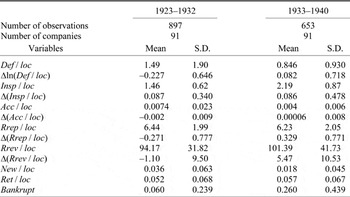
Table 1 contains means, the number of observations, and the standard deviations for each of the variables for the two time periods under investigation. Because most of the data are in ratio form, the means are, in effect, unweighted company averages. However, investigation confirms that they are a very close fit to aggregate data. Thus the mean of inspections per locomotive derived from aggregate figures for 1923–1932 is 1.42, and the sample mean in Table 1 is 1.46. Along with Figure 1 these provide an overview of the course of locomotive safety down to 1940. As can be seen there are sharp declines in defects per locomotive in the first period but, as noted, stagnation after 1932. And as Figure 1 reveals, inspections per locomotive rose steadily—a point that I will return to later. Finally, accidents per locomotive follow the same broad trend—declining until about 1932 and then stabilizing.
MEANS AND STANDARD DEVIATIONS

Notes:
Not all companies or variables have the full number of observations. Repair costs and revenues are in thousands of 1929 dollars.
Locomotive Inspection, 1923–1932
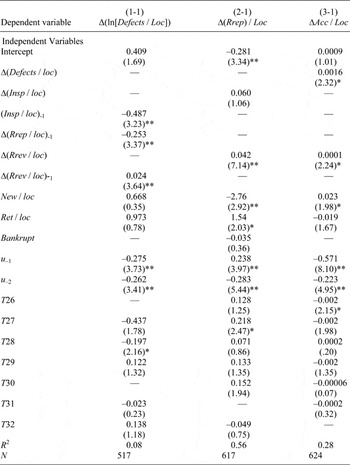
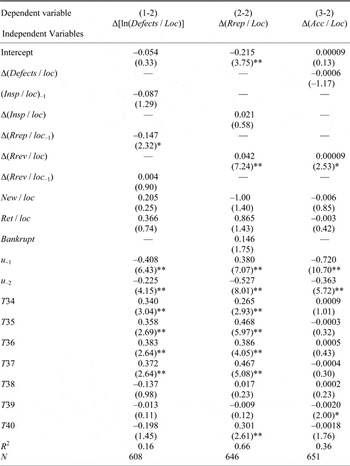
Results of estimating equations 1–3 for 1923–1932 are contained in Table 2. A number of alternative specifications were investigated and these findings are broadly typical. equation 1-1 indicates that lagged inspections did indeed sharply reduce locomotive defects, even in the presence of controls for real repair spending. I take this as statistical support for the direct evidence discussed previously that the bureau worked in part because it reduced the carriers' agency problems. Increases in real repair spending also reduced defects. In fact, equation 4 reveals that inspections had far greater effects directly than by increasing repair spending (−0.487 vs. −0.253 * 0.060 = −0.015). It was as if the American Railway Association had hired a group of Taylorites and given them authority to tighten up on locomotive repair operations.
REGRESSIONS, LOCOMOTIVE DEFECTS, REPAIR COSTS, AND ACCIDENTS, 1923–1932

* Significant at the 5 percent level.
** Significant at the 1 percent level.
Notes:
All equations were estimated employing a fixed effects model and are significant at the 0.0001 level. Repair costs and revenues are in thousands of 1929 dollars. Standard errors are robust for heteroskedasticity, and figures in parentheses are absolute values of t-statistics.
Although inspections were highly productive, as Figure 1 indicates, the bureau also increased inspection intensively during these years. In fiscal 1925 Congress gave the bureau power to inspect nonsteam locomotives and along with this came an additional 15 inspectors; inspections rose from about 0.9 per steam locomotive in 1923 to 1.36 in 1926. Thereafter they continued to rise, reaching 1.73 in 1932, although the number of inspectors remained unchanged. The bureau obliquely took credit for this seeming burst of productivity, claiming that it resulted from a decline in locomotive accidents the investigation of which had taken time away from inspection. A more plausible explanation is simply that the number of steam locomotives hit an all-time high of 69,114 in 1924 and then began a long slide to extinction.Footnote 44 Although this decline reflected the effects of depression after 1929, revenue ton miles per locomotive mile rose about 20 percent from 1920–1930 as the carriers upgraded their locomotive stock.
Equation 1-1 also demonstrates that increases in revenue per locomotive raised defects. Locomotive purchases and retirements had little impact on defects, perhaps because of measurement problems noted above. However, the value of constant term and time dummies sums to 0.012, suggesting that exogenous forces were, if anything, slightly increasing locomotive defects during these years. In all likelihood this resulted from the growth in locomotive complexity, as motive power increasingly came to include superheaters, feedwater heaters, power reverse gear, fire doors, thermic siphons (which supplied water to the boiler crown sheet, thereby improving fuel efficiency), boosters, speed control, and other devices needing maintenance. The Federal Coordinator of Transportation's claim that the reduction in defects resulted from the “the decline in business and the tendency to use the newer more modern power and to concentrate the limited maintenance expenditures thereon” was only partly true. New locomotives have little impact, but the reduction in the number of locomotives resulting from both rising productivity and the “decline in business” did raise inspection intensiveness thus reducing defects per locomotive. Hence, while the bureau was, as it always claimed, the main source of reduced locomotive defects in the 1920s, it had a little help from depression and better technology.
Although equation 1-1 indicates that repair spending reduced defects, equation 2-1 suggests that in 1929 the average of 1.61 inspections per locomotive may have induced the carriers to spend an additional 1.61 * 0.060 * 1,000 = $97 per locomotive, or around $5.9 million on the 60,582 locomotives in service that year. (However, the large standard error associated with inspections in equation 2-1 makes such a calculation highly imprecise.) While this may seem like a large sum, between 1924 and 1932 inspections accounted for only about 1.5 percent of repair spending on steam locomotives. The positive impact of revenue on repair work in equation 2-1 presumably reflects both the availability of funds as well as the effects of additional locomotive miles on the need for more intensive maintenance. Bankrupt carriers, however, seem to have made little change in their repair policies. Unsurprisingly, companies that purchased new locomotives reduced repair spending per locomotive, and the positive effect of retirements probably reflects the concentration of spending on fewer locomotives. Holding the locomotive stock constant, replacing an old locomotive with a newer one reduced repair spending about $1,220 a year. The value of the constant term and time dummies averages about +$89 a year—again probably a reflection of the increasing complexity of the locomotive stock noted above.
Finally, as equation 3-1 reveals, the bureau may have been less effective in diminishing locomotive accidents than it was in reducing defects. Defects per locomotive fell from about 2.8 to 0.43 or by 2.37 between 1923 and 1932, implying by equation 3-1 a decline in accidents of −2.37 * 0.0016 = 3.8 per thousand. In fact accidents fell from over 19 per thousand locomotives in 1923 to about three in 1932.Footnote 45 Thus most of the improvement in locomotive safety was not due to the bureau's inspections. More important were the fall in revenue per locomotive and especially “exogenous” changes in technology and operating practices (captured by the constant term and the coefficients of the time dummies), which averaged about −0.74 per thousand per year. These probably included carrier Safety First work and other organizational changes, as well as the large scale retrofitting of locomotives with devices that improved both safety and efficiency. Thus some of the same forces that raised repair costs and added to defects, such as thermic siphons, also improved safety because they reduced the likelihood of boiler explosions. Companies also shifted to alloy steels, built boilers with flexible staybolts that were less likely to break, and employed improved fuse plugs to prevent boiler explosions.Footnote 46
Thus it appears that bureau inspections were highly effective in reducing locomotive defects. They achieved this result in good part by reducing company agency problems. Inspections may have been less effective in reducing accidents, apparently because many defects were only loosely related to safety. In addition, accidents resulted not only from defects but from other failures of equipment and from operating practices as well. In short, as other studies have also found, regulatory emphasis on engineering means (specifications, mechanical defects) did not always translate into performance ends (accidents). Finally, inspections induced additional repair spending, but such spending was not the main source of declining defects or accidents.
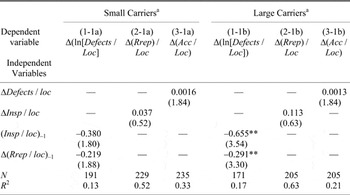
Modern studies suggest that the impact of safety regulations may be contingent on firm size, and it is of interest to know whether such a pattern obtained for the bureau's activities as well. Accordingly, Table 3 contains separate regressions for the smallest and the largest third of carriers in the sample—lines with respectively fewer than 183 or greater than 600 locomotives. These regressions are identical in form to those in Table 2 so only variables pertaining to inspection and its results are shown.
Table 3 suggests that inspections of large carriers were considerably more effective in reducing defects than were inspections of small carriers. Yet the marginal impact of defects on accidents does not differ appreciably by firm size. Taken together such findings suggest that inspections yielded greater safety benefits on large than small carriers, which surely would have come as a surprise to those who advocated legislation in 1910. It probably reflects the greater scope for agency problems at larger carriers and hence the greater opportunities for low cost safety gains.Footnote 47
REGRESSIONS, THE IMPACT OF FIRM SIZE ON INSPECTION EFFECTIVENESS, 1923–1932

** Significant at the 1 percent level.
a Small carriers are those with fewer than 183 locomotives; large carriers are those with more than 600.
Notes:
All equations were estimated employing a fixed effects model and are significant at the 0.0001 level. Repair costs and revenues are in thousands of 1929 dollars. Standard errors are robust for heteroskedasticity, and figures in parentheses are absolute values of t-statistics.
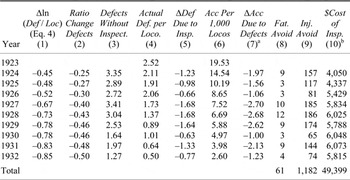
The equations in Table 2 allow a rough cost benefit analysis of the bureau's inspection work, and this is contained in Table 4 for the period 1924–1932. Here the results of equation 4 are presented in column 1 and these are employed to derive the ratio decline in defects per locomotive due to inspections (column 2). This allows a calculation of what defects would have been absent inspections (column 3) and thus, in column 4 a calculation of the reduction due to the bureau's efforts. Finally, this in turn allows a calculation of the effect of inspection on accidents, injuries, and fatalities, whereas equation 2-1 allows estimation of additional repair costs from inspections. As can be seen, inspection avoided about 61 fatalities and 1,182 injuries at a cost of about $49 million over this period. The Federal Coordinator of Transportation collected data on the carriers' employee accident costs in 1932. The average cost of major disabilities was $5,503 (in 1929 dollars) and for $5,611fatalities. Such figures imply bureau inspection was “worth” about $8 million. Such calculations, of course require a large dose of salt. As noted, the estimate of repair costs is imprecise. In addition, the costs of running the bureau as well as any capital costs attributable to inspection have been ignored as have any efficiency gains it may have induced. Despite such caveats it seems likely that bureau inspections contributed only modestly to safety during the 1920s at a rather high price.Footnote 48
SIMULATION OF COSTS AND BENEFITS OF LOCOMOTIVE INSPECTION, 1923–1932

a The change in accidents is per thousand locomotives;
b Inspection costs are in thousands of 1929 dollars.
Notes:
Col. (1) is derived from equation 4. Col. (2) converts (1) to ratio changes following procedures outlined in Wooldridge, Introductory Econometrics. Col. (3) = col. (4) lagged one year divided by [1 + col. (2)]. Col. (5) = col. (3) – col. (4). from equation 3-1. Col. 7 = Col. 5 * 1.6 from equation (3-1). Cols. (8) and (9) = col. (7) /col. (6) * (actual fatalities or injuries). Col. 10 is inspections per locomotive * $60 from equation 2-1 * locomotives.
Source:
Bureau of Locomotive Inspection and calculations by the author.
Locomotive Inspection, 1933–1940
The results for equations 1–3 for the fiscal years 1933–1940 are contained in Table 5. They could not be more different from those for the 1920s. As can be seen, inspections have no statistically significant effect on defects or repair spending. The marginal effect of defects on accidents is about a third that for 1923–1932 (compare equations 3-1 and 3-2) and is statistically insignificant. Although it is tempting to blame this cessation of safety progress on the depression-induced collapse in revenues and maintenance, the equations control for both variables. In addition, real repair spending per locomotive rose every year from 1933 through 1937, and while spending declined again in 1938, it remained higher in that year than in 1929.
REGRESSIONS, LOCOMOTIVE DEFECTS, REPAIR COSTS, AND ACCIDENTS, 1933–1940

* Significant at the 5 percent level.
** Significant at the 1 percent level.
Notes:
All equations were estimated employing a fixed effects model and are significant at the 0.0001 level. Repair costs and revenues are in thousands of 1929 dollars. Standard errors are robust for heteroskedasticity, and figures in parentheses are absolute values of t-statistics.
More plausibly, by the early 1930s locomotive inspection had simply encountered diminishing returns. Inspections per locomotive continued to increase—from 1.64 in 1933 to 2.40 in 1940 as the carriers stored and then retired older rolling stock. Yet defects per inspected locomotive remained stable and low, averaging about 0.85 during 1933–1940 (Table 1). In addition, the smaller marginal effect of defects on accidents and its statistical insignificance, suggest that the defects inspectors found were less severe than in the past. A rough index of defect severity can be estimated by the number of locomotives removed from service relative to the number of defects. This ratio declined from about four per hundred in 1923 to less that 1.5 in 1940, which reinforces the conclusion that the number of serious defects fell relative to the total. There is also a small amount of direct historical evidence on these matters. Writing in 1934 one of the Pennsylvania Railroad's regional vice presidents explained that “the Federal men. . . are much more active and very much more exacting than was the case some time ago.”Footnote 49
Although the period after 1940 is beyond the scope of this article, a brief glimpse at available data supports the contention that inspection of steam locomotives had hit diminishing returns by the early 1930s. Inspections per locomotive rose steadily throughout World War II (Figure 1) and remained high (compared to the 1920s) until the demise of steam. Yet accidents per locomotive rose during World War II and were about the same in 1954 as they had been in 1932. The patterns of locomotive defects and percentage of locomotives with defects tell a similar tale. In short, the safety gains from federal inspection of steam locomotives had reached the end of the line by 1932.
CONCLUSION
The formation of the ICC's Bureau of Locomotive Inspection in 1911 represented one of the first federal efforts to regulate work safety and its activities continue under new management to this day. The driving force for federal inspection had been the railroad brotherhoods—especially the unions representing enginemen and firemen. A law, they claimed, by requiring all carriers to establish minimum standards and to follow their own rules, could improve work safety. As finally written, the Boiler Inspection Act essentially codified best practice and instituted federal inspection of the process. It represented a major expansion of federal oversight into company operating practices.
Although the carriers had sharply contested early versions of the law, its implementation generated little controversy. The smooth transition to a new regulatory regime reflected the flexibility and sales efforts of the Bureau of Locomotive Inspection. The bureau phased in its new regulations, and to achieve compliance it followed procedures similar to those of the FDA, stressing benefits rather than deterrence. It emphasized the benefits of the new rules, claiming that its inspectors were doing the carriers' work for them, rooting out inefficiencies in operating practices and providing public goods such as accident data and better technology. Bureau and company records yield direct evidence on both the Bureau's approach and its results. They reveal widespread and significant agency problems that yielded low quality and sometimes fraudulent repair work resulting in locomotives with dangerous defects. Ironically, federal inspection led to a tightening of the rules and supervision governing the work lives of the men who had supported federal inspection. The new regulations thus subtly redefined the meaning of freedom for railroad workers; if they were less free to work as they pleased, their gain was a measure of freedom from risk.
Econometric findings reinforce the direct historical evidence and provide additional insights. Using a model similar to that employed by investigators of OSHA safety inspections, we find for the 1920s and early 1930s that bureau inspections played a major role in reducing locomotive defects—especially on large carriers—and, moreover, that they did so primarily by reducing agency problems. Inspections were less successful in reducing accidents and injuries during these years, however, for the new rules ignored worker behavior and covered only a subset of potential equipment hazards. Instead, exogenous changes in technology were probably more important in improving workers' safety. Moreover, a rough cost benefit analysis of the period 1923–1932 suggests that the benefits of the new rules were achieved at a rather high price.
In the years after 1932, progress in steam locomotive safety largely came to an end. Although inspection intensity continued to rise, econometric analysis of the period 1933–1940 reveals that it had little effect on either defects or accidents. On the margin, locomotive inspection had simply run out of steam.