Introduction
The research on microstrip antennas has taken a leap in the past few decades and is still a surviving and continuously progressing subject because of its low profile, ease in fabrication, and low-cost behavior. Microstrip antenna is one of the most important classes of antenna. The development in various analysis methods and models helps in designing new radiating patches which can be fabricated and tested for use in numerous applications. The numerical techniques such as MoM, FEM, SDT, and FDTD have become more affordable due to advancement in computational power of the computers which has opened new dimensions in performing parametric analysis of the designed antennas [Reference Kumar and Ray1]. The analytic techniques not only allow the designers to design patch antennas that operate in free space but also extend to meet new specifications for newer applications with new challenges. Microstrip antenna researches were originally driven by the defense sector but now have become increasingly oriented toward telecommunications, automotive, aerospace, and biomedical applications [Reference Mishra, Singh, Singh, Singh and Singh2]. Satellite and radar communication and wide area communication networks are just a few of communication systems that have benefitted from microstrip antenna design advancements.
With the advancement in technology and great demand for the design of compact planar multiband antennas with simpler geometry for wireless devices [Reference Singh, Mishra, Narayan Tripathi and Singh3], the miniaturized and multiband antennas are highly desired. Several techniques for miniaturization are meandering, bending, folding, wrapping, etc. The goal of multiband operation is achieved by ground plane and radiating patch modifications using fixed slots, reconfigurable slots, defected ground and notches, ground strip, etc. [Reference Mishra4]. The resonating behavior of microstrip patch antenna can be predicted with the knowledge of physical dimensions of antenna structure. The geometry of the antenna is intuitively conceived and can be designed for specific band of applications.
However, this article is confined to the symmetrical shapes of antenna only and asymmetrical antenna structure is omitted as it will make the paper more voluminous. A simple and general geometry of each type of antenna shape has been considered for discussion. The study of antenna shapes, bandwidth enhancement techniques, and antenna parameters such as resonating band, bandwidth, gain, dimensions, and materials suitable for various applications is presented in the proceeding sections.
Flower shape antennas
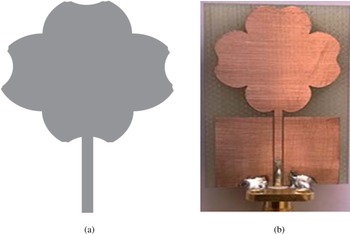
The performance of natural flower-shaped (compare Fig. 1) antennas [Reference Patre and Singh5–Reference Soorya and Ramprakash11] with planar size has been tabulated in Table 1. Most of the flower-shaped antennas of Table 1 are designed using FR4 epoxy substrate whereas antenna reported in [Reference Ooi and Ang10] is designed using air and copper substrates. The antennas mentioned in [Reference Patre and Singh5, Reference Rani Patre and Singh6, Reference Kim, Choi and Kim8–Reference Ooi and Ang10] operate at single resonating band; the antenna mentioned in [Reference Soorya and Ramprakash11] operates at dual band whereas five-band behavior is observed in rose shape antenna [Reference Elavarasi and Shanmuganantham7] which is having a minimum area of 144 mm2 amongst the antennas reported in Table 1. The antenna reported in [Reference Soorya and Ramprakash11] has the largest planar area (8100 mm2). It is interesting to observe that in flower-shaped antennas, the antenna with maximum and minimum planar area exhibits a bandwidth in the vicinity of 500 MHz, which is suggestive of the fact that area of the flower-shaped antennas in case of [Reference Elavarasi and Shanmuganantham7, Reference Soorya and Ramprakash11] hardly affects the bandwidth performance of the antenna. However, both the antennas have been designed using different principles; therefore, an exact correlation between size and bandwidth of the two antennas reported in [Reference Elavarasi and Shanmuganantham7, Reference Soorya and Ramprakash11] cannot be made.
(a) Flower shape antenna geometry. (b) Fabricated photograph of flower shape fabricated antenna; reprint with permission from [Reference Patre and Singh5].

Comparative analysis of flower shape antennas

M, measured result; S, simulated result; NR, not reported; NB, notch band.
A maximum simulated peak gain 7.1 dBi and measured peak gain 7.4 dBi are observed in [Reference Kim, Choi and Kim8, Reference Ooi and Ang10], respectively. Flower shape antennas find its applications in the frequency range of 1.03–13.46 GHz. The maximum bandwidth (11 GHz) is observed in the antenna mentioned in [Reference Kim, Choi and Kim8]. The smallest size (12 × 12 mm2) antenna is reported in [Reference Elavarasi and Shanmuganantham7]. The radiation pattern of flower shape antenna shows almost bidirectional behavior in E-plane and omnidirectional behavior in H-plane.
In column 1 of Table 1, it is observed that the flower shape geometry can be designed after creating distinct small segments on the boundary of radiating patch. This leads to an increase in the overall perimeter (P) of the designed radiating patch and finally increases the current length path [Reference Patre and Singh5]. The increased current length path generates higher resonance frequencies. Therefore, flower shape antenna is a more suitable candidate for wideband applications as compared to conventional antenna.
Leaf shape antennas
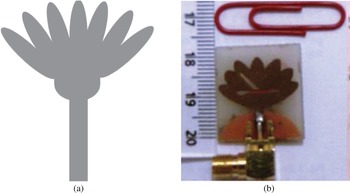
The overview of leaf shape (compare Fig. 2) antennas [Reference Ahmed and Sebak12–Reference Singh, Mishra, Pandey, Patel, Yadav and Singh17] along with their characteristics and applications has been presented in Table 2. Two antennas [Reference Ozkaya and Seyfi14, Reference Ahdi Rezaeieh and Kartal15] have been designed using FR4 epoxy substrate material and are resonating at single band and have same smallest antenna dimension (25 × 16 and 20 × 20 mm2) whereas the antenna reported in [Reference Bai, Zhong and Liang13] has the maximum planar area. The antenna with maximum planar area attains the highest bandwidth of 28.4 GHz and the antennas with minimum planar areas [Reference Ozkaya and Seyfi14, Reference Ahdi Rezaeieh and Kartal15] exhibit bandwidths of 3 and 4 GHz, respectively. In leaf shape antennas, we observe that the large planar area and change in dielectric constant from 4.4 (FR4 epoxy) to 3.5 yield a higher bandwidth of 28.4 GHz.
(a) Leaf shape antenna geometry. (b) Fabricated photograph of leaf shape antenna; reprint with permission from [Reference Ahdi Rezaeieh and Kartal15].

Comparative analysis of leaf shape antennas

M, measured result; S, simulated result; NR, not reported; NB, notch band.
The ratio of bandwidth of antenna with the largest area [Reference Bai, Zhong and Liang13] to the antenna with minimum area [Reference Ozkaya and Seyfi14] is 7.1:1 whereas the ratio of maximum area to minimum area of the antenna is 16:1. It can be easily inferred that with the increase in antenna area, the bandwidth increases. A simulated and measured gain of 6 and 5.9 dBi, respectively, is reported in [Reference Ahmed and Sebak12] and the leaf of rose shape antenna [Reference Lotfi Neyestanak16]. The radiation pattern of leaf shape antenna shows daunt shape pattern, omnidirectional pattern, asymmetrical and unidirectional pattern, and broadside pattern.
Tree shape antennas
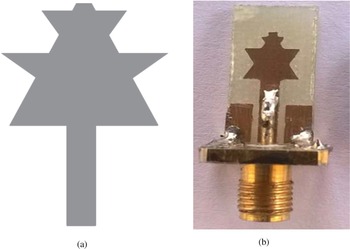
The performance of natural tree shape (compare Fig. 3) antennas [Reference Zeng, Zhang, Wang and Xie18–Reference Shen, Huang and Dong24] is presented in Table 3, which are designed over many different substrates (FR4 epoxy, Teflon, Nylon, and air). Antennas reported in Pythagoras shape antenna [Reference Kumar, Kumar and Singh19, Reference Arun and Karl Marx20] are multiband and reconfigurable, respectively, whereas the rest antennas [Reference Zeng, Zhang, Wang and Xie18, Reference Mishra and Sahu21–Reference Shen, Huang and Dong24] are single-band antenna. The antenna reported in [Reference Shen, Huang and Dong24] has the largest area (150 × 150 mm2) whereas antenna reported in [Reference Singhal, Goel and Singh22] has smaller size among the reported antenna in [Reference Zeng, Zhang, Wang and Xie18–Reference Shen, Huang and Dong24]. The antennas mentioned in [Reference Mishra and Sahu21, Reference Singhal, Goel and Singh22] have smaller patch area and they also yield higher bandwidth of the order of 17.3 GHz [Reference Mishra and Sahu21] and 11.2 GHz [Reference Singhal, Goel and Singh22] whereas antenna [Reference Shen, Huang and Dong24] yields a very low impedance bandwidth (0.7 GHz) in penalty of large size.
(a) Tree shape antenna geometry. (b) Fabricated photograph of tree shape antenna; reprint with permission from [Reference Singhal, Goel and Singh22].

Comparative analysis of tree shape antennas

M, measured result; S, simulated result; NR, not reported; NB, notch bands.
The simulated antenna gains are reported in Table 3 by the authors. The antenna [Reference Shen, Huang and Dong24] shows the maximum peak gain of 18.4 dBi but it is not suitable for small devices due to its large size. Antenna [Reference Singhal, Goel and Singh22] has a very small area of 9.2 × 18.5 mm2 and can be used in mobile, radio, and satellite applications. The antennas with large planar areas [Reference Zeng, Zhang, Wang and Xie18, Reference Shen, Huang and Dong24] exhibit a smaller fractional bandwidth but exact co-relation cannot be derived as both are fabricated on different substrate materials. The radiation pattern of tree shape antenna shows half-wave dipole-like pattern and omnidirectional pattern.
Owing to the analysis of tree shape antennas, it is observed that most of the antennas [Reference Zeng, Zhang, Wang and Xie18, Reference Kumar, Kumar and Singh19, Reference Singhal, Goel and Singh22, Reference Park, An and Lee23] in [Reference Zeng, Zhang, Wang and Xie18–Reference Shen, Huang and Dong24] come into the category of fractal antenna. Fractal antenna increases the effective current length path on the radiating surface after filling the blank space with conducting material. Therefore, in wideband applications, tree shape geometry can be replaced with fractal geometry and vice-versa.
Fan shape antennas
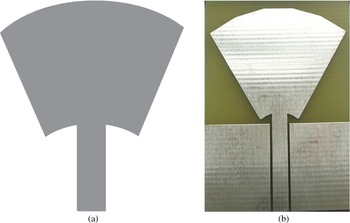
Fan shape (compare Fig. 4) antennas [Reference Mathew, Anitha, Roshna, Nijas, Aanandan, Mohanan and Vasudevan25–Reference Kumar and Vishwakarma31] listed in Table 4 have been designed only for single-band applications. The smallest size antenna has been reported in [Reference Ojaroudi, Mehranpour and Ghadimi28] with maximum measured bandwidth (14.6 GHz) and can be used for ultra-wide band applications. The antenna with the largest planar area of 125 × 125 mm2 is reported in [Reference Babakhani and Sharma26] with a very small bandwidth (simulated) of 0.49 GHz.
(a) Fan shape antenna geometry. (b) Fabricated photograph of Fan shape antenna; reprint with permission from [Reference Wang, Yan, Li and Li29].

Comparative analysis of fan shape antennas

M, measured result; S, simulated result; NR, not reported; NB, notch bands.
However, it is difficult to deduce a direct relation between the area and the bandwidth, as only the simulated bandwidth of the antenna with maximum area [Reference Babakhani and Sharma26] is reported. A maximum simulated gain of 6 dBi and measured gain of 4.4 dBi is observed in [Reference Babakhani and Sharma26, Reference Wang, Yan, Li and Li29] respectively. The radiation pattern of fan shape antenna shows omnidirectional pattern, bidirectional pattern, and dipole-like pattern.
Pi shape antennas
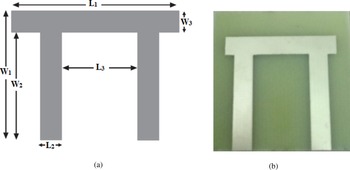
Table 5 depicts an overview of Pi shape antennas [Reference Choi, Kwak, Lee and Kwak32–Reference Arora, Sharma and Ray34] (compare Fig. 5). Pi shape antennas [Reference Choi, Kwak, Lee and Kwak32, Reference Chen33] show dual resonating behavior while the antenna mentioned in [Reference Arora, Sharma and Ray34] resonates at single frequency. A minimum/maximum measured bandwidth of 0.114/10.7 GHz is observed in [Reference Choi, Kwak, Lee and Kwak32, Reference Arora, Sharma and Ray34], respectively. The antenna reported in [Reference Choi, Kwak, Lee and Kwak32] shows dual- and single-band characteristics with shorting pin and without shorting-pin, respectively. The antenna mentioned in [Reference Choi, Kwak, Lee and Kwak32] is modified for three band (605, 920, and 1420 MHz) applications and reported in [Reference Deshmukh, Nishad, Gosavi, Narayanan, Nayak and Ambekar35]. The resonating band of antenna [Reference Deshmukh, Nishad, Gosavi, Narayanan, Nayak and Ambekar35] has changed from dual band to triple band with proper adjustment of feed position.
(a) Pi shape antenna geometry. (b) Fabricated photograph of Pi shape antenna.

Comparative analysis of Pi shape antennas

M, measured result; S, simulated result; NR, not reported; NB, notch bands.
The antenna mentioned in [Reference Choi, Kwak, Lee and Kwak32, Reference Chen33] has smaller size (15 × 15 mm2) and larger size (30 × 40 mm2), respectively, as compared to antennas reported in [Reference Choi, Kwak, Lee and Kwak32–Reference Arora, Sharma and Ray34]. The operating frequency of Pi shape antenna can alter and makes it suitable for wideband/multiband applications after increasing the current length path. From Table 5, it is concluded that the Pi shape antenna is compact in size due to its simple structure and suitable for low-frequency applications. Physical resonant length of Pi shape antenna for TM10 can be approximated as derived in [Reference Deshmukh, Nishad, Gosavi, Narayanan, Nayak and Ambekar35].

We observe a higher impedance bandwidth when RT-Duroid is used as substrate material and a minimum bandwidth when Teflon is used as substrate material. A maximum 6.52 dBi measured peak gain is observed in antenna [Reference Choi, Kwak, Lee and Kwak32] which is useful in WLAN applications.
Butterfly shape antennas
The performance of butterfly-shaped antennas [Reference Sun, He, Hu, Zhu and Chen36–Reference Tiwari, Singh and Kanaujia38] is presented in Table 6. The butterfly shape antenna is rarely reported in literature, but the authors searched in literature and found only single-band butterfly shape antenna. A measured bandwidth of 2.21, 6.7, and 1.45 GHz is observed in antennas [Reference Sun, He, Hu, Zhu and Chen36–Reference Tiwari, Singh and Kanaujia38], respectively. Operating band of these antennas is varying between 2.6 and 9.3 GHz. Butterfly shape antennas [Reference Sun, He, Hu, Zhu and Chen36, Reference Tiwari, Singh and Kanaujia38] have been designed for low-frequency applications but these are not practically integrable in small devices due to large structure size (>27 × 34 mm2).
Comparative analysis of butterfly shape antennas

M, measured result; S, simulated result; NR, not reported; NB, notch bands.
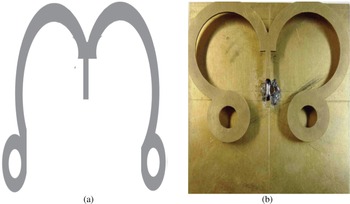
Resonance frequency of the butterfly shape antenna can be controlled with the removal of small circles in the left and right arms (compare Fig. 6) of the butterfly shape geometry. Feed position of the butterfly shape antenna can adjust the impedance matching and magnitude of return loss. The antenna mentioned in [Reference Tiwari, Singh and Kanaujia38] has a maximum peak gain of 8.8 dBi as compared to the gain reported in the antenna mentioned in [Reference Sun, He, Hu, Zhu and Chen36] (8.3 dBi) and [Reference Ye, Ning Chen and See37] (5 dBi).
(a) Butterfly shape antenna geometry. (b) Fabricated photograph of butterfly shape antenna; reprint with permission from [Reference Sun, He, Hu, Zhu and Chen36].

Bat shape antennas
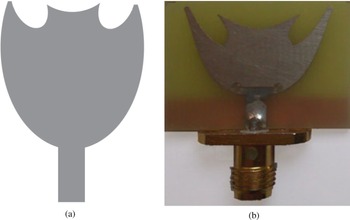
The performance of bat shape antennas [Reference Fakharian, Rezaei and Azadi39–Reference Mirmosaei, Afjei, Mehrshahi and Fakharian41] in terms of size, substrate, resonating band/bandwidth, peak gain radiation pattern, and tools used/applications is presented in Table 7. The geometry of bat shape antenna and fabricated photograph are portrayed in Figs 7(a) and 7(b) respectively. The geometry of bat shape antenna is basically a modified version of ellipse shape geometry. The major axis edge of ellipse shape geometry is notched to design a bat shape antenna. Antennas reported in Table 7 have been designed for single-band operation over FR4 epoxy and RT-Duroid materials, respectively. The bat shape antennas reported in [Reference Fakharian, Rezaei and Azadi39–Reference Singh, Singh and Singh42] exhibit a measured bandwidth of 11.2 GHz [Reference Fakharian, Rezaei and Azadi39], 0.26 GHz [Reference Kuralay, Uzun and Imeci40], and 8.73 GHz [Reference Mirmosaei, Afjei, Mehrshahi and Fakharian41]. A very large bandwidth of 11.2 GHz [Reference Fakharian, Rezaei and Azadi39] and a small bandwidth of 0.26 GHz [Reference Kuralay, Uzun and Imeci40] are observed. The antenna mentioned in [Reference Fakharian, Rezaei and Azadi39] shows a better absolute bandwidth as compared to the antennas reported in Table 7.
(a) Bat shape antenna geometry. (b) Fabricated photograph of bat shape antenna; reprint with permission from [Reference Mirmosaei, Afjei, Mehrshahi and Fakharian41].

Comparative analysis of bat shape antennas

M, measured result; S, simulated result; NR, not reported; NB, notch bands.
The size of the antenna mentioned in [Reference Fakharian, Rezaei and Azadi39] (17 × 27 mm2) is also compact as compared to the antennas reported in Table 7. However, the peak gain (9.72 dBi) of antenna [Reference Kuralay, Uzun and Imeci40] has a maximum value as compared to the antennas listed in Table 7. The radiation pattern of the antenna mentioned in [Reference Fakharian, Rezaei and Azadi39] shows omnidirectional/quasi omnidirectional and the antenna mentioned in [Reference Mirmosaei, Afjei, Mehrshahi and Fakharian41] shows monopole-like with bidirectional/omnidirectional, respectively. Bat shape antenna is suitable for WLAN, WiMAX, and UWB applications.
Owing to the bat shape antenna, it is observed that the notches are used on the ellipse-shaped geometry to enlarge the perimeter (P) of bat shape antenna which alters the low resonance frequency and finally increases the impedance bandwidth. This argument is validated with the well-known fact that the maximum current distribution appears on the edges rather than the center of the radiating patch.
The resonance frequency (L f) of bat shape, flower shape, leaf shape, and fan shape antenna is given by equation (2) as reported in [Reference Fakharian, Rezaei and Azadi39, Reference Mirmosaei, Afjei, Mehrshahi and Fakharian41].

where

The resonance frequency of the bat shape antenna can be controlled with alteration in perimeter length (P) which is in conformity with equation (2). This argument is not only applicable for bat shape antenna but also used in nature-inspired different types of antenna designs such as flower shape [Reference Patre and Singh5, Reference Rani Patre and Singh6], leaf shape [Reference Ahmed and Sebak12], fan shape [Reference Kumar and Vishwakarma31], and butterfly shape [Reference Tiwari, Singh and Kanaujia38]. These structures also increase the patch periphery without changing the actual patch size which causes the resonance frequency shift toward the lower frequency and vice-versa. Moreover, they enhance the antenna bandwidth due to the generation of higher modes by different boundary segments of the patch [Reference Patre and Singh5].
Wearable antennas
The performance of wearable antennas [Reference Singh, Singh and Singh42–Reference Yadav, Singh, Bhoi, Marques, Zapirain and Díez46] with different geometry (compare column 1 of Table 8) has been presented in Table 8. The reported wearable antennas have been fabricated over jeans fabric. The wearable antennas [Reference Singh, Singh and Singh42, Reference Yadav, Singh, Bhoi, Marques, Zapirain and Díez46] have been designed for single ultra-wide band applications with a bandwidth of 13.08 and 8.64 GHz, respectively, while the antenna mentioned in [Reference Singh, Dhupkariya and Bangari43] has been designed for dual ultra-wide band applications with a bandwidth of 2.29 and 4.23 GHz band. However, the concept of partial ground has been introduced in the antenna mentioned in [Reference Singh, Dhupkariya and Bangari43]. The antennas mentioned in [Reference Yadav, Singh and Mohan44, Reference Yadav, Singh, Yadav, Beliya, Bhoi and Barsocchi45] show circularly polarized behavior after using defected ground structure (DGS). The antenna mentioned in [Reference Yadav, Singh and Mohan44] operates in a single band (bandwidth of 4.2 GHz) whereas the antenna mentioned in [Reference Yadav, Singh, Yadav, Beliya, Bhoi and Barsocchi45] operates in triple bands (bandwidth of 0.9, 3.7, and 3.8 GHz).
Comparative analysis of wearable antennas

M, measured result; S, simulated result; NR, not reported; NB, notch bands.
The size of the antennas mentioned in [Reference Yadav, Singh, Yadav, Beliya, Bhoi and Barsocchi45, Reference Yadav, Singh, Bhoi, Marques, Zapirain and Díez46] is same and have smaller planer area (25 × 25 mm2) as compared to the antennas reported in Table 8. A minimum peak gain of 3.8 dBi of the antenna mentioned in [Reference Singh, Singh and Singh42] and a maximum peak gain of 5.7 dBi of the antenna mentioned in [Reference Singh, Dhupkariya and Bangari43] have been reported. Omnidirectional radiation pattern behavior of the antennas reported in [Reference Singh, Singh and Singh42, Reference Singh, Dhupkariya and Bangari43, Reference Yadav, Singh, Yadav, Beliya, Bhoi and Barsocchi45, Reference Yadav, Singh, Bhoi, Marques, Zapirain and Díez46] and bidirectional/omnidirectional radiation pattern of the antenna reported in [Reference Yadav, Singh and Mohan44] in E-plane/H-plane are observed. Wearable antennas reported in Table 8 find the applications in biomedicals, sensors, WiMAX, WLAN, C/X/Ku, and UWB bands.
The designing procedure of wearable antenna is almost same as the patch antenna. However, wearable antenna uses the flexible substrates for antenna design due to its practical implantation on human body. After examining the wearable antennas reported in Table 8, it is concluded that the wearable antenna plays a very vital role in medical applications but following issues are yet to be improved: to reduce the bending effect, make it washable, reduce electromagnetic interference in human body.
Multiband antennas
The performance of multiband antennas [Reference Sudeep, Goswami and Yadav47–Reference Sachan and Dhubkarya53] up to seven resonating bands has been presented in Table 9. The multiband antennas with simple design are highly desired for wireless applications as it is integrated into smart devices for multiple applications with the use of single antenna. The design of multiband antenna has been achieved in Table 9 after modification on radiating patch and ground plane structure using slots, notches, and defected ground, etc. [Reference Ali, Prasad and Biradar51]. The multiband antennas [Reference Sudeep, Goswami and Yadav47, Reference Verma and Srivastava48] have been designed for dual (bandwidth of 0.4 and 2.2 GHz) and triple bands (bandwidth of 0.05, 0.21, and 0.43 GHz), respectively, while the antennas mentioned in [Reference Kaur, Singh and Kaur49] and [Reference Gangwar and Alam50] have been designed for quad band applications with a bandwidth of 0.32, 0.09, 0.09, 0.04 GHz and 0.25, 0.31, 0.3, 1.04 GHz, respectively. The penta-band antenna [Reference Ali, Prasad and Biradar51] resonates in 3.54–9.78 GHz with a maximum bandwidth of 0.38 GHz, hexa-band antenna [Reference Singh, Mishra, Dwivedi and Singh52] resonates in 11.20–23.55 GHz with a maximum bandwidth of 1.77 GHz, and hepta-band antenna [Reference Sachan and Dhubkarya53] resonates in 1.57–7.91 GHz with a maximum bandwidth of 0.52 GHz. The antennas mentioned in [Reference Sudeep, Goswami and Yadav47, Reference Kaur, Singh and Kaur49–Reference Ali, Prasad and Biradar51] have been designed with partial ground structure and the antennas mentioned in [Reference Verma and Srivastava48, Reference Singh, Mishra, Dwivedi and Singh52] have been designed with the introduction of slots and notches on the radiating patch for multiband operations whereas hepta-band antenna [Reference Sachan and Dhubkarya53] has been designed using multiple substrate layers with photonic bandgap (PBG) structure to achieve seven band resonances.
Comparative analysis of multiband antennas

M, measured result; S, simulated result; NR, not reported; NB, notch bands.
The antennas [Reference Sudeep, Goswami and Yadav47–Reference Sachan and Dhubkarya53] reported in Table 9 have been fabricated over FR4 epoxy substrate. The antenna mentioned in [Reference Sudeep, Goswami and Yadav47] has smaller planar area (15 × 20 mm2) and the antennas mentioned in [Reference Verma and Srivastava48, Reference Sachan and Dhubkarya53] have larger planar area (39 × 47.6 mm2) as compared to the antennas reported in Table 9. A minimum peak gain of 1.2 dBi of the antenna mentioned in [Reference Ali, Prasad and Biradar51] and a maximum peak gain of 8 dBi of the antenna mentioned in [Reference Kaur, Singh and Kaur49] have been reported. Omnidirectional radiation pattern behavior of the antenna mentioned in [Reference Kaur, Singh and Kaur49], bidirectional/omnidirectional radiation pattern of the antennas mentioned in [Reference Sudeep, Goswami and Yadav47, Reference Verma and Srivastava48, Reference Gangwar and Alam50], dipole-like/omnidirectional radiation pattern of the antenna mentioned in [Reference Ali, Prasad and Biradar51], and directional radiation pattern behavior of the antenna mentioned in [Reference Singh, Mishra, Dwivedi and Singh52] in E-plane/H-plane are observed.
Monopole antennas
In Table 10, the performances of monopole antennas [Reference Bai, Zhong and Liang13, Reference Ahdi Rezaeieh and Kartal15, Reference Singh, Mishra, Pandey, Patel, Yadav and Singh17, Reference Wang, Yan, Li and Li29, Reference Ye, Ning Chen and See37, Reference Tiwari, Singh and Kanaujia38] are presented. The monopole antennas with leaf shape geometry have been reported in [Reference Bai, Zhong and Liang13, Reference Ahdi Rezaeieh and Kartal15, Reference Singh, Mishra, Pandey, Patel, Yadav and Singh17]. A measured bandwidth of 28.4 and 3 GHz of antennas reported in [Reference Bai, Zhong and Liang13, Reference Ahdi Rezaeieh and Kartal15] is, respectively, observed. Triple band antenna [Reference Singh, Mishra, Pandey, Patel, Yadav and Singh17] yields the impedance bandwidth of 51.7, 11.5, and 10.8% at frequencies 0.54, 3.04, and 3.87 GHz, respectively. A fan shape monopole antenna reported in [Reference Wang, Yan, Li and Li29] resonates in 3.1–10.6 GHz band and yields a bandwidth of 7.5 GHz. Monopole antennas with butterfly shape [Reference Ye, Ning Chen and See37] and bat shape [Reference Tiwari, Singh and Kanaujia38] resonate in single band with a bandwidth of 7.5 and 11.2 GHz, respectively.
Comparative analysis of monopole antennas

M, measured result; S, simulated result; NR, not reported; NB, notch bands.
A measured maximum/minimum bandwidth of 28.4/3 GHz is observed in [Reference Bai, Zhong and Liang13, Reference Ahdi Rezaeieh and Kartal15], respectively. However, the antenna mentioned in [Reference Singh, Mishra, Pandey, Patel, Yadav and Singh17] reported only simulated bandwidth wherein a maximum/minimum bandwidth of 51.7/10.8% is observed. The antenna mentioned in [Reference Ahdi Rezaeieh and Kartal15] has smaller planar area (20 × 20 mm2) and the antenna mentioned in [Reference Ye, Ning Chen and See37] has the largest planar area (300 × 300 mm2) compared to the antennas reported in Table 10. However, the antenna mentioned in [Reference Ahdi Rezaeieh and Kartal15] has smaller bandwidth among the antennas listed in Table 10. The bandwidth of the antenna mentioned in [Reference Bai, Zhong and Liang13] is larger but the size (80 × 80 mm2) of the antenna is significantly large.
A minimum/maximum peak gain of 3.05/5 dBi is observed in [Reference Ahdi Rezaeieh and Kartal15, Reference Ye, Ning Chen and See37], respectively. A maximum peak gain of 5 dBi is offered in the antenna mentioned in [Reference Ye, Ning Chen and See37] but practically not suitable for small devices due to its large antenna size. Radiation pattern of the monopole antennas is almost omnidirectional in nature.
A brief survey on bandwidth enhancement techniques
There are several bandwidth enhancement techniques such as introduction of thick and lower permittivity substrate, multilayer substrate, parasitic elements, slots and notches, shorting wall, shorting pin, DGS, metamaterial-based split ring resonator (SRR) structure, fractal geometry, and composite right-hand/left-hand transmission line (CRLH-TL) approach that have been tabulated in Table 11. Thick and low permittivity substrate antenna is reported here for wideband applications (35% bandwidth) [Reference Luk, Mak, Chow and Lee54]. Stacked microstrip patch antennas [Reference Mishra, Singh and Singh55–Reference Nayeri, Lee, Elsherbeni and Yang59] consist of different layers of dielectric material along with patch and parasitic patch that are electronically coupled to the feed line. The stack antenna increases the overall height and back radiation of the MSAs which is not desirable for conformal applications. However, stacked broadband MSAs improve the gain of the antenna with negligible degradation in radiation pattern over the entire bandwidth as compared to the single-layer antenna.
Comparative overview of bandwidth enhancement techniques of MSAs

Gap coupled microstrip patch antenna is the most popular technique in practice that is used to enhance the bandwidth where two patches are separated by a suitable gap length. In this, one patch is directly excited by feed (fed patch) and other is radiated by fed patch (parasitic patch) [Reference Kumar and Gupta60–Reference Meshram and Vishvakarma62]. Electronically coupled (stacked antenna), aperture coupled, and gap coupled antenna are known as multi resonating antennas that yield broad bandwidth but their large size and volume make them unsuitable for the antenna array element [Reference Kumar and Ray1]. A maximum of 44.9% bandwidth is achieved in stacked antennas [Reference Ooi, Qin and Leong56] and up to 30% improved bandwidth is reported by [Reference Meshram and Vishvakarma62] in all gap coupled antennas. Dual (14.08/13.32%) and wideband (25.09%) multilayer antenna with improved gain for WLAN/WiMAX applications is reported [Reference Mishra, Singh and Singh55].
The shorting wall and shorting pin loaded antennas [Reference Guha and Antar63–Reference Chiu, Wong and Chan71] have been reported in Table 11. A maximum bandwidth (98.22%) is achieved by using a folded patch and shorting pin techniques [Reference Malekpoor and Jam65] where a shorting copper pin is used to connect the upper patch and ground plane. Antenna layer shorted by a conducting wall or folded wall to achieve the broad bandwidth up to 28.1% impedance bandwidth is reported by Li et al. [Reference Li, Chair, Luk and Lee68]. The slot on the radiating patch creates another resonance in addition to the patch resonance thereby increasing the bandwidth at the expense of increasing back radiation but it suffers from poor gain and degradation of radiation pattern [Reference Kumar and Ray1, Reference Ansari, Singh, Dubey, Khan and Vishvakarma72, Reference Jan and Su73, Reference James and Hall74]. Introduction of slot on the patches has led to an impedance (Z s = R r + jX c) parallel to the input impedance of the antenna. The slot impedance consists of radiation resistance (R r) and the reactive component (X c) in series that alters the total input impedance of the patch antenna [Reference Kamakshi, Singh, Ansari and Mishra75]. Enhanced bandwidth up to 25.09% [Reference Mishra, Singh and Singh55] and 48.8% [Reference Jan and Su73] is achieved in slot loaded antenna.
Researchers are also trying to enhance the antenna gain and they have already proposed several gain enhancement techniques in last decades such as addition of dielectric substrates over the primary dielectric substrate [Reference Jackson and Alexopoulos76, Reference Yang and Alexopoulos77], up to 4 dBi increased gain is obtained using metamaterial structure [Reference Majid, Rahim and Masri78]; PBG structure is also used to increase significant gain [Reference Yang, Alexopoulos and Yablonovitch79], electromagnetic band gap structure has been used to achieve up to 2.9 dBi enhanced gain [Reference Boutayeb and Denidni80] and slotted ground plane structure is reported to enhance the antenna gain up to 3.3 dBi [Reference Kuo and Hsieh81].
To design high efficiency antenna, impedance of fed network and radiating patch impedance should be conjugated to match perfectly. To overcome the poor radiation efficiency problem of MSA, a dual feed circularly polarized antenna is chosen to improve radiation efficiency [Reference Xing, Wang, Li and Wei82].
Small planar size of antenna is in more demand in advanced communication technology due to their compatibility with monolithic microwave integrated circuit and array antenna elements. Several methods have been developed to reduce the antenna structure size such as low-temperature co-fired ceramic technology with only 8 × 8 × 1.1 mm3 of antenna volume is reported [Reference Li, Zhang, Wang, Zhao, Liu and Xu83], an effective approach of inductively loading the patch using a cuboid ridge is presented [Reference Whittow and Motevasselian84], and a square patch antenna with loading of slits and truncated corners is reported while 36% antenna size is reduced as compared to conventional square patch antenna [Reference Chen, Wu and Wong85].
Owing to the above study, it is observed that many techniques have been reported in literature to improve the antenna parameters such as bandwidth, gain, and radiation efficiency. In this section, only bandwidth enhancement techniques have been carried out and the techniques for gain and radiation efficiency improvement are omitted as it makes this work more voluminous.
Effects of thick substrate, stacked substrate, and parasitic substrate
The thick substrate (S. No. 1 in Table 11) provides high gain and large bandwidth of microstrip patch antenna but at the same time it makes antenna more voluminous and limits the applications of microstrip patch antenna. The alteration in substrate height (h) shifts the resonating frequency toward lower band (with increase in substrate height) or toward higher frequency band (with decrease in substrate height) [Reference Balanis86] which is also in conformity with equation (4).

where c is speed of light, f is resonating frequency, ɛ r is relative permittivity of dielectric.
The simplified circuit diagram of thick substrate microstrip patch antenna is like rectangular microstrip patch antenna as presented at S. No. 1 in Table 11. The value of electrical circuit elements can be calculated with the analysis presented in [Reference Singh, Mishra and Singh87–Reference Shivnarayan and Vishvakarma89]. After relating equation (4) and the analysis presented in [Reference Singh, Mishra and Singh87–Reference Shivnarayan and Vishvakarma89], it may be concluded that there is a decrease in capacitive effect, quality factor, and resonating frequency of microstrip patch antenna whereas the inductive effect increases with the increase in substrate height. However, authors have reported thin substrate microstrip antenna for improved bandwidth (30%) with a penalty of spurious radiation and poor gain [Reference Tsai and York90].
In designing microstrip patch antenna, the use of thick substrate (S. No. 1 in Table 11) results in high gain and large bandwidth but at the same time it limits its applications by making it more voluminous.
The multilayer structure consists of two or more substrate layers with different dielectric constants (S. No. 2 in Table 11) to increase the bandwidth and gain of the antenna. The stacked antenna shows a small degradation in radiation pattern over entire bandwidth as compared to the conventional antenna. The drawback of stacked antenna is that it increases the antenna volume and generates spurious radiation in aperture-coupled stacked antenna which restricts antenna applications in small devices. The effect of multilayer structure in terms of effective dielectric constant, resonating frequency, mutual inductance, and capacitance of stacked and parasitic patches are discussed in reported works [Reference Mishra4, Reference Kuralay, Uzun and Imeci40, Reference Singh, Aneesh, Kamakshi and Ansari91].
The gap-coupled structure (S. No. 3 in Table 11) of strip conductor is represented by an equivalent T or π network [Reference Meshram and Vishvakarma62]. The plate capacitance (Cp) is introduced because of field distribution at the edge of the conductor whereas gap capacitance (Cg) arises due to the coupling effect of two conductors. Large air gap between two patches may be ineffective and behave as single patch antenna due to weak electric field at the edges of conductors. The resonant frequency decreases exponentially with an increase in gap length due to the significant shift in zero reactance point of the antenna. The gap between patches introduces gap capacitance (Cg) and plate capacitance (Cp) as illustrated at S. No. 3 in Table 11 and values can be referred from antennas reported in [Reference Meshram and Vishvakarma62, Reference Singh, Mishra and Singh87, Reference Ansari, Singh, Yadav and Vishwakarma92–Reference Ansari, Yadav, Mishra, Singh and Vishvakarma94].
Effects of shorting pin and shorting wall
A copper rod is generally used to short the radiating path and ground via dielectric substrate (compare S. No. 4 in Table 11). The copper rod comprises of an inductance (L sh) in parallel to the patch antenna circuit that is illustrated at S. No. 4 in Table 11. The inductive effect of shorting copper rod is formulated in equation (5) as stated in [Reference Ansari, Singh, Yadav and Vishwakarma92, Reference Mishra, Singh and Singh93].

where A = Euler's constant = 0.5772, D is diameter of the shorting pin, and η 0 = 120π.
The shorting wall or metal plate is used to short the two regions (radiating patch and ground patch) of microstrip patch antenna (compare S. No. 5 in Table 11) to overcome the surface wave effects. An introduction of shorting pin between radiation patch and ground plane leads to control the operating transverse magnetic (TM) modes, antenna gain, resonance size, and bandwidth due to the significant change in current length path on the radiating surface [Reference James and Hall74]. Introduction of shorting wall results in wideband behavior of microstrip patch antenna. Also, parallel inductive load is introduced due to shorting wall which can be calculated as [Reference Mishra, Singh, Yadav, Ansari and Vishvakarma95]:

where, l = length of shorting wall, t = width of shorting wall, h = height of substrate.
Effects of slot and notch analysis of notch loaded patch
The introduction of a notch (L n × W n) on the patch (compare S. No. 7 in Table 11) creates multiple resonance and directs current flow in two different ways, normal to the patch and around the notches. Current length normal to patch is responsible for resonance at the designed frequency of the initial patch (L p × W p) whereas current length around the notches generates second resonance frequency. Due to this phenomenon, the inductance and capacitance of equivalent circuit of antenna get replaced with a series inductance (ΔL) and a series capacitance ΔC respectively which can be calculated as [Reference Mishra, Ansari, Kamakshi, Singh, Aneesh and Vishvakarma88].


where μ 0 = 4π × 10−7 H/m, C g = gap capacitance [Reference Yang, Alexopoulos and Yablonovitch79].


The impedance of notch loaded patch as shown in Table 11 is given as,

where


Figure 8 and S. No. 7 in Table 11 show the modified circuit of antenna after the introduction of notch on the patch with additional coupling impedance Z m between two resonator circuits (with notch (Znp) and without notch Zcp). Impedance Z m is in series with mutual inductance L m and capacitance C m and can be calculated as mentioned in [Reference Shivnarayan and Vishvakarma89]. The equivalent impedance (Zcp) of simple rectangular patch (L p × W p) antenna without notch is given according to [Reference Singh, Mishra and Singh87].

where


Equivalent circuit of notch loaded patch antenna.

Analysis of slot loaded patch
The slot on the patch (compare S. No. 6 in Table 11) can be analyzed by using the duality relationship between the dipole and slot [Reference Xing, Wang, Li and Wei82]. Introduction of slot (L s × W s) on the patches led to an impedance (Z s = R r + jX c) parallel to the input impedance of the antenna as shown in Table 11 at S. No. 6 and is given by equation (23). Further values can be calculated accordingly [Reference Singh, Aneesh, Kamakshi and Ansari91].

where R r and X c are given as


B = 2π/λ is propagation constant in free space and S i and C i are defined as:


Hence, the total input impedance of slot loaded antenna can be calculated as:

where

Defected ground structure (DGS) and Split ring resonator (SRR)
The DGS is generally used on ground plane (compare S. No. 8 in Table 11) to improve the antenna radiation but for some antenna structures this technique also helps to improve the antenna bandwidth [Reference Shivnarayan and Vishvakarma89, Reference Singh, Ansari, Kamakshi, Mishra and Aneesh96–Reference Shackelford, Leong and Lee99]. The DGS structure changes current length path and electrical elements value (R1, L1, and C1) of equivalent circuit of microstrip patch antenna. The DGS increases inductance value (L1) and reduces capacitance value (C1) of resonant circuit (compare S. No. 8 in Table 11). This fact results into large bandwidth (f − f c) (f + f c) of microstrip patch antenna as stated in equation (32). Extremely high impedance bandwidth (112.4%) is reported in [Reference Chiang and Tam100] as compared to the impedance bandwidth of antennas reported in [Reference Mishra, Singh, Singh, Singh and Singh2] (54.65%) and [Reference Guha and Kumar101] (22%). Equivalent circuit model and elemental values of DGS are given below as formulated in [Reference Khandelwal, Kanaujia and Kumar102].


SRR structure is a very common structure on ground plane (compare S. No. 9 in Table 11) to change the material properties such as permeability and magnetic susceptibility in electric field environment. The SRR structure consists of opposite small gaps in concentric, square, and rectangular nonmagnetic metal-like copper (compare S. No 9 in Table 11). The small opposite gaps behave as two parallel plates and produce a large capacitance value which lowers the resonating frequency. Also, the small structure of SRR results in low radiation losses and very high-quality factor. In antenna design, SRR structure improves the impedance bandwidth as compared to conventional antennas [Reference Arora, Pattnaik and Baral103–Reference da Silva, de Andrade, da Silva, Fernandes and Pereira106]. The antenna reported in [Reference da Silva, de Andrade, da Silva, Fernandes and Pereira106] has a large impedance bandwidth (17.66%) in comparison to the bandwidths of 12% in [Reference Arora, Pattnaik and Baral103], 6.6/4.8% in [Reference da Silva, de Andrade, Fernandes, da Silva, Júnior, Pereira and Neto104], and 11.4% in [Reference Patel, Argyropoulos and Kosta105]. Equivalent circuit of SRR is depicted in Table 11 (S. No. 9) and its elemental values can be calculated as in [Reference Baena, Bonache, Martin, Sillero, Falcone, Lopetegi, Laso, Garcia, Gil, Portillo and Sorolla107].
Fractal geometry
Initially, the concept of fractal antenna was introduced for the reduction of antenna size. In order to satisfy the demand of bandwidth and compact size of an antenna, researchers are utilizing the fractal geometry in his research to improve the bandwidth for advanced technologies. This antenna increases the effective current length path on the radiating surface after filling the blank space with conducting material. The fractal geometry introduces an additional virtual reactive inductors and capacitors in resonance circuit. This behavior of fractal antenna creates multi-resonance which can be chosen after proper selection of fractal geometry. Number of iterations can increase the radiation property and bandwidth of a fractal antenna.
The fractal antennas [Reference Elavarasi and Shanmuganantham7, Reference Singhal, Goel and Singh22, Reference Park, An and Lee23, Reference Sharma, Lakwar, Kumar and Garg108–Reference Srivastava, Khanna and Saini112] have been reported at S. No. 10 in Table 11. The antennas reported in [Reference Elavarasi and Shanmuganantham7, Reference Singhal, Goel and Singh22, Reference Park, An and Lee23, Reference Sharma, Lakwar, Kumar and Garg108–Reference Srivastava, Khanna and Saini112] have utilized the fractal geometry with the introduction of other reported bandwidth enhancement techniques such as flower shape antenna [Reference Elavarasi and Shanmuganantham7] used fractal geometry with SRR structure, tree shape antennas [Reference Singhal, Goel and Singh22, Reference Park, An and Lee23] used notch and DGS, respectively, and the antennas reported in [Reference Sharma, Lakwar, Kumar and Garg108–Reference Srivastava, Khanna and Saini112] used SRR, metamaterial, slot, shorting-pin, and gap coupled structure, respectively. A maximum/minimum bandwidth of 113.13/3.3% in [Reference Singhal, Goel and Singh22, Reference Sharma, Lakwar, Kumar and Garg108] is observed, respectively, among reported antennas at S. No. 10 in Table 11. After comparison of fractal antennas, this is concluded that the fractal geometry can optimize both size and bandwidth provided the introduction of techniques reported in S. No. 1–10 has been used.
Composite right/left-handed transmission line (CRLH-TL) approach
A miniaturized technique CRLH-TL approach for bandwidth enhancement is presented at S. No. 11 in Table 11. The antennas [Reference Rajasekhar and Kumar113–Reference Ahmed, Ahmed, Ihsan, Chaudhary and Arif118] reported at S. No. 11 in Table 11 have utilized the CRLH-TL technique to enhance the bandwidth. The miniaturization of monopole antenna has been achieved by using CRLH-TL unit cells with zeroth-order resonant (ZOR) mode [Reference Nuthakki and Dhamodharan114]. The ZOR resonance frequency of the antenna does not depends on its length, but it depends on the parameters of CRLH-TL unit cells. Merely ZOR cannot enhance the antenna bandwidth. Therefore, merging of ZOR modes with CRLH-TL unit cell results an enhancement in bandwidth without decreasing antenna efficiency.
The equivalent circuit model of the basic CRLH-TL unit cell is represented by series combination of inductance LP and capacitance CP and shunt combination of inductance LQ and capacitance CP [Reference Rajasekhar and Kumar113]. In CRLH loading, open circuit and short circuit resonance of ZOR mode is due to the shunt and series branch of inductor and capacitor observed, respectively. The resonance frequencies for the series branches (f o (series)) and shunt branch (f o (shunt)) can be written as given in [Reference Abdalla, Hu and Muvianto115].


The antennas reported in [Reference Rajasekhar and Kumar113, Reference Nuthakki and Dhamodharan114] have utilized the CRLH-TL two-unit cell with a bandwidth of 160% between 1.55 and 14.25 GHz for UWB applications and the antennas reported in [Reference Abdalla, Hu and Muvianto115, Reference Abdalla and Hu116] with four-unit cell have been designed with a maximum bandwidth of 173% between 1.0 and 13.6 GHz. However, two-unit cells of same size for triple band (bandwidth of 200, 500, and 600 MHz) and three-unit cell of different sizes for quad band (bandwidth more than 100 MHz for each band) applications have been reported [Reference Abdalla, Hu and Muvianto115, Reference Abdalla and Hu116]. The antenna [Reference Ghosh and Das117] utilizes the CPW and stub for circular polarization (impedance bandwidth of 1770 MHz between 3.78 and 5.55 GHz and ARBW of 1750 MHz between 3.50 and 5.25 GHz) and band notch with slit loaded (impedance bandwidth of 2200 MHz between 3.28 and 5.48 GHz with a band notch from 4.18 to 4.65 GHz). The antenna [Reference Ahmed, Ahmed, Ihsan, Chaudhary and Arif118] has been designed with CRLH-TL approach and gap coupled concept results dual-band characteristic at 4.84 and 5.22 GHz resonance with the impedance bandwidth of 100 and 50 MHz, respectively.
Conclusions
A comprehensive review of microstrip patch antenna concerning flower shape, leaf shape, tree shape, fan shape, Pi shape, butterfly shape, and bat shape antennas along with bandwidth enhancement techniques has been carried out. The antenna size, dielectric materials, resonating band, peak gain, radiation efficiency, simulating tools, and their applications have been carefully investigated.
From the discussions carried out in this review paper, the following points can be highlighted:
(1) Most of the reported antenna designs are simulated through the HFSS based on finite element method (FEM) algorithm and validated well with experimental results. IE3D (MoM-based program) performs simulation inherently faster (minimum time is required per iteration) while HFSS (FEM-based program) is inherently able to analyze much more general geometry of antenna. Ansoft HFSS provides very neat and adaptive mesh refinement while CST allows better handling of difficult electromagnetic coupling between its different parts. FEM and finite integration technique (FIT)-based program are more suitable than other simulation package for modern small and compact size of antenna.
(2) The leaf shape antenna [Reference Bai, Zhong and Liang13] exhibits extremely wideband impedance bandwidth (28.4 GHz) covering L, C, X, and Ku bands of electromagnetic spectrum. The bandwidth (28.4 GHz) of leaf shape antenna [Reference Bai, Zhong and Liang13] is larger than the antennas reported in [Reference Patre and Singh5–Reference Ahmed and Sebak12, Reference Ozkaya and Seyfi14–Reference Mirmosaei, Afjei, Mehrshahi and Fakharian41] of Tables 1–5. The simulated peak gain of 18.4 dBi of tree shape antenna [Reference Shen, Huang and Dong24] and measured peak gain of 9.72 dBi of bat shape antenna [Reference Kuralay, Uzun and Imeci40] are larger than the gain reported in [Reference Patre and Singh5–Reference Park, An and Lee23, Reference Mathew, Anitha, Roshna, Nijas, Aanandan, Mohanan and Vasudevan25–Reference Tiwari, Singh and Kanaujia38].
(3) Antenna size of reported works is in millimeter scale. The antenna reported in [Reference Elavarasi and Shanmuganantham7] has a very small antenna dimensions (144 mm2) whereas the antenna reported in [Reference Shen, Huang and Dong24] and [Reference Ye, Ning Chen and See37] has very large antenna dimensions 22 500 and 90 000 mm2, respectively, as compared to the antennas reported in Tables 1–10. The compact antenna [Reference Elavarasi and Shanmuganantham7] has been designed for IEEE802.11, IEEE802.11, GSM, WLAN, and WiMAX applications. Among several dielectric materials such as FR4 epoxy, RT/Duroid, Foam, Air, Teflon, and Nylon, the FR4 epoxy is mostly used to design microstrip antenna due to its wide availability and feasible cost.
Owing to the review of different antenna geometry (compare Tables 1–10) specially flower shape, leaf shape, tree shape, fan shape, Pi shape, butterfly shape, bat shape, wearable, multiband, monopole, fractal, and CRLH-TL antennas, it is concluded that the shapes are notched on the edges of radiating patch to enhance the perimeter as well as impedance bandwidth of the antenna.
This argument is in conformity with the fact of a maximum current distribution appears on the edges rather than the center of the radiating patch.
After examining the wearable antennas reported in Table 8, it is concluded that the wearable antenna plays a very vital role in medical applications but following issues are yet to be improved: to reduce the bending effect, make it washable, reduce electromagnetic interference in human body.
(4) A critical review of bandwidth enhancement techniques and equivalent circuit model of microstrip patch antenna is presented in Table 11. The circuit theory model concept is merely taken into consideration for the review of bandwidth enhancement techniques. From the above discussion, it can be clearly concluded that the shorting wall, shorting pin, and loading of slot are various types of inductive loading whereas the notch, DGS, gap coupled, SRR, and CRLH-TL are several types of inductive as well as capacitive loading. The resonance behavior of microstrip patch antenna depends on the overall input impedance of the patch antenna and the input impedance of antenna can be changed by any physical change in antenna structure with the help of reported techniques listed in Table 11.
Acknowledgements
We would like to show our gratitude to Nidhi Singh for her support in language editing that greatly improved the manuscript.
 Brijesh Mishra received his M. Tech. (Electronics Engineering) and D.Phil. (RF and Microwaves) degrees from the University of Allahabad in 2012 and 2018. Dr. Brijesh Mishra worked as an Assistant Professor in the Department of Electronics and Communication Engineering at Shambhunath Institute of Engineering and Technology (SIET) during 2012–2013 and 2017–2018. Presently, he is working as an Assistant Professor (NPIU-MHRD) in the Department of Electronics and Communication Engineering at Madan Mohan Malaviya University of Technology. He has published more than 38 research papers in journals of international repute, international conferences, and books chapters and he has also edited an international book entitled “VLSI, Microwave and Wireless Technologies-Proceedings of ICVMWT 2021”. Dr. Brijesh Mishra is the principal investigator and co-investigator in two NPIU and World Bank funded projects. He is the recipient of awards like Excellence in Performance and Outstanding contributions. He has served as Organising Track Chair and Organising Secretary in IEEE Conference (ICE3-2020) and Springer Conference (ICVMWT-2021), respectively. He is a member of IEEE, ISTE, IE(I), IETE, IAENG, and IFERP. His research interest includes modeling, simulation, and fabrication of RF and microwave devices and its applications.
 Ramesh Kumar Verma received his M. Tech degree in year 2015 from Bundelkhand Institute of Engineering and Technology Jhansi, in Digital communication. He had completed B. Tech in year 2009 from Raj Kumar Goel Institute of Technology Ghaziabad in Electronics and Communication Engineering. He is currently pursuing Ph.D. from AKTU Lucknow, Uttar Pradesh, India. He is an expert in antenna designing, fabrication, IE3D simulation software and Particle Swarm Optimization (PSO) Algorithm. Presently, he is working on optimization of microstrip patch antenna with PSO and curve fitting.
 Yashwanth N is working as an Associate Professor in the Department of Electronics and Communication Engineering, Nagarjuna College of Engineering & Technology, Bengaluru, India. He has completed his Ph.D. from Visvesvaraya Technological University, Belagavi in 2020. In 2012, he received his M. Tech degree in Signal Processing and VLSI from Jain University, Bengaluru. He completed his B.E. in Electronics and Communication Engineering from Visvesvaraya Technological University, Belagavi in 2010. He has worked as an Assistant Professor at Rajeev Institute of Technology, Hassan, with 8 years of teaching experience to UG and PG students. He has authored or co-authored more than 15 research papers in international journal/conference proceedings. His research interests include wireless sensor networks, signal processing, VLSI, communication systems, and antennas. He is a reviewer of many international journal/conference proceedings.
 Rakesh Kumar Singh received his M. Tech (Electronics Engineering) and Ph.D. (Electronics and Communication) degrees from Sam Higginbottom University of Agriculture, Technology and Sciences during 2013 and 2018, respectively. He has completed his B.Sc. and M.Sc. degrees from the University of Allahabad in 1999 and 2003, respectively. Currently, he is working as a Director at SIET, Prayagraj Uttar Pradesh, affiliated from AKTU. He has teaching and research experience of about 16 years. Dr. Rakesh Kumar Singh has published more than 14 papers in International Journals and Conferences and supervised more than three M. Tech thesis. His research interest includes modeling and simulation of VLSI devices, RF and microwave devices, and its applications.