Introduction
Elder abuse affects an estimated 1 in 10 older adults in the USA. Elder abuse agencies work with victims to reduce the risk of revictimization by providing legal and support services, and referrals to community-based services. In collaboration with the New York City Department for the Aging (DFTA) Elder Justice Service, we implemented routine mental health screenings finding that one-third of victims reported significant depressive symptoms (Sirey et al., Reference Sirey, Berman and Salamone2015a). Depressed victims have higher mortality rates (Dong et al., Reference Dong, Simon and Mendes de Leon2009). When offered abuse resolution services, victims underutilize them, sometimes believing that they have no options for change. Depressive symptoms, including depressed mood, a sense of hopelessness, and helplessness further reduce the use of services.
We have developed PROTECT, Providing Options to Elderly Clients Together, with our community partners to address depression among victims seeking elder abuse services. PROTECT is a 9-week behavioral psychotherapy tailored to the needs of elder abuse victims. It is simple, easy to learn, and can be delivered by community clinicians with high adherence (Sirey et al., Reference Sirey, Halkett and Chambers2015b). Using our model of late-life depression (Alexopoulos, Reference Alexopoulos2019), PROTECT is designed to address the impact of chronic stress by activating the reward system through the increase of pleasurable activities and taking actions toward personalized goals. PROTECT therapists work with victims to increase self-protective behaviors, to reduce stress, and to engage in activities with non-abusive others (Solomonov et al., Reference Solomonov, Bress and Sirey2019). PROTECT includes ongoing communication with agency staff to maintain a cohesive treatment approach aimed to reduce risk of re-victimization among patients.
This study was designed to test the feasibility, acceptability, and preliminary efficacy of PROTECT on depression severity and quality of life among elder abuse victims with capacity. We hypothesized that victims receiving PROTECT would be more likely to initiate therapy, report higher satisfaction, have greater reductions in depression, and have greater improvement in quality of life as compared to victims who are referred to community therapists.
Methods
Subjects
Eligible victims of abuse were screened using the Patient Health Questionnaire-9 (PHQ-9) by their elder abuse resolution case workers. Case workers obtained verbal permission from eligible clients (PHQ-9 ≥ 10) to allow Cornell research staff to contact the client directly. Clients who agreed to be contacted met with a research assistant to review the study and obtain written informed consent.
Eligible participants: (1) were ≥ 55 years of age; (2) had capacity to consent (per abuse agency staff); (3) reported significant depression (PHQ-9 ≥ 10); and (4) received abuse resolution services from a community-based agency. Exclusion criteria included (1) active suicidal ideation (Montgomery–Åsberg Depression Rating Scale (MADRS) item 10 ≥ 4); (2) lack of basic proficiency in English; (3) an Axis 1 DSM-5 diagnoses other than unipolar depression or generalized anxiety disorder; (4) a Montreal Cognitive Assessment (MoCA) score < 24; or (5) a severe or life-threatening medical illness.
Treatments
Subjects were randomized to either “PROTECT” or the Usual Care condition (community referral). The randomization schedule was 2:1 in favor of PROTECT to provide an adequate sample for testing of feasibility and acceptability. PROTECT was provided by two licensed social workers who completed training with the Principal Investigator and demonstrated competence.
Prior to initiating therapy, PROTECT therapists contacted the elder abuse case workers to review the safety of the home, status of the alleged abuser and elder abuse prevention goals. PROTECT sessions were delivered in the home, or at a safe public location that was easily accessible and convenient to the participant.
PROTECT therapy consists of an evaluation session and eight subsequent clinical sessions. The initial phase of treatment includes discussion and psychoeducation about stress and depression, and identification of client treatment goals related to the abuse. Goals included steps to promote safety, self-care to increase self-efficacy, or steps to manage interactions with the alleged abuser. In follow-up sessions, participants identify and increase pleasurable activities as they review action plans and steps to achieve prior goals. Following a planning worksheet together, the therapist and client develop new plans and rewarding activities. In final sessions, the therapist reviews the patient’s successfully used strategies and facilitates independence in selecting goals and developing action plans posttreatment.
The Usual Care condition was a referral to a mental health provider who accepted the client’s insurance or a mental health clinic. A referral is the usual strategy used in elder abuse agencies without on-staff mental health services. Participants were given the referral by research staff upon randomization.
Measures
Trained research assistants, blinded to treatment assignment, conducted study assessments in the participant’s home or a safe public location at baseline, mid-treatment (Week 6), and at treatment end (Week 9).
Elder abuses were reported by victims at the beginning and end of the intervention using a modified versions of the measure used in Under the Radar: New York State Elder Abuse Prevalence Study. Feasibility was defined as a high rate of therapy initiation (≥75% began therapy). Acceptability was defined using the Client Satisfaction Questions (CSQ) and defined as a score of ≥3 on a four-point scale. Depression diagnosis was determined using the SCID V, and depression severity outcome was assessed using the MADRS. Quality of life was assessed using the World Health Organization Quality of Life-BREF (WHOQOL-BREF). The Cornell Services Index (CSI) (Sirey et al., Reference Sirey, Meyers and Teresi2005) was used to record therapy visits and treatment initiation.
Statistical analyses
Descriptive statistics for continuous (median and interquartile range [IQR]) and categorical (frequency and percentage) were reported on demographics and clinical characteristics of two treatment groups at baseline. A Mann–Whitney test and Fisher’s exact test were conducted to test the difference between PROTECT and Usual Care for continuous and categorical variables, respectively.
Remission rate was defined as the percentage of participants with MADRS scores ≤10 at Week 9. Response was defined as a reduction of ≥50% in MADRS scores from baseline to Week 9. We conducted two mixed-effects linear regression models to compare the trajectories of change in MADRS scores and WHOQOL scores between PROTECT and Usual Care, respectively. Each model included fixed effects of treatment (PROTECT vs. Usual Care), time, and their interaction, as well as a participant-specific random intercept. Both models were adjusted for age and gender. Site and its interaction with treatment were initially included in the model but were dropped as their effects were statistically nonsignificant. A two-sided p-value less than 0.05 was considered statistically significant. Intent-to-treat analyses are presented with all available data in the mixed-effects models. Remission and response rates were calculated based on 30 patients with complete data. All analyses were conducted in R 3.6.1 (R Foundation for Statistical Computing; http://www.r-project.org/).
Results
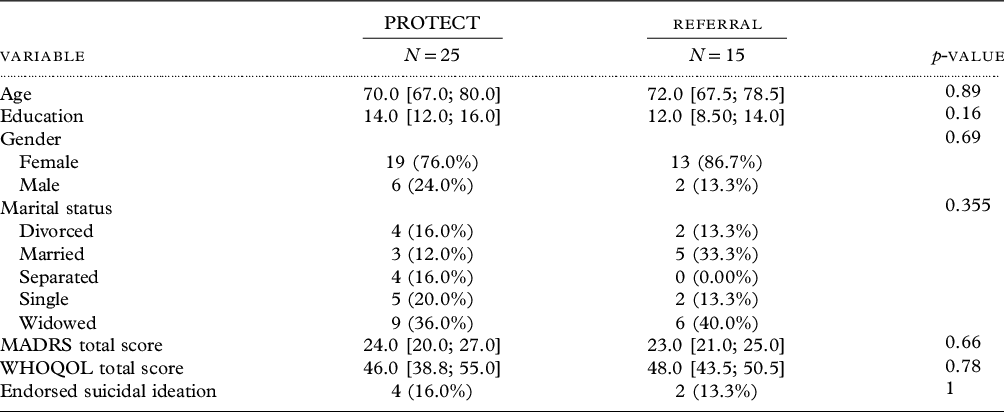
Among the 40 clients who were eligible and consented to the study, there were no significant demographic or clinical differences between the two treatment groups (PROTECT therapy N = 25 and Referral group N = 15) at baseline (Table 1). At the beginning of the study, 75% of clients reported being subjected to two or more types of abuse. More than three-quarters (77.5%) reported verbal/emotional abuse, 57.5% reported physical abuse, 65% reported financial abuse, and 12.5% reported neglect as part of the abuse pattern.
Demographic characteristics for the sample at baseline

Note. Median and first and third quartiles in parentheses are presented for numeric variables. Frequencies (n; %) are presented for categorical variables. The significance of differences between treatment conditions was calculated with Mann–Whitney test for categorical variables and Fisher’s exact test for continuous variables. MADRS = Montgomery–Åsberg Depression Rating Scale; WHOQOL = The World Health Organization Quality of Life.
The a priori acceptability benchmark (≥3 out of 4) was met, as we found a mean of 3.14 (SD = 1.20) on the CSQ at the end of PROTECT. We were able to demonstrate feasibility as 100% of PROTECT participants initiated therapy and met with a PROTECT therapist. This engagement rate is greater than the a priori 75% standard set for feasibility. This rate is higher than the 20% (3/15) of those participants in the Referral control group who connected with a mental health provider.
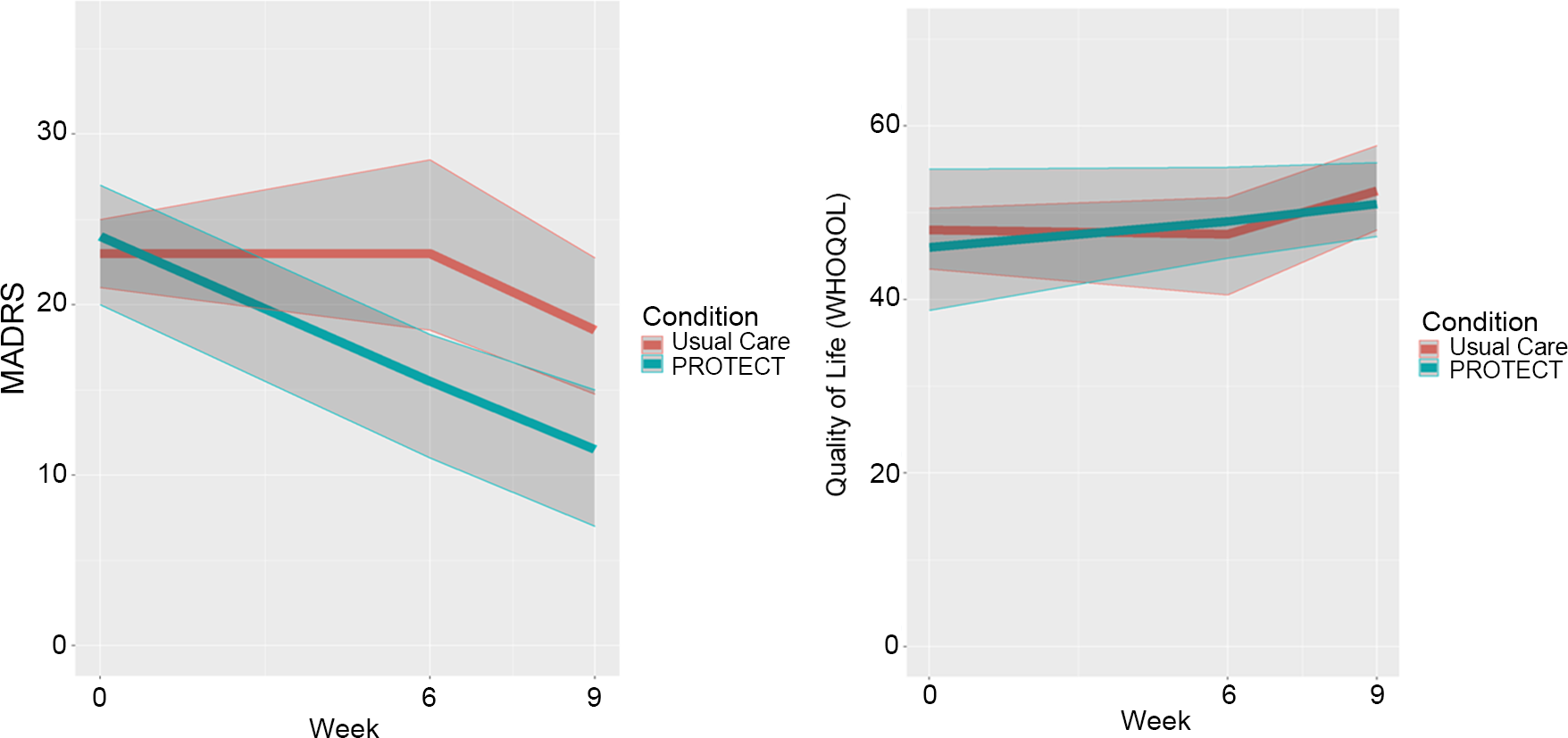
Among 40 patients with available posttreatment data, mixed-effects models showed a significant reduction in depression severity (MADRS scores) over time (F[2,62] = 34.36, p < 0.001; Figure 1). Interaction between treatment and time was significant (F[2,61] = 8.02; p < 0.001). Post hoc comparisons showed that, compared to those receiving Usual Care, participants who received PROTECT had an average reduction of 6.53 more points on the MADRS at Week 6 (t(71) = −3.02, p = 0.003) and 5.29 points at Week 9 (t(70) = −2.46, p = 0.02). Approximately 55% (10/18) of PROTECT participants met the criterion for response of depression (i.e. reduction of ≥50% in MADRS score), compared to only 17% (2/12) of participants in the Usual Care condition. Further, 33% (6/18) of PROTECT participants achieved remission (MADRS ≤ 10), compared to 17% (2/12) of Usual Care participants.
Reduction in depression severity and improvement in quality of life (WHOQOL) over the course of 9 weeks. Note. Lines represent median reduction in depression, with interquartile range (IQR) band. MADRS = Montgomery–Åsberg Depression Rating Scale. WHOQOL = The World Health Organization Quality of Life.

We found significant improvement in quality of life (WHOQOL) over the course of treatment (F(2,57) = 5.00; p = 0.01). However, we observed no treatment difference at baseline or in the slopes of change (Figure 1).
Discussion
Our pilot study data demonstrated that PROTECT therapy was feasible and acceptable and led to a high rate of treatment initiation among this vulnerable and underserved older adult population with high rates of depression. Elder abuse victims who received PROTECT had a greater decrease in depression compared to those who received a referral to a community provider. Both interventions led to a similar improvement in quality of life.
Our results show clinically meaningful improvements in depression severity over the course of PROTECT. The results are consistent with previous reports of similar psychotherapy interventions, such as Engage, developed by our group and used with other populations (Alexopoulos et al., Reference Alexopoulos, Raue and Banerjee2020), and showed clinically significant reductions when extended to community settings (Sirey et al., Reference Sirey, Raue and Solomonov2020). Developing interventions and planning implementation in partnership increased the likelihood for PROTECT to be tailored to clients’ needs and to be successfully implemented within nonmental health systems.
PROTECT was designed as an intervention to be offered in conjunction with abuse resolution services. The similar improvement in quality of life in both conditions could be a consequence of the support and guidance elder abuse case managers provided to victims in both PROTECT and the Usual Care condition. It is also possible that the small sample limited our statistical power to capture differences in quality of life outcomes. In addition, we cannot evaluate the longer-term outcomes of this intervention. While replication in a larger study is needed to confirm the benefits of PROTECT, to our knowledge ours is the first study to develop a mental health intervention designed specifically for elder abuse victims. Future studies could expand services by delivering PROTECT to a larger sample of elder abuse victims and to victims who speak a language other than English.
Conflicts of interest
Dr. Alexopoulos served on Advisory Board of Eisai and of Janssen Pharmaceuticals. He also served on the Speakers Bureaus of Allergan, Otsuka, and Takeda-Lundbeck. The other authors have no conflicts of interest.
Description of authors’ roles
Dr. Sirey developed the intervention and designed and implemented the study. Dr. Solomonov, Dr. Lee, and Ms. Guillod analyzed the data. Ms. Guillod and Zanotti collected the data. Drs. Soliman, Alexopoulos, Sirey, Solomonov, and Ms. Guillod and Zanotti all assisted with writing the manuscript.
Acknowledgments
We wish to thank our collaborators at the New York City Elder Justice Service and the abuse service case workers who support the research and make referrals. We are grateful to the study participants for their time and their trust in us and to our colleagues and staff who contribute to making it possible both at the Institute and beyond.