Introduction
Alzheimer's disease (AD) is a chronic, progressive, neurodegenerative disorder leading to impairments of memory and cognitive function and increased patient dependency on family members and healthcare providers as they deteriorate. Spouses and relatives are often the main providers of care for patients with AD residing in the community (Rice et al., Reference Rice, Fox, Max, Webber, Da, Hauck and Segura1993), delaying the need for institutionalization which is both costly to society and usually less attractive to both patients and their families.
However, the provision of informal care also gives rise to so-called “caregiver burden”, encompassing the extent to which caregivers’ emotional or physical health, social life, and financial status are influenced by caring for their patients (Zarit et al., Reference Zarit, Orr and Zarit1985; Reference Zarit, Todd and Zarit1986). Previous studies have found that informal caregivers of patients with AD have lower health-related quality of life, higher rates of depression, and experience increased stress and anxiety, compared to the general population (Schulz et al., Reference Schulz, O'Brien, Bookwala and Fleissner1995; Vitaliano et al., Reference Vitaliano, Zhang and Scanlan2003; Etters et al., Reference Etters, Goodall and Harrison2008). Most caregivers of patients with AD report that they often experience strenuous levels of stress, and approximately one-third have symptoms of depression (Yaffe et al., Reference Yaffe2002). Caregiver burden also has consequences for the patients, e.g. decreased quality of life and increased risk of institutionalization (Yaffe et al., Reference Yaffe2002; Gaugler et al., Reference Gaugler, Kane, Kane and Newcomer2005). Thus, although increased reliance on informal caregivers to provide care may delay the large cost of accommodating patients in residential care settings, informal caregiving is not without societal costs and health consequences for both the caregiver and their patient.
Interventions aimed at treating AD need to be evaluated by also taking into account their impact on the caregiver. First, we need to understand how important aspects of the patient's health affect the caregiver. Then we can include these consequences in the evaluation of interventions and make the appropriate priorities and allocation of health care resources. The level of caregiver burden perceived is highly dependent on the caregiver's own characteristics as well as on the patient's characteristics, including behavioral symptoms and care need (Torti et al., Reference Torti2004).
The primary aim of this study was to study the effect of these patient characteristics or disease indicators on informal care giving and perceived caregiver burden, in order to inform what patient outcomes are important from a caregiver burden perspective. Previous studies have assessed the effect of key disease indicators separately (i.e. cognition, ADL-abilities, and behavioral disturbances) (Bédard et al., Reference Bédard, Pedlar, Martin, Malott and Stones2000; Etters et al., Reference Etters, Goodall and Harrison2008), but there is a lack of data on their combined effect on time spent on care and perceived caregiver burden. This study therefore assessed the direct and indirect associations between patient disease indicators, informal care hours and caregiver burden in patients and caregivers residing in the community. Data were also collected on caregiver health-related quality of life but are only presented as descriptive statistics in this paper and not included in the main analysis.
The provision of health care and availability of formal care services differs across countries. For instance, Alzheimer Europe reports in a comparative review across Europe that the state carries a legal responsibility for home care in many northern European countries whereas in southern Europe this responsibility is more often carried by the patient's family (Alzheimer Europe, 2006). Such differences are likely to result in regional differences in experiences and perceptions of caregiver burden, but might they also affect the associations between disease indicators and caregiver outcomes? A previous review concluded that findings of such associations have been consistent across geographical regions in previous studies (Torti et al., Reference Torti2004). A secondary aim of this study was therefore to explore whether our findings are consistent across different countries.
The sample of patients and caregivers utilized in the present study were collected from four countries. They were selected in order to represent different geographical and cultural regions of the developed world. Spain was selected to represent southern Europe, which is characterized by more informal care; Sweden and the U.K. to represent northern Europe with its centralized health care institutions and wide access to formal care; and the U.S.A. to represent a decentralized system with high variation in access to formal health care. Thus, the current study provides not only the opportunity to assess the associations between disease indicators and caregiver outcomes in a large pooled sample, but also to assess the associations in different geographical and cultural settings. Moreover, testing the associations between disease indicators, informal care hours and caregiver burden in different countries may provide stronger evidence and generalizability of the findings.
Methods
Study design
The present analysis is based on 866 community-dwelling AD patient- and caregiver pairs. This was a subset of a cross-sectional sample of 1,222 AD patients and their primary caregiver who were recruited from 92 clinical practices in Sweden, Spain, the U.K. and the U.S.A., which also included patients in a residential care setting. The inclusion criteria were: (1) patients with a clinical diagnosis of possible or probable AD with or without vascular elements; (2) patients with an informed primary caregiver (responsible for the informal care of the patient, caring in a non-professional capacity and having up-to-date knowledge about the patient's day-to-day needs and current situation); and (3) both the patient and the primary caregiver willing and able to participate in the study and provide informed consent. The exclusion criteria were: (1) patient or primary caregiver affected by alcohol or narcotics to the extent that it interferes with the completion of the study; and (2) patient or caregiver having difficulty understanding the local language. Patients were identified by screening patient records after which they were contacted by their responsible physician and asked whether they wanted to participate in the study. Informed consent was obtained from all participants or, if the patient was not capable of providing informed consent, their caregiver provided consent on their behalf. An interview was conducted with both the patient and their caregiver, together with their physician or a research nurse. Recruitment was managed so that sufficiently large samples (approximately 70–90) of patients in each severity groups (mild, moderate and severe) were obtained for each country.
The study was conducted according to the Declaration of Helsinki (World Medical Association, 2000) and approved by ethics committees in all four countries.
Disease severity assessments
The cognitive function of the patient was assessed using the Mini-mental State Examination (MMSE; Folstein et al., Reference Folstein, Folstein and McHugh1975), and scores were categorized into mild (21–30), moderate (10–20) and severe (0–9). Patients who did not complete all questions in the MMSE instrument were assigned truncated values (7.2% of the patients did not complete all questions, and on average they missed 3.3 questions), except four patients who, without explanation, had not responded to any of the questions.
Patients’ ADL-ability was assessed with the Disability Assessment for Dementia scale (DAD; Gelinas et al., Reference Gelinas, Gauthier, Mcintyre and Gauthier1999) The DAD scale encompasses 40 separate ADL activities, which are related to the initiation, planning and organization of both basic and instrumental ADL- abilities. Scores are presented on a 0–100 scale, where higher scores represent fewer disabilities in performing ADLs (Gauthier et al., Reference Gauthier, Gelinas and Gauthier1997, Gelinas et al., Reference Gelinas, Gauthier, Mcintyre and Gauthier1999). DAD scores were obtained for 99% of the patients.
Patients’ behavioral disturbances were assessed with the short version of the Neuropsychiatric Inventory Questionnaire (NPI-Q; Cummings et al., Reference Cummings, Mega, Gray, Rosenberg-Thompson, Carusi and Gornbein1994, Kaufer et al., Reference Kaufer2000). The NPI-Q includes 12 separate behavioral domains, and assesses the nature, frequency and severity of the disturbances, as well as caregivers’ perceived distress in response to these disturbances. The severity score ranges from 0 to 36, where higher scores indicate increased severity of behavioral disturbances. NPI-Q scores were obtained for 94% of the patients. Given the high concordance between the severity and distress scores in the NPI-Q (Cummings et al., Reference Cummings, Mega, Gray, Rosenberg-Thompson, Carusi and Gornbein1994), the present study collected both scores but only analyzed the severity score.
All instruments and assessments were administered to the caregiver as the informant, except the MMSE instrument which was conducted by direct interview with the patient.
Caregiver burden
Caregiver burden was assessed with the 22-item Zarit Burden Inventory (ZBI; Zarit et al., Reference Zarit, Orr and Zarit1985). The ZBI consists of 22 statements, to which the caregiver responds whether he or she never, rarely, sometimes, quite frequently, or nearly always feels what is described in the statement. Each response is rated for frequency on a 5-point Likert scale (0–4). A ZBI score is obtained by adding all responses where a scale ranging from 0 to 88 is obtained. The higher the ZBI score, the greater the caregiver's burden (Zarit et al., Reference Zarit, Reever and Bach-Peterson1980; Reference Zarit, Todd and Zarit1986). ZBI scores were obtained for 91% of the patients.
In the U.S.A., the last two questions of the ZBI were mistakenly not responded to in the original interview of caregivers. Therefore, all questions, including the last two, were repeated at a later date through a postal survey. The additional ZBI assessment commenced approximately four months after the original interview. Thus, to calculate a total ZBI score (i.e. using all 22 questions) at the first interview, the additional assessment's last two scores were adjusted for the percentage change in scores between the first and second time-point using the first 20 questions (i.e. using each patient's individual percentage change).
Caregivers’ health-related quality of life was assessed both with the SF-12v2, and WHOQoL-BREF instruments (Ware et al., Reference Ware2005). SF-12 is a 12 item instrument measuring health-related quality of life. It includes eight domains: physical functioning, role physical, bodily pain, general health, vitality, social functioning, role emotional, and mental health. Test items are scored and standardized to the 1998 general U.S. population with a specific algorithm, and results are expressed in terms of two meta-scores: the Physical Component Summary (PCS) and the Mental Component Summary (MCS). Scores have a mean of 50 and standard deviation of 10, with higher scores indicating better quality of life. The WHOQoL-BREF instrument comprises 26 items which measure the caregivers’ perception of quality of life in four broad domains; physical health, psychological health, social relationships, and environment. For comparability across domains and also against other instruments, the raw domain scores are transformed into values ranging from 4 to 20, with higher scores indicating better quality of life.
Resource utilization
Resource utilization, including accommodation and informal care, was assessed with the Resource Utilization in Dementia Lite (RUD-Lite) instrument (Wimo and Winblad, Reference Wimo and Winblad2003). Accommodation was categorized into community dwelling (living at home or with relative) and residential care (intermediate forms of accommodation, dementia-specific residential accommodation, and long-term institutional care). The present analysis was based on the community-dwelling patients.
The RUD Lite questionnaire was used to assess how much time informal caregivers had spent caring for the patients 30 days prior to the visit. Informal care time was categorized into hours spent on basic and instrumental ADL, and supervision per day. The informal care questions also included the time per day the caregiver spent asleep in order to avoid overestimations from caregivers perceiving they were providing care around the clock. Consequently, if the caregivers’ stated time per day on care giving activities exceeded their time awake, the recorded care time was reduced to fit into this constraint. First, supervision time was reduced, and if not sufficient, basic ADL time was reduced and ultimately instrumental ADL time; 7.8% of the caregivers had their stated time reduced, of whom 81% had only their supervision time reduced. The primary caregiver was also asked to estimate their level of contribution among all informal caregivers. This was used to provide an estimate of the total number of hours spent on caring by all informal caregivers. Informal care time was obtained from 98% of the caregivers.
Demographics
Patient and caregiver demographics, including their age, gender and interrelationship (i.e. whether they were cohabiting, married or if the caregiver was a child of the patient), and the education and occupation of the caregiver, and the disease history (i.e. co-morbidities and duration of dementia symptoms) and medications of the patient were recorded during interviews.
Statistical analysis
The number of informal care hours, caregiver burden, health-related quality of life and utility were compared across the four countries (see Table 2). Confidence intervals were parametrically estimated for all outcomes except for mean informal care hours for which non-parametric bootstrapping was used. This is a widely used approach for outcomes that cannot be assumed to be normally distributed, which is necessary for parametric estimates. Similarly, differences across countries were tested with one-way ANOVA for all outcomes except informal care for which the non-parametric Kruskall-Wallis test was used instead.
The associations between the disease indicators, informal care hours and caregiver burden were further explored with various regression methods as described below. Estimates were derived both for each country separately and for the pooled sample of data from all four countries (see Tables 4 and 5).
The independent variables included in the model for informal care hours were cognition (MMSE), ADL-abilities (DAD) and behavioral disturbances (NPI). For caregiver burden (ZBI), the same independent variables plus informal care hours were included. All independent variables were entered sequentially in order to explore the independent effects of each variable on the dependent variables.
Non-normally distributed outcomes have previously been suggested to be modeled using a Generalized Linear Model (GLM) with log link and gamma distributed errors (Dunn et al., Reference Dunn2003). This was done for informal care. A similar model was used for caregiver burden, but with unity link and normally distributed errors. In addition to β coefficients, standardized estimates were presented in order to contrast strengths of effects. To account for clustering by countries in the pooled analyses, the GLM models were fitted with Generalized Estimating Equations assuming an exchangeable correlation structure within countries.
Path analyses of disease indicators, covariates, informal care and caregiver burden were performed using Structural Equation Modeling (SEM) methodology on the pooled data (Figure 1). A pathway model was constructed based on the results from the regression models, in order to assess differences in direct and indirect effects of disease indicators on informal care and caregiver burden. The purpose of the SEM model was not to test more complex hypothetical constructions but rather to confirm that the results from the regression models fit the underlying data (i.e. the covariance between disease indicators and outcomes) using a causal pathway model, and to provide standardized estimates of the effects of disease indicators. Model fit was assessed with χ2, RMSEA, Probability of Close Fit, Akaike's Information Criterion (AIC) and Schwarz's Bayesian Criterion (SBC). The following criteria were used to asses whether a proposed model had good fit, and was better compared to other models: χ2 p-value >0.05, RMSEA p-value <0.05, Probability of Close Fit >0.05, and lower AIC and SBC. Standardized estimates (i.e. using standard deviation scores for dependent and independent variables) were presented to be able to contrast estimated effects of predictors. Double headed arrows between disease indicators in Figure 1 imply estimates of correlation between variables, and hence do not assume directionality of effects between variables. Given the skewed distribution, informal care hours were logged transformed in order to normalize the distribution.
Standardized β coefficients and correlations from the selected pathway model of pooled data, for patients and caregivers residing in community dwellings.

All tests and models were performed with SAS V9.1.3. (SAS Institute Inc, Cary, NC)
Results
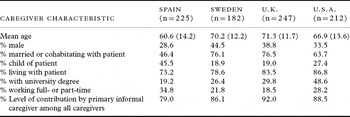
Descriptive statistics of the primary caregivers’ characteristics are shown in Table 1. Spanish caregivers were more often the child of their patient (46%), compared to caregivers from the other three countries (≤27%). Hence, caregivers in Spain were younger, fewer were married to and lived with their patient, and more worked full- or part-time.
Descriptive statistics (standard deviation) of primary caregivers

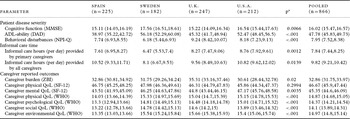
Mean disease severity, informal care hours, caregiver burden, and health-related quality of life measures, across countries, are shown in Table 2. Among all caregivers, 97% provided informal care to their patients (data not shown). Patients were more severely cognitively and functionally impaired in Spain and less in Sweden, whereas U.K. patients had the most behavioral symptoms. Differences across countries were statistically significant but relatively small. The primary caregivers spent 8 hours on informal care per day on average, again with small but significant differences across countries. U.S. caregivers perceived less burden than the U.K. carers whereas Spanish caregivers had the lowest quality of life scores on almost all domains.
Mean (95% confidence intervals) scores on patient disease severity instruments, informal care and caregiver reported outcomes

*p-values for ANOVA model testing differences across countries, except for Informal care time for which Kruskall-Wallis was used.
MMSE = Mini-mental State Examination; DAD = Disability Assessment for Dementia scale; NPI-Q = Neuropsychiatry Inventory Questionnaire; ZBI = Zarit Burden Inventory; QoL = quality of life; SF = short form’ WHO = World Health Organization.
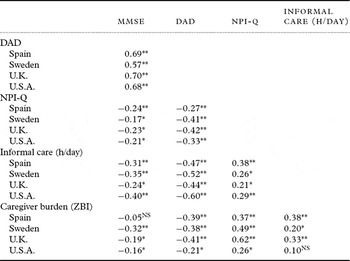
Pair-wise correlations between disease indicators (MMSE, DAD and NPI-Q severity) and informal care hours provided by the primary caregiver, and caregiver burden are shown in Table 3. The correlations between disease indicators were significant in all four countries. All three measures of disease severity were significantly correlated with the number of informal care hours, in all four countries. With the exception of MMSE scores in Spain, all disease indicators were significantly correlated with caregiver burden. The number of informal care hours was significantly and positively correlated with caregiver burden in all countries but the U.S.A.
Correlations between disease severity indicators and informal care and caregiver burden in patients and caregivers residing in community dwellings, stratified by country

* p-value <0.05.
** p-value <0.001.
NS p-value >0.05.
MMSE = Mini-mental State Examination; DAD = Disability Assessment for Dementia scale; NPI-Q = Neuropsychiatry Inventory Questionnaire; ZBI = Zarit Burden Inventory.
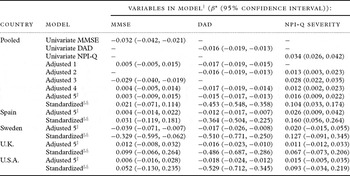
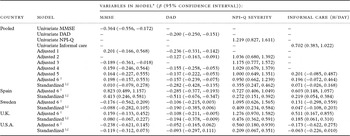
Univariate (single associations) and adjusted (adjusted for covariates) associations between disease indicators (MMSE, DAD and NPI-Q severity) and informal care hours provided by the primary caregiver and caregiver burden are shown in Tables 4 and 5. Given the consistent correlations between disease indicators and informal care hours and caregiver burden across the studied countries (Table 3), all regression analyses were performed on a pooled sample of all four countries. Each horizontal line in the tables displays a unique univariate or adjusted model (“–”implies that the variable was not included in the model). Univariate and adjusted effects of a specific disease indictor are compared by contrasting parameter estimates vertically. For example, in the univariate analysis a 1-unit increase in MMSE scores was associated with a 3.2% decrease in the number of informal care hours (Univariate MMSE, Table 4). When DAD scores were included in the model (Adjusted 1, Table 4), the estimated effect of MMSE scores was attenuated and near zero (0.5% increase). In contrast, when NPI-Q severity scores was included in the model (Adjusted 3, Table 4), the effect of increasing MMSE scores was largely unchanged (2.9% decrease).
Univariate and adjusted associations (β* (95% confidence interval)) between patients’ disease indicators and the number of informal care hours per day provided by their primary caregiver, for patients and caregivers residing in community dwellings

* Exponentiating the β coefficient reflects the percentage change in informal care hours per 1-unit increase in the predictor.
† If a β coefficient is presented, the variable was included in the model, and “–” implies that the variable was not included in the model.
‡ Presented β coefficients are adjusted for patients age, gender, and number of comorbidities, caregivers’ age, gender, and whether the caregivers is living with the patient, is married to the patient, is a the child of the patient, has a university degree, and whether he or she is working full or part-time.
§ Effect size after independent variables have been transformed into standard deviation scores. Given the skewed distribution of informal care hours, it was not standardized prior to entering model.
MMSE = Mini-mental State Examination; DAD = Disability Assessment for Dementia scale; NPI-Q = Neuropsychiatry Inventory Questionnaire; ZBI = Zarit Burden Inventory.
Univariate and adjusted associations (β (95% confidence interval)) between patient's disease indicators and caregiver burden (ZBI), for patients and caregivers residing in community dwellings

* If a β coefficient is presented, the variable was included in the model, and “–” implies that the variable was not included in the model.
† Presented β coefficients are adjusted for patients age, gender, and number of comorbidities, caregivers’ age, gender, and whether the caregivers is living with the patient, is married to the patient, is a the child of the patient, has a university degree, and whether he or she is working full or part-time.
‡ Effect size after dependent and independent variables have been transformed into standard deviation scores.
MMSE = Mini-mental State Examination; DAD = Disability Assessment for Dementia scale; NPI-Q = Neuropsychiatry Inventory Questionnaire; ZBI = Zarit Burden Inventory.
All three indicators of disease severity were significantly associated with the number of informal care hours in the univariate analyses (Table 4) with the expected signs (the more severe disease, the more informal care). However, sequentially including all three measures into one model attenuated the estimated effects of MMSE and NPI-Q severity score on informal care hours, whereas the effect of DAD scores (i.e. ADL-abilities) remained largely unchanged. This implies that the effect of DAD scores on the number of informal care hours was the same irrespective of whether they were accompanied by higher or lower MMSE and NPI-Q scores. In contrast, the effect of higher NPI-Q scores on informal care hours was weaker if not accompanied by lower DAD scores. Adjusting for patient and caregiver characteristics had, if anything, minor influences on the estimated effects (Adjusted 5). With respect to interpretations by countries, the only divergence from the above-stated findings was that a higher MMSE score was significantly associated with fewer informal care hours in Sweden. However, DAD scores were the strongest predictor of the number of informal care hours in all four countries (see standardized estimates by countries)
With respect to caregiver burden, all three indicators of disease severity and number of informal care hours were significantly associated with caregiver burden in the univariate analyses of pooled data (Table 5) with the expected signs (the more severe and more informal care, the higher caregiver burden). However, whereas the effect of MMSE was abolished, the effects of DAD and NPI-Q scores were slightly attenuated but significant, after including all three disease indicators in the model. The effect of informal care on caregiver burden was attenuated and non-significant after adjusting for all disease indicators. With respect to interpretations by countries, NPI-Q scores was the strongest predictor in all countries, except in Spain. In Spain, all disease indicators were significant predictors of caregiver burden, and DAD scores being the strongest. Stratified by countries, DAD scores were significantly associated with informal care hours in Spain and the U.S.A. Assuming multi-collinearity between MMSE and DAD scores, and hence excluding the MMSE score from the adjusted model, did not change the findings (data not shown in tables, available upon request). NPI-Q scores was still the strongest predictor in all countries but Spain, where the effect was almost equal to the effect of DAD scores. Excluding data from Spain in the pooled analyses resulted in similar findings as those obtained from the pooled analysis of all countries (β coefficients = MMSE: −0.006 (−0.193, 0.181); DAD: −0.105 (−0.123, −0.087); NPI-Q: 0.985 (0.601, 1.368); and informal care: 0.188 (−0.144, 0.520)).
Following the results from the regression analyses we hypothesized that only ADL-abilities influenced informal care hours, and that both ADL-abilities and severity of behavioral disturbances influenced caregiver burden, and that their relative importance varies. In addition, we assumed that part of the association between ADL-abilities and caregiver burden was mediated by informal care hours. Thus, in light of the adjusted results in the regression analysis a path-analysis model was constructed and tested under the SEM framework on the pooled sample (Figure 1). The constructed model had a good fit (χ2 p-value = 0.18, RMSEA = 0.03 (95% CI: 0.00–0.07); Probability of Close Fit = 0.72). Further modifications to the model, for example including or excluding effects of MMSE, DAD, and NPI-Q severity scores, resulted, if anything, in inferior model fits or added complexity with no additional gain in model fit (i.e. higher AIC). Assuming that caregiver burden influenced informal care hours instead of the opposite resulted in almost an equally good fit (χ2 p-value = 0.17, RMSEA = 0.03 (95% CI: 0.00–0.09), Probability of Close Fit = 0.62), but the AIC score was higher (−0.46 vs −1.08). However, the results imply that the model in no way gives indications of the causal pathway between informal care hours and caregiver burden. All standardized coefficients in the model are significant (p-value <0.05). The model implies that DAD influences both informal care and caregiver burden, and that the association between DAD and caregiver burden is partly mediated by informal care (30% of the total effect of DAD on caregiver burden is mediated by informal care hours). NPI-Q severity has no effect on informal care hours, but a strong direct effect on caregiver burden, which is larger than the effect of DAD (0.38 vs. −0.17).
Discussion
The present study was performed to provide further insights into the relative importance of deteriorating cognition, ADL-abilities, and increasing behavioral disturbances on the time informal caregivers spend caring for patients residing in the community, and the burden they experience. The analysis revealed that cognition per se was not of importance, but rather that the patients’ ADL-abilities was the main predictor of the number of hours caregivers provide, and that severity of behavioral disturbances was the main predictor of the burden caregivers experience. Hence, variation in cognition is not a predictor of informal care and caregiver burden, unless accompanied by variation in ADL-abilities and behavioral disturbances.
Data from four countries enabled comparison across countries with diverging care cultures and health care systems. The main findings were consistent across Sweden, the U.K. and U.S.A. for both the analysis of informal care and caregiver burden, and with respect to informal care also for Spain. However, whereas NPI-Q was the most influential predictor in all other counties, ADL-abilities was the strongest in Spain and cognition also had a significant effect. The adjusted association may be spurious, given the limited variation in cognition when holding ADL-abilities and behavioral disturbances constant (see discussion on multi-collinearity below). The contradictory findings in Spain may be the result of a number of different causes, including differences in cultural effects, differential sampling (i.e. samples are not comparable), or random variation. The present study did not have the data required to investigate further what could be the cause. Thus, we have no compelling explanation as to why the effect of cognition, ADL-abilities and behavioral disturbances on caregiver burden would be different in Spain.
In most countries, spouses and relatives are the main providers of care. In the U.S.A., 70% of patients with dementia are living at home (Alzheimer's Association; 2008), and the corresponding number for Spain has been reported to be 80% (Serrano-Aguilar et al., Reference Serrano-Aguilar, Lopez-Bastida and Yanes-Lopez2006). Based on estimates from national surveys in the U.K., economic models have assumed that approximately half of cognitively impaired patients requiring full-time care are institutionalized (Ward et al., Reference Ward, Caro, Getsios, Ishak, O'brien and Bullock2003); thus the total proportion of AD patients being cared for by family members is likely to be higher. Informal caregivers are therefore not uncommon, and caregiver burden may result in large societal costs and health consequences.
Numerous studies have found that behavioral disturbances are associated with increased caregiver burden (Beeri et al., Reference Beeri, Werner, Davidson and Noy2002; Sink et al., Reference Sink, Holden and Yaffe2005). Specific behavioral disturbances, including aggression, agitation, and night-time behaviors are important predictors of caregiver burden (Gaugler et al., Reference Gaugler, Kane, Kane and Newcomer2005). An Italian study found that agitation, irritability, motor, and night-time behaviors were the most influential behavioral disturbances with respect to caregiver burden, and that moderate to severe functional impairment in patients were important determinants of the risk of depression and burden in caregivers (Rinaldi et al., Reference Rinaldi2005). Generally, patients who retain mobility exert larger burden on their caregiver than non-mobile patients (Miyamoto et al., Reference Miyamoto, Ito, Otsuka and Kurita2002). Previous studies have also found that decreasing ADL-abilities is associated with increased caregiver burden (Rinaldi et al., Reference Rinaldi2005; Razani et al., Reference Razani2007). Although this study confirms that behavioral disturbances are more important, it also shows that the influence of patients’ abilities to cope with activities in their every-day life is not negligible in itself. Thus, the deteriorating progress of AD, resulting in the patients’ inability to care for themselves appears to be a predictor of caregiver perceived burden, even if not accompanied by more informal care hours or increased severity of behavioral disturbances.
The direct association between informal care and caregiver burden, adjusted for the patient disease severity, was rather weak. However, this is not surprising as informal care is not just a direct consequence of the patient's disease severity, but other external factors are also important such as kinship between patient and caregiver, and gender of the caregiver (Zarit et al., Reference Zarit, Reever and Bach-Peterson1980; Annerstedt et al., Reference Annerstedt, Elmstahl, Ingvad and Samuelsson2000). Thus, the weak association may imply that variation in informal care, holding disease severity constant, is a proxy of different caregiver characteristics, and resulting personal preferences and propensities to provide informal care to their patients, or seek nursing home placement (Spruytte et al., Reference Spruytte, van Audenhove and Lammertyn2001). For example, caregivers who provide more informal care may be individuals who are better adapted to cope with the burden associated with being the informal caregiver than those providing less informal care, thus diluting the effect of informal care on caregiver burden.
The present study, as well as previous studies (Coen et al., Reference Coen, Swanwick, O'boyle and Coakley1997; Clyburn et al., Reference Clyburn, Stones, Hadjistavropoulos and Tuokko2000), show that behavioral disturbances are important predictors of caregiver burden. Thus, treatments aimed at reducing behavioral disturbances may result not only in health benefits for the patients, but also in health and cost saving effects for the caregiver and society. However, although there are many pharmacological therapies targeting neuropsychiatric symptoms, they are not very effective in patients with dementia, and some are associated with severe adverse events (Sink et al., Reference Sink, Holden and Yaffe2005). The available evidence on the effect of cholinesterase inhibitors on behavioral disturbances is inconclusive. A review found that only 25% of studies found an effect that could possibly be clinically meaningful (Sink et al., Reference Sink, Holden and Yaffe2005). However, for the patients, cognitive impairment per se may be a much more devastating problem than ADL abilities or behavior. Thus, symptomatic treatment of cognition is still of importance.
The instruments used to assess caregiver burden and quality of life were all available in validated translations for each of the included countries and have been used extensively in previous research. The WHOQoL BREF was developed with the specific aim of producing an internationally and cross-culturally comparable instrument for the assessment of quality of life. Still, there may be differences across the four countries that were not sufficiently captured due to limitations in the selected instruments.
The QoL instruments were not included in the aims of this paper and we have only included descriptive statistics for them in the results. However, we did perform preliminary analysis of their correlation with the disease severity measures which showed some associations that justify studying them further. This would need to be considered in a separate paper.
There was significant correlation between the three disease indicators which may cause a problem of multi-collinearity when including all as predictors in our statistical models. For this reason we showed the results of both the univariate and the adjusted models in order to enable the reader to follow the impact of including and excluding predictors. Further, the largest correlation was between MMSE and DAD, and including or excluding MMSE did not change the model results substantially. For this reason we believe that our findings are sound.
Generalizability of results to the underlying population from which the study population has been sampled is always of concern. The current study sample was large, both in terms of the number of countries involved and as a pooled sample. The intent of sampling in the present study was to achieve large enough samples across the whole disease severity spectrum. Although this does not permit estimates for the total population, it creates a large enough sample to present estimates in specific subpopulations, which with population-based sampling would not have been possible with a similar sample size. However, due to the composition of the study population, caregiver burden and caregiver time may be overestimated since caregivers and patients not known by the care system are not included. In addition, given that the sampling was not structured (i.e. opportunity sampling), pooling the data may be beneficial and create more variation in the type of patients and caregivers who are included, as the sampling performed by study centers may have differed across countries. As we were not primarily interested in studying whether absolute values of informal care and caregiver burden differed across countries, but rather interested in the influence of disease indicators, which appears not to vary vastly across the studied countries, this increased variation may increase the generalizability of the results to a general population of patients with AD and their caregivers.
Another paper, which is based on the same data set, further examines the influence of disease severity on costs of care (Gustavsson et al., submitted but not yet published). In that study we found that cost of care not only increased with increasing disease severity (as measured by MMSE scores), but that variation in costs of care was primarily predicted by patients’ ADL-abilities.
In conclusion, the present study found that the direct influence of patients’ cognition on caregiver burden is limited and is mediated rather by other disease indicators. Instead, the patients’ ADL-abilities are the main predictor of informal care hours, and both ADL-abilities and behavioral disturbances are important predictors of perceived caregiver burden, where the latter has the strongest effect. These results were consistent across Sweden, the U.K. and the U.S.A.
Conflict of interest declaration
Niklas Bergvall, Anders Gustavsson and Linus Jönsson are employed at i3 Innovus, a contract research organization, and act as consultants to the pharmaceutical industry. Per Brinck and Daniel Eek are employed at AstraZeneca R&D. Anders Wimo and Bengt Winblad have been scientific consultants to most drug companies engaged in dementia care but have no shares or employment in these companies. The study was funded by an unrestricted research grant from AstraZeneca R&D and this paper was developed in accordance with Good Publication Practice Guidelines for Pharmaceutical Companies.
Description of authors’ roles
Niklas Bergvall contributed to the study design, acquisition of data, analysis and interpretation of the data and writing of the paper. Per Brinck contributed to the study design, acquisition of data, analysis and interpretation of the data and review of the paper. Daniel Eek contributed to the study design, acquisition of data, analysis and interpretation of the data and review of the paper. Anders Gustavsson contributed to the study design, acquisition of data, analysis and interpretation of the data and review of the paper. Anders Wimo contributed to the study design, acquisition of data and review of the paper. Bengt Winblad contributed to the study design and review of the paper. Linus Jönsson contributed to the study design, acquisition of data, analysis and interpretation of the data and review of the paper.
Acknowledgments
The authors thank all participants of this study, including all the investigators and interviewers who contributed to the data collection.