


For a long time, due to the dearth of early documents and archaeological data, very few secondary studies discussed the cemeteries of the Han vassal lords. Among those that have focused on the archaeological angle is Liu Zhendong's 劉振東 1994 preliminary study of the tomb structures with reference to the relevant received sources.Footnote 1 In 2005, Li Yinde 李銀德 correlated archaeological and literary sources to discuss all fifteen tombs known at the time, providing a more advanced picture of the Western Han regulations on burial customs.Footnote 2 Three years later, based on further excavations, came Zang Lü's 葬律 publication of the bamboo strips found in a Han tomb at Yunmeng Shuihudi (Hubei province). These provided specifications for the stately robes, sacrificial offerings, and the number and quality of inner and outer coffins, as well as the dimensions of the burial pit, mortuary park, tower gates and walls, and ancestral shrines to be dedicated to deceased nobles of the highest rank (chehou).Footnote 3 As these regulations were so comprehensive, Shuihudi provided a window upon burial practices during the two Han dynasties.
With the continuous accumulation of archaeological data, research on the nobles’ tombs accelerated, particularly in 2008, when the multi-generational mortuary complex of Zhang Anshi, Noble of Fuping, was discovered in the southern suburbs of Xi'an, on the Fengqi Plain. Because it was the first family cemetery to be found in such good condition, and for several years after its discovery the only example of a family cemetery that was scientifically excavated in its totality, and moreover a noble burial site that tallied with ritual prescriptions, it proved extraordinarily valuable to archaeologists and historians alike. Supplementing the small to mid-size Han tombs in the Chang'an greater metropolitan regionFootnote 4 and the tombs of many high-ranking Tang officials in the vicinity, the Zhang Anshi family cemetery site made detailed cross-class and cross-chronological comparisons possible, and so was deemed to be of “the utmost significance” for research on ritual regulations, construction processes for large noble tombs, and the evolution of burial customs.Footnote 5 Not surprisingly, the site of Zhang Anshi's tomb was selected as one of the “Top Ten New Archaeological Discoveries for the Nation” (全國十大考古新發現) in 2010.
Three years after the excavations at the Fengqi Plain family cemetery began, archaeologists in another part of the country discovered the well-preserved site of the deposed Western Han emperor (93–59 b.c.e.), Liu He 劉賀 (Haihun 海昏 Noble), in Nanchang 南昌, Jiangxi province.Footnote 6 Once its cultural riches were publicized widely, that tomb attracted the lion's share of the attention, for it gave people the best idea about the riches that would have been deposited within an imperial tomb. As a result, research on the Zhang Anshi site gradually stalled. Now, more than ten years after the Fengqi Plain excavation began, many questions about the Zhang Anshi family cemetery await resolution, and this essay aims to explore several issues of interest to all students of Michael Loewe, young and old, to whom this essay is dedicated.
This essay consists of three main parts: the first, an archaeological survey of the family cemetery association with Zhang Anshi; the second, a review of the secondary literature considering the question of whether Zhang Anshi's family cemetery did or did not “transgress the rituals” of mid- to late Western Han (a debate that for lack of evidence must remain unresolved); and the third, which considers the question why Zhang Anshi was not buried in Duling, among the “accompanying burials,” contrary to modern expectations.
The Excavation of a Western Han Tomb on Fengqi Plain
From July 2008 to December 2011, the Shaanxi Provincial Institute of Archaeology excavated a cemetery site located high above the Fengqi plain, 470–630 meters above sea level. To the north, the site overlooks the old tamped-earth walls of Han Chang'an; to the south, it stretches to the Qinling 秦嶺 Mountains. There, the plain is high, and the water level deep, making this an ideal site for a large cemetery. To the east, some 6 kilometers away, lies the mausoleum site of Han Xuandi, on the high plateau once under the jurisdiction of Du County. To the west, it is 6 kilometers away from the seat of Du County during Western Han. Altogether the entire site measures some 60,000 square meters, or roughly (1.05 times) the size of a standard football field in the US.
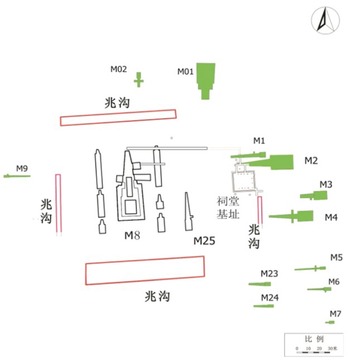
The site's core area is rectangular. Running 195 meters east-west and 159 meters north-south, the core covers more than 30,000 square meters. In addition to the two major tombs, both shaped like the Chinese character Jia 甲 (M8 and M25), there are six burial pits, plus what appears to be a single shrine or worship hall (now known solely from its tamped-earth foundation), not to mention roads and a complete drainage system expanded over successive generations. Surrounding the major tombs are trenches, and beyond the trenches, twelve more tombs, built to the east, west, and north of the major tombs, which are mostly relatively large, luxurious, and built to a very high standard. These tombs most certainly were not occupied by ordinary people. Their tomb passages all lead toward the major tombs, as if they were minor stars in a constellation. Clearly, these lesser tombs have been sited in relation to M8, as seen in Figure 1.
Layout of the Fengqi Plain cemetery site (after Zhang Zhongli 張仲立, Ding Yan 丁岩, and Zhu Yanling 朱艷玲, “Fengqiyuan Han mu: Xi Han da jiangjun de jiazu muyuan,” plate 1).

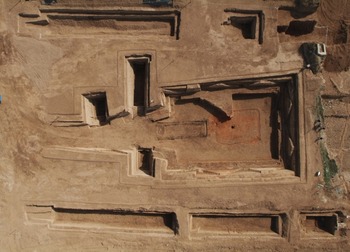
The most important jia-shaped tomb, M8, was made of tamped earth in roughly a rectangular shape. Its tomb passageway faces north. The east, south, and west walls of the main tomb chamber have neat and uniform zigzag steps. It consists of the principal coffin chamber, front coffin chamber, and three “side chambers” on either side of the tomb passageway. The principal coffin chamber has rammed-earth walls on all four sides. Within the principal chamber, there are two additional layers of walls, one of brick and one of wooden facing, with the space between them filled with charcoal, nine jade bi discs, and many pieces of jade suits (whose strings had presumably rotted away). The structure of the front coffin chamber very much resembles the principal coffin chamber, but within it no fewer than seven carriages had been placed. To the sides of the major tomb are six rectangular burial pits from which excavators retrieved more than two thousand figurines (some made of carved wood and some of molded clay), all of which had been painted in bright mineral colors and wore armor. The clay figurines were first fitted with moveable wooden arms (also painted), after which they were dressed in leather armor, helmets, or silken scarves. Over time, most of the wooden arms, leather armor, helmets, and silken scarves rotted away, becoming dust, but the figurines’ painted bodies still retained their bright mineral colors. Apparently, the wooden figurines were also brilliantly painted, with similar “clothes” and “armor.”Footnote 7 All of the figurines are believed to have once carried weapons. Wooden battle chariot models and every type of metal weapon, plus eleven seals related to military officers, were arranged in a regular pattern.Footnote 8 (See Figure 2.)
The jia 甲-shaped great tomb M8, from above (Zhang Zhongli, Ding Yan, and Zhu Yanling, “Fengqiyuan Han mu: Xi Han da jiangjun de jiazu muyuan,” p. 84, figure 7).

Approximately 25 meters to the southeast lies the other jia-shaped tomb, M25. This tomb is brick-lined, and its tomb passageway also faces north. Unearthed from it were pieces of a jade suit, jade bi discs, clay vessels, and equipment (ornaments) for model carriages and horses, which were originally mingqi made of wood, but had rotted away.Footnote 9 Due east of M8, some 80 meters distant, is an architectural foundation site, whose main foundation, pillar bases, doorways, corridors, steps, and drain spillways are in a relatively complete state of preservation. Also found there are patterned roof tiles, bearing the legends “Longlasting Pleasure, Without End” (Changle weiyang 長樂未央), and bricks patterned with a Hui 回-graph pattern of concentric squares.Footnote 10 These burial items recall similar items found at Duling, Xuandi's mausoleum complex. For this reason, archaeologists determined that this was once a shrine or worship hall (citang 祠堂).Footnote 11
Although grave robbers had plundered almost every tomb at the Fengqi Plain cemetery, the burial objects were still quite numerous, in both type and quantity. Roughly three thousand items were recovered, some of which are still undergoing conservation. Every object testifies to the high status of the tomb occupants—from the site on high ground, the presence of a shrine, and the quantity of grave goods (all made to a high standard), which includes large carriages decorated with lacquer painting and figurines wearing armor and holding weapons.
Preliminary investigation of the site led archaeologists to believe that they had located a family cemetery used continuously from mid-Western Han until Wang Mang's Xin 新 dynasty (9–23 c.e.). The largest tomb, M8, seems to date to the reign of Han Xuandi (r. 74–49). The farther the distance of the tombs from M8, the smaller the tombs are, with M5 being comparatively late, dating to the Wang Mang era. The tomb occupant of M8 almost certainly had attained the rank of king or noble; unquestionably, his family members ought to have been extremely prominent throughout the period from mid- to late Western Han.Footnote 12 As fieldwork progressed, these first impressions only deepened so that now one can confirm that the scale, layout, form of the site, and complex temporal relations between the various tombs are becoming clear. Zhang Zhongli, head of the excavation team, published an essay in 2011Footnote 13 asserting that the occupant of M8 could only be Zhang Anshi, based on various features of the main tomb and its particular placement within the constellation of tombs at the site, but also on the discovery of a bronze seal with the character for “Zhang” on it and the seal impression (fengni 封泥) “Weijiang changshi” 衛將長史, meaning General of Defense, Senior Staff Officer.
Based on his Han shu biography, Zhang Anshi, son of Zhang Tang 張湯,Footnote 14 served under three Han emperors, Wudi, Zhaodi, and Xuandi. During the reign of Zhaodi, Zhang Anshi was ennobled as the Noble of Fuping (富平侯). Instrumental in the decision to elevate Xuandi to the throne, he continued during Xuandi's reign to pile up achievements, until eventually, in 67 b.c.e., he was appointed to the rank of Marshal of State (da sima 大司馬), with concurrent title of General of the Cavalry and Chariots (juji jiangjun), with control over the Secretariat. Shortly afterward, Zhang Anshi was given the title General of Defense (wei jiangjun 衛將軍), in charge of all guard units in the palace and capital, making his rank and standing second only to that of the Marshal of State Huo Guang 霍光 (fl. 120–68 b.c.e.). After Zhang Anshi died, he was given the posthumous title of Jinghou 敬侯 (“Respectful Noble”). “The Son of Heaven awarded him seal and sashes, sending him to the grave with a light carriage and armed entourage … and he gave land in the eastern plain of Du County, where he was to have a burial site dug, a mound raised, and a shrine built” in his honor by the imperial Court Architect (jiangzuo 將作).Footnote 15 The obsequies were presumably carried out with great solemnity. Over the eight generations from Zhang Anshi until Zhang Ji, the Zhangs were nobles for nearly two hundred years, with no demotion due to bad behavior. “No nobles had a record that could compare with this,”Footnote 16 since the family had flourished for eight generations, without interruption. More than ten of Zhang Anshi's sons and grandsons were awarded such titles as Palace Attendant (shizhong 侍中, an honorary title); Regular Palace Attendants (zhong changshi 中常侍, a post with substantial duties as part of the emperor's entourage; Cavalier Attendants (sanji 散騎) in various ministries and bureaus; and Colonels (xiaowei 校尉) of several types in several locations.
The received texts regarding Zhang Anshi's burial and tomb are consistent with the archaeological evidence in the Fengqi Plain family cemetery, just as the size and conformation of the large-scale site, with a major tomb site, M8, surrounded by a dozen larger and smaller tombs, is consistent with the rise and fall of the Zhang family from the time of Zhang Anshi through late Western Han. For these reasons, Zhang Zhongli, lead excavator, is confident that this family cemetery ought to belong to the Zhang family, whose burial plot was conferred by Emperor Xuan himself at the time of Zhang Anshi's death. The family cemetery provides evidence of a noble family that continued to prosper, even if it did not command the same luster as in Zhang Anshi's era.Footnote 17 Later, Ding Yan 丁岩, one of the team of archaeologists to excavate the site, published his own “Tentative Exploration of the Identity of the Master of the Fenqi Plain Western Han Tomb,”Footnote 18 offering further proofs to support Zhang Zhongli's 2011 conclusions. With even greater precision Ding identified the correspondences between the archaeological site and the received historical records, thereby confirming the identity of the occupant of tomb M8. Thereafter came the work by Liu Hanxing 劉漢興, who was the first to assign the twelve tombs surrounding M8 to the five generations of Zhangs buried in the family cemetery. Based on Han Guohe's 韓國河 analysis of the four types of Han burials,Footnote 19 Liu Hanxing analyzed the individual sets of grave goods in the tombs, and tentatively identified which tombs belonged to which individuals listed in the Zhang family genealogy, all of which proved helpful. As Zhang Zhongli wrote,
Only in rare cases can we ascertain the identity of the tomb occupant. Knowing the identity not only sheds light on certain aspects of one phase in Han history; it also helps those who would like to better understand the background for the burial system of the two Han dynasties, and it adds to our store of information.Footnote 20
Although this statement was first used by Zhang Zhongli in relation to the discovery of the tomb of Liu He (Haihun hou, as he is commonly known), it applies equally well to the family cemetery of Zhang Anshi.Footnote 21
Han Burial Regulations and Ritual Transgressions: The case of Zhang Anshi's Tomb
In Western Han, in the status hierarchy known as “orders of honor” 爵位, nobles rank just below the kings of the Liu ruling clan (i.e., the zhuhou wang 諸侯王). As Cai Yong says, “The zhuhou wang are imperial sons who have been enfeoffed as kings. The chehou 徹侯 (highest-ranking nobles) are awarded to those who are not members of the Liu clan, but who have earned extraordinary merit.”Footnote 22 (To avoid the use of Han Wudi's personal name, in late Western Han and Eastern Han the title chehou was changed to tonghou 通侯 or liehou 列侯.)
During their lifetimes, nobles enjoyed certain political and economic privileges; after their deaths, they were buried according to ritual regulations. Previous studies often lumped the Western Han noble burials together with those of the Liu-clan kings, but the status of the two groups differed greatly. The Western Han kings were positioned strategically in such a way as to protect the realm, sometimes as buffer zones, with their jurisdictions straddling provinces and commanderies; their principalities included several tens of walled cities, and numerous officers in their palace employ, on the model of the imperial capital.Footnote 23 By contrast, the ranks of the nobles included the younger sons of Liu-clan kings, members of the consort clans, and meritorious officials (both the newly created nobles [shifeng hou 始封侯] and the descendants who had inherited their noble titles [si hou 嗣侯]). Nobles were awarded fiefs of varying sizes whose income was calculated in terms of households to be taxed: for example, ten thousand households, one thousand, or one hundred. The Han-era funerary regulations plainly reflected these gradations of rank. Additionally, tombs of the nobles, unlike tombs of the Liu-clan kings, exhibited strong local identities, with particularly stark differences between tombs in the north and tombs in the south.Footnote 24 As the mortuary complex of a famous noble line with income drawn from 10,600 households in the capital region of the Guanzhong Basin, Zhang Anshi's family cemetery affords us a clearer and more comprehensive picture of the regulations for the nobles’ cemetery plots, shrines, cemetery arrangements, and grave goods, allowing us to make some progress on a host of interesting topics.
We can divide the nobles’ funerary regulations into two categories: those “above ground” (such as the grave mound, cemetery walls, shrine, and configuration of the “accompanying burial” tombs on the site) and those “below ground” (not only the number and placement of accompanying burials, but also such underground features as the inner and outer coffins, the provision of jade face masks and suits, the chariots and horses or models thereof buried in the tomb, and the pits filled with burial items). Below, we select some of the tomb's main features for discussion:
Jade Suits
Graverobbers had plundered most of the tomb contents of the large tomb belonging to Zhang Anshi and his wife, and fire had ravaged the site, perhaps because the graverobbers used torches. The principal coffin chamber was completely ruined, but quite a few pieces of broken jade from a jade suit were recovered.Footnote 25
Jade suits (yu yi 玉衣), also sometimes called “jade cases” (yu xia 玉匣/柙) were given by the Han throne whenever high-ranking members of the governing elite (e.g., Liu-clan kings and princes, princesses, and nobles) in good standing died. As the fifth-century Hou Han shu Treatise on Rites and Ceremonies clearly states, upon their deaths emperors were given a jade suit, sewn together with gold thread; Liu-clan kings, newly created nobles, palace ladies of the first-rank, and princesses were given jade suits sewn together with silver thread;Footnote 26 and the first-rank consorts and imperial sisters received jade suits sewn together with copper thread. Lu Zhaoyin's 盧兆蔭 study of the Han jade suit system is an excellent piece of research. Lu figures that the jade suits perhaps first appeared in Western Han during the reigns of Wendi and Jingdi, but at that early time there were no set regulations about the conferrals. Archaeologists have found that the majority of Western Han kings and nobles had jade suits sewn with gold thread, but there are also examples sewn with threads of silver, copper, or silk. Apparently, by Eastern Han, however, the regulations about these jade suits were fixed, and archaeology confirms that the hierarchy specified for the Eastern Han jade suits in the Hou Han shu treatise was nearly always followed during that dynasty.Footnote 27
Judging from the extant archaeological finds, the Western Han nobles residing in the north all had jade suits, as is seen with the Xianyang Yangjiawan 楊家灣 tomb of Chancellor Zhou Bo 周勃 and his wife;Footnote 28 the Xi'an Xin'an Brick Factory (新安磚廠) tomb of Liu Ying 劉嬰; Noble of Lixiang 利鄉 (in Shaanxi); the Dongchang 東昌 tomb of Liu Zu 劉祖, Noble of Zao 趮 (in Shandong); the Handan 邯鄲 tomb of Liu Anyi 劉安意, Noble of Xiangshi 象氏; and the Xingtai 邢台 tomb of Liu Qian 劉遷, Noble of Quyang 曲煬 (both in Hebei). Such suits very seldom appear in the southern noble tombs in Jiangsu, Anhui, and Hunan. In the Shaanxi tomb of Zhou Bo and his wife, as with the tomb of Zhang Anshi and his wife, both the male tomb occupant and his wife wore jade suits, which suggests that a spouse of a noble had the right or privilege to wear jade suits as well.Footnote 29
Burial of Carriages and Horses
In the pre-Qin period (before 221 b.c.e.), elite tombs had real carriages and horses buried in them, presumably by regulation. The early Western Han followed this regulation consistently for the Son of Heaven, we presume (since no imperial tombs have been opened),Footnote 30 as for the Liu-clan kings and for the nobles.
With the continuous discovery of noble tombs dating to Western Han, the evidence has overturned Gao Chongwen's 高崇文 preliminary speculation that “only first-rank [Liu-clan] kings have large-scale tombs with real horses and chariots, and there are no instances of noble tombs with such offerings,” since we now know of two Western Han nobles, Zhou Bo and Zhang Anshi, who were buried with real chariots and horses.Footnote 31 In early Western Han, such burials were uncommon even for Liu-clan kings, due to severe economic constraints, and the burials of such costly items did not seem to follow a well-defined set of ritual regulations. But from the reign of Han Wudi down to Yuandi's era, following social and economic developments, the members of the governing elite seem to have lived in far greater luxury and to have enjoyed in death increasingly lavish funerals. Predictably perhaps, during those several reigns, the burial of real horses and carriages became much more commonplace. However, by late Western Han, in 33 b.c.e., an edict by Yuandi ordered the end of the custom of burying real horses and carriages among the tomb offerings,Footnote 32 and indeed, to date, no late Western Han tombs of Liu-clan kings have been discovered with that specific type of offering, which suggests the custom was at that point discontinued.Footnote 33 During Eastern Han, models of chariots and horses, but not real ones, were buried in the sites that have been excavated, regardless of whether the tomb belonged to a Liu-clan king or to a noble.
In Yangjiawan, the tomb of Zhou Bo yielded many sets of chariots and horses, and Zhang Anshi's tomb M8 has also placed within it two quadrigas (both life-sized), and five mingqi chariots with horses. The life-sized chariots both had bronze and inlaid gold decorations of high quality and intricate patterning. The wheels and seat box are of lacquered wood, and the chariots have canopies above.
In the Han period, for a wooden chariot to be made of high-quality materials, expertly worked by artisans and decorated with intricate patterns, driven by four good horses, who themselves wear the most luxurious decorations—the value of such an item is obvious. This is not only a sign of the tomb occupant's position and status; it is also a clear sign of [a family's] economic power.Footnote 34
According to the research by Gao Chongwen, during the early and mid-Western Han kings were usually buried with three sets of real chariots and horses. The rule specifying three sets of hearses (hun che 魂車, individually named sheng che 乘車, dao che 道車, or gao che 槀車, according to rank) should have been inherited from pre-Qin customs. Such hearses conveyed the dead, with their flags, clothing, and other offerings to the tomb pit, and after the coffin of the deceased was placed within the tomb, they, too, were buried within.Footnote 35 But in the case of the tomb of Zhang Anshi, only two sets of real chariots and horses were included (one less than those typically given the Liu-clan kings). Evidently, this reflects the status difference between the kings and nobles. Zhang Anshi's tomb also had five sets of mingqi models of chariots and horses, which were about one-quarter life-size. Whether this proportion may have been significant is worth considering.
Burial Figurines
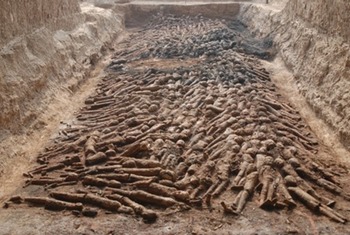
As stipulations regarding the burial of clay figurines were also part of the regulated arrangements for noble tombs, we would expect to find figurines in most, if not all noble tombs. Very few figurines wearing armor have been found in noble tombs in the Guanzhong Basin or elsewhere, but such figurines do appear in two tombs, those of Zhou Bo and Zhang Anshi, both near the Western Han capital. The inclusion of the armored figurines in these two tombs ought to reflect the unusually high stature of these tomb occupants among nobles, because both had acted as kingmakers (Figure 3).Footnote 36 On two sides of M8, the tomb now assigned to Zhang Anshi, lie six burial pits, from which have been recovered some two thousand clay and wooden soldiers, neatly arranged in the tomb; each soldier wears armor and helmets, and each is equipped with a weapon, either a sword, halberd, or crossbow. Doubtless, many rules governed the choice of the distinctive arrangements and weaponry assigned each soldier.
Burial pit K6, image of armored soldier figurines, after Zhang Zhongli, Ding Yan, and Zhu Yanling, “Fengqiyuan Han mu: Xi Han da jiangjun de jiazu muyuan,” Plate 13 (p. 85)

In particular, the colorfully painted and sculpted clay figurines (nearly one thousand in number) arrayed in battle formation, with their carefully articulated facial features, hair styles, decorations, moveable arms, silk clothing,Footnote 37 armor, and weapons, recall those found earlier at Yangling, the mortuary complex for Jingdi (r. 157–141 b.c.e.). Whereas outside Guanzhong very few nobles’ tombs had such expensively produced figurines wearing armor, inside Guanzhong the tombs of Zhou Bo and Zhang Anshi produced many of these (more than a thousand in Zhang Anshi's tomb).Footnote 38 At present, most scholars believe that use of this type of figurine was usually reserved for members of the imperial line. Certainly, the typical aristocrat or high-ranking official would be allowed to use these only with special permission. Presumably, most burials of such high-ranking people had only the clay figurines whose clothes had been sculpted and painted in bright mineral colorsFootnote 39 (see Figure 3).
Among the noble tombs in the Guanzhong Basin, Zhou Bo's tomb had more than three thousand clay figurines, whose clothing was sculpted and then painted. The New Brick Factory site in Xi'an, which contains the tomb of the Noble Liu Ying, yielded figurines with real clothes (like those in Zhang Anshi's tomb), but those were very few in number and most seemed to have been models of attendants.
Shrines
In Western Han, near the imperial tomb mound, a site called the “Chamber of Rest” would have contained the deceased emperor's effects (the objects he had used in daily life, including robes and caps), which at certain ceremonial times, on a monthly basis, were taken out and displayed in a solemn parade that traveled from the Chamber of Rest to the shrine (yue you yi guan 月游衣冠).Footnote 40 As archaeologists have found, similar structures were built near the tombs of a great many Han kings. Apparently, having been influenced by the model from the imperial and royal tombs, noble families in their cemeteries also set up shrines (citang 祠堂), as many early writings attest. After the death of Huo Guang, Noble of Bolu 博陸 (Broad Lands), they “levied the soldiers in the Three Rivers Region [i.e., the commanderies of Henan, Hedong, and Henei] to work together to build the burial mound and shrine, and then cover it over [once the underground structures had been completed]. Then they established for the site three hundred households [whose production would maintain the site].”Footnote 41 In the case of Chancellor Zhang Yu 張禹, appointed Noble of Anchang 安昌, “when he reached old age, he superintended the building of his gravemound, and erected a shrine.”Footnote 42 Still, archaeologists have discovered remarkably few examples of shrines erected for nobles.
The lack of evidence is doubtless partly due to the age of the cultural artifacts that were broken and destroyed (some by grave robbers, no doubt, in the looting process) and partly due to the excavators’ inattention to proper procedures for surveying the excavation site and artifacts. As the foundations for Zhang Anshi's shrine represent the first evidence discovered for a family cemetery of a noble (since the excavation of the tomb for the deposed emperor, the Noble of Haihun, came later and, plainly, it has its own unique features), it seems all the more important that we come to understand the particularities of its conformation, scale, and layout.
Eighty meters east of Zhang Anshi's great tomb (M8), the “core” tomb of the family cemetery, there is a square building base measuring some 19 meters per side. The main part is a rammed-earth platform, on which sat a structure with a “three-five” ground plan, meaning the proportions of the rectangle measure three units by five. (In English, each unit is called a “bay,” meaning, the space between two pillars).Footnote 43 The structure has completely finished steps, stone column foundations, doorways, corridors, stepping stones, and equipment to divert water from the site. In the archaeologists’ opinion, the site ought to represent a shrine,Footnote 44 given its relation to the “core” tomb M8. A variety of building materials have been used for the site, including square bricks, thin rectangular bricks, hollow bricks, clay tubes, slabs of tile, and rooftiles.Footnote 45
Trenches
Around the site a perimeter wall (yuan 垣) was built. One chapter in the Han shu devoted to the emperors’ male favorites says, “Have the imperial Court Architect raise a gravemound for [Dong] Xian 董賢 [at Yiling 義陵, the mortuary complex built for Aidi], and on the outside build prohibited walkways, and a perimeter wall running for several li 里.”Footnote 46 Based on the Shuihudi manuscript “Statutes on Burial,” nobles should have double-perimeter walls enclosing the cemetery, not just a single wall. No perimeter walls of this type, however, have been found at the Zhang Anshi family cemetery, only trenches.Footnote 47 These trenches surround the core tomb (M8) and also the site identified as the shrine. For whatever reason, the trenches are not very deep, merely 2–3 meters, and their length and width vary depending on the building site they surround.Footnote 48 The southern trench is the widest, measuring some 20 meters wide, and the northern trench is the longest, at more than 70 meters in length. Taken together, they signify that the buildings encased by the trenches are special, if not unique in nature, due to the extent of the single building site and also the nature of the tomb occupancy there.
In the imperial burial complex for Han Jingdi (r. 157–141 b.c.e.) at Yangling, archaeologists have found the tombs of Zhou Ying 周應, Noble of Sheng 繩 (enfeoffed 149 b.c.e.), and Bing Wu 丙武, Noble of Gaoyuan 高宛 (enfeoffed in 184 b.c.e.), as well as a number of other tombs that likely represent noble tombs. That cemetery also uses trenches to mark out sections of the terrain. Regarding this phenomenon, Hu Bin considers that the number or type of “the accompanying burials” for the imperial tombs may be constrained by a single and unchanging ‘ritual system,’” and perhaps there were mandates about using the trenches to mark off the noble tombs.Footnote 49 By contrast, Cao Long imagines burial practices, which concerned the “accompanying burials” or peizang included at the imperial mortuary complex, evolving over time during the two centuries of Western Han.Footnote 50 As Cao wrote, “After Jingdi, this kind of trench boundary gradually extended to become the wall boundary, from whence it was inherited by the Eastern Han.”Footnote 51 In that case, we may ask several related questions that cannot currently be resolved by the available archaeological evidence. These questions include the following: (1) When marking the boundaries of the cemetery, is there a hierarchy between walls and trenches, with trenches marking the cemeteries of relatively lower status? (2) Can we confidently posit real differences between imperial burials, royal burials, and noble burials, when discussing the boundaries of the peizang? (3) Can we say with assurance what features of a cemetery or mortuary complex would indicate that the site “transgresses the ritual regulations”? While much more archaeological data must be compiled before we have answers to these basic questions, we attempt below to survey the current secondary literature relating to the transgression of the ritual regulations.
During Western Han, we presume that the burial system had relatively strict rules that reflected the social hierarchies from the emperor down, such as official ranking, orders of honor, and various other hierarchies. Regulations mandated how large and how sumptuous a tomb could be, and these mandates were presumably enforceable by law, judging from an earlier “Table for the Meritorious Officials of the Han Founder, by Year” in the Shi ji, which notes, “The Noble of Wuyuan 武原, Wei Buhai 衛不害, in the sixteenth year of Jingdi's reign and the thirteen year of his own rule, had his kingdom abolished, as he was tried and convicted of having ‘exceeded the Statutes’ in the manner of his burial arrangements.”Footnote 52 This instance proves that the Han nobles sometimes, at least, received very stiff punishments for ignoring the ritual rules. Moreover, in 2006, as noted above, the Shuihudi cache of manuscripts included slips from a Han tomb manuscript entitled “Statutes on Burial.” As that document clearly mandates the rules for noble burials, we can use it to investigate Zhang Anshi's mortuary complex and whether the rules did or did not apply to that family cemetery.
The Height of the Burial Mound
One of the relatively early records to contain information about the stipulated height of nobles’ tomb mounds is the “Spring Officers” section, “Mound-builder” subsection, in the Zhouli 周禮, a work that surfaced only in late Western Han, but probably had earlier antecedents. Zheng Xuan's commentary to that text quoted the Han statutes as saying, “The tomb mound of a noble should be four zhang in height, and the guanneihou on down to the commoners each have mounds of varying height, depending upon their ranks in the hierarchy.”Footnote 53 The Shuihudi “Statutes on Burial” specifies the height of a noble's tomb mound as three zhang (6.9 meters, more or less), using Han measurements, where one Han foot equals 23.1 centimeters today,Footnote 54—a figure at odds with the 9.24 meters that Zheng Xuan stipulated, whereas Zhang Anshi's mortuary complex is only some 1.3 meters high today. That said, by the excavators’ calculations, the original height of Zhang Anshi's tomb mound may have been as much as 15 meters, or even taller.Footnote 55 For this height to have so greatly surpassed the stipulation that Zheng Xuan cited, not to mention the figure given in the Shuihudi “Statutes on Burial,” is significant. In addition, we know that the Mawangdui tomb mounds slightly exceeded 16 meters, and the Anhui, Fuyang tomb of the Noble of Ruyin was even taller, measuring some 20 meters. Again, we find instances where the ritual regulations seem to have been exceeded, and by quite a lot.Footnote 56
One Han shu chapter reports that under Han Wudi, in Yuanshou 元狩 Year 5 (corresponding to 118 b.c.e. in the Western calendar),
Li Cai, as Chancellor, was tried for having stolen three qing of land, when an imperial edict granted him a burial plot at Yangling, which ought to have been 20 mu 畝; Cai sold the surplus for over 400,000 cash. In addition, he forcefully seized 1 mu of fertile land outside the ‘spirit way.’ When sent down for trial, he committed suicide.Footnote 57
This entry suggests that nobles were typically granted roughly 20 mu of land for their burial plots, when they had been given the signal honor of being invited to “accompany” an emperor in death by being buried near him in an imperial mausoleum site. The “Statutes on Burial” plainly state that a noble's tomb should measure 45 zhang east–west, and 42 zhang north–south. By Han measurements, a noble tomb would then measure 103.5 meters east–west and 96.6 meters north–south, or approximately 9998.1 square meters, or 21.87 mu (2.4 US acres). This is close to the figure stipulated in the Han shu chapter.Footnote 58 Yet Zhang Anshi's own burial site measures 159 meters north–south and 195 meters east–west, with an area of nearly 31,005 square meters (7.66 US acres), more than three times larger than the area stipulated for the burial site of the noble Li Cai in the “Statutes on Burial.”Footnote 59
Moreover, the Shuihudi “Statutes on Burial” said that nobles were to have erected a shrine or worship hall of “approximately six zhang.” This would correspond to a square of 13.8 meters to a side, whose building's surface area would be 190.44 square meters (0.047 acres).Footnote 60 But we saw that the area thought to be Zhang Anshi's shrine was 19 meters to a side, making for a building's surface area of some 376 square meters, or very nearly double what is specified in the Shuihudi “Statutes on Burial.”
From the foregoing, we can deduce that the cemetery plot of Zhang Anshi exceeds the usual stipulated size for nobles’ tombs. Many scholars believe that this was due to a special conferral by the emperor himself, Xuandi, who wanted to recognize Zhang Anshi for unusual merit by awarding him these extraordinary funerary arrangements. (Compare Huo Guang's mortuary complex, for another extraordinary conferral.) By this theory, although limits placed on nobles’ tombs by the “Statutes on Burial” should have been observed under normal circumstances, the emperor always had the power, should he choose, to break the binding precedents of the Han ruling house, without anyone deeming it an infringement or transgression of the rituals. Liu Hanxing emphasized that Zhang Anshi's tomb and tomb mound had been built by the Court Architect by imperial decree; thus, Liu reasoned, this huge cemetery ought to conform to the expectations of the time. Xu Weimin 徐衛民, following the same logic, thought that building the Zhang Anshi complex must be considered “business as usual,” and not an infringement of the ritual rules.Footnote 61 Liu Rui, however, disagreed with this analysis about the imperial grant. He thought the “Statutes on Burial” represented early Western Han customs, which held until the mid- to late Western Han, by which time the court's finances had improved significantly,Footnote 62 resulting in the court's issuance of new burial regulations.
Regarding this question, Zhang Zhongli's analysis seems the most well-rounded. Zhang thinks that the “Statutes on Burial” were standard at the date when they were issued; still, any amendments to those laws were not necessarily recorded in the standard histories. But following the coincidence of two factors lavish burials finally became not only politically possible and sometimes expedient, but also practically inevitable; these two factors were an increase in production that took place under dowager empress Lü and Wendi, coupled with, during Wudi's reign, the “exclusive” preference given to classical learning with its praise for lavish burials.Footnote 63 In any event, as lavish burials became more common as signs of respect or filial duty, this, needless to say, would have diminished the force of the strictures or “political tools” originally designed to thwart the awards of excessive grants made by emperors to the clans and individuals they favored.Footnote 64
Zhang Anshi's Tomb in Relation to “Accompanying Burials”
For a long time, the scholarly consensus was that Zhang Anshi must have been buried in an “accompanying burial” (peizang 陪葬) at Duling, the mausoleum complex for Han Xuandi.Footnote 65 Only with the 2008–2011 excavations at the Fengqi Plain site, which established beyond a reasonable doubt the identity of the tomb occupant, did the scholarly world for the first time have definite knowledge of Zhang Anshi's burial site. That discovery, in turn, created a discursive space in which we can offer a new analysis of Zhang Anshi's tomb, asking whether Zhang was buried in an “accompanying burial” at Duling, and if not, why not.
A bit of background: When one is buried in an “accompanying burial” for an emperor, it is as if, in the afterlife, one attends the emperor. Such burials are usually reserved for close blood relations (e.g., empresses and court ladies, plus kings and princes of the Liu-clan ruling line), high-ranking officials, the most illustrious nobles, or imperial favorites. The person given this signal honor (which itself entails obligations) is, after his or her natural death, to be buried near the imperial tomb, without close family, unless granted special permission, to convey the idea of special closeness and exclusive loyalty to the imperial person.Footnote 66 In Western Han, this custom of “accompanying burial” began as early as the reign of the Han founder, Liu Bang 劉邦. Peizang are buried to the side of the emperor's tomb, with mounds built atop those peizang, and, in some cases, a ritual structure nearby.
The regulations for the “burial companions” and the mausoleum towns are inextricably bound together, as both are designed to consolidate imperial power. The Han shu geographic treatise (“Di li zhi” 地理志) says,
When the Han was founded, it established its capital at Chang'an, and then it had moved to Changling 長陵 [the mausoleum town built for Gaozu, the Han founder] the Tians 田 of Qi, the Zhaos 昭, Qus 屈, and Jings 景 of Chu [i.e., the most powerful families in the old pre-unification kingdoms], plus all the ennobled meritorious officials. In later generations, the high-ranking officers of two thousand bushels and the very richest people, plus the local strongmen, all were ordered to live near the imperial mausolea. Likely, this was to “strengthen the trunk and weaken the branches” [as Jia Yi's slogan went], and not only because they wanted to pay due respect to the burial sites.Footnote 67
After the Han founder instituted this policy of setting up mausoleum towns, to which he moved such people, his imperial successors, from Huidi to Xuandi, did the same. The establishment of a mausoleum town came first, designed to consecrate the burial site; second, the orders came to move the great clans, meritorious officials, and local strongmen from “east of the passes.”Footnote 68 In the capital's environs, the throne could win over their forces, while exploiting their enormous assets enrich the capital's economic and cultural resources. Given the central government's grants of lands and cash to the migrants, very soon every local official, strongman, and rich family was vying to move to the imperial capital region, and especially to move to the mausoleum towns to avail themselves of connections to the imperial family (“climbing up on their coattails”). For this reason, many famous statesmen and powerful people came out of these mausoleum towns.
The mausoleum town system was fully in place by the time Jingdi's mortuary complex, at Yangling, was constructed, and later the imperial and noble cemeteries followed the Yangling model. Such cemeteries had double perimeter walls, enclosing the entire sacred precinct, which was in a broad sense composed of not only the “core area” of the imperial tomb, but also the “accompanying burials” sites, plus the mausoleum towns. The imperial tomb sites (meaning, those of the emperor and his empress, separately interred), the external walls, gates and tower gates, outer storage pits and shrines, and other ritual building sites (typically to the north and south of the imperial burial mounds)—all constituted the “core area” around which was built an outer wall, and outside the outer perimeter wall was the area for the “accompanying burials” and the mausoleum town.Footnote 69
Beginning, then, with Gaozu's Changling mortuary complex, the “accompanying burials” were established in the east of the imperial burial site, in a comparatively concentrated manner, which nonetheless exhibits a clear pattern: taking the East Major's Road as the central axis extending from the imperial tomb sites, the accompanying burials are neatly arranged to the north and south of that road, always to the east but near the imperial tomb mounds.Footnote 70 The closer the burial mounds are to the East Major gate, the higher the burial mound, suggesting their higher rank in life, and subsequently in their afterlives. A few burial mounds are smaller, indicating the relatively low ranks of the tomb occupants in life. Already this pattern for the disposition of accompanying burials is fixed.Footnote 71
Peizang tombs in the Western Han mortuary complexes are in the east or northeast of the site, which reflects the way the entire Chang'an metropolitan site is conceptualized. The capital city of Han Chang'an and its Weiyang Palace within both have their principal gates in the eastern perimeter walls, and the Western Han imperial tombs also face east as the principal direction. The vast majority of the peizang tombs in the eastern portion of the complex are arrayed on either side of the East Major's Road, just as military and civil officials would be arrayed at court. Given the location of the capital at Chang'an in the northwest, most of the principal cities, kingdoms, nobilities, and commandery-county administrative sites of the realm lay to the east of the capital basin. Thus, the peizang tombs, assigned to the east, represent the outlying kingdoms in the realm in relation to the imperial tomb itself, which corresponds to Chang'an and to its palace city.Footnote 72
Another underlying reason for this arrangement of peizang tombs at the Western Han imperial tomb sites, we suspect, is that it reflects a very old cosmological concept of “honoring the West” (zunxi 尊西). As a passage in a chapter titled “Four Taboos” (Sihui 四諱) in Wang Chong's Lunheng (compiled c. 95 c.e.) says, “Now, as we all know, the west is the direction of age and maturity. It is therefore the position of honor. Should a senior dignitary be in the West, the person of lower status or younger age is in the east.”Footnote 73 This illustration of roughly contemporary views means that the emperor, as superior in status, should sit in the west and face the east when he entertained those of inferior status. Naturally enough, then, not just at wine feasts but in the mortuary complex, the emperor's tomb mound assumes the most honorable place (west) whereas his officials’ tombs lie to the east. In that way, superior and inferior have their relations confirmed and clarified.Footnote 74
Traditional Views about Zhang Anshi's Tomb
Emperor Xuan's reign marks the mid-dynastic restoration in Western Han. Not surprisingly, then, there were many peizang tombs at Duling, the imperial mausoleum sites. According to the Xianning xian zhi 咸寧縣誌, juan 11, which cites the Treatise on Chang'an (Chang'an zhi),
Several thousand paces southeast of Duling, there lie tens of “accompanying burials,” which guard the tomb; the size of these peizang varies. To the north, about a li away, nearly a hundred tombs (all chaotic and disordered) have come to light. From here going north, one runs straight into the southern wall of the city. To the east and west the region extends, but on the high plateau, piled up, one after another.Footnote 75
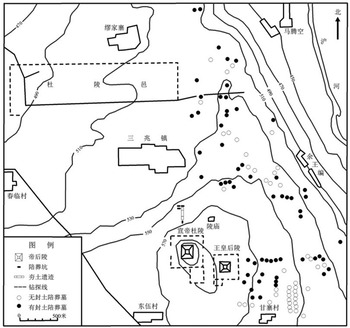
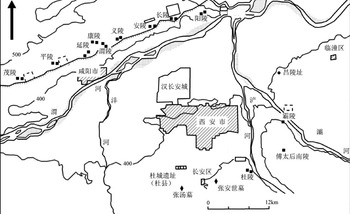
Judging from the documents we have today, Duling has 62 peizang tombs with tomb mounds, plus 45 whose mounds have been leveled off, making for a total of 107 gravesites. These were basically divided into two precincts, one in the northeast and one in the southeast, in accordance with the Western Han stipulations regarding the proper arrangement of peizang tombs. (See Figure 4.)Footnote 76 But the question remains: Is Zhang Anshi's tomb among those peizang tombs at Duling?
Duling, Xuandi's mausoleum town, after Han Duling lingyuan yizhi (mod.)

The Han shu biography of Zhang Anshi says, “Zhang Tang originally lived in Duling [actually Du county]. Zhang Anshi served the courts of Wudi, Zhaodi, and Xuandi. As he served in turn the three courts, in the end [during Xuandi's reign], he was reassigned to [his home county], later called Duling.”Footnote 77 This means that Zhang Anshi, who grew up in Du county, was eventually awarded a peizang site in the environs, in the newly built Duling. According to the “Basic Annals of Xuandi,”
In the spring, the first year of Yuankang (65 b.c.e.), the court chose for Xuandi's tomb a site in the eastern part of Du county, on a high plateau, and later named the site Duling. To Duling were moved [the peizang sites for Xuandi's] Chancellor, generals, nobles, two thousand bushel officials, and those whose wealth was calculated at [or above] one million cash.Footnote 78
As it happened, Zhang Anshi died three years later, in the fourth year of Yuankang, and at that point, he was given a number of honors, including the right to have his tomb built under the supervision of the imperial Court Architect.Footnote 79 Because of such entries in a standard history, up until recently most scholars believed that Zhang Anshi's tomb ought to be among the peizang tombs at Duling.
Of course, according to the customs of the time, Zhang Anshi, as Xuandi's second highest-ranking officer and son of a former Chancellor, merited inclusion among the “accompanying burials” for Xuandi. The Han shu “Annals of Chengdi” chapter provides an entry saying that when Chengdi was building his mortuary complex at Changling 昌陵, he moved to the site the five thousand households that could command wealth of five million cash or more. Chengdi “gave burial plots [at Changling] to the Chancellor, Imperial Counselor, generals, nobles, princesses, and two-thousand-bushel officials so (with their fine gradations), as well as residences.”Footnote 80 This suggests that the emperor provided this list of people with residential sites in his mausoleum town, at the same time that he intended to confer (or, more likely, did ceremonially confer) peizang burial plots in his own mortuary complex upon the same set of people, in this doubtless following earlier precedents. The Han shu “Basic Annals of Xuandi” chapter only says that the most well-known notables were moved to Duling, the site of his mortuary town, to live, and it said nothing about any postmortem arrangements for them. Still, if we examine the documents carefully, we see that these people were very likely also buried at Duling. Generally speaking, even if they were not interred in “accompanying burials,” their burial sites would have been carefully pre-selected to be located somewhere near the mausoleum towns.Footnote 81
For these reasons, the renowned classical scholar Wang Xianqian 王先謙 believed that Zhang Anshi must have been buried after his death in a peizang tomb at Duling.Footnote 82 In his classic Handai hunsang lisu kao (On Han Marriage and Mourning Rituals), Yang Shuda cited Wang Xianqian's Han shu buzhu (Supplementary Notes on the Han shu), which said, “Du refers to Duling, the third year, when Zhang Anshi first died, and he was granted the signal honor of a peizang burial site.” To Wang's conjecture, Yang added his own opinion:
The “Basic Annals of Xuandi” says, In spring, the first year of Yuankang [i.e., 65 b.c.e.], Xuandi ordered that his mausoleum site be prepared on the Du County plain, and that the name of the county be changed to Duling. So when Zhang Anshi's biography in the Han shu says of “east of Du,” and the “Basic Annals” chapter speaks of the site on the plain east of Du, these two records match one another precisely. When Wang says that Zhang Anshi had an accompanying burial, he is correct to do so.Footnote 83
In all likelihood, these two pieces of scholarship by Wang and Yang are the origins of the assumptions about Zhang Anshi's burial at Duling, which later scholars felt justified in accepting.
After the Han, many gazetteers about Zhang Anshi's burial site came up with different ideas, without determining whether Zhang Anshi was buried in Duling in a peizang burial. For example, Taiping huanyu ji 太平寰宇记, juan 25, says, “Zhang Anshi's burial site is 8 li south of the Mingde Gate; it is popularly known as the ‘Burial Mound of the General of Chariots and Cavalry (juji jiangjun) Zhang.’”Footnote 84 The Xianning xian zhi 咸寧縣誌, juan 14, said, “The gravesite of Noble of Fuping, Zhang Anshi, was south of the city walls, and west of the Changyan fortifications.”Footnote 85 According to the records provided in the gazetteers themselves, Zhang Anshi's gravesite ought to be at or near the Mingde Gate, to the south of the Tang Chang'an city. But Mingde Gate, in the Tang Chang'an city perimeter walls, was 15 li 里 to the northwest of Duling, a site that is too far from Duling. For this reason, Liu Qingzhu suspected that the gazetteer records were unreliable. Based on the Western Han system, the “accompanying burial” lands conferred ought to be near the imperial tomb mound, and thus Zhang Anshi's gravesite ought to be in the environs of Duling,Footnote 86 among the “accompanying burials,” he opined.
Plainly, if we compare the archaeological materials with the received records and analyze the two sources with some care, we arrive at a conclusion that in this case contradicts the received wisdom reflected in the literary sources. Firstly, generally speaking, with conferrals of burial sites on the nobles and high-ranking people who are given the privilege of having a burial mound erected, the conferrals are made by the ruling house and the occupant of the throne, in accordance with the rank the person enjoyed in life. Therefore, to confer a burial site does not invariably mean that one has been granted the extraordinary honor of a peizang burial site in the imperial mortuary complex; only those who are most favored in that group are buried in the immediate environs of the emperor himself, and these we call “accompanying burials.” As far as most high officials were concerned, to be awarded such a peizang was the very highest form of honor. If a person received such an extraordinary honor by imperial grace, the person's biography should have recorded this award after his or her death.Footnote 87 For instance, when the Noble of Ducheng 都成, Jin Anshang 金安上, died during the reign of Xuandi, an entry said, “He died, and had conferred upon him a burial site with a mound at Duling, as well as the posthumous name of Respectful Noble” (Jing hou 敬侯; NB: the Han courts could confer the same posthumous names on different people).Footnote 88 Similarly, the stele of Zhao Kuan 趙寛 reads, “His eldest son and heir Ang 卬, who was Leader of the Gentleman of the Palace [zhonglangjiang 中郎將] in the Right Ministries, went out with Chong Tian [otherwise unidentified] on a punitive campaign … . Ang was awarded an accompanying burial at Duling.”Footnote 89 Another entry tells us that, at the age of seventy-four sui, in the eighth year of Yanxi, Yang Bing died in his nobility, and he had conferred upon him an accompanying burial.Footnote 90 These notices definitively state that after the death of a noble, he would be awarded the privilege of having a burial mound among the “accompanying burials,” and yet no such record appears in Zhang Anshi's biography.
Second, from the Song on entries in gazetteers, such as Taiping huanyu ji and Xianning xianzhi, recorded the location of Zhang Anshi's burial. They place that site at a considerable distance from Duling, which suggests that earlier scholars had by no means assumed that Zhang Anshi had been awarded an accompanying burial at Duling, since all such burial sites are in the proximity of the imperial tomb itself.
Third, if we carefully examine the conditions at Yangling, where the burial pits and accompanying burials have been scientifically excavated with the utmost care, we see that after the highest-ranking court officials received the special privilege of being awarded a burial site and mound among the peizang burials, they then used that site as a family cemetery for themselves and their descendants. It is reasonable to assume that many of the peizang tombs in the Yangling mortuary complexes are tombs of nobles, and clustered around those “accompanying burial” sites are several small to mid-sized burials, presumably the tombs of those nobles’ descendants, constituting a particular type of family cemetery, even if each and every member of the noble's family is not buried with the peizang tomb. Around these “family cemeteries” in the imperial mortuary complex are trenches marking off the site on all four sides so that the entire “accompanying burials” site stands as a single territorial unit, separated to some degree from the other units in the “accompanying burials” location in the mortuary complex. We believe that the arrangement of “accompanying burials” at Yangling became the model for sites built for the later Western Han emperors.Footnote 91 That said, Zhang Anshi's great tomb on the Fengqi Plain (M8) certainly has his descendants clustered in burials around him; but notably, a trench separates Zhang Anshi's burial site from those of his descendants. This is not the case with the “accompanying burials” at Yangling, where the trenches demarcate and cordon off a single family's burial site. This layout, with intervening trench, suggests that Zhang Anshi's family cemetery cannot really be considered to belong to the regulatory system that we find at imperial mortuary complexes.
Fourth, from the point of view of archaeology, when we examine the family cemetery of Zhang Anshi, we find that Zhang's gravesite was to the southwest of Duling, Xuandi's mortuary complex. This, too, does not accord with the usual Han custom of having the “accompanying burials” distributed east or northeast of the deceased emperor's own funeral mound. Moreover, Zhang's family cemetery is some distance from Duling, at nearly 6 kilometers, or 3.72 miles, from Xuandi's tomb. It does not lie, therefore, within the scope of the Duling excavation site, which is bordered in the south by today's Dazhao 大兆 District (Dongwu 東伍 and Ganzhai 甘寨 villages) in Chang'an county; in the north by Xi'an city's own Matengkong 馬騰空 village, in the Wild Goose Pagoda area, Qujiang 曲江 District; in the west by Sanzhao 三兆 village; and in the east by the western bank of the Chan 滻 River. (See Figure 5.)
Disposition of the Western Han imperial mortuary complexes, west and east of Han Chang'an; image from Han Duling lingyuan yizhi (1993) plate 1, to which there have been added markings to show the tombs of Zhang Anshi and Zhang Tang, Anshi's father. The blocks near the imperial mortuary complexes (usually rectangular but square near Changling 長陵) represent the mausoleum towns. The block marked Xi'an City shows the boundaries of the very extensive metropolitan region in the early 1990s, which was much bigger than Han Chang'an; it does not show the Ming fortified city, which occupies only a small part of Xi'an City. Today's Xi'an metropolitan region encloses all of the area of the Sui-Tang capital of Chang'an, and much beyond.

When these four pieces of evidence are considered together, it is clear that Zhang Anshi was not buried in an “accompanying burial” at Duling, despite some earlier claims to that effect.
Unquestionably, Zhang Anshi was a meritorious official, one of the so-called “right-hand men” of the emperors he served. According to Han court regulations, he was fully qualified to receive from any one of those emperors the signal honor and privilege of having conferred upon him an “accompanying burial” site in an imperial mortuary complex, such as that built for Xuandi at Duling. Nevertheless, it seems obvious that his gravesite was not among those of the peizang tombs at Duling. Why is that?
First, we must think objectively and realize the practical constraint on building family cemeteries in the peizang section of any imperial mortuary complex: there was sometimes limited room to build such burial sites in a given complex, due to the local terrain. As noted earlier, archaeologists have found at Duling that such “accompanying burial” sites are in the eastern and northeastern segments of the complex, which extend as far east as the bank of the Chan River. To a certain extent, the river boundary restricted the number of tombs that could be built in the eastern portion of the complex. Still, Zhang Anshi died in the fourth year of Yuankang, fairly early in Xuandi's reign, when the imperial tomb had only been under construction for three years or so, so one can imagine that there should have been, in theory, sufficient room to bury Zhang Anshi at Duling. Moreover, although the majority of peizang tombs are in the east, there are also quite a few tombs sited north of the imperial gravemound, and the occupants of those tombs, which are relatively near the East Major's Road, tend to have been even higher-ranking in status. One would think that Zhang Anshi, by the regulations, might have been buried near the East Major's Road and not, then, near the banks of the Chan River, so this hypothesis does not hold water upon closer examination.
After the most obvious “objective” material reason is eliminated, the reason that the location of Zhang Anshi's burial was not among the usual peizang can only be subjective: it must reflect a personal choice by Zhang Anshi, and there must have been a deep underlying reason for the choice to locate his burial site on Fengqi Plain.Footnote 92 As we have seen, a set of precedents existed during Han for the allocation of peizang sites, but the existence of a regular system did not preclude modifications being introduced into it, under special circumstances. Proof of this can be found in the Hou Han ji 後漢紀 (Chronicle of Later Han), which says, “Earlier, Yuan An's wife had died at a young age, and she was buried in Yuan An's home village. Chancellor Yuan An, in his testamentary edict, noted that he, as Chancellor, had a higher duty to serve his emperor in death,” so he relinquished the thought that he be buried in his hometown, near his father and grandfather, even while it meant that their bones would remain alone in the older burial site. A similar case can be seen in Wei Xuancheng's biography, which also had imperial approval.Footnote 93 (Wei was also a very high-ranking official, whose service was much valued. Under Yuandi, he even became Chancellor.) So it seems that high-ranking officials could ask not to be buried in a peizang site in the imperial mortuary complex, particularly if they wanted to be buried near their ancestors and loved ones.
A second point may be adduced in evidence. If we look at the father of Zhang Anshi, Zhang Tang lived in Du County (today's Ducheng village in Chang'an); he also is buried in Du County. Zhang Anshi had therefore grown up in Du County, and both of his parents were buried there. Zhang Tang was a special favorite of Han Wudi, who held a huge number of positions—Commissioner of Trials (tingwei 廷尉) and Imperial Counselor—before being slandered and stripped of his position, at which point he committed suicide.Footnote 94 Even though in the end he was cleared of all charges by Han Wudi, Zhang Anshi may have felt keenly that his father had not been allowed to live out his natural years, and he, Anshi, would not have wanted to deprive his father of his companionship in death. Therefore, Zhang Anshi may have wished to be buried closer to his father, as a way of expressing his filial obligations to him.
Had Zhang Anshi been an ordinary official, he would likely have been buried near his father Zhang Tang, but because he was such a high-ranking official, the location of his burial (next to his father or next to his ruler, as an exemplary son or a meritorious official) was not easily resolved. Pursuing this train of thought, then we notice something intriguing about the choice of terrain for Zhang Anshi's tomb. Today, east of Zhang Anshi's tomb, 6 kilometers away, is Xuandi's mortuary complex Duling. Zhang Anshi's tomb is also 6 kilometers away, but to the west of Zhang Tang's gravesite.Footnote 95 That the two distances are the same may not be coincidental. We surmise that the reason Zhang Anshi did not accept the imperial act of grace is that Zhang Anshi chose to demonstrate his equal fealty to his father Zhang Tang and to his emperor, as a way of demonstrating that he exemplified both loyalty and filiality. After all, the Fengqi Plain site is equidistant from the gravesites of his father and his emperor.
Of course, as Cao Long has already said, “The single biggest obstacle to research on the Western Han peizang tomb sites and the system used to regulate them is the dearth of archaeological excavations for kings, princes, and nobles.”Footnote 96 Because of this, despite a thorough investigation of the available sources relating to one single research problem, we authors must agree with Cao Long that “there are many details for which we have no conclusive proof.”Footnote 97 To find the answers for the many problems relating to the gravesites in Zhang Anshi's cemetery, we have no recourse but to await future excavations that will give us further data to assess.
Conclusion
Through examination of the family cemetery of Zhang Anshi, we can glimpse the burial customs in Western Han for nobles. Even though most noble tombs followed the ritual regulations, these rules could be set aside for a variety of factors, including economic development, societal fashions, precise relations between ruler and subject, and, if we are correct, personal choices. For that reason, the noble tombs, despite the rough parity of their tomb occupants, exhibit all manner of variations over the course of time, providing us moderns with rich and varied examples that are striking. If we only had the “Statutes on Burial,” we would focus, in all probability, only on the ways that the family cemetery exceeded the rituals and could have been regarded, then and now, as “transgressive.” But the “Statutes on Burial” of an earlier time had likely already undergone changes by the time of Han Xuandi's reign, so it makes better sense to view the evidence in the context of Zhang Anshi's own era. Like earlier emperors, Xuandi used his gift conferrals to advance his political program and shore up support for the ruling house, especially because he was responsible for the Western Han mid-dynastic Restoration. But for any system to work properly, there must be a measure of flexibility in the system, especially when it comes to the supreme powerholders. Given the objective constraints of the era, Zhang Anshi's family cemetery lay within the environs of the capital and close to the imperial mausoleum towns. The plot of land was likely an imperial gift, and the site was likely constructed by the office of the imperial Court Architect. In that sense, by definition, it could not “transgress/exceed the regulations” and must have been considered permissible by Xuandi and by his court, even if it was “special” or unusual, when compared to other tombs.
We moderns today may not always or immediately think of peizang wholly in a political light. But apparently in Han times, some great officials, on their own initiatives, asked not to be buried among the “accompanying burials” section of the imperial mortuary complexes, no matter how great the honor. Zhang Anshi seems to have been one of these people who managed to find a way to do what he thought best, without offending the throne. This explains why the standard histories praise him as a person whose nature was “loyal, trustworthy, prudent, and generous,” as someone who “avoided the limelight and distanced himself from [the cruder operations of] power politics” (匿名跡遠權勢).Footnote 98 This excellent model was evidently passed down by Zhang Anshi to several generations of his descendants. Thus, Zhang Anshi not only provided them with preferential access to power through the ren 任 privilege, but also gave them a model by which they could establish the good reputations they needed to serve in office, generation and after generation. His descendants’ continued successful service to the emperor is the main reason why the Fengqi Plain family cemetery continued to entomb office-holders for many generations after Zhang Anshi had died, with a total of seven major tombs.