Introduction
A usage-based constructionist approach assumes that the development of linguistic knowledge occurs via interactions between exposure to linguistic environments and more basic forces from cognitive–psychological factors (e.g., Ambridge, Kidd, Rowland & Theakston, Reference Ambridge, Kidd, Rowland and Theakston2015b; Goldberg, Reference Goldberg2019; Lieven, Reference Lieven2010; Tomasello, Reference Tomasello2003). Linguistic knowledge exists as clusters of form–function pairings (i.e., constructions; Goldberg, Reference Goldberg1995), with varying degrees of abstraction. The emergence and growth of these clusters are affected by diverse factors, such as the distributional properties of individual items (e.g., Abbot-Smith & Tomasello, Reference Abbot-Smith and Tomasello2006; Tomasello, Reference Tomasello2003), the nature of the form–function mapping of each item (e.g., Cameron-Faulkner, Lieven & Theakston, Reference Cameron-Faulkner, Lieven and Theakston2007), the degree of (in)consistency involving the current stimulus against prior experience (e.g., Dittmar, Abbot‐Smith, Lieven & Tomasello, Reference Dittmar, Abbot‐Smith, Lieven and Tomasello2008), and domain-general learning mechanisms (e.g., Langacker, Reference Langacker and Schmid2017; Stefanowitsch, Reference Stefanowitsch2011; Theakston, Reference Theakston2004). As learning occurs, some of the clusters are strengthened enough to reliably defeat other competitors (Bates & MacWhinney, Reference Bates, MacWhinney, Wanner and Gleitman1982, Reference Bates, MacWhinney, MacWhinney and Bates1989; MacWhinney, Reference MacWhinney and MacWhinney1987; Goldberg, Reference Goldberg2019). Existing evidence, most of which comes from Indo-European languages (e.g., Aguado-Orea & Pine, Reference Aguado-Orea and Pine2015; Behrens, Reference Behrens2006; Cameron‐Faulkner, Lieven & Tomasello, Reference Cameron‐Faulkner, Lieven and Tomasello2003; Ibbotson & Tomasello, Reference Ibbotson and Tomasello2009), supports the core assumption of this approach that ascribes the development of linguistic knowledge to the interplay between input properties and domain-general learning capacities.
One issue within this approach is how to better capture developmental trajectories of children’s linguistic knowledge based on the exposure that they receive. Recently, researchers have used computational modelling to address this issue. As a proxy for the conceptual space in human cognition, a simulation provides a reliable model for how learning occurs (e.g., Ambridge & Blything, Reference Ambridge and Blything2016; Ambridge et al., Reference Ambridge, Maitreyee, Tatsumi, Doherty, Zicherman, Pedro, Bannard, Samanta, McCauley, Arnon, Bekman, Efrati, Berman, Narasimhan, Sharma, Nair, Fukumura, Campbell, Pye, Pixabaj, Paliz and Mendoza2020; Lupyan & Christiansen, Reference Lupyan and Christiansen2002; Matusevych, Alishahi & Backus, Reference Matusevych, Alishahi and Backus2016). Specifically, emerging research has shown the effectiveness of Bayesian inference for this kind of task (e.g., Alishahi & Stevenson, Reference Alishahi and Stevenson2008; Bannard, Lieven & Tomasello, Reference Bannard, Lieven and Tomasello2009; Barak, Goldberg & Stevenson, Reference Barak, Goldberg, Stevenson, Su, Duh and Carreras2016; Barak & Goldberg, Reference Barak and Goldberg2017; Nguyen & Pearl, Reference Nguyen, Pearl, Brown and Dailey2019; Perfors, Tenenbaum, Griffiths & Xu, Reference Perfors, Tenenbaum, Griffiths and Xu2011a; Xu & Tenenbaum, Reference Xu and Tenenbaum2007), assuming that human learning involves updating one’s beliefs based on previous experience. However, there is one caveat to this practice: previous research has been skewed heavily towards English, so it is uncertain to what degree the implications of these simulation studies are generalisable across languages to support the core assumption of the usage-based constructionist approach.
Against this background, the present study explores how Korean-speaking children develop their knowledge about representative argument structure constructions expressing a transitive event – an active transitive and a suffixal passive – as a function of input properties and statistical learning. This proceeds in two ways. One is the analysis of caregiver input and child production in CHILDES (MacWhinney, Reference MacWhinney2000), the largest open-access child corpora in Korean. The other is a Bayesian simulation that employs information about the frequency of the two construction types in the corpus. Korean, an understudied language in this regard, provides an interesting testbed because of language-specific properties such as agglutination and scrambling/omission of sentential components, which are distinct from characteristics of most languages that have thus far been studied in this regard. Some studies have analysed Korean-speaking children’s acquisition of these constructions through behavioural experiments (e.g., Jin, Kim & Song, Reference Jin, Kim and Song2015; Kim, Sung & Yim, Reference Kim, Sung and Yim2017; Shin, Reference Shin2020). However, we are not aware of any study on their developmental trajectories involving clause-level constructions by combining corpus analysis and computational modelling through the window of the usage-based constructionist approach.
Active transitive and suffixal passive in Korean
Korean is an agglutinative, Subject–Object–Verb languageFootnote 1 with overt case-marking. These structural cues allow scrambling of pre-verbal arguments if that reordering preserves the original intention with no ambiguity. Korean also permits the omission of almost all sentential elements: as long as participants in an event are clearly identified within that context, a case marker or a combination of an argument and a case marker can be omitted without changing the basic propositional meaning.
A canonical active transitive construction (1a) typically occurs with the nominative-marked agent, followed by the accusative-marked theme. The thematic roles of each argument are indicated by designated case markers: a nominative case marker (NOM) -i/ka (-i after a consonant) and an accusative case marker (ACC) -(l)ul (-ul after a consonant). The two arguments can be scrambled, comprising the theme–agent ordering (1b). In addition, a case marker (2a) or a noun and a case marker altogether (2b) can be omitted where relevant.


Previous research on Korean-speaking children’s acquisition of the active transitive shows an asymmetry by canonicity. To illustrate, the canonical pattern is employed more reliably than its scrambled counterpart (e.g., Jin et al., Reference Jin, Kim and Song2015; Kim et al., Reference Kim, Sung and Yim2017; Shin, Reference Shin2021). Children also tend to map the initial noun onto the agent until the age of four, regardless of its actual thematic role (e.g., Kim, O’Grady & Cho, Reference Kim, O’Grady and Cho1995; No, Reference No, Lee, Simpson and Kim2009). This is consistent with the oft-mentioned agent-first strategy, which is found in many languages (e.g., Abbot-Smith, Chang, Rowland, Ferguson & Pine, Reference Abbot-Smith, Chang, Rowland, Ferguson and Pine2017; Huang, Zheng, Meng & Snedeker, Reference Huang, Zheng, Meng and Snedeker2013; but see Garcia & Kidd, Reference Garcia and Kidd2020; Shin, Reference Shin2021).
A canonical suffixal passive constructionFootnote 3 (3a) occurs with the NOM-marked theme, followed by the dative-marked agent indicated by a dative marker (DAT)Footnote 4 -eykey/hanthey. The verb carries dedicated passive morphology as one of the four suffixes: -i, -hi, -li, and -ki (under allomorphic distribution). This pattern can be scrambled, yielding the agent–theme ordering, (3b). The same kind of omission as in (2a–b) also occurs where relevant.


Contrary to the case of the active transitive, how Korean-speaking children acquire the suffixal passive is inconclusive. Children up to four years of age are not generally adept at the passive in Korean (e.g., Kim et al., Reference Kim, Sung and Yim2017; Shin, Reference Shin2020), which aligns with the attested difficulties with passives cross-linguistically (e.g., Abbot-Smith et al., Reference Abbot-Smith, Chang, Rowland, Ferguson and Pine2017; Huang et al., Reference Huang, Zheng, Meng and Snedeker2013). However, their performance diverges after the age of four depending upon task types and verb types. For example, five-and-six-year-old children perform at chance-level comprehension (Kim et al., Reference Kim, Sung and Yim2017; Shin, Reference Shin2020), but their production of the passive could be primed (Kim, Reference Kim2010). Verb semantics also seems to affect their comprehension so that five-year-olds show above-chance performance in accomplishment verbs but at-chance performance in stative verbs (Lee & Lee, Reference Lee and Lee2008). Hence, these mixed reports make it difficult to gain a clear understanding of children’s developmental trajectory involving the passive.
We identify three language-specific aspects that may render the learning process of the two construction types in Korean particularly challenging for children. First, the form–function associations involving case-marking dedicated to these constructions are not straightforward (e.g., Choo & Kwak, Reference Choo and Kwak2008). This is particularly true for the two markers, NOM and DAT. For example, whereas NOM primarily indicates a nominal that designates the instigator of an action (i.e., the agent role), as in (1a–b), the same marker indicates the theme in the passive, as in (3a–b). In a similar vein, DAT basically indicates that a nominal is a recipient (in a ditransitive construction), but this marker indicates the agent in the passive as in (3a–b). Therefore, this aspect could affect how the children acquire knowledge about case-marking and clause-level constructions in which the markers engage. Children generally use these markers from the age of two or three, but their understanding of case-marking is not complete until the age of four (e.g., Cho, Reference Cho1982; Chung, Reference Chung1994; Lee, Kim & Song, Reference Lee, Kim and Song2013; No, Reference No, Lee, Simpson and Kim2009). However, few attempts have been made to precisely address the impact of the multiple form–function mapping of case-marking on the development of constructional knowledge.
Second, case markers exhibit varying degrees of omission. The optionality of these markers, particularly of NOM and ACC, is observed in colloquial speech (Sohn, Reference Sohn1999); compared to NOM, ACC tends to be occasionally dropped (Chung, Reference Chung1994). This characteristic seems to affect the acquisition of knowledge about NOM and ACC within the active transitive. Evidence shows that children learn NOM as an indicator of the subject in a sentence as early as 18 to 20 months old (e.g., Cho, Reference Cho1982; Lee, Reference Lee2004) and they typically employ a NOM-marked argument as the agent of an event (Kim, Reference Kim and Slobin1997; Lee & Cho, Reference Lee, Cho, Lee, Simpson and Kim2009; No, Reference No, Lee, Simpson and Kim2009). Notably, children acquire NOM earlier and use it more reliably than they use ACC (e.g., Jin et al., Reference Jin, Kim and Song2015; Kim et al., Reference Kim, Sung and Yim2017; Lee et al., Reference Lee, Kim and Song2013), which suggests an asymmetry regarding the developmental order of these markers. What remains to be discovered is how this asymmetric nature of case-marking omission influences children’s acquisition of the active transitive.
Third, verbal morphology serves as a core element in the passive: only this suffix indicates that a sentence is in the passive voice, signalling that the NOM-marked argument is not the agent but the theme and that the DAT-marked argument is the agent instead. Therefore, the sensitivity to passive morphology is crucial for successful acquisition of the passive in Korean (e.g., Shin, Reference Shin2020). However, this morphology rarely occurs in input due to the scarcity of the passive in usage. It is also morphologically irregular (e.g., Yeon, Reference Yeon, Brown and Yeon2015) and unproductive because it applies only to a limited set of verbs (e.g., Lee & Lee, Reference Lee and Lee2008; Sohn, Reference Sohn1999). Beyond this, it overlaps with verbal morphology used for a morphological causative construction (e.g., Sohn, Reference Sohn1999). Despite these challenges to the acquisition of the Korean suffixal passive induced by verbal morphology, most previous studies have shown only age factors in acquiring the passive, with the role of verbal morphology unexplored.
With these in mind, we investigate (i) the linguistic environments surrounding Korean-speaking children pertaining to transitive events and (ii) their acquisition of the two construction types as a function of input properties (centring around these constructions) and statistical learning (Bayesian inference). In the next section, we probe into the first inquiry by presenting an analysis of Korean child corpora in CHILDES as an exploratory study.
Analysis of caregiver input and child production
Methods
We analysed all the Korean child corpora available in CHILDES. The dataset consists of 81,593 sentences from nine caregivers and 38,388 sentences from four children whose ages range from 1;3 to 3;10 (Table 1). Of primary interest in this analysis were the active transitive (1a–b) and suffixal passive (3a–b), with or without the omission of such obligatory components as arguments and case-marking, with (non-)canonical word order. We also examined the use of individual markers – NOM, ACC, and DAT – dedicated to the two construction types.
Information about corpora.

Note. F = father; GM = grandmother; GF: grandfather; M = mother.
CLAN, a default programme of CHILDES for data analysis and editing, is not supported for Korean, so the analysis was conducted through Python programming in a semi-automatic way. As the raw data were not suitable for an automatic pattern-finding process, they were applied first to a pre-processing stage: typos and spacing errors were corrected; part-of-speech tagging information was attached automatically and revised manually; lines whose length was less than five strings (i.e., characters) or those consisting only of onomatopoeia and mimetic words were excluded (see Shin, Reference Shin2020 for the details about the pre-processing). Any non-verb-final instance (e.g., Yengswu-NOM read-SE book-ACC; eat-SE rice-ACC) was also excluded from the data. These treatments resulted in 69,498 sentences (285,350 eojeolsFootnote 5 ) for the caregiver input and 1,985 sentences (25,047 eojeols) for the children’s production.
Next, the pre-processed data were inputted to an automatic search process whereby instances of the two construction types and the three markers involving these constructions were extracted. To illustrate, the canonical active transitive with no omission was identified through the following steps. First, we isolated instances with a verb and more than one noun. Second, of these instances, we extracted cases with both NOM and ACC. Lastly, from these cases, we outputted sentences where NOM preceded ACC as a text file. Beyond these steps, every list of sentences for each extraction was checked manually to ensure its accuracy.
In addition to the frequency information about each pattern and case-marking, we calculated ∆P, a unidirectional statistics for association strength that estimates the degree to which a cue co-occurs with an outcome (e.g., Allan, Reference Allan1980; Desagulier, Reference Desagulier2016). A ∆P score, which ranges from –1 to 1, is computed based on a contingency table (Table 2), following the mathematical formula (4) where the probability of the outcome is conditioned upon that of the cue. For the interpretation of ∆P scores, the closer ∆P (outcome|cue) is to 1, the more likely the cue co-occurs with the outcome; the closer ∆P (outcome|cue) is to –1, the more unlikely the cue co-occurs with the outcome. We applied this technique to the individual markers used in the two construction types to discover how these markers invite the corresponding thematic roles and vice versa in the target constructional patterns (cf. Ramscar, Yarlett, Dye, Denny & Thorpe, Reference Ramscar, Yarlett, Dye, Denny and Thorpe2010).
Association strength: ∆P (¬ stands for ‘not’).

 $$ \Delta P\hskip0.35em =\hskip0.35em p\left(\mathrm{Outcome}\;|\;\mathrm{Cue}\right)-p\left(\mathrm{Outcome}\;|\neg \mathrm{Cue}\right)\hskip0.35em =\hskip0.35em \mathrm{a}/\left(\mathrm{a}+\mathrm{b}\right)-\mathrm{c}/\left(\mathrm{c}+\mathrm{d}\right) $$
Results: caregiver input
Construction
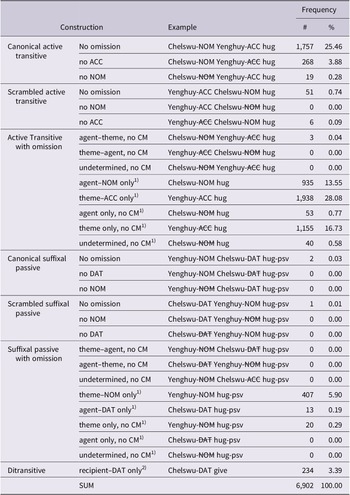
Table 3 presents frequency information about all the possible constructional patterns for a transitive event in the caregiver input. There were five major trends in the caregiver input.Footnote 6 First, the number of first-noun-as-agent patterns (3,049 instances) did not exceed that of first-noun-as-theme patterns (3,579 instances). Second, short, simple utterances (e.g., one-argument patterns; 4,561 instances) occurred more frequently than two-argument patterns (2,107 instances). Third, the passive patterns were rare in the input (443 instances) compared to the active ones (6,225 instances), but the number of passive patterns with only one case-marked argument was relatively large (420 instances). Fourth, within the active transitive, once two arguments were attested overtly, most of the utterances followed the canonical word order (i.e., agent-before-theme; 2,047 out of 2,104 instances). Fifth, within the active patterns, the omission rate of NOM (0.01) was considerably lower than that of ACC (0.23).
Constructional patterns (with or without scrambling and omission of sentential components) for a transitive event in the caregiver input (adapted from Shin, Reference Shin2020).

Note. CM = case-marking. 1) does not involve canonicity as it is undeterminable with only one overt argument. Although 2) does not relate to a transitive event per se and does not count as a relevant pattern, we considered it here because DAT is often used to indicate a recipient in the active and thus a potential competitor of the agent–DAT pairing in the passive.
Case-marking
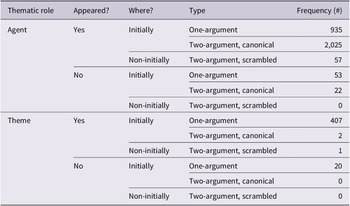
NOM involves two functions for the two construction types, indicating either the agent (for the active transitive) or the theme (for the suffixal passive). Table 4 presents frequency information about NOM based on the thematic role associated with it and whether/where the case-marked argument appeared in the patterns extracted from the caregiver input. NOM was used more as an indication of the agent than an indication of the theme. The ∆P scores substantiated the strong bi-directional association between NOM and the agent role in the context of a transitive event. NOM and the agent were extremely reliable cues for each other (∆P (AGENT|NOM) = 0.853; ∆P (NOM|AGENT) = 0.856). In contrast, NOM was highly unlikely to introduce the theme (∆P (THEME|NOM) = –0.868) and vice versa (∆P (NOM|THEME) = –0.905). This indicates strong cue validity (cf. Bates & MacWhinney, Reference Bates, MacWhinney, MacWhinney and Bates1989) between NOM and the agent within the transitive-event-related constructional patterns in the caregiver input.
Frequency of NOM in caregiver input.

Within the active transitive, ACC typically indicates the theme. Table 5 presents frequency information about ACC based on whether/where the case-marked argument appeared in the patterns extracted from the caregiver input. Considering the overall frequency of the patterns in Table 3, the number of the ACC-related patterns was relatively large. In particular, the one-argument pattern with only ACC present (1,938 instances) occurred as frequently as the other two patterns (51 + 1,776 = 1,827 instances), which yielded no statistical significance: χ 2(1) = 2.924, p = .087. The ∆P scores showed that the association between ACC and the theme role within a transitive event was moderately reliable. That is, ACC was a dependable cue for the theme (∆P (THEME|ACC) = 0.350) and vice versa (∆P (ACC|THEME) = 0.670) but not extremely strong as occurred in the case of NOM and the agent. This was caused by the high omission rate for ACC compared to that of NOM, by increasing the impact of the ¬ cue on calculation of ∆P. These results indicate that, despite the consistent mapping between form and function within the active transitive, the theme–ACC pairing manifests weaker cue validity (cf. Bates & MacWhinney, Reference Bates, MacWhinney, MacWhinney and Bates1989) than the agent–NOM pairing, particularly when ACC invites the theme.
Frequency of ACC in caregiver input.

Note. Since the focus of analysis was patterns involving a transitive event, we excluded any ditransitive pattern.
For DAT, there were only 16 instances where this marker indicated an agent in the passive. The ∆P scores further revealed that DAT and the agent were unlikely to be associated with each other (∆P (AGENT|DAT) = –0.507; ∆P (DAT|AGENT) = –0.098). Although the active patterns involving DAT are mostly ditransitives (and therefore do not count as relevant patterns expressing transitive events), we considered them here because DAT, often used as an indicator of a recipient in the active, serves as a potential competitor of the agent–DAT pairing in the passive. Together with the low frequency of the agent–DAT pairing, this attribute considerably aggravates the cue validity (cf. Bates & MacWhinney, Reference Bates, MacWhinney, MacWhinney and Bates1989) of DAT for the agent role (consequently, this pairing gives way to the agent–NOM pairing).
Result: child production
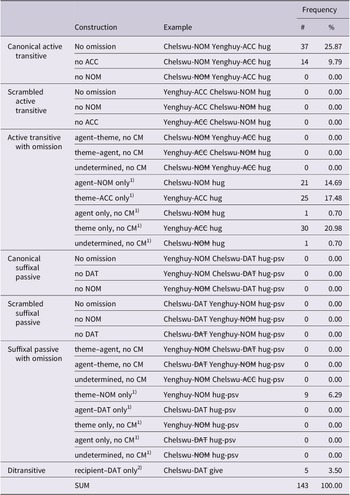
Table 6 presents frequency information about all the constructional patterns for a transitive event in the children’s production.Footnote 7 When expressing a transitive event, the children utilised only a few patterns: the canonical active transitive with no omission (37 instances), the active transitive with the no-ACC theme argument (30 instances), and the one-argument active patterns with either the theme–ACC pairing (25 instances) or the agent–NOM pairing (21 instances). Of the two-argument patterns with case-marking omitted, the children used only the no-ACC pattern (14 instances). There were nine instances of the one-argument passive pattern with the theme–NOM pairing: of these instances, four included the verb po-i- ‘see-PSV’ and two included the verb yel-li- ‘open-PSV’ (beyond these, we could not find such skewness in the rest of the patterns that the children uttered).
Constructional patterns (with or without scrambling and omission of sentential components) for a transitive event in child production.

Note. CM = case-marking. 1) does not involve canonicity as it is undeterminable with only one overt argument. Although 2) does not relate to a transitive event per se and does not count as a relevant pattern, we considered it here because DAT is often used to indicate a recipient in the active and thus a potential competitor of the agent–DAT pairing in the passive.
Discussion
Although the amount of data for the two construction types was small (9.93% and 5.34% for the entire data of the caregiver input and children’s production, respectively), thus requiring cautious interpretation, this analysis yielded two major findings.
First, we found an asymmetry in the frequency of the two construction types for expressing transitive events. In the caregiver input, the active transitive occupied most of the input composition, but there were generally more theme-first patterns than agent-first patterns. There were more instances of one-argument patterns than those of two-argument patterns, reflecting the general characteristic of caregiver input (e.g., Cameron-Faulkner et al., Reference Cameron‐Faulkner, Lieven and Tomasello2003). Regarding the two-argument patterns, the canonical pattern occurred more frequently than the scrambled pattern.
The asymmetries involving the constructional patterns in the caregiver input were induced by such factors as thematic role ordering, the number of arguments, voice type, and the omission of sentential elements. These factors appear to manipulate the degree to which each pattern was available or reliable when the children acquired constructional knowledge from the caregiver input (Bates & MacWhinney, Reference Bates, MacWhinney, Wanner and Gleitman1982, Reference Bates, MacWhinney, MacWhinney and Bates1989; MacWhinney, Reference MacWhinney and MacWhinney1987). Indeed, we found that the characteristics of the children’s production generally mirrored those of the caregiver input. For instance, the children employed the canonical active transitive as the core construction type for expressing a transitive event, which was also the dominant pattern in the caregiver input. The children’s use of patterns that included omissions also resembled the same tendency found in the caregiver input. This aligns with previous literature highlighting the direct connection between caregiver input and children’s development of linguistic knowledge (e.g., Ambridge et al., Reference Ambridge, Bidgood, Twomey, Pine, Rowland and Freudenthal2015b; Behrens, Reference Behrens2006; Cameron-Faulkner et al., Reference Cameron‐Faulkner, Lieven and Tomasello2003; Stoll, Abbot‐Smith & Lieven, Reference Stoll, Abbot‐Smith and Lieven2009).
The other notable finding in this analysis involved case-marking: the degrees of associations between individual markers and the corresponding functions diverged. Whereas NOM and ACC were related strongly to the agent and the theme, respectively, DAT was not likely to occur with the agent. Overall, the agent–NOM and theme–ACC pairings operated reliably, with the individual forms supplying the corresponding functions and vice versa. Of the two possible candidates of functions for NOM – the agent (in the active) and the theme (in the passive) – the former was predominant. Specifically, despite the positive values of ∆P scores involving ACC, this marker exhibited only a moderate level of association strength relative to the case of NOM, with ACC being more favourable as a cue to invite the theme than as an outcome to be invited by the theme.
On a related note, the strong bi-directional association between form and function that NOM manifests for transitive events supplies high cue validity, which increases cue strength enough to facilitate a learner’s acquisition of this particular mapping early on (Bates & MacWhinney, Reference Bates, MacWhinney, Wanner and Gleitman1982, Reference Bates, MacWhinney, MacWhinney and Bates1989; MacWhinney, Reference MacWhinney and MacWhinney1987). This language-specific feature in Korean seems somewhat inconsistent with the meaning-before-form account in language learning (Ramscar et al., Reference Ramscar, Yarlett, Dye, Denny and Thorpe2010) and possibly serves as the core motivation for the early, rapid learning of this knowledge compared to ACC, as demonstrated in previous research (e.g., Cho, Reference Cho1982; Jin et al., Reference Jin, Kim and Song2015; Kim et al., Reference Kim, Sung and Yim2017; Lee, Reference Lee2004; Lee & Cho, Reference Lee, Cho, Lee, Simpson and Kim2009; Lee et al., Reference Lee, Kim and Song2013; Shin, Reference Shin2021).
Based on these results, we model children’s knowledge about clause-level constructions through a Bayesian simulation, specifically asking whether and how the model learns the constructions in their entirety (i.e., without the mediation of lexical information). The findings of the caregiver input serve as a seed for the simulation, which models a learner’s cognitive space regarding the two construction types in Korean. Our Bayesian learner acquires these constructions as schematised input, which comprises pairings of morpho–syntactic and semantic–functional properties representing these constructions.
Bayesian simulation
Bayesian inference assumes that humans continuously update their beliefs about an event, represented as probabilities, through accumulated observations, making inferences according to these updated beliefs. One’s degree of belief about an event (posterior probability) is calculated using both the accumulated degree of conviction in a hypothesis which occurs before encountering the event (prior probability) and a conditional probability where the event would be observed given that the hypothesis is true (likelihood) (Pearl & Russell, Reference Pearl, Russell and Arbib2001; Perfors et al., Reference Perfors, Tenenbaum, Griffiths and Xu2011a). This idea is formalised as Bayes’ theorem (5), where A and B are independent events, P(A|B) refers to the posterior probability, P(B|A) to the likelihood, P(A) to the prior probability, and P(B) to the marginal probability.
 $$ P\left(A|B\right)\hskip0.35em =\hskip0.35em \frac{P\left(B|A\right)\ast P(A)}{\mathrm{P}\left(\mathrm{B}\right)} $$
P(B) is less important in actual application than in theory because the event B is fixed due to a stronger focus on the effects of the event A on one’s beliefs (Kruschke, Reference Kruschke2015). This condition produces a simpler formula (6) where the posterior probability is proportional to the likelihood times the prior probability (the marginal probability is not considered in this calculation).
 $$ P\;\left(A|B\right)\hskip0.35em \infty \hskip0.35em P\;\left(B|A\right)\ast P(A) $$
Bayesian inference can accommodate how language develops with respect to lexico–grammatical knowledge (e.g., Alishahi & Stevenson, Reference Alishahi and Stevenson2008; Bannard et al., Reference Bannard, Lieven and Tomasello2009; Matusevych et al., Reference Matusevych, Alishahi and Backus2016; Nguyen & Pearl, Reference Nguyen, Pearl, Brown and Dailey2019; Xu & Tenenbaum, Reference Xu and Tenenbaum2007; Perfors, Tenenbaum & Regier, Reference Perfors, Tenenbaum and Regier2011b), sentence-pattern-wise networks and productivity (e.g., Barak & Goldberg, Reference Barak and Goldberg2017), and typological generalisations (e.g., Culbertson & Smolensky, Reference Culbertson and Smolensky2012).
Alishahi and Stevenson (Reference Alishahi and Stevenson2008), inter alia, provided an important precedent for the current work. They showed a Bayesian account of the emergence and growth of English verb-argument constructions, which largely resembled developmental aspects that English-speaking children manifest. They created artificial input as pairs of a sentential frame and the corresponding semantic description involving this frame based on naturalistic caregiver input in CHILDES. These form–meaning pairs were inputted to an unsupervised Bayesian learning model to measure how the model displayed probability distributions in the formation of constructional clusters as learning proceeded. As the quantity of input increased over time, the Bayesian model was able to assign higher probabilities to frequently occurring verbs within specific constructions to which they were mapped and to generalise this schematic knowledge to a newly attested lexicon. Their modelling work is consistent with the major assumptions of the usage-based constructionist approach, supporting the interplay of frequency effects and general learning mechanisms without positing domain-specificity in language development.
Two conceptual points of Alishahi and Stevenson (Reference Alishahi and Stevenson2008) are highly relevant to our simulation. One is the direct mapping of a sentential frame and its semantic description. This reflects the idea that the inseparability of form and meaning/function, conceptualised as a construction, is a core property of language (Goldberg, Reference Goldberg1995). We thus created input for this study’s Bayesian learner by combining a constructional frame (a morpho–syntactic layer) and its meaning/function (a semantic–functional layer). The other point involves how constructions exist in humans’ conceptual space. Alishahi and Stevenson (Reference Alishahi and Stevenson2008) assumed that constructional knowledge creates clusters that share similar features in their syntactic–semantic properties, intertwined with probabilities about how likely these clusters accord with or deviate from each other (cf. Goldberg, Reference Goldberg2019). Following this point, we showed the development of constructional patterns (as clusters in the simulation environment) via posterior probabilities of these patterns and their changes due to learning.
Methods Footnote 8
Composition of input
All the constructional patterns for transitive events were included, with scrambling and varying degrees of omission manifested (see Table 3). There is no Korean corpus of caregiver input paired with semantic–functional information, so we generated an artificial set of input based on the characteristics of Korean caregiver input in CHILDES pertaining to these patterns (cf. Alishahi & Stevenson, Reference Alishahi and Stevenson2008). To focus exclusively on the development of constructional knowledge in its entirety, independently of lexical items, we devised two layers of schematised input: a morpho–syntactic layer specifying the formal properties of the pattern and a semantic–functional layer indicating the thematic roles of arguments and functions of markers. Each element in these layers had a left-to-right index to maintain information about canonicity in the input. For instance, the canonical active transitive (7) started with a nominal (N) followed by -i/ka, which was linked to the agent–nominative pair. This proceeded with another nominal followed by -(l)ul, which was associated with the theme–accusative pair, and finally a verb (V) denoting an action.

Whereas real morphemes indicated markers and passive morphology,Footnote 9 N and V represented abstract syntactic categories for nouns and verbs, respectively. Here, we did not presume that children receive these abstract categories from the beginning of learning; rather, we assumed that these categories represent heuristics – strategic and provisional knowledge emerging probabilistically through exposure – employed during acquisition. That is, a word with a marker stands for an entity, and a word at the end of a sentence refers to an action. Notably, we included no content word to control for the effect of lexical information on the simulation results and to better demonstrate the developmental aspects of the constructional patterns in their entirety in the cognitive space that we modelled.
Model training
The general learning algorithm for our Bayesian learner was similar to that of Alishahi and Stevenson (Reference Alishahi and Stevenson2008): adding a new input item to an existing group of constructions that had the most similar characteristics to the item. The degree of similarity was determined by the probability that the new item was close to the individual groups of constructions existing in the model. This process is formalised as (8): to find the best-matching construction, the model classified a new input item nCx as an existing construction type eCx, ranging over the indices of all the constructions in the model, with the maximum probability given nCx.
 $$ {\displaystyle \begin{array}{cc}\mathrm{Best}\ \mathrm{Construction}\;(nCx)\hskip0.35em =\hskip0.35em & \hskip-0.8em \mathrm{argmax}\hskip0.5em P\left( eCx| nCx\right)\\ {} eCx\hskip-22.3em \end{array}} $$
The computation of P(eCx | nCx) followed Bayes’ rule as in (6) where the posterior probability P(eCx | nCx) was proportional to the multiplication of the conditional probabilities associated with the existing construction types and the priors of the existing construction types.
The actual frequency information in Table 3 served as initial priors for the constructional patterns. As learning proceeded, information about the constructional patterns was updated. This was achieved through updating the pattern frequencies by adding the number(s) of the classified input to the classified construction type over the course of learning. To prevent the probability from converging upon zero, we adopted the Laplace smoothing technique (e.g., Agresti & Coull, Reference Agresti and Coull1998): the Laplace estimator added the value of one as the Laplace value to the original frequency value so that the probability of occurrence of each construction type did not become zero and thus incalculable.
For construction learning, we used transitional probability – namely, a series of conditional probabilities from the first item to the last item within a specific pattern. This reflects how children utilise linguistic input for learning – deducing intended meanings and functions from a given form (cf. Goldberg, Reference Goldberg2019) – in an incremental manner (e.g., Özge, Küntay & Snedeker, Reference Özge, Küntay and Snedeker2019; Strotseva-Feinschmidt, Schipke, Gunter, Brauer & Friederici, Reference Strotseva-Feinschmidt, Schipke, Gunter, Brauer and Friederici2019). To illustrate, the transitional probability of the canonical active transitive with no omission is obtained by the multiplication of the following probabilities (Figure 1): construction-initial N–i/ka pairing (a), construction-initial agent–NOM pairing given the construction-initial N–i/ka pairing (b), construction-medial N– (l)ul pairing given the construction-initial agent–NOM pairings (c), construction-medial theme–ACC pairing given the construction-medial N–(l)ul pairings (d), construction-final V given the construction-medial theme–ACC pairings (e), and construction-final action given the construction-final V (f). This particular composition nicely captures both pattern-wise facts (i.e., ‘What items appear where and in what sequence?’) and case-marking facts (i.e., ‘What form–function associations of markers engage in a constructional pattern?’) pertaining to a construction.
Schematic display of how to calculate transitional probability: canonical active transitive with no omission.

Model performance and prediction
There were 10 learning phases, with each phase consisting of one pass through the whole set of input (6,902 instances; see Table 3). Posterior probabilities of the constructional patterns were measured at every learning phase to estimate the degree of clustering for these constructions after the learning finished. We also traced the individual posterior probabilities from the learning phases 1–10 to see how the degree of clustering changed during learning in the given simulation environment.
We predicted two specific outcomes. First, the degree of clustering for the constructional patterns should be asymmetric as learning proceeds. The corpus analysis showed that factors such as thematic role ordering, the number of arguments, voice type, and the omission of sentential elements generate the construction asymmetry in the caregiver input, thereby manipulating the cue strength involving these patterns. This would create by-construction competition that should affect the course of learning. We thus expected a major increase in the posterior probabilities of the frequently attested patterns in the caregiver input (e.g., the canonical active transitive with no omission, the active transitive with only the theme–ACC pairing, the active transitive with only the theme argument without ACC). Furthermore, due to the characteristics of the Bayesian inference algorithm that constantly updates available information against previous experience, we further anticipated a continuous increase in the posterior probabilities of these major patterns as the learning proceeded.
We also predicted that the growth of clustering for the suffixal passive patterns should be suppressed considerably throughout the learning process. We identified two core factors contributing to this suppression. At the construction level, there was an unusual occurrence of verbal morphology: compared to its active counterpart – the null (and default) form in the input – this construction type engaged in the passive suffix (PSV), which was scarce in the input. At the case-marking level, there were atypical form–function associations of case-marking: NOM indicating the theme (but typically the agent) and DAT indicating the agent (but typically the recipient), all of which were rare in the input. Therefore, we expected that the information from these two levels, together with the continuous updating mechanism in the Bayesian model, would inhibit the passive patterns across the board.
Results and discussion
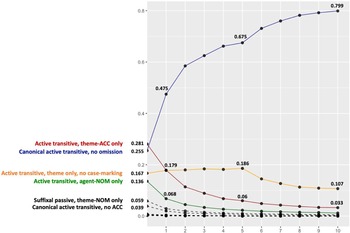
Figure 2 presents posterior probabilities of the constructional patterns per learning. Whereas most of the constructional patterns converged upon almost zero probability, the canonical active transitive was the only pattern whose degree of clustering was constantly increasing as learning proceeded. This finding indicates that, because of both its high construction frequency and the typical or dominant type of form-function pairings of case-marking, this constructional pattern was well-established in our model. This also aligns with the findings of behavioural studies showing children’s adult-like success in comprehending this pattern relative to the other patterns with a partial argument, marker, or both (e.g., Shin, Reference Shin2021).
By-construction posterior probability per learning. X-axis: learning phase; Y-axis: posterior probability.
Note. The other constructional patterns not specified in this figure converged upon zero probability immediately after the first learning. The ditransitive pattern only with the recipient–DAT pairing did not fall into a transitive event and was thus excluded. For the readers’ sake, this pattern achieved the posterior probability of 0.035 and 0.036 after the first and 10th learning, respectively.

In contrast, the growth of several patterns did not comply with distributional properties in the input. The active transitive with only the theme–ACC pairing, for example, was the most frequent pattern in the given input (1,938 instances), but the posterior probability of this pattern was neither the highest nor did it defeat that of the canonical active transitive with no omission. The posterior probability of the active transitive with only the no-ACC theme argument, the third most frequent pattern in the input (1,155 instances), slightly increased until the fifth learning phase, when it then immediately decreased. One possible reason for this disparity is that the development of the clustering for these patterns was somehow inhibited due to the characteristics of the other active transitive patterns during learning. The initial theme–ACC pairing (1,989 instances) was outnumbered by the initial agent–NOM pairing (2,960 instances); the number of the initial no-ACC theme argument (1,161 instances) was smaller than that of the initial theme–ACC pairing (1,989 instances) and the initial agent–NOM pairing (2,960 instances). Therefore, this study’s model may have learnt these case-marking properties (together with where each pairing occurred in a pattern) early and cumulatively during the learning process.
The degree of clustering for the remaining patterns decreased during the learning process, which may be ascribable to the same kind of suppression effects induced by these patterns’ fully-fledged counterpart – the canonical active transitive with no omission, which occupied a fairly large amount of input. Meanwhile, the finding that the posterior probability of the active transitive with only the agent–NOM pairing decreased over learning remains unclear at this point. We speculate that a similar kind of inhibitory force, caused by various constructional patterns in the input, may have affected how this pattern was learnt. This pattern was the fourth most frequent one in the input. However, the agent–NOM pairing occurred less often before a verb (935 instances for the active transitive, agent–NOM only; six instances for the scrambled active transitive, no ACC) than before the N–(l)ul pairing (1,938 instances for the canonical active transitive, no omission). This interplay may have suppressed the development of this pattern despite its relatively high construction frequency and the typicality of the form–function mapping of case-marking in the pattern. Even so, the reason for this suppression remains unclear and may thus require further investigation.
The change of posterior probabilities in the passive patterns (the suffixal passive with only the theme–NOM pairing, only the agent–DAT pairing, or only the no-NOM theme argument) is attributable to cue competition involving case-marking and verbal morphology. The suffixal passive with only the theme–NOM pairing has two features: the unusual case-marking (i.e., NOM indicating the theme) and the atypical passive morphology. The development of this pattern may thus have been suppressed greatly by its corresponding pattern – the active transitive with only the agent–NOM pairing, which has the typical case-marking (NOM indicating the agent) and verbal morphology (no active morphology). Similarly, the growth of the suffixal passive with only the agent–DAT pairing may have been constrained by the ditransitive with only the recipient–DAT pairing: case-marking (DAT indicating the recipient is more often than DAT indicating the agent) and verbal morphology (verb with no morphology is more often than verb with passive suffixes). The suffixal passive with only the no-NOM theme argument engages in passive morphology, which is atypical; this nature may have facilitated a similar composition of this pattern, the active transitive patterns with only one case-less argument (1,248 instances), in expressing transitive events. These findings thus indicate that cue competition involving case-marking and verbal morphology across the two voice types substantially modulates learning outcomes in the model.
General discussion
Summary of findings
This study explored Korean-speaking children’s knowledge about clause-level constructions in expressing a transitive event – an active transitive and a suffixal passive – in two ways: corpus analysis of caregiver input and child production (Section 3) and computational modelling through schematised input with no lexical information involved (Section 4).
The analysis of child corpora in CHILDES revealed two major aspects of caregiver input and child production. First, the rates of constructional patterns produced by the children generally mirrored those uttered by the caregivers. This aligns with the previous corpus-based studies across languages showing direct input–output relations in child language development (e.g., Ambridge et al., Reference Ambridge, Bidgood, Twomey, Pine, Rowland and Freudenthal2015b; Behrens, Reference Behrens2006; Cameron-Faulkner et al., Reference Cameron‐Faulkner, Lieven and Tomasello2003; Stoll et al., Reference Stoll, Abbot‐Smith and Lieven2009). Second, despite the multiple form–function associations of case-marking in Korean, the caregivers’ use of the three markers – NOM, ACC, and DAT – for the two construction types expressing transitive events was skewed towards single form–function pairings: NOM for the agent (and not for the theme), ACC for the theme (with uneven degrees of association between form and function by direction), and DAT not for the agent. These aspects provide empirical evidence for the nature of early input pertaining to the form–function mapping of case-marking dedicated to clause-level constructions related to transitive events in Korean, which has remained unclear in the previous literature on Korean-speaking children’s language development.
Based on the properties of the caregiver input, we modelled a Bayesian learner to see how the constructional patterns would develop as a result of the characteristics of construction-based input (without considering lexical information), by measuring the patterns’ posterior probabilities over the course of learning. Overall, we found the dominance of one pattern, the canonical active transitive with no omission, which occupied approximately one-third of both the caregiver input and the children’s production regarding constructional patterns expressing transitive events. In contrast, the development of the other patterns, including the one-argument active pattern either with only the theme–ACC pairing or with only the no-ACC theme argument and the passive patterns, seemed to be suppressed. The disproportionate rate of learning outcomes suggests that input properties, together with a statistical learning mechanism, may shape the structure of linguistic knowledge in a way that drives such information to centre around the most representative frame. Together, the simulation results suggest that this study’s learning model could reveal reasonable linguistic generalisations, by forming constructional knowledge as a function of schematised input and statistical learning, even in the case of lesser-studied languages such as Korean. We believe that the particular information that we utilised for the model training – transitional probability – allowed the model to achieve this degree of generalisation, by incorporating the constructional distributions and the particular form–function mapping of the core structural components of each construction type.
Inconsistency in the development of constructional patterns across corpus analysis and Bayesian simulation
This global similarity between the model performance and the children’s production is tempered by some notable inconsistencies, which are summarised in Table 7 (see also Appendix for the whole comparison between the caregiver input, children’s production, and posterior probabilities of the constructional patterns at the 10th learning phase). Considering the overall number of constructional patterns that the children produced (143 instances), they seemed to prefer the three patterns, all of which include NOM, in production. In contrast, the learning model did not yield the corresponding rates of posterior probabilities for these patterns within the given simulation environment.
Three constructional patterns involving major inconsistencies across corpus analysis and simulation (10th learning).

It seems that our computational model faithfully followed the construction-based distributional properties attested in the caregiver input. For instance, the active transitive with only the agent–NOM pairing (935 instances) was outnumbered by the corresponding pattern with only the theme–ACC pairing (1,938 instances), which may have affected the posterior probability of the former pattern through the raw frequency. The canonical active transitive with no ACC (268 instances) also occurred less frequently than its fully equipped counterpart (canonical active transitive with no omission: 1,757 instances). This may have influenced the posterior probability of this pattern through both the raw frequency and the transitional probability – that is, P(Theme_2–ACC_2 | Agent_1–NOM_1) suppressed P(N_2 | Agent_1–NOM_1). In the same way, the number of the suffixal passive with only the theme–NOM pairing (407 instances) was less than that of the active transitive with only the agent–NOM pairing (935 instances), and this may have guided the posterior probability of the passive pattern by way of both the raw frequency and the transitional probability – that is, P(Agent_1–NOM_1 | N_1–i/ka_1) suppressed P(Theme_1–NOM_1 | N_1–i/ka_1). Considering that our learning model proceeded with transitional probabilities accounting for both constructional distributions and case-marking facts, it is reasonable to think that the model responded favourably to the construction frequency and the form–function mapping of case-marking in the input.
The children, however, may have been affected more by the reliable or available form–function mapping of NOM for transitive events than constructional distributions in the caregiver input. We found in the corpus analysis that (i) NOM was not only a highly reliable cue to introduce the agent but also a highly reliable outcome invited by the agent and (ii) it occurred more frequently in the initial position than in the non-initial position. In turn, these characteristics allow for high cue validity for this particular mapping (Bates & MacWhinney, Reference Bates, MacWhinney, MacWhinney and Bates1989), leading the children to primarily (and strongly) deploy NOM to indicate the actor of a transitive event. This interpretation supports previous research demonstrating the Korean-speaking children’s heavy reliance on a heuristic that maps NOM onto the agent role (particularly for the first noun) for transitive constructions (e.g., Jin et al., Reference Jin, Kim and Song2015; Kim et al., Reference Kim, Sung and Yim2017; Lee et al., Reference Lee, Kim and Song2013; Shin, Reference Shin2021). Indeed, children are known to be better attuned to a local cue (induced by case-marking) than to a distributional cue (induced by word order) due to the computational advantage of the former versus the latter (Bates & MacWhinney, Reference Bates, MacWhinney, MacWhinney and Bates1989; Shin, Reference Shin2021; Wittek & Tomasello, Reference Wittek and Tomasello2005). In this respect, compared to the computational model that considers both local and distributional cues simultaneously, the children may have attended more to the agent–NOM pairing than the construction-based distributional properties in the early stages of learning.
Nevertheless, the case of the suffixal passive with only the theme–NOM pairing is still unclear. We speculate that there was some influence of lexical items on this inconsistency. As reported in the corpus analysis, the way that the children produced this pattern was tied to several verbs. Despite the numeric insufficiency for generalisation, it seems that the children’s production of this pattern was limited to less abstract, narrow-range schemata, which is consistent with the gradual-abstraction account (e.g., Tomasello, Reference Tomasello2003). This lexical specificity found in the passive may be due to the challenge of learning a passive voice (e.g., Kim et al., Reference Kim, Sung and Yim2017; Shin, Reference Shin2020; also cross-linguistically e.g., Abbot-Smith et al., Reference Abbot-Smith, Chang, Rowland, Ferguson and Pine2017; Huang et al., Reference Huang, Zheng, Meng and Snedeker2013). Even so, because no content word was used in the input for the present simulation, this issue is left unaddressed in the current study and requires further investigation.
Broader implications on child language development
Our simulation work provided somewhat different flavour than the previous research on this subject (e.g., Alishahi & Stevenson, Reference Alishahi and Stevenson2008; Ambridge & Blything, Reference Ambridge and Blything2016; Bannard et al., Reference Bannard, Lieven and Tomasello2009; Barak et al., Reference Barak, Goldberg, Stevenson, Su, Duh and Carreras2016; Matusevych et al., Reference Matusevych, Alishahi and Backus2016) due to the two motivations of this study. One was to model a child learner after the age of one or two, following the age range of the children in CHILDES (see Table 1). For this reason, we employed frequency information in the caregiver input as the initial priors of the learning model, instead of creating a tabula rasa model from scratch, with the assumption that this study’s Bayesian learner was already equipped with varying degrees of prior probabilities involving the constructional patterns.Footnote 10 The other motivation in this study was to model the development of linguistic knowledge about clause-level constructions in their entirety. For this reason, we devised the schematised input with a pair of two abstract layers, instead of using content words attested in the caregiver input. Therefore, this study’s computational model cannot predict whether children’s linguistic knowledge is organised around specific lexical items and develops towards abstract constructions in a piecemeal manner, as the gradual abstraction account claims (e.g., Theakston, Ibbotson, Freudenthal, Lieven & Tomasello, Reference Theakston, Ibbotson, Freudenthal, Lieven and Tomasello2015; Tomasello, Reference Tomasello1992, Reference Tomasello2003). Instead, this particular simulation environment allowed us to test how the Bayesian model learns constructional knowledge as proposed by the early abstraction account, the other perspective of the usage-based constructionist approach arguing for the early emergence of abstract knowledge (albeit still requiring a considerable amount of exposure to linguistic environments for the maturation of knowledge; e.g., Dąbrowska & Tomasello, Reference Dąbrowska and Tomasello2008; Rowland, Chang, Ambridge, Pine & Lieven, Reference Rowland, Chang, Ambridge, Pine and Lieven2012; Saffran, Aslin & Newport, Reference Saffran, Aslin and Newport1996; cf. Messenger & Fisher, Reference Messenger and Fisher2018).
Due to these motivations and the particularities for the simulation environment, in conjunction with this study’s narrow scope of investigation (i.e., constructions only for transitive events), our computational model may not have exactly demonstrated human linguistic behaviours, as shown in the children’s production. In particular, the fact that we composed input without lexical information renders it impossible for the model to capture this lexically tied factor (cf. Alishahi & Stevenson, Reference Alishahi and Stevenson2008) to the extent that human learners do when acquiring constructional knowledge (e.g., Ambridge, Bidgood, Twomey, Pine, Rowland & Freudenthal, Reference Ambridge, Bidgood, Twomey, Pine, Rowland and Freudenthal2015a; Goldberg, Reference Goldberg2019; Tomasello, Reference Tomasello2003), as in the case of the suffixal passive with only the theme–NOM pairing. Furthermore, we utilised only well-formed instances (with at least one argument and a verb), ignoring incomplete instances in the caregiver input such as partial and verb-less utterances with various noun–marker pairings.Footnote 11 Therefore, the answer to the core question of this study can only be partial at this point.
Nonetheless, we discovered convincing compatibility of the model performance with the children’s production. For instance, the distributional properties of the constructional patterns for transitive events and the characteristics of case-marking and verbal morphology dedicated to these constructions in the caregiver input yielded the model performance largely consistent with the children’s production, despite having no individual support from lexical information. This approximates how Korean-speaking children’s constructional knowledge develops and changes in their conceptual space in response to construction frequency within the given amount of input and form–function correlations involving the core structural properties of the target construction types. In particular, the suppression effects observed in the model performance reflects the by-construction competition, driven by the asymmetric degrees of cue validity induced by both constructions and their structural components (i.e., case-marking and verbal morphology). This aligns nicely with the Competition Model that shows how children acquire coalitions of form–function mapping and adjust the weight of each mapping for an optimal fit for learning (Bates & MacWhinney, Reference Bates, MacWhinney, Wanner and Gleitman1982, Reference Bates, MacWhinney, MacWhinney and Bates1989; MacWhinney, Reference MacWhinney and MacWhinney1987).
Our findings also highlight the status of abstract form–function correspondences – constructions, which are independent of individual lexical items – as a psychological reality in language development (Goldberg, Reference Goldberg2019; Lieven, Reference Lieven2016; Tomasello, Reference Tomasello and Bavin2009). The classic version of computational simulations within the usage-based constructionist approach has been utilising both lexically specific information and constructional information simultaneously (e.g., Alishahi & Stevenson, Reference Alishahi and Stevenson2008; Ambridge & Blything, Reference Ambridge and Blything2016; Bannard et al., Reference Bannard, Lieven and Tomasello2009; Barak et al., Reference Barak, Goldberg, Stevenson, Su, Duh and Carreras2016; Barak & Goldberg, Reference Barak and Goldberg2017). However, this study exclusively considered information about constructions, with a special focus on the distributional properties of constructional patterns and the particular form–function pairings of the core structural components for each construction type. This aspect may render it somewhat difficult to pinpoint the locus of the dissimilarities between the caregiver input, the children’s production, and the model performance. However, this study’s novel approach allows us to effectively examine the extent to which children respond to knowledge about clause-level constructions during learning.
Together, the present study contributes to the literature on child language development in two directions. First, the implications of our findings support the major tenet of the usage-based constructionist approach that explains the development of linguistic knowledge as a result of the interplay between input properties and domain-general learning capacities (Ambridge et al., Reference Ambridge, Bidgood, Twomey, Pine, Rowland and Freudenthal2015b; Goldberg, Reference Goldberg2019; Lieven, Reference Lieven2010; Tomasello, Reference Tomasello2003). Second, this study’s implications expand the current research practice in computational modelling for child language to include the unit of clause-level construction (without the mediation of lexical information). Specifically, this study employed direct form–function mapping and transitional probability for model training, illuminating the role of core morpho–syntactic features comprising the target construction types (case-marking and verbal morphology; scrambling or omission of sentential components) in the model’s construction learning. In conclusion, we believe this study’s findings advance understanding of how input-related factors (the nature of item frequency/distribution and form–function associations) and learning mechanisms (statistical learning, together with the continuously updating mechanism against prior experience, as Bayesian inference suggests) jointly affect the organisation of target linguistic knowledge (clause-level construction) in children’s cognitive space – particularly, regarding lesser-studied languages in this field.
The findings of this study should be further verified and re-assessed from various angles, particularly through behavioural experiments on (the structural components of) clause-level constructions. Compared to the active employment of the real-time measurement of children’s sentence comprehension in major languages under investigation (e.g., Abbot-Smith et al., Reference Abbot-Smith, Chang, Rowland, Ferguson and Pine2017; Huang et al., Reference Huang, Zheng, Meng and Snedeker2013; Özge et al., Reference Özge, Küntay and Snedeker2019; Strotseva-Feinschmidt et al., Reference Strotseva-Feinschmidt, Schipke, Gunter, Brauer and Friederici2019), processing-based research on child language in Korean is in its infancy. Furthermore, the literature is scant on Korean-speaking children’s linguistic development considering language-specific properties at the level of clause-level constructions (cf. Jin et al., Reference Jin, Kim and Song2015; Kim et al., Reference Kim, Sung and Yim2017; Lee et al., Reference Lee, Kim and Song2013). With a similar focus on the two construction types in this study, Shin (Reference Shin2020) revealed an interplay of word order, case-marking, and verbal morphology in Korean-speaking children’s comprehension of these constructions with scrambling and varying degrees of omission. By devising a novel methodology that obscured parts of test sentences through acoustic masking, Shin found a comprehension advantage of a local cue (case-marking; particularly the agent–NOM pairing) over a distributional cue (word order; particularly the agent-first heuristic) and emerging sensitivity to passive morphology proportionate to age. Future work would thus benefit from exploring to what extent the findings of computational simulations (with various learning algorithms) explain those from behavioural experiments. This is what we plan to pursue next.
Competing interests
The authors declare none.
Appendix
Comparison between the caregiver input, children’s production, and posterior probabilities (10th learning) of the constructional patterns.