Introduction
The tensions in the Church of England between liberals and conservatives surface in different issues at different times. In recent years, the focus for these tensions has been on homosexualityFootnote 3 and the ordination of women as bishops.Footnote 4 In earlier years, the presenting issues have been the ordination of women as priests,Footnote 5 divorce and remarriage,Footnote 6 and cohabitation and sex outside marriage.Footnote 7 In addition to moral issues and issues of church ordering, there have also been a series of debates sparked by bishops who publicly adopt apparently radically liberal beliefs about doctrine or Scripture: David Jenkins in the 1980s,Footnote 8 John Robinson in the 1960s,Footnote 9 and Hensley Henson in an earlier generation.Footnote 10
The terms liberal and conservative in an Anglican context do not necessarily refer to well-defined parties, and this is especially true in England. Historically, conservatism has mostly been expressed as a rather general adherence to traditional patterns of beliefs or practices that may go back centuries. Liberalism has, on the other hand, had connections with particular movements, and owes its origins, in part, to the growth of Enlightenment rationalism. Liberalism in the Church of England is often traced to the work of Charles GoreFootnote 11 and the collection of essays, Lux Mundi, which responded to the challenge to Christian orthodoxy created by the emerging disciplines of critical biblical scholarship and natural science. Perhaps the most influential liberal movement in the Church of England has been the Churchmen’s Union founded in 1898, which became the Modern Churchmen’s Union in 1931 and the Modern Churchpeople’s Union in 1986. The union’s journal, Modern Churchman, which became Modern Believing in 1994, has sought to promote the discussion of liberal ideas in the church generally, and particularly in the Church of England. Liberalism has mainly influenced the Church of England by introducing new ways of regarding traditional beliefs and practices, often by introducing these through liberal clergy and bishops.
A more common way to define parties in the Church of England has been to look at church tradition. The two main parties are the Anglo-catholic wing and the evangelical wing, both of which have their roots in the eighteenth and nineteenth centuries.Footnote 12 Anglo-catholicism began with the Tractarian Movement in Oxford, and supporters sought to move the Anglican Church nearer to its Roman Catholic roots. The emphasis has been on church worship with keen interest in liturgy, sacraments and especially the eucharist. The evangelical wing of the Church of England arose out of the general eighteenth- and nineteenth-century resurgence in evangelicalism, but is also associated with key figures such as Charles Simeon, from Cambridge, and those of the Clapham Sect.Footnote 13 Supporters sought to move the Church of England nearer to its reformed roots. The emphasis has been on the preaching of Scripture that leads to personal conversion and holy living.
Between these two wings lies what is termed variously as ‘middle of the road’, ‘traditional’ or ‘broad church’ Anglicanism. Although sometimes identified as a separate movement within the Church of England,Footnote 14 churches in this category are linked mainly by not belonging to either of the two wings, Anglo-catholic or evangelical. Broad churches in this sense represent congregations that embrace a range of practices and theological stances. Many parishes in England have a long history of being shaped by different traditions from one incumbent to the next, and present-day practices can combine disparate elements. For example, buildings that portray evidence of the Anglo-catholic romantic influence on the design of the chancel may now host worship that is largely devoid of Anglo-catholic attention to liturgy or vestments. In other cases, broadly Anglo-catholic worship may include music derived from charismatic renewal, while pew Bibles portray an evangelical concern for the preaching of Scripture. Broad-church Anglicans, almost by definition, are likely to encompass a range of conservative to liberal views, and it can be difficult to predict what particular individuals may believe. Nonetheless, broad-church Anglicans are probably in the majority, and where they go, so goes the Church of England as a whole.
Alongside these three traditions have been a number of other influences that have affected parts of the Church of England to varying extents. Most recently, the Charismatic Movement has had a widespread impact on the Church of England, mostly associated with evangelicalism.Footnote 15
Mapping the liberal–conservative divide onto church tradition in the Church of England is complicated because traditions with different backgrounds sometimes find themselves united on taking a conservative stand, but for quite different reasons. A typical case is the opposition to women priests, which for some Anglo-catholics is rooted in a theology of priesthood or in fear of making permanent the separation from the Roman Catholic Church, but which for some evangelicals is rooted in biblically-derived notions of authority and leadership. Although both wings have taken similar conservative stances on this issue, they are not necessarily united on other issues. A typical case is that of homosexuality, where Anglo-catholicism has traditionally been rather benign over the issue,Footnote 16 whereas evangelicalism has generally taken a negative stance.Footnote 17
Although differences of opinion and tensions between liberals and conservatives have been around for a very long time, it seems that they are increasingly coming to a head. The divisions in England reflect those across the worldwide Anglican Communion, where some sort of formal separation seems distinctly possible. There may be a number of different reasons for this accelerating change. It might be, for example, that divisions that have been present for many years are becoming public due to changes in attitudes toward authority. Minorities are no longer willing to bow to the majority view, and younger generations are expressing openly beliefs and attitudes that previous generations held mainly in private. On the other hand, it may be that liberalism has become more widespread as church people adopt the attitudes and beliefs of the societies in which they live. In this case, conflict arises as a traditional and conservative church adjusts to the changes in the beliefs and attitudes of some of its members. Another possibility is that conservatives are becoming more conservative in their views. The post-war rise of evangelicalism in the Church of England has given evangelicals a stronger voice in the running of the church,Footnote 18 perhaps making conservative views more acceptable than they were previously and thereby encouraging more extreme views.
Separating these different scenarios is not easy, and it is possible that all of them have operated, along with other factors. The final voice on these matters may well lie with historians who will look back from future generations and see the changes in a wider perspective. What historians tend to concentrate on are the big events and the lives of the influential: the conferences, synods, bishops and protesters. What they will find more difficult to judge is the mood of ordinary churchgoers: the lay people who fill the pews and the clergy who give a lead at parish level. This is where it helps to examine beliefs and attitudes through interviews and surveys of a range of churchgoers. This paper is an analysis of a survey conducted in 2001 among readers of the main newspaper of the Church of England, the Church Times, some results of which have already been reported elsewhere.Footnote 19 Although it may not be a completely representative sample of the whole Church of England, it does represent a very large number of committed lay and ordained Anglicans whose views range from the ultra liberal to the ultra conservative. The initial findings of this survey have been analysed by Francis, Robbins and Astley,Footnote 20 who compared responses to individual items between different groups within the sample, including clergy versus laity, young verses old laity, and Anglo-catholic versus evangelical clergy.
The present study uses a more sophisticated, multivariate analysis to look at changes over time within each of the main traditions. Age in this context is taken as a measure of cohort, so that differences between young and old reflect the changing values of different cohorts within the Church of England. The importance of this is that today’s young Anglicans may be tomorrow’s leaders. Measuring differences between age groups indicates how the Anglican Church in England has changed in the past and where it might be heading in the future.
Examining the data in this way could help to identify, more precisely, the reasons why division seems to be increasing in the Church of England. If the increase were due to longstanding differences which are only now surfacing, we would expect to see wide disparity in essential beliefs between traditions across the full age-range of its members. Older generations would be no less divided in opinions than younger ones, just less likely to voice those differences in public. If increasing division has arisen because of an increase in conservatism among evangelicals, we would expect to find that younger evangelicals are more conservative than older ones, while the rest of the Church of England has remained relatively unchanged. If division has arisen because parts of the Church of England have become more liberal while others have remained unchanged, we would expect to see older generations displaying uniformly conservative views but some traditions among younger cohorts showing more liberal views.
To test these possibilities we have examined a range of beliefs and attitudes among lay and ordained Anglicans, some of which are related to theological beliefs, some to moral values, some to ecclesiastical practices and some to issues that might be considered neutral. Looking at a range of beliefs and attitudes should indicate if conservatism in the Church of England simply implies a general resistance to change, or if it is about the specific rejection of changes that challenge particular deeply held beliefs.
Method
The Church Times is the main newspaper of the Church of England, with a circulation of around thirty-three thousand. In 2001, it published a four-page questionnaire in two editions of the paper spanning the end of March and the beginning of April. The questionnaire was designed to assess a wide range of opinions, attitudes and beliefs among a cross-section of English Anglicans. This study uses responses from 5967 lay and ordained people who lived in England, who attended an Anglican church at least twice a month and who had complete data for all variables in this analysis. Church Times readers cover a very wide range of opinions, and a broad spectrum of traditions from across the denomination are represented in the sample.
Dependent variables
The questionnaire contained a wide range of items, mainly presented as five-point Likert scales,Footnote 21 which related to issues such as theological beliefs, moral attitudes, the ordination of women and traditional patterns of church practice. These items were either used individually, or combined into scales consisting of items relating to a particular topic. A summary of scales and their reliabilities is shown in the appendix, and further details of items and scales can also be found in Francis, Robbins and Astley, and Village and Francis.Footnote 22 For the purposes of this analysis some items were recoded so that, for all dependent variables, a high score indicated what was considered the more conservative or traditional attitude. Dependent variables were placed into four groups depending on the nature of the conservatism to which they related.
Theological variables comprised a scale measuring orthodox belief about the Christian faith, a scale measuring traditional beliefs about the Bible and a single item in which respondents were asked to measure their overall theological stance on a seven-point bipolar scale ranging from liberal to conservative.Footnote 23 Together these variables were a measure of liberal versus conservative belief in the general area of theology and Christian belief.
Moral variables comprised four scales measuring attitudes toward cohabitation and sex outside marriage, divorce and the church, homosexuality, and concern for moral issues in society. Together these variables were a measure of liberal versus conservative belief in the general area of personal or social morality.
Ecclesiastical variables comprised a range of scales and items related to traditional practices within the Church of England or to its status in society. The former comprised a four-item scale measuring preference for traditional worship and two items related to the ordination of women as priests or as bishops. The latter comprised a five-item scale related to the Establishment of the Church of England, a two-item scale related to ecumenism, a five-item scale measuring support for church schools, a two-item scale measuring support for teaching exclusively Christian-based religious education in schools, and an item related to the closure of rural churches. Together these variables were taken as a measure of liberal versus conservative belief in the general area of church life.
Neutral variables were those measuring beliefs or attitudes that were not expected to be strongly related to liberal or conservative beliefs as normally understood in the Church of England, but which nonetheless may be important issues for some churchgoers. They included a three-item scale related to concern for global issues such as poverty, health and the environment; a six-item scale measuring willingness or unwillingness to pay tax to support welfare services; and a three-item scale measuring concern over the application of science in society (e.g. genetic engineering or the use of animals in testing commercial products).
Independent (predictor) variables
Although a wide range of variables collected in the survey may have predicted the various dependent variables,Footnote 24 the interest in this study was on the relationship with age and church tradition. Age was assessed on a six-category scale: 6 = <40, 5 = 40s, 4 = 50s, 3 = 60s, 2 = 70s and 1 = 80+. This scale used as a measure of cohort membership, so that the oldest cohort scored one and the youngest six. In this way, correlations with cohort number indicated the assumed direction of changes in attitudes and beliefs between generations. Church tradition was assessed by a seven-item bipolar scale ranging from ‘Catholic’ to ‘Evangelical’. This scale has been widely used to assess church tradition in the Church of England and covers the main wings, with those in the middle representing broad-church Anglicans.Footnote 25 In this analysis the scale was used to place respondents in a particular church tradition. The middle three categories were labelled ‘broad’, the lowest two categories as ‘Anglo-catholic’ and the highest two as ‘evangelical’. Broad church may thus have included both ‘broad catholics’ and ‘broad evangelicals’, which perhaps reflects the nature of the central grouping in the Church of England.
Analysis
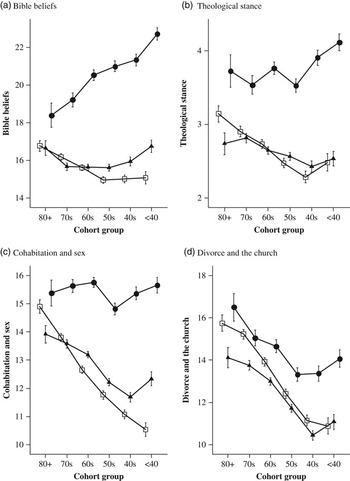
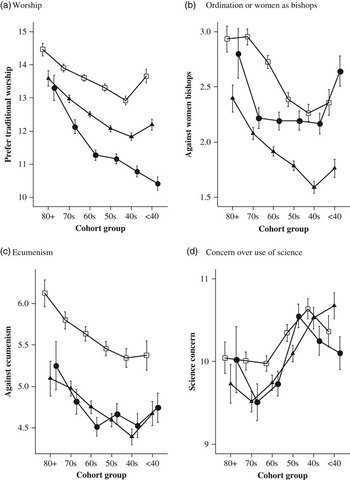
Each dependent variable was regressed against cohort number and church tradition by using a simple linear regression model. The model also included a cohort–tradition interaction term to test if the relationship between a dependent variable and cohort number varied significantly between people in different church traditions. The interaction term was centred by subtracting the mean value of cohort or tradition from each variable before calculating the product. This procedure reduces problems of multicollinearity and makes the coefficient of the term easier to interpret.Footnote 26 The patterns of change with cohort number were examined graphically for a sample of dependent variables chosen from across the four main groups. Mean scores for each cohort were plotted against cohort group for those classed as Anglo-catholic (open squares), broad church (closed triangles) and evangelical (closed circles). For the sake of clarity, error bars were limited to ±1 standard error of the mean. With the sample size in this study, non-overlapping error bars indicate significantly different means at least at the 5% level of significance.
Results
The self-reported church tradition seemed to reflect the likely readership of the Church Times, covering a range of people but with a majority towards the catholic end of the spectrum. Of the 5967 respondents, 42.5% were classed as Anglo-catholic, 40.5% as broad church and 17.0% as evangelical. Evangelicals were underrepresented in this sample, but there were sufficient (n = 1012) to make a meaningful comparison.
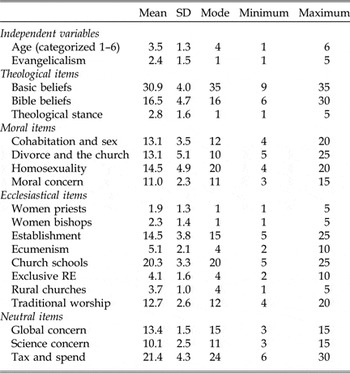
The scores for dependent variables (Table 1) suggested that in most cases the majority of respondents scored near the middle or conservative end of the spectrum. This was true for theological variables such as Bible beliefs and theological stance, and moral items such as divorce or moral concern for society. In a few cases, such as basic Christian beliefs and homosexuality, scores were clustered at the conservative end of the scale. Ecclesiastical variables tended, more often, to be normally distributed about the centre of the scale (e.g. views on establishment or worship), or with a mean towards the less conservative end, as in the case for the ordination of women as priests or bishops. Neutral-variable scores were also clustered in the middle of the scale, apart from global concern, where nearly all respondents reported high levels of concern for all three items in the scale.
Summary of variables

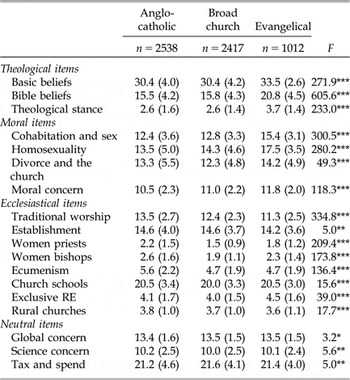
Mean scores differed significantly between church traditions. For theological and moral variables, Anglo-catholics were invariably the most liberal (low-scoring) group and evangelicals the most conservative (high-scoring) group, with broad church falling somewhere between the two (Table 2). For the ecclesiastical variables of worship, Establishment, ecumenism and keeping rural churches open, Anglo-catholics were the most conservative and evangelicals the least conservative. Over the issue of women’s ordination, Anglo-catholics were also the most conservative group, with evangelicals not far behind and the broad-church group being the most liberal on this issue. The only ‘ecclesiastical’ variable where evangelicals were most conservative was with respect to teaching exclusively Christian religious education in schools, and they had a similar average score to Anglo-catholics. Differences between traditions in the neutral variables were very slight, and statistical significance mainly reflected the large sample sizes.
Mean (SD) scores for dependent variables by church tradition

*p < 0.05; **p < 0.01; ***p < 0.001.
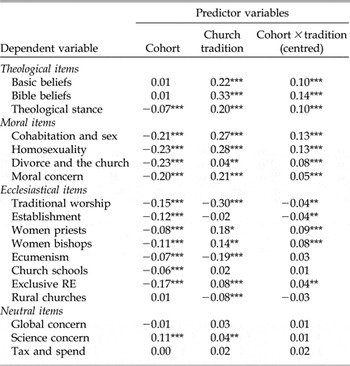
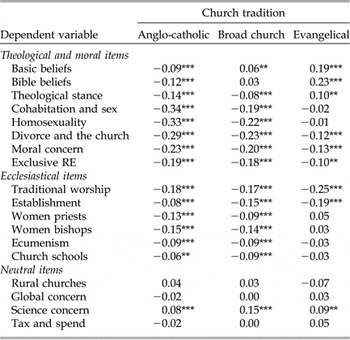
Regression of variables against cohort and church tradition showed that these variables were significant predictors of all of the theological and moral variables, most of the ecclesiastical variables but generally not the neutral variables (Table 3). The most frequent pattern was for a negative correlation with cohort group, indicating a general decline in conservatism among recent cohorts across a wide range of variables in the theological, moral and ecclesiastical group. The interaction term was significant in 12 of the 18 variables, showing that the pattern of change between cohorts differed markedly between traditions. This is illustrated by the separate regressions of independent variables against cohort group for each church tradition (Table 4).
Summary of linear regression models with cohort group, church tradition and interaction term as predictors

Table shows standardized beta weights.
**p < 0.01; ***p < 0.001.
Regression of dependent variables on cohort group by church tradition

Table shows standardized beta weights.
**p < 0.01; ***p < 0.001.
These analyses revealed that the pattern of change over time in attitudes and beliefs in the sample seems to have been complex and related to quite specific doctrinal positions. Within the variables tested, a number of distinct patterns emerged:
In a group consisting mainly of variables related to theological and moral issues, there was a sharp decline in conservatism among Anglo-catholic and broad-church respondents but an increase, no change, or a slight decrease in conservatism among evangelicals. For Bible beliefs (Figure 1a), younger evangelicals were significantly more conservative than their older counterparts. The increasing scores in this tradition were matched by decreases in the rest of the sample, which explains why there was no overall change in average score by cohort when all traditions were treated together (Table 3). This pattern was repeated for basic beliefs and general theological stance (Figure 1b), though in these cases the increase in evangelical conservatism was less marked. For the moral variables of sex outside marriage (Figure 1c) and homosexuality, there was a decline in conservatism among young cohorts in the Anglo-catholic and broad-church traditions, but no change among evangelicals. For the remaining moral variables, plus exclusive religious education, there was a decline in conservatism in all traditions, but this was less evident among evangelicals compared with the other traditions. For divorce (Figure 1d), for example, there was an overall decline in conservatism among all three traditions, though younger evangelicals showed some resistance to abandoning traditional stances on divorce compared with their Anglo-catholic and broad-church contemporaries.
Theological and moral beliefs in relationship to cohort group by tradition. Higher scores indicate a more conservative stance (Anglo-catholic = open squares; broad church = closed triangles; evangelical = closed circles; Error bars are ±1 SE)

In another group consisting of ecclesiastical variables, all three traditions usually showed some decline in conservatism but Anglo-catholics tended to be the most conservative. For worship (Figure 2a), Anglo-catholics showed a significant preference for traditional forms in all age groups. The difference was least marked among the oldest cohort, and increased among the younger cohorts due to the steeper rate of change among younger evangelicals, who were more in favour of new forms or worship and hymns.
Ecclesiastical and neutral beliefs in relationship to cohort group by tradition. For legend, see Figure 1

The issue of the ordination of women showed the sorts of patterns that might have been predicted (Figure 2b): Anglo-catholics in their 60s and 70s were the most opposed group, though opposition lessened somewhat among younger Anglo-catholics. Evangelicals were generally in favour, though there was evidence of a marked increase in opposition among those under 40. The broad-church trend showed a steep decline in opposition with cohort number, and this group showed the strongest support for the ordination of women as priests and as bishops.
On the issue of ecumenism (Figure 2c), older people in all traditions tended to be less favourably disposed toward merging with other denominations or belonging to an ecumenical church. Anglo-catholics were especially opposed, which may reflect anxiety about the merger with the Methodist Church that was being debated at the time.Footnote 27 There was decline in all traditions in support for the Establishment of the Church of England, with little overall difference between them.
The final group of variables related to ‘neutral’ issues, where there was no clear difference between the traditions, and generally no change over time. The exception was for concern over the use of science (Figure 2d), where traditions were similar but concern was higher among younger cohorts, the opposite trend for that evident in most other issues. This may partly reflect a growing distrust for the use of genetic engineering, which was an issue in the news in Britain at the time.
Discussion
This large sample of practising Anglicans, ordained and lay, from the Church of England has revealed some marked differences between traditions. Francis, Robbins and AstleyFootnote 28 examined this in the same sample separately for the difference between age groups and between clergy of different traditions. This analysis has included both lay and clergy and looked in more detail at the changes over time within different traditions. Although previous analyses of these data have shown some marked differences in attitudes and beliefs between the clergy and laity,Footnote 29 the patterns of change across cohorts are very similar. For this reason the two groups were included in the present analyses, and the results are broadly applicable to both.
An assumption of this study has been that the sample, to some extent, represents changes across the whole of the Church of England, and this assumption requires some justification. Although the Church Times undoubtedly attracts mainly readers who are Anglo-catholic and liberal, its readership is clearly much broader than this particular group. The current sample, if typical of readers generally, indicates that a significant number of conservative evangelicals also read the newspaper. The self-reported classification system for church tradition separated out those who considered themselves Anglo-catholic or evangelical from the rest, and these two groups are clearly distinct within this sample and likely to represent the groups at large in the Church of England. The remaining group, classed as ‘broad church’, was probably weighted towards the catholic end of the scale in this particular sample, so results reported here for this group may be nearer to the Anglo-catholic group than might be so if the sample included more ‘broad’ evangelicals. A representative sample of the whole church would probably have changed the relative differences between broad-church scores and the rest (making them slightly nearer to the evangelicals and further from the Anglo-catholics in same cases), but not the overall patterns recorded here.
A second assumption has been that age differences can largely be interpreted as changes in the average beliefs of cohorts, rather than the effects of ageing as such. This seems justified, since an ageing effect would be expected to be more consistent between people of different church traditions. Furthermore, longitudinal studies of cohorts suggest that attitudes are generally fixed by early adulthood and change little thereafter.Footnote 30 Although some differences between the cohort groups may have been due to the effects of ageing per se on beliefs and attitudes, the overwhelming likelihood is that the age-related trends observed here represent the stable views of different cohorts who have come to adult maturity in a society where general attitudes toward religion and morality have undergone rapid and marked changes. The data show, as Francis, Robbins and AstleyFootnote 31 suggest, that the different generations that coexist in the Church of England have very different outlooks on their faith. When analysing beliefs of people in the church, it is important to take into account the cohort to which they belong.
The present study confirms the major fault-lines between Anglo-catholics and evangelicals identified by Francis, Robbins and AstleyFootnote 32 in their analysis of differences between clergy. Importantly, it shows more clearly that these differences are complex and strongly related to cohort. Two key findings emerge from the present study.
First, it is clear that there is no simple liberal versus conservative divide between Anglo-catholics and evangelicals because this distinction depends on the type of issue in question. Conservatism for evangelicals is about theological traditionalism and moral conservatism. They hold to orthodox beliefs about the Christian faith (such as the existence of God, the resurrection of Jesus and the reality of heaven) and traditional beliefs about the nature of Scripture and its interpretation. On matters of church order they are less traditional, and open to changes in worship and to the established status of the Church of England. Younger evangelicals are open to seeing a loss of the special status of their Church and perhaps would welcome a merger with other denominations (though perhaps Protestant rather than Catholic). For Anglo-catholics, conservatism is about retaining patterns and practice of church life, but not necessarily traditional beliefs or patterns of moral behaviour. Along with many in the broad church, they have been more willing than evangelicals to embrace changes in orthodox belief, biblical interpretation and moral behaviour. In terms of church practice, Anglo-catholics are generally less willing to see change, though there is some reduction in conservative views among younger cohorts.
The second key finding of this study is that it helps to explain the increasingly divided nature of the Church of England. This is not because long-standing differences are being unmasked in public, at least to judge by the views of the older cohorts in this sample. Among those 70 or older, the differences between the traditions were relatively small, and most shared beliefs that were largely orthodox and traditional. Nor could the change be ascribed to a widespread increase in conservatism among younger evangelicals. Although there was one instance (that of Bible beliefs) where younger evangelicals appeared to be markedly more conservative than their forebears, in most cases younger evangelical cohorts were similar to older ones. This was true for such beliefs as cohabitation and sex outside marriage, and for same-sex intercourse, same-sex marriage or the ordination of homosexuals. In some cases, evangelicals have become more relaxed on moral issues, and this seems to be true to some extent over divorce. Whether this is a principled change, or a response to the inevitable fact that more and more churchgoers and clergy are divorced and remarried, is not clear. It does seem that there may be a point beyond which younger evangelicals will not go because in this group attitudes do not seem to be becoming indefinitely more liberal as time goes on.
The findings give support to the idea that the growing divisions in the Church of England are largely due to the sharp reduction in theological and moral conservatism among Anglo-catholics and some broad-church members. The marked decline in conservatism with cohort in a wide range of indicators suggests that, unlike evangelicals, these traditions have tended to adopt the mores and values of the cohorts of society to which they belong. The differences in matters ecclesiastical are more complex, but there is some evidence of an increasing divide related to the maintenance of conservatism among younger Anglo-catholics and a reduction among younger evangelicals. If historically the major battles between Anglo-catholics and evangelicals have been about church order and practice, today among the emerging generation they are about theology and morality. This conclusion may come as little surprise to avid observers of the Anglican Church, but the value of a study such as this is that it gives clear empirical evidence to this suggestion.
The results here may also indicate something of what lies ahead for Anglicans in England. If the patterns observed do indeed reflect changes in the basic beliefs and values of different cohorts, then the Church of England would seem to be entering a prolonged phase in which differences between traditions will be much more marked than they have been for generations. If those under 40 retain their basic stance through life, and those following them have similar views, then by mid-century the traditions would have almost completely segregated in their views about the faith and its consequences for moral behaviour. Although much is currently being made of the issue of homosexuality, it is clear from these findings that the divide goes much wider and deeper than this single issue. At heart it may relate to profound differences in the understanding of the relationship of Scripture to faith, and this is an area where both wings of the Church of England seem to be moving in opposite directions.
This is not to say that people in the different traditions have entirely separate views on all matters. There are a number of areas where concerns are shared (as in the issues surrounding global poverty, social equality and concern over the use of science), and attempts to hold the Anglican Communion together by focusing on some of these issues (as at the 2008 Lambeth Conference) are not entirely misplaced. However, it would be equally wrong to argue that the division is about the minor, and largely irrelevant, issue of homosexuality. It is much more likely that homosexuality is the presenting issue that points to a more profound difference in the way that faith is understood and expressed.
The Church Times survey was a one-off and broad survey of a particular group of Anglicans at a particular moment. The questions asked were partly driven by issues of the day, and partly by timeless issues that will always confront Christians trying to understand and live out their faith. Despite some problems with such cross-sectional surveys, the results have been surprisingly revealing: both confirming ideas that many may hold but with little evidence, and revealing trends that might otherwise have gone unnoticed. Given the cohort-trends revealed here, it would seem imperative that the Church of England continues to repeat this sort of survey in the decades ahead. An obvious start might be to repeat the survey in the Church Times, perhaps also including other publications such as the Church of England Newspaper that would increase the number of evangelicals in the overall sample. Such studies would show when and if opinions cease to diverge, and whether there is some sort of convergence in the future. Will evangelicals gradually adopt more liberal theological and moral attitudes, or will they continue to maintain views increasingly at odds with the rest of the Church? Will there be a resurgence of conservatism among Anglo-catholics that will spread from solely ecclesiastical matters to include morality and theology? Answers to these questions will remain largely unknown unless research of this nature is replicated in the future.
Appendix. Dependent variables used in analysis
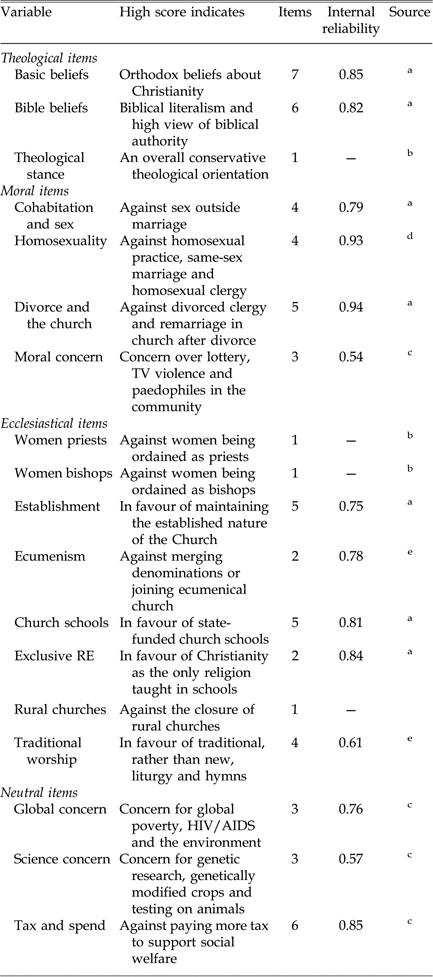
Note: Internal reliability measured by Cronbach’s alpha.Footnote 33 Source: aL.J. Francis, M. Robbins and J. Astley, Fragmented Faith?; bA. Village and L.J. Francis, The Mind of the Anglican Clergy; cA. Village, ‘Factors Predicting Relationship with Society among Anglicans in England’; dA. Village and L.J. Francis, ‘Attitude toward Homosexuality among Anglicans in England’; eNot previously published.