


1 Introduction
Argumentation is a form of reasoning where a claim is accepted or rejected according to the analysis of the arguments for and against it. The way in which arguments and justifications for a claim are considered allows for an automatic reasoning mechanism where contradictory, incomplete and uncertain information may appear. In the last decades, argumentation has evolved as an attractive paradigm for conceptualizing common sense reasoning (Prakken & Vreeswijk, Reference Prakken and Vreeswijk2002; Besnard & Hunter, Reference Besnard and Hunter2008; Rahwan & Simari, Reference Rahwan and Simari2009). Moreover, the study of argumentation within the field of artificial intelligence has grown lately (Bench-Capon & Dunne, Reference Bench-Capon and Dunne2007). Several approaches were proposed to model argumentation on an abstract basis (Dung, Reference Dung1995), using classical logics (Besnard & Hunter, Reference Besnard and Hunter2001), or using logic programming (García & Simari, Reference García and Simari2004). In addition, the argumentation process has been applied in various domains and applications such as decision making and negotiation (Amgoud et al., Reference Amgoud, Parsons and Maudet2000; Black & Hunter, Reference Black and Hunter2009), and multi-agent systems (Parsons et al., Reference Parsons, Sierra and Jennings1998; Amgoud et al., Reference Amgoud, Maudet and Parsons2002).
The foundations for the study of argumentation reside on areas like legal reasoning and philosophy (Toulmin, Reference Toulmin1958; Pollock, Reference Pollock1987). One of the most influential works is the book The Uses of Argument (Toulmin, Reference Toulmin1958). There, Toulmin put forward the idea that arguments needed to be analyzed using a richer format than the dichotomy of premises and conclusion used in formal logic analysis. He proposed a model for the layout of arguments that, in addition to data and claim, distinguishes between warrant, backing, rebuttal and qualifier.
For clarity purposes, it is interesting to include in this introduction a brief presentation of Toulmin's ideas. According to Toulmin, the claim is the original assertion that we are committed to and must justify when challenged. The data is the ground which we produce as support for the original assertion; it represents information on which the claim is based. The warrant is a general rule-like statement that authorizes the sort of step to which our particular argument commits us; it is an inference license that provides the connection between data and claim. The qualifier represents the degree of force that our data confers on our claim in virtue of our warrant. In defending a claim we may be asked why the warrant should be accepted as having authority; thus, challenging a particular claim in this way may lead to question, more generally, the legitimacy of a whole range of arguments. Standing behind the warrant that is subject of discussion is the backing, which shows why a warrant holds. Finally, a rebuttal can indicate exceptional conditions which might be capable of defeating the warranted conclusion. A graphical representation of Toulmin's scheme is included below.
 $$\raster="rg1"$$
Given the scheme proposed by Toulmin, we can distinguish two kinds of interactions among its elements. First, in addition to the data supporting the claim, the backing provides support for the warrant. Second, the presence of a rebuttal leads to the rejection of the claim through the defeat of the argument. Later studies on argumentation put aside the notion of support to focus on the notion of defeat, which is a key element in the acceptability calculus of arguments. Dung's (Reference Dung1995) seminal work provided a basis for the representation of arguments and their interactions. He proposed an Abstract Argumentation Framework (AF) in which a set of arguments and a defeat relationFootnote 1 among them are considered to determine the acceptable arguments of the framework.
Following Dung's approach, most works in the literature have been devoted to argumentation formalisms that focus on a defeat relation. Notwithstanding this, in the last decade, the study of the notion of support regained attention among the researchers. Recently, several interpretations of support have been addressed in the literature. Cayrol and Lagasquie-Schiex (Reference Cayrol and Lagasquie-Schiex2005) consider a general support relation among arguments as a positive interaction, without giving additional constraints. Another interpretation consists of evidential support (Oren & Norman, Reference Oren and Norman2008), which enables to distinguish between prima facie and standard arguments. Prima facie arguments represent the notion of evidence and do not require support from other arguments to stand, while standard arguments cannot be accepted unless they are supported by evidence. Boella et al. (Reference Boella, Gabbay, van der Torre and Villata2010) provide a deductive interpretation of support. Deductive support is intended to capture the following intuition: if argument  $$\[--><$>{\cal A}<$><!--$$
supports argument
 $$\[--><$>{\cal B}<$><!--$$
then the acceptance of
 $$\[--><$>{\cal A}<$><!--$$
implies the acceptance of
 $$\[--><$>{\cal B}<$><!--$$
and, as a consequence, the non-acceptance of
 $$\[--><$>{\cal B}<$><!--$$
implies the non-acceptance of
 $$\[--><$>{\cal A}<$><!--$$
. In addition, a necessity support relation among arguments was first introduced in Nouioua and Risch (Reference Nouioua and Risch2010). Necessary support enforces the following constraint: if argument
 $$\[--><$>{\cal A}<$><!--$$
supports argument
 $$\[--><$>{\cal B}<$><!--$$
it means that
 $$\[--><$>{\cal A}<$><!--$$
is necessary for
 $$\[--><$>{\cal B}<$><!--$$
. Thus, the acceptance of
 $$\[--><$>{\cal B}<$><!--$$
implies the acceptance of
 $$\[--><$>{\cal A}<$><!--$$
and, conversely, the non-acceptance of
 $$\[--><$>{\cal A}<$><!--$$
implies the non-acceptance of
 $$\[--><$>{\cal B}<$><!--$$
. Then, Cohen et al. (Reference Cohen, García and Simari2012) introduce a backing relation which encodes the support that Toulmin's backings provide for their associated warrants.
As can be noted above, the literature mostly addresses the study of support within the context of abstract argumentation, by explicitly considering a support relation among arguments. However, other approaches (Verheij, Reference Verheij2003; Martínez et al., Reference Martínez, García and Simari2006; Cohen et al., Reference Cohen, García and Simari2011) take support into account in a different setting. In particular, DefLog (Verheij, Reference Verheij2002, Reference Verheij2003) constitutes an approach to dialectical argumentation that allows for the representation of the elements in Toulmin's scheme, as well as the support links among them (Verheij, Reference Verheij2005, Reference Verheij2009). Martínez et al. (Reference Martínez, García and Simari2006) provide arguments with enough internal structure so as to explicitly define a subargument relation among arguments. In that way, the subargument relation represents the support that an argument provides for its super arguments. On the other hand, the formalism proposed by Cohen et al. (Reference Cohen, García and Simari2011) introduces special kind of rules to represent the support relation between backings and warrants of Toulmin's scheme in the context of Defeasible Logic Programming (DeLP).
A first step toward a better understanding of the notion of support in argumentation was taken by Cayrol and Lagasquie-Schiex (Reference Cayrol and Lagasquie-Schiex2011), who consider some interpretations of support proposed in the literature. This work reviews different interpretations for the notion of support in argumentation, and discusses how they are addressed in several formalisms. The aim is to provide a comprehensive study where similarities and differences among these interpretations are highlighted. To conclude this section, let us consider a motivating example inspired on Prakken and Vreeswijk (Reference Prakken and Vreeswijk2002) and Cayrol and Lagasquie-Schiex (Reference Cayrol and Lagasquie-Schiex2009).
Example 1 Consider the following arguments exchanged during the meeting of the editorial board of a newspaper:
 $$\[--><$>{\cal I}<$><!--$$
: information I concerning person P should be published.
 $$\[--><$>{\cal P}<$><!--$$
: information I is private so, P denies publication.
 $$\[--><$>{\cal S}<$><!--$$
: I is an important information concerning P's son.
 $$\[--><$>{\cal M}<$><!--$$
: P is the new prime minister so, everything related to P is public.
It is clear that some conflicts appear during the above discussion. That is the case of the conflict between arguments  $$\[--><$>{\cal P}<$><!--$$
and
 $$\[--><$>{\cal I}<$><!--$$
, and between arguments
 $$\[--><$>{\cal M}<$><!--$$
and
 $$\[--><$>{\cal P}<$><!--$$
. On the other hand, there is a relation between arguments
 $$\[--><$>{\cal P}<$><!--$$
and
 $$\[--><$>{\cal S}<$><!--$$
, which is clearly not a conflict. Moreover,
 $$\[--><$>{\cal S}<$><!--$$
provides a new piece of information enforcing argument
 $$\[--><$>{\cal P}<$><!--$$
.
If we want to represent the scenario depicted in Example 1 as an AF, we need to find a way to express the relation between arguments  $$\[--><$>{\cal P}<$><!--$$
and
 $$\[--><$>{\cal S}<$><!--$$
. Given that Dung's approach only considers one kind of interaction among arguments (the defeat relation), the support that argument
 $$\[--><$>{\cal S}<$><!--$$
provides for argument
 $$\[--><$>{\cal P}<$><!--$$
is represented through the notion of reinstatementFootnote 2. However, the fact that
 $$\[--><$>{\cal S}<$><!--$$
reinstates
 $$\[--><$>{\cal P}<$><!--$$
by defeating
 $$\[--><$>{\cal I}<$><!--$$
or
 $$\[--><$>{\cal M}<$><!--$$
is counterintuitive since there are no reasons to find argument
 $$\[--><$>{\cal S}<$><!--$$
in conflict with
 $$\[--><$>{\cal I}<$><!--$$
or
 $$\[--><$>{\cal M}<$><!--$$
. Finally, taking
 $$\[--><$>{\cal S}<$><!--$$
into account leads to either modify
 $$\[--><$>{\cal P}<$><!--$$
or to find a more intuitive solution for representing the interaction between
 $$\[--><$>{\cal S}<$><!--$$
and
 $$\[--><$>{\cal P}<$><!--$$
. An alternative is to consider a new and independent relation among arguments, a support relation, since the idea is not to revise already existing arguments but to represent as much as possible all the kinds of interactions between them. Following this intuition, several works in the literature addressed this issue, which will be reviewed next.
The rest of this work is organized as follows. Section 2 introduces the work on Bipolar Argumentation Frameworks (Amgoud et al., Reference Amgoud, Cayrol and Lagasquie-Schiex2004; Cayrol & Lagasquie-Schiex, Reference Cayrol and Lagasquie-Schiex2005, Reference Cayrol and Lagasquie-Schiex2007, Reference Cayrol and Lagasquie-Schiex2009, Reference Cayrol and Lagasquie-Schiex2010, Reference Cayrol and Lagasquie-Schiex2011), an extension of Dung's argumentation frameworks that accounts for a general support relation among arguments. Section 3 presents the meta-argumentation approach (Boella et al., Reference Boella, Gabbay, van der Torre and Villata2010), where deductive support among arguments is represented. In Section 4 a necessity interpretation of support is introduced in the Argumentation Frameworks with Necessities (Nouioua & Risch, Reference Nouioua and Risch2010, Reference Nouioua and Risch2011; Boudhar et al., Reference Boudhar, Nouioua and Risch2012). Section 5 presents the Evidential Argumentation Systems (Oren & Norman, Reference Oren and Norman2008), in which the acceptability of arguments is highly dependent on being supported by the environment. In Section 6 the argumentation frameworks of Martínez et al. (Reference Martínez, García and Simari2006) are introduced, where a subargument relation among arguments is proposed. Section 7 discusses the Backing-Undercutting Argumentation Frameworks (Cohen et al., Reference Cohen, García and Simari2012), where a support relation expressing the support that Toulmin's backings provide for their associated warrants is considered. Then, in Section 8, we comment on other approaches that are related to the research topic covered in this survey, including the Abstract Dialectical Frameworks (Brewka & Woltran, Reference Brewka and Woltran2010), a reconstruction of Toulmin's ideas using DefLog (Verheij, Reference Verheij2002, Reference Verheij2003, Reference Verheij2005, Reference Verheij2009), and an extension of DeLP, where Toulmin's form of support between backings and warrants is considered (Cohen et al., Reference Cohen, García and Simari2011). Finally, in Section 9, some conclusions regarding support in argumentation systems are presented.
The reader should note that the definitions in this survey are taken from the original publications. However, for uniformity purposes that will become clear in the following sections, the notation in some cases has been slightly changed or adapted.
2 Bipolar Argumentation Frameworks
The notion of bipolarity has been widely studied in different domains such as knowledge and preference representation (Benferhat et al., Reference Benferhat, Dubois, Kaci and Prade2002; Dubois & Prade, Reference Dubois and Prade2005), and decision making (Amgoud et al., Reference Amgoud, Bonnefon and Prade2005; Dubois et al., Reference Dubois, Fargier and Bonnefon2008). Amgoud et al. (Reference Amgoud, Cayrol and Lagasquie-Schiex2004) discuss the use of bipolarity in argumentation, analyzing how it appears under different forms in each step of the argumentation process. Then, they present a first approach to Bipolar Argumentation Frameworks, an extension of Dung's AFs that accounts for two independent interactions between arguments with diametrically opposed nature: a defeat relation and a support relation. A further formalization of Bipolar Argumentation Frameworks was developed (Cayrol & Lagasquie-Schiex, Reference Cayrol and Lagasquie-Schiex2005), where the acceptability of arguments is analyzed by taking the support relation into consideration.
Definition 1 (Bipolar Argumentation Framework) A Bipolar Argumentation Framework (BAF) is a tuple  $$\[--><$>\langle {\Bbb A},{{{\Bbb R}}_d},{{{\Bbb R}}_s}\rangle <$><!--$$
, where
 $$\[--><$>{\Bbb A}<$><!--$$
is a finite and non-empty set of arguments,
 $$\[--><$>{{{\Bbb R}}_d}\, \subseteq \,{\Bbb A}\,\times \,{\Bbb A}<$><!--$$
is a defeat relation between arguments, and
 $$\[--><$>{{{\Bbb R}}_s}\, \subseteq \,{\Bbb A}\,\times \,{\Bbb A}<$><!--$$
is a support relation between arguments.
Note that the relation  $$\[--><$>{{{\Bbb R}}_d}<$><!--$$
of BAFs is the same as in Dung's argumentation frameworks; thus, as mentioned before, we will refer to it as the defeat relation. A BAF can be graphically represented by a directed graph called the bipolar interaction graph, where nodes are arguments and edges could be of two kinds. Cayrol and Lagasquie-Schiex (Reference Cayrol and Lagasquie-Schiex2005) use ↛ and → to respectively denote defeat and support among arguments. Notwithstanding, to provide a unified setting in this survey we will follow the usual notation for Dung's argumentation frameworks in which the single arrow → denotes the defeat relation. The support relation among arguments will be denoted using a double arrow ⇒; from here on we will use this notation to distinguish between the defeat and support relations. Furthermore, we will incorporate a label over the double arrow ⇒ to identify the interpretation given to the support relation. Since the support relation of a BAF is just a positive interaction among arguments, with no particular interpretation, we will use the label ‘s’ to denote that it is a general support relation. Hence, the support relation of a BAF will be denoted using
 $$\[--><$>{\mathop{ \Rightarrow }\limits^{s}} <$><!--$$
. As will be shown later, other formalizations provide particular interpretations of support and thus, different labels will be used to distinguish them.
Example 2 The discussion in Example 1 can be represented by  $$\[--><$>BA{{F}_2}\, = \,\langle {{{\Bbb A}}_2},{{{\Bbb R}}_{{{d}_2}}},{{{\Bbb R}}_{{{s}_2}}}\rangle, <$><!--$$
where
 $${\Bbb A}{{}_2}\, = \,\{ {\cal I},{\cal P},{\cal S},{\cal M}\} \; \; \; \; {{{\Bbb R}}_{{{d}_2}}}\, = \,\{ ({\cal P},{\cal I}),({\cal I},{\cal P}),({\cal M},{\cal P})\} \; \; \; \; {{{\Bbb R}}_{{{s}_2}}}\, = \,\{ ({\cal S},{\cal P})\} $$
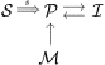
The bipolar interaction graph associated to BAF2 is depicted below, where  $$\[--><$>{\cal S}<$><!--$$
provides support for
 $$\[--><$>{\cal P}<$><!--$$
,
 $$\[--><$>{\cal M}<$><!--$$
defeats
 $$\[--><$>{\cal P}<$><!--$$
,
 $$\[--><$>{\cal P}<$><!--$$
defeats
 $$\[--><$>{\cal I}<$><!--$$
and vice versa.
 $$\raster="rg2"$$
In order to consider the interaction between supporting and defeating arguments, Cayrol and Lagasquie-Schiex (Reference Cayrol and Lagasquie-Schiex2005) introduce the notions of supported and secondaryFootnote 3 defeat which combine a sequence of supports with a direct defeat.
Definition 2 (Supported and Secondary Defeat)Let  $$\[--><$>\langle {\Bbb A},{{{\Bbb R}}_d},{{{\Bbb R}}_s}\rangle <$><!--$$
be a Bipolar Argumentation Framework and
 $$\[--><$>{\cal A},{\cal B}\, \in \,{\Bbb A}<$><!--$$
.
• A supported defeat from
 $$\[--><$>{\cal A}<$><!--$$
to
$$\[--><$>{\cal B}<$><!--$$
is a sequence
$$\[--><$>{{{\cal A}}_1}{{{\cal R}}_1}\, \ldots \,{{{\cal R}}_{n\,{\rm{ - }}\,1}}{{{\cal A}}_n},n\,\geq \,3<$><!--$$
, where
$$\[--><$>{{{\cal A}}_1}\, = \,{\cal A}<$><!--$$
,
$$\[--><$>{{{\cal A}}_n} = {\cal B}<$><!--$$
, s.t.
$$\[--><$>\forall i\, = \,1\, \ldots \,n\,{\rm{ - }}\,2<$><!--$$
,
$$\[--><$>{{{\cal R}}_i}\, = \,{{{\Bbb R}}_s}<$><!--$$
and
$$\[--><$>{{{\cal R}}_{n\,{\rm{ - }}\,1}}\, = \,{{{\Bbb R}}_d}<$><!--$$
.
• A secondary defeat from
$$\[--><$>{\cal A}<$><!--$$
to
$$\[--><$>{\cal B}<$><!--$$
is a sequence
$$\[--><$>{{{\cal A}}_1}{{{\cal R}}_1}\, \ldots \,{{{\cal R}}_{n\,{\rm{ - }}\,1}}{{{\cal A}}_n},n\,\geq \,3<$><!--$$
, where
$$\[--><$>{{{\cal A}}_1}\, = \,{\cal A}<$><!--$$
,
$$\[--><$>{{{\cal A}}_n}\, = \,{\cal B}<$><!--$$
, s.t.
$$\[--><$>{{{\cal R}}_1}\, = \,{{{\Bbb R}}_d}<$><!--$$
and
$$\[--><$>\forall i\, = \,2\, \ldots \,n\,{\rm{ - }}\,1<$><!--$$
,
$$\[--><$>{{{\cal R}}_i}\, = \,{{{\Bbb R}}_s}<$><!--$$
.





Cayrol and Lagasquie-Schiex (Reference Cayrol and Lagasquie-Schiex2005) state that, by extension, a sequence reduced to two arguments  $$\[--><$>{\cal A}{{{\Bbb R}}_d}{\cal B}<$><!--$$
(i.e., a direct defeat
 $$\[--><$>{\cal A}\, \rightarrow \,{\cal B}<$><!--$$
) is also considered as a supported defeat from
 $$\[--><$>{\cal A}<$><!--$$
to
 $$\[--><$>{\cal B}<$><!--$$
. Hence, given a BAF
 $$\[--><$>\langle {\Bbb A},{{{\Bbb R}}_d},{{{\Bbb R}}_s}\rangle <$><!--$$
and arguments
 $$\[--><$>{{{\cal A}}_1},\, \ldots \,,{{{\cal A}}_k},{\cal B}\, \in \,{\Bbb A}<$><!--$$
, a path
 $$\[--><$>{{{\cal A}}_1}\,{\mathop{ \Rightarrow }\limits^{s}} \, \cdots \,{\mathop{{ \Rightarrow \,}}\limits^{s}} {{{\cal A}}_k}\, \rightarrow \,{\cal B}<$><!--$$
in the bipolar interaction graph leads to k supported defeats from
 $$\[--><$>{{{\cal A}}_i}<$><!--$$
to
 $$\[--><$>{\cal B}<$><!--$$
, respectively,
 $$\[--><$>(1\,\leq \,i\,\leq \,k)<$><!--$$
. Similarly, a path
 $$\[--><$>{\cal B}\, \rightarrow \,{{{\cal A}}_1}\,{\mathop{{ \Rightarrow \,}}\limits^{s}} \ldots \,{\mathop{ \Rightarrow }\limits^{s}} \,{{{\cal A}}_k}<$><!--$$
in the bipolar interaction graph leads to k − 1 secondary defeats from
 $$\[--><$>{\cal B}<$><!--$$
to
 $$\[--><$>{{{\cal A}}_j}<$><!--$$
, respectively,
 $$\[--><$>(2\,\leq \,j\,\leq \,k)<$><!--$$
. For instance, in the BAF2 of Example 2 there is a supported defeat from
 $$\[--><$>{\cal S}<$><!--$$
to
 $$\[--><$>{\cal I}<$><!--$$
determined by the path
 $$\[--><$>{\cal S}{\mathop{{\, \Rightarrow }}\limits^{s}} \,{\cal P}\, \rightarrow \,{\cal I}<$><!--$$
in the bipolar interaction graph. On the other hand, the direct defeats
 $$\[--><$>{\cal M}\, \rightarrow \,{\cal P}<$><!--$$
,
 $$\[--><$>{\cal P}\, \rightarrow \,{\cal I}<$><!--$$
and
 $$\[--><$>{\cal I}\, \rightarrow \,{\cal P}<$><!--$$
are also supported defeats.
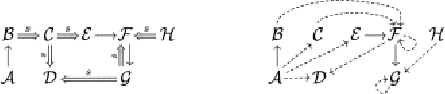
Example 3 Let us consider the Bipolar Argumentation Framework BAF3 characterized by the bipolar interaction graph depicted below on the left.
 $$\raster="rg3"$$
The direct defeats of BAF3 are depicted above on the right using solid arrows, while the secondary defeats and the supported defeats (which are not also direct defeats) are depicted using dashed arrows. For instance, since  $$\[--><$>{\cal A}<$><!--$$
defeats
 $$\[--><$>{\cal B}<$><!--$$
,
 $$\[--><$>{\cal B}<$><!--$$
supports
 $$\[--><$>{\cal C}<$><!--$$
, and
 $$\[--><$>{\cal C}<$><!--$$
supports both
 $$\[--><$>{\cal D}<$><!--$$
and
 $$\[--><$>{\cal E}<$><!--$$
, there are secondary defeats from
 $$\[--><$>{\cal A}<$><!--$$
to
 $$\[--><$>{\cal C},{\cal D}<$><!--$$
and
 $$\[--><$>{\cal E}<$><!--$$
. Moreover, since
 $$\[--><$>{\cal E}<$><!--$$
defeats
 $$\[--><$>{\cal F}<$><!--$$
there are supported defeats from
 $$\[--><$>{\cal B}<$><!--$$
and
 $$\[--><$>{\cal C}<$><!--$$
to
 $$\[--><$>{\cal F}<$><!--$$
. Finally, observe that, since
 $$\[--><$>{\cal F}<$><!--$$
defeats
 $$\[--><$>{\cal G}<$><!--$$
and
 $$\[--><$>{\cal G}<$><!--$$
supports
 $$\[--><$>{\cal F}<$><!--$$
, there exists a supported defeat from
 $$\[--><$>{\cal G}<$><!--$$
to itself and a secondary defeat from
 $$\[--><$>{\cal F}<$><!--$$
to itself.
As shown in Example 3, note that if  $$\[--><$>{\cal A}{\mathop{{\, \Rightarrow }}\limits^{s}} \,{\cal B}<$><!--$$
and
 $$\[--><$>{\cal B}\, \rightarrow \,{\cal A}<$><!--$$
, then
 $$\[--><$>{\cal A}<$><!--$$
and
 $$\[--><$>{\cal B}<$><!--$$
are self-defeating arguments since there exists a supported defeat from
 $$\[--><$>{\cal A}<$><!--$$
to itself and a secondary defeat from
 $$\[--><$>{\cal B}<$><!--$$
to itself. This occurs because no restriction in the Bipolar Argumentation Frameworks prevents arguments from defeating and supporting each other. However, some restrictions regarding defeating and supporting arguments in a BAF are introduced, as explained below.
Following Dung's semantics, Cayrol and Lagasquie-Schiex (Reference Cayrol and Lagasquie-Schiex2005) determine the characteristics that an acceptable set of arguments in a Bipolar Argumentation Framework must satisfy. On the one hand, they consider that an acceptable set of arguments must be internally coherent (in the sense that no arguments in the set should defeat each other); to achieve this, they extend the notion of conflict-freeness proposed by Dung (Reference Dung1995) into +conflict-freeness to consider the supported and secondary defeats. On the other hand, given that BAFs allow for the representation of support among arguments as well as defeat, they consider that an acceptable set of arguments must also be externally coherent (a set of arguments that defeats and supports the same argument cannot be acceptable). This notion of external coherence is captured in the BAFs by the notion of safety as defined below.
Definition 3 (Conflict-Freeness and Safety)Let  $$\[--><$>\langle {\Bbb A},{{{\Bbb R}}_d},{{{\Bbb R}}_s}\rangle <$><!--$$
be a Bipolar Argumentation Framework and
 $$\[--><$>S\, \subseteq \,{\Bbb A}<$><!--$$
.
• S is +conflict-free iff
$$\[--><$>{\!\!\!\!\!\!\!\!\!{\vskip-0.9\hskip16pt/}\hskip-5.3pt\exists}}{\cal A},{\cal B}\, \in \,S<$><!--$$
s.t. there is a supported defeat or a secondary defeat from
$$\[--><$>{\cal A}<$><!--$$
to
$$\[--><$>{\cal B}<$><!--$$
.• S is safe iff
$$\[--><$>{\!\!\!\!\!\!\!\!\!{\vskip-0.9\hskip16pt/}\hskip-5.3pt\exists}}{\cal A}\, \in \,{\Bbb A}<$><!--$$
,
$$\[--><$>{\!\!\!\!\!\!\!\!\!{\vskip-0.9\hskip16pt/}\hskip-5.3pt\exists}}{\cal B},{\cal C}\, \in \,S<$><!--$$
s.t. there is a supported or a secondary defeat from
$$\[--><$>{\cal B}<$><!--$$
to
$$\[--><$>{\cal A}<$><!--$$
, and either there is a sequence of support from
$$\[--><$>{\cal C}<$><!--$$
to
$$\[--><$>{\cal A}<$><!--$$
, or
$$\[--><$>{\cal A}\, \in \,S<$><!--$$
.


The ‘+’ in the above definition expresses that checking whether a set is +conflict-free requires to take supported and secondary defeats into account, in addition to the direct defeats considered by the classical notion of conflict-freeness. In that way, the notion of +conflict-freeness is more restrictive than the notion of conflict-freeness proposed by Dung. To illustrate this, let us consider the BAF3 of Example 3. The set  $$\[--><$>\{ {\cal A},{\cal F}\} <$><!--$$
is both +conflict-free and conflict-free. On the contrary, the set
 $$\[--><$>\{ {\cal A},{\cal C}\} <$><!--$$
is conflict-free but not +conflict-free since there exists a secondary defeat from
 $$\[--><$>{\cal A}<$><!--$$
to
 $$\[--><$>{\cal C}<$><!--$$
. Similarly, the set
 $$\[--><$>\{ {\cal G}\} <$><!--$$
is conflict-free but not +conflict-free since
 $$\[--><$>{\cal G}<$><!--$$
defeats itself through a supported defeat. Finally, the set
 $$\[--><$>\{ {\cal B},{\cal C},{\cal D},{\cal E},{\cal H}\} <$><!--$$
is +conflict-free but not safe since
 $$\[--><$>{\cal E}<$><!--$$
defeats
 $$\[--><$>{\cal F}<$><!--$$
and
 $$\[--><$>{\cal H}<$><!--$$
supports
 $$\[--><$>{\cal F}<$><!--$$
. Thus, if we consider arguments
 $$\[--><$>{\cal E}<$><!--$$
and
 $$\[--><$>{\cal H}<$><!--$$
separately, the sets
 $$\[--><$>\{ {\cal B},{\cal C},{\cal D},{\cal E}\} <$><!--$$
and
 $$\[--><$>\{ {\cal B},{\cal C},{\cal D},{\cal H}\} <$><!--$$
are safe. Cayrol and Lagasquie-Schiex (Reference Cayrol and Lagasquie-Schiex2005) show that the notion of safety is powerful enough to encompass the notion of +conflict-freeness (i.e., if a set is safe then it is also +conflict-free). That the converse does not hold is shown in the above example. However, they also show that if a set S is +conflict-free and closed for
 $$\[--><$>{{{\Bbb R}}_s}<$><!--$$
(i.e., if
 $$\[--><$>{\cal A}{{{\Bbb R}}_s}{\cal B}<$><!--$$
and
 $$\[--><$>{\cal A}\, \in \,S<$><!--$$
, then
 $$\[--><$>{\cal B}\, \in \,S<$><!--$$
), then S is also safe.
Following Dung's approach, acceptability of an argument  $$\[--><$>{\cal A}<$><!--$$
with respect to a set of arguments S is defined by Cayrol and Lagasquie-Schiex (Reference Cayrol and Lagasquie-Schiex2005) by requiring direct defeaters of
 $$\[--><$>{\cal A}<$><!--$$
to be directly defeated by S. Then, preferred extensions of a BAF are defined as maximal (for ⊆) admissible sets. However, aiming to reinforce the coherence of admissible sets, three definitions for the notion of admissibility are proposed by Cayrol and Lagasquie-Schiex (Reference Cayrol and Lagasquie-Schiex2005), from the most general to the most specific one. First, by requiring admissible sets to be +conflict-free and to have the property of defending all its elements they introduce d-admissibility (‘d’ means ‘in the sense of Dung’). Second, s(afe)-admissibility enforces d-admissibility by requiring safety for admissible sets. Finally, they strengthen external coherence by requiring admissible sets to be closed for
 $$\[--><$>{{{\Bbb R}}_s}<$><!--$$
, thus leading to c(losed)-admissibility.
Different notions of admissibility may lead to different extensions of a BAF. For instance, given the BAF3 of Example 3, the set  $$\[--><$>\{ {\cal B},{\cal C},{\cal D},{\cal E},{\cal H}\} <$><!--$$
is not d-admissible since, although it is +conflict-free, it does not defend
 $$\[--><$>{\cal B}<$><!--$$
against the direct defeat from
 $$\[--><$>{\cal A}<$><!--$$
. In that way, the d-preferred extensions of BAF3 are
 $$\[--><$>\{ {\cal A},{\cal H}\} <$><!--$$
and
 $$\[--><$>\{ {\cal C},{\cal D},{\cal E},{\cal H}\} <$><!--$$
. However, given that
 $$\[--><$>\{ {\cal C},{\cal D},{\cal E},{\cal H}\} <$><!--$$
is not safe since
 $$\[--><$>{\cal E}\, \rightarrow \,{\cal F}<$><!--$$
and
 $$\[--><$>{\cal H}{\mathop{{\, \Rightarrow }}\limits^{s}} \,{\cal F}<$><!--$$
, the s-preferred extensions of BAF3 are
 $$\[--><$>\{ {\cal A},{\cal H}\} <$><!--$$
,
 $$\[--><$>\{ {\cal C},{\cal D},{\cal E}\} <$><!--$$
and
 $$\[--><$>\{ {\cal C},{\cal D},{\cal H}\} <$><!--$$
. Finally, the sets
 $$\[--><$>\{ {\cal A},{\cal H}\} <$><!--$$
and
 $$\[--><$>\{ {\cal C},{\cal D},{\cal H}\} <$><!--$$
are not c-admissible since
 $$\[--><$>{\cal H}{\mathop{{\, \Rightarrow }}\limits^{s}} \,{\cal F}<$><!--$$
and
 $$\[--><$>{\cal F}<$><!--$$
does not belong to the sets. Thus, the c-preferred extensions of BAF3 are
 $$\[--><$>\{ {\cal A}\} <$><!--$$
and
 $$\[--><$>\{ {\cal C},{\cal D},{\cal E}\} <$><!--$$
.
Observe that, since the notion of acceptability only considers direct defeats when requiring defense for an argument, target arguments of supported and secondary defeats may belong to a BAF's extensions. Such is the case of arguments  $$\[--><$>{\cal C},{\cal D}<$><!--$$
and
 $$\[--><$>{\cal E}<$><!--$$
, which belong to the preferred extensions of BAF3. If the notion of acceptability was reinforced to take supported and secondary defeats into account, arguments
 $$\[--><$>{\cal C}<$><!--$$
,
 $$\[--><$>{\cal D}<$><!--$$
and
 $$\[--><$>{\cal E}<$><!--$$
would no longer belong to the preferred extensions of BAF3 since there is a secondary defeat from
 $$\[--><$>{\cal A}<$><!--$$
to each one of them. Therefore, the only d-preferred and s-preferred extension of BAF3 would be
 $$\[--><$>\{ {\cal A},{\cal H}\} <$><!--$$
, while the only c-preferred extension would be
 $$\[--><$>\{ {\cal A}\} <$><!--$$
.
Cayrol and Lagasquie-Schiex (Reference Cayrol and Lagasquie-Schiex2007, Reference Cayrol and Lagasquie-Schiex2010) present an alternative approach for handling bipolarity in argumentation frameworks. The idea is to transform a BAF into a Dung-like argumentation framework that consists of a set of coalitions and a defeat relation between them. The defeat relation of the initial BAF will appear only at the coalition level. As a consequence, a coalition will gather non-conflicting arguments. Thus, the support relation of the initial BAF will not appear at the coalition level, but will be used to gather arguments into coalitions. As mentioned by Cayrol and Lagasquie-Schiex (Reference Cayrol and Lagasquie-Schiex2010) the two fundamental principles governing the definition of a coalition are the coherence principle (coalitions must be conflict-free) and the support principle (arguments in a coalition must be directly or indirectly related by the support relation).
Let  $$\[--><$>{\rm{BAF}}\, = \,\langle {\Bbb A},{{{\Bbb R}}_d},{{{\Bbb R}}_s}\rangle <$><!--$$
be a Bipolar Argumentation Framework represented by the bipolar interaction graph
 $$\[--><$>{{{\cal G}}_{{\rm{BAF}}}}<$><!--$$
. The graph representing the partial framework
 $$\[--><$>\langle {\Bbb A},{{{\Bbb R}}_s}\rangle <$><!--$$
(i.e., a framework composed by the set of arguments and the support relation of BAF) is denoted by
 $$\[--><$>{{{\cal G}}_s}<$><!--$$
. Similarly, AFBAF denotes the AF
 $$\[--><$>\langle {\Bbb A},{{{\Bbb R}}_d}\rangle <$><!--$$
associated to BAF (i.e., the abstract argumentation framework composed by the set of arguments and the defeat relation of BAF).
Definition 4 (Coalition)Let  $$\[--><$>{{BAF}}\, = \,\langle {\Bbb A},{{{\Bbb R}}_d},{{{\Bbb R}}_s}\rangle <$><!--$$
be a Bipolar Argumentation Framework.
 $$\[--><$>C\, \subseteq \,{\Bbb A}<$><!--$$
is a coalition of BAF iff it is a maximal conflict-free set for AFBAF such that the subgraph of
 $$\[--><$>{{{\cal G}}_s}<$><!--$$
induced by C is connected.
Briefly, the subgraph of  $$\[--><$>{{{\cal G}}_s}<$><!--$$
induced by C consists of the arguments in C and the edges in
 $$\[--><$>{{{\cal G}}_s}<$><!--$$
such that they link two arguments in C. In addition, this induced subgraph is said to be connected iff there exists a directed or undirected path of support between every pair of arguments in the subgraphFootnote 4. For instance, given the BAF3 of Example 3 we obtain the coalitions
 $$\[--><$>{{C}_1}\, = \,\{ {\cal A}\} <$><!--$$
,
 $$\[--><$>{{C}_2}\, = \,\{ {\cal B},{\cal C},{\cal D},{\cal E},{\cal G}\} <$><!--$$
and
 $$\[--><$>{{C}_3}\, = \,\{ {\cal F},{\cal H}\} <$><!--$$
.
Definition 4 requires coalitions to be conflict-free for AFBAF. This means that there exist no arguments  $$\[--><$>{\cal A},{\cal B}<$><!--$$
in a coalition C such that
 $$\[--><$>{\cal A}<$><!--$$
directly defeats
 $$\[--><$>{\cal B}<$><!--$$
, thus referring to conflict-freeness in Dung's sense. In general, this prevents conflicting arguments from belonging to the same coalition. However, if supported and secondary defeats were taken into consideration, the resulting coalitions might not be +conflict-free. Such is the case of coalitions C 2 and C 3 obtained from Example 3, which are not +conflict-free since
 $$\[--><$>{\cal G}<$><!--$$
and
 $$\[--><$>{\cal F}<$><!--$$
are self-defeating arguments.
Let  $$\[--><$>{\rm{BAF}}\, = \,\langle {\Bbb A},{{{\Bbb R}}_d},{{{\Bbb R}}_s}\rangle <$><!--$$
be a Bipolar Argumentation Framework and
 $$\[--><$>C({\Bbb A})<$><!--$$
the set of coalitions of BAF. Cayrol and Lagasquie-Schiex (Reference Cayrol and Lagasquie-Schiex2007) define conflicting coalitions as follows. Two coalitions C 1 and C 2 are conflicting, denoted C 1c-defeats C 2, if
 $$\[--><$>\exists {{{\cal A}}_1}\, \in \,{{C}_1},\exists {{{\cal A}}_2}\, \in \,{{C}_2}<$><!--$$
such that
 $$\[--><$>{{{\cal A}}_1}{{{\Bbb R}}_d}{{{\cal A}}_2}<$><!--$$
. Then, given the set of coalitions
 $$\[--><$>C({\Bbb A})<$><!--$$
and the c-defeat relation, they define an argumentation framework
 $$\[--><$>{\rm{CAF}}\, = \,\langle C({\Bbb A}),c{\rm{\hbox - }}defeat\rangle <$><!--$$
referred to as the coalition framework (CAF) associated with BAF. Finally, Cayrol and Lagasquie-Schiex (Reference Cayrol and Lagasquie-Schiex2007) propose an approach for computing the extensions of a BAF in terms of the extensions of its associated CAF. First, the extensions of a CAF are obtained following Dung's approach. Then, the different coalitions in an extension of the CAF are merged to obtain the corresponding extension of the BAF. In that way, for instance, by gathering all arguments belonging to the coalitions of a preferred extension of CAF they obtain a cp-extension (coalition-preferred extension) of BAF.
Example 4 Given the BAF3 of Example 3 we obtain the associated coalition framework CAF 4. The coalitions of BAF 3are depicted below on the left, and the resulting CAF 4is on the right.
 $$\raster="rg4"$$
The only preferred extension of CAF 4is  $$\[--><$>\{ {{C}_1},{{C}_3}\} <$><!--$$
. Thus, the cp-extension of BAF 3is
 $$\[--><$>\{ {\cal A},{\cal F},{\cal H}\} <$><!--$$
.
Observe that the cp-extension of BAF3 in Example 4 differs from the d/s/c-preferred extensions obtained directly from BAF3. Since the c-defeat relation of a CAF does not take into consideration the supported and secondary defeats of the associated BAF, the resulting extensions of the CAF might contain arguments that otherwise would be self-defeating. Such is the case of argument  $$\[--><$>{\cal F}<$><!--$$
in BAF3, which belongs to the preferred extension of CAF4 (and correspondingly the cp-extension of BAF3). However, as shown in Example 3,
 $$\[--><$>{\cal F}<$><!--$$
is a self-defeating argument. In contrast, if supported and secondary defeats were considered when computing the c-defeat relation, self-defeating arguments would lead to self-defeating coalitions, thus preventing those arguments from appearing in the framework's extensions.
Cayrol and Lagasquie-Schiex (Reference Cayrol and Lagasquie-Schiex2007, Reference Cayrol and Lagasquie-Schiex2010) remark that some properties of Dung's argumentation frameworks are preserved for CAFs. Notwithstanding, they also mention that other properties valid for Dung's frameworks are lost. For instance, as shown in the following example, a cp-extension of a BAF might not always be admissible.
Example 5 Let BAF 5be represented by the bipolar interaction graph depicted below on the left.
 $$\raster="rg5"$$
Here, we obtain the coalitions  $$\[--><$>{{C}_1}\, = \,\{ {\cal I}\}, {{C}_2}\, = \,\{ {\cal J},{\cal K},{\cal L}\}, {{C}_3}\, = \,\{ {\cal M}\} <$><!--$$
. The associated coalition framework is
 $$\[--><$>CA{{F}_{\rm{5}}}\, = \,\langle \{ {{C}_1},{{C}_2},{{C}_3}\}, \{ ({{C}_1},{{C}_2}),({{C}_2},{{C}_3})\} \rangle <$><!--$$
and is depicted above on the right. The only preferred extension of CAF 5is
 $$\[--><$>\{ {{C}_1},{{C}_3}\} <$><!--$$
. Therefore, the cp-extension of BAF 5is
 $$\[--><$>\{ {\cal I},{\cal M}\} <$><!--$$
. However, we have
 $$\[--><$>{\cal L}\, \rightarrow \,{\cal M}<$><!--$$
but
 $$\[--><$>{\cal I}<$><!--$$
does not defend
 $$\[--><$>{\cal M}<$><!--$$
against
 $$\[--><$>{\cal L}<$><!--$$
(neither by a direct defeat nor by a supported or a secondary defeat). Instead, argument
 $$\[--><$>{\cal I}<$><!--$$
defeats argument
 $$\[--><$>{\cal J}<$><!--$$
that belongs to the coalition that defeats
 $$\[--><$>{\cal M}<$><!--$$
and therefore
 $$\[--><$>\{ {\cal I},{\cal M}\} <$><!--$$
is not admissible in Dung's sense.
Cayrol and Lagasquie-Schiex (Reference Cayrol and Lagasquie-Schiex2007, Reference Cayrol and Lagasquie-Schiex2010) state that coalitions must be considered as a whole and thus cannot be used separately in the defeat process. Thus, they say that the loss of admissibility as mentioned in Example 5 is not a problem since it takes the defeats from individual arguments into consideration. At any case, they say that admissibility would be lost in Example 5 due to the size of coalition  $$\[--><$>{{C}_2}\, = \,\{ {\cal J},{\cal K},{\cal L}\} <$><!--$$
(which does not take the direction of support paths into account). Then, they proposed the elementary coalitions in terms of conflict-free maximal support paths. In that way, given the BAF5 of Example 5 we would obtain two independent coalitions
 $$\[--><$>\{ {\cal J},{\cal K}\} <$><!--$$
and
 $$\[--><$>\{ {\cal K},{\cal L}\} <$><!--$$
instead of the original coalition
 $$\[--><$>\{ {\cal J},{\cal K},{\cal L}\} <$><!--$$
. However, as remarked by the authors themselves and shown in the following example, elementary coalitions do not always enable to recover Dung's properties.
Example 6 Let BAF 6be characterized by the bipolar interaction graph depicted below on the left.
 $$\raster="rg6"<!--\]$$
The elementary coalitions obtained from BAF 6are  $$\[--><$>E{{C}_1}\, = \,\{ {\cal I}\} <$><!--$$
,
 $$\[--><$>E{{C}_2}\, = \,\{ {\cal J},{\cal K},{\cal L}\} <$><!--$$
and
 $$\[--><$>E{{C}_3}\, = \,\{ {\cal M}\} <$><!--$$
. The associated coalition framework is
 $$\[--><$>CA{{F}_6}\, = \,\langle \{ E{{C}_1},E{{C}_2},E{{C}_3}\}, \,\{ (E{{C}_1},E{{C}_2}),<$><!--$$
 $$\[--><$>(E{{C}_2},E{{C}_3})\} \rangle, <$><!--$$
depicted above on the right. The preferred extension of CAF 6is
 $$\[--><$>\{ E{{C}_1},E{{C}_3}\} <$><!--$$
, so the cp-extension of BAF 6is
 $$\[--><$>\{ {\cal I},{\cal M}\} <$><!--$$
. However,
 $$\[--><$>\{ {\cal I},{\cal M}\} <$><!--$$
is not admissible since
 $$\[--><$>{\cal I}<$><!--$$
does not defend
 $$\[--><$>{\cal M}<$><!--$$
against the defeat from
 $$\[--><$>{\cal L}<$><!--$$
.
Finally, the authors argue that the loss of admissibility as shown in Examples 5 and 6 is not problematic. As mentioned before, they justify this claim by stating that Dung's notion of admissibility takes into account ‘individual’ defeat and defense, whereas in their coalition-approach ‘collective’ defeat and defense should be considered. As will be shown below, these issues have been addressed and criticized by other approaches to support in argumentation.
3 Meta-argumentation frameworks with deductive and defeasible support
Boella et al. (Reference Boella, Gabbay, van der Torre and Villata2010) introduce a meta-argumentation approach that allows for the consideration of support among arguments. Unlike the support relation of the Bipolar Argumentation Frameworks, they introduce deductive support which constitutes a particular interpretation of support. Briefly, deductive support establishes the following constraints on the acceptability of arguments: if  $$\[--><$>{\cal A}<$><!--$$
supports
 $$\[--><$>{\cal B}<$><!--$$
and
 $$\[--><$>{\cal A}<$><!--$$
is accepted, then
 $$\[--><$>{\cal B}<$><!--$$
must be accepted too; and if
 $$\[--><$>{\cal B}<$><!--$$
is not accepted, then
 $$\[--><$>{\cal A}<$><!--$$
must not be accepted either.
Boella et al. (Reference Boella, Gabbay, van der Torre and Villata2010) address two drawbacks of the meta-argumentation approach to Bipolar Argumentation Frameworks presented in Section 2. First, they mention the loss of admissibility in Dung's sense, and second, the definition of the notions of defeat in the context of a support relation. In addition, they claim that a support relation among arguments can be introduced without extending Dung's theory. In that way, they propose to use meta-argumentation to instantiate an AF in order to represent deductive support among arguments.
As mentioned in Section 2, Cayrol and Lagasquie-Schiex (Reference Cayrol and Lagasquie-Schiex2007, Reference Cayrol and Lagasquie-Schiex2010) claim that the loss of admissibility, as occurred in Examples 5 and 6, is not problematic since it takes into account ‘individual’ defeats whereas, with their meta-argumentation approach, they want to consider ‘collective’ defeats. In contrast, Boella et al. (Reference Boella, Gabbay, van der Torre and Villata2010) state that the aim of using meta-argumentation is to preserve all Dung's properties and principles, and they do not agree that it makes sense for meta-arguments to group arguments that are somehow related by the support relation.
Following the notation introduced in the previous section,  $$\[--><$>{\cal A}\, \rightarrow \,{\cal B}<$><!--$$
will denote that
 $$\[--><$>{\cal A}<$><!--$$
defeats
 $$\[--><$>{\cal B}<$><!--$$
. Like in BAFs, the defeat relation in the approach of Boella et al. (Reference Boella, Gabbay, van der Torre and Villata2010) corresponds to the defeat relation of Dung's AFs. Then, since they provide a particular interpretation of support, we will use
 $$\[--><$>{\cal A}\,{\mathop{ \Rightarrow }\limits^{d}} \,{\cal B}<$><!--$$
to denote that
 $$\[--><$>{\cal A}<$><!--$$
deductively supports
 $$\[--><$>{\cal B}<$><!--$$
. Here, the label ‘d’ over the double arrow indicates that the support relation among arguments is deductive.
Given the coexistence of supporting and defeating arguments, additional defeats are considered by Boella et al. (Reference Boella, Gabbay, van der Torre and Villata2010) by combining a sequence of supports and a direct defeat. In particular, they propose the mediated defeats which enforce the constraints of deductive support. Briefly, if  $$\[--><$>{\cal A}{\mathop{{\, \Rightarrow \,}}\limits^{d}} {\cal B}<$><!--$$
and
 $$\[--><$>{\cal C}\, \rightarrow \,{\cal B}<$><!--$$
, then a mediated defeat from
 $$\[--><$>{\cal C}<$><!--$$
to
 $$\[--><$>{\cal A}<$><!--$$
occurs. In the following, we will use d-BAF to denote a Bipolar Argumentation Framework in which the support relation has a deductive interpretation.
Definition 5 (Mediated Defeat)Let  $$\[--><$>\langle {\Bbb A},\, \rightarrow, \,{\mathop{ \Rightarrow }\limits^{d}} \rangle <$><!--$$
be a d-BAF and
 $$\[--><$>{\cal A},{\cal B}\, \in \,{\Bbb A}<$><!--$$
. A mediated defeat from
 $$\[--><$>{\cal A}<$><!--$$
to
 $$\[--><$>{\cal B}<$><!--$$
is a sequence
 $$\[--><$>{{{\cal A}}_1}\,{\mathop{{ \Rightarrow \,}}\limits^{d}} \cdots \,{\mathop{ \Rightarrow }\limits^{d}} \,{{{\cal A}}_{n\,{\rm{ - }}\,1}}<$><!--$$
and
 $$\[--><$>{{{\cal A}}_n}\, \rightarrow \,{{{\cal A}}_{n\,{\rm{ - }}\,1}} \ (n\,\geq \,3)<$><!--$$
, where
 $$\[--><$>{{{\cal A}}_1} = \,{\cal B}<$><!--$$
and
 $$\[--><$>{{{\cal A}}_n}\, = \,{\cal A}<$><!--$$
.
The following example illustrates how the mediated defeats allow to recover from the loss of admissibility occurred in Example 6.
Example 7 Let BAF 6be the Bipolar Argumentation Framework of Example 6. Given a deductive interpretation for the support relation of BAF 6, we obtain the d-BAF 7depicted below.
 $$\raster="rg7"$$
Here, there is a mediated defeat from  $$\[--><$>{\cal I}<$><!--$$
to
 $$\[--><$>{\cal K}<$><!--$$
since
 $$\[--><$>{\cal I}<$><!--$$
defeats
 $$\[--><$>{\cal J}<$><!--$$
, which is supported by
 $$\[--><$>{\cal K}<$><!--$$
. Moreover, there is also a mediated defeat from
 $$\[--><$>{\cal I}<$><!--$$
to
 $$\[--><$>{\cal L}<$><!--$$
. Mediated defeats of d-BAF 7are depicted above using dashed arrows. As shown in Example 6, the cp-extension of BAF 6is
 $$\[--><$>\{ {\cal I},{\cal M}\} <$><!--$$
and it is not an admissible set. However, when considering d-BAF 7, the set
 $$\[--><$>\{ {\cal I},{\cal M}\} <$><!--$$
is admissible. This is because, given the mediated defeat from
 $$\[--><$>{\cal I}<$><!--$$
to
 $$\[--><$>{\cal L}<$><!--$$
, argument
 $$\[--><$>{\cal M}<$><!--$$
is now defended against the defeat from
 $$\[--><$>{\cal L}<$><!--$$
.
The other drawback of the meta-argumentation approach presented in Section 2 that Boella et al. (Reference Boella, Gabbay, van der Torre and Villata2010) mention is that secondary defeats may lead to undesired results. To illustrate this issue, let us consider the following example adapted from Boella et al. (Reference Boella, Gabbay, van der Torre and Villata2010).
Example 8 Consider a scenario where two soccer teams, Liverpool  $$\[--><$>({\cal L})<$><!--$$
and Manchester United
 $$\[--><$>({\cal M}{\cal U})<$><!--$$
, are on the final race to win the Premier League
 $$\[--><$>({\cal P}{\cal L})<$><!--$$
. Suppose that Liverpool wins the Premiere League
 $$\[--><$>({\cal L}{\cal P}{\cal L})<$><!--$$
if it wins its last match
 $$\[--><$>({\cal L}{\cal W})<$><!--$$
or Manchester United does not win its own
 $$\[--><$>({\cal M}{\cal U}{\cal N}{\cal W})<$><!--$$
. Note that Liverpool and Manchester United are not playing against each other and thus, the results of their matches are independent. Then we have that ‘Liverpool wins its last match’ supports ‘Liverpool wins the Premier League’
 $$\[--><$>({\cal L}{\cal W}\,{\mathop{ \Rightarrow }\limits^{d}} \,{\cal L}{\cal P}{\cal L})<$><!--$$
, and ‘Manchester United does not win its last match’ also supports ‘Liverpool wins the Premier League’
 $$\[--><$>({\cal M}{\cal U}{\cal N}{\cal W}\,{\mathop{{ \Rightarrow \,}}\limits^{d}} {\cal L}{\cal P}{\cal L})<$><!--$$
. Suppose now that Liverpool loses its last match
 $$\[--><$>({\cal L}{\cal L})<$><!--$$
and Manchester United does not win its own
 $$\[--><$>({\cal M}{\cal U}{\cal N}{\cal W})<$><!--$$
. We have that ‘Liverpool loses its last match’ defeats ‘Liverpool wins its last match’
 $$\[--><$>({\cal L}{\cal L}\, \rightarrow \,{\cal L}{\cal W})<$><!--$$
. Therefore, taking secondary defeats into consideration we have that ‘Liverpool loses its last match’ defeats ‘Liverpool wins the Premier League’
 $$\[--><$>({\cal L}{\cal L}\, \rightarrow \,{\cal L}{\cal P}{\cal L})<$><!--$$
. A graphical representation of this situation is included below, where the secondary defeat is depicted using a dashed arrow.
 $$\raster="rg8"$$
In this case,  $$\[--><$>{\cal L}{\cal P}{\cal L}<$><!--$$
(which expresses that ‘Liverpool wins the Premier League’) will not be an accepted argument since there is no reinstatement for it against the defeat from
 $$\[--><$>{\cal L}{\cal L}<$><!--$$
.
The result obtained in Example 8 is counterintuitive because  $$\[--><$>{\cal L}{\cal P}{\cal L}<$><!--$$
is also supported by argument
 $$\[--><$>{\cal M}{\cal U}{\cal N}{\cal W}<$><!--$$
, which is undefeated. Therefore, to avoid counterintuitive results, Boella et al. (Reference Boella, Gabbay, van der Torre and Villata2010) propose to dismiss the secondary defeats on their meta-argumentation approach and consider the mediated defeats instead. Although secondary defeats may lead to counterintuitive results when considering a deductive interpretation of support, as will be shown in Section 4, they prove to be useful in contexts where other interpretations of support are considered.
As mentioned before, deductive support is expected to comply with the following constraints: if  $$\[--><$>{\cal A}<$><!--$$
supports
 $$\[--><$>{\cal B}<$><!--$$
and
 $$\[--><$>{\cal A}<$><!--$$
is accepted, then
 $$\[--><$>{\cal B}<$><!--$$
must be accepted too; and if
 $$\[--><$>{\cal A}<$><!--$$
supports
 $$\[--><$>{\cal B}<$><!--$$
, and
 $$\[--><$>{\cal B}<$><!--$$
is not accepted, then
 $$\[--><$>{\cal A}<$><!--$$
must not be accepted either. Unlike the meta-argumentation approach presented in Section 2, Boella et al. (Reference Boella, Gabbay, van der Torre and Villata2010) do not group arguments together in meta-arguments, but they add meta-arguments. In brief, the idea is to represent the deductive support from an argument
 $$\[--><$>{\cal A}<$><!--$$
to an argument
 $$\[--><$>{\cal B}<$><!--$$
through the defeat from argument
 $$\[--><$>{\cal B}<$><!--$$
to an auxiliary argument called
 $$\[--><$>{{{\cal Z}}_{{\cal A},{\cal B}}}<$><!--$$
, together with the defeat from argument
 $$\[--><$>{{{\cal Z}}_{{\cal A},{\cal B}}}<$><!--$$
to argument
 $$\[--><$>{\cal A}<$><!--$$
.
Given a set  $$\[--><$>{\Bbb U}<$><!--$$
called the universe of arguments, for each argument
 $$\[--><$>{\cal A}\, \in \,{\Bbb U}<$><!--$$
they introduce the meta-argument
 $$\[--><$>acc({\cal A})<$><!--$$
that expresses ‘
 $$\[--><$>{\cal A}<$><!--$$
is accepted’. In addition, they incorporate meta-arguments
 $$\[--><$>{{X}_{{\cal A},{\cal B}}}<$><!--$$
and
 $$\[--><$>{{Y}_{{\cal A},{\cal B}}}<$><!--$$
for each defeat
 $$\[--><$>{\cal A}\, \rightarrow \,{\cal B}<$><!--$$
. The meta-argument
 $$\[--><$>{{X}_{{\cal A},{\cal B}}}<$><!--$$
expresses that ‘the defeat from
 $$\[--><$>{\cal A}<$><!--$$
to
 $$\[--><$>{\cal B}<$><!--$$
is not active’ and the meta-argument
 $$\[--><$>{{Y}_{{\cal A},{\cal B}}}<$><!--$$
expresses that ‘the defeat from
 $$\[--><$>{\cal A}<$><!--$$
to
 $$\[--><$>{\cal B}<$><!--$$
is active’. For each arguments
 $$\[--><$>{\cal C},{\cal D}\, \in \,{\Bbb U}<$><!--$$
such that
 $$\[--><$>{\cal C}\,{\mathop{ \Rightarrow }\limits^{d}} \,{\cal D}<$><!--$$
they introduce a meta-argument
 $$\[--><$>{{Z}_{{\cal C},{\cal D}}}<$><!--$$
, which expresses that ‘
 $$\[--><$>{\cal C}<$><!--$$
does not support
 $$\[--><$>{\cal D}<$><!--$$
’. Then, they characterize the universe of meta-arguments as
 $$\[--><$>{\Bbb U}{\Bbb M}\, = \,\{ acc({\cal A})\;|\;{\cal A}\, \in \,{\Bbb U}\} \cup \{ {{X}_{{\cal A},{\cal B}}},\,{{Y}_{{\cal A},{\cal B}}},{{Z}_{{\cal A},{\cal B}}}\;|\;{\cal A},{\cal B}\, \in \,{\Bbb U}\} .<$><!--$$
Finally, they define a meta-defeat relation ↦ that expresses the conflicts among the original arguments in a meta level.
The following definition characterizes the meta-argumentation framework EAF that enables to encode deductive support among arguments. Given a d-BAF, an argument  $$\[--><$>{\cal A}<$><!--$$
will belong to an extension of d-BAF iff its meta-argument
 $$\[--><$>acc({\cal A})<$><!--$$
belongs to the corresponding extension of EAF.
Definition 6 Let  $$\[--><$>d{\rm{\hbox - }}BAF\, = \,\langle {\Bbb A}, \rightarrow, {\mathop{ \Rightarrow }\limits^{d}} \rangle <$><!--$$
be a Bipolar Argumentation Framework with deductive support. The associated meta-argumentation framework is
 $$\[--><$>EAF\, = \,\langle {\Bbb M}{\Bbb A}, \mapsto \rangle <$><!--$$
, where
 $$\[--><$>{\Bbb M}{\Bbb A}\, \subseteq \,{\Bbb U}{\Bbb M}<$><!--$$
is
 $$\[--><$>\{ acc({\cal A})\;|\;{\cal A}\, \in \,{\Bbb A}\} \cup \{ {{X}_{{\cal A},{\cal B}}},{{Y}_{{\cal A},{\cal B}}},{{Z}_{{\cal A},{\cal B}}}\;|\;{\cal A},{\cal B}\, \in \,{\Bbb A}\} <$><!--$$
and
 $$\[--><$> \mapsto \subseteq {\Bbb M}{\Bbb A}\,\times \,{\Bbb M}{\Bbb A}<$><!--$$
is a meta-defeat relation such that:
• If
$$\[--><$>{\cal A}\, \rightarrow \,{\cal B}<$><!--$$
, then
$$\[--><$>acc({\cal A})\, \mapsto \,{{X}_{{\cal A},{\cal B}}},{{X}_{{\cal A},{\cal B}}}\, \mapsto \,{{Y}_{{\cal A},{\cal B}}}<$><!--$$
and
$$\[--><$>{{Y}_{{\cal A},{\cal B}}}\, \mapsto \,acc({\cal B})<$><!--$$
.• If
$$\[--><$>{\cal A}\,{\mathop{{ \Rightarrow \,}}\limits^{d}} {\cal B}<$><!--$$
, then
$$\[--><$>acc({\cal B})\, \mapsto \,{{Z}_{{\cal A},{\cal B}}}<$><!--$$
and
$$\[--><$>{{Z}_{{\cal A},{\cal B}}}\, \mapsto \,acc({\cal A})<$><!--$$
.


Example 9 Let us consider the d-BAF 9characterized by the following interaction graph.
 $$\raster="rg9"$$
The coalition framework CAF 9associated with d-BAF 9is depicted below on the left, and the corresponding meta-argumentation framework EAF 9is on the right.
 $$\raster="rg10"$$
The preferred extension of CAF 9is  $$\[--><$>\{ {{C}_1}\} <$><!--$$
, so the cp-extension of d-BAF 9would be
 $$\[--><$>\{ {\cal P},\,{\cal Q},\,{\cal S}\} <$><!--$$
. In contrast, the preferred extension of EAF 9is
 $$\[--><$>\{ acc({\cal S}),{{Y}_{{\cal S},{\cal R}}},{{Z}_{{\cal Q},{\cal R}}},{{Z}_{{\cal P},{\cal Q}}}\} <$><!--$$
, leading to the preferred extension of d-BAF 9being
 $$\[--><$>\{ {\cal S}\} <$><!--$$
.
Observe that the approaches of Cayrol and Lagasquie-Schiex (Reference Cayrol and Lagasquie-Schiex2007, Reference Cayrol and Lagasquie-Schiex2010) and Boella et al. (Reference Boella, Gabbay, van der Torre and Villata2010) lead to different results in Example 9. Since Boella et al. (Reference Boella, Gabbay, van der Torre and Villata2010) considers deductive support among arguments, if  $$\[--><$>{\cal A}\,{\mathop{ \Rightarrow }\limits^{d}} \,{\cal B}<$><!--$$
and
 $$\[--><$>{\cal B}<$><!--$$
is not accepted, then
 $$\[--><$>{\cal A}<$><!--$$
cannot be accepted either. Thus, in Example 9, given that
 $$\[--><$>{\cal S}\, \rightarrow \,{\cal R}<$><!--$$
and
 $$\[--><$>{\cal Q}\,{\mathop{ \Rightarrow }\limits^{d}} \,{\cal R}<$><!--$$
,
 $$\[--><$>{\cal Q}<$><!--$$
cannot be accepted since
 $$\[--><$>{\cal R}<$><!--$$
is not accepted. Similarly,
 $$\[--><$>{\cal P}<$><!--$$
is not accepted either since it deductively supports
 $$\[--><$>{\cal Q}<$><!--$$
.
In addition, note that the meta-defeat relation ↦ in Definition 6 does not take mediated and supported defeats into consideration. As mentioned by Boella et al. (Reference Boella, Gabbay, van der Torre and Villata2010), given  $$\[--><$>{\cal A}\,{\mathop{{ \Rightarrow \,}}\limits^{d}} {\cal B}<$><!--$$
, they condense all defeats involving arguments
 $$\[--><$>{\cal A}<$><!--$$
and
 $$\[--><$>{\cal B}<$><!--$$
using only the meta-argument
 $$\[--><$>{{Z}_{{\cal A},{\cal B}}}<$><!--$$
. In that way,
 $$\[--><$>{{Z}_{{\cal A},{\cal B}}}<$><!--$$
allows to capture the behavior modeled by the mediated and supported defeats. Therefore, they simplify the representation of the meta-argumentation frameworks in which supported and mediated defeats occur. To illustrate this, let us consider the following example.
Example 10 Let us consider the d-BAF 10depicted below, where mediated and supported defeats are denoted using dashed arrows.
 $$\raster="rg11"$$
Suppose that the mediated and supported defeats of d-BAF 10are included on the associated EAF 10. The defeat graph of EAF 10is shown on the left below.
 $$\raster="rg12"$$
The mediated defeat from  $$\[--><$>{\cal T}<$><!--$$
to
 $$\[--><$>{\cal N}<$><!--$$
expresses that if
 $$\[--><$>{\cal T}<$><!--$$
is accepted, then
 $$\[--><$>{\cal N}<$><!--$$
should not be accepted; this is captured by two paths in the defeat graph of EAF 10. In particular, since one of these paths includes the meta-argument
 $$\[--><$>{{Z}_{{\cal N},{\cal O}}}<$><!--$$
, we could disregard the other without losing the effect of the mediated defeat. On the other hand, the supported defeat from
 $$\[--><$>{\cal N}<$><!--$$
to
 $$\[--><$>{\cal V}<$><!--$$
can also be captured by looking into different paths in the defeat graph of EAF 10. First we have the path from
 $$\[--><$>acc({\cal N})<$><!--$$
to
 $$\[--><$>acc({\cal V})<$><!--$$
, which corresponds to the supported defeat itself. However, we can also capture the behavior modeled by the supported defeat by combining two other paths in the defeat graph. The supported defeat from
 $$\[--><$>{\cal N}<$><!--$$
to
 $$\[--><$>{\cal V}<$><!--$$
expresses that if
 $$\[--><$>{\cal N}<$><!--$$
is accepted, then
 $$\[--><$>{\cal V}<$><!--$$
should not be accepted. Then, if the meta-argument
 $$\[--><$>acc({\cal N})<$><!--$$
is accepted, it implies that the meta-argument
 $$\[--><$>{{Z}_{{\cal N},{\cal O}}}<$><!--$$
is not accepted. Moreover, since the only defeater of
 $$\[--><$>{{Z}_{{\cal N},{\cal O}}}<$><!--$$
is
 $$\[--><$>acc({\cal O})<$><!--$$
, it also implies that
 $$\[--><$>acc({\cal O})<$><!--$$
is accepted, leading to
 $$\[--><$>acc({\cal V})<$><!--$$
being not accepted. Note that, as for the mediated defeat, this alternative considers a path involving the meta-argument
 $$\[--><$>{{Z}_{{\cal N},{\cal O}}}<$><!--$$
, thus making it possible to disregard the path from
 $$\[--><$>acc({\cal N})<$><!--$$
to
 $$\[--><$>acc({\cal V})<$><!--$$
. Finally, the preferred extension of EAF 10is
 $$\[--><$>\{ acc({\cal T}),{{Y}_{{\cal T},{\cal O}}},{{Y}_{{\cal T},{\cal N}}},{{Z}_{{\cal N},{\cal O}}},{{X}_{{\cal O},{\cal V}}},{{X}_{{\cal N},{\cal V}}},acc({\cal V})\} <$><!--$$
and thus, the preferred extension of d-BAF 10is
 $$\[--><$>\{ {\cal T},{\cal V}\} <$><!--$$
.
Suppose now that the mediated and supported defeats are not considered in EAF 10. Then, we obtain a simplified version of the defeat graph, which is depicted above on the right. Despite the simplified representation we can note that the preferred extension of EAF10 is  $$\[--><$>\{ acc({\cal T}),{{Y}_{{\cal T},{\cal O}}},{{Z}_{{\cal N},{\cal O}}},{{X}_{{\cal O},{\cal V}}},acc({\cal V})\} <$><!--$$
, while the preferred extension of d-BAF 10is still
 $$\[--><$>\{ {\cal T},{\cal V}\} <$><!--$$
.
The simplified representation shown in Example 10 is possible since Boella et al. (Reference Boella, Gabbay, van der Torre and Villata2010) prove that the incorporation of supported and mediated defeats does not change the extensions of the meta-argumentation framework using Dung's semantics, as it can be seen in Example 10.
Boella et al. (Reference Boella, Gabbay, van der Torre and Villata2010) present an extended approach that considers two kinds of second-order defeats. First, they consider defeats from an argument or a defeat relation to another defeat relation and second, defeats from an argument to a support relation. There exist in the literature other approaches that address the first kind of second-order defeats (e.g., Modgil, Reference Modgil2009; Baroni et al., Reference Baroni, Cerutti, Giacomin and Guida2011). However, Boella et al. (Reference Boella, Gabbay, van der Torre and Villata2010) remark that the difference between other approaches and theirs is that they also consider the case in which a defeat relation defeats another defeat relation. On the other hand, the second kind of second-order defeat they propose allows for the modeling of what they call defeasible support, which overrides the constraints imposed by the deductive support interpretation.
Regarding the second kind of second-order defeats proposed in Boella et al. (Reference Boella, Gabbay, van der Torre and Villata2010), the work of Pollock (Reference Pollock1987) provided the basis for further research on this topic. He stated that defeasible reasons (which can be assembled into arguments) have defeaters and that there are two kinds of defeaters: rebutting defeaters and undercutting defeaters. The former defeat the conclusion of an inference by supporting the opposite one, while the latter defeats the connection between the premises and conclusion without defeating the conclusion directly. The work by Boella et al. (Reference Boella, Gabbay, van der Torre and Villata2010) was the first to consider this issue in the context of Bipolar Argumentation Frameworks. However, as will be shown in Section 7, recent work by Cohen et al. (Reference Cohen, García and Simari2012) also addresses rebutting and undercutting defeaters in abstract argumentation frameworks with an explicit support relation.
The following definition provides an instantiation of an AF as a bipolar second-order argumentation framework using meta-argumentation, as introduced by Boella et al. (Reference Boella, Gabbay, van der Torre and Villata2010). As stated before, the sets  $$\[--><$>{\Bbb U}<$><!--$$
and
 $$\[--><$>{\Bbb U}{\Bbb M}<$><!--$$
, respectively, represent the universe of arguments and meta-arguments. In addition, d-EBAF represents a Bipolar Argumentation Framework with second-order defeats, where the support relation among arguments has a deductive interpretation.
Definition 7 Let  $$\[--><$>d{\rm{\hbox - }}EBAF\, = \,\langle {\Bbb A}, \rightarrow, {\mathop{ \Rightarrow }\limits^{d}}, {{ \rightarrow }^2} \rangle <$><!--$$
be an Extended Bipolar Argumentation Framework with deductive support, where
 $$\[--><$>{\Bbb A}\, \subseteq \,{\Bbb U}<$><!--$$
is a set of arguments,
 $$\[--><$> \rightarrow \subseteq \,{\Bbb A}\,\times \,{\Bbb A}<$><!--$$
is a defeat relation,
 $$\[--><$>{\mathop{ \Rightarrow }\limits^{d}} \, \subseteq \,{\Bbb A}\,\times \,{\Bbb A}<$><!--$$
is a deductive support relation and
 $$\[--><$>{{ \rightarrow }^2} \subseteq ({\Bbb A}\; \cup \, \rightarrow )<$> <$>\,\times \,( \rightarrow \, \cup \,{\mathop{ \Rightarrow }\limits^{d}} )<$><!--$$
is a second-order defeat relation. The associated extended meta-argumentation framework is
 $$\[--><$>EA{{F}^ + } \, = \,\langle {\Bbb M}{\Bbb A}, \mapsto \rangle <$><!--$$
, where
 $$\[--><$>{\Bbb M}{\Bbb A}\, \subseteq \,{\Bbb U}{\Bbb M}<$><!--$$
is
 $$\[--><$>{ \{ acc({\cal A})\;|\;{\cal A}\, \in \,{\Bbb A}\} \, \cup \,<$><!--$$
 $$\[--><$>\{ {{X}_{{\cal A},{\cal B}}},{{Y}_{{\cal A},{\cal B}}},{{Z}_{{\cal A},{\cal B}}}\;|\;{\cal A},{\cal B}\, \in \,{\Bbb A}\} \, \cup \,\{ {{X}_{{\cal A},{\cal B}\, \rightarrow \,{\cal C}}},{{Y}_{{\cal A},{\cal B}\, \rightarrow \,{\cal C}}},{{X}_{{\cal C},{{Z}_{{\cal A},{\cal B}}}}}, \cr &#x0026; {{Y}_{{\cal C},{{Z}_{{\cal A},{\cal B}}}}}\;|\;{\cal A},{\cal B},{\cal C}\, \in \,{\Bbb A}\} \cr}<$><!--$$
and
 $$\[--><$> \mapsto \; \subseteq \,{\Bbb M}{\Bbb A}\,\times \,{\Bbb M}{\Bbb A}<$><!--$$
is a meta-defeat relation such that:
• If
$$\[--><$>{\cal A}\, \rightarrow \,{\cal B}<$><!--$$
, then
$$\[--><$>acc({\cal A})\, \mapsto \,{{X}_{{\cal A},{\cal B}}}<$><!--$$
,
$$\[--><$>{{X}_{{\cal A},{\cal B}}}\, \mapsto \,{{Y}_{{\cal A},{\cal B}}}<$><!--$$
and
$$\[--><$>{{Y}_{{\cal A},{\cal B}}}\, \mapsto \,acc({\cal B})<$><!--$$
.• If
$$\[--><$>{\cal A}\,{\mathop{ \Rightarrow }\limits^{d}} \,{\cal B}<$><!--$$
, then
$$\[--><$>acc({\cal B})\, \mapsto \,{{Z}_{{\cal A},{\cal B}}}<$><!--$$
and
$$\[--><$>{{Z}_{{\cal A},{\cal B}}}\, \mapsto \,acc({\cal A})<$><!--$$
.• If
$$\[--><$>{\cal A}\,{{ \rightarrow }^2} \,({\cal B}\, \rightarrow \,{\cal C})<$><!--$$
, then
$$\[--><$>acc({\cal A})\, \mapsto \,{{X}_{{\cal A},{\cal B}\, \rightarrow \,{\cal C}}}<$><!--$$
,
$$\[--><$>{{X}_{{\cal A},{\cal B}\, \rightarrow \,{\cal C}}}\, \mapsto \,{{Y}_{{\cal A},{\cal B}\, \rightarrow \,{\cal C}}}<$><!--$$
and
$$\[--><$>{{Y}_{{\cal A},{\cal B}\, \rightarrow \,{\cal C}}}\, \mapsto \,{{Y}_{{\cal B},{\cal C}}}<$><!--$$
.• If
$$\[--><$>({\cal A}\, \rightarrow \,{\cal B})\,{{ \rightarrow }^2} \,({\cal C}\, \rightarrow \,{\cal D})<$><!--$$
, then
$$\[--><$>{{Y}_{{\cal A},{\cal B}}}\, \mapsto \,{{Y}_{{\cal C},{\cal D}}}<$><!--$$
.• If
$$\[--><$>{\cal C}\,{{ \rightarrow }^2} \,({\cal A}\,{\mathop{ \Rightarrow }\limits^{d}} \,{\cal B})<$><!--$$
, then
$$\[--><$>acc({\cal C})\, \mapsto \,{{X}_{{\cal C},{{Z}_{{\cal A},{\cal B}}}}}<$><!--$$
,
$$\[--><$>{{X}_{{\cal C},{{Z}_{{\cal A},{\cal B}}}}}\, \mapsto \,{{Y}_{{\cal C},{{Z}_{{\cal A},{\cal B}}}}}<$><!--$$
and
$$\[--><$>{{Y}_{{\cal C},{{Z}_{{\cal A},{\cal B}}}}}\, \mapsto \,{{Z}_{{\cal A},{\cal B}}}<$><!--$$
.





Example 11 Let us consider the d-BAF 10of Example 10 and suppose we add the second-order defeat  $$\[--><$>{\cal W}\,{{ \rightarrow }^2} \,({\cal T}\, \rightarrow \,{\cal O})<$><!--$$
. The resulting Extended Bipolar Argumentation Framework d-EBAF 11is depicted below, where the second-order defeat is represented using a dashed arrow.
 $$\raster="rg13"$$
The extended meta-argumentation framework  $$\[--><$>EAF_{{11}}^{ + } <$><!--$$
associated with d-EBAF 11is depicted below.
 $$\raster="rg14"$$
The preferred extension of  $$\[--><$>EAF_{{11}}^{ + } <$><!--$$
is
 $$\[--><$>\{ acc({\cal T}),\,acc({\cal W}),\,{{Y}_{{\cal W},{\cal T}\, \rightarrow \,{\cal O}}},\,acc({\cal O}),\,acc({\cal N}),\,{{Y}_{{\cal O},{\cal V}}}\} <$><!--$$
. Therefore, the preferred extension of d-EBAF 11is
 $$\[--><$>\{ {\cal T},{\cal W},{\cal O},{\cal N}\} <$><!--$$
since the defeat from
 $$\[--><$>{\cal T}<$><!--$$
to
 $$\[--><$>{\cal O}<$><!--$$
is made ineffective by
 $$\[--><$>{\cal W}<$><!--$$
. Thus, given that
 $$\[--><$>{\cal O}<$><!--$$
is no longer defeated and can be accepted, it defeats
 $$\[--><$>{\cal V}<$><!--$$
. Finally, argument
 $$\[--><$>{\cal N}<$><!--$$
, which deductively supports
 $$\[--><$>{\cal O}<$><!--$$
, is also accepted.
According to Definition 7, a second-order defeat on a support relation leads to an override on the constraints imposed by deductive support. When  $$\[--><$>{\cal C}\,{{ \rightarrow }^2} \,({\cal A}\,{\mathop{ \Rightarrow }\limits^{d}} \,{\cal B})<$><!--$$
, the meta-defeat relation is such that
 $$\[--><$>acc({\cal C})\, \mapsto \,{{X}_{{\cal C},{{Z}_{{\cal A},{\cal B}}}}}\, \mapsto \,{{Y}_{{\cal C},{{Z}_{{\cal A},{\cal B}}}}}\, \mapsto \,{{Z}_{{\cal A},{\cal B}}}<$><!--$$
. Hence, if
 $$\[--><$>acc({\cal C})<$><!--$$
is accepted, then
 $$\[--><$>{{Z}_{{\cal A},{\cal B}}}<$><!--$$
is defeated. As a result, since the deductive support from
 $$\[--><$>{\cal A}<$><!--$$
to
 $$\[--><$>{\cal B}<$><!--$$
has been made ineffective by
 $$\[--><$>{\cal C}<$><!--$$
, if
 $$\[--><$>{\cal B}<$><!--$$
is not accepted then
 $$\[--><$>{\cal A}<$><!--$$
can be accepted and, conversely, if
 $$\[--><$>{\cal A}<$><!--$$
is accepted then it can be the case that
 $$\[--><$>{\cal B}<$><!--$$
is not accepted. To illustrate this, let us consider the following example.
Example 12 Suppose now we extend the Bipolar Argumentation Framework d-BAF 10of Example 10 with the second-order defeat  $$\[--><$>{\cal W}\,{{ \rightarrow }^2} \,({\cal N}\,{\mathop{ \Rightarrow }\limits^{d}} \,{\cal O})<$><!--$$
. In this case, we obtain the Extended Bipolar Argumentation Framework d-EBAF 12depicted below, where the dashed arrow represents the second-order defeat.
 $$\raster="rg15"$$
The extended meta-argumentation framework  $$\[--><$>EAF_{{12}}^{ + } <$><!--$$
associated with d-EBAF 12is depicted below.
 $$\raster="rg16"$$
Here, argument  $$\[--><$>{\cal O}<$><!--$$
is defeated by argument
 $$\[--><$>{\cal T}<$><!--$$
and therefore it is not accepted. However, argument
 $$\[--><$>{\cal N}<$><!--$$
is accepted because the support from
 $$\[--><$>{\cal N}<$><!--$$
to
 $$\[--><$>{\cal O}<$><!--$$
has been made ineffective by the defeat from argument
 $$\[--><$>{\cal W}<$><!--$$
. In that way, the preferred extension of
 $$\[--><$>EAF_{{12}}^{ + } <$><!--$$
is
 $$\[--><$>\{ acc({\cal T}),\,{{Y}_{{\cal T},{\cal O}}},\,acc({\cal W}),\,{{Y}_{{\cal W},{{Z}_{{\cal N},{\cal O}}}}},\,acc({\cal N}),\,{{X}_{{\cal O},{\cal V}}},\,acc({\cal V})\} <$><!--$$
, and the preferred extension of d-EBAF 12is
 $$\[--><$>\{ {\cal T},{\cal W},{\cal N},{\cal V}\} <$><!--$$
.
Finally, as remarked by Boella et al. (Reference Boella, Gabbay, van der Torre and Villata2010), the model of defeasible support they propose allows for the representation of both rebutting and undercutting defeaters. Rebutting defeat is modeled when  $$\[--><$>{\cal A}\,{\mathop{ \Rightarrow }\limits^{d}} \,{\cal B}<$><!--$$
and
 $$\[--><$>{\cal C}\, \rightarrow \,{\cal B}<$><!--$$
, while undercutting defeat is modeled when
 $$\[--><$>{\cal C}\,{{ \rightarrow }^2} \,({\cal A}\,{\mathop{ \Rightarrow }\limits^{d}} \,{\cal B})<$><!--$$
.
4 Argumentation Frameworks with Necessities
Nouioua and Risch (Reference Nouioua and Risch2010) first presented the Argumentation Frameworks with Necessities (AFNs), an extension of Dung's AFs that incorporates a specialized kind of support relation between arguments: the necessity relation. Briefly, the necessity relation establishes that if an argument  $$\[--><$>{\cal A}<$><!--$$
supports another argument
 $$\[--><$>{\cal B}<$><!--$$
, then
 $$\[--><$>{\cal A}<$><!--$$
is necessary to obtain
 $$\[--><$>{\cal B}<$><!--$$
. In that way, if
 $$\[--><$>{\cal B}<$><!--$$
is accepted then
 $$\[--><$>{\cal A}<$><!--$$
is also accepted, and if
 $$\[--><$>{\cal A}<$><!--$$
is not accepted then
 $$\[--><$>{\cal B}<$><!--$$
cannot be accepted either. They argue that, unlike a general support relation, the necessity relation has the advantage to ensure that its interaction with the defeat relation generates new defeats having exactly the same nature as the direct ones. In addition, they contend that this specialization of the support relation allows to generalize the acceptability semantics in a natural way that ensures admissibility.
Definition 8 (Argumentation Framework with Necessities) An Argumentation Framework with Necessities (AFN) is a tuple  $$\[--><$>\langle {\Bbb A},{\Bbb R},{\Bbb N}\rangle <$><!--$$
, where
 $$\[--><$>{\Bbb A}<$><!--$$
is a set of arguments,
 $$\[--><$>{\Bbb R}\, \subseteq \,{\Bbb A}\,\times \,{\Bbb A}<$><!--$$
is a defeat relation and
 $$\[--><$>{\Bbb N}\, \subseteq \,{\Bbb A}\,\times \,{\Bbb A}<$><!--$$
is an irreflexive and transitive necessity relation.
The definition of AFN presented here corresponds to the one introduced by Boudhar et al. (Reference Boudhar, Nouioua and Risch2012), where the necessity relation  $$\[--><$>{\Bbb N}<$><!--$$
is transitive. The relation
 $$\[--><$>{\Bbb R}<$><!--$$
is the same as in Dung's argumentation frameworks; thus, following the adopted convention, we refer to it as the defeat relation. From the original defeats and the necessity relation new defeats can be obtained in two cases: if
 $$\[--><$>{\cal A}<$><!--$$
defeats
 $$\[--><$>{\cal C}<$><!--$$
and
 $$\[--><$>{\cal C}<$><!--$$
is necessary for
 $$\[--><$>{\cal B}<$><!--$$
, then
 $$\[--><$>{\cal A}<$><!--$$
defeats
 $$\[--><$>{\cal B}<$><!--$$
; and if
 $$\[--><$>{\cal C}<$><!--$$
defeats
 $$\[--><$>{\cal B}<$><!--$$
and
 $$\[--><$>{\cal C}<$><!--$$
is necessary for
 $$\[--><$>{\cal A}<$><!--$$
, then
 $$\[--><$>{\cal A}<$><!--$$
defeats
 $$\[--><$>{\cal B}<$><!--$$
. These extended notions are formalized in the following definition.
Definition 9 (Extended Defeat)Let  $$\[--><$>\langle {\Bbb A},{\Bbb R},{\Bbb N}\rangle <$><!--$$
be an Argumentation Framework with Necessities and
 $$\[--><$>{\cal A},{\cal B}\, \in \,{\Bbb A}<$><!--$$
. There is an extended defeat from
 $$\[--><$>{\cal A}<$><!--$$
to
 $$\[--><$>{\cal B}<$><!--$$
, noted as
 $$\[--><$>{\cal A}{{{\Bbb R}}^ + } {\cal B}<$><!--$$
, iff
 $$\[--><$>\exists {\cal C}\, \in \,{\Bbb A}<$><!--$$
s.t. either
 $$\[--><$>{\cal A}{\Bbb R}{\cal C}<$><!--$$
and
 $$\[--><$>{\cal C}{\Bbb N}{\cal B}<$><!--$$
, or
 $$\[--><$>{\cal C}{\Bbb R}{\cal B}<$><!--$$
and
 $$\[--><$>{\cal C}{\Bbb N}{\cal A}<$><!--$$
. The direct defeat
 $$\[--><$>{\cal A}{\Bbb R}{\cal B}<$><!--$$
is considered as a particular case of extended defeat.
Nouioua and Risch (Reference Nouioua and Risch2010) originally introduced the first kind of extended defeat, which coincides with the secondary defeat proposed by Cayrol and Lagasquie-Schiex (Reference Cayrol and Lagasquie-Schiex2005). Then, Nouioua and Risch (Reference Nouioua and Risch2011) further developed the AFNs introducing, among other things, the other kind of extended defeat.
An AFN can be graphically represented by a directed graph where nodes are arguments and there are two kinds of edges denoting the defeat and support relations. Nouioua and Risch (Reference Nouioua and Risch2010) use → and  $$\[--><$>\raster="rg37"<$><!--$$
to, respectively, denote defeat and support among arguments. However, as mentioned before, to maintain uniformity in this survey we will use
 $$\[--><$>{\cal A}\, \rightarrow \,{\cal B}<$><!--$$
to denote that
 $$\[--><$>{\cal A}{\Bbb R}{\cal B}<$><!--$$
(defeat), and
 $$\[--><$>{\cal A}{\mathop{{\, \Rightarrow \,}}\limits^{n}} {\cal B}<$><!--$$
to denote that
 $$\[--><$>{\cal A}{\Bbb N}{\cal B}<$><!--$$
(necessity). In this case, the label ‘n’ over the double arrow indicates that the support relation is interpreted as necessity. To simplify the representation, we will only include the ‘direct’ necessities on the graph. Therefore, the necessities obtained by transitivity on the support relation can be visualized by following the support paths on the graph. Next, we introduce an example that illustrates the above definitions.
Example 13 Consider the AFN 13depicted below on the left.
 $$\raster="rg17"$$
There is a necessity from  $$\[--><$>{\cal A}<$><!--$$
to
 $$\[--><$>{\cal C}<$><!--$$
, and from
 $$\[--><$>{\cal D}<$><!--$$
to
 $$\[--><$>{\cal F}<$><!--$$
. The graph above on the right summarizes the extended defeats obtained from AFN 13, which are depicted using dashed arrows, except for those that are also direct defeats. Given that
 $$\[--><$>{\cal D}<$><!--$$
defeats
 $$\[--><$>{\cal A}<$><!--$$
and
 $$\[--><$>{\cal A}<$><!--$$
supports
 $$\[--><$>{\cal B}<$><!--$$
and
 $$\[--><$>{\cal C}<$><!--$$
(respectively, directly and indirectly), there are extended defeats from
 $$\[--><$>{\cal D}<$><!--$$
to
 $$\[--><$>{\cal B}<$><!--$$
and
 $$\[--><$>{\cal C}<$><!--$$
. In addition, since
 $$\[--><$>{\cal D}<$><!--$$
defeats
 $$\[--><$>{\cal A}<$><!--$$
and supports
 $$\[--><$>{\cal E}<$><!--$$
and
 $$\[--><$>{\cal F}<$><!--$$
, there are also extended defeats from
 $$\[--><$>{\cal E}<$><!--$$
and
 $$\[--><$>{\cal F}<$><!--$$
to
 $$\[--><$>{\cal A}<$><!--$$
.
Acceptability in AFNs is addressed by adopting an extensional approach. In presence of a necessity relation, a main requirement when defining acceptable sets of arguments is to avoid cycles of necessities because such cycles reflect a form of deadlock that can be seen as an instance of the fallacy known as begging the question Footnote 5. First, Nouioua and Risch (Reference Nouioua and Risch2010) addressed this issue by assuming that the necessity relation of an AFN is acyclic. Then, a formal characterization of necessity-cycle-freeness was provided in Nouioua and Risch (Reference Nouioua and Risch2011). Finally, Boudhar et al. (Reference Boudhar, Nouioua and Risch2012) provide a new characterization of AFNs by requiring the necessity relation to be irreflexive and transitive, and thus avoiding any risk of having a cycle of necessities. As mentioned before, Definition 8 takes into account the constraints for the necessity relation introduced in Boudhar et al. (Reference Boudhar, Nouioua and Risch2012). Then, the notions of coherent set and strongly coherent set are introduced as follows.
Definition 10 (Coherent and Strongly Coherent Sets)Let  $$\[--><$>\langle {\Bbb A},{\Bbb R},{\Bbb N}\rangle <$><!--$$
be an argumentation framework with necessities and
 $$\[--><$>S\, \subseteq \,{\Bbb A}<$><!--$$
.
• S is coherent iff it is closed under
$$\[--><$>{{{\Bbb N}}^{{\rm{ - }}1}} (i.e.,\,\forall {\cal A}\, \in \,S,\,\forall {\cal B}\, \in \,{\Bbb A},\,\,if\,{\cal B}{\Bbb N}{\cal A}\,\,then\,\,{\cal B}\, \in \,S)<$><!--$$
.• S is strongly coherent iff it is coherent and conflict-free w.r.t.
$$\[--><$>{\Bbb R}<$><!--$$
.


The coherence requirement ensures that a set of arguments S provides all the necessary arguments to each of its members. Hence, since it concerns only the necessity relation  $$\[--><$>{\Bbb N}<$><!--$$
, if
 $$\[--><$>{\Bbb N}\, = \, \roslash <$><!--$$
, then strong coherence is reduced to classical conflict-freeness. For instance, given the AFN13 of Example 13, some coherent sets are
 $$\[--><$>\{ {\cal A}\} <$><!--$$
,
 $$\[--><$>\{ {\cal A},{\cal B},{\cal C},{\cal D}\} <$><!--$$
and
 $$\[--><$>\{ {\cal D},{\cal E},{\cal F}\} <$><!--$$
. In contrast, the set
 $$\[--><$>\{ {\cal B},{\cal C}\} <$><!--$$
is not coherent since
 $$\[--><$>{\cal A}{\Bbb N}{\cal B}<$><!--$$
and
 $$\[--><$>{\cal A}<$><!--$$
does not belong to the set. From the coherent sets mentioned before, only
 $$\[--><$>\{ {\cal A}\} <$><!--$$
and
 $$\[--><$>\{ {\cal D},{\cal E},{\cal F}\} <$><!--$$
are strongly coherent; the set
 $$\[--><$>\{ {\cal A},{\cal B},{\cal C},{\cal D}\} <$><!--$$
is not strongly coherent since
 $$\[--><$>{\cal D}{\Bbb R}{\cal A}<$><!--$$
and therefore, it is not conflict-free.
Acceptability semantics for AFNs follow the same principles as Dung's AFs and uses the notion of strong coherence instead of conflict-freeness. Then, admissible sets and preferred extensions of an AFN are characterized as follows.
Definition 11 (Admissible Sets and Preferred Extensions)Let  $$\[--><$>AFN\, = \,\langle {\Bbb A},{\Bbb R},{\Bbb N}\rangle <$><!--$$
be an argumentation framework with necessities and
 $$\[--><$>S\, \subseteq \,{\cal A}<$><!--$$
.
• S is an admissible set of AFN iff it is strongly coherent and if
$$\[--><$>\exists {\cal B}\, \in \,{\Bbb A},\exists {\cal A}\, \in \,S<$><!--$$
s.t.
$$\[--><$>{\cal B}{\Bbb R}A<$><!--$$
, then for each coherent set
$$\[--><$>S^{\prime}\, \subseteq \,{\Bbb A}\,\backslash \,S<$><!--$$
s.t.
$$\[--><$>{\cal B}\, \in \,S^{\prime}<$><!--$$
it holds that
$$\[--><$>S{\Bbb R}S^{\prime} (i.e.,\exists {\cal C}\, \in \,S,\exists {\cal D}\, \in \,S^{\prime}s.t.\;{\cal C}{\Bbb R}{\cal D})<$><!--$$
.• S is a preferred extension of AFN iff it is a maximal (w.r.t.
$$\[--><$>\subseteq<$><!--$$
) admissible set.


Given the AFN13 of Example 13 some admissible sets are  $$\[--><$>\{ {\cal D}\} <$><!--$$
and
 $$\[--><$>\{ {\cal D},{\cal E},{\cal F}\} <$><!--$$
. The set
 $$\[--><$>\{ {\cal D}\} <$><!--$$
is trivially admissible since it is strongly coherent and no argument in AFN13 defeats
 $$\[--><$>{\cal D}<$><!--$$
. In addition, the set
 $$\[--><$>\{ {\cal D},{\cal E},{\cal F}\} <$><!--$$
is strongly coherent and is defended against the defeat from
 $$\[--><$>{\cal C}<$><!--$$
because
 $$\[--><$>{\cal D}<$><!--$$
defeats
 $$\[--><$>{\cal A}<$><!--$$
and
 $$\[--><$>{\cal A}<$><!--$$
is a member of
 $$\[--><$>\{ {\cal A},{\cal B},{\cal C}\} <$><!--$$
, the only coherent set to which
 $$\[--><$>{\cal C}<$><!--$$
belongs. On the contrary, the set
 $$\[--><$>\{ {\cal A},{\cal B},{\cal C}\} <$><!--$$
is not admissible since
 $$\[--><$>{\cal D}<$><!--$$
defeats
 $$\[--><$>{\cal A}<$><!--$$
and the set does not provide defense against it. Finally, the only preferred extension of AFN13 is
 $$\[--><$>\{ {\cal D},{\cal E},{\cal F}\} <$><!--$$
.
Nouioua and Risch (Reference Nouioua and Risch2011) remark that the notion of admissibility they propose can be seen as an extension of Dung's admissibility where conflict-freeness is replaced by strong coherence and self-defense concerns extended defeats in addition to the direct ones. They show that a set of arguments  $$\[--><$>S<$><!--$$
is admissible iff it is strongly coherent and for every argument
 $$\[--><$>{\cal A}<$><!--$$
such that
 $$\[--><$>{\cal A}{\Bbb R}S (\exists {\cal B}\, \in \,S\,\,s.t.\,\,{\cal A}{\Bbb R}{\cal B})<$><!--$$
, it holds that
 $$\[--><$>S{{{\Bbb R}}^ + } {\cal B}<$><!--$$
. In addition, they introduce several properties regarding the extensions of AFNs, such as the preservation of properties of preferred extensions w.r.t. those for Dung's argumentation frameworks.
The authors remark that their results also hold for deductive support by simply replacing the necessity relation  $$\[--><$>{\Bbb N}<$><!--$$
by a deductive support relation
 $$\[--><$>{\Bbb D}<$><!--$$
, and using closeness under
 $$\[--><$>{\Bbb D}<$><!--$$
instead of
 $$\[--><$>{{{\Bbb N}}^{{\rm{ - }}1}} <$><!--$$
. They postulate that the deductive and necessary interpretations of support are dual. This duality, also remarked in Cayrol and Lagasquie-Schiex (Reference Cayrol and Lagasquie-Schiex2011), establishes that
 $$\[--><$>{\cal A}\,{\mathop{ \Rightarrow }\limits^{n}} \,{\cal B}<$><!--$$
is equivalent to
 $$\[--><$>{\cal B}\,{\mathop{{ \Rightarrow \,}}\limits^{d}} {\cal A}<$><!--$$
. Thus, by inverting the direction of the deductive support relation in Boella et al. (Reference Boella, Gabbay, van der Torre and Villata2010), the mediated and supported defeats correspond to the extended defeats of Nouioua and Risch (Reference Nouioua and Risch2011). Analogously, by inverting the direction of necessary support in Nouioua and Risch (Reference Nouioua and Risch2011) the extended defeats correspond to the mediated and supported defeats of Boella et al. (Reference Boella, Gabbay, van der Torre and Villata2010). Next, we will provide a series of examples that illustrate this duality closely.
Example 14 Let us consider the scenario presented in Example 8, where Liverpool  $$\[--><$>({\cal L})<$><!--$$
or Manchester United
 $$\[--><$>({\cal M}{\cal U})<$><!--$$
is about to become the champion of the Premier League
 $$\[--><$>({\cal P}{\cal L})<$><!--$$
. Liverpool wins the Premier League
 $$\[--><$>({\cal L}{\cal P}{\cal L})<$><!--$$
if it wins its last match
 $$\[--><$>({\cal L}{\cal W})<$><!--$$
or Manchester United does not win its own one
 $$\[--><$>({\cal M}{\cal U}{\cal N}{\cal W})<$><!--$$
. Recall that, as mentioned in Example 8, Liverpool and Manchester United are not playing against each other. In addition, Liverpool loses its last match
 $$\[--><$>({\cal L}{\cal L})<$><!--$$
and Manchester United does not win its own. Suppose we want to represent this situation by adopting a necessity interpretation of the support relation. The resulting representation is depicted below.
 $$\raster="rg18"$$
We have that ‘Liverpool loses its last match’ defeats ‘Liverpool wins its last match’  $$\[--><$>({\cal L}{\cal L}\, \rightarrow \,{\cal L}{\cal W})<$><!--$$
. In addition, given the necessity interpretation of support, there is an extended defeat from
 $$\[--><$>{\cal L}{\cal L}<$><!--$$
to
 $$\[--><$>{\cal L}{\cal P}{\cal L}<$><!--$$
, depicted above using a dashed arrow. As a result, the outcome of the system would be that Liverpool is not the Premier League's champion. Clearly, this is an undesired result because Manchester United did not win its last match, turning Liverpool into champion. The unexpected outcome in this case arises from the mistaken interpretation of support. Recall that a necessity interpretation determines that an argument is accepted iff all its necessary arguments are also accepted. Thus, by not having
 $$\[--><$>{\cal L}{\cal W}<$><!--$$
accepted,
 $$\[--><$>{\cal L}{\cal P}{\cal L}<$><!--$$
is not accepted either.
Let us suppose now that instead of a necessity interpretation we give the support relation a deductive interpretation. The new representation of the described situation is depicted below.
 $$\raster="rg19"$$
Here, since there is a deductive interpretation of support, the defeat from  $$\[--><$>{\cal L}{\cal L}<$><!--$$
to
 $$\[--><$>{\cal L}{\cal P}{\cal L}<$><!--$$
no longer exists. This is because the only additional defeats that make sense under a deductive interpretation are the supported and mediated defeats. As a result, the outcome of the system is, as expected, that Liverpool is the Premier League champion.
The previous example shows that different interpretations of support may lead to different results. Thus, not every interpretation of support allows for the correct modeling of each scenario. In contrast, the following example shows that an interpretation that seems to be appropriate for a given situation might lead to incorrect results later.
Example 15 Let us consider a scenario similar to the one described in Example 14 with the following difference: Manchester United wins its last match  $$\[--><$>({\cal M}{\cal U}{\cal W})<$><!--$$
instead of losing it. In this new scenario there is no reason to adopt a different interpretation of support than the deductive interpretation used in Example 14. Therefore, given the deductive support among arguments we obtain the representation depicted below.
 $$\raster="rg20"$$
Here, in addition to the defeat from  $$\[--><$>{\cal L}{\cal L}<$><!--$$
to
 $$\[--><$>{\cal L}{\cal W}<$><!--$$
, there is a defeat from
 $$\[--><$>{\cal M}{\cal U}{\cal W}<$><!--$$
to
 $$\[--><$>{\cal M}{\cal U}{\cal N}{\cal W}<$><!--$$
. Furthermore, given the deductive interpretation of support, there are no additional defeats. This representation leads to the incorrect result that
 $$\[--><$>{\cal L}{\cal P}{\cal L}<$><!--$$
is accepted, meaning that Liverpool wins the Premier League even though it lost its last match and Manchester United won its own. If we adopt a necessity interpretation of support, the outcome is, as expected, that Liverpool is not the Premier League's champion. The associated representation for this situation using necessary support is depicted below.
 $$\raster="rg21"$$
In this case, there are extended defeats from  $$\[--><$>{\cal L}{\cal L}<$><!--$$
to
 $$\[--><$>{\cal L}{\cal P}{\cal L}<$><!--$$
and from
 $$\[--><$>{\cal M}{\cal U}{\cal W}<$><!--$$
to
 $$\[--><$>{\cal M}{\cal U}{\cal N}{\cal W}<$><!--$$
leading to the non-acceptance of
 $$\[--><$>{\cal L}{\cal P}{\cal L}<$><!--$$
as expected.
As preceding examples illustrate, choosing an appropriate interpretation for expressing support among arguments is not easy. Although it is necessary to analyze the support relation for each particular scenario, this is not enough. According to Example 14 a deductive interpretation of support was adequate. However, Example 15 presented a similar scenario where, without changing the support relation among arguments (and thus, maintaining the adopted interpretation), the addition of new information led to unintended results. Consequently, including a direct defeat resulted in the need for changing the interpretation of support, which is clearly an undesired feature for an argumentation system.
One issue behind this problem is that, since we are dealing with abstract argumentation systems, there are no knowledge representation guidelines to follow. In that way, given the adopted knowledge representation of a scenario, some interpretations of support become more suitable than others. To illustrate this, let us consider the following example.
Example 16 Consider the scenario introduced in Example 14. Suppose now that we adopt the following knowledge representation. Instead of having a single argument ‘Liverpool wins the Premier League’  $$\[--><$>({\cal L}{\cal P}{\cal L})<$><!--$$
supported by both ‘Liverpool wins its last match’
 $$\[--><$>({\cal L}{\cal W})<$><!--$$
and ‘Manchester United does not win its last match’
 $$\[--><$>({\cal M}{\cal U}{\cal N}{\cal W})<$><!--$$
, let us consider two arguments representing that Liverpool might win the Premier League in two different ways. The former is ‘Liverpool wins the Premier League due to winning its last match’
 $$\[--><$>({\cal L}{\cal P}{{{\cal L}}_1})<$><!--$$
, which is supported by
 $$\[--><$>{\cal L}{\cal W}<$><!--$$
. The latter expresses that ‘Liverpool wins the Premier League provided that Manchester United does not win its last match’
 $$\[--><$>({\cal L}{\cal P}{{{\cal L}}_2})<$><!--$$
, which is in turn supported by
 $$\[--><$>{\cal M}{\cal U}{\cal N}{\cal W}<$><!--$$
. In this case, we can adopt a necessity interpretation of support, as depicted below.
 $$\raster="rg22"$$
Here, there is an extended defeat from  $$\[--><$>{\cal L}{\cal L}<$><!--$$
to
 $$\[--><$>{\cal L}{\cal P}{{{\cal L}}_1}<$><!--$$
, which is depicted using a dashed arrow. Then, the outcome of the system in this case is, as expected, that Liverpool is the Premier League champion because argument
 $$\[--><$>{\cal L}{\cal P}{{{\cal L}}_2}<$><!--$$
is accepted. Furthermore, the non-acceptance of argument
 $$\[--><$>{\cal L}{\cal P}{{{\cal L}}_1}<$><!--$$
reflects the fact that Liverpool won the Premier League not by winning its last match, but because Manchester United did not win its own.
Finally, Nouioua and Risch (Reference Nouioua and Risch2011) propose an extension of the AFNs in which the necessity relation expresses the fact that an argument requires at least one element from a set of arguments. The resulting framework is called Generalized Argumentation Framework with Necessities (GAFN). Then, Boudhar et al. (Reference Boudhar, Nouioua and Risch2012) present an approach to turn an AFN into a Dung meta-argumentation framework so that the usual acceptability semantics may be applied. Similarly to Cayrol and Lagasquie-Schiex (Reference Cayrol and Lagasquie-Schiex2007, Reference Cayrol and Lagasquie-Schiex2010), the main idea is to build coalitions of arguments that are called clusters. Intuitively, each argument gives rise to a cluster that contains all arguments that are necessary for it. They state that, unlike the original coalitions of Cayrol and Lagasquie-Schiex (Reference Cayrol and Lagasquie-Schiex2010), the definition of clusters considers the direction of the necessity relation and it is not required that a cluster is conflict-free since internally conflicting clusters lead to self-defeating meta-arguments that do not belong to any extension.
5 Evidential Argumentation Systems
Arguments are pieces of reasoning that enable to conclude a claim from a set of premises. In argumentation theory it is usually assumed that these premises (thus, the arguments they belong to) always hold since argumentation frameworks represent a snapshot of the arguments and relations involved on the reasoning process. However, alternative approaches like (Oren and Norman, Reference Oren and Norman2008) consider that arguments should be backed up by evidence. Evidential reasoning involves determining which arguments are applicable based on some evidence. In that way, the approach to evidential support proposed by Oren and Norman (Reference Oren and Norman2008) intends to capture a particular notion: an argument cannot be accepted unless it is supported by evidence.
Oren and Norman (Reference Oren and Norman2008) introduce the Evidential Argumentation Systems that extend Dung's AFs by incorporating a specialized support relation to capture the notion of evidential support. This support relation enables distinguishing between prima facie and standard arguments. Prima facie arguments do not require support from other arguments to stand, while standard arguments must be linked to at least one prima facie argument through a support chain. In addition, the system proposed by Oren and Norman (Reference Oren and Norman2008), inspired on work by Nielsen and Parsons (Reference Nielsen and Parsons2006), in which multiple arguments can attack one another, allows for defeat and support by sets of arguments.
As mentioned before, an argument will be accepted only if it is supported through a chain of arguments, each of them is itself supported. At the beginning of this chain of supporting arguments there is a special argument η that represents support from the environment (i.e., the existence of supporting evidence). To represent this notion Oren and Norman (Reference Oren and Norman2008) define an Evidential Argumentation System as follows.
Definition 12 (Evidential Argumentation System)An Evidential Argumentation System (EAS) is a tuple  $$\[--><$>\langle {\Bbb A},{{{\Bbb R}}_d},{{{\Bbb R}}_e}\rangle <$><!--$$
, where
 $$\[--><$>{\Bbb A}<$><!--$$
is a set of arguments,
 $$\[--><$>{{{\Bbb R}}_d}\, \subseteq \,{{(2}^{\Bbb A}} \backslash \{ \} )\,\times \,{\Bbb A}<$><!--$$
is a defeat relation, and
 $$\[--><$>{{{\Bbb R}}_e}\, \subseteq \,{{2}^{\Bbb A}} \,\times \,{\Bbb A}<$><!--$$
is a support relation, such that within the argumentation system
 $$\[--><$>{\!\!\!\!\!\!\!\!\!{\vskip-0.9\hskip16pt/}\hskip-5.3pt\exists}}X\, \in \,{{2}^{\Bbb A}} <$><!--$$
,
 $$\[--><$>{\cal Y}\, \in \,{\Bbb A}<$><!--$$
such that
 $$\[--><$>X{{{\Bbb R}}_d}{\cal Y}<$><!--$$
and
 $$\[--><$>X{{{\Bbb R}}_e}{\cal Y}<$><!--$$
. The existence of a ‘special’ argument
 $$\[--><$>\eta \, \notin \,{\Bbb A}<$><!--$$
is assumed.
An element of the support relation of the form  $$\[--><$>\{ \eta \} {{{\Bbb R}}_e}{\cal A}<$><!--$$
represents support by the environment for
 $$\[--><$>{\cal A}<$><!--$$
, which is called a prima facie argument. Since the environment requires no support, η cannot appear as the second element of a member of
 $$\[--><$>{{{\Bbb R}}_e}<$><!--$$
. In addition, since any argument defeated by the environment will be unconditionally defeated it makes no sense to include such arguments, therefore prohibiting the environment from appearing in the defeat relation. Note that the relation
 $$\[--><$>{{{\Bbb R}}_d}<$><!--$$
is the same as in Dung's AFs. Therefore, we refer to it as the defeat relation of the Evidential Argumentation Systems.
Oren and Norman (Reference Oren and Norman2008) use  $$\[--><$>S<$><!--$$
 $$\[--><$>\raster="rg37"<$><!--$$
 $$\[--><$>\cal A<$><!--$$
and
 $$\[--><$>S\, \rightarrow \,{\cal A}<$><!--$$
to denote that the set
 $$\[--><$>S<$><!--$$
, respectively, defeats and supports argument
 $$\[--><$>{\cal A}<$><!--$$
; notwithstanding this, we will use the unified notation presented in the previous sections in which
 $$\[--><$>S{{{\Bbb R}}_d}{\cal A}<$><!--$$
will be noted as
 $$\[--><$>S\, \rightarrow \,{\cal A}<$><!--$$
and
 $$\[--><$>S{{{\Bbb R}}_e}{\cal A}<$><!--$$
will be noted as
 $$\[--><$>S\,{\mathop{ \Rightarrow }\limits^{e}} \,{\cal A}<$><!--$$
. In this case, the label ‘
 $$\[--><$>e<$><!--$$
’ over the double arrow indicates that the support relation has an evidential interpretation.
Example 17 Let  $$\[--><$>EA{{S}_{17}}\, = \,\langle {{{\Bbb A}}_{17}},{{{\Bbb R}}_{d17}},{{{\Bbb R}}_{e17}}\rangle <$><!--$$
be the following Evidential Argumentation System.

A graphical representation of EAS 17is included below.
 $$\raster="rg23"$$
The support relation of an Evidential Argumentation System does not fully capture the intuition that arguments should be backed up by evidence, but expresses that one set of arguments supports another argument. To capture this constraint, Oren and Norman (Reference Oren and Norman2008) define the notion of evidential support as follows.
Definition 13 (Evidential Support)Let  $$\[--><$>\langle {\Bbb A},{{{\Bbb R}}_d},{{{\Bbb R}}_e}\rangle <$><!--$$
be an Evidential Argumentation System. An argument
 $$\[--><$>{\cal A}\, \in \,{\Bbb A}<$><!--$$
is evidence-supported (e-supported) by a set
 $$\[--><$>S<$><!--$$
iff one of the following conditions holds:
•
$$\[--><$> S{{{\Bbb R}}_e}{\cal A}<$><!--$$
, where
$$\[--><$>S\, = \,\{ \eta \} <$><!--$$
or•
$$\[--><$>\exists T\, \subset \,S<$><!--$$
s.t.
$$\[--><$>T{{{\Bbb R}}_e}{\cal A}<$><!--$$
and
$$\[--><$>\forall {\cal B}\, \in \,T,\,{\cal B}<$><!--$$
is e-supported by
$$\[--><$>S\backslash \{ {\cal B}\} <$><!--$$
.


S minimally e-supports  $$\[--><$>{\cal A}<$><!--$$
iff there is no S′ ⊂ S such that
 $$\[--><$>{\cal A}<$><!--$$
is e-supported by S′.
The notion of evidential support for an argument  $$\[--><$>{\cal A}<$><!--$$
requires evidence (the special argument η) at the start of a chain of support, which leads through various arguments to
 $$\[--><$>{\cal A}<$><!--$$
. Then, based on this notion of evidential support, the evidence-supported defeats are defined in order to model defeats that are be backed up by evidence or facts.
Definition 14 (Evidence-Supported Defeat)Let  $$\[--><$>\langle{{{\Bbb A}}{}},{{{\Bbb R}}_{d}},{{{\Bbb R}}_{e}}\rangle <$><!--$$
be an Evidential Argumentation System and
 $$\[--><$>{\cal A}\, \in \,{\Bbb A}<$><!--$$
. A set
 $$\[--><$>S<$><!--$$
carries out an evidence-supported defeat (e-supported defeat) on
 $$\[--><$>{\cal A}<$><!--$$
iff the following conditions hold:
•
$$\[--><$> T{{{\Bbb R}}_d}{\cal A}<$><!--$$
, where
$$\[--><$>T\, \subseteq \,S<$><!--$$
and•
$$\[--><$>\forall {\cal B}\, \in \,T<$><!--$$
,
$$\[--><$>{\cal B}<$><!--$$
is e-supported by
$$\[--><$>S<$><!--$$
.


An e-supported defeat from S to  $$\[--><$>{\cal A}<$><!--$$
is minimal iff there is no S′ ⊂ S such that S′ carries out an e-supported defeat on
 $$\[--><$>{\cal A}<$><!--$$
.
Given the EAS17 of Example 17, argument  $$\[--><$>{\cal I}<$><!--$$
is e-supported by the set
 $$\[--><$>\{ \eta, {\cal G},{\cal H},{\cal J}\} <$><!--$$
, and there is an e-supported defeat from
 $$\[--><$>\{ \eta, {\cal K}\} <$><!--$$
to
 $$\[--><$>{\cal I}<$><!--$$
. Observe that
 $$\[--><$>{\cal I}<$><!--$$
is not e-supported by
 $$\[--><$>\{ {\cal M}\} <$><!--$$
, since
 $$\[--><$>{\cal M}<$><!--$$
is not in turn e-supported. Similarly, although
 $$\[--><$>\{ {\cal L}\} \, \rightarrow \,{\cal J}<$><!--$$
, it is not an e-supported defeat since
 $$\[--><$>{\cal L}<$><!--$$
is not e-supported.
Following Dung's approach, an argument  $$\[--><$>{\cal A}<$><!--$$
is acceptable with respect to a set of arguments
 $$\[--><$>S<$><!--$$
if the set defends
 $$\[--><$>{\cal A}<$><!--$$
against every defeat it receives. However, Oren and Norman (Reference Oren and Norman2008) state that, since evidence is taken into consideration, only e-supported defeats should be considered when computing the acceptability of arguments in an Evidential Argumentation System. They allow an argument to be defended from an e-supported defeat by having the defeat itself defeated. In that way, minimal e-supported defeats are considered and thus, they are broken by defeating any argument belonging to the defeating set. In addition, an essential requirement for acceptable arguments is that they should be backed up by evidence.
Definition 15 (Acceptability)Let  $$\[--><$>\langle {\Bbb A},{{{\Bbb R}}_d},{{{\Bbb R}}_e}\rangle <$><!--$$
be an Evidential Argumentation System and
 $$\[--><$>{\cal A}\, \in \,{\Bbb A}<$><!--$$
.
 $$\[--><$>{\cal A}<$><!--$$
is acceptable w.r.t. a set of arguments S iff
• S e-supports
$$\[--><$>{\cal A}<$><!--$$
and• Given a minimal e-supported defeat from
$$\[--><$>X\, \subseteq \,{{2}^{\Bbb A}} <$><!--$$
against
$$\[--><$>{\cal A}<$><!--$$
,
$$\[--><$>\exists T\, \subseteq \,S<$><!--$$
s.t.
$$\[--><$>T{{{\Bbb R}}_d}{\cal X}<$><!--$$
, where
$$\[--><$>{\cal X}\, \in \,X<$><!--$$
so that
$$\[--><$>X\,\backslash \,\{ {\cal X}\} <$><!--$$
no longer carries out an e-supported defeat on
$$\[--><$>{\cal A}<$><!--$$
.


Then, Oren and Norman (Reference Oren and Norman2008) follow Dung's approach to define an admissible set S as a conflict-free (w.r.t.  $$\[--><$>{{{\Bbb R}}_d}<$><!--$$
) set of arguments such that every argument in S is acceptable with respect to S. Similarly, an evidential preferred (e-preferred) extension of an Evidential Argumentation System is characterized as a maximal (w.r.t.
 $$\[--><$>\subseteq <$><!--$$
) admissible set. In addition, they remark that Dung's preferred extensions can be captured in an Evidential Argumentation System by having support existing only between the environment (η) and all other arguments in the system.
Given the Evidential Argumentation System EAS17 depicted in Example 17, argument  $$\[--><$>{\cal H}<$><!--$$
is acceptable w.r.t.
 $$\[--><$>\{ \eta, {\cal J}\} <$><!--$$
since it is e-supported by the set and there is no e-supported defeat against it. On the contrary, argument
 $$\[--><$>{\cal I}<$><!--$$
is not acceptable w.r.t.
 $$\[--><$>\{ \eta, {\cal G},{\cal H},{\cal J}\} <$><!--$$
since the set does not defend
 $$\[--><$>{\cal I}<$><!--$$
against the e-supported defeat from
 $$\[--><$>{\cal K}<$><!--$$
. Notwithstanding, the set
 $$\[--><$>\{ \eta, {\cal G},{\cal H},{\cal J}\} <$><!--$$
is admissible since it is conflict-free, all arguments in the set are e-supported by the set, and there are no e-supported defeats to any argument in the set. In contrast, the set
 $$\[--><$>\{ \eta, {\cal G},{\cal H},{\cal J},{\cal M}\} <$><!--$$
is not admissible since, although it is conflict-free and there exist no e-supported defeats against the arguments of the set,
 $$\[--><$>{\cal M}<$><!--$$
is not acceptable with respect to the set since it is not e-supported by it. As a result, the only e-preferred extension of EAS17 is
 $$\[--><$>\{ \eta, {\cal G},{\cal H},{\cal J},{\cal K}\} <$><!--$$
.
In the following we will discuss the relation between evidential support and other interpretations of support. A clear difference between the notion of evidential support proposed by Oren and Norman (Reference Oren and Norman2008) and the approaches of Cayrol and Lagasquie-Schiex (Reference Cayrol and Lagasquie-Schiex2005), Boella et al. (Reference Boella, Gabbay, van der Torre and Villata2010) and Nouioua and Risch (Reference Nouioua and Risch2010) presented in Sections 2, 3 and 4, respectively, is that the former expresses the support that a set of arguments provides for another argument, while the others only relate pairs of arguments. Taken this into consideration, it is possible to analyze the relation in the context of an Evidential Argumentation System where arguments are defeated and supported by unary sets of argumentsFootnote 6. In order to do so, let us consider the following example inspired on Nouioua and Risch (Reference Nouioua and Risch2010).
Example 18 Let us consider a scenario where a student is analyzing whether he is able to obtain a scholarship in a particular university. The university statutes dictate that a student will get a scholarship  $$\[--><$>({\cal S})<$><!--$$
if he has a bachelor degree with honors
 $$\[--><$>({\cal B}{\cal H})<$><!--$$
or he has a low budget
 $$\[--><$>({\cal L}{\cal B})<$><!--$$
. Let us assume that the student has obtained a bachelor with honors and has a low budget due to having a part-time job
 $$\[--><$>({\cal P}{\cal J})<$><!--$$
. In addition, suppose that the student won a million dollar prize in the lottery
 $$\[--><$>({\cal W}{\cal L})<$><!--$$
a few days before applying for the scholarship. This situation can be represented by the Evidential Argumentation System EAS 18depicted below.
 $$\raster="rg24"$$
In this context it is expected that the student obtains the scholarship since he has a bachelor's degree with honors. This is captured by the outcome of the system since  $$\[--><$>\{ \eta, {\cal W}{\cal L},{\cal P}{\cal J},{\cal B}{\cal H},{\cal S}\} <$><!--$$
is an e-preferred extension of EAS18.
Suppose now that we want to represent the situation described in Example 18 using necessary support instead of evidential support. Therefore, we can characterize the situation through the AFN18 depicted below.
 $$\raster="rg25"$$
Observe that the new representation does not include the special argument η. This is because, since all argument in EAS18 are either directly or indirectly supported by the environment, in an argumentation framework with necessities we can omit the representation of η. In this case, given that the support relation has a necessity interpretation, an extended defeat from  $$\[--><$>{\cal W}{\cal L}<$><!--$$
to
 $$\[--><$>{\cal S}<$><!--$$
occurs (denoted using a dashed arrow), leading to
 $$\[--><$>{\cal S}<$><!--$$
not belonging to the preferred extension
 $$\[--><$>\{ {\cal W}{\cal L},{\cal P}{\cal J},{\cal B}{\cal H}\} <$><!--$$
of AFN18. This is clearly an undesired result, and it follows from the interpretation given to the support relation and its associated representation. Recall that, under a necessity interpretation, if
 $$\[--><$>{\cal B}\,{\mathop{ \Rightarrow }\limits^{n}} \,{\cal A}<$><!--$$
and
 $$\[--><$>{\cal C}{\mathop{{\, \Rightarrow }}\limits^{n}} \,{\cal A}<$><!--$$
, then both
 $$\[--><$>{\cal B}<$><!--$$
and
 $$\[--><$>{\cal C}<$><!--$$
must be accepted in order for
 $$\[--><$>{\cal A}<$><!--$$
to be accepted. This is not the case of the scenario described by Example 18, because the student can obtain the scholarship either by having a bachelor degree with honors or by having a low budget.
Let us suppose now that we want to represent the situation described in Example 18 using a deductive interpretation of support. Then, we can characterize the d-BAF18 depicted below.
 $$\raster="rg26"$$
As explained for the AFN, the special argument η is not included here either. Since supported and mediated defeats must be taken into account in the context of deductive support, a mediated defeat from  $$\[--><$>{\cal W}{\cal L}<$><!--$$
to
 $$\[--><$>{\cal P}{\cal J}<$><!--$$
occurs. However, this defeat does not affect the membership of
 $$\[--><$>{\cal S}<$><!--$$
to the preferred extension
 $$\[--><$>\{ {\cal W}{\cal L},{\cal B}{\cal H},{\cal S}\} <$><!--$$
of d-BAF18. Although the deductive support approach leads to the expected outcome in this situation, it does not allow to correctly represent some scenarios where evidential support is expressed. To illustrate this, let us consider the following example.
Example 19 Suppose a similar scenario as the one presented in Example 18, where the only way to obtain a scholarship is to have a low budget. The student applying to the scholarship has a part-time job, and has won the lottery. This new situation can be represented by the Evidential Argumentation System EAS 19depicted below.
 $$\raster="rg27"$$
In this case, it is expected that the student does not obtain the scholarship, since by winning the lottery he no longer has a low budget. This is denoted by the e-supported defeat from  $$\[--><$>{\cal W}{\cal L}<$><!--$$
to
 $$\[--><$>{\cal L}{\cal B}<$><!--$$
, which prevents
 $$\[--><$>{\cal S}<$><!--$$
from being e-supported. In that way, argument
 $$\[--><$>{\cal S}<$><!--$$
expressing that the student obtains the scholarship does not belong to the e-preferred extension
 $$\[--><$>\{ \eta, {\cal W}{\cal L},{\cal P}{\cal J}\} <$><!--$$
of EAS19.
Suppose we want to model the situation illustrated in Example 19 using deductive support. Then, we obtain the following d-BAF19.
 $$\raster="rg28"$$
Here there is a mediated defeat from  $$\[--><$>{\cal W}{\cal L}<$><!--$$
to
 $$\[--><$>{\cal P}{\cal J}<$><!--$$
. In addition,
 $$\[--><$>{\cal L}{\cal B}<$><!--$$
is not accepted in d-BAF19 because it is defeated by
 $$\[--><$>{\cal W}{\cal L}<$><!--$$
. However, given this new representation argument
 $$\[--><$>{\cal S}<$><!--$$
belongs to the preferred extension
 $$\[--><$>\{ {\cal W}{\cal L},{\cal S}\} <$><!--$$
of d-BAF19, which is clearly an undesired outcome. Recall that, given
 $$\[--><$>{\cal A}\,{\mathop{ \Rightarrow }\limits^{d}} \,{\cal B}<$><!--$$
, it holds that if
 $$\[--><$>{\cal A}<$><!--$$
is accepted then
 $$\[--><$>{\cal B}<$><!--$$
is also accepted, and if
 $$\[--><$>{\cal B}<$><!--$$
is not accepted then
 $$\[--><$>{\cal A}<$><!--$$
is not accepted either. Then, argument
 $$\[--><$>{\cal B}<$><!--$$
can be accepted even if argument
 $$\[--><$>{\cal A}<$><!--$$
is not accepted. Therefore, it is not correct to use a deductive interpretation of support in scenarios like the one presented in Example 19. On the other hand, modeling evidential support using the general support relation of the Bipolar Argumentation Frameworks might also lead to undesired results. For instance, if we represent the situation described in Example 18 using a BAF, a secondary defeat from
 $$\[--><$>{\cal W}{\cal L}<$><!--$$
to
 $$\[--><$>{\cal S}<$><!--$$
occurs, leading to the non-acceptance of argument
 $$\[--><$>{\cal S}<$><!--$$
.
Finally, there is another characteristic that differentiates the evidential approach of Oren and Norman (Reference Oren and Norman2008) from the work by Cayrol and Lagasquie-Schiex (Reference Cayrol and Lagasquie-Schiex2005), Boella et al. (Reference Boella, Gabbay, van der Torre and Villata2010) and Nouioua and Risch (Reference Nouioua and Risch2010). As explained in Definition 15, an argument in an Evidential Argumentation System is acceptable with respect to a set of arguments if it is defended against e-supported defeats. However, there is an additional requirement that the acceptable arguments must satisfy: they should be supported by evidence (i.e., they must be directly or indirectly supported by the special argument η). This implies that, given an Evidential Argumentation System with no defeats among arguments ( $$\[--><$>{{{\Bbb R}}_d}\, = \,\roslash <$><!--$$
), it can be the case that some arguments are not accepted. Namely, arguments that are not backed up by evidence will not be justified in the system. For instance, argument
 $$\[--><$>{\cal R}<$><!--$$
in Example 17 is not accepted since it is not supported by evidence. A similar approach to the Evidential Argumentation Systems was proposed by Rotstein et al. (Reference Rotstein, Moguillansky, Falappa, García and Simari2008, Reference Rotstein, Moguillansky, García and Simari2010), where active and potential (inactive) arguments are distinguished depending on whether they are supported by evidence or not. On the contrary, in the approaches by Cayrol and Lagasquie-Schiex (Reference Cayrol and Lagasquie-Schiex2005), Boella et al. (Reference Boella, Gabbay, van der Torre and Villata2010) and Nouioua and Risch (Reference Nouioua and Risch2010) if there exist no defeats among arguments, then all arguments in the system will be accepted.
6 Subargument as support
Several approaches in the literature have addressed the notion of subargument, including approaches by Simari and Loui (Reference Simari and Loui1992), Prakken and Sartor (Reference Prakken and Sartor1997), García and Simari (Reference García and Simari2004), Martínez et al. (Reference Martínez, García and Simari2006) and Prakken (Reference Prakken2009). In the context of a given argument, intermediate conclusions might need to be sustained. When this is the case, a subargument can be constructed; thus, a premise in one argument becomes the conclusion in another argument. In that way, a subargument is a subordinate argument that sustains a premise, and is a component of a larger argument. In other words, a subargument constitutes a line of reasoning contributing to some conclusion, hence providing some kind of support for its superarguments.
Although the above mentioned approaches do not explicitly consider subargument as a support relation in the sense we are considering in this survey, it is clear that they regard subarguments as providing support for their superarguments. In particular, Martínez et al. (Reference Martínez, García and Simari2006) proposed an abstract argumentation framework with an explicit subargument relation. It is important to remark that the main focus of that work and subsequent works by Martínez et al. (Reference Martínez, García and Simari2007, Reference Martínez, García and Simari2008a, Reference Martínez, García and Simari2008b) concerns the strength of arguments and how that affects the arguments acceptability.
In this section, we will present the subargument relation of Martínez et al. (Reference Martínez, García and Simari2006). Then, we will discuss its relation with a particular interpretation of support among arguments: the necessary support presented in Section 4. Martínez et al. (Reference Martínez, García and Simari2006) introduce a new abstract argumentation framework that extends Dung's approach by incorporating a subargument relation and a preference relation among arguments. In addition, instead of Dung's defeat relation, they propose a symmetric conflict relation, which is then combined to the preference relation to obtain the defeats among arguments.
Definition 16 (Abstract Argumentation Framework with Subarguments)An Abstract Argumentation Framework with Subarguments (AFS)Footnote 7is a tuple  $$\[--><$>\langle {\Bbb A},\, \sqsubseteq, \,{\Bbb C},{\Bbb R}\rangle <$><!--$$
, where
 $$\[--><$>{\Bbb A}<$><!--$$
is a finite set of arguments,
 $$\[--><$> \sqsubseteq\! \subseteq \,{\Bbb A}\,\times \,{\Bbb A}<$><!--$$
is a transitive subargument relation,
 $$\[--><$>{\Bbb C}\, \subseteq \,{\Bbb A}\,\times \,{\Bbb A}<$><!--$$
is a symmetric and anti-reflexive conflict relation and
 $$\[--><$>{\Bbb R}\, \subseteq \,{\Bbb A}\,\times \,{\Bbb A}<$><!--$$
is a preference relation.
An element  $$\[--><$>{\cal A}\, \sqsubseteq \,{\cal B}<$><!--$$
in the subargument relation expresses that ‘
 $$\[--><$>{\cal A}<$><!--$$
is a subargument of
 $$\[--><$>{\cal B}<$><!--$$
’, and every argument is considered a superargument and a subargument of itself. The conflict relation between two arguments
 $$\[--><$>{\cal A}<$><!--$$
and
 $$\[--><$>{\cal B}<$><!--$$
denotes the fact that these arguments cannot be simultaneously accepted since they contradict each other. Because of this interpretation the conflict relation
 $$\[--><$>{\Bbb C}<$><!--$$
of an AFS is symmetric. In addition, the conflict relation should also exhibit a rational behavior regarding subarguments. Thus, Martínez et al. (Reference Martínez, García and Simari2006) propose that the conflict relation must satisfy the property of conflict inheritance.
Definition 17 (Conflict Inheritance)Let  $$\[--><$>\langle {\Bbb A}, \sqsubseteq, {{{\Bbb C}}},{\Bbb R}\rangle <$><!--$$
be an AFS and
 $$\[--><$>{\cal A},{\cal B}\, \in \,{\Bbb A}<$><!--$$
. If
 $$\[--><$>({\cal A},{\cal B})\, \in \,{\Bbb C}<$><!--$$
, then
 $$\[--><$>({\cal A},{{{\cal B}}_1})\, \in \,{\Bbb C}<$><!--$$
,
 $$\[--><$>({{{\cal A}}_1},{\cal B})\, \in \,{\Bbb C}<$><!--$$
,
 $$\[--><$>({{{\cal A}}_1},{{{\cal B}}_1})\, \in \,{\Bbb C}<$><!--$$
, for any arguments
 $$\[--><$>{{{\cal A}}_1},{{{\cal B}}_1}<$><!--$$
such that
 $$\[--><$>{\cal A}\, \sqsubseteq \,{{{\cal A}}_1}<$><!--$$
,
 $$\[--><$>{\cal B}\, \sqsubseteq \,{{{\cal B}}_1}<$><!--$$
.
Hence, if an argument  $$\[--><$>{\cal A}<$><!--$$
is in conflict with an argument
 $$\[--><$>{\cal B}<$><!--$$
, then the conflict is still present when considering superarguments of
 $$\[--><$>{\cal A}<$><!--$$
and
 $$\[--><$>{\cal B}<$><!--$$
.
Example 20 Let us consider the  $$\[--><$>AF{{S}_{20}}\, = \,\langle {{{\Bbb A}}_{20}},{{ \sqsubseteq }_{20}},{{{\Bbb C}}_{20}},{{{\Bbb R}}_{20}}\rangle <$><!--$$
and two arguments
 $$\[--><$>{\cal N},{\cal O}\, \in \,{{{\Bbb A}}_{20}}<$><!--$$
such that
 $$\[--><$>({\cal N},{\cal O})\, \in \,{\Bbb C}{{}_{20}}<$><!--$$
,
 $$\[--><$>{\cal N}\,{{ \sqsubseteq }_{20}}\,{{{\cal N}}_1}<$><!--$$
and
 $$\[--><$>{\cal O}\,{{ \sqsubseteq }_{20}}\,{{{\cal O}}_1}<$><!--$$
. Since
 $$\[--><$>{{{\Bbb C}}_{20}}<$><!--$$
is symmetric and satisfies the conflict inheritance property, we have the following conflicts involving arguments
 $$\[--><$>{\cal N}<$><!--$$
,
 $$\[--><$>{\cal O}<$><!--$$
and their superarguments
 $$\[--><$>{{{\cal N}}_1}<$><!--$$
,
 $$\[--><$>{{{\cal O}}_1}<$><!--$$
:

Regarding the preference relation, Martínez et al. (Reference Martínez, García and Simari2006) introduced the following notation: if  $$\[--><$>{\cal A}{\Bbb R}{\cal B}<$><!--$$
but not
 $$\[--><$>{\cal B}{\Bbb R}{\cal A}<$><!--$$
, then
 $$\[--><$>{\cal A}<$><!--$$
is preferred to
 $$\[--><$>{\cal B}<$><!--$$
, noted as
 $$\[--><$>{\cal A}{\succ}{\cal B}<$><!--$$
; if
 $$\[--><$>{\cal A}{\Bbb R}{\cal B}<$><!--$$
and
 $$\[--><$>{\cal B}{\Bbb R}{\cal A}<$><!--$$
, then
 $$\[--><$>{\cal A}<$><!--$$
and
 $$\[--><$>{\cal B}<$><!--$$
are arguments with equal relative preference, noted as
 $$\[--><$>{\cal A}\, \equiv \,{\cal B}<$><!--$$
; and if neither
 $$\[--><$>{\cal A}{\Bbb R}{\cal B}<$><!--$$
nor
 $$\[--><$>{\cal B}{\Bbb R}{\cal A}<$><!--$$
, then
 $$\[--><$>{\cal A}<$><!--$$
and
 $$\[--><$>{\cal B}<$><!--$$
are incomparable, noted as
 $$\[--><$>{\cal A} \triangleright\!\!\! \triangleleft {\cal B}<$><!--$$
. As mentioned before, defeats among arguments in their approach are obtained as a result of applying preferences to the conflicting arguments. Given two arguments
 $$\[--><$>{\cal A}<$><!--$$
and
 $$\[--><$>{\cal B}<$><!--$$
such that
 $$\[--><$>({\cal A},{\cal B})\, \in \,{\Bbb C}<$><!--$$
, the preference relation
 $$\[--><$>{{\Bbb R}} <$><!--$$
is considered. If
 $$\[--><$>{\cal A}\,{\succ}\,{\cal B}<$><!--$$
or
 $$\[--><$>{\cal B}\,{\succ}\,{\cal A}<$><!--$$
then the preferred argument is a proper defeater of the other, and if
 $$\[--><$>{\cal A} \triangleright \!\!\!\triangleleft {\cal B}<$><!--$$
or
 $$\[--><$>{\cal A}\, \equiv \,{\cal B}<$><!--$$
then
 $$\[--><$>{\cal A}<$><!--$$
and
 $$\[--><$>{\cal B}<$><!--$$
are blocking defeaters. Note that if
 $$\[--><$>{\Bbb R}\, = \,\roslash <$><!--$$
, then for every arguments
 $$\[--><$>{\cal A},{\cal B}\, \in \,{\Bbb A}<$><!--$$
it holds that
 $$\[--><$>{\cal A} \triangleright \!\!\!\triangleleft {\cal B}<$><!--$$
.
In the following we will discuss the similarities between the subargument relation of Martínez et al. (Reference Martínez, García and Simari2006) and the necessary support relation presented in Section 4. Some constraints that a subargument relation should satisfy have been proposed in the literature. In particular, the compositionality principle (Prakken & Vreeswijk, Reference Prakken and Vreeswijk2002) captures the intuition that an argument cannot be accepted unless all its subarguments are accepted. This implies that (i) if an argument is accepted then all its subarguments are also accepted, and (ii) if an argument is not accepted then all its superarguments are not accepted either.
Given the necessity interpretation of support, it can be noted that the constraints imposed by the compositionality principle correspond to those characterized by necessary support. Recall that, given  $$\[--><$>{\cal A}{\mathop{{\, \Rightarrow \,}}\limits^{n}} {{{\cal A}}_1}<$><!--$$
, if
 $$\[--><$>{{{\cal A}}_1}<$><!--$$
is accepted then
 $$\[--><$>{\cal A}<$><!--$$
is also accepted (which corresponds to the first constraint of the compositionality principle) and, if
 $$\[--><$>{\cal A}<$><!--$$
is not accepted, then
 $$\[--><$>{{{\cal A}}_1}<$><!--$$
cannot be accepted either (second constraint of the compositionality principle). Similarly, the conflict inheritance property for AFS proposed by Martínez et al. (Reference Martínez, García and Simari2006) captures this constraint by propagating the conflicts between arguments through their superarguments.
Since the AFNs do not originally take preferences into account, we will first analyze the case where the AFS of Martínez et al. (Reference Martínez, García and Simari2006) have an empty preference relation  $$\[--><$>{\Bbb R}<$><!--$$
. Note that in such a case, if
 $$\[--><$>({\cal A},{\cal B})\, \in \,{\Bbb C}<$><!--$$
, then
 $$\[--><$>{\cal A}<$><!--$$
defeats
 $$\[--><$>{\cal B}<$><!--$$
and vice versa, noted as
 $$\[--><$>{\cal A}\, \rightarrow \,{\cal B}<$><!--$$
and
 $$\[--><$>{\cal B}\, \rightarrow \,{\cal A}<$><!--$$
, respectively. For instance, consider the AFS20 of Example 20 and suppose that
 $$\[--><$>{{{\Bbb C}}_{20}}\, = \,\roslash <$><!--$$
. Given that there are no preferences among arguments, conflicts
 $$\[--><$>({{c}_1})\,{\rm{ - }}\,({{c}_8})<$><!--$$
result in the defeats
 $$\[--><$>({{d}_1})\,{\rm{ - }}\,({{d}_8})<$><!--$$
indicated below.

Let us now consider an AFN that describes this situation. The corresponding AFN20 is depicted below, where the support relation is the subargument relation of AFS20, and the defeat relation is determined by defeats  $$\[--><$>({{d}_1})\,{\rm{ - }}\,({{d}_8})<$><!--$$
.
 $$\raster="rg29"$$
Next, we will analyze whether the extended defeats of AFN20 introduce unintended behavior or not. According to Definition 9, we obtain the following extended defeats of the first kind:  $$\[--><$>{\cal N}\, \rightarrow \,{{{\cal O}}_1}<$><!--$$
,
 $$\[--><$>{\cal O}\, \rightarrow \,{{{\cal N}}_1}<$><!--$$
,
 $$\[--><$>{{{\cal N}}_1}\, \rightarrow \,{{{\cal O}}_1}<$><!--$$
and
 $$\[--><$>{{{\cal O}}_1}\, \rightarrow \,{{{\cal N}}_1}<$><!--$$
. Similarly, we obtain the following extended defeats of the second kind:
 $$\[--><$>{{{\cal N}}_1}\, \rightarrow \,{\cal O}<$><!--$$
,
 $$\[--><$>{{{\cal O}}_1}\, \rightarrow \,{\cal N}<$><!--$$
,
 $$\[--><$>{{{\cal N}}_1}\, \rightarrow \,{{{\cal O}}_1}<$><!--$$
and
 $$\[--><$>{{{\cal O}}_1}\, \rightarrow \,{{{\cal N}}_1}<$><!--$$
. Note that all the extended defeats are in particular direct defeats and therefore, they do not modify the acceptability status of arguments with respect to the original defeat relation of AFN20.
The preceding analysis concerns a subset of the AFS proposed by Martínez et al. (Reference Martínez, García and Simari2006), namely, those frameworks in which no preferences among arguments are considered. Let us now discuss the case of the AFS that have a non-empty preference relation. For instance, let us consider again the AFS20 of Example 20 and suppose now that  $$\[--><$>{{{\Bbb C}}_{20}}\, \ne \,\roslash <$><!--$$
. Then, we will analyze how conflicts
 $$\[--><$>({{c}_1})\,{\rm{ - }}\,({{c}_8})<$><!--$$
are resolved by using preferences to obtain a set of defeats. In particular, the resulting defeats will be a subset of the defeats
 $$\[--><$>({{d}_1})\,{\rm{ - }}\,({{d}_8})<$><!--$$
. Therefore, we will analyze these defeats in the context of an AFN and observe whether the extended defeats we obtain lead to unintended or counterintuitive behavior.
Recall that an extended defeat in an AFN originates from the combination of a direct defeat and the support relation among arguments. Hence, we can analyze the defeats  $$\[--><$>({{d}_1})\,{\rm{ - }}\,({{d}_8})<$><!--$$
independently since the extended defeats they generate do not lead to further extended defeats. Below we show a graphical representation of the AFNs associated with AFS20, where the necessary support relation corresponds to the subargument relation of AFS20 and the defeat relation, respectively, considers defeats
 $$\[--><$>({{d}_1})\,{\rm{ - }}\,({{d}_8})<$><!--$$
. In each case, the extended defeats obtained from the combination of the support and defeat relations are depicted using dashed arrows.
 $$\raster="rg30"$$
A detailed analysis of each case follows.
(d 1)  $$\[--><$>{\cal N}\, \rightarrow \,{\cal O}<$><!--$$
.
In this case we obtain the extended defeats  $$\[--><$>{\cal N}\, \rightarrow \,{{{\cal O}}_1}<$><!--$$
and
 $$\[--><$>{{{\cal N}}_1}\, \rightarrow \,{\cal O}<$><!--$$
. The extended defeat
 $$\[--><$>{\cal N}\, \rightarrow \,{{{\cal O}}_1}<$><!--$$
encodes the following behavior: if
 $$\[--><$>{\cal N}<$><!--$$
is accepted then
 $$\[--><$>{{{\cal O}}_1}<$><!--$$
is not accepted. This defeat corresponds to the first kind of extended defeat and is related to the second constraint of the compositionality principle since
 $$\[--><$>{\cal N}\, \rightarrow \,{\cal O}<$><!--$$
and
 $$\[--><$>{\cal O}\,{\mathop{ \Rightarrow }\limits^{n}} \,{{{\cal O}}_1}<$><!--$$
(which corresponds to
 $$\[--><$>{\cal O}\, \sqsubseteq \,{{{\cal O}}_1}<$><!--$$
); if
 $$\[--><$>{\cal N}<$><!--$$
is accepted, then
 $$\[--><$>{\cal O}<$><!--$$
will not be accepted and thus,
 $$\[--><$>{{{\cal O}}_1}<$><!--$$
will not be accepted either. On the other hand, the extended defeat
 $$\[--><$>{{{\cal N}}_1}\, \rightarrow \,{\cal O}<$><!--$$
expresses that if
 $$\[--><$>{{{\cal N}}_1}<$><!--$$
is accepted, then
 $$\[--><$>{\cal O}<$><!--$$
is not accepted. In this case, the defeat corresponds to the second kind of extended defeat and is related to the first constraint of the compositionality principle: given that
 $$\[--><$>{\cal N}\,{\mathop{{ \Rightarrow \,}}\limits^{n}} {{{\cal N}}_1}<$><!--$$
(which corresponds to
 $$\[--><$>{\cal N}\, \sqsubseteq \,{{{\cal N}}_1}<$><!--$$
), if
 $$\[--><$>{{{\cal N}}_1}<$><!--$$
is accepted, then
 $$\[--><$>{\cal N}<$><!--$$
is also accepted. Hence, since
 $$\[--><$>{\cal N}\, \rightarrow \,{\cal O}<$><!--$$
we have that
 $$\[--><$>{\cal O}<$><!--$$
will not be accepted.
(d 2)  $$\[--><$>{\cal O}\, \rightarrow \,{\cal N}<$><!--$$
.
The analysis in this case is analogous to the analysis performed for  $$\[--><$>({{d}_1})<$><!--$$
.
(d 3)  $$\[--><$>{\cal N}\, \rightarrow \,{{{\cal O}}_1}<$><!--$$
.
Here, the only extended defeat we obtain is  $$\[--><$>{{{\cal N}}_1}\, \rightarrow \,{{{\cal O}}_1}<$><!--$$
. This defeat corresponds to the second kind of extended defeat and it expresses that if
 $$\[--><$>{{{\cal N}}_1}<$><!--$$
is accepted then
 $$\[--><$>{{{\cal O}}_1}<$><!--$$
is not accepted. In this case, the extended defeat is associated to the first constraint of the compositionality principle: since
 $$\[--><$>{\cal N}\,{\mathop{ \Rightarrow }\limits^{n}} \,{{{\cal N}}_1}<$><!--$$
(respectively,
 $$\[--><$>{\cal N}\, \sqsubseteq \,{{{\cal N}}_1}<$><!--$$
), if
 $$\[--><$>{{{\cal N}}_1}<$><!--$$
is accepted, then
 $$\[--><$>{\cal N}<$><!--$$
is also accepted and thus, given that
 $$\[--><$>{\cal N}\, \rightarrow \,{{{\cal O}}_1}<$><!--$$
, argument
 $$\[--><$>{{{\cal O}}_1}<$><!--$$
will not be accepted.
(d 4)  $$\[--><$>{{{\cal O}}_1}\, \rightarrow \,{\cal N}<$><!--$$
.
The extended defeat obtained in this case is  $$\[--><$>{{{\cal O}}_1}\, \rightarrow \,{\cal N}<$><!--$$
, which corresponds to the first case of extended defeat and is related to the second constraint of the compositionality principle since
 $$\[--><$>{{{\cal O}}_1}\, \rightarrow \,{\cal N}<$><!--$$
; if
 $$\[--><$>{{{\cal O}}_1}<$><!--$$
is accepted, then
 $$\[--><$>{\cal N}<$><!--$$
will not be accepted. Therefore, given that
 $$\[--><$>{\cal N}\,{\mathop{ \Rightarrow }\limits^{n}} \,{{{\cal N}}_1}\,\,({\cal N}\, \sqsubseteq \,{{{\cal N}}_1})<$><!--$$
, argument
 $$\[--><$>{{{\cal N}}_1}<$><!--$$
will not be accepted either.
(d 5)  $$\[--><$>{\cal O}\, \rightarrow \,{{{\cal N}}_1}<$><!--$$
.
The analysis in this case is analogous to the analysis performed for (d 3).
(d 6)  $$\[--><$>{{{\cal N}}_1}\, \rightarrow \,{\cal O}<$><!--$$
.
The analysis in this case is analogous to the analysis performed for (d 4).
(d 7)  $$\[--><$>{{{\cal N}}_1}\, \rightarrow \,{{{\cal O}}_1}<$><!--$$
.
In this case there are no extended defeats.
(d 8)  $$\[--><$>{{{\cal O}}_1}\, \rightarrow \,{{{\cal N}}_1}<$><!--$$
.
As for (d 7), no extended defeats are obtained in this case.
Although the preceding analysis is made for the particular case of the abstract argumentation framework with subarguments AFS20 and its associated argumentation framework with necessities AFN20, the obtained results can be generalized to any AFS. On the one hand, since the subargument relation of an AFS is transitive, the relation  $$\[--><$>{\cal N}\, \sqsubseteq \,{{{\cal N}}_1}<$><!--$$
(respectively,
 $$\[--><$>{\cal O}\, \sqsubseteq \,{{{\cal O}}_1}<$><!--$$
) could have been obtained through the transitivity of the subargument relation in the presence of other arguments. On the other hand, as mentioned above, the extended defeats of an AFN cannot be used to obtain other extended defeats. Therefore, the case-by-case analysis performed for AFS20 and AFN20 holds for any AFS and its corresponding associated AFN.
There exist several approaches in the literature that address the issue of preferences in argumentation, such as Amgoud and Cayrol (Reference Amgoud and Cayrol2002), Bench-Capon (Reference Bench-Capon2003), Modgil (Reference Modgil2009) and Amgoud and Vesic (Reference Amgoud and Vesic2011). However, it is important to remark that, although the approach of Martínez et al. (Reference Martínez, García and Simari2006) uses preferences to resolve conflicts among arguments, in this work we focus on the subargument relation.
Finally, the preceding analysis shows that there exists a close relation between the subargument relation of Martínez et al. (Reference Martínez, García and Simari2006) and the necessity relation of the AFNs presented in Section 4. The subargument relation suggests that subarguments are necessary for their superarguments, and there is a relation between the constraints imposed by the necessary support and the constraints imposed by the compositionality principle. In that way, it is possible to establish some form of correspondence between the subargument relation of Martínez et al. (Reference Martínez, García and Simari2006) and the necessary support of the AFNs.
7 Backing-Undercutting Argumentation Frameworks
Cohen et al. (Reference Cohen, García and Simari2012) introduce the Backing-Undercutting Argumentation Framework (BUAF), an extension of Dung's AF that incorporates a specialized support relation and a preference relation among arguments, also distinguishing between different types of attacks. In particular, the support relation corresponds to the support that Toulmin's backings provide for their associated warrants (see Section 1). On the other hand, the attack relation of a BUAF allows to distinguish between three different types of attacks: rebutting attacks, undercutting attacks and undermining attacks; the first two being related to rebutting and undercutting defeaters, as proposed by Pollock (Reference Pollock1987). The remaining type of attack is related to undermining defeaters, which are widely considered in the literature (see e.g., Prakken, Reference Prakken2009) and originates from attacks to an argument's premise. Thus, the BUAFs provide the means for representing both attack and support for an argument's inference, allowing to capture Pollock's undercutting defeaters and Toulmin's backings.
Definition 18 (Backing-Undercutting Argumentation Framework)A Backing-Undercutting Argumentation Framework (BUAF) is a tuple  $$\[--><$>\langle {\Bbb A},{\Bbb D},{\Bbb B}, \preceq\rangle <$><!--$$
, where
•
$$\[--><$>{\Bbb A}<$><!--$$
is a set of arguments,•
$$\[--><$>{\Bbb D}\, \subseteq \,{\Bbb A}\,\times \,{\Bbb A}<$><!--$$
is an attack relation,•
$$\[--><$>{\Bbb B}\, \subseteq \,{\Bbb A}\,\times \,{\Bbb A}<$><!--$$
is a backing relation and•
$$\[--><$>\preceq\subseteq \,{\Bbb A}\,\times \,{\Bbb A}<$><!--$$
is a partial order denoting a preference relation.


The formalism distinguishes between three different types of attack within the attack relation  $$\[--><$>{\Bbb D}<$><!--$$
: the rebutting, undercutting and undermining attacks, respectively denoted as
 $$\[--><$>{{{\Bbb R}}_b}<$><!--$$
,
 $$\[--><$>{{{\Bbb U}}_c}<$><!--$$
and
 $$\[--><$>{{{\Bbb U}}_m}<$><!--$$
(i.e.,
 $$\[--><$>{\Bbb D}\, = \,{{{\Bbb R}}_b}\; \cup \;{{{\Bbb U}}_c}\; \cup \;{{{\Bbb U}}_m}<$><!--$$
). The subsets of the attack relation are pairwise disjoint, since an argument cannot attack another argument in more than one way (otherwise the attacking argument would be considered as having multiple conclusions).
Similarly to the notation for preferences presented in Section 6, when two arguments  $$\[--><$>{\cal A}<$><!--$$
and
 $$\[--><$>{\cal B}<$><!--$$
are related by the preference relation (i.e.,
 $$\[--><$>({\cal A},{\cal B})\, \in \!{\preceq}<$><!--$$
) it means that
 $$\[--><$>{\cal B}<$><!--$$
is at least as preferred as argument
 $$\[--><$>{\cal A}<$><!--$$
, noted as
 $$\[--><$>{\cal A}\,{\preceq}\,{\cal B}<$><!--$$
. Following the usual convention,
 $$\[--><$>{\cal A}\, \prec \,{\cal B}<$><!--$$
means that
 $$\[--><$>{\cal A}\,{\preceq}\,{\cal B}<$><!--$$
and
 $$\[--><$>{\cal B}\,{\npreceq}\,{\cal A}<$><!--$$
. Similarly, if
 $$\[--><$>{\cal A}\,{\preceq}\,{\cal B}<$><!--$$
and
 $$\[--><$>{\cal B}\,{\preceq}\,{\cal A}<$><!--$$
, arguments
 $$\[--><$>{\cal A}<$><!--$$
and
 $$\[--><$>{\cal B}<$><!--$$
are considered equivalent, noted as
 $$\[--><$>{\cal A}\, \equiv \,{\cal B}<$><!--$$
; and if
 $$\[--><$>{\cal A}\,{\npreceq}\,{\cal B}<$><!--$$
,
 $$\[--><$>{\cal B}\,{\npreceq}\,{\cal A}<$><!--$$
arguments
 $$\[--><$>{\cal A}<$><!--$$
and
 $$\[--><$>{\cal B}<$><!--$$
are considered incomparable, noted as
 $$\[--><$>{\cal A} \bowtie{\cal B}<$><!--$$
.
Cohen et al. (Reference Cohen, García and Simari2012) use the notation  $$\[--><$>{\cal A}\, \Rightarrow \,{\cal B}<$><!--$$
and
 $$\[--><$>{\cal A}<$><!--$$
 $$\[--><$>\raster="rg37"<$><!--$$
 $$\[--><$>\cal B<$><!--$$
to, respectively, denote that
 $$\[--><$>{\cal A}<$><!--$$
supports or attacks
 $$\[--><$>{\cal B}<$><!--$$
. Following the notation introduced in this work, we will use
 $$\[--><$>{\cal A}\,{\mathop{ \Rightarrow }\limits^{b}} \,{\cal B}<$><!--$$
to denote that
 $$\[--><$>{\cal A}<$><!--$$
supports
 $$\[--><$>{\cal B}<$><!--$$
. In this case, the label ‘b’ over the double arrow indicates that the support relation of a BUAF corresponds to the support relation that Toulmin's backings provide for their associated warrants. On the other hand, since we have used the dashed arrow
 $$\[--><$>\raster="rg37"<$><!--$$
with a different notation purpose in this paper, we will use
 $$\[--><$>{\cal A}<$><!--$$
 $$\[--><$>\Rightarrow<$><!--$$
 $$\[--><$>{\cal B}<$><!--$$
to denote that
 $$\[--><$>{\cal A}<$><!--$$
attacks
 $$\[--><$>{\cal B}<$><!--$$
in a BUAF.
Example 21 Let us consider the following arguments discussing whether a room in a building is illuminated at night.
 $$\[--><$>{\cal I}<$><!--$$
: Room R in building B is illuminated because it has lamps that light up automatically at night.
 $$\[--><$>{\cal F}<$><!--$$
: There is a power failure in the neighborhood where building B is located in.
 $$\[--><$>{\cal E}<$><!--$$
: Building B is connected to the electricity grid.
 $$\[--><$>{\cal G}<$><!--$$
: Building B has emergency electrical generators.
These arguments and their interactions can be characterized by the Backing-Undercutting Argumentation Framework  $$\[--><$>BUA{{F}_{21}}\, = \,\langle {{{\Bbb A}}_{21}},\;{{{\Bbb D}}_{21}},\;{{{\Bbb B}}_{21}},\;{{{\preceq}}_{21}}\rangle <$><!--$$
, where

A graphical representation of BUAF 21is included below.
 $$\raster="rg31"$$
Here, there is an undercutting attack from  $$\[--><$>{\cal F}<$><!--$$
to
 $$\[--><$>{\cal I}<$><!--$$
. In addition,
 $$\[--><$>{\cal E}<$><!--$$
and
 $$\[--><$>{\cal G}<$><!--$$
are backing arguments for
 $$\[--><$>{\cal I}<$><!--$$
. Finally, the preference relation establishes that
 $$\[--><$>{\cal F}<$><!--$$
is preferred to
 $$\[--><$>{\cal E}<$><!--$$
and
 $$\[--><$>{\cal G}<$><!--$$
is preferred to
 $$\[--><$>{\cal F}<$><!--$$
.
Rebutting and undermining attacks are resolved directly by applying preferences to the conflicting arguments. In contrast, backings need to be taken into consideration to determine the success of undercutting attacks. In that way, in the absence of backings, undercutting attacks will always succeed; otherwise, it is necessary to compare the backing and undercutting arguments. As the following definition shows, these defeats are known as primary defeats.
Definition 19 (Primary Defeat)Let  $$\[--><$>\langle {\Bbb A},{\Bbb D},{\Bbb B},{\preceq}\rangle <$><!--$$
be a BUAF and
 $$\[--><$>{\cal A},{\cal C}\, \in \,{\Bbb A}<$><!--$$
.
 $$\[--><$>{\cal A}<$><!--$$
primarily defeats
 $$\[--><$>{\cal C}<$><!--$$
iff one of the following conditions hold
•
$$\[--><$>({\cal A},{\cal C})\, \in \,({{{\Bbb R}}_b}\, \cup \,{{{\Bbb U}}_m})<$><!--$$
and
$$\[--><$>{\cal A}\,{\nprec}\,{\cal C}<$><!--$$
; or•
$$\[--><$>({\cal A},{\cal C})\, \in \,{{{\Bbb U}}_c}<$><!--$$
and
$$\[--><$>{\!\!\!\!\!\!\!\!\!{\vskip-0.9\hskip16pt/}\hskip-5.3pt\exists}}{\cal B}\, \in \,{\Bbb A}<$><!--$$
s.t.
$$\[--><$>({\cal B},{\cal C})\, \in \,{\Bbb B}<$><!--$$
; or•
$$\[--><$>({\cal A},{\cal C})\, \in \,{{{\Bbb U}}_c}<$><!--$$
and
$$\[--><$>\exists {\cal B}\, \in \,{\Bbb A}<$><!--$$
s.t.
$$\[--><$>({\cal B},{\cal C})\, \in \,{\Bbb B}<$><!--$$
and
$$\[--><$>{\cal A}\,{\nprec}\,{\cal B}<$><!--$$
.


Observe that in the above definition rebutting and undermining attacks are grouped together. Cohen et al. (Reference Cohen, García and Simari2012) remark that this is because, given the level of abstraction on the arguments structure, it is not possible to distinguish an attack to an argument's premise from an attack to its conclusion. Note that, in the case of undercutting attacks, the attacking argument is compared to the backing argument instead of the attacked argument. This is due to the role that the authors assign to backing and undercutting arguments. They state that Pollock's undercutting defeaters can be regarded as attacking Toulmin's warrants. Thus, Toulmin's backings are considered as aiming to defend their associated warrants against undercutting attacks, by providing support for them.
The preceding definition determines how conflicts expressed in the attack relation of a BUAF are resolved to obtain their corresponding defeats. However, given the coexistence of support and attack relations among arguments, additional conflicts arise. It is clear that backing and undercutting arguments are conflicting: while the latter attacks the connection between premises and conclusion of an argument, the former provides support for it; therefore, they should not be jointly accepted. Moreover, given that the conflict between backing and undercutting arguments might not be explicitly included on the attack relation of a BUAF, it is necessary to ensure this acceptability constraint. To achieve this, Cohen et al. (Reference Cohen, García and Simari2012) introduce the notion of implicit defeat.
Definition 20 (Implicit Defeat)Let  $$\[--><$>\langle {\Bbb A},{\Bbb D},{\Bbb B},\,{\preceq}\rangle <$><!--$$
be a BUAF and
 $$\[--><$>{\cal A},{\cal B},{\cal C}\, \in \,{\Bbb A}<$><!--$$
. If
 $$\[--><$>({\cal B},{\cal C})\, \in \,{\Bbb B}<$><!--$$
,
 $$\[--><$>({\cal A},{\cal C})\, \in \,{{{\Bbb U}}_c}<$><!--$$
and
 $$\[--><$>{\cal A}{\nprec}{\cal B}<$><!--$$
, then:
•
$$\[--><$>{\cal A}<$><!--$$
implicitly defeats
$$\[--><$>{\cal B}<$><!--$$
; and•
$$\[--><$>{\cal B}<$><!--$$
implicitly defeats
$$\[--><$>{\cal A}<$><!--$$
iff
$$\[--><$>{\cal B}\,{\nprec}\,{\cal A}<$><!--$$
.


Since  $$\[--><$>{\cal A}<$><!--$$
is an undercutting argument for
 $$\[--><$>{\cal C}<$><!--$$
and the preference relation is such that
 $$\[--><$>{\cal A}<$><!--$$
is not less preferred than the backing argument
 $$\[--><$>{\cal B}<$><!--$$
of
 $$\[--><$>{\cal C}<$><!--$$
, we have that
 $$\[--><$>{\cal A}<$><!--$$
primarily defeats
 $$\[--><$>{\cal C}<$><!--$$
(see Definition 19). Then, in order to propagate this defeat to the backing argument
 $$\[--><$>{\cal B}<$><!--$$
of
 $$\[--><$>{\cal A}<$><!--$$
we need to analyze the preference between
 $$\[--><$>{\cal A}<$><!--$$
and
 $$\[--><$>{\cal B}<$><!--$$
. As mentioned before,
 $$\[--><$>{\cal A}\,{\nprec}\,{\cal B}<$><!--$$
leading us to the following alternatives: (a)
 $$\[--><$>{\cal B}\, \prec \,{\cal A}<$><!--$$
, (b)
 $$\[--><$>{\cal B}\, \equiv \,{\cal A}<$><!--$$
or (c)
 $$\[--><$>{\cal B} \bowtie {\cal A}<$><!--$$
. Hence, in all cases we will have that
 $$\[--><$>{\cal A}<$><!--$$
implicitly defeats
 $$\[--><$>{\cal B}<$><!--$$
. This result is sound since the primary defeat from
 $$\[--><$>{\cal A}<$><!--$$
to
 $$\[--><$>{\cal C}<$><!--$$
involved a comparison between argument
 $$\[--><$>{\cal A}<$><!--$$
and the backing argument
 $$\[--><$>{\cal B}<$><!--$$
of
 $$\[--><$>{\cal C}<$><!--$$
. On the other hand, the implicit defeat from
 $$\[--><$>{\cal B}<$><!--$$
to
 $$\[--><$>{\cal A}<$><!--$$
will only occur in alternatives (b) and (c), where arguments
 $$\[--><$>{\cal A}<$><!--$$
and
 $$\[--><$>{\cal B}<$><!--$$
are considered equivalent or incomparable according to te preference relation. To summarize, given the conditions in Definition 20, if
 $$\[--><$>{\cal B}\, \prec \,{\cal A}<$><!--$$
then
 $$\[--><$>{\cal A}<$><!--$$
implicitly defeats
 $$\[--><$>{\cal B}<$><!--$$
, and
 $$\[--><$>{\cal B}<$><!--$$
does not implicitly defeat
 $$\[--><$>{\cal A}<$><!--$$
; whereas if
 $$\[--><$>{\cal B}\, \equiv \,{\cal A}<$><!--$$
or
 $$\[--><$>{\cal B} \bowtie {\cal A}<$><!--$$
we have that
 $$\[--><$>{\cal A}<$><!--$$
implicitly defeats
 $$\[--><$>{\cal B}<$><!--$$
and vice versa.
In the above definition, conflicts originated from the coexistence of backing and undercutting arguments are considered. As mentioned before, in the presence of supporting arguments additional considerations must be taken into account. Cohen et al. (Reference Cohen, García and Simari2012) state that, according to Toulmin's characterization of backings, a backing for an argument establishes the conditions justifying the connection between its premises and its conclusion (i.e., its associated warrant). Hence, given a backing  $$\[--><$>{\cal B}<$><!--$$
for an argument
 $$\[--><$>{\cal A}<$><!--$$
, if
 $$\[--><$>{\cal B}<$><!--$$
is not accepted, then the conditions for argument
 $$\[--><$>{\cal A}<$><!--$$
's warrant to hold are not satisfied. Thus, argument
 $$\[--><$>{\cal A}<$><!--$$
should not be accepted either since its associated warrant no longer has the required support, which was provided by argument
 $$\[--><$>{\cal B}<$><!--$$
. In order to capture this constraint within the BUAFs, the authors introduce the indirect defeats among arguments which propagate defeats from backing arguments to the arguments they support.
Definition 21 (Indirect Defeat)Let  $$\[--><$>\langle {\Bbb A},{\Bbb D},{\Bbb B},\,{\preceq}\rangle <$><!--$$
be a BUAF and
 $$\[--><$>{\cal A},{\cal C}\, \in \,{\Bbb A}<$><!--$$
.
 $$\[--><$>{\cal A}<$><!--$$
indirectly defeats
 $$\[--><$>{\cal C}<$><!--$$
iff
 $$\[--><$>\exists {\cal B}\, \in \,{\Bbb A}<$><!--$$
such that
 $$\[--><$>({\cal B},{\cal C})\, \in \,{\Bbb B}<$><!--$$
, and
 $$\[--><$>{\cal A}<$><!--$$
primarily defeats, implicitly defeats or indirectly defeats
 $$\[--><$>{\cal B}<$><!--$$
.
The recursion in Definition 21 is required to capture the conflicts arising from chaining backing arguments. For instance, let us consider a BUAF where  $$\[--><$>{\cal D}<$><!--$$
supports
 $$\[--><$>{\cal C}<$><!--$$
,
 $$\[--><$>{\cal C}<$><!--$$
supports
 $$\[--><$>{\cal B}<$><!--$$
and there is a primary defeat from
 $$\[--><$>{\cal A}<$><!--$$
to
 $$\[--><$>{\cal D}<$><!--$$
. Since
 $$\[--><$>{\cal A}<$><!--$$
primarily defeats
 $$\[--><$>{\cal D}<$><!--$$
, which in turn supports
 $$\[--><$>{\cal C}<$><!--$$
, there is an indirect defeat from
 $$\[--><$>{\cal A}<$><!--$$
to
 $$\[--><$>{\cal C}<$><!--$$
. Furthermore, from this indirect defeat we obtain that
 $$\[--><$>{\cal A}<$><!--$$
indirectly defeats
 $$\[--><$>{\cal B}<$><!--$$
, since
 $$\[--><$>{\cal A}<$><!--$$
indirectly defeats
 $$\[--><$>{\cal C}<$><!--$$
which supports
 $$\[--><$>{\cal B}<$><!--$$
. This makes sense because, if argument
 $$\[--><$>{\cal C}<$><!--$$
loses the support provided by its backing
 $$\[--><$>{\cal D}<$><!--$$
, then it no longer has the basis to provide support for argument
 $$\[--><$>{\cal B}<$><!--$$
.
Previously, we have introduced the graphical representation for a BUAF. Now, we will introduce a graphical representation for the defeats presented in Definitions 19, 20 and 21. Cohen et al. (Reference Cohen, García and Simari2012) use  $$\[--><$>{\cal A}\,{\rightsquigarrow}\,{\cal B}<$><!--$$
to denote that
 $$\[--><$>{\cal A}<$><!--$$
defeats
 $$\[--><$>{\cal B}<$><!--$$
(either primarily, implicitly or indirectly). However, for uniformity purposes, we will follow the notation introduced in this work and use
 $$\[--><$>{\cal A}\, \rightarrow \,{\cal B}<$><!--$$
to denote that
 $$\[--><$>{\cal A}<$><!--$$
defeats
 $$\[--><$>{\cal B}<$><!--$$
in a BUAF.
Example 22 Let us consider the BUAF 21of Example 21, which is depicted below on the left. The graph included below on the right depicts the defeats obtained from BUAF 21.
 $$\raster="rg32"$$
Given that the undercutting argument  $$\[--><$>{\cal F}<$><!--$$
and the backing argument
 $$\[--><$>{\cal E}<$><!--$$
of
 $$\[--><$>{\cal I}<$><!--$$
are such that
 $$\[--><$>{\cal E}\, \prec \,{\cal F}<$><!--$$
(since
 $$\[--><$>{\cal E}\,{\preceq}\,{\cal F}<$><!--$$
and
 $$\[--><$>{\cal F}\,{\npreceq}\,{\cal E}<$><!--$$
), there is a primary defeat from
 $$\[--><$>{\cal F}<$><!--$$
to
 $$\[--><$>{\cal I}<$><!--$$
. Consequently, there is also an implicit defeat from
 $$\[--><$>{\cal F}<$><!--$$
to
 $$\[--><$>{\cal E}<$><!--$$
. In contrast, there is an implicit defeat from
 $$\[--><$>{\cal G}<$><!--$$
to
 $$\[--><$>{\cal F}<$><!--$$
since
 $$\[--><$>{\cal G}<$><!--$$
is a backing argument of
 $$\[--><$>{\cal I}<$><!--$$
such that
 $$\[--><$>{\cal F} \prec {\cal G}<$><!--$$
(since
 $$\[--><$>{\cal F}{\preceq}\,{\cal G}<$><!--$$
and
 $$\[--><$>{\cal G}{\npreceq}{\cal F}<$><!--$$
). Finally, the implicit defeat from
 $$\[--><$>{\cal F}<$><!--$$
to
 $$\[--><$>{\cal E}<$><!--$$
leads to an indirect defeat from
 $$\[--><$>{\cal F}<$><!--$$
to
 $$\[--><$>{\cal I}<$><!--$$
which, as mentioned before, is also a primary defeat.
Acceptability of arguments in a BUAF is computed by following an extensional approach. Thus, Cohen et al. (Reference Cohen, García and Simari2012) use the definitions in Dung (Reference Dung1995) to obtain the accepted arguments of the framework. Based on Definitions 19, 20 and 21, they establish a defeat relation among arguments. Then, a Dung AF is obtained by considering the arguments of the BUAF and the defeat relation to finally compute the extensions of the BUAF by applying any semantics proposed in the literature. For instance, given the BUAF21 of Example 21, whose defeats are shown in Example 22, the preferred extension of BUAF21 is  $$\[--><$>\{ {\cal G},{\cal I},{\cal E}\} <$><!--$$
.
In the following we will discuss the similarities between the backing relation of Cohen et al. (Reference Cohen, García and Simari2012) and other interpretations of support presented in the previous sections. In particular, since they take the backing relation into account, we will focus on the indirect and implicit defeats. As shown before, the former are obtained from the combination of other defeats and the support relation of a BUAF; whereas the latter capture the conflicts between backing and undercutting arguments, given a successful undercutting attack (i.e., a primary defeat). Therefore, we will initially abstract from the preference relation in the analysis. Let us first consider the indirect defeats characterized in Definition 21. A graphical representation is included below, where the indirect defeat is denoted using a dashed arrow.
 $$\raster="rg33"$$
Observe that this defeat corresponds to the secondary defeat of the BAFs presented in Section 2, and also to the first kind of extended defeat of the AFNs presented in Section 4. This correspondence is expected since, as mentioned before, one of the responsibilities that a backing argument has with respect to the argument it supports is to determine the circumstances under which the connection between its premises and conclusion (i.e., the associated warrant) holds. In that way, backing arguments can be regarded as necessary for the arguments they support.
The first kind of implicit defeat characterized in Definition 20 is depicted below, where the implicit defeat is denoted using a dashed arrow.
 $$\raster="rg34"$$
In this case, the implicit defeat corresponds to the mediated defeat of the approach to deductive support presented in Section 3. This defeat makes sense in the context of a BUAF, since the undercutting defeat from  $$\[--><$>{\cal A}<$><!--$$
to
 $$\[--><$>{\cal C}<$><!--$$
involves a preference comparison between arguments
 $$\[--><$>{\cal A}<$><!--$$
and
 $$\[--><$>{\cal B}<$><!--$$
. Hence, it is expected that if
 $$\[--><$>{\cal C}<$><!--$$
is not accepted then
 $$\[--><$>{\cal B}<$><!--$$
is not accepted either, which corresponds to one of the constraints imposed by the deductive interpretation of support.
The second kind of implicit defeat is depicted below, where the implicit defeat is denoted using a dashed arrow.
 $$\raster="rg35"$$
Unlike the other, this implicit defeat requires a deeper analysis. Given that it originates from the consideration of a (successful) undercutting attack, the support relation and some preference between arguments, it is not possible to directly compare this defeat with other kinds of defeat from other approaches. Moreover, even if the preference relation was not taken into account, this implicit defeat does not correspond to any of the defeats proposed in the other approaches. This is because the implicit defeats are highly connected to the interpretation of support in a BUAF. That is, in the context of a successful undercutting attack, implicit defeats are intended to prevent backing and undercutting arguments from being simultaneously accepted.
Next, we will focus on the remaining defeats proposed by the approaches introduced in the previous sections. Regarding the AFNs, let us consider the second kind of extended defeat which establishes that if  $$\[--><$>{\cal B}\, \rightarrow \,{\cal C}<$><!--$$
and
 $$\[--><$>{\cal B}\,{\mathop{ \Rightarrow }\limits^{n}} \,{\cal A}<$><!--$$
, then
 $$\[--><$>{\cal A}\, \rightarrow \,{\cal C}<$><!--$$
. This defeat is not explicitly considered in the BUAFs; notwithstanding, Cohen et al. (Reference Cohen, García and Simari2012) introduce a property establishing that if an argument is accepted, then all its backing arguments are also accepted. For instance, given the preferred extension of BUAF21 from Example 21, argument
 $$\[--><$>{\cal I}<$><!--$$
is accepted, as well as its backing arguments
 $$\[--><$>{\cal G}<$><!--$$
and
 $$\[--><$>{\cal E}<$><!--$$
. Clearly, if a backing argument is in turn supported by another argument, then that argument will also be accepted. Therefore, the behavior modeled by this property of BUAFs corresponds to the second kind of extended defeat of the AFNs in the following sense: given
 $$\[--><$>{\cal B}\, \rightarrow \,{\cal C}<$><!--$$
and
 $$\[--><$>{\cal B}{\mathop{{\, \Rightarrow }}\limits^{b}} \,{\cal A}<$><!--$$
, if
 $$\[--><$>{\cal A}<$><!--$$
is accepted then
 $$\[--><$>{\cal B}<$><!--$$
is also accepted and therefore
 $$\[--><$>{\cal C}<$><!--$$
will not be accepted because of being defeated by
 $$\[--><$>{\cal B}<$><!--$$
.
The analysis of the supported defeats considered by the approaches presented in Sections 2 and 3 is different. A supported defeat establishes that if  $$\[--><$>{\cal A}<$><!--$$
supports
 $$\[--><$>{\cal C}<$><!--$$
(respectively,
 $$\[--><$>{\cal A}\,{\mathop{ \Rightarrow }\limits^{s}} \,{\cal C}<$><!--$$
and
 $$\[--><$>{\cal A}{\mathop{{\, \Rightarrow \,}}\limits^{d}} {\cal C}<$><!--$$
) either by a direct support or by a chain of supports and
 $$\[--><$>{\cal C}\, \rightarrow \,{\cal B}<$><!--$$
, then
 $$\[--><$>{\cal A}\, \rightarrow \,{\cal B}<$><!--$$
. The supported defeats are not considered in the BUAFs. This is because, given the adopted interpretation of support, if
 $$\[--><$>{\cal A}\,{\mathop{{ \Rightarrow \,}}\limits^{b}} {\cal C}<$><!--$$
and
 $$\[--><$>{\cal C}\, \rightarrow \,{\cal B}<$><!--$$
, the fact that the backing argument
 $$\[--><$>{\cal A}<$><!--$$
is accepted does not imply that
 $$\[--><$>{\cal C}<$><!--$$
will be accepted, thus allowing for
 $$\[--><$>{\cal B}<$><!--$$
to be accepted. For instance, it can be the case that the backing argument
 $$\[--><$>{\cal A}<$><!--$$
of
 $$\[--><$>{\cal C}<$><!--$$
is accepted, but
 $$\[--><$>{\cal C}<$><!--$$
is not accepted because it is defeated by a successful rebutting attacker
 $$\[--><$>{\cal D}<$><!--$$
that is in turn accepted. Thus, since
 $$\[--><$>{\cal D}<$><!--$$
makes
 $$\[--><$>{\cal C}<$><!--$$
not accepted, it reinstates
 $$\[--><$>{\cal B}<$><!--$$
making it accepted.
Regarding the mediated defeats presented in Section 3, note that, although the first kind of implicit defeat in a BUAF corresponds to a mediated defeat, these are not equivalent. This is because the implicit defeat only takes into account the primary defeats originated from successful unercutting attacks, which are then combined to the support relation to obtain the implicit defeats. Thus, if, for instance, we have an argument  $$\[--><$>{\cal A}<$><!--$$
, which is a rebutting defeater for
 $$\[--><$>{\cal C}<$><!--$$
, and there exists a backing argument
 $$\[--><$>{\cal B}<$><!--$$
for
 $$\[--><$>{\cal C}<$><!--$$
, then there is no implicit defeat from
 $$\[--><$>{\cal A}<$><!--$$
to
 $$\[--><$>{\cal B}<$><!--$$
.
The preceding analysis shows that the BUAF does not provide the means for representing the supported defeats from Sections 2 and 3. Similarly, the mediated defeats from Section 3 are captured in the BUAF only when considering primary defeats that are the result of successful undercutting attacks. However, it was shown that BUAFs encode (whether explicitly or implicitly) the behavior modeled by the extended defeats presented in Section 4. Thus, since it was shown in Section 4 that the necessity and deductive interpretations of support are dual, we could say that the behavior modeled by the supported and mediated defeats is captured on the BUAFs.
As a result, we can conclude that some aspects of the backing relation of Cohen et al. (Reference Cohen, García and Simari2012) correspond to some aspects of other interpretations of support proposed in the literature. In particular, the constraints imposed by the necessary support presented in Section 4 (respectively, the deductive support presented in Section 3) are modeled by the BUAFs, since backing arguments are necessary for the arguments they support. However, as discussed above, the backing relation imposes additional restrictions on the acceptability of arguments that take undercutting arguments into specific consideration. Hence, we cannot establish a total correspondence between the necessary (respectively, deductive) support and the backing relation.
8 Other approaches to support in argumentation
In this section we will describe other approaches existing in the literature that are related to the research topic covered in this survey. The approaches presented in the previous sections correspond to abstract argumentation formalisms that address the notion of support among arguments, most of them by providing a specific interpretation of support. In contrast, next we will present other approaches that either do not explicitly consider the notion of support or do not correspond to an abstract argumentation formalism. First, we will consider the Abstract Dialectical Frameworks (ADFs) (Brewka & Woltran, Reference Brewka and Woltran2010), a generalization of Dung-style argumentation frameworks. Although the authors do not formally define a notion of support, a support relation between arguments could be encoded in their formalism. Then, we will introduce DefLog (Verheij, Reference Verheij2002, Reference Verheij2003), a sentence-based theory of dialectical argumentation, which constitutes one of the first approaches in the literature of argumentation that addressed the notion of support. Finally, we will present Extended Defeasible Logic Programming (E-DeLP) (Cohen et al., Reference Cohen, García and Simari2011), a rule-based argumentation system based on Defeasible Logic Programming that captures the notion of Toulmin's backing by allowing support for defeasible rules.
In Brewka and Woltran (Reference Brewka and Woltran2010) the authors mention the relevance of proof standards in legal reasoning as well as in everyday reasoningFootnote 8. Thus, they introduced the ADFs as an attempt to add proof standards to Dung frameworks. An ADF is a directed graph, whose nodes represent arguments which can be accepted or not, and the links between the nodes represent dependencies. Each argument  $$\[--><$>{\cal X}<$><!--$$
in the graph is associated with an acceptance condition
 $$\[--><$>C({\cal X})<$><!--$$
, which is some propositional function whose truth status is determined by the corresponding values of the acceptance conditions for those arguments
 $$\[--><$>{\cal Y}<$><!--$$
such that
 $$\[--><$>({\cal Y},{\cal X})<$><!--$$
is a link in the ADF (i.e.,
 $$\[--><$>{\cal Y}<$><!--$$
is a parent of
 $$\[--><$>{\cal X}<$><!--$$
). Thus, the influence a node may have on another node is entirely specified through the acceptance conditions.
In contrast to Dung frameworks where links represent one particular type of relationship, namely defeat, and where arguments are accepted unless defeated, ADFs allow for the representation of different dependencies. For instance, there can be nodes which are rejected unless supported by some accepted nodes (leading to supporting links); also, there can be links of different strength, and even links which support or defeat a node depending on the context. Thus, the concept of associating individual acceptance conditions with arguments provides ADFs with a rich expressive capacity. As the authors in Brewka and Woltran (Reference Brewka and Woltran2010) show, Dung-style AFs can be represented by an ADF by setting as acceptance condition  $$\[--><$>C({\cal X})\, = \,\neg {\cal Y}<$><!--$$
for each argument
 $$\[--><$>{\cal X}<$><!--$$
such that
 $$\[--><$>({\cal Y},{\cal X})<$><!--$$
is a link in the ADF; that is, that the argument
 $$\[--><$>{\cal X}<$><!--$$
is accepted if none of its parents is accepted.
As noted by Brewka and Woltran (Reference Brewka and Woltran2010), an important aspect of their work is the generalization of the standard Dung semantics. They state that grounded semantics can be generalized to arbitrary ADFs. On the other hand, they state that for stable and preferred semantics a notion of support and defeat is needed, which is present in a sub-class of ADFs called Bipolar Abstract Dialectical Frameworks (BADFs). In that way, the authors adapt techniques from Gelfond and Lifschitz (Reference Gelfond and Lifschitz1988) to avoid support cycles. Regarding the support cycles, the AFNs presented in Section 4 initially addressed this issue by assuming an acyclic necessity relation (Nouioua & Risch, Reference Nouioua and Risch2010). Then, a formal characterization of necessity-cycle-freeness was provided in Nouioua and Risch (Reference Nouioua and Risch2011); finally, in Boudhar et al. (Reference Boudhar, Nouioua and Risch2012) the authors provide a new characterization of AFNs by requiring the necessity relation to be irreflexive, therefore avoiding any risk of having a cycle of necessities.
Regarding the other approaches presented in the previous sections, Brewka and Woltran (Reference Brewka and Woltran2010) state that their approach goes further since rather than adding a second type of links they allow for a whole variety of link and node types. In particular, they state that the acceptance conditions in the ADFs are more flexible than the constraints described by specific interpretations of support such as deductive, necessary or evidential support. For instance, if  $$\[--><$>{\cal C}<$><!--$$
depends on
 $$\[--><$>{\cal A}<$><!--$$
and
 $$\[--><$>{\cal B}<$><!--$$
, the following constraint can be taken into account in an ADF: the acceptance of
 $$\[--><$>{\cal B}<$><!--$$
and the non-acceptance of
 $$\[--><$>{\cal A}<$><!--$$
imply the acceptance of
 $$\[--><$>{\cal C}<$><!--$$
.
In spite of the flexibility provided by the acceptance conditions, since the status of a node in the graph only depends on the status of its parents, ADFs might not be able to capture the acceptability constraints imposed by a particular interpretation of support. To illustrate this, let us consider the deductive interpretation of support. If  $$\[--><$>{\cal A}\,{\mathop{ \Rightarrow }\limits^{d}} \,{\cal B}<$><!--$$
and
 $$\[--><$>{\cal C}\, \rightarrow \,{\cal B}<$><!--$$
, then there exists a mediated defeat
 $$\[--><$>{\cal C}\, \rightarrow \,{\cal A}<$><!--$$
, which corresponds to the constraint that if
 $$\[--><$>{\cal B}<$><!--$$
is not accepted then
 $$\[--><$>{\cal A}<$><!--$$
should not be accepted either. An ADF that depicts this situation would have the nodes
 $$\[--><$>{\cal A}<$><!--$$
,
 $$\[--><$>{\cal B}<$><!--$$
and
 $$\[--><$>{\cal C}<$><!--$$
, and the links
 $$\[--><$>({\cal A},{\cal B})<$><!--$$
and
 $$\[--><$>({\cal C},{\cal B})<$><!--$$
. However, no acceptance condition in the ADF will be capable to ensure that
 $$\[--><$>{\cal A}<$><!--$$
is not accepted when
 $$\[--><$>{\cal C}<$><!--$$
is accepted, since there is no link between
 $$\[--><$>{\cal A}<$><!--$$
and
 $$\[--><$>{\cal C}<$><!--$$
in the ADF. A similar situation arises when considering the support relation of the Bipolar Argumentation Frameworks presented in Section 2. However, in that case Brewka and Woltran (Reference Brewka and Woltran2010) claim that it is due to the difference between what is considered a conflict in BAFs and ADFs. To illustrate this, they introduce the following example.
Example 23 Assume you plan to go swimming in the afternoon  $$\[--><$>({\cal S})<$><!--$$
, and suppose there are clouds
 $$\[--><$>({\cal C})<$><!--$$
indicating it might rain
 $$\[--><$>({\cal R})<$><!--$$
. However; the (reliable) weather report says that winds
 $$\[--><$>({\cal W})<$><!--$$
will blow away the clouds so that there will be no rain. In this context we have that
 $$\[--><$>{\cal C}<$><!--$$
supports
 $$\[--><$>{\cal R}<$><!--$$
,
 $$\[--><$>{\cal R}<$><!--$$
defeats
 $$\[--><$>{\cal S}<$><!--$$
, and
 $$\[--><$>{\cal W}<$><!--$$
defeats
 $$\[--><$>{\cal R}<$><!--$$
. This scenario can be represented by the BAF depicted below
 $$\raster="rg36"$$
Using appropriate acceptance conditions, and assuming that  $$\[--><$>{\cal W}<$><!--$$
's defeat on
 $$\[--><$>{\cal R}<$><!--$$
is stronger than
 $$\[--><$>{\cal C}<$><!--$$
's support,
 $$\[--><$>\{ {\cal C},{\cal W},{\cal S}\} <$><!--$$
would be the set of accepted arguments in the ADF by the preferred semantics. On the other hand, when considering the BAF, the set
 $$\[--><$>\{ {\cal C},{\cal W},{\cal S}\} <$><!--$$
is not +conflict-free since there is a supported defeat from
 $$\[--><$>{\cal C}<$><!--$$
to
 $$\[--><$>{\cal S}<$><!--$$
, and the preferred extension would be
 $$\[--><$>\{ {\cal C},{\cal W}\} <$><!--$$
. However, Brewka and Woltran (2010) state that it is expected to have the argument
 $$\[--><$>S<$><!--$$
in the extension, since by having the wind blowing away the clouds it will not rain, thus supporting the plan to go swimming.
The main difference between the ADFs and the BAFs is that, as mentioned before, ADFs impose acceptability constraints through the acceptance conditions, which can only make reference to a node's parents. Therefore, ADFs do not consider conflicts between arguments that are not directly linked. On the other hand, the BAFs define the supported and secondary defeats that link two arguments that were not directly linked by either the defeat or the support relations. Moreover, as shown before, the behavior modeled by the mediated defeats of the approach to deductive support by Boella et al. (Reference Boella, Gabbay, van der Torre and Villata2010) cannot be captured by the ADFs. Analogously, the same occurs when considering the extended defeats of the AFNs presented in Section 4.
Finally, Brewka and Woltran (Reference Brewka and Woltran2010) state that to model the notion of +conflict-freenes in the ADFs (which takes the supported and secondary defeats into account) the following links have to be added: (i) a defeat link from  $$\[--><$>{\cal A}<$><!--$$
to
 $$\[--><$>{\cal C}<$><!--$$
whenever
 $$\[--><$>{\cal C}<$><!--$$
is defeated by a node
 $$\[--><$>{\cal B}<$><!--$$
, and
 $$\[--><$>{\cal B}<$><!--$$
is either directly or indirectly supported by
 $$\[--><$>{\cal A}<$><!--$$
(suppoted defeat); and (ii) a defeat link from
 $$\[--><$>{\cal A}<$><!--$$
to
 $$\[--><$>{\cal C}<$><!--$$
whenever
 $$\[--><$>{\cal C}<$><!--$$
is either directly or indirectly supported by a node
 $$\[--><$>{\cal B}<$><!--$$
, and
 $$\[--><$>{\cal B}<$><!--$$
is defeated by
 $$\[--><$>{\cal A}<$><!--$$
(secondary defeat). However, they claim that the above example suggests this might not always be desired.
Verheij (Reference Verheij2005, Reference Verheij2009) performed a reconstruction of Toulmin's ideas, starting from a theory of dialectical argumentation called DefLog (Verheij, Reference Verheij2002, Reference Verheij2003). Verheij (Reference Verheij2003) characterizes DefLog as a sentence-based theory instead of as an argument-based theory. He argues that this is because DefLog focuses on prima facie justified assumptions instead of on the arguments obtained in terms of them. Briefly, DefLog's logical language has two connectives × (dialectical negation) and  $$\[--><$>{\rightsquigarrow}<$><!--$$
(primitive implication). The dialectical negation
 $$\[--><$>\times {\cal S}<$><!--$$
of a statement
 $$\[--><$>{\cal S}<$><!--$$
expresses that the statement
 $$\[--><$>{\cal S}<$><!--$$
is defeated. Dialectical negation is inherently ‘directed’ in the following sense: if
 $$\[--><$>\times {\cal S}<$><!--$$
is justified, then
 $$\[--><$>{\cal S}<$><!--$$
is defeated; however, it is not the case that if
 $$\[--><$>{\cal S}<$><!--$$
is justified, then
 $$\[--><$>\times {\cal S}<$><!--$$
is defeated. Primitive implication is, in contrast with the material implication of classical logic, intended to express elementary conditional relations that exist contingently in the world. This binary connective is used to express that one statement supports another, and allows to obtain other statements through the use of modus ponens. Finally, it is possible to combine and nest the connectives × and
 $$\[--><$>{\rightsquigarrow}<$><!--$$
to obtain more complex statements such as
 $$\[--><$>{\cal A}\,{\rightsquigarrow}\,({\cal B}\,{\rightsquigarrow}\,{\cal C})<$><!--$$
and
 $$\[--><$>{\cal A}\,{\rightsquigarrow}\,\times {\cal B}<$><!--$$
.
The central definition in DefLog is the notion dialectical interpretation (or extension) of a set of prima facie justified assumptions. In the dialectical interpretation of a set of assumptions not all sentences need to be given a positive evaluation: an assumption can be either positively evaluated as justified, or negatively evaluated as defeated. This corresponds to the idea of taking the assumptions as prima facie justified, instead of definitively true: some of the prima facie justified assumptions turn out to be actually justified, while others result as defeated in the dialectical interpretation.
As in the Bipolar Argumentation Frameworks presented in Section 2, in DefLog the notions of sequence of supports and of supported defeat can be retrieved but at the language level (between sentences). On the other hand, the notion of conflict-freeness proposed by Verheij (Reference Verheij2003) corresponds to the notion of safe set proposed by Cayrol and Lagasquie-Schiex (Reference Cayrol and Lagasquie-Schiex2005) (no sentence can be at the same time supported and defeated by the set). In addition, extensions in DefLog correspond to Dung's stable extensions for DefLog theories that do not go beyond the expressiveness of Dung's argumentation frameworks.
Verheij (Reference Verheij2005) presented a formal elaboration of Toulmin's ideas. The author argued that the main reason for this formalization was to repair an omission in Toulmin's work. He stated that Toulmin (Reference Toulmin1958) only discussed the structure of arguments but did not pay attention to the evaluation of arguments. For that extent, Verheij (Reference Verheij2005) provided a representation of Toulmin's scheme using DefLog . The connection between the data  $$\[--><$>({\cal D})<$><!--$$
and claim
 $$\[--><$>({\cal C})<$><!--$$
is expressed through the primitive implication
 $$\[--><$>{\cal D}\,{\rightsquigarrow}\,{\cal C}<$><!--$$
. The warrant
 $$\[--><$>({\cal W})<$><!--$$
acts as a bridge between data and claim. Thus, the primitive implication
 $$\[--><$>{\cal W}\,{\rightsquigarrow}\,({\cal D}\,{\rightsquigarrow}\,{\cal C})<$><!--$$
expresses that it follows from the warrant that the claim follows from the data. As introduced by Toulmin (Reference Toulmin1958), backings
 $$\[--><$>({\cal B})<$><!--$$
provide support for warrants, and they become relevant when warrants are challenged. In Verheij (Reference Verheij2005) the relation between backing and warrant is defined exactly as the relation between data and claim, and is expressed by the primitive implication
 $$\[--><$>{\cal B}\,{\rightsquigarrow}\,{\cal W}<$><!--$$
. Finally, the role of rebuttals is taken into specific consideration, since a rebuttal can clearly influence the evaluation of an argument for a particular claim.
As introduced by Toulmin (Reference Toulmin1958), rebuttals involve conditions of exception for an argument. However, since Toulmin did not elaborate much on the nature of rebuttals, Verheij (Reference Verheij2005) identified five statements that can be argued against: the data  $$\[--><$>{\cal D}<$><!--$$
, the claim
 $$\[--><$>{\cal C}<$><!--$$
, the warrant
 $$\[--><$>{\cal W}<$><!--$$
, the conditional
 $$\[--><$>{\cal D}\,{\rightsquigarrow}\,{\cal C}<$><!--$$
and the conditional
 $$\[--><$>{\cal W}\,{\rightsquigarrow}\,({\cal D}\,{\rightsquigarrow}\,{\cal C})<$><!--$$
. In that way, a rebuttal
 $$\[--><$>{\cal R}<$><!--$$
can be of any of these five kinds, expressed as
 $$\[--><$>{\cal R}\,{\rightsquigarrow}\,\times {\cal S}<$><!--$$
, where
 $$\[--><$>{\cal S}<$><!--$$
is one of the five statements enumerated before. To illustrate these notions let us consider Toulmin's famous example about Harry's citizenship, where a rebuttal of the fifth kind is considered. In this case, we have the following prima facie justified assumptions:
 $$\[--><$>{{{\cal D}}_1}<$><!--$$
: ‘Harry was born in Bermuda’
 $$\[--><$>{{{\cal W}}_1}<$><!--$$
: ‘A man born in Bermuda will generally be British subject’
 $$\[--><$>{{{\cal B}}_1}<$><!--$$
: ‘The following statutes and other legal provisions…’
 $$\[--><$>{{{\cal R}}_1}<$><!--$$
: ‘Harry has become a naturalized American’
It is at issue that Harry is a British subject ( $$\[--><$>{{{\cal C}}_1}<$><!--$$
). Therefore, we can assume the following logical connections:
 $$\[--><$>{{{\cal B}}_1}\,{\rightsquigarrow}\,{{{\cal W}}_1}<$><!--$$
,
 $$\[--><$>{{{\cal W}}_1}\,{\rightsquigarrow}\,({{{\cal D}}_1}\,{\rightsquigarrow}\,{{{\cal C}}_1})<$><!--$$
and
 $$\[--><$>{{{\cal R}}_1}\,{\rightsquigarrow}\,\times ({{{\cal W}}_1}\,{\rightsquigarrow}\,({{{\cal D}}_1}\,{\rightsquigarrow}\,{{{\cal C}}_1}))<$><!--$$
. The set of assumptions contains a conflict: the nested conditional
 $$\[--><$>{{{\cal W}}_1}\,{\rightsquigarrow}\,({{{\cal D}}_1}\,{\rightsquigarrow}\,{{{\cal C}}_1})<$><!--$$
is both supported (as an assumption) and defeated (its defeat follows by modus ponens from
 $$\[--><$>{{{\cal R}}_1}<$><!--$$
and
 $$\[--><$>{{{\cal R}}_1}\,{\rightsquigarrow}\,\times ({{{\cal W}}_1}\,{\rightsquigarrow}\,({{{\cal D}}_1}\,{\rightsquigarrow}\,{{{\cal C}}_1}))<$><!--$$
).
Which assumptions are finally justified or defeated is essentially constrained as follows: an assumption is defeated if and only if the assumption's dialectical negation follows from the assumptions that are justified. In that way, the dialectical interpretation of a set of statements S is (Supp(J), Def(J)), where (J,D) is a partition of S such that J is conflict-free and defeats all the statements in D. Supp(J) denotes the set of sentences supported by J, and Def(J) denotes the set of sentences defeated by J. Thus, the statements in Supp(J) are the justified statements of the dialectical interpretation, while the sentences in Def(J) are the defeated statements. Given the above example, in the unique dialectical interpretation the only defeated assumption is  $$\[--><$>{{{\cal W}}_1}\,{\rightsquigarrow}\,({{{\cal D}}_1}\,{\rightsquigarrow}\,{{{\cal C}}_1})<$><!--$$
, while the other six assumptions are justified. As a result, the statements
 $$\[--><$>{{{\cal D}}_1}\,{\rightsquigarrow}\,{{{\cal C}}_1}<$><!--$$
and
 $$\[--><$>{{{\cal C}}_1}<$><!--$$
are unevaluated since there is neither a justifying reason nor a defeating reason against them.
Next, we will present Extended Defeasible Logic Programming (E-DeLP), a formalism that allows for the representation of the elements in Toulmin's scheme. After that, a brief comparison between DefLog and E-DeLP is provided.
Cohen et al. (Reference Cohen, García and Simari2011) introduce E-DeLP, an extension of Defeasible Logic Programming (DeLP) (García & Simari, Reference García and Simari2004) that incorporates some reasoning patterns that constitute important contributions to the argumentation community. In particular, the authors extend DeLP to capture Pollock's undercutting defeaters and Toulmin's backings, allowing for the construction of arguments that provide reasons for or against defeasible rules. The representational language of E-DeLP is defined in terms of five disjoint sets: a set of facts, a set of strict rules, a set of defeasible rules, a set of backing rules and a set of undercutting rules. Facts and strict rules express non-defeasible or indisputable information, whereas the other three types of rules express tentative information that may be used if nothing could be posed against it. The elements incorporated into the representational language of E-DeLP are the backing and undercutting rules, which respectively express support and attack for defeasible rules. In that way, the addition of these rules allows for the discussion about the defeasible rules application.
Toulmin's warrants are represented by Cohen et al. (Reference Cohen, García and Simari2011) through defeasible rules. Thus, since undercutting defeaters attack an inference, they can be thought as reasons against using defeasible rules. Similarly, since Toulmin's backings provide support for their associated warrants, they can be regarded as reasons in favor of using defeasible rules. The existence of backing and undercutting rules for a defeasible rule in E-DeLP is not mandatory. Hence, a defeasible rule without backing rules is applicable, since there are not explicit requirements for its use. On the other hand, the presence or absence of undercutting rules for a defeasible rule R depends on the existence of conditions of exception for the application of the warrant expressed by R.
The notion of defeasible derivation is extended by Cohen et al. (Reference Cohen, García and Simari2011) to consider backing rules. Briefly, for a defeasible rule to be applicable in the derivation process, the conditions established by one of its backing rules, if existing, must be satisfied. In that way, three kinds of arguments can be constructed: claim, backing and undercutting arguments. Claim arguments provide reasons for or against literals, while backing and undercutting arguments, respectively, provide reasons for or against using a defeasible rule.
Finally, the authors define the attacks between arguments, distinguishing between rebutting, undercutting and undermining attacks. Then, these notions are combined with a preference criterion to determine the defeats among arguments. Backing arguments are intended to prevent undercutting attacks from succeeding. In that way, backing arguments pay an essential role when computing the arguments acceptability. Once all defeats are obtained, E-DeLP uses a dialectical process to compute the warranted literals, which correspond to the finally accepted claim arguments.
A significant difference between the approaches of Cohen et al. (Reference Cohen, García and Simari2011) and Verheij (Reference Verheij2003) is that DefLog is a sentence-based approach whereas E-DeLP is an argumentative approach based on logic programming. In addition, arguments in DefLog are sets of statements, while in E-DeLP arguments are sets of specific rules. As mentioned before, in DefLog it is possible to combine and nest the connectives × and  $$\[--><$>{\rightsquigarrow}<$><!--$$
, allowing for the representation of both Pollock's undercutting defeaters and Toulmin's backings. However, since dialectical negation expresses defeat, a fixed criterion for arguments comparison is used in DefLog: an argument for a statement
 $$\[--><$>\times {\cal S}<$><!--$$
will always be preferred to an argument for a statement
 $$\[--><$>{\cal S}<$><!--$$
. Thus, in Verheij's approach it is not possible to express attack without defeat. On the contrary, in E-DeLP the arguments comparison criterion is modular and thus, the most appropriate criterion for the domain that is being represented can be selected. Therefore, given the comparison criterion, attacks in E-DeLP will not always succeed as defeats.
9 Conclusion
In this work we have studied the notion of support between arguments in argumentation systems. Toulmin's seminal work (Toulmin, Reference Toulmin1958) provided a basis for the study of support within the argumentation community. He put forward the idea that arguments needed to be analyzed using a richer format than the dichotomy of premises and conclusion used in formal logic analysis. Then, he proposed a model for the layout of arguments that, in addition to data and claim, distinguishes between warrant, backing, rebuttal and qualifier. Given Toulmin's model, we can distinguish two kinds of interactions between its elements. In particular, in addition to the data supporting the claim, the backing provides support for the warrant.
Most studies on argumentation systems put aside the notion of support to focus on the notion of defeat; notwithstanding this, recently, the study support between arguments regained attention among the researchers. A first step toward the study of support was given by Verheij (Reference Verheij2002, Reference Verheij2003), where a theory of dialectical argumentation called DefLog was presented. Then, using DefLog as a starting point, a reconstruction of Toulmin's ideas was provided (Verheij, Reference Verheij2005, Reference Verheij2009), where the support and defeat links between the elements of Toulmin's scheme were represented.
In the last decade, several interpretations of support have been addressed by different argumentation formalisms. The Bipolar Argumentation Frameworks (Amgoud et al., Reference Amgoud, Cayrol and Lagasquie-Schiex2004; Cayrol & Lagasquie-Schiex, Reference Cayrol and Lagasquie-Schiex2005, Reference Cayrol and Lagasquie-Schiex2007, Reference Cayrol and Lagasquie-Schiex2009, Reference Cayrol and Lagasquie-Schiex2010, Reference Cayrol and Lagasquie-Schiex2011), presented in Section 2, constitute a general approach to support in abstract argumentation frameworks where the support relation between arguments is left general. The research line on Bipolar Argumentation Frameworks clearly motivated later works on the study of the notion of support. In particular, several approaches where different interpretations of support such as deductive support (Boella et al., Reference Boella, Gabbay, van der Torre and Villata2010), necessary support (Nouioua & Risch, Reference Nouioua and Risch2010, Reference Nouioua and Risch2011; Boudhar et al., Reference Boudhar, Nouioua and Risch2012) and evidential support (Oren & Norman, Reference Oren and Norman2008) were proposed (see Sections 3, 4 and 5).
Following the spirit of Verheij (Reference Verheij2005, Reference Verheij2009), Cohen et al. (Reference Cohen, García and Simari2011, Reference Cohen, García and Simari2012) addressed the notion of support based on Toulmin's model for the layout of arguments. Specifically, they consider the support that Toulmin's backings provide to their associated warrants both in the context of abstract argumentation frameworks and defeasible logic programming (see Sections 7 and 8). On the other hand, there exist some interactions between arguments that can be considered as a form of support between arguments, which have not been explicitly analyzed as a support relation so far. Such is the case of the subargument relation of Martínez et al. (Reference Martínez, García and Simari2006) presented in Section 6.
It is also interesting to note that the Argument Interchange Format (AIF) allows for the representation of support between arguments through the use of rule of inference application nodes. In particular, it was shown by Chesñevar et al. (Reference Chesñevar, McGinnis, Modgil, Rahwan, Reed, Simari, South, Vreeswijk and Willmott2006) that Toulmin's scheme can be represented using an AIF argument network. On the other hand, the notion of argument accrual (Pollock, Reference Pollock1991; Verheij, Reference Verheij1996; Prakken, Reference Prakken2005; Gómez Lucero et al., Reference Gómez Lucero, Chesñevar and Simari2009) could be related to the notion of support among arguments. Briefly, accrual is based on the intuitive idea that having more reasons for a given conclusion makes such a conclusion more credible. However, accrual has not been addressed in this survey because we believe that a comparison between the notion of argument accrual and the notion of support requires an analysis of a different nature than those analyses employed in comparing different interpretations of support.
It was shown that each interpretation of support establishes some constraints on the acceptability of arguments. In most cases, these constraints led to considering new defeats between arguments, which are somehow inferred from the already existing defeats and the support relation. In particular, it was also shown that these defeats make sense depending on the chosen interpretation given to the support relation, since they enforce the constraints established by it. Thus, given a particular interpretation of support, we need to consider one set of ‘inferred’ defeats or another. In that way, it is not possible to provide a formal mechanism that computes these defeats without considering the particular interpretation given to the support relation of an argumentation system. Otherwise, mistaken results could be obtained from the consideration of some defeats that were not expected to exist within the context of a specific interpretation.
From the analysis of the similarities and differences among these interpretations, we can conclude that most of them are closely related. The deductive and necessity interpretations presented in Sections 3 and 4 are shown to be dual in the following sense: an argument  $$\[--><$>{\cal A}<$><!--$$
deductively supports another argument
 $$\[--><$>{\cal B}<$><!--$$
if and only if
 $$\[--><$>{\cal B}<$><!--$$
is necessary for
 $$\[--><$>{\cal A}<$><!--$$
. Similarly, it was shown that there exists a direct correspondence between the subargument relation presented in Section 6 and the necessity relation. Then, it was also shown that there exists a correspondence between the backing support relation presented in Section 7 and the necessary support, in the sense that backing arguments are necessary for the arguments they support. However, since the backing relation imposes additional constraints on the acceptability of arguments, this correspondence is partial. On the other hand, there is an essential feature that differentiates the evidential support presented in Section 5 from the other approaches: an acceptable argument in an Evidential Argumentation System must be supported by evidence. Hence, it can be the case that an undefeated argument in the system is rejected for not being backed up by evidence.
Finally, we are certain that the study of a support relation among arguments is a promising research line within the argumentation community. Although several research works focus on the study of Dung-like argumentation frameworks where only defeats between arguments are considered, by incorporating a support relation the representational capabilities of argumentation systems is augmented. We can also note that most works in the literature address the study of support within the context of abstract argumentation; however, recent approaches began to study the notion of support in a more concrete setting. Particularly note that, as mentioned in Section 4, the use of abstract systems might lead to some knowledge representation problems, which could be resolved by using more concrete systems. On the other hand, there are several interpretations of support left to be studied, in addition to those already considered in literature. Moreover, this study will probably lead to the exploration of other relations between arguments that have not been considered in the argumentation formalisms developed so far.
Appendix The following table summarizes the acronyms used throughout the paper.



