Introduction
Worldwide, there are 47 million people living with dementia today (Alzheimer's Disease International, 2016). Australia, like many other countries, is facing a number of health care policy challenges as a consequence of the increasing prevalence of dementia; more than 332,000 people living with dementia. Dementia is predominantly caused by a group of chronic, neurodegenerative conditions, which lead to progressive cognitive and functional impairment. They are often accompanied by physical comorbidity (e.g., delirium, falls, malnutrition, frailty, and incontinence) (Kurrle et al., Reference Kurrle, Brodaty and Hogarth2012). Seventy percent of people with dementia live in the community: many of them have multimorbidity with long-term and complex care needs, and rely heavily on formal health, aged care, and support services. For example, about 60% of community-dwelling older people experience five or more long-term conditions and there is an estimated 83,800 hospitalizations of older people due to falls in Australia (Australian Institute of Health and Welfare, 2014).
We describe one case of a female client with moderate dementia and her daughter carer who participated as a dyad in a person centered, interdisciplinary, and reablement program called I-HARP (Interdisciplinary home-based reablement program). I-HARP is an adaptation of the USA model CAPABLE (Community Aging in Place: Advancing Better Living for Elders), which takes into account common challenges that frail older people experience concerning external risks for disability, functional decline, and multimorbidities. The CAPABLE framework is underpinned by the person-environment fit theory, disablement process, and lifespan theory of control, resilience, individualized, client directed goal setting, and planning of care guided by the principles of motivational interviewing and interdisciplinary team work (Szanton et al., Reference Szanton2014). Notably, CAPABLE is designed for people without cognitive impairment. Therefore, we adapted the CAPABLE framework for I-HARP to include the principles of person-centered dementia care, cognitive rehabilitation, shared decision making, partnership with the family carer, and carer support.
I-HARP focuses on improving the person's self-care ability and mobility by intervening directly on these abilities as well as on factors that modify them, for example cognitive function, pain, medication management, strength and balance, depression and anxiety, and the home environment. In this paper, we provide the detailed steps involved in the implementation of I-HARP and its outcomes via this case illustration.
Case study
“Mary” was an 87-year-old Hungarian widow living in a single-storey house, with one of her five daughters, Tess (in her early 50s) and Tess's husband who also had several health issues. Mary was diagnosed with mixed dementia (Alzheimer's disease and vascular dementia) by a geriatrician (MMSE 18/30) six months prior to joining I-HARP. She was referred by a local senior clinician who thought I-HARP could be of benefit for Mary and Tess.
Assessment
In terms of her clinical background, Mary had been suffering from post-traumatic stress disorder (PTSD) originating from the second World War as well as the loss of one of her daughters several years ago. She had early morning awakening, coupled with disorientation with time, and visual hallucinations of small children being around. From a medical perspective, Mary also had mild emphysema, atrial fibrillation, severe osteoarthritis, and incontinence. Mary was currently on multiple medications for those conditions (rosuvastatin calcium, temazepam, irbesartan, esomeprazole, fluoxetine HCL, digoxin, apixaban, and oxycodone) as well as other over the counter-medications (paracetamol, calcium, magnesium, and vitamin D supplements). Mary complained of pain, and could walk only a short distance with the aid of a walking frame. She tired easily and spent a significant amount of time sleeping during the day. Mary showed fluctuating MMSE scores (14–17, possibly due to fatigue and language proficiency), with moderate dementia (Level 5), according to the Global Deterioration Scale (GDS) (Reisberg et al., Reference Reisberg, Ferris, de Leon and Crook1982) at the baseline assessment.
Tess had been providing full time daily care of Mary for the past seven years, without other siblings’ help. She appeared highly stressed and anxious largely due to her caring responsibilities. During the assessments, the clinicians noted the complex family dynamics between Tess and her other five siblings, as well as between Mary and her daughters (including Tess). It was also noted that Tess was reluctant to trust care workers who provided weekly support for Mary and had not increased the current 8 h of home support per week to the entitled 15 h. Tess and her husband were planning to move out in the next three months and to allow the other siblings to take more responsibility for Mary's care, but Mary was unaware of the plan.
Intervention: I-HARP
Following the I-HARP protocol, we initially provided brief family psychoeducation for Tess (90 min of a face-to-face session and 30 min of a follow-up phone call) covering dementia and its impact, practical strategies, principles of reablement and person centered care, the goal of I-HARP, as well as discussing Tess's role and needs as a primary carer. This was followed by 11 home visits with Mary and Tess of 1.5 h (6 × Occupational Therapy, OT, 4 × Registered Nurse, RN, and 1 × Psychologist) consisting of:
1. An initial multidisciplinary assessment performed by an OT for functional abilities, strength and balance and home safety risks. An RN also assessed the medication regime for complexity and evidence of communication with health care providers. Issues such as pain and PTSD were also discussed. Finally, a neuropsychologist attended the home and assessed cognitive needs and existing strategy use;
2. An interdisciplinary plan tailored to meet Mary's needs to enhance self-care ability using person centered goal setting; and
3. Implementation of the plan including: Cognitive rehabilitation, energy conservation and task simplification strategies, balance and strength exercises, pain relief management, anxiety management, problem solving, medication simplification/adherence training, and AUD$503 minor home repair and modifications. A face-to-face case conference meeting, and regular emails and phone conversations between the program clinicians facilitated interdisciplinary team work and coordination of the program for its duration (four months).
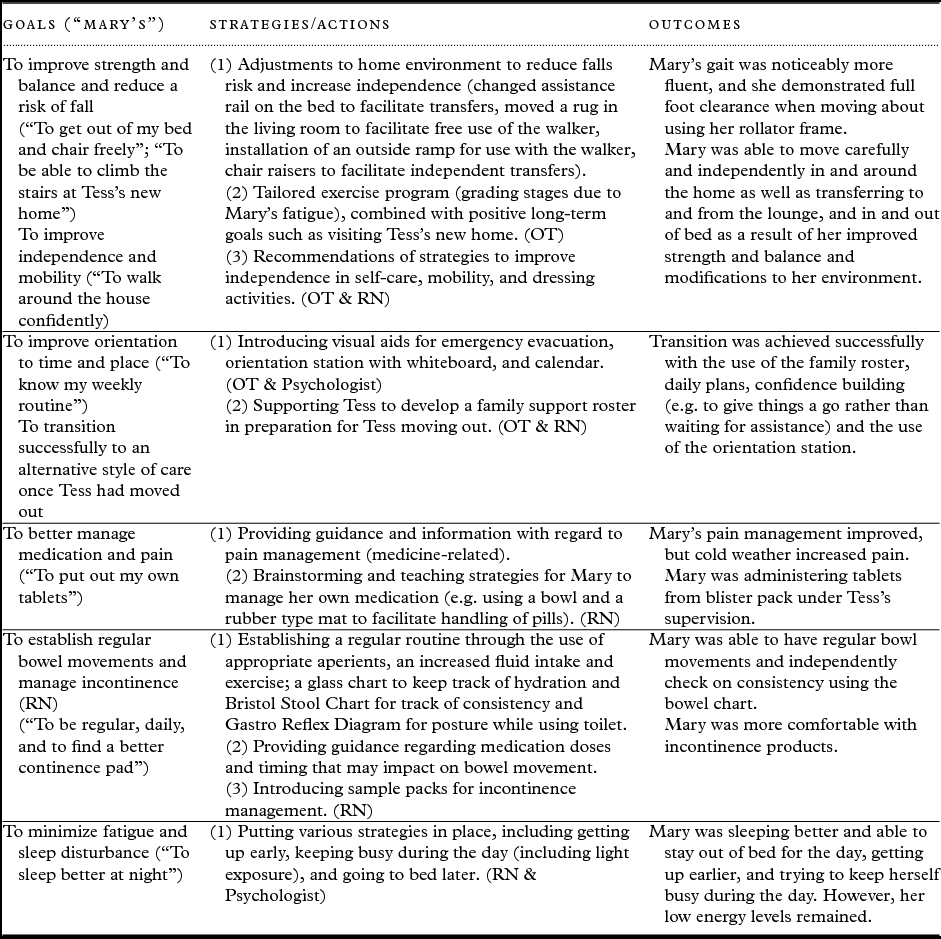
Following are the comprehensive assessments, the clinicians worked closely with Mary and Tess to help them identify the goals and action strategies that Mary wanted to and could achieve in the following three months. Also, the clinicians encouraged Tess to communicate with Mary regarding her plan to move out as soon as possible. Openness was important for the clinicians in order to have a meaningful relationship with Mary. Table 1 provides a list of the goals agreed, and the action plans and implementation strategies that followed. Additionally, Mary was observed to enjoy talking on the phone, speaking different languages with others (particularly German with one of her grandchildren), and cooking (doing the chopping on the table, preparing a shopping list, and making potato salads). The clinicians encouraged Tess to facilitate opportunities for Mary to follow her interests through family activities and the utilization of home care support.
I-HARP goals and action plans for Mary and Tess

Outcomes
As shown in Table 1, most of Mary's goals were achieved, with a significant improvement in her functional mobility towards the end of the program. The Modified Barthel Index (Shah version) (Shah et al., Reference Shah, Vanclay and Cooper1989) score of predictive function improved from 62 to 88. Mary's ability to move safely around her home environment without assistance enabled her to spend short periods (e.g., 1–2 h) at home alone without support. In addition, the clinicians noted a better spirit and confidence in Mary's conversation. It was also observed that Mary's reliance on Tess reduced noticeably as Tess was no longer expected to do “everything” for and with Mary.
Tess appeared more relaxed, and less likely to interject during conversations between Mary and the clinicians. Tess strongly agreed with the concept of focusing on Mary's capabilities. She felt Mary became more active, alert, and cognitively and socially engaged, which helped her to enable Mary to be more independent and confident rather than doing things for her. Tess noted, “My mother has more confidence to use skills that she has used all her life” and that “she's got the confidence to go ahead with some of them again.” She also said “It has been such a wonderful thing to have that outlook and that positivity rather than saying well ‘you can't do this and you can't do that all the time.” Mary's confidence resulted in significantly reduced feelings of despair about Tess's moving out. Tess said, “It has been a lovely transition and I think if we haven't had this support from everyone this would have been dramatically different.”
Tess described that she now had a better understanding of how health issues affect everyday life activities, and summarized the key aspects of the success of the program including: one-on-one, hands-on approach; establishment of good relationship between the clinicians and Mary; positivity and reassurance; continuity and regularity of visits; taking sufficient time with visits (1.5 h each visit); professional input to handle family dynamics, as all family members and Mary trusted the clinicians’ judgment and found it easier to comply and follow their suggestions.
Mary's feedback further confirmed the observations made by the clinicians and Tess. Mary frequently expressed her gratitude for the clinicians’ visits and the help they had provided, which in her view gave her more confidence and physical strength. Mary said “My life has been changed very much. I accept what I have learned from clever people they taught me and thank you very much for helping me.” “I'm a different person, they've done me so much good.” With regard to Tess's moving out, Mary said “I don't feel alone, because Tess visits me.” She acknowledged that she was able to incorporate various strategies into her everyday life, which made an immense difference to her mobility around the home and the exercises had given her a great deal of confidence.
Discussion
Living with dementia does not reduce the person's essential needs to those that relate to their illness experience only. Psychological, neurological, and social impairments caused by dementia, for example, may limit the persons everyday living and experiences, but s/he still retains the capacity to enjoy a meaningful life. Social health, defined by Huber et al. (Reference Huber2011), provides us with a constructive frame of reference as it recognizes the power of diverse and adaptable human capabilities to reach a state of well-being in the absence of having a perfect status of physical health. In this regard, “the state of well-being can be achieved as they are able to make adaptations to their limitations and seize opportunities to reclaim some of their abilities, while maintaining a balance between the ability and the disability, in the context of their social, psychological, and physical environments” (Vernooij-Dassen and Jeon, Reference Vernooij-Dassen and Jeon2016, p. 701). The case of Mary and Tess has demonstrated key contributions of I-HARP, in particular how such reablement approaches to care may contribute to optimizing social health of people living with dementia. The principles of I-HARP, such as person-centered dementia care and goal setting, shared decision making, interdisciplinary team work, as well as working in partnership with the family caregiver, played a pivotal role in realizing successful outcomes. As a result of her participation in I-HARP, Mary was able to re-gain her confidence and physical strength, which enabled her to become more independent in her daily activities and achieve improved well-being.
An increasing number of trials have demonstrated the effects of occupational therapist led restorative or reablement approaches that are individually tailored with environmental modifications to care for people with dementia and their carers: for example, the Care of Persons with Dementia in their Environments (COPE) program (Gitlin et al., Reference Gitlin, Winter, Dennis, Hodgson and Hauck2010), Tailored Activities Program (TAP) (Gitlin et al., Reference Gitlin, Winter, Burke, Chernett, Dennis and Hauck2008; O'Connor et al., Reference O'Connor, Clemson, Brodaty, Gitlin, Piguet and Mioshi2015); Community based occupational therapy (Graff et al., Reference Graff, Vernooij-Dassen, Thijssen, Dekker, Hoefnagels and Rikkert2006). However, a major knowledge gap exists in ways of providing care for people at early to moderate stages of dementia with multimorbidities (often known as complex care needs) where interdisciplinary team efforts would likely have higher impact. Existing community care services in Australia such as nursing, allied health services and home modification, and maintenance services under the Commonwealth Home Support Programs and Home Care Packages are designed to support frail older people in the community to maximize their independence in their home environment. However, services that focus on rehabilitative frame of reference or reablement approaches to care for people with dementia who also have multimorbidities are almost non-existent in Australia and the international literature points to the same trend (Mittler, Reference Mittler2016). Importantly, reaching optimal outcomes of these services requires a full integration of relevant services, involving a multi- and inter-disciplinary team work.
The role of I-HARP in the case of Mary and Tess has substantiated the notion of social health for people with dementia whose health is often further compromised by complex care needs and environment beyond clinical features of dementia. The detailed processes involved in I-HARP as outlined in this case report corroborates that complex care needs require a complex intervention, and consequently a complex evaluation. I-HARP is currently tested with a small cohort of people (n = 18) with early to moderate dementia and their carers. Through this pilot, we have identified two areas for improvement of I-HARP: stronger carer support and speech pathology support (as well as psychology and physiotherapy). The processes and findings of the I-HARP study will provide timely insights to inform future community services and delivery models throughout the transition period. A full-scale trial of I-HARP is necessary to determine its effectiveness in improving the outcomes for the person with dementia and the family caregiver and will provide evidence of whether I-HARP is cost effective.
Conflict of interest
None.
Description of authors’ roles
Y.-H. Jeon designed the study, contributed to the I-HARP protocol, delivered psychoeducation for the family caregiver, and drafted and revised the paper. L. Clemson, S. L. Naismith, and S. L. Szanton contributed to the I-HARP protocol, made critical feedback on the paper. L. Mowszowski and C. Dawes (Psychologists), N. McDonough (Occupational Therapist), and M. Mackenzie (Registered Nurse) contributed to the I-HARP protocol, delivered the intervention and provided critical feedback on the paper. L. Krein coordinated I-HARP, conducted the interviews with the participants, and provided critical feedback on the paper. All the authors contributed to the finalization of the paper.
Acknowledgments
This case report is derived from a pilot study funded by the Dementia Collaborative Research Centre – Assessment and Better Care, University of New South Wales as part of an Australian Government Initiative. We are grateful for the support provided by the CAPABLE Team, especially Jill Roth and Allyson Evelyn-Gustave, at Johns Hopkins University, MD, USA.