Introduction
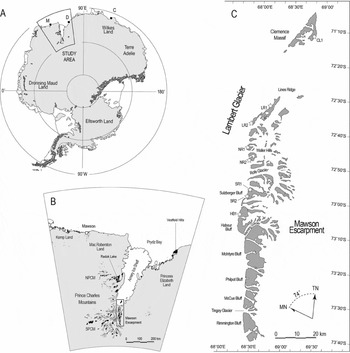
The Prince Charles Mountains comprise a series of mountain peaks and flat topped massifs that lie between latitudes 70°S and 74°S and longitudes 60°E and 69°E (Fig. 1). They are exposed in a large ice sheet depression created by the Lambert Glacier–Amery Ice Shelf. This glacier–ice sheet represents the largest single icestream flowing from the interior of Antarctica. It drains approximately 15% of east Antarctica (Drewry and others Reference Drewry, Jordan and Jankowski1982; Hambrey Reference Hambrey, Barron and Larson1991) and overlies an extensive fjordal valley that can be traced at least 1500 km inland from the coast (Damm Reference Damm2007).
Location of study. (A) Antarctica with the Lambert Basin and the Prince Charles Mountains study area highlighted. Dark grey regions represent areas of exposed bedrock. M = Mawson Station, D = Davis Station, C = Casey Station. (B) Enlargement of study area highlighted in (A) showing extent of bedrock within the Lambert Basin. Flow lines south of the Amery Ice Shelf represent the Lambert Glacier and its tributaries. NPCM = Northern Prince Charles Mountains, SPCM = Southern Prince Charles Mountains. (C) Enlargement of the Mawson Escarpment highlighted in (B) showing the moss localities described.

The extremely remote Prince Charles Mountains have rarely been visited and, particularly from a botanical perspective, remain little explored. Major Australian research expeditions reached the region in 1960, 1972, 1974, 1988, 1998 and 2002. These studies mostly focused on the basement geology and glaciology, although some plant and invertebrate samples were collected. There has never been a systematic botanical survey of this region (Peat and others Reference Peat, Clarke and Convey2007).
From the available botanical collections, Coscinodon lawianus (J.H. Willis) Ochyra (as Grimmia lawiana J.H. Willis) has been identified from the northwest Mawson Escarpment (1973 collection of R. Filson; MEL 1012186) and from near Radok Lake in the Amery Oasis (1988 collection of D. Adamson; ADT 07539, RDS 19050). Ptychostomum pseudotriquetrum (Hedw.) D.T. Holyoak and N. Pedersen (as Bryum pseudotriquetrum) has been identified growing at depths down to 81 m in Radok Lake (Wagner and Seppelt Reference Wagner and Seppelt2006).
Material and methods
Sample collection and site morphology
Moss specimens were sampled in the summer of 2002–2003 during a joint Australian and German expedition (PCMEGA) to the southern Prince Charles Mountains. Field work was undertaken along the northern Mawson Escarpment and at Clemence Massif along the eastern side of Lambert Glacier (Fig. 1).
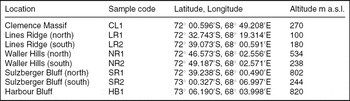
Field sampling involved the collection of small samples from the locations in Table 1. The samples comprised a few moss shoots that were placed in paper envelopes, air-dried and stored frozen or cool until use. Voucher specimens are held at the Australian National University in Canberra, Australia.
Location of sampled sites.

The Prince Charles Mountains samples were compared with specimens from other continental Antarctic locations, obtained from the herbaria of the British Antarctic Survey (BAS) and the Australian Antarctic Division (ADT).
DNA extraction and preparation
DNA was extracted from the top 3 mm of single moss shoots (Skotnicki and others Reference Skotnicki, Selkirk and Beard1998). Freshly collected moss samples and older herbarium samples were treated in the same manner. Single shoots were ground in extraction buffer using an electric drill fitted with a sterilised glass bit, extracted with chloroform/isoamyl alcohol, RNase-treated, and precipitated with isopropanol. After rinsing the DNA pellets in ethanol, they were resuspended in 15 ml sterile water and stored at 4°C until used for DNA sequencing.
The complete ITS region of the 18S–26S nrDNA was amplified in a polymerase chain reaction (PCR) using primers designed by White and others (Reference White, Bruns, Lee, Taylor, Innis, Gelfland, Sninsky and White1990). DNA was amplified and sequenced as described previously, using standard techniques (Skotnicki and others Reference Skotnicki, Mackenzie, Clements and Selkirk2005). The complete sequence of the ITS1–5.8S–ITS2 region was determined for each sample using Chromas software (Technelysium Pty. Ltd.) to edit and assemble the sequencing chromatograms. The rps4 region was similarly amplified and analysed using standard techniques.
Sequence alignment and analysis
Moss ITS gene sequences were first aligned using the CLUSTAL-W program (Thompson and others Reference Thompson, Higgin and Gibson1994), and were then further manually aligned using BioEdit version 5.0.9 (Hall Reference Hall1999), and compared with sequences of known species of Antarctic mosses (Skotnicki and others Reference Skotnicki, Mackenzie, Clements and Selkirk2005). Aligned ITS sequences were compared with each other and with sequences of known moss species using BLAST (Altschul and others Reference Altschul, Madden, Schäffer, Zhang, Zhang, Miller and Lipman1997) and PAUP version 4.0b4a (Swofford Reference Swofford1998), which clustered the different mosses sufficiently well with other known moss sequences to identify the species taxonomically.
Rps4 sequences were similarly aligned and analysed to confirm taxonomic identification.
Results
Field observations
Moss colonies occurred sporadically thoughout the study area and varied in size from small clusters of cushions in areas of 0.1–1 m2, to moss beds that extended over areas from 10 m2 to approximately 500 m2 (Fig. 2). The locations of the observed moss colonies are given in Table 1 and Fig. 1.
Mosses from the southern Prince Charles Mountains. (A) Single cushions of Ptychostomum pseudotriquetrum from Clemence Massif (CL1). (B). Mid-sized colony of P. pseudotriquetrum from Sulzberger Bluff (SR2). (C) Extensive colony of Coscinodon lawianus observed at the Waller Hills (NR2). Large sections of the colony were growing on ground saturated with water sourced from the glacier upslope. (D) Closer view of C. lawianus from location NR2.

At Clemence Massif, mosses (Fig. 2A) grew as large discrete cushions in a narrow east-facing gully draining from an elevated bedrock plateau on the southeast margin of the massif.
At the Lines Ridge (north) site LR1, moss (and lichens) grew on bedrock and poorly sorted scree on the west side of the ridge, typically along fractures in the rock where the site was protected by a rocky overhang. At the Lines Ridge (south) site LR2, moss colonies were growing on a north-facing inclined wall of bedrock, under a slight overhang of rock.
At Waller Hills (north), at site NR1, healthy green moss grew on a northwest facing diamictite deposited on the west side of the cliffs, facing Lambert Glacier. At Waller Hills (south), at site NR2, moss (Figs. 2C, D) was growing at the southern tip of a bluff adjacent to a west-flowing unnamed tributary glacier. Healthy mosses were relatively abundant on a shallow west-facing slope that forms a summer meltstream from the upper reaches of the tributary glacier. Mosses were growing predominantly in channels at this location, and were sampled along a transect about 200 m in length.
At Sulzberger Bluff (north), at site SR1, mosses were found at the foot of a rocky outcrop, forming a small patch on the west face of the escarpment.
At Sulzberger Bluff (south), at site SR2, mosses (Fig. 2B) occurred in relative abundance on diamictite in a shallow west-facing valley draining a hanging glacier above the colonies.
At Harbour Bluff site HB1, moss colonies grew adjacent to a meltstream channel. No mosses were observed south of this location on Mawson Escarpment.
Laboratory morphological identification
Morphology of the shoots, colour of stems, shape and colour of leaves, shape of leaf cells, cross sectional anatomy of leaves and stems were examined, and compared with published descriptions (Filson Reference Filson1966; Spence and Ramsay Reference Spence, Ramsay and McCarthy2006; Holyoak and Pedersen Reference Holyoak and Pedersen2007; Ochyra and others Reference Ochyra, Lewis Smith and Bednarek–Ochyra2008) and herbarium specimens. Samples CL1, NR1, SR1 and SR2 were identified as Ptychostomum pseudotriquetrum (Hedw.) D.T. Holyoak & N. Pedersen. Samples LR1, LR2, and all nine samples from the extensive moss colony at location NR2 were identified as Coscinodon lawianus (J.H. Willis) Ochyra. Sample HB1 was identified as Schistidium antarctici (Cardot) L.I. Savicz & Smirnova.
ITS and rps4 gene sequencing results
Comparison of the ITS DNA sequences from the nine NR2 samples of Coscinodon lawianus collected in the transect at the southern Waller Hills site (NR2) showed that they were all genetically identical for these genes. In approximately 800 nucleotides sequenced from the ITS region, none of the nine specimens analysed showed any genetic variation. The LR1 and LR2 samples were also genetically identical to the NR2 samples for the ITS sequence.
ITS sequences of several other herbarium specimens, morphologically identified as C. lawianus, were almost identical with the NR2, LR1 and LR2 ITS sequences: these included specimens collected as Grimmia lawiana from Mt. Ward in the North Masson Ranges, Mac.Robertson Land (specimen Upton #1 collected by E. Upton in 1987), from Quilty Nunataks in Ellsworth Land (specimen Convey 524), from Stornes West in the Larsemann Hills, Princess Elizabeth Land (specimen LH 19–3, R. Pigeon) and from Henriksenskjera in Dronning Maud Land (specimen RILS 11138).
For seven samples of C. lawianus from location NR2, no differences were detected in 630 nucleotides of the rps4 gene. The LR1 and LR2 samples were also identical to these specimens for the rps4 sequence, and all of these specimens were also almost identical to herbarium specimens of C. lawianus from Mt. Ward in the North Masson Ranges, Mac.Robertson Land (specimen Upton #1), from Mawson, Mac.Robertson Land (specimen BAS 1512, collected in 1962), from Mitchell Peninsula, Wilkes Land (specimen ADT 19844), from the Larsemann Hills in Princess Elizabeth Land (specimen LH19–3), from Quilty Nunataks in Ellsworth Land (specimen Convey 524), and from Henriksenskjera in Dronning Maud Land (specimen RILS 11138).
For Ptychostomum pseudotriquetrum, the ITS sequences of specimens CL1, NR1 and SR2 were very similar to each other and were also very similar (98.4%) to two samples of P. pseudotriquetrum previously examined from Canada Glacier and Granite Harbour in Victoria Land, Antarctica (specimens P159 and CCC5; Skotnicki and others Reference Skotnicki, Mackenzie, Clements and Selkirk2005). For the rps4 gene, specimens CL1, NR1 and SR1 were all identical.
For the HB1 sample, morphologically identified as Schistidium antarctici, the first 110 nucleotides of the ITS region are very similar to the same region of ITS sequences from Coscinodon lawianus samples LR1 and NR2. The remaining 750 nucleotides are 93% similar to Schistidium antarctici from Mitchell Peninsula, Wilkes Land (specimens SR17 and RILS 6294) and also 93% similar to S. apocarpum from Heard Island (specimens H660c and H133). A BLAST analysis (Altschul and others Reference Altschul, Madden, Schäffer, Zhang, Zhang, Miller and Lipman1997) shows it to be most closely related to Schistidium antarctici from Casey in Wilkes Land, Antarctica.
The HB1 sample had an rps4 sequence which was identical in all but one nucleotide to that of a specimen of Schistidium antarctici from Clark Peninsula, Wilkes Land (specimen SR17), and was almost identical to a herbarium specimen of this species from Mitchell Peninsula in Wilkes Land (specimen RILS 6294).
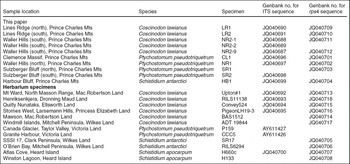
ITS and rps4 sequences for the Prince Charles Mountains moss specimens, and also for the herbarium specimens used for comparison, have been deposited with Genbank. Accession numbers are in Table 2. It is worth noting that some of the herbarium specimens, which gave good DNA sequences, were 20–55 years old.
Genbank accession numbers, identities and sampling locations for mosses used in this study.

Discussion
The present study has recorded for the first time the presence of three moss species in the southern Prince Charles Mountains. At latitudes between 71°S and a little over 73°S, these locations represent the southernmost record of mosses in this region of continental Antarctica. Our research has also demonstrated the utility of DNA sequencing of the ITS region and rps4 gene for genetic analysis of three species of Antarctic mosses, enabling taxonomic identification based on only a partial nucleotide sequence of the conserved nuclear ribosomal 18S–26S DNA ITS region or the conserved chloroplast rps4 gene.
Moss colonies were predominantly found on west-facing slopes where localised summer runoff provided moisture. At Clemence Massif mosses occurred on a morphologically similar east-facing slope. Colonies were mostly growing on glacial diamictite consisting of a silt rich matrix in which sub-angular to sub-rounded rocks of pebble to boulder size are found (White and Hermichen Reference White and Hermichen2007). These sediments drape the summits and flanks of the massifs along the northern Mawson Escarpment and, by correlation with similar strata in the northern Prince Charles Mountains, may date to between the middle Miocene (12–8 Ma) to the early (<2.6 Ma) Pleistocene (McKelvey and others Reference McKelvey, Hambrey, Harwood, Mabin, Webb and Whitehead2001; Whitehead and others Reference Whitehead, Harwood, McKelvey, Hambrey and McMinn2004; White and Hermichen Reference White and Hermichen2007). Minimal ice thickening during the most recent glacial maximum (18 ka BP) within the Prince Charles Mountains suggest these strata were exposed both before and after this event (White and others Reference White, Fink and Gore2011).
Mosses were not found south of Harbour Bluff. This most probably reflects a change in landform and sediments whereby north of Harbour Bluff the massifs are more gently sloped and are extensively draped by glacial debris. To the south of Harbour Bluff, the massifs are more precipitous and bare of sediment cover, except along their base where modern bouldery moraines are present. In this area the glacial sediment elsewhere colonised by mosses is limited to dry side valleys and hanging cirques (White and Hermichen Reference White and Hermichen2007), regions not explored by the authors.
At all sites where moss growth occurred, there was some summer meltwater runoff that provided sufficient moisture for limited growth during the short Antarctic summer. Mosses only occurred where there was such water in drainage channels. Very low winter temperatures in the Prince Charles Mountains mean the mosses would remain freeze-dried for most of each year with a very short growing season of probably no more than a couple of months in midsummer.
Of the three moss species found in the southern Prince Charles Mountains, Ptychostomum pseudotriquetrum has a global distribution, Schistidium antarctici and Coscinodon lawianus are Antarctic endemics.
Ptychostomum pseudotriquetrum is generally regarded as cosmopolitan, but Ochyra and others (Reference Ochyra, Lewis Smith and Bednarek–Ochyra2008) consider it to be bipolar with intermediate occurrences at high altitudes. It is one of the most widespread and common moss species in Antarctica, both in terms of cover and frequency (Ochyra and others Reference Ochyra, Lewis Smith and Bednarek–Ochyra2008). It occurs in the maritime Antarctic, the Antarctic Peninsula and in continental Antarctica where it has been found as far south as Canada Glacier in the Lower Taylor Valley (77°37′S, 163°33′E) in Victoria Land (Schwartz and others Reference Schwartz, Green and Seppelt1992). In the region of the Lambert Glacier-Amery Iceshelf, P. pseudotriquetrum has been recorded as an aquatic plant from Radok Lake in the northern Prince Charles Mountains, (Wagner and Seppelt Reference Wagner and Seppelt2006) and the Ingrid Christensen Coast (Seppelt Reference Seppelt and Pickard1986). It has also been recorded as a terrestrial plant in Enderby Land, Kemp Land (Seppelt and Green Reference Seppelt and Green1998) and Mac.Robertson Land (as Bryum antarcticum, Filson Reference Filson1966).
Schistidium antarctici is an Antarctic endemic, widespread in continental and maritime Antarctica and is rare on South Georgia, the only subantarctic island where this species in known (Ochyra and others Reference Ochyra, Lewis Smith and Bednarek–Ochyra2008). Its southernmost record (as Grimmia antarctici) is 83°49′S 172°25′E, from Mt Harcourt in southern Victoria Land (Seppelt and Green Reference Seppelt and Green1998). In the region of the Lambert Glacier-Amery Iceshelf, it is known from Enderby Land and the Ingrid Christensen Coast of Princess Elizabeth Land (Seppelt and Green Reference Seppelt and Green1998).
Coscinodon lawianus is also an Antarctic endemic, only known from East Antarctica (Ochyra and others Reference Ochyra, Lewis Smith and Bednarek–Ochyra2008). It was first described (as Grimmia lawiana J.H.Willis) from the Mawson Coast of Mac.Robertson Land (Filson Reference Filson1966) but has since been described from Dronning Maud Land, Enderby Land, the Ingrid Christensen Coast of Princess Elizabeth Land and more widely in Mac.Robertson Land including other parts of the Mawson Coast and the northern Prince Charles Mountains (Ochyra and others Reference Ochyra, Lewis Smith and Bednarek–Ochyra2008).
The new records of mosses from the southern Prince Charles Mountains presented here provide a valuable addition to distribution data for Antarctic bryophytes. They are pertinent to continuing discussions concerning the length of time present species have been part of the Antarctic biota (Convey and others Reference Convey, Gibson, Hillebrand, Hodgson, Pugh, Smellie and Stevens2008; Convey and others Reference Convey, Stevens, Hodgson, Smellie, Hillenbrand, Barnes, Clarke, Pugh, Linse and Cary2009), since the Prince Charles Mountains comprise ancient rocks and land surfaces which remained exposed during the most recent glacial maximum (~18 ka BP) and very likely have remained ice-free for at least the last 2.2 Ma (Fink and others Reference Fink, McKelvey, Hambrey, Fabel and Brown2006).
Acknowledgements
We thank Duanne White and other members of the PCMEGA expedition for assistance with sample collection, Helen Peat of the British Antarctic Survey Herbarium and Perpetua Turner of the Australian Antarctic Division Herbarium for providing herbarium specimens, Anne Mackenzie for assistance with DNA sequencing, two referees for helpful comments, and the Australian Antarctic Programme for major logistical support for fieldwork in the Prince Charles Mountains, Antarctica. This work was supported by an Antarctic Science Research Grant and the Hermon Slade Foundation.