From decrying sampling lawsuits in his music to giving interviews with academics, Public Enemy's Chuck D is an important figure in the discourse on music copyright in hip hop. His vocal critiques, coupled with his group's canonical status, have rendered Public Enemy an outsize presence in histories of hip hop sampling. For example, Chuck D mused on how Public Enemy felt the effects of sampling lawsuits:
Public Enemy's music was affected more than anybody's because we were taking thousands of sounds. If you separated the sounds, they wouldn't have been anything – they were unrecognisable. The sounds were all collaged together to make a sonic wall. Public Enemy was affected because it is too expensive to defend against a claim. So we had to change our whole style, the style of It Takes a Nation and Fear of a Black Planet, by 1991. (McLeod Reference McLeod2004)
What Chuck D implies is that Grand Upright Music Ltd v. Warner Brothers Records, Inc., a legal dispute between a music publisher and a record label, set a precedent and changed music industry standards regarding digital samples (decided 1991). Public Enemy seems to have been affected by such legal decisions more than other hip hop artists, but the impact felt by this group only begins to tell the story of how sampling aesthetics changed in response to copyright lawsuits.
Although works by Kembrew McLeod and Peter DiCola (2004), and Amanda Sewell (Reference Sewell2013, Reference Sewell2014) have shed light on some of the case's possible effects, there has yet to be a study on the case's impact on the genre of hip hop more broadly. McLeod and DiCola gather valuable interviews from musicians and industry professionals about how sampling became more difficult and expensive following Grand Upright, while Sewell investigates how the music of five canonical artists changed in the years following the case. This work creates a foundation for further studies on Grand Upright, offering valuable context and relevant tools. What needs further attention, however, is how hip hop artists and subgenres normally excluded from the canon may have responded to this case; subgenres such as pop-rap, New Jack Swing and gangsta rap constituted an important part of the popular music field in the early 1990s, but the effects of sampling lawsuits on these genres is unknown. Taking Sewell's study of canonical artists as a model, this article explores the impact of Grand Upright on the diverse subgenres that comprised hip hop music from 1988 to 1993.
Grand Upright v. Warner involved rapper Biz Markie's sampling of Gilbert O'Sullivan's 1971 piano ballad, ‘Alone Again (Naturally)’, in his song, ‘Alone Again’. Terry O'Sullivan (who represented his brother's affairs in the United States) sent a cease-and-desist order, asking that the song be removed from the album, to which Markie's attorney responded that they had anticipated permission and would not have released the song had they known of O'Sullivan's objection (Falstrom Reference Falstrom1994, p. 363). Filed on 17 December 1991, the wording of Judge Kevin Thomas Duffy's decision has biblical gravity: he begins with a quotation from the Old Testament: ‘Thou shalt not steal’. He goes on: ‘The conduct of the defendants herein, however, violates not only the Seventh Commandment, but also the copyright laws of this country’.Footnote 1 In this sweeping judgement, Duffy deems Markie's sampling both legally and morally reprehensible, even referring the case for criminal prosecution. Duffy's blatant characterisation of sampling as theft could be read in the context of the moral panic surrounding rap in the late 1980s and early 1990s, as well as underlining the systemic racism built into American copyright, which privileges musical parameters that can be notated in a score (Greene Reference Greene1999; Arewa Reference Arewa2006, p. 580). Duffy was not an expert in either copyright or music, and his decision betrayed a misunderstanding of the creativity and history embodied in sampling.
Assembling a representative sample
Building on Sewell's article concerning copyright lawsuits and sampling aesthetics, I conducted a genre-wide study of popularly circulating hip hop songs selected from Billboard Magazine from the years 1988 to 1993. These years were not chosen haphazardly. I begin my study in 1988 because it is the year that The Source, the first major hip hop magazine, was published, and a year that falls at the beginning of the period scholars of hip hop and music copyright point to as a ‘golden age’, either of hip hop sampling, or of hip hop music more broadly (McLeod and DiCola Reference McLeod and DiCola2011, p. 19; Williams Reference Williams2013, p. 2; Schloss Reference Schloss2013, p. 39). 1991, and the Grand Upright v. Warner decision, is in the middle of this six-year period. I chose to end my study in 1993, because, to my ear, significant aesthetic changes in hip hop sampling had permeated the genre by this time. Dr. Dre's influential album The Chronic was released in December of 1992, followed by Snoop Doggy Dogg's Doggystyle in 1993; these crossover hits spawned many imitators. Consequently, gangsta rap, and the subgenre of G-funk, had become the new sound of much of mainstream rap music by 1993. In the early 1990s, gangsta rap dominated the field to the point that other genres rhetorically positioned themselves in relation to it (Williams Reference Williams2013, p. 48). By 1993 hip hop was established as an important part of the field of popular music, and not simply the short-lived fad that critics alleged in the 1980s. As I conducted this study, it became clear that music released in 1988 sounded significantly different from music released in 1993, and that a study of this period would suffice as a snapshot of a genre undergoing aesthetic transformation.
Unlike previous studies, I draw my corpus from primary sources, rather than retrospective, canonising ones. It would have been easier to compile a list of songs based on the numerous ‘best of’ lists in Rolling Stone, Vibe or The Source. Even Sewell's study, which lays much of the groundwork for my own, focused on the albums of five canonical artists, tracing their sampling habits before and after the Grand Upright decision (Sewell Reference Sewell2013 pp. 189–225; 2014). However, I argue that corpus studies addressing generic changes such as mine should strive to best represent the given genre within the larger field of cultural production. Generically speaking, hip hop music in the late 1980s and early 1990s was segmented into several subgenres, including jazz-, alternative- and otherwise ‘political’ rap; pop rap and R'n’B-inflected hip hop; and gangsta rap, which increased greatly in popularity in the later years of my study. Previous studies focused primarily on the first category (incidentally on subgenres that have accrued greatest prestige), which is why artists like Public Enemy, De La Soul and A Tribe Called Quest are frequently cited in academic work on sampling.
Any historian knows that the dream of re-creating or even studying the past ‘as it really was’ is folly, but in this case, I believe that we can get a little closer by broadening the field of study to include examples of hip hop music that are not typically discussed by scholars, despite their commercial success and popularity. To these ends, my study takes a ‘historicist’ approach, to adopt David Brackett's distinction between historicist and ‘presentist’ (Brackett Reference Brackett2016, p. 9). This means that my corpus includes songs by pop-rap artists like MC Hammer, Vanilla Ice, Sir Mix-A-Lot and Marky Mark and the Funky Bunch. Despite their exclusion from most scholarly histories on hip hop, these artists had hit songs on the Billboard charts, and constituted an important part of the field of cultural production, not just as hip hop music, but as popular music more broadly. To conduct such a study that is not informed by the historical field of production effectively constitutes the omission of entire subgenres, and within those subgenres, some of the most broadly-circulating and recognisable songs from this time period.
In order to avoid the problems outlined above, I used the Billboard charts to select the songs for my study. From 1988 to 1993, I surveyed Billboard's Hot 100 (B100), Hot Black Singles/Hot R&B Singles (BRB), and Hot Rap Songs charts (BRS).Footnote 2 I included a balance of hip hop songs from all three charts, which resulted in the representation of diverse hip hop subgenres, including pop, jazz, gangsta and Latin rap, turntablism (instrumental hip hop), New Jack Swing and Hip-House. During my period of study the region became increasingly important, and so the charts illuminated diverse regional sounds, from the East Coast, West Coast, Midwest, South and Jamaica. I included crossover hits, as well as songs from the BRS chart that did not cross over. I included as many female performers as possible; this is the only way I gave special treatment of any kind. Female performers often worked in subgenres that marked the margins of hip hop, like TLC, whose music undoubtedly participates in the genre of hip hop, but does not always include rap and shares many features with contemporary R'n’B. Even so, songs by female performers ultimately make up a small percentage of the overall corpus. I did not give canonical artists special treatment, instead including their songs as I would any others, looking at their chart performance, and assessing how they circulated as representatives of their subgenres. After I had selected the songs that would represent each of the six years (about 50 per year), I worked through the corpus chronologically. Beginning in 1988, I noted each song's peak chart positions for B100, BRB and BRS (as relevant), and then I commenced my work with identifying and classifying samples, using Amanda Sewell's sampling typology (explained below).
Although this study draws upon Amanda Sewell's research on this period, it makes some important departures. By taking a historicist approach, my study is both more inclusive and more representative of the genre of hip hop as a whole. Surveying hip hop music that was commercially successful as well as the artists who were critically acclaimed broadens the scope of my study compared with Sewell's, as well as adding weight to her findings with this additional purview. She writes,
If we accept these five groups [Public Enemy, the Beastie Boys, De La Soul, A Tribe Called Quest and Salt-N-Pepa] as a representative sample of hip hop artists from the late 1980s and 1990s, then it is clear that both the numbers of samples in and the distribution of sample types in their music dramatically changed in the early 1990s. (Sewell Reference Sewell2013, p. 220)
I must disagree that these groups are a representative sample: each is an exception, not the rule. Minus Salt-N-Pepa, Sewell's five artists are commonly accepted to have used more samples than their contemporaries; she suggests that Public Enemy's sampling was a better representation of common practice than Salt-N-Pepa, and my study will suggest that the opposite is true (Sewell Reference Sewell2014, pp. 316–17). Limiting her study to these five groups does not provide a complete picture of hip hop in a state of flux, which is why I feel it necessary to expand upon Sewell's work. In a related vein, Sewell also writes that artists managed to maintain their earlier styles when access to samples was limited, while my findings also complicate this assertion (Sewell Reference Sewell2014, p. 316). Finally, my study includes different metrics than Sewell's, going beyond yearly averages to explore the distribution of samples per song. This means that rather than relying upon averages as a sort of summary of yearly trends, I am able to discuss the number of samples per song across subgenres with greater specificity. My study also employs Sewell's sample subtypes as well as her broader categories: her article includes broader trends regarding sample types, but I go further by gathering quantifiable data about the changes within the sub-types that Sewell proposes.
At first blush it may seem unnecessary to devote yet another study to this lawsuit, especially when the effects of the case have come to be taken for granted by fans of hip hop. However, the intersection of legal decisions and musical aesthetics is terrain seldom explored, and there are few historical instances as blatant as Grand Upright v. Warner in which the law has been applied so forcefully to musical practice, dictating what artists can and cannot do. Additionally, in the early 1990s hip hop stood on the brink of its great leap into mainstream popular music, making this period notable. If – as Chuck D suggests – hip hop producers were forced to make different choices because of a legal decision, this is not only something we would want to know, I contend that we would want to know how hip hop music was affected with the greatest possible specificity.
Using Sewell's typology of sampling
To assess how sampling changed I used Amanda Sewell's typology. In her 2013 dissertation, Sewell presents a system that consists of three main sample types – Structural, Surface, and Lyric – each with multiple subtypes. The first, and most commonly used type is the Structural sample. They are slices of previous recordings that are ‘repeated end-to-end in sustainable patterns throughout a track’, and can be broken down into their sub-types based on source instrumentation (Sewell Reference Sewell2013, p. 27). As the name suggests, Structural samples constitute the musical foundation for hip hop many songs: ‘individual structural samples coalesce to form the track's groove’ (Sewell Reference Sewell2013, p. 34). Sewell breaks the structural sample into four subtypes: Percussion-Only, Intact, Non-Percussion and Aggregate. Percussion-Only samples are just that, they include only percussion instruments from the source track, whether it is solo drum kit or other percussion. Intact samples take a vertical slice from a source recording, so that all instruments sounding in the original, including percussion, are present in the sample. The Non-Percussion subtype is similar to the Intact one, ‘using original bass, keyboards, or other instruments, but lacking any sampled drums’ (Sewell Reference Sewell2014, p. 304). Sewell also includes a fourth type, Aggregate, which I did not use in my study; this subtype describes a musical texture that, as a structural type, is looped for the duration of a song (or section), but is derived from multiple source songs. For example, the aggregate structure might take drums from one song, bass from another, and keyboard and horn from yet another. Her dissertation project was more interested in describing the musical textures that result from different sampling techniques than counting samples and identifying their sources, thus I have chosen not to use the Aggregate type, since it does not help answer the question of how the total number of samples changed.Footnote 3
Secondly, Sewell proposes a Surface sample type, which operates on top of or in dialogue with the Structural-sample groove:
Not all non-vocal or non-lyric sounds in a sample-based hip hop track are actually part of the groove, however: samples can accent or rupture the groove or the lyrics without necessarily being a component of the groove or the lyrics themselves. (Sewell Reference Sewell2013, p. 48)
Surface samples can be broken down into three subtypes: Constituent, Emphatic, and Momentary. Constituent samples are ‘only a beat long and appear … at regular intervals atop the groove’ (Sewell Reference Sewell2014, p. 304). Some of the most common constituent sample types are James Brown grunts and shouts, and brass hits that recur over the groove once every bar. The other two surface types, Emphatic and Momentary, function more like framing devices or interruptions. Emphatic surface samples occur at the beginning or end of a track: brass fanfares and reggae style drum introductions are particularly common Emphatic samples. House of Pain's ‘Jump Around’ begins with such a ‘fanfare’, an Emphatic sample of the horn introduction of Bob & Earle's ‘Harlem Shuffle’ (1966). Sewell describes the Momentary subtype as a sample that appears ‘only once in a track but in an unpredictable place’ (Sewell Reference Sewell2014, p. 304). Although they become less common into the early 1990s, Momentary samples are common in the early years of my study: they serve as moments of rupture, as Tricia Rose describes them, in the midst of the otherwise loop-based groove (Reference Rose1994, pp. 38–9).
Sewell's final type is the Lyric sample, which is broken into Single and Recurring subtypes. Although these types seem self-explanatory, I will briefly delineate how they function. First, I want to emphasise that Sewell indicates that these are samples of ‘spoken, sung, or rapped text’ (Sewell Reference Sewell2014, p. 304). In this way, a Lyric sample could be similar to a Non-Percussion or Constituent sample, but the important difference is the use of distinguishable text. As I mention above, vocal Constituent samples are quite common, but I did not classify them as Lyric samples simply because they were vocal: the verse groove of Queen Latifah's ‘Dance for Me’ includes a non-texted, doo-wop-inspired vocal sample from Sly and the Family Stone's ‘Dance to the Music’ (1968).Footnote 4 I classified this as a Non-Percussion sample, because it had no discernable text. As Sewell enumerates in her dissertation, the Lyric sample is special, in that it relies on text recognition (Sewell Reference Sewell2013, pp. 54, 68). Singular Lyric samples often fulfil a similar function to Momentary Surface samples, interrupting the musical structure and creating dialogue between musical elements. Recurring Lyric samples, on the other hand, function as hooks or refrains or are formally significant in some other way. In some cases, a Recurring Lyric sample becomes the hook of the new song – something the hip hop community commonly refers to as a ‘scratch hook’.
I chose to use Sewell's typology for several reasons: I found it to be comprehensive; it was derived from hip hop of the 1980s and 1990s; and most importantly, it resonated with my experiences as a rap listener and scholar. The sample types she proposes put into words conventions and patterns that I had long heard, but did not have terms to describe. In short, I used her typology because it works, and it works especially well for hip hop from 1988 to 1993. However, Sewell's typology does not necessarily reflect how artists thought about these musical materials; my reliance on this typology is not intended to supersede the knowledge and sensibilities of hip hop musicians themselves. While these sample types portray trends at the level of the genre, individual practitioners working in hip hop at the time may not have conceived of their music in this way.Footnote 5 The typology should be understood as a set of analytical tools: it is descriptive, not prescriptive.
After generating my corpus, I identified the samples in each song, classifying them according to Sewell's typology. My primary resource in this process was WhoSampled.com, a database that professes to be ‘the world's largest community for fans of sampled music, cover songs and remixes’. I first listened to all of the samples listed on WhoSampled, and classified them according to Sewell's typology.Footnote 6 When I heard a sample that was not included on WhoSampled, the process became a bit more complicated. If my own listening knowledge fell short, I consulted a combination of the-breaks.com, Wikipedia, original CD liner notes (in PDF and hard copy), genius.com (a lyric website that occasionally includes musical discussions), Reddit and my listening community. Although not exhaustive, the size and diversity of the corpus, along with the large number of samples I was able to find, offered a compelling portrait of hip hop as a genre undergoing significant change.
Findings
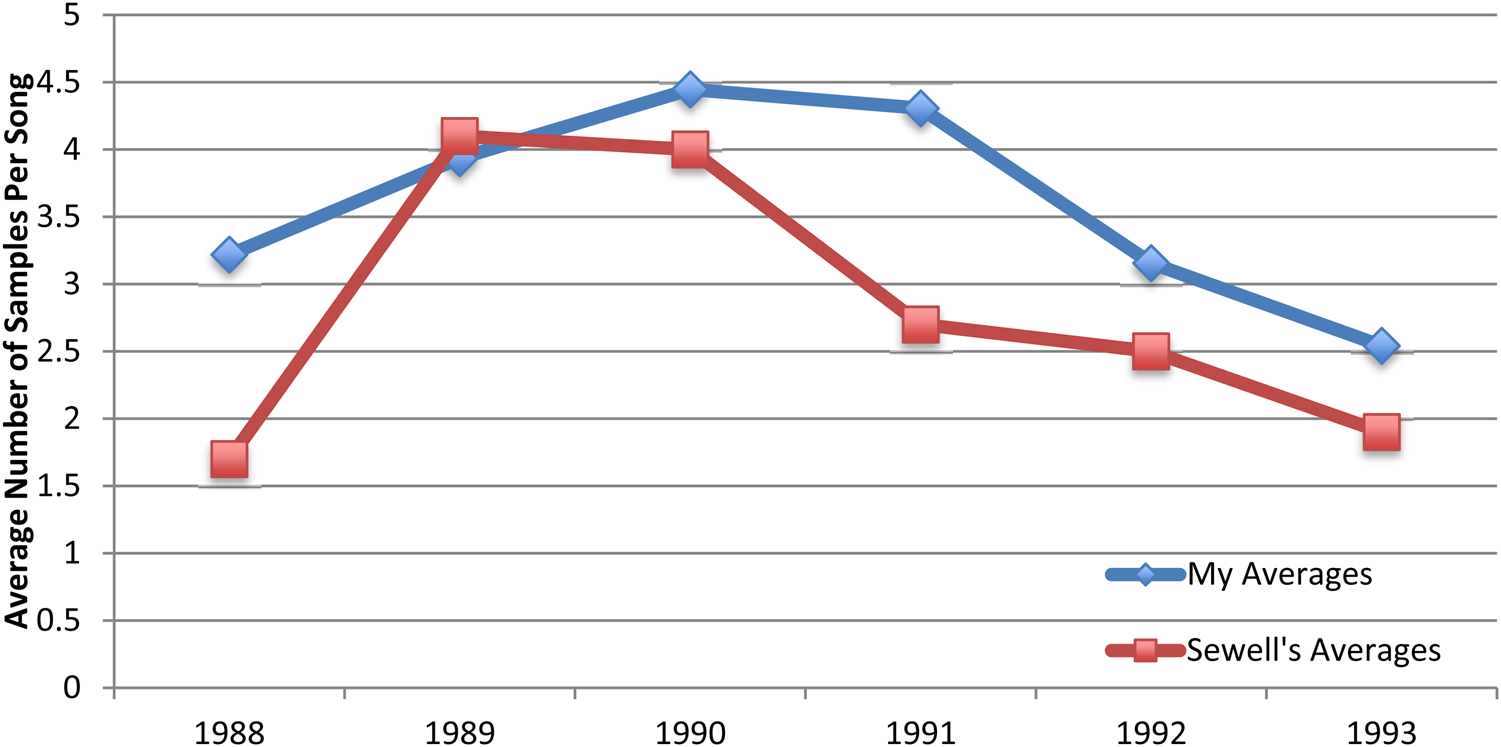
I repeated the experiment outlined in Sewell's article, but instead of using the releases of five canonical artists over a 10 year span, I studied a representative sample of artists and songs from a 6 year period. Sewell's study and my own indicate a decrease in the average number of samples around 1991, suggesting that something important, impacting hip hop music as a genre, was happening. To follow in this line of empirical reasoning, I am cognisant that correlation does not equal causation: Grand Upright v. Warner may not have been the sole reason why the number of samples per song declined, but I am confident that it played an important role. Despite the differences between our studies, one thing is clear: the dominant trend is a decreasing number of samples into the early 1990s. Represented visually in Figure 1, this trend is quite striking, but it that only tells part of how sampling changed during this time period.
Average number of samples per song
*For physical copies, Figures 1 and 12-15 should be rendered in colour. In digital format, all except Figure 2 could appear in colour.

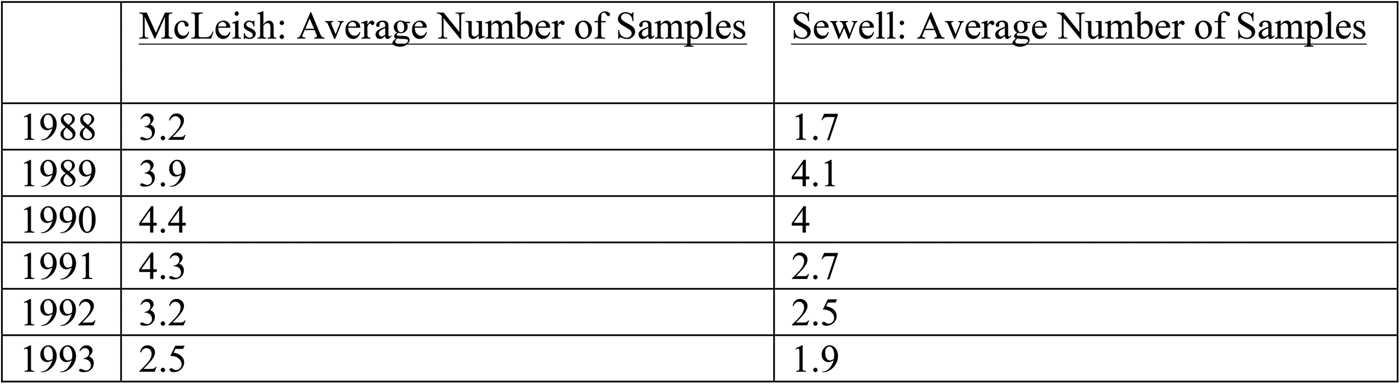
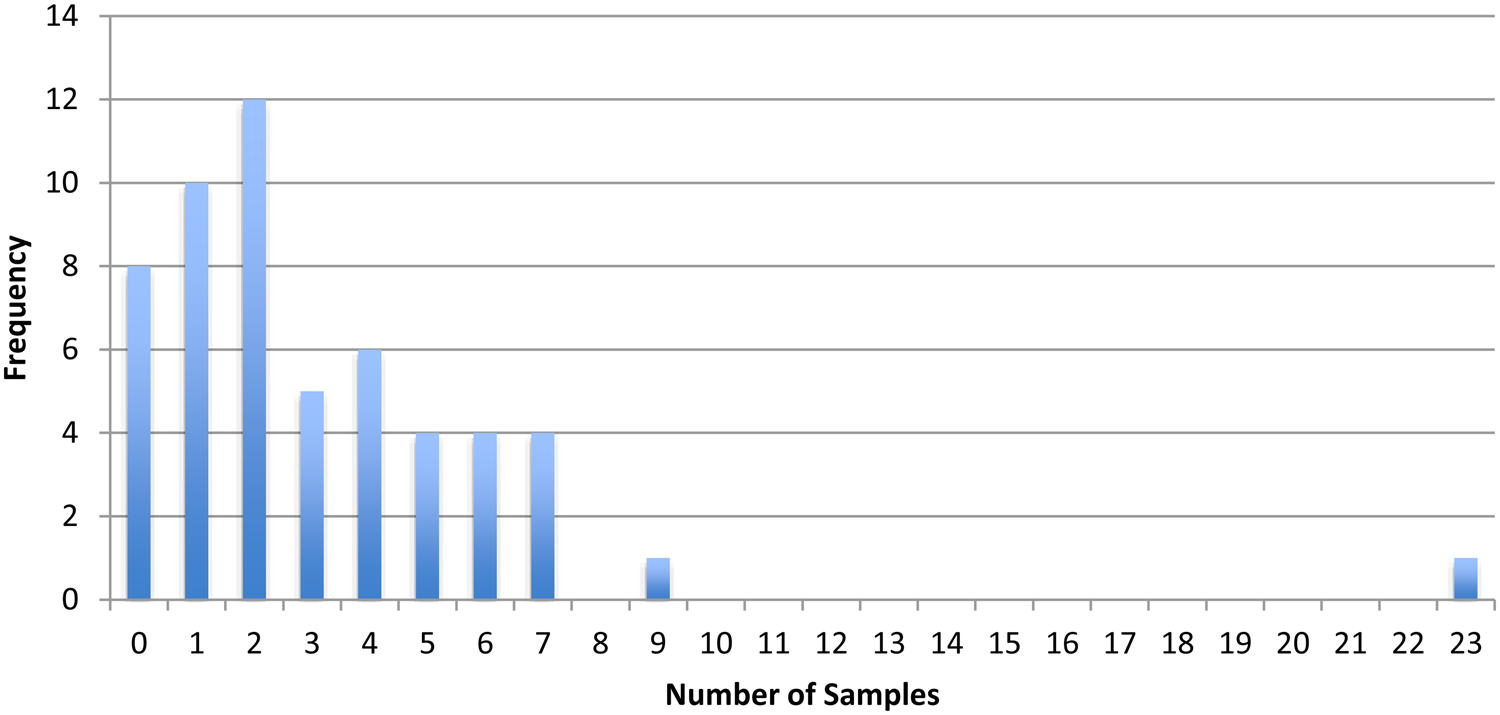
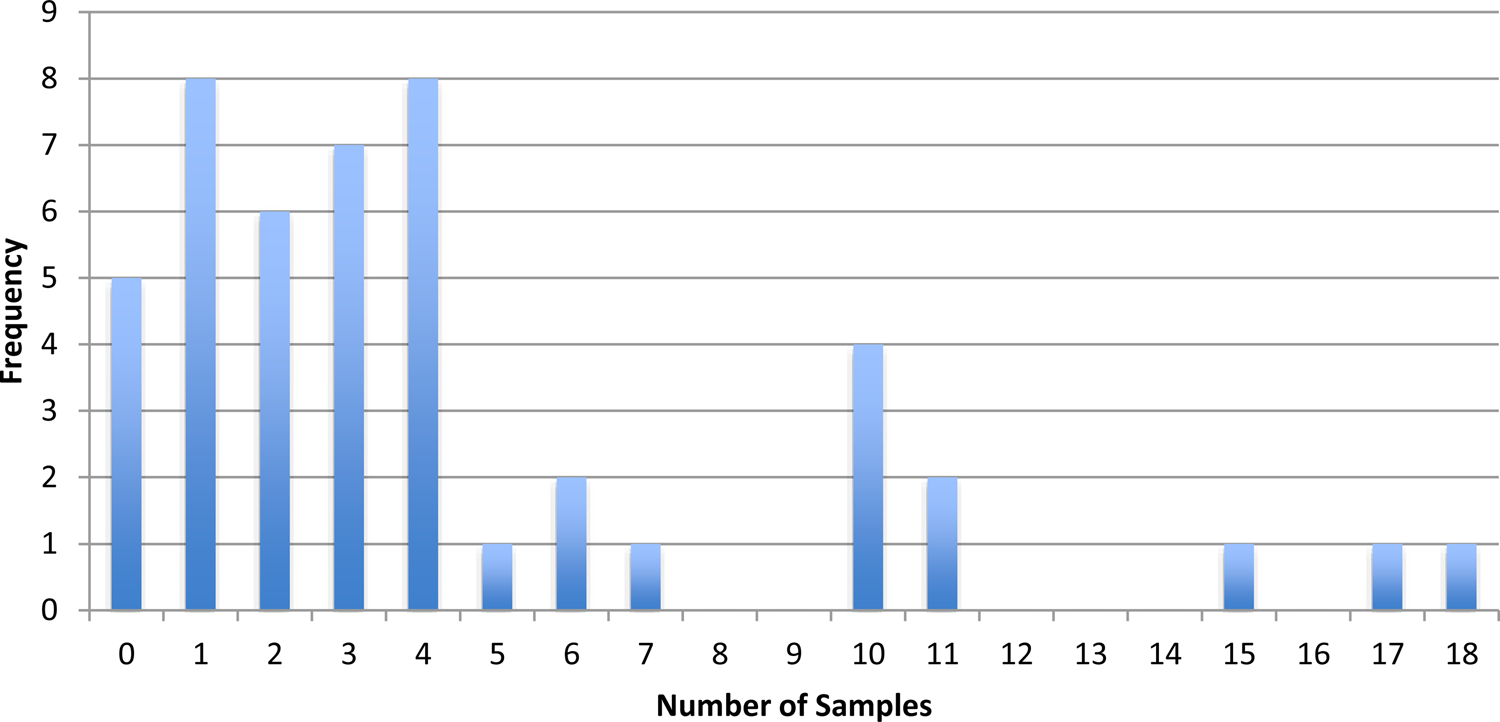
Both Sewell and I found an increasing average number of samples per song, peaking in 1989 or 1990, with a decline until 1993 (Figure 2). Sewell's highest average is 4.1 in 1989: I expect that her average is slightly higher than my own because of her reliance on canonical artists. The rest of the study indicates that her averages were lower than mine, which I attribute to her use of the Aggregate sample type (as outlined above). Despite the differences between our studies, one thing is clear: the dominant trend is a decreasing number of samples into the early 1990s. In order to assess how the number of samples per song was distributed, I plotted a frequency distribution histogram for each year of my study. The bulk of the songs in this year are concentrated at the left side of the graph, with many songs containing one, two or zero samples (Figure 3). The song with the most identifiable samples in my study comes from 1988: Public Enemy's ‘Night of the Living Baseheads’ is on the right of the graph, with 23 identifiable samples. It is a visually striking outlier, given that the song with the next-highest number of samples has only nine (‘Bring the Noise’, also by Public Enemy).
Average number of samples (compared to Sewell)

Sample frequency (1988)

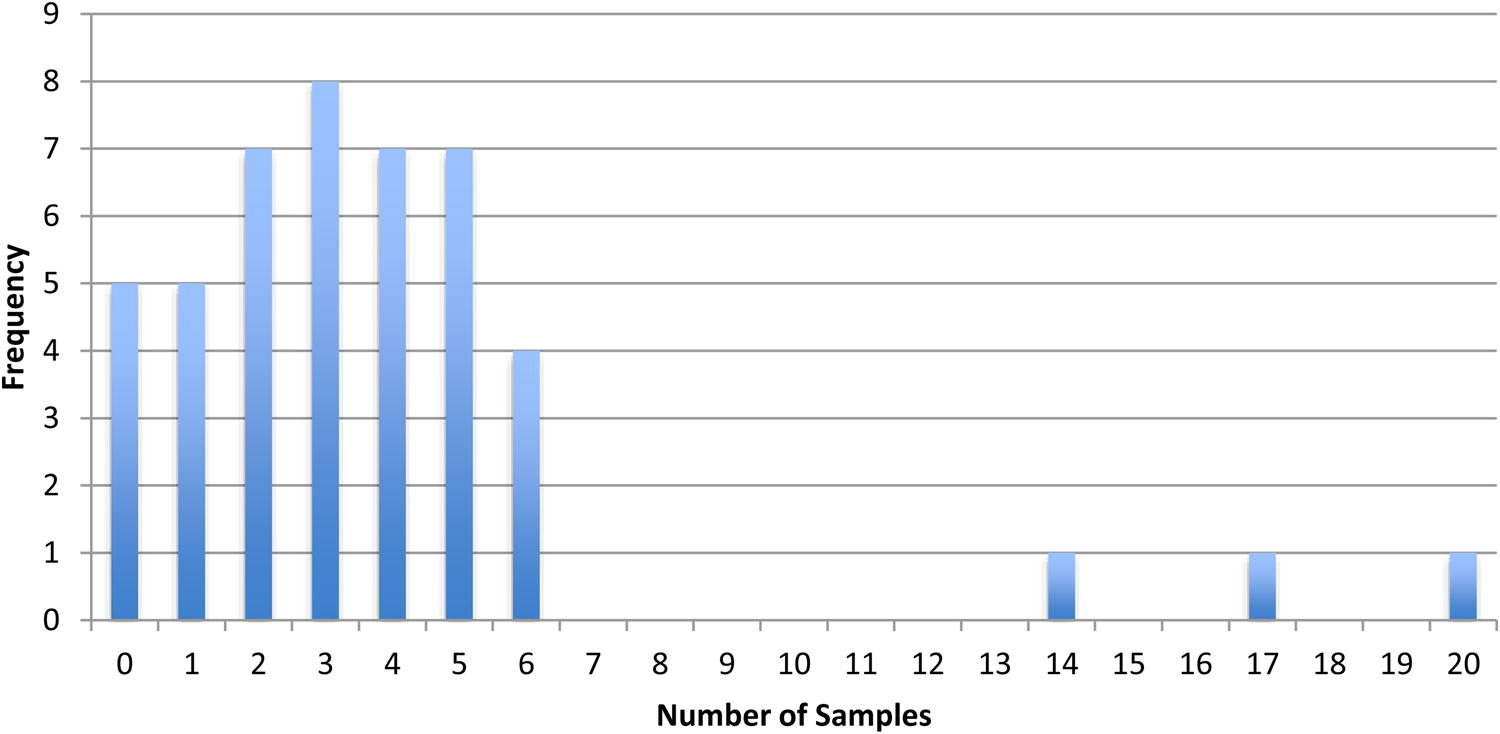
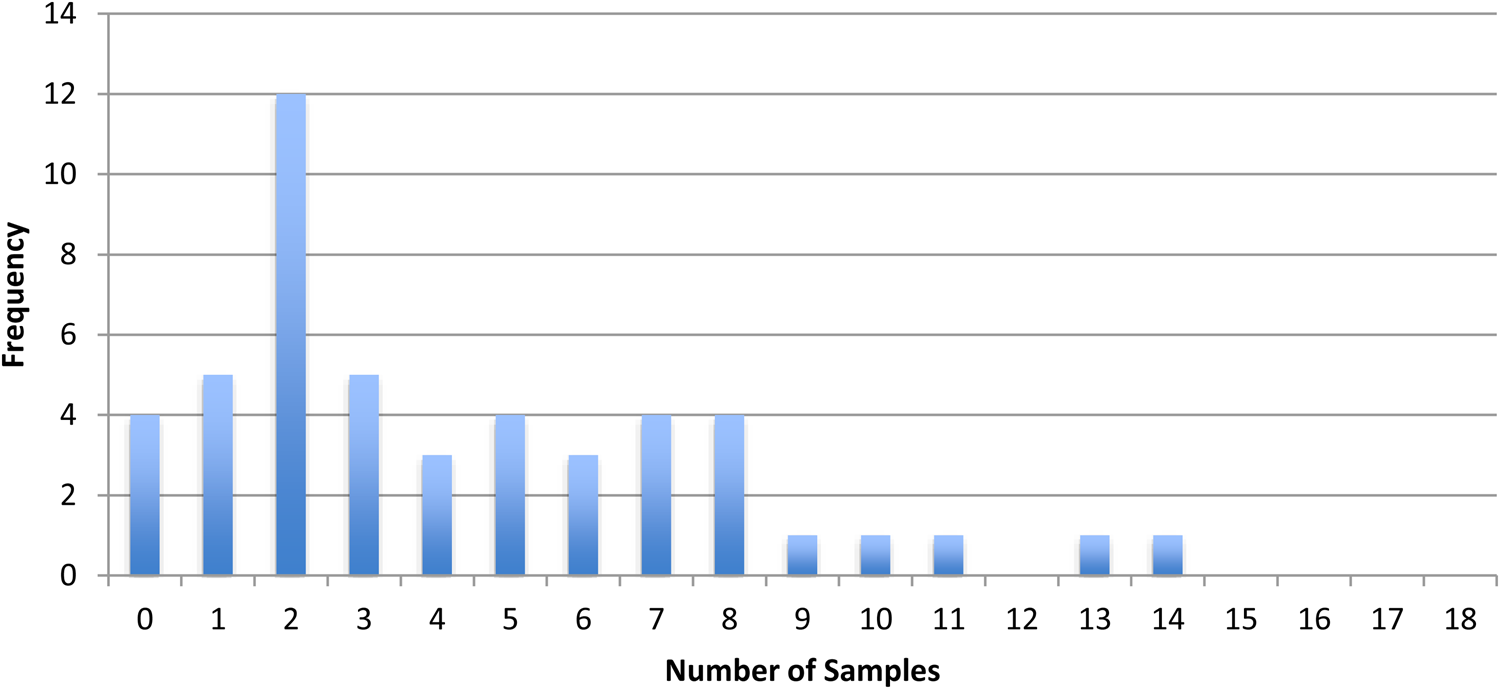
The histograms for 1989 and 1990 demonstrate some compelling trends: the majority of samples are distributed more evenly than in 1988 (Figures 4 and 5). As in 1988, there are still a few outliers with more samples than average, but during these years, more songs fall into this category. Based on my listening experience, I expected to find a greater number of samples across subgenres before completing the corpus study: artists like old-school rapper Kool Moe Dee and pop-rap/New Jack Swing duo Kid ‘N Play have songs with 10 samples.Footnote 7 It is not simply canonical East Coast artists (known for their dense sampling textures) who are including more samples – the preference for more samples per song ranges across subgenres. In 1990, N.W.A. and N.W.A.-alumnus Ice Cube have songs with 17 and 15 samples respectively, indicating that West Coast artists also used the sample-dense collage aesthetic at this time.Footnote 8
Sample frequency (1989)

Sample frequency (1990)

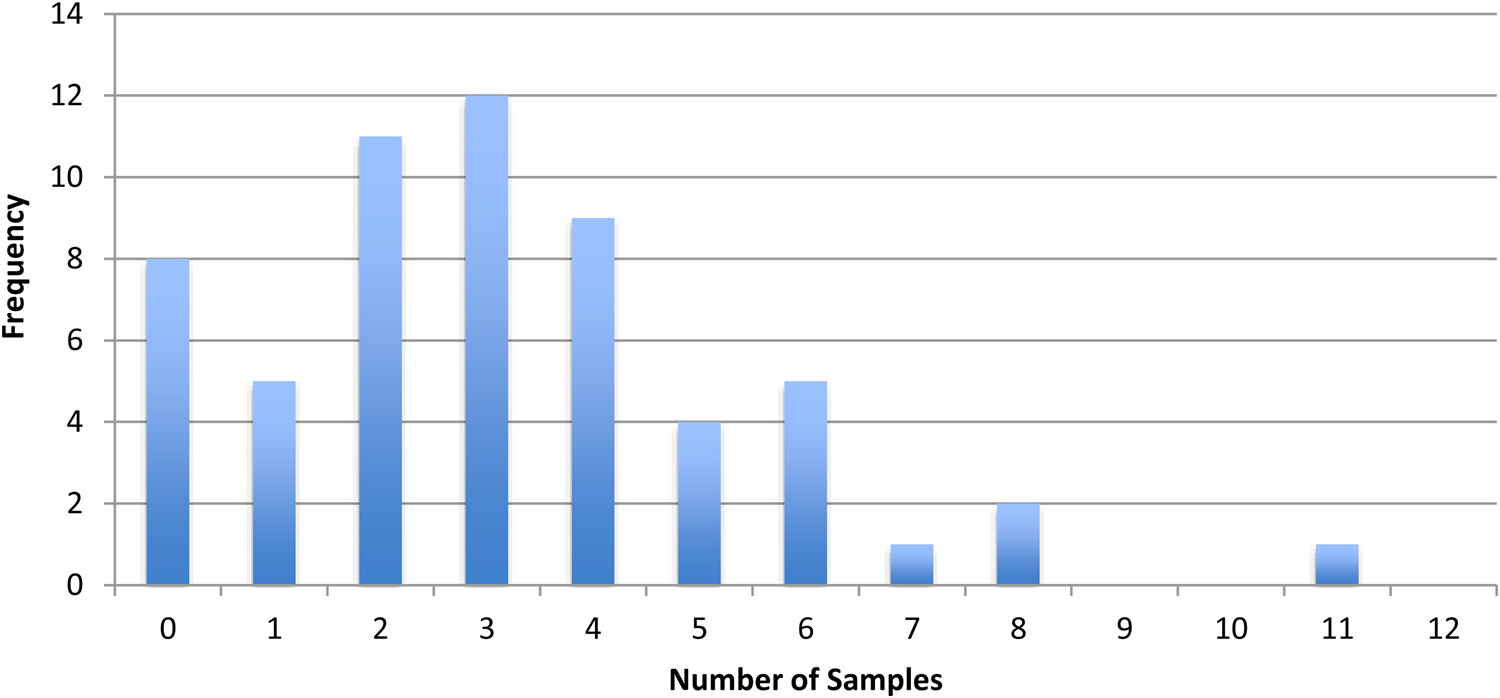
Figure 6 shows that, already in 1991, the outlier songs with the most samples have either been eliminated or have fewer samples: two samples is the most common (with 12 songs) while the bulk of songs have zero to eight samples. The songs with the second- and third-most samples in 1991 are by Public Enemy and their DJ, Terminator X, (‘Can't Truss It’, with 13 samples, ‘Homey Don't Play Dat’, with 11 samples, respectively), but the song with the most samples is by West Coast rapper, Yo-Yo. Her song, ‘Stompin’ to the 90s’ (produced by Ice Cube) has 14 samples, solidifying the fact that West Coast hip hop did make use of many samples at this time.Footnote 9 Figure 7 indicates that the trend from 1991 became even more extreme: 11 samples is the maximum for 1992, by West Coast, Latino hip hop group, Cypress Hill (‘The Phuncky Feel One’, produced by DJ Muggs). Not only is the impact of copyright lawsuits unevenly felt across subgenres, but it is also felt across regions: East Coast artists are no longer statistical outliers with the most samples beginning in 1991, instead West Coast artists take up the collage aesthetic and continue to produce with more than average samples into 1992.Footnote 10
Sample frequency (1991)

Sample frequency (1992)

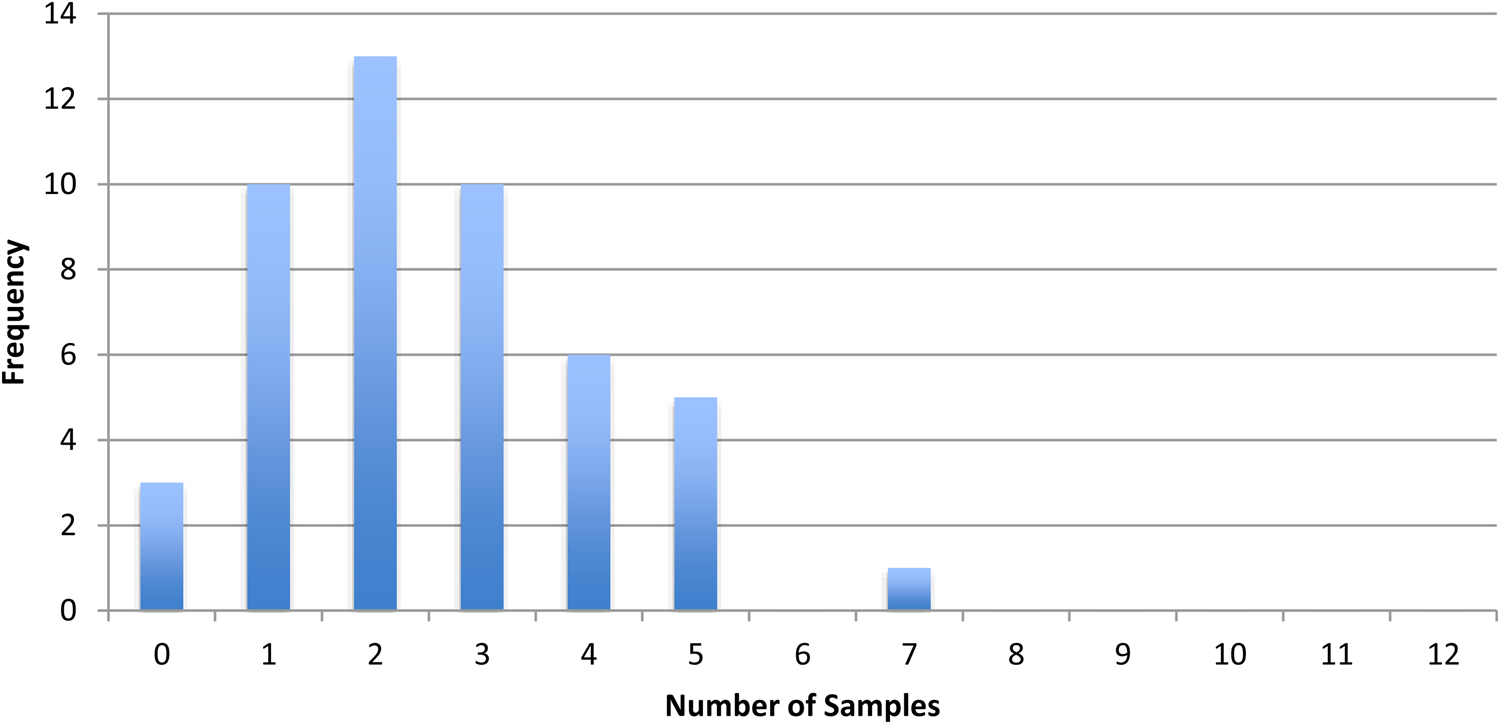
By 1993, the statistical outliers of the late 1980s are gone (Figure 8). Taken together, the histograms illustrate the generic changes to hip hop sampling practice that many have heard, but have not yet had the means to discuss: what is gone are the songs with dense sample collage aesthetic, but the songs with a couple of samples remain. In this sense, the studies that lament the impact of sampling lawsuits on golden-age artists are correct: Public Enemy and De La Soul were indeed more affected by these changes than others. What roughly stays the same, however, is the number of songs that include only a couple of samples, suggesting that artists working in pop-rap and its related subgenres were not affected by copyright lawsuits in the same way as sample-heavy artists such as Public Enemy.Footnote 11 If I had not included artists from diverse subgenres and with varied chart success, this trend probably would not have been visible. To summarise, the effect of sampling lawsuits on hip hop is not evenly distributed across subgenres: there are no songs in my corpus with more than 15 samples released after Grand Upright, but many songs continue to include a couple of samples.
Sample frequency (1993)

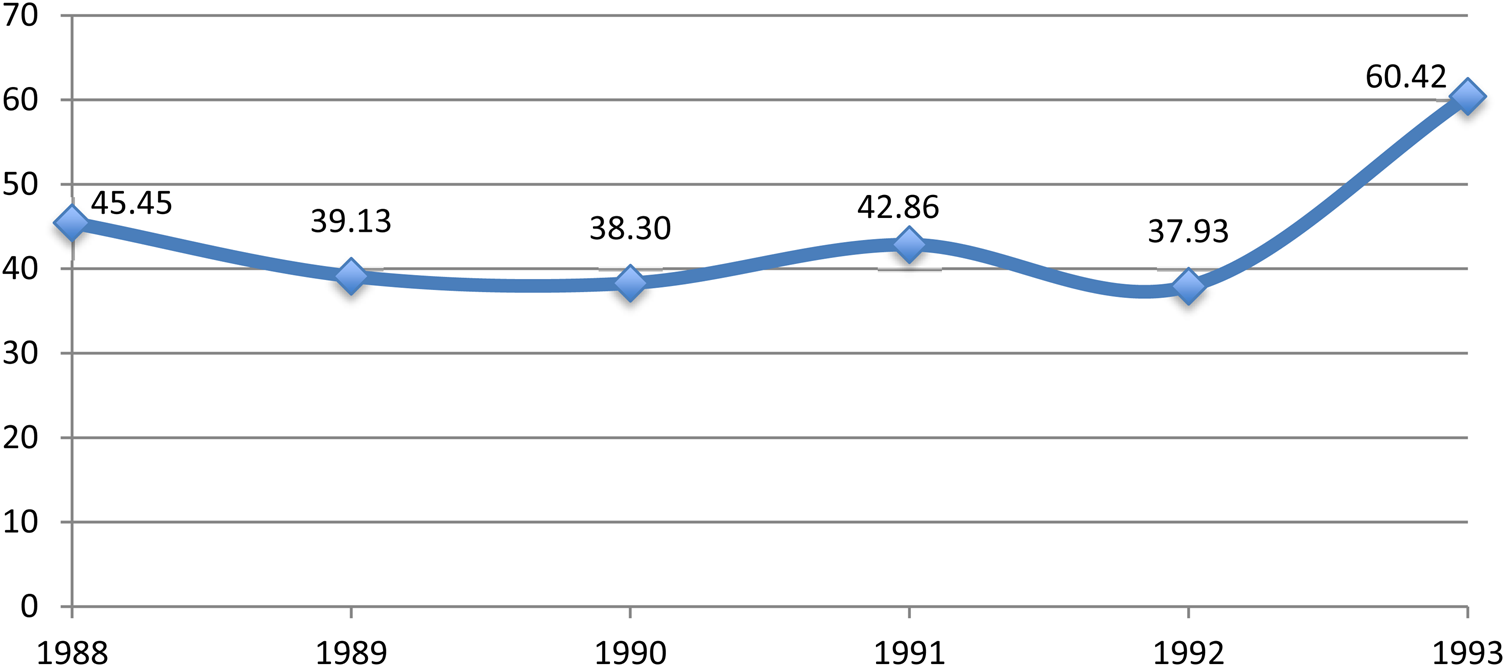
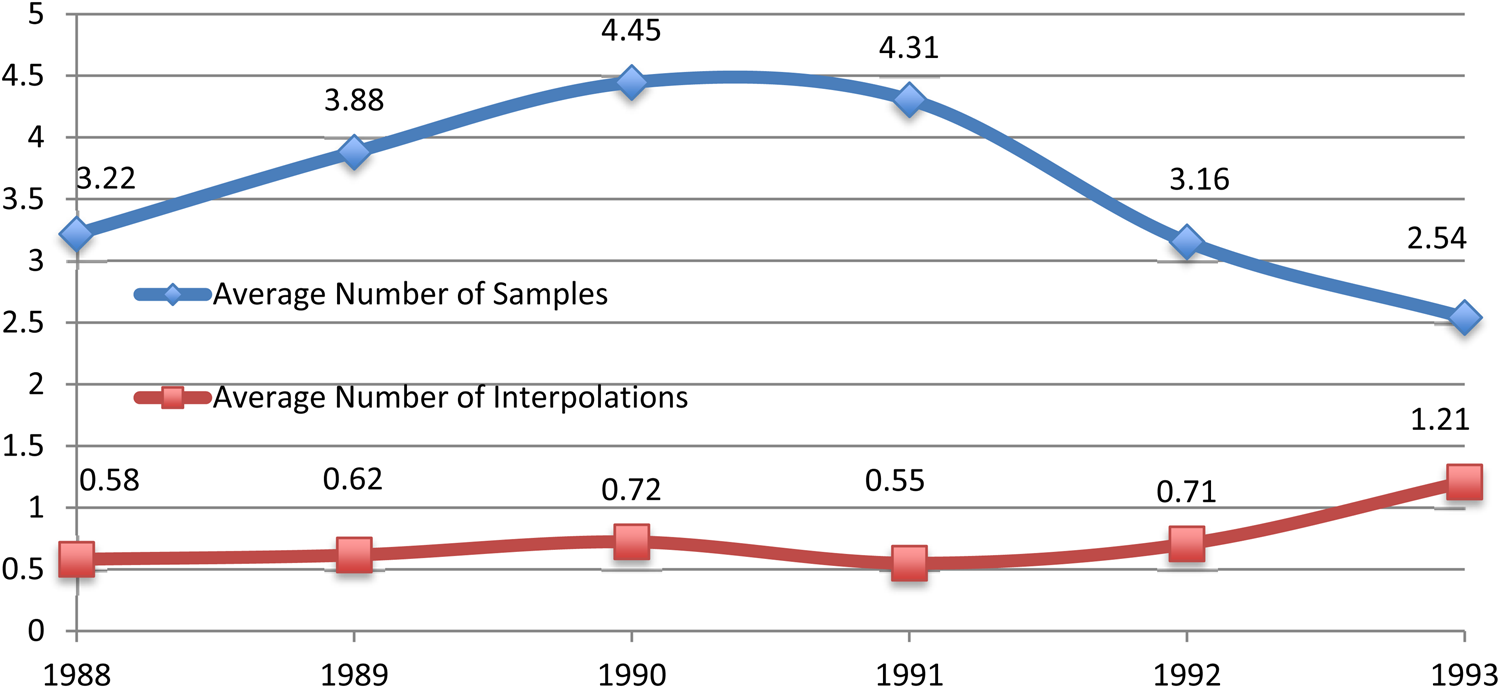
Some artists responded to the new legal climate by using interpolations: re-performed sections of older songs; these became an attractive choice for producers for two main reasons. First of all, it is simpler to secure only one set of rights: for an interpolation, one only has to clear the underlying composition, rather than the composition and a recording (as with a sample). Music copyright case law in the United States has established strict protections for sound recordings, giving litigious content owners a platform to pursue legal action for the use of any uncleared sample. Second, producers like Dr. Dre began to prefer interpolations as more than workable alternatives to sampling, because re-recording gave producers more control over individual sonic elements (Williams Reference Williams2013, p. 83). As artists experimented more with interpolations, often used in the same song as samples, they seemed to be taken with the creative possibilities that re-performing older songs offered, and later in the 1990s, interpolations became aesthetically appealing in their own right.Footnote 12 As Figure 9 demonstrates, the number of songs with interpolations gradually increases, reaching 60% by 1993. Grand Upright was settled in December of 1991, so it is unlikely that its effects would have been felt right away. Figure 10 indicates that while the average number of samples per song decreases from 1991 to 1993, the number of interpolations rises in tandem. I do not mean to suggest that the rise in interpolations is the direct result of a legal decision: rather, it was but one response to a changing music industry in which access to samples could no longer be taken as a given. When one mode of intertextual reference became less feasible, hip hop artists turned to another: interpolation did not supplant sampling in the non-rap musical structure of hip hop, but instead, augmented an existing tradition. Intertextual reference is a central component of creative expression in hip hop music: as Justin Williams puts it, ‘the fundamental element of hip hop culture and aesthetics is the overt use of pre-existing material to new ends’ (Williams Reference Williams2013, p. 1). Hip hop interpolations create different sonic effects, and create musical meaning in different ways from sampling, but they are still part of the same ‘fundamental element’ that Williams describes.
Percentage of songs with interpolations

Average number of samples vs. interpolations

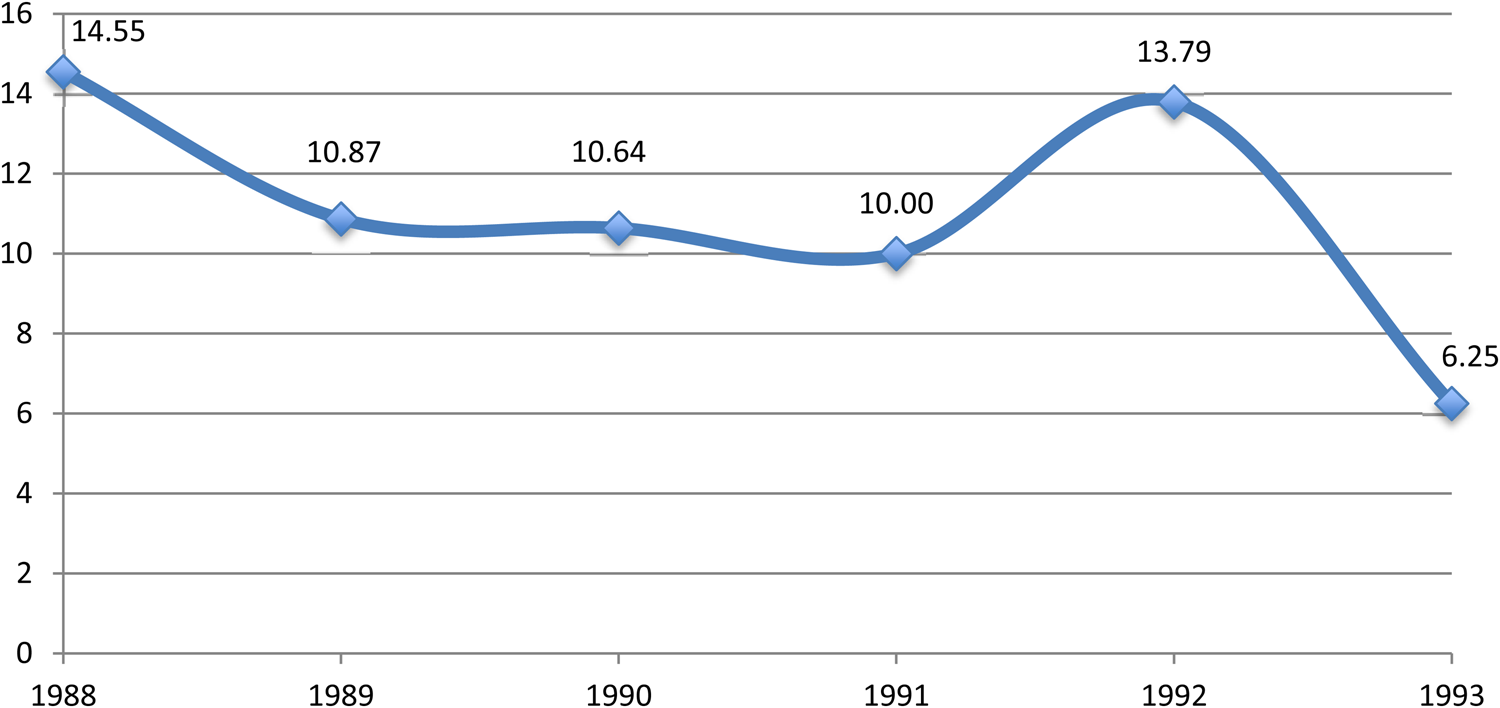
As interpolations surpassed samples, I expected to find more songs with no samples at all, but this was not the case (see Figure 11). There were more songs without any samples in 1988 than in 1993, adding nuance to discussions of songs in the ‘golden age’; indeed, from 1989 to 1991, this percentage stays constant at about 10 (Figure 11). If I had made a hypothesis regarding the percentage of songs without samples after reading the Grand Upright literature, it would have been a graph that rises abruptly in 1992 and 1993. However, the percentage in fact decreases at that time, indicating there were more songs overall that had at least one sample. In this way, Figure 11 contradicts much of the existing literature about the effects of Grand Upright. Although there were fewer samples per song, there were also more songs with at least one sample, indicating that copyright lawsuits did not singlehandedly kill hip hop sampling.
Percentage of songs with 0 samples

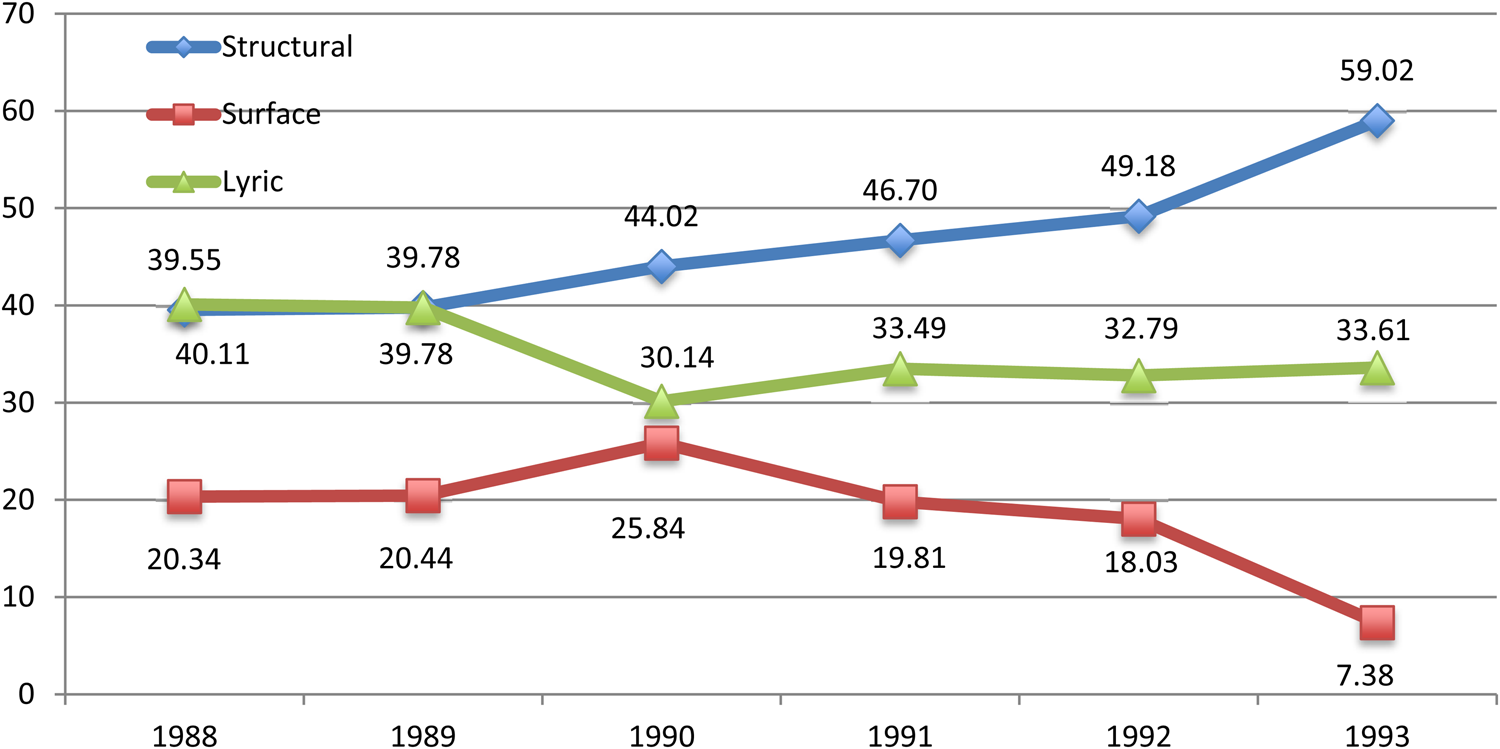
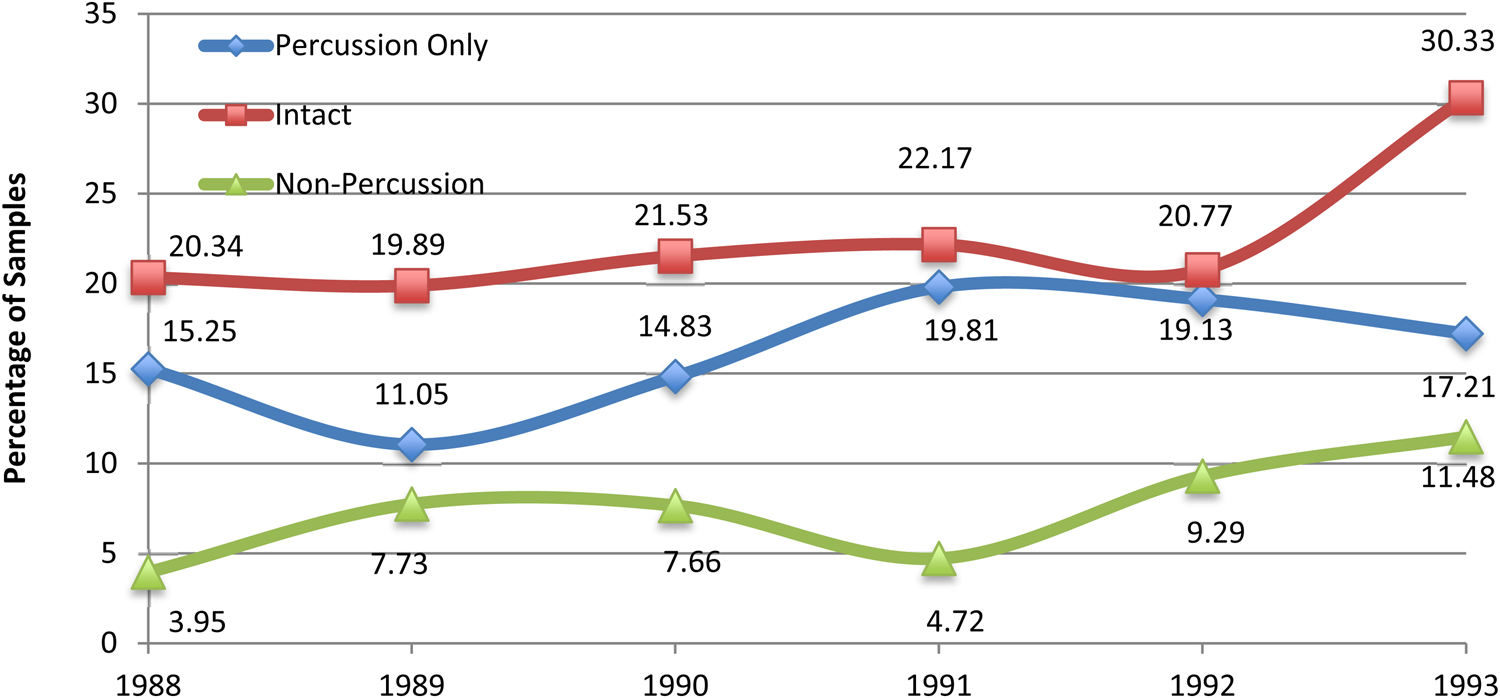
I observe a stark change in producers’ preference for sample types and sub-types over the years of my corpus study (Figure 12). In 1988 and 1989, Structural and Lyric samples each make up about 40 per cent, while Surface samples make up the balance. To a fan of ‘golden-age’ hip hop, this breakdown makes sense: both types of Lyric samples are very common, and Structural samples make up the groove. Surface samples are not a part of the groove's musical foundation, but they do add rhythmic and textural interest when interacting with the other sample types, so it is unsurprising that there were fewer. Beginning in 1989, the Structural sample overtakes the others, eventually peaking at 59 per cent in 1993, while the other two types decrease. Lyric samples stabilise at around 30 per cent, while Surface samples sink to a mere 7.38 per cent. Notably, the changing percentages of the sample types from 1991 to 1993 in Figure 12 occur in the context of a decreasing average number of samples. To put it another way: as the overall number of samples declines, it becomes clear that the Structural sample is the most important type for producers, or, at least the type they prioritise as access to samples becomes limited. I contend that the aesthetic differences in hip hop music before and after Grand Upright are at least as attributable to the changes to sample-type distribution as they are to the decreasing number of samples overall.
Sample type percentages by year

Surface samples nearly disappear in the later years of my study, which is one of the main differences between songs released before and after the Grand Upright decision. From 1988 to 1993, the Intact sub-type remains producers’ preferred Structural sample. I was surprised that Percussion-Only samples were not the best represented sub-type, because so much discourse has been devoted to the important breaks of hip hop sampling, such as the ‘Funky Drummer’ and ‘Amen, Brother’. Non-Percussion samples remain the least common, although the percentage begins to rise in 1992, when it became more common for producers to sample synthesiser and bass lines in gangsta rap and G-funk.Footnote 13 The most notable development illustrated in Figure 13 is the spike in Intact samples in 1993, which is part of a larger set of tendencies pertaining to all sample subtypes. The rise in Intact Structural samples is probably a response to industry demands, the legal climate following Grand Upright and restricted access to samples. Although artists still used samples in 1992 and 1993, they did so in a different, more conservative way: producers sought more ‘bang for their buck’ when it came to sample licensing. If the record label were to pay for the rights to a sample, then the few samples that producers did use became even more important. Intact samples (and especially long, intact samples) are often more recognisable than single instrument samples, and even more so than Surface samples. After working extensively with these songs and their samples, I observed that the Intact Structural samples in songs released from 1991 onwards fulfil important structural functions in their new songs. Dr. Dre's ‘Let Me Ride’ from The Chronic (released 1992, peaked at # 34 on the B100 in 1993), is one such song. Dre samples Parliament's ‘Mothership Connection (Star Child)’, including foregrounded synthesiser, as well as the rest of the band. ‘Let Me Ride’ also borrows its hook from ‘Mothership Connection’: an interpolation of the chorus, ‘Swing low, sweet chariot stop and/Let me ride’ makes its first appearance at 1:14, suggesting that the use of Parliament's iconic 1975 song is salient and intended to be recognised. To reiterate: Intact Structural samples became more attractive to producers when their access to samples had been compromised; although there were fewer samples (on average) from 1991 to 1993, the samples that producers did choose to include were no less important than those used in the previous years.
Structural samples

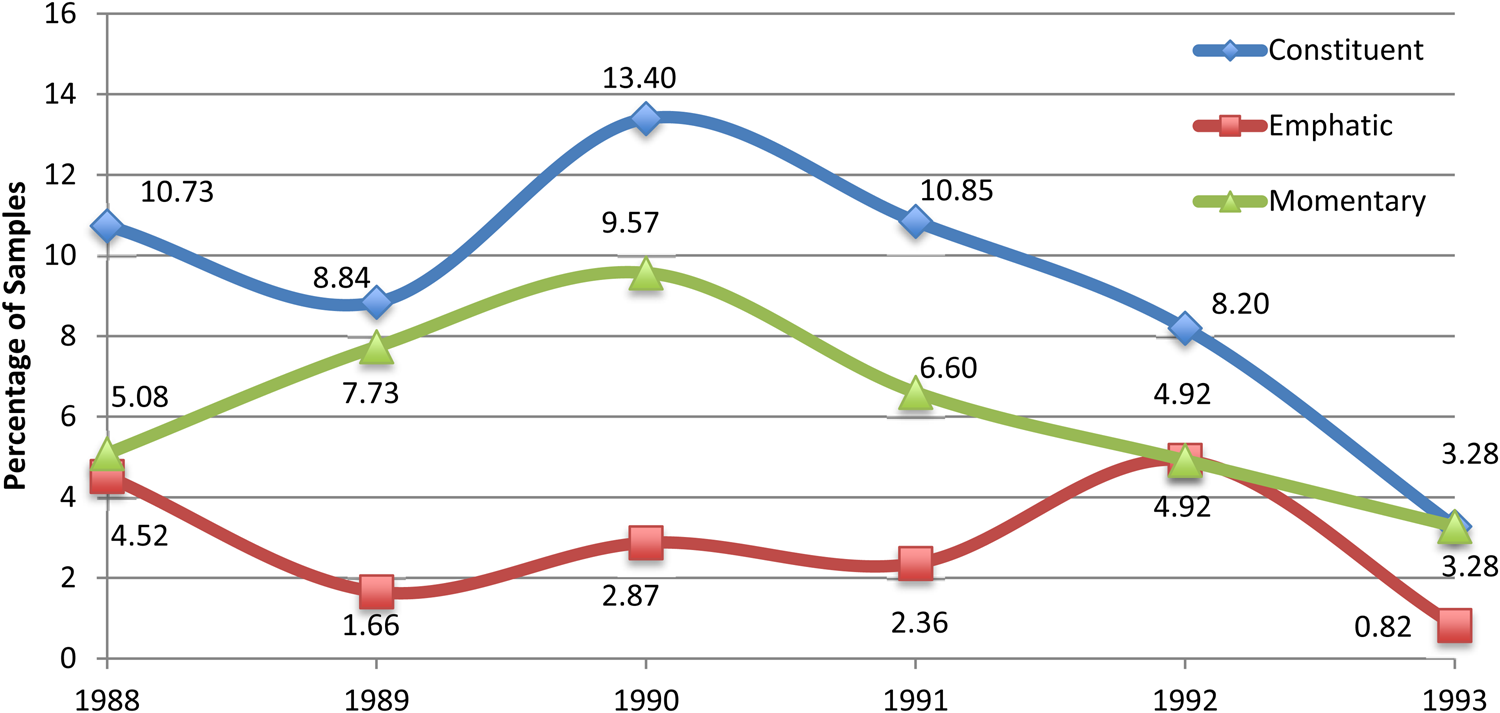
One of the main differences between songs released before and after Grand Upright is the frequency of Surface. Although this type was the least commonly used type in my corpus, the importance of Surface samples in creating the dense collage aesthetic associated with the ‘golden age’ cannot be understated. As suggested by Figure 12, the percentage of Surface samples peaked in 1990 and sank to a low of 7.38 per cent. Figure 14 indicates how these subtypes were distributed: the Constituent type, which punctuates the groove at regular intervals, was the most used subtype. Emphatic and Momentary Surface samples may have been used less frequently, but producers can use them to create original and startling effects. The near disappearance of the Surface sample type is but one change that marks generic transformation frequently discussed in hip hop from the late 1980s and early 1990s. More than any other type, it is the Surface samples of various subtypes that create the dense, polyrhythmic and polyphonic textures associated with canonical artists like Public Enemy and De La Soul. The layering tendency of hip hop music is best observed in the Surface sample type: when artists stop using it, the resulting musical textures become less heterogeneous and dialogic. When producers felt pressure to reduce the number of samples in their songs, Surface were the first to go. Like Sewell, I do not interpret this as a fundamentally good or bad development (2014, p. 295). However, I do believe that the near elimination of the Surface sample type reflects artists re-thinking the intertextual purposes and potential of sampling.
Surface samples

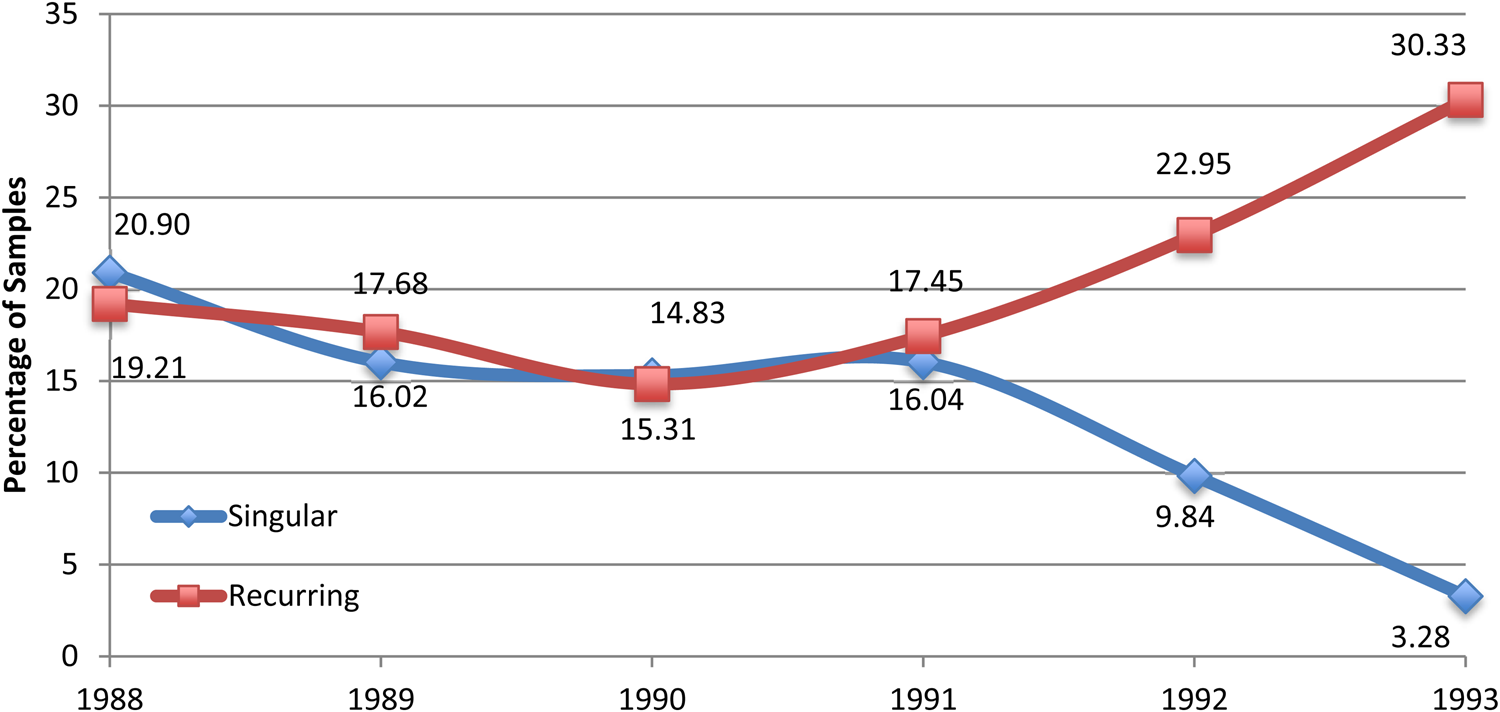
Recurring and Singular Lyric samples follow a similar trajectory: per Figure 15, Recurring Lyric samples became more popular after 1991. This is another instance of a frugal approach to sampling, in which producers seem to be seeking quality over quantity. Recurring samples are only cleared once, and used throughout the song, at times as a new hook. Singular Lyric samples, like Surface samples, often function as interjections, interruptions or ruptures, as Tricia Rose has so perceptively put it (Reference Rose1994, pp. 38–9). The result is, if not a homogenous, perhaps a monolithic approach to sampling: as in ‘Let Me Ride’, the connections to pre-existing songs are fewer, but they are just as purposeful, and in some cases, more obvious and meaningful.
Lyric samples

Case studies: Public Enemy, DJ Jazzy Jeff & the Fresh Prince, and Dr. Dre
Public Enemy
I included songs by the same artists across multiple years so that I could trace the changes to their sampling practices over time, comparing examples of their pre- and post-Grand Upright work.Footnote 14 Rather than focusing on albums, I use individual songs to explore not only how the number of samples per song changes, but also how the functions of the samples, and the characteristics of the songs change over the years. Focusing on songs also allows me to go into more musical detail than a survey of albums across multiple years. I discuss two songs by Public Enemy because the changes to their style receive so much scholarly attention, focusing on how they responded to the imperative to use fewer samples. I present case studies that demonstrate how different subgenres respond to the need for fewer samples: DJ Jazzy Jeff & the Fresh Prince work in the pop-rap subgenre, and Dr. Dre produces gangsta rap and G-funk.
Public Enemy's ‘Night of the Living Baseheads’ (1988) features the most samples of any song in my corpus. Tricia Rose calls the song:
[A] narrative bricolage that offers critical commentary on police, drug dealers, drug addicts, and black middle class, the federal government, media discourse, and music censorship groups. A visual, symbolic, and conceptual tour de force, ‘Baseheads’ is one of rap music's most extravagant displays of the tension between postmodern ruptures and the continuities of oppression. (Rose Reference Rose1994, p. 115)
The song contains at least 23 samples and exhibits Public Enemy's sample-heavy style in the ‘golden age’. Like many Public Enemy songs, ‘Baseheads’ begins with a Singular Lyric sample from a political speech. In this case, it is Nation of Islam leader and New Black Panther Party member Khalid Abdul Muhammad:Footnote 15
Have you forgotten that once we were brought here, we were robbed of our name, robbed of our language? … We lost our religion, our culture, our god … and many of us, by the way we act, we even lost our minds.
The song's groove explodes while Chuck D spits ‘Here it is, BAM!/And you say “Goddamn, this is the dope jam”’ (0:13–0:14). James Brown's ‘The Grunt’ (1970) constitutes the foundation for the song's groove: an Intact, Structural sample incorporating saxophone, guitar and percussion. Overall, the musical textures and lyric delivery and references of ‘Baseheads’ imply a purposeful difficulty, a sort of hip hop modernism, which is surely one of the qualities that attracts so many scholars to Public Enemy's music. ‘Baseheads’ has a heterogeneous texture; though its groove is based on looped samples, it is punctuated with ruptures and segues. ‘Baseheads’ includes four Momentary Surface samples, which pause the established groove. At 1:49, Temptations frontman Dennis Edwards calls out ‘Hold it, hold it! Listen’, and the bluesy piano introduction of ‘I Can't Get Next to You’ (1969) plays. The Bomb Squad introduces a playful moment of self-reflexivity: on the original Temptations song, Edwards tries to encourage an audience to stop their applause and pay attention to the beginning of the song, and here, the producers draw attention to the patchwork musical structure of ‘Baseheads’ by using Edwards’ appeal to stop and listen. Not all listeners would have recognised the reference, but its sudden juxtaposition with the established groove highlights ‘I Can't Get Next to You’ as musical material that comes from somewhere else.Footnote 16
‘Baseheads’ features an overwhelming number of voices: I identified 16 Single and two Recurring Lyric samples, as well as newly performed vocals from both Chuck D and Public Enemy's ‘Minister of Information’ Professor Griff. In addition to these samples, ‘Night of the Living Baseheads’ has many lyric references; the title refers to classic zombie film Night of the Living Dead (1968), and the word ‘base’ refers to crack cocaine, thus ‘baseheads’ are ‘crack-heads’, or possibly people freebasing cocaine. Throughout the song, Chuck D plays with the word ‘base’: at 0:47, he spits ‘Please don't confuse this with the sound, I'm talkin’ bout base’, the last word itself a sample of Chuck D saying ‘Bass! How low can you go?’ at 0:14 in ‘Bring the Noise’ (Public Enemy 1987). At 2:14, the Bomb Squad inserts what Amanda Sewell would call a lyric substitution: D.M.C. (of Run-D.M.C.) interrupts Chuck D's sentence in another instance of wordplay: ‘Yo listen/I see it on their faces/first come, first serve basis’. In this case, as in several others, the voices of ‘Baseheads’ engage in dialogue: not only do the instrumental samples function dialogically, but sampled and newly-performed vocals also speak and answer each other. ‘Night of the Living Baseheads’ includes samples drawn from diverse genres and artists, ranging from David Bowie to Aretha Franklin, no-wave group ESG, and funk artists the Bar-Kays and Rufus Thomas. While the groove provides the instrumental foundation of the song, it is frequently interrupted; each verse ends with scratching and a Momentary sample (like the Temptations one described above).
As Amanda Sewell and others have observed, Public Enemy's style changed after the Grand Upright decision, and their music incidentally became less popular. Their songs did use fewer samples, but I argue that this is not the only reason for the changes to their sound. Muse Sick-N-Hour Mess Age was released in 1994 – the first Public Enemy album released after Grand Upright. Their previous album, Apocalypse 91…The Enemy Strikes Black also expresses the changing production and sampling techniques I will describe below, but I find the differences between Public Enemy's early, canonical work and the sound of Muse Sick much more obvious. Sewell argues that Public Enemy's music began to sound dated to hip hop listeners, specifically because they ‘were able to maintain a sense of their earlier musical styles even when their primary creative tools – that is, samples – were severely restricted … If anything, Public Enemy's music sounded the same to critics and other listeners, not different’ (Sewell 2014, p. 296, emphasis added). To my ears, however, Public Enemy seems to be trying to keep up with the latest in hip hop: ‘I Stand Accused’, from Muse Sick-N-Hour Mess Age synthesises the group's older sampling aesthetic with Chuck D's best impression of West-Coast gangsta rap.
In contrast to ‘Night of the Living Baseheads’, ‘I Stand Accused’ contains just four identifiable samples. The most noticeable difference between ‘I Stand Accused’ and Public Enemy's earlier songs is the complete absence of Surface samples. Chuck D raps over a smooth synth pad, which is punctuated by a Recurring Lyric sample from the Ohio Players’ ‘Funky Worm’ – a favourite sample for gangsta rap producers. Emulation of the distinctive ‘Funky Worm’ synthesiser became a generic marker of gangsta rap in the early 1990s: by sampling this song – although it is the vocals and not the synthesiser – Public Enemy rhetorically align themselves with gangsta rap. Other elements of the song suggest participation in the gangsta rap subgenre, such as the slower tempo (88 beats per minute), Chuck D's lazy delivery, the sung hook and an overarching preference for smooth timbres. ‘I Stand Accused’ includes two Single Lyric samples, which are redolent of Public Enemy's earlier style. However, these Lyric samples – drawn from the dialogue from the 1989 film Harlem Nights and civil rights docuseries Eyes on the Prize (1987–1990) – do not create the same patchwork, dialogic texture as the samples in ‘Night of the Living Baseheads’.Footnote 17
The two Public Enemy songs I chose to discuss span the extremes of the group's sampling practice, illustrating how outliers with many samples, like ‘Baseheads’ in 1988, and ‘Fight the Power’ in 1989, are squeezed out by more conservative approaches to sampling, even in Public Enemy's own catalogue. Public Enemy's style changed, and part of the reason they abandoned the sample-based collage aesthetic of their canonical albums was the risk of sampling lawsuits. Yet the Grand Upright decision was not handed down in a cultural vacuum: gangsta rap was becoming an important cultural force that helped to propel hip hop music further into the mainstream. It is thus unsurprising that Public Enemy would experiment by synthesising the newer and commercially successful gangsta rap with their previous style. Public Enemy were but one group active in the hip hop field of cultural production: case studies drawn from other subgenres are needed to assess changes to sampling across hip hop.
DJ Jazzy Jeff & the Fresh Prince
To account for the impact of sampling lawsuits like Grand Upright on pop-rap, I will discuss the evolving musical style of DJ Jazzy Jeff & the Fresh Prince. The duo had a string of hits in late 1980s and early 1990s, and their first top 20 hit on the B100 was ‘Parents Just Don't Understand’, which also won the first Grammy Award for Best Rap Performance (1989). The ‘Parents Just Don't Understand’ music video catapulted the young Will Smith to fame, in part inspiring the television show The Fresh Prince of Bel-Air (1990–1996).Footnote 18 Although released in 1988, the peak of sampling's ‘golden age’, ‘Parents Just Don't Understand’ contains just two samples. As I outline above, hit songs like this are not typically included in the discourse on music copyright and sampling in the golden age, probably because they confound the familiar narrative that the number of samples decreased, and decreased drastically. However, as I outline above, it is important to include songs from all parts of the field of popular music, and pop-rap was an important, and extremely visible part of this field.
‘Parents Just Don't Understand’ features two samples: an Intact Structural sample of Peter Frampton's ‘Won't You Be My Friend?’ (1977) and a Constituent Surface sample of a brass hit from John Davis and the Monster Orchestra's ‘I Can't Stop’ (1976). Jazzy Jeff ‘fattens up’ the Frampton sample by doubling the bass line and adding a drum machine; although the sample is not up front in the mix, it still provides the song's musical foundation. Any newly performed elements – like the bass and drum machine – function to emphasise features already present in the sample. By fleshing out the drums and bass, Jazzy Jeff intensifies the polyrhythms of the Frampton sample, making the resulting hip hop groove funkier. My corpus study indicated that Surface samples were the type that declined most from 1988 to 1993, and though ‘Parents Just Don't Understand’ only has one, it is a salient feature. The jabbing brass sample, so emblematic of the golden age, marks the hypermeter and adds another layer onto the polyrhythm already established by the Frampton sample. In some cases DJ Jazzy Jeff uses it to emphasise the Fresh Prince's rhymes: after he expresses disdain for the uncool clothing his mom chooses for him, the Surface sample hits ‘I said, “Mom, this shirt is plaid with a butterfly collar!”’ (0:52–0:54).
Although their sound changed less drastically than Public Enemy's, there are significant differences between DJ Jazzy Jeff & The Fresh Prince's sound before and after Grand Upright. A venture into New Jack Swing, ‘I'm Looking for the One’ (1993) was not as much of a hit as ‘Parents Just Don't Understand’, but it exemplifies the new aesthetic choices artists were making. It includes just one sample, a Percussion-Only Structural sample of a popular breakbeat, James Brown's ‘Funky President (People It's Bad)’ (1974). Although producers Markell and Teddy Riley use the historically significant James Brown break, musical meaning in ‘I'm Looking for the One’ does not rely on the sampling tendency in a significant way. Instead, the production style uses musical features that evoke a relaxed and luxurious setting; ‘I'm Looking for the One’ has many layers of newly performed instruments, including percussion, electric guitar, highly processed bass, backup vocals and a sung hook. Notably, the hook (sung by Teddy Riley) is processed through a vocoder or talk-box that gives a similar effect to contemporary autotune (0:02–0:20). Williams identifies this vocal effect as an important generic marker of G-funk, because it draws on the earlier P-funk style for which the subgenre is named (Williams 2013, p. 82). ‘I'm Looking for the One’ and its accompanying music video evoke leisure and wealth: the teenage woes of the young Fresh Prince are replaced with cruising in a classic car and chilling on a yacht to the sounds of expensive-sounding, professional production.
Released in 1993, the song and its music video are in dialogue with the cultural phenomenon of gangsta rap; the Fresh Prince even takes a shot at N.W.A. in the third verse: ‘Nine Trey, everybody wanna be a gangsta /Buck-buck-buck-buck, but no more, thanks to me’ (2:43–2:49). After delivering the line ‘everybody wanna be a gangsta’, the Fresh Prince points to a decidedly less luxurious dingy filled with N.W.A. look-alikes dressed in the group's trademark black and white with ball caps and chains (2:46–2:49). This moment indicates the fraught influence of gangsta rap on pop-rap and the mainstream: while Jazzy Jeff & the Fresh Prince were clearly inspired by contemporary gangsta rap, they also want to distance themselves from the subgenre. What these lyrics and imagery do is link the stylistic features of ‘I'm Looking for the One’ to broader signifiers of gangsta rap, evoking what would have been understood as a more ‘dangerous’ genre, but also incorporating some of its elements with the hopes of bolstering DJ Jazzy Jeff & the Fresh Prince's own commercial appeal.
Dr. Dre
To explore how gangsta rap evolved at this time, I will discuss three songs produced by Dr. Dre, who helped to bring gangsta rap into the mainstream of both hip hop culture and popular music generally. N.W.A’.s ‘100 Miles and Runnin’’ (1990) contains a total of 17 identifiable samples: five Structural, nine Surface and three Lyric samples. To a casual listener, the texture Dr. Dre creates on this track is very similar to the dense collages associated with Public Enemy's production team the Bomb Squad; as I have discussed in the previous case studies, songs released before 1991 tend to have a foundational groove punctuated with or ruptured by Surface and Lyric samples. ‘100 Miles and Runnin’’, and much other gangsta rap, however, makes more use of the extreme high and low registers than other contemporary rap subgenres. Justin Williams ties extreme bass frequencies in gangsta rap to the listening space of the automobile: Dr. Dre frequently discussed how he produced with the customised car stereo in mind (Williams 2013, pp. 76–81). Bomb-Squad-produced tracks like ‘Baseheads’ sound claustrophobic in their density, whereas contemporary gangsta rap like ‘100 Miles and Runnin’’ sounds more spacious, despite its many samples. The bass booms and the upper register are occupied by a shredded guitar sample from Funkadelic's ‘Get Off Your Ass and Jam’ (1975).Footnote 19 Like ‘Baseheads’, ‘100 Miles’ presents a proliferation of voices: MC Ren, Dr. Dre, and Eazy-E rap, a woman's voice narrates an interlude between verses, and there are three lyric samples. In ‘100 Miles’ Dre establishes grooves based on sampled loops only to rupture and fragment them with an episode composed of Lyric and Surface samples. The subject matter of the lyrics and the extreme low bass frequencies establish this song as gangsta rap (as does N.W.A’.s association with the subgenre) although it does include features of the golden-age sample collage aesthetic used by East Coast groups like Public Enemy.
As the gangsta rap subgenre of G-funk emerged, Dr. Dre used more synthesisers and live instruments. Like ‘100 Miles and Runnin’’, Above the Law's ‘Murder Rap’ was also released in 1990, but it represents a different phase in Dr. Dre's production style. The song has a total of 10 samples: two Structural, three Surface, and five Lyric. In ‘Murder Rap’, Dr. Dre foregrounds a Constituent synthesiser sample from Quincy Jones's ‘Ironside Theme’ (1971), which simply slides up and down an octave, evoking a siren. What is striking about the ‘Murder Rap’ synth sample is not its melody, but its timbre. The ‘Ironside’ and ‘Murder Rap’ synthesiser blends saw-tooth and square wave oscillators, slightly detuned, with a glide between each note – a sound hip hop fans and producers now refer to as the ‘G-funk whistle’. This synthesiser timbre is also very similar to the Ohio Players’ ‘Funky Worm’ sample, making it an early example of this timbre in Dr. Dre's work. In ‘Murder Rap’, Dr. Dre combines the bass frequencies of his N.W.A. production aesthetic with a memorable synthesiser timbre – something he explored further in the following years.
Dr. Dre solidified the G-funk production aesthetic (including the whistle synthesiser) on his first own solo album, The Chronic (Reference Dr. Dre1992), and Snoop Doggy Dogg's debut, Doggystyle (Reference Dogg1993). The latter album's lead single, ‘Who Am I? (What's My Name?)’ peaked at number 8 on the B100 and BRB, and reached number 1 on the BRS. Snoop Dogg's ‘What's My Name?’ has only two samples: an Emphatic sample of The Counts’ ‘Pack of Lies’ (1971), and a Recurring Lyric sample from Parliament's ‘P-Funk (Wants to Get Funked Up)’ (1975), which consists solely of George Clinton saying ‘the bomb!’ in a low register (as at 0:09). While The Counts’ sample is slightly atypical, the Recurring Lyric sample is characteristic of this period. Rather than licensing several samples, Dre simply re-uses the evocative Clinton sample over and over. The average number of samples in my study for 1993 was 2.5, making ‘What's My Name?’ statistically representative for this year. What the song lacks in samples, it makes up for in interpolations: with a total of seven, ‘What's My Name?’ has no shortage of intertextual references. One interpolation is particularly significant: the melody and rhythm of the hook of ‘What's My Name?’ are borrowed directly from George Clinton's ‘Atomic Dog’ (1982), but instead of ‘Atomic Dog’, a mixed chorus sings ‘Snoop Doggy Dogg’ (see Williams 2013 p. 99 for a transcription). Snoop and Dr. Dre also borrow the iconic ‘bow wow wow yippee yo yippee yay’ refrain from ‘Atomic Dog’ in ‘What's My Name?’ As in ‘I'm Looking for the One’, the first part of the vocal hook is processed through a talk-box effect, announcing the song's participation in G-funk (0:05-0:15, and throughout).
Although they are numerous, Williams points out that the borrowed elements in ‘What's My Name?’ are not ‘textually signalled’: ‘Its sources of material are not obvious in themselves, and to a young listener unknowledgeable of 1970s soul and funk, it can sound strikingly “original”’ (Williams 2013, p. 9). Instead, Dr. Dre took earlier recordings as inspiration for new songs: interpolations are woven into nearly all of his work, and recording each part anew allowed Dre to have more control over each sonic element, as well as avoiding expensive master licensing fees. Although interpolations may have started out as substitutes for sampling, they soon became a rich intertextual device in their own right. Dr. Dre's techniques were hugely popular, and affected both hip hop and mainstream popular music more broadly: taking Jazzy Jeff and the Fresh Prince's ‘I'm Looking for the One’ and Public Enemy's ‘I Stand Accused’ as examples, it is clear that artists working in various hip hop subgenres felt the need to respond to G-funk, whether by imitating, refusing it or both.
If what scholars appreciate about sampling is the rich, intertextual connections it brings to interpreting new music, then they should not lament the decline of sampling as the disappearance of intertextuality in hip hop music. Like other African-American musical genres, hip hop always includes references to its past, and to the genres that were foundational to its emergence. The impulse towards intertextual reference remained integral to post-Grand Upright hip hop music, but it shifted from sampling's concrete reference to previous recordings, to interpolations and holistic references to earlier compositions.
Conclusion: a complicated legacy
Although hip hop music changed broadly between 1988 and 1993, sampling lawsuits like Grand Upright by no means killed the genre, as many had feared it would. This study confirms that, while the average number of samples did decrease, this trend was not felt evenly across hip hop subgenres. Sampling lawsuits affected artists like Public Enemy, working in the sample-collage aesthetic, more than pop-rap artists like DJ Jazzy Jeff & the Fresh Prince, who used roughly the same number of samples before and after the Grand Upright lawsuit. When artists did choose to sample in 1992 and 1993, they were much more frugal in their approach: instead of creating a collage of second-long samples, producers highlighted one or two Intact or Recurring Lyric samples as the basis of a new song. Gangsta rap producer Dr. Dre responded to the risk of sampling lawsuits by turning to interpolations, and in doing so, steered hip hop production aesthetics away from the heterogeneous onslaught cultivated by the Bomb Squad, and towards the synthesiser-heavy smooth-yet-funky grooves of G-funk.
In this way, Chuck D and Hank Shocklee were right about the effects of sampling lawsuits like Grand Upright. However, the group was an anomaly, not the paradigmatic case that much scholarship makes them out to be. Although the sample-collage aesthetic associated with Public Enemy in the ‘golden age’ is absent from the charts after 1991, this does not mean that sampling had been eliminated. Contrary to Sewell's suggestion, Public Enemy's style did change as a result, but rather than solely attempting to capture their earlier style while using fewer samples, they also emulated other popular styles such as G-Funk, eschewing the hard-hitting style that fans had loved. Perhaps their decline in popularity was related to the unruly tastes of hip hop consumers, but I would argue that Public Enemy's musical response to the possibility of a lawsuit did indeed play a role in re-defining the music they were able to make, as well as altering their creative processes (shifting from beat-making with digital samplers to work with real instruments). However, sampling continued to be important across subgenres, with pop-rap continuing to use one or two samples as if no change had occurred.
Using an historicist lens to interrogate Grand Upright v. Warner contributed many of the insights of this article. An historicist approach to corpus selection illuminates the diversity of sampling practices and other stylistic choices across hip hop's many subgenres. Selecting music via the popularity charts reveals regional trends, demonstrating the waxing and waning of the sample collage aesthetic on the East- and West Coasts. And, as illustrated in the frequency histograms, this methodology offers a granular representation of how samples were distributed by song, indicating that the canonical artists often discussed in the context of sampling were statistical outliers. Corpus studies inherently face the challenge of selecting a representative group of songs, and many researchers opt for the set of limitations posed by canonical examples. Presentist and historicist methodologies must each navigate the perils of selection bias: either in the form of cherry-picking canonical works to stand in as representatives of a genre (as in Sewell's study) or through the interference of explicit researcher selection informed by historical discourse (as in mine). Despite the criteria Sewell uses to justify her choice (each group's lead rapper remained constant, each had a Platinum album), it is unclear why Public Enemy, the Beastie Boys, De La Soul, Salt-N-Pepa and A Tribe Called Quest were the best options to ground her study (Sewell 2013, p. 300). Except for Salt-N-Pepa, these groups were known to have sampled more than their contemporaries: for example, Public Enemy's Fear of a Black Planet (1990) and the Beastie Boys’ Paul's Boutique (1989) were singled out by McLeod and DiCola in a section called ‘Albums You Can't (Or Don't) Make Anymore’ specifically because they used so many samples (McLeod and DiCola Reference McLeod and DiCola2011 pp. 201–12). Corpus studies like Sewell's generalise their findings (based on a canonical group of songs) and apply them to a genre or period as a whole, rather than attempting to capture the diversity of that genre or period in the first place. Not only does selection bias colour the results of the study, but it also misses an opportunity to glean more about what was happening across a repertoire at a given time.
Corpus studies operating from presentist perspectives are informed by – and participating in – canon building, if only implicitly. By this, I mean that such studies engage with which music is best, most historically significant, and in many cases, serious or authentic enough to stand in for its respective genre. These studies do not necessarily set out to pass judgement in this way – it is incidental to answering their research questions – and yet such implicit judgements have concrete effects on the studies’ findings. In other words, some music may qualify on the basis of its perceived value in the present, not as part of an historical field of cultural production that held space for multiple discourses. As Brackett writes,
The opposition between presentist and historicist approaches contrasts the retroactive grouping of texts into a genre based on a presumed stylistic consistency and critical consensus with the study of the conflictual meanings of categories via a reconstruction of a historical horizon of meaning. (Brackett 2016, p. 5)
Presentist studies run the risk of homogenising the stylistic features of a heterogeneous genre by applying contemporary categories to historical periods when they were still in flux. Some musical subgenres that were legible as ‘hip hop’ in the late 1980s and early 1990s may not qualify according to current sensibilities (such as Jamaican hip hop, Hip-House, or the music of TLC), although I would argue that this music deserves a place in scholarly discourse. On the flip side, artists who sample prolifically from the older genres of jazz, soul, and funk – like A Tribe Called Quest and Public Enemy – not only benefit from the prestige of the genres they reference, but also solidify their positions in the hip hop canon by continual study. In sum, much can be gained by employing historicist methodologies in corpus-informed research, especially in terms of working with genre in a more nuanced and inclusive way.
In the wake of the Grand Upright decision, Biz Markie's ‘Alone Again’ remains unavailable for purchase. Although the title of Markie's following album, All Samples Cleared! responds to Grand Upright with tongue in cheek, Markie and his label took the decision seriously: the entire album features only four samples (all cleared!), a meagre number in comparison with his previous album's 12. The Grand Upright decision was delivered in the midst of a moral panic surrounding hip hop music, and the court's decision to characterise the creative practice of sampling as theft could not have helped. Sampling lawsuits like Grand Upright serve as external imperatives that have shaped the evolution of hip hop as a musical genre. However, all was not lost in the aftermath: artists changed their sampling practices in a way that made the few samples in songs more structurally important, and used interpolations as another way to reference earlier works. Sampling continues to be an important creative resource for artists in hip hop and beyond: it would take more than a nation of millions to hold sampling back.