Social participation is a key determinant of healthy aging and has become a key concept in social policy in various contexts (Leone & Hessel, 2015; Menec, Reference Menec2003; Plouffe & Kalache, Reference Plouffe and Kalache2010). Despite the lack of a consensus definition, conceptualizations of social participation are often congruent with the overarching definition proposed by Levasseur, Richard, Gauvin, and Raymond (Reference Levasseur, Richard, Gauvin and Raymond2010) as “a person’s involvement in activities that provide interaction with others in society or the community” (p. 2148). A large body of research has connected seniors’ social participation to various measures of health and well-being, such as quality of life, morbidity, feelings of fulfilment, depression, social inclusion, and self-rated health (Leone & Hessel, 2015; Lui, Everingham, Warburton, Cuthill, & Barlett, Reference Lui, Everingham, Warburton, Cuthill and Bartlett2009; Richard, Gauvin, Gosselin, & LaForest, Reference Richard, Gauvin, Gosselin and Laforest2008; World Health Organization, 2007). The incorporation of social participation within various models of age-friendly communities has served to make this concept central to healthy aging initiatives, and has raised awareness of the need to consider not just individual but also environmental factors (Lui, et al., Reference Lui, Everingham, Warburton, Cuthill and Bartlett2009; Menec, Means, Keating, Parkhurst, & Eales, Reference Menec, Means, Keating, Parkhurst and Eales2011; Raymond & Grenier, Reference Raymond and Grenier2015). Attending to environmental factors is particularly vital when addressing the social participation of older adults with disabilities given that inadequate physical and social environmental arrangements may present additional barriers (Raymond & Grenier, Reference Raymond and Grenier2015).
Age-related vision loss (ARVL) has been shown to have significant negative impacts on social participation, and its prevalence is expected to more than double by 2020 (Crews & Campbell, Reference Crews and Campbell2004; Gold, Zuvela, & Hodge, Reference Gold, Zuvela and Hodge2006; Rudman & Durdle, Reference Rudman and Durdle2008). ARVL, which most commonly results from age-related macular degeneration, glaucoma, and diabetic retinopathy, can be defined as visual impairment that occurs later in life; cannot be corrected by standard lenses, surgery, or medication; and impacts everyday activity performance (Jutai et al., Reference Jutai, Hooper, Strong, Cooper, Hutnik, Sheidow and Russell-Minda2006). ARVL has been associated with compromised quality of life, depression, anxiety, emotional distress, and increased mortality (Crews & Campbell, Reference Crews and Campbell2004; Girdler, Packer, & Boldy, Reference Girdler, Packer and Boldy2008; Mojon-Azzi, Sousa-Poza, & Mojon, Reference Mojon-Azzi, Sousa-Poza and Mojon2008). Furthermore, these negative outcomes have been linked to decreased social participation (Lovie-Kitchin, Soong, Hassan, & Woods, Reference Lovie-Kitchin, Soong, Hassan and Woods2010; Ramulu et al., Reference Ramulu, van Landingham, Massof, Chan, Ferrucci and Friedman2012). For example, in a Canadian study, participation in daily activities and social roles was significantly diminished for participants with ARVL compared with an age-matched cohort of community-dwelling persons with no disabilities (Desrosiers et al., Reference Desrosiers, Wanet-Defalque, Témisjian, Gresset, Dubois, Renaud and Overbury2009). A further example is provided by a cross-sectional qualitative study, which found that 45 participants responded in one of two ways when they encountered difficulty in social situations: they re-adjusted their behaviours to maintain social activities (e.g., becoming more assertive or selective), or withdrew from meaningful social participation as a result of the effort and emotional energy required (Wang & Boerner, Reference Wang and Boerner2008).
Although declines in social participation associated with ARVL are well documented, less is known about effective ways to address these outcomes or which environmental factors exacerbate or ameliorate them (McGrath & Rudman, Reference McGrath and Rudman2013; Ramulu et al., Reference Ramulu, van Landingham, Massof, Chan, Ferrucci and Friedman2012). A scoping review that addressed factors contributing to decreased participation among seniors with ARVL found that research has primarily focused on individual factors such as demographic (e.g., age, gender) and vision-related (e.g., type and severity of vision loss diagnosis) characteristics, with minimal attention to environmental influences (McGrath & Rudman, Reference McGrath and Rudman2013). Thus, further investigation is needed to illuminate how environmental features, in addition to demographic, vision-related, and other characteristics, facilitate and constrain social participation of older adults with ARVL.
Research Aims and Objectives
This study, which was part of a larger grounded theory study examining experiences of rehabilitation and everyday life among older adults with ARVL, aimed specifically to understand the process of social participation. Overall, the study aimed to add depth to existing literature and to inform service and advocacy efforts by illustrating the process of social participation as mediated within context.
Methods
As noted by Raymond and Grenier (Reference Raymond and Grenier2015), older people with disabilities have tended to be marginalized from research on social participation, and attention to their perspectives is vital so that policies and practices address the complexity of participation as experienced in everyday life. Thus, we employed a constructivist grounded theory approach given that this methodology provides a means to theoretically map out social processes by starting within the everyday actions and experiences of individuals involved in such processes (Charmaz, Reference Charmaz2006; Nayar, Reference Nayar, Nayar and Stanley2015). Accordingly, we aimed to start our study grounded in the everyday experiences of older adults with ARVL, rather than in pre-existing theoretical frameworks, so as to generate an abstract theoretical understanding through an inductive, iterative research process (Charmaz, Reference Charmaz2006).
Study Sites, Recruitment, and Participants
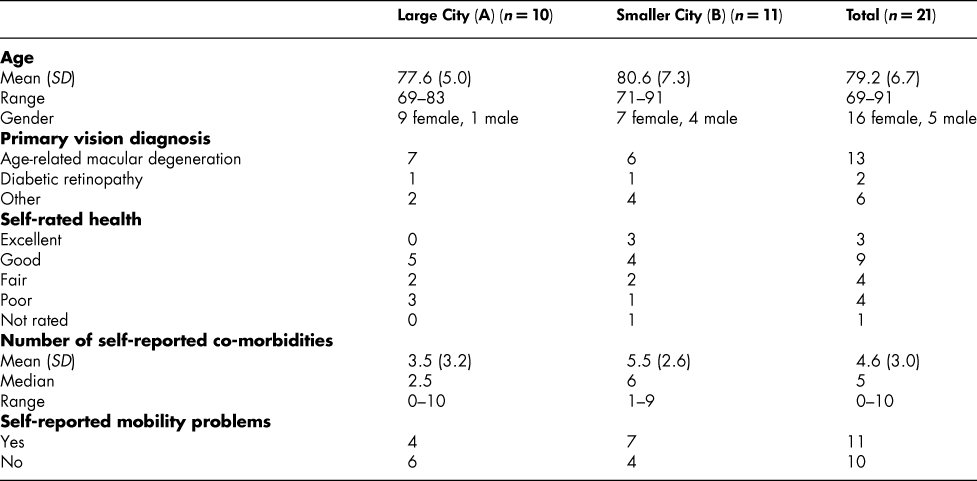
The study was conducted in two Canadian sites: a large city and its surrounding metropolitan area (population of about six million) and a smaller city (population of about 400,000). Following receipt of ethics approval from the relevant institutional review board, recruitment was accomplished with the assistance of CNIB (formerly, Canadian National Institute for the Blind) intake workers who screened potential participants during regular telephone intake interviews. Inclusion criteria were as follows: a) males and females age 65 and older, (b) newly registered CNIB clients, (c) diagnosis associated with ARVL, and (d) adequate English and cognitive abilities to participate in data collection activities. Consistent with theoretical sampling (Charmaz, Reference Charmaz2006), five participants were initially recruited at each site. Data collection and the first stage of open coding were completed with these 10 participants to inform further sampling, data collection, and analysis (Charmaz, Reference Charmaz2006). In total, 10 participants in the large city (city A) and 11 participants in the smaller city (city B) were included (see Table 1 for sample description). Comparatively, the participants in city B were older and reported a greater number of co-morbidities and mobility challenges than those in city A.
Summary of descriptive characteristics

SD = standard deviation
Data Collection
Data collection involved face-to-face interviews conducted in informants’ homes or another private space chosen by them, audio diaries, and life space maps. Prior to each participant’s first appointment with a CNIB independent living specialist (ILS), a semi-structured in-depth interview was completed to explore everyday functioning and social participation. For example, questions were asked regarding what activities participants did, inside and outside their homes, that involved interacting with others; when the activities took place and who they were done with; and how their involvement in various social activities had changed as their vision loss progressed. We used various forms of verbal and non-verbal prompting to encourage elaboration. For audio diaries, participants were asked to submit a telephone voice message every two weeks over a two-month period (four entries in total) that addressed daily life with low vision. This method was added to tap into tacit elements of everyday life that might not surface during interviews (Papadopoulos & Scanlon, Reference Papadopoulos and Scanlon2002). In the final session, we conducted an in-person interview composed of follow-up questions uniquely tied to information shared in a participant’s first interview, and created a life space map to capture community space use before and after ARVL onset (Huot & Rudman, Reference Huot and Rudman2015). All interviews were audio-taped and transcribed verbatim. Although all participants completed the two interviews and life space maps, there were varying levels of participation in audio diary submission (10 participants completed all diary submissions, 3 completed three submissions, 3 completed one submission, and 5 completed none).
Consistent with constructivist grounded theory (Charmaz, Reference Charmaz, Denzin and Lincoln2003, Reference Charmaz2006), credibility was optimized through an iterative process of data collection and analysis. More specifically, emerging insights from ongoing data analysis, particularly from the data collected with the first 10 informants, led to modifications of the interview guide to elaborate developing categories. For example, within the first 10 interviews, several informants talked about how their previous patterns and experiences with various mobility options, such as public transportation and walking, influenced their perceptions of viable options in their daily life as a person with ARVL. Given this background, we added questions to the interview guide that related to lifelong and current patterns of community mobility, such as if and how they had used public transportation previously and currently.
Data Analysis
Analysis began simultaneously with data collection and was an inductive, iterative process (Charmaz, Reference Charmaz2006). Utilizing QSR International’s NVivo software, we conducted line-by-line and theoretical coding. Employing the constant comparative method, we constantly compared codes and processes within and across participant data to form categories and themes.
Initially, our analysis was conducted in each city separately, with two analysts working at each site. Given that the purpose of maximum variation sampling in grounded theory is to achieve an understanding of a process that accommodates diverse conditions and types of informants, we aimed to understand the process across the two cities rather than conduct a cross-city comparison. As detailed in the findings, however, we did note one main difference between the sites related to mobility options, given that the larger city had more diverse public transportation options and several informants in that city had used these options prior to the onset of vision loss.
The four analysts brought perspectives from occupational therapy, public health, gerontology, low-vision rehabilitation, and psychology to the data analysis process, thereby enhancing theoretical sensitivity (Charmaz, Reference Charmaz2006). Following coding of data from the first five informants in each site, the four analysts met to discuss and elaborate codes and begin the process of building categories that included data from both sites. The resulting codes and categories were continually revised through ongoing analyses and discussion, and initial coding was finalized in a second research team meeting. For example, the category of “facing diminishing social supports” encompassed codes dealing with changes that were described as leading to less support being available for a range of activities, such as “deaths of family members, friends and neighbours”, “moving neighbourhood”, “changes in neighbourhood composition”, and “health issues faced by family members and friends”. As another example, the category of “safety concerns and fears” encompassed codes named “falling”, “winter”, “previous falls”, “night time”, and “being institutionalized”. Once categories were finalized, we focused on theoretical coding in order to map the social participation process in relation to environmental and other features. This analytic stage involved sketching out various visual models that encompassed the key categories and their inter-relationships, ending with the selection of a model that best fit our analytical findings.
Results
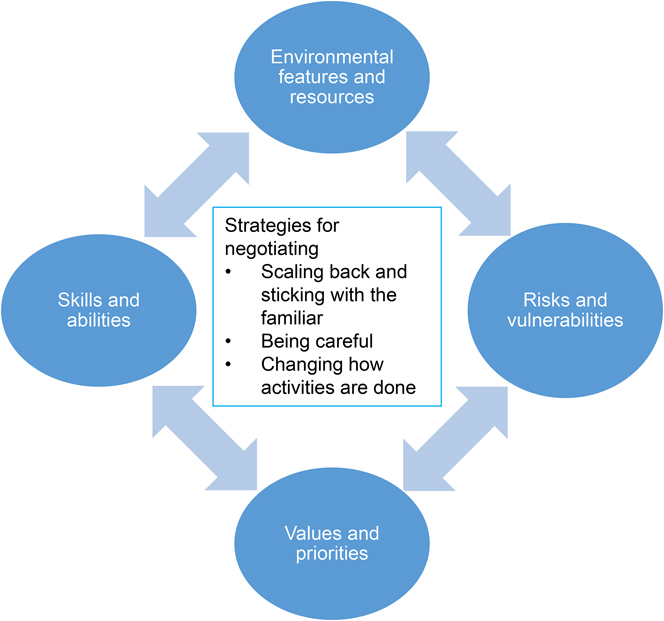
Several environmental features and resources emerged as key factors in establishing constraints and resources for social participation. In particular, these features related to mobility options, physical environmental features, social environmental barriers, and sources of informal supports. As depicted in the transactional model of the process of negotiating social participation in context (see Figure 1), these environmental features – in transaction with participants’ abilities and skills, values and priorities, and risks and vulnerabilities – influenced whether and how participants attempted to negotiate a particular social activity. Transaction and transactional are used to reflect the ways in which these various aspects of the model were not just independent factors interacting with each other, but also were continuously intertwined and mutually shaping (Cutchin & Dickie, Reference Cutchin, Dickie, Cutchin and Dickie2013). For example, features experienced as risks and vulnerabilities were shaped in relation to a participant’s abilities and skills and aspects of his or her environment, so that a particular feature might be risky for one participant and not for another participant.
Process of negotiating social participation in context
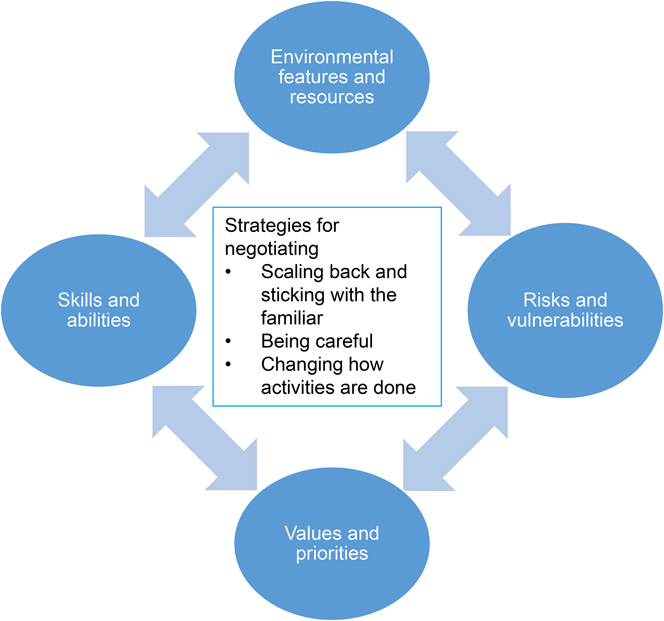
After we provide examples of changes in social participation described by the study participants, we depict the environmental features and resources aspect of the model to show how the negotiation of social participation involved transactions among these features and the other elements depicted in Figure 1. Finally, we outline strategies used to negotiate social participation. Throughout this section, findings are illustrated and supported by quotes from participants who are identified with a code number and letter, referring respectively to city and recruitment order (A referring to larger city, B referring to smaller city).
Changes in Social Participation
Participants varied in the extent to which ARVL had led to decreases in social participation. Some had stopped participating in numerous activities that enabled social connections and, consequently, these participants expressed feeling disconnected and lonely. Other participants engaged in a variety of activities within their homes and communities that resulted in interpersonal connections. However, with the exception of A10 and B5, participants noted a significant decrease in the amount and frequency of participation in activities that connected them with others. In contrast, A10 indicated, “I go to anything I want to go to. I don’t let it [my vision loss] stop me”, and B5 stressed that she was “always out”.
An extensive list of socially interactive community-based activities had been discontinued across the participants; for example, volunteering, walking or biking around their community, going to movies, eating out, and shopping. Participants also discontinued a number of in-home activities that had provided opportunities to interact with and feel connected to others, such as writing Christmas cards, watching television, reading newspapers, and baking for others.
Many participants had ceased or significantly decreased engagement in both formal and informal activities that previously enabled them to connect with others and feel part of a group or community. For example, the first response of B3 to a question regarding changes in daily life with decreasing vision was:
Well, I can’t sit out [at] the front in the summer and watch people go by [on] the sidewalk ’cause I don’t know who the hell they are …, like going through cashiers and stuff like that … I can’t joke or talk with them like I always used to … because I can’t see their faces.
A7 discussed how she had stopped attending church when she could no longer drive: “I kind of stopped going to church … I haven’t been there in a month.” B2 talked about her previous habit of browsing in bookstores and speaking with others about books, stating, “I used to go to Chapters [book store], I went to Coles [book store] … but you just don’t go and browse.”
Participants associated activity losses with feelings of anger, resentment, boredom, and grief. Participants also connected activity losses to feelings of being disconnected and lonely. For example, B2, who no longer went out into the community on her own, described how she went out shopping once a week with a friend, but “otherwise, I’m pretty alone.” B7, who did not venture into the community on his own and only saw his out-of-town children on a monthly basis, described his daily life as limited:
Well, I just have to sit and think because there’s, there’s nothing going on in the room here, it’s just four walls and I don’t have a TV and all that, I don’t have anything like beyond that … there’s nothing else to do.
Environmental Features and Resources
Four types of environmental features and resources were forefronted as influencing the negotiation of social participation. Below, we illustrate each type of environmental feature and resource and, as pertinent to specific examples of participation, show how such features transacted with the other three elements depicted in Figure 1 (abilities and skills, values and priorities, and risks and vulnerabilities).
a. Mobility Options.
Participants described various ways they attempted to maintain participation within available, and often limited, mobility options, and how they often faced multiple barriers to being independently mobile in the community. Abilities and skills (e.g., walking without aids, using public transit, driving a motor vehicle), environmental features and resources conducive to independently accessing the community (e.g., readily accessible public transit, living in close proximity to community resources, a spouse who drives), and values and priorities (e.g., valuing maintaining independence vs. asking for help to access the community) differentiated participants who remained actively engaged in a variety of community-based, social activities from those who were more restricted and felt isolated. As well, perceptions of the risks posed by mobility options and vulnerability to such risks influenced how participants navigated mobility.
Losing the ability to be independently mobile in the community appears to lead to several changes in social participation, including (a) decreased frequency and variety of community-based activities that enables interaction with others; (b) having to wait for help from others to access the community; (c) loss of spontaneity in daily activities; and (d) deciding to “let go” of activities outside of the home that were not necessary for independent community living. Within city B, the limitations of the public transportation system combined with these other elements in ways that significantly limited mobility. Indeed, several participants in this city indicated they no longer ventured out into the community on their own. B6 said, “I don’t go out now, no, not alone … The only people that take me out are my kids.” B1, who indicated that last winter she went outside “only when somebody came and was taking me”, talked about the combined effects of vision loss, a mobility impairment, weather conditions, and perceptions of risk and vulnerability:
Because with my walking, the way I walk and my eyesight, both, if I had better legs and bad eyes, or good eyes and bad legs, it’d be different because I’ve got both. I’ve got both and that’s kind of hard. You know, I don’t like to get out in the wintertime, last winter was terrible, there was a lot of ice … I didn’t like to get out … I was petrified.
Several participants connected losing their driver’s licence to the loss of valued activities and social contact. A7, who had given up her driver’s licence during the interval between interviews one and two, indicated that “because of giving up driving, of course, I’ve given up a lot of my little pleasures.” She also connected her loss of driving to decreased contact with family members: “And then my sister, I don’t see her much more … because with her not liking to drive in from [another town], and me not able”, and, “I used to go over to my daughter’s quite a bit, but, like for the last year, I don’t go over there.” After losing her licence, B5 stopped volunteering at a nearby cancer clinic: “I don’t go to a cancer clinic any more … I don’t have any volunteering … because I would have to have somebody drive me.”
Many people in city B noted that they had either infrequently or never used the bus system. For example, B11 commented, “the last time I used [public transit was] about 25 years ago.” This lack of experience, combined with signs on buses not being readable, little knowledge of bus routes, bus stops being difficult to get to, and the perception of buses as risky, led to public transit being viewed as a non-viable alternative by most participants in the smaller city. For example, B5, who had not used the bus system in her adult life, stated that although “we got a bus that goes directly by here [her home]” she didn’t “know how, where it goes”. Moreover, she indicated that “a lot of people that I know that use the bus say ‘it’s not a place for you’.”
Several participants in the larger city had more experience using public transit over their lifetimes and continued to use it. However, they set limits on how they used the transit. For example, they reported using transit only for “necessary” activities, such as getting to medical appointments, and using only familiar routes. In addition, they described public transit use as more challenging and more risky given their vision impairments. A4, who continued to use the bus system but with decreasing frequency, described her increasing discomfort and why she increasingly used transit specifically designed for persons with disabilities:
But if I go out, if the bus is coming I look on the glass, I have to look careful to see what number of bus is coming … and will ask somebody when I am crossing [the street] with this to help me … That’s why I’m glad with the wheel transit, cause the Wheels Trans comes to your door, and picks you up. So it’s rarely I go out to take the bus because it’s difficult going out for me; it’s dangerous for me, when I’m crossing the street.
b. Physical Environmental Features.
Participants described a number of physical environmental features that presented barriers to social participation. Transactions among environmental features that were physical in nature and features associated with the other three elements in the model informed participants’ decisions regarding whether and how to access community-based social activities, including (a) variability in participants’ mobility and other skills, (b) previous histories of falling, (c) fear of falling, (d) the value placed on maintaining independence, and (e) whether or not they lived with a spouse.
Commonly mentioned physical environmental features, particularly in relation to perceived risks for falling, were slippery surfaces, uneven curbs, inadequately maintained walking surfaces, stairs, and escalators. As an example, A1 described how her attempt to navigate unfamiliar stairs had led to a recent fall:
It’s not a new church but for me was new, because that was the first time I was going for a funeral. Going down the stairs – and there is just a little turn on my right, so there was a railing in there and I hold on and I go down, convinced it was the pavement … it was another step which I didn’t notice … Somehow my vision was getting really worse, so I fell down.
The ways that such physical environmental features influenced social participation was related to various skills, perceived risks, and values and priorities. For example, B2, who lived independently and had no health conditions affecting her mobility, walked on her own in her local community to obtain groceries and visit a park. She stressed that she had “never fallen” but that she needed to constantly be careful when out in the community because of environmental features, “and when I go out, I think I’m more aware of … steps and stairs than I ever was before, and cracks. I don’t walk along staring at the ground, but the streets … are dreadful.” In contrast, B11, who restricted where she went in the community and only went when she was accompanied by her spouse, stated, “I’m so, so terrified in wintertime going out, they don’t clean these sidewalks that well, out at the front [of her apartment building].” As an exception, B5, who did not report any other co-morbid health conditions, appeared to prioritize continued participation in valued activity over the potential of falling. She shared examples of how she continued to travel even though she had fallen: “I travel a lot … I think … the only place I didn’t fall was in Africa. And I’ve fallen everywhere else I’ve been.” Overall, participants who had a history of falling, co-morbidities that impacted walking, and/or stated they no longer trusted themselves to navigate difficult physical environmental conditions, were much more likely to have stopped participating in activities done outside of their homes, and to express relying on others to complete necessary community-based activities.
Several other physical environmental features were described as difficult, frustrating, or impossible to negotiate due to vision loss, such as: traffic lights; busy intersections; darkness or inadequate lighting; debit machines; elevator buttons; bus, street, and stores signage; changing store layouts; forms requiring signatures; and information on credit cards, coins, and paper bills. For example, B10 discussed physical barriers that had led him to decide to no longer shop on his own, a readily available option since he lived with a spouse who drove:
I can’t take things down to buy things. I wouldn’t buy things without her … I look down the aisles in the store and I used to be able to just see the sign at the top of the aisle, what was in that aisle, and I knew exactly where I was going to go. Now I stumble around a little bit cause I can’t read those signs any more. And the darn people in the store, they keep changing the signs anyways … I wouldn’t be able to do much shopping I think without some assistance.
B6 described how a change in a locker system had led to decreased involvement in a volunteer activity she had done for 25 years:
They were going through some renovations, like physically, they were changing things and where we used to put our purses and coat and that … they temporarily assigned us a locker, as opposed to the room where you could just get in punching some numbers … Well, I … couldn’t handle that ’cause I couldn’t see.
Although B6 was beginning to re-engage in this activity by the end of the study, her example shows how this seemingly small change created a barrier to a valued activity.
In particular, participants connected the challenge of crossing streets to their decision to not go out into the community on their own. A7, who used a walker, discussed the challenge of crossing at busy intersections. When asked, in her second interview, how she was dealing with this challenge, she stated, “I’m not … I’m staying home.” B6, who used a walker and described herself as being “dependent on my family” to leave her apartment, also discussed the fear of navigating streets: “I am too scared to get out on the road by myself.”
c. Social Environmental Barriers.
Participants also described how ARVL was associated with challenges to their sense of comfort in social situations, threats to their sense of identity and how others perceived them, risks of social embarrassment, and increased vulnerability. Social environmental challenges often resulted from transactions among environmental features (e.g., pace of everyday life, social misunderstandings of persons with low vision), skills and abilities to recognize others and manage social situations, and whether or not they thought they could manage potential risks and maintain a personally acceptable and valued social image.
Several participants noted how challenging it was to deal with declining abilities to recognize others. For example, A6 emphasized not being able to recognize people as “a big thing and I’m sure people think, ‘my God … sometimes she says hello and sometimes she doesn’t’.” B10 stated his “biggest problem is recognizing people … I have to look very closely to make sure who I’m talking to.”
Participants discussed fears of being embarrassed, socially misunderstood, treated differently (e.g., like a child or an “old” person), and ignored or made to feel vulnerable or invisible within the bustle of everyday life. For example, B9 connected her reluctance to eat out to physical environmental challenges and the potential for social misperception and embarrassment:
No, I hate [going out to eat], can’t eat at home, why would I want to go out? I have a hard time … like walking, like a step … In the summertime we were watering the flowers outside and I swear everybody would think I was drunk … I go all over the place.
B3 shared concerns that he might be misperceived as an “old bastard” and how this affected his sense of comfort in his regular visits to a local coffee shop:
Well, a few weeks ago I … even quit going to [name of coffee shop] for a while, they were wondering where the hell I was, they thought I was sick or something but I was just … it was getting to be too much, so, thinking everybody was looking at me, [and thinking] “well, there is one old bastard who just sits and gawks at me.”
In some instances, the various challenges resulting from ARVL, in combination with social environmental features, led to feelings of insecurity and discomfort and, in turn, decreased frequency of participation or withdrawal from activities outside of the home. A7 described her concerns regarding how other people she played cards with reacted to her:
I mean some people I play with, they’re patient because they know what my problems are, but others don’t. And I can tell by the looks on their faces, and their, “Huhhhh” … they’re impatient with me.
B11 connected her decision to stop accompanying her husband to the grocery store to the ways other people ignored her and the difficulties she faced:
You have other people shopping in the grocery stores and they don’t give a damn about anyone that has a problem. And it’s amazing how many people are so rude. They’ll just bang into the back of your legs and down I go. And do they care less? They just take their cart and carry on. They don’t even say boo and here I am, the one that’s laying on the floor.
d. Sources of Informal Support.
For many participants, particularly those who did not drive or use public transit, informal supports were key in enabling access to the community to complete necessary community-based activities of daily living such as food shopping or banking. Participants described how they attempted to negotiate such support in ways aligned with their values and priorities, particularly in relation to maintaining an acceptable self- and social identity. Overall, the findings highlighted complex processes of re-negotiation of roles, relationships, and identities that occur as older individuals with ARVL come to rely on family members, and sometimes neighbours and friends, for assistance with activities. The process was not one of simply asking for help when faced with a challenge – rather, participants described weighing a variety of considerations, related to their values as well as perceived social risks and vulnerabilities, when deciding whether to ask, and who to ask, for help. For example, participants considered how they might be socially perceived (e.g., as a burden or as incapable); what they valued and prioritized (e.g., independence, maintaining community living); other demands on family members (e.g., work, family life); and whether or not they believed a family member would understand why they needed the help in relation to ARVL. Most sought support from children when they wanted to complete activities necessary for continued independent community living, while support for discretionary leisure and social activities was less frequently sought.
Several study participants stressed the value they placed on perceiving themselves and being perceived by others as independent and, conversely, not being perceived as dependent, a burden, or a nuisance. Participants, in turn, described the challenges involved in having to rely on others for assistance with activities they had previously done on their own, resenting the need for such help. For example, A10, after describing how she had to ask a store clerk to assist her with filling out a form for a parcel she was mailing, stated:
And she fills it out for me, but it … feels embarrassing, having to ask people to do things for you. Especially when … you’ve been doing it for so long on your own and suddenly you have to ask.
B6 stated that she got “a little resentful” as her vision loss meant she needed help to go out into the community:
I mean I used to get out and maybe go to … Wal-Mart and walk around there, or else get the bus and go right uptown, but I can’t dare trust myself to [do] either one of those things now … Yeah, now I’m dependent on my family … And that annoys me. ’Cause I’ve always been independent.
The availability of informal supports, particularly spouses, was connected to differing levels of social participation. Moreover, social participation was influenced by transactions between supports available, participants’ needs for supports, and the types of supports participants sought and accepted given their values and priorities. Some participants provided examples that suggested accepting help was often easier if they did not need to directly ask for the assistance, and if they perceived that people would readily give assistance and understand the challenges they were experiencing as a result of ARVL. For example, B11 shared that she was able to continue attending a lodge with her husband because of the unsolicited support she received from other women who understood her vision loss:
They all really know what my problem is … There’s two girls at the Lodge and it’s absolutely amazing – like every time I even go to use the washroom, there’s one of the girls are always with me.
A7, who lived in close proximity to members of her Jamaican family and had ties to the broader Jamaican community, described how people were always available to help. A7 framed this help as part of what families and community members do, and readily accepted the help she received: “Well, I don’t really ask them; to be frank, I don’t … they pledge to do those things for me.”
In contrast, there were numerous examples of participants being reluctant to ask for help from others, and deciding to limit the help sought. For example, B11, who used to enjoy browsing at a mall frequently, explained that she had only been out with her daughter to the mall “a couple of times I guess” as she felt “like I’m holding them back” when she would have “to ask what the price is … and all this to know whether it’s a good buy or not.” A7, who previously enjoyed attending the theatre, indicated that she did not want to ask her friends to help her: “It’s too big a responsibility for a person like me, to be on the subway … or the theatre too.”
In particular, participants carefully negotiated requests for assistance from children with their awareness of other demands on their children’s time, the geographic distance from their children, and the nature of the relationship they had, working to not be perceived as a burden. A10 described her reluctance to ask her son and daughter-in-law for assistance:
I try not to call them. I try to be as independent as I possibly can. I only call if it’s something I really can’t do myself … I just don’t want to be a burden … When I die, I want them to say, “Well, I’m sorry she’s gone”; I don’t want them to say, “Well, thank God for that, she was such a nuisance”.
It was also clear that the ongoing nature of participants’ relationships with their children as well as their sense of whether or not their children understood their vision loss influenced what assistance they sought. For example, B1 described not asking her children for much help, particularly her youngest son with whom she had a strained relationship:
He doesn’t feel badly about it [her vision loss] but … he feels that he’s going to be having to look after me. … And he will – when he comes, I hide letters and things, because he will, he’s inclined to be a bit nosy, or if I have a bill, he looks at the bill: well, you know, “Should you be doing this, should you …?” … But they feel that you’re going a bit dotty.
Strategies for Negotiating Social Participation
In summary, as depicted in Figure 1, participant descriptions of how their social participation had changed over time as they experienced ARVL conveyed continual engagement in a process that involved navigating among environmental features and resources, personal skills and abilities, values and priorities, and risks and vulnerabilities. When faced with challenges, participants sometimes stopped participating in particular activities. However, there were also instances when the study participants attempted to maintain participation in activities that were valued or necessary for community living and enabled connecting with others. Below, we have categorized these attempts according to three types of strategies: (1) scaling back and sticking with the familiar, (2) being careful, and (3) changing how activities are done.
“Scaling back and sticking with the familiar” involved cutting back what activities were done, as well as when, how often, and where activities were done. For example, participants commonly reported decreased frequency of going out into the community to shop and limiting what they shopped for (e.g., only groceries), as well as only going to familiar stores. This approach enabled continued participation in a particular activity, albeit in a more limited way. As another example, with respect to when activities were done, several participants described avoiding doing activities at night, due to the intersection of their vision issues with perceptions of risk and availability of supports. Many participants used the strategy of only going to places in the community they were familiar with. For example, B10 discussed using this strategy:
I’ve been to the same bank … for quite a few years now and the same pharmacist, and I know the people there, too, and I know my way around, but if I go to a strange, a different, store I haven’t been to ever before, I’m very dubious; I can’t find my way.
Another common strategy, often used in response to environmental features perceived as risky, involved heightened cautiousness, or “being careful”. For example, after describing how she accessed her local community on her own, A10 stated, “So I try to be careful, looking [around] as much as I can … knowing who’s around me and what’s going on … I don’t go out in the dark anymore.” A2 stressed how he was careful when using his bike: “Like the stores nearby … there’s a pharmacy not far from here and even going to Canadian Tire … I drive on the sidewalk with my bike and I’m very careful and don’t cross streets on my bike.”
With respect to the strategy of “changing how activities are done”, participants described using a broad range of adaptations to enable continued participation in valued social activities. B11 described using “larger cards” to continue playing cards with her husband and friends, even though “the first time they saw them [the larger cards], [they said] ‘What are these things? Look at the size of them!’” A5 adapted what she did as a volunteer at her church: “I don’t do cash, because I used to do cash before, but I don’t do cash … I could make a mistake and so I don’t want to be bothered … with the money, no. But I can sell things.”
Discussion
Although prior research has demonstrated the pervasive impact of ARVL on social participation (Desrosiers et al., Reference Desrosiers, Wanet-Defalque, Témisjian, Gresset, Dubois, Renaud and Overbury2009), such research has largely aligned with broader understandings of disability among seniors that locate causative factors within individual bodies and functional capabilities (Grenier, Reference Grenier2005; McGrath & Rudman, Reference McGrath and Rudman2013). This study adds to existing research by enhancing understanding of the dynamic, transactional process of negotiating social participation. It adds to the existing knowledge base by highlighting how various environmental features can work against continued participation for older adults with ARVL, thereby highlighting what Grenier (Reference Grenier2005) has referred to as the contextual experience of disability. In addition, the study highlights the centrality of risk in the everyday negotiation of social participation, as well as how risks are understood and managed from the perspective of seniors with ARVL.
This study illuminates the process through which older adults with ARVL actively negotiate participation by balancing skills and abilities, values and priorities, risks and vulnerabilities, and environmental features and resources. The resulting theoretical model (see Figure 1) supports the use of transactional frameworks to understand social participation as a complex, dynamic negotiation process, rather than as a static outcome to be predicted via demographic or diagnostic variables. Transactional frameworks addressing participation extend beyond looking at activities, persons, and environments as independent factors to examining them as continuously intertwined and mutually shaping (Cutchin & Dickie, Reference Cutchin, Dickie, Cutchin and Dickie2013).
The application of transactional frameworks to understanding the daily lives of aging adults can lead to more complex understandings of participation that address the diverse ways aging adults actively negotiate changes over time (Shank & Cutchin, Reference Shank and Cutchin2010). For example, Menec et al.’s work (Reference Menec, Means, Keating, Parkhurst and Eales2010) supports the use of transactional frameworks to optimize the implementation of the World Health Organization’s (WHO’s) Age Friendly Cities initiative. These authors argued that it is clear that
age-friendly domains (the physical environment, housing, the social environment, opportunities for participation, informal and formal community supports and health services, transportation, communication and information) cannot be treated in isolation from intrapersonal factors, such as age, gender, income, and functional status, and other levels of influence, including the policy environment” (p. 479).
As another example, the disability creation process model depicts social participation as a situational result of ongoing transactions between intrinsic, or personal, factors and extrinsic, or environmental, factors (Fougeyrollas, Noreau, & Boshen, Reference Fougeyrollas, Noreau and Boshen2002). Moreover, transactional frameworks highlight the ways in which older adults with disabilities actively work to negotiate valued forms of participation within environmental conditions, moving away from conceptualizations that frame those with disabilities as passive and dependent (Raymond & Grenier, Reference Raymond and Grenier2015). Further use of transactional frameworks to study how aging adults with ARVL negotiate social participation within various environmental contexts can thereby enable more complex understandings of how personal and environmental changes and features come together within daily life and, together, influence social participation.
In this study, numerous physical environmental features, such as inadequately maintained sidewalks, poor lighting, and small print, were experienced as barriers to community-based social participation. The exact features of particular relevance to a study participant varied according to other elements in the model, such as the nature of the visual impairments associated with the individual’s visual conditions. In particular, physical environmental features set up barriers to community mobility that led many participants to discontinue or limit going out into their communities on their own. These findings are consistent with a number of studies which have attended to interactions of physical environmental features, community mobility, and social participation among seniors with and without ARVL (MacLachlan, Rudman, & Klinger, Reference MacLachlan, Rudman and Klinger2007; Raymond, Grenier, & Hanley, Reference Raymond, Grenier and Hanley2013; Richard et al., Reference Richard, Gauvin, Gosselin and Laforest2008; Rudman, Huot, Klinger, Leipert, & Spafford, Reference Rudman, Huot, Klinger, Leipert and Spafford2010). In particular, our study’s findings demonstrate how the inadequacy of environmental arrangements to accommodate differences in visual abilities can shape social exclusion for aging adults with ARVL.
Although a body of research has established a range of negative outcomes associated with decreased community mobility among older adults, few studies have specifically examined the links between modes of community mobility and social participation. A Canadian survey involving community-dwelling older adults found that participants who were automobile drivers, public transport users, and/or pedestrians had higher participation levels than participants who were automobile passengers or users of taxis and adapted transit (Dahan-Oliel, Mazer, Gelinas, Dobbs, & Lefebrve, Reference Dahan-Oliel, Mazer, Gelinas, Dobbs and Lefebrve2010). In line with these findings, we observed that participants with ARVL who were capable of accessing and using public transit and were comfortable walking in their communities had greater possibilities for maintaining engagement in valued social participation.
Participants’ descriptions of their mobility options also revealed a series of challenges, particularly prevalent for aging adults with ARVL living in the smaller city. Public transportation use was more challenging and less prevalent among seniors with ARVL when the following factors co-existed: the public transit system offered limited options; familiarity and skills were limited to automobile travel; and health conditions impacted physical mobility. However, even participants living in the larger city – which had a range of options including subways, buses, and streetcars – who had previous experience and an enhanced sense of comfort using public transit experienced vision-related challenges that limited public transit use. In both contexts, participants described buses as risky contexts, and discussed the limitations of adapted transportation options for spontaneous forms of social participation. Overall, our findings highlight the need for solutions designed to enhance the community mobility of aging adults to be based on considerations of context-specific conditions, a range of abilities and skills, and the life histories of aging adults rather than homogenous views of “seniors’ needs” (Grenier, Reference Grenier2005; Rudman & Durdle, Reference Rudman and Durdle2008).
The WHO’s Age Friendly Cities framework (2007) includes social, cultural, and political environmental elements. Congruent with this framework, the current findings point to the crucial roles of diverse environmental elements within the social participation process. For example, reflecting the values embedded within their larger sociocultural environments and circulated through discourses of successful aging (Raymond & Greiner, Reference Raymond and Grenier2013), independence – particularly understood as accomplishing one’s self-care activities by oneself and staying in one’s home – emerged as a guiding value for many study participants. Retaining independence appeared essential to maintaining an acceptable personal and social identity, which subsequently had an impact on how social participation was negotiated. Previous studies have shown that older adults with impairments often devote more time and resources to self-care tasks, and are less likely to engage in leisure and what they consider to be “non-essential” activities (Dahan-Oliel et al., Reference Dahan-Oliel, Mazer, Gelinas, Dobbs and Lefebrve2010). As well, policies and health care practices for aging adults often emphasize self-care activities and tend to neglect social and leisure activities (Grenier, Reference Grenier2005).
This study’s findings show how a focus on self-care activities, as well as on instrumental activities viewed as key to continued community living, is shaped within a broader social environment that also emphasizes independence (Raymond & Grenier, Reference Raymond and Grenier2015). In the negotiation process, participants often prioritized activities considered necessary for continued independent, community living, as opposed to those done for enjoyment or maintaining social relationships. Prioritizing independence also set boundaries on when family members and friends were asked for assistance and for what types of activities, reinforcing earlier work that has illuminated the complex ways in which help is negotiated by aging adults to preserve a sense of independence and avoid being perceived as a burden (Girdler et al., Reference Girdler, Packer and Boldy2008; Rudman et al., Reference Rudman, Huot, Klinger, Leipert and Spafford2010).
Although engagement in self-care and instrumental activity supports continued community living, potential negative implications also result from decreased or lost involvement in social and leisure activities. For example, previous research has pointed to the importance of continued social participation, connecting it to a person’s quality of life, social inclusion, self-rated health, cognitive performance, mental health, and increased longevity (Dahan-Oliel et al., Reference Dahan-Oliel, Mazer, Gelinas, Dobbs and Lefebrve2010; Glass, De Leon, Bassuk, & Berkman, Reference Glass, De Leon, Bassuk and Berkman2006; Richard et al., Reference Richard, Gauvin, Gosselin and Laforest2008). Ironically, the efforts of participants to maintain independence may, in turn, expose older adults to enhanced risk of negative physical, psychological, and social outcomes frequently found in studies of older adults with ARVL (Rudman et al., Reference Rudman, Huot, Klinger, Leipert and Spafford2010). Taken together, these findings demonstrate the need for vision rehabilitation and other support services to expand beyond a focus on “medical-functional-corporeal” (Grenier, Reference Grenier2005) and self-care issues, to consider how to provide supports and alter social environments to enable continued social participation via a variety of activities (Moody & Phinney, Reference Moody and Phinney2012). The findings also point to potentially negative unintended consequences of focusing rehabilitation and health services primarily on maximizing independence, further supporting the need for other ways of framing outcomes such as interdependence, and optimizing opportunities for agency (Ballinger & Payne, Reference Ballinger and Payne2002; Raymond & Grenier, Reference Raymond and Grenier2013).
In the area of low-vision rehabilitation, self-management programs have grown, with such programs being linked to positive effects on quality of life and on alleviating depression (Ryan, Reference Ryan2014). However, this study and others have shown how environmental features shape experiences of reduced participation for older adults with ARVL (Rudman et al., Reference Rudman, Huot, Klinger, Leipert and Spafford2010). Collectively, this research points to the need for parallel efforts aimed at optimizing vision and age-friendly environments. Such efforts need to expand beyond issues of physical accessibility, and consider the diversity of features that work against feelings of comfort, safety, and belonging in a range of contexts (Estes & Wallace, Reference Estes, Wallace and Phillipson2010; Raymond et al., Reference Raymond, Grenier and Hanley2013; Zur & Rudman, Reference Zur and Rudman2013). For example, to address social barriers that arise from being misunderstood, stigmatized, and excluded, there is a need both for public education regarding the implications of ARVL and for advocacy aimed at improving access to services and environments.
Older adults with ARVL are often framed within research as being at risk for a variety of adverse outcomes, and low-vision rehabilitation practices in turn emphasize risk screening, assessment, education, and reduction (Lord & Dayhew, Reference Lord and Dayhew2001; Tabrett & Latham, Reference Tabrett and Latham2009). More broadly, there has been an increasing expectation, reflected in social policies and discourses of aging, that aging adults will identify and manage risks so as optimize self-reliance, functioning, and safety (Ballinger & Payne, Reference Ballinger and Payne2002; Bornat & Bytheway, Reference Bornat and Bytheway2010; Rudman, Reference Rudman2015). Concerns have been raised regarding the extent to which experts have defined rehabilitation practices and research, with little attention to the meaning of risk in older adults’ everyday lives and how they go about negotiating risk (Ballinger & Payne, Reference Ballinger and Payne2002). The findings of our study provide insights into how older adults with ARVL identified, interpreted, and negotiated risks, including risks to their physical well-being as well as their personal and social identity. Similarly, Bornat and Bytheway (Reference Bornat and Bytheway2010) found that risk was viewed by aging individuals as an ongoing process, a daily reality, and an integral part of the negotiation of social participation.
In this study, participants’ interpretations of risk were not based solely on objective assessment but transacted with their values and priorities, skills and abilities, and environmental features and resources. Thus, for some participants, the social risk of being infantilized or misperceived was something they prioritized to be avoided in order to maintain an acceptable social identity, while other participants exposed themselves to such risks in order to engage in valued social activities. It was also clear that risks, such as falling, social isolation, and depression, were intimately related to each other and were weighed against each other. According to Ballinger and Payne (Reference Ballinger and Payne2002), service providers often focus on physical risk thereby limiting what is viewed as risky within services and what risks services address. The current findings support the need for a broader construction of risk, particularly in attending to social risks, to understand how older adults manage multiple, interacting risks within daily life.
Like the results found by Rush, Murphy, and Kozak (Reference Rush, Murphy and Kozak2012), who conducted a photovoice study addressing older adults’ perceptions of risk in everyday life, this study revealed active strategies that older adults integrate into daily life to manage risk. In both studies, older adults continued to take risks in order to maintain community living and, at times, participate in valued social activities. Further research addressing older adults’ experiences of risk can enhance collaborative approaches to risk management that encompass risk taking and avoidance, and address the intertwined, dynamic nature of risk as it is encountered within the contexts of everyday life (Rush et al., Reference Rush, Murphy and Kozak2012). Moreover, such research can provide detailed descriptions of strategies older adults have developed over their lifetimes to negotiate risk and other barriers to participation.
Conclusion
This study aimed to enhance understanding of the social participation process as it is negotiated by older adults with ARVL, with a focus on understanding how environmental features influence social participation. As a constructivist grounded theory study, the study’s findings are not generalizable in the traditional sense of this word. Rather, constructivist grounded theory aims to provide understandings and concepts that other researchers can examine for applicability to similar processes in different contexts (Charmaz, Reference Charmaz, Denzin and Lincoln2003, Reference Charmaz2006). The study findings are bounded by the contexts in which the study was completed, that is, within two Canadian urban settings, with a primarily female sample, and with informants who did not express any significant financial barriers to participation. The utility and analytical generalizability of this process model, however, is strengthened by the use of theoretical sampling, multiple methods of data collection, and the inclusion of analysts from different disciplines. Our model points to four key aspects of a transactional process of negotiating social participation: (a) environmental features and resources; (b) skills and abilities; (c) values and priorities; and (d) risks and vulnerabilities. The findings also point to key environmental aspects of the process of social participation, including mobility options, physical environmental features, social environmental barriers, and sources of informal support. These features are continuously negotiated by aging adults with ARVL as they attempt to maintain valued social participation, enact the value of independence, and effectively manage risks and vulnerabilities.
We have outlined several implications for services and advocacy efforts within the discussion of the study findings, particular in relation to community mobility options, risk, and social participation. The provision of these services and supports must address visual deficits and physical environmental features, but must also extend to focus on the whole person in transaction with various environmental features. It is also clear that efforts to enhance the social participation of aging adults with ARVL must extend beyond individual-level interventions into societal and advocacy efforts that address various socially produced and perpetuated barriers limiting social participation. Finally, future research must continue to explore the complex ways individuals and their environments transact in order to promote valued social participation for older adults with ARVL.