The term “golden hour” has been used to describe the first 60 minutes after a patient sustains traumatic injury.Reference Cowley1, Reference Cowley2 This concept—that a severely injured patient’s best chance for survival is contingent upon reaching definitive medical care within this time frame—is ubiquitous throughout trauma care literature.Reference Lerner and Moscati3, Reference Rogers, Rittenhouse and Gross4 While mortality has been shown to increase with delayed transport times, particularly for patients with head injuries or severe thoracic or abdominal injuries, broader studies demonstrating the superiority of the golden hour of transport are lacking.Reference Sampalis, Denis and Lavoie5–Reference Newgard, Schmicker and Hedges10 In the United States and other resource-available settings, rapid and safe transport to a trauma center is standard-of-care for injured civilians during peacetime.Reference Rogers, Rittenhouse and Gross4 Similarly, rapid transport time for injured soldiers, among other interventions, has greatly improved survival statistics in combat situations.Reference Goldberg11–Reference Howard, Kotwal and Santos-Lazada14
Unfortunately, modern warfare unintentionally, or intentionally, involves civilian noncombatants.Reference Rubenstein and Bittle15, Reference Aboutanos and Baker16 Persons caught in modern conflict often lack basic health care services; these services either were not available prior to the conflict or were disabled or destroyed as a result of conflict.Reference Murray, King and Lopez17, Reference Forrester, Forrester and Basimouneye18 Concomitantly, health care personnel are often targeted by combatants, which further decimates health care systems.Reference Rubenstein and Bittle15, Reference Patel, Gibson-Fall and Sullivan19 Trauma care in these settings is often provided through a bricolage of nongovernmental organizations, military hospitals, and incapacitated health care systems.Reference Murray, King and Lopez17 There are rarely formalized transport mechanisms in place for delivering injured civilians to definitive medical care. We sought to describe and compare transport times of injured civilians in modern conflict zones to assess the degree to which injured civilians are transported within the golden hour in these environments.
METHODS
We evaluated existing literature describing transport times after trauma and patient outcomes among civilian victims of trauma in modern conflict zones. PubMed, Ovid, and Web of Science databases were searched using the terms “war,” “conflict,” “trauma,” “surgery,” “transport,” “golden hour,” “triage,” and “healthcare,” both alone and in combination with countries of interest (Supplement). A scoping review was performed and PRISMA guidelines were followed. Countries included in the search terms were those recognized as involved in conflict according to the Uppsala Conflict Data Program.20 All studies published between January 1990 and November 2017 found through search criteria were included for initial review to ensure capture of relevant studies.
Initial titles and abstracts from all 3 databases were screened for duplicates and then reviewed for relevance prior to obtaining full-text manuscripts. Eligible articles were independently reviewed by 2 blinded reviewers, who each evaluated the following criteria: study location, transport duration, transport modality, mechanisms of injury, and prehospital and in-hospital morbidity and mortality. Disagreement between reviewers was resolved through discussion with a third reviewer. In light of the heterogeneity of the studies, a broad definition of transport time from injury to arrival at definitive care was used. If time of injury was not available, then time from initial contact with medical care to definitive medical care was used. If neither of these 2 times were available, then the general transport time reported by the authors of a given manuscript was used. Exclusion criteria included abstracts describing health care provided by foreign military engaged in conflict and manuscripts not written in English, French, Spanish, or German. Missing data were requested from study authors and incorporated when possible. Additional studies were sought by examining the bibliographies of all studies identified during the search process. For the qualitative analysis, we did not set a sample size minimum, as we did not expect to find a large number of articles. Statistical analysis was performed using STATA® (version 14.1). This was determined to be an institutional review board exempt study as all articles were publically available.
RESULTS
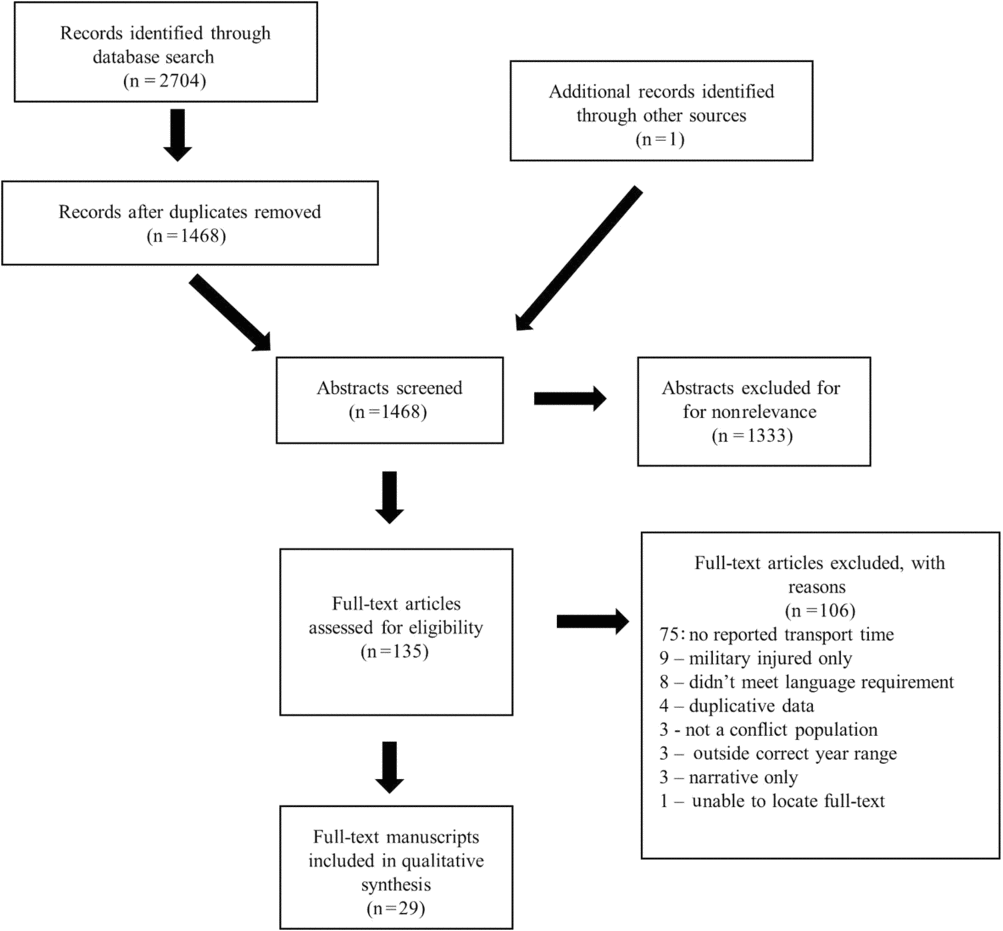
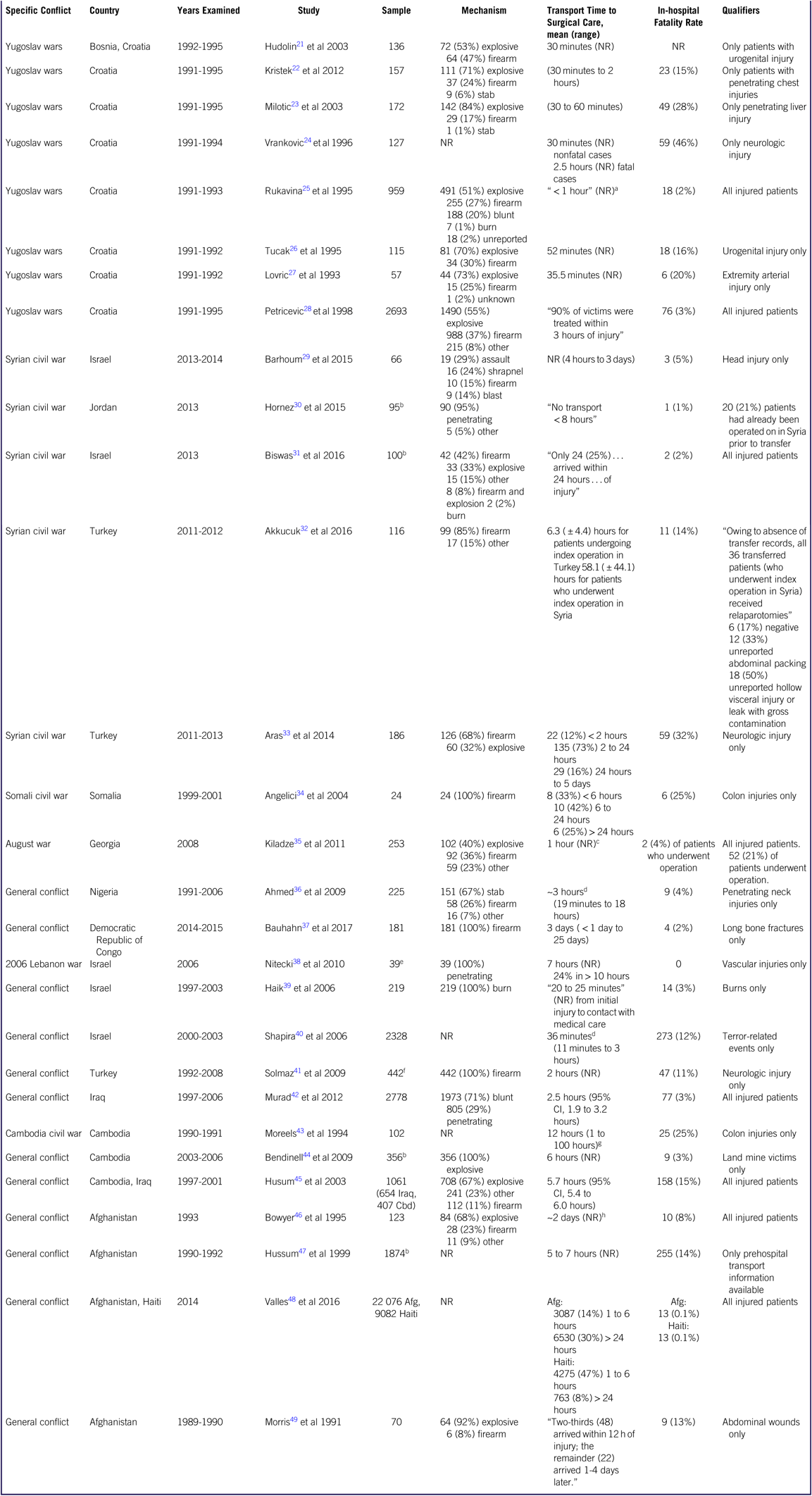
The initial database search identified 2704 abstracts (Figure 1). One thousand four hundred sixty-eight records remained after 1236 duplicates were removed. One thousand three hundred thirty-three abstracts were excluded after abstract review for nonrelevance. One additional manuscript was identified through other sources. Complete manuscripts were obtained for the remaining 135 papers (5% of total). Of these, 106 were excluded for the following reasons: insufficient data on transport times (n = 75), foreign military combatants (n = 9), did not meet language requirements (n = 8), duplicative data (n = 4), not a conflict population (n = 3), outside correct year range (n = 3), narrative only (n = 3), or unable to locate full text (n = 1). Twenty-nine studies met inclusion and exclusion criteria and were included in the qualitative synthesis (Table 1).Reference Hudolin and Hudolin21–Reference Morris and Sugrue49
Manuscript Selection Process

Manuscripts Describing Transportation of Injured Persons to Definitive Medical Care in Conflict Zones Worldwide, 1990-2017

Abbreviations: Afg, Afghanistan; Cbd, Cambodia; NR, not reported.
a Transport distance “10-30 km.”
b Ambulance transport only.
c Transport distance “~70 km.”
d Median.
e Air and ground transport.
f helicopter transport only.
g Transport distance “~50 km.”
h Transport distance “80 km.”
Eight studies were from the Yugoslav wars, 6 were from the Syrian civil war, 4 were from general conflict in Afghanistan, 2 were from general periods of conflict in Iraq, 2 were from general conflict in Israel, 2 were from general conflict in Cambodia, and there was 1 manuscript from each of the following: the Somali civil war, the August war in Georgia, the 2006 Lebanon war, general conflict in Nigeria, general conflict in Democratic Republic of Congo, general conflict in Turkey, and the Cambodian civil war. There were no studies with transport times reported identified from South America or Central America. Two studies evaluated populations from 2 countries; in this case each country’s population was counted separately.
The 29 studies described 47 273 patients. Transport times varied widely by conflict. Only 7 (24%) manuscripts described transport times shorter than 1 hour. Persons injured during generalized conflict in Israel had the shortest reported transport times, with both papers reporting transport times of less than 1 hour. Similarly, 4 of the 8 Yugoslav wars manuscripts reported transport times shorter than 1 hour. Transport times for the Syrian conflict, Nigeria, Democratic Republic of Congo, Iraq, Cambodia, Iraq, Afghanistan, Turkey, and Somalia were all longer than 1 hour. Only 3 papers reported transport distance, which ranged from 10 to 80 km. Method of transportation was infrequently reported. Of the 6 studies that reported the method of transportation, 4 reported exclusively ground transport, 1 reported a combination of helicopter and ground transport, and 1 reported exclusively helicopter transport. Two studies reported the number of persons who died in transport, which ranged from 0.8% to 1.1%. Mechanism of injury also varied widely between studies. All studies from the Yugoslav wars reported ≥50% of patients with non–firearm-related injuries, while 3 of the 5 manuscripts from the Syrian civil war had firearm injury frequencies ranging from 68% to 95%.
Only 8 (28%) studies evaluated all injured patients; most studies assessed isolated anatomic sites of injury or single injury patterns. The highest mortalities were observed among patients who experienced neurologic injury, which ranged from 32% to 46%. Similarly high mortality rates were seen among patients with penetrating liver (28%), penetrating colon (25%), and extremity arterial injury (20%). For the manuscripts that evaluated all injured patients, median in-hospital mortality was 3% (range: 0.1%-15%). No statistical evaluation of predictors for increased mortality or pooling of studies was feasible because of the wide variation in patient populations between studies.
DISCUSSION
Transport of injured civilians within 1 hour of injury is not a current reality for the majority of modern conflicts, nor is it clear that it should be a priority. Transport typically occurred on the order of several hours or days. Prolonged civilian transport times are multifactorial but may be complicated by lack of motorized transport, fighting in rural areas, absence of ambulance or transport services, perceptions of transporter and patient safety, absence of medical facilities, and poor roads, among other impediments.Reference Aboutanos and Baker16 While these same challenges may be present in peacetime in low-resource settings, the disparity is likely exacerbated by conflict.Reference Forrester, Forrester and Kamara50
There were 2 notable exceptions to the prolonged patient transport. Short transport times were reported both in Israel and during the Yugoslav wars. In the case of Israel, this rapidity may be due to Israel’s well-established triage and disaster protocols and a vigorous ground and air transport system.Reference Soffer and Klausner51 The significant resources available in the Israeli context clearly distinguishes this country from the other countries examined in the review, as the other countries are low- or middle-income countries.52 Consequently, while the rapid transport times seen in Israel are to be commended, comparison of transport times between Israel and the remaining countries should be made with caution.
Similarly, prior to the 1992-1995 Yugoslav wars, health care and prehospital systems in Bosnia and Herzegovina were quite functional, which may have provided a more robust transport infrastructure when conflict began.Reference Simunovic53 In contrast, Somalia, Democratic Republic of Congo, Cambodia, and Afghanistan had fledgling health systems and emergency medical systems prior to conflict, which were further decimated as a result of ongoing conflict. Too few manuscripts described methods of transportation, limiting analysis of the impact of transport method on transport times. However, having robust pre-existing prehospital and hospital health care infrastructure likely improves a country’s ability to adapt to the stresses of conflict and, at the very least, provides a basic framework for triage and health care delivery.
Anticipated transport times have important implications for field triage of injured persons. Rapid transport of severely injured persons may increase chance of salvage and decrease the number of preventable deaths.Reference Kotwal, Howard and Orman12, Reference Howard, Kotwal and Santos-Lazada14 Among injured US military service personnel in Afghanistan, a less than 60-minute transport time was associated with a 39% reduction in the odds of dying once transport from the scene of injury had been initiated.Reference Howard, Kotwal and Santos-Lazada14 However, influx of severely injured patients may increase in-hospital mortality because failure-to-rescue rates may increase with larger numbers of critically ill patients as capacity of facilities becomes overwhelmed.Reference Kotwal, Howard and Orman12, Reference Martin, Eckert and Schreiber13, Reference Ball, Williams and Tallah54 This may be particularly problematic for civilian health care systems caught in conflict. Existing overburdened civilian health care systems may become further overwhelmed if treatment capacity is unable to keep pace with inflow of the severely wounded. Ultimately, care of the injured in a conflict setting becomes a balance between transport times and health care resources; transport must be rapid in order maximize salvage, but there must also be definitive care that patients can be transported to. Otherwise, hospital resources may be exhausted and understaffed and underprepared hospitals may be unable to provide care to other, less severely injured patients. In these settings, recommendations to transport patients to definitive care within 1 hour should be viewed with caution, particularly in the absence of robust data showing that rapid transport improves patient outcomes.
Yet opportunities for improving care of injured civilians in conflict zones are several. Forward projection of resources may bring basic first aid capacity closer to the site of conflict but must be balanced by the ability to ensure the safety of rescuers and transport personnel.Reference Giannou and Baldan55 A current example is the White Helmets, volunteer rescuers in Syria.56 They have rescued thousands of injured civilians yet they have paid a heavy price with over 204 rescuers killed since the group’s inception in 2013. Some groups have gone so far as to push forward civilian mobile surgical teams.Reference Fosse and Husum57 Yet, increasingly, civilian first responders and medical personnel are targeted by state and nonstate combatants in modern conflict.Reference Patel, Gibson-Fall and Sullivan19, Reference Carmichael and Karamouzian58, Reference Trelles, Stewart and Kushner59 Threats to rescuer safety by combatants breach ethical guidelines, violate international humanitarian law, and may constitute war crimes.Reference Giannou and Baldan60, Reference Fox, Stoddard and Harmer61 Such attacks should not be tolerated by international governing bodies, but the ability to change the behavior of combatants through international sanction or reprimand has not yet been demonstrated. Protection of first-responder rescuers must be ensured to prevent an injury that would result in yet another patient. Simple interventions by laypersons such as airway positioning and hemorrhage control may help reduce preventable deaths. Standardized first aid packages such as STOP the Bleeding could be made culturally and contextually relevant and provided to civilians caught in conflict settings.Reference Rossaint, Bouillon and Cerny62 Empowering civilians to provide point-of-injury first aid may extend the survivability threshold of civilian casualties and expand the number and capabilities of first responders.
As seen in Israel and in most modern militaries, a well-organized prehospital transport network and a series of staged care centers with escalating responsibilities may reduce transport times and decrease mortality.Reference Kotwal, Howard and Orman12, Reference Soffer and Klausner51 However, countries or regions in conflict are unlikely to marshal the resources necessary to continue such a system, particularly if one was not present preconflict. International investment in conflict-zone civilian transport may be required in such settings. The World Health Organization’s response to the battle for Mosul, Iraq in 2016 is such an example. During this period, the World Health Organization oversaw a field to tertiary-level trauma chain executed by nongovernmental organizations and civilian partners to address the anticipated humanitarian disaster and is credited for saving potentially 1500-1800 lives.Reference Fox, Stoddard and Harmer61, Reference Spiegel, Garber and Kushner63
Ultimately, available data on transport of injured civilians in conflict zones are limited and more research is needed. The expectation that civilians be transported within 1 hour of injury should be based upon empiric evidence rather than extrapolation from ambiguous civilian data or difficult-to-extrapolate military data. The use of standardized, transparent conflict trauma registry software in events such as Mosul may enable comparison of transport times between conflicts, facilities, or organizations.Reference Mehmood, Chan and Allen64, Reference Zargaran, Schuurman and Nicol65 Funding for targeted research protocols to evaluate the impact of transport time on morbidity and mortality of civilian trauma patients caught in conflict is urgently needed. It is possible that transporting severely injured civilians to incapacitated or overwhelmed health care facilities is detrimental to the care of a larger number of less severely injured patients. If the international community is to invest in transport of civilians caught in conflict zones, resource allocation should be based on substantive data demonstrating where limited resources can have the most benefit for the most number of injured.
There were several limitations to this study. First, there is selection bias: only 13 of the 78 countries identified by the Uppsala Conflict Data Project as countries experiencing conflict were captured with this review.20 Additionally, not all conflicts may have been identified through the Uppsala Conflict Data project, which may limit applicability to all conflict zones. Second, publication bias may exist because organizations may be less likely to publish higher mortality rates from their facilities. Similarly, institutions or hospitals severely overburdened by treating civilian casualties may not have the ability or bandwidth to collect, analyze, and publish their data. Third, there was wide variation in the study populations, which limits the ability to compare studies at the conflict or country level. Fourth, recall bias may be present when injured persons or transport personnel report transport times, particularly when patients are in extremis. Fifth, on-scene or in-transport mortality was rarely identified by any of the studies limiting mortality assessment just to in-hospital mortality. Sixth, few manuscripts detailed the number of persons who died on transport, which limits assessment of potential mortality averted through more rapid transport. Finally, due to the wide variability in study populations, no pooled analysis of either transport time or in-hospital mortality was possible.
CONCLUSIONS
Available data show that transport of injured civilians caught in conflict zones within the golden hour is not commonly achieved. Some injured civilians may receive timely medical care in conflict settings with functional and rapid existing transport mechanisms, yet this does not seem to be reality for many civilians injured in conflict zones since 1990. While transport of injured civilians to definitive care may not be possible in all situations, the concept of rapid intervention and shorter transport times should be the mindset. Protection of first responders and persons transporting the injured, improved first responder training, and international investment in prehospital transport of injured civilians may reduce the morbidity and mortality of civilians caught in conflict settings.
Acknowledgments
The authors would like to thank Barclay Stewart for his critical review of the manuscript.
Conflict of Interest
The authors have no conflicts of interest to disclose.
Supplementary Material
To view supplementary material for this article, please visit https://doi.org/10.1017/dmp.2019.42.