Introduction
Several studies have demonstrated a link between bullying victimization and subclinical or clinical psychotic symptoms (Lataster et al. Reference Lataster, van Os, Drukker, Henquet, Feron, Gunther and Myin-Germeys2006; Campbell & Morrison, Reference Campbell and Morrison2007; Kelleher et al. Reference Kelleher, Harley, Lynch, Arsenault, Fitzpatrick and Cannon2008; Schreier et al. Reference Schreier, Wolke, Thomas, Horwood, Hollis, Gunnell, Lewis, Thompson, Zammit, Duffy, Salvi and Harrison2009). This is in accordance with a large body of evidence describing the adverse effects of being victimized on mental health problems, such as depression and anxiety (Hawker & Boulton, Reference Hawker and Boulton2000), and self-harm behaviors and suicidal ideations (Barker et al. Reference Barker, Arseneault, Brendgen, Fontaine and Maughan2008; Herba et al. Reference Herba, Ferdinand and Stijnen2008; Klomek et al. Reference Klomek, Sourander, Niemela, Kumpulainen, Piha, Tamminen, Almqvist and Gould2009; Reijntjes et al. Reference Reijntjes, Kamphuis, Prinzie and Telch2010). This has highlighted victimization as a major social risk factor that, through its putative effect on cognitive and biological processes, may induce a lasting psychological vulnerability (Arseneault et al. Reference Arseneault, Bowes and Shakoor2010).
However, to date, all studies investigating the association with psychosis have used self-report measures of bullying victimization. This is problematic for two reasons. First, self-report potentially introduces biases because of the subjective quality of the appraisal of bullying. As the presence of psychotic experiences may plausibly impact on this subjective appraisal, there is a risk of over-reporting of victimization. Longitudinal and prospective studies (Poulton et al. Reference Poulton, Caspi, Moffit, Cannon, Murray and Harrington2000; Schreier et al. Reference Schreier, Wolke, Thomas, Horwood, Hollis, Gunnell, Lewis, Thompson, Zammit, Duffy, Salvi and Harrison2009) have been partly able to counter this bias by showing that the victimization experiences preceded the psychotic symptoms. Nevertheless, it cannot be excluded that subtle alterations associated with the vulnerability for psychosis lead to over-reporting of victimization experiences, even before the onset of the psychotic experiences. Second, if victimization and psychosis outcome are both based on self-reports, a spurious correlation may arise due to common method variance. Such a correlation may be partly due to the same assessment method being used, thereby overestimating the real relationship between victimization and psychosis.
Elsewhere we have argued that it is essential to include methods using peer reports in studies investigating the adverse effects of victimization (Gromann et al. Reference Gromann, Goossens and Krabbendam2011). The advantage of peer reports is that they are based on a considerable number of observers who are familiar with and present in a given environment (Atlas & Pepler, Reference Atlas and Pepler1998). In addition, although self-reports may be colored by a possible pre-existing psychotic vulnerability, this risk is absent in peer reports. This does not fully exclude the risk of over-reporting in peer reports, as these may be influenced by a tendency to report as victims the children who behave oddly, but peer report is plausibly less susceptible to this risk than self-report. Although both peer nomination and self-report have been established as valid methods (Pellegrini, Reference Pellegrini, Juvonen and Graham2001; Olweus, Reference Olweus, Jimerson, Swearer and Espelage2010), it is important to realize that they tap different constructs: self-report measures individual perception and peer nominations measure group perceptions (Juvonen et al. Reference Juvonen, Nishina, Graham, Juvonen and Graham2001). Thus, peer reports are suitable for investigating the reputation of a child whereas self-reports are useful for investigating the way children view themselves in a given environment. Peer-reported victimization has been associated with more rejection and less acceptance in the group (Juvonen et al. Reference Juvonen, Nishina, Graham, Juvonen and Graham2001). In turn, social exclusion has been linked to mental health problems in general (Huxley & Thornicroft, Reference Huxley and Thornicroft2003) and psychosis specifically (Wicks et al. Reference Wicks, Hjern, Gunnell, Lewis and Dalman2005). Self-reported victimization, however, has been associated with self-reported adjustment outcomes such as depressed mood, anxiety, loneliness and negative self-views (Juvonen et al. Reference Juvonen, Nishina, Graham, Juvonen and Graham2001). Comparing self-reports and peer reports of victim status may thus yield essential information, especially with regard to their putative impact on the development of psychotic experiences.
The purpose of this study was to investigate the relationship between bullying victimization as assessed with self-reports and peer reports on the one hand and non-clinical psychotic experiences in a general population sample of young adolescents on the other. The general population approach has proven useful because it allows investigation of the mechanisms of psychosis at the non-clinical level, where the expression of the phenotype is much more common than at the level of the clinical disorder (Johns & van Os, Reference Johns and van Os2001). Many previous studies have supported this approach, providing evidence for longitudinal continuity (Poulton et al. Reference Poulton, Caspi, Moffit, Cannon, Murray and Harrington2000; Schreier et al. Reference Schreier, Wolke, Thomas, Horwood, Hollis, Gunnell, Lewis, Thompson, Zammit, Duffy, Salvi and Harrison2009), shared risk factors (van Os et al. Reference van Os, Hanssen, Bak, Bijl and Vollebergh2003, Reference van Os, Pedersen and Mortensen2004; Cougnard et al. Reference Cougnard, Marcelis, Myin-Germeys, de Graaf, Vollebergh, Krabbendam, Lieb, Wittchen, Henquet, Spauwen and van Os2007), shared demographic characteristics (Binbay et al. Reference Binbay, Drukker, Elbi, Aksu Tanik, Ozkinay, Onay, Zagli, van Os and Alptekin2011), symptom dimensions (Stefanis et al. Reference Stefanis, Hanssen, Smirnis, Avramopoulos, Evdokimidis, Stefanis, Verdoux and van Os2002; Krabbendam et al. Reference Krabbendam, Myin-Germeys and de Graaf2004) and neuropsychological correlates (Krabbendam et al. Reference Krabbendam, Myin-Germeys, Hanssen and van Os2005; Simons et al. Reference Simons, Jacobs, Jolles, van Os and Krabbendam2007). To assess victimization, we used standard self-report and peer-report measures of victimization. Subsequently, we divided the sample into four subgroups to examine their link to non-clinical psychotic experiences: exclusively self-reported victims, exclusively peer-reported victims, victims according to both self-reports and peer reports, and non-victims.
Considering the established link between self-reported victimization and psychosis, all self-reported victim groups should differ from the non-victims. However, assuming that this relationship is due to an interpretation bias, peer reports should not be associated with non-clinical psychotic experiences. Specifically, we expected both exclusively self-reported victims and victims according to both self- and peer reports to report more psychotic experiences than the exclusively peer-reported victims and non-victims. Our secondary aim was to disentangle the relationship between self-reported victimization and psychosis by investigating whether the main types of self-reported victimization (i.e. physical, possession-directed, verbal, direct relational and indirect relational) differentially predict non-clinical psychotic experiences. Examining whether different types of self-reported victimization influence psychosis differently may further our understanding of the risk-increasing effect of bullying and may inform possible interventions.
Method
Subjects
In total, 818 children were asked to participate in this study. Of these, 19 children did not get parental permission to participate, 22 children were not present at the time of data collection due to illness, 17 did not complete the questionnaires, and 36 could not be classified into one of the bullying roles. Specifically, those 36 subjects received the same scores for multiple and incompatible roles (e.g. bully and outsider) and therefore could not be classified to one role. This left us with 724 children: 374 boys (51.7%) and 350 girls (48.3%). There was no significant difference in terms of age between boys and girls (F = 0.006, p > 0.9). The mean age was 11.9 years (s.d. = 0.76, range 10–14 years); 684 subjects (94.5%) were born in The Netherlands.
Procedure
The data collection took place in April and May 2010. Subjects were recruited in collaboration with their primary schools. In total, 17 primary schools participated, from different villages and cities in The Netherlands. The children were tested at their own schools. At least two research assistants were present during every experimental session. The parents of all children received a consent letter in which the aims and procedures of the study were described. They could return an attached objection note if they did not want their child to participate. Children themselves were also given the opportunity to decline participation, but none did. At the beginning of the session, children were informed that all data would be treated confidentially and that their names would be removed in the dataset. On average, the testing took 30 min for each subject.
Assessment
Non-clinical psychotic experiences
Non-clinical psychotic experiences were assessed by four yes/no questions: (1) ‘Some children believe in mind reading or being psychic. Have other people ever read your mind?’; (2) ‘Have you ever had messages sent just to you through radio or TV?’; (3) ‘Have you ever thought that people are following you or spying on you?’; and (4) ‘Have you ever heard voices other people cannot hear?’ These questions were obtained from the Diagnostic Interview Schedule for Children (DISC-C), which is a widely used structured diagnostic instrument aimed at discovering more than 30 different disorders in children and adolescents (Shaffer et al. Reference Shaffer, Fisher, Lucas, Dulcan and Schwab-Stone2000). The validity and reliability of the DISC-C has been established, indicating that it is a suitable tool for diagnosing children and adolescents. For this study, the four questions tapping psychosis were translated into Dutch. Previous research has shown their high validity in terms of predicting adult psychotic disorder (Poulton et al. Reference Poulton, Caspi, Moffit, Cannon, Murray and Harrington2000) and assessing psychotic experiences in children (Lataster et al. Reference Lataster, van Os, Drukker, Henquet, Feron, Gunther and Myin-Germeys2006). All answers to the psychosis questions were combined into one continuous psychosis outcome measure.
Peer reputation of victim status
The Bullying Role Nomination Procedure (BRNP), a standard peer-nomination procedure, was used to determine the victims in the class. Previous research has established the validity of this nomination procedure (Goossens et al. Reference Goossens, Olthof and Dekker2006). Further details of the procedure can be found elsewhere (Olthof et al. Reference Olthof, Goossens, Vermande, van der Meulen and Aleva2011). Two questions were asked to obtain victim versus bully nominations: (a) ‘Do you know anyone in your classroom who is being victimized in this particular way? If so, could you give us the name(s)?’ and (b) ‘Do you know which classmates carry out that particular form of bullying?’ To obtain a general measure for peer nomination of victim status, continuous scores were computed for each class by dividing the number of received nominations by the number of nominators (i.e. children who participated in the nomination procedure and were asked to nominate other children, excluding themselves, for bullying roles). Children were assigned the role of victim if their victim nomination score was at least 0.1 and exceeded all other bullying role scores (i.e. ringleader bully, assistant, reinforcer, outsider, and defender) by at least 0.01. All other children were classified as non-victims. Hence, the non-victims consisted of all other bullying roles and all non-involved children (i.e. the remaining children who were not involved in bullying).
Self-perception of victim status
The self-perception of being victimized was measured by means of the Revised Olweus Bullying Questionnaire (Olweus, Reference Olweus1996), which is a standard self-report procedure. First, children received a definition of bullying. We used the general question ‘How many times have you been the victim of bullying in the past three months?’ as an index of self-perceived victim status. Five additional items were used to assess the different forms of bullying victimization: (1) ‘How many times in the past three months did it happen that you were sworn at, laughed at or ridiculed at school?’ (i.e. verbal); (2) ‘How many times in the past three months did it happen that classmates did not allow you to participate in group activities even though you wanted to?’ (i.e. direct relational); (3) ‘How many times in the past three months did it happen at school that you were kicked, hit, pushed, or intentionally hurt in a different way?’ (i.e. physical); (4) ‘How many times in the past three months did it happen that classmates told lies or annoying things about you?’ (i.e. indirect relational); and (5) ‘How many times in the past three months did it happen that something was stolen from you, hidden or destroyed on purpose?’ (i.e. possession-directed). In line with previous research (Olweus, Reference Olweus, Jimerson, Swearer and Espelage2010), we used a cut-off score of 3 or higher: thus, whenever subjects reported incidents of victimization occurring two or three times a month (i.e. score 3), once a week (i.e. score 4) or several times a week (i.e. score 5), they were classified as self-reported victims.
Statistical analyses
SPSS version 17 (SPSS Inc., USA) was used to analyze the results. First, all cases were selected and recoded into one group variable, consisting of the following four subgroups: exclusively self-reported victims (only victims on the basis of their self-reports), both self- and peer-reported victims (self-reports and peer reports in agreement), exclusively peer-reported victims (only identified as victims on the basis of peer reports), and non-victims. The continuous psychosis variable was transformed into normalized scores, using Rankit's procedure. This standard SPSS method uses the formula (r – 1/2)/w, with w equaling the number of observations and r being the rank, ranging from 1 to w. An ANOVA was performed with group (four types of victimization) as the independent variable and the normalized psychosis outcome measure as the dependent variable. Post-hoc pairwise comparisons were corrected for multiple comparisons (i.e. Bonferroni correction). Subsequently, a linear regression analysis was conducted to examine the relationship between different victimization types and psychosis, with the different types of self-reported bullying (i.e. physical, possession-directed, verbal, direct relational and indirect relational) as predictors and the continuous psychosis outcome measure as the dependent variable. All analyses were controlled for gender and age. All statistical tests were evaluated at a significance level of α = 0.05.
Results
Frequencies
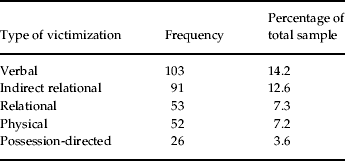
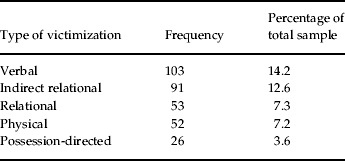
The sample consisted of 79 exclusively self-reported victims (10.9%), 33 exclusively peer-reported victims (4.6%), 37 both self- and peer-reported victims (5.1%) and 575 non-victims (79.4%). Table 1 depicts the frequencies of each type of self-reported bullying victimization.
Frequencies and percentages for each type of self-reported victimization
In total, 303 subjects (41.9%) answered ‘no’ to all four psychosis questions, indicating that they had no psychotic-like experience at all, and 421 subjects (58.1%) reported at least one psychotic-like experience. Out of those, 200 subjects (27.6%) reported at least two psychotic-like experiences, 68 subjects (9.4%) reported at least three experiences, and eight subjects (1.1%) answered ‘yes’ to all four psychosis questions.
Is there a group effect on the psychosis outcome measure?
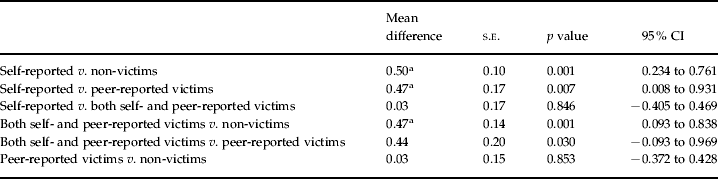
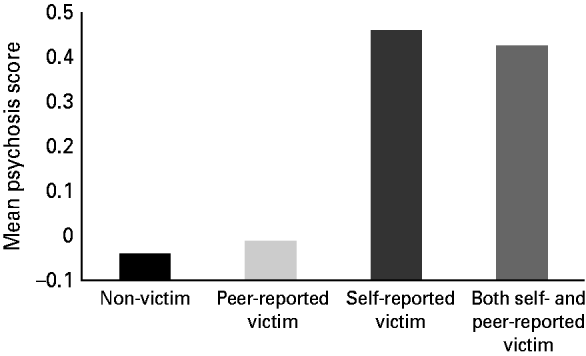
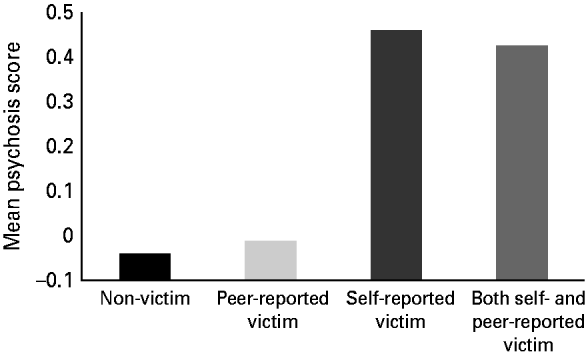
There was a significant effect of group on non-clinical psychotic experiences (F = 11.14, p < 0.0001). Post-hoc pairwise comparisons (Table 2, Fig. 1) showed that self-reported victims scored significantly higher than peer-reported victims and higher than the ‘non-victims’ subgroup. Both self- and peer-reported victims scored significantly higher than ‘non-victims’. There were no significant differences between self-reported victims and both self- and peer-reported victims. Peer-reported victims did not differ significantly from non-victims or both self- and peer-reported victims.
Test statistics for the pairwise comparisons between the four subgroups
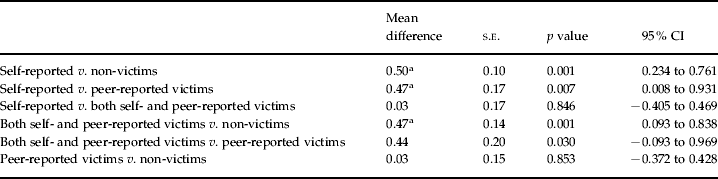
s.e., Standard error; CI, confidence interval.
a Significant at an adjusted α of 0.01 after Bonferroni correction.
The mean distribution of the psychosis outcome score for each subgroup.
Is there a relationship between the different types of self-reported victimization and the psychosis outcome measure?
The model with the self-reported victimization types (i.e. physical, possession-directed, verbal, direct relational, and indirect relational) explained a significant proportion of variance in non-clinical psychotic experiences (ΔR 2 = 0.089, F = 10.91, p < 0.001). Direct relational victimization significantly predicted psychosis scores (β = 0.08, t = 1.98, p < 0.05), as did indirect relational victimization (β = 0.16, t = 3.53, p < 0.001) and physical victimization (β = 0.12, t = 3.11, p < 0.005). The prediction of non-clinical psychotic experiences was not significantly improved by verbal victimization (β = 0.06, t = 1.25, p > 0.2) or by possession-directed victimization (β = 0.02, t = − 0.51, p > 0.5).
Discussion
This study is the first to investigate the relationship between non-clinical psychotic experiences and both peer reports and self-reports of victimization. The results show that peer-reported victimization is not associated with a higher frequency of non-clinical psychotic experiences. By contrast, there was a strong link between self-reported victimization and non-clinical psychotic experiences. The risk-increasing effect of victimization was related exclusively to the subjective appraisal of victimization experiences. The lack of an association between peer reports and non-clinical psychotic experiences further suggests that children who report psychotic-like experiences do not have an increased risk to become nominated as a victim by their peers. Given that children are not considered victims because they act differently due to their psychotic-like experiences, the concept of reverse causality may not apply here. These findings underscore the relevance of the use of peer reports in addition to self-reports of victimization.
The finding that self-reported victimization is related to the risk for psychotic-like experiences is in line with previous research (Lataster et al. Reference Lataster, van Os, Drukker, Henquet, Feron, Gunther and Myin-Germeys2006; Schreier et al. Reference Schreier, Wolke, Thomas, Horwood, Hollis, Gunnell, Lewis, Thompson, Zammit, Duffy, Salvi and Harrison2009), supporting the validity of our study. Our results add to this by showing that the different types of self-reported victimization have different associations with psychosis: significant associations were found with direct relational, indirect relational and physical victimization but not with verbal or possession-directed victimization. The link of both direct and indirect relational victimization with psychotic-like experiences is plausible, given the social nature of the core features of psychosis, such as social withdrawal and paranoia, and suggests that social processes also play a role in the development of non-clinical psychotic experiences. Considering the more subjective social nature of indirect relational victimization, this finding highlights the idea that the individual interpretation may play a role in the association between self-reported victimization and psychotic experiences. Physical victimization, however, is one of the more direct and observable victimization types, and thus less likely to be missed by peer reports. However, even physical interactions may be prone to different interpretations.
The association between self-reported victimization and psychotic-like experiences can be explained by two mechanisms, which are not necessarily mutually exclusive. The first presupposes a causal role for victimization, through either cognitive or biological changes or both. The experience of social adversity in childhood may lead to negative cognitive schemas related to social humiliation, thereby creating a cognitive vulnerability that forms the basis for psychotic-like experiences (Birchwood et al. Reference Birchwood, Gilbert, Gilbert, Trower, Meaden, Hay, Murray and Miles2004). Biological models indicate that early trauma may result in long-term changes in the brain. The densities of dopamine receptors and subsequent dopamine release have been shown to rise due to stress-related dysregulation of the hypothalamic–pituitary–adrenal (HPA) axis (Walker & Di Forio, Reference Walker and Di Forio1997). In turn, dopamine sensitization has been proposed as a major mediator for the expression of psychosis (Kapur, Reference Kapur2003).
The second mechanism assumes that self-reported victimization is due to an interpretation bias in children with a pre-existing psychosis vulnerability. Accordingly, reports of victimization are considered a consequence rather than a cause. The latter explanation has credibility because peer reports, arguably the more objective measures of victimization, were not associated with increased psychotic-like experiences in this study. However, several precautionary notes are relevant here. First, longitudinal and prospective data exist showing that victimization precedes the onset of psychotic-like experiences (Poulton et al. Reference Poulton, Caspi, Moffit, Cannon, Murray and Harrington2000; Schreier et al. Reference Schreier, Wolke, Thomas, Horwood, Hollis, Gunnell, Lewis, Thompson, Zammit, Duffy, Salvi and Harrison2009). Second, it has been argued that psychosis is associated more strongly with under- than over-reporting of victimization (Dill et al. Reference Dill, Chu, Grob and Eisen1991; Read, Reference Read1997), which goes against the explanation of self-reported victimization as a consequence of an interpretation bias. Third, peer reports rely on multiple observers and are likely to be less sensitive to subtle signs of victimization. In this regard, it is important to consider that, in general, self-reported victim status was more frequent than peer-reported victim status, showing that children were more likely to perceive themselves as victims than their peers do. Although peer reports may seem more objective, they are also susceptible to bias. Considering that bullying sometimes occurs in private, relevant behaviors or gestures can be missed in some cases and some peer reports may be based on wrong or insufficient information. Hence, combining self-reports and peer reports allows us to examine a higher frequency of victims, supporting the importance of including both measures in the assessment of victimization.
The current findings are limited by a few methodological issues. First, a self-report measure based on four single questions was used to assess non-clinical psychotic experiences. This only allows for a limited, general assessment of psychosis, and precludes distinguishing in terms of symptom frequency or level of conviction. However, the psychosis questions have been derived from a standard clinical interview and the results are comparable to previous studies using a similar instrument (Poulton et al. Reference Poulton, Caspi, Moffit, Cannon, Murray and Harrington2000; Lataster et al. Reference Lataster, van Os, Drukker, Henquet, Feron, Gunther and Myin-Germeys2006). Second, the cross-sectional nature of the study precludes drawing any conclusions about causality. The need to disentangle the temporal order of victimization experiences and development of psychotic-like experiences in longitudinal studies has only become more relevant given the current finding that the association is limited to self-reported experiences of victimization. It has been shown that depressed children are at a higher risk of being bullied but they also show stronger symptoms after being bullied (Fekkes et al. Reference Fekkes, Pijpers, Fredriks, Vogels and Verloove-Vanhorick2006), suggesting that mental health problems can act both as a precursor and as a consequence of victimization. The question remains whether this also holds for psychosis.
In conclusion, the current findings suggest that the perception of being victimized is a sufficient condition for the presence of a higher rate of psychotic-like experiences. Peer-reported victimization status does not contribute to an increased frequency of psychotic-like experiences, either because self-reported victimization is due to an interpretation bias of children with a pre-existing psychosis vulnerability, or because the victimization experiences are too subtle or infrequent to be picked up by peer reports. Future studies on victimization and psychosis should refer to the current literature on assessment of victimization, which suggests that peer nominations and self-reports measure two different constructs: group versus individual perceptions (Juvonen et al. Reference Juvonen, Nishina, Graham, Juvonen and Graham2001). The important question is not which measure is superior, but rather which construct is the key to understanding the association between victimization and psychosis.
Acknowledgements
L. Krabbendam was funded by a VIDI grant from The Netherlands Organization for Scientific Research (NWO).
Declaration of Interest
None.