INTRODUCTION
Forest growth models have been applied to diverse forest types and have demonstrated their suitability in northern latitudes, tropical moist forests and plantations; however, their application in Africa and in indigenous forests is limited (Saint-Andre et al. Reference Saint-Andre, Nouvellon, Laclau, Ranger, Bouillet and Nzila2003; Malhi et al. Reference Malhi, Gardner, Goldsmith, Silman and Zelazowski2014). To facilitate sustainable use of forest resources, decision makers require knowledge of the current forest condition and predictions of the future state of forests (Phillips et al. Reference Phillips, Brash, Yasman, Subagyo and van Gardingen2003). In the absence of long-term tree inventory data as in many developing countries (Grainger Reference Grainger2008), forest growth models are useful for assessing the current and future growth rates of trees, and therefore crucial for informing sustainable management (Vanclay Reference Vanclay2003).
Miombo woodland, dominated by the genera Brachystegia, Julbernardia and Isoberlinia of the family Fabaceae, is the most extensive dry forest and tropical seasonal woodland in central and southern Africa, covering c. 2.4 million km2 (Dewees et al. Reference Dewees, Campbell, Katerere, Sitoe, Cunningham, Angelsen and Wunder2010). Approximately 75 million people inhabit miombo woodland regions, with a further 25 million urban dwellers reliant on provisioning ecosystem services derived from miombo woodland (e.g. timber and charcoal) (Dewees et al. Reference Dewees, Campbell, Katerere, Sitoe, Cunningham, Angelsen and Wunder2010). However, the majority of miombo woodland across Africa is in decline, mainly driven by conversion to agricultural land and extraction of wood for energy (Willcock et al. Reference Willcock, Phillips, Platts, Swetnam, Balmford and Burgess2016). Additionally, increases in temperature and reductions in moisture availability due to climate change are expected to result in the accumulation of C4 grasses and increased fire frequency, adversely affecting the productivity of miombo woodland (Lehmann et al. Reference Lehmann, Anderson, Sankaran, Higgins, Archibald and Hoffmann2014), which may have concomitant negative impacts on human wellbeing (Fisher et al. Reference Fisher, Chaudhury and McCusker2010).
The aim of this study is to present a new rapid assessment approach for first-order estimation of the sustainability of forest off-take rates in a region where long-term tree inventory datasets generally do not exist, namely the data-deficient miombo woodlands of Malawi. Our approach involves combining quantitative sampling of the current woody biomass with remotely sensed globally available land cover data (GlobCover), and then using two freely available forest growth models (MYRLIN and LPJ-GUESS) to estimate current and potential future above-ground growth rates. We compare these modelled results with the perceived sustainability of current off-take rates, which we quantify based on interviews with local informants.
METHODOLOGY
Study area
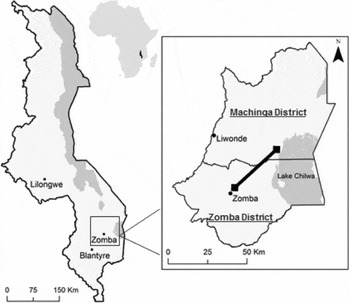
The study was conducted in four villages located in the districts of Zomba and Machinga (southern Malawi). The villages were selected as part of the Ecosystem Services for Poverty Alleviation (ESPA) Attaining Sustainable Services from Ecosystems through Trade-off Scenarios (ASSETS) project (http://espa-assets.org/) and are located on a transect between Lake Chilwa and the Zomba-Malosa Forest Reserve (Fig. 1; Appendix S1; available online).
Map of Malawi detailing the main water bodies (shaded) and cities (labelled points). The location of the transect line on which the study sites are located is indicated.

Inventory methods
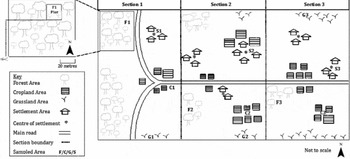
In June and July of 2013, three 20 × 20 m sample plots were established within each dominant land use (forest [predominantly miombo woodland], settlement, cropland and grassland) of the four study villages using a random stratified sampling strategy (see Appendix S1), resulting in 48 plots in total (Fig. 2). Within plots, the diameter at breast height outside bark (DBH; 1.3 m) of living woody flora >0.5 cm DBH was measured to the nearest millimetre using a calliper or diameter tape, in accordance with the RAINFOR methodology (Phillips et al. Reference Phillips, Baker, Feldpausch, Brienen, Almeida and Arroyo2009). Species positions were recorded using a global positioning system (Garmin GPSmap 60CSx). Banana and bamboo species were excluded from this study due to classification as a perennial crop or grass. The vernacular name (in Chichewa or Yao) and growth rate category (fast/medium/slow/unknown) of a species was provided by a local expert (Appendices S1 and S2).
Diagrammatic representation of the establishment of inventory plots.

Interviews
Semi-structured interviews were carried out with the village headman, accompanied by the Village Natural Resources Management Committee (VNRMC) member in each of the four villages (eight people in total). Interviewees were asked about harvesting practices and also to estimate the time period for which they considered that the tree resources within the villages would remain intact in order to establish local perceptions of sustainability. Specific interview questions included:
-
• Where do villagers obtain timber, woodfuel and poles from within the village?
-
• How much of each tree is utilized for timber, woodfuel and poles?
-
• How long do you expect the village forest to last?
-
• How long would you like the village forest to last?
Modelling tree growth
We selected two contrasting models requiring minimum primary input data, which is advantageous for application in data-deficient regions: 1) Methods of Yield Regulation with Limited Information (MYRLIN), a growth and yield model aimed at organizations with limited information on forest dynamics (Alder et al. Reference Alder, Baker and Wright2002); and 2) the Lund–Potsdam–Jena generalized ecosystem modelling framework (LPJ-GUESS), a forest process model that combines the LPJ global dynamic vegetation model (LPJ-DGVM) with the forest gap model FORSKA (Smith et al. Reference Smith, Prentice and Sykes2001; Sitch et al. Reference Sitch, Smith, Prentice, Arneth, Bondeau and Cramer2003).
MYRLIN
MYRLIN was used in this study to model current above-ground biomass (AGB) growth rates within land use categories. It assumes that the pattern of diameter increment (Dinc) of tropical trees is similar, allowing predictions to be made about tree growth rates (Vanclay Reference Vanclay2003). Species were grouped by growth rate (fast/medium/slow/unknown) for simulation of the mean Dinc (cm year–1) for each land use category within the four villages, producing village-specific Dinc values (Appendices S2 and S3). To produce more generic study area estimates, the data from the four villages were combined to create an overall mean Dinc for each land use, weighted by the number of trees present in the given land use (Fig. S3.1, Step 1). The overall mean Dinc values were calculated using Microsoft Excel 2007 and IBM SPSS Statistics 21.
To calculate the sustainability of current annual tree off-take (kg per capita), the Dinc (cm year–1) required conversion to AGB growth (kg ha–1 year–1). AGB growth was estimated using the tropical dry forest – excluding tree height – allometric model of Chave et al. (Reference Chave, Andalo, Brown, Cairns, Chambers and Eamus2005). Due to a lack of species-specific wood density data, which are often only available for a proportion of species in an inventory plot (Flores & Coomes Reference Flores and Coomes2011), the mean value for African species from a global tropical forest database of 16 468 records (0.6047 g cm–3) was used (Chave et al. Reference Chave, Coomes, Jansen, Lewis, Swenson and Zanne2009; Zanne et al. Reference Zanne, Lopez-Gonzalez, Coomes, Ilic, Jansen and Lewis2009).
The estimated AGB growth was calculated by subtracting the measured biomass (based upon DBH only) from the modelled annual biomass increase (DBH + Dinc) in the plot (Fig. S3.2, Step 3). This was then multiplied by the number of trees in a given plot, converted to kg ha–1 year–1, and a 95% confidence interval (CI) was calculated for the mean AGB growth per land use type. Therefore, our CIs address plot natural variability and sampling error in estimating biomass growth, but ignore the unknown modelling error within MYRLIN. The latter is beyond the scope of this investigation, but has been reported elsewhere (Smith et al. Reference Smith, Prentice and Sykes2001; Vanclay Reference Vanclay2003).
Estimation of land use area
To estimate the sustainable off-take at a village level from MYRLIN, the means of the plot-scale estimates were multiplied by the available area of the relevant land cover. The areas of forest, grassland and cropland in each village were derived from the GlobCover 2009 land cover map (European Space Agency 2010). GlobCover does not provide the area of settlement; therefore, this was calculated by measuring the area of 100 randomly selected homesteads (defined as the area of land including and immediately surrounding houses) in each village using ArcMap10.1 software. The mean area of homesteads was multiplied by the number of houses present in the village to obtain a settlement value (MASDAP 2013) (Appendix S4). This was removed proportionally from the other land cover areas. The model-derived AGB growth was multiplied by the area of the respective land use in each village in order to gain a village-level estimation.
LPJ-GUESS
LPJ-GUESS is used to simulate natural vegetation dynamics in response to inter-annual climatic variations, in the absence of human interference (Smith et al. Reference Smith, Prentice and Sykes2001). It has been applied in a number of studies estimating vegetation dynamics and carbon exchanges at regional and local scales (e.g. Morales et al. Reference Morales, Hickler, Rowell, Smith and Sykes2007). LPJ-GUESS was utilized in this study to investigate the degree to which climatic variables affected tree growth rates within the study area in order to establish the sensitivity of off-take rates to climate change. The annual biomass growth data was simulated for the period 1995–2005 at a resolution of 0.5 degree latitude × 0.5 degree longitude, resulting in two cells of interest, with three of the study villages in one cell and the fourth study village in the other. Data input included precipitation, temperature, solar radiation, soil data and atmospheric carbon dioxide concentration, obtained from the Climate Research Unit Time Series 3.0 dataset (Harris et al. Reference Harris, Jones, Osborn and Lister2014). The model yields information on the carbon biomass, including roots (estimated to contribute 25% to AGB) (Lewis et al. Reference Lewis, Lopez-Gonzalez, Sonke, Affum-Baffoe, Baker and Ojo2009). Carbon biomass is assumed to be 50% of dry biomass (Chave et al. Reference Chave, Andalo, Brown, Cairns, Chambers and Eamus2005).
RESULTS
AGB growth within the study area
The 48 plots sampled contained 909 stems from 118 species (Appendix S2), indicating large diversity in tree species. Trees in forest areas displayed the smallest DBH (mean 6.5 [95% CI 5.55–7.53] cm) values in comparison with grassland (mean 8.61 [95% CI 5.39–11.82] cm), settlement (mean 15.18 [95% CI 12.95–17.41] cm) and cropland (mean 27.98 [95% CI 20.62-35.33] cm), respectively. Tree growth was dominated by trees of less than 5 cm DBH in most plots in all land use categories.
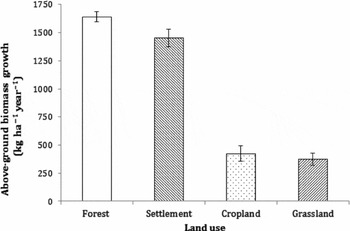
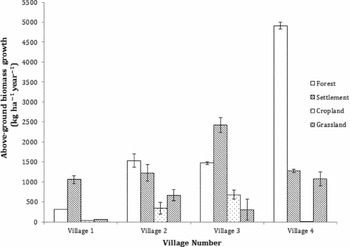
Using MYRLIN, the estimated AGB growth was variable across the study area (Fig. 3) and between land uses within villages (Fig. 4). The largest AGB growth – and thus the largest sustainable yield – within the study area was found in the forest land use category (mean 1639 [95% CI 1594–1684] kg ha–1 year–1), followed by a settlement area (mean 1453 [95% CI 1376–1530] kg ha–1 year–1). Cropland and grassland displayed the lowest annual AGB increases per unit area in all villages. The largest AGB growth within villages was found in the forest land use in Village 4 (mean 4913 [95% CI 4821–5006] kg ha–1 year–1; Fig. 4). The settlement land use category in Village 3 had the second largest AGB growth per hectare (mean 2419.08 [95% CI 2230–2608] kg ha–1 year–1).
Above-ground biomass growth within land use categories in the study area, derived from MYRLIN predictions. Error bars display 95% confidence limits.

Above-ground biomass growth for land use categories within the villages, derived from MYRLIN predictions. Error bars display 95% confidence limits.

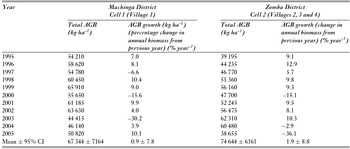
The AGB biomass modelled using LPJ-GUESS (1995–2005) varied temporally between the Zomba and Machinga districts. This was subsequently reflected in the annual change in AGB (Table 1). Both districts displayed large climate-driven decreases in AGB in specific years; Zomba District displayed large decreases in 2000, 2004 and 2005, whilst Machinga District displayed large decreases in 1997, 2000 and 2003.
The annual modelled above-ground biomass (AGB) of trees and changes in AGB for grid cells containing the Zomba and Machinga districts (1995–2005) derived using LPJ-GUESS. AGB estimate based on roots contributing 25% of above-ground live tree carbon from an African literature estimate (Lewis et al. Reference Lewis, Lopez-Gonzalez, Sonke, Affum-Baffoe, Baker and Ojo2009).

Off-take rates
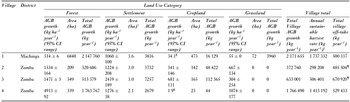
Using local government data to estimate the mean annual consumption of wood (off-take rate = 570.51 kg per person) (Government of Malawi 2010) (Appendix S5) and assuming that the annual sustainable harvest rate of the modelled AGB growth for the individual villages was 80% (Appendix S6), it can be seen that Villages 1 and 4 are currently harvesting wood within sustainable limits, while Villages 2 and 3 have annual deficits of 187 000 kg and 165 000 kg (Table 2), respectively. To meet the current off-take, Village 2 requires a forest area of at least 317 hectares and Village 3 requires a forest area of at least 456 hectares.
Summary of above-ground biomass (AGB) growth values for land use categories in the villages derived using MYRLIN. Estimates and 95% confidence limits displayed are based upon AGB in live trees of more than 0.5 cm diameter at breast height. †Settlement area was derived from ArcMap calculations (Appendix S7). ‡A sustainable harvest rate of 80% of the total AGB growth was assumed (Appendix S5). §Sample size of 1, therefore 95% confidence intervals (CIs) cannot be calculated. ¶Current off-take has surpassed the AGB growth.

Village interviews
Most villages had access to forest areas that provided timber products, notably firewood, timber and poles, in addition to non-timber forest products (NTFPs). Informants mentioned NTFPs, including the provision of shade, medicinal products and fruit, as the additional ecosystem services that people gained from trees (Appendix S7). Harvesting of timber often involves the felling of large trees, whereas harvesting of firewood and poles only requires that part of the tree is cut, allowing future regrowth of trees (Appendix S7).
Opinions on the future of trees and village forest areas differed between villages. Informants in Villages 1, 2 and 4 desired for trees within the villages to be present for their children and explained that they were planting new trees and replacing trees that were felled (Appendix S7). Village 3 informants were less optimistic about the presence of trees and the village forest in the future, and were concerned that there may be few or no trees left within a few years (Appendix S7). The importance of local markets in providing timber products was emphasized (Village 1 and 2) and attributed to the lack of trees present.
DISCUSSION
The impact of people on AGB
Research has mainly focused on the growth rates of trees within forest areas, resulting in AGB growth in the land use categories of settlement, cropland and grassland being less well studied. Historically, this is because the majority of timber products were sourced from well-stocked forest areas; however, these have become depleted as a result of deforestation (Kuyah et al. Reference Kuyah, Sileshi, Njoloma, Mng'omba and Neufeldt2014). Our results highlight the potential for other land uses (e.g. settlements) to provide a source for woody biomass, and therefore more consideration should be given to trees located outside forest areas.
Within the study area, trees located within forests displayed the largest AGB growth, principally because, whilst smaller than trees situated in other land use categories, they were more numerous. Concomitantly, forested land uses provide a higher carbon store than other land uses (Willcock et al. Reference Willcock, Phillips, Platts, Balmford, Burgess and Lovett2012; Willcock et al. Reference Willcock, Phillips, Platts, Balmford, Burgess and Lovett2014). Despite this, findings from this study show that a sizable proportion of AGB growth exists in areas outside of forests, supporting other studies, both in Malawi (Zulu Reference Zulu2010) and across the globe (de Foresta et al. Reference de Foresta, Somarriba, Temu, Boulanger, Feuilly and Gauthier2013), which found that biomass harvesting activities were undertaken across a range of land uses (Appendix S1).
The modelled AGB growth per hectare for forested land uses was largest for villages containing many fast-growing, large, non-native species such as pine (Pinus spp.) and blue gum (Eucalyptus globulus) trees, which had been specifically planted to provide timber. Growth rates of plantation forests are higher (7000–13 000 kg ha–1 year–1) than that of natural miombo woodland (530–2740 kg ha–1 year–1) (Eggleston et al. Reference Eggleston, Buendia, Miwa, Ngara and Tanabe2006). Supplementing existing forest with small-scale plantations of fast-growing, non-native trees to provide timber products is an increasingly common practice within rural villages in Malawi as a result of government policies encouraging investment in plantations in order to meet woodfuel demand (Dewees Reference Dewees1995; Kuyah et al. Reference Kuyah, Sileshi, Njoloma, Mng'omba and Neufeldt2014). However, there are potential ecological implications associated with clearing natural forest and replacing it with plantations, including reductions in species diversity, soil quality and the supply of NTFPs, microclimate impacts and increased water consumption for certain species (Burley Reference Burley2012). Further research into species used for tree stock replenishment would be valuable in order to ensure that the species planted are suitable to meet short- and long-term village needs.
The impact of climate on AGB
Total AGB values modelled using LPJ-GUESS for the Machinga (67 344 ± 7164 kg ha–1) and Zomba districts (74 643 ± 6161 kg ha–1) were larger than that previously documented in miombo woodland (22 310–42 470 kg ha–1) (Ryan et al. Reference Ryan, Williams and Grace2011; Shirima et al. Reference Shirima, Munishi, Lewis, Burgess, Marshall and Balmford2011; Kuyah et al. Reference Kuyah, Sileshi, Njoloma, Mng'omba and Neufeldt2014). This is likely to be attributable to LPJ-GUESS modelling vegetation in the absence of humans. For example, Brown (Reference Brown1997) estimated that the potential average total AGB of African lowland dry forest in the absence of human influence is 92 000 kg ha–1, but due to human influence, the total AGB is closer to 60 000 kg ha–1. Whilst lowland dry forests can be quite different to miombo woodlands, these findings demonstrate the substantial impacts that human disturbance can have on AGB, and thus they have implications for the successful utilization of LPJ-GUESS within miombo woodland, which is characterized by human disturbances such as deforestation, grazing, land conversion and the cultivation of indigenous and non-indigenous species.
Since LPJ-GUESS simulates vegetation dynamics in response to the climate, the variation in AGB growth is associated with local and regional climatic conditions that occurred between 1995 and 2005. Productivity of miombo woodland is primarily a function of soil moisture and rainfall availability (Ngongondo et al. Reference Ngongondo, Xu, Tallaksen, Alemaw and Chirwa2011); therefore, a reduction in these environmental variables would impact upon the amount of off-take villagers can harvest sustainably. Malawi experiences inter-annual variability in rainfall, and the years that displayed the largest modelled annual decreases in tree biomass within the Zomba and Machinga districts (1997, 2000–2002 and 2005) coincided with drought conditions in Malawi (Government of Malawi 2010). In addition, natural disturbances such as fire are a frequent characteristic of vegetation dynamics within miombo woodland (Ryan & Williams Reference Ryan and Williams2011). LPJ-GUESS incorporates fire disturbance (Smith et al. Reference Smith, Prentice and Sykes2001), and this may have also contributed to the decreases in AGB in the years that experienced large reductions. The years that showed a reduction in AGB suggest high natural tree mortality, meaning that all off-take within the villages further decreases AGB and is unsustainable. This has large implications for determining the sustainable harvest rate and highlights the importance of incorporating climatic considerations when modelling future sustainability.
Comparing MYRLIN and LPJ-GUESS
There is no single best model or modelling framework for modelling tree growth; every model has advantages and disadvantages and, in many cases, more than one model is appropriate for application. The strengths of yield models (e.g. MYRLIN) are often the weaknesses of process models (e.g. LPJ-GUESS) (Porté & Bartelink Reference Porté and Bartelink2002). MYRLIN and LPJ-GUESS both require different data inputs and subsequently simulate results that cannot be quantitatively compared, for example, at a village level.
MYRLIN has the advantage of being an open access model that has the ability to incorporate field survey data and can be adapted to reflect local knowledge of tree species (Vanclay Reference Vanclay2003). This study has demonstrated MYRLIN's ability to establish the current baseline of tree cover and growth in different land uses within data-deficient areas. Despite this flexibility, a more comprehensive understanding and application of forest dynamics is required (Appendix S8). Forest yield models assume that climatic conditions remain constant and therefore the tree population in a given area is relatively stable and will return to equilibrium if harvested sustainably (Sileshi Reference Sileshi2014). Climate change encompasses variations in the conditions that govern tree growth, whereas yield models disregard some important underlying factors of tree productivity (Monserud Reference Monserud2003). Consequently, the usefulness of the results derived from MYRLIN may be limited because changing climatic conditions may well mean that future tree growth rates deviate from those observed in the past.
The sustainable harvest rate will vary according to climatic conditions, as highlighted by our LPJ-GUESS results for Malawi. The most useful models are those that are sensitive to the effects of climate change on tree development over long periods (Monserud Reference Monserud2003). LPJ-GUESS can be utilized where site-specific information is not available, and it can be adapted in order to incorporate human influence (Pfeiffer et al. Reference Pfeiffer, Spessa and Kaplan2013). LPJ-GUESS has also been used to indicate the influence of future climate change on vegetation dynamics at district and regional levels (Hickler et al. Reference Hickler, Vohland, Feehan, Miller, Smith and Costa2012); however, it is difficult to validate the results of LPJ-GUESS in data-deficient regions that are characterized by human disturbance (Appendix S8).
The limitations of both models indicate uncertainty around the AGB growth rates given here (Appendix S8). Future growth rates will depend on the rate of climate change and its impact on the conditions for tree growth (Appendix S1). A decline in biomass growth would likely negatively impact human wellbeing in the region, although this could be mitigated by introducing new tree species that are better suited to future climatic conditions than the present mix of tree species.
CONCLUSION
This study highlights the importance of the inclusion of trees located outside of forest areas in growth studies such as this. The AGB growth rates modelled in this study provide useful benchmarks against which future changes might be compared and can be used to support sustainable forest management practices alongside the tree planting initiatives that have already been established by local people. Due to anticipated future climate variability and anthropogenic disturbance in Malawi, sustainable future off-take rates should incorporate both of these impacts on vegetation dynamics, as well as an understanding of who benefits from the derived ecosystem services. Such integrated models will provide a more dynamic assessment of sustainability within data-deficient areas, such as the miombo woodlands in Malawi.
ACKNOWLEDGEMENTS
We acknowledge A. Nicholass, D. Alder, J. Sanudi, C. Mazombwe, E. Mbingwani, M. Likoswe, H. Chapama, C. Brough, D. Kafumbata, M. Joshua and the researchers from Leadership for Environment and Development for Southern and Eastern Africa for their assistance with this investigation. Additionally, we thank all of the villagers and the Village Natural Resource Management Committee members for their knowledge, hospitality and assistance. We also thank T. Hickler for assistance in using LPJ-GUESS. We also thank our three anonymous reviewers, whose comments greatly improved the manuscript.
FINANCIAL SUPPORT
This research is an output of the project ‘Attaining sustainable services from ecosystems through trade-off scenarios’ (ASSETS) (NE-J002267-1), funded with support from the Ecosystem Services for Poverty Alleviation Programme (ESPA). The ESPA programme is funded by the Department for International Development (DFID), the Economic and Social Research Council (ESRC) and the Natural Environment Research Council (NERC). Additional funding was provided by the Engineering and Physical Sciences Research Council (EPSRC) Vacation Bursary (EP/L505067/1). Neither funder had any involvement in study design or writing of the report.
CONFLICT OF INTEREST
None.
ETHICAL STANDARDS
The authors assert that all procedures contributing to this work comply with the ethical standards of the relevant national and institutional committees on human experimentation and with the Helsinki Declaration of 1975, as revised in 2008. Our study conforms to national, local and institutional laws and requirements, both in the United Kingdom and Malawi. Where human subjects were used, we obtained express permission and respected their privacy.
Supplementary material
To view supplementary material for this article, please visit https://doi.org/10.1017/S0376892916000485