1. Introduction
Through a body of work conducted by the authors of this text, this article reviews the practice of performance-installation and its relationship to music improvisation. Our research draws directly on two tours of the UK, the first in 2018 and the second in early 2020. The tours, named ‘Sacrificial Floors’ and ‘Points of Failure’, were organised around predominantly small, independent art/music spaces over a short, focused timeframe. By presenting work in this way, we could reflect upon, adapt and evaluate previous performances and apply this practice-thinking to our next performance. To accompany this text, we provide video and audio recordings of ‘Sacrificial Floors’(Video Example 1) Footnote 1 and ‘IKLECTIK – Points of Failure’(Sound Example 1). Footnote 2
Our work is motivated by the practical engagement of performing at various public events, which directly inform our discussion in the final section. Here we discuss making as a performative event, material engagements with sound and expanded and reduced instruments. Our interests bridge DIY technology, forms of making, improvisation and sonic art.
2. Performance-installation in Context
[O]bjects and things are used to make sound; objects and things are played and performed; objects and things are exhibited; objects and things occupy a space; objects and things dictate readymade actions; objects and things become points of interaction; and objects and things are made and unmade (broken). (Richards Reference Richards, Grant, Matthias and Prior2021: 188)
In his chapter ‘Sacrificial Floors and Tables: Making/Unmaking Sound’, Richards attempts to set out what can be considered as performance-installation (Richards Reference Richards, Grant, Matthias and Prior2021); the preceding quote offers a summary. In its simplest form, performance-installation can be seen as a hybrid of installation and performance art. Richards elaborates on this by suggesting that performance-installation is ‘a nexus between performance and installation art, DIY electronic music and maker culture’ (ibid.: 187). He draws on the work of Tetsuya Umeda to further highlight characteristics of performance-installation.
Richards continues by suggesting that the origins of performance-installation lie in the Fluxus movement, citing the multifaceted Happenings, where many things happen at the same time, and the often short, enigmatic, Haiku-like instructions of Event scores, which are action-based and routinely call for making, breaking, assembling and disassembling. He points to George Brecht’s The Cabinet, where not only readymade objects but also what Brecht termed ‘readymade actions’ are employed. The readymade action is viewed as a critical concept in terms of defining performance-installation. As indicative examples of performance-installation, he also discusses the work of Alison Knowles, Otomo Yoshihide and Christian Marclay, and Kanta Horio.
Building on this chapter, in this article we will set out a more detailed definition of performance-installation. There are a number of key points to address: making and unmaking, and making in public; sound ‘through’ materials and materials at hand; readymade actions and attending to a sound; space, site and architectural features as material; and the expanded relationship between audience and performer. For clarity, we will use the term ‘audience’ to denote the public that attend performance-installation. We should also emphasise that in the context of this discussion, the ‘installation’ part of performance-installation more specifically refers to sound installation; in the work discussed here, sound is our primary concern.
2.1. Making/unmaking
Making and unmaking are critical parts of performance-installation. This involves being actively engaged in working with and through materials in front of an audience of a performance-installation. Some researchers in art and design have named this ‘public making’ (Shaw and Bowers Reference Shaw and Bowers2015). The making is primarily focused on sounding artefacts and devices, things that make sound or things to make sound. The building and assemblage of circuits, patching together of sound-making modular systems, operation of and attendance to mechanical automation, the setting up and positioning of amplifiers and loudspeakers are but a few examples of making activities that lend themselves to performance-installation. Unmaking, dis-assemblage, de-construction and reconfiguration are also part of the making/unmaking performance-installation paradigm and can form part of an interconnected web of actions.
Richards has also previously proposed that in his work ‘performance begins on the workbench and is extended onto the stage’ (Richards Reference Richards2008: 25). However, this is not the case in performance-installation, in which such distinctions between ‘work’ and ‘play’ and their respective spaces are no longer applicable. It is not simply a case of elevating making to performance – for example, live soldering of sound circuits – but of seeing making and performance as a holistic activity, intrinsically related to or dependent on each other. This holistic activity is demonstrated, for example, by media artist Dasha Hewitt. In her performance work 20 Oscillators in 20 minutes she builds 20 breadboard complementary metal-oxide semiconductor (CMOS) oscillators as a performance activity in a given time frame (Hewitt Reference Hewitt2016).
2.2. Materials at hand
As already highlighted, an understanding of performance-installation is intertwined with the act of making and unmaking in public. The stuff that we make things with, the materials, nevertheless play an equally vital role in the making process. It is important to stress here that we are talking about sound ‘of’ and ‘through’ materials rather than the notion of sound as material, or the materiality of sound. ‘Of’ suggests that sound derives from materials, while ‘through’ implies that sound is somehow enacted upon, conditioned in some way by the materials. ‘Through’ also infers a direction of travel, something in flux, dynamic in state.
In an interview conducted by Richards, Tetsuya Umeda discusses the influence of the Japanese Mono-ha movement on his work (Umeda Reference Umeda2018). The Mono-ha movement consisted of a group of artists who, as Joan Kee states, ‘were known for their espousal of things, or objects whose fundamental material properties were allowed to be shown’ (Kee Reference Kee2008: 405). The Mono-ha movement also became known as the School of Things. Among these artists was Lee Ufan, who sought to present ‘the world as it is’ (Ufan 1969, in Kee Reference Kee2008: 405). The Encounter – the encounter between the viewer and the thing – was also a key concept of the Mono-ha movement. In performance-installation there is also a direct working with materials from the bottom up, an approach Richards has previously discussed along with the related ideas of low-level electronics and a music of things (Richards Reference Richards, Collins and Escrivan2017). Materials are brought to the performance-installation space and worked on, and ‘through’, to produce sound. These include electronic components, solder and wire, readymade sound-making objects, appropriated technological artefacts and household items used as acoustic resonators. In addition, performance-installation looks to materials at hand, things found in the performance/install space, and things found en route to the space. Umeda has also considered the audience as a form of source material (Umeda Reference Umeda2017). This could also be applied to other performers/installers.
2.3. Readymade actions: attending to sound
Let’s look again at Brecht’s The Cabinet. A wall cabinet is exhibited in a gallery, containing a number of items such as a clock, mug, yoyo and bottle with liquid. Attendees of the exhibition are invited to take these items from the cabinet and use them ‘in ways appropriate to their nature’, and then return them to the cabinet. Brecht, when reflecting on the work, explains:
The aspect of this work which (to me) is of most interest is not the object-like part, that is, the cabinet and its contents, but rather what occurs when someone is involved with its object-like part. The work to me is more in the nature of a performance (music and dance) than of an object. (Brecht Reference Brecht1960, quoted in Dezeuze Reference Dezeuze2002)
The Cabinet calls for action; for example, the clockwork clock may be wound, or the hands of the clock altered; the yoyo spun; the bottle with liquid shaken or poured. The work was part of an exhibition titled Toward Events: An Arrangement (1959) that included a number of other, what can be called, readymade action pieces, such as The Case and The Dome (see Robinson Reference Robinson2009). These pieces, then, are not set works as such, but works that can be versioned in multiple ways with different objects and different cabinets, cases or containers, each time asking for different interactions and placement and arrangement of objects. These are performance interaction pieces of sorts. The idea of the readymade action as presented here is particularly pertinent when considering performance-installation. Objects and materials are important in performance-installation, but how such objects and materials are enacted upon, engaged with, or animated is also critical. We are left contemplating performing-through-objects and object play, object improvisation, object appropriation, object subversion and ‘object time’.Footnote 3
Performance-installation implies a performance style governed by the constraints of objectively making and installing things and of ‘unperformance’. Performance is seen as an extension of labour. Melodrama, seeking extra-object activity and exaggerated performance gestures, is often played down. Moreover, attending to, rather than playing a sound is an important aspect of performance-installation. This implies that some form of autonomy exists in the sound, or sound-making object. The attendee (the performer/unperformer) observes and listens and acts only when ‘called upon’. Actions are temporal too: how long does it take to install, make, assemble or disassemble a sound-making object? Thus, performance-installation is formed by timeframes of actions and activities, processes and interactions.
2.4. Making in space
The architectural features of the performance-installation space can also be thought of as material; for example, the acoustic features of a room; a window ledge, alcove, or shelf; a side room or cupboard; a low ceiling with beams. There is a link between materials and space. Again, reference can be made to Kaprow and his definition of Happening in that: ‘Its material environments may be constructed, taken over directly from what is available, or altered slightly’ (Kaprow 1966: 3). This calls for the performer/installer to seek performance spaces that go beyond the archetypal black box or white cube; such spaces offer little in terms of raw materials to exploit in performance-installation. This can also be said of the traditional concert hall or front-facing stage. The performance-installation seeks to use the whole space available for performance. Self-supporting electronic sound devices and DIY sound systems help to distribute sound into the corners and cracks of the performance space. Additionally, the ability to create bespoke solutions to sound and space breaks down and expands the concept of a sound stage. Audience and performers are invited to explore these whole spaces in performance, thus creating further points of interaction, movement (performer/listener/observer) and action.
2.5. Audience
In performance-installation, everything in the space has the potential to become part of the performance, including the audience: ‘It follows that audiences should be eliminated entirely’ (Kaprow 1965: 264). Kaprow argues that ‘audience’ elevates performance, for example, to a spectacle, to theatre, something that is above the everyday. If audience is eliminated, people can act as some kind of fluid material within the work. Kaprow was also concerned with shifting the point of attention of the work or questioning the relationship between performer and audience. He likens the performance stage to the centre of a painting’s canvas, an exclusive space (ibid.: 261). By taking the work to the ‘periphery’, the central, exclusive space can be freed up.
Performance-installation does not necessarily elicit what may be described as audience participation. The audience are observers and listeners with the opportunity to engage in the work on different levels and are invited to seek different perspectives of what might constitute the work. It is important to think about scale in such performances, where making, engagement with materials and actions are of human scale. Sounds can also be quiet: this can encourage audiences to ‘come up close’ and freely move around the performance-installation space to see and hear what is going on. Such freedom of movement can also be applied to the performers/installers within the space. There has been previous debate about performance perambulation and promenade performance, where the audience is encouraged to move through the space and between performance substations and microsystems (Bowers et al. Reference Bowers, Richards, Shaw, Frize, Freeth and Topley2016). In this context, performers and audience can be scattered across a space. The audience may stand, walk, sit on the floor (or a chair, table, architectural feature), crouch, kneel, or drink at a make-shift bar. Audience members are dynamic components, active engagers in the performance-installation, not passive consumers. The notion of an ecology is present (Bowers Reference Bowers2002). There is a synergy between audience, space, materials and performer/installer.
3. Performance-installation in Practice
In order to give the reader a taste of the character of performance-installation in practice, we will now describe the authors’ works ‘Sacrificial Floors’ and ‘Points of Failure’ in detail.
3.1. ‘Sacrificial Floors’ (2018)
Our first tour, named ‘Sacrificial Floors’, took its name and inspiration from a book chapter (Richards Reference Richards, Grant, Matthias and Prior2021). This tour was a collaboration between the two authors of this article and Tetsuya Umeda. It included four performances at venues across England over five days in 2018. The idea for ‘Sacrificial Floors’ was to create a series of events that respond to the architecture of the performance spaces and draw on materials and objects we collected on our travels between these spaces. We would begin the tour with an arsenal of basic devices for performance, including mixing desks, DIY synthesisers, a collection of microphones, light bulbs, relay switches and pocket radios. As the title of the tour suggests, we planned to perform our miscellaneous collection of objects and materials from the floor of the performance space. We avoided performing from behind tables and attempted to create an environment that would spread throughout the presentation space.
3.1.1. Northern Charter
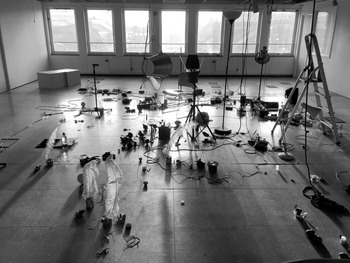
On arrival in Newcastle, we stopped off at a car scrap yard to pick up materials for the evening’s performance. We scavenged horns, lights, speakers, relay switches and amplifiers from the beaten-up cars around the yard. At Northern Charter, an art space which occupies a floor of a former office block, we added to our collection using objects from the space, including bowls, tin cans, microphone stands, a ladder, string and lamps of different shapes and heights (Figure 1).
‘Sacrificial Floors’ performance-installation set up at Northern Charter, Newcastle.

As the audience entered and without announcing a beginning, we animated different parts of the performance space as a trio. Five amplified relays were set in motion, creating rhythmic pulses across the performance space. Speaker drivers were placed upright and in different positions on the floor. The speakers were attached to a variety of amplified outputs from DIY synthesisers and microphones. Different objects were placed directly on the speaker cones to create numerous timbres and textures. The objects were taken on and off the cones at different times throughout the performance. Drips were created using plastic bottles and rubber piping, and these drips were then placed above bowls which could be heard acoustically or amplified using hydrophones plugged into one of the various amps/speakers we had on the floor. The performance lasted around 50 minutes and included moments of playing together as well as in duos and solo.
3.1.2. Centrala
We arrived at Centrala in Birmingham, a rectangular space with white walls, to a smaller performance space than that in Newcastle. For this performance-installation, we decided to use the PA, which would allow us to emphasise low frequencies but we did not want the amplified sounds to drown out the small, more delicate acoustic and locative sounds. A bass bin and top from the PA were placed on a board with wheels so they could be moved freely around the space. Smaller islands of performance activity were set up in the hope that the audience would feel more encouraged to walk around the room, rather than stay at the edges like they had in the previous performance. We set up a collection of objects and materials that greeted the audience as they entered. When walking back to Centrala from the hotel we were staying at, we came across a small market selling bric-a-brac; we bought some glass vases and metallic objects that we would use in the performance.
During the performance, we placed the glass vases around the space with hydrophones inside them to amplify drips and motorised objects in close proximity to them. We moved between our small, shared islands, attending to artefacts placed nearby. These islands gave a clear performance ecology that we could work with individually while contributing to the general soundscape. For example, one performer could be exploring objects amplified through the hydrophones, while another could be moving the speakers on wheels, reflecting the amplified sound off different surfaces of the space. This performance set up also offered a more informal environment where the audience could walk around the islands to create a different dynamic between the audience and performers.
3.1.3. IKLECTIK
IKLECTIK is an artist-run space in south London with a large room and high ceiling with exposed wooden beams. We had all performed previously at IKLECTIK and knew what to expect in terms of set up and the general architecture of the space. Reflecting on the previous evening’s performance, we decided to try another method that would shape our collaborative improvisation. This would include specifically not setting up anything prior to the audience arriving. Getting objects, devices and equipment out of our bags, the set up and the soundcheck would all be a part of the making and unmaking of our performance. The repacking was also part of the performance. This would not only shape the unfolding and closing of the performance but also give us some foundational limitations to performance possibilities.
The unpacking and repacking of our equipment gave the performance a clear sense of shape. Once everything was unpacked from the boxes and bags, we navigated the space, switching things on and off and activating the various systems. After about one hour, the room was full of activity; a very noisy sound and light environment enveloped all parts of the space. We announced a 15-minute break in the performance, but we left the autonomous devices activated so the sound and light continued unattended. The audience used this time to get a drink, to go outside or to explore the performance-installation from different perspectives. After the break, we began to dismantle the installation. Piece by piece the different components were disassembled and put back in their bags and boxes. After around 45 minutes the space was mostly clear again. The piece ended with Umeda performing solo on three large resonating DIY Rijke Tubes (‘hoot tubes’) heated on a small stove provided by IKLECTIK.
3.1.4. Arnolfini
Our final performance of the tour took place at the Arnolfini in Bristol, a large established art space in the centre of the city. We were to perform in the theatre space, which was a large black box with sound-dampening curtains surrounding the room. The tiered seating was pulled back and we presented our work ‘in the round’. Before the performance, we walked around the old docks collecting sounds and bits of scrap metal that we would use in the performance. Hydrophones (which were also used in the performance) were placed into the river next to the Arnolfini to collect underwater soundwaves. We decided against using the in-house PA. As with IKLECTIK, we chose to start the performance with all the objects and devices inside our portable luggage. At the start of our performance, we wheeled our luggage into the performance space and began to unpack. Our actions were directly shaped by construction and deconstruction of the performance-installation. The recorded sounds were placed straight from the recorder to a horn speaker positioned in the centre of the space. As we had a larger space to work with, we attempted to make smaller islands of activities across the performance space. This was successful in diffusing the performance activity across the room.
We decided to take a break in the middle of proceedings but again left many parts of the installation running. As with the performance at IKLECTIK, this gave audience members a chance to see and hear the performance-installation from various perspectives.
3.2. ‘Points of Failure’ (2020)
‘Points of Failure’ was a five-date tour that took place at various art/music spaces across the UK in early 2020. The tour was a collaboration between this article’s two co-authors and directly developed the practice-thinking that emerged from ‘Sacrificial Floors’. For ‘Points of Failure’, we sought to explore the sonic possibilities of objects and materials through live making, failure and improvisation. Again, we used a basic set of materials and objects similar to ‘Sacrificial Floors’. ‘Points of Failure’ was less about collecting materials on the way and more about building an interactive environment with the materials we had at hand and episodic structures for performing through and revealing the failures related to making, performing and DIY electronics.
3.2.1. IKLECTIK
At IKLECTIK, large surface transducers were attached to the grand piano and low bass frequencies were propagated through the wooden lid, frame and strings of the piano. A number of cardboard boxes were distributed across the floor and actuated with motors, lights and solenoids. Seven microphone stands were placed throughout the space and used to hang objects with liquid which dripped into different vessels we found in the venue. Rather than having an interval, we performed one long 50-minute improvisation.
3.2.2. DAI Hall
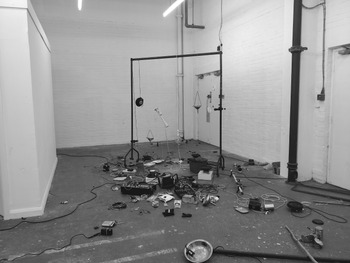
DAI Hall is an empty shop turned art gallery in Huddersfield that has two main spaces: a street-level gallery and a basement. We opted to perform in the basement, which was built from brick and concrete and had a large reverb and no windows so blackout could be achieved.Footnote 4 A kitchen built from partition wooden walls, a somewhat incongruous cube-like structure, occupied the corner of the room. A bass transducer was attached to the roof so that the whole kitchen would become a resonant speaker. An old coat rack was moved from the corner and assembled in the middle of the room for us to hang light bulbs, speaker cones, a funnel for the drips and an air horn. This became a central architecture for the performance-installation to be built around. After the first performance of the tour at IKLECTIK, we decided to bring in some new materials and objects including balloons (which were blown up and stamped on at various intervals), scrap metal attached to two sticks with fishing line, and an air horn (Figure 2).
‘Points of Failure’ performance-installation in the basement of DAI Hall, Huddersfield.

3.2.3. Fuse Art Space
Fuse Art Space in Bradford, like DAI Hall, also occupies an old shop. The performance that evening was shared with another group who also had equipment and instruments set up in the space.Footnote 5 This meant that we decided not to set anything up prior to the beginning of our performance. The install of our sound-making objects and materials would be done live. This proved to be an interesting challenge and would develop the thinking from our ‘Sacrificial Floors’ tour. After the first group had finished, we carried a large plinth from the side to the centre of the space. This marked an ambiguous beginning to our performance. This moment flattened set up, soundcheck and performance into a single event. Lots of failures occurred: we smashed a light bulb, balloons stamped on did not burst and the battery for the air horn ran out halfway through the performance.
3.2.4. Star and Shadow
The Star and Shadow in Newcastle has a black box with theatre-style lighting and a large PA. Again, we set up in the centre of the space and decided to make use of the PA to play low frequencies. DIY synthesisers and a collection of disposable cameras, which had been hacked and modified to create looped-triggered flashes and low frequency sweeps, were employed. We hung objects from a steel truss attached to the ceiling including lights, horn speakers and metallic objects. Two large bowls were placed below the funnels attached to microphone stands to collect drips, which were amplified using hydrophones. We moved through the space creating a performance that was episodic, playing with contrasting dynamics and moving between PA sound and small, locative acoustic sounds.
3.2.5. The Glad Cafe
Our final performance was at The Glad Cafe in Glasgow, a music and art space with a raised stage and medium-sized PA. This event brought together all our previous explorations and discussions. Again, an upright piano was used with transducers attached through which we played low frequencies. We also hooked up to the in-house PA so we could further explore some of the dynamism achieved at the Star and Shadow. Similar to the previous evening, the performance was episodic in nature, which allowed us to try out different combinations of materials, objects and sound aesthetics.
4. Improvisation in Performance-installation
Improvisation exists at all levels and stages of our performance-installations. There are similarities here with much improvised practice and music: there are no scores, schemas or instructions, and predetermined arrangements are kept to a minimum; durations are flexible and decisions are made spontaneously. Our work, to use Cardew’s words when discussing improvisation, ‘is in the present’ and consists of a ‘collection of musical innocents’ (Cardew Reference Cardew1971). As outlined in our definition of performance-installation, making/unmaking, choice of materials, movements and actions, use of space and placement of objects and things in that space, and engagement with audience can all be subject to improvisation. It is from this position that performance-installation asks us to rethink improvisation. Improvisation is not always the first term to be thought of when, for example, making a device or artefact to produce sound. In this context, we may describe our work as following trial and error procedures to create sound circuits or devices, or our scavenging for materials and parts could be seen as following the tradition of objet trouvé or found sound. Finding materials is both serendipitous and improvised. Then finding sound ‘of’ and ‘through’ material can also be spontaneous in nature, unplanned and accidental.
However, there are points of departure when thinking about improvisation and self-expression. Comparisons can be made with Cage when reflecting on performing through objects and materials. Cage veered away from the idea of improvisation. He confessed that: ‘The thing I don’t like about or didn’t like about improvisation was that it was based on taste and memory and it didn’t get the improviser to the point where he encountered a revelation something that he didn’t already know’ (Cage Reference Cage1990: 377). When writing about Cage’s work, Pritchett also argues that improvisation ‘when conducted with natural objects, becomes an act of discovery and not of expression; it is like a walk in the woods, a mushroom hunt’ (Pritchett Reference Pritchett1996: 195). Ingram suggests that Cage only countenanced the use of improvisation when using instruments that could not be controlled (Ingram Reference Ingram2006). Ingram cites Cage’s Inlets (1977) and Child of Tree (1975) as examples of works that employ uncontrollable instruments (ibid.). We will return to this discussion on self-expression, acts of discovery and performing through objects and materials later in this section.
4.1. Expanded and reduced instruments (making/unmaking)Footnote 6
Derek Bailey in his seminal text Improvisation puts forward the idea of Instrumental Impulse, an attitude of the player to the ‘tactile element’ of their instrument (Bailey Reference Bailey1993). Lippit adds: ‘Bailey’s iconic non-idiomatic improvisation manifests as a style of playing that directly addresses the materiality of the guitar itself’ (Lippit Reference Lippit2020: 8). This ‘attitude’ towards the instrument is rooted in physical things, objects, materials and their limitations. We are presented with ‘instrument as object’ and ‘instrument as material’. There are physical boundaries and constraints inherent in such instruments, and finite parameters from which sound can be made. However, in performance-installation, the boundaries of instrument can be expanded and reduced beyond the traditional concept of musical instrument. Let’s take a look at the notion of the expanded instrument.
We have already implied that musical instruments, through making/unmaking, can extend to an assemblage of things, or components that can be patched together, extended, or added to. In our performance-installation, for example, there are a number of instances where the concept of extended instrument is applied. During both tours, we prepared loudspeakers with, among other things, beakers, coins, screws and buttons, and improvised with these preparations. This type of expanded instrument relates to transduction – the conversion of energy from one form to another – and sympathetic vibrations. A relational aesthetic is established between the materials in the performance-installation space, and the performer/installer develops such relationships through improvisation.
In addition to transduction, we expanded our instruments through considering fields, specifically electric magnetic fields (EMFs). For example, a radio tuned to static would be placed in the vicinity of an object emitting EMFs. Our hacked and modified disposable cameras produced EMFs when charging and flashing; this in turn would interfere with the radio. The ‘Points of Failure’ tour included performances where radios were hung from a stick and a performer/installer carried the stick and radios, moving through the performance-installation space and the EMFs in an improvised manner. We also worked with Tesla-style spark gaps, that is, small DIY circuits that allowed a high voltage electric current to pass between two bits of bare wire. The spark gaps omit loud, erratic, square-type sound waves accompanied by flashes of blue light. The EMFs created by these devices were not only picked up by the detuned radios but also interacted with other electronic circuits placed within proximal range. For example, a circuit used to turn vibration from a piezo element into a gate signal now interferes with the spark gaps, creating a chaotic interaction between the two devices.
Finally, our instruments were expanded through distributed control signals (see also Bowers et al. Reference Bowers, Richards, Shaw, Frize, Freeth and Topley2016). We shared and improvised with distributed controls signals that included electrical voltages and light. During the ‘Sacrificial Floors’ tour, intermittent flickering lights triggered by water droplets were used as a control signal for vibrating tin cans with feathers. The position of these cans with their light sensors in relation to the light created a complex inter-relationship between processes and performers. A single drip into a bowl of liquid would be amplified (by a hydrophone), cause a light to flicker and cause a tin can in another part of the performance space to vibrate and sound, to rattle. The performers/installers could improvise with any part of this expanded mesh-like instrument at any time. In this example, the concept of instrument is not only expanded to include a range of materials and sounds but also instrumental control is distributed among performers/installers.
On the other side of the coin is the reduced instrument: a disassembled and unmade system, device or circuit. Our performance-installations would often, but not exclusively, follow the process of install/uninstall as detailed in Section 3. Moreover, Richards’s sound circuits in particular encourage not ‘composing inside electronics’, a term suggested by David Tudor (Collins Reference Collins2004), but ‘improvising inside electronics’. Circuits are left deliberately prototypic, unfixed and ‘of-the-hand’. For example, nails and screws are used as terminal posts for wire-wrapped signals. The design of these devices encourages modification and reconfiguration of circuits as live performance, crocodile clips and touch (skin conductance) being often the preferred method of interaction. These devices can, therefore, be easily disassembled (or assembled). These devices/instruments fall into the category of infra-instruments, ‘temporary assemblies of stuff’ (Bowers and Archer Reference Bowers and Archer2005: 6). The examples of reduced instruments and unmaking outlined here can also be applied in reverse to making and to expanded and assembled instruments.
One more category of reduced instrument relates to raw material as instrument, where material is finite and resources can be expended. The ‘Sacrificial Floors’ and ‘Points of Failure’ tours incorporated such materials. For example, dry ice was used to create a range of sounds and visual stimuli. This included resonating objects, creating gas for popping canisters and bottles, and bubbling liquid (hydrophone). In the ‘Sacrificial Floors’ tour, a car battery was used for powering lights and sounding car horns. As the tour progressed, and with no means of recharging the battery, car horn improvisations became quieter and less dynamic as the battery charge depleted. Other such finite materials encompassed popping candy in beakers (amplified), lead-acid battery for a compressor driving air horns and balloons bursting. The materials mentioned here have a limited life span, and when thought of as material-as-instrument, bring another dimension to improvisation: the performer/installer is working with conserving energy, or what might be considered as ‘playing and improvising with resource’.
4.2. Wayfaring (materials at hand)
As well as improvisations with materials found within the performance space, we also consider the act of collecting and working with materials found ‘along the way’ as a form of improvisation. This extends our performance actions from the space, to the journeys taken between performances and geographical locations. Our whole tour could be seen as an improvisational event, engaging with materials and sound worlds we stumbled across during our expedition. For example, our visit to the car scrap yard before the Newcastle performance gave us new sonic possibilities and informed how we performed at Northern Charter that evening. At Centrala we explored the nearby canal for detritus and rubbish as well as visiting a nearby market. These newly acquired devices informed the way we performed with each other that evening and invited new ways to improvise.
These expeditions were all part of the practice; the journeys between places directly influenced our material practice. As we built up a collection of objects and devices, the sonic possibilities became more varied and complex. Approaching performance in this way flattened our familiarity with particular techniques and technologies; we each had to form new improvisational relationships and associations with the materials we collected. The ‘materials at hand’ were also the things we could collect along the way. In his book Lines, Tim Ingold (Reference Ingold2016) considers ‘two modalities of travel’, wayfaring and transport. Wayfarers travel in response to the ‘perceptual and material’ characteristics of the environments they move through; they pause, meander and take influence from the specifics of these places:
Even the wayfarer, of course, goes from place to place, as does the mariner from harbour to harbour. He must periodically pause to rest, and may even return repeatedly to the same abode or haven to do so. Each pause, however, is a moment of tension that—like holding one’s breath—becomes ever more intense and less sustainable the longer it lasts. (Ibid.: 78)
Transport, on the other hand, is more ‘destination-orientated’:
For the transported traveller and his baggage, by contrast, every destination is a terminus, every port a point of re-entry into a world from which he has been temporarily exiled while in transit. This point marks a moment not of tension but of completion. (Ibid.: 79–80)
We consider our work to be a form of wayfaring, though we have particular destinations in mind when beginning a tour; we allow our journeys, the travelling between places, to inform the material characteristics of our work. We continue to change, adapt and respond through improvisation to the spaces and environments we move through, similar to Cage looking for mushrooms in a forest.
4.3. Action and improvisation (readymade actions: attending to a sound)
We have already talked about the readymade action as a constitutive component of performance-installation and from this we can arrive at improvisation as a set of actions. Some comparisons can be made between Brecht’s concept of the readymade action and James Gibson’s theory of affordance: ‘different objects of the environment have different affordances for manipulation’ (Gibson Reference Gibson1979: 128). A hammer, for example, affords striking something: the user grasps its handle and hits another object; while a chair ‘demands’ to be sat upon. Both these objects dictate a specific relationship with their user. If we look again at the example of the clockwork clock, there are many ways in which such a clock could be wound. For example, the time it takes to fully wind a clock, or the positioning of the clock’s hands or setting the alarm, could be improvised, in that the duration, the settings, are not predetermined or known beforehand, nor perhaps has that particular action been chosen by the performer prior to the moment of its performance. The readymade action also calls for the performer/installer to interrogate such actions, to possibly subvert or work against the expectation of an object’s associated action: to unmake the readymade action. With this comes a whole set of possibilities from which object play, performing through objects and improvisation can be approached.
Our readymade actions derived from a number of objects and materials, an illustrative case being CD trays from old desktop computers, with their motor and gears, and the action of opening and closing the tray in the manner of a concertina or squeezebox to directly drive a loudspeaker. Other readymade actions came from: pulling string attached to speakers suspended from beams and/or the ceiling, blowing up balloons and patching cables of a modular synth. It is important to note that the installation of our sound-making devices, materials and instruments as performance followed a course of action, a chain of events that led to sound happenings. For example, consider the first step of unpacking cases (e.g., Brecht’s The Case) where the order of items drawn from the case and their employment in the performance-installation was improvised, or the pouring of water from a jug or kettle into a bowl or vessel to then be improvised with. There were silent actions too, such as placing, then climbing a ladder to hang apparatus. These silent actions, however, had the potential to set something sounding moments or minutes later, and worked as a series of ‘implied sounds’ that may or may not have been realised as sound at different points in the performance.
Closely connected to readymade actions is the idea of instrumental control or lack of control. We have already mentioned Cage’s view on uncontrollable instruments and their use in improvisation. We brought pre-made sound circuits with us on tour, some of which could be considered uncontrollable (see Wainwright and Richards Reference Wainwright and Richards2019). A feature of ‘Points of Failure’ was improvised duets on uncontrollable sound circuits. This also served as a way of scrutinising the human–human, human–machine relationship. These duets were not about self-expression as such but about being led by the ‘nature’ of the sound circuits which in turn called for improvised responses: responses to ‘accidental’ sounds, uncontrollable instruments and ‘failures’ of the performer/performers.
Uncontrollable instrument can also be extended to include an unstable system. A system may also change state over time, oscillating between stable and unstable. These systems demand different levels of attendance or courses of action at different times. At IKLEKTIC we placed a bass transducer on a small table along with a range of objects, such as a metal bowl, oil can and stainless-steel butter dish. Low frequencies played through the transducer caused the objects to vibrate across the table and eventually fall onto the floor, each fall leading to a unique sound event. The readymade action here was for the performer/installer to locate the fallen object from its resting place and reinstall it on the table. The improvisation of positioning/repositioning objects on the table and their proximity to each other resulted in their resistance or compliance towards being shaken from their perch. This too is yet another example of the expanded instrument discussed earlier.
4.4. Improvisation with site (making in space)
All the performances we conducted responded to the performance-installation space through improvisational methods. This happened in a number of different ways: exploring the physical architecture (ceiling, floor, doors and rooms adjacent to the performance space); through the sonic architecture (reverberance, surface transduction and material make-up of the room); and objects and artefacts found within the space (buckets, stands, freestanding structures, kitchen utensils and scrap material). At DAI Hall, for example, we attached bass transducers to the partitioned kitchen using the room as a resonant chamber. This is yet another example of the concept of expanded instruments, as presented previously, and how devices we bring with us allow us to extend and augment the spaces we are working within. At the Arnolfini, we journeyed around sites close to the performance space to collect sounds and other materials related to the local environment. These materials were then brought into and used in the performance space. By doing this we formed a hybrid, interconnected space comprising different superimposed environments. During the performances at IKLECTIK, we used wooden beams to hang different objects from, such as horn speakers, lights and dripping mechanisms. The beams informed where hung objects could be placed and therefore influenced the shape of the performance-installation as well as the way we navigated this space.
Researcher and musician Lauren Hayes has unpacked ideas of site-specific, site-sensitive and site-responsive within a musical practice (Hayes Reference Hayes2017). She offers site-responsive as an alternative to site-specific to consciously consider performers, audiences and the environment that co-exist within the site. Her work Sounding Out Spaces (ibid.) discusses a series of performances responding to ‘non-traditional’ spaces using microphones, loudspeakers and electronics alongside objects, materials and the environmental characteristics of the site itself. Our work continues Hayes’s thinking, and we attempt to collaborate with, and resituate our practice in relation to, the environmental conditions of the site we are performing within. Through performance-installation we not only respond to the environments and ecologies we are performing within but also build new, interacting environments within these spaces. By doing this we learn about the conditions of the site but also give elements of the site a voice through our exploratory, improvisational interventions (Hogg Reference Hogg2013; Shaw and Bowers Reference Shaw and Bowers2020).
4.5. Virtuosity in listening (audience)
We have talked about the ‘nature’ of a device, readymade actions, affordances and uncontrollable instruments and unstable systems. These issues challenge the notion of how sound is made in/as performance, and how improvisation may be viewed.
There are clear distinctions between attending to a sound and performing on an instrument. As we have stressed earlier, attending to a sound infers that a sound or sound-making object has some kind of autonomy or agency, and performance happens at ‘arm’s length’. For example, the materials and devices we often chose to perform with have very little convention in terms of a musical repertoire (how does one improvise a light bulb?). While ‘performing on’ suggests something is enacted upon, an object is met by some form of external force. Throughout our performance-installation, we looked towards working with self-supporting and generative systems. A system would be installed; this could be, for example, a dripping tube where droplets would fall into an amplified bowl of water, or the heating and cooling of DIY Rijke Tubes, or switching on a generative digital noise synth. Once these sound-making systems were established, they would be largely self-supporting. However, these systems did not eliminate improvisation. For example, the drips would become a source for improvisation: the water supply of the drips would be manipulated; resonating objects would be used to interrupt the drip’s pattern; and drips would be collected in different vessels with and without liquid, amplified and acoustic.
The inherent instabilities of the systems outlined in this article all call for the performer to take on the role of the attendee. ‘To attend’ places an onus on listening and observing, and for the attendee to be present and to follow – what we might call, a duty of care. The attendee may also maintain or break the behaviour of a system. This ultimately leads to further questions surrounding virtuosity within improvisation. Listening and observing are at the core of attendance. This does not, however, imply that the attendee is a passive, objective listener/observer in performance. Listening and observing become dynamic actions of performance and improvisation. On the face of it, it would appear that the attendee displays an order of detachment from sound-making, standing back from the ‘centre of the stage’, unperformance as we have called it. However, we argue that in such a context, virtuosity is in the listening.
Moreover, we consider improvisation as not being wholly reliant on self-expression. What our performance-installation teaches us is that it asks for a different type of ‘performer-state’. This performer-state can be best understood by looking again at Gibson’s theory of affordance:
An affordance cuts across the dichotomy of subjective-objective and helps us to understand its inadequacy. It is equally a fact of the environment and a fact of behaviour. It is both physical and psychical, yet neither. An affordance points both ways, to the environment and to the observer. (Gibson Reference Gibson1979: 129)
The performer-state we have outlined brings the performer closer to the audience, and the audience closer to the performer. Both performer and audience are involved in the action of listening and observing.
5. Conclusion
In this article, we have arrived at a broader definition of musical instrument that encompasses ‘instrument as object’ and ‘raw material as instrument’. This has led us to rethink how improvisation may be directly applied to ‘playing with resource’. We have also come to view ‘instrument’ as a distributed mesh-like structure in which collective improvisation may occur. Our journeys between places and materials found ‘along the way’, a form of wayfaring, are considered as part of the work itself. As performers we are often being asked to ‘attend to’ sound rather than ‘play’ an instrument. This ‘attendance’, nevertheless, is seen as an active part of performance and improvisation where listening is foregrounded and suggests a new type of performance-state. From this position, we claim that virtuosity is in the listening. Finally, we question self-expression in improvisation and view affordance as a way to break down the dichotomy of subjective–objective responses in improvised performance. Perhaps most importantly, what results from all the preceding is a refreshing performance context that is inspiring for both performers and audience. It is a context that we look forward to continuing to develop and explore in our future practice.