Vancomycin-resistant enterococci (VRE) are common in some parts of the world, including South East Asia.Reference Humphreys 1 , Reference Cai, Chan and Fisher 2 Reductions in VRE prevalence have been achieved through a number of different measures.Reference Humphreys 1 , Reference Passaretti, Otter and Reich 3 , Reference Hayden, Bonten, Blom, Lyle, van de Vijver and Weinstein 4 Active surveillance combined with contact precautions remains a common approach shown to reduce transmission.Reference Humphreys 1 , Reference Diekema and Edmond 5 Contaminated surfaces play an important role in the transmission of VRE; most prevention and control strategies include measures to decontaminate the environment.Reference Hayden, Bonten, Blom, Lyle, van de Vijver and Weinstein 4 , Reference Otter, Yezli and French 6
VRE emerged at our hospital in the mid-2000s and the VRE rate continued to increase despite implementation of targeted active surveillance in 2006. We report the impact of a VRE control bundle directed toward improving screening and isolation of VRE carriers and improving environmental hygiene.
METHODS
The VRE bundle comprised several elements designed to improve the identification and isolation of VRE carriers: (1) an expansion of active surveillance, (2) enhanced precautions signage, and (3) an automated system to identify known VRE carriers on admission. Improvements in environmental hygiene in this bundle included (1) implementation of hydrogen peroxide vapor (HPV, Bioquell, from 30% hydrogen peroxide) for terminal disinfection following the discharge of VRE patients, (2) a change in the bleach cleaning solution, and (3) an audit of general discharge cleaning using fluorescent markers. In addition, education and feedback regarding multidrug-resistant organism rates were provided regularly.
Fluorescent markers were applied to 8 high-touch objects in rooms before standard discharge cleaning, and UV light was used to inspect rooms after cleaning to ascertain adequate removal. In total, 19 rooms were evaluated pre-intervention and 23 rooms were evaluated post-intervention by comparing the rate of fluorescent marker removal. The rates of VRE-positive admission screens before and after the breakpoint were compared. The impact of the automated electronic alert system to identify known VRE carriers on admission was evaluated by comparing the proportion of known VRE carriers incorrectly admitted to an open bay rather than a side room. Fisher’s exact tests were used to compare rates.
A “breakpoint” regression model was fitted to the monthly number of VRE cases per 1,000 admissions from January 2008 to January 2015. The model evaluates potentially differing trends before and after a breakpoint that is estimated by the model rather than specified a priori. Slopes around the breakpoint, mean monthly VRE incidence at the time of the change, and variability around the mean were also analyzed. We used a Markov Chain Monte Carlo routine to estimate parameters, assigning noninformative uniform prior distributions for parameters over their support within a Bayesian analysis.Reference Gelman and Shalizi 7 We performed 10,000,000 iterations, retaining every 100th iteration for sampling from the posterior distribution. Samples were exported to CODA for analysis, including assessing the support for the breakpoint coinciding with the different stages of the intervention. Convergence was assessed visually. The R statistical environment was used for the breakpoint analysis (v 3.0.1). 8
PCR was used to detect vanA or vanB.Reference Dutka-Malen, Evers and Courvalin 9 Enterococci were identified as E. faecium or E. faecalis by PCR or MALDI-TOF mass spectrometry (Bruker Daltonik, Bremen, Germany).Reference Dutka-Malen, Evers and Courvalin 9 Available isolates were typed using multilocus variable number of tandem repeats analysis (MLVA).Reference Top, Schouls, Bonten and Willems 10
RESULTS
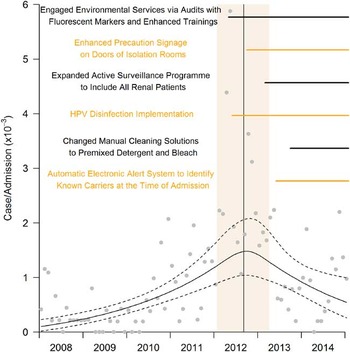
A total of 405 cases were reported over this 85-month period. The peak VRE rate was 1.5 per 1,000 admissions (95% confidence interval [CI], 1.0−2.1) in August 2012, which decreased to 0.5 per 1,000 admissions (95% CI, 0.3−1.0) by January 2015. The best estimate for the breakpoint corresponds to early August 2012 (95% CI, January 2012–March 2013), when the bundle was implemented (Figure 1). The interval spans the introduction of all elements of the bundle (apart from the change in bleach and the automatic alert); thus, any or a combination of bundle elements could have played a role in the reduction of VRE.
Rate of new VRE cases of infection or colonization per 1,000 admissions. The breakpoint in rate in August 2012 corresponds to the implementation a bundle of interventions.

The proportion of fluorescent markers removed by discharge cleaning improved from 60.5% (92 of 152) pre-intervention to 78.8% (145 of 184) post-intervention (odds ratio [OR], 2.4; 95% CI, 1.5−4.0; P<.001). The rate of VRE admission screening increased from 4.6 to 6.3 per 100 admissions (OR, 1.4; 95% CI, 1.4−1.5; P<.001). The proportion of known VRE carriers admitted to an open bay rather than a single room fell from 4.3% (31 of 724) to 0.6% (3 of 505) following the introduction of an automated electronic alert (OR, 0.1; 95% CI, 0.03−0.5; P<.001).
Only 6% of cases occurred within the first 48 hours of hospitalization (67% of cases occurred after 48 hours of hospitalization, and 27% of cases had evidence of previous hospital admission) suggesting in-hospital transmission. The rate of cases identified in the first 48 hours of admission did not change significantly before or after of the breakpoint in August 2012 (0.3 cases per 1,000 admissions before August 2012 vs 0.4 per 1,000 admissions after August 2012, P=.647). A total of 63% of cases were from active surveillance cultures, 22% were from contact tracing, and 15% were clinical cultures. A total of 3,652 rooms were decontaminated using HPV since it was implemented; cycle times were approximately 2.5 hours with an additional 0.5 hours for pre-cleaning prior to HPV.
Of 395 speciated cases, 390 were E. faecium and 5 were E. faecalis. Of 279 isolates available for PCR analysis, 77% carried vanB and 23% carried vanA. Of 264 typed isolates, a major clone accounted for 77% of isolates and secondary clone accounted for 20% of the isolates.
DISCUSSION
Our hospital experienced a progressive increase in VRE from 2008 despite standard infection prevention and control measures. The bundle of interventions was associated with a significant change in the VRE incidence. Because the adoption of all but 2 of the interventions (change in bleach cleaning solution and electronic alert system) were included in the 95% confidence intervals around the breakpoint, we were not able to determine which intervention was responsible for the reduction, and it is plausible that >1 intervention element contributed to the result.
Implementing or improving the identification and isolation of VRE carriers through contact precautions has been shown to reduce VRE transmission in some but not all studies.Reference Humphreys 1 Some argue that VRE screening and isolation should be scaled down or even abandoned;Reference Humphreys 1 , Reference Diekema and Edmond 5 however, we believe that VRE screening and isolation were an integral part of the successful bundle.
Other interventions in our bundle were directed toward reducing the environmental burden of VRE, which has been shown to shed into the hospital environment and to survive on dry surfaces, and prior room occupancy by a patient with VRE has been shown to be a risk factor for VRE acquisition in the incoming room occupant.Reference Hayden, Bonten, Blom, Lyle, van de Vijver and Weinstein 4 , Reference Otter, Yezli and French 6 Furthermore, improving the efficacy of discharge disinfection either by introducing HPV or by enhanced standard methods has been shown to reduce VRE transmission.Reference Passaretti, Otter and Reich 3 , Reference Hayden, Bonten, Blom, Lyle, van de Vijver and Weinstein 4 We implemented fluorescent marking to audit the quality of our conventional discharge cleaning. As in other studies, the removal of the fluorescent markers during the baseline audit period was poor (~60%).Reference Carling, Parry, Rupp, Po, Dick and Von Beheren 11 We demonstrated significant improvements by feeding back audit data and educating environmental services staff. The effectiveness of HPV use has been shown in other studies.Reference Passaretti, Otter and Reich 3 , Reference Otter, Yezli and French 6 The introduction of fluorescent markers and HPV spanned the 95% confidence interval around the breakpoint; thus it is plausible that both contributed to the reduction in VRE.
The vast majority of VRE in our study was E. faecium and vanB was considerably more common than vanA. MLVA identified a major clone of VRE, accounting for almost 80% of the isolations, which mapped to ST203, as reported in outbreaks elsewhere.Reference Johnson, Ballard and Grabsch 12
Our study has a number of important strengths. The breakpoint model evaluated the change in VRE rate, which is less prone to bias because the breakpoint was not specified a priori. We had a detailed dataset spanning 6 years, which combined clinical and molecular data. We also collected quantitative data to verify the effectiveness of several elements of the bundle.
However, this study did not have a control group, so we cannot exclude the possibility that the reductions occurred by chance; the change in rate of VRE correlated so closely with the implementation of our bundle that this is very unlikely. Whether the increases in VRE were due to an ongoing outbreak or increasing endemic prevalence, however, remains unclear.
The finding that most VRE were identified after the first 48 hours of hospital admission in the absence of previous hospitalization, combined with the fact that 80% of the VRE isolates were from a single clone, suggests the in-hospital transmission of VRE since it emerged in 2008. Prompt identification, isolation, and management of the patients and their clinical environment led to substantial and sustained reductions in VRE.
ACKNOWLEDGMENTS
Financial support: No financial support was provided relevant to this article.
Potential conflicts of interest: Dr. Jonathan Otter was employed part-time by Bioquell during the study, but he has now moved to Imperial. Dr. Paul Tambyah has received research support from Baxter, GSK, ADAMAS, Merlion Pharmaceuticals, Sanofi Pasteur, Fabentech, and Inviragen. He has also received honoraria from Novartis and Astra-Zeneca. All other authors have no conflicts to declare.