Examining the anti-slavery pronouncements of Britons across two generations, it is easy to imagine that the children of the first abolitionists had much harder hearts than their parents. In 1823, the earnest campaigner Zachary Macaulay insisted that ‘every Englishman who loves his country should dedicate his whole life, and every faculty of his soul, to efface this foul stain from its character’.Footnote 1 A mere twenty-two years later, his son, the MP and historian Thomas Babington Macaulay, argued that his ‘especial obligations in respect of negro slavery ceased when slavery itself ceased in that part of the world for the welfare of which I, as a member of this House, was accountable’. The younger Macaulay seemed to give voice to many Victorians’ hardening distaste for ‘busying ourselves about matters which we do not fully understand, and cannot efficiently control’.Footnote 2 The apparent contrast between these declarations of father and son – one rousing and one defeatist, one inspiring activity and the other advocating apathy, one assuming responsibility for slavery and the other shirking it – may actually be misleading.Footnote 3 While their views on slavery and empire differed in many important ways, both men emphasised Britons’ moral responsibility for slavery within their own nation's territories.Footnote 4
The idea of national guilt was one of the main ingredients in popular campaigns against the slave trade and slavery, and it structured subsequent disagreements about how international policies against slavery should be decided. To understand the dynamics of national guilt requires investigating the moral geography of British anti-slavery politics over a long period of time. The phrase ‘moral geography’ may seem peculiar or even pretentious, but it is an efficient way to describe the problem of how Britons considered the spatial dimensions of their responsibilities regarding slavery; a ‘moral geography’ is a study of how place shapes people's feelings of moral responsibility for an evil.Footnote 5 Such an approach can investigate the role of place in the humanitarian politics of anti-slavery, which confronted complicated networks of national, imperial and transnational commerce. In particular, it is useful to consider why the Victorian state focused on slave-trade suppression rather than encouraging foreign emancipations or why British consumers abstained from West Indian slave-grown sugar before the Emancipation Act yet proved such untroubled customers of slave-grown produce from foreign parts after 1833.
For more than two centuries, slaving may have been seen by some as distasteful, but it was by no means a sin requiring legislation to ban it. In the sixty years after 1776, abolitionists redefined first the slave trade and then slaveholding as national rather than personal sins, obliging legal interdiction by the state.Footnote 6 The morality of slavery moved from the frontiers of individual conscience to the chambers of the houses of parliament, revising the boundaries of individual, national and local sovereignty. For slavery to shift from a matter of personal behaviour to national concern would require British responsibility for the actions of others. Sympathy for the suffering of others is qualitatively different to assuming a moral duty and personal agency in stopping that suffering.Footnote 7 Delineating the geographical limits of this externalisation of guilt and presumption of responsibility for slavery, therefore, becomes an important task.Footnote 8
Historians have previously examined the emergence of humanitarian anti-slavery sentiment as part of ‘a momentous turning point in the evolution of man's moral perception and thus in man's perception of himself’ or as ‘revolutions in moral responsibility’ resulting from ‘shifts in the conventional boundaries of moral responsibility’.Footnote 9 While attitudes about the proper spheres of British power and responsibility changed over time, there were also perpetual differences when it came to calculating Britons’ moral responsibilities. These ethical divisions consistently existed in the anti-slavery movement. Particular post-emancipation crises threw these distinctions into sharper relief but did not create them. Studying the moral geography of anti-slavery consciences will highlight some challenges for those scholars, such as Thomas Haskell, Adam Hochschild and Michael Barnett, who are impressed by British abolitionists’ role in an internationalist humanitarian awakening.Footnote 10
National and consumer sins
By the middle of the eighteenth century, moral objections to slavery and the slave trade impressed many religious communities in the British Atlantic world. Following the lead of individual Quakers, meetings affiliated with the Society of Friends in North America started to fear the polluting influence of slaveholders as members of their religious communities. John Woolman, a Pennsylvanian Quaker, went further and decided also to abstain from purchasing goods produced by the enslaved.Footnote 11 These two models of proto-abolitionism, one shunning slave ownership and the other shunning all derivative products of slave labour, shared a fear that the sinfulness of slavery was polluting, whether the contagion stemmed from communion or consumption. While both possibilities relied on assumptions of sin, Woolman's moral geography – his sphere of responsibility – was far more expansive that those Friends of the Society who merely condemned slave dealing by co-religionists. He assumed personal responsibility for avoiding the fruits of slavery, becoming anxious at his consumption of sinful products. He shared with other Quakers an expanding assumption of moral responsibility for slavery that was founded on fears that the opening defeats of the French and Indian Wars in 1754 were linked to Pennsylvania's violent association with slavery.Footnote 12 However, Woolman's position on consumer goods was radical and unusual, based on pollution through participation in the market rather than the pollution of religious communion with slaveholders.
Intellectually, Woolman's unbounded personal responsibility, which presumed a global moral canvass, was radically different from his peers. In practice, so long as the slave-grown produce he rejected originated in Britain's West Indian or American colonies, he shared with others a moral geography constrained by the borders of the British Empire. Thomas Haskell takes Woolman as an empirical example of his theory that growing marketisation in the modern world transformed individuals’ ‘operative sphere of responsibility’. Transnational commerce, he posits, made a man like Woolman ‘attentive to the remote consequences of his acts and familiar with the intricate web of mutual dependencies that the market establishes between buyers and sellers’.Footnote 13 Haskell quotes his subject's view that ‘unrighteousness to the injury of men who live some thousands of miles off is the same in substance as . . . the injury of our neighbours’ and Woolman made arguments about the suffering of slaves on Africa's distant shores that would be echoed by later abolitionists.Footnote 14 However, while the Quaker's moral geography ranged over great distances, its implied radicalism in disrespecting the political boundaries on a map was largely undeveloped and untested. Distinguishing between the radical individualism of Woolman's particular practices and the national political campaigns of later anti-slavery activists is vital to understanding the political dimensions of abolitionists’ moral geography.Footnote 15
In Britain, the Somerset and Knight cases of the 1770s safely insulated the home country from the legal institution of slavery by ruling that it belonged in the colonies alone.Footnote 16 The physical distance between the West Indies and Britain was the same as it always had been; what changed, by the last decades of the eighteenth century, was the moral distance – the political conception of Britons’ responsibility for slavery.Footnote 17 Even if arguments drawing on natural rights and Christian doctrine could be used to establish the sinfulness of making slaves of other peoples, the success of a political campaign against slavery rested on nationalising this sin. Making slavery the sin of a nation, rather than of individuals, would align the moral motive and legal authority for action against human bondage. Anthony Benezet, in his 1767 writings, alluded briefly to this idea, developing the American Quakers’ steps in this direction.Footnote 18 Within a decade, Granville Sharp advanced the argument that the guilt of slavery fell collectively on Britons, not just on slave traders or slaveholders. He did so by appealing to popular notions of ‘the immediate Interposition of divine providence, to recompence [sic] impenitent nations according to their Works’.Footnote 19 Every Briton might have an obligation to act once the millstones of guilt had been distributed through nationality and subjecthood. Moreover, a transatlantic war of words during the American Revolution had the unintended consequence of discussing national blame for slavery and the slave trade. As Christopher Brown suggests, this offered individuals, sects and nations the prize of ‘moral capital’ for their abolitionist virtue and, consequently, guilt for their sinful inaction.Footnote 20
After 1787, mass petitioning and popular support urged the nation's parliament to act against a barbaric trade supplying a debased colonial society.Footnote 21 It is beyond the scope of this paper to determine whether God-fearing Britons expected punishments for inaction in this world or the next but both fears could be found in countless references to ‘the mercy of Providence . . . from Heaven for those enormous evils we have committed’, as William Pitt begged.Footnote 22 The nation's collective responsibility for the morality of British merchants and British colonists was a dominant idea throughout the anti-slavery campaigns. Political sovereignty created obligations for the conduct those engaged in the British slave trade.
A distinct reformulation of moral responsibility emerged after 1791 when parliament had rejected a bill to abolish Britain's slave trade for the first time. A proposed abstention from sugar – anachronistically, we would call it a consumer boycott – was radical in method, intent and theory, as Clare Midgley argues.Footnote 23 Practically, an individual or family disavowal of slave sugar placed significant new power into the hands of women. Politically, self-denial promised to let consumer power do what parliament should have done: stop the traffic in slaves from Africa to the sugar colonies. Intellectually, this tactic identified Britons’ active consumption of slave-grown sugar as a new reason to take a similarly active role in abolitionism. A pamphlet on the topic, written by William Fox and promoted by his publisher Martha Gurney, enjoyed swift sales, amassing twenty-six editions, with perhaps 130,000 copies printed in London and many more again in provincial and piratical printings.Footnote 24 Fox instructed readers that ‘if we purchase the commodity, we participate in the crime’. He reasoned that, ‘[w]ere an hundred assassins to plunge their daggers into their victim’ then ‘every one of them would be guilty of the intire [sic] crime’.Footnote 25
Such a doctrine anticipated later transnational consumer movements in connecting the moral responsibility of consumers and the means by which their purchases were being produced. In the late eighteenth century, however, this argument was still strongly infused with the moral geography of empire and with national identity. While the consumption of slave-grown produce transferred guilt from the West Indian planter to the British consumer, it did so within a closed market of protective tariffs. The monopoly granted to the British West Indies meant that the ‘laws of our country . . . prohibit us the sugar cane, unless we will receive it through the medium of slavery’.Footnote 26 Moreover, when Fox asserted that ‘the offices of humanity and functions of justice’ should universally protect the ‘rights of men’ of any race, he did not suggest that fellow-Britons opposed abuses everywhere. Anchored in his own experience of anti-slavery and West Indian monopoly, Fox never argued that British consumers would be morally responsible for the way a foreign commodity, such as cotton, was produced. This scenario earned barely any contemplation while British sugar enjoyed a protected monopoly in the home market. Rather, he specified direct action against the suffering of Africans perpetrated by British planters at a distance from the metropole and British slave traders even when beyond the boundaries of the empire.Footnote 27 Fox attacked the violation of the ‘common law’ (of Britain) when ‘fellow subjects’ (by which he meant slaves born on British soil) were held in slavery.Footnote 28 His moral outrage was defined by nationality rather than ‘by geographical boundaries’ of distance. Much of the universalist language surrounding ‘all nations of one blood’ reflected an eighteenth-century conflation of race with ‘nation’.Footnote 29 In this light, Fox condemned racial slavery perpetuated by Britons, rather than offering a moral mandate for transnational action.
Finally, we should observe that this consumer responsibility for sugar production came as an instrument for abolishing the slave trade; while abolitionists ultimately expected this to transform West Indian slavery into a freer form of labour, sugar would still be made by slaves, even if it was less polluted by the blood of Africans killed in the middle passage. Elites including William Wilberforce were troubled by Fox's appeal to popular economic power precisely because it sought to circumvent a proper political decision for parliament. If abstention had targeted some foreign produce of slavery, manufactured in territories outside the sovereignty of the crown, then it would have been utopian but unthreatening. The constitutionality of the abstention campaign was in question precisely because it usurped the responsibility of parliament by promising to overturn a determination of MPs.Footnote 30
When Elizabeth Heyrick revived the tactic to press for immediate emancipation after 1824, she still wanted to ‘have purified the nation from the foulest of its corruptions’ alongside the promise ‘of possessing “clean hands”’ through boycotting West Indian goods. Like Fox, she emphasised that planters and consumers were ‘the thief and the receiver of stolen goods’.Footnote 31 Heyrick mentioned foreign slaveholding states only to note that ‘we must purge ourselves of these pollutions’ in order ‘to persuade them to follow her [England's] example’.Footnote 32 Like her, T. S. Winn celebrated the ambiguity of deriving guilt through both one's nation and one's consumption. He admitted in 1825 that ‘it may seem hard that the Nation should be bound by the unjust acts of its Government’ but it was fair enough given that ‘every man, woman and child, in Great Britain, have for centuries been, and still actually are, abettors of, and participators in, the iniquitous system, by being purchasers and daily consumers of the guilt produce of Slavery’.Footnote 33 Before emancipation, the captive market for sugar consumption made consumer and imperial responsibilities identical.
Such a formula helped abolitionists rouse individuals’ sense of duty to escape a guilt devolved on them by their country, and this idea was easily revived as late as 1838 during agitation against the ‘apprenticeship’ imposed on freed West Indians. In this campaign, the Ladies’ Anti-Slavery Association in the North declared that ‘[t]he crimes of our country have lain heavy on our hearts; we could not bear to partake of the guilty produce, to leave the legacy of unexpiated sin for our children’.Footnote 34 Until their victory over planters in the British Empire, anti-slavery rhetoric could pair together imperial and consumer identities, since their sugar came from one of their own colonies.Footnote 35
Given the political challenges facing anti-slavery campaigners in their attacks on British slave trading or West Indian slavery, it is hardly surprising that theoretical differences were ignored so easily. However, as the foregoing examples suggest, arguments for abstention from slave-produced sugar or rum contained the kernel of a radical proposal for individual consumer responsibility. While circumstances did not test how many abolitionists would expand this concept from imperial produce to foreign, slave-grown goods, this question would confront Britons after emancipation. In order to trace the ways in which British anti-slavery politics transcended or respected national borders now requires analysis of the imperfect distinctions contemporaries drew between slave-trade suppression and foreign slaveholding. In turn, the next two parts of this paper will consider the moral geographies of responsibility for the slave trade and slavery beyond the borders of the British Empire, before drawing conclusions about the contours and causes of the boundaries on Britons’ consciences.
International suppression of the slave trade
The Slave Trade Abolition Act of 1807 banned British subjects from engaging in slave trading anywhere in the world; while the prohibition extended beyond the borders of the empire, it only sought to regulate the actions of Britons or those trading in British territories. So, while the geography of anti-slavery responsibility extended to any foreign port where British slave traders operated, this derived from the authority and responsibility of parliament. However, in reality, this ban was impossible to enforce if British slave traders had recourse to the flags of other countries. During the Napoleonic Wars, the royal navy intercepted hostile foreign shipping and readily checked the flags of neutral shipping visiting European ports or colonies. In 1814, one MP told the House of Commons that ‘it had come to his ears, that there were persons in this country base enough to wish for the return of peace, on account of the facilities it would afford for carrying on this detestable traffic under another flag’.Footnote 36 As the conflict ended, the British government faced one of the first dilemmas presented by the transformation into an anti-slave-trading nation: how would abolition be enforced in times of peace? It was this practical difficulty, as much as fears of economic disadvantage, which led British foreign policy to push for foreigners to abolish their slave trades and cooperate in mutual naval interdiction.Footnote 37
Rather than presenting French abolition as a condition of peace imposed by the victors on the vanquished, Wilberforce and others insisted that the French would be abolishing a trade that had been suppressed by the ravages of war.Footnote 38 Abolition became a legitimate area for international meddling since a peace treaty's ‘legal permission to carry it on would practically be a new establishment of it’.Footnote 39 It was precisely because Britain held preeminent sway over peace negotiations that subjects felt responsible and legitimate in directing foreigners to act against the slave trade. Abolitionists objected to their country signing a treaty ‘creating it anew’ given that ‘the war had practically abolished it for many years past’.Footnote 40 For abolitionist petitioners, a victorious Britain could not claim neutrality at a time when French merchants planned, ‘with the aid of British Capital, to carry on the Trade on the Coast of Africa’. Once more, a cry raised by Wilberforce insisted that ‘all who would not be partakers of the guilt’ their country would ‘protest against it’.Footnote 41
A response duly emerged from the provinces; in Plymouth, for example, ‘a very numerous and respectable’ assembly bemoaned that Britain might ‘confederate in the Revival’ of the slave trade, bringing down ‘Divine Vengeance’ on ‘all those who shall either carry on or be wanting in their utmost exertions, to prevent, the Continuance of so odious and detestable a Traffic’.Footnote 42 Between a fifth and a third of Britain's adult male population signed such a petition during the peace negotiations.Footnote 43 Amongst these anti-slavery supporters in the country, there were a variety of attitudes towards the defeated French, both vindictive and altruistic, when it came to imposing abolition as a condition of peace.Footnote 44 In the British cabinet, quite aside from national calculations of realpolitik, politicians were under pressure from sporadic bursts of petitioning, as Seymour Drescher convincingly shows. The mass mobilisation of 1814–15 demanded that slave-trade abolition should be a priority in peace negotiations; it was one of a handful of occasions when large numbers of Britons campaigned for anti-slavery measures in foreign, rather than imperial, policy.Footnote 45
In negotiations surrounding the Treaty of Paris, Wellington offered Prince Talleyrand's government ‘a sum of money or an Island in the West Indies, in order to obtain from them the immediate abolition of the Slave Trade’.Footnote 46 Ironically, the restored Bourbons held out in 1814 for a five-year delay in abolition, but found themselves stomaching an immediate ban in 1815 when Napoleon issued one at the start of the Hundred Days in a cynical appeal to British public opinion.Footnote 47 More appreciated was the abolition of the Dutch slave trade, undertaken to thank Britain for the freedom of the Netherlands.Footnote 48 In the case of the monarchs of the Iberian nations, economic recapitalisation provided by British loans had to be tied to abolition in the case of Spain or restriction for Portugal. As Castlereagh concluded, ‘the present temper of Parliament and of the Nation’ would not permit a loan to establish security for a regime that promoted the slave trade as a national interest.Footnote 49
British popular support for international slave-trade suppression had dramatic consequences for the shape of nineteenth-century British foreign policy beyond the practical need to prevent Britons hiding under the flags of slave-trading nations. Without the particular opportunities and challenges presented to British abolitionists during the construction of a new Concert of Europe, the national right and national obligation to meddle in others’ slave trades would have been far weaker. In the decades following the Napoleonic Wars, British legal recognition of new South American states was tied to their abolition of the slave trade.Footnote 50 British arbitration of Spanish decolonisation was framed by a popular abhorrence of complicity in restoring regimes that would sponsor the slave trade and Canning promised in 1822 that ‘no state in the New World will be recognized by Great Britain which has not frankly and completely abolished the trade in slaves’.Footnote 51 Having sought local abolition laws, declarations or constitutional articles, British diplomats pursued a new round of Latin American treaties guaranteeing mutual search at sea between the royal navy and the Argentine Confederation, Uruguay (both 1839), Mexico (1842), Bolivia, Chile (both 1842) and Ecuador (1847); the Foreign Office showed particular urgency in securing the right of search from nations with flags abused by slavers and not from others, such as New Granada, whose flags the slave traders adopted less often.Footnote 52
The transnational basis of slave-trade commerce did not respect the political boundaries of nineteenth-century empires. As early as 1810, the philanthropic African Institution erroneously briefed the royal navy that a ship was only Portuguese – and therefore permitted to supply slaves to Brazil – if it was built, owned and crewed by Portuguese men. Such ambiguities in treaties were regularly used to expand Britain's legitimate responsibilities and powers throughout the next century.Footnote 53 In 1839 and 1845, Palmerston and Aberdeen redesigned – or, more accurately, twisted – international law to authorise the royal navy to enforce more completely slave-trade abolition against Portuguese and Brazilian shipping. The governments of these nations were not meeting the obligations that Britain understood to have been contracted in bilateral treaties. If these powers did not enforce abolition, then both Whigs and Tories were willing to police these foreigners’ merchants as if they were British. This was not without controversy amongst parliamentarians, since it pushed the boundaries of Britain's powers under bilateral treaties; Aberdeen himself was critical of Palmerston's actions and anxious about his own when he followed a similar course.Footnote 54 Later attempts to secure an international ban on slave trading actually underlined the fact that most Britons assumed the need for national consent from other ‘civilized’ countries, given the problems arising from unilateral or serial bilateral suppression regimes.Footnote 55 The impossibility of enforcing British abolition without powers over foreign flags created a national moral interest in other nations’ sins. The expense, bloodiness and violence of the campaign did not escape criticism from pacifists and penny-pinchers, particularly in the 1840s. Rather than defending the slave trade, however, laissez-faire MPs such as William Hutt, Richard Cobden and William Gladstone argued that the naval campaign was ineffective in suppressing illegal traffickers and only succeeded in causing greater suffering. They challenged whether legal, diplomatic and military bullying by Britain undermined the cultivation of domestic anti-slavery sentiment.Footnote 56
What is striking is how this expansive, ambitious approach to slave-trade diplomacy contrasted with a meek and weak policy in pushing foreigners to abandon slavery altogether. In the same period, activists from the British and Foreign Anti-Slavery Society had hoped that British recognition of the Republic of Texas, together with loans, could be tied to emancipation. By contrast, Palmerston and Aberdeen focused almost exclusively on a slave-trade suppression treaty in return for recognition, leaving slaveholding to internal Texan politics.Footnote 57 While some thought recognition of a new, slaveholding nation constituted active complicity on the part of Great Britain, establishment opinion concluded that slaveholding would not be encouraged and anti-slave-trade interests would be advanced.Footnote 58 Such questions of where foreign policy should draw a line between tolerating slavery and pushing for slave-trade suppression would resurface in the American Civil War. The United States had long resisted permitting Britain a right of search.Footnote 59 There was wisdom, not eccentricity, in Lincoln's calculation that the 1862 Lyons–Seward Treaty would confirm his administration's humanitarian credentials in British eyes.Footnote 60 While Britons fiercely disagreed over the rights or wrongs of the conflict and the extent to which slavery lay at the heart of the war, Palmerston's government was safe in the knowledge that the Confederate constitution banned the slave trade. On this point, the Southerners converged with the consistent priority of Britain's anti-slave-trade foreign policy, aware it was a precondition for their much-desired diplomatic recognition.Footnote 61 On both sides of the Atlantic, however, those pro-Union partisans who saw the recognition of a slaveholding power as inconsistent with Britain's anti-slavery policies were introducing a novel and controversial proposition.
Rather than using foreign policy to promote emancipation alongside slave-trade suppression, British governments used moral suasion with other ‘civilised’ powers. This reflected a preference for making foreign populations aware of their own national guilt rather than assuming for Britons the responsibility of acting against slaveholding in other societies. Before the unique circumstances surrounding the Congress of Vienna, Henry Brougham had argued that ‘[n]o great reform has ever taken place in one part of the international and intercolonial systems, without a similar change being soon effected in all the other parts’; Britain could rely on setting ‘an example of reformation’.Footnote 62 British abolitionists such as Thomas Clarkson and Zachary Macaulay took it upon themselves to develop popular anti-slavery movements in other countries precisely because they recognised the limitations of British foreign policy in spreading their principles abroad.Footnote 63 This concern for foreigners’ self-determination weighed far more heavily in public opinion and political action concerning slavery than it did regarding the slave trade. As we shall see in the next section, these differences can be illuminated more clearly by now considering why Britons proved so deferential to the political geography of slaveholding when framing their anti-slavery duties.
Anti-slavery in one country?
While a combination of practical and contingent circumstances meant that abolition of the slave trade dragged British consciences abroad, politicians could adopt a more distant approach to foreign slaveries. Continuing slave trades depleted and devastated the African continent or disrupted abolitionist nations’ efforts but the perpetuation of slaveholding within other countries was more readily ignored. This division was not simply natural but a contentious development framed by the national basis of British anti-slavery guilt before the West Indian emancipation of 1834–8. In the decades following 1838, some abolitionists hoped to see their government take moral responsibility for the porous commercial or financial relationships which still fed New World slaveries; they wished to embrace the potential global market responsibility left undeveloped and untested in earlier radical abolitionism. That the British population ultimately accepted international trade and national consumption of slave-grown goods and the export of capital or equipment for foreign slaveholders deserves careful explanation. Had the ‘moral geography’ of British anti-slavery supporters shrunk, relieving political pressure on statesmen?
In fact, as we have seen, political boundaries mattered as much as distance in determining Britons’ sense of moral responsibility for slaves’ suffering. While the differences between a bounded social responsibility of national or church community and an unbounded individual responsibility to all humanity had been present in mid-eighteenth-century ideas, there had been little tension or testing of which model of moral responsibility would win out in practice. After the termination of apprenticeship in 1838, conflicts multiplied in number, size and importance as subjects invested in foreign businesses profiting from a form of labour now prohibited in the British Empire, as domestic dependence on slave-grown sugar and cotton grew, and as escaping slaves sought sanctuary on the ‘free soil’ of the United Kingdom. In these three spheres of complicity, arguments for apathy and inaction ultimately won out and it is necessary to explain why.
The 1807 Slave Trade Act had banned Britons from financing the trafficking of Africans to other nations’ colonies, but British proved even more difficult to police than subjects. Moreover, following West Indian emancipation, the British government acted slowly, gradually and unconvincingly to implement similar restrictions on capital in slaveholding industries. While Britons were ordered not to own slaves or invest in businesses using them, the huge commercial investment in the slave-infused economies of Latin America suggests many breaches of the law's letter and spirit. The case of the Cata Branca slaves, where Brazilian abolitionists presented evidence of a London-based company's fraudulent working of slaves, was an unusual occasion when illegality was caught. For many years, British mining businesses, such as the St John d'el Rey Company, maintained the fiction that they hired slave workers rather than owning them.Footnote 64 When tangible public examples were exposed, the British government was embarrassed into investigation and action. It seems that the rarity and difficulty of these cases bred official fatalism rather than duplicity, since the state was poorly equipped to untangle practical circumstances on the ground and secure convictions.Footnote 65
Where British subjects directly owned slaves and the government faced incontrovertible evidence, action followed for fear of public anger. This was a politics of ‘clean hands’, desperately avoiding moral responsibility or complicity rather than seeking or seizing opportunities to interfere in foreign slaveries. Loans or investments where British subjects did not assume personal responsibility for slaveholding could be accepted as the price of doing business in a world still suffused with slavery. The moral geography of British anti-slavery extended to subjects’ overseas property but not to their dividend cheques. This apathy mirrored political resignation towards British involvement in slave-related imports and exports – but the latter situation was less the product of weary consensus than a turbulent political contest.
While abolitionists pioneered mass abstention from West Indian sugar and rum during the period stretching from 1791 to 1833, they were consuming increasing quantities of slave-grown cotton. With a series of advances in cotton-gin technology, the slave agriculture of the American South boomed in response to the unending demand of the industrial mills of northern England.Footnote 66 By the turn of the nineteenth century, imports of cotton from the United States dominated the British market and, despite the disruption of the war of 1812, swelled the profitability of plantations. Annual cotton cultivation in the slave states increased from around 2 million to 182 million pounds of cotton between 1791 and 1823, strengthening Southerners’ attachment to their ‘peculiar institution’.Footnote 67 Clarkson himself denied the need, in 1792, to extend British anti-slavery abstention campaigns to slave-grown cotton, not least because that ‘might take away the bread of a million of our fellow subjects, the innocent poor of this country’.Footnote 68 The limited scope of abstention, targeting imperial sugar, suggests that it was a tactical obligation for British abolitionists, rather than an imperative for all forms of slave-grown imports. It is hard to credit Elizabeth Heyrick or the Liverpool merchant James Cropper, both advocates of abstention from West Indian sugar in the 1820s, with ignorance or imbecility in their apparent inconsistency. Instead, their sense of moral responsibility was attuned to the political geography of the British Empire, rather than simply the physical breadth of the Atlantic Ocean.
Before 1833, one of the only people to propose economic sanctions for foreign sins abroad was not a radical abolitionist but a very conservative foreign secretary. In the midst of his desperate attempts to balance the demands of Britain's anti-slavery conscience and French national pride in 1814–15, Lord Castlereagh suggested ‘a League against the import of Colonial produce grown by States, dissentient from the general policy’ of abolishing the slave trade. This clearly struck him as a neat way to appease popular pressure through British commercial policy rather than French politicians, but it seems not to have met with enthusiasm by his peers.Footnote 69 No such trade penalty was applied to states resisting abolition and, even if it had, the Castlereagh proposals would not have penalised the produce of slavery per se since all European nations including Britain itself retained slavery after banning the slave trade. This germ of an idea fell on stony ground, in all likelihood, because Britain's existing system of duties excluded foreign sugars, making a ‘League’ against French exports a fairly hollow threat.
Until emancipation, the long-standing policy of West Indian protection rewarded slave cultivation. However, growing anxieties about the price of sugar led some politicians by the 1840s to propose free trade in sugar. In general, free traders vilified emancipated black Britons as undeserving of special protection, resisting the claims of protectionists that the illegal slave trade would prosper from the measure.Footnote 70 This question exposed differing views of the moral geography of Britain's anti-slavery responsibilities. While Bishop Samuel Wilberforce suggested that the consumption of slave-grown commerce would ‘plunge this country again into the guilt of this great crime’, he was soon disappointed to discover that the rest of the country did not feel the same way.Footnote 71 Some of the cleric's allies supported an imperial preference for wholly non-humanitarian motives, but the arguments that they employed still bear study since these shaped the national debate beyond the houses of parliament. As Milner Gibson argued, ‘[t]hey must confine their attention to their own country’ rather than ‘making their trade depend upon the municipal laws of foreign nations, and the abolition of slavery in other lands’ when the ‘two things were distinct’.Footnote 72 British authority, legitimacy and responsibility for slave production, he and his peers suggested, was confined to British soil, and the development of abolitionist movements in other nations would only be hampered by the isolation, rivalry and hostility of protectionism.Footnote 73
Some protectionists reasoned that the principal beneficiaries of an open sugar trade would be the Brazilian and Cuban slaveholders still buying illegally imported slaves from Africa whereas the cotton-exporting United States enforced a largely effective ban. However, defending the Whig preference for freer trade in 1845, Thomas Macaulay insisted that this distinction was sophistry, given that a domestic slave trade thrived between the ‘breeding States’ of the upper South and ‘the sugar and cotton States’ down the Mississippi where enslaved Africans were in the highest demand. By this measure, America's exports were ‘the fruits, not only of slavery, but of the slave trade’.Footnote 74 Since the exclusion of slave-grown sugar was morally inconsistent with the embrace of slave-grown cotton, Macaulay suggested that the nation's anti-slavery conscience, which his father had played so significant a role in cultivating, had to keep out of the customs house.
Philosophically, this argument demanded the consistency of a universal rule that would place the guilt of consuming any and all slave produce either inside or outside the proper moral duties of the British nation. This type of argument met short shrift from particularly clever protectionists such as Benjamin Disraeli, who in 1846 told his Whig opponents that he had ‘no wish to argue the question abstractly’. He denied the ‘abstract principle, that a man, because he is obliged to wink at a certain evil, is bound to commit a greater one’ and so defended the poorly mapped moral geography of the status quo against their ‘flashy plea’. His distinction between ‘an abstract or a concrete position’ analysed the terms of debate more rigorously than other clashes inside the Palace of Westminster or without. Disraeli actually noted that the inconsistency now derided by free traders was consistency with the fact that slave-trade abolition ‘was supported by men who patronized slave-grown cotton and slave-grown tobacco’; indeed, ‘when Clarkson, and at a subsequent period, Wilberforce addressed those districts of the north of England which originated the great movement against slavery’, the industry of those areas had been ‘fed with cotton the produce of slave labour’ and British subjects had ‘been smoking, snuffing, and chewing slave-grown tobacco’ long before and after they petitioned parliament. Far from being ignorant of this, ‘a practical people knew how to deal with circumstances’ and ‘must put an end to those abominations we can control, and shut our eyes to those we cannot control’.Footnote 75
In Disraeli's hands, the protection of sugar was not a hopeless attempt to seal British society in a moral vacuum from the practicalities of a fallen world. Rather, he drew a distinction between an established dependency ‘we cannot control’ and a rejection of a novel reception of slave-grown sugar, which would mean allowing new ‘abominations we can control’.Footnote 76 Therefore, while he declined to draw indelible boundaries between moral responsibility for slavery in Brazil and slavery in the United States, he still emphasised national limits of responsibility: in this case, Britain had a duty not to slide backwards into greater dependency on slave produce, even if he agreed that it was impossible to break the addiction entirely. Hence, the slavery of foreign nations became the business of the British legislature if parliamentarians were going to create a new field of fortune rather than accept the inevitability of existing market forces. If other protectionists had stuck to such a clever rationalisation of existing trade policy, they may have had rather more luck than they did.
In 1841, Sir Robert Peel had developed a similar argument: ‘I do not recognise that principle’ that ‘there is some overpowering moral obligation which compels us to abstain altogether from the consumption of the produce of slavery’. Rather, ‘after attempting to adjust this balance of good and evil’, he came down ‘in favour of this continued exclusion of sugar, the produce of slave labour’.Footnote 77 And while he did not support abstraction, he compared Britain to Rome in a poem of Dryden's, arguing that while Britons did not ‘rule the world, and make mankind obey’ as the Romans had done, there was still ‘a sway, an “awful sway”, which we could still exercise – that there was in our hands not a material but a moral power, enabling us to “rule the world”, and, through the influence of high principles and of glorious sacrifices, to “make mankind obey”’.Footnote 78 That Peel, the son of a cotton merchant, found slave-grown cotton unobjectionable was unremarkable, but his line of logic was interesting. Like his future tormentor Disraeli, he rejected any hint of extending the moral geography of British anti-slavery responsibility indefinitely, preferring to focus on the agency of the British government in changing existing market conditions. Such a theorem diverged from the free traders on the question of whether a novel importation of sugar would implicate Britons in foreign guilt but accepted the more general notion that Britain was not responsible for the way their raw materials were cultivated abroad. The question of the sugar duties was so controversial because it required an active choice on the part of the government and so presented an unusually clear example of British trade policies’ responsibility for slavery overseas.
If some parliamentarians for or against the sugar duties could happily agree that the moral geography of anti-slavery conscience did not extend to foreign produce, then what had happened to the radical, unbounded implications of John Woolman, William Fox and Elizabeth Heyrick's consumer responsibility? Some abolitionists did attempt to revive the general principle that purchasers of slave-grown articles became participators in the tyranny of slavery. However, following the sugar debacle, which had split the British and Foreign Anti-Slavery Society, the Birmingham Quaker Joseph Sturge and his comrades hoped to promote individual, consumer choice where national tariff barriers did not exist – and this was an option that even Richard Cobden could condone, as hopeless as he thought the effort was.Footnote 79 A transatlantic ‘free produce’ movement promoted free-labour goods on just this basis.Footnote 80 Sturge went so far as securing special underwear for all his family, removing the faintest stain of slavery from his intimates.Footnote 81 An aged Thomas Clarkson now championed abstention from all slave-grown produce, where fifty years earlier he had limited the principle to West Indian exports.Footnote 82 Doubtless, early Victorians who patronised free-labour repositories did believe that their consciences were tied to the means of production rather than their national responsibilities as Britons. However, they were few in number and represented a surprisingly small minority of abolitionists and an even smaller proportion of the public.
Recalling his former life as a slave, the black abolitionist John Brown insisted in 1854 that if British women witnessed ‘the infliction of what are called slight punishments on these unfortunate creatures, they would, I am sure, never in their lives wear another article made of slave-grown cotton’.Footnote 83 Yet, as one advocate for East Indian cotton complained after the American Civil War, ‘it may safely be affirmed that, if the annihilation of slavery had depended upon the people of this Christian land paying knowingly one farthing per yard extra for free-labour calico, slavery would have gone on for ever’.Footnote 84 Ironically, during that conflict, those Britons who advocated ‘interfering in the affairs of a nation three thousand miles away’ to reopen the cotton trade were the same ones who considered the slave production of that commodity as none of their business.Footnote 85 Far from being a decline or betrayal of the principles underlying the imperial boycotts of the 1790s and 1820s, Victorian dilemmas over sugar and cotton presented starker distinctions over the limits of individual consumer and national responsibilities. Given that earlier pamphleteers had offered both engines of guilt as operating in parallel, it is not clear how many abstainers in the earlier period really supported a principle of individual consumer responsibility given that they did not extend the rule to foreign cotton or tobacco.
If the vast majority of Britons voted with their shopping baskets and accepted the foreign produce of slavery in their homes, they could get far more exercised when slaveholding foreigners brought their human property directly on to British soil. As David Turley has charted, the geographical proximity of the West Indies and Canada to the United States led to numerous controversies concerning American slaves on British soil. When slaves from the United States arrived in British colonies during a storm, piloted seized vessels to British ports or marched across the Canadian border, slavery could not be dismissed as the sovereign responsibility of another nation.Footnote 86 While the Foreign Office acceded to demands for an article of extradition in cases where fugitives were accused of crimes, anxious abolitionists were reassured by Lord Aberdeen that in practice this would never happen – and, indeed, it did not.Footnote 87
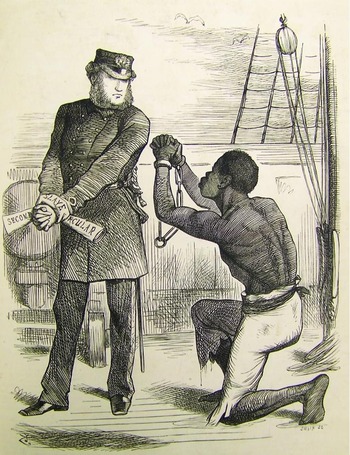
The messy realities of anti-slavery policy on the spot threw up still more difficulties, however. British officials and naval officers stationed in slaveholding countries had for many years been given individual discretion in balancing respect for local sovereignty with their occasional instincts to aid escaping slaves. In 1874–5, a series of Fugitive Slave Circulars caused a major political controversy. With approval by Disraeli's Conservative administration, the Admiralty explicitly banned British officers from obstructing the capture of fugitive slaves seeking asylum on their vessels. While respectful of international law, which placed ships under local jurisdiction while in port, the judgement outraged moral sensibilities since it seemed to require the navy's active complicity in the upholding of slave ownership.Footnote 88 Scrambling to contain the scandal, the government ultimately retreated behind a Royal Commission after issuing an equally controversial second order, depicted by one cartoonist as binding the hands of a sailor, humiliatingly restraining him from his national responsibility to hate slavery (Figure 1).Footnote 89 The circulars were not such dramatic departures from military, legal and political opinion as the press imagined, since British dedication to slave-trade suppression had always coexisted with respect for the domestic slaveholding laws of foreign countries. However, the circulars violated the boundaries of moral responsibility for many circulation-conscious editors whose readers could find active complicity rather than resigned distance in the government's position on abandoning stowaways.
‘Men and Brothers!!’, Punch, 4 Mar. 1876, 79. Fugitive Slave. ‘Take these off!’ Captain, R.N. ‘How can I? – With this on?’

Just as Northerners in the United States objected to the Fugitive Slave Law making them complicit in Southern slaveholding, it seems likely that a majority of the British public, comprising supporters of both parties, felt that their nation should not transform their sailors into slave catchers. The treatment of slavery in African communities under later nineteenth-century British colonial rule is too large a topic to discuss here, but some basic facts may illustrate that imperial officials’ selective blindness was largely consistent with the ‘moral geography’ of earlier foreign relations. Because protected countries were not technically British colonies, their domestic affairs were often considered as ‘foreign’ as those of sovereign states so long as British institutions and personnel did not become overtly complicit in slavery. When such compromising occasions were highlighted in parliament, ministers eagerly assured MPs that officials would not intervene to return slaves. In 1896–7, for example, the Tory attorney general, Sir Richard Webster, insisted that it would be illegal to detain slaves for being fugitives in British East Africa but quite proper to return them to be tried for incidental crimes. An opposition MP chastised him: ‘it was a shock to find that in any legal sense the status of slavery was recognised under British influence’; the scandal of 1874–5 showed that ‘if slaves were to be treated by English officers different from free men, a strong feeling in the country would rise against it’.Footnote 90
Under the legal innovation of protectorates, the British government avoided complicity in slaveholding while permitting intra-African slaveries to continue within ‘uncivilised’ communities. This practice echoed the linguistic and legal abolitions in 1840s India, where ‘traditional’ slavery was denied the sanction of the courts and Anglo-Indians rechristened their slaves as ‘servants’.Footnote 91 What British policy continued to attack was inter-racial slave trading, at least in theory – there were plenty of examples of officials on the spot hiding information from Whitehall. This was partly the result of a desire for stability – external slave trades caused disruptive slave raiding while tolerating ‘traditional’ domestic slaveries made for an easier life – but the combination was politically and culturally viable because of the nature of British anti-slavery thinking.Footnote 92 As Arthur Balfour insisted, this caution did not mean ‘that they regarded it as part of the permanent policy of this country to maintain in any district under our control an institution so alien to our traditions, our wishes, and our whole habits of thought, as the institution of slavery’.Footnote 93 Both parties found comfort in a system that denied a legal status to slavery under the British flag but permitted it to continue amongst protected peoples. Drawing parallels between these practices and earlier British policies does not excuse colonial heartlessness but rather acknowledges the long-standing flaw in the anti-slavery mould that shaped many Britons’ consciences across generations. The upheavals of external slave trades justified international concern in the way that slavery within other societies could not.
Tensions over the boundaries of moral responsibility informed a famous Punch cartoon of 1865. At a time when politicians debated the purpose of expensive West African colonies, the artist John Tenniel suggested that Britain owed Africa nothing and should redirect humanitarian sentiment closer to home (Figure 2). An accompanying comic poem developed his theme that an overextension of national responsibility left London's pauper urchins asking,
The image was dedicated to the Conservative Lord Stanley, who had recently argued that ‘thirty years after the extinction of slavery, and sixty years after the legal extinction of the slave trade, I think we may fairly hold that whatever debt we owed to the people of Africa has by this time been paid off’. The son of the colonial secretary who oversaw the Emancipation Act, Stanley proposed that anti-slavery obligations should not extend to colonial, military or missionary establishments in West Africa, maintaining that ‘it is constantly assumed that in some way or other we are responsible for the fortunes and destiny of the African race’ when ‘I am afraid we had better first look at home’.Footnote 95 This scepticism that missionary or philanthropic projects exploited Britain's anti-slavery conscience to further their own ends, ignorantly or mischievously, had a long heritage.
‘Telescopic Philanthropy’, Punch, 4 Mar. 1865, 89. Little London Arab. ‘Please, ‘M, ain't we black enough to be cared for?’ (with Mr Punch's complements to Lord Stanley).

The title of Tenniel's cartoon, ‘telescopic philanthropy’, came from the chapter in Charles Dickens's Bleak House, published a decade earlier. That novel's mockery of Mrs Jellyby, the misguided philanthropist, matched Dickens's pessimism for British anti-slavery obligations to Africa.Footnote 96 Reviewing a book about Thomas Fowell Buxton's Niger Expedition of 1840, Dickens commented on anti-slavery exertions more generally: ‘[g]ently and imperceptibly the widening circles of enlightenment mist stretch and stretch, from man to man, from people on to people’ but ‘no convulsive effort, or far-off aim, can make the last great outer circle first, and then come home at leisure to trace out the inner one’. Instead, ‘work at home must be completed thoroughly, or there is no hope abroad’.Footnote 97 This critique of abolitionist plots to undermine African participation in the European slave trade summed up the notion of the ‘telescopic philanthropy’ Tenniel's cartoon would later illustrate. Far from defending slavery, pessimists such as the author, the politician and the illustrator suggested that Britons were powerless to speed ‘the mighty revolutions of the wheel of time’ in dismantling foreign slave trading or slaveholding and so should focus on tangible and immediate calls on their philanthropy.Footnote 98
Whether Britons surveyed the moral geography of world slavery with the help of ‘telescopic philanthropy’ or not, most suffered from anti-slavery myopia – and many abolitionists before 1833 had done so too. While Victorian Britons clearly differed over the extent to which they could control and the means by which they might undermine slavery abroad, it is striking how limited their differences were. Brief abolitionist attempts to force the state's import tariffs to discriminate between slave- and free-labour produce faded quickly, while opposition to expenditure on naval suppression of the slave trade was always expressed in terms of efficacy rather than amorality. While the public could be enraged by evidence of active complicity, they were still content to let more expansive responsibility for anti-slavery stop where the writ of British law ended.
Clean hands
In deciding when foreigners’ slave trading or slaveholding touched British consciences, the mainstream of anti-slavery opinion followed Pontius Pilate and focused on keeping blood off their hands. Heyrick had explicitly promoted abstention from West Indian sugar not only as a method to pressure parliament but also as a way of guaranteeing ‘clean hands’ from the stain of national guilt.Footnote 99 Her own strictures did not dictate whether ‘clean hands’ required abstention from foreign slave-grown products, though it seems likely she would have embraced such radicalism if she had lived beyond 1831. Regardless, ‘do no evil’ became the rule of official anti-slavery policy, even if there could still be political and public quarrels over what constituted active rather than passive acquiescence in the evils of foreign slavery.
Whether slave-trading in international waters or owning slaves on British soil, the sins of fellow-Britons clearly triggered national obligations; slaveholding violations of British sovereignty in Canada, the Caribbean or the deck of a docked ship did too. The reconstruction of post-war Europe gave Britons a causal responsibility for the revival of slave trading and consequent treaty engagements, required to police illegal British slave traders, provided extra-territorial rights and responsibilities over foreign slavers. There may have been practical or material incentives for British assumption or abrogation of particular responsibilities, but the ideological divisions assumed a life of their own in determining what future politicians could or could not get away with. An emphasis on national identity spreading slaveholders’ polluting sin to all Britons had justified political action before 1833; afterwards, it hobbled radical interpretations of responsibility for foreign slavery.
This article opened by noting how Zachary and Thomas Macaulay placed similar stress on national responsibilities to address imperial sins, though they spoke in different contexts. The younger man likely differed from his father in the conclusions he drew from the maxim that, ‘to every individual and every society, Providence has assigned a sphere within which benevolence ought to be peculiarly active’ and in consequence ‘it is not true that we are bound to exert ourselves to serve a mere stranger as we are bound to exert ourselves to serve our own relations’.Footnote 100 However, in discriminating between one's responsibility for slavery depending on its location – and its political location rather than its geographical proximity – both Macaulays reflected intergenerational British consistency. This conclusion has implications for the histories of consumer morality, the expansion of humanitarian sympathy and the causes of abolitionism, which will be addressed in turn.
First, while historians have been right to point to the political radicalism of consumer abstention practised by British abolitionists, particularly given the implicit rejection of parliamentary sovereignty and the political agency accorded to women, the moral logic behind such acts was incredibly complex. It was not the same moral consumerism that drives many twenty-first-century shoppers to feel causally responsible for the means by which their food or clothes are manufactured. The link between anti-slavery and ethical consumption has been noted in recent years as abolitionist abstention is examined as a predecessor to the modern fair-trade movement. In 2007, to mark the bicentenary of slave-trade abolition, Britain's Westerham Brewery launched ‘William Wilberforce Freedom Ale’, made with fair-trade sugar from Malawi.Footnote 101 Local fair-trade groups and the BBC's History webpages continue to draw such parallels.Footnote 102 Scholars have, similarly, been impressed by the extent to which British anti-slavery saw consumption as the source of guilt and a weapon to erase it, drawing parallels with the contemporary anti-sweatshop movement.Footnote 103 However, while the language of ‘clean hands’ and the guilt of the buyer suggest similarities with ‘fair-trade’ consumerism, individual responsibility was inflected with national responsibility for ending slavery in Britain's own colonies before 1833. After this, the principle of abstaining from foreign produce was an innovative addition to abolitionist debates about what it meant to be an anti-slavery empire. A fuller consumer responsibility for the means of production developed in the later nineteenth and twentieth centuries.
Given that it is interdependent, international commerce that Haskell credits for creating a sense of humanitarian obligation to slaves (albeit as an unintended side effect), it seems unconvincing that these connections were so weak in establishing personal responsibility for foreign slavery. If agency was more often refracted through national rather than individual responsibility, then Haskell's model is both a poor description of Britain's moral revolution and a poor explanation of its causes.Footnote 104 Although abolitionists spoke of common humanity and international brotherhood in establishing sympathy, these reflected uncertainties about the nationality of slaves and contemporary elision of ‘race’ and ‘country’. While humanitarian sympathy could extend over political borders, humanitarian action stuck within very clear lines. The idea of the political nation and the power of the state played a pivotal role in creating agency and responsibility over such transnational market institutions as the Atlantic slave trade or New World slavery. It was not an expansion of responsibility for far-away suffering that permitted the rise of abolitionism but a new responsibility for suffering inflicted by the British state, under its laws or by its subjects. The political geography of moral responsibility expanded to include colonists and international traders under the British flag, suggesting that answers will lie in the study of late eighteenth-century political culture rather than the determinations of economic culture.
Finally, in explaining the sudden emergence and rapid triumph of anti-slavery ideas in modern Britain, this argument confirms a recent turn away from macroeconomic explanations for a revolution in political culture. While Drescher long ago demonstrated that abolition was ‘econocide’, the following decades saw scholars retreat towards models based on unintended capitalist acculturation rather than deliberate capitalist calculation.Footnote 105 As Christopher Brown and Srividhya Swaminathan, amongst others, have suggested, religious and political ideas created the terms of the anti-slavery debate and were, in turn, reshaped by it.Footnote 106 Material changes in modernising Britain may have created new gaps in the market for public campaigning, informing, abstaining and pamphleteering. However, the adoption of anti-slavery campaigners relied on the individual talents and agency of cultural entrepreneurs and political activists, not to mention the receptivity of a public able and willing to accept and propagate these ideas. A study of ‘moral geography’ suggests that ideas of national responsibility trumped market responsibilities throughout Britain's anti-slavery campaigns. Given the stress abolitionists laid on establishing personal guilt and sin in mobilising individual activists, David Brion Davis is right to redirect our attention to the religious content of popular anti-slavery, just as political contingency has displaced material determinism in the work of recent decades.Footnote 107
While the conflicts over Britain's responsibilities reflected different ‘strands and sources of anti-slavery thought that had co-existed before 1838’, the two strands or sources were not simply ‘eschatological evangelicalism and utilitarian political economy’.Footnote 108 The distinction was rather more complex, turning on understandings of national agency or the balance between national and consumer guilt. These varied interpretations hinged on different plans of the moral geography of British anti-slavery, defining to what extent responsibility was tied to individuals’ transnational consumption of produce or to individuals’ political responsibility for their own nation. And those moral geographies drawn in the wake of emancipation had, long before, been traced by the first generation of abolitionists.