Highlights
-
Assessed whether the Provincial Strategy was associated with changes in epilepsy surgery and presurgical assessment rates.
-
The Provincial Strategy was associated with a level increase in the epilepsy surgery rate and slope decreases in other healthcare for epilepsy.
-
Other regions with low epilepsy surgery rates may benefit from similar interventions.
Introduction
Epilepsy is one of the most common neurological disorders 1 and significantly affects quality of life Reference Berto2 and increases morbidity and mortality risk. Reference Thurman, Logroscino and Beghi3,Reference Keezer, Sisodiya and Sander4 Although epilepsy is a complex disease requiring a holistic approach to treatment, Reference Berto2 seizure frequency and severity are major determinants of health-related quality of life in patients with epilepsy. Reference Baranowski5,Reference Taylor, Sander, Taylor and Baker6 Therefore, seizure control is an important objective of epilepsy treatment. However, a third of patients with epilepsy continue to experience seizures despite appropriate treatment with antiseizure medications (ASMs) Reference Kalilani, Sun, Pelgrims, Noack-Rink and Villanueva7 and are diagnosed with drug-resistant epilepsy (DRE). Reference Kwan, Arzimanoglou and Berg8
Fortunately, epilepsy surgery is an effective treatment alternative for patients with DRE who are eligible. Reference Wiebe, Blume, Girvin and Eliasziw9 Epilepsy surgery typically involves the resection of the epileptogenic zone, the cortical area in which the patient’s seizures originate. Reference Perucca, Scheffer and Kiley10 It is recommended that patients with DRE are assessed for epilepsy surgery eligibility upon diagnosis, Reference López González, Rodríguez Osorio and Gil-Nagel Rein11–Reference Cross, Jayakar and Nordli14 which is determined by the identifiability of the epileptogenic zone and the risk of postoperative morbidity. Reference Perucca, Scheffer and Kiley10 However, epilepsy surgery is underutilized in the province of Ontario, where approximately 39% (15.1 million) of Canadians reside. 15 Between 2001 and 2010, just 1.2% of patients received epilepsy surgery within two years of DRE diagnosis in Ontario, and only 2.2% were assessed for candidacy. Reference Burneo, Liu, Leonard and Saposnik16 These figures indicate that many people with epilepsy in our region who may have benefited were not being considered for the procedure. Reference Wiebe, Blume, Girvin and Eliasziw9
In 2013, the Ontario Ministry of Health and Long-Term Care (OMHLTC) approved the Provincial Strategy for Epilepsy Care, herein referred to as the Provincial Strategy, to increase epilepsy surgery rates. The OMHLTC committed to adding 21 new Epilepsy Monitoring Unit (EMU) beds across the province, allocated funding specifically for epilepsy surgeries (including neurostimulation) and commissioned the Epilepsy Implementation Task Force (EITF) to implement the remaining components of the Provincial Strategy. 17 The EITF, comprising senior leaders of the epilepsy community, was tasked with coordinating resources and waitlists, establishing standardized protocols across hospitals for epilepsy diagnosis and surgery and developing resources for community neurologists and primary care providers. 17 These standardized protocols and resources were developed as guidelines, accessible from the Epilepsy South Central Ontario website. 18
For logistical reasons, only 19 of the 21 EMU beds were added, for a total of 40 (28 adult and 12 pediatric) in the province. Eleven beds were distributed between three cities that did not previously have EMUs. These facilities, now called District Epilepsy Centres (DECs), cannot perform epilepsy surgeries but can assess patients for eligibility. The other eight new EMU beds were distributed between the two cities with existing EMUs. These facilities can perform epilepsy surgeries and are called Regional Epilepsy Surgery Centres of Excellence (RESCs). Figure 1 depicts the current locations of DECs and RESCs in Ontario. 19,20
Current epilepsy monitoring unit locations in Ontario, Canada. LHSC = London Health Sciences Centre; TGH = Toronto General Hospital; HHS = Hamilton Health Sciences; KGH = Kingston General Hospital; TOH = The Ottawa Hospital; CHEO = Children’s Hospital of Eastern Ontario.

The effectiveness of the Provincial Strategy has not yet been evaluated using a population-based sample of patients with DRE. Therefore, our primary objective was to assess whether the Provincial Strategy was associated with changes in the rates of epilepsy surgery and assessments for candidacy. Our secondary objective was to assess whether the rates of other healthcare for epilepsy, including neurological consultations, emergency department (ED) visits and hospital admissions, changed between the period before the Provincial Strategy was implemented and the period after.
Materials and methods
Study design and data sources
We conducted a population-based study with an interrupted time series design using data routinely collected on the health services provided within Ontario’s publicly funded healthcare system. The databases used include the Canadian Institute for Health Information (CIHI) Discharge Abstract Database (DAD), CIHI Same-Day Surgery, CIHI National Ambulatory Care Reporting System (NACRS), Ontario Health Insurance Plan (OHIP), Ontario Drug Benefit Program (ODB), Registered Persons Database, Drug Identification Number, Local Health Integration Network, Postal Code Conversion File (PCCF) and Ontario Cancer Registry.
These datasets were linked using unique encoded identifiers and analyzed at ICES. ICES is an independent, nonprofit research institute whose legal status under Ontario’s health information privacy law allows it to collect and analyze health care and demographic data, without consent, for health system evaluation and improvement. Brief descriptions of the databases used in this study are available in Supplementary Table 1.
Study population
We assembled annual cohorts for July 1st to June 30th of each year from 2007 to 2019, comprising all individuals with prevalent DRE who were eligible for publicly funded prescription drug coverage under the ODB program and had no history of cancer (Figure 2). The ODB program covers most of the cost of prescription medications for eligible individuals in Ontario. 21 Eligible individuals include those who are 65 or older, live in long-term or special care homes, receive home or community care, receive disability or income support or have high prescription drug costs relative to their income. 21 In 2018, individuals 24 years and younger also became eligible, which was changed in 2019 to exclude those with private prescription drug coverage. 22
Flow chart depicting annual cohort build. ODB = Ontario Drug Benefit; OHIP = Ontario Health Insurance Plan.

Epilepsy was defined using a validated algorithm of ICD-10 and OHIP physician billing codes. Reference Tu, Wang and Jaakkimainen23 DRE was identified among patients with epilepsy as those who were prescribed at least two ASMs, each with at least 90 days duration, followed by a third ASM or a seizure. The study population was restricted to those eligible for the ODB program because drug prescription data were needed to apply our definition of DRE and are only available for these individuals. The specific ICD and OHIP codes used to define the inclusion and exclusion criteria are available in Supplementary Table 2, and the eligible ASMs used to identify those with DRE are listed in Supplementary Table 3.
Outcome definitions
Epilepsy surgery was identified using physician billing codes in the OHIP database. Eligible surgical procedures included resections of any size, commissurotomies, callosotomies, hemispherectomies and implantations of deep brain and vagus nerve stimulators. We did not include responsive neurostimulation, laser interstitial thermal therapy or other ablation techniques in this definition as they were unavailable in Canada before 2020. Stimulator implantation was included in this definition since it indicates the patient received appropriate care. Epilepsy surgery candidacy assessment was also identified using physician billing codes in the OHIP database. We considered a patient to have been assessed for surgical candidacy if they received scalp video-electroencephalography (video-EEG) or were implanted with intracranial (subdural or depth) electrodes, whichever occurred first.
Neurological consultations for epilepsy were identified using the OHIP database, where we required one physician billing code for an outpatient neurological consultation billed with epilepsy as the reason. We used ICD-10 codes for epilepsy, status epilepticus and Landau–Kleffner syndrome in the NACRS database to identify ED visits and in the DAD to identify hospital admissions for epilepsy. Specific epilepsy syndromes other than Landau–Kleffner could not be included in this definition as ICD-10 codes for these syndromes are unavailable in the databases used. The specific OHIP and ICD codes used to define all outcomes are available in Supplementary Table 2.
Research ethics statement
ICES is a prescribed entity under Ontario’s Personal Health Information Protection Act (PHIPA). Section 45 of PHIPA authorizes ICES to collect personal health information, without consent, for the purpose of analysis or compiling statistical information with respect to the management of, evaluation or monitoring of, the allocation of resources to or planning for all or part of the health system. Projects that use data collected by ICES under section 45 of PHIPA and use no other data are exempt from REB review. The use of the data in this project is authorized under section 45 and approved by ICES’ Privacy and Legal Office.
Statistical analyses
We used segmented Poisson regression models to assess whether the annual incidence of each outcome changed between the period before the Provincial Strategy was initiated (July 2007–June 2016) and the period after (July 2016–June 2019). Segmented regression is a method of analyzing interrupted time series data where separate estimates are obtained for the model intercept and slope in each period pre- and post-intervention. Reference Taljaard, McKenzie, Ramsay and Grimshaw24 The intervention is assessed using the difference between the actual post-intervention intercept (the level change) and slope (the slope change) from those expected if the pre-intervention trend had continued unchanged into the post-intervention period. Reference Xiao, Augusto and Wagenaar25 We selected June 30th, 2016, as the interruption point as this was the approximate date that all EMU beds became available. We expected that adding EMU beds would have the most significant effect of all the strategy components since this would directly increase institutional capacity to assess patients for surgical candidacy. We checked the assumptions of our segmented regression models (i.e., overdispersion, autocorrelation and non-stationarity) to ensure they were satisfied. A p-value of 0.05 was used to determine statistical significance, and all analyses were conducted by BC using SAS software version 9.4 (SAS Institute Inc., Cary, NC, USA).
Data availability
The dataset from this study is held securely in coded form at ICES. While legal data sharing agreements between ICES and data providers (e.g., healthcare organizations and government) prohibit ICES from making the dataset publicly available, access may be granted to those who meet pre-specified criteria for confidential access, available at www.ices.on.ca/DAS (email: das@ices.on.ca). The full dataset creation plan and underlying analytic code are available from the authors upon request, understanding that the computer programs may rely upon coding templates or macros that are unique to ICES and are therefore either inaccessible or may require modification.
Results
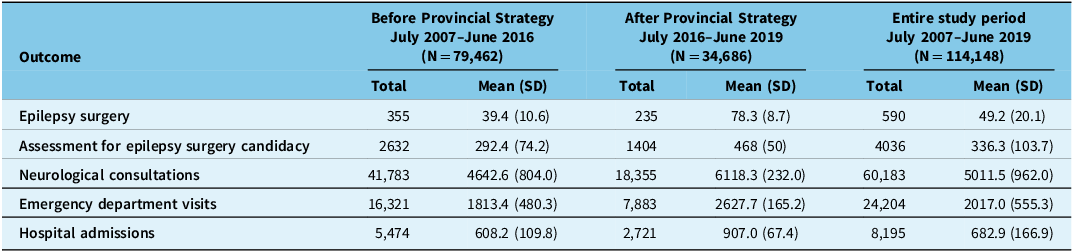
We included 79,462 participants with DRE in the period before the Provincial Strategy was implemented and 34,686 in the period after. The total and annual mean number of each outcome identified by period are available in Table 1. The results of the segmented Poisson regression analyses are summarized in the following sections, with all specific estimates available in Supplementary Table 4 and the plotted rates and fitted segmented regression lines in Figure 3.
Segmented regression plot for each outcome. (A) Epilepsy surgery. (B) Assessment for epilepsy surgery candidacy. (C) Neurological consultations for epilepsy. (D) Emergency department visits for epilepsy. (E) Hospital admissions for epilepsy.

Total and mean annual number of each outcome by period before and after the Province Strategy was implemented

SD = standard deviation. Note: The number of prevalent cases in each annual cohort was summed over each period and is indicated in brackets in the column heading. Patients were included more than once in each period if they were included in multiple annual cohorts.
Epilepsy surgeries and assessments for candidacy
The Provincial Strategy was associated with a level increase in the rate of epilepsy surgery of 48% (95% CI: 0%, 118%). The slope change in this rate was minimal, decreasing by 2% (95% CI: −17%, 15%) per year. The Provincial Strategy was not associated with level or slope changes in the rate of assessments for epilepsy surgery candidacy, with a level increase of 5% (95% CI: −18%, 12%) and a slope decrease of 4% (95% CI: −10%, 3%) per year.
Other healthcare for epilepsy
The Provincial Strategy was not associated with level changes in the rates of neurological consultations (8%, 95% CI: −6%, 23%), ED visits (−5%, 95% CI: −28%, 25%) or hospital admissions for epilepsy (10%, 95% CI: −4%, 25%). However, the Provincial Strategy was associated with slope decreases in the rates of these outcomes of 10% (95% CI: −15%, −5%), 10% (95% CI: −20%, 1%) and 7% (95% CI: −12%, -1%) per year, respectively.
Discussion
We found that the Provincial Strategy was associated with a 48% level increase in the rate of epilepsy surgeries. We also found that the Provincial Strategy was associated with slope decreases in the rates of neurological consultations, ED visits and hospital admissions for epilepsy of 10%, 10% and 7% per year, respectively. However, the estimate for ED visits was not statistically significant.
These findings indicate that the Provincial Strategy may be associated with an increase in the use of epilepsy surgery in Ontario. The estimate for the level increase in the rate of surgeries was not statistically significant; however, the lower confidence limit was equal to the null value of zero. Both the number of events per data point and the number of data points in the periods before and after the interruption point affect power in segmented regression analyses. Reference Hawley, Ali, Berencsi, Judge and Prieto-Alhambra26 Considering that there was an annual average number of epilepsy surgeries of 49.2, with only three data points post-interruption and the lower confidence limit was equal to the null value, we likely had insufficient power to reject the null hypothesis. Therefore, we believe the observed increase likely reflects a true increase in this outcome. This finding is important not only for patients but also for Ontario’s healthcare system. The Provincial Strategy was shown to be cost-effective prior to implementation, Reference Bowen, Snead, Chandra, Blackhouse and Goeree27 and the cost-effectiveness of epilepsy surgery in Ontario in general has also been demonstrated. Reference Wiebe, Gafni, Blume and Girvin28–Reference Widjaja, Demoe and Yossofzai30
It was surprising that we observed no corresponding increase in assessments for surgical candidacy. The long waitlists for epilepsy surgery preceding the availability of additional funding, along with a corresponding increase in operating room resources for epilepsy surgery, may have caused the sudden increase in epilepsy surgeries but not assessments. Additionally, EMU beds in some DECs and RESCs are used to treat conditions other than epilepsy if needed, which may have contributed to the lack of increase in assessments.
A previous study found a slope decrease in epilepsy surgeries at the Toronto RESC among pediatric patients between 2013 and 2019, relative to 2001 to 2012. Reference Yossofzai, Biswas and Moineddin31 This study also found that in both periods, there was an increasing trend in assessments for epilepsy surgery candidacy. These findings contrast those of the present study; however, these studies have several methodological differences. The previous study selected 2013 as the interruption point instead of 2016, as it was consistent with a previous study by the authors and with the timing of the Provincial Strategy’s approval by OMHLTC. We selected 2016 as it was consistent with the approximate date that the added EMU beds at the RESCs became available. Additionally, the previous study included patients at just one specialized epilepsy center in Ontario, which may not reflect the trends observed in the entire province.
Although the relative increase in epilepsy surgeries was substantial, the absolute rate of epilepsy surgery remained low after the Provincial Strategy was implemented. This finding suggests that most patients with DRE in Ontario are still not receiving appropriate epilepsy care. Considering that there remain waitlists for EMU admission, intracranial-EEG and epilepsy surgery, increasing the number of EMU beds and the availability of neurosurgeons and surgical facilities is likely needed to further increase the Ontario healthcare system’s capacity to perform epilepsy surgeries.
We also found slope decreases in the rates of neurological consultations, ED visits and hospital admissions for epilepsy after the Provincial Strategy was implemented. Although the decrease in ED visits was not statistically significant, the upper confidence limit was close to the null value. Considering that the estimate is not very precise, its lack of statistical significance may also be due to insufficient power.
The slope decrease in neurological consultations can be interpreted as a positive or negative outcome of the Provincial Strategy, depending on whether it is associated with improved seizure control. If the decrease reflects fewer neurological consultations not associated with improved seizure control, it indicates that patients received less frequent care from a neurologist without a significant improvement in their symptoms. However, we have evidence that epilepsy surgery rates may have increased and that ED visits and hospital admissions for epilepsy may have decreased, both suggesting that seizure control likely improved in this population. Therefore, considering these findings and that improved seizure control is typically associated with less frequent neurologist visits, we believe this decrease is a positive outcome of the Provincial Strategy.
There are some limitations of this research. One limitation is our likely lack of sufficient power in the analyses estimating the associations of the Provincial Strategy with epilepsy surgeries and possibly with ED visits. We could not increase power in this study, as we included all individuals who met our inclusion criteria and resided in Ontario. We also could not include the annual periods after 2019 because epilepsy surgeries were affected by the COVID-19 pandemic, which began in March 2020 in our region.
The identification of our study sample also has some potential limitations. Our definition of DRE may not have been sufficiently specific, as we could not determine whether patients tried a second ASM due to intolerability. However, we attempted to mitigate this limitation by including a minimum duration of 90 days for each ASM trial, as we expected medication changes due to intolerability to occur within the first 90 days. Another limitation is our ability to include only individuals eligible for ODB coverage. Therefore, we could not include all patients with DRE in the province. However, since those who receive disability benefits are eligible for ODB and many patients with DRE receive disability benefits, we likely included a significant proportion of patients with DRE in the province. Additionally, the ODB eligibility criteria changed during the study period. In 2018, the Ontario government extended eligibility to individuals 24 years and younger and, in 2019, to those 24 years and younger without private prescription drug coverage. 22 Therefore, this extension of eligibility may have introduced selection bias if young people who would not have been covered before this change had systematically differing rates of our outcomes than the rest of the study population. Importantly, these limitations indicate that estimates of the prevalence of DRE in Ontario cannot be derived from this study.
Misclassification of the outcomes also likely occurred; however, the magnitude is unclear, as the codes and algorithms used to identify these concepts were not previously validated. Additionally, we could only use video-EEG to identify surgical assessments, as neuropsychological evaluations are unidentifiable in the available data. In addition, other changes in epilepsy care not related to the Provincial Strategy likely occurred in the province during the study period, which may have confounded our results. To our knowledge, the only significant change was the development of Project ECHO: Epilepsy Across the Lifespan, a continuing medical education program for community healthcare professionals to improve epilepsy care. 32 The virtual and case-based program connects community healthcare providers with a multidisciplinary team experienced in diagnosing and treating epilepsy. As our study period ended in June 2019 and Project ECHO: Epilepsy was launched in 2019, it is unlikely that the program confounded our findings.
The choice of interruption point may be a limitation of this study. We selected July 1st, 2016, as this is the approximate date that all new EMU beds were added at the RESCs. However, the guidelines and standardized protocols were published between 2014 and 2017, and the coordination of resources and waitlists began in 2017. Although the funding for epilepsy surgery became available in 2013, it is unlikely that it was immediately utilized, as corresponding increases in personnel and surgical facilities availability were required. Finally, there may be spatial heterogeneity in the effectiveness of the Provincial Strategy due to the distribution of the added EMU beds and other resources. Future research should explore whether there may be spatial accessibility barriers to epilepsy care in Ontario.
In conclusion, the Provincial Strategy was associated with a level increase in the rate of epilepsy surgeries and slope decreases in the rates of neurological consultations, ED visits and hospital admissions for epilepsy. However, the estimates for epilepsy surgeries and ED visits were not statistically significant. Other regions with comparable healthcare infrastructure experiencing low rates of epilepsy surgery may benefit from similar interventions.
Supplementary material
The supplementary material for this article can be found at https://doi.org/10.1017/cjn.2025.14.
Acknowledgments
We would like to acknowledge the methodological support provided by Jennifer Reid of ICES Western. We thank IQVIA Solutions Canada Inc. for the use of their Drug Information File. This document used data adapted from the Statistics Canada Postal CodeOM Conversion File, which is based on data licensed from Canada Post Corporation, and/or data adapted from the Ontario Ministry of Health (MOH) PCCF, which contains data copied under license from ©Canada Post Corporation and Statistics Canada. Parts of this material are based on data and/or information compiled and provided by the Ontario MOH, Ontario Health and CIHI. The analyses, conclusions, opinions and statements expressed herein are solely those of the authors and do not reflect those of the funding or data sources; no endorsement is intended or should be inferred.
Author contributions
T Antaya: project administration, methodology, writing – original draft preparation. B Carter: project administration, methodology, data curation, formal analysis, writing – review and editing. S Shariff: methodology, writing – review and editing. L Boissé Lomax: conceptualization, writing – review and editing. E Donner: conceptualization, writing – review and editing. K Nylen: conceptualization, writing – review and editing. OC Snead: conceptualization, writing – review and editing. J Burneo: conceptualization, methodology, funding acquisition, supervision, writing – review and editing.
Funding statement
This study was funded by the Ministry of Health and the Ministry of Long-Term Care through Project ECHO (Extension for Community Healthcare Outcomes) Epilepsy Across the Life Span. This study was also supported by ICES, which is funded by an annual grant from the Ontario Ministry of Health (MOH) and the Ministry of Long-Term Care (MLTC), and the Jack Cowin Endowed Chair in Epilepsy Research at Western University.
Competing interests
J Burneo received funding for this study from the Jack Cowin Endowed Chair in Epilepsy Research at Western University, the MOH and the Ministry of Long-Term Care (MLTC) through Project ECHO (Extension for Community Healthcare Outcomes) Epilepsy Across the Life Span. J Burneo also received support for this study from ICES, which is funded by an annual grant from the Ontario MOH and the MLTC. The remaining authors have no conflicts of interest.