I. Introduction
Historically, road traffic victims and their dependants faced with someone who denies liability have been able to obtain compensation only through the potentially complex, costly, intimidating, protracted and uncertain path of a negligence suit. In contrast, since the passing of Britain's Workmen's Compensation Act, 1897, financial redress has been available to many though not all employees without demonstrating another party's negligence, provided their injury arose “out of and in the course of employment”. Subsequently, this remedy was extended to include victims of many occupational diseases. Since 1948, when the National Insurance (Industrial Injuries) Act came into operation, compensation has been obtainable from public funds via the social security system.
Since the 1930s many have proposed placing road victims in the same position as injured workers.Footnote 1 Although bills have come before Parliament repeatedly, not one has become law. This article investigates initiatives, particularly since the 1960s, for the no-fault compensation of road traffic victims in Great Britain.Footnote 2 It examines the extent of road death and injury; specific proposals for reform; arguments for and against change; and the reasons why no reform ensued, notwithstanding the precedent of workmen's compensation and the example set by a number of other countries.
That reform proposals began to emerge in the early 1930s is unsurprising. The rising toll of road death and injury was a factor, as was the widespread perception that roads were places of social conflict where rich and selfish male drivers killed and maimed impecunious pedestrians. In addition, the advent of compulsory third party insurance for drivers under the terms of the Road Traffic Act, 1930 meant that the cost of no-fault compensation could be met through increased insurance premiums without threatening individual motorists with financial ruin. Later proposals for funding compensation through a small levy on fuel or via general taxation also promised to spread costs and minimise the expense to individual motorists. Although motor insurance premiums should have fallen if litigation and insurers' administrative costs subsequently declined, concern about the cost of a no-fault remedy partially explains the failure to introduce reform, as does government reluctance to upset motorists. As important in the 1930s was the opposition of the motoring lobby, notably the Automobile Association, to almost all proposals to restrict motorists' liberty or increase the cost of motoring. Since the 1970s, disability organisations have objected to the idea of favouring road victims but not, say, those who suffered birth defect or medical injury. There is little indication that practising lawyers or other interest groups such as insurers opposed reform in order to protect their professional and financial interests. Academic lawyers, on the other hand, did influence politicians – mainly on grounds of principle – against making special provision for road traffic victims. For years Patrick Atiyah was prominent in opposing no-fault compensation in the motoring context, though eventually he came to see the advantage of such reform as a first step towards more radical change.
II. Death and Injury
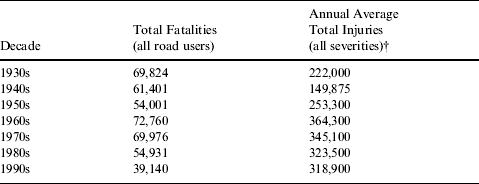
Road death and injury supplied the fundamental context for all discussion about liability rules and the compensation. Most sources agree that Britain's first road traffic death involving a motor car occurred at Crystal Palace in 1896 when, as more than one commentator has put it, Bridget Driscoll “stepped off the curb and into history”.Footnote 3 Since that first fatality vehicles have taken a fearful toll of life and limb. Between 1926, when official records began, and 1999, 422,033 people died on Britain's roads at an average rate of 5,983 per year. Every decade from the 1930s to the 1990s saw tens of thousands of road deaths. In the worst year on record, 1941, when wartime conditions such as the “blackout” increased existing dangers, 9,169 fatalities were recorded. A post-war peak of 7,985 deaths in one year was attained in 1966. As for non-fatal injuries among all road users, no statistics are available for the early years of the World War II, but between 1926 and 1989 every year for which records exist saw recorded annual road casualty figures (all severities) of at least 123,000 (in 1943) and as many as 398,000 (in 1965)Footnote 4 (Table 1).
Road Deaths and Injuries in Great Britain, by Decade, 1930s–1990sFootnote *
Source: Road Accidents Great Britain 2001 (London 2002) p. 43.
* Britain, in common with most other countries, classified fatalities as road deaths if they occurred within 30 days of injury.
† No figures for injuries are available for 1939–1941 inclusive. The relatively low figure for the 1940s may reflect limited use of cars by private motorists during the war years.
Such was the carnage that one Minister of Transport in the 1930s termed British roads sites of “mass murder”.Footnote 5 In the course of the decade others equated death and injury on the roads with the butchery of the battlefield.Footnote 6 Such remarks were not confined to the thirties. In 1965 Lord Chief Justice Parker described the roads as places of “civil war”.Footnote 7 Some months later Barbara Castle, when Minister of Transport, deplored the fact that road deaths since the end of the Second World War exceeded the number of Britain's wartime civilian fatalities. She also forecast “something like a holocaust” over the next two decades.Footnote 8
The figures for death and injury on Britain's roads since 1926 are in many ways shocking but over the years, in relation to the number of registered vehicles and distances travelled, death rates declined markedly. In 1930 2.3m licensed motor vehicles gave rise to 7,305 road deaths, whereas in 1999 more than 28.3m vehicles produced “only” 3,423 deaths. Death rates on Britain's roads per 100,000 population or 10,000 vehicles also compared favourably with those in other developed countries.Footnote 9 Since 1972 the trend in road traffic fatalities has been generally downwards. In 2007, for the first time, and to some fanfare including double-page news coverage and an editorial in The Times, fewer than 3,000 fatalities occurred.Footnote 10
III. From Horse and Buggy to Beveridge
How has the law treated road traffic victims in terms of compensation? This section examines developments in law since the mid-Victorian period and failed attempts to effect reform in the 1930s and 1940s.
As John Spencer has shown, in traditional “‘horse and buggy law’…the driver or rider was only liable in so far as he was at fault”.Footnote 11 However, following judgment in the case of Rylands v. Fletcher (1868), the Victorian period saw the emergence of the legal theory of strict liability whereby damages could be payable when injury was inflicted in the course of conducting a business for profit, even if there was no question of fault. The theory was extended to cases involving steam-driven traction engines that inflicted injury when on the highway by frightening horses, crushing water mains, or emitting sparks that ignited hay ricks. In the early days of motoring the courts viewed the motor car more as a traction engine than a horse and buggy. If a car damaged property or people, the person who brought the car onto the highway was held strictly liable. But in 1909, in the case Wing v. London General Omnibus Company, the Court of Appeal dismissed the notion that motor cars were dangerous things. In so doing it “completely rejected the strict liability approach”. Thereafter, “the law relating to motor accidents [was] squarely upon the basis of fault liability upon which it has rested ever since.”Footnote 12 As we shall see, some argued that this was unfair to road traffic victims, especially pedestrians, cyclists and horse riders.
The first attempt to change the law to benefit road traffic victims was initiated by the Pedestrians' Association (PA) in 1932, in the person of the lawyer and Conservative politician Lord Danesfort. Founded in 1929, the PA sought to promote the safety of the walking public and to protect and preserve pedestrian rights and amenities. Danesfort's Road Traffic (Amendment) Bill provided that non-motorists who suffered personal injury by contact with a motor vehicle through no fault of their own, should be eligible for compensation from a driver without the need to prove negligence.Footnote 13 The motoring press, Automobile Association (AA) and Royal Automobile Club (RAC) reacted with fury.Footnote 14 The government was more sympathetic. The Earl of Plymouth, parliamentary secretary at the Ministry of Transport, informed parliament that a revised measure might receive government support. As a result Danesfort withdrew his bill.Footnote 15
Danesfort introduced a slightly amended bill in March 1933. On this occasion the government proposed the appointment of a select committee. In June 1934, following a favourable report from this committee, Danesfort tabled his bill for a third time. Notwithstanding the fulminations of some peers and the motoring press, it passed all stages in the House of Lords. In the end, however, the government turned hostile and declined either to support the bill in the Commons “or afford any facility for its further progress”.Footnote 16 It justified this volte-face by emphasising the absence of persuasive foreign precedent, lack of a proven connection between no-fault compensation and improved road safety, the prospect of higher insurance premiums for motorists and the sanctity of Common Law principles equating liability with negligence (thereby disregarding the precedent of workmen's compensation).Footnote 17 However, all these points had been raised at a time when ministers had been expressing sympathy for the bill. In reality, government antipathy had increased because of its reluctance to offend the emergent but already powerful motoring lobby.
The PA remained keen to continue the struggle even after this third failure but Danesfort's death in June 1935 ended its hopes, even though its chairman, Alexander Kaye Butterworth, restated the case for reform in September 1936.Footnote 18 Thomas Cassells, Labour MP for Dumbartonshire, trade union solicitor and expert on workmen's compensation and employers' liability, briefly raised the plight of uncompensated road traffic victims in the House of Commons in 1937. However, the Lord Advocate made it clear that he had no intention of recommending legislation.Footnote 19
During the Second World War, prompted by an observation from James Griffiths MP at an annual meeting of the Labour Party that social security payments “made to relieve a family in need of help ought not to depend upon how the family has lost its livelihood, but on the fact that it has lost its livelihood”, the PA issued a short paper. Published in August 1942, it recommended:
1. Amendment of the law on the lines of Danesfort's bills.
2. Creation of a no-fault remedy funded through third party insurance that would allow road victims to claim limited sums along the lines of the workmen's compensation acts.
3. Establishment of a fund, financed by all insurance companies, to pay compensation in cases where no third party insurance claim was possible (e.g. where death or injury was caused by an uninsured or untraceable driver).Footnote 20
Of course, these recommendations actually did envisage the allocation of benefits on the basis of how livelihood was lost. In the event they had only limited impact upon government policy.
In 1937 a Board of Trade Committee on compulsory insurance, to which Butterworth and another PA witness gave evidence, recommended the creation of central fund from which the victims of uninsured drivers might obtain the damages to which they were entitled. Nothing happened until after the Second World War but in 1946 the Motor Insurers' Bureau was established to meet the needs of such victims.Footnote 21 This innovation, however, did not meet the PA's principal concern, for it remained the case that an injured party still needed to prove fault in order to recover damages.
While the war was still on the Beveridge Committee briefly addressed the issue of compensation for road traffic victims. When discussing the “problem of alternative remedies” the Beveridge Report identified three areas in which loss of income could be met by means of a legal claim against another person. These three areas concerned marital breakdown (a wife could claim maintenance from her husband) along with industrial and road injury victims (negligent employers or road users could be sued). The Beveridge Plan envisaged social insurance provision that protected people from penury without the stigma attached to the Poor Law. But the existence of alternative remedies raised a number of questions for Beveridge: “How far should the possible existence of these other rights of the person in need of income affect his claim under the proposed social security scheme? Should the developments now proposed in social insurance be accompanied by any change of these other rights?” Beveridge emphasised that social security benefits should be paid promptly regardless of the existence of any possible alternative remedy and that the same need ought not to be met twice over. But he added that the question of alternative remedies in the industrial, marital and motoring contexts “presents special features and involves varied questions of law and policy, too technical for exhaustive discussion” in his report. He therefore suggested the appointment of a specialist committee of inquiry.Footnote 22 Otherwise, the Beveridge Report made no further mention of road accidents. In July 1944 the Home Secretary, Herbert Morrison, appointed a Departmental Committee on Alternative Remedies. Although this was the specialist committee Beveridge had proposed, it did not explore the issue of traffic accidents. Thereafter, the question fell into abeyance.Footnote 23
IV. From Parker to Pearson
After some years in abeyance, the issue of uncompensated road traffic victims re-emerged as a matter of sustained public interest and debate in the 1960s, and not only in the United Kingdom.Footnote 24 Why the sixties saw increased concern about the subject is a complex issue. With the inception of legal aid and the National Health Service in the late 1940s it might appear that the issue would have been less urgent. But other factors such as the emergence of the “risk society”, increasing affluence and blurring of the stark difference between pedestrians (working class) and motorists (middle and upper class) may have been influential.Footnote 25 The surge in road fatalities and injuries in the sixties was a more tangible consideration. In the fourteen-year period between 1945 and 1958, road fatalities in Britain averaged 5,140 p.a. Thereafter, a substantial increase occurred, though not relative to vehicle numbers or mileage, with deaths hitting an annual average of 7,207 between 1959 and 1969 inclusive.Footnote 26 As the number of fatalities rose, road safety became a focus for the media and politicians; excessive speed, drink driving, poor vehicle maintenance and the need for seat belts were particular concerns. This section explores developments in Britain and elsewhere between the early 1960s and the appointment of the Royal Commission on Civil Liability and Compensation for Illness and Injury in 1972.
As early as 1960 a plea for no-fault compensation appeared in Current Legal Problems. A few years later Hamish Grey approved of such a change in the same specialist publication.Footnote 27 Their ideas attracted only limited attention. In contrast Lord Chief Justice Parker's presidential address to the Bentham Club of University College London, subsequently published in the same journal, was picked up by the press and accorded substantial publicity. In view of the impact of his speech it is noteworthy that Lord Parker prefaced his remarks by apologising to his audience that pressure of work had prevented him from giving “the thought and industry necessary to produce a really worth-while address”.Footnote 28
Appalled that many innocent people were dying on the roads every year with “barely the flicker of an eyelid” from the public, Parker despaired either of the criminal law or the law of negligence remedying the shocking state of affairs. Like Payne, he thought overseas precedent, in particular the no-fault insurance scheme enacted by the Canadian province of Saskatchewan in 1946, pointed the way forward.Footnote 29 It was time, Parker thought, for Britain to recognise that its methods for compensating road victims were inadequate and to address an “urgent social problem” that threatened to worsen as traffic volume increased. Parker therefore called for the appointment of a Royal Commission to formulate “a comprehensive insurance scheme under which everyone injured in a road accident would get compensation, regardless of who was to blame”.Footnote 30 Parliamentary questions about the appointment of a commission elicited reasonably sympathetic, but non-committal, responses from the Attorney-General and Prime Minister. They stated that the issue was under consideration but also that no swift solution was likely because it was, in Harold Wilson's words, “bristling with legal problems”.Footnote 31
Although Parker made no mention of American developments it is possible that they influenced his thinking, for Robert Keeton and Jeffrey O'Connell had published proposals for a no-fault scheme for road traffic victims in 1964. Their article summarised two chapters of a book they published subsequently. Shocked by the USA's “staggering” toll of road deaths (over 47,000 fatalities in 1964) and convinced, like Parker and others, that the problem would worsen, Keeton and O'Connell advocated a scheme administered by insurance companies that compensated victims for actual losses and confined tort remedies to cases of severe injury.Footnote 32
Arthur Goodhart, president of the PA between 1951 and 1963, emeritus professor of law at Oxford University and former member of the Monckton Committee on Alternative Remedies, praised the work of Keeton and O'Connell and other American scholars in a speech he delivered when visiting professor at the University of Virginia Law School in 1965. Goodhart also endorsed Parker's “radical proposal”. He did not expect British law to change imminently but thought reform “will be easier to introduce” in the UK than in the USA and “will not be too long postponed”. He expected Britain to lead the way partly because it already had compulsory third party liability insurance for motorists as well as State health and unemployment insurance, both of which capped compensation payments. Abolition of the defence of contributory negligence in 1945, the illegality of contingency (no-win-no-fee) arrangements and the insignificance of “plaintiffs' lawyers” in parliament also were promising indicators. Road traffic victims merited their own special scheme because Goodhart viewed automobile injuries as different, in the same way that industrial injury was different:
Motor vehicles have created a new and special danger not only to those who, as pedestrians, do not use automobiles themselves, but also to those who use them. It is reasonable, therefore, that a special system of social insurance should be provided for them…this argument is less forceful where the accident is the result of a collision between two vehicles, but even here there is a public interest in providing that there should be a proper system of compensation insurance, because without it many persons may be forced to rely on public assistance.Footnote 33
Whether road traffic victims really did merit preferential treatment is debatable. After all, people could become reliant on publicly-funded benefits for all sorts of reasons ranging from birth defect to sports injury; what made those injured on the roads different or more deserving? Indeed, shortly after Goodhart delivered his address, Terry Ison indicted the entire tort system as “a capricious and unsatisfactory method of compensating victims of injury or disease”. He advocated its abolition and replacement by universal no-fault compensation that ignored the cause of an injury or disease, was compatible with or integrated into the social security system and gave priority to “income security”.Footnote 34 Nevertheless, proposals for the no-fault compensation of road traffic victims and no others continued to appear, though the UK, rather than leading the way as Goodhart anticipated, lagged behind the USA and several other countries.Footnote 35
In Britain two academic lawyers, D.W. Elliot and Harry Street, were the first people since the 1930s to outline detailed reform proposals. In a book published in 1968 they levelled several charges against the prevailing fault-based system: “It is a matter of chance whether particular traffic victims are compensated; it is the undeserving rather than the deserving who are the most fully compensated; the compensation never arrives when it is needed; the cost of operating the scheme is enormous; and the scheme is wasteful and slow, encourages a decline of moral standards and does nothing to promote road safety”.Footnote 36 Although Elliot and Street thought the case for reform “unanswerable”, they recognised that “radical reform is strongly opposed by many”, largely because road traffic victims had no distinct claim for special treatment. Their main response to such opposition was similar to that advanced not only by Goodhart a few years earlier but by Danesfort in the 1930s: “Mankind has devised a swift-moving machine which is killing and maiming in ever-increasing numbers every second of the day and leaving its victims without financial support. Citizens demand that the law shall not allow this to happen”.Footnote 37 So Elliot and Street asserted that it was public attitudes that made traffic victims different from, for example, cancer sufferers or people injured in their homes.
Elliot and Street proposed no-fault compensation for all road traffic victims, even the reckless. They favoured a state-administered scheme funded by higher insurance premiums and fuel taxes. Their main objective was to replace lost earnings by means of regular rather than one-off payments as swiftly and cheaply as possible, but modest sums would be available to meet other losses. The option to sue at the common law would cease.Footnote 38
These proposals were welcomed, at least in some quarters. Both the International and Comparative Law Quarterly and Modern Law Review carried enthusiastic endorsements from academic lawyers. André Tunc wrote: “It would be disappointing if the voice of Professor Street and other scholars who have made comparable efforts were not to be heard”. Harvey McGregor thought there was “much to recommend” the proposals: “Until now there has been plenty of general talk but no concrete proposals. Road Accidents has the great merit of providing just this and thereby has given the community the essential focus for profitable discussion and, in the field of the modernization of the law of tort, has put Britain on the international map.” John Jolowicz of Cambridge University was less enthusiastic, mainly because he thought “our troubles” lay more with “the substance of the law itself” rather than its operation in the road accident context. Nevertheless, he agreed that “the main lines of Professor Street's criticisms are entirely justified and that radical reform of the law is needed.”Footnote 39
In 1970 Patrick Atiyah, then Professor of Law at the Australian National University, published the first edition of Accidents Compensation and the Law, a book that quickly gained recognition as a masterly exposition of personal injury law in the UK. In his final chapter Atiyah addressed the issue of reform. He thought it unfortunate that discussion in England, the USA and the Commonwealth had tended to focus on the road injury issue in isolation. He argued that there were “already far too many special cases”, that “piecemeal reform…has gone on too long, and that comprehensive reform of the whole system is what is needed today”. Atiyah admired the ideas under discussion in New Zealand and put forward by Ison. “What is surely needed is a single comprehensive system based on the existing social security system, but with benefits as adequate as society can afford”.Footnote 40 Atiyah, then, did not support the proposals of Elliot and Street.
When, in 1970, the Society of Conservative Lawyers examined the issue of compensation for personal injury at the request of the leader of the opposition, Edward Heath, it too viewed Elliott and Street's ideas unsympathetically. The Society objected to the uncosted nature of the proposals, the prospect of inadequate compensation for the blameless and the “monstrous notion” that even intoxicated drivers or pedestrians who threw themselves in front of moving vehicles would be eligible for benefits. The Society also anticipated that no-fault compensation would cause a huge rise in motor insurance premiums.Footnote 41 Except for children, who should be “entitled to compensation whether or not the driver of the vehicle is at fault”, the Society opposed no-fault coverage. Instead of the comprehensive reform favoured in other quarters, however, it recommended nothing more than “improvements to the present system”.Footnote 42 Unsurprisingly, Conservative lawyers produced conservative recommendations.
V. The Pearson Commission and its Critics
The chances of reform, radical or otherwise, increased in 1972 when Edward Heath's Conservative government decided to establish a Royal Commission on Civil Liability and Compensation for Illness and Injury (Pearson Commission). The commission's brief was to examine “in what circumstances and by what means compensation should be payable in respect of death or personal injury…having regard to the cost and other implications for the recovery of compensation, whether by way of compulsory insurance or otherwise”. The commission identified the plight of traffic victims as a prime area for investigation.Footnote 43 This section explores the origins, work and largely adverse reception of the commission along with reform proposals put forward during the six years or so that it was sitting.
In announcing the commission's appointment under the chairmanship of Lord Pearson, the Prime Minister identified several factors that indicated the need for an inquiry. One was the recommendation of the Robens Committee on Safety and Health at Work in July 1972 for a “thorough review [not only] of the present system of actions at common law for compensation for injuries sustained at work” but also of “civil compensation for personal injury generally”.Footnote 44 Other considerations were the thalidomide scandal, Lord Chief Justice Parker's 1965 speech and Heath's own longstanding recognition of the need for a full inquiry.Footnote 45
The Prime Minister made no reference to overseas developments but other countries had recently made or were considering changes in their systems for compensating victims of road traffic. No-fault schemes had come into operation in the United States, first in Puerto Rico (1970), then in Massachusetts (1971).Footnote 46 In 1972 New Zealand, following the 1967 report of a Royal Commission on Compensation for Personal Injury, passed an Accident Compensation Act that provided for the no-fault compensation, by means of a state insurance scheme, not only of victims of motor vehicles but of all earners, whether injured at work or anywhere else.Footnote 47
The Pearson Commission began its deliberations in March 1973. It did not submit its report, chapter 18 of which dealt with roads, until March 1978. During those five years sporadic public debate about how to compensate road victims continued.Footnote 48 The legal rights organisation, Justice, proposed a no-fault insurance system to stimulate “a more positive interest in devising improved methods of compensating victims of other calamities”. But it also outlined a road traffic scheme.Footnote 49 Justice had decided on its investigation before Heath announced the appointment of the Pearson Commission. Indeed, the Justice committee responsible for the investigation met for the first time on the eve of the Prime Minister's announcement. Once that announcement was made, the committee decided to proceed with its work and to present its conclusions as evidence to the Royal Commission – as it did in 1973. Its submission was one of 865 forwarded to the Commission by 766 individuals and organisations; the Society of Conservative Lawyers submitted a revised version of its 1970 report.Footnote 50 In its October 1974 General Election manifesto the Conservative Party mentioned the need to consider reform of the law on compensation for personal injury.Footnote 51 In 1975 the law lord, Lord Wilberforce, expressed support for a scheme of “automatic compensation regardless of any question of fault” in his ruling in the (unreported) case of Snelling v. Whitehead.Footnote 52
An attempt to change the law occurred while the Pearson Commission was sitting, prompted by an accident that occurred 1971. The film director Ken Loach, already renowned for such titles as Cathy Come Home, Up the Junction and Kes, was involved in a serious motorway collision. It occurred when another car shed a wheel and collided with Loach's vehicle, propelling it into the base of a bridge. Two members of the family died and three were injured, Mrs Loach critically. The family sued for damages but after 4½ years they dropped their case, incurring substantial costs, because of the intolerable emotional strain.Footnote 53
Partly as a result of the Loach family's experience, Graham Page, Conservative MP for Crosby, introduced a Road Accident (Compensation) Bill that sought to make “the user of a motor vehicle on the road responsible for any death or injury arising out of the use of that vehicle on the road, whoever is to blame”. Page, treasurer of the PA and veteran road safety campaigner, also was motivated by frustration with the length of time the Pearson Commission was taking to report and Britain's tardiness compared with other countries in introducing a no-fault regime.Footnote 54 Page's bill was debated in Parliament, albeit late on a Friday afternoon in a depleted chamber, and several speakers accorded it a cautious welcome. However, after consulting the Commission, which saw little merit in the bill, the government decided it was inappropriate to legislate before Pearson reported. The debate was adjourned and Page's bill received no further consideration.Footnote 55
As noted, the Pearson Commission finally reported in March 1978. Though its terms of reference “encompassed a wide and complex field”, it did not consider itself authorised to examine certain issues, including injury in the home. Neither did it explore the case for a comprehensive compensation scheme on New Zealand lines. As a result, it saw no alternative but to continue Britain's “mixed system” of fault and no-fault provision. It viewed its task as the improvement of both tort and social security compensation by co-ordinating the two systems to ensure that victims did not recover twice over or not at all. As we shall see, some critics thought the Commission interpreted its terms of reference too literally and should have adopted a broader approach.
As far as road injuries were concerned, the Commission criticised the prevailing fault regime for being slow, expensive to administer and overly-dependent upon chance. It compensated too few victims and did nothing to promote safety. Commissioners recognised that these criticisms applied beyond the sphere of road injury, but maintained that traffic victims deserved special treatment by virtue of their large numbers, the severity of the injuries they often sustained, their presence across all sections of society and the fundamental importance of road transport. They claimed that the existence of compulsory third party insurance since 1930 demonstrated Parliament's longstanding recognition that traffic injury was “different”. These considerations persuaded the Commission to propose a no-fault compensation scheme for anyone injured in or by a motor vehicle, with benefits similar to those available under the industrial injuries scheme and special provision for children and the elderly. The scheme would be administered by the Department of Health and Social Security (DHSS) and financed by a levy on petrol of one penny per gallon. It would cover all injuries involving motor vehicles on public roads or land to which the public had access and all injuries involving at least four days absence from work. In all but exceptional circumstances, even those injured whilst engaging in misconduct would be eligible for compensation. Actions for damages at common law would remain possible but any no-fault compensation received would be deductible from an award. The Commission therefore thought that lawsuits would occur only in cases of severe injury involving substantial financial loss.Footnote 56
A leading article in the Guardian, which focused on the road traffic scheme, was enthusiastic about the report: “The case for introducing a basis of compensation for road injuries which no longer relies on proving that someone is to blame is powerfully, indeed unanswerably, argued…. It will be difficult for a government to reject a case so forcefully argued on behalf of people who are overwhelmingly deserving”. The Guardian believed the proposals deserved “a high place in the list of priorities of the next government – whatever that government's philosophical approach might be to the increase in public spending which Pearson must inevitably entail”. The Prime Minister, James Callaghan, “cannot be blind to the electoral attractions of a package of this kind”. The newspaper's one reservation concerned the cost of implementation.Footnote 57
The Times was more guarded. An editorial described the existing “jumble” of arrangements for compensating the injured and disabled as a “serious social injustice”. It was “absurd”, for example, that someone injured by an uninsured motorist should recover only social security benefits, whereas someone similarly injured by an insured driver might receive substantial damages. In principle it was “right” to expand no-fault provision by means of social security, without dispensing altogether with the tort system. In sum, therefore, the Commission's proposals were “broadly sound in principle and desirable in general intent”. At the same time, the newspaper expressed several reservations. Its main concern was whether, “in the light of future economic conditions and rival claims upon public expenditure”, the country could afford the proposals.Footnote 58
The Times maintained that insurers opposed state intervention “in any sphere but in the case of motor cover they argue persuasively that any scheme which switches the burden of damage claims onto the motoring community at large and away from the bad driver cannot be a good thing”.Footnote 59 In reality, the British Insurance Association held no strong opinions, though it did prefer “evolutionary change in the tort system”. It was prepared to devise and operate a no-fault scheme on commercial lines but expressed scepticism about financing it through a petrol levy. The TUC, though also opposed to the petrol levy, favoured a no-fault scheme, provided the reckless were made to pay and the right to sue remained.Footnote 60
A Labour Party Working Group on No-Fault Liability was divided. Some of its members supported the Commission's road scheme on the grounds that it would entail no additional public expenditure; find acceptance with the public; assist numerous people and “act as a target for improvements in financial provision for other disabled people”. Others objected that it would create a privileged new group, provide no redress to those injured in the past and aid many with only minor injuries.Footnote 61 Organisations such as the Disability Alliance, which represented the interests of disabled people, were concerned about the prospect of increased competition for limited resources. The Alliance utterly opposed the creation of another group eligible for preferential treatment on the basis of the cause, rather than the extent, of disablement.Footnote 62
Few academic appraisals of the Pearson Report were complimentary. Donald Harris, Director of the Centre for Socio-Legal Studies in Oxford, acknowledged that implementation of Pearson's proposals would improve existing arrangements. However, he criticised the Commission's legalistic approach, its lack of an overall strategy and recommendations that promised to complicate rather than simplify the social security system. Although Harris was mainly concerned with the report as a whole, he also argued that the establishment of a road injuries scheme would create vested interests, which would make it more difficult to implement the universal scheme that he preferred, allocating compensation on the basis of need, regardless of the cause of disability.Footnote 63
Another academic lawyer, R.A. Hasson of Osgoode Hall Law School in Toronto, termed the Pearson Commission “a failure” and dismissed its report as “confused and intellectually undistinguished”. The “complex and unwieldy scheme” made “little sense from the point of view of either cost or justice”. None of its recommendations was “truly…radical”. Even the “most far-reaching”, the road traffic scheme, was pallid in comparison with overseas proposals.Footnote 64 Atiyah, by now Professor of English Law at Oxford, thought the Commission's recommendation for a “new scheme…for road accident victims (and no others) is…indicative of a total lack of principle. For road accident victims do not form a coherent class of victims defined by any social welfare policy and their selection as a group for this favoured treatment is purely a pragmatic and totally unprincipled proposal for extension of the welfare system” (emphasis in original).Footnote 65 Richard Lewis of University College Cardiff accused the Commission of failing either “to come to terms with the fundamental questions in the compensation debate” or to explain why road traffic victims merited preferential treatment.Footnote 66 John Fleming of Berkeley Law School, who praised some aspects of the Commission's report, deplored its narrow interpretation of its remit and judged many of its proposals “cautious”.Footnote 67 As far as the road proposals were concerned, an Australian academic provided the most favourable assessment. He regarded the Commission's proposals as “providing an excellent basis for compensating one group of injured persons”. The proposals therefore deserved “our support and further study”.Footnote 68
What of the views of HM Government? In a statement to the House of Commons made on the day the Pearson Report was published, the Prime Minister promised that the government would study the proposals and consult widely with interested parties. Soon after, however, he warned that it would also consider the question of cost, “which could be considerable”.Footnote 69 Three months after Pearson reported, the Labour Party publicised plans for the introduction of a comprehensive disability benefit if it won the next General Election. When breaking this news The Times's social services correspondent observed that Labour disliked the road scheme, not least because it would exclude people injured in other circumstances.Footnote 70
At official level the DHSS was quick to register opposition to the Commission's proposals. The department wished “to secure progress for the disabled generally” not to benefit one section of the community, at huge expense, purely on grounds of the origin of disablement. As one official wrote, “we could give 100,000 of the country's most disabled people a pension of £5 per week for a good deal less than the Pearson scheme costs”. Other objections included the prospect of heavy expenditure on minor injuries and major difficulties in dealing with the many people disabled on the roads before any new scheme began. Officials acknowledged that the public accepted the preferential treatment accorded war pensioners and industrial injury victims, both of which groups had “powerful lobbies” to advance their interests, but doubted whether the public would view road traffic victims in the same light. They also wondered what the public would make of someone sent to prison for reckless driving but allocated a pension for injuries sustained in the same incident. DHSS ministers accepted these appraisals.Footnote 71
In June 1978 the Cabinet's Home and Social Affairs Committee decided that a no-fault scheme for road victims was incompatible with the DHSS's objective of a General Disability Allowance for the seriously injured. At the same time, recognising the “major resource difficulties” associated with both proposals, it recommended that the government should enter into no commitments.Footnote 72
In November 1978 the views of HM Government, the official opposition and backbench MPs were expressed in the course of a Commons debate on the motion: “That this House takes note of the Report of the Royal Commission on Civil Liability and Compensation for Personal Injury”. In introducing the debate the Secretary of State for Social Services, David Ennals, made it clear that the government had no policy initiatives to announce. He also indicated that in view of the expansion of the social security system in recent years, “there is a general feeling that we may have gone about as far as is sensible in the construction of further individual benefits for particular kinds of disablement.” As the Solicitor-General noted, the debate as a whole focused surprisingly little on the road scheme. Although this scheme had “some obvious attractions”, Ennals offered a number of arguments against it. First, road accident victims did not constitute a special class denied access to existing benefits. Second (but erroneously given the longstanding preference shown to victims of occupational injury and disease), giving preferential treatment to one category of victim would introduce “an entirely new concept”. Third, it was difficult to know how to treat the many surviving victims of past road accidents. Fourth, disability interest groups opposed the scheme and favoured a general allowance based on personal need rather than cause of disability. Ennals then hinted that the government was also contemplating a general disability allowance.
For the Conservatives, Patrick Jenkin, who within months succeeded Ennals at the DHSS, expressed little admiration for the Pearson Report. He agreed with those academics who discerned little principle, strategy or radicalism in the recommendations. He also appeared to agree with the disability groups and others that a special road scheme was objectionable.Footnote 73
Thus, nothing in the November 1978 debate indicated that either of the main political parties intended to act upon the Pearson Report or single out road traffic victims for special treatment. The Labour and Conservative Party manifestos for the May 1979 General Election were silent about compensation for personal injury, though Labour, about to begin eighteen years in opposition, promised to introduce a new disability allowance based on severity of incapacity.Footnote 74 In 1980 Harry Orriss thought a no-fault scheme for road traffic victims would be “excellent” but believed that “the present and immediately future world of reality, provides hard reasons as well as less hard excuses for at least shelving this major reform”. In other words, cost made it “highly unlikely” that Margaret Thatcher's new Conservative administration would introduce reform.Footnote 75
VI. After Pearson
Without open rejection, the Royal Commission's proposals appeared to be quietly sinking into oblivion. Then, in January 1982, a member of the Commission, Lord Allen of Abbeydale, complained in the House of Lords about the lack of government response to Pearson and called for the no-fault compensation of road victims. Lord Bellwin, responding for the government, emphasised the importance of a “coherent benefit system” that would assist “all disabled people”. He also drew attention to resource constraints before announcing that the government rejected the introduction of “a further preferential, no-fault benefit aimed at a special section of the public”.Footnote 76 Finally, therefore, the road scheme appeared to have been laid to rest. However, in line with its long history as an enduring idea, proposals for a no-fault scheme for road victims continued to surface periodically. This section reviews no-fault investigations, proposals and bills since the 1980s.
In 1988, the Review Body on Civil Justice recommended that the “Lord Chancellor should consider, in consultation with the insurance industry, the feasibility of a no-fault scheme, restricted to less serious road injuries and financed by private insurance.”Footnote 77 The Review Body had no mandate to investigate “the substantive law of negligence”; its terms of reference were to “improve the machinery of civil justice in England and Wales by means of reforms in jurisdiction, procedure and court administration and in particular to reduce delay, cost and complexity”. In the course of its consultations, however, it discovered “a body of opinion in favour of some no-fault scheme” beyond those already in existence. Although it did not examine the idea in detail, it concluded that such a scheme, applied to less serious road injuries, might have “a number of advantages”, especially in terms of reducing uncertainty for claimants, eliminating the cost and delay associated with litigation, removing disputes from the courts and therefore relieving pressure on the court system. The one possible disadvantage was the prospect of higher motor insurance premiums.Footnote 78
In July 1989 the Lord Chancellor, Lord Mackay of Clashfern, announced his acceptance of the Review Body's recommendation for an inquiry into the feasibility of a no-fault scheme covering less serious road injuries. A working party with representatives from eight government departments was set up to carry out the review. It found that “criticisms of the existing system of tort compensation for road injury made by the Pearson Commission remain valid”. But instead of the proposal put forward by Pearson it recommended a “no-fault scheme which is limited, at least at the outset, to smaller claims [as] a practicable, albeit cautious solution…at relatively low cost”. It would be funded and administered by the insurance industry and cover personal injury for claims of between £250 and £2500. The Lord Chancellor's Department solicited comments from the general public, the insurance industry, lawyers, motoring organisations and other interested parties. The department's ideas “did not find much favour”; as a result, the existing system remained in place.Footnote 79
In 1998 and 1999 Dr Desmond Turner, MP, was inspired by a tragic case of injury in his constituency to introduce two bills “to ensure compensation for persons injured as a result of road traffic accidents”. Neither made progress.Footnote 80 Dr Brian Iddon, MP, presented a more limited bill in 2008. He too was motivated by tragedy. In 2004, one of his constituents, Rajendra Vanker, was seriously injured through no fault of his own when hit by a vehicle as he loaded a parked car. The collision, which occurred as a result of a fatal heart attack, left Mr Vanker unable to continue his work as a research chemist or even to walk unaided. Four years later, he still required medical attention. Since nobody could be held negligent, he received no compensation. Iddon proposed the creation of a fund, through a levy on insurers, to compensate motor victims in cases where liability could not be established.Footnote 81 The bill did not succeed.
VII. Conclusion
Proposals for some form of no-fault compensation covering personal injuries sustained on the roads, first tabled in 1932, were still being drawn up seventy-six years later in 2008. They were formulated between the wars when State provision of welfare was limited and, with greater frequency, in the post-1960 Welfare State era of legal aid, social security and a National Health Service. They arose because of the widespread perception on the part of Lord Chief Justice Parker, members of the Pearson Commission and many others that a fault-based system of compensation failed to meet the needs of victims in a cost-effective, equitable and efficient manner, despite the existence of compulsory third party insurance for motorists. Not one of the proposals found its way into law. Consequently (or perhaps nevertheless), it seems likely that further attempts will occur in the future.
Two questions arise from this long history of failed initiatives: why have so many attempts at reform been made and why have none succeeded? The first of these questions is the more easily answered. Traffic accidents are commonplace and highly visible. Everyone uses the roads; everyone has seen a road crash or its aftermath; everyone has been involved in a road accident, is aware that they could be or knows someone who has suffered the consequences. Individual road traffic victims and their families can suffer terribly and receive nothing by way of compensation if unable to prove negligence. The uncompensated injuries involving the Loach family, Clifford Snelling and Rajendra Vanker are not isolated examples. The outcomes in such hard cases have affronted many observers' ideas of natural justice. It is not surprising, therefore, that efforts have repeatedly ensued to change the law by establishing some sort of no-fault compensation scheme. Yet bills inspired by individual tragedies and introduced by outraged politicians failed to win over the government of the day and make progress.
The idea that certain victims of misfortune constitute a distinctive group with special claims to financial compensation was not new even in 1932. By then it had already been established that certain sections of the community, notably employees and members of the armed forces, who suffered injury or ill-health deserved no-fault benefits superior to those available to the rest of the population. Since 1964 those injured as a result of criminal activity also have been eligible for special payments, though with scant justification in the eyes of some academics.Footnote 82 It is widely accepted that members of the armed forces constitute a coherent group that deserves special treatment in terms of compensation by virtue of the fact that they have volunteered or been conscripted with the prospect of facing extreme danger in the service of their country.
Whether the same can be said of the much larger number of people who, simply as members of the general workforce, were eligible for workmen's compensation or industrial injury benefits is less certain. In a nation whose success, even existence, depends upon its economic strength as much as its fighting forces, it can be argued, as it was by Beveridge, that agricultural and industrial workers were as vital to the national interest as soldiers, sailors and airmen. Accordingly, Beveridge thought they deserved social security benefits unavailable to the rest of the community.Footnote 83 From his perspective the so-called “industrial preference” was a public policy imperative at least as much as a moral obligation. Whether that imperative remains pertinent in post-industrial Britain is debatable, but the withdrawal of benefits once allotted can be difficult politically, particularly if, as is likely, organised labour would object.
It is debatable also whether there ever has been a convincing moral or public policy argument for affording preferential treatment to road traffic victims. Goodhart, Elliot and Street and members of the Pearson Commission, among others, thought there was; Patrick Atiyah (in the 1970s), other academic lawyers, disability groups and successive governments disagreed. But debate about the merits of a no-fault compensation scheme for road injury victims did not turn solely upon theoretical arguments about the moral deserts of real or imagined groups. Attempts to reform the law foundered for a variety of reasons. These included the reluctance of politicians to alienate motorists by causing fuel prices or insurance premiums to rise, and government unwillingness to countenance the bureaucracy or expenditure required to administer any scheme not run by insurance companies. Government was also concerned about the potential cost to the public purse of a no-fault scheme funded by means other than a petrol levy or private insurance. By the sixties motor vehicles were the concern of at least seven government departments, none of which was committed to the cause of no-fault compensation. Indeed, the ministry most involved in the issue in the wake of the Pearson Report, the DHSS, opposed it. Hence, it was never clear which branch of government might have taken the matter forward. In any case, with the election of Margaret Thatcher's Conservatives in 1979 there was ideological resistance to reform that smacked of collectivism.
There is little evidence that the opposition of motoring organisations was as significant in the post-1965 period as it undoubtedly was in the 1930s. As Plowden pointed out years ago, the existence of a unified and influential motoring lobby, though taken for granted by many commentators, was questionable in the age of mass motoring.Footnote 84 At the same time, however, no powerful interest group or surge of public opinion demonstrated a commitment to changing the law.
Atiyah, who in 1970 made a straightforward plea for the abolition of tort and the establishment of a generous and comprehensive programme of compensation as part of the social security system, later accepted that such change would involve “very considerable difficulties”. Cost and the wholesale reformulation of an “extraordinarily complex” disability income system that had evolved over many years were major considerations. He also laid stress on “the general conservative backlash of the last few years” as an additional factor. “Recent history”, he later observed, gave reformers little reason for optimism.Footnote 85
Though Atiyah continued to reject a road injury scheme on moral grounds, he came to realise that the political and economic climate offered no prospect of comprehensive reform. He therefore advocated limited reform, such as a road scheme, as a politically feasible alternative that might lead eventually to more substantial change.Footnote 86 Such remains the view in the latest (2006) edition of Peter Cane's Atiyah's Accidents, Compensation and the Law, though since 1996 Atiyah has argued for the end of the tort system and its replacement with private insurance provision.Footnote 87 This change of heart has been viewed as indicative of either a drift to the political right or acceptance of the political reality that social welfare provision is far more likely to be reduced than expanded.Footnote 88
Rationally, if the State is to assume responsibility for the welfare of victims of misfortune, the consequences of the misfortune are all important and its cause of no consequence. But in early twenty-first century Britain the enactment of reform involving large-scale expansion of state welfare is highly unlikely for political and economic reasons. By the same token, the imminent introduction of a no-fault compensation scheme for road traffic victims is no more probable than it was when Lord Danesfort drew up his first bill nearly eighty years ago. Since Atiyah's private insurance solution also appears a “non-starter”, the likelihood is that things will remain much the same for the foreseeable future.