INTRODUCTION
Characterization of suitable habitat for juvenile flatfish is important for the management of nursery areas. The nursery value of habitat is commonly assessed by measuring growth and condition of juveniles. Higher condition and growth rate results in successive improvements in feeding (van der Veer & Witte, Reference van der Veer and Witte1993), predator avoidance (Gibson et al., Reference Gibson, Yin and Robb1995; Wennhage, Reference Wennhage2000) and ultimately survival (Vethaak, Reference Vethaak1992; Islam & Tanaka, Reference Islam and Tanaka2005). It is the combination of several habitat variables that favour rapid growth. Physicochemical conditions (e.g. temperature, salinity and dissolved oxygen) are considered to be the primary determinants of distribution and growth in flatfish (Karakiri et al., Reference Karakiri, Berghahn and van der Veer1991; Reichert, Reference Reichert2003; Amara et al., Reference Amara, Mahé, LePape and Desroy2004) while food abundance and quality are also important factors affecting growth and condition of young fish (van der Veer & Witte, Reference van der Veer and Witte1993; Burrows et al., Reference Burrows, Gibson, Robb and Comely1994; Gibson, Reference Gibson1994).
Some studies observed field caught juvenile fish that displayed growth rates similar to those of laboratory animals reared in excess feeding conditions. This suggested that an abundance of food and an absence of competition can occur on flatfish nursery grounds (van der Veer et al., Reference van der Veer, Pihl and Bergman1990; Karakiri et al., Reference Karakiri, Berghahn and van der Veer1991; Amara et al., Reference Amara, Laffargue, Dewarumez, Maryniak, Lagardère and Luczac2001) which has led to the formulation of the ‘maximum growth/optimal food’ hypothesis (Karakiri et al., Reference Karakiri, Berghahn and van der Veer1991; Reichert, Reference Reichert2003). However in other instances, differences in juvenile growth rate between regions are observed, which might reflect differences in food composition and availability (van der Veer & Witte, Reference van der Veer and Witte1993; van der Veer et al., Reference van der Veer, Dapper and Witte2001) and indicate spatial variability in the quality of nursery ground habitat. Spatial variation in growth rates and condition in juvenile flatfish has been observed across a range of spatial scales (1–100s of kilometres) (Glass et al., Reference Glass, Rooker, Kraus and Holt2008).
The diet of flatfish has been widely studied for the assessment of nursery quality. Some studies have examined how the diet of recently settled flatfish changes with size to determine if prey shifts occur during the ontogeny of the fish (Whyche & Shackley, Reference Whyche and Shackley1986; Aarnio et al., Reference Aarnio, Bonsdorff and Rosenback1996). Others have addressed the issue of trophic niche width and examined dietary overlap and resource partitioning between different flatfish species (Beyst et al., Reference Beyst, Cattrijsse and Mees1999; Cabral et al., Reference Cabral, Lopes and Loeper2002; Vinagre et al., Reference Vinagre, Franca, Costa and Cabral2005). However, levels of intraspecific variation in diet are relatively unknown; the few studies that address this focus on large-scale variability (100s of kilometres; Woll & Gundersen (Reference Woll and Gundersen2004), 3–10 km; Berghahn (Reference Berghahn1987)). The possible impact of spatial variation in diet on the growth and condition of flatfish on sandy-beach nursery areas has not yet been addressed.
This study aims to assess growth and feeding ecology of juvenile plaice (Pleuronectes platessa Linnaeus, 1758) within a restricted size-range of 70–90 mm in total body length. Plaice is a commercially important flatfish in the north-east Atlantic (Millner et al., Reference Millner, Walsh, Díaz de Astarloa and Gibson2005) and juvenile plaice are widely dispersed on nursery grounds in this region. Special attention is given to the importance of studying growth, condition and diet over different spatial scales when evaluating flatfish nursery ground quality. The first objective was to investigate the intraspecific variation in diet over two spatial scales (10s of kilometres and 100s of metres). The second objective was to assess intraspecific variation in morphology, growth and condition and determine whether spatial variation in these parameters can be linked to spatial variation in diet at the above mentioned scales.
MATERIALS AND METHODS
Field work
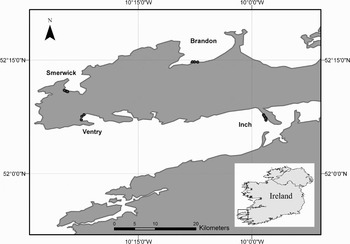
Sample collection formed part of a long term annual flatfish survey which aims to assess and monitor the juvenile stages of commercially important flatfish populations on beaches in the south-west and west of Ireland. Those beaches are important nursery areas for flatfish populations like turbot and plaice (Haynes et al., in press). Sampling was conducted during three consecutive days in September 2007 and during the same period in 2008. Juvenile plaice were collected during spring low tide from three beaches every year (Inch, Smerwick and Ventry in 2007 and Inch, Smerwick and Brandon in 2008) and from three replicate hauls on each beach (Figure 1). The distance between beaches ranged from 30–80 km; the distance between hauls within the same beach ranged from 300–1000 m. A beach seine of 20 m breadth with a 12 mm square mesh size was used, covering an approximate swept area of 1380 m2. Six plaice of 70–90 mm were randomly selected from each haul and kept frozen until analysis. This size-range was chosen to allow comparison of ingested food items during a specific growth stage of fully metamorphosed plaice (Ryland, Reference Ryland1966).
Beach seine locations and position of 3 hauls per beach (per year) at nursery grounds on the south-west coast of Ireland.

Morphology and gut content measurements
Several morphological characteristics of a total of 108 juvenile individuals were recorded after thawing; body length, eye diameter, mouth height (Braber & de Groot, Reference Braber and de Groot1973b) and mouth width were measured to the nearest 0.01 mm. Mouth gape (0.01mm2) was calculated by multiplying mouth width and mouth height by π (Piet et al., Reference Piet, Pfisterer and Rijnsdorp1998). Both stomach and intestines (guts) of all juveniles were analysed together as plaice have a rather small stomach and long alimentary tract (Beyst et al., Reference Beyst, Cattrijsse and Mees1999). Gut content analyses of all juvenile plaice were carried out and prey items were identified under a stereomicroscope to their main taxonomic groups and counted. Total number of prey taxa and total prey abundance in the guts were measured. Stomach fullness was calculated as a percentage; length of gut containing prey divided by total gut length * 100.
Condition and growth
Fulton's condition factor (Fulton, Reference Fulton1911) was calculated for each fish using the formula K = (W/L 3)*100, where W is fresh weight (g) and L is total length (cm). This widely used morphometric index assumes that heavier fish of a given length are in better condition and it has been proven to be a good indicator of habitat quality (Gilliers et al., Reference Gilliers, Amara and Bergeron2004).
Otolith microstructure analysis was used to provide a relative measure of recent growth for all juvenile plaice. The right sagittal otolith was extracted, mounted on a slide with the convex side facing upwards and embedded with crystalbond. Otoliths were polished and examined using transmitted light with a compound microscope (Olympus U-TV1X-2) and a 20 × objective lens. Image analysis software (Image Pro Plus 6.2) was used to measure the width of the 10 most recently deposited daily increments along the core-rostrum axis. The mean daily increment width over the last 10 days before capture was calculated as an index of recent growth. The otolith diameter was measured under the 4 × objective lens to obtain an index of overall fish growth.
Data analyses
Minitab 15 was used for statistical analyses. The balanced data were tested for normality and homogeneity of variances. Prior to examining variability in plaice morphology, diet descriptors, growth and condition between beaches and hauls, a two-way analysis of variance (ANOVA) with beach and year in the model was carried out to examine if any variability was attributed to year-differences. In the event a significant variation between years was found, further analyses were carried out for every year separately. Two-way nested ANOVAs were performed to examine effects of beach and haul, nested within beach, on fish morphology and diet descriptors. Beach was included as a fixed factor while haul was included as a random factor (Underwood, Reference Underwood1997). Significant beach effects were further explored using Tukey's post hoc comparisons. Analysis of covariance (ANCOVA), with fish length as a covariate, was used to investigate if relative otolith diameter differed between plaice from different beaches or hauls. Pearson's correlation was used to determine if any correlation existed between mean diversity of gut contents and mean fish condition across all hauls.
Prey assemblage composition in the stomach of fish was analysed using the non-metric multidimensional scaling (nMDS) ordination technique of the PRIMER version 5 statistical package (Clarke, Reference Clarke1993). From the original samples by prey matrix (108 × 14), abundances of prey were square root transformed and the Bray–Curtis similarity coefficient was calculated for every sample to generate a similarity matrix. Differences in diet among beaches and hauls were further analysed using two-way nested analysis of similarities (ANOSIM). Where significant differences were found, particular emphasis was placed on the R-statistic values produced by ANOSIM to identify the extent of the difference. Similarity of percentages (SIMPER) was employed to determine which prey-classes contributed the most to any similarities within beaches.
RESULTS
Spatial variation in diet composition
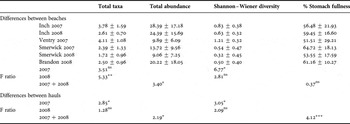
Diet of plaice was compared between hauls and beaches based on five different prey descriptors; numbers of prey taxa, prey abundance, prey diversity, stomach fullness and prey assemblages. Since we found variability in total prey taxa and Shannon–Wiener prey diversity between years, two-way nested ANOVA was repeated for both variables for each year separately. A two-way nested ANOVA revealed differences in gut contents on both spatial scales (Table 1). At a small spatial scale (300–1000 m), prey descriptors varied between fish from replicate hauls, except for total prey taxa and prey diversity in 2008. Prey descriptors also varied at a larger spatial scale (30–80 km) between fish collected from different beaches. A pairwise comparison revealed a significant higher prey diversity in fish from Ventry compared to Inch (P = 0.0168) and Smerwick (P < 0.001) in 2007. Differences in total prey abundance and total prey taxa in 2008 were evident across beaches but no significant differences in percentage stomach fullness were found between beaches.
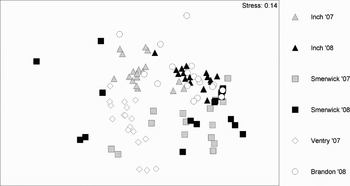
Non-metric multidimensional scaling ordination plot of the prey abundance data in the guts of 108 juvenile plaice. Sampling was carried out during 6 sampling occasions divided over 4 beaches and 2 years.

Results of two-way nested ANOVA, with hauls nested within beach, performed on prey descriptors in the guts of plaice, with mean and standard deviation for every beach in both years.

Levels of significance;ns, not significant; *, P < 0.05; **P < 0.01; ***P < 0.001.
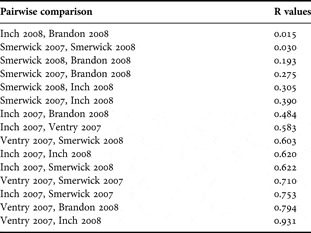
The nMDS ordination plot derived from prey abundance data of the guts of fish, caught in different hauls and beaches indicated some discrete groups of prey assemblages (Figure 2). Two-way nested ANOSIM demonstrated that prey assemblages differed significantly between hauls (R = 0.200, P < 0.001) and beaches (R = 0.602, P < 0.001). The greatest difference in prey composition occurred between fish from Ventry in 2007 and fish from other beaches in both years whereas the smallest difference was found between fish from Inch and Brandon in 2008 and between fish from Smerwick in 2007 and 2008 (Table 2).
Results of ANOSIM pairwise test with R-statistic values close to unity indicating a high difference in composition of gut samples between sampling occasions and vice versa.

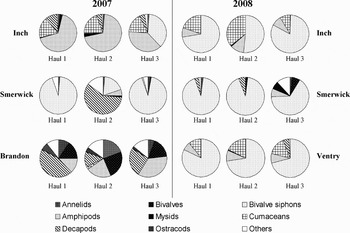
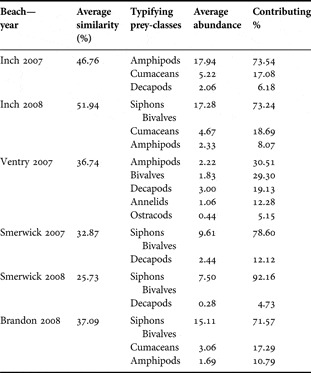
SIMPER analysis performed on prey data in the fish guts detected an average similarity within beaches between 26% and 52% (Table 3). Diet of plaice from Inch is in both years characterized by a high abundance of amphipods and cumaceans; similarly to diet of fish from Brandon in 2008 but very different from diet of plaice from the other beaches. Diet of plaice from Smerwick is dominated by a high abundance of one prey item, bivalve siphons, and a small amount of decapods. Fish from Ventry in 2007 were feeding on a large variety of prey from different taxonomic classes. Pie charts in Figure 3 graphically represent both small and large scale differences.
Pie charts showing the taxonomic breakdown of prey items in the guts of juvenile plaice across 3 replicate hauls on 3 beaches over 2 years. Flatworms, gastropods, copepods, echinoderms and arachnids were rarely found in some guts and pooled in the group ‘others’.

SIMPER analysis showing average similarity percentages of prey composition in guts of fish within different sampling occasions. The average abundance and percentage contribution of typifying prey classes contributing >5% to within-group similarity for the fish in the six sampling occasions are shown.

Intraspecific variability in plaice morphology
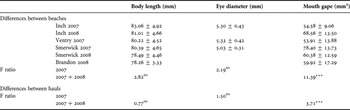
All fish were within the size-range of 70–90 mm in total length. A two-way nested ANOVA (Table 4) showed no significant differences in fish body length between beaches or between hauls within each beach. Similarly, eye diameter (which was only measured from 2007 fish) was not significantly different between beaches or hauls. Mouth gape, standardized for fish length, differed significantly between hauls and between beaches. A pairwise comparison test showed that mouth gape was significantly larger in fish from Smerwick in 2007 compared to fish from Smerwick in 2008 (P = 0.008), Ventry in 2007 (P < 0.001), Brandon in 2008 (P = 0.006) and Inch in 2007 (P < 0.001). Fish from Inch in 2008 also showed a significantly larger mouth gape compared to fish from Inch in 2007 (P = 0.010) and Ventry in 2007 (P = 0.030).
Results of two-way nested ANOVA, with hauls nested within beach, performed on morphological characteristics of plaice, with mean and standard deviation for every beach in both years.

Levels of significance;ns, not significant; *, P<0.05; **P < 0.01; ***P < 0.001.
Spatial variation in condition and growth
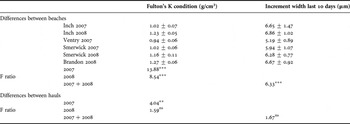
In this study, Fulton's K condition index of juvenile plaice ranged between 0.86 and 1.20 g cm−3 in 2007 and between 0.96 and 1.40 g cm−3 in 2008. Fish from 2008 were in significantly better condition than those from 2007 (two-way ANOVA, F = 98.52, P < 0.001). Two-way nested ANOVA revealed significant differences in condition between beaches within both years and between hauls in 2007 but no variation between hauls was found in 2008 (Table 5). In 2007, fish with lowest condition were found in Ventry and were significantly lower compared to fish from Inch (P < 0.001) and Smerwick (P = 0.001). In 2008, fish with lowest condition were found in Smerwick, and were significantly lower than fish from Brandon (P < 0.001) and Inch (P = 0.038).
Results of two-way nested ANOVA, with hauls nested within beach, performed on condition (Fulton's K) and recent growth (otoliths' average increment width over last 10 days) of plaice, with mean and standard deviation for every beach in both years.

Levels of significance;ns, not significant; *, P<0.05; **P < 0.01; ***P < 0.001.
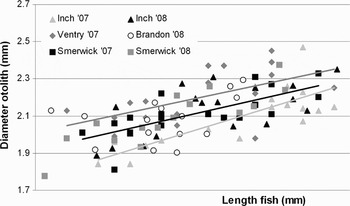
Otolith diameter showed a linear increase with fish length (F = 84.40, P < 0.0001) confirming that otolith growth reflects somatic growth. ANCOVA did not detect differences in otolith diameter, corrected for fish length, between hauls (F = 1.42, P = 0.172) but otolith diameter differed between beaches (F = 4.19, P = 0.002). Pairwise comparisons showed that fish from Ventry in 2007 had larger otoliths than fish from Inch in 2007 (P < 0.001) (Figure 4). This indicates slower growth rates over the life of fish on Ventry compared to fish on Inch. This finding corresponds with observed variation in recent growth. A two-way nested ANOVA showed that mean peripheral increment width, which ranged between 3.62 µm and 9.82 µm, was not different between hauls but differed significantly between beaches (Table 5). Recent growth was lower for fish from Ventry in 2007 compared to fish from all other beaches in both years (P < 0.05). In contrast to fish condition, recent growth did not differ between years, suggesting that differences in recent growth were not large enough to contribute to differences in overall condition of plaice between beaches.
Ratio of otolith diameter by total fish length for every individual with trendlines displaying the different beaches over both years. Trendlines are presented for 2007 fish data.

Correlation between diet and condition
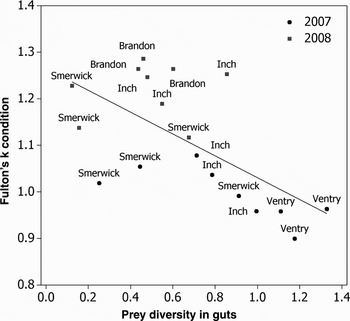
As described above, prey diversity in juvenile plaice guts varied between hauls within beaches. For each haul, mean condition and mean prey diversity were calculated. Pearson's correlation analysis detected significant decreases in condition with higher prey diversity (r= –0.630, P = 0.005). This significant inverse linear relationship showed that fish feeding on greater prey diversity also displayed the poorest condition (Figure 5).
Scatterplot of prey diversity in plaice guts against Fulton's K condition of plaice. Every point represents the averages of all studied plaice pooled per haul.

DISCUSSION
Our results on food composition in plaice guts are in agreement with earlier findings. Polychaetes, molluscs and crustaceans are major food items in diet of juvenile plaice on sandy beach nursery areas (Braber & de Groot, Reference Braber and de Groot1973a), with an ontogenetic shift occurring in larger fish from polychaetes towards crustaceans (Edwards & Steele, Reference Edwards and Steele1968; Rijnsdorp & Vingerhoed, Reference Rijnsdorp and Vingerhoed2001). Whyche & Shackley (Reference Whyche and Shackley1986) found this change in diet occurring at a fish length of 35–40 mm, probably because at this size plaice move to deeper parts of the littoral zone where wave action is strong and food organisms such as amphipods, harpacticoids and young bivalves are more exposed. Major taxonomic groups dominating plaice diet in our study, revealed by multivariate analyses, differed among beaches. Variation in stomach fullness and prey abundance was also observed at a smaller spatial scale (between hauls) within beaches. This spatial variability in diet suggests a high degree of trophic adaptability to different prey.
Without information on the benthic fauna, it is unclear if differences in diet are the result of selective feeding behaviour and/or differences in prey distribution and availability between locations. The observed variation in the quantity and diversity of prey items occurred at a scale of 100s of metres (300 m was the smallest distance between hauls). Following the observations of Burrows et al. (Reference Burrows, Gibson, Robb and Maclean2004) that plaice have a very high probability of remaining in a 100 m wide zone for at least one day, we can assume that plaice caught in one haul were also feeding in distinct areas compared to each other. As it is unlikely that plaice from adjacent hauls have different feeding preferences, we hypothesize that food abundance and availability differs between the haul locations.
Small-scale variation between hauls within beaches was found in Fulton's condition of plaice. Condition indices are indicative of short term fish growth and are directly linked with food (Ferron & Leggett, Reference Ferron and Leggett1994). As discussed above, we hypothesize that food abundance and availability differed between haul locations, affecting plaice condition. The correlation between prey diversity and condition of plaice from different hauls suggested that a varied diet leads to poorer condition whereas a feeding strategy which is based on a high degree of specialization on a few prey types results in good condition. Plaice were generally in better condition in 2008 compared to 2007 and large-scale variation between beaches was found within both years. Plaice from Inch and Brandon had a better than average condition and a low prey diversity in their gut, compared to plaice from Ventry and Smerwick. Abundant food resources might be available here in combination with selective feeding (of amphipods in Inch and bivalve siphons in Smerwick) to obtain the best nutritional status. Plaice caught in some hauls in Smerwick and in all hauls of Ventry did not grow up under optimal food conditions and had a lower condition as a result. We assume that prey are less abundant in this area. Another plausible suggestion for this diet difference (maybe as a result of lower prey availability) is that fish feeding on Ventry are exploiting less mobile prey because they are in poorer condition. We observed a higher stone content in the guts of plaice from Ventry and this might indicate they have a rather endobenthic feeding behaviour.
While diet very likely caused condition and growth differences of plaice between hauls and between beaches in this study, we cannot exclude possible additional factors (working in combination) that could be driving large-scale spatial variation. The physical environment is known to affect nursery quality and subsequently fish growth. Variation in temperature between beaches might occur as there is a river inflow in Ventry beach but no freshwater input in Smerwick and Inch beaches. Optimal growth temperature for juvenile plaice is around 20°C when abundant food is available (Fonds et al., Reference Fonds, Cronie, Vethaak and Van Der Puyl1992). At this temperature, the high assimilated energy from a faster ingestion is still exceeding the energy losses for metabolism which increases with temperature (Yamashita et al., Reference Yamashita, Tanaka and Miller2001). Sediment type also influences a fish's ability to bury itself in the substrate in order to escape predators (Gibson & Robb, Reference Gibson and Robb1992). The beach in Inch is more exposed than in Smerwick and Ventry, therefore, differences in sediment type are likely. However, more research is needed to investigate if differences in burying effort, and subsequently fish growth, occur between beaches. Amezcua et al. (Reference Amezcua, Nash and Veale2003) found significant differences in flatfish diet between sediment types. This highlights the direct influence of beach structure and exposure on composition of benthic communities. The biotic environment can affect the growth rate of plaice. Previous studies have linked spatial patterns in growth and abundance of plaice with the availability of food. Karakiri et al. (Reference Karakiri, Berghahn and von Westernhagen1989) and Berghahn (Reference Berghahn1987) reported higher growth rates of plaice in the tidal flats of a nursery area compared to plaice in the tidal channels and concluded that food limitation occurred in the channels. Poxton et al. (Reference Poxton, Eleftheriou and McIntyre1982) found a higher abundance of juveniles in areas with an abundant benthic food supply in the Clyde Sea area. Van der Veer & Witte (1993), showed a positive relationship between food abundance and growth of plaice in the Dutch Wadden Sea. In our study, prey abundance in some haul locations could have been reduced by predator foraging (Berghahn, Reference Berghahn1987) or other disturbances which lead to different food availabilities; e.g. beam trawling enhances the abundance of small opportunistic benthic species such as polychaetes (Rijnsdorp & Vingerhoed, Reference Rijnsdorp and Vingerhoed2001). Lower growth rates might also be ascribed to density dependent growth as demonstrated by Modin & Pihl (Reference Modin and Pihl1994). In the absence of more biological or environmental data on the studied sites, we can only speculate about possible additional factors influencing variation in juvenile plaice growth and condition.
Condition indices in larval and juvenile fish respond quickly to changes in food availability and can give a good indication of the growing conditions over the previous 24 hours (Ferron & Leggett, Reference Ferron and Leggett1994). On the other hand, otolith growth responds more gradually to changes in feeding conditions and metabolic rate and represents a running average of fish growth rather than an instantaneous measure (Campana & Neilson, Reference Campana and Neilson1985). This could explain why variation between hauls was observed in fish condition, but not in otolith growth rate. While patchy distribution of prey items may produce small scale variation in fish condition, over a longer time period the movement of plaice between sites within a beach would produce a more homogeneous pattern of otolith growth. Moreover, diet differences between hauls do not override diet differences between beaches, as shown by a clear separation on the nMDS plot. This may reflect overall differences in habitat quality between beaches, contributing to variation in plaice growth.
In this study, dissimilarity in mouth morphology was observed; mean mouth gape differed between hauls and was higher in plaice from Smerwick compared to plaice from Inch and Ventry. No other citing of intraspecific differences in mouth gape was found in the literature and the reason for this difference here can only be speculated upon. The mouth gape has been identified by Piet et al. (Reference Piet, Pfisterer and Rijnsdorp1998) as the most important morphological characteristic affecting prey selection. As such, the observed larger mouth gape in Smerwick might be related to the high level of predation on bivalves. The jaws of plaice are well modified to biting off parts of bivalve molluscs (Yazdani, Reference Yazdani1969). Different flatfish species adapt their behaviour to the behaviour of the prey (Holmes & Gibson, Reference Holmes and Gibson1983) but the question remains whether juvenile plaice morphology can adapt depending on the available prey items. In stock identification studies two-dimensional measurements of the head can be useful for distinguishing fish from different areas. Further experimental work could help to establish how the availability of prey and feeding preferences influence mouth morphology.
Variation in growth and condition across replicate hauls within beaches highlights the importance of adequate replicate sampling. As juvenile plaice are active and mobile feeders but with a strong sense for site fidelity (Burrows et al., Reference Burrows, Gibson, Robb and Maclean2004), studies which attempt to link the composition of the benthic fauna to flatfish dietary preferences should consider small scale variation in these parameters. There is a danger of misinterpretation if assessments of nursery ground quality are based only on broad descriptors of the benthic community and average condition or growth across a beach. Also, closer examination of how diet and condition varies within a nursery area can help to elucidate how habitat characteristics influence growth and survival of juvenile fish.
ACKNOWLEDGEMENTS
This project was funded through the STRIVE Programme by the Environmental Protection Agency, Ireland. Thanks to Paula Haynes, Stephen Comerford, and the crew of the Commercial Fisheries Research Group for the collaboration during field sampling. We would like to thank the Marine Institute, Bord Iascaigh Mhara and Taighde Mara Teoranta for the financial and logistic support for the annual flatfish survey. Finally, we would like to thank our anonymous referees for their valuable comments and suggestions which improved the content of the present paper.