INTRODUCTION
The human resources literature reveals that work-family conflict potentially creates significant social costs, including medical costs, thus generating a demand for family-friendly benefits. It is purported that workers with high levels of work-family conflict would search for jobs in firms that offer these benefits. In practice, however, little is known about the actual take-up of available family-friendly benefits for different types of workers. Even less is known of whether these benefits actually help to manage work-family conflict. We use a large sample of (representative) Canadian firms and their workers to examine the take-up of privately offered family-friendly benefits and to shed light on these questions.
The incorporation of women into the labour force has significantly changed the face of the labour market. In particular, the increase in dual-earner families has raised concern about the levels of work-family conflict modern families face. For instance, a recent article in The Economist features the increasing pressure that exists among workers to manage the demands of both work and family (The Economist, 2 January 2010, pp. 49–51). Other examples of this concern in academic circles abound (Blank, Reference Blank1990; De Cieri, Holmes Abbott, & Pettit, Reference De Cieri, Holmes, Abbott and Pettit2005; Haddock, Zimmerman, Ziemba, & Lyness, Reference Haddock, Zimmerman, Ziemba and Lyness2006). Some of these concerns have been addressed by governments introducing regulation and benefits to ease work-family conflict (for instance through the regulation of parental leave, or the public provision of childcare). However, family-friendly workplace benefits are crucial in countries with low government involvement in social matters. Even in welfare states, the role of employers may be important in mitigating work-family conflict by offering employees additional benefits with telework, or flexible schedules, practices that depend mainly on the firm and are not subject to regulation.Footnote 1
Typically, the take-up of firm provided family-friendly benefits is difficult to quantify. The evidence is fragmented in diverse studies that use different measures of availability. Firm surveys tend to have availability questions, but no information about workers’ use of these benefits. Furthermore, nationally representative surveys do not examine this information in their questionnaires. Evidence is often drawn from very limited surveys of a small number of firms in specific industries or locations.
The distinction between availability and use of benefits is important. Broadly speaking, workers that are susceptible to work-family conflict are mainly dual-earner families with young children and single parents (Bardoel Moss, Smyrnios, & Tharenou, Reference Bardoel, Moss, Smyrnios and Tharenou1999; Golden, Reference Golden2001, Reference Golden2008; Tausig & Fenwick, Reference Tausig and Fenwick2001; Haddock et al., Reference Haddock, Zimmerman, Ziemba and Lyness2006). In Canada, the fraction of couples with both spouses employed rose from 35% in the middle 1970s to around 70% in 2008. Dual earner families have increased faster among families with dependent children at home. For example, the proportion of dual-earner families with preschool children at home (under age 6) rose from 31% to 67% between 1978 and 2008, while the rate among those with older children (youngest between 6 and 15) went from 45% to 77%. Single parent families have also increased their presence in the labour force with the fraction of single mothers with a full time/full year schedule rising from 43% to 51% between 1980 and 2005 (LaRochelle-Côté, Reference LaRochelle-Côté, Gougeon and Pinard2009; Marshall, Reference Marshall2009). Similarly, in the US 51% of all couples and 61% of two-parent households with dependent children were dual earner households and 74% of all single parents worked (US Department of Labor, 2005). A cursory look at the availability of family-friendly benefits suggests that, overall firms offer sufficient support: ~57% of firms in Canada offer flexible work schedules, 11% offer telework, and 12% offer family support services, such as daycare. By contrast however, the actual take-up, or use of these benefits, is substantially lower: about 37% of the workers use flexible time arrangements, 6% use telework, and only 2% use family support services (Author's calculation using the Canadian Workplace and Employee Survey (WES)).Footnote 2
Discrepancies between availability of benefits and use of benefits may indicate the existence of barriers within the firm structure to access these benefits, such as lack of managerial support, workers’ expectation of negative career consequences, firms’ time expectations at conflict with benefits or lack of co-worker support, and reflect the gendered nature of policy utilization. (For a complete summary of theories explaining the gap between availability and use of benefits see McDonald, Brown, & Bradley, Reference McDonald, Brown and Bradley2005.) Alternatively, it could mean that workers with families do not find specific family-friendly workplace benefits useful. For instance, flexible hours may be of little use to full-time working parents of pre-school children. They may prefer full-time care for their children, that is, mostly available during regular work hours. Telework may be of limited usefulness to parents of small children, as working at home restricts the attention that a child would need. Childcare or eldercare may be quite useful, but only provided that the worker has child or eldercare responsibilities that can be accommodated by the services provided.
We contribute to the growing literature that assesses the take-up of privately offered, family-friendly benefits studying the case of Canada. Our analysis uses the Canadian WES for the period 1999–2002. The WES surveys a nationally representative sample of Canadian firms and their employees. This link between workplaces and employees allows us to connect employee characteristics, such as use of family-friendly benefits, education, and hours of work, with those of firm characteristics, such as availability of benefits, organizational changes, and human resources practices. The main advantage of this data set is that we can make use of a large, representative sample as well as the employee–employer connection.
A substantial literature within work-family benefits examines the benefits to the employer for implementing these practices. Abbott and De Cieri (Reference Abbott and De Cieri2008) point out the main influences in the provision of benefits and develop case studies to assess these influences. Parkes and Langsford (Reference Parkes and Langford2008) test whether satisfaction about work-family balance influences hiring and retention in Australian firms. Gray (Reference Gray2002) use British data from employee-workplace linked survey to study the impact of a wide array of workplace characteristics (including family-friendly benefits) on several measures of firm outcomes. A positive association is found between family-friendly benefits and most measures of firm outcomes. Glass and Riley (Reference Glass and Riley1998) use American data to look at the impact of family responsive policies on employee retention after childbirth. They find maternity leave policies have positive effects to reduce employee turnover. More generally, Eaton (Reference Eaton2003) suggests that flexibility in family-supportive practices increase worker commitment thereby increasing productivity and reducing turnover. We do not analyse direct measures of firm performance in relation to benefit availability as these studies do. Rather, we focus on assessing different reasons for low take-up of benefits to suggest channels for the interaction between benefits and firm outcomes to occur.
The literature on the take-up of these benefits consists mostly of studies that either look into either family-friendly benefit availability, or, family-friendly benefit use. In general, family-friendly benefits are associated with larger, unionized firms (Glass & Fujimoto, Reference Glass and Fujimoto1995). Unions are also a strong determinant of workplace availability of benefits in Britain (Budd & Mumford, Reference Budd and Mumford2004). Golden (Reference Golden2001) examines the characteristics of employees who voluntarily do not work a standardized schedule and finds that females with dependents; Caucasians; union members; better educated long-serving employees; and, private-sector employees are more likely to engage in this practice. A similar result is found by Gray and Tudball (Reference Gray and Tudball2003) who study availability of family friendly practices in Australia using linked workplace and employee data, and find that education and training and being in high skilled occupations are the main determinant of access to benefits. A potentially important variable in explaining the gap between availability and use of benefits regards employee awareness of benefits offered (Visser & Williams, Reference Visser and Williams2006; Colley, Reference Colley2010). Budd and Mumford, (Reference Budd and Mumford2004, Reference Budd and Mumford2006) study the determinants of perceived access to benefits and reveals that skills (age, education, professional occupation) and union membership are the main factors in explaining awareness.
Distinction between the use of, and the availability of, privately provided benefits is well understood and analysed in theoretical models (see McDonald, Brown, & Bradley, Reference McDonald, Brown and Bradley2005 and references therein for an extensive summary of theories). However, this distinction has not explicitly been made in the majority of empirical studies of privately provided benefits.Footnote 3 With some exceptions (Secret, Reference Secret2000; De Cieri et al., Reference De Cieri, Holmes, Abbott and Pettit2005), commonly cited estimates of benefit use only consider workers who have the benefit available to them and could be biased, as they ignore the possibility of selection of workers into certain firms.Footnote 4
In contrast with these papers, we exploit the advantages of substantially larger samples and take into account worker selection into firms according to benefit availability. Our definition of availability comes from worker's responses and thus bypasses the problem of addressing formal policies (as reported by managers). Assuming awareness of benefits, this distinction between use and availability of benefits allows us to estimate determinants of benefits use, while taking into account worker selection of employment conditions. Methodologically, we use firm technical constraints for available benefits as exclusion restrictions in a two-step estimation procedure. Selection issues are important for almost all benefit-gender group combinations studied. We also find that the reasons for low take-up of different benefits vary. Our estimates are conditional on employment and assume that an increase in privately offered benefits will have a negligible impact on an individual's choice to work. From the trade-off between wage and benefits that is likely to be implicit in contract determination, we focus on the factors that affect the actual use of benefits.
The following two sections present the empirical methodology and describe the data used for the analysis. Next, we provide our results and a discussion of their implications and robustness. The last section concludes.
Methodology
Government involvement in the provision of family-friendly benefits consists of the regulation of leave, pregnancy-related insurance, and subsidies for schooling/care for children.Footnote 5 This paper, however, focuses solely on the role of employers in the provision of family-friendly benefits. These (firm-provided) family-friendly benefits are voluntary practices introduced by firms to help workers reconcile the demands of work and family life. Different instruments help employees deal with work-family conflict. They can be classified in three groups:
(a) Policies to facilitate work leave. These include extensions to maternity leave, either paid or unpaid, other forms of parental leave and a career break option.
(b) Policies to facilitate work schedule changes. These include all forms of work schedule reductions, including flexible hours or work from home (telework).
(c) Policies to support family. These offer practical help with child or eldercare.
Our paper analyses generic family-support policies and two policies that facilitate changes in work schedule: telework and flexible hours.
We use a simplified version of Moffit's (Reference Moffitt1983) model of benefit take-up where the extent of work-family conflict (WFC) is not observable. What we do observe is the individual's use of family-friendly benefits. Given a fixed individual cost of using the benefit, a ‘use of benefit’ equation could be stated as:
 $${\rm{WF}}{{{\rm{C}}}^{\rm{\ast}}} \, = \,{\rm{\alpha }}X + {\rm{{\epsilon};}}\,{\rm{and}}\,{{B}_{\rm{U}}} = {\rm{1}}\,,{\rm{if}}\,{\rm{WF}}{{{\rm{C}}}^{\rm{\ast}}} \,{\rm{ \gt 0}}{\rm{.0}}\,{\rm{otherwise}}$$
where B U (an indicator variable) is only observed if the unobserved work-family conflict.
WFC* is greater than the (fixed) costs of using the benefit, α is a vector of parameters indicating the effect of the covariates in X on benefit use. The fixed costs include lack of information, transaction costs and stigma or, more likely, a combination of the three.Footnote 6 Substituting the structural model we have,
 $${\rm{Pr}}\,({{B}_{\rm{U}}}\, = {\rm{1}}\,{\rm{|}}\,{{X)}}\, = \,{\rm{Pr}}\,{\rm{(WF}}{{{\rm{C}}}^{\rm{\ast}}} \,{\rm{ \gt }}\,{\rm{0}}\,{\rm{|}}\,{\rm{X)}}\, = \,{\rm{\phi (\alpha X)}}$$
where φ(.) is the normal cumulative distribution function for the case of the probit model.
The literature on work-family conflict hypothesizes a relationship between work-family conflict and family structure. It is expected that workers with more, or younger, children, or those with less flexibility to manage care responsibility (single parents) are more likely to use benefits (Bardoel et al., Reference Bardoel, Moss, Smyrnios and Tharenou1999; Gray & Tudball, Reference Gray and Tudball2003; Budd & Mumford, Reference Budd and Mumford2004; Haddock et al, Reference Haddock, Zimmerman, Ziemba and Lyness2006; Golden, Reference Golden2008). Therefore, one can measure the magnitude of work-family conflict with indicators for family characteristics that are plausibly correlated with the amount of conflict faced. A positive association between an increase in the number of dependents (increase in family-conflict) and the probability of using a benefit will indicate that the benefit appears to lessen work-family conflict.
If workers were randomly distributed across firms, estimates of equation (1) would provide estimates of the causal effect of each factor on the use of a given benefit. However, individuals work in firms, or areas, with different probabilities of family-friendly benefits being offered. Organizations themselves are constrained in their ability to supply benefits (Heywood, Siebert, & Xiangdong, Reference Heywood, Siebert and Xiangdong2007). There may be technical constraints limiting the availability of benefits, such as the feasibility of offering telework. The firms may also respond to aggregate characteristics of local labour markets thus limiting the availability of these benefits.Footnote 7
Since benefit use cannot be observed unless the benefit is available, estimates of equation (1) will generally be biased, as they are based on the sample of workers for whom the benefit is available, rather than on a random sample of workers. Assuming that workers are aware of benefit availability, we can obtain the probability of use, free of this selection bias, by estimating the joint bivariate distribution of use and availability. The model considers that there is an underlying relationship such that we only observe a binary outcome as specified in equation (1). In addition, the dependent variable is only observed if a selection condition is met. In this case the selection condition is given by the availability of benefits (B A) (Van de Ven & Van Pragg, Reference van de Ven and van Praag1981).Footnote 8
 $${\matrix{ {{B}_{\rm{U}}} \!\!\!\!= \,{\rm{\alpha X}}\, + \,{\rm{{\epsilon}}}\hfill\; \; \; \; \; \; \; \; \; \; \; \; \; \; \; \; \cr {{B}_{\rm{A}}} \!\!\!\!= \,W{\rm{\gamma }}\, + \,L{\rm{\tau }}\,{\rm{ + }}\,{\rm{\upsilon }}\,{\rm{ \gt }}\,{\rm{0;}}\; \; \; \; \; \; \; \; {\rm{where}}\,{{B}_{\rm{u}}}\, \gt \,{\rm{0}}\, \leftrightarrow \,{{B}_{\rm{A}}}\,{\rm{ \gt }}\,{\rm{0}} $$
where W is a vector of workers’ attributes and firm characteristics influencing the provision of benefits, L is a vector of variables describing the structure of the labour market from where the firm is likely to hire its workers, and (γ, τ) are the associated vectors of parameters. The error terms ε and ν are jointly normally distributed, independently of the variables in the respective equations, with zero expectations and corr (ε, ν) = ρ. As defined before, the vector X represents variables that influencing benefit use.
The regressors in the availability equation include variables that predict the employee's selection into firms offering the benefit, sometimes referred to as identifying restrictions. These include: worker characteristics the employer may wish to retain/attract, like job tenure, experience, education and occupation indicator variables; firm characteristics that impose technical restrictions on benefit availability such as industry and firm size indicator variables; and labour market characteristics where the firm is likely to hire their employees, such as the fraction in the strata of: (a) skilled male and female workers, (b) women of child-bearing age, (c) unionized employees, and, (d) unionized females of child-bearing age in the strata.Footnote 9
The empirical determination of benefit availability and benefit use is a complex process that forces us to accept several shortcomings in the estimation. First, we are not directly modelling the demand for benefits, but rather the use of benefits. Because workers’ demand for benefits embodies a trade-off between family-friendly benefits and other forms of compensation, it should be modeled then, as the result of a simultaneous choice between wages and other job characteristics that influence the provision of those benefits. Heywood, Siebert, and Xiangdong (Reference Heywood, Siebert and Xiangdong2007) look into the joint determination of wages and family friendly benefits using managerial attitudes towards family work conflict as an instrument in the determination of benefits. They find a large a negative effect of benefits on wages that are not present in ordinary least-squares regressions. In this sense our question regards only whether benefits are indeed associated with measures of family-work conflict, and not the pecuniary costs associated with it.
Second, we do not consider that workers’ skills represent endogenous choices, that is, workers who anticipate the eventual use of benefits and therefore choose skills and occupations most likely to offer them. If this were the case our selection-corrected estimates of the probability of use would differ from estimates that account for this additional selection issue. Two characteristics, however, of family-friendly benefits support our abstracting from this issue. Many career choices that may determine availability of benefits in the future are made well before the worker faces high levels of family-work conflict and are, to some extent, independent of benefit consideration. This is the case with education level or occupation. Also, telework or flexible hours, unlike other fringe benefits, are often not formalized policies, but are granted at a manager's discretion. Therefore, it is rather unlikely, for at least two of the policies we study here, that workers make skill or occupation choices anticipating the availability of future family-friendly benefits.
Finally, benefit availability is only observed for individuals who work, which may lead to further sample selection issues. In this respect our estimates are conditional on employment and we implicitly assume that a wider availability of workplace benefits would negligibly impact the choice of working or not.Footnote 10 We consider these relatively ‘small’, and often informal, practices unlikely to be a major determinant of labour supply.
We abstract from this trade-off to focus on the factors that affect the actual use of benefits. In essence, we try to answer a relatively basic question regarding the use of family-friendly benefits: When firms offer such benefits, and workers choose appropriate ‘compensation/family-benefits’ packages, then why do we not observe high levels of benefit take-up? Are the benefits not useful to workers? Or, do workers that most need the benefits not have access to them?Footnote 11
We can answer this question with our stylized model. Comparing the estimates obtained with standard probit models and those obtained correcting for selection can shed light on the usefulness of benefits. role that For instance, Heywood, Siebert, and Xiangdong (Reference Heywood, Siebert and Xiangdong2007) use managerial attitudes towards family work conflict as an instrument in the determination of benefits and find a large a negative effect of benefits on wages that are not present. Estimates of benefit use that do not account for availability capture the influence of variables that measure work-family conflict on the probability of benefit use among those who have benefits available. Estimates of benefit use that account for availability capture the influence of these demographic characteristics on the probability of benefit use for a random sample of workers. By comparing the two sets of estimates we gain insight into both, the usefulness of family-friendly benefits to mitigate work variables used to measure family conflict are not significant among workers with available family conflict and, the selection process of workers into firms with benefits. If, for instance, the benefits, but are significant determinants of benefit use among a random sample of workers, that is, we have significant estimates in equation (2), but not in equation (1), then it would indicate that workers with available benefits do not use the benefit to reduce work-family conflict, although the benefit would be useful for the general population. This would support the hypothesis of a mismatch between the use and the availability of benefits. Alternatively, if the variables that measure family conflict are significant determinants of benefit use among those who have available benefits, but not among a random sample of workers, that is, producing significant estimates in equation (1), but not in equation (2), then it would support the notion that workers with high levels of work-family conflict are more likely to be in jobs that offer family-friendly benefits (no mismatch).
The WES
This study uses data from the 1999–2002 WES. The survey collected a broad range of information on a nationally representative sample of employers and their employees in all industries except farming, fishing, hunting, trapping, and public administration.Footnote 12
We will examine the following employer provided family-friendly benefits as follows:
Flex-time or flexible hours
In this work arrangement an employee is employed for a number of core hours, but is able to vary start and stop times provided that a full complement of core hours is worked. Benefit use is determined by responses to the following question, structured to minimize reporting error: ‘Do you work flexible hours? (This means you may work a certain number of core hours, but you can vary your start and stop times as long as you work the equivalent of a full work week)’. Since many firms do not have formal policies regarding flexible time, we construct a variable for flex-time availability at the firm based on this benefit being available to other workers in the firm in similar roles. That is, a benefit is available if it is used by other workers in the firm, within similar broadly defined occupations.Footnote 13 Awareness is still an issue that might affect our estimation. Low levels of awareness will lead to underestimating availability of benefits. Flexible time is available to 56% of workers and is used by ~37% of workers.
Telework
This is a work arrangement for employees to work at home (for pay) for at least some hours of their regular schedule. The employee is asked to respond to: ‘Is your work at home mainly: (a) Paid and within your normally scheduled work hours? (b) Paid and in addition to your normally scheduled work hours? (c) Unpaid and in addition to your normally scheduled work hours?’. We consider that a worker is using telework if he answers (a) to the above question. As with flex-time, we consider that telework is available if it is available to other workers in the firm with similar occupations (see footnote 13). Approximately 11% of workers report telework to be available, while 6% of workers report use of telework.
Family support
The employee is asked a series of questions regarding employer support for childcare, eldercare, or other types of family support: ‘Does your employer offer help for childcare either through an on-site centre or assistance with external suppliers or informal arrangements?’,‘Does your employer offer help with eldercare services?’ and ‘Does your employer offer other personal support or family services?’. Each question is followed by another question regarding use. (For instance, the question regarding childcare availability is followed by ‘Did you use this help within the past twelve months?’). We construct an indicator variable for ‘family support’ equal to 1 if the employee answered that any of these three benefits is offered by the employer. Hence, the family support variable includes childcare, eldercare and other family support services.Footnote 14 Although childcare constitutes approximately half of the services provided, they are only used by a third of the workers. For this reason, we group the results for the three forms of family support services into a single category. About 2% of the workers report using this benefit and 12% report the benefit being available.
Even though for family support we are able to define use and availability directly, based on employee's answers to specific questions, the employee-based definition of availability is not without problems. Lack of information and awareness of benefits is still a significant problem in the provision of benefits (see footnote 6). For this reason, we performed the analysis using a similar measure of availability to that employed in the analysis of flexible hours or telework that is, based on reported usage of similar workers in the firm. The results, available upon request, are similar to those reported here.
According to the model specified in the previous section, use of benefits depends on family structure (captured through indicators for number, age of children, and marital status). We include hours of work to control for the demands of the job.Footnote 15 Additionally, workers from different cultures may face specific issues regarding the proper way to deal with family responsibilities and work demands, or, recent immigrants may face a different set of choices regarding family benefits due to a lack of knowledge of Canadian institutions. We control for this heterogeneity by including an indicator for Canadian-born and Caucasian ethnicity.
Availability of family benefits depends on a vector of workplace characteristics reflecting: (a) worker and firm characteristics and (b) characteristics of the strata where the firm is more likely to draw their employees (Abbott & De Cieri, Reference Abbott and De Cieri2008). The first group of variables includes five indicators for industry (primary industries is the reference group), four occupational indicators (production workers is the reference group), three indicators for firm size (firms with less than 20 workers is the reference group), measures of tenure and experience, three indicators for numbers of hours worked and four educational indicators (no educational degree is the omitted category). We also include an indicator for a worker either unionized, or covered by a collective agreement, since unionization may affect the likelihood of certain benefits being offered. As previously mentioned, a firm depending on its size, may face technical constraints in offering daycare services to its employees. It may also face difficulties offering telework to workers because of the nature of the work they do, or it may be forced to offer flexible hours to individuals working long shifts. The second group of variables includes a measure of the fraction of skilled workers and skilled working women in the corresponding strata, a measure of the fraction of women in the strata that are of child bearing age and an indicator for whether or not the strata is highly unionized.Footnote 16 To discern whether the effect of unionization depends on the composition of the strata, we include an indicator for the fraction of women of child-bearing age in the strata that are unionized. All models include indicators for geographical region.
In order to increase the number of benefit users, we pool the two available waves of the survey (1999–2000 and 2001–2002) and also control for survey year in our analysis. We report robust Huber-White standard errors, allowing for clustering among firms. We restrict the sample to those workers who provided answers to the benefits and labour characteristics questions, which results in observations of 33,082 for female workers and 43,212 for males. We separate the genders, traditional in this type of study, because men and women are likely to have different levels of work-family conflict.
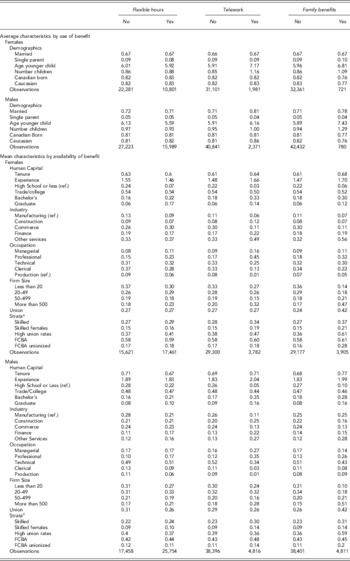
We report the mean characteristics of the sample by use and availability of benefits in Table 1 (a) and (b), for female and male workers separately. Skill levels (tenure and experience) are similar among workers who both use and do not use flexible hours. This is in contrast with telework and family support use that is mostly associated with more educated and experienced workers. In general, users of benefits have more children and their youngest child tends to be older than nonusers, except for the use of flexible hours. It is noteworthy, however, that single parents are not more represented among the users of benefits (approximately the same fraction of single parents, about 9% of female (5% male) workers, can be counted among users and nonusers). It is difficult to argue against the need of those facing single parenthood to work in a family-friendly environment, but this could suggest that the benefits are either not suitable or not available for this particular group. Surprisingly, married male workers are more represented in the telework and family-support user categories than in the nonuser category, while married female workers are approximately equally represented in both categories.
Average characteristics by use of benefit and mean characteristics by availability of benefit

Note: aA strata reflects the geographic location from where the firm is more likely to draw their workers. It is defined by the set of observations in a given province, industry, and for a given firm size.
FCBA = female child bearing age.
Table 1 shows that available benefits, particularly family benefits, are more prevalent in large firms (over 500 employees), although available flexible hours and telework are similarly distributed among the smaller firms (those less than 20 and those between 20 and 49 employees). A larger fraction of managerial and professional females have benefits available to them, relative to other occupations. Flexible time is largely available to technical male workers, whereas telework is mostly prevalent among managers, professional and technical male workers. Telework and family benefits are more prevalent in stratas with higher concentrations of skilled workers, whereas family benefits are more prevalent in stratas with high fraction of skilled workers, high unionization rates, or high fractions of unionized females of child bearing age.
The use of family-friendly benefits
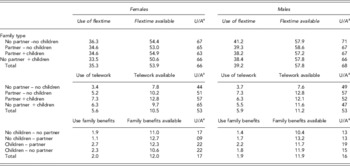
Table 2 shows the percentage of use and availability of benefits by gender and family type. There is no a priori evidence that females or families with dependents use family-friendly benefits more than other groups. The proportion of female (male) users of flexible time ranges only between 33.5% and 36.3% (38.2–41.2%) across all family types. There is some evidence of higher use of telework and family support among workers with dependents, but the differences are surprisingly small. For instance, between 5.5% and 7.3% of workers with dependents use telework, versus 3.4% to 7.3% of workers with no dependents. Furthermore, between 1.8% and 2.7% of workers with dependents use family benefits, versus 1.1% to 1.9% of workers with no dependents. Additionally, although benefits are somewhat less available to (female) single parents, the distribution of availability by family type reveals that most benefits are equally available among all family types and that some, such as telework, are even more likely to be available to female workers with children than to other females. The conditional (on availability) probabilities shown in the third and sixth column of Table 2 further confirms the small uptake of benefits, specifically of family benefits, which is not over 22% for any family type. Conditional on availability, telework is used on average by 53% of workers, whereas flexible time is used by around 67% of workers.
Percentage use and availability of benefits by family type

Notes: aU/A = probability of use conditional on availability.
P(use|availability) = P(use + availability)/P(availability).
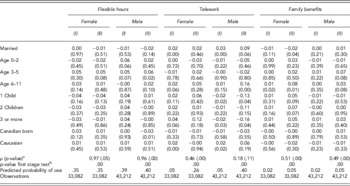
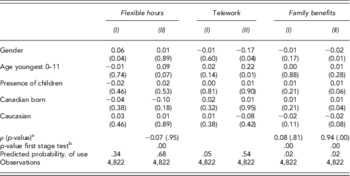
We turn now to the main estimates of the paper, reported in Table 3. Column (I) shows the marginal effect of a change in the independent variable on the probability of use for each benefit. We compare these estimates with those from the selection model, reported in columns (II) for each benefit. The correlation coefficient between the error terms in the use and availability equations, ρ, appears below each set of selection corrected estimates along with its p-value in parenthesis. The sign of the correlation coefficient (ρ) provides an intuition for the direction of the selection effect. Positive values of ρ indicate that unobservable factors that influence the probability of having benefits available also influence the probability of using benefits. In general, we expect this correlation to be positive as workers with higher family demands are more likely to seek out family-friendly benefits from their employers. If ρ is statistically significant, then the null hypothesis that the availability and use equations are independent can be rejected.
Estimates of the marginal effects of family characteristics on use of benefits by gender (p-values)

Notes: Column (I) shows marginal effects of use of benefit in a probit regression of use of benefit on family characteristics.
Column (II) shows marginal effects of use of benefit in a selection model for availability.
Both models control hours of work, year, and geographical location.
aOf the null hypothesis of zero correlation between the error terms of the use and availability equations.
bOf the null hypothesis that the excluded instruments are jointly zero in the first stage regression.
The next row reports the results of the first stage F-test of the hypothesis that the excluded instruments are jointly zero in the first stage regression, followed by its p-value. In all cases, the first stage instruments are highly significant. The next to last row in Table 3 reports the predicted probability of use conditional on availability (column I) and the predicted unconditional probability of use (column II). The unconditional probability can be interpreted as the fraction of workers who would use the benefit if it was available to every worker. Results are reported by gender because working women traditionally experience a larger share of work-family conflict. Not only do we expect women to find benefits more useful, but they also tend to select jobs with these benefits more often than men. Estimated coefficients for the first stage availability equation are displayed in the Appendix.
Our main result is the relevance of accounting for firm selection to understand the incidence of benefit use. In all cases, except for males using telework, we reject the null hypothesis of zero correlation between the error terms of the use and availability equations, indicating that the selection model is indeed appropriate. The correlation coefficient is, as expected, positive. Contrary to what we anticipated, we do not observe significant differences in selection between men and women.
A second question probed whether benefits were mismatched with the needs of workers. Mismatching can be identified by differences in the significance of the coefficients with and without correcting for selection. As discussed above, significant estimates in equation (2), but not in equation (1) would suggest that workers with available benefits do not use the benefit to reduce work-family conflict, although the benefit would be useful for the general population. This would support the hypothesis of a mismatch between use and availability of benefits. Alternatively, significant estimates in equation (1), but not in equation (2), would support the notion that workers with high levels of work-family conflict are more likely to be in jobs that offer family-friendly benefits (no mismatch).
Flexible time does not seem to be used by most women as a solution to the work-family conflict. Both sets of estimates for this benefit, first two columns of Table 3 are very similar. For male workers the indicator for pre-school children is positively and significantly correlated to the use of flexible hours among those with available benefits, an effect that remains after we consider selection. For both genders, the similitude of estimates under both models indicates that the selection bias does not primarily affect the indicators for family conflict, suggesting that other, unaccounted for factors are driving the selection. Furthermore, there is no indication that low use is due to lack of availability, since workers seem to be fully selected into this arrangement (indicated by the unchanged probability of use).
The use of telework does show significant gender differences. Family characteristics do influence the use of telework among female workers who have the benefit available (columns 5 and 6 in Table 3) but these effects disappear when we consider selection. This suggests that family demands are a likely factor in the selection process that leads females to use telework. For males, the estimates remain significant, and even increase in magnitude, once we account for selection. However, the test of independence of equations reveals that selection corrected estimates are not sufficiently different from those obtained under the assumption of independence to warrant the use of the selection model (p = .11). This indicates that work-family conflict does not drive males to select into firms that offer telework. This is reinforced by the fact that the probability of males using telework is negatively correlated with the presence of older children. The gender difference in these estimates supports the idea that women seem to use telework to cope with childcare responsibilities, but men with older children are less likely to use telework. The difference between the predicted probabilities in both models seems to indicate that lack of availability may account for, at least with females, the low use of this benefit.
The use of family support is not significantly influenced by indicators of family-work conflict, among workers who have the benefit available (Table 3, columns I and II under this benefit heading). However, once we account for selection, the presence of one or two older children has a significant impact on the likelihood of benefit use for women (one child for men). Similarly, women with school-aged children are more likely to use this benefit when we account for selection. This is consistent with the observation that workers with high levels of family conflict are under-represented in firms that offer family support suggesting a mismatch for the availability of family benefits, that is, available to workers who do not use them. Interestingly, single mothers are more likely to use these benefits than married mothers, further supporting the hypothesis that family benefits are most useful for workers with both families and potentially high work-family conflict.Footnote 17 The predicted probability of use would double if the benefit became available to all workers. However, it represents a small impact (only 5% of all workers would use the benefit if it was generally available). This could indicate that formal childcare, even if conveniently located and facilitated by the firm, may be an expensive benefit for workers.
Robustness: hours of work and single parents
In our analysis of use of benefits we have included indicators for hours of work to account for time constraints of family demands. This approach presumes that hours of work are exogenously determined. However, an important issue regarding the robustness of these estimates concerns the possible endogeneity of hours of work. This is a particular concern for telework and flexible hours because a demand for these benefits may be related to an unobservable individual characteristic (Averett and Hotchkiss, Reference Averett and Hotchkiss1995). It is plausible, for instance, that workers who resist rigid and demanding schedules may choose jobs that are flexible or, jobs that can be performed from home and with fewer work hours, regardless of family responsibilities.
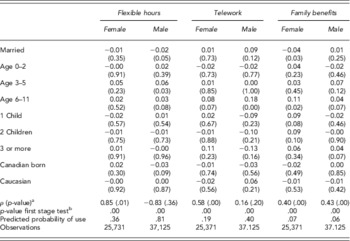
Conventional treatment of this endogeneity problem in our framework is complicated since we are already correcting for a selection issue. Moreover, the WES contains no suitable instrument to correct for endogeneity of hours of work. However, we are able to check the robustness of our estimates for this problem by repeating the previous regressions for the sub-sample of full-time workers. The marginal effects are shown in Table 4. Results for female workers are virtually unchanged when we consider the sample of full-time workers, suggesting that our previous estimates were not strongly biased in this regard. For full-time males we do observe some noteworthy changes. Most significant is the negative change in the sign of the correlation coefficient between use and availability of flexible hours. Our previous results are reinforced, that is, the use of flexible time among males is unrelated to family-work conflict for full-time male workers and that other, unaccounted for characteristics are driving the selection of males into flexible hours. For the other two benefits, the estimates are similar, though slightly less precise. Overall the results for the full-time sample of workers suggests that endogeneity of hours of work is unlikely to cause a strong bias in our previous estimates that would reveal further gender differences in benefit use to cope with family responsibilities.
Marginal effects of family characteristics on benefits use

Notes: Full-time workers (p-values).
Models include controls for hours of work, year and location.
Column (I) shows the marginal effects of family characteristics on use of benefit in a probit
Column (II) shows the marginal effects of family characteristics on use of benefits in a selection model for availability.
aTest statistic of zero correlation between the error terms of the availability and use equations.
bTest statistic of the hypothesis that the excluded instruments are jointly zero in the first stage regression.
Despite the considerable improvements the WES allows for the analysis of the incidence of family-friendly practices, attributable to the sample structure and large sample sizes, individual responses however, pose a problem for the interpretation of results. Namely, with no information about overall availability of benefits for a household, we are unable to infer much from observations of gender differences in use of benefits. Additionally, we cannot address the specific question of whether a reason for low use is ‘dual’ access to benefits. However, it can be partially answered by looking at the probability of use among single parents, as this demographic group is less likely to have access to a partner's benefits. If the selection corrected estimates of the effect of demographic variables on use are not significant for the single parent sample, it would suggest that the benefit is less than adequate to deal with work and family demands, rather than the alternative explanation, that the benefit is available through a partner's job.
Table 5 shows the results from regressions similar in spirit to the main results but estimated for the (gender pooled) sub-sample of single parents. We have made a more parsimonious model to account for the small sample of single parents. In this specification, the use equation collapses the three indicators for ‘age of the youngest child’ to a single indicator variable for ‘children less than 11’, and the three indicators for ‘number of children’ to a unique indicator for ‘more than one child’. We observe similar trends for the sub-sample of single parents. For flexible hours, the only significant effect among selection corrected estimates is for the coefficient for the presence of (one) young child. However, the negative correlation coefficient suggests that selection is not guided by family-work conflict. A female single parent seems more likely to use telework and family support than male single parents. The presence of (one) young children increases the likelihood of telework use, whereas it is the presence of (more than one) older children that affects the likelihood of family support use. The difference in the estimates of demographic variables in columns 5 and 6 of Table 5, again suggests that family support is not available to single parents who would use them. Overall, the estimates reported in Table 5 do not suggest that dual access to benefits is a likely reason for low use of benefits. On the contrary, these estimates reinforce those of Table 3 since this sub-sample of workers is less likely to have access to a partner's benefits.
Estimates of the marginal effects of family characteristics on use of benefits for single parents (p-values)

Notes: Column (I) shows the marginal effects of use of benefit in a probit regression of use of benefit on family characteristics.
Column (II) shows the marginal effects of use of benefit in a selection model of use of benefit conditional on benefit availability.
aOf the null hypothesis of zero correlation between the error terms of the use and availability equations.
bOf the null hypothesis that the excluded instruments are jointly zero in the first stage regression.
Conclusion
We ask the following question regarding privately provided, family-friendly benefits: why do we not observe higher levels of take-up of these benefits? Are benefits not useful to workers, or, do workers that need the benefits have no access to them? We use a unique database that distinguishes between use and availability of benefits to account for worker selection into firms with available benefits employment conditions, using technical constraints in the provision of available benefits as exclusion restrictions in a two-step estimation procedure. We specifically consider flexible work scheduling, telework and family support services.
Our analysis reveals two things. First, selection issues are important to understand the take-up of employer-provided benefits. Contrary to what was expected, however, it is not only women that select firms with family-friendly benefits (except for telework). Second, following a correction for selection, not all benefits are equally useful. Workers do not appear to use flexible schedules to achieve work-life balance. Telework, however, seems to be related to factors that measure family-work conflict for female workers only. Family support services, though, such as daycare, do not appear to be offered to workers who would use them.
Because the empirical determination of benefit availability and benefit use is a complex process, our estimates are conditional on employment and assume that an increase in privately offered benefits will have a negligible impact on an individual's choice to work. We also abstract from the trade-off between wage and benefits, likely to be implicit in contract determination, to focus on the factors that affect the actual use of benefits. Other endogeneity issues, such as a worker's choice of skills are ignored. We do argue however, that the benefits we consider here, intended to help workers reconcile the demands of work and family life, unlike other fringe benefits, are often informal, and are unlikely to be a fundamental determinant of labour contracts in general.
Acknowledgement
We thank HRSD Canada for financial support and for granting remote access to the data. Thanks also to Lucy Chung and Yves Decard for excellent support in data analysis.
APPENDIX
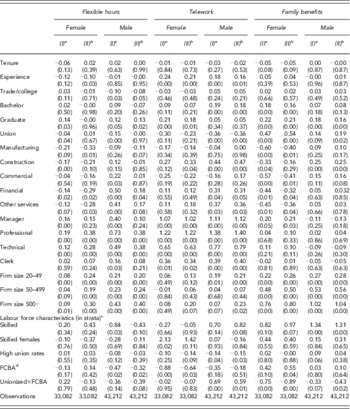
Columns labelled (I) show estimates of the influence of firm and labour market characteristics on the availability of benefits from an ordinary probit regression. Columns labelled (II) show the first stage regression coefficients of the joint bivariate probit model. These estimates indicate a correlation between highly qualified workers, or higher ranked occupations and availability of benefits. Firm characteristics such as firm size are also strongly correlated with the provision of benefits, with larger firms being more likely to supply benefits. Regarding labour market characteristics, a high fraction of females of child bearing age in the strata positively affects the availability of family benefits for females, but not for males. Further, male workers in stratas with a high degree of unionization are less likely to have access to telework or flexible time. We believe that this difference in effects by gender is related to the fact that these benefits are not, in general, suitable for manufacturing and primary industries, which encompass a high degree of unionized male workers. Females, on the other hand, are likely more concentrated in industries more suitable for the use of these benefits and can benefit from unionization
Estimates of firm and labour force characteristics from the availability/selection models by gender