Recently, the size-scale effects in plastic deformation have been studied both experimentally[Reference Dimiduk, Woodward, LeSar and Uchic1–Reference Greer and De Hosson3] and theoretically[Reference Csikor, Motz, Weygand, Zaiser and Zapperi4, Reference Ispánovity, Groma, Györgyi, Csikor and Weygand5] for several different materials. In the case of conventional crystalline materials, as with metals, it is well established that the decreasing sample size may significantly affect the fundamental mechanisms of plasticity: for example, in dislocation storage, multiplication, motion, pinning, etc. Therefore, although the plasticity of macroscopic samples appears as a smooth process, in the plastic deformation of microcrystals specific dislocation avalanches are formed leading to an uncontrolled deformation process including also the possibility of catastrophic failure. Accordingly, micrometer-sized samples of coarse-grained metals are not suitable for use in the fabrication of micro-devices.
It is well established that bulk ultrafine-grained (UFG) materials may be achieved by using severe plastic deformation (SPD) techniques,[Reference Valiev6, Reference Zhilyaev and Langdon7] decreasing the grain sizes into the submicrometer and nanometer ranges. Typically, the materials produced by SPD exhibit tensile ductilities below 10% at ambient temperature due to exhaustion in their work hardening capacity. Furthermore, this low ductility is correlated with extremely low strain rate sensitivity (SRS) of ~0.01–0.03 characterizing the mechanical behavior of these materials.[Reference Meyers, Mishra and Benson8] It was suggested that the mechanical properties of UFG metals may be improved if grain boundary sliding (GBS) is achieved at relatively low temperatures.[Reference Valiev, Alexandrov, Zhu and Lowe9–Reference Valiev, Murashkin, Kilmametov, Straumal, Chinh and Langdon11] It was recently shown that SPD is capable of improving the room-temperature ductility of an Al–30 wt% Zn UFG alloy processed by high-pressure torsion (HPT)[Reference Valiev, Murashkin, Kilmametov, Straumal, Chinh and Langdon11] since this UFG material became super-ductile with unusually high elongations up to >150% and an unusually high SRS of ~0.22. In this work, we applied a focused ion beam (FIB), depth-sensing indentations and scanning electron microscopy (SEM) to reveal experimentally the basic deformation mechanism in this UFG alloy at the micrometer scale. We report here the plastic deformation of UFG micro-pillars, demonstrate the occurrence of intensive GBS at room temperature and note the potential for effectively applying these UFG materials in micro-devices.
The experiments were conducted using an aluminum-based alloy containing 30 wt% Zn prepared from high-purity components by vacuum induction melting. Disks having diameter of 20 mm and thicknesses of 0.8 mm were prepared from the as-cast alloy and then homogenized at 500 °C for 5 h to give a solid solution microstructure with equiaxed grains having a mean size of ~65 µm. These disks were processed by HPT for five turns at room temperature using a pressure of 6.0 GPa and a rotation speed of 1 rpm under quasi-constrained conditions.[Reference Zhilyaev and Langdon7] Samples were cut from the HPT-processed disks for mechanical investigation at a distance of 5 mm from the sample center. The microstructure after HPT contained equiaxed ultrafine Al grains having an average size of ~200–400 nm.[Reference Valiev, Murashkin, Kilmametov, Straumal, Chinh and Langdon11]
Micro-pillars having a diameter of ~3 µm and a height of ~10 µm were prepared on the surface of the polished disks using SEM and FIB functions in a multi-functional Quanta 3D operating at a voltage of 30 kV. Different currents of Ga+ ions highly accelerated at 30 kV were applied for the milling operation. In order to avoid possible damage from the Ga+ ions,[Reference Uchic, Shade and Dimiduk2] the micro-pillars were fabricated in three steps by surface milling. In the first two steps, currents of ~15 and ~1 nA were applied in sequence to mill a rough pillar on the disk surface having diameters of ~6 and ~4.5 µm, respectively. Thereafter, a lower current of ~0.1 nA was used to fine mill the pillar to a final diameter of ~3 µm.
Nanocompressions were made at room temperature using a flat-ended conical diamond indenter within a depth-sensing ultra-microhardness testing machine (UMIS CSIRO, New South Wales, Australia) operating under a force, F, that increased linearly with time up to 4 mN under an imposed loading rate of 10−2 mN/s. It should be noted that the micro-pillars in the annealed, coarse-grained samples corresponded to single crystals. The orientations of these pillars were determined using the electron back-scattered diffraction menu of the Quanta 3D. To avoid any possible damaging effect from extremely high avalanches, the indenter was automatically stopped at a maximum compression depth of 2 µm.
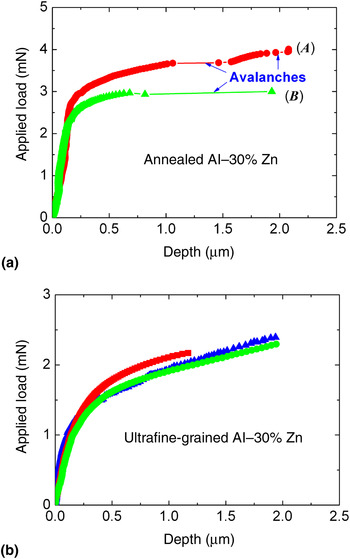
Figure 1(a) shows typical compression load–depth curves obtained from micro-pillars on the surface of annealed samples. The two pillars are single crystals fabricated by FIB from two different coarse grains and having orientations near to <111> (pillar A) and near to <100> (pillar B). Both curves show the presence of visible strain avalanches. This is a well-known phenomenon characterizing the plasticity of micrometer-scale single crystals,[Reference Dimiduk, Woodward, LeSar and Uchic1–Reference Csikor, Motz, Weygand, Zaiser and Zapperi4] where complex dislocation processes take place intermittently causing scale-free isolated slip events. These large strain fluctuations lead to difficulties in plastically forming micrometer-scale single crystals because of the possibility of catastrophic failure. For this reason, micrometer-sized samples of coarse-grained metals are not suitable for use in the fabrication of micro-devices.
Typical compression load–depth curves obtained for: (a) the annealed single-crystal Al–30Zn pillars showing evidence for avalanches on a microscopic scale. The pillars A and B have orientation near <111> and <100>, respectively; (b) the UFG Al–30Zn pillars showing the occurrence of stable deformation without avalanches. These pillars are polycrystalline even at this scale because the grain size was only ~200–400 nm.

In contrast, Fig. 1(b) shows typical compression load–depth curves for micro-pillars on the surfaces of the UFG samples. Unlike the curves in Fig. 1(a), these curves are smooth and there is an absence of any strain avalanches. It is noted that these micro-pillars are polycrystalline even at this scale because of the small grain size of ~200–400 nm. Therefore, when interpreting the plastic behavior of these UFG samples, the role of the grain boundaries must be considered. It is well known that grain boundaries can not only act as obstacles for the moving dislocations but can also become dislocation sources. Furthermore, if grain boundary diffusion is enhanced, leading to significant GBS, the deformation process will take place primarily by the motion of grain boundaries. Because of these compensating effects, catastrophic slip events cannot take place in polycrystalline pillars. Therefore, the smooth flow of the UFG samples is attributed unambiguously to the effects of the grain boundaries. It is noted that the curves obtained on the UFG polycrystalline pillars show excellent reproducibility with a scatter of <10% whereas the curves in Fig. 1(a) characterizing the behavior of single-crystal micro-pillars show deviations of more than 30%.
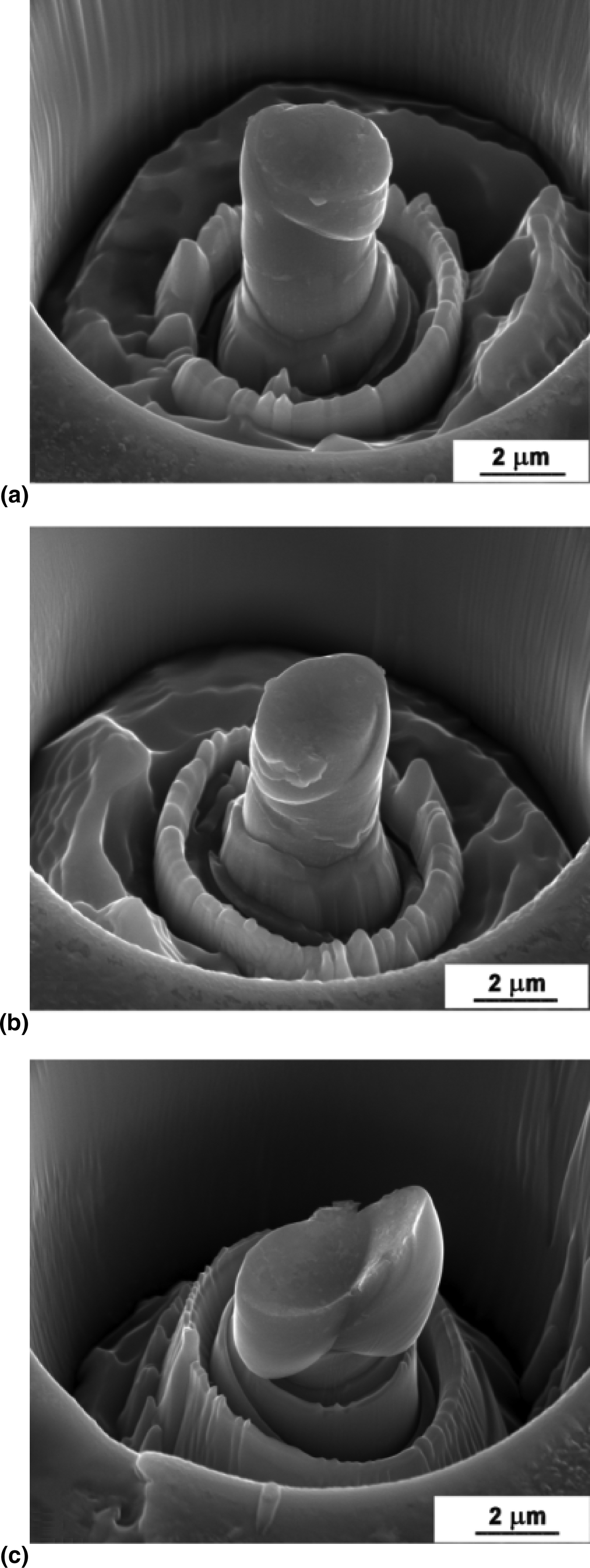
An examination of the compressed micro-pillars by SEM revealed a surface morphology in the annealed condition as shown in Fig. 2. The surface of pillar A with an orientation near <111> is presented in two different positions labeled (a) and (b) which were created by rotating the sample around its symmetry axis by 90°. The surface of pillar B having an orientation near to <100> is presented in Fig. 2(c). In each case, strain localizations and extreme slip bands are observed near to the direction of maximum shear stress at 45° relative to the orientation of the compression stress. These strain localizations and extreme slip bands correlate with the strain avalanches visible in Fig. 1(a).
The surface morphologies of the compressed micro-pillars in the annealed condition: pillar A is shown in two different positions labeled (a) and (b) separated by a 90° rotation and pillar B is shown in (c). For both samples, strain localizations and extreme slip bands are observed corresponding to the avalanches visible in Fig. 1(a).
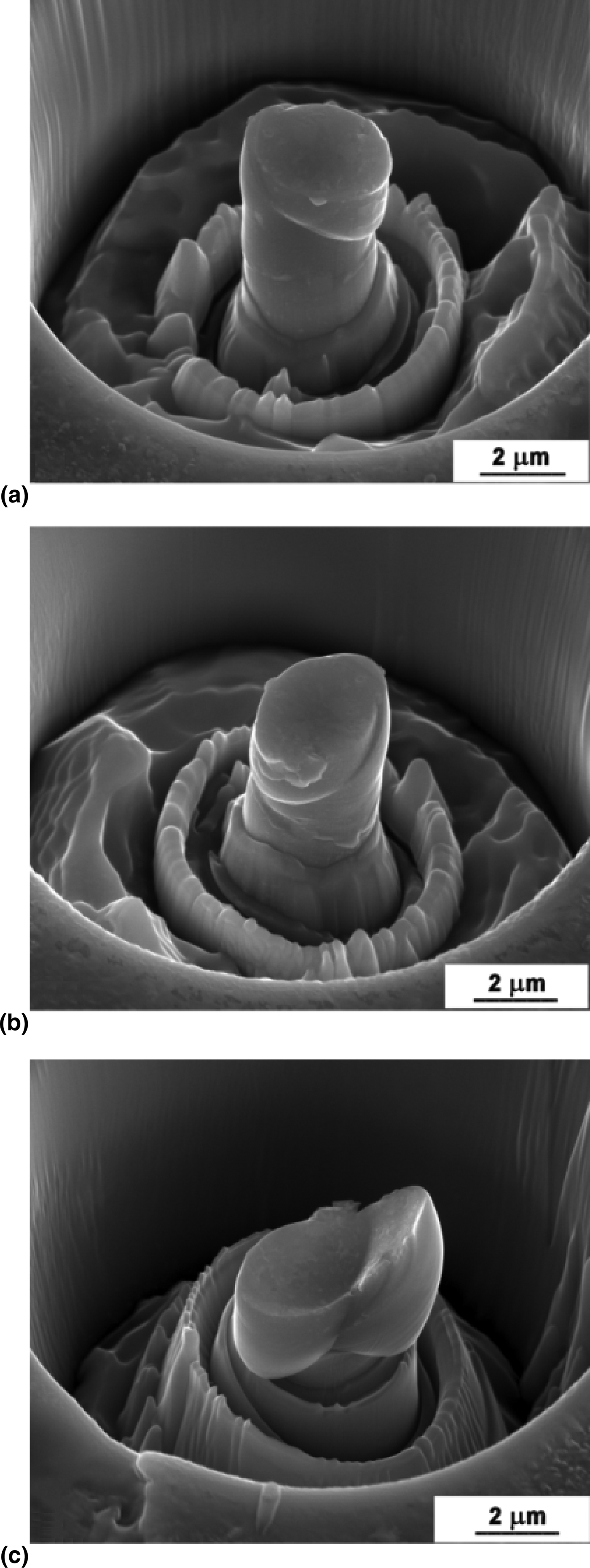
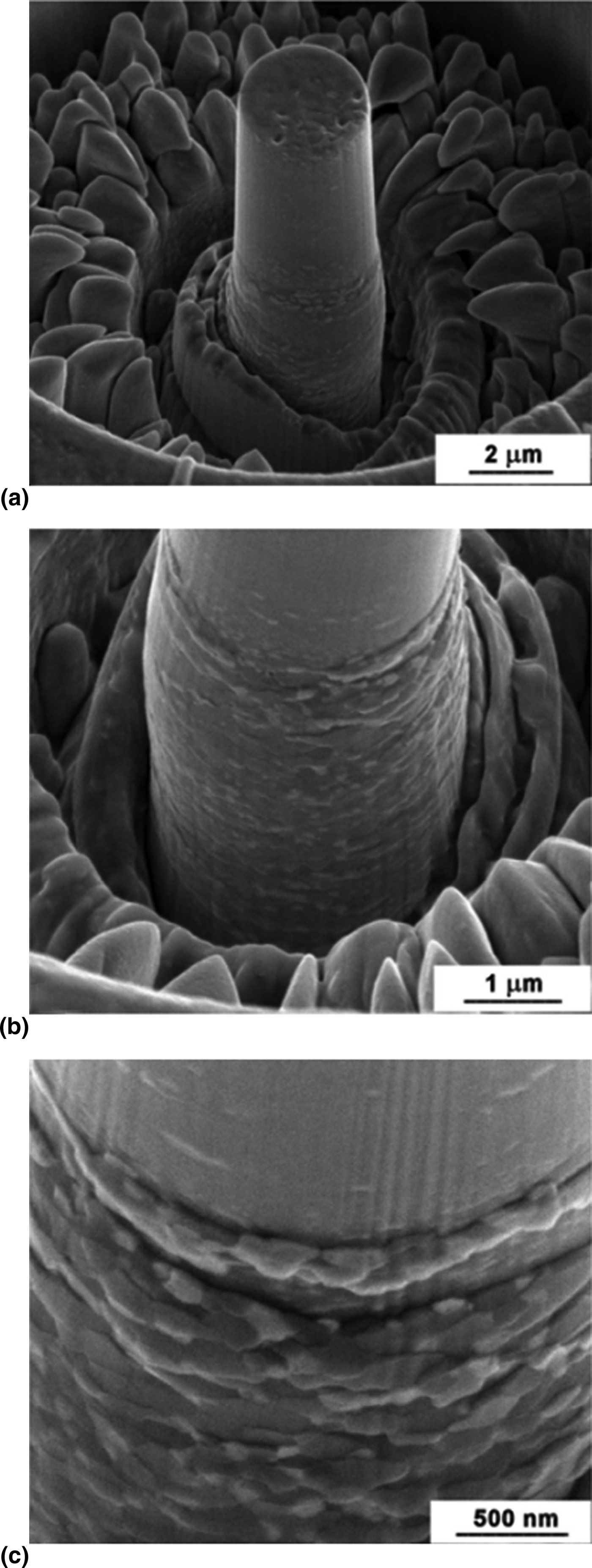
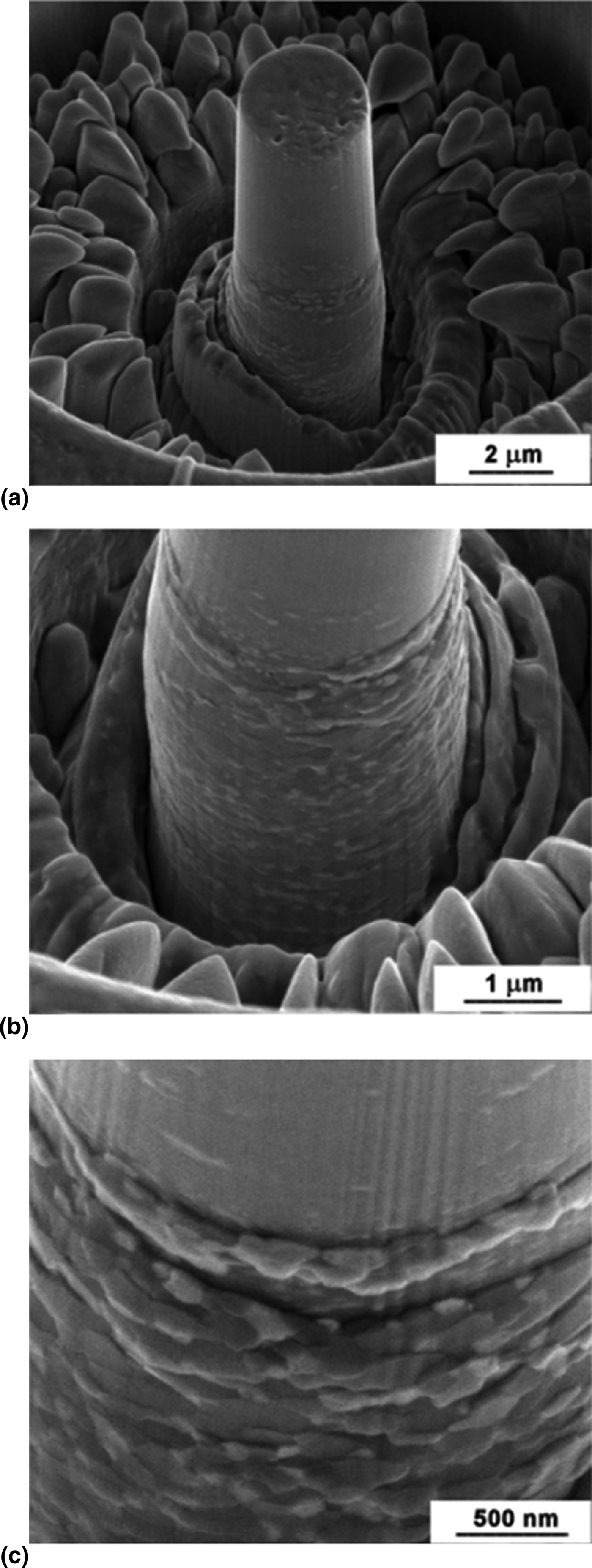
Figure 3 shows the surface morphology of the deformed UFG micro-pillars recorded at (a) low, (b) intermediate and (c) high magnifications demonstrating clearly the occurrence of intensive GBS without localization and extreme slip. It can be seen for the UFG samples that the compensating effect of the grain boundaries has converted the maximum shear stress along the direction of 45° into the motion of individual grains, resulting in deformation having cylindrical symmetry as rings of refined grains are displaced around the sample. In the most recent work,[Reference Chinh, Csanádi, Győri, Valiev, Straumal, Kawasaki and Langdon12] using depth-sensing indentation tests at different temperatures, it was shown that the diffusion process controlling the plastic deformation in this UFG Al–30 wt% Zn alloy is unusually strong even at room temperature. The diffusion coefficient of ~1.6 × 10⁻¹⁶ m2/s estimated for this alloy is about three orders higher than the value of ~10−19 m2/s characterizing Al self-diffusion along the Al/Al grain boundaries and correlates reasonably with the value of ~10−15 m2/s for Zn diffusion along Al/Al grain boundaries. The intensive GBS and other unusual plastic behavior of the UFG Al–30 wt% Zn alloy are attributed to the development of thin layers of a Zn-rich phase which segregate at the Al/Al grain boundaries.[Reference Straumal, Valiev, Kogtenkova, Zieba, Czeppe, Bielanska and Faryna13] The observations shown in Fig. 3 are consistent with the smooth compression load–depth curves in Fig. 1(b). The stable deformation by GBS of the UFG micro-pillars, without the occurrence of catastrophic avalanches, emphasizes the advantage of the GBS mechanism and suggests a potential for using these UFG materials in the fabrication of micro-devices.
The surface morphologies of the compressed UFG micro-pillars recorded at (a) low, (b) intermediate and (c) high magnifications: there is direct evidence for the occurrence of intensive GBS without localizations and extreme slip.
The present unique observations reveal the occurrence of intensive GBS at room temperature in the UFG Al–30 wt% Zn alloy, confirming the basic deformation mechanism even in samples having a size at the micrometer scale. The results show that GBS can be a viable deformation process in UFG metals processed by SPD and the occurrence of sliding provides an explanation for the unusually high SRS and high ductilities of these materials. As a consequence of the role of the grain boundaries, it is not possible to form strain localizations such as slip bands across the cross sections of the samples. This means that the deformation process is relatively homogenous and this has important practical implications for the electronics industry and especially for using these materials in micro-devices.
Acknowledgments
This work was supported by the Hungarian Scientific Research Fund (OTKA) under Grant Nos. K81360 and K67692 (NQC), by the Russian Foundation for Basic Research and Federal Agency for Science and Innovations (RZV) and by the National Science Foundation of the United States under Grant No. DMR-0855009 (TGL). The European Union and the European Social Fund provided financial support for this project under Grant Agreement No. TÁMOP 4.2.1./B-09/1/KMR-2010-0003.