Introduction
Foreign bodies are common otological problems. Usually, these foreign bodies are inert objects and are easily removed by general practitioners. However, some foreign bodies, such as insects, are known to be troublesome.
Insects pose a challenge in removal and are associated with a high risk of complications. Typical complications include manipulation injuries to the canal wall or tympanic cavity. The simple technique of killing the insect by instilling oil and retrieving it is mostly successful.
Some patients can develop severe local or systemic reactions that may prove fatal. We present a series of six patients in whom catastrophic complications occurred as a result of insects entering the ear.
Case details
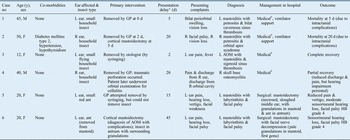
A retrospective evaluation of the charts of six patients was performed. All of these patients had a history of animate objects (insects) entering the ear. The clinical profiles of these patients are summarised in Table I.
Clinical profile and outcome of patients with complications due to animate aural foreign bodies

*To our centre. †Medical management included broad-spectrum injectable antibiotics, anti-inflammatory agents, treatment for co-morbidities, and symptomatic treatment for pain, vertigo or facial palsy, as required. No = number; y = years; d = days; M = male; L = left; GP = general practitioner; bilat = bilateral; F = female; R = right; AOM = acute otitis media; HB = House–Brackmann
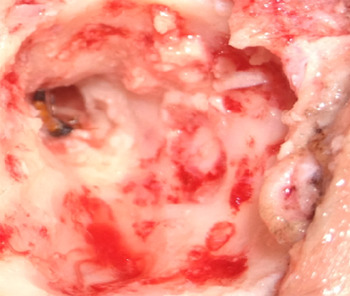
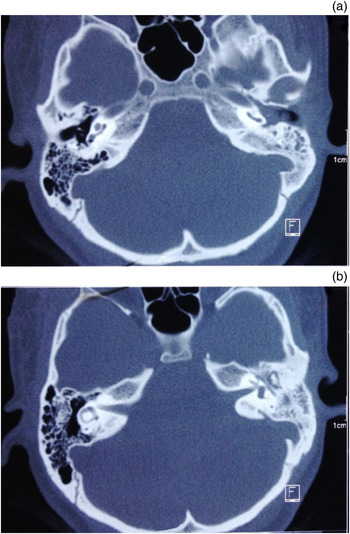
All patients (four female and two male) had a definite history of an insect entering the ear, and all received intervention for retrieval of the insect before presenting to our centre. In four cases, the insect was retrieved from the external auditory canal. One patient had presented with symptoms and signs of acute mastoiditis, with intratemporal complications; on exploration, the surgeon had retrieved an insect from the mastoid antrum. One patient was investigated at our centre and an ant was removed from the antrum (case number five; Figures 1 and 2).
Ant in mastoid antrum, with surrounding granulation (case number five).

High-resolution, axial computed tomography scans of case number five (a and b), showing diffuse soft tissue density in the mastoid and middle ear.

Five patients presented at our tertiary care centre with progressive otological or systemic symptoms, even after insect removal. The medical management comprised broad-spectrum antibiotics, anti-inflammatory agents, and symptomatic treatment for facial palsy, vertigo or otalgia.
The overall prognosis of patients was poor. Two patients who had extratemporal complications with multisystem involvement at the time of presentation were managed in intensive care units and required ventilator support. One of these patients had pre-existing diabetes and uncontrolled hypothyroidism. Both patients had a subsequent fatal outcome. Two patients with intratemporal complications (facial palsy and sensorineural hearing loss) were treated surgically by mastoidectomy and facial nerve decompression at our centre. Only partial resolution of the symptoms could be achieved. The only patient with complete resolution (case number three) had presented early (on the 2nd day after removal of the insect) with persisting headache as a result of sigmoid sinus thrombosis, and responded well to medical management.
Discussion
Animate aural foreign bodies can rarely present with catastrophic complications. Such complications have been described very infrequently in the literature.Reference Das1–Reference Schulze, Kerschner and Beste5 Several large case series of aural foreign bodies have been reported.Reference Das1–Reference Bressler and Shelton3 The complications described had mostly been caused by untrained manipulation in an attempt to remove the aural foreign body.
In a series of 462 cases of aural foreign bodies treated over a period of 7 years, Fornazieri et al. reported that 27.5 per cent of these cases were the result of animate foreign bodies; 26.3 per cent of such cases had complications.Reference Fornazieri, Cutolo, Moreira, Navarro Pde, Takemoto and Hesbiki4 Injury to the canal wall was the most common complication, which could be attributed to attempts at removal by general practitioners. Following a detailed analysis of various parameters of type and duration of aural foreign bodies, including management techniques, Schulze et al. recommended early referral to an ENT specialist (within 24 hours) for all children and for adults where the foreign body was difficult to visualise.Reference Schulze, Kerschner and Beste5 In the literature, there are no studies on catastrophic complications as a result of animate aural foreign bodies. Ugwu and Okolugbo reported a series of four cases of otogenic tetanus, in which one patient had a history of an aural foreign body.Reference Ugwu and Okolugbo6 Trauma during retrieval was thought to be the cause of the tetanus.
In our series, all six patients had a recent history of animate aural foreign bodies. The foreign bodies were retrieved from the external auditory canal in four cases; in our experience, mastoiditis frequently develops in this clinical scenario. In two cases, initial mastoiditis had progressed to intracranial and intratemporal complications, with a subsequent fatal outcome. Permanent hearing impairment was the most common intratemporal complication. Three patients developed complete facial palsy. Such catastrophic outcomes can be attributed to the patients' immunological status or retained parts of the insect in some cases, but in others, disease progressed despite complete insect removal.
The exact pathogenesis of the catastrophic responses to aural insects as noted in this study remains unclear. The effects may be caused by the direct effect of toxins in insect stings. Another possible explanation is a ‘localised anaphylactic’ reaction to the toxins or proteins in insect saliva. The immune response may also be caused by body proteins of dead insects trapped in aural cavities. The clinical cases reported here additionally seem to indicate to a propensity for hypercoagulability and venous sinus thrombosis.
Insect sting allergy is known to occur at all ages, and can occur even after a number of previous uneventful stings. Even without intervening stings, sensitisation can develop over decades, resulting in a subsequent anaphylactic reaction.Reference David7 The frequency of large local reactions is uncertain, but about 50 fatal sting reactions occur each year in the USA.Reference Barnard8 A similar allergic reaction to polypeptides in mosquito saliva has been termed Skeeter syndrome.Reference Simons and Peng9 Though the clinical manifestations of Skeeter syndrome are similar to that of bacterial cellulitis, they progress more rapidly in the former condition, with progression over the course of hours (rather than days as is typically seen in cellulitis). To the best of our knowledge, insect-induced localised idiosyncratic types of inflammatory response involving the middle and inner ear, with a spectrum of consequences as described here, have not been previously described in the literature.
Important factors in the patient's history are the time of foreign body removal and the skill of the doctor involved at first presentation. In case number five, the complications experienced could certainly have been avoided if the patient had been referred to an otologist at an earlier stage. The various published reviews equivocally opine that otologists are superior to emergency physicians in removing a foreign body from the ear as they use a surgical otomicroscope for visualisation.Reference Das1, Reference Thompson, Wein and Dutcher2, Reference Dance, Riley and Ludemann10
• In rare cases, animate aural foreign bodies can cause catastrophic intratemporal and extratemporal complications, even after successful retrieval
• Localised anaphylaxis associated with an immune response or direct toxicity of the insect sting could explain these events
• Once complications have arisen, prognosis is guarded; early intervention is likely to be pre-emptive
This case series aimed to report an unusual observation of catastrophic complications as a result of animate foreign bodies in the ear. The possible mechanism of these complications is discussed. The prognosis was invariably poor in all but one case.
Conclusion
Animate aural foreign bodies should be managed meticulously. Early and complete insect retrieval by an experienced otologist is key to complication prevention. An idiosyncratic type of localised inflammatory response to an insect's sting can lead to dangerous complications. In cases where intervention is delayed and in patients with systemic co-morbidities, prognosis is guarded. In patients with progressive local symptoms, prompt surgical intervention should be considered, especially if there is suspicion that part of the foreign body has been retained. The ideal algorithm for medical and surgical management of patients presenting with complications remains unclear.