Ant gardens (AGs) are mutualistic systems formed by a close association between different ant species living in parabiosis and several epiphyte species that grow on their nests. These ants carry epiphyte seeds and continuously incorporate them into their carton nests over the colony's lifetime (Orivel & Leroy Reference ORIVEL and LEROY2011). Once incorporated into a nest, epiphyte seeds find a suitable substrate for seed germination and seedling establishment, mainly because of the nutrient-rich composition of the carton nest (Blüthgen et al. Reference BLÜTHGEN, SCHMIT-NEUERBURG, ENGWALD and BARTHLOTT2001) as well as a possible lack of pruning behaviour by the ants and allelopathy by plants (Orivel & Leroy Reference ORIVEL and LEROY2011). Therefore, most seeds of different species incorporated into the nest can potentially germinate and make up AGs. Apart from seeds actively selected and incorporated by the ants, plant species may reach the nest via other dispersal vectors (e.g. wind or birds; Kaufmann Reference KAUFMANN2002, Orivel & Leroy Reference ORIVEL and LEROY2011). As a result, 53 plant species from 12 families have been recorded in Neotropical AGs, from which a subset of 20 are exclusively found on AGs and/or exclusively dispersed by AG ant species (known as true AG epiphytes; Orivel & Leroy Reference ORIVEL and LEROY2011).
Although the role played by different dispersal agents on seed arrival in AGs is well acknowledged (Kaufmann Reference KAUFMANN2002, Orivel & Leroy Reference ORIVEL and LEROY2011), the potential effects of post-dispersal processes or the assembling rules shaping local AG epiphyte community composition are far less studied. The availability of true AG seeds around the nest and the potential arrival of non-true AG seeds into AGs might be expected as the main stochastic forces determining the epiphyte composition of AGs. However, deterministic post-germination processes, such as epiphyte species interaction after initial establishment and local AG environmental conditions, may also play important role as drivers of this micro-community composition. If so, such forces will balance the effects of stochastic events, resulting in complex assembly rules regulating AG epiphyte communities.
In this study, we investigated the role played by deterministic and stochastic forces in the structure of epiphyte species communities from Neotropical AGs formed by the ant species Camponotus femoratus and Crematogaster levior. Initially, we hypothesized that both deterministic and stochastic processes will be synergistically driving AG epiphyte composition at small spatial scales. For deterministic processes, we tested whether nest volume (proxy for succession time) and abiotic conditions (light availability, number of branches and nest height) will determine species composition. If our hypothesis is true, we expect that similarity in AG composition will vary predictably with AG volume and/or environmental conditions. We further expect that if stochastic mechanisms are also driving epiphyte AG communities, spatially closer AGs will be more similar in epiphyte composition. Investigating the balance between deterministic and stochastic forces determining AG epiphyte composition enables us to set predictions that will improve our understanding of the origin and functioning of these multi-specific systems.
We performed this study on a reserve named ‘Km-41’, belonging to the Biological Dynamics of Forest Fragments Project (BDFFP), located approximately 80 km north of Manaus, Central Amazon, Brazil (02°24′S, 59°22′W). In tropical forests, AGs are common in areas with relatively high light intensity (Dejean et al. Reference DEJEAN, CORBARA, ORIVEL, SNELLING, DELABIE and BELIN-DEPOUX2000). In our study, a small dirt road of 10 m width created a sunny corridor in which AGs were densely distributed in the forest canopy. In August 2011, we walked along this road on a straight section and studied the AGs as we found them, which were not necessarily located at the boundary between the road and the forest, but were at no more than 20 m from the road. Therefore, linear distance between AGs positively correlates with distance along the road. In total, we observed 18 AGs formed exclusively by the ant species Crematogaster levior and Camponotus femoratus. We found these AGs only on the first kilometre of the road, a region in which the canopy was more open and the light incidence was higher than in other areas along the road. The AGs observed were located in different canopy strata. In each AG, we sampled all epiphyte species growing on it, assigning them to genera and morphospecies.
We measured nest volume to evaluate whether AG epiphytic composition is governed by plant species succession over the AG, as recently formed AGs are small cartons, and as times goes by, the nest is enlarged because of colony and epiphyte growth. We acknowledge that AG volume is not directly related to the age of the AGs. It may also be related to the number of tree branches supporting the AGs and to the availability of local resources for carton nest construction. However, all studied AGs were located within a 1 km × 20-m area and we have no reason to believe that resource availability for nest construction should be different over this geographic scale. Additionally, the volume of AGs was not correlated with the number of phorophyte branches supporting the AGs (r = 0.10). Therefore, we believe that the variation in the volume of AGs in our study is a good proxy of the variation in the age of the AGs. We calculated each nest volume (NV) using the formula for the volume of an ellipsoid: NV = 4/3 × π × (garden diameter)2 × garden height.
To investigate whether abiotic conditions shape AG epiphyte composition, we chose three environmental variables that potentially affect plant composition in AGs: local light availability, the number of host-tree branches supporting the AG and the height above ground of the AG. We estimated light availability using a convex spherical densitometer positioned by the trunk (at a height of 1.3 m) of phorophytes, under each AG. We counted the number of branches actually supporting the AG, and measured the height of the AG in relation to the ground with a measuring tape. These variables may be environmental filters, as light availability influences epiphytic establishment (Huston Reference HUSTON1994), the number of phorophyte branches may influence nest structure and form (Davidson Reference DAVIDSON1988), and the height of the AG in relation to the ground may determine epiphyte species occurrence, as some depend on contact with the ground, and others are adapted to bare branches (Nieder et al. Reference NIEDER, ENGWALD, KLAWUN and BARTHLOTT2000). Finally, to determine whether closer AGs are more similar in their epiphytic composition, we measured the distances among AGs using a GPS. We analysed the influence of AG volume, local environmental conditions and geographic distance among AGs on epiphyte composition via variation partitioning (Peres-Neto et al. Reference PERES-NETO, LEGENDRE, DRAY and BORCARD2006) and partial Mantel correlations of distance matrices. To decompose geographic distances among nests into mutually orthogonal axes, we used principal components of neighbour matrices (PCNM, or Moran's eigenvector maps), creating linear spatial predictors that can fit in canonical analyses (Dray et al. Reference DRAY, LEGENDRE and PERES-NETO2006). We then used a forward selection technique to select the significant axes to be incorporated in further analyses, as recommended by Blanchet et al. (Reference BLANCHET, LEGENDRE and BORCARD2008). Variation was partitioned with the epiphyte community as the dependent matrix and three independent matrices: environmental conditions (light availability, bifurcation and height above ground of the AG), nest volume and PCNM axes for spatial structure. The significance of each component was then tested via partial redundancy analysis (pRDA), with the significance of each component conditioned by the two others. As a complementary analysis, we ran partial Mantel tests using Bray–Curtis dissimilarity distance matrix for epiphyte species composition, and the Euclidean distance matrices for individual variables, nest volume and geographic distance among nests, as well as the first axis of a PCA ordination of environmental variables. Geographic distance and nest volume had large ranges, so we logarithmically transformed them to improve model fit for partial Mantel tests. All analyses were performed in R v. 3.1.2, using the package vegan and the package ecodist.
We recorded 19 epiphyte morphospecies from at least nine genera: Aechmea, Anthurium, Codonanthe, Codonanthopsis, Ficus, Oedematopus, Peperomia, Philodendron and Psychotria. We found an average of 3 ± 1.28 (mean ± SD) morphospecies per AG, varying from AGs with 1 (Peperomia macrostachya, Piperaceae) to those with five species. The average distance among each AG pair was 251 ± 2.6 m, ranging from 1.33 m up to 1075 m. The average volume of the AGs was 0.019 ± 0.027 m3, ranging from 0.0001 m3 up to 0.088 m3. AGs were at 3.2 ± 1.5 m height on average, ranging from 1.2 up to 8.3 m, and received 79% ± 0.09% of mean light availability, ranging from 76.5% up to 83.5%. Additionally, AGs were on average supported by 2.27 ± 1.31 phorophyte branches, ranging from one to six branches.
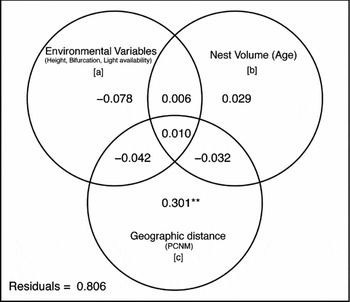
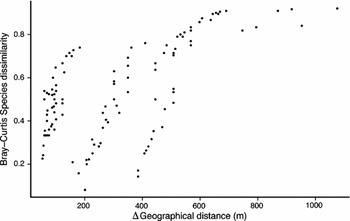
Spatial distribution of AGs significantly explained the variation in epiphyte composition, represented by the PCNM axes (fraction [c], R2adj = 0.301, P < 0.01; Figure 1). Epiphyte composition variation was not explained by environmental variables (fraction [a], R2adj = −0.08, P = 0.98) and nest volume (fraction [b], R2adj = 0.03, P = 0.24). PCA axis 1 captured 57.4% of variation in environmental variables, but neither PCA axis (Mantel r: −0.15, P = 0.14) nor individualized environmental variables had significant relationships with community composition (bifurcation – Mantel r: −0.13, P = 0.16; light availability – Mantel r: −0.11, P = 0.21; height of the AG from the ground – Mantel r: −0.13, P = 0.23). Also, partial Mantel analysis confirmed the lack of relationship between AGs volume and species composition dissimilarity of epiphyte community on AGs (Mantel r: −0.11, P = 0.82), and that closer AGs had a more similar epiphytic community composition (Mantel r = 0.63, P < 0.01). This pattern was steady only for those AGs located further than 600 m from each other, but still enough for a significant test (Figure 2). Conversely, we found an indistinguishable pattern of species dissimilarity for those AGs within a geographic distance <600 m, which repeats across spatial scales because of a small number of AG pairs within certain distances (e.g. 120–200 m, 320–400 m; Figure 2). Hence, this repeated pattern (<600 m) is an artifact of the small numbers of pairs within the mentioned range of distances.
Venn diagram of the variation partitioning of Neotropical ant gardens (formed by Camponotus femoratus and Crematogaster levior ants) epiphyte composition (Y) explained by three data sets: environmental variables (height of nests, number of bifurcation and light availability), nest volume and geographic distance among nests. The rectangle represents the total sum-of-squares of Y. Asterisks represent significant proportions of explained variation.

Increasing Bray-Curtis dissimilarity of epiphyte composition with geographical distance among Amazonian ant gardens formed by Camponotus femoratus and Crematogaster levior ants (Mantel r = 0.63, P < 0.001).

We found a negative effect of geographic distance on epiphyte compositional similarity among AGs. Additionally, we did not observe any clear relationship between AG volume or local environmental conditions on AG composition. A distance decay of similarity can be caused by both a decrease in environmental similarity and by increasing dispersal limitation with distance (Nekola & White Reference NEKOLA and WHITE1999). As we have no reason to believe that AG conditions not considered here, such as nutrient availability, water content and carton nest stability, changed noticeably over our geographic gradient, it seems that stochastic processes related to seed-dispersal constraints are the main force shaping AG epiphyte composition. Whereas AG epiphyte seeds can be dispersed by wind or birds, AG ant species are the main dispersal vectors in this system. This is because of some marked, specific associations among epiphyte and AG ant species (Orivel & Dejean Reference ORIVEL and DEJEAN1999, Youngsteadt et al. Reference YOUNGSTEADT, BACA, OSBORNE and SCHAL2009), in which seeds are recognized by ants through specific volatile cues (Youngsteadt et al. Reference YOUNGSTEADT, NOJIMA, HÄBERLEIN, SCHULZ and SCHAL2008). Such a dispersal system results in shorter seed removal distances than those with wind- or bird-dispersed seeds, which would be enough to limit species distribution over small geographic scales. Furthermore, considering seed availability as a key mechanism responsible for the identities of epiphytes on AGs, may help to explain why previous studies like Davidson (Reference DAVIDSON1988) failed to identify any association between seed attractiveness to C. femoratus and differences in AG epiphyte composition, as the most attractive seeds are not necessarily the most abundant.
The polydomous nature of AG colonies could also explain the pattern we describe here, because closer nests can still be part of the same colony and share the same pool of epiphyte species. However, from the 153 comparisons among pairs of nests, only 19 were less than 30 m from each other and other 35 pairs were separated by less than 50 m (Figure 2). Although there is no information about the maximum distance among polydomous AG colonies, we find it safe to assume that for arboreal ants, AGs further apart than 50 m would not be part of the same colony. Therefore, the greater the distance among AGs, the less likely the ants are to collect each other's seeds, and consequently, the greater will be the differences between seeds incorporated into gardens.
Although our results did not support the influence of environmental conditions on variation in the AGs epiphyte composition on a local scale, we note that environmental conditions might still be an important factor driving AG epiphyte composition on other ecological and geographic scales. All AGs we sampled were located in a relatively small area and therefore, were subjected to similar environmental conditions. Hence, variation in the environmental conditions may not have been large enough to impact the occurrence of AG epiphyte species on this small scale. Such a small range of habitat heterogeneity does not impair our conclusions because we have focused on the factors shaping epiphyte composition on this local, small geographic scale. However, generalizations based on these results should be made with caution. AGs occurring at the edges of forest fragments harbour a different set of epiphyte species in comparison with AGs within the fragment core (Leal et al. unpublished data). Additionally, some AG epiphyte species are more commonly associated with certain abiotic conditions or with certain nest sizes (Davidson Reference DAVIDSON1988, Nieder et al. Reference NIEDER, ENGWALD, KLAWUN and BARTHLOTT2000). Hence, although we have observed that local epiphyte composition in AGs is driven mainly by stochastic events on a local scale, deterministic forces still play a stronger role on higher ecological and geographic scales.
In conclusion, we have not eliminated the role of environmental filtering, but have shown its minor contribution to communities on a small spatial scale. We suggest that stochastic ecological processes related to epiphyte seed dispersal constraints are strong drivers of AG epiphyte composition on a local scale, and that the choices of AG ants are limited by seed species availability. This mechanism may be a consequence of the roles of ants in structuring AGs, which not only maintain the homogeneous conditions of AGs but also choose and collect the seeds that will be incorporated into the garden. Accordingly, neighbouring gardens are the main source of AG epiphyte seeds, and a combination between seed abundance and attractiveness of neighbouring AGs seems to drive the higher epiphyte composition similarity among closer AGs at small spatial scales.
ACKNOWLEDGEMENTS
Fernando M. Resende, Franciele P. Peixoto, João P. C. Menezes and Thiago B. d'A. Couto helped in fieldwork and on the first drafts of the manuscript. Paulo E. C. Peixoto, Paulo E. D. Bobrowiec and Manoela Borges helped to set up the sampling design and also improved the first drafts versions. Alan N. Andersen, Fabricio B. Baccaro and an anonymous referee discussed and improved the final drafts of this manuscript. This work was developed as part of the activities of Forest Amazon Ecology Course (EFA/2011). Authors are supported by Coordenação de Aperfeiçoamento de Pessoal de Nível Superior (CAPES) grants. This is article No. 696 of the Technical Series of Biological Dynamics of Forest Fragments Project (PDBFF - INPA/STRI).