INTRODUCTION
Human remains corresponding to Paleolithic Homo sapiens are not abundant in the European archaeological record in general, and especially not in certain regions of the Iberian Peninsula, as is the case of inland Iberia. A paleoanthropological study was recently published regarding a human navicular (foot bone) from the Cueva de los Torrejones (Tamajón, Guadalajara, Spain), which was previously considered Homo sp. (Arribas et al. Reference Arribas, Díez, Jordá, Balbín, Valiente and Musat1995), showing that it actually belongs to Homo sapiens (Pablos et al. Reference Pablos, Sala and Arribas2018). This human bone (T93-S3-27) was recovered from the Lithostratigraphic Unit-Sumidero 3 (LU-S3) during the 1993 field excavation associated with faunal remains from the Late Pleistocene (Arribas et al. Reference Arribas, Díez, Jordá, Balbín, Valiente and Musat1995, Reference Arribas, Díez Fernández-Lomana and Jordá Pardo1997; Díez Fernández-Lomana et al. Reference Díez Fernández-Lomana, Jordá Pardo and Arribas Herrera1998; Carrión et al. Reference Carrión, Scott, Arribas, Fuentes, Gil-Romera and Montoya2007).
An in-depth and detailed anthropological study of this foot bone ruled out the possibility of it belonging to Neandertals or their ancestors (Pablos et al. Reference Pablos, Pantoja-Pérez, Martínez, Lorenzo and Arsuaga2017), suggesting that it could correspond to a H. sapiens fossil (Pablos et al. Reference Pablos, Sala and Arribas2018). In fact, if the stratigraphical and biochronological assignment were confirmed, this foot fossil would become the only Upper Paleolithic human fossil found in the interior of the Iberian Peninsula. Therefore, the implications of this new taxonomic reassignment are particularly relevant due to the absence of Paleolithic Homo sapiens remains in inland Iberia (Martínez et al. Reference Martínez, Pablos, Sala, Pantoja-Pérez and Conde-Valverde2017; Pablos et al. Reference Pablos, Sala and Arribas2018). In addition, Upper Paleolithic occupation sites in this region are scarce. In fact, evidence of late Neandertal or Mousterian survival south of the Ebro River on the Iberian Peninsula, which has been reliably dated using the Ultrafiltration method, ceases more than 40–42 ka BP (Kehl et al. Reference Kehl, Burow, Hilgers, Navazo, Pastoors, Weniger, Wood and Jordá Pardo2013; Wood et al. Reference Wood, Barroso-Ruíz, Caparrós, Jordá Pardo, Galván Santos and Higham2013; Higham et al. Reference Higham, Douka, Wood, Bronk Ramsey, Brock, Basell, Camps, Arrizabalaga, Baena, Barroso-Ruiz, Bergman, Boitard, Boscato, Caparros, Conard, Draily, Froment, Galvan, Gambassini, Garcia-Moreno, Grimaldi, Haesaerts, Holt, Iriarte-Chiapusso, Jelinek, Jorda Pardo, Maillo-Fernandez, Marom, Maroto, Menendez, Metz, Morin, Moroni, Negrino, Panagopoulou, Peresani, Pirson, de la Rasilla, Riel-Salvatore, Ronchitelli, Santamaria, Semal, Slimak, Soler, Soler, Villaluenga, Pinhasi and Jacobi2014; Alcaraz-Castaño et al. Reference Alcaraz-Castaño, Weniger, Alcolea, de Andrés-Herrero, Baena, de Balbín, Bolin, Cuartero, Kehl, López, López-Sáez, Martínez Mendizabal, Pablos, Rodríguez-Antón, Torres, Vizcaíno and Yravedra2015, Reference Alcaraz-Castaño, Alcolea-González, Kehl, Albert, Baena-Preysler, de Balbín-Behrmann, Cuartero, Cuenca-Bescós, Jiménez-Barredo, López-Sáez, Piqué, Rodríguez-Antón, Yravedra and Weniger2017a; Wolf et al. Reference Wolf, Kolb, Alcaraz-Castaño, Heinrich, Baumgart, Calvo, Sánchez, Ryborz, Schäfer, Bliedtner, Zech, Zöller and Faust2018, but see Zilhão et al. Reference Zilhão, Anesin, Aubry, Badal, Cabanes, Kehl, Klasen, Lucena, Martín-Lerma, Martínez, Matias, Susini, Steier, Wild, Angelucci, Villaverde and Zapata2017 for a discussion). The oldest evidence of Upper Paleolithic sites (Gravettian) within the Iberian Peninsula is dated to around 25–26 ka BP at the Peña Capón (Guadalajara, Spain) site (Alcaraz-Castaño et al. Reference Alcaraz-Castaño, Alcolea González, Balbín, García Valero, Yravedra and Baena2013, Reference Alcaraz-Castaño, López-Recio, Tapias, Cuartero, Baena, Ruiz-Zapata, Morín, Pérez-González and Santonja2017b, Reference Alcaraz-Castaño, Alcolea-González, Pablos and Sala2019a), which could indicate a long period with no evidence of human presence inland on the Iberian Peninsula. Nevertheless, La Boja rockshelter site displays early or basal Aurignacian chronologies of around 36.5 ka cal BP, though it is located on the coast (Zilhão et al. Reference Zilhão, Anesin, Aubry, Badal, Cabanes, Kehl, Klasen, Lucena, Martín-Lerma, Martínez, Matias, Susini, Steier, Wild, Angelucci, Villaverde and Zapata2017).
For these reasons, the implications of these findings required a more accurate chronological framework for this human fossil. In this study, we present the direct dating of the human navicular found in the Lithostratigraphic Unit S3 (LU-S3), as well as other hominin and faunal bones and teeth from different sectors and levels from the Cueva de los Torrejones using the AMS radiocarbon (14C) method with ultrafiltration pretreatment.
Historical Background
The Cueva de los Torrejones (Tamajón, Guadalajara, Spain) was excavated from 1993 until 1995 (Arribas et al. Reference Arribas, Díez, Jordá, Balbín, Valiente and Musat1995, Reference Arribas, Díez Fernández-Lomana and Jordá Pardo1997, Reference Arribas, Garrido and García Solano2005). Excavation at this site was divided into four different sectors in the cavity: Entrada (entrance), Sumidero (sinkhole), Pasillo (corridor), and Tejones (badgers). These excavations documented two chronological episodes: the upper units corresponding to the Holocene and the lower units assigned to the Upper Pleistocene (Arribas et al. Reference Arribas, Díez, Jordá, Balbín, Valiente and Musat1995, Reference Arribas, Díez Fernández-Lomana and Jordá Pardo1997, Reference Arribas, Garrido and García Solano2005). The fauna recovered from the lower levels of the cave included hyena (Crocuta crocuta), bear (Ursus sp.), steppe rhinoceros (Stephanorhinus cf. hemitoechus), and leopard (Panthera pardus) remains, among other species, which suggested an age of between 60 and 80 thousand years (ka) for the Pleistocene deposit (Arribas et al. Reference Arribas, Díez, Jordá, Balbín, Valiente and Musat1995, Reference Arribas, Díez Fernández-Lomana and Jordá Pardo1997; Arribas Reference Arribas1997, Reference Arribas, Garrido and García Solano2005). A few lithic tools preliminarily assigned to the late Middle Paleolithic were recovered from the lower part of the sequence (Arribas et al. Reference Arribas, Díez, Jordá, Balbín, Valiente and Musat1995; Carrión et al. Reference Carrión, Scott, Arribas, Fuentes, Gil-Romera and Montoya2007). A palynological analysis indicated very recent dates for three badger coprolites from the surface levels, which were directly dated to 150–250 BP (Carrión et al. Reference Carrión, Gil, Rodríguez, Fuentes, García-Antón and Arribas2005). This suggests a continuous presence of badgers in the cave from the Pleistocene until recent times.
Human remains were found, along with the rest of the recovered fauna, most of which came from the disturbed upper levels and their chronological ascription corresponded to the Chalcolithic. In some exceptional cases, some human remains found in the superficial and reworked units were assigned to H. sapiens cf. neanderthalensis due to their plesiomorphic characters (Arribas et al. Reference Arribas, Díez, Jordá, Balbín, Valiente and Musat1995; Arribas and Jordá Reference Arribas and Jordá1999). A hominin foot remain (a right navicular bone found in the LU-S3 from the Sumidero sector) was particularly emphasized. Although this element was assigned as Homo sp. due to the absence of diagnostic characteristics, its stratigraphic adscription in an in situ unit (associated with hyenids and ursids) suggested an older chronology for the rest of the human remains, assigning it to a Pleistocene, late Middle Pleistocene or early Late Pleistocene chronology (Arribas et al. Reference Arribas, Díez, Jordá, Balbín, Valiente and Musat1995). In 2017, a new excavation and multidisciplinary research project was initiated. The objectives of that project, which remains ongoing, were to gain new insight into the geology, stratigraphy, taphonomy, taxonomy, anthropology, archaeology, and chronology of the site. During three short field seasons from 2017 until 2019, a small surface area of the upper levels of the Sumidero sector was excavated, reaching the top of LU-S3 where the human navicular supposedly came from. The association of the human navicular with Pleistocene fauna suggested a potential Upper Palaeolithic chronology. Given the scarcity of Palaeolithic hominin remains throughout Europe and their absence in central Iberia, the specific objective of this article is to verify the human navicular chronology through direct dating. Moreover, other human and faunal remains were directly dated to provide context for the human navicular.
MATERIAL AND METHODS
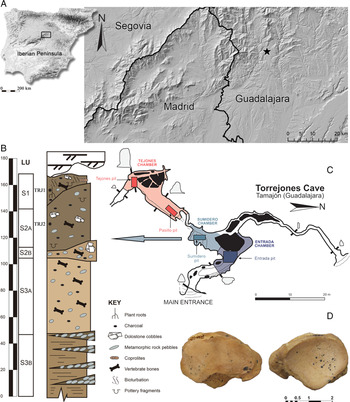
A huge effort has been made at this site to provide the most accurate chronological contextualization possible, focusing on the use of radiocarbon techniques, specifically the ultrafiltration method with the ABA pretreatment, on the fossil remains to effectively remove contaminants from the bone collagen (Bronk Ramsey et al. Reference Bronk Ramsey, Higham, Bowles and Hedges2004b; Higham et al. Reference Higham, Jacobi and Bronk Ramsey2006; Higham Reference Higham2011), with special emphasis on the most relevant taxa from the Sumidero sector. Seven samples (bones and teeth) were sent for AMS-ultrafiltration dating purposes to different labs: Oxford Radiocarbon Accelerator Unit (ORAU)-OxA in England (Brock et al. Reference Brock, Higham, Ditchfield and Bronk Ramsey2010), Beta Analytic-BETA in the United States (www.radiocarbon.com), and Curt-Engelhorn-Zentrum Archaeometrie-MAMS in Germany (Kromer et al. Reference Kromer, Lindauer, Synal and Wacker2013). However, only four of them yielded an age. Moreover, two additional elements (ursid and hyenid bones/teeth from LU-S3) were selected for possible direct dating, but they did not weigh enough to be sampled. We directly sampled several Homo and equid bones from the upper units (LU-S1 and LU-S2, Figure 1) in the Sumidero sector, which were recovered throughout the course of this current project. Furthermore, we sampled an equid tooth and the human navicular, both recovered from level LU-S3 during the excavation carried out in the 90s. Finally, a C. crocuta premolar recovered in 2017 from a surface level (level LU-T1) of the “Tejones” sector was also sampled.
A) geographic location and digital terrain model showing the position of the Cueva de los Torrejones site (source LiDAR-IGN). B) Stratigraphic column of the Sumidero Sector from Cueva de los Torrejones showing the different lithostratigraphic units (LU). The colors used in the stratigraphic column correspond to those of the Munsell® color system for wet sediment. Scale in cm. The 14C samples (TRJ-1 and TRJ-2; Table 2) that are currently being excavated are indicated in their approximate location by an asterisk (*). The samples recovered from the prior excavation are not shown due to the ambiguity of the original position. C) Topographic scheme of the site plan showing the different sectors. Modified from Arribas et al. (Reference Arribas, Garrido and García Solano2005). D) Distal (left) and proximal view (right) of the human navicular bone (T93-S3-27), modified from Pablos et al. (Reference Pablos, Sala and Arribas2018). Scale in cm.

All 14C dates presented in this paper were obtained using ultrafiltration pretreatments to reduce environmental contamination and remove short-chained proteins (see Brock et al. Reference Brock, Bronk Ramsey and Higham2007, Reference Brock, Higham, Ditchfield and Bronk Ramsey2010; Higham et al. Reference Higham, Jacobi and Bronk Ramsey2006 for details of the method of ultrafiltration pretreatment) and have been calibrated using the OxCal v.4.3 software (Bronk Ramsey Reference Bronk Ramsey2009) against the IntCal13curve (Reimer et al. Reference Reimer, Bard, Bayliss, Beck, Blackwell, Bronk Ramsey, Buck, Cheng, Edwards, Friedrich, Grootes, Guilderson, Haflidason, Hajdas, Hatté, Heaton, Hoffmann, Hogg, Hughen, Kaiser, Kromer, Manning, Niu, Reimer, Richards, Scott, Southon, Staff, Turney and van der Plicht2013). The 14C ages offered in this study are given in BP (before present), meaning years before 1950, and are calibrated (cal BP) to provide absolute calendar ages. The results of the calibration are shown as cal BP (2 σ; 95.4% probability). To verify the state of preservation of the collagen in the different bones to be dated, the C:N ratio, %C and %N values must be evaluated. The C:N ratio should be between 2.9 and 3.6 (Ambrose Reference Ambrose1990; van Klinken Reference van Klinken1999; Higham et al. Reference Higham, Douka, Wood, Bronk Ramsey, Brock, Basell, Camps, Arrizabalaga, Baena, Barroso-Ruiz, Bergman, Boitard, Boscato, Caparros, Conard, Draily, Froment, Galvan, Gambassini, Garcia-Moreno, Grimaldi, Haesaerts, Holt, Iriarte-Chiapusso, Jelinek, Jorda Pardo, Maillo-Fernandez, Marom, Maroto, Menendez, Metz, Morin, Moroni, Negrino, Panagopoulou, Peresani, Pirson, de la Rasilla, Riel-Salvatore, Ronchitelli, Santamaria, Semal, Slimak, Soler, Soler, Villaluenga, Pinhasi and Jacobi2014). Once the samples met the collagen quality criteria, they were graphitized and dated according to the methods of each lab using ultrafiltration pretreatment in each case (Bronk Ramsey et al. Reference Bronk Ramsey, Higham and Leach2004a; Bronk Ramsey Reference Bronk Ramsey2009).
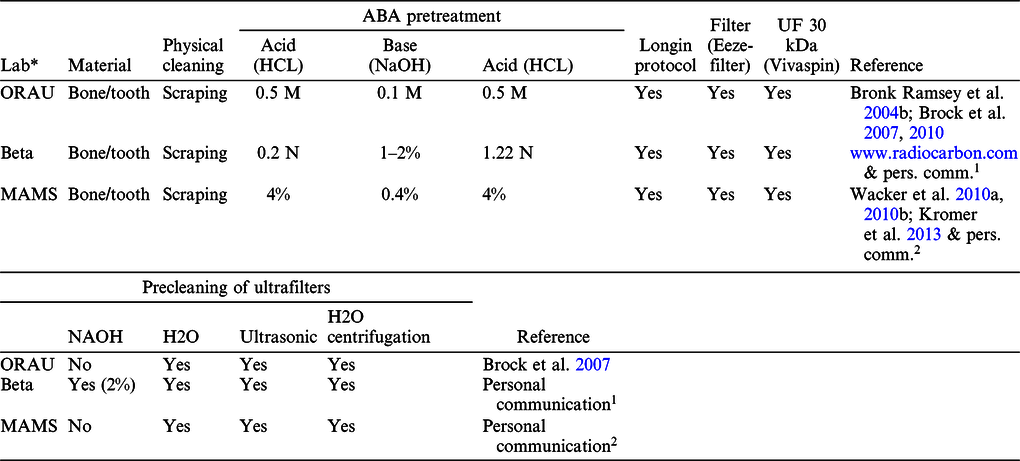
The methodology carried out by the three labs for AMS radiocarbon dating with which we deal followed the Longin protocol (Longin Reference Longin1971), modified by Brown et al. (Reference Brown, Nelson, Vogel and Southon1988). All the three labs applied the ABA (acid-base-acid) pretreatment after the scraping of the surface to eliminate soil contaminants (Table 1). The ABA method is carried out to effectively remove sedimentary and other contaminant carbonates (Bronk Ramsey et al. Reference Bronk Ramsey, Higham, Bowles and Hedges2004b; Brock et al. Reference Brock, Higham, Ditchfield and Bronk Ramsey2010). After the pretreatment, a gelatinization process according to Longing (Reference Longin1971) is done, and the obtained gelatin is filtered with Eeze-like filters to remove small (<80 μm) solid particles (Brock et al. Reference Brock, Higham, Ditchfield and Bronk Ramsey2010). The gelatin obtained in the former steps is ultrafiltered with ultrafilters Vivaspin-like of 30 KDa previous to combustion and graphitization in all of the three labs (Brock et al. Reference Brock, Higham, Ditchfield and Bronk Ramsey2010; Wacker et al. Reference Wacker, Němec and Bourquin2010a, Reference Wacker, Bonani, Friedrich, Hajdas, Kromer, Němec, Ruff, Suter, Synal and Vockenhuber2010b). In every lab, a rigorous precleaning procedure of the ultrafilters is done to effectively remove the carbon-containing humectants present in the filters prior to the ultrafiltration of the bone gelatin (Brock et al. Reference Brock, Bronk Ramsey and Higham2007). The filters are precleaned in the three labs by ultrasonicating in ultrapure water (Table 1), and then passed though fresh ultrapure water prior to use (Brock et al. Reference Brock, Higham, Ditchfield and Bronk Ramsey2010). The Beta lab furthermore applies a previous bath of NaOH to the ultrafilters.
Comparison of the ABA pretreatment and the precleaning of the filters carried out at all the three labs considered in this study.

1 Personal communication, Chris Patrick (Vice President of Laboratory Operations-Beta).
2 Personal communication, Ronny Friedrich (Laborleiter-Curt-Engelhorn-Zentrum Archäometrie gGmbH-MAMS).
* Beta = Beta analytic Inc. ORAU = Oxford Radiocarbon Accelerator Unit. MAMS = Curt-Engelhorn-Centre for Archaeometry. UF = Ultrafiltration.
RESULTS
In order to provide an accurate framework for determining the chronology of the Cueva de los Torrejones human fossil, a revised stratigraphy has been performed on the archaeological pit where it was recovered. In the Sumidero sector, all the profiles exposed in the test pit during the excavations in the 90s were studied. Three main levels have been defined, which coincide with the previously proposed description (Arribas et al. Reference Arribas, Díez, Jordá, Balbín, Valiente and Musat1995, Reference Arribas, Díez Fernández-Lomana and Jordá Pardo1997, Reference Arribas, Garrido and García Solano2005); they have been subdivided, however, into additional sub-units (Figure 1).
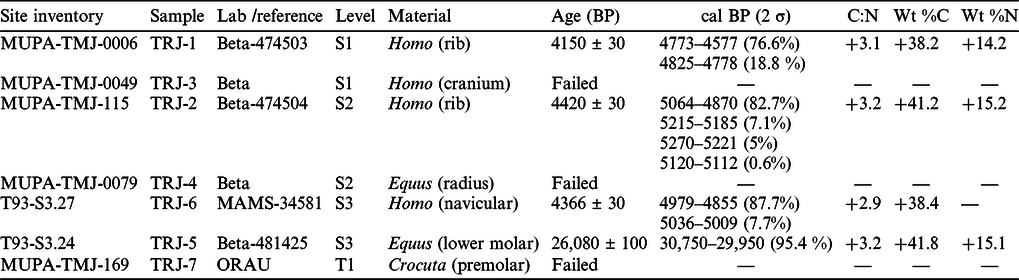
14C dates for the different lithostratigraphic units from the Sumidero sector are presented in Table 2. Two dates on human remains from around 4500–5300 cal BP confirm Chalcolithic ages for the uppermost levels (LU-S1 and LU-S2). It was not possible to date two of the samples (one from each of these levels), as not enough collagen was recovered. These dates are compatible with the lithic industry, the micromammal association, and the presence of pottery in these two upper levels.
AMS radiocarbon dates using ultrafiltration pretreatment from different sectors and levels from Cueva de los Torrejones.*

* All ages are calibrated with the OxCal v4.3 software (Bronk Ramsey Reference Bronk Ramsey2009) against the IntCal13 curve providing a probability range of 95.4% (Reimer et al. Reference Reimer, Bard, Bayliss, Beck, Blackwell, Bronk Ramsey, Buck, Cheng, Edwards, Friedrich, Grootes, Guilderson, Haflidason, Hajdas, Hatté, Heaton, Hoffmann, Hogg, Hughen, Kaiser, Kromer, Manning, Niu, Reimer, Richards, Scott, Southon, Staff, Turney and van der Plicht2013). For the samples, we included the isotopic values and C:N ratios. Beta = Beta analytic Inc. ORAU = Oxford Radiocarbon Accelerator Unit. MAMS = Curt-Engelhorn-Centre for Archaeometry. BP = before present (years before 1950). cal BP = calibrated years before present (all probability ranges are expressed at 95.4%: 2 σ).
One Pleistocene date of 30,750–29,950 cal BP was obtained for an equid lower molar found in level LU-S3 (Beta-481425). However, the human navicular recovered from the LU-S3 provided a Holocene age of 4855–5036 cal BP (MAMS-34581, mass of extracted collagen on the raw bone mass (%Coll) = 6.3 referred to the >30 kDa fraction). A hyenid premolar recovered from surface LU-T1 was sampled to be dated and did not provide positive results because not enough collagen was preserved.
CONCLUDING DISCUSSION
The unexpectedly recent chronology of the navicular T93-S3-27 implies that there is no evidence of human fossils from the Upper Paleolithic in the Cueva de los Torrejones. Rather, this human bone is coetaneous with the human remains recovered from the overlying levels (LU-S1 and LU-S2). However, the direct dating of one horse fossil remain from the same unit (found together with the navicular bone) provided an age of ca. 30,000 cal BP, thus confirming the Pleistocene chronology for the LU-S3.
This chronological inconsistency suggests a mixture of different units, perhaps due to bioturbation processes as was previously observed, or due to inclusions of the LU-S2 in the LU-S3 as described in previous studies (Arribas et al. Reference Arribas, Díez, Jordá, Balbín, Valiente and Musat1995, Reference Arribas, Garrido and García Solano2005). In any case, direct dating of the human bone indicates an obvious mixture of chronologies. The causes of this mixture will be investigated in future studies through geological, taphonomic, biostratigraphical, and micromorphological analyses.
Holocene human remains in Late Pleistocene contexts are not rare in the karstic environments from the European archaeological record (Conard et al. Reference Conard, Grootes and Smith2004; Gómez-Olivencia Reference Gómez-Olivencia, Rios-Garaizar, Garate Maidagan and Gómez-Olivencia2013; Sala et al. Reference Sala, Algaba, Gómez-Olivencia, Pablos, Bonmatí, Rodríguez, García and Arsuaga2013 among others). The closest known case is found in the Cueva de la Zarzamora site in Segovia (Spain), where remains of Chalcolithic individuals have been found incorporated into a hyena den deposit corresponding to the Marine Isotopic Stage (MIS) 3 (Sala et al. Reference Sala, Arsuaga, Laplana, Zapata, Gil García, García, Aranburu and Algaba2011, Reference Sala, Algaba, Gómez-Olivencia, Pablos, Bonmatí, Rodríguez, García and Arsuaga2013). As a cautionary note, the human remains belonging to H. sapiens apparently recovered from Paleolithic cave contexts, which were subsequently used as sepulcher during recent Prehistory (Neolithic/ Chalcolithic/ Bronze), must be studied from a Paleoanthropological point of view and/or directly dated.
As a final remark, evidence of occupation of inland Iberia during the Middle-Upper Paleolithic period is increasingly growing in the areas surrounding the Cueva de los Torrejones (Alcaraz-Castaño et al. Reference Alcaraz-Castaño, Alcolea González, Balbín, García Valero, Yravedra and Baena2013, Reference Alcaraz-Castaño, López-Recio, Tapias, Cuartero, Baena, Ruiz-Zapata, Morín, Pérez-González and Santonja2017b, Reference Alcaraz-Castaño, Alcolea-González, Pablos and Sala2019a, Reference Alcaraz-Castaño, Alcolea-González, Balbín-Behrman, Kehl and Weniger2019b; Alcolea González et al. Reference Alcolea González, de Balbín, García Valero, Cruz Naimi, De Balbín, Valiente and Mussat1995, Reference Alcolea González, Balbín, García and Jiménez1997; Sala et al. Reference Sala, Pablos, Gómez-Olivencia, Sanz, Villalba, Pantoja-Pérez, Laplana, Arsuaga and Algaba2020) and, therefore, it is necessary to continue working in the region to expand upon the information currently available.
ACKNOWLEDGMENTS
This work could not have been carried out without the collaboration of C. Posth and J. Krause, who contributed with the direct dating of the navicular T93-S3-27. We are deeply grateful to the Tamajón-Torrejones research and excavation team. We really would like to acknowledge the Instituto Geológico y Minero de España (IGME) and its personnel, especially S. Menéndez, for allowing access to the fossils under their care. The effort put forth and work carried out by the excavation team during the 1993–1995 seasons in the Cueva de los Torrejones is very much appreciated. We are grateful for the constructive and fruitful discussion provided by M. Alcaraz-Castaño. Especial thanks to Chris Patrick (Beta) and Ronny Friedrich (MAMS) for methodological information provided. Logistic and administrative support from the Ayuntamiento de Tamajón is deeply appreciated.
Part of this research was funded by the Spanish projects of the “Ministerio de Ciencia e Innovación (MCI)” PGC2018-093925-B-C33 and PGC2018-093925-B-C31 (MCI/AEI/FEDER, UE) and “Junta de Comunidades de Castilla la Mancha” (SBPLY/17/180801/000103, SBPLY/18/180801/000034 and SBPLY/19/180801/000015). N-S was supported by a Juan de la Cierva Incorporación postdoctoral contract (IJCI-2017-32804). Lauren Ames kindly reviewed a previous English version of the manuscript.
Finally, we appreciate the helpful comments and suggestions provided by Associate Editor Christine Hatté and two anonymous reviewers, which significantly improved the article.