

Can aspects of large-scale cultural transformation be observed by tracing relatively subtle changes in day-to-day lifeway patterns of indigenous people? In particular, is it possible to assess effects of the pre-Hispanic-to-colonial transition in Mesoamerica in terms of dietary patterns within the native communities? These are questions rightfully addressed by zooarchaeological analysis and interpretation. Along with other archaeological materials, faunal remains can be interpreted to support models of human behavior that go beyond ethnohistorical reconstructions (Alexander and Kepecs Reference Alexander, Kepecs, Kepecs and Alexander2005:9; Charlton et al. Reference Charlton, Fournier, Charlton, Majewski and Gaimster2009:410). Focused faunal studies can develop a meaningful glimpse into the direct impact of colonization of native populations.
The diverse ways in which European colonization impacted native populations of Latin America and the Mesoamerican landscape have been extensively explored since the early colonization (Sahagún Reference Sahagún and Cline1989 [1585]), through the early twentieth century (Prescott Reference Prescott1936), and to the present (Alexander and Kepecs Reference Alexander, Kepecs, Kepecs and Alexander2005; Azúa Reference Azúa1992, Reference Azúa and Brumfiel2005; Beekman Reference Beekman2010; Evans Reference Evans2008; Melville Reference Melville1994; Weigand Reference Weigand, Evans and Webster2001), but there has been little detailed attention to changes in dietary patterns during the transition to colonial rule. Most pre-Hispanic-to-colonial studies, as extensively catalogued by Beekman (Reference Beekman2010), deal with large-scale cultural modifications in regional political, economic, religious, artistic, and societal aspects of the native communities and with geological and ecological changes resulting from the cultural changes. Only rarely is the impact of colonization on the everyday life of common populations explored in detail.
Archeological study in west-central Mexico traditionally focuses on political or ethnographic sequences, dramatic shaft tombs, conical stepped pyramids, mortuary remains, ceramic typologies, large-scale ecological changes, and mineral resources. Fauna is generally mentioned in the context of religious iconography or mortuary offerings (Guzmán and Polaco Reference Guzmán and Polaco2003, Reference Guzmán and Polaco2005; Pollard and Cahue Reference Pollard and Cahue1999). For example, Gennis' (Reference Gennis1999) finely detailed overview of the prehistory and history of the Etzatlan Basin mentions ceremonial, but not dietary, use of the native deer (Odocoileus virginianus) even though this animal was an important faunal resource throughout prehistory. Other faunal data are lacking in that volume.
Although some shell middens and coastal marshes (marismas) or estuaries of west Mexico have been described in some detail (Mountjoy and Claassen Reference Mountjoy, Claassen, Dillon and Boxt2005; Scott Reference Scott and Bell1974; Shenkel Reference Shenkel and Bell1974; Voorhies et al. Reference Voorhies, Kennett, Jones and Wake2002, Voorhies et al. Reference Voorhies, Gusick, Kennett and Wake2008; Wing Reference Wing1968, Reference Wing1969), and dogs associated with coastal burials are mentioned (Cumbaa Reference Cumbaa and Scott1973; Gill Reference Gill and Bell1974: Wing Reference Wing1968), only a few (fairly outdated) reports from interior western Mexico include faunal dietary data, and much of these data are perfunctory (Meighan Reference Meighan1961; Seibert Reference Seibert and Meighan1972; Susia Reference Susia1961). Likewise, there have been no attempts to trace trends or changes in subsistence activities over the long term with specific reference to the colonial transition. There are, nevertheless, some examples of focused zooarchaeological research dealing with communal lifeways and subsistence (Álvarez and Ocaña Reference Álvarez and Ocaña1999; Azúa Reference Azúa and Brumfiel2005; Corona-M Reference Corona-M2008; Corona-M and Arroyo-Cabrales Reference Corona-M and Arroyo-Cabrales2007; Deagan Reference Deagan2004; Reitz and Cumbaa Reference Reitz, Cumbaa and Deagan1983; Sanders et al. Reference Sanders, Parsons and Santley1979; Wing and Steadman Reference Wing, Steadman, Andrews and Andrews1980).
Because it is necessary in archaeologically based anthropological research to explore the dietary use of faunal resources in depth, here I report the dietary yield of archaeofaunal remains collected from four sites in the environs of Etzatlan, an important regional center of west Mexico. I focus on the likely changes in the dietary patterns there at the onset of, and subsequent to, Spanish colonization. Faunal materials were also used for nondietary purposes (for example, the manufacture of tools, decorations, or other artifacts), but the present research addresses only dietary use of animals. I first summarize the Etzatlan archaeological region and its research history. I then describe the excavations that produced this archaeofaunal collection, the statistically derived chronology of the sites, the recovered faunal materials, and my analytical techniques. After presenting the results of this analysis I conclude by describing the relationship of the observed patterns of faunal resource usage to the significant cultural changes imposed by the transition from a pre-Hispanic to a colonial lifeway.
THE ETZATLAN BASIN
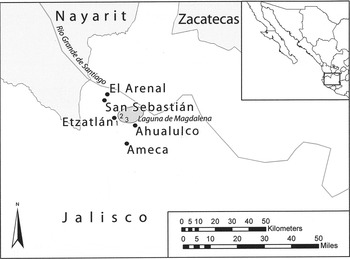
The Etzatlan archeological region occupies the westernmost lake basin of the Mesa Central or altiplano of Jalisco, Mexico (Figure 1), centered in the Teuchitlan tradition core described by Weigand (Reference Weigand, Foster and Gorenstein2000:44–45; Reference Weigand, Evans and Webster2001:249). It is located at an elevation of about 1,400 m (4,593 feet) and is about 80 km (50 miles) west of Guadalajara. Jalisco has approximately 235 km (146 miles) of coastline. Although the Etzatlan basin is about 100 km (62 miles) inland, there is some evidence of use of coastal resources (Pollard Reference Pollard1997:368).
Diagram of the Jalisco area around the Etzatlan archaeological region. Black dots are modern communities. Position and size of the lake are estimated. 1 = Anona, 2 and 3 = island sites Santiaguito and Las Cuevas; location of Tiana is unknown. Map by B. Codding. Used with permission from Culture & Agriculture.

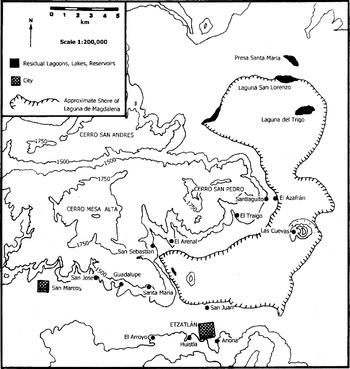
During the Postclassic period and at the time of Spanish entrada into the Etzatlan area, numerous native communities were located around the margins of an expansive lake (Laguna de Magdalena) and on islands within the lake (Figure 2). Laguna de Magdalena was one of many volcanic endorheic freshwater sources in central Mexico; that is, it was a closed drainage basin with no direct outflow, losing water only by evaporation and seepage. The lake has been pictured as extending from the community of Etzatlan on the south to El Arenal on the north (Bell Reference Bell1974; Nicholson and Meighan Reference Nicholson, Meighan and Bell1974:Plate 1). In 1892 the lake was about 32 km (20 miles) long and several miles wide (Goldman Reference Goldman1951) and supported a local commercial fishery. The lake was drained in the early twentieth century (Weigand Reference Weigand, Foster and Weigand1985), but residual stands of water or possibly reservoirs in the basins of this area continue to provide habitat for some fish (Domínguez-Domínguez et al. Reference Domínguez-Domínguez, Boto, Alda, de León and Doadrio2007; Smith and Miller Reference Smith and Miller1980), and aquatic birds (Williams Reference Williams1982).
Enlarged view of the Etzatlan archaeological region showing former lake basin as estimated from archaeological survey by Long and Glassow (adapted by author from hand-annotated topographical map [number unknown] accompanying field notes).

Early Spanish reports note that Etzatlan had an able-bodied adult male population of about 600 (Nance et al. Reference Nance, de Leeuw, Weigand, Prado and Verity2008). Weigand (Reference Weigand, Evans and Webster2001), however, estimates that Etzatlan had a population of possibly several thousand individuals occupying roughly 600 ha (1,483 acres). Weigand (Reference Weigand, Evans and Webster2001) terms Etzatlan a small “state” strong enough to resist Tarascan conquest for nearly half a century prior to the entrada. Large quantities of obsidian were available to occupants of this area, particularly from nearby volcanos in the Sierra de la Venta near Magdalena. Corn, beans, and cotton were cultivated in the region, and processing and transport of salt and minerals were major industries.
Etzatlan has had various other names (for example, Icatlan, Yzatlan, or Izatlan), and the political and economic importance of this area was recognized early on by the Spanish who encouraged exploitation of native resources. A major complex of colonial buildings and fortifications, including a monumental ceremonial and administrative center (Templo/Convento de la Concepción), was constructed. A recent reconstruction of this edifice still graces the modern city of Etzatlan.
PREVIOUS ARCHAEOLOGY AT ETZATLAN
In general, western Mexico has received less attention than areas with monumental remains of epic civilizations (Beekman Reference Beekman2010:41; Heredia Espinoza Reference Heredia Espinoza2008:1; Nance et al. Reference Nance, de Leeuw, Weigand, Prado and Verity2008:1). Nevertheless, the Etzatlan Basin has a lengthy, if sporadic, history of archaeological exploration and study (Bell Reference Bell1974; Foster and Weigand Reference Foster and Weigand1985; Gennis Reference Gennis1999; Glassow Reference Glassow1967; Kelly Reference Kelly1945; Long Reference Long1966; Long and Taylor Reference Long and Taylor1966; Nicholson Reference Nicholson1962; Weigand Reference Weigand and Bell1974). This research focused either on reconstructing culture history or recording and systematizing the traditional archaeological treasures of pre-Hispanic cultures—elaborately decorated ceramics and figurines, habitational or monumental structures, and elaborate tombs and their contents.
An extensive exploration of sites around Laguna Magdalena took place in 1963 when Stanley Long of the University of California at Los Angeles (UCLA), assisted by Michael Glassow, located and explored dozens of residential communities and mortuary sites (shaft tombs) under the auspices of the Institute of Andean Research “Project A” led by Clement Meighan and H.B. Nicholson of UCLA. Among these sites were the communities of Tiana, Anona, and Santiaguito situated south of Lake Magdalena and Las Cuevas on an island in the lake (Figure 2). These sites, which yielded the content of the present study, were deemed to be residential along with associated crop fields and pastures. The sites were uniformly excavated in randomly spaced 1.5 × 1.5 m units extracted in artificial 20 cm levels without reference to apparent natural or cultural depositional changes, although features were treated as unique depositions. Each level of each unit was considered a separate unit of analysis with an excavated volume of .45 m3. It should be kept in mind, however, that 20 cm levels are wide enough that subtle distinctions between sequential depositions and cultural content may be blurred.
Along with the vast collection of ceramics, Long and Glassow recovered a substantial archaeofaunal collection representing use of animal resources by site occupants. Unfortunately, these materials were trowel-collected rather than screened (Michael Glassow, personal communication 2007; and as recorded in field records), and the completeness of the faunal collection cannot be verified. This recovery technique is “not so unusual in field practice in Mexico” (Helen Pollard, personal communication 2010). However, remains of small taxa (for example, frogs) were collected as consistently as larger taxa, so trowel collection may have been fairly meticulous.
Other recovered cultural items included chipped and ground stone artifacts, fragments of historic glass and historic metal objects (copper awls or needles, nails, etc.), and spindle whorls. Long (Reference Long1966) completed a description of mortuary artifacts as his dissertation, but because of his untimely death, broader aspects of the site were neither studied nor documented. Glassow (Reference Glassow1967) described pottery from the nearby community of Huistla. All materials, including bone collected from the Etzatlan project, were curated at UCLA but remained unstudied until the present. This study advances the investigation of the Etzatlan archaeological region by analysis and interpretation of the Etzatlan archaeofaunal materials in the context of both pre-Hispanic and colonial occupations.
THE ETZATLAN FAUNAL COLLECTION
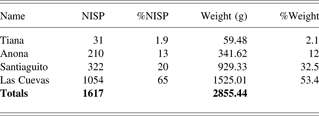
Tiana, Anona, Santiaguito, and Las Cuevas yielded a total of 1,617 vertebrate specimens with a total weight of 2,855.44 g. These are listed in Table 1 in which specimens are quantified by Number of Identified Specimens (NISP), a nonanalytical sum of specimens (whether identified or not identified), and weight. This table includes small quantities of specimens from nonstratigraphic proveniences such as burials or unit extensions. In the analysis portions of this report, however, specimens associated with burials are excluded along with specimens from unmeasured unit extensions or features that interrupted or interfered with the 20 cm limits of each stratigraphic provenience.
Faunal remains recovered from four Etzatlan sites
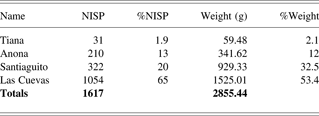
Since the Las Cuevas collection constitutes 65% of the data for this study, it provides the most detailed image of dietary use of faunal resources. The other three sites provide supporting information. This report documents the identification and stratigraphic patterns of the Etzatlan archaeofaunal collection and provides insight into dietary practices and changes thereto in both the pre-Hispanic and colonial occupations.
METHODS
All recovered faunal specimens were quantified and identified to the most detailed taxonomic level possible by direct comparison with curated comparatives from the Los Angeles County Museum of Natural History and the Zooarchaeology Laboratory of the Cotsen Institute of Archaeology at UCLA. Archaeological specimens were identified to species and/or genus when possible or by broader taxonomic category (family, class, order) when more precise identification was not possible. Each specimen was cataloged by site, unit, level, taxon, element, part of element, anatomical side, age, weight, and condition (burned, cut, gnawed, worked) to the greatest extent possible. Overall, 675 specimens (42% of the collection) were identified to species, genus, or family level. Another 931 specimens were identified to order or class, and 11 specimens were not identifiable except as vertebrata. For the purpose of analysis, the faunal remains from the Etzatlan sites are easily grouped into several major categories. These categories are (1) large mammals (for example, artiodactyls or bovids), (2) medium mammals (primarily canids), (3) small mammals (mainly leporidae or opossums), (4) birds, and (5) reptiles/amphibians (turtles and frogs/toads).
It is important to recognize, however, that simple counts or even proportional representations of even large samples of archaeological specimens do not necessarily impart the most meaningful image of dietary practices. Different animals yield disproportionate quantities of edible flesh on the basis of total body mass. Large animals producing greater quantities of flesh are generally assumed to be preferred over smaller animals (Bayham Reference Bayham1979, Reference Bayham1982; Broughton Reference Broughton1994, Reference Broughton1999; Emery Reference Emery2008; Jochim Reference Jochim1998; Ugan Reference Ugan2005). Thus, it is necessary to determine the quantity of dietary flesh actually represented by the archaeological remains rather than simple frequencies. In this research, scientifically supportable estimates of meat yield of each faunal resource are derived by an allometric method.
Allometry is a regressional nonlinear relationship drawn between body mass and weight of archaeological bone. The resulting estimate of flesh yield is termed “sample biomass.” Specifically, the allometric method for calculating sample biomass is presented by Reitz and Wing (Reference Reitz and Wing2008:236, Method 3). In this method, the weight in grams of the actual archaeological specimens in each taxon or category of taxa is converted to kilograms of flesh directly associated with those specimens. Constants for a wide range of vertebrates are presented by Reitz and Wing (Reference Reitz and Wing2008:68) who consider this technique to be one of the most accurate methods of estimating dietary meat yield. Since no constants are available for the frogs and toads in this study, an averaged reptile/amphibian constant is devised. In the final step of this estimation process, a meat weight percentage of total body weight is applied for each class of vertebrate. Meat weight for most mammals and birds is calculated at 70% of total body weight and 50% for artiodactyls and leporidae (White Reference White1953).
Two additional analytical techniques are used to further define dietary patterning at the Etzatlan sites. The first is the abundance index (AI): a ratio of one taxon or category of taxa to another taxon or category of taxa (Broughton Reference Broughton1994, Reference Broughton1999). This takes the form ΣtaxonXi/(ΣtaxonXi + ΣtaxonYi) and is used in the present research to develop patterns of relative use of preferred (i.e., large) taxa (taxon “X”) versus less-preferred (i.e., smaller) taxa (i.e., taxon Y) throughout occupational phases at sites with both pre-Hispanic and colonial components. As noted above, preference for large size is found by Bayham (Reference Bayham1979, Reference Bayham1982), Broughton (Reference Broughton1994, Reference Broughton1999), Broughton et al. (Reference Broughton, Cannon, Bayham and Byers2011), Emery (Reference Emery2008), Jochim (Reference Jochim1998), and Ugan (Reference Ugan2005) in both hunter-gatherer societies as well as in highly developed polities such as the classic Maya.
Secondly, Margalef's (Reference Margalef and Hall1957) Diversity Index (Da) is used to explore dietary breadth over time at the two sites with both pre-Hispanic and colonial occupations by relating the number of taxa and the number of individuals of each taxa. In this index Da = (S-1)/log to base e N where S is the number of species and N is the number of individuals. The higher the index, the greater the diversity of species.
CHRONOLOGICAL CONTEXT FOR ETZATLAN
Unfortunately there is little chronological structure for the Etzatlan sites, and difficulties in establishing chronological structure for west Mexican sites have been recognized for decades (Helen Pollard, personal communication 2010; see also Nance et al. Reference Nance, de Leeuw, Weigand, Prado and Verity2008; Taylor Reference Taylor1970). Long (Reference Long1966) reported obsidian hydration rim widths ranging between 1.8 and 3.2 microns for the upper levels of Las Cuevas and from 5.4 to 5.5 microns for the lower levels, with consistent widening of rim widths toward the lower levels, suggesting undisturbed deposition. Four radiocarbon dates ranging between 320 b.c. and a.d. 370 were also obtained from mortuary-related bone and Pacific and Caribbean shell (Long Reference Long1966). Weigand (Reference Weigand, Foster and Gorenstein2000:46) has defined the Etzatlan phase of the Teuchitlan tradition as Late Postclassic to a.d. 1520 (Spanish contact). He has also obtained several additional radiocarbon dates from the Etzatlan area, but these are not yet published (Roger Nance, personal communication 2008).
To provide additional ethnographic and chronological structure for the Etzatlan sites using an entirely different dataset and analytical technique, an ongoing correspondence analysis (CA) by a team of UCLA researchers has aligned the ceramics recovered by Long and Glassow into a sequence of pre-Hispanic and colonial pottery types along an undated statistically derived axis or “timeline” (Nance et al. Reference Nance, de Leeuw, Weigand, Prado and Verity2008). On this timeline, a specific CA value (.4593) represents the point at which colonial ceramics (i.e., Majolica glazed pottery) indicative of Hispanic occupation are found. Data presented here explore the relationship of this significant change in culture due to colonial influences and subsistence patterns.
It must be noted, however, that the correspondence analysis does not account for the entire faunal collection. CA values were established only for those proveniences (units/levels) with a specified minimum number of potsherds of sufficient quality to establish their typology. Faunal specimens from units/levels without assigned CA values are excluded from the occupational timeline. Thus, the faunal sample related to the correspondence analysis and reported herein comprises 74% of the total collection. In addition, more pre-Hispanic (38) than colonial (18) units/levels were used to establish the CA timeline. These conditions clearly introduce uncertainty into the faunal patterning. Yet the timeline suffices to coarsely bracket any changes in dietary patterns between the pre-Hispanic and colonial faunal depositions at Anona and Las Cuevas where ceramic evidence of both occupations was found.
RESULTS
Some general comments on the sites and the condition of the faunal collection are necessary as context for results of this analysis. First, the Etzatlan faunal specimens are well preserved, with little deterioration. Except for simple cleaning with water, the archaeologically recovered bones were not treated in any manner. Although Long (Reference Long1966) reported manganese oxide deposits on some artifacts and bone, this appeared to be minimal and did not interfere with identification of the specimens.
Second, there is some concern that depositional stratigraphy of the Etzatlan sites may have been disturbed. Since the excavations took place in village settings, various types of land use, especially cultivation, may have affected distribution and recovery of cultural remains (Lyman and O'Brien Reference Lyman and O'Brien1987). Stratigraphic patterning of the Etzatlan faunal remains as reported herein gives some insight into this possibility.
Finally, the overall completeness of the Etzatlan faunal collection may be problematic. Decades of storage, repackaging, and transfer could have affected the completeness of the collection. With these considerations in mind, the results of this analysis follow.
The Tiana Excavations and Archaeofauna
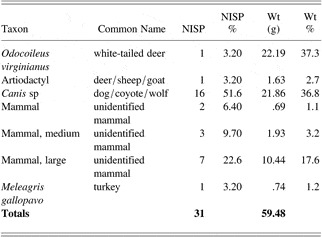
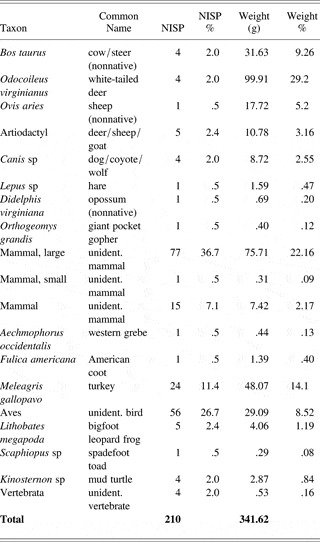
The exact location of Tiana is not recorded in ethnographic documents or the archaeological field records. It may have been located in what today is a neighborhood within the city of Etzatlan (Christopher Beekman, personal communication 2010). Although four units were excavated at Tiana and 82 faunal specimens are noted on the field catalog, only 31 fragments from a single .45 m3 unit of analysis remained in the curated collection. Thus, this small collection can be described, but further analysis is not possible. This faunal collection consisted almost entirely of large- and medium-size mammals (Table 2). Both the unidentified artiodactyl and unidentified large mammal bones are consistent with deer, and together with identified deer remains constitute 29% of the collection. Identified canid and unidentified medium-size mammal specimens together account for 61% of the collection. The single bird (Meleagris gallopavo, turkey) element accounts for 3.2% of the collection. The unidentified medium-size mammal is likely to be Canis sp (dog/coyote/wolf). Of the Canis genus, domestic dog is the most likely. It would be equally valid to consider the Canis sp NISP as 5 because 12 of the fragments were from a shattered cranium. If it had been possible to rejoin these specimens into a single specimen, the total NISP would have been 20 and the proportion of medium-size mammal would have been reduced to 25%. However, the fragments did not fit together.
Summary of Tiana faunal remains

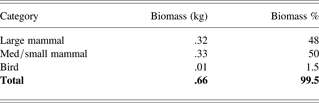
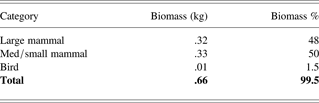
With the exception of the canid cranium, all other identified mammal specimens were partial limb elements. Nine specimens were burned; none had evidence of butchery or rodent/carnivore gnawing. Table 3 presents the allometrically estimated sample biomass of this archaeofauna. The small size and undefined chronology of this collection prohibits detailed interpretation. Since there was no evidence for pre-Hispanic-to-colonial transition at this site, no AI or Da analyses are appropriate. On the other hand, several units/levels from this site yielded sufficient ceramic material for inclusion in the ceramic correspondence analysis. The CA value (−1.4721) for the single unit/level that produced faunal remains is one of the earliest pre-Hispanic values for the four sites.
Sample biomass of Tiana faunal remains
The Anona Excavations and Archaeofauna
Anona was located on what is now the southeastern border of modern Etzatlan. Twelve units were excavated there with a total volume of approximately 22.5 m3. This volume is not precise since level depths were not recorded in one unit. Five units yielded faunal materials. Of the faunal remains, 75% were recovered from one unit, so patterning at this site strongly reflects the content of that unit. Although this site produced more faunal remains than did Tiana, the dietary range at Anona is equally narrow, consisting primarily of large mammal (nearly all of which compares favorably with deer) and turkeys (Table 4). Canids, a variety of medium-size birds (most of which were waterfowl), and reptiles/amphibians (turtle and frog/toad) played minor roles in the diet. The turtle, frog, and toad remains are evidence of exploitation of the nearby aquatic resource area (see Porcasi Reference Porcasi2010). One specimen in this collection was burned; none were cut or gnawed.
Summary of Anona faunal remains

This collection includes small quantities of three nonnative species. Four juvenile Bos taurus (cow/steer) carpals, eroded by cooking, were found in a single provenience at a depth of 60–80 cm. This may indicate deliberate burial of dietary refuse, or that this level might be mixed and possibly should be excluded from the analysis. It might also indicate that the CA timeline is faulty. On the other hand, one Ovis aries (sheep) specimen and one Didelphis virginiana (opossum) specimen were recovered in a single provenience at a depth of 20–40 cm, which is consistent with colonial occupation and supporting the timeline. The cow/steer and sheep were introduced by European settlers. There were no cow/steer remains from major flesh-producing anatomical elements, suggesting that only inferior portions might have been available to the native population. Sheep are represented by single radius and humerus elements, although numerous “artiodactyl” elements might include additional sheep. The opossum naturally migrated into western North America in the early twentieth century (Jameson and Peeters Reference Jameson and Peeters1988). Since this animal frequently uses burrows, it may represent natural intrusion into site stratigraphy rather than cultural deposition. Other stratigraphic data presented herein, however, argue that there was minimal depositional disturbance.
When the Anona faunal data from all units are arranged by stratigraphic level, a noteworthy pattern is found (Table 5). First of all, in the deepest (earliest) levels (between 120 and 80 cm), bird bone predominates. Enigmatically, there is a total lack of bird bone in the uppermost levels. Secondly, considerable large mammal bone (52 specimens) is found in the middle level of this site (60–80 cm). This, too, declines over time. These sharp demarcations suggest that: (1) there was observable dietary change, possibly due to occupational transition, and (2) site stratigraphy was not seriously compromised because any substantial disturbance would have produced a more homogenized pattern. This depth (60–80 cm) is also the point at which remains of several nonnative (introduced) species were encountered, contributing to the sizeable content of large mammal bone. Of the 85 large mammal specimens recovered at this site, only nine are identified to species level, and five of these are introduced taxa (cow and sheep).
Anona faunal remains by stratigraphic level

The uppermost (most recent) levels at this site (40–00 cm) contain a concentration of large mammal specimens and little else, possibly indicating that the upper levels were not as thoroughly scrutinized as the lower levels. The substantial quantity of large mammal specimens recovered from the level representing the middle occupational span (60–80 cm) theoretically indicates increased use of highly ranked taxa and greater dietary optimization (Broughton Reference Broughton1994, Reference Broughton1999; Smith Reference Smith1991; Stephens and Krebs Reference Stephens and Krebs1986).
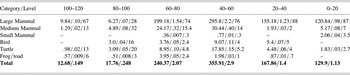
Table 6 presents the allometrically derived sample biomass and proportion of total biomass at each level for the Anona archaeofauna. There is a substantial peak in biomass at the 60–80 cm level (1.35 kg), based for the most part on large mammal specimens (79% of total specimen weight at that level). This is followed by a marked decline in total biomass (.2 kg) in the uppermost level even though large mammal accounted for 99% of the total specimen weight at that level. As noted above, however, the surface level collection may not be comprehensive.
Anona allometrically-estimated biomass (Shown as specimen weight (g)/estimated biomass (kg)/% total biomass. Large mammal is assumed to be deer.)

The Santiaguito Excavations and Archaeofauna
Santiaguito was located on the western edge of Lake Magdalena at the foot of Cerro San Pedro. Twenty units with a total volume of 46.8 m3 were excavated there. Considering the size of this excavation, faunal remains were relatively sparse (Table 7). All proveniences yielding faunal remains had pre-Hispanic CA values, even though other proveniences produced ceramics and Colonial-period CA values (Nance et al. Reference Nance, de Leeuw, Weigand, Prado and Verity2008). However, two specimens of nonnative taxa were recovered from the pre-Hispanic proveniences, suggesting some, albeit limited, stratigraphic disturbance. Eleven other nonnative specimens were recovered from proveniences without CA values, so their temporal context cannot be established.
Summary of Santiaguito faunal remains

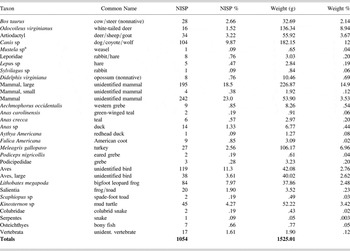
Large mammals, most of which were identifiable as deer, dominate this collection (58.7%). Medium-sized mammals (14.2%) and reptiles/amphibians (13.6%) are important components of the diet while small mammals and birds are lesser constituents. A total of 66 specimens were burned (31% of the collection) and two specimens had butchery marks.
Regardless of the limited time frame for faunal specimens noted above, some patterning of faunal resources is found (Table 8). A substantial increase in use of faunal resources begins at the 60–80 cm level, possibly pointing to a transition from pre-Hispanic to colonial occupation, although the CA timeline does not indicate a cultural (i.e., ceramic) change at this site. This increase, however, is consistent with the pattern of change at Anona and suggests contemporaneity of occupations throughout the area. At Santiaguito, however, this increase peaks at the 40–60 cm level. It is noteworthy that subsequent to this peak the use of faunal resources, especially large mammals, declines. Again, this mirrors the Anona pattern, and as at Anona, the distinctness of this pattern suggests that stratigraphy at Santiaguito was fairly intact. As at Anona, there are few bird remains in the uppermost levels.
Santiaguito faunal remains by stratigraphic level

Table 9 presents the allometrically estimated biomass of the Santiaguito archaeofauna for each level. As with the NISPs shown in Table 8, there is a corresponding rise in biomass during the middle occupation at this site (between 80 and 40 cm). This diminishes above 40 cm. There is no evidence for pre-Hispanic-to-colonial transition at this site, so no AI or Da analyses are appropriate.
Santiaguito allometrically-estimated biomass (Shown as specimen weight (g)/estimated biomass (kg)/% total biomass. Large mammal is assumed to be deer.)

The Las Cuevas Excavations and Archaeofauna
Las Cuevas was located on what had been an island in the lake. In his unpublished field records as transcribed at the Fowler Museum Archives of Archaeology at UCLA, Long notes only that this island was irregularly shaped and has “exclusively pyroclastic, volcanic outcrops, including basalt (fine-grained and vesicular) as well as probable rhyolites. Obsidian was omnipresent.”
Sixteen units with a total volume of 45.45 m3 were excavated there. In addition, two burials and some features were excavated at this site. These burials were not in shaft tombs but appeared to be informal interments (Michael Glassow, personal communication 2009). Although excavators originally thought this might have been a “temple” site, this notion was abandoned when observed mounds were found to be natural structures with protruding bedrock. Instead, they excavated a flat promontory extending toward the former lake bottom. The ruins of an adobe building were found on this landform.
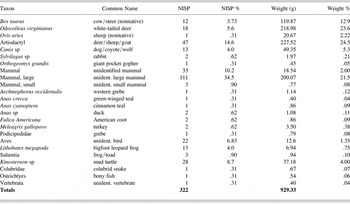
Fourteen units produced faunal remains (Table 10). Twenty-seven specimens were burned (2.6% of the total collection); eight specimens had cut marks, and three had evidence of rodent or carnivore gnawing. As noted earlier, because Las Cuevas produced the most substantial faunal collection, it presents the most detailed dietary image of the four sites. Although Las Cuevas is generally consistent with the other sites, when the Las Cuevas fauna are arrayed by stratigraphic level (Table 11), maximum quantities of all categories of taxa are found at and above the 40–60 cm level. This shallower accumulation suggests somewhat greater use of faunal remains during more recent times than at Anona or Santiaguito where maximum remains are found at deeper levels. However, uniform deposition rates and site formation processes at the several sites cannot be assumed. Thus, the chronological relationship of the Las Cuevas stratigraphy with the other sites remains speculative and could only be tested by radiometric dating.
Summary of Las Cuevas faunal remains

aThis weasel mandible is heavily incised with a cross-hatched pattern and is some type of artifact.
Las Cuevas faunal remains by stratigraphic level

On the other hand, the upper levels at Las Cuevas are similar to upper levels at the other sites (the quantity of large mammals decreases sharply above 40 cm and is replaced by increased quantities of smaller birds and reptiles/amphibians). This is consistent with the findings at Anona and Santiaguito. The change at the 40–60 cm level may represent a cultural change (a modification of resource usage) resulting from influence of the colonial occupation. The decline in use of large mammals and replacement by avian and herpetological taxa is acute. The consistency of this declining pattern above the 40–60 cm peak also suggests that stratigraphy of the site was not severely disturbed.
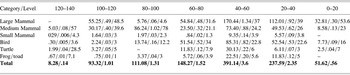
Table 12 presents the allometrically derived biomass of the Las Cuevas archaeofauna at each level. Maximum biomass is found during the middle occupational span at this site (at 40–60 cm) and decreases above that level, primarily because of the decrease in large mammal biomass.
Las Cuevas allometrically-estimated biomassa (Shown as specimen weight (g)/estimated biomass (kg)/% total biomass. Large mammal is assumed to be deer.)

COMPARATIVE STRATIGRAPHY OF THE FAUNAL COLLECTIONS
There is striking consistency between depositional patterns at the three Etzatlan sites with stratigraphic definition (Anona, Santiaguito, and Las Cuevas). In general, faunal frequencies, and especially the quantities of highly ranked large taxa, peaked midway during occupation at each site and declined thereafter. Notable changes in the faunal patterns emerge at the 60–80 cm level for Anona and Santiaguito and at the 40–60 cm level for Las Cuevas. There are differences, however, in the details of each site's pattern, and uniform rates of deposition cannot be assumed. At Anona the earlier occupational levels produced primarily avian rather than large mammalian taxa, and the upper levels had no bird bone. At Santiaguito birds were of lesser importance. At Las Cuevas birds became more important than mammals during later occupational stages. Medium-size mammals and reptiles/amphibians were more important at Las Cuevas than at the other sites, especially during the later periods of occupation. The maximum deposits at Las Cuevas continued into more recent levels than at the other sites.
Differing sample sizes of the three site datasets may have contributed to the abovementioned disparities. With its larger sample, Las Cuevas probably produces the most reliable indicator of dietary patterns overall. In general, however, the sites present a uniform image of intensive exploitation of large mammals during middle occupational spans immediately subsequent to what may have been the occupational change, followed by consistent declines in the use of highly ranked taxa (for example, deer) in the later occupations. Citing findings by Schibler et al. (Reference Schibler, Jacomet, Hüster-Plogmann and Brombacher1997) and Pétrequin et al. (Reference Pétrequin, Arbogast, Bourquin-Mignot, Lavier and Viellet1998), Shennan (Reference Shennan2002) describes similar patterns in the Old World in which native large mammals decline over time because of increased cultivation of the habitat and other human uses of the area. The Schibler et al. (Reference Schibler, Jacomet, Hüster-Plogmann and Brombacher1997) findings also indicate a significant overall decrease in use of animal flesh over time related to increased use of cereal products. However, Cook and Ranere (Reference Cook, Ranere and Clutton-Brock1989) argue that native cervid populations can be enhanced by the disturbance of less-than-suitable native habitat and expansion of agriculture.
The vertical distribution of nonnative taxa at the Etzatlan sites argues for both stratigraphic integrity and a consistent depositional level at which evidence for colonization is found. Most of the small quantities of opossum, cow/steer, and sheep were recovered above 60 cm at all three sites. Most nonnative specimens were recovered at Las Cuevas (arguing that the larger sample produced a more realistic collection), and two of these were found below 80 cm. The mixing (albeit minimal) of colonial taxa as deep as this (80 cm) suggests there may have been some stratigraphic disturbance, possibly by intrusive disposal of dietary refuse into existing levels.
ALLOMETRIC ESTIMATION OF BIOMASS
A decrease in faunal biomass is found at all three sites that have stratigraphic patterning. Maximum biomass occurs at middle occupational levels at all three sites, while later (upper level) deposits yield reduced biomass. At Anona, biomass decreases from a maximum of 1.35 kg at 60–80 cm to .2 kg at 0–20 cm (Table 6). At Santiaguito maximum biomass of 2.9 kg at 40–60 cm decreases to 1.13 kg at 0–20 cm (Table 9). At Las Cuevas, maximum biomass of 3.6 kg at 40–60 cm decreases to .56 kg at 0–20 cm (Table 12).
RELATING THE FAUNAL DATA TO OCCUPATIONAL CHANGE
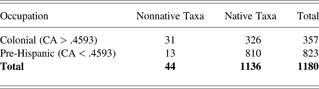
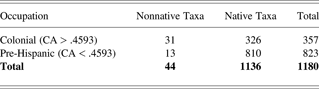
The vertical positioning of nonnative taxa is generally consistent with chronological deposition and minimal site disturbance. Almost 10% of specimens collected from colonial proveniences (with CA values >.4593) at all sites were nonnative taxa, while less than 2% of specimens derived from pre-Hispanic contexts (with CA values <.4593) were nonnative. To more closely examine this finding, a 2 × 2 chi-square test was applied to compare the observed archaeological data with statistically derived expected values (Table 13). This test revealed a significant difference (p = .000) in the proportion of nonnative and native taxa during the two occupational time periods. It supports the position that there was a nonchance distribution of native and nonnative fauna during the two time periods and strengthens the contention that there was little disturbance of the deposits. A phi-coefficient (Φ) calculated as a measure of the strength of this relationship resulted in Φ = .17, which would be considered “small” according to Cohen's conventions (Cohen Reference Cohen1988).
Chi-square test of chronologically discrete Etzatlan fauna
Occupational Phases at Anona
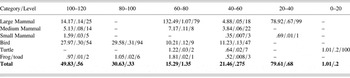
Seven CA values were used for Anona on the timeline: three pre-Hispanic and four colonial. These represent the only Anona proveniences with both faunal remains and sufficient ceramic content to establish CA values. When the Anona fauna are separated into the two occupational phases as defined by these CA values (Table 14), a different pattern of faunal use emerges from that presented by stratigraphic analysis (Table 5). Based on the CA timeline, large mammal bone predominates in the pre-Hispanic period and diminishes in the Colonial period. Use of large mammals does not appear to be enhanced by colonization. The large quantity of bird found in the earliest stratigraphic levels (80–120 cm) (Table 5) does not reappear until the Colonial period. During the Colonial period there are greater quantities of medium and small mammals and reptiles and amphibians. While this analysis makes no attempt to evaluate the dietary optimization represented by this archaeofauna, a widening of dietary breadth to include smaller (presumably lower-ranked) taxa is considered to be an indication of reduced availability of preferred (higher-ranked) taxa (Broughton Reference Broughton1994, Reference Broughton1999; Broughton et al. Reference Broughton, Cannon, Bayham and Byers2011; Smith Reference Smith1991; Stephens and Krebs Reference Stephens and Krebs1986).
Anona faunal remains by occupational period

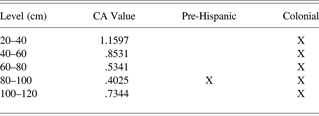
There is some basis, however, for relating the stratigraphic deposit to changes in occupation. In Unit 8, the only unit providing stratigraphic sequence at Anona, CA values increase moving upward through the stratigraphic levels, indicating later depositions. There is a single, anomalous exception in consistency of stratigraphy and CA values: the colonial CA value of .7344 at 100–120 cm (Table 15). The CA-based hypothetical onset of the Colonial period is at the 60–80 cm level (with a CA value of .5341). This level also has an important concentration of large mammal bone (Table 5) that diminishes in overlaying strata that have more recent CA values (Tables 5 and 15).
Relationship of CA values and stratigraphic levels, Anona, Unit 8
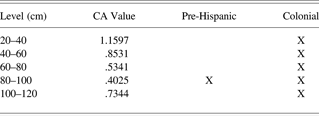
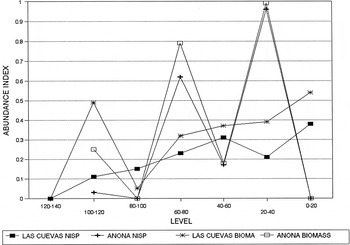
Figure 3 displays both NISP and biomass AIs from Las Cuevas and Anona by excavation level. The patterns for the two sites are entirely different. At Las Cuevas, both the NISP and biomass AIs increase linearly from deepest to uppermost levels, with an anomalous peak in biomass at the 60–80 cm level. On the other hand, both the Anona AIs (NISP and biomass) are erratic, with two distinctive peaks separated by a low point at 40–60 cm. Overall, however, the progression of ratios from both sites clearly reflects the substantial increase in large mammals at the 60–80 cm level. As noted previously, this increase may be related to the onset of colonial occupation with the introduction of nonnative large taxa (for example, cow/steer, sheep) into the diet. The AI increases found in the upper levels at Anona reflect the fact that with the exception of two specimens, only large mammal bone is found between 00–40 cm. However, this erratic pattern could be the result of small sample bias or ineffective recovery method.
Abundance indices: large versus small taxa.

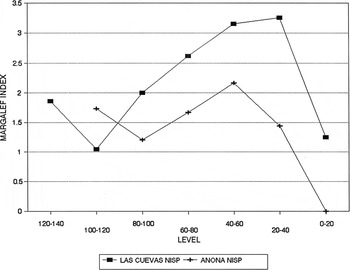
In terms of dietary breadth or evenness, the pattern may be more meaningful (Figure 4). In general, the Margalef Index (Da) increases over time as represented by the stratigraphic levels, indicating widening of dietary breadth. This widening diminishes only in the uppermost levels of the site as noted for the AI. Both AI and Da data from the 00–20 cm level are problematic and may be disregarded because some faunal data may not have been recorded for the surface level.
Margalef indices: species diversity over time.

Occupational Phases at Las Cuevas
With its larger sample of both ceramics and faunal remains, 49 CA values were derived from Las Cuevas: 35 were pre-Hispanic and 14 were colonial. Thus, while the Las Cuevas sample is larger than that from Anona, the data are less balanced for the two occupational phases. For this reason, it is best to assess faunal usage for the two occupational periods at this site on the basis of proportion rather than simple NISPs (Table 16).
Las Cuevas faunal remains by occupational period

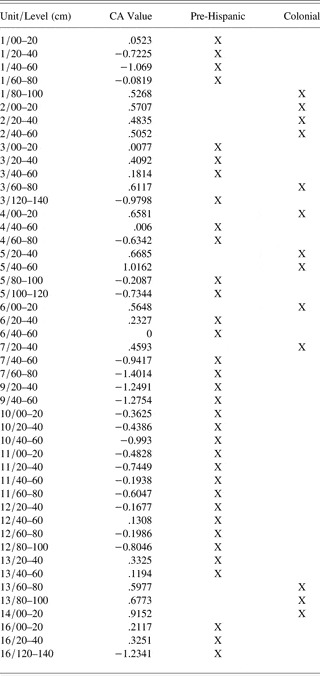
Table 17 relates CA values and stratigraphic levels at Las Cuevas. In Unit 1 a colonial CA value is found at 80–100 cm. Unit 2 has colonial CA values from the surface down to 60 cm depth. Units 3 through 6 have mixed pre-Hispanic and CA values, but most colonial CA values are in the upper 40 cm of the units. Unit 7 provides the theoretical occupational change CA value (.4593) at the surface. Remaining units providing faunal-related CA values are mainly pre-Hispanic with the exception of Unit 13 that yielded colonial CA values at deepest levels.
Relationship of CA values and stratigraphic levels, Las Cuevas (Excludes values derived from unmeasured unit extensions, features, burials, or tombs.)

As at Anona, faunal patterning by occupational period at Las Cuevas (Table 16) differs from the stratigraphic patterning (Table 11). Differences between the pre-Hispanic and colonial occupations are minor and involve moderately greater use of medium-size mammal in the pre-Hispanic period and greater use of birds and reptiles/amphibians in the later occupation. Proportions of both large and small mammals are unchanged between the two occupations. Thus, no changes in stratigraphic patterning at this site are necessarily related to occupational changes. Radiometric testing is needed to establish both the depositional chronology of the site and alignment of the faunal data within that chronology.
Applying the AI to the Las Cuevas faunal collection, the relative quantity of large mammals (taxon X) is compared to all smaller taxa (taxon Y) (medium/small mammals, birds, and reptiles/amphibians) (Figure 3). This progression of ratios indicates a steady increase in the use of large mammals over time. As at Anona, this might be a combination of increased use of native large taxa (deer) as well as increasing use of the introduced large taxa (for example, cow/steer) (Table 13). However, this finding is problematic since it is based on individually counting numerous fragments of what was probably a single shattered cow/steer horn in one colonial provenience. If these fragments were to be counted as a single element, the proportional representation of large mammal would decrease markedly. As at Anona, data from the 00–20 cm level are not entirely supportable since not all faunal data may have been recorded from the surface for all units.
Although the AIs for both sites indicate increasing relative proportions of large mammals over time (Figure 3), there is, nevertheless, a clear pattern of decreasing biomass available at both Anona (Table 6) and Las Cuevas (Table 12) over time. This pattern is also reflected at Santiaguito (Table 9), although there is no evidence of occupational change at that site. The Margalef Indices for both Anona and Las Cuevas indicate a general widening of dietary breadth over time.
DISCUSSION
The four Etzatlan sites produced a relatively small archaeofaunal collection with an extremely narrow range of faunal resources, consisting primarily of deer, dog, turkey, frog, and mud turtle. Fish, rodents, the leporidae, and other native taxa are either underrepresented or entirely lacking. These might have included jaguar, puma, skunk, badger, fox, raccoon, or armadillo. These are not found in the archaeological collections even though substantial quantities of some small taxa (frog and toad) were recovered throughout the collection. The reptile (turtle) and amphibians (frog and toad) are evidence of the use of aquatic fauna, but the lack of fishbone eliminates any meaningful assessment of the use of aquatic vertebrates.
Terrestrial birds (turkey) and year-round and migratory waterfowl are a meaningful constituent in the dietary pattern at Las Cuevas throughout both the pre-Hispanic and Colonial periods, yet birds are not found at Anona until the closing stage of the pre-Hispanic period. In general, all four sites suggest a more intensive use of faunal resources during the pre-Hispanic period and immediately after the arrival of the Spanish, with a marked decline during later colonial occupation.
All four Etzatlan faunal collections exhibit an unreasonable lack of what should be abundant native small taxa, fish, and rodent bone. It is difficult to explain how sites directly associated with a large freshwater lake could produce a near void of fishbone, especially since native fishing from canoes was reported by the first Spaniards to visit the area (Long Reference Long1966) and since other aquatic taxa (i.e., turtles and frogs) are found in quantity. Fishing was an important industry throughout prehistory at the lakes of west Mexico (Azúa Reference Azúa and Brumfiel2005; Pollard Reference Pollard, Smith and Berdan2003, Reference Pollard, Alexander and Kepecs2005; Williams Reference Williams2009). Similarly, the small mammals and rodents native to the area that are normally abundant in agricultural communities are not found in these archaeological collections. Whether this lack of small taxa reflects the genuine character of the dietary pattern or an introduced bias requires consideration.
There are several possible causes for the lack of small species bone (especially fishbone) in the Etzatlan faunal collection. These include: (1) nonuse of such resources, (2) off-site transport or food processing, (3) curational separation or loss, (4) differential survivability of fish or other small bone in the soil, or (5) unscreened recovery technique.
Of these, the first is illogical and contrary to ethnographic documentation. Certainly specific food gathering, transport, processing, and discard behaviors could have modified the content of the faunal collection. Deliberate exclusion of fishbone or its removal from the collection is not mentioned by site excavators in any field records and cannot be assumed. It is possible, however. This leaves differential preservation and unscreened recovery technique as likely causes for the lack of small species.
Fish native to the endorheic lakes of the Mesa Central tend to be small species including members of the Goodeidae and Atherinidae families (Azúa Reference Azúa and Brumfiel2005; Berlanga-Robles et al. Reference Berlanga-Robles, Madrid-Vera and Ruiz-Luna2002, Guzmán and Polaco Reference Guzmán and Polaco2005, Polaco and Guzmán Reference Polaco and Guzmán1997). Such tiny skeletal elements would not be recoverable without fine-mesh screening. Quitmyer (Reference Quitmyer2004) demonstrates how recovery method seriously affects faunal data analysis, especially for small taxa such as fish. Hand recovery may have entirely missed fishbone content at the sites. Furthermore, small fish might have been cooked and eaten whole-bodied much like sardines or anchovies. Azúa (Reference Azúa and Brumfiel2005) suggests that humans and dogs may have simply consumed the fishbone. The small fish would have been netted in large quantities similar to coastal techniques for netting anchovies. On the other hand, several fishing technologies were used throughout Mesoamerica, including simple rod, line, and hooks; traps; fishing spears; and bows and arrows (Guzmán and Polaco Reference Guzmán and Polaco2005; Williams Reference Williams2009). The lack of fishbone is even more enigmatic because excavation of a number of Classic/epi-Classic burials has produced offertory vessels containing fish remains (Guzmán et al. Reference Guzmán, Polaco and Pollard2001, Guzmán and Polaco Reference Guzmán and Polaco2003). Some pre-Hispanic populations revered a god named Opochtli who determined the success or failure of fisheries (Guzmán and Polaco Reference Guzmán and Polaco2005).
Several researchers have explored differential survivability of archaeological fishbone vis à vis other vertebrate bone (Colley Reference Colley and Schiffer1990; Lubinski Reference Lubinski1996; Nicholson Reference Nicholson1996; Wheeler and Jones Reference Wheeler and Jones1989; Zohar et al. Reference Zohar, Dayan, Galili and Spanier2001). The results of these and other studies are mixed and tend to be affected by local conditions, experimental technique, and the nature of specific taxa. For example, Zohar et al. (Reference Zohar, Dayan, Galili and Spanier2001) found no correlation between fishbone density and bone frequency in several case studies from coastal Israel. In a number of faunal collections from coastal Mexico, Cumbaa (Reference Cumbaa and Scott1973), Voorhies et al. (Reference Voorhies, Kennett, Jones and Wake2002), Wake (Reference Wake2004), and Wake et al. (Reference Wake, Anikouchine, Voorhies and Voorhies2004) found large accumulations of fishbone surviving as readily as large mammal remains. California coastal sites 11,000 years old consistently yield large quantities of preserved fishbone (Porcasi Reference Porcasi2008; Rick et al. Reference Rick, Erlandson and Vellanoweth2001). In short, it is not clear whether the void in fishbone at Etzatlan is related to the nature of fishbone (bone size and/or density) or to other taphonomic factors.
The soil into which bones are deposited may also affect survivability and rate of recovery (Nicholson Reference Nicholson1996). Bone deposited in water or in highly organic midden tends to preserve well while bone deposited in highly acidic soil tends to deteriorate more rapidly than in neutral or alkaline soil. For example, one noted researcher advises that “fish bones survive very poorly throughout Central Mexico” (Helen Pollard, personal communication 2010). If soil chemistry in this region destroys fish bone, the lack of fish bone in this collection may be less enigmatic than thought.
In a simple experiment to determine if soil acidity might have destroyed small bone (especially fishbone) at the Etzatlan sites, the author tested soil samples from Las Cuevas and Santiaguito using a commercial soil pH test kit. In these tests, soil samples from Las Cuevas and Santiaguito were dissolved in measured quantities of deionized water along with soil pH test tablets, and the resulting solutions were evaluated by color for pH level. Results showed a pH of 7.0 at Las Cuevas (neutral) and a pH of 6.0 (mildly acidic) at Santiaguito. Neither soil sample was sufficiently acidic to destroy bone. These findings are provisional, however, because the soil samples were taken from burial contexts (the only available soil samples for the sites).
In the absence of contrary data, it is assumed that the lack of small taxa and fishbone in these collections is the result of the unscreened recovery technique. Screening, especially fine-mesh or water-screening, is recognized as necessary for recovery of small taxa, especially fishbone (Colley Reference Colley and Schiffer1990; Cumbaa Reference Cumbaa and Scott1973; Quitmyer Reference Quitmyer2004; Ross and Duffy Reference Ross and Duffy2000; Takács and Bartosiewicz Reference Takács and Bartosiewicz1998; Wheeler and Jones Reference Wheeler and Jones1989). Troweling recovery yields entirely different species lists from screening recovery, and hand-collected assemblages tend to be biased toward large species (Lyman Reference Lyman1994; Payne Reference Payne and Higgs1972).
Yet it is unclear how substantial quantities of frog and toad bones were recovered throughout the Etzatlan deposits while fish bones are so sparse. The bountiful representation of these relatively small animals in the Etzatlan archaeofauna is inconsistent with the lack of other small taxa but attests to careful trowel collection technique. Interestingly, the same situation was found by Azúa at Postclassic Xaltocan. He notes that: “Despite conditions of preservation and recovery that permitted the recovery of small and fragile amphibian bones, fish were poorly represented in the bone assemblage from Xaltocan” (Azúa Reference Azúa and Brumfiel2005:237). He suggests that the bones of small indigenous fish might have been consumed whole by the human community and larger fish bones might have been consumed by their dogs. Located in the northern Basin of Mexico, the Xaltocan archaeological site is, like Etzatlan, situated on a relic island in the bed of dry Lake Xaltocan. Studies of prehistoric life there are currently ongoing.
CONCLUSIONS
This article presents several different but related perspectives on the Etzatlan archaeofauna collection. Data include quantities by taxon (NISPs) and percentages in terms of stratigraphic deposition and allometric estimates of nutritional yield (biomass). Abundance and diversity indices present further images of the faunal collections. Even though the overall sample is small and completeness of the collections is problematic, these analyses yield several patterns of dietary lifeways of site occupants over time. These may be summarized as follows:
1. The archaeofaunas at the four sites depict a narrow dietary range consisting mainly of large mammals (most of which are deer), medium mammals (most of which are dog), a variety of birds (most of which are turkeys), a large frog, and mud turtles. There is an enigmatic lack of fish and small mammal bone. While the details of this dietary range differ somewhat at the four sites, the basic pattern is consistent.
2. When data are viewed stratigraphically (for Anona, Santiaguito, and Las Cuevas), similar patterns are found. There is a marked reliance on large mammal (deer) in the earliest occupational levels, but this diminishes over time relative to the use of smaller, hypothetically lower-ranked taxa, including birds and reptiles or amphibians. These findings parallel those of Deagan (Reference Deagan2004:616–620) who recorded patterns of animal exploitation in pre- and post-contact Caribbean Taino sites. Maximum use of faunal resources appears to have occurred during the middle occupations at the sites. Overall use of faunal resources declines in the upper levels of the sites.
3. The stratigraphic patterns are notably coherent at all the sites, suggesting that there was little stratigraphic disturbance of site matrix.
4. There are specific changes in the dietary patterns at each site suggesting occupational changes. These correspond, in general, with the point on the ceramic correspondence analysis timeline where evidence of colonization is found. These changes involve decreased use of large mammals over time and increased use of smaller taxa including medium and small mammals, birds, and reptiles/amphibians.
5. Dietary patterning along the CA timeline differs from patterning by site stratigraphy. This may be due to the fact that there were more than double the number of pre-Hispanic proveniences than colonial proveniences contributing to the timeline. The need for radiometric dating of the sites is obvious.
6. Possible scenarios for explaining the lack of small taxa bone (especially fishbone) are discussed. The most likely cause for this lack is the unscreened recovery technique.
7. Finally, it is recognized that the Etzatlan archaeofaunal collection is a small, unscreened sample without direct radiometric context. There is likely loss of some recorded faunal specimens. Thus, conclusions drawn from this study must be considered provisional and would certainly be enhanced by further research.
RESUMEN
Este articulo presenta evidencias de que ciertos aspectos de la transformación cultural a gran escala pueden observarse trazando relativamente sutiles cambios en los patrones de modo de vida del días a día de poblaciones particulares. Específicamente, se utilizan datos faunística dietéticas para evaluar los efectos de la transición prehispánica a colonial en la cuenca del lago más occidental de la Mesa Central o altiplano de Jalisco, México.
El análisis de los vestigios de la fauna alimenticia procedentes de los cuatro sitios de la Cuenca de Etzatlan (Tiana, Anona, Santiagito, y Las Cuevas) presentan importantes contrastes entre los patrones dietéticos prehispánicos y los coloniales. Cambios específicos en los patrones dietéticos sugieren cambios ocupacionales que corresponden, en general, con una cronología derivada estadísticamente en la cual la cerámica presenta evidencia del principio de la colonización. Estudios alométricos se usan para calcular la masa biológica fáunica; los índices de abundancia y diversidad para definir estos patrones relativos a la cronología. Hay una disminución en el uso de los mamíferos grandes a través del tiempo y un aumento en el consumo de mamíferos pequeños, pájaros y reptiles/anfibios. En particular se ha observado que durante la época colonial, hubo un incremento marcado en el consumo de los mamíferos nativos grandes más importantes (v.gr. el venado). Sin embargo, esta abundancia disminuyó considerablemente durante el período colonial tardío. La reducción de los cérvidos nativos es consistente con el aumento del cultivo del habitat y la adopción de una dieta más amplia.
Todos los cuatro sitios presentan una gama de dieta constante y estrecha que consiste de grandes mamíferos (la mayoría de los cuales son los venados), perro, turquía, ranas, y tortugas. Una falta enigmática de espina de pez se encuentra a pesar de que los sitios estaban ubicados en los alrededores de ahora extinto lago de Magdalena. Esta vacío en espina de pez se considerara el resultado de un método de recuperación sin analizar. En general, sin embargo, los patrones dietéticos a lo largo de la línea de tiempo estadísticamente derivada de los sitios difieren de patrón por estratigrafía del sitio, y es evidente la necesidad de datación radiométrica directa. En ausencia de tales datos, las conclusiones extraídas de este estudio deben considerarse provisional y limitado.
ACKNOWLEDGMENTS
I thank Roger Nance and his UCLA colleagues who developed the Etzatlan ceramics CA for giving me the opportunity to study this archaeofauna and to use the correspondence analysis timeline as background for the faunal analysis. The Long/Glassow field notes on Las Cuevas were transcribed by John F. Holz and Dr. Wendy G. Teeter at the Fowler Museum Archives of Archaeology at UCLA. Señora Rosa Acero provided an erudite Spanish abstract. Several reviewers greatly enhanced the quality of this article.