

For all the great hopes placed in these organizations, Geneva in 1920 did not offer more than a disused hotel for the League of Nations (l’Hôtel National) and an old boarding school for the International Labor Organization. The first Assemblies of the League took place in the austere Salle de la Réformation, which was subject to all sorts of criticism by the international press.
The delay in securing a permanent site of course increased the problems of organization […] At first everything [in New York] was improvised. The Assembly that year had to take place in a converted skating rink at Flushing Meadows on Long Island, in buildings which had once been part of the World’s Fair. From the end of 1946 both the Secretariat and the Assembly moved to Lake Success, outside New York, camping in the buildings of a disused gyroscope factory.
Introduction
Almost exactly a century ago,Footnote 2 on April 26, 1921, the Establishment Officer of the League of Nations (LoN) Howard Huston alerted his colleagues about an impending “housing crisis within the Secretariat.”Footnote 3 In a memorandum directed to Herbert Ames – the first Financial Director of the LoN – Huston requested an immediate increase of funds to expand the working capacity of the then headquarters of the League: a building called the National Hotel (l’Hôtel National). In his request, Huston clarified that these measures were urgently needed due to the enlargement of the Economic Section of the League and the division between the Health and the Social Section. But above all, the creation of an Armaments Section – which was later renamed as the more fitting Disarmaments Section – demanded a spatial expansion without parallel in the early years of this nascent international organization (IO). Huston, in particular, demanded the approval of an additional expenditure of 1,000 gold francs per month. This would be destined for the renting of a neighboring property. Indeed, one of the reasons that had convinced League officials of acquiring the Hôtel National for the enormous price of 5,500,000 gold francs was that this property had nearby plots or venues that could be incorporated as the IO grew.Footnote 4 But above all, the dignified architecture and structure of the Hôtel had convinced the League to choose this site for its first permanent dwelling. In fact, Eric Drummond – first Secretary-General of the organization – considered that this was the only site in Geneva that could meet the expectations of the organization.Footnote 5 While local press outlets saw this as a lavish choice – as it gave the staff “a kind of high life in offices which had been hotel rooms overlooking [l]ake [Leman]”Footnote 6 – Drummond instead believed that the institution had finally settled in a building whose “dimensions, style, and architectural beauty are worthy of the great international task that lies before the League.”Footnote 7 Regardless of this lofty statement, by the early twenties, it was becoming evident to those toiling within the Hôtel that its walls were growing increasingly small for the League.Footnote 8
If it was raining at the LoN, next door at the International Labor Organization (ILO) it was pouring. A year or so after Huston’s memorandum, the ILO governing body adopted a similarly strongly phrased memorandum in relation to its own limitations of space.Footnote 9 With the French national Albert Thomas at its helm, the ILO had found its first permanent dwelling in the basement of the Institut International d’Education la Châtelain in 1920, often called the Thudichum school after its rector.Footnote 10 This edifice would eventually be refashioned as the Carlton Hotel, and later would become the site of the International Committee of the Red Cross – but that is a story for another occasion.Footnote 11 For our purposes, we must note that, by 1921, ILO officials were increasingly at odds with the basement of this boarding school. In their opinion, the limited space “does not r[e]ach even a reasonable standard from the hygienic point of view, to say nothing of it allowing the space necessary for really efficient work.”Footnote 12 In fact, these ILO bureaucrats – not unlike myself – were toiling in a cramped space in the wake of a global pandemic. For that reason, we can easily sympathize with their concerns related to their hunch that the “high rate of sickness this winter has been partly due to the inadequacy of the present accommodation.”Footnote 13 And even in the face of these limitations, this IO was constantly expected to grow. If for Huston the main problem before the League was the inauguration of the Armaments Section, for the ILO the rising tensions came from the ever-expanding library. And these preoccupations were only related to the edifices that served as the working places for the full-time staff of these institutions. The limitations of space also extended to the lack of proper infrastructures for parliamentary meetings. At this early stage of the history of IOs, the ILO and League assemblies were held awkwardly either at the Casino Kursaal (nowadays the Fairmont Grand Hotel) or the Salle de la Réformation – also called the Calvinium(!), demolished in 1969.Footnote 14 Both were fairly inconvenient in terms of logistics or acoustics.Footnote 15 The former was described by its contemporaries as a “barn-like structure situated at the other end of Geneva and intended for […] Calvinist worship” while the latter was seen as “a sort of combined vaudeville show and dance hall.”Footnote 16
A careful reading of the traces and silences found in the archival collections of these early IOs shows that infrastructural and spatial anxieties were the bread and butter of the everyday operations of global governance. More often than not, the lofty goals of the pursuit of peace were punctuated by the routine malfunction of machinery, the occasional industrial fire, and the general displeasures of overcrowded offices. The men – and rarely but increasingly, womenFootnote 17 – that served as the pioneering cohorts of international civil servants had (just like any contemporary reader) to muster the resources and navigate the constraints imposed upon them by their built environments – and often to their chagrin. This is especially true to those involved in the so-called first generation of IOs, which through luck and improvisation produced knowledge and practices that later came to define the operations of future international institutions.Footnote 18
And yet, the anxieties and promises that space and architecture posed for these networks of transnational governance are, by and large, absent from our scholarly accounts. Sinclair’s recent monograph on the history of IOs in international law, for instance, tells us a nuanced and rich account of the intellectual history of Thomas’s tenure and the context of the early ILO without mentioning the frustrations that the organization faced in the crowded basements of La Châteleine or its eventual displacement to the Bloch property in Geneva – a building that today hosts the World Trade Organization – also a story for another time.Footnote 19 In the neighboring fields of international and global history, the surge of interest in the study of internationalisms has not necessarily been accompanied by a careful interrogation of the spaces and venues of IOs. The Hotêl National, for example, only appears in two sentences of Sluga’s (masterful, to be sure) history of internationalisms,Footnote 20 while Pedersen’s groundbreaking monograph on the League’s Mandate system tell us little about the material investments behind the so-called l’espirit de Genève.Footnote 21 Most accounts, in other words, divorce their analysis of actors, ideas, or norms from the seemingly banal histories of the “buildings, staffs, and letterheads.”Footnote 22 While the “human component” of IOs has been submitted to an increased scrutiny in international history,Footnote 23 and in the aftermath of “biographical turn” to “people with projects” in international law,Footnote 24 the non-human and more-than-human elements of international institutions have remained largely unexplored. These elements, moreover, warrant study for it is within those very concrete “rooms” in which international lawmaking operations take place – imposing constraints and providing resources for those engaged in this sort of work.Footnote 25
What is more, “IOs are inclined to define their own histories by writing ‘official histories’ themselves [… and s]uch official histories maybe be written by insiders, who lack a scientific or critical regard,” as Reinalda duly noted.Footnote 26 This fact is even more salient when it comes to the literature on edifices of IOs, which often follows the genre of coffee table literature – highlighting hagiographic narratives of progress and downplaying moments of tension and conflict.Footnote 27 The literature, if at all, might present us with a rosy picture of the grand palaces that eventually came to host IOs, but will remain stubbornly silent with regards to the rather precarious and improvised locales that actually came to serve the fledging system of IOs in their infancy. Conversely, in this chapter, I draw from, and contribute to, the recent or forthcoming works that bring the study of material culture, space, and art and architecture into the conversation on global governance.Footnote 28 In this vein, I trace a history of the interim dwellings of IOs, arguing that a study of the built environments that haphazardly nested these institutions might reveal much about the structural limitations and jurisdictional boundaries of these “delicate machines” of world ordering.Footnote 29 To do so, after this short introduction, we return to (2) the ironically named Hôtel National. Then, (3) we cross the Atlantic to the early United Nations complex in Lake Success and Flushing Meadows in the state of New York. This will allow me to (4) conclude with some remarks on the relevance of primary sources and archival research in the theory and history of international law and IOs.
A Contradiction in Terms? The Hotel National, Home to the International Community
In an “irony of history,” the first permanent dwellings of one of the pioneering twentieth-century IOs was the former Hôtel National.Footnote 30 From there, the League “overflowed into two or three surrounding buildings.”Footnote 31 As I mentioned earlier, its acquisition had been partly prompted by Drummond’s desire of finding a dignified site for the IO – and the Hôtel, for him, was the only serious option that Geneva offered.Footnote 32 But most dramatically, the acquisition of this edifice was also prompted by the attempt of other cities to dethrone Geneva as the foremost site of interwar internationalism.Footnote 33 As noted in the epigraph, spectators in both Switzerland and abroad were painfully cognizant of the fact that, “[f]or all the great hopes placed in these organisations, Geneva in 1920 did not offer more than a disused hotel for the [LoN] and an old boarding school for the [ILO].”Footnote 34 To be sure, Genevese and Swiss authorities were aware of this. William Rappard, who had served as the chief Swiss negotiator at the Paris peace negotiations, knew that other European municipalities were competing to oust Geneva – something that would be unacceptable to his Swiss constituency. The mere fact the Viennese newspaper Freien Presse had published a call for furniture supply for the secretariat had angered local businessmen, as it made them doubt whether the League had “the restoration of Swiss industry from its present depression at heart.”Footnote 35 In fact, Brussels had almost outbid Geneva when the League’s Council recommended that the US President Wilson convene the first assembly in Belgium in 1920.Footnote 36 While Geneva was saved by Wilson’s “friendly and spontaneous” gesture to prefer the neutrality of Switzerland over the revanchisme of the recently invaded Belgium,Footnote 37 this episode convinced Rappard and the President of the Swiss Confederation, Giuseppe Motta, that now it was their turn to reciprocate. Had it not been for the personal rapport between Wilson and Rappard, perhaps Geneva “might well be nothing more than a cantonal capital.”Footnote 38
The first Swiss overture to sway the League to stay in Geneva came in the form of a tax exemption in 1920. At that time, the Genevese Conseil d’État decided not to charge the LoN for the droits de mutation et des transcription (a tax related to the acquisition of property) of the Hôtel National, which amounted almost to 700,000 gold francs.Footnote 39 The majority of the council members favored the exoneration as a way to support the League and show their commitment to its historical mission – and pivotal role in warranting Swiss neutrality and independence. And yet, a minority of socialists, led by M. Burklin, argued against the measure, claiming that the state could not afford to exonerate the payment of this tax amid the acute housing crisis which affected the local working class. Along these lines, M. Nicole stated that the League represented the interests of the international capitalist class, which is why the only stable peace could be built by the international workers’ movement. In the end, the socialist faction remained adamant, tallying twenty-two votes against the majority’s sixty-two votes to exonerate the tax. In the following weeks the Council, presided by Paul Pictet, published its official decision to exonerate, laying the first stone upon which “International Geneva” was erected.Footnote 40 Indeed, it was only after this that the Federal and local authorities began investing heavily in infrastructure “to live up to the privilege of being chosen.”Footnote 41 In the years that followed, Geneva witnessed the opening of a new railway station (named Cornavin), an airport (named Cointrin), and a series of infrastructures for communications and transport technologies.
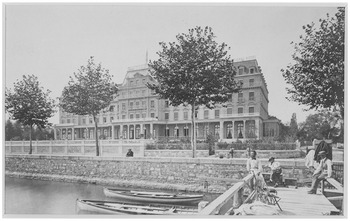
Despite this tax exemption, the League still paid a hefty amount to acquire the Hôtel. While it had been originally erected in the late 1870s to create a luxurious hotel on the right bank of the lake (rive droite), it failed to reach commercial success. Not only did its construction costs exceed the initial expectations (leading to the dramatic suicide by defenestration of one of its initial owners),Footnote 42 but its location in the then-outskirts of Geneva failed to attract wealthy clients. Even in the 1920s and 1930s, League officials were skeptical of the Hôtel’s location “at the extremity of an industrial and working-class neighborhood, still in development.”Footnote 43 After the Great War, the plans to reopen the edifice as a hotel were quickly scuttled after the League manifested its interest in the property, and it was instead renovated by the architects Marc and Jean Camoletti for a bureaucratic use (Figure 9.1). But even after these repairs, it was clear that “the old hotel was not particularly well-suited for administrative functions and as the League’s work picked up pace, the leadership of the League Secretariat was struggling to fit the growing number of staff [and] meetings.”Footnote 45 The spatial layout of the League, in fact, reflected its own internal hierarchies. Unsurprisingly, the top floors were reserved for the higher echelons of staff (Drummond, for instance, used a corner office that overlooked the lake, where former Habsburg aristocrats had spent their nights), with various Sections located in the middle floors of the edifice.Footnote 46 “Ancillary services” were relegated to the basement, attic, and the neighboring villas. In 1924, the hotel complex was suggestively renamed Palais Wilson, in an homage to the Unitedstatesean President who had strongly vouched for Geneva in the struggle to find a dignified location for the League.
Genève, Hôtel National. Unknown author (1919).

Figure 9.1 Long description
The foreground features a narrow body of water, likely a canal or river, extending horizontally across the bottom of the frame. Three small, light-colored boats are moored in the water, positioned towards the left. A wooden dock extends from the lower right corner, angling slightly towards the left. Three men are seated on the dock: one on the far right wearing a hat and vest, one in the center wearing a cap and looking down, and one on the left wearing a light-colored shirt and looking right. Behind the water, a stone retaining wall supports a paved promenade. A decorative concrete balustrade runs along the top of this wall, behind which is a landscaped garden with low shrubs and several mature deciduous trees. One man in a hat is seated on the balustrade on the left. The background is dominated by the Hôtel National, a grand, multi-story building with a symmetrical facade. Its ground floor features a colonnaded portico. Above this, multiple floors display rows of windows and balconies. The building culminates in a complex mansard roof with dormer windows. The words "HOTEL NATIONAL" are visible on the roofline near the center. Large trees with dense foliage are positioned in front of and to the sides of the hotel, partially obscuring its lower and upper sections.
All in all, “the pattern that emerges […] is one of an organisation that is clearly bursting at its seams.”Footnote 47 The League officials were painfully aware of this, which is why they started to look for new alternatives to move out almost as soon as they moved in. Archival traces from 1925 note that the Secretary-General himself was “experiencing the utmost difficulty in finding office accommodation for the staff. All the available space in the Hôtel National has been utilised and further dividing and subdividing […] is no longer possible.”Footnote 48 The ILO – which, as seen earlier, was also in a dire place in terms of infrastructure – eventually built its own edifice in another lakeside property donated by the Genevese and Swiss authorities. The fact that they had managed to do so for much less (around 3,000,000 gold francs) was not lost on the League’s secretariat. Eventually, after receiving some land donations from the Genevese and Swiss authorities, the League also moved to erect its own purpose-built Palais des Nations, the design of which was to be selected through an international competition of architects.Footnote 49
In the meantime, the League tried unsuccessfully to sell the Hôtel National to increase the budget for the new edifice. Alas, despite the “untiring efforts which M. Motta [on behalf of the Swiss Confederacy] has made to bring these delicate negotiations to a satisfactory conclusion,” the League failed to receive even a single offer for the Hôtel.Footnote 50 Motta and the Swiss Federation even wanted an assurance that the Helvetic state would complement any private bid so that the League at least received four million gold francs (which was still one and a half million less than it had spent in 1920 to buy the venue). And yet, no offers came. As the global economic situation worsened, it was easy for League officials to look back and conclude, “the acquisition of the Hôtel National had not been a brilliant operation but was justified by urgency.”Footnote 51 The Belgian architect Victor Horta – President of the Jury of Architects elected to supervise the erection of the new Palais – was even more blunt in his assessment. In his view, the acquisition of the Hôtel proved that the League had, “in their efforts to buy a draught horse, mistakenly accepted to purchase an elephant.”Footnote 52
The early years of the League, in other words, were tied to this white elephant. Due to the delays and complications, the official Palais open its doors only in 1937. But at that time, the League was no longer expanding but was rather on the verge of collapse due to the worsening international climate. Aloft, the Palais remained “something of a pristine haunted house,”Footnote 53 while most of the technical staff of the League sought refuge in Princeton at the other side of the Atlantic during the second great war.Footnote 54 The League’s lifetime, in other words, had been marked by its awkward tenure at the Hôtel. Indeed, once it became clear selling the Hôtel was not possible, the organization did its best to find respite in the limitations of this dwelling. The most salient example of this was the improvised modernist pavilion that was built by the local architect Adolphe Guyonnet in 1931, commissioned for the upcoming Conference for the Reduction and Limitation of Armaments.Footnote 55 It was there where the League witnessed one of its most remembered “failures”Footnote 56 – as the thirties witnessed a surge towards rearmament and the opening of a new chapter in the twentieth-century European civil war. In its wake, the nascent United Nations organization would also have to find a home to call its own – this time away from the shores of lake Leman. We turn to this now.
Lake Failure: Commuting to the Early United Nations
With the utopian promise of exhibiting “the world of tomorrow,” the 1939 World’s Fair opened its doors in the Flushing Meadows complex in New York. Originally conceived to promote economic recovery after the sorrows of the Great Depression, the start of the second great war four months later gave its motto a new meaning.Footnote 57 “The world of tomorrow” entailed not only a globe changed by the innovations in technology or consumer goods,Footnote 58 but also the promise of a new planetary order forged during and after the “scourge of war.” As the conflagration dawned in Europe, spectators roamed around the fair’s Court of Peace to visit the adjacent national pavilions and the Hall of Nations. While the German Reich had conspicuously withdrawn its participation at the last minute, the Italian Pavilion reminded the fairgoers of the towering vision that the Axis powers wanted to impose on European soil.Footnote 59 Not far away, the pavilion of the Second Polish Republic survived exclusively on the private support from the Polish-Unitedstatesean benefactors, as its Government-in-Exile could no longer afford to run it.Footnote 60 Defiant – as if aware of the suffering to come – the Soviet and “Jewish Palestinian” pavilions remained not far, articulating their own visions of the world of tomorrow.Footnote 61 In the 1939 New York World’s Fair, just like the many other international exhibitions that have sprouted in the North Atlantic world since the nineteenth century, the aesthetical, political, and socio-technical dimensions of the world ordering were seamlessly intertwined.Footnote 62
After the end of the war, the infrastructure that once had heralded the coming of the “world of tomorrow” in 1939 came to serve a similar purpose in the years after 1945. Initially, the UN would come to use a variety of venues scattered in Long Island while the final headquarters were being erected in Manhattan.Footnote 63 The first of those was the Bronx campus of Hunter College (nowadays, CUNY’s Lehman College).Footnote 64 During the war, the campus had been vacated of students and readapted as a training station for the US Navy WAVES (“women accepted for voluntary emergency service.”) Again, improvisation marked the first steps of this new-born IO. The pool in the gym building was covered up with planks to create a makeshift press center – with the New York Times relegated to the “hairdrying room.”Footnote 65 What is more, that same gym room would be the venue for the first strike of the UN personnel of the first (out of many) walkouts of the Soviet Delegation from the Security Council.Footnote 66 Later that year, the UN moved to a more “permanent” temporary venue (insofar as they would stay there three to five years): the Sperry Gyroscope Company in Lake Success.Footnote 67 Just like Hunter College, the new house of peace had formerly had a military function, as it housed “one of the biggest war plants in the New York area, and one of the most secret, closely guarded factories anywhere in the world.”Footnote 68 While 118 residents of Lake Success voted in favor (with 70 against) of becoming “the world’s capital city,” the refurbished military factory was still far from perfect.Footnote 69 The New York Times, for instance, raised “violent objections […] on the inadequacy of press facilities” of both the Lake Success and the Hunter College makeshift headquarters.Footnote 70 Perhaps as a revenge for its time in the College’s “hairdrying” room, the Times complained that – unlike in the League’s edifices – the UN’s Long Island sites “have separated bar and lounge facilities” for delegates and the press. Moreover, the lack of space forced the UN to reject more than 2,500 requests for seats, as only 385 of the 732 places of the new Council Chamber were available for the public. The battle waged by the press for more space in the room was paralleled by a similar international dispute between the US and Soviet delegations in relation to the admission of new member states to the IO.Footnote 71 In sum, the walls of Hunter College ended up being too small to host “international society.”
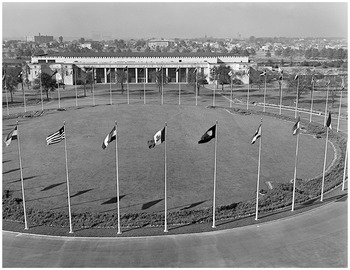
To resolve this, the UN turned towards the leftover infrastructure from the 1939 fair. From then on, the “New York City Building” (nowadays the Queens Museum) housed the UN General Assembly from 1946 to 1950 (Figure 9.2). This was initially confusing for the “delegates, visitors[,] and [journalists]” who were flabbergasted to arrive at an international building that had the words “[The] City of New York emblasoned in black letters across the façade.”Footnote 72 Be that as it may, it was in the Flushing Meadows complex, in fact, that the UN’s partition plan for Palestine was voted in 1947 – not far away from the “Jewish Palestinian” pavilion, which was situated roughly halfway between the New York building and the Court of Peace. Even the old fair’s railroad service was reopened by the Long Island Rail Road system, allowing for a relatively straightforward commute from New York’s Penn Station every half an hour or so to the newly renamed “United Nations station” in Flushing Meadows. The interim headquarters at Lake Success, however, were a bit more difficult to reach, as the route required delegates and staff to take a train to the Great Neck and then hail a bus.Footnote 73 Tired of these “intramural headaches,” the Secretary-General Lie urged for the creation of a national home for “[t]he wandering United Nations, now shuttling between a fair building and a reconverted factory, [… desperate to] have a place to call its own.”Footnote 74

In this sense, the 1939 fair’s “Hall of Nations” was but an early dress rehearsal for the posterior negotiations related to the creation of a “United Nations Organisation.” And yet – just like the Hôtel National in the case of the League – one finds little to no references in the literature in relation to the everyday geographies of the early days of these IOs.Footnote 76 This is unsurprising, given the hegemonic hold of the methodological benchmarks of intellectual history on the field of the theory and history of international law and international institutions.Footnote 77 But for the men and women who toiled within these IOs, spatial, architectural, and infrastructural considerations were anything but ancillary. The same was true, I suggest, for the leading state and non-state actors that were involved in the financing and erection of these sites. As we have seen, both in Geneva and in New York, the “location, location, location” of an IO was a hotly contested affair – intimately tangled with questions of national jealousy, international rivalries, and the “dignity” of international institutions. As we have seen, ideas – on their own – do not erect headquarters; establish bureaucracies; or cross frontiers.Footnote 78 To do so, they require land, capital, and labor. In this chapter, I offer but a modest example of how the stories of the political economies of two pioneer IOs can be rewritten into our histories of international institutional law.
Concluding Remarks: Archival Research for International Institutional Law
Given the fixation of international (institutional) lawyers with the history of our (sub)discipline and its “founding fathers,”Footnote 79 one can understand why some might believe that we already know everything about the history of our IOs.Footnote 80 Indeed, in a discipline where teleological narratives of progress are so pervasive,Footnote 81 it is easy to dismiss the early days of the League or the UN as times of inchoate experimentation, only relevant insofar as they pave the way for our own contemporary institutional arrangements.Footnote 82 Indeed, until very recently, the League was mostly remembered as a “failed” IO – relegated as a moment of “not yet” in the history of an increasingly sophisticated international order.Footnote 83
But the collective memory of our discipline – just as the one of its individual members – is partial and fickle. To decide to see and remember the League’s history as one of failure was a particular disciplinary choice, with important distributive and political implications.Footnote 84 The same is true, of course, for the early UN, which quickly had to justify its mandate by contrasting its operations with those of its Geneva-based predecessor. Instead of this tired narrative of “failure,” a growing trend of interventions in international law and global history are challenging the “historiographical amnesia” of our standard accounts of the development of IOs.Footnote 85 To “unlearn some common tropes,”Footnote 86 a new generation of scholars in both fields have delved into the “archives of universal history” of IOs.Footnote 87 Within them, as I’ve tried to show in this chapter, we have found “sundry worlds within the world” – a plethora of traces and silences that bear witness to the quotidian hopes and anxieties that surrounded the lofty project of world ordering through international norms and institutions.Footnote 88 This sobering encounter with primary sources and archival collections, I hope, can push international legal scholars to note that perhaps we do not know everything about the history of international institutions. In fact, an archival journey often pushes us as researchers to come to understand our “known unknowns” – and more dramatically, to discover we might still have many “unknown unknowns.”
This is not to argue that we should take archival collections as pristine repositories of truth, nor that we should approach primary sources without a critical eye. We need not to succumb to the fever of the archive.Footnote 89 This is an important point, as some international lawyers have come to mistakenly read all primary source-based historical work as epistemologically modernist and politically conservative.Footnote 90 In fact, some of the leading interventions in the histories of internationalism precisely anchor their narrative in biases and limitations of their archival repositories.Footnote 91 This is particularly true for IOs. While their archives “are an extraordinarily fertile, undervalued, underutilised, and endangered source,” they have been also compiled and curated following the geopolitical biases and pressures that these institutions faced in their day-to-day activities.Footnote 92 It is because of these pressures and biases – and not in spite of them – that the traces and silences found in these primary sources and archival collections have much to say about the ways in which “the international” was forged, negotiated, and contested within these institutions.Footnote 93 It is time we, as students and scholars of international institutional law, start listening.

 Open access