Quality of life (QoL) is a broad term which encompasses notions of a good life, a valued life, a satisfying life, and a happy life (McCrea, Shyy, & Stimson, Reference McCrea, Shyy and Stimson2006). QoL generally refers to evaluating the general well-being of individuals and societies (Derek, Ron, & Geraldine, Reference Derek, Ron and Geraldine2009) with key well-being indicators of life satisfaction (Ryff & Keyes, Reference Ryff and Keyes1995). Depending on the research objectives, quality of life can be investigated either with a focus on one specific aspect or by a multidimensional construct consisting of several domains (Cummins, Reference Cummins2005; Felix & Garcia-Vega, Reference Felix and Garcia-Vega2012; International Living, 2011).
Diener (1984, cited in Headey, Veenhoven, & Wearing, Reference Headey, Veenhoven and Wearing1991) distinguished between bottom-up and top-down theories of subjective well-being (SWB) and life satisfaction (LS). Bottom-up causation implies that particular variables cause SWB. In such case, overall life satisfaction would be a combination of satisfaction in particular domains (Brief, Butcher, George, & Link, Reference Brief, Butcher, George and Link1993). On the other hand, top-down causation states that people assess their general life satisfaction and rely on this when judging domains (Lucas, Reference Lucas2004), that is, global life satisfaction determines satisfaction in specific domains (Lance, Lautenschlage, Sloan, & Varca, Reference Lance, Lautenschlage, Sloan and Varca1989). Satisfaction in life domains is commonly treated as causes of overall LS but they may also be consequences of it. Evidence supports that both directions can occur simultaneously (Brief et al., Reference Brief, Butcher, George and Link1993; Headey et al., Reference Headey, Veenhoven and Wearing1991), and this is known as a "bidirectional" or "reciprocal" model (Lance et al., Reference Lance, Lautenschlage, Sloan and Varca1989).
The concept of satisfaction with life has been defined as a positive assessment that a person makes of their life in general, or of particular domains such as family, studies, work, health, friends and free time, among others (Diener, Emmons, Larsen, & Griffin, Reference Diener, Emmons, Larsen and Griffin1985; Diener & Biswas-Diener, Reference Diener and Biswas-Diener2000). Numerous studies have addressed satisfaction with life overall or in certain domains, in a single period or during significant transitions and milestones such as parenthood.
Although studies are still scarce (Veenhoven, Reference Veenhoven2008), the evidence so far suggests that food is among the important domains of life which affect the satisfaction of individuals (Blanchflower, Oswald, & Stewart-Brown, Reference Blanchflower, Oswald and Stewart-Brown2013; Grunert, Dean, Raats, Nielsen, & Lumbers, Reference Grunert, Dean, Raats, Nielsen and Lumbers2007; Schnettler et al., Reference Schnettler, Miranda, Sepúlveda, Denegri, Mora and Lobos2012). However, little attention has been paid to the domain of food so far. The contribution of food to quality of life has been well established (American Dietetic Association, 2005) but research focuses the effects of nutrition on physical health, e.g. health is one of the frequently mentioned motivations when consumers make their food choices (Chen, Reference Chen2011; Mollet & Rowland, Reference Mollet and Rowland2002). The link between food intake and objective health seems clear but there are other aspects to both of these variables that require further study. Brief et al. (Reference Brief, Butcher, George and Link1993) point out that objective health is one of the most important influences on overall life satisfaction, but self-perceived health is an important mediator in this relationship. And the need for food, as stated below, goes beyond nutritional fulfillment.
Following the bottom-up approach, Grunert et al. (Reference Grunert, Dean, Raats, Nielsen and Lumbers2007) consider food a prerequisite for people to be content with their lives. Studies conducted with low-income samples in South Africa, Ethiopia and Peru have shown that the availability of food is one of the fundamental conditions for having a good life (Clark, Reference Clark2000; Guillen-Royo, Reference Guillen-Royo2008). Other studies indicate that the possibility of spending a higher amount of money on food for the home is associated with the possibility of access to better quality and healthier food (French, Wall, & Mitchell, Reference French, Wall and Mitchell2010; Schnettler et al., Reference Schnettler, Miranda, Sepúlveda, Denegri, Mora and Lobos2012; Story, Kaphingst, Robinson-O’Brien, & Glanz, Reference Story, Kaphingst, Robinson-O’Brien and Glanz2008). Thus income may improve life assessment as it allows to fulfilling basic and psychosocial needs (Tay & Diener, Reference Tay and Diener2011). These findings point out that in spite of, and sometimes because of the abundance of food available, food occupies a considerable part of an average person’s life in terms of time and resources (Grunert et al., Reference Grunert, Dean, Raats, Nielsen and Lumbers2007).
According to Tay and Diener (Reference Tay and Diener2011), a mix of daily activities that include, among others, social relationships and the meeting of physical needs is required for optimal SWB. In this sense, food fulfills a utilitarian function for the body but it is also a vehicle for pleasure and social construction (Hausman, Reference Hausman2005; Kniazeva & Venkatesh, Reference Kniazeva and Venkatesh2007). Ateca-Amestoy, Cortés, and Moro-Egido (Reference Ateca-Amestoy, Cortés and Moro-Egido2013) state that social relationships correlate positively with life satisfaction in Latin America, and Hargreaves, Schlundt, and Buchowski (Reference Hargreaves, Schlundt and Buchowski2002) stress the emotional dimension of food associated with celebrations and social interaction. Food is prepared in the expectation that it will be shared and enjoyed in company (Kniazeva & Venkatesh, Reference Kniazeva and Venkatesh2007), on weekdays with the family and on weekends with friends (Dean et al., Reference Dean, Grunert, Raats, Nielsen and Lumbers2008; Gillespie & Gillespie, Reference Gillespie and Gillespie2007). Research into positive emotions has shown that basic need activities, such as eating, are an important category of stimuli eliciting happiness (Macht, Meininger, & Roth, Reference Macht, Meininger and Roth2005). Macht, Haupt, and Salewsky (Reference Macht, Haupt and Salewsky2004) found that more than one third of meals in everyday life are linked to positive emotions and determined that the pleasure of eating is associated with food qualities (tasty and healthy), the environment (comfortable and calm), social factors (interaction with friends, family), the person (feeling good and relaxed) and a hedonist attitude in the sense of perceiving the pleasure of eating as an important part of life. Indeed, happy people eat out more often and spend more time with friends (Veenhoven, Reference Veenhoven2003), although a greater frequency of eating out is linked to a higher income in both developed and developing countries (Rezende & de Avelar, Reference Rezende and de Avelar2012; Thornton, Crawford, & Ball, Reference Thornton, Crawford and Ball2011).
Given the importance of food for satisfaction or dissatisfaction with life, Grunert et al. (Reference Grunert, Dean, Raats, Nielsen and Lumbers2007) developed and tested the Satisfaction with Food-related Life scale (SWFL) in three studies in eight European countries. Like the Satisfaction with Life Scale (SWLS) (Diener et al., Reference Diener, Emmons, Larsen and Griffin1985), the SWFL scale consists of five items; these items exhibit good reliability as measured by Cronbach’s alpha, good temporal stability, convergent validity with two related measures, and construct validity as indicated by relationships with other quality of life indicators, including satisfaction with life. Schnettler et al. (Reference Schnettler, Miranda, Sepúlveda, Denegri, Mora, Lobos and Grunert2013) evaluated the psychometric properties of the SWFL scale and its relation to the SWLS using a confirmatory factor analysis. The results indicated an adequate level of internal consistency and a good fit to the data, thus demonstrating discriminant validity between the two constructs. The evaluation of a causal covariance structure analysis model composed of the SWFL as the antecedent construct and the SWLS as the consequent construct indicates a medium level of relationship between the two constructs. However, one of the limitations of these studies arises from the fact that no questions were included in the questionnaire about other domains of life, as a way of testing whether satisfaction in other domains of life influences overall life satisfaction. Also, the results from these studies have yet to explain in detail the mechanisms by which food affects satisfaction with life, so it is important to carry out further research on this relationship.
Therefore, the aim of this study was to assess the effect of satisfaction with food-related life on life satisfaction among inhabitants of the main municipalities of central Chile through the application of an ordered logit model. To do this, the results of the SWFL scale were used as an explanatory variable of life satisfaction. Additionally, the effect of other variables on the degree of satisfaction with life was examined, such as sociodemographic characteristics and eating habits inside and outside the home. The joint effect of eating and other domains on satisfaction with life is explored in aggregated form.
Based on previous studies (Grunert et al., Reference Grunert, Dean, Raats, Nielsen and Lumbers2007; Schnettler et al., Reference Schnettler, Miranda, Sepúlveda, Denegri, Mora and Lobos2012, Reference Schnettler, Miranda, Sepúlveda, Denegri, Mora, Lobos and Grunert2013), we expected to confirm the existence of a positive relation between satisfaction with life and satisfaction with food-related life. At the same time, considering the link between health and eating (American Dietetic Association, 2005; Chen, Reference Chen2011; Mollet & Rowland Reference Mollet and Rowland2002; Veenhoven, Reference Veenhoven2008) and between eating and social interaction with family and friends (Gillespie & Gillespie, Reference Gillespie and Gillespie2007; Hargreaves et al., Reference Hargreaves, Schlundt and Buchowski2002; Kniazeva & Venkatesh, Reference Kniazeva and Venkatesh2007; Macht et al., Reference Macht, Meininger and Roth2005; Veenhoven, Reference Veenhoven2003), we expected to find a combined effect of eating and other domains on people’s satisfaction with life.
Method
Sample
Personal interviews were conducted by trained interviewers (psychologists) with a sample of 1,277 people over age 18 from the Regions of Valparaiso, Metropolitan Santiago, Libertador Bernardo O’Higgins and Maule in central Chile. The surveys were conducted in the main municipalities of these regions (over 100,000 inhabitants), with the number of respondents set proportionally to the number of inhabitants of the municipalities of Valparaiso, Viña del Mar (Valparaiso Region), El Bosque, La Florida, La Pintana, Las Condes, Maipú, Ñuñoa, Peñalolen, Pudahuel, Puente Alto, Recoleta, San Bernardo, Santiago (Metropolitan Region), Rancagua (Libertador Bernardo O’Higgins Region) and Talca (Maule Region).
Procedure
The survey was conducted during May and July 2011 in supermarkets and food courts inside malls located in different socioeconomic areas. The interviewers explained to the respondents the objectives of the survey and the strictly confidential treatment of the information obtained, and then asked if they agreed to answer the questionnaire. The response rate was 58%.
Prior to the survey, the questionnaire was pre-tested with 5% of the survey sample, using the same method of addressing the participants as in the final survey. As no problems were detected, no changes were required in either the questionnaire or the interview procedure. The questionnaires obtained in the pre-test were not incorporated into the analysis of the results. The participants signed informed consent statements before responding. The execution of the study was approved by the Ethics Committee of the Universidad de La Frontera in Temuco, Chile.
Instrument
The questionnaire included the following scales:
SWLS (Satisfaction with Life Scale)
Developed by Diener et al. (Reference Diener, Emmons, Larsen and Griffin1985), this is a scale consisting of five items grouped into a single factor to evaluate overall cognitive judgments about a person's own life: “In most ways my life is close to my ideal”; “The conditions of my life are excellent”; “I am satisfied with my life”; “So far I have gotten the important things I want in life”; “If I could live my life over, I would change almost nothing”. Studies conducted in Spain report a high internal consistency of the scale in its Spanish version with Cronbach’s alpha values between 0.82 and 0.88 (Chico & Ferrando, Reference Chico and Ferrando2008; Vásquez, Duque, & Hervás, Reference Vásquez, Duque and Hervás2013). The existence of a single factor for all items in the Spanish SWLS has also been confirmed in previous studies in Spain and Chile (Schnettler et al., Reference Schnettler, Miranda, Sepúlveda, Denegri, Mora and Lobos2012; Vásquez et al., Reference Vásquez, Duque and Hervás2013; Vera-Villarroel, Urzúa, Pavez, Celis-Atenas, & Silva, Reference Vera-Villarroel, Urzúa, Pavez, Celis-Atenas and Silva2012).
SWFL (Satisfaction with Food-related Life)
Proposed and tested by Grunert et al. (Reference Grunert, Dean, Raats, Nielsen and Lumbers2007) in eight European countries, it shows adequate levels of internal consistency (Cronbach’s α varying between 0.81 and 0.85). The SWFL scale also presented adequate levels of internal consistency (Cronbach’s α: 0.878,) in a study in Chile (Schnettler et al., Reference Schnettler, Miranda, Sepúlveda, Denegri, Mora and Lobos2012). The five items of the scale are grouped in a single dimension: “Food and meals are positive elements”; “I am generally pleased with my food”; “My life in relation to food and meals is close to ideal”; “With regard to food, the conditions of my life are excellent”; “Food and meals give me satisfaction in daily life”. In both SWLS and SWFL the respondents must indicate their degree of agreement with these statements using a 6-level Likert scale (1: disagree completely, 6: agree completely).
HRQOL (Health related quality of life index)
Developed by Hennessy, Moriarty, Zack, Scherr and Brackbill (Reference Hennessy, Moriarty, Zack, Scherr and Brackbill1994), it consists of four items that explore the self-perception of health, recent physical health, recent mental health and recent limitations on activity.
Two bilingual translators translated all the original items of the SWLS (Diener et al., Reference Diener, Emmons, Larsen and Griffin1985), SWFL (Grunert et al., Reference Grunert, Dean, Raats, Nielsen and Lumbers2007) and the HRQOL (Hennessy et al., Reference Hennessy, Moriarty, Zack, Scherr and Brackbill1994) from English to Spanish. A third bilingual translator back-translated the Spanish versions of the scales to English. The discrepancies between both versions were resolved by discussion until all the translators agreed on the final versions of the scales. These Spanish versions of the SWLS and SWFL have been previously tested in Chile (Schnettler et al., Reference Schnettler, Miranda, Sepúlveda, Denegri, Mora and Lobos2012), presenting adequate levels of internal consistency, the existence of a single factor for all the items and good convergence validity in the sample studied.
Additionally, five Likert-type responses were included (1: strongly disagree, 5: strongly agree) in order to evaluate beliefs about the importance of five sources of happiness: family, work, leisure, friends and food.
Monthly food expenditure was inquired through questions such as the frequency of meals in the home together with the family group (breakfast, lunch, supper and dinner), as well as the time available for each of these meals. The frequency of meals outside the home in restaurants, fast food outlets and street food carts, as well as the frequency of the purchase of prepared food were also enquired.
Questions for sociodemographic classification were included at the end of the questionnaire: gender, age, marital status, number of members in the family group, presence and age of children, area of residence, occupation and level of education of head of the household, and possession of 10 domestic goods. The combination of these two latter variables in a matrix allows the socioeconomic status to be determined, classified as ABC1 (high and upper middle), C2 (middle-middle), C3 (lower middle), D (low) and E (very low). These variables are, conceptually, related with income, educational level and possessions accumulated by the family group, allowing a simple but adequate estimate of the socioeconomic status of Chilean households (Adimark, 2004).
Statistical analysis
The results were analyzed using SPSS v. 16.0 for Windows in Spanish. The scale factors from the SWLS and SWFL were extracted using a principal components analysis, considering eigenvalues greater than 1. The internal consistency of the scales was calculated using Cronbach's alpha coefficient (Hair, Anderson, Tatham, & Black, Reference Hair, Anderson, Tatham and Black1999).
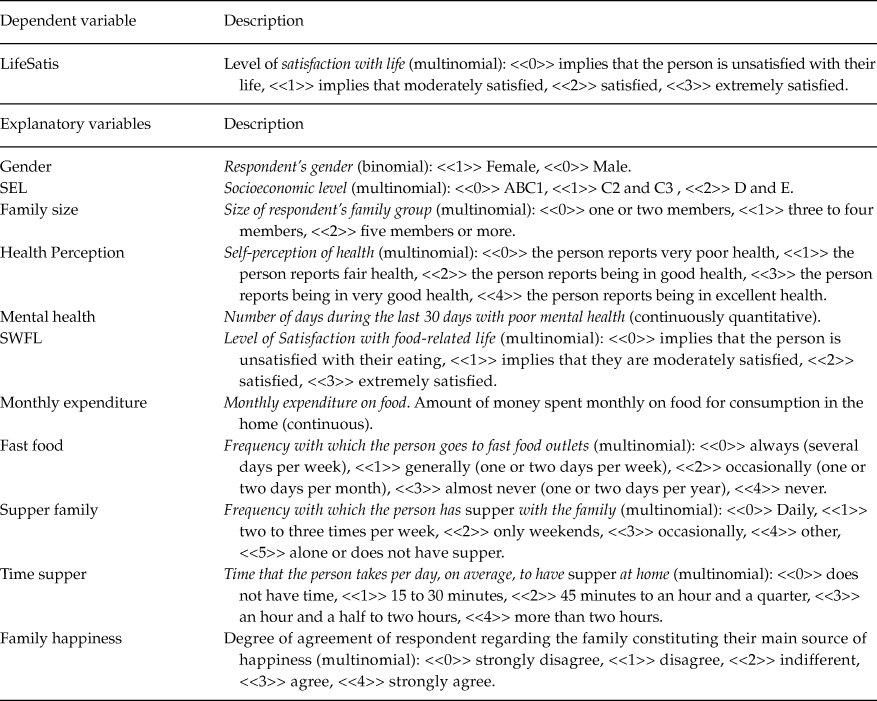
In order to compare the influence of different explanatory variables in the satisfaction with life of people in the main municipalities in central Chile, an ordered logit model (Greene, Reference Greene1999) was proposed, entering degree of satisfaction with life as the dependent variable, and the responses obtained in the questionnaire as explanatory variables. This statistical approach treats the satisfaction response categories as ordered, and applies an ordered probability model (ordered probit or ordered logit). In other words, this approach imposes ordinality on the data, with a category such as ‘‘extremely satisfied’’ viewed as having a higher rank than the category ‘‘satisfied’’ (Kristofferson, Reference Kristoffersen2010). Ferrer-i-Carbonell and Frijters (Reference Ferrer-i-Carbonell and Frijters2004) have argued that assuming cardinality or ordinality of well-being measures makes little or no difference. However, logit ordered models have been used recently to measure life satisfaction of high school students (Becchetti & Pisani, Reference Becchetti and Pisani2014), the relationship between social capital and life satisfaction (Sulemana, Reference Sulemana2014), among others. The specifications of the dependent and explanatory variables that were significant in the model generated are presented in Table 1. The following were used to measure the goodness of fit of the model: Nagelkerke's R2 adj. (Pseudo-R2) and -2 log likelihood (-2LL).
Definition of dependent variables and explanatory variables for the ordinal logit regression model generated to measure the satisfaction with life of people in the central zone of Chile

Results
Sociodemographic characteristics
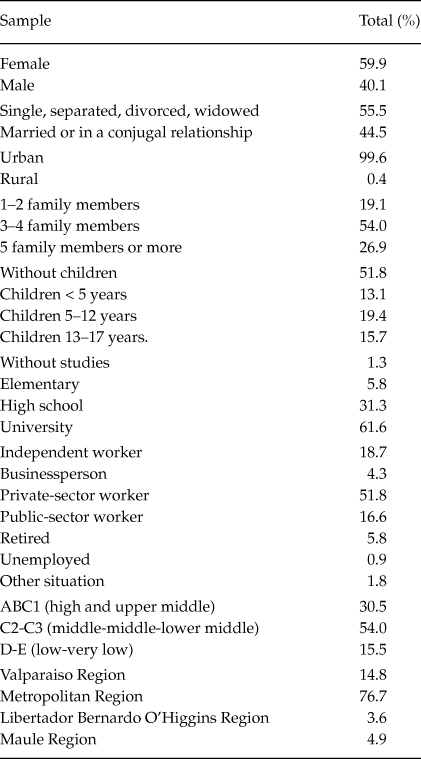
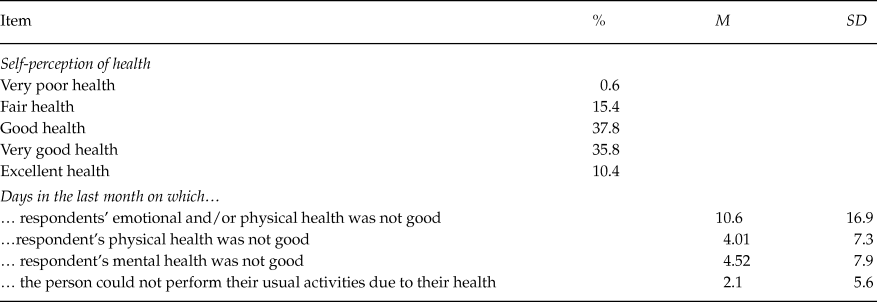
The sample was composed of mostly women (59.9%), single or without a partner (55.5%), resident in urban areas (99.6%), in family groups of three to four members (54.0%), without children (51.8%) or with children between ages 5 and 12 (19.4%), with university studies (61.6%), employed (68.4% taking private sector and public sector employees together), from high socioeconomic status (ABC1, 30.5%) (Table 2). The mean age of the sample was 37 years (SD = 13.6). Table 3 displays the results of the health-related quality of life index (Hennessy et al., Reference Hennessy, Moriarty, Zack, Scherr and Brackbill1994). The average on which the mental and/or physical health of the respondents was not good in the last month prior to the survey was 10.6 days (minimum 0, maximum 30). The greatest proportion of respondents had a good (37.8%) or very good (35.8%) self-perception of their health.
Demographic characteristics of the sample. July 2011

HRQOL results for the sample. July 2011

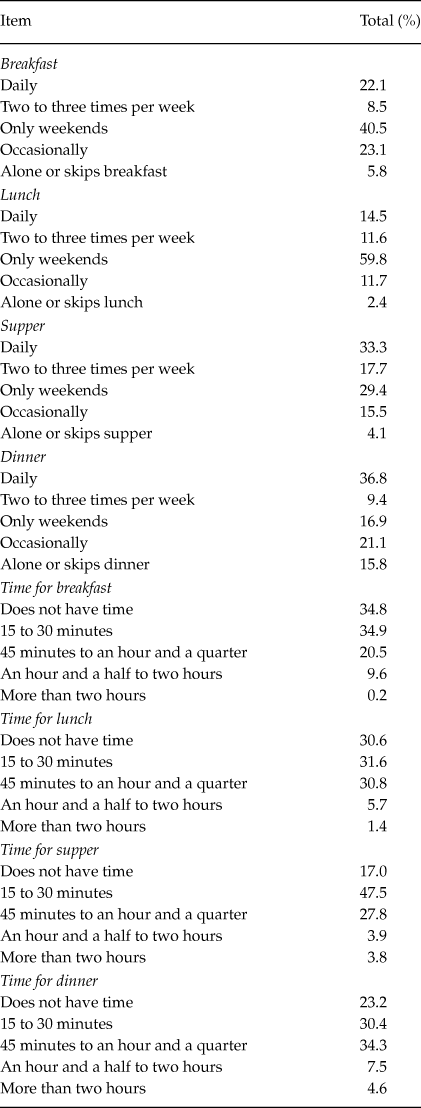
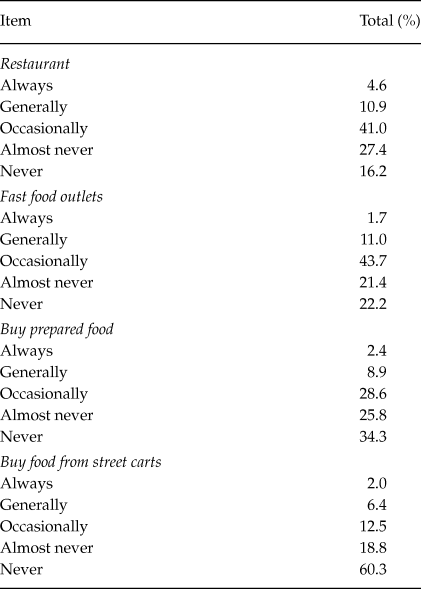
The average monthly food expenditure in the sample was USD 367.5 (486.49 Chilean pesos/1USD), a value that exceeds the national average monthly food expenditure by 16.6%, estimated for the main Chilean cities in the last Survey of Family Budgets, corresponding to USD 315.2 (National Statistics Institute, 2007). A significant part of the sample had breakfast (40.5%) and lunch (59.8%) with their family “only on weekends”; supper with the family occurred mainly daily (33.3%) and “only on weekends” (29.4%). Dinner with the family was mainly daily (36.8%) and occasionally (21.1%). Around 35% of respondents did not have time for breakfast or had 15 to 30 minutes. Approximately 31% did not have time for lunch, 31.6% had 15 to 30 minutes and 30.8% had 45 to 75 min. 17% of respondents did not have time for supper, 47.5% had 15 to 30 minutes. Just about 23.2% did not have time for dinner, whereas 30.4% had 15 to 30 minutes and 34.3% 45 to 75 minutes (Table 4). With respect to the frequency of food consumption outside the home (Table 5), the greatest proportion of respondents “occasionally” ate in restaurants (41.0%) and in fast food outlets (43.7%); “never” (34.3%) and “occasionally” (28.6%) bought prepared food and “never” bought food from street food carts (60.3%).
Frequency with which the person has meals with the family and time that the person takes per day, on average, to have meals at home in the total sample. July 2011

Frequency of consumption of food outside the home in the total sample. July 2011

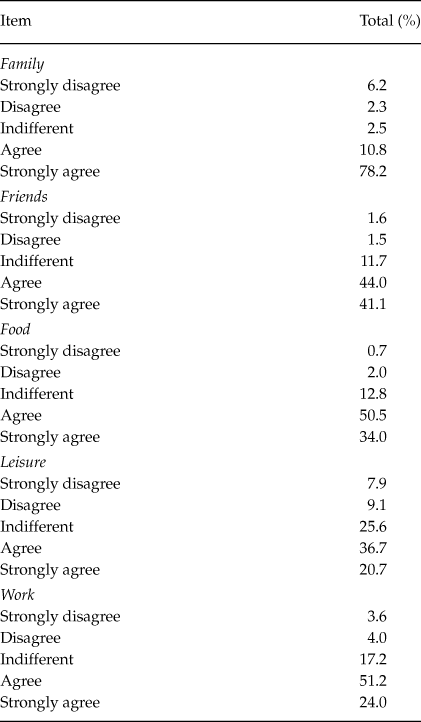
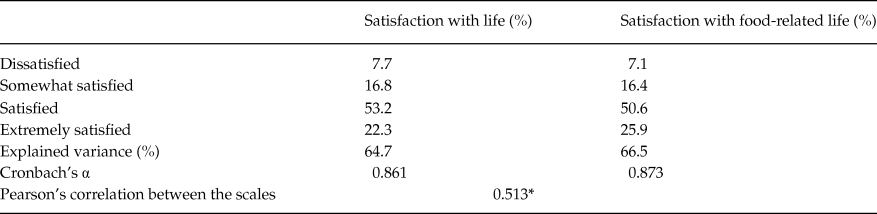
In relation to the sources of happiness (Table 6), 78.2% of respondents strongly agreed that the family was an important source of happiness, followed by friends (41.1%), food (34.0%), leisure (20.7%) and work (24.0%). The SWLS and SWFL scales presented adequate levels of internal consistency and the existence of a single factor. In both scales, “extremely dissatisfied” and “dissatisfied” were merged in a single category due to the low number of participants in each. In the total sample for both scales, the proportion of satisfied people was higher (Table 7).
Importance of five sources of happiness in the total sample. July 2011

Description of the sample according to degree of satisfaction with life and food-related life

Notes: *The correlation is significant at 0.01 (two-tailed)
Ordered logit model analysis
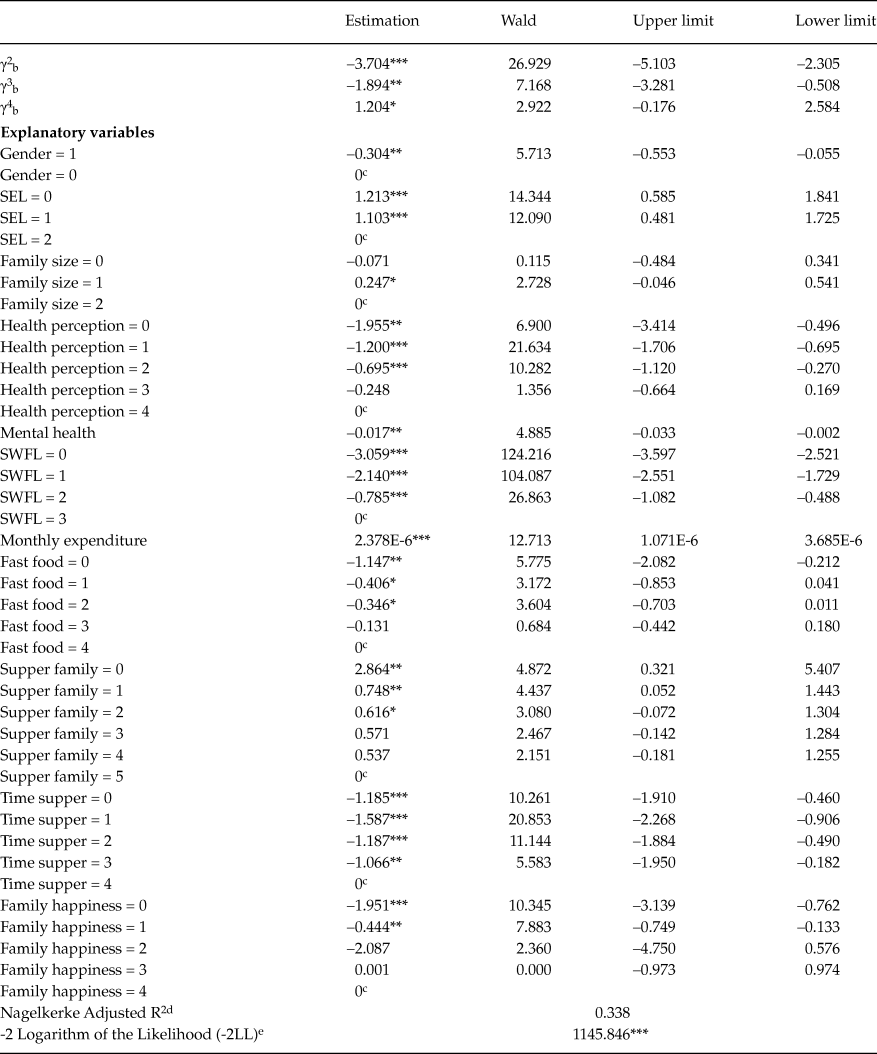
The results for the ordered logit model generated for “satisfaction with life” (LifeSatis) are presented in Table 8. The fit of the model was significant at p < .01 for the -2 log likelihood with the Nagelkerke pseudo R2 value greater than 0.3. The signs of the coefficients of the logit model generated directly show the direction of the relation of each explanatory variable with the dependent variable. The Wald statistical values indicate the individual significance of the coefficients, which, when associated with their probability, make it possible to reject or not the null hypothesis of non-significance. This study used a 10% level of significance (*p < .10), 5% (**p < .05) and 1% (***p < .01). Upper limit and lower limit are the confidence intervals for the coefficients estimated from the model. In general, the signs of the coefficients are consistent with what was expected.
Results of the ordinal logit regression model generated to measure the satisfaction with life (LifeSatis) of people in central Chilea

Notes: aSignificant variables at *p < .10, **p < .05, ***p < .01 based on the Wald statistic. bValue of the threshold or limit parameter (cut parameter). There are three threshold parameters because there are four response categories for the dependent variable "satisfaction with life” (LifeSat); cThis parameter is at zero because it is redundant. This is a comparison category for each explanatory variable in the model; dNagelkerke’s R 2 is a statistical proxy of the determination coefficient (Pseudo-R2) in the logit model; eSignificant model at the level ***p < .01 for the -2 log likelihood.
A lower likelihood of high satisfaction with life (β = –0.304) in women compared to men was observed (Table 8), which is a common finding in Latin America (Copestake, Guillen-Royo, Chou, Hinks, & Velazco, Reference Copestake, Guillen-Royo, Chou, Hinks and Velazco2009). According to the results, there is a greater likelihood of high satisfaction with life in higher socioeconomic levels (ABC1 β = 1.213; C2-C3 β = 1.103) than in people with lower incomes (D and E). Our results confirm those obtained in recent studies that concluded that higher income or a comfortable economic situation improve life satisfaction in different countries (Agrawal et al. Reference Agrawal, Murthy, Philip, Mehrotra, Thennarasu, John and Isaac2011; Diener, Ng, Harter, & Arora, Reference Diener, Ng, Harter and Arora2010; Schnettler et al. Reference Schnettler, Miranda, Sepúlveda, Denegri, Mora and Lobos2012; Yiengprugsawan, Somboonsook, Seubsman, & Sleigh, Reference Yiengprugsawan, Somboonsook, Seubsman and Sleigh2012). Considering the classic function of satisfaction (utility), depending on “consumption of goods” and “recreational behavior”, the former means that belonging to those segments with higher income implies that they have the opportunity to acquire more goods and enjoy more leisure time. This way, and considering all the other constant variables, income level indirectly contributes to a greater probability of satisfaction with life since it enables more opportunities for consumption of goods that can positively influence a person’s well-being.
Family size is a variable that also helps explain satisfaction with life (Table 8) by being associated with different dimensions of the relationship between a person and their family, such as the benefits associated with eating at home (Alonso, O’Neill, & Zizza, Reference Alonso, O’Neill and Zizza2012) or the family as a source of happiness (Delle Fave, Brdar, Freire, Vella-Brodrick, & Wissing, Reference Delle Fave, Brdar, Freire, Vella-Brodrick and Wissing2011).
Using people who stated that their health is excellent as a basis for comparison, the other groups that considered their health to be very poor (β = –1.955), fair (β = –1.200) or good (β = –0.695) most likely reported less satisfaction with life compared to the baseline group (Table 8). This is consistent with the results of Kouvumaa-Honkanen et al. (Reference Kouvumaa-Honkanen, Honkanen, Viinamaki, Heikkila, Kaprio and Koskenvuo2000), Strine, Chapman, Balluz, Moriarty, & Mokdad (Reference Strine, Chapman, Balluz, Moriarty and Mokdad2008) and the Human Development Report in Chile (UNDP, 2012), that indicate that people’s satisfaction with life tends to increase when they have a positive self-evaluation of their health. In relation to mental health, the more days spent dealing with mental health problems (β = –0,017), the lower the likelihood of a high satisfaction with life. This result confirms the relation between mental state and life satisfaction (Lyubomirsky, King, & Diener, Reference Lyubomirsky, King and Diener2005; Yiengprugsawan et al., Reference Yiengprugsawan, Somboonsook, Seubsman and Sleigh2012).
According to the results of the SWFL scale, people who are dissatisfied (β = –3.059), moderately satisfied (β = –2.140) or satisfied (β = –0.785) with their food-related life are less likely to be highly satisfied with life compared to people who are extremely satisfied with their food. Notably, in every case it was observed that the coefficient is significant to the p value < .01 (Table 8). This confirms the results obtained by Grunert et al. (Reference Grunert, Dean, Raats, Nielsen and Lumbers2007), Schnettler et al. (Reference Schnettler, Miranda, Sepúlveda, Denegri, Mora and Lobos2012) and Schnettler et al. (Reference Schnettler, Miranda, Sepúlveda, Denegri, Mora, Lobos and Grunert2013) that there is a positive relation between people’s food-related satisfaction and their satisfaction with life.
In the case of the explanatory variable referring to the monthly food expenditure, it was observed that a higher expenditure positively influenced the likelihood of high satisfaction with life (β = 2.378E-6), showing that in addition to the person’s socioeconomic status, spending on the consumption of goods – food in this case – influenced satisfaction with life (Table 8).
The habit of fast food consumption reduces the probability of high satisfaction with life when the frequency of said consumption is always (β = –2.864), generally (β = –0.406) or occasionally (β = –0.346) compared to those who stated that they never eat in fast food restaurants (Table 8). In this vein, it was observed that the likelihood of high satisfaction with life increases significantly when the person reported having supper with family either daily (β = 2.864), twice or three times a week (β = 0.748) or on weekends (β = 0.616), compared to those who have supper alone or omit this meal entirely (Table 8). With respect to the time available for supper, a lower likelihood of high satisfaction with life was observed if the person does not have time (β = –1.185), has 15 to 30 minutes (β = –1.587), 45 minutes to an hour and a quarter (β = –1.187) or between an hour and a two and a half hours (β = –1.066) compared to those who have more than two hours for supper (Table 8). This indicates that not only is it important to share this meal as a family, but that the time the family can dedicate to this meal is also relevant for a higher level of satisfaction with life because it is associated with the social interaction around food.
Finally, the decrease in the likelihood of a high satisfaction with life if the person strongly disagreed (β = –1.951) or disagreed (β = –0.444) with the family being an important source of happiness compared to those participants who strongly agreed with this statement (Table 8), is consistent with the idea that family is a universal source of gratification (Delle Fave et al., Reference Delle Fave, Brdar, Freire, Vella-Brodrick and Wissing2011) that satisfies basic human needs (Yiengprugsawan et al., Reference Yiengprugsawan, Somboonsook, Seubsman and Sleigh2012).
Discussion
This study assessed the effect of satisfaction with food-related life on life satisfaction among people of upper-middle incomes in the main municipalities of central Chile, where the population is predominantly urban. This assessment was conducted following the bottom-up approach in LS research, using, as an explanatory variable for life satisfaction (measured by the SWLS), the categories of satisfaction with food-related life obtained through the results of the Satisfaction with Food related-life (SWFL) scale in an ordered logit model.
The SWLS and SWFL scales presented adequate levels of internal consistency and the existence of a single factor for all the items. The values of Cronbach's alpha coefficient from both scales were similar than those obtained by Schnettler et al. (Reference Schnettler, Miranda, Sepúlveda, Denegri, Mora and Lobos2012) with a sample of native Mapuche people in the Araucanía Region in Chile (0.876 and 0.878, respectively). The results of the present study make it possible to confirm the existence of a positive relation between satisfaction with life and satisfaction with food-related life. The correlation between the two scales was significant and similar to that obtained in a previous study in Chile (Schnettler et al., Reference Schnettler, Miranda, Sepúlveda, Denegri, Mora and Lobos2012) and higher than that obtained in eight European countries by Grunert et al. (Reference Grunert, Dean, Raats, Nielsen and Lumbers2007). This result may be related to the fact that consumers in developing countries spend a much higher proportion of their income on food than consumers in developed countries (Selvanathan & Selvanathan, Reference Selvanathan and Selvanathan2006). Food is a need common to everyone; nevertheless, if this takes up the greatest part of the household budget, it is to be expected that this will become a significant concern and have a greater impact on the satisfaction with life of these people compared to those for whom the food budget is less relevant.
Objective life circumstances and global personality dimensions both affect LS. The top-down and bottom-up approaches are met by the interpretation of one's circumstances (Brief et al., Reference Brief, Butcher, George and Link1993). In this regard, the result that indicates that people less satisfied with their food-related life are less likely to report high satisfaction with life, reaffirms the idea that a daily basic need such as food can be an important source of life satisfaction for people, because eating is not only a biological act but an act of subjective and social significance that binds individuals with needs for affection, recognition and identity.
It also confirms that the domains of functioning closest to the personal life of individuals have the greatest influence on personal life satisfaction (García-Viniegras & González, Reference García-Viniegras and González2000). Lance et al. (Reference Lance, Lautenschlage, Sloan and Varca1989) assert that the direction of the relationship between overall and domain life satisfaction depends on the function of the domains. The function varies according to (1) the scope, the extent to which the domain encompasses only one or a few persons, entities or activities; (2) criticalness, the extent to which substitute domains are not readily available; and (3) centrality, the persistence of the individual’s conscious attention to the domain. The domain of food tends to involve a narrow scope (usually closest family members and friends), and it cannot be replaced by other domains in fulfilling the individual’s food-related demands, which require constant attention every day, even more so, every few hours. A specific, critical and central life domain like this one, according to Lance et al. may be more likely to contribute to global life satisfaction.
In this sense, food involves activities and daily considerations relating to its procurement, preparation and intake (Grunert et al., Reference Grunert, Dean, Raats, Nielsen and Lumbers2007), activities undertaken by everyone, regardless of their socioeconomic status. Moreover, food is related to other areas of life, such as health (Chen, Reference Chen2011; Dean et al., Reference Dean, Grunert, Raats, Nielsen and Lumbers2008; Mollet & Rowland, Reference Mollet and Rowland2002) and the social interaction with family and friends (Gillespie & Gillespie Reference Gillespie and Gillespie2007; Hargreaves, et al. Reference Hargreaves, Schlundt and Buchowski2002; Kniazeva & Venkatesh, Reference Kniazeva and Venkatesh2007; Macht et al., Reference Macht, Meininger and Roth2005), and this has been previously reported as a source of happiness (Macht et al., Reference Macht, Meininger and Roth2005).
Although the results complement the reports from previous studies that relate food and quality of life in low-income populations (Clark, Reference Clark2000; Guillen-Royo, Reference Guillen-Royo2008), the use of the SWFL scale in the present study makes it possible to suggest that food and the degree of satisfaction associated to it influence life satisfaction and people’s quality of life in general. This is to say that food not only has an impact on the quality of life of people who are poor, it affects everyone, including those who have access to good food, which presumably is the case for those of higher socioeconomic status.
Also, the present investigation contributes to the detection of food-related variables that influence satisfaction with life state that satisfaction is considered to reflect a comparison of what people have, to what they think they deserve, expect, or may reasonable aspire to. Income can be seen as an instrument to buy goods and services, including food, that contribute to individual well-being (Salinas-Jiménez, Artés, & Salinas-Jiménez, Reference Salinas-Jiménez, Artés and Salinas-Jiménez2010). The lack of food derived from material deprivation has a negative effect on life satisfaction (Ateca-Amestoy et al., Reference Ateca-Amestoy, Cortés and Moro-Egido2013). An increasing likelihood of a high satisfaction with life is related to the person being able to spend more money on food every month, which confirms the findings by Schnettler et al. (Reference Schnettler, Miranda, Sepúlveda, Denegri, Mora and Lobos2012). The possibility of spending a higher amount of money on food for the home is associated with the possibility of gaining access to food of better quality (French et al., Reference French, Wall and Mitchell2010; Schnettler et al., Reference Schnettler, Miranda, Sepúlveda, Denegri, Mora and Lobos2012; Story et al., Reference Story, Kaphingst, Robinson-O’Brien and Glanz2008) and variety, and according to the preferences of the individual without price limitation. This is important if we consider that food consumption is not only an act of satisfaction of the basic need for nutrition but also a source of pleasure and an expression of one’s own identity (Hausman, Reference Hausman2005; Kniazeva & Venkatesh, Reference Kniazeva and Venkatesh2007; Macht et al., Reference Macht, Meininger and Roth2005).
Despite evidence regarding happy people eating out more often (Veenhoven, Reference Veenhoven2003), the results of the present investigation indicate a decrease in the likelihood of a high satisfaction with life if the person eats in fast food outlets, always, frequently or occasionally, compared to those who never eat at this type of establishment. This may be related to the low chance people have of going home for lunch given the long distances between home and work, mainly in large cities such as capitals (76.1% of the sample is in the Metropolitan Region of Santiago). In this respect, Rezende and de Avelar (Reference Rezende and de Avelar2012) conclude that on many occasions people opt to eat out because they are pressed for time or are unable to have their meals at home on a daily basis. Even though many people cannot eat at home for the aforementioned reasons, and eating in fast food outlets becomes a convenient alternative due to the low prices and the time saving it entails, we can conclude that the consumption of food in fast food restaurants has a negative effect on satisfaction with life in the sample studied.
In Chile, supper is an evening meal traditionally to be had in the company of others, frequently chosen instead of dinner, considered a larger, more elaborated meal. In this regard, one noteworthy result is the increase in the probability of high satisfaction with life if the person can have supper with their family daily, two to three times per week or at least on weekends, compared to those who have supper without their family. This may relate to the fact that hedonic eating is mostly experienced in the presence of familiar persons who easily engage in social interactions during the meal (Macht et al., Reference Macht, Meininger and Roth2005). Food is prepared in the expectation that it will be shared and enjoyed in the company of family and friends (Dean et al., Reference Dean, Grunert, Raats, Nielsen and Lumbers2008; Gillespie & Gillespie, Reference Gillespie and Gillespie2007; Kniazeva & Venkatesh, Reference Kniazeva and Venkatesh2007). Thus, food preparation and consumption in the home are considered healthful and beneficial (Alonso et al., Reference Alonso, O’Neill and Zizza2012), because the homemade meal symbolizes the family unit (Kniazeva & Venkatesh, Reference Kniazeva and Venkatesh2007). Also, there is increasing evidence that frequency of shared family mealtimes is associated with positive health outcomes for children and youth, including reduced risks for eating disorders (Neumark-Sztainer, Eisenberg, Fulkerson, & Story, Reference Neumark-Sztainer, Eisenberg, Fulkerson and Story2008), increased consumption of healthy food and less consumption of unhealthful food (Hammons & Fiese, Reference Hammons and Fiese2011), less risk for childhood obesity (Gable, Chang, & Krull, Reference Gable, Chang and Krull2007) and greater family cohesion (Welsh, French, & Wall, Reference Welsh, French and Wall2011). However, it is not always possible to eat frequently with the family during the day, particularly in the Metropolitan Region, due to the long distances between the home and the workplace. Quick, Fiese, Anderson, Koester and Marlin (Reference Quick, Fiese, Anderson, Koester and Marlin2011) identify work/life stress among the barriers to sharing meals together. This means that on many occasions, breakfast and lunch are not eaten with the family, which might be compensated by sharing meals at the end of the day.
Therefore, if eating frequently with the family benefits the health of family members and at the same time increases people’s satisfaction with life, this practice must be promoted by the corresponding government institutions (for example, Ministry of Health, Ministry of Labor) with the aim of improving the population’s quality of life. It should be emphasized that having supper with the family not only increases the likelihood of a high satisfaction with life, the time available to eat with the family also plays an important role. Our results indicate a significant reduction in the probability of high satisfaction with life if the person has less than two hours to have supper with their family. This confirms previous studies that have shown that spending more time with family is related to a higher quality of life (Greenhaus & Powell, Reference Greenhaus and Powell2006), but the results of this study highlight the impact that having enough time to share a meal with family has on life satisfaction. In the case of the study sample, this is related again to the long commutes that are detrimental to spending more time with the family. Also, it may be related to the longer work schedule in Chile, commonly extend until 7 pm or later. There are even some types of work (many of them related to management positions), where the person must make weekends available to fulfill the goals demanded by companies, at the expense of spending this time with their family. There is evidence that those who dedicate more time and energy working at the expense of investing in their interpersonal relationships (i.e. with family) tend to experience more work-to-family conflict, and decreased family function and mental health (Smith-Major, Klein, & Ehrhart, Reference Smith-Major, Klein and Ehrhart2002). Based on our results, we agree with the proposal by Masuda and Sortheix (Reference Masuda and Sortheix2012) of creating policies that allow citizens and employees to spend more time and energy building their family relationships. Their study provided empirical evidence of the importance of allowing individuals to spend more time and devote more energy caring for their family, which, according to the results of this study, should be pursued by getting together with family to share a meal on a daily basis. Associated with the results that indicate a relation between satisfaction with life and family size, and between satisfaction with life and the frequency and time available for supper with the family, it should be noted that only the agreement that family is one of the main sources of happiness was a significant explanatory variable of satisfaction with life. Family support has a greater effect on happiness and life satisfaction, and family support has been found to buffer life satisfaction in the face of traumatic periods (North, Holahan, Moos, & Cronkite, Reference North, Holahan, Moos and Cronkite2008).
Thus, it is possible to suggest that satisfaction with life in the study sample is influenced by different areas: food (satisfaction with food-related life, the frequency of food consumption in fast food outlets, the monthly food expenditure), health (self-perception of health, days with mental health problems) and family (family size, the frequency and time available for early evening meal with the family, the level of agreement with the family being one of the main sources of happiness). The results of the study point to an important link between food and family; therefore, family meals should be pursued as a more common practice to contribute to a better life in Chile.
One limitation of this study is that the sample consisted to a large degree of participants from higher socioeconomic status, women and residents of urban areas, and this is not representative of the sociodemographic distribution in Chile. The proportion of people in the high and upper middle segment is approximately 10% (Adimark, 2004). At the same time, according to data from the 2002 Census, the percentage of women is 50.5% and the urban population is 13.4% (National Statistics Institute, 2003). Therefore, the results may be valid for people who reside in urban areas of the central regions of the country, where more than 50% of the Chilean population is located, and belongs preferentially to the higher and upper middle, middle-middle and lower middle socioeconomic levels. Another limitation is that, although the results suggest a causal relationship between LS and SWFL, the use of cross-sectional data does not allow proving causality. These limitations lead to the need to carry out further research on satisfaction with food-related life, and its relation to satisfaction with life, in a longitudinal manner and in representative samples of the population.