Implications
A 7-year study was carried out in Angus heifers to investigate possible seasonality responses in genetic lines differing in age at puberty (AP) by 62 days. The indicators of seasonality were circulating prolactin (PRL) concentration and hair growth, at around puberty. Both indicators showed inherited differences, but only PRL was associated with AP. This suggests that part of the change in AP in these genetic lines may involve changing sensitivity to seasonality or day length, and this may be mediated by prolactin.
Introduction
Studies over the last 20 years at AgResearch have established that age at puberty (AP) in grazing heifers is inherited (heritability 0.26 ± 0.03, as reported by Amyes and Morris, Reference Amyes and Morris2009), and responses of various correlated traits to selection for lower AP have been reported, including growth (Morris et al., Reference Morris, Wilson, Bennett, Cullen, Hickey and Hunter2000), carcass (Morris et al., Reference Morris, Amyes, Cullen and Hickey2006) and reproduction (Morris and Amyes, Reference Morris and Amyes2005 and Reference Morris and Amyes2007). With the management constraints involved in running the selection experiment, which included mating dates being at about the same time each year (and similarly calving dates), the expression of puberty was confounded with season.
Preliminary unpublished studies from this experiment indicated that prolactin (PRL) concentration in blood is also a heritable trait. Accordingly, serum PRL was monitored in the above selection lines, to assess whether selection for earlier AP was associated with any change in PRL, as a possible mediator of any seasonality differences between lines. Studies by Auldist et al. (Reference Auldist, Turner, McMahon and Prosser2007) have shown with dairy cows in spring, for example, that administering melatonin (a hormone which under natural conditions responds to seasonal day length changes) resulted in reduced PRL concentration and milk yield.
Berman (Reference Berman1960) reported in a cattle study that hormonal control (intervention with thyroxine) was able to mimic a seasonal influence on hair growth, with animals maintained under constant environmental conditions. In sheep, by analogy, an association between wool growth and seasonality is well known (e.g. Wuliji et al., Reference Wuliji, Weatherall, Andrews, Dodds, Turner and Wheeler1995; Pearson et al., Reference Pearson, Parry, Ashby, Choy, Wildermoth and Craven1996). Hair growth was thus investigated in the present experiment as another possible measure of response to seasonality. The objectives of this study were: (i) to estimate heritabilities of PRL concentration and hair growth in grazing Angus cattle, and (ii) to compare the selection lines for these two seasonality traits.
Material and methods
Animals
This study involved a 250-cow Angus herd and its associated young stock, managed at AgResearch’s Tokanui Station, 40 km south of Hamilton, New Zealand, and later at Whatawhata Research Station, 20 km west of Hamilton. All stock handling and sampling procedures were approved by the AgResearch Ruakura Animal Ethics Committee.
Since 1984/1985, the herd had been used in a divergent selection study, with the breeding objective being to change AP in heifers (Morris et al., Reference Morris, Wilson, Bennett, Cullen, Hickey and Hunter2000). The herd consisted of a line selected for increased pubertal age (AGE+) and another for reduced pubertal age (AGE−); these two lines grazed alongside a control unselected line. The primary animals in the present PRL study were the heifer calves from both selection lines (calf crops born in 1999 to 2005) and from the control line (1999 to 2002; line terminated thereafter). Back-cross calves, generated in the middle years (2000 to 2003), were included in this study; they were born to AGE+ and AGE− dams, and were sired by three first-cross bulls.
Numbers of heifer calves recorded totalled 629 over 7 years (range, 71 to 115 per year), comprising 59 different sire groups (56 sires from the lines and first three crosses). By line, there were 242 AGE−, 113 AGE+, 78 control and 196 back-cross animals. Heifers from the two selection lines differed in the direct selection trait, AP, by a mean of 62.2 days (15% of the mean of 416 days for the two lines over the 7 years).
Management and puberty monitoring
Calves were born over a 9-week period each year in late winter/early spring (mean date of birth, 24 August). Cows and their calves grazed on pasture consisting of a mixture of white clover and ryegrass. All calves were weaned and weighed on 1 day each year at about 4 to 5 months of age, and were then managed in separate grazing groups by sex (lines and back-crosses all together). Calves received an effective anthelmintic drench at weaning, and again at intervals thereafter. Yearling weights were recorded on all animals, on 1 day in September each year. Date at first behavioural oestrus was monitored in heifers by staff about twice-weekly from 8 to 17 months of age, assisted by their observations of paint marks by chinball-harnessed vasectomised bulls (or entire bulls during the mating period from 14 to 16 months of age). The calf ages at puberty and live weights were available from all calf crops beginning in 1985.
Prolactin and hair growth
Blood samples from the tail were obtained from all heifer calves at 2- to 3-month intervals from 11 to 18 months of age, using 10-ml vacutainer tubes, to determine serum PRL concentration. Previous reports (Whisnant et al., Reference Whisnant, Thompson, Kiser and Barb1986; Parrott and Goode, Reference Parrott and Goode1993) have suggested an association in ruminants between PRL and cortisol concentrations, and this hormone was thus also assayed from the same samples, in order to adjust PRL data for cortisol differences. Measurements of hair growth were taken as follows: a hair sample was obtained from yearling heifers near the end of winter (August) and again in summer (February) with a shearing hand-piece over the left-side ribs, and its quantity was measured by weight per unit length of the shearing blow; linear hair growth was measured 6 weeks later from the same site with a ruler.
Sample analysis
Blood samples were analysed for PRL concentration using ovine PRL (NIDDK-oPRL-1-2) for standards and radioiodination, and ovine PRL antiserum (NIDDK-anti-oPRL-2). Prolactin was iodinated by the Iodogen method (Pierce, Rockford, IL, USA), using [125I] iodide (New England Nuclear NEZ0033A, Perkin Elmer, MA, USA). The assay method was essentially as prescribed for the NIDDK reagents. Separation of antibody-bound label from free label was by second antibody precipitation using an excess sheep anti-rabbit serum (generated at the Ruakura Research Centre, Hamilton, New Zealand). Sensitivity was 0.6 ng/ml; cross-reactivity of bovine with ovine PRL was 0.8. Inter-assay and intra-assay variations at 10 ng/ml were 25.15% and 15.15%, respectively. Cortisol concentrations were determined using a double antibody radioimmunoassay method, validated for bovine use by Fisher et al. (Reference Fisher, Verkerk, Morrow and Matthews2002).
Data analyses
Age at first oestrus (AFO) was calculated from the dates of birth and of first behavioural oestrus (above), and AFO was then transformed to an underlying scale (standardised age at first oestrus, SFO) with a standard deviation of unity, as if AFO was an ordered categorical response (Gianola and Norton, Reference Gianola and Norton1981). All PRL and cortisol concentration data were transformed to natural logarithms for analysis. Preliminary fixed-effects analyses were carried out using the JMP package of SAS, version 3 (SAS, 2001). Contemporary groups were defined by year of birth, while the other fixed effects were selection line and age of dam, with a covariate for date of birth and (for PRL) a fixed effect for cortisol concentration (as a binomial, describing whether elevated or not by at least 50% above the contemporary group mean; on this criterion 15% of samples had an elevated cortisol). Animal-model restricted maximum likelihood (REML) analyses were then carried out (Gilmour et al., Reference Gilmour, Gogel, Cullis, Welham and Thompson2002) to estimate heritabilities of all traits (logePRL and logecortisol concentrations, hair weight, hair length, AP and yearling live weight), and genetic correlations (r g) and phenotypic correlations (r p) among these. A relationship matrix was used, to include all pedigrees back to the foundation stock in the 1970s; effectively this also accounted for selection line, so that selection line was not required in the REML analyses as a fixed effect. Remaining fixed effects used in the REML analyses were as described above for the fixed-effects analyses. Maternal effects were not considered here. REML procedures were also used to estimate between-cow repeatabilities of the seasonality and related traits (logePRL concentration and logecortisol concentration, hair weight and hair length) over time, using a repeated-records model.
Results
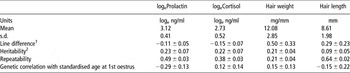
Table 1 shows the means for PRL and hair growth. Standard deviations were of intermediate size, relative to their means. Coefficients of variation ranged from 13% (logePRL) to 24% (hair weight). All traits were heritable, significant (except hair length) and there was a range of repeatability estimates from 0.21 to 0.64.
Selection line differences and parameter estimates (± s.e.) for loge prolactin concentration, loge cortisol concentration and hair growth (weight and length)

1AGE− mean minus AGE+ mean at ∼13 months of age.
2Single-trait analyses.
The r g estimate between logePRL concentration and SFO (Table 1) was significant (P < 0.05), while the other three estimates with SFO in Table 1 were not significantly different from zero. Estimates of r g for logePRL concentration with other traits were as follows: with hair weight −0.18 ± 0.14 (r p −0.04 ± 0.03); hair length 0.27 ± 0.31 (r p −0.00 ± 0.04) and yearling weight 0.15 ± 0.11 (r p 0.05 ± 0.04).
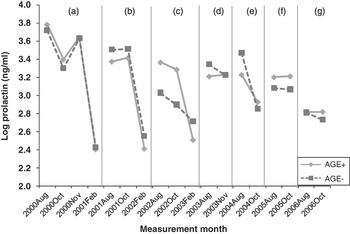
Table 1 also shows that the AGE− line was 0.11 ± 0.05 units lower in logePRL than the AGE+ line at ∼13 months of age in October (P < 0.05), indicating that the AGE− line had an 11% lower PRL concentration. There was a significant effect of sampling time (‘year-season’) on logePRL (P < 0.001), but no significant effect for line over all ages or for the interaction of line and year-season (Figure 1). While both measures of hair growth appeared to be greater in the AGE− line (weight by 4%; length by 3%), neither difference was significant. Nor were the line differences in logecortisol significant overall. However, when the line differences were significant, the AGE− line had lower cortisol concentration than the AGE+ line (by 15% ± 7% in October samples, and by 20% ± 7% when combining data from late spring samples: October to December period).
Effect of heifer selection line (AGE− v. AGE+) on loge prolactin concentration by measurement date, for seven year-of-birth groups: (a, 1999; b, 2000; … g, 2005).

Discussion
Line means
The AGE− line had a significantly lower value in PRL concentration (by 11%) and in cortisol concentration (by 15%) than the AGE+ line at ∼13 months of age. However, the line difference in PRL concentration was not present at later ages; there was also an apparent inconsistency at 13 months with the sign of the genetic correlation between SFO and logePRL, which was negative. Possibly this could reflect the melatonin-PRL link being down-regulated after puberty, in a manner similar in principle to the observations of Smith et al. (Reference Smith, Clay, Caraty and Clarke2007) in sheep, although these are short-day breeders. For the hair growth traits, neither the genetic correlations with AP, nor the line differences, were significant.
Genetic parameters
Three of the four seasonality traits measured had significant heritabilities in this experiment (Table 1). Other bovine reproductive traits also show seasonality, including post-partum anoestrous interval (Montgomery et al., Reference Montgomery, Davis and Hurrell1980) and ovulation rate (Echternkamp et al., Reference Echternkamp, Gregory, Dickerson, Cundiff, Koch and Van Vleck1990), so it is perhaps not surprising that hormonal traits such as PRL concentration at around puberty are also heritable. In a study with breeding ewes in Virginia, United States, where selection was applied to change autumn lambing ability, there was also heritable variation for PRL; heritabilities of log-transformed nocturnal melatonin and PRL concentrations were 0.29 (P = 0.05) and 0.26 (P < 0.10; Notter and Chemineau, Reference Notter and Chemineau2001).
For PRL, with a heritability of intermediate size (0.23) and a high repeatability (0.49), it would be feasible to select change to PRL concentration, although it is not immediately obvious whether AP would also change. This is because a different PRL concentration could result from higher pituitary secretion, a change in receptor binding, or some modification of feedback mechanisms between AP and PRL. Yearling weight had a small genetic correlation with PRL, but direct selection to change PRL is unlikely to change yearling weight by much. It is already known that yearling weight and SFO are correlated (Morris et al., Reference Morris, Amyes, Cullen and Hickey2006), and that the AGE− line was heavier than the AGE+ line at the yearling stage.
Conclusions
There were significant differences between AP lines in PRL and cortisol, especially in spring at ∼13 months of age. In contrast, there were no significant differences between lines in hair growth (neither weight nor length). Further study might be able to elucidate whether the relationships observed here between PRL and pubertal age are the same in autumn-born cattle.
Acknowledgements
We thank Ken Jones (Tokanui) and Shane Hill (Whatawhata) and their staff for care of stock and assistance with sample collection, at both sites. Funding was provided by the New Zealand Foundation for Research, Science & Technology.