INTRODUCTION
Predator–prey dynamics between white sharks (Carcharodon carcharias) and pinnipeds have gained considerable attention in South Africa (Martin et al., Reference Martin, Hammerschlag, Collier and Fallows2005) and elsewhere (Ainley, Reference Ainley, Henderson, Huber, Boekelheide, Allen and McElroy1985; Klimley et al., Reference Klimley, Anderson, Pyle and Henderson1992, Reference Klimley, Pyle, Anderson, Klimley and Ainley1996; Anderson et al., Reference Anderson, Klimley, Pyle, Henderson, Klimley and Ainley1996; Pyle, 1996). Strong (Reference Strong, Klimley and Ainley1996) hypothesized that a shark would optimize its hunting efficiency by initiating a high speed attack sequence from depth and distance so as to maximize the element of surprise. Consistent with Strong's hypothesis, Martin et al. (Reference Martin, Hammerschlag, Collier and Fallows2005) documented that over 85 per cent of attacks on Cape fur seals (Arctocephalus pusillus pusillus) in False Bay to the east of the Cape Peninsula, South Africa, consisted of an initial high speed breach (Martin et al., Reference Martin, Hammerschlag, Collier and Fallows2005). Such observations highlighted the vulnerability of pinnipeds as they traverse between offshore foraging grounds and terrestrial rookeries, particularly in close proximity to the pinniped rookery where their presence is highly predictable (Rand, Reference Rand1956), and sharks can effectively adapt their habitat use to optimize the likelihood of capturing seals.
Besides travelling to and from foraging grounds, pinnipeds may also enter the water adjacent to their colony for other purposes, including thermo-regulation, play or competition for space within the colony (Rand, Reference Rand1967). Frequently, seals entering water for this purpose form groups and are said to be ‘rafting’ (the act of several seals lying together at the surface with little or no directional movement). Little attention has been paid to: (a) the predation risk of pinnipeds involved in this activity; (b) the behaviour strategies adopted by pinnipeds to mitigate predation risk; or (c) the behavioural response of white sharks to the presence of such seal activity. In this communication we report on a series of observed behavioural interactions between white sharks and Cape fur seals adjacent to Geyser Rock, South Africa.
MATERIALS AND METHODS
Geyser Rock (34°41′s 19°25′E) lies directly opposite Dyer Island (a marine seabird sanctuary), and hosts an estimated 55,000 Cape fur seals (Davids, personal communication). A 230 m wide channel, between 3 and 6 m deep, separates the islands. Cape fur seals commonly raft in this channel adjacent to Geyser Rock (Figure 1). White sharks are seasonally abundant in the waters surrounding Geyser Rock between April and November (Kock & Johnson, Reference Kock, Johnson, Nel and Peschak2006).
An aerial view of the channel that lies between Dyer Island (north) and Geyser Rock (south) (courtesy of Google Earth). Approximate positions of both normal rafting and outer rafting (OR) are indicated. The approximate positions (based on land marks) of successful attacks (SP), unsuccessful attacks (UP), scavenging events (SC) and con-specific alerting (CA) occurring within, or near to, the channel are indicated.

On 135 days from November 1999 to January 2001, for 4–6 hours a day (0800–1700 h), white sharks were attracted to a vessel anchored within the channel, as part of research being undertaken by R.L. Johnson for his MSc thesis (Reference Johnson2003). During the course of this research, opportunistic sightings of interactions (predatory and non-predatory) between white sharks and Cape fur seals in the channel were recorded. Vertical water visibility was recorded on an hourly basis using a Secchi disc. If the channel bottom was visible, then visibility was recorded as greater than water depth.
RESULTS
A total of 11 successful attacks (SP), three unsuccessful attacks (UP), and three scavenging events were witnessed (N = 14; Figure 1). Seven attacks involved living seals which were, for various reasons, stationary in the water at the time of the attack. The attacks on the stationary seals included four (3 SP, 1 UP) that appeared to be sleeping (i.e. floating vertical in water column with head at surface), two young of the year (YOY) weakly flailing in the current (2 SP), and one apparently moribund sub-adult (1 SP). Another three attacks (other than on stationary seals) consisted of two on seals that were porpoising, as part of a group, across the channel mouth (1 SP, 1 UP), and one on a seal within a rafting group adjacent to Geyser Rock (1 UP). The circumstances of the remaining four attacks were unknown as they were first sighted after feeding had commenced (4 SP). It is, however, improbable that these four attacks represented scavenging as no floating carcasses were seen in the area prior to the attack (i.e. 4 SP). On two occasions, sharks were observed prior to their initial strike. On 19 January a flailing YOY seal floated past the research vessel. A ~250 cm total length (TL) white shark accelerated slightly (compared to normal patrolling speed) towards the seal and gripped the seal in its mouth. The seal was carried ~10 m before the shark bit down and began consuming it. On 10 March a juvenile drifted out from Geyser Rock and lay resting against the research vessel's anchor rope. A ~250 cm TL shark slowly approached and tentatively bit the seal (investigatory bite). The seal awoke and displayed evasive manoeuvres—leaping and diving in multiple directions—before escaping beneath the water's surface towards Geyser Rock (Figure 2A).
(A) Unsuccessful attack by a ~250 cm white shark on a sleeping sub-adult Cape fur seal. In the background is Geyser Rock, with typical rafting seals; (B) a patrolling white shark is being mobbed (combination of HA, SCO, and HP behaviours) by a group of Cape fur seals (swimming direction of white shark indicated by arrow).

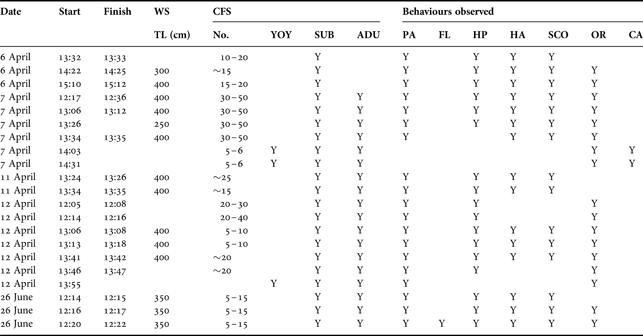
Twenty-one encounters were recorded that did not consist of any obvious attempt by the white shark to attack a seal, the details of which are described in Table 1. During only one of these encounters were seals observed to take flight. On that occasion, a small group of rafting seals was seen to erupt out of the water and escape towards Geyser Rock; moments later a white shark was observed patrolling the area vacated by the fleeing seals. Most commonly, mobbing-type behaviour was the initial response displayed by seals to a patrolling shark (Figure 2B). This included ‘scooting’, defined as when a seal would leave its rafting group and approach a shark along the sea-floor to within one or two metres, harass the shark, then return immediately towards the rafting group. This type of harassment was typically directed at the shark from behind, with the seals approaching the shark's tail region. Although inter-specific contact was not observed, its occurrence could not be excluded. Seals were also observed to porpoise behind the shark in a distinctive manner, whereby they would leap high out of the water with very little directional velocity (high porpoising). The number of seals involved in such an interaction would vary during the course of the shark's progress along Geyser Rock's shoreline, because just as some seals ceased mobbing the shark after it had passed them by, others would encounter the shark and begin mobbing it. Seals of all size-classes (excluding YOY) and of either sex participated in these mobbing events. Following such mobbing encounters, the distribution of the seals in the channel would change, with a number of seals rafting further away from Geyser Rock (outer rafting) compared with prior to the shark's arrival. Typically not all the seals would shift location, so that two distinct rafting groups would be apparent, one close to Geyser Rock and the other further out. The outer rafts would persist for 10–30 minutes following the last sighting of a shark or of a mobbing event. On two occasions during 7 April 2000, a sleeping YOY seal (most likely a different individual on each occasion) was sighted drifting away from Geyser Rock. Around 30 minutes before the first of these two sightings (which were approximately 10 minutes apart), a shark had been observed patrolling near Geyser Rock. On each occasion, four to six seals (non YOY) swam towards and bumped the sleeping YOY (conspecifics alerting); as soon as it was aroused, all the seals swam towards Geyser Rock. During all non-predatory shark–seal encounters (N = 21), the vertical visibility of the water exceeded the channel depth (i.e. the bottom was clearly visible).
Non-predatory (no attempted attack) encounters between white sharks (WS) and Cape fur seals (CFS) within the channel. Approximate sizes of groups varied considerably as seals would frequently join and leave the interaction as the shark patrolled along the coastline. Only age-classes specifically observed were included, although other non-observed age-classes may have been involved.

PA, patrolling; FL, fleeing; HP, high porpoising; HA, harassing; SCO, scooting; OR, outer rafting; CA, conspecific alerting.
DISCUSSION
Waters adjacent to pinniped rookeries are frequently associated with the presence of white sharks. In South Africa, white sharks appear to target Cape fur seals as seals shuttle between feeding grounds and their island rookery (Martin et al., Reference Martin, Hammerschlag, Collier and Fallows2005). Our results show that such predator–prey dynamics are not limited to a white shark's ability to ambush pinnipeds (see Strong, Reference Strong, Klimley and Ainley1996 and Pyle et al., Reference Pyle, Klimley, Anderson, Henderson, Klimley and Ainley1996) while pinnipeds traverse to and from their feeding grounds. The channel environ of this study offers little opportunity for white sharks to ambush Cape fur seals due to its depth (maximum 6 m) and clear visibility, yet they successfully attack, and feed off, pinnipeds here. Of interest was the fact that 90% (N = 10) of fully witnessed successful attacks/scavenging were on either dead (N = 3) or stranded (N = 6) seals. Although the channel may limit predation opportunities on alert seals, sharks patrolling directly adjacent to Geyser Rock encounter other predation opportunities i.e. non-alert seals (sleeping), or seals that are incapable of escape (stranded YOY, injured, moribund or dead seals). The approach pattern of two sharks witnessed (slow without breaching) prior to them attacking seals further suggests a conscious targeting of incapacitated or unaware seals, in which camouflage is not a precursor to success. In South Africa, ontogenetic shifts in the white shark diet exist, in which smaller sharks are primarily piscivorous, whilst pinnipeds become increasingly important in the diet as sharks grow (Cliff et al., Reference Cliff, Elst, Govender, Witthuhn, Bullen, Klimley and Ainley1996). Targeting incapacitated or dead pinnipeds may offer smaller sharks opportunities to exploit this resource at a comparatively earlier life stage. In addition, such opportunistic capture of pinnipeds may have been an evolutionary precursor to the ambush hunting described elsewhere (Martin et al., Reference Martin, Hammerschlag, Collier and Fallows2005). Opportunistic capture of ‘non-alert’ seals may also have the additional advantage of possibly requiring less energy and having a higher success rate than sharks capturing seals through ambush attack.
The presence of white sharks patrolling the channel can negatively affect a seal's fitness directly (predation) or indirectly (predatory fear causing avoidance of optimal habitat). As such, behavioural adaptations that lower predatory risk are an expected consequence. Within the channel environs, Cape fur seals appear to utilize mobbing for this purpose. Stewardson & Brett (Reference Stewardson and Brett2000) first identified mobbing of white sharks by pinnipeds at Plettenberg Bay in South Africa (a single seal mobbing a single shark). Although recognizing its possible function in reducing predation risk, it was discussed, among other possibilities, that the expression of this behaviour was linked to the physiological state of the large bull seals (e.g. heightened androgen and aggression) during the breeding season. A second report of a white shark being mobbed, this time by the Australian fur seal (Arctocephalus pusillus doriferus) introduced multiple mobbers, although again the group was restricted to large male seals (Kirkwood & Dickie, Reference Kirwood and Dickie2005). Such observations (single encounters and limited to a few adult males) lend themselves towards the conclusion that mobbing of white sharks is a dangerous practice as mobbers immediately face possible injury. Indeed, one of the five mobbing seals was bitten by the white shark during observations by Kirkwood & Dickie (Reference Kirwood and Dickie2005). Alternatively, in this study mobbing seems to be a common tactic amongst seals, performed by all age-classes (barring YOY) and both sexes, thereby implying that associated risks to mobbers in the environs of the channel is comparatively less.
Optimum environmental conditions (e.g. murky, eutrophic water) were cited as possible factors enhancing the ability of white sharks to stay camouflaged, thereby increasing the possibility of a successful attack (Pyle et al., Reference Pyle, Klimley, Anderson, Henderson, Klimley and Ainley1996). White sharks typically hunt in three-dimensional habitats, in which the vertical dimension (approaching from depth) is frequently used to successfully attack pinnipeds (Strong, Reference Strong, Klimley and Ainley1996). The channel is shallow (3–6 m depth), and combined with water visibility in excess of depth, the channel is effectively reduced to a two-dimensional habitat, in which sharks are unable to utilize depth to surprise rafting seals. Channel depth and clarity may also affect the number of mobbers participating. The advantages of ‘multiple mobbers’ participating in predator mobbing have been examined in mammals (Tamura, Reference Tamura1989) and birds (Flasskamp, Reference Flasskamp1994). When joined by other individuals, mobbing was intensified and prolonged, thereby suggesting that the predator is affected by the number of mobbers (Ostreiher, Reference Ostreiher2003). We hypothesize that the favourable physical environment of the channel significantly reduces predation risk to a mobber, and as such facilitates regular participation by large numbers of fur seals (increased effectiveness) when encountering a shark.
Mobbing as an anti-predation strategy arises when the costs of immediate predation risk, are outweighed by the benefits to the individual's fitness (overall predation risk, social standing, etc.) or to its inclusive fitness (e.g. reduced predation risk for kin; Hamilton, Reference Hamilton1964). Specifically, the components of mobbing behaviour can potentially fulfil a number of functions that benefit the mobber's fitness. Through scooting and harassing, the mobbers (seals) communicate their awareness of the shark's presence, and make the shark cognizant that the element of surprise is lost (i.e. the ‘perception advertisement’ hypothesis, Frankenberg, Reference Frankenberg1981). Mobbers may communicate intra-specifically via ‘high porpoising’ (deliberate directional swimming while porpoising at an exaggerated height) the ‘presence’ and ‘whereabouts’ of a predator to ignorant con-specifics. In addition, high porpoising may advertise to a patrolling shark the futility of attempting to attack such a ‘healthy’ seal, in the same manner that energetic ‘stotting’ of gazelles may dissuade predators such as wild dogs (Lycaon pictus) (Zahavi & Zahavi, Reference Zahavi and Zahavi1997). Predator absence is better than a present but discouraged predator. Harassment by seals may assist in driving the shark away from the immediate rafting area, similar to small birds mobbing owls (the ‘move on’ hypothesis, Flasskamp, Reference Flasskamp1994). Mobbing can, of course, be innately selfish. The opportunity for seals to interact with one of their major predators, but in an environment that effectively shackles that predator, could provide an important learning experience, teaching individuals about predator avoidance.
The establishment of ‘outer rafts’ following sighting of a patrolling shark increases the collective vigilance of rafting seals in what is effectively a two-dimensional habitat (depth being removed). Indeed, the establishment of outer rafts by seals may be a function of the benign environment of the channel. The channel's shallow, clear water promotes vigilance as a method of predator avoidance as well as being conducive to outer rafting—it is easier for seals to outer raft in a sheltered area. It remains unknown why outer rafting is not a permanent feature of the seal behaviour in the channel, but it is possible that unrecognized costs associated with this behaviour exist.
Alerting YOY conspecifics, via bumping, was conspicuous communication behaviour. Barlow (Reference Barlow1972, Reference Barlow1974) described Galapagos sea lions Zalophus californianus wollebaeki interacting with seal pups in the presence of Galapagos sharks Carcharhinus galapagensis (apparently to warn them), for which there may be several explanations. Paternalism is possible though unlikely, as male pinnipeds are not necessarily predisposed to caring for pups—they often squash them (Miller, Reference Miller1974). However, such apparent altruistic behaviour may arise if the inclusive fitness benefits outweigh the risks incurred. Such benefits would arise if a previous alerter, or its kin, was subsequently alerted to a predator's presence by one or more unrelated conspecifics. Curiosity could also prompt a seal to bump a YOY. The bumping of an object is advantageous to an individual if such bumping reveals a benefit, e.g. food.
ACKNOWLEDGEMENTS
This work formed part of a larger study funded by the Department of Environmental Affairs and Tourism (DEAT), the University of Pretoria, Western Cape Nature Conservation Board and the International Association of Impact Assessment—South African affiliate. Grateful thanks to Western Cape Nature Conservation Board and Tony Venter (Dyer Island headman) for permission to work from Dyer Island, assistance, and the use of facilities. Logistical support by Marine Dynamics (supplied the research vessel). Others who assisted in this research are Deon Sadie (formerly University of Stellenbosch), Mike Meyër (DEAT), Stephan Swanson (formerly DEAT), Deon Kotze (DEAT), Mike Patterson (formerly DEAT), Michael C. Scholl (University of Cape Town) and Lezanne Brits (SAMPLA).