Introduction
Smectite is commonly formed by weathering or by diagenetic or hydrothermal alteration of volcanic glass or minerals such as feldspars, micas, olivine, hornblende, and augite of volcanic and pyroclastic rocks and is the main constituent of bentonites (Grim & Güven Reference Grim and Güven1978; Elliott Reference Elliott1993; Christidis et al. Reference Christidis, Scott and Marcopoulos1995; Christidis & Dunham Reference Christidis and Dunham1997; Christidis & Scott Reference Christidis and Scott1997; Christidis Reference Christidis1998, Reference Christidis2001; Wulaningsih et al. Reference Wulaningsih, Humaida, Harijoko and Watanabe2013; Ghanem & Jarrar Reference Ghanem and Jarrar2013; Motoki et al. Reference Motoki, Sichel, Vargas, Melo and Motoki2015; Kadir et al. Reference Kadir, Külah, Önalgil, Erkoyun and Elliott2017). During alteration, the glass shards and igneous minerals react with meteoric water or hydrothermal fluids via a solid-solution mechanism, resulting in micro- and macro-scale physicochemical environmental conditions – characterized by local variations of Al, Mg, and Fe – and a pH in the range of 8 to 9 favor the precipitation of smectite (Huff et al. Reference Huff, Anderson, Rundle and Odin1991; Ver Straeten Reference Ver Straeten2004; Takagi et al. Reference Takagi, Koh, Song, Itoh and Mogi2005; Środoń et al. Reference Środoń, Clauer, Banas and Wójtowicz2006; Ray et al. Reference Ray, Collings, Worton and Jones2011; Paz et al. Reference Paz, Angélica and Neves2012; Osborn et al. Reference Osborn, Duffield, Elliott, Wampler, Elmore and Engel2014; Ekinci Şans et al. Reference Ekinci Şans, Esenli, Kadir and Elliott2015; Huff Reference Huff2016). These microenvironmental geochemical variations may vary considerably yielding significant compositional variations of smectites (Christidis & Dunham Reference Christidis and Dunham1997). These microenvironmental conditions may also favor precipitation of carbonates (dolomite, siderite), due to increase in Mg/Ca or Fe/Ca activity ratios and the consumption of Al during/following formation of smectite (Weaver & Beck Reference Weaver and Beck1977).
The Miocene volcano-sedimentary units are widespread in the tectonic Balıkesir basin in western Anatolia and were altered, resulting in the development of kaolinite, halloysite, alunite, and borate deposits with economic potential (Ece & Schroeder Reference Ece and Schroeder2007; Ece et al. Reference Ece, Schroeder, Smilley and Wampler2008, Reference Ece, Ekinci, Schroeder, Crowe and Esenli2013). Although most of these deposits in western Anatolia developed under a tectonically controlled hydrothermal alteration process in the Miocene volcanic units, the absence of hydrothermal clues such as lateral and vertical mineralogical and geochemical zonation and sulfur and iron phases (Mutlu et al. Reference Mutlu, Sariz and Kadir2005; Kadir & Akbulut Reference Kadir and Akbulut2009; Kadir & Kart Reference Kadir and Kart2009; Kadir et al. Reference Kadir, Erman and Erkoyun2011) in the study area suggest that the genesis of Balıkesir bentonite is still open to debate.
The mineralogical and geochemical properties of Yeniköy and Bigadiç (Balıkesir) bentonites were studied by Kocabaş (Reference Kocabaş2006) and Çoban (Reference Çoban2014). Prior to this research, no detailed information was available concerning the mineralogical or geochemical characteristics and genesis of the bentonite deposits of the Miocene volcanic units in the Balıkesir area, which have economic potential as raw material for use in the paper and bleaching industries in Turkey. The aim of the present study was, therefore, to determine the mineralogy and geochemistry of the bentonite deposits and discuss their genetic relationship with volcano-sedimentary units. A further purpose was to compare bentonite deposits of the eastern Aegean Islands of Samos, Chios, and Thrace of the same age and geological environment (Ekinci Şans et al. Reference Ekinci Şans, Esenli, Kadir and Elliott2015; Koutsopoulou et al. Reference Koutsopoulou, Christidis and Marantos2016). This comparison aimed to underline the main parameters which controlled the formation of these deposits and to interpret the differences observed between the various deposits of the broader area, taking into account the composition of the parent rocks.
Geological Setting and Depositional Environment
Geological Setting
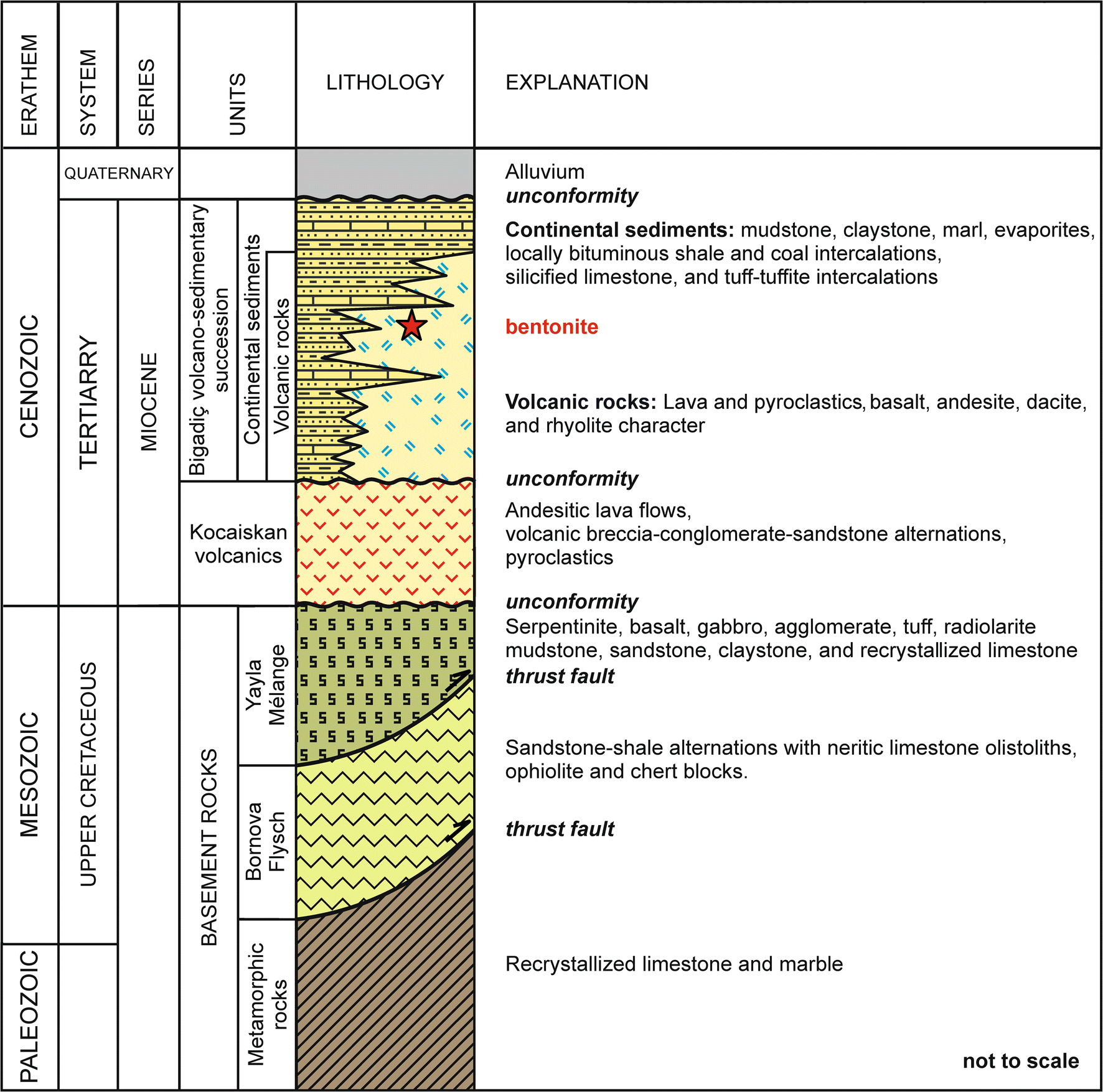
Basement rocks of the area studied comprise Paleozoic–Mesozoic metamorphic rocks, Upper Cretaceous (Maastrichtian) Bornova Flysch, and Upper Cretaceous Yayla ophiolitic mélange (Fig. 1). Paleozoic-Mesozoic metamorphic rocks are composed of recrystallized limestones and marbles and are overlain tectonically by Upper Cretaceous (Maastrichtian) Bornova Flysch. The Bornova Flysch crops out at the southwestern side of the İzmir-Ankara-Erzincan Suture Zone (IAESZ) and consists of olistoliths and ophiolitic blocks bearing intensely sheared and folded detrital sediments (Konuk Reference Konuk1977; Akdeniz Reference Akdeniz1980; Erdoğan et al. Reference Erdoğan, Altner, Güngör and Özer1990; Okay & Siyako Reference Okay, Siyako and Turgut1993; Okay et al. Reference Okay, Satr, Siyako, Monie, Metzger, Akyüz, Yin and Harrison1996, Reference Okay, Tansel and Tüysüz2001). The Bornova Flysch is overlain tectonically by the Upper Cretaceous Yayla ophiolitic mélange. The Yayla ophiolitic mélange is composed of serpentinite, basalt, gabbro, agglomerate, tuff, radiolarite-mudstone, sandstone, claystone, and recrystallized limestone and is overlain unconformably by Lower Miocene Kocaiskan volcanics. This unit is the first product of the Miocene volcanism in western Anatolia and is composed of andesitic lava and pyroclastic rocks. The unit is overlain unconformably by the Miocene Bigadiç volcano–sedimentary succession (BVSS). The BVSS is composed of volcanic (rhyolitic and dacitic Sındırgı volcanics, Gölcük Basalt, trachyandesitic dikes of the Kayırlar Volcanics, and basalts and andesites of the Şahinkaya Volcanics) and lacustrine sediments intercalated with volcano-sedimentary units (Erkül et al. Reference Erkül, Helvacι and Sözbilir2005a). Lacustrine sediments of the BVSS comprise mudstone, claystone, marl, evaporites, and silicified limestone intercalated with tuff and tuffite. This unit has been described as the Soma Formation by Akyürek & Akdeniz (Reference Akyürek and Akdeniz1989) and Pehlivan et al. (Reference Pehlivan, Duru, Dönmez, Ilgar, Akçay, Erdoğan and Özer2007). These tectonically deformed and folded sediments are also intercalated locally with bituminous shale and coal levels (Akyürek & Akdeniz Reference Akyürek and Akdeniz1989). All the aforementioned formations are overlain unconformably by Quaternary alluvium (Fig. 2).
Geological map of the Balıkesir area (modified from MTA 2002)

Stratigraphic section of the Balıkesir area (modified from Akyürek & Akdeniz Reference Akyürek and Akdeniz1989; Erkül et al. Reference Erkül, Helvacι and Sözbilir2005a; Pehlivan et al. Reference Pehlivan, Duru, Dönmez, Ilgar, Akçay, Erdoğan and Özer2007). Stratigraphic symbols are as defined in Fig. 1

Lithology
The lithologies which have been distinguished within the bentonite-bearing Miocene Bigadiç volcano–sedimentary succession in the Balıkesir region are described below.
Mudstone
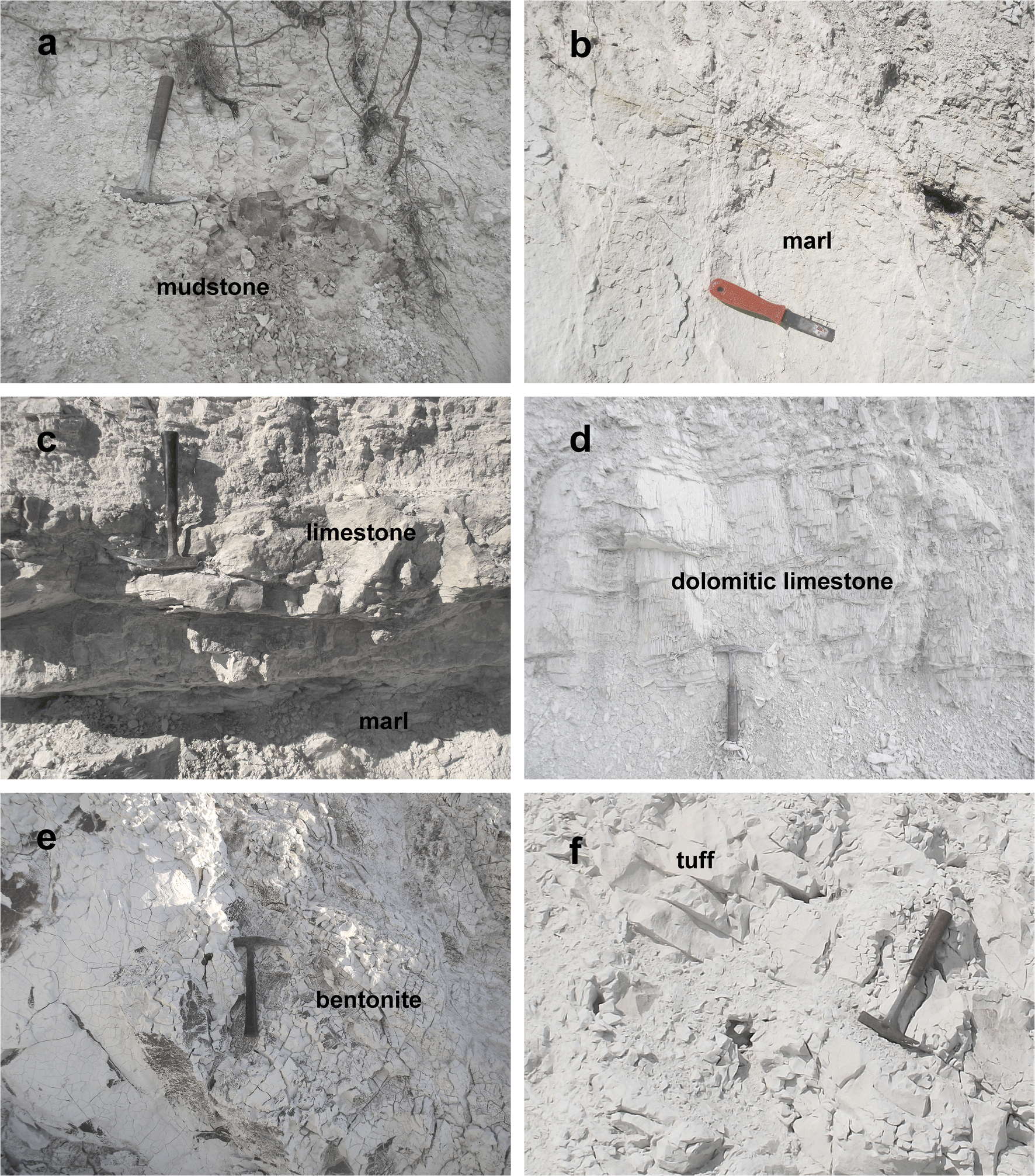
This mudstone facies is characterized by different thicknesses (10–50 cm) of mudstone layers in the bentonite deposits. The mudstones are light brown in color. They contain desiccation cracks, relict plant rootlets, and Mn oxide stains (Fig. 3a).
Marl
This marl facies is white to cream in color, thin bedded (10–50 cm), and contains desiccation cracks filled by relict plant rootlets and Mn oxide stains (Fig. 3b).
Limestone and dolomitic limestones
This facies is characterized mainly by dolomitic limestones, white to cream in color, medium to thick bedded (1–3 m), is fractured, Mn oxide stained, and contains silica bands and local occurrences of argillaceous limestone (Fig. 3c,d).
Claystone
This facies is characterized by white, beige, and locally light brown, 10–100 cm thick, smectite-rich clays in the bentonite deposits. The claystones contain recent desiccation cracks, relict plant rootlets, and Mn oxide stains as fracture in-fills (Fig. 3e,f).
Tuff
This facies is friable, locally massive and thin bedded (30 cm–5 m). It is composed mainly of ash and locally epiclastic rock fragments and volcanic materials, such as pumice, volcaniclastic grains, and devitrified glass shards. It is pink, white, or grayish-white in color. The composition of the tuff ranges from rhyolitic to andesitic and the tuffaceous units show intense argillization (Fig. 3g,h).
Field photographs of the Balıkesir bentonite deposits. (a) Mudstone in the Bereketli bentonite deposit; (b) marl layers in the Yeniköy bentonite deposit; (c,d) alternation of carbonate and marl units in the Çağış bentonite deposit; (e) close-up view of bentonite in the Çağış bentonite deposit; (f) tuffaceous units intercalating the Çağış bentonite deposit; (g,h) general view of the Çaldere bentonite deposit; (i) general view of the Yeniköy bentonite deposit hosted by a tuffaceous unit and overlained by carbonate; (j) general view of the Çağış bentonite deposit overlain by carbonate; (k) Bereketli bentonite deposit intercalating tuffaceous units; and (l) enlarged view of k


General Features of Bentonite Deposits
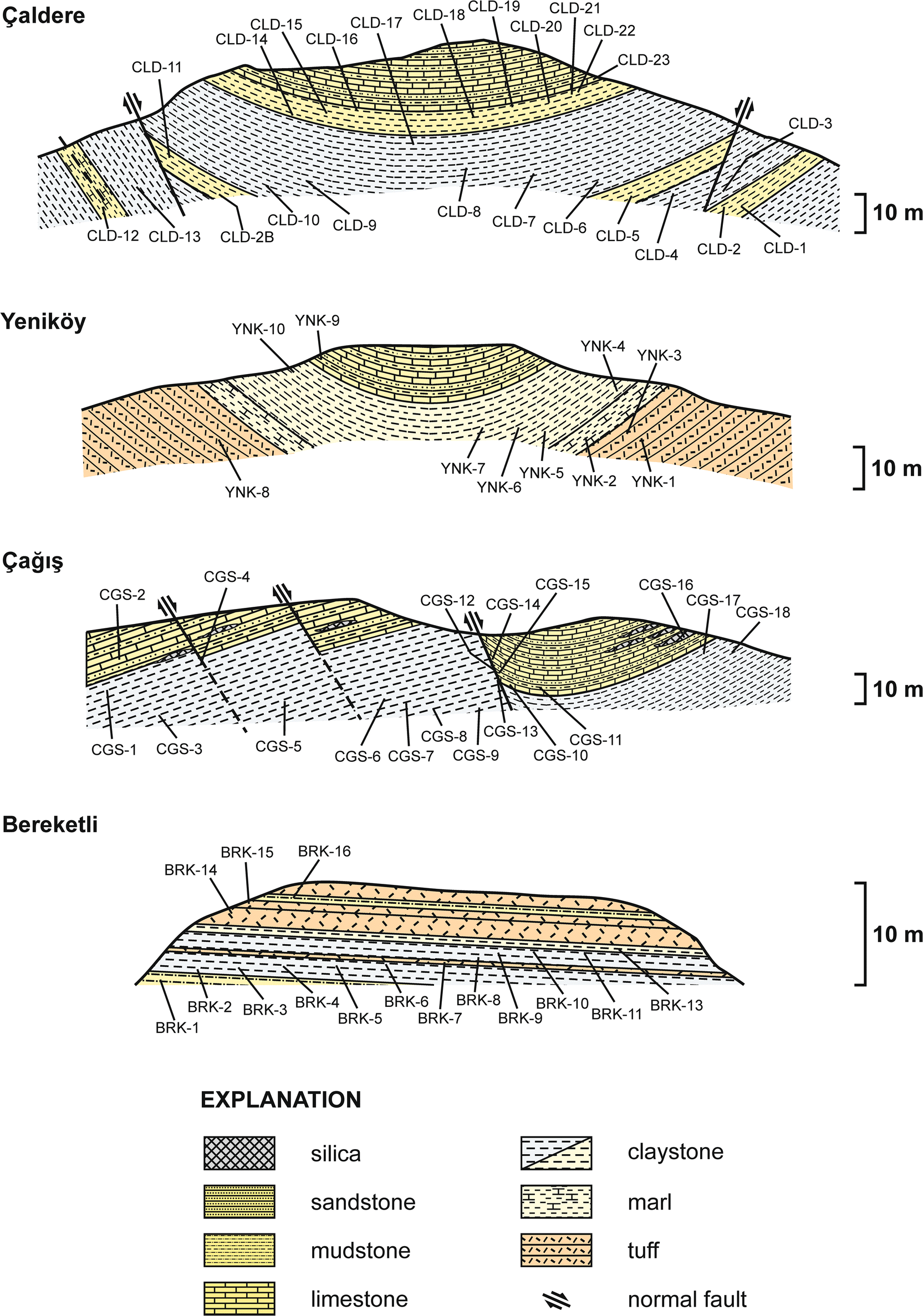
Bentonites and volcano-sedimentary samples of the Balıkesir region were collected from four recently mined bentonite deposits within the BVSS. The bentonite deposits are described below by name, beginning with the bentonites in the northeast of the study area and progressing southward (Figs. 3 and 4).
Çaldere deposit (CLD)
This bentonite deposit lies within the sediments of the BVSS as a N–S trending syncline. This deposit contains cream to white colored bentonite with alternating beige bentonite layers rich in Fe oxide. The bentonite continues upward with beige bentonite and is overlain by silicified, dolomitic limestone layers of the BVSS. The total thickness of this Ca-bentonite is ~30 m (Fig. 3g,h). The Çaldere bentonite deposit is currently being mined and ~12,000 tons of bentonite is produced annually for the paper and bleaching industries in Turkey (Bakır et al. Reference Bakιr, Akbulut, Kapkaç, Karahan and Çetin2012).
Yeniköy deposit (YNK)
The Yeniköy bentonite deposit also lies within the sediments of the BVSS as a N–S trending syncline. A beige-colored bentonite overlies a grayish-white-colored basal tuff of the BVSS (Fig. 3i). This bentonite has recent desiccation cracks, plant rootlets, and, locally, Fe oxide stains. The total thickness of this Ca-bentonite is ~10 m, and upward is succeeded by light brown, thin-bedded argillaceous tuff and white, argillaceous, nodular limestone layers. This deposit was discovered earlier and was mined for the paper and bleaching industries in Turkey (Bakır et al. Reference Bakιr, Akbulut, Kapkaç, Karahan and Çetin2012).
Çağış deposit (CGS)
The Çağış bentonite deposit lies within intensely folded and faulted sediments of the BVSS (Fig. 3j). This deposit starts at the lower contact as a white bentonite and exhibits conchoidal fracture, plastic and recently formed desiccation cracks. This bentonite also has silica and opal intercalations of varying thickness of 1–5 m. The Çağış deposit is covered by cream- to beige-colored, silicified limestone, marl, and mudstone alternations which are 10–15 m thick. The total thickness of the bentonite in this deposit is ~25 m. This deposit contains an appreciable tonnage of both Na- and Ca-bentonite and is currently being mined for the paper and bleaching industries in Turkey, but the reserve quantity has not been calculated (Bakır et al. Reference Bakιr, Akbulut, Kapkaç, Karahan and Çetin2012).
Bereketli deposit (BRK)
In this deposit, light brown, thin-bedded mudstones of the BVSS underlie the beige, conchoidal-fractured, and locally ferromagnesian mineral fragments such as amphibole-and biotite-bearing bentonite (Fig. 3k). This bentonite incorporates argillaceous tuff intercalations of various thickness between 5 and 50 cm (Fig. 3l). The total thickness of bentonite in this deposit is ~5. This bentonite is covered by ~6 m of cream- and pink-colored tuff and tuffite layers enclosing silt-to-sand sized pumice and rock fragments of the BVSS. This deposit was previously discovered and mined to supply paper and bleaching industries in Turkey (Bakır et al. Reference Bakιr, Akbulut, Kapkaç, Karahan and Çetin2012).
Sketch of the Balıkesir bentonite deposits

Materials and Methods
Field work was carried out using the existing 1/500,000 scale geological map of the Balıkesir region (Fig. 1; MTA 2002) to determine the distribution of bentonite deposits and related volcano-sedimentary units in the area studied. Up to 500 g of bentonite was collected from each of the various stratigraphic sections (Fig. 4). Optical microscope studies using a Nikon-LV 100 Pol (Nikon Corporation, Tokyo, Japan) were carried out in thin section of fresh volcanic rock samples. Selected samples that represent various degrees of alteration were manually crushed and powdered using a tungsten carbide pulverizer for X-ray diffraction (XRD) and geochemical analyses.
Separation of the clay fraction followed the removal of Fe(III) oxide cements, carbonate cements, and organic matter (Kunze & Dixon Reference Kunze, Dixon and Klute1986). The treated samples were sieved to <2 mm and 100 g of the <2 mm fraction was mixed with deionized water and disaggregated using a ‘Stir-Pak’ (Cole-Parmer, Vernon Hills, Illinois, USA) mixer head and mixer controller. The <2 μm fractions were separated from the silt (2–50 μm) by repeated siphoning of the dispersed material. The clay fraction (<2 μm) was separated by sedimentation of the suspension after 24 h of dispersion in distilled water and removal of the upper 5 cm, followed by centrifugation for 10 min at 2451×g (4000 rpm) using a Hettich 32A centrifuge (Andreas Hettich GmbH and Co. KG, Tuttlingen, Germany).
The mineralogical characteristics of the samples were determined using powder XRD with a Rigaku D / Max – 2200 with an Ultia PC (Rigaku Corporation, Tokyo, Japan). The XRD analyses were performed using CuKα radiation with a scanning speed of 1°2θ/min and a tube voltage and current of 40 kV and 30 mA, respectively. Bulk mineralogy was determined using random powder mounts. Several oriented mounts were prepared, from each clay fraction separated as noted above, by dropping a small amount of clay suspension onto a glass slide and drying in air. One oriented mount was solvated using ethylene glycol (EG) vapor at 60°C for 2 h to identify smectites. Other oriented mounts were heated at 300 and 550°C for 2 h to identify chlorite and kaolinite.
Quantitative analysis of the samples was performed on random powder samples (side loading mounting) emplaced in Al-holders, by the Rietveld method using the BGMN computer program (Autoquan© software package version 2.8), on a Bruker D8 Advance Diffractometer equipped with a Lynx Eye strip silicon detector, and using Ni-filtered CuKα radiation (35 kV, 35 mA) at the Technical University of Crete (Greece). Data were collected in the range 3–70°2θ with a step size of 0.02°2θ and counting time of 1 s per strip step (total time 63.6 s per step).
Representative smectite-dominated bulk samples were prepared for scanning electron microscopy-energy dispersive X-ray analysis (SEM-EDX) using double-sided tape to adhere the fresh, broken surface of each sample to an Al sample holder and by coating the samples thinly with fine Au particles (350 Å) using a Giko IB-3 ion coater (Giko Engineering Co. Ltd., Nagoya, Japan). The analyses were performed at Middle East Technical University (Ankara, Turkey) using a QUANTA 400F Field Emission SEM instrument (Thermo Fisher Scientific, Hillsboro, Oregon, USA). Transmission electron microscopy (TEM) studies were carried out at the Bilkent University (Ankara, Turkey) using an FEI Tecnai F30™ (FEI/Thermo Fisher Scientific, Hillsboro, Oregon, USA) instrument. The clay particles for TEM analysis were dispersed in an ultrasonic ethanol bath for ~30 min, and one drop of each clay suspension was placed on a carbon-coated copper grid and dried at room temperature.
The chemical analyses of 13 bentonite, six argillaceous carbonate/calcareous claystone, and four tuff samples were performed at the Bureau Veritas Mineral Laboratories (Vancouver, Canada) using a PerkinElmer Elan 9000 (PerkinElmer Inc., Waltham, Massachusetts, USA) inductively coupled plasma-atomic emission spectrometer (ICP-ES), a mass spectrometer (ICP-MS), and a Spectro (Spectro Analytical Instruments Inc., Mahwah, New Jersey, USA) XLAB-2000 PED X-ray fluorescence spectrometer (PEDXRF), which was calibrated using USGS inter-laboratory standards. The detection limits for the analyses were between 0.01 and 0.1 wt.% for major elements, 0.1 and 5 ppm for trace elements, and 0.01 and 0.5 ppm for REE (rare earth elements).
The degree of chemical index of weathering (CIW) of bentonite, argillaceous carbonate/calcareous claystone, and tuff whole-rock samples was calculated using Eq. 1 (Harnois Reference Harnois1988):

where CaO* is the amount of CaO incorporated in the silicate fraction.
The structural formula of smectite was determined in the <2 μm clay fractions of samples with the largest smectite content. The smectite-rich clay fractions were separated using the method described above. The amount of SiO2 polymorphs in the clay fraction was corrected for impurities that were not removed and not detected by XRD. The structural formula of smectite was calculated based on O20(OH)4.
Fresh tuffaceous units that represent the parent rock of the bentonite were used for mass-gain and mass-loss calculations. Mass gains and losses have been calculated and estimated using the EASYGRESGRANT program (Eq. 2) (López-Moro Reference López-Moro2012) and from isocon diagram plots of the geochemical analyses (Grant Reference Grant1986, Reference Grant2005):

where C i is the concentration of component i, O indicates the fresh rock, and A indicates the altered rock. The M O and M A values are the equilibrium masses (as wt.% or ppm) of the fresh and altered rocks, respectively.
The C i A/C i O ratios were plotted to obtain the slopes of the isocon graphic lines from the fresh and the altered rock analytical data using Eq. 3:

where ∆C i is the gain or loss of mass. MnO was assumed to be immobile based on clusters of slopes that were close to 1.00.
If a constant mass is assumed (Eq. 4),

Thus, sample compositions that plot above the isocon line indicate a mass gain during the alteration process and samples that plot below this line represent a mass loss during alteration.
Results
Petrography
The parent rock of bentonite in the Balıkesir region is composed of rhyolitic and andesitic tuffs and spilite (basalt). Rhyolitic and andesitic tuff show porphyritic texture, are composed of plagioclase (albite-andesine), and are partly to completely altered, locally showing sericitization and zonation (Fig. 5a,b). Sanidine crystals show Carlsbad twining and are partly altered (Fig. 5b). Biotite and hornblende crystals are partly to completely altered to Fe-(oxyhydr)oxides and are locally chloritized (Fig. 5c). The groundmasses of rhyolitic and andesitic tuffs consist of plagioclase microlites with argillitic and carbonate alteration, and Fe-(oxyhydr)oxidation products (Fig. 5d). Spilitic basalt is composed of pyroxene crystals and plagioclase microlite in a volcanic groundmass, showing intersertal texture (Fig. 5e,f).
Photomicrographs of: (a–c) altered feldspar, hornblende and biotite in tuff, plane-polarized light (BRK-14, CLD-24); (d) carbonatization, argillization, and Fe-(oxyhydr)oxidation in rhyolitic tuff, plane-polarized light (HBP-16); (e) pyroxene crystals between plagioclase in spilitic basalt, showing intersertal texture, plane-polarized light (HBP-13); and (f) a pyroxene crystal in spilitic basalt, plane-polarized light (HBP-13)

XRD Determinations
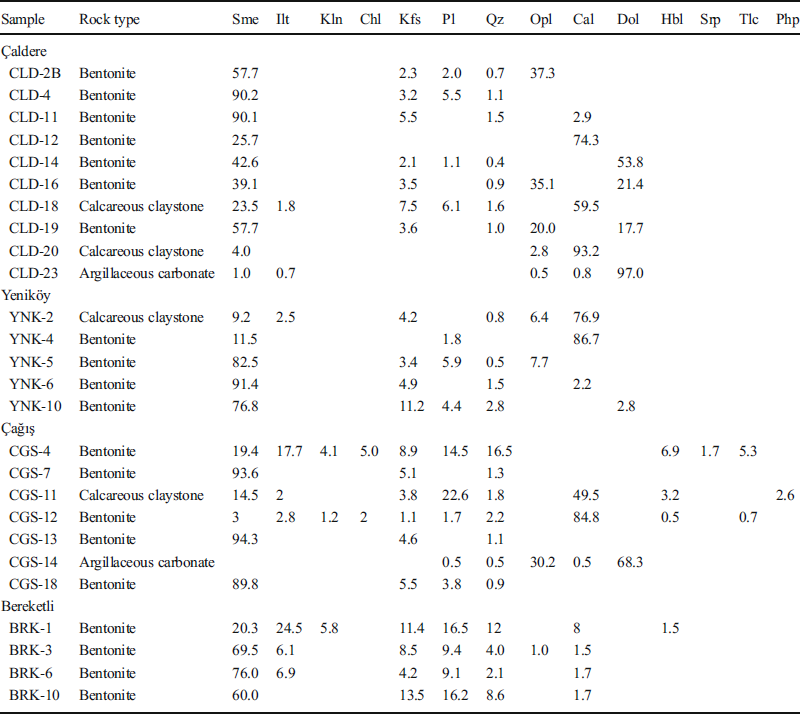
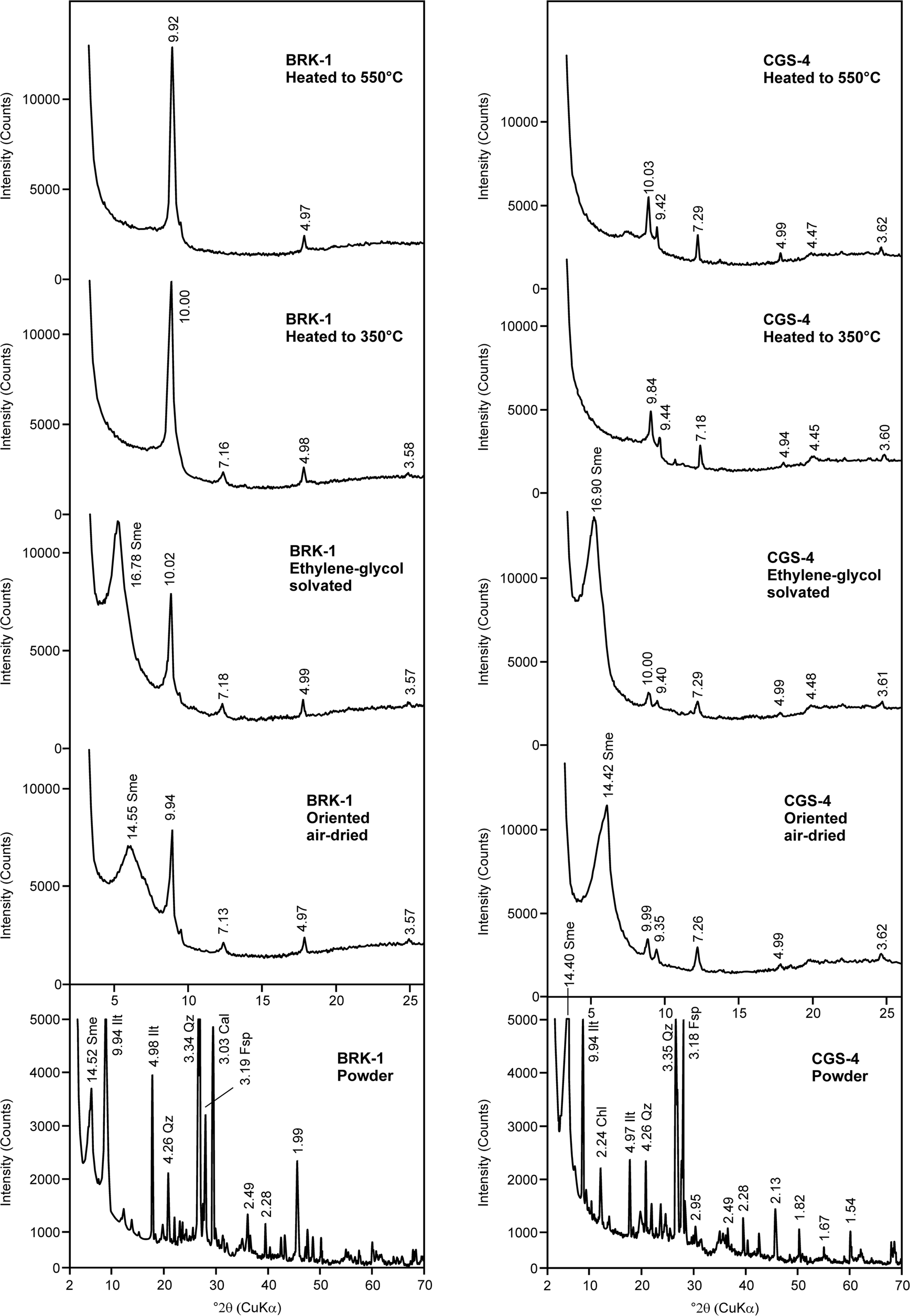
The quantitative analyses with Rietveld refinement and representative XRD traces of the bentonite and their parent rock bulk samples are given in Table 1 and Fig. 6, respectively. Smectite is abundant, sometimes associated with minor illite and accessory chlorite and kaolinite in the bentonites and altered volcanic units. The smectite content varies between broad limits, from a few wt.% in argillaceous carbonates and calcareous claystones to >90 wt.% in bentonites (Table 1). These minerals are accompanied by quartz, K-feldspar, plagioclase, dolomite, calcite, and opal-CT. Accessory amphibole, talc, serpentine, and pyrophyllite are present in the Çağış deposit. The abundance of calcite and dolomite increases in the upper level of the Çaldere and Çağış bentonite deposits.
Mineralogical variations (wt.%) in the Balıkesir bentonite deposits from analysis of XRD patterns for claystone samples

Abbreviations: Sme: smectite; Ilt: illite; Kln: kaolinite; Chl: chlorite; Kfs: K-feldspar; Pl: plagioclase; Qz: quartz; Opl: Opal-CT; Cal: calcite; Dol: dolomite; Hbl: hornblende; Srp: serpentine; Tlc: talc, Php: phillipsite (mineral-name abbreviations after Whitney & Evans Reference Whitney and Evans2010)
XRD patterns for Balıkesir bentonite samples. Sme: smectite; Ilt: illite Chl: chlorite, Fsp: feldspar, Qz: quartz, Opl: Opal-CT, Cal: calcite, Dol: dolomite (mineral-name abbreviations after Whitney & Evans Reference Whitney and Evans2010)


Smectite was identified by a sharp reflection at 14.42–14.93 Å that shifted to 16.09–16.97 Å after EG solvation and collapsed to 9.53–9.90 Å and 9.43–9.86 Å after heating at 300 and 550°C for 2 h, respectively (Fig. 6).
SEM–EDX and TEM Analyses
The SEM images indicated that volcanic materials such as feldspar, mica, and glass shards are highly altered and yielded the cement material in these units (Fig. 7a–d). Smectite flakes developed in microfractures and dissolution voids of altered feldspar and devitrified glass shard and at the edge of platy mica via dissolution and precipitation. The sizes of flaky smectite mostly increase from the fracture centers toward their margins (Fig. 7e–g). Locally, the volcanic unit encloses abundant euhedral dolomite crystals associated with smectite crystals and a network of calcified filaments (Fig. 7h–j).
SEM images of: (a,b) flaky smectite matrix between resorbed feldspar and mica-abundant volcanic materials (CGS-12, CGS-4); (c) relic of altered feldspar enclosing flaky smectite (BRK-1); (d) devitrified volcanic glass edging smectite (BRK-6); (e) the formation of smectite in microfractures of previously formed smectite (CLD-11); (f) close-up view of a dense smectite crystal (CLD-11); (g) smectite flakes in pore (CLD-4); (h) the formation of smectite as cement between dolomite crystals (CLD-16); (i) rhombohedral dolomite crystal (CLD-16); and (j) dolomite crystals covered by microorganisms (CLD-16)


The TEM images confirmed the flaky morphology of smectite (Fig. 8a,b). The diameter of the smectite flakes varies between 0.1 and 0.3 μm.
TEM images of: (a,b) smectite crystals (BRK-6, CLD-4)

Chemical Analyses
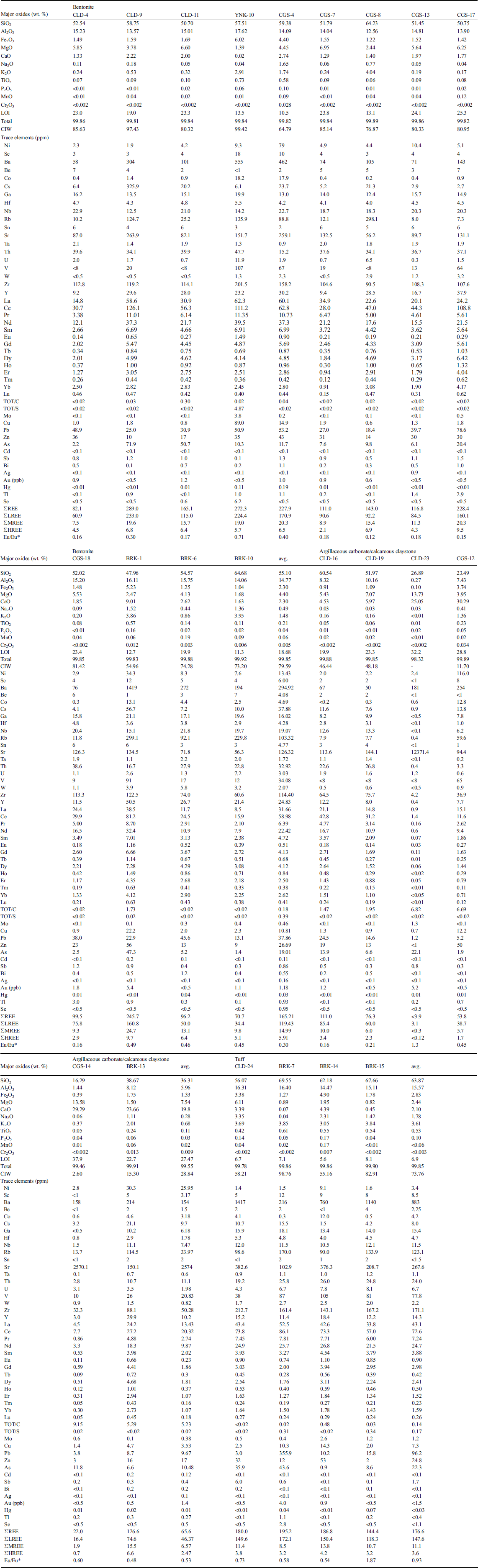
Chemical analyses of bentonite units are characterized by moderate concentrations of SiO2 (average 55.10 wt.%), Al2O3 (average 14.77 wt.%), MgO (average 4.40 wt.%), Fe2O3 (average 2.30 wt.%), and CaO (average 2.30 wt.%) and small concentrations of Na2O (average 0.49 wt.%) and K2O (average 1.48 wt.%). Loss on ignition (LOI) is considerable, reflecting the presence of smectite (average 18.68 wt.%). Concentrations of trace elements such as Ba (average 295 ppm), Rb (average 103 ppm), Sr (average 126 ppm), and Zr (average 114 ppm) decrease in bentonite relative to the parent tuff (Table 2). In addition, argillaceous carbonate/calcareous claystone samples have smaller concentrations of SiO2 (average 36.3 wt.%), Al2O3 (average 5.96 wt.%), Fe2O3 (average 1.33 wt.%), Na2O (average 0.28 wt.%), and K2O (average 0.68 wt.%), compared to the bentonites, and more MgO (average 7.54 wt.%), CaO (average 19.8 wt.%), and LOI (average 27.47 wt.%) compared to the bentonites. These units are characterized by the presence of Ba (average 154 ppm), Rb (average 34 ppm), Sr (average 2574 ppm), and Zr (average 50 ppm). The observed compositional differences between the bentonite and the argillaceous carbonate/calcareous claystone samples reflect the relative abundance of carbonates admixed with the volcanic material.
Major oxide (wt.%), minor element (wt.%), and trace element (ppm) contents of the bentonite, argillaceous carbonate/calcareous claystone and volcanic parent rock samples in the study area (see Table 1 for the mineralogical compositions of the samples)

ΣREE = the sum of (La–Lu)+Y; ΣLREE = the sum of La–Nd; ΣMREE = the sum of (Sm–Ho); ΣHREE = the sum of (Er–Lu); and Eu/Eu* = EuN/√(SmN*GdN) (Mongelli Reference Mongelli1997), where N refers to a chondrite-normalized value (Sun & McDonough Reference Sun and McDonough1989)
The tuffaceous units representing a parent rock of the bentonite are characterized by greater abundances of SiO2 (average 63.87 wt.%), Al2O3 (average 15.57 wt.%), Fe2O3 (average 2.83 wt.%), Na2O (average 1.78 wt.%), and K2O (average 3.61 wt.%), and smaller abundances of MgO (average 2.44 wt.%), CaO (average 1.78 wt.%), and LOI (average 6.9 wt.%) compared to the bentonite samples (Table 2).
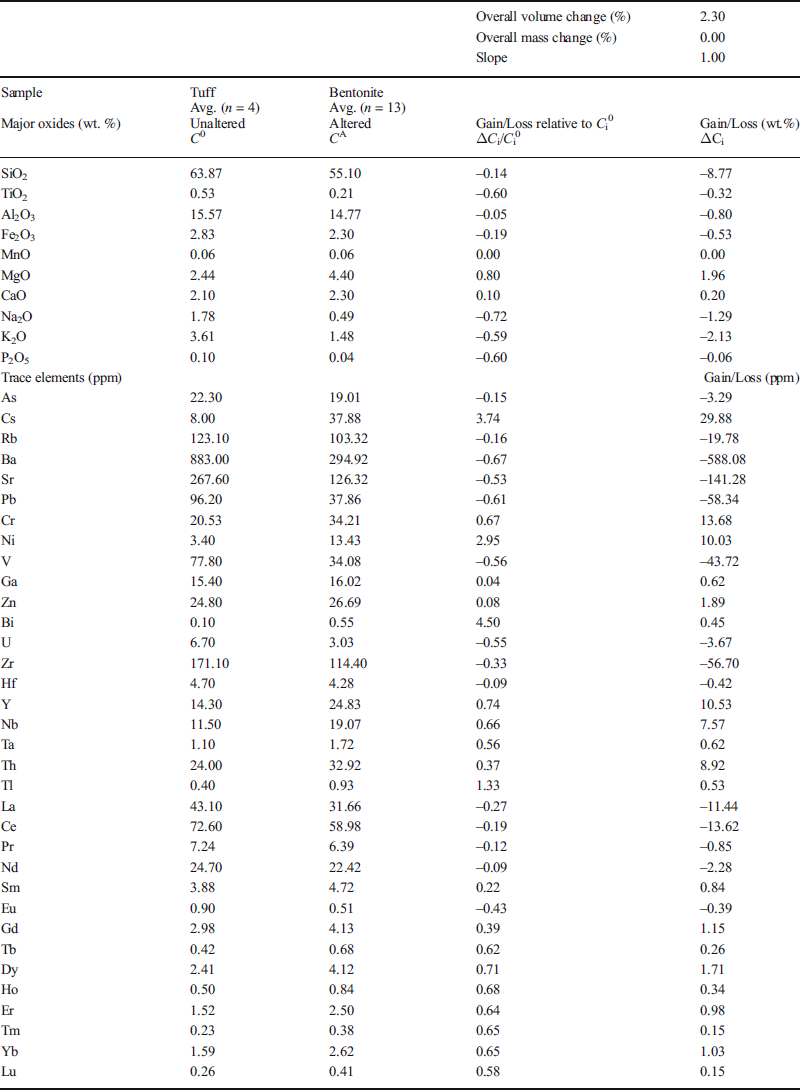
The mass gains and losses based on the plots of the geochemical analyses on isocon diagrams (Grant Reference Grant1986, Reference Grant2005) showed that SiO2, Fe2O3, Na2O, K2O, Ba, Sr, Rb, V, and Zr were released, while MgO, CaO, Cr, Nb, Th, and Y were enriched during alteration based on the best-fit isocon slope (m = 1.00) (Table 3; Fig. 9a–f). MnO shows an immobile nature based on clusters of slopes close to 1.00.
Mass gains and losses of major oxides (g) and trace elements (ppm) for the bentonite based on the isocon analysis diagram (Grant Reference Grant1986, Reference Grant2005; López-Moro Reference López-Moro2012)

Mass changes (a-f) in the major element (g) and trace element (ppm) contents within the study area based on the isocon analysis diagram (Grant Reference Grant1986, Reference Grant2005; López-Moro Reference López-Moro2012)

The REE of bentonite, argillaceous carbonate/calcareous claystone, and tuff were normalized to chondrite values and primitive mantle (Sun & McDonough Reference Sun and McDonough1989; Fig. 10a,b). Light rare earth elements (LREE) are enhanced compared to middle rare earth elements (MREE) and heavy rare earth elements (HREE), with negative Eu anomalies (Eu/Eu* = 0.30–0.93). According to mass-balance calculations the LREE and Eu were depleted during alteration of the tuffs to bentonite, whereas HREE were enriched (Table 2). These trends are the opposite of those observed during the formation of the Kimolian bentonites from alteration of acidic volcanic rocks (Christidis Reference Christidis1998). The carbonate/calcareous claystones have small REE abundances (Fig. 10a,b) due to the influence of dilution by carbonates (e.g. Table 1).
Chondrite- and primitive mantle-normalized patterns for Balıkesir bentonite and volcanic samples (Sun & McDonough Reference Sun and McDonough1989)

The CIW values for bentonite, argillaceous carbonate/calcareous claystone, and tuff are 79.59%, 28.84%, and 73.76%, respectively, suggesting the presence of a wide-ranging alteration process in the volcanic units (Table 2). The CIW of bentonite is higher than that of the parent tuff, whereas those of the carbonate/calcareous claystones are considerably lower. The low CIW values of the carbonate/calcareous claystones reflect the presence of carbonates (abundance of CaO and MgO).
When plotted on a discrimination diagram (Winchester & Floyd Reference Winchester and Floyd1977) the parent rocks of the different bentonites have rhyolitic and andesitic-trachyandesitic affinities (Fig. 11). Projection on the discrimination diagram of Hastie et al. (Reference Hastie, Kerr, Pearce and Mitchell2007) shows that the bentonites have high-K and shoshonitic affinities based on the crossplot of Co vs. Th (Fig. 12). The bentonites from the eastern Aegean and Thrace display similar characteristics, although in general they tend to have more basic affinities compared with their counterparts in the present study.
Geochemical discrimination plot of the bentonite and parent volcanic samples using immobile elements Nb/Y vs. Zr/Ti diagram (Winchester & Floyd Reference Winchester and Floyd1977) and comparison with the bentonites from the eastern Aegean and Thrace (data from Koutsopoulou et al. Reference Koutsopoulou, Christidis and Marantos2016)

Geochemical discrimination plot of Balıkesir bentonite using crossplot of Co vs. Th (Hastie et al. Reference Hastie, Kerr, Pearce and Mitchell2007), and comparison with the bentonites from the eastern Aegean and Thrace (data from Koutsopoulou et al. Reference Koutsopoulou, Christidis and Marantos2016)

Smectite Chemistry
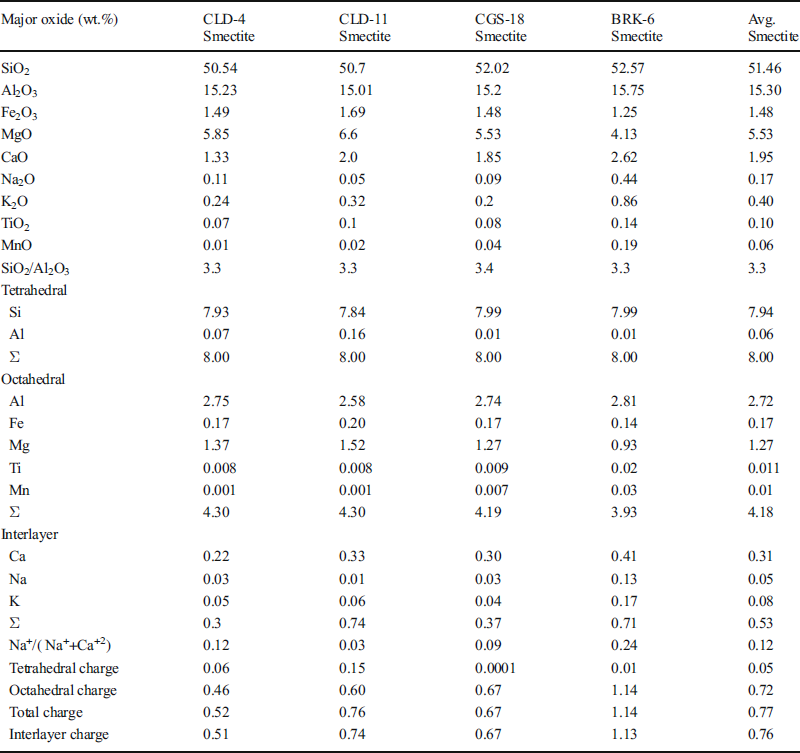
The structural formulae for the smectites of samples CLD-4, CLD-11, CGS-18, and BRK-6, calculated from the chemical analysis of clay fractions, are typical of montmorillonite (Table 4) with an average estimated structural formula of

Chemical compositions and structural formulae for purified smectite samples. Calculated based on O20(OH)4

The smectite is Fe-poor, indicating that the parent rocks might be of acidic composition (Christidis Reference Christidis2008) in accordance with the projection in the discrimination diagrams (Figs 11 and 12). The Na+/(Na++Ca2+) ratios suggest Ca-rich bentonite, in accordance with the XRD traces of the bulk samples and the air-dried oriented clay fractions, which show smectite d 001 spacings typical of smectites with bivalent exchangeable cations (Fig. 6). Moreover, the octahedral occupancy is considerably larger than 4 (Table 4, see also average smectite structural formula), indicating that some of the Mg might also be present in the interlayer.
Discussion
Alteration Patterns in Bentonite Formation
The bentonite deposits in the Çaldere, Yeniköy, Çağış, and Bereketli areas in the Balıkesir region, Turkey, consist of alternating claystone and mudstone associated with limestone, and developed by diagenetic processes in the Miocene Bigadiç volcano-sedimentary units which were deposited in local tectonically controlled depression zones (Fig. 13). The Bigadiç volcano-sedimentary units, which hosted and intercalated bentonite and borate deposits, are composed of rhyolitic and andesitic Sındırgı volcanics, Gölcük basalt, trachyandesitic dikes of the Kayırlar volcanics, and basaltic-andesitic Şahinkaya volcanics. The Çaldere and Çağış bentonites were derived from acidic rocks, whereas their counterparts of the Yeniköy and Bereketli deposits display more basic (andesitic-trachyandesitic) affinities (Fig. 11). The bentonites from the eastern Aegean and Thrace of Upper Oligocene--Upper Miocene age (Koutsopoulou et al. Reference Koutsopoulou, Christidis and Marantos2016) are plotted in the same diagram. Except for the Samian bentonites, which have alkaline (trachytic) affinities, the remaining eastern Aegean and Thracean bentonites were derived from volcanic rocks of more basic affinities than their counterparts of this study. Smectite abundant claystone beds enclosing desiccation cracks, plant rootlets, and locally Fe-(oxyhydr)oxide stains are in close contact with volcanic materials of the basin and continued with an ostracod- and foraminifera-bearing carbonate, alternating with marl, claystone, and sandstone in an upward sequence. About 50 km to the south (outside the study area) bituminous shale and coal levels are also enclosed (Akyürek & Akdeniz Reference Akyürek and Akdeniz1989), suggesting a lacustrine–palustrine sedimentation environment.
Sketch of genetic model for the Balıkesir bentonite deposits

Smectite is abundant and detrital materials (such as chlorite and rock fragments) are absent from the Balıkesir bentonite deposits that are interbedded or overlain by carbonate rocks. This suggests that the bentonite deposits formed authigenically as ‘primary bentonites’ from volcanoclastic materials deposited in a calm lacustrine–palustrine environment during the early diagenesis by dissolution-precipitation reactions similar to those underlined by Jeans et al. (Reference Jeans, Merriman, Mitchell and Bland1982), Takagi et al. (Reference Takagi, Koh, Song, Itoh and Mogi2005), and Kadir et al. (Reference Kadir, Külah, Önalgil, Erkoyun and Elliott2017). Thus, volcanic glass shards along with feldspar, biotite, and hornblende crystals were subjected to early diagenetic processes after deposition and were converted to primary bentonite (Fig. 13).
The development of sericitization in feldspar, partial formation of Fe-(oxyhydr)oxides, and chloritization of hornblende and biotite in rhyolitic and andesitic tuff, plus formation of smectite in microfractures and dissolution voids of altered feldspar and mica, suggest a dissolution and precipitation mechanism. Locally, abundant euhedral dolomite crystals in dissolution voids of volcanic units suggest that the sedimentary environment was subjected to alternation of wet and dry periods during early diagenesis (Wright & Tucker Reference Wright and Tucker1991). The association of calcified filament structures with dolomite and smectite attests to the presence of biological activity during diagenetic processes (c.f. Wright Reference Wright1986; Eren et al. Reference Eren, Yeşilot Kaplan, Kadir and Kapur2018).
The significant depletion of SiO2, Ba, Sr, Pb, V, and Zr, but less of K2O, Fe2O3, Na2O, and Rb, and the enrichment of MgO and CaO, during alteration of glass shards and volcanogenic minerals favored formation of smectite under alkaline conditions and an open hydraulic system (Fig. 9; Dible & Tiller Reference Dible and Tiller1981; Christidis & Scott Reference Christidis and Scott1997). In contrast MnO, Al2O3, and TiO2 are virtually immobile, similar to the findings of previous studies (Zielinski Reference Zielinski1982; Christidis Reference Christidis1998). In addition, the white color of the bentonites suggests Fe- and Ti-poor parent materials, indicating the presence of rhyolitic precursors as was also suggested by discrimination diagrams (Fig. 10), in accordance with previous work (Esenli Reference Esenli1993; Christidis & Scott Reference Christidis and Scott1997). The Na and K released might have resulted in local precipitation of heulandite-clinoptilolite in altered volcanic units in Kargın, 30 km southeast of Balıkesir and outside the area studied (Christidis et al. Reference Christidis, Scott and Marcopoulos1995; Ekinci Şans et al. Reference Ekinci Şans, Esenli, Kadir and Elliott2015). In the carbonate-rich horizons, calcite and dolomite might have formed by direct chemical precipitation or/and by dolomitization of earlier precipitated calcite during diagenesis.
The Si released during the alteration process resulted in secondary silicification (precipitation of quartz, opal-CT) in the uppermost levels of the bentonite deposit, similar to previous studies (Lavery, Reference Lavery1985; Christidis et al. Reference Christidis, Scott and Marcopoulos1995; Inoue Reference Inoue and Velde1995; Kirov et al. Reference Kirov, Šamajova, Nedialkov and Stanimirova2011; Çiflikli et al. Reference Çiflikli, Çiftçi and Bayhan2013; Malek-Mahmoodi et al. Reference Malek-Mahmoodi, Khalili and Mirlohi2013). The high values of Ba (up to 1419 ppm), Sr (1003 ppm), and Zr (132.3 ppm) also support the suggestion of a volcanogenic origin. The K released may also have resulted in the formation of accessory illite. The increases in LREE/(MREE+HREE) and a negative Eu anomaly in the bentonite samples suggest that the Al, Mg, Fe, and Si required for the formation of smectite originated from the alteration of feldspars and volcanic glass during diagenesis (Kadir et al. Reference Kadir, Külah, Önalgil, Erkoyun and Elliott2017).
An interesting feature of the alteration of tuffs to bentonite in the study area is the decrease in LREE and Eu contents and the increase in HREE contents during alteration (Tables 2, 3). This trend is the opposite of the observed behavior of REE during alteration of an acidic precursor to bentonite in Kimolos Island, Greece, (Christidis Reference Christidis1998) and is attributed to the minerals hosting REE in the various areas. The Kimolian bentonites and respective parent rocks contain igneous phosphates (apatite and monazite), which host the LREE (Christidis Reference Christidis1998). In contrast, the HREE are present in the original volcanic glass and are leached during alteration. In the present study the bentonites contain very small amounts of P2O5 compared with the parent tuffs, suggesting significant P2O5 leaching. Therefore, P might not just be associated with phosphate minerals but might also be hosted in the glass, from where it was released during alteration. In contrast, the HREE might be associated, in the rocks studied, with hornblende or biotite, which are largely preserved during alteration (Table 1). Finally, the migration of Eu during alteration (Table 2) is compatible with the alteration of feldspars during alteration as previously mentioned.
Comparison with the eastern Aegean and the Thracean Bentonites
Bentonite deposits are widespread in the broader area of the eastern Aegean, Thrace, and western Anatolia. These deposits bear several similarities and different features in terms of age, geodynamic and geological environment, and parent-rock composition. The age of the bentonites varies from Upper Eocene to Oligocene in Thrace to Upper Miocene in Samos (Ekinci Şans et al. Reference Ekinci Şans, Esenli, Kadir and Elliott2015; Koutsopoulou et al. Reference Koutsopoulou, Christidis and Marantos2016). The depositional environment of the parent rocks varies from being shallow marine-brackish in Thrace to lacustrine in the eastern Aegean (Samos and Chios Islands) and western Anatolia (including the present study), whereas their geochemical affinities vary from calc-alkaline to shoshonitic (Pe-Piper & Piper Reference Pe-Piper, Piper, Dilek and Pavlides2006, Reference Pe-Piper, Piper, Beccaluva, Bianchini and Wilson2007; Ekinci Şans et al. Reference Ekinci Şans, Esenli, Kadir and Elliott2015; Koutsopoulou et al. Reference Koutsopoulou, Christidis and Marantos2016). The shoshonitic affinities of the Balıkesir bentonites were suggested by discrimination plots (Fig. 11) and have been shown in previous studies (Koutsopoulou et al. Reference Koutsopoulou, Christidis and Marantos2016).
An interesting similarity between the eastern Aegean and Balıkesir bentonites formed in lacustrine–palustrine environments from acidic precursors is the type of the parent rock and the spatial development of alteration to bentonite. In the Samos bentonite, the parent rock was an ignimbrite and the bentonite was formed by low-temperature hydrothermal fluids controlled by fault lines (Koutsopoulou et al. Reference Koutsopoulou, Christidis and Marantos2016). In Chios, the bentonite was formed at the expense of an ash flow, but the alteration to bentonite was not complete because volcanic activity was limited to a single event (Koutsopoulou et al. Reference Koutsopoulou, Christidis and Marantos2016). In Balıkesir, the parent rocks were airborne tuffs deposited with clastic and carbonate sediments in the lacustrine–palustrine basin. The thickness of the bentonite outcrops, their lateral extent, and their texture are also compatible with slightly welded airborne tuffs characterized by massive feature (Figs. 3 and 4) similar to those reported by Erkül et al. (Reference Erkül, Helvacι and Sözbilir2005b). The comparable compositions of the parent rocks notwithstanding, the Balıkesir bentonites are richer in smectite than their Samian and Chios counterparts and, in particular, they do not contain abundant opal-CT (Table 1). This suggest that excess Si migrated during alteration of the acidic precursors as was indicated by the mass-balance calculations and the isocon plots (Table 3, Fig. 9). The migration of Si is related to the diagenetic alteration of the tuffs and is associated with fluid flow.
Hence, the question is transferred to the mechanism which facilitated fluid flow in the Balıkesir bentonites compared to their Samian and Chios counterparts. In Samos, the parent ignimbrite behaved like a “geoautoclave” (Aleksiev & Djourova Reference Aleksiev and Djourova1975; de’Genarro et al. Reference de'Genarro, Cappelletti, Langella, Perrotta and Scarpati2000; Machiels et al. Reference Machiels, Garcés, Snellings, Vilema, Morante, Paredes and Elsen2014) and alteration to bentonite occurred along fault lines in which the system was open. In Chios, the quick cooling of the parent ash flow caused fast dissipation of heat and partial conversion to bentonite (Koutsopoulou et al. Reference Koutsopoulou, Christidis and Marantos2016). The field relationships and the textural features of Balıkesir bentonites indicate that the parent rocks were airborne tuffs or slightly welded ash flows and that heat-driven flow might not have been prevalent during alteration. The fluid flow, therefore, may have been related to the development of hydraulic head during diagenesis associated with Neogene tectonics in the broader area.
Conclusions
The Balıkesir bentonite deposits in western Anatolia formed by a diagenetic process in the Miocene volcano-sedimentary units which were deposited in depression zones. The lithology, mineralogy, and geochemistry of the bentonites containing desiccation cracks, plant rootlets, locally Fe-(oxyhydr)oxide stains, and accompanied by carbonates suggest formation under alternating wet and dry periodic climatic changes in a shallow lacustrine–palustrine environment. Alteration of feldspar, amphibole, and biotite released Al, Mg, and Fe for the formation of smectite under mild alkaline conditions controlled by an open hydraulic system. The high LREE/(MREE+HREE) ratios and negative Eu anomalies suggest that smectite formed diagenetically from volcanic materials.
Acknowledgments
This study was funded by the Scientific Research Projects of Eskişehir Osmangazi University (Project 2016–1358). The authors are much indebted to Professor Emilia García Romero and an anonymous reviewer for their extremely careful and constructive reviews that improved the quality of the paper significantly. The authors are also very grateful to the anonymous Associate Editor and to the Editor-in-Chief, Joseph W. Stucki for their insightful editorial comments and suggestions. This paper was presented at the 9th Mid-European Clay Conference, 2018, in Zagreb, Croatia. Nergis Önalgil is thanked for assisting during the field work.
Compliance with Ethical Standards
Conflict of Interest
The authors have no conflict of interest and also approve the publication ethics.