Introduction
Interspecific competition among insect parasitoids is a common phenomenon in natural plant-herbivore-parasitoid systems and can influence the population dynamics of insect communities (Bográn et al., Reference Bográn, Heinz and Ciomperlik2002; DeMoraes & Mescher, Reference DeMoraes and Mescher2005). This effect has been substantiated in several biological control programmes, where introduced parasitoids frequently proved to be superior competitors, displacing other parasitoid species (reviewed in Reitz & Trumble, Reference Reitz and Trumble2002).
In most cases, quarantine regulations require preliminary studies on interspecific competition between exotic and local parasitoids in the laboratory. It is sometimes difficult to quantify the relative importance of factors that play a role in competition in the field, derived from results with laboratory cultures containing two species in a simple and artificial environment with individuals in close proximity to each other. However, a literature review, relating laboratory evaluations of natural enemy efficacy with field evaluations, performed by Mottern et al. (Reference Mottern, Heinz and Ode2004), concluded that more than 75% of the studies demonstrated that laboratory tests served as good predictors of field efficiency.
In some laboratory studies, differential larval competition and the ability of host discrimination were found to affect direct competitiveness between two parasitoid species (McBrien & Mackauer, Reference Mackauer, Mackauer, Ehler and Roland1990; Pijls et al., Reference Pijls, Hofker, Van Staalduinen and Van Alphen1995; Bokonon-Ganta et al., Reference Bokonon-Ganta, van Alphen and Neuenschwander1996; Infante et al., Reference Infante, Mumford, Barrera and Fowler2001; Agboka et al., Reference Agboka, Schulthess, Chabi-Olaye, Labo, Gounou and Smith2002; Wang & Messing, Reference Wang and Messing2003). Individual searching efficiency may also be influenced in case two parasitoid species compete for the same host (Chua et al., Reference Chua, Gonzales and Bellows1990). Few studies have been aimed at investigating the effect of host plants per se on interspecific competition between parasitoids (Iwao et al., Reference Iwao, Nakamura and Ohsaki2001). Host plants may indirectly influence the impact of natural enemies on their herbivore host (Cortesero et al., Reference Cortesero, Stapel and Lewis2000). Levels of attack rates can differ on different host plants because plants frequently mediate host location and, therefore, influence the effectiveness of parasitoids (Benrey et al., Reference Benrey, Denno and Kaiser1997; Billquist & Ekbom, Reference Billquist and Ekbom2001; Liu & Jiang, Reference Liu and Jiang2003). Due to differential host location abilities, competitiveness of two parasitoids on different host plants might be different.
In 2002, the specialist parasitoid Diadegma semiclausum Hellen (Hymenoptera: Ichneumonidae) was introduced to Kenya in order to suppress diamondback moth (DBM), Plutella xylostella L. (Lepidoptera: Plutellidae), populations in cabbage production areas in the Kenyan highlands. The most important local parasitoid reported so far was Diadegma mollipla (Holmgren) (Hymenopera: Ichneumonidae), a generalist parasitoid that, together with other local parasitoid species, never exceeded parasitism levels higher than 15% (Oduor et al., Reference Oduor, Löhr, Seif, Sivapragasam, Kole, Hassan and Lim1996). Both Diadegma species prefer to parasitize the same larval stages of DBM, have similar temperature requirements but differ in their host specificity (Talekar & Yang, Reference Talekar and Yang1991; Rossbach et al., Reference Rossbach, Löhr and Vidal2005; Sithole, Reference Sithole2005). The potato tuber moth Phthorimaea operculella (Zeller) (Lepidoptera: Gelechiidae) is one other host species known for the indigenous D. mollipla, but additional hosts are suspected to be in the host range of this species because the potato tuber moth is also not indigenous to this region. On the other hand, the host range of Diadegma semiclausum is restricted to DBM (Abbas, Reference Abbas1988) and has been the most widely used and successfully introduced parasitoid for biocontrol of DBM in several countries (Talekar & Shelton, Reference Talekar and Shelton1993).
In 2000, the normally crucifer-specific DBM extended its host range to snowpeas in a horticulture production area in Naivasha in the Rift Valley of Kenya. Research on the parasitism efficiency of D. mollipla on DBM on the new host plant proved that the parasitoid species did better on DBM on snowpeas as compared to cabbage (Rossbach et al., Reference Rossbach, Löhr and Vidal2006a). Host location studies revealed that D. mollipla was able to find its host equally well on cabbage and on peas, whereas D. semiclausum used crucifer-typical volatiles as host-finding cues and prefered cabbage over DBM-infested snowpea (Rossbach et al., Reference Rossbach, Löhr and Vidal2005). Therefore, we assumed that on the new host plant D. mollipla should have a competitive advantage over its introduced congenus and should be able to establish a niche on peas when displaced on cabbage. In the laboratory Sithole (Reference Sithole2005) demonstrated a clear advantage in competition of D. semiclausum over D. mollipla on DBM when feeding on cabbage. Observations in the field confirmed that the exotic species out-competed and even displaced most of the generalist indigenous species on DBM on cabbage, including D. mollipla (Momanyi et al., Reference Momanyi, Löhr and Gitonga2006; Löhr et al., Reference Löhr, Gathu, Kariuki, Obiero and Gichini2007). Coinciding with this study, natural total parasitism of DBM in kale and in snowpea fields was investigated, and results indicated potential differences between laboratory and field competition (Rossbach et al., Reference Rossbach, Löhr and Vidal2006b).
The first objective of this study was to examine the influence of a new host plant of a herbivore host on an introduced and on a locally competing parasitoid species. The second objective aimed at comparing laboratory results with field observations in order to evaluate predictions for the field situation from competition studies in the laboratory. We determined progeny production under simultaneous and delayed interspecific competition in the laboratory. Moreover, we studied the influence of host plants on competition and the effect of different host and parasitoid densities in greenhouse experiments.
Material and methods
Host plants and larvae
The cabbage strain of the diamondback moth (DBM) originated from cabbage fields at Wundanyi, Taita Taveta District, Kenya (Altitude: 1650 m, 03°26'11''S, 038°20'37''E) and was reared in an insectary (T=23±2°C) on potted cabbage plants (Brassica oleracea L. var. capitata (Copenhagen Market)). The pea strain of the diamondback moth was collected from a sugar snap pea field (Pisum sativum, var. Oregon sugar pod) near Naivasha in Nakuru District, Kenya (Altitude: 1500 m, 00°44'98''S, 036°26'2''E). Since 2000, the colony has been maintained on potted snowpeas (Pisum sativum, var. Oregon sugar pod) in the laboratory. For a detailed description of rearing methods of both DBM strains, see Löhr & Gathu (Reference Löhr and Gathu2002).
Parasitoids
A culture of D. mollipla was started with DBM larvae collected in Naro Moru, Nyeri District, Kenya. Parasitoids were multiplied for three generations in the laboratory before they were used for the experiments. A colony of D. semiclausum was started in October 2001 with pupae imported from the Asian Vegetable Research and Development Center (AVRDC) in Taiwan. This culture had been maintained in the laboratory for three years when experiments were conducted. Both parasitoid species were reared separately on second and third instar DBM larvae on cabbage leaves in perspex cages serving as parasitism chambers (20×20×25 cm). Parasitized larvae were transfered to plastic boxes covered with nylon mesh for ven-tilation and fed with cabbage leaves until pupation. Pupae were then removed and kept in separate containers. Emerging parasitoids were released into parasitism chambers. Honey was provided as a food source for adults. Age of females used for the experiments varied between two and five days. Both species had no oviposition experience before the experiments started.
Simultaneous intra- and interspecific competition
Three plastic oviposition chambers (15×15×15 cm) were prepared, and each was provided with 50 second instar DBM larvae on a pea leaf. Larvae were given two hours to settle on the leaf. Thereafter, two mated parasitoid females were introduced into these chambers, belonging to either D. mollipla or D. semiclausum. Additionally, one female from each of the two parasitoid species was introduced to the third chamber. After 24 h, all parasitoid adults were removed, and the DBM larvae were reared to adults. The number of parasitoid pupae and progeny for each species emerging at the end of the experiment was recorded. Dead larvae were dissected in order to check for parasitoid eggs or larvae. Parasitoid larvae were counted and included into total parasitism. Larvae of the two Diadegma species cannot be differentiated, and parasitoid larvae could, therefore, not be assigned to a particular species. The experiment was conducted at 23±2°C and replicated 15 times.
Delayed simultaneous interspecific competition
We used the same oviposition chambers mentioned above to set up an experiment on time related competitive interactions. Fifty second instar larvae on a pea leaf were exposed to a single female of D. semiclausum. Additionally, a single female of D. mollipla was introduced into these chambers with a time lag of 4 h and 8 h, respectively, without removing the D. semiclausum female. Total oviposition time for all parasitoid females was 24 h. The experiment was repeated in reverse order of parasitoids and was replicated ten times for each time sequence and species order.
Delayed interspecific competition
Fifty second instar larvae on a pea leaf were exposed for 24 h to oviposition by a single D. semiclausum female in an oviposition chamber as mentioned above. Larvae were transferred to a fresh pea leaf and then exposed to subsequent 24 h parasitism by D. mollipla at different time intervals, i.e. immediately, 24 h and 48 h after exposure to D. semiclausum. Each time interval was replicated ten times. The number of parasitoid pupae and progeny for each species emerging at the end of the experiment was recorded. Dead larvae were dissected in order to check for parasitoid eggs or larvae. In the second run of this experiment, DBM larvae were first exposed to D. mollipla and then to D. semiclausum.
Effect of host plants on interspecific competition
We conducted an experiment in cages placed in a plastic sheet-covered greenhouse to test the influence of the host plant on parasitoid interspecific competition. The cages had plastic frames (110×90×75 cm) covered with a fine mesh on all sides and the top. A wooden board (80×100 cm) with four openings (Ø 15 cm) was placed on the bottom of the cages. The board was covered with a layer of soil (1 cm) and was elevated from the ground in order to insert potted plants into the openings. The plants were placed in a 60–40 cm grid, with a diagonal distance of 75 cm. This set-up was chosen in order to simulate field conditions as closely as possible.
DBM larvae were offered either on one host plant species or on two host plants species in three different experimental set-ups. First four potted cabbage plants were introduced into the cage. A day before parasitoid exposure, each plant was infested with 20 second instar DBM larvae reared on cabbage. Twenty-four hours later, two females of each parasitoid species were released into the cage for eight hours (exposure time 8.30 am to 4.30 pm). Larvae were collected immediately after the end of exposure time and reared in separate cages until emergence. Number of parasitoid pupae and species and sex of emerged adults was recorded. The experiment was repeated with DBM reared on peas with four pea plants infested. In the third set-up of this experiment, we used two infested pea plants and two infested cabbage plants offered at the same time. Each host plant exposure experiment was replicated six times (three cages at a time).
Effect of larval density on competition
This experiment was conducted with two host plants (two pea and two cabbage plants) in the cages described above. In the first part, the cabbage plants were infested with 20 larvae and the pea plants with ten larvae. Afterwards, the density of larvae on the two host plant species was reversed. Exposure time of DBM larvae was eight hours, and two females of each parasitoid species were introduced into the cages.
Effect of parasitoid density on competition
Two snowpea and two cabbage plants infested with 20 DBM larvae each were introduced into the cage. The experiment was conducted with three different D. mollipla densities. The number of D. mollipla females was two, four and, in the last set-up, six. The number of D. semiclausum females was kept constant at two females. Exposure time was eight hours.
Statistical analyses
All data were analyzed using the SAS loglinear modeling GENMOD procedure (SAS Institute, 1999–2000). The model is particularly suitable for count data under the assumption of a Poisson distribution. In cases where the criteria for ‘goodness of fit’ deviated too far from 0 (value>1.5), the Poisson regression was replaced by a negative binomial regression with the same SAS procedure.
Results
Simultaneous competition
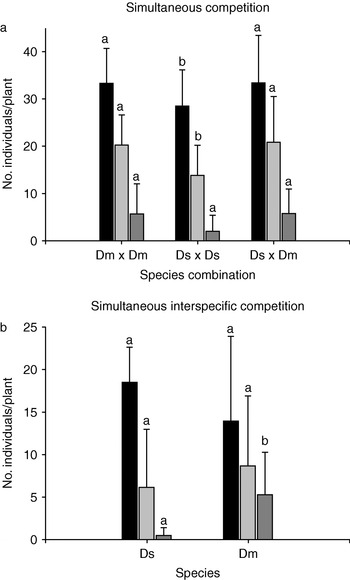
Simultaneous parasitism of two D. mollipla females and of one female of each parasitoid species resulted in a similar number of parasitized larvae and production of a higher number of progeny as compared to two competing D. semiclausum females (df=2, χ2=7.14, p<0.05) (fig. 1a). The number of female progeny was very variable within all parasitoid combinations and, therefore, not significantly different from each other (df=2, χ2=4.13, p=0.12).
Simultaneous intra- and interspecific competition between Diadegma mollipla (Dm) and Diadegma semiclausum (Ds) on Plutella xylostella on snowpea. (a) (■, Parasitized;  , emerged;
 , females.) Number of parasitized larvae, total progeny production and emerged females. (b) (■, total emerged; , males; , females.) Progeny production of both species in interspecific competition experiments.

Although D. mollipla produced on average twice as many adults as D. semiclausum, the difference was not significant due to the high standard deviation (df=1, χ2=3.04, p=0.08) (fig. 1b). The number of females produced by D. mollipla was significantly higher as compared to D. semiclausum (df=1, χ2=11.1, p<0.01).
Delayed simultaneous competition
Parasitism and progeny production of D. mollipla and D. semiclausum after total oviposition time of 24 h with a head start of 4 h and 8 h for one species, respectively, are presented in table 1. The combined number of parasitized larvae was similar for each exposure sequence. Individual ovipositing females performed very variably. When D. semiclausum was given a head start, the total number of progeny of both species combined was significantly lower as compared to D. mollipla starting to attack earlier (df=3, χ2=6.74, p<0.01). When D. mollipla attacked earlier, the number of progeny of each species was similar after 24 h of oviposition. When this species was introduced later, it produced significantly less progeny as compared to D. semiclausum (df=1, χ2=5.35, p<0.05 after 4 h; df=1, χ2=9.33, p<0.01 after 8 h). The number of female progeny was very low for both species.
Delayed simultaneous interspecific competition between Diadegma mollipla (Dm) and Diadegma semiclausum (Ds) on Plutella xylostella on snowpea. The second parasitoid was introduced after 4 h and 8 h, respectively. Total parasitism duration was 24 h.

Figures represent mean±SD. Different letters indicate significant differences within a column, and an asterisk denotes significant differences between the species (p<0.05).
Delayed competition
The number of parasitized larvae was similar for all exposure sequences (table 2). The time interval of exposure influenced total and individual progeny production. Significantly fewer adults emerged at time intervals of 48 h and 72 h, regardless which parasitoid species attacked larvae first (df=5, χ2=41.5, p<0.01). The number of progeny of each species was very variable, and the time interval had no significant effect on the total number of progeny of both species, except for D. mollipla at 72 h (df=5, χ2=36.64, p<0.01). At time intervals of 48 h and 72 h, the species, which attacked first, produced more progeny; but this was only significant at 72 h (df=1, χ2=4.39, p<0.05 for Dm-Ds and df=1, χ2=36.28, p<0.01 for Ds-Dm). Exposure sequence and time interval had no influence on female progeny. The number of emerged females was very low and varied considerably between individual ovipositing females.
Delayed interspecific competition of Diadegma mollipla (Dm) and Diadegma semiclausum (Ds) on Plutella xylostella on snowpea. Time intervals of exposure were 24 h, 48 h and 72 h between parasitoids.

Figures represent mean±SD. Different letters indicate significant difference within columns and an asterisk indicates significant differences between the species (p<0.05).
Effect of host plants on interspecific competition
The total number of parasitized DBM larvae per plant was similar, irrespective of plant species and host plant combination. Diadegma mollipla produced significantly less progeny than D. semiclausum on both host plants (df=1, χ2=44.7, p<0.01; df=1, χ2=50.3, p<0.01: table 3). When DBM infested pea plants were offered alone or simultaneously with infested cabbage plants, D. mollipla produced an average of less than one larva per plant, whereas D. semiclausum produced an average of seven offspring. When cabbage was offered alone, all progeny was produced by D. semiclausum. In the mixed host plant exposure, the number of offspring of D. mollipla was similar on both host plants (0.3 on cabbage, 0.6 on pea) (df=1, χ2=0.83, p=0.36). Diadegma semiclausum also produced similar numbers (6.9 on cabbage, 6.6 on pea) (df=1, χ2=0.10, p=0.75).
Effect of host plants on interspecific competition of Diadegma mollipla (Dm) and Diadegma semiclausum (Ds) on Plutella xylostella. Figures represent mean±SD. Different letters indicate significant differences within columns, and the asterix indicate significant differences between the species (p<0.05).

Effect of host density on interspecific competition
The level of parasitism and progeny production was not influenced by a different number of larvae on host plants (table 4). On the same plant percentage, parasitized larvae, adults and progeny contribution of parasitoid species were similar for the two host densities (10 and 20 larvae per plant) on each host plant (df=1, χ2=2.28, p=0.13; df=1, χ2=1.89, p=0.16). The contribution of D. mollipla to the total progeny production was significantly lower on both plants, as compared to D. semiclausum. The number of offspring of D. mollipla was significantly higher on pea than on cabbage (df=1, χ2=10.26, p<0.01). Diadegma semiclausum produced more progeny on cabbage than on pea (df=1, χ2=4.0, p<0.05). The latter species also produced significantly more females on cabbage with 20 host larvae than in other density/plant combinations (df=3, χ2=188.4, p<0.01).
Effect of host density and host plants on interspecific competition of Diadegma mollipla (Dm) and Diadegma semiclausum (Ds) on Plutella xylostella. Host densities: ten and 20 larvae on both plants (c-10 and c-20 on cabbage, p-10 and p-20 on pea). Different letters indicate significant differences within columns.

Effect of parasitoid density on interspecific competition
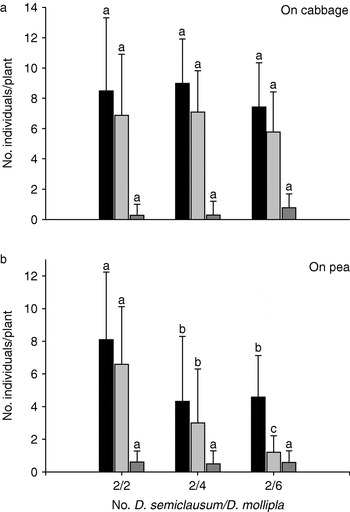
An increasing number of ovipositing females of D. mollipla resulted in a decrease of progeny of D. semiclausum on the pea plants (df=2, χ2=17.9, p<0.01) (fig. 2). It did not have an effect on the number of progeny of D. mollipla (df=2, χ2=0.10, p=0.95). The number of D. mollipla offspring was consistently low and remained below one larva per plant on both host plants. On cabbage plants, the total number of parasitized larvae, production of progeny and contribution of parasitoid species to total progeny was similar for all parasitoid densities (df=2, χ2=1.18, p=0.55; df=2, χ2=0.47, p=0.79) (fig. 2a). The number of progeny produced by D. semiclausum on cabbage was significantly higher than the progeny numbers of D. mollipla and did not change with an increasing number of ovipositing D. mollipla females. On pea plants, higher number of ovipositing D. mollipla females resulted in a significant reduction in the number of parasitized larvae (df=2, χ2=6.47, p<0.05) and production of progeny (df=2, χ2=13.31, p<0.01) due to a reduction of D. semiclausum progeny from 6.6 (equal number of ovipositing females) to 1.2 (six D. mollipla females) (fig. 2b).
Effect of Diadegma mollipla density on DBM offered on (a) cabbage and (b) pea as host plants on interspecific competition with D. semiclausum. Number of females: 2/2 (two D. mollipla females; 2/4 (four D. mollipla); 2/6 (six D. mollipla); and two D. semiclausum (■, parasitized; , Ds; , Dm).

Discussion
In simultaneous intra- and interspecific competition experiments in the laboratory, D. mollipla was superior to D. semiclausum on snowpea. In an identical experimental set-up using cabbage as host plants, D. semiclausum clearly out-competed D. mollipla, producing 73% of total progeny (Sithole, Reference Sithole2005). Both species are able to discriminate between parasitized and unparasitized larvae and do not superparasitize (Lloyd, Reference Lloyd1940; Ullyet, Reference Ullyett1943, Reference Ullyett1947; Venkatraman, Reference Venkatraman1964; Yang et al., Reference Yang, Chu and Talekar1994). Interspecific host discrimination between D. semiclausum and Cotesia plutellae resulted in multiparasitzed larvae (Shi et al., Reference Shi, Li and Li2004). However, in our study, preliminary dissections of host larvae after simultaneous parasitism contained only one egg. Therefore, we assumed that almost all progeny emerged from singly parasitized larvae and competition took place between adults, depending on which species parasitized more hosts within the given time. Mortality of parasitized hosts was mainly attributed to failure of emergence. Only very few hosts died during their larval stage, and they contained a single parasitoid embryo. Higher mortality of pupae from snowpeas, as compared to cabbage, occurred in both species (Rossbach et al., Reference Rossbach, Löhr and Vidal2006c; Rossbach, unpublished data). Higher parasitism levels of Diadegma mollipla on DBM on snowpea, as compared to DBM on cabbage, have been demonstrated in an earlier study (Rossbach et al., Reference Rossbach, Löhr and Vidal2006a); whereas, for D. semiclausum, the reverse was true (Rossbach et al., Reference Rossbach, Löhr and Vidal2006c). The ability of a species to produce proportionally more females than its competitor is crucial for its performance (Reitz & Trumble, Reference Reitz and Trumble2002). We did not specifically investigate this parameter in order to measure performance because of the differential time both species were kept in culture and the concomitant decline in females in laboratory cultures. Furthermore, the number of females was extremely variable for both species in all experiments, thus complicating the interpretation of the results.
In the delayed competition experiments on snowpea, the first attacker was the clear winner when the time interval was greater than 24 h. Presence of hosts parasitized by either species seemed to have negatively affected the ability of the other to locate unparasitized larvae for parasitism. On cabbage, whichever of the two species, D. semiclausum or D. mollipla, had first access to the host, irrespective of exposure interval, predominated with 85–97% of the emerging progeny (Sithole, Reference Sithole2005). Similar results were reported from delayed competition experiments with other parasitoid species (McBrien & Mackauer, Reference Mackauer, Mackauer, Ehler and Roland1990; Shi et al., Reference Shi, Li and Li2004; DeMoraes & Mescher, Reference DeMoraes and Mescher2005; Muli et al., Reference Muli, Schulthess, Maranga, Kutima and Jiang2005). In our study, the number of parasitized DBM larvae was constant for all exposure sequences and time intervals (except for Ds-Dm (48 h)); but total progeny was significantly reduced at time intervals of 48 h and 72 h, irrespective of which species parasitized first. After these time intervals, host larvae were already in their third to fourth instar. Most likely, higher pupal parasitoid mortality was caused by a shorter development duration that remained for the second attacker and not because of multiparasitism of hosts.
Simultaneous delayed competition experiments on snowpea suggested that oviposition of D. mollipla was influenced by newly parasitized larvae by the D. semiclausum. Freshly parasitized larvae by D. semiclausum might have disturbed ovipositing D. mollipla females. Some parasitoids deposit an external signal after oviposition, allowing host discrimination for conspecifics. The parasitoid Aphidius smithi, for example, marks its hosts externally with pheromones. Mackauer (Reference Mackauer, Mackauer, Ehler and Roland1990) suggested that these marking pheromones on already parasitized hosts could be detected by antennation and facilitate discrimination. The ectoparasitoid Eupelmus vuilleti (Crw) seems to deposit a chemical compound on the surface of the seeds containing parasitized hosts (Gauthier et al., Reference Gauthier, Sanon, Monge and Huignard1999). At this time, we can only speculate that chemical interference might also play a role in the interaction between D. mollipla and D. semiclausum. It is also possible that direct chemical interference between adults occurs in these two parasitoids. An increasing number of D. mollipla females led to a decrease in progeny of D. semiclausum on snowpea. The presence of a higher number of its competitor's females caused D. semiclausum to shun away from the unusual host plant, although the D. mollipla females did not parasitize more larvae on any of the host plants. Adults of the parasitoids Cephalonomia stephanoderis Betrem and Prorops nasuta Waterston (Hymenoptera: Bethylidae) emit a characteristic smell, presumably to keep away other individuals (Infante et al., Reference Infante, Mumford, Barrera and Fowler2001). Tamò et al. (Reference Tamò, Roelfstra, Guillaume and Turlings2006) recently demonstrated that parasitoid-produced odours can directly affect other members of the third trophic level. In olfactometer tests, females of the parasitoid Cotesia marginiventris (Cresson) strongly avoided the smell of its competitor Cotesia sonorensis (Cameron).
Findings from the laboratory studies indicated an advantage for D. mollipla over D. semiclausum on snowpea as compared to cabbage. We, therefore, assumed that the former species could find its niche on snowpea, whereas D. semiclausum remained predominant on cabbage. Gradual displacement of D. mollipla by the introduced parasitoid on Brassica crops in Kenya was predicted by Sithole (Reference Sithole2005) in laboratory competition studies. Later, this result was confirmed to occur in the field (Momanyi et al., Reference Momanyi, Löhr and Gitonga2006; Rossbach et al., Reference Rossbach, Löhr and Vidal2006b; Löhr et al., Reference Löhr, Gathu, Kariuki, Obiero and Gichini2007). However, given more natural conditions in the experimental cages, D. mollipla parasitized significantly less larvae than in small containers. As expected, all progeny on cabbage, when offered alone, came from D. semiclausum. On pea alone, progeny production of D. mollipla did not increase to higher numbers than one individual per plant, whereas D. semiclausum produced a constant number of offspring on both plants, whether DBM host strains were offered alone or together. Two different host densities on different host plants did not affect parasitism levels of both parasitoids. D. mollipla still produced significantly less progeny than its competitor, but its parasitism rates were higher on their host larvae on snowpea than on cabbage, regardless of the number of larvae available. Wang et al. (Reference Wang, Duff, Keller, Zalucki, Liu and Bailey2004) reported that an increase in host density led to aggregation of D. semiclausum adults in the field, but density-dependant increase of parasitism rates was not observed. Higher host density on cabbage resulted in higher production of females by D. semiclausum. However, by comparing two densities, we cannot state if female progeny production is density dependent.
Diadegma semiclausum uses crucifer-typical volatiles to locate its host (Ohara et al., Reference Ohara, Akio and Takabayashi2003; Bukovinsky et al., Reference Bukovinszky, Gols, Posthumus, Vet and Van Lenteren2005). Therefore, it has a better host location ability on cabbage as compared to pea, a plant species outside its normal host plant range. Diadegma mollipla has at least one more host, the potato tuber moth. Host location cues of D. mollipla are unknown; however, the species seems to use a blend of volatiles existing in a variety of plants (Rossbach et al., Reference Rossbach, Löhr and Vidal2005). Differential host searching efficiency, due to different host specifity of the two parasitoids, might be one explanation why D. mollipla was significantly less competitive on snowpea in semi-field conditions as compared to the laboratory. While D. semiclausum females appeared to be more active and were observed hovering around the plants searching for hosts, D. mollipla prefered to rest on the mesh that covered the cage. The relatively small distance between host plants might have facilitated D. semiclausum detecting host larvae, even on an unusual host plant. Wang & Keller (Reference Wang and Keller2002) observed visual perception of D. semiclausum close to host larvae when they compared the host searching efficiency of the DBM specialist, D. semiclausum, and the more oligophagous Cotesia plutellae. The DBM specialist was more effective, both in the location of DBM and overcoming its host defence.
Results on the competitiveness of D. mollipla on snowpea differed largely between laboratory and cage experiments. The latter simulated the field situation more closely except for the parasitism levels of D. semiclausum on DBM on snowpea. In the field, the species remained in the original host habitat, probably due to sufficient densities of host larvae on kale plants in neighbouring farms (Rossbach et al., Reference Rossbach, Löhr and Vidal2006b). Diadegma mollipla performed slightly better on snowpea as compared to cabbage, but remained less competitive than D. semiclausum on both host plants. This parasitoid species might still be able to parasitize DBM larvae on snowpeas even in the presence of the overall predominant D. semiclausum, especially when the former occurs in higher numbers. However, field observations showed that D. mollipla did not establish on DBM in snowpeas after its displacement on kale (Rossbach et al., Reference Rossbach, Löhr and Vidal2006b). We assumed that the generalist species prefered to withdraw to other natural hosts in native habitats, rather than moving to snowpeas.
Acknowledgements
The study was conducted within the ICIPE-led project entitled ‘Biocontrol of Diamondback Moth in East Africa’ and financed by the German Federal Ministry of Economic Cooperation and Development (BMZ). The first author and her research were funded by the German Research Foundation (DFG). We thank two anonymous reviewers for their constructive comments on a first draft of our manuscript.