INTRODUCTION
Responsibility for the policies, procedures and investigations associated with workplace bullying often falls to human resource professionals, while line managers have day-to-day responsibility for the actions of their staff. There is evidence that the existence of an anti-bullying policy in an organisation may assist with the management of bullying allegations, but research shows that the grievance handling process is complex and that policies alone are insufficient (Harrington, Rayner, & Simmel, Reference Harrington, Rayner and Warren2012). Individuals who allege bullying bring their own version of incidents or events to any investigation, but regardless of the allegations made, there is always more than one account of what took place. Perception influences the interpretations placed on our actions and that of others, especially in terms of whether particular actions constitute bullying or not in the context in which they are observed. The process by which bullying is perceived influences the outcomes for individuals and organisations. It also creates difficulty in defining bullying and in creating one-size-fits-all policies and procedures. Human resource professionals, line managers and investigators are heavily reliant on self-reports in the management of workplace bullying. Grievance procedures, and preventative measures, require improved understanding of the subjectivities associated with allegations of bullying from all concerned. It is incumbent upon the organisations to continually strive to improve the measures in place to prevent and manage bullying in the workplace. A key element of this responsibility is a need to attempt to understand how people perceive workplace bullying and how the various individual interpretations influence their management. It is argued that it is difficult to separate feeling bullied from any objective state of being bullied, and that awareness raising, investigation and management need to be undertaken in a manner that recognises the importance of the nuances of individual interpretation.
Studies of workplace bullying identify serious psychological distress, physical health problems and even suicide as outcomes for individuals (Balducci, Fraccaroli, & Schaufeli, Reference Balducci, Fraccaroli and Schaufeli2010; Sims & Sun, Reference Sims and Sun2012). Consequences for the organisation are also widely documented (e.g., Rhodes, Pullen, Vickers, Clegg, & Pitsis, Reference Rhodes, Pullen, Vickers, Clegg and Pitsis2010). From the research perspective, Einarsen, Hoel, Zapf, and Cooper (Reference Einarsen, Hoel, Zapf and Cooper2010: 16) observe that most studies describe bullying in terms of behaviours objectively visible to others, yet collect data by asking respondents if they have been subject to these behaviours. Identifying bullying behaviours is also complicated by the difficulty of incorporating the perceived bully’s intent, since this is difficult to ascertain and measure. Third-party observers’ objectivity and awareness of the perceived bully’s intentions are also likely to be shaped by their experiences and biases. Despite the value of the research to date, management of workplace bullying cannot be advanced much further by simply replicating the investigations that do not seek to understand the role of perception in interpretations of bullying.
Matthiesen and Einarsen (Reference Matthiesen and Einarsen2010) observe that the victim’s subjective experience is critical. Bartlett and Bartlett (Reference Bartlett and Bartlett2011) acknowledge that it is the subjective nature of the phenomenon that makes it difficult to measure and manage. There is growing attention to individual perception of events that might be defined as bullying. One early example comes from research on school bullying. Mishna (Reference Mishna2004) asked children, parents and teachers about their perception of bullying, and identified many complexities. Victims were sometimes seen as responsible for their situations, the degree of power imbalance difficult to decide, and children made different meanings of events considered bullying by adults.
As adults, we do not perceive bullying unambiguously either. Lutgen-Sandvik and Tracy (Reference Lutgen-Sandvik and Tracy2012: 18) observe that ‘all too often’ individuals draw on discourses that increase their feelings of powerlessness in attempting to make sense of situations. Cognitive and emotional interpretations of an event affect its stressfulness (Lazarus & Folkman, Reference Lazarus and Folkman1984). While such influences are expected in perceptions of workplace bullying (Frese & Zapf, Reference Frese and Zapf1988; Einarsen et al., Reference Einarsen, Hoel, Zapf and Cooper2010: 16), the subjectivities are difficult to research and are often not sufficiently recognised in organisational responses to bullying.
Psychological studies provide some clues to subjective processes in bullying, suggesting for example, personality and social status influences. Zapf and Einarsen (Reference Zapf and Einarsen2010) identify that people reporting bullying are more likely to have lower emotional stability (or maturity), social competence, self-esteem, self-confidence and assertiveness. They also observe that, paradoxically, over-achievers and highly conscientious people are more likely to report being bullied, along with people in inferior positions of power, and outsiders who do not belong to the dominant group. It is unclear, however, whether respondents’ personality or social status cause them to be bullied, or to perceive bullying more than others, as most research relies on self-reports but does not address underlying perceptual factors. Some findings may be because of perceptions of bullying that do not necessarily accord with reality.
Perceiving the true intent of others is complex. Omari (Reference Omari2007) found people asked to provide their own explanations of workplace bullying often used terms like ‘bully’ and ‘victim’ simplistically. ‘Bully’ typically indicated an antisocial individual exercising undue influence in a way lacking respect for other’s dignity and psychological well-being. Other qualitative studies have examined the personal perspectives of observers of potential bullying behaviours (e.g., MacIntosh, Reference MacIntosh2005; Lutgen-Sandvik, Reference Lutgen-Sandvik2006).
A useful framework for understanding subjectivity in interpersonal relations is Heider’s (Reference Heider1946, Reference Heider1958) Balance Theory. Heider is known as the originator of Attribution Theory, although his perspective is broader and more complex than subsequent interpretations (e.g., Malle, Reference Malle2008; Crandall, Silvia, N’Gbala, Tsang, & Dawson, Reference Crandall, Silvia, N’Gbala, Tsang and Dawson2010). While Balance Theory has been cited as having a ‘long and rich history’ (Hummon & Doreian, Reference Hummon and Doreian2003: 18), it has not received the same attention as Attribution Theory, but has considerable value in understanding perceptions of bullying.
In essence, Balance Theory explains the way that we as individuals employ subjective processes in our understandings of each other, and each other’s behaviour towards us. To start with, ‘balance’ is achieved when two people both like each other or both dislike each other; and imbalance when one likes the other but this is not reciprocated. When a third element is introduced, an activity, action or third person, what is referred to as the pox triad is formed, and balance (or imbalance) is related to that third element (x) as well as the initial relationship between the perceiver (p) and the other (o) (Heider, Reference Heider1946, Reference Heider1958). This is explained in more detail as our discussion unfolds below.
This paper presents a perspective based on Balance Theory to help understand the complex subjectivities that are involved when attempting to detect, correct or prevent (Ferris, Reference Ferris2009) workplace bullying. It does not address the problem of accurately identifying bullying in an objective sense. Rather, since managers, human resource professionals and researchers are heavily reliant on self-reports, it contributes to understanding how the subjectivities in the everyday use of the terms ‘bully’ and ‘victim’ affect individual interpretation and responses (Vie, Glaso, & Einarsen, Reference Vie, Glaso and Einarsen2011). Understanding these interpretations and responses cannot make bullying investigation and management fully objective, but can assist in separating out some of the influences on individuals. What follows is an elaboration on Balance Theory in the context of workplace bullying, including a number of propositions, and then a discussion of the implications for detection, correction and prevention measures.
Heider’s view of perception
Heider’s (Reference Heider1946, Reference Heider1958) view of interpersonal relations is particularly relevant to bullying – or at least dyadic bullying – as it examines how individuals perceive others’ behaviour. Heider examined how we apply basic concepts such as ‘causing’ and ‘suffering’ when perceiving others by looking behind their actions to infer their motivation. Since people are complex, and often relatively little known to the perceiver, this process is inherently subjective. Social relations are central to our subjective well-being, therefore we employ a wide range of cues not present in the event, including: generalised feelings about others; properties of groups we perceive they belong to; perceived norms of social conduct; and, comparisons with specific others. We do not perceive others as physical objects but construct a view of them as an intrinsic part of our subjective socio-emotional world.
This process is powerfully illustrated by Heider and Simmel’s (Reference Heider and Simmel1944) experiment in which participants were asked to explain what they saw in an animated film showing moving geometric shapes. Subjects gave elaborate stories in which triangles and circles were ‘in love’, ‘angry’, ‘fighting’, ‘escaping’, ‘yelling’, ‘embracing’ or ‘living happily’. Even analogies to the physical world showed a relationship to humans: one side of a box was labelled a ‘door’ because it ‘opened’ when other shapes interacted with it. Heider observed this tendency to perceive the world in terms of interpersonal relations to be reflected in ‘myths, folk tales, novels, poems, plays and popular or philosophical essays’ (Heider, Reference Heider1958: 2). Each individual’s understanding of the social world involves an interpretation of how people interact and their place in the social world.
BALANCE THEORY AND BULLYING: FUNDAMENTAL FACTORS
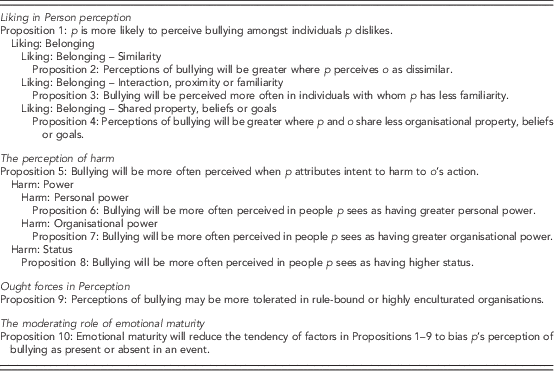
Heider describes many factors involved in constructing perceptions of others. Of particular relevance to bullying are liking, harming and ought forces. The two most central factors in person perception generally are our reaction to events connected to others, and how we interpret their causes: ‘the most important characteristics of events that affect us are, first whether or not they are positive, pleasant, and satisfying, and second their causal sources’ (1958: 16). Therefore, in the context of bullying, a perceiver (p) considers whether the other’s (o’s) behaviour is pleasant or unpleasant, and whether o intended to cause harm rather than benefit to p. A person (p) is more likely to perceive bullying when o’s act is unpleasant and o’s relation with p is perceived as negative towards p: the two elements are balanced, being both negative. Ought forces are ‘rules of conduct’ that might explain o’s motive for harming p, for example o might consider social or organisational status includes a right to harm others. These ideas are elaborated below with all the propositions set out in Table 1.
Managing workplace bullying: Propositions from Heider’s Balance Theory

In our propositions concerning subjective factors underlying claims of bullying, based on Heider’s theory, the focus is on p’s perception of o in a given event or series of events (with x being the event or events for those familiar with Heider’s pox notation ). Perceptual processes in o and in third parties (referred to by Heider as q) may also be relevant to validating p’s perceptions but fall beyond the scope of this discussion. The interest, here, is in p’s perception of whether bullying has occurred, regardless of whether objective data supports it, since p’s response to o is based on this subjective viewpoint. It is assumed that understanding p’s viewpoint is helpful or necessary to assessing p’s claims and understanding the response to o.
The propositions are organised around two central influences on perceptions of bullying, liking and harm. Liking, in turn, requires discussion of belonging, and harm of power, status and ought forces. In considering these propositions, the reverse relationship is also usually expected. For example, Proposition 1 concerns p liking o but o’s liking of p is clearly relevant to bullying. Further, Proposition 10, concerning emotional maturity as a moderating factor, is a key to understanding interpretations of acts as bullying, and is discussed later.
Liking in person perception
For Heider, perceptions of events involving others are fundamentally organised in terms of whether we like or dislike the other. If our feelings towards another are in conflict we construct a simplified representation that minimises ambivalence (Heider, Reference Heider1958: 182); our attitudes towards others are fundamentally positive or negative. Maintaining a more complex and realistic representation of a person requires a sophisticated ability or effort to separate positive and negative traits. We tend to construct an image of o exemplifying o’s liked or disliked aspects, but not both.
Heider’s approach comprises many such elements; all simplified, generalised perceptions of others. Balance Theory predicts that when faced with conflicting evidence concerning elements we tend to balance their valences (positive vs. negative qualities). If we perceive o dislikes us but acts favourably towards us, we induce that o likes us after all or that o’s action is in reality not beneficial but rather disguised harm. Similarly, if we like o but o acts unfavourably towards us, we change our feeling about o or our perception of o’s intent. For Heider, liking is a fundamental element, resistant to change. This is the basis of the halo effect (Heider, Reference Heider1958: 182), the tendency to overgeneralise liked (or disliked) characteristics by imagining a person to be inherently likeable or dislikeable. Contradictions in externally observed characteristics are balanced by constructing an internal imagined personality consistent with our feelings about o.
Since Heider views sentiment as the first determinant of attribution, and since bullying is a negative event:
Proposition 1: p is more likely to perceive bullying in individuals p dislikes.
Many factors, however, contribute to the perception of another as liked or disliked. For example, whether o likes p is especially important, but even o’s physical appearance may be involved. Liking is interrelated with perceptions of causality, harm, power, status and values, but particularly with belonging.
Liking: Belonging
Belonging is a fundamental organising principle of social perception that describes a tendency to perceive relatedness between parts of a unit. We look for consistency between people according to the groups they belong to (e.g., family), or between a person and their actions (e.g., ‘he is acting out of character’). In grouping individuals we use a variety of factors including things they make or own, outcomes of their actions, kinship, nationality, religion and interaction with others (Heider, Reference Heider1958: 178). Heider relates four aspects of belonging to liking: we like people who are similar to us, interact with us, are familiar to us and who share property, beliefs or goals with us. In general, therefore, we are more likely to perceive bullying in those who do not (or are not perceived to) share any of these features with us.
Liking: Belonging – Similarity
Perceived similarity is important in constructing mental representations of others. We have a tendency to like people we perceive as similar to us and dislike those we see as different. Heider observes that ‘like’ denotes both similarity and positive affect.
Similarity is a broad concept. Workplace conflict, for example, has been related to differences in gender, race, culture and nationality (Williams & O’Reilly, Reference Williams and O’Reilly1998; Samnani, Reference Samnani2013). While peers may be in the same work group, and interact with each other, there may be differences that influence ‘liking’. Considering Proposition 1 and the tendency to induce disliking from dissimilarity, it is proposed that:
Proposition 2: Perceptions of bullying will be greater where p perceives o as dissimilar.
p’s attitude towards self also contributes to this perception. Since we rarely consider ourselves as bullies – to do so would be to overtly dislike ourselves – we do not expect people similar to us to be bullies. Maintaining self-esteem may require us to consider members of out-groups as bullies more often than members of groups to which we belong.
Liking: Belonging – Interaction, proximity and familiarity
There is evidence we tend to like people we associate with – the ‘social distance effect’ (Heider, Reference Heider1958: 191). Thus, when we form groups, for example, by moving into a new neighbourhood, or work team, we come to rate others as more likeable than similar people known at a distance, leading to the proposition that:
Proposition 3: Bullying will be perceived more often in individuals with whom p has less familiarity.
In organisations, reducing social distance might involve organising staff in teams rather than in a leader-centric hierarchy. Proposition 3 suggests a lower incidence of perceived bullying between members of co-located teams than between similar individuals related hierarchically.
We tend to have contact with those we like and avoid those we dislike. More than most social environments, however, workplaces force individuals to work with those whom they dislike, including peers. This may help explain why workplace bullying is frequently reported as an epidemic (e.g., McAvoy & Murtagh, Reference McAvoy and Murtagh2003). Greater perceptions of bullying are expected in workplaces where privacy is limited by the physical and social environment. It is even possible that when the desire to avoid disliked people is frustrated, some will accentuate their dislike in a manner that increases the disharmony. Exceptions to the social distance effect also occur: we sometimes focus our negative feelings more on someone close to us, just as we may find unknown people interesting, and this may be owing to a range of factors including age and socialisation.
Familiarity often follows from proximity and generally produces similar predictions. In some cases though, a new person appears familiar – for example if one has learned about them from others, or recognises them from public life. Even relatively superficial information – in the extreme the mere repetition of a name – may induce us to think a person is familiar and hence to like them.
Unfamiliarity involves uncertainty and is threatening when we otherwise feel insecure. Heider (Reference Heider1958: 193–194) relates unfamiliarity to the conflict and instability that may be observed in groups such as adolescents, minorities and young children in unfamiliar surroundings. Therefore, in organisations where social familiarity is inhibited, such as those with high turnover or a sudden influx of newcomers, perceptions of bullying are likely to be more frequent.
Liking: Belonging – Shared property, beliefs or goals
In Heider’s framework we perceive others not only in terms of their personal characteristics but also in relation to objects and ideas associated with them. For example, sharing property, beliefs and goals with others induces us to like them, and conversely liking others tends to lead to convergence with their property, beliefs and goals.
Property to Heider (Reference Heider1958: 194) includes both physical and non-tangible assets. In a workplace we may feel ownership of projects, ideas and initiatives. We may even see people as owned – ‘my people’, ‘my assistant’. Shared ownership leads us to feel part of a group and hence to like other group members, while lack of sharing increases social distance and disliking.
Managers and supervisors are an obvious example of a group defined by common ownership, particularly where management styles increase social distance from subordinates. To the extent such subordinates perceive themselves as an ‘outgroup’ with less organisational ‘property’, we expect greater perceptions of bullying where p is subordinate to o, than where p and o are equals, or o is subordinate. This is separate from the effect of power discussed below.
Sharing can also lead to resentment and antagonism if p and o cannot each fully own the desired property. For example when organisational assets require substantial collaboration or joint decision making to achieve shared goals, negative emotions may increase perceptions of bullying among organisational members sharing property.
Similar trends are expected when beliefs and goals diverge. Workplace relations may be coloured by stereotypical beliefs about members of different social or cultural groups. A nurse who believes doctors are arrogant, a manager who believes subordinates are lazy or someone who views colleagues and peers from certain countries as untrustworthy, creates social distance that may encourage perceptions of bullying.
Difference in goals among an organisational hierarchy can similarly lead to social distance. Managers, and sometimes subordinates, may be inherently seen as bullies owing to group goals. Heider makes an interesting distinction between competitive and cooperative goals, predicting that cooperation will encourage liking. Competitive workplaces encourage organisational assets to be seen as private rather than common property, encouraging perceptions of bullying. Therefore:
Proposition 4: Perceptions of bullying will be greater where p and o share less organisational property, beliefs or goals.
To summarise Propositions 1–4 above, p’s perception of o’s act as bullying is more likely when p dislikes o or sees o as belonging to a different social group. The perception of bullying is increased when p and o are dissimilar, non-interacting, physically distant, unfamiliar and do not share property, beliefs or goals. All these factors influence p towards disliking o. This discussion now addresses a second fundamental factor in perception of bullying, the perception of o’s act as the cause of p’s negative feelings and whether o intended to harm p.
The perception of harm
Bullying is one way others harm us. For Heider, whether another’s act harms or benefits us has a fundamental role in organising social perceptions in ‘a wide and colourful range of human interaction’ (1958: 254). He considered perceiving harm to involve an attribution of cause and an evaluation of o’s action as positive or negative. This evaluation of positive or negative translates into an evaluation of benefit or harm. In attributing cause, of harm in particular, in bullying, p may consider whether o intended the act, whether o’s act was accidental or thoughtless, and whether o realises how p sees it. If o intended it – was o forced to do it, doing it for a greater good or to benefit rather than harm p? In evaluating the act or its outcome – did o intend a positive outcome that turned negative, against expectations? Does o evaluate the act with the same valence as p? Do p and o each see how the other sees it, or how others, society or law judge it? Here there are many possibilities for subjective bias. Perhaps this is why the bully’s intention is considered an important problem in bullying research (Einarsen et al., Reference Einarsen, Hoel, Zapf and Cooper2010).
While a manager or investigator may wish to objectively conclude o bullied or did not bully p, p is subjectively attuned to many nuances in the meaning of o’s act. Liking versus disliking and benefiting versus harming are basic elements in whether these show o as a positive or negative in p’s social world. Central to the attribution of harm versus benefit is a desire to make sense of others’ acts by attempting to understand their motives, looking for ‘continuity or constancy in the reality’ (Heider, Reference Heider1958: 257). This is, again, a process of construction, an attempt to interpret complex, ambiguous or conflicting evidence. For Heider, we can understand these at different levels by looking beyond ‘local’ harm or benefit to its ‘total’ relevance: What does the event say about o’s intentions towards me?
This process involves levels of attribution. For example, if I feel hurt when a colleague, o, speaks to me in a tone of annoyance, questions arise at different levels:
-
1. Does my hurt really come from o’s tone? Or, for example, my sensitivity to criticism after a rebuke from another (q), a previous rebuke from o or my bad mood today? If I conclude my feeling arose because o did indeed speak unusually harshly to me I ask:
-
2. Did o intend to harm me? Was o upset by someone (or something) other than me? Was o ordered to speak harshly to me or trying to please someone else this way? Perhaps o sees that tone as a means to a positive end, as a parent rebukes a child for its own good. If I conclude o intended to harm me, I ask:
-
3. What are o’s motives for harming me? Is o a hostile person in general? Is this a temporary or permanent attitude towards me? Is o acting in revenge for a perceived wrong on my part? Do I deserve a rebuke? Doesn’t o like me? If the latter, I ask:
-
4. Why doesn’t o like me? Has q told o stories about me? Am I a dislikeable person? This fundamental level is concerned with o as a person.
These factors are not explored in a set order nor necessarily consciously, but the example illustrates the tendency to interpret o’s action in the context of a broader mental model of o’s intentions in relation to p. As people often conceal their deeper motives person perception involves considerable inference, but understanding o’s intentions is necessary to avoid harm: otherwise we are ‘at the mercy of seemingly fickle events in the environment’ (Heider, Reference Heider1958: 257).
Proposition 5: Bullying will be more often perceived when p attributes intent to harm to o’s action.
Perception of intent to harm does not stand alone, and ultimately our judgement of whether o likes us serves as a useful guide to the complexities of a relationship, even if it brings a risk of bias or misattribution. The crucial role of emotional maturity in this is outlined later.
Attribution of intention to harm: Liking
Perceiving liking and harm are even more complex in the impersonal environment of an organisation. The limited information about o may be conflicting: a bully may be charming and helpful at times. Managers may like subordinates, yet deny their wishes or reprimand them for the organisation’s benefit. In this context, individuals are even more dependent on inferences in deciding whether o intends to harm or benefit them.
Balance Theory suggests we are more likely to perceive o’s actions as bullying when we believe o dislikes us. Conversely, if we feel o likes us we infer o’s actions are not intended to be harmful, not as harmful as first thought or not directed at us as a person. Further elaborating on Proposition 1, p will more likely call o a bully when o is perceived by p to dislike p.
Bullying as an expression of dislike can be very subtle, giving it great power: detecting whether another likes or dislikes us as a person requires perceptual skills based in considerable emotional maturity (discussed later). Workplaces discourage personal intimacy but encourage networks and coalitions, belonging factors that blur personal liking. Perception of harm is therefore influenced by perceived belonging and liking (and vice versa). It is necessary to address these subjectivities, power, perceived belonging or liking, when determining intention.
Harm: Power
Heider finds close links between perceptions of harm, power, status and ‘ought forces’ as well as liking and belonging. A power imbalance between bully and victim is usually part of an objective definition of bullying. Indeed, bullying may be less about objectively harming the other than creating a perception of the power to harm the other.
For Heider (Reference Heider1958: 263), power has ‘a tremendous impact on the meaning and acceptance of harm and benefit’. He defines power as the ability to control one’s environment Heider (Reference Heider1958: 261). While he primarily considers personal power, in a workplace organisational power is also important. These factors are considered separately, but while perceptions of bullying may have more to do with one’s status as a person than as an employee, the two sources may be difficult to separate in practice.
Harm: Personal power
Heider (Reference Heider1958: 259) observes that people perceived to be powerful are attributed with many other qualities. One reason is the tendency to form unitary images of a person at a deeper level: we seek to categorise o as more or less powerful than us, much as we tend to like or dislike o. A powerful o is more likely to be seen as acting at will and may be unaware of the impact on p (Hershcovis, Reich, Parker, & Bozeman, Reference Hershcovis, Reich, Parker and Bozeman2012), where a weak o is seen as a victim of circumstances or under the influence of others (e.g., D’Cruz & Noronha, Reference D’Cruz and Noronha2010): to have an internal rather than external locus of control (e.g., Thibaut & Ricken, Reference Thibaut and Riecken1955). Where p perceives o as more personally powerful, o’s acts are more likely to be perceived as bullying than outcomes of external forces acting on o. A powerful o is more likely to be seen to cause p’s negative situation, and p’s situation is more likely to be seen as negative if p associates power with harm, as is often the case (Heider, Reference Heider1958). Of course, others may see the power relations between p and o differently.
Proposition 6: Bullying will be more often perceived in people p sees as having greater personal power.
Perceived power affects not only where we find the ‘cause’ of our misfortunes but how we subsequently evaluate the harm as positive or negative. When p perceives o as stronger, five evaluations are possible (Heider, Reference Heider1958: 260). p may:
-
(i) Accept the harm as being in the natural order of things: a ‘pecking order’.
-
(ii) Accept the harm as an indication that o dislikes p. Since p believes p is weaker than o, p accepts the disliking as valid; indicating p admires strength in others.
-
(iii) Reject o’s action, thinking o ought not to bully p even though o is stronger. If p does not feel strong enough to challenge o’s power, p may fantasise about revenge.
Of these only (iii) is likely to lead to the perception of o as a bully. Conversely if p feels stronger than o, p may:
-
(iv) Think o is justified in attacking p for some specific reason.
-
(v) Think o impudent and attempt to put o in his or her place.
Here, p is unlikely to feel bullied in the sense of feeling diminished as a person. p’s emotional maturity provides an interpretation at the local level, and p perceives o as antisocial and disrespectful but has the ego-strength to respond assertively.
Harm: Organisational power
If o has organisational power over p, certain evaluations appear more likely. Organisational power may assist the perception that it is natural for o to harm subordinates, as part of the hierarchy. Aspects of organisational culture such as emphasis on competition may encourage the disliking of individuals less able to control their environment, and p may accept this. Management indifference to excessive uses of organisational power may reinforce p’s perception of having a lower level of power.
Proposition 7: Bullying will be more often perceived in people p sees as having greater organisational power.
If p has sufficient ego-strength he or she will either accept the harm as a valid response to his or her error or challenge o’s misuse of organisational authority to attack him or herself as a person.
Organisational power is visibly reflected in formal policies, authority to direct, organisational charts and status symbols such as office position. It also has a more subjective quality reflected in, for example, referent or legitimate power, forms of power in organisations that have a partly social basis (French & Raven, Reference French and Raven1959). Combining these multiple influences to form an overall perception of organisational power may therefore be complicated and the demarcation with personal power correspondingly less clear.
Personal and organisational power combine in networks of interpersonal influence that are fundamental to the fabric of organisations. The seeking and granting of favours, friendships, coalitions, in- and out-groups and impression management activities produce constantly fluctuating power dynamics. When confused about the real intentions behind words or actions, perceived power is one of the most important factors in inferring intentions. However, the impersonality of workplaces and their emphasis on collective rather than personal goals mean we often know little of others’ real motives and bias is quite likely. Power is therefore a critical issue in attempting to assess the validity of bullying claims.
In this context it is not surprising that distinguishing harm from benefit can be difficult. Just as what appears at a local level to be harm may be seen as a benefit at a deeper level, so too a benefit may be disguised harm. Organisational rewards and favours can be used to disempower individuals, with similar consequences to overtly aggressive behaviour. Perceived bullying is therefore likely to be more common in organisations whose managers use benefits in ways that reinforce power distance and dependency, or social distance and out-groups.
Harm: Status
Heider (Reference Heider1958: 261) observes that power is often conflated with status, a general judgement of worthiness or value as a person. A high status person is judged to be admirable or superior, and a low status person as inferior, to be disparaged. Position in the organisational hierarchy is often associated with status. Operational staff, for example, may be treated as less valuable people than managers and executives: as human ‘resources’ subject to greater scrutiny and control through paternalistic or patronising management. Devaluing people of lower organisational rank may then cause them to overvalue managers’ organisational or personal power. Such subjective factors are in themselves sufficient basis to relate status differences to perceptions of bullying:
Proposition 8: Bullying will be more often perceived in people p sees as having higher status.
While p may attribute harm as a consequence of o’s perceived status, o may objectively harm p to assert superiority. This motive is distinct from the intention to gain power over p and, as noted above, perhaps more fundamental to the bully’s intention. The problem for p is, again, disentangling his or her subjective processes from o’s actual intentions. Emotional maturity includes an understanding of how people use harm to increase their power and status.
Ought forces in perception
To summarise the argument above, p is subjectively more or less likely to perceive o as a bully according to how he or she feels in relation to o: liked or disliked, belonging to the same or different social groups, stronger or weaker, and admired or disrespected amongst other factors. Balance is achieved when p’s feelings about o and o’s perceived intentions are both positive or both negative. If p feels disliked by, weaker than or disrespected by o, perceiving an ambiguous act as caused by o, or perceiving o’s intention as negative, creates a balanced image of o.
A different sort of influence on perception of harm involves ought forces, beliefs that something ought to happen owing to objective forces applying to people generally. Such laws are implied in moral standards (e.g., right vs. wrong), values (e.g., beauty vs. ugliness; good vs. bad) and ideas of what people ought to do to achieve long-term goals (e.g., ‘I ought to see my doctor about this’). Like the factors above, ought forces organise perception and action by providing constancy: what a person ought to do applies over time and independently of wants and wishes. Balance is achieved when oughts and other elements – likes, values etc. – are both positive or both negative: to like something that is wrong, ugly, bad or against one’s long-term interests is imbalanced. Either one’s liking changes or one’s perception of the object or person is revised to what ought to be. For example, a criminal may change his or her ways, or may come to believe criminal acts are in fact helping the underdog in society.
For Heider, the acts of others are always interpreted in the light of ought forces. For example, because it helps us to accept situations we believe we have no control over, we are prone to believing harm is the prerogative of powerful people and victims ought to accept it (Heider, Reference Heider1958: 263). This is an important reason to expect greater perception of bullying in powerful or high status people: an act we dislike can be attributed to a powerful person’s predisposition to harm others. If p is upset that a manager has summarily cancelled p’s pet project without explanation, p can balance dislike with a belief that managers are generally harmful (uncaring or disinterested). If p does not feel strong enough to demand an explanation this can be rationalised: good employees ‘ought’ to accept managerial authority.
Therefore, in responding to o’s act p considers whether o ought to have done it; p may feel deserving of the harm. More commonly we do not accept harm and feel angry at it. If we stand up to o we may not feel bullied, but failing this we can balance our anger and helplessness by reframing our wish not to be harmed as a right: o ought not to have harmed us. We feel righteous indignation against the objective order of our social world (Heider, Reference Heider1958: 264) taking our feelings as objectively justified and o’s aggression as personally biased against us. These are perceptual defences, rationalising our perceived inability to stand up to another.
Similarly, ought forces can be used to explain bad events as being the result of fate. p may believe a negative event is punishment for something others see as completely unrelated. Believing that bad things ought not happen to good people, p sees ‘fate’ or some other forces ‘punishing’ him or her.
Perceptions of bullying may be substantially influenced by beliefs that weaker or less worthy individuals deserve such treatment, by feelings of righteous indignation against the objective order, or by fatalistic beliefs about cause and effect. Oughts can be used to explain away real bullying or to find a source for unwanted ‘bad’ events that may not involve bullying. Managers and investigators should therefore be aware of the role of oughts in claims of bullying.
Highly rule-bound or enculturated organisations may promote this type of thinking when expectations of how a person ought to behave, and even his or her values, reduce the scope for deciding one’s own goals, values and beliefs. Goffman’s (Reference Goffman1961) ‘total institutions’ such as the military, religious orders or boarding schools form an extreme example. Business organisations with cultures focused on internal processes (Cameron & Quinn, Reference Cameron and Quinn2011) are more common examples. When organisational beliefs and values override personal ones, bad events as well as good ones are attributed to the organisation, and negative behaviours, rather than being labelled as bullying, are accepted (Miller & Rayner, Reference Miller and Rayner2012). Therefore we expect:
Proposition 9: Perceptions of bullying may be more tolerated in rule-bound or highly enculturated organisations.
In this context it is likely that self-reports and investigations could be influenced by this tolerance, and managers and investigators need to be able to critically evaluate their own interpretations of events.
As can be seen from these propositions, Heider’s Balance Theory offers avenues for exploration of the highly subjective nature of the interpretation of an event or incident as bullying. Importantly, the Balance Theory principles may have significant exceptions, such as those concerning interaction, proximity and familiarity discussed above. Heider believed exceptions do not detract from the value of more fundamental trends. There is, however, an underpinning element, which is present throughout Heider’s work, that explains emotional maturity.
THE MODERATING ROLE OF EMOTIONAL MATURITY
Emotional maturity, as already highlighted, is an important moderator of these propositions. Emotionally mature individuals are expected to be better able to accurately perceive and interpret behaviour, and are less likely to be susceptible to the misperceptions resulting from Balance Theory tendencies. Individuals with a lower level of emotional maturity may need assistance to determine whether particular actions constitute bullying, or not. While organising and simplifying the complexities of social relations, when balance involves bias it can exacerbate bullying: achieving balance by adopting a bully’s negative valuation, for example, is not healthy.
Heider (Reference Heider1958: 212) underpinned Balance Theory with an organismic source of motivation, which leads healthy people to improve themselves. Emotional maturity involves cultivating healthy levels of self-esteem, ego-strength and ability to realistically distinguish reality from subjective constructions. This is no easy task, as it involves addressing often invisible subjective biases, along with broad social experience leading to awareness of how people objectively use liking, belonging, power, status and oughts to influence others. Therefore:
Proposition 10: Emotional maturity will reduce the tendency of factors in Propositions 1–9 to bias p’s perception of bullying as present or absent in an event.
Emotional maturity is also expected to moderate the inclination to bully another. Indeed, bully and victim may have similar beliefs concerning their relative likeability, power and value, and those ought forces that relate power and value to harm. Do the terms ‘bully’ and ‘victim’ imply fixed dispositions or are both parties capable of change, or even hardwired for it, through developing emotional maturity? Is emotional maturity a stable, global characteristic or do all individuals have periods or behavioural areas of immaturity? These questions invite reconsideration of assumptions about bullies and victims as human beings; this then has implications for preventing, detecting and correcting bullying behaviours.
THE VALUE OF THE PROPOSITIONS
Management of workplace bullying has become increasingly important, and research into the causes, consequences and amelioration of the phenomenon is similarly growing. In the growing body of work there is still limited attention paid to the subjective nature of referring to an act or event as bullying. Noticeably absent from extant research is work considering the myriad of influences on individuals’ subjective interpretations. The propositions set out here are yet to be tested empirically. Testing would include exploration of the degree to which the propositions are relevant in different cultural contexts and wider notions of diversity. The focus here has been to frame a discussion that will prompt further study of the value of Balance Theory in understanding workplace bullying, and to highlight some implications for research. It will be important for research to develop further understanding of the role of Balance Theory in understanding individual perceptions and interpretations of the actions of others as bullying or not. In the interim there are some elements of this discussion that may be considered appropriate for exploration in organisations.
Discussion of bullying sometimes simplifies acts, events and roles of involvement of ‘bully’ and ‘victim’, ignoring the range of other factors that influence interpretations. Heider’s perspective suggests we all face significant difficulties in perceiving the actual motivation and feelings of others and are apt to balance conflicting information by devaluing or overvaluing ourselves. There is danger in objectifying bullying with ‘us and them’ stereotypes. Balance Theory shows why social relationships are rarely simple.
This exploration of Balance Theory has attempted to show how a person’s subjective world is based on principles quite alien to the rational cause-effect models in traditional scientific thinking or management practice. Perception involves not only sensory data but also emotions and inferences about why people act as they do. All these cues and clues are filtered through a hierarchy of possible causes, which fundamentally rest on whether others like us as a person. As social beings we are particularly sensitive to being disliked, rejected or otherwise harmed.
The normal difficulties of untangling liking, belonging, power, status and oughts in perceiving another as harming or benefiting us is complicated in workplaces by issues of organisational power, status, values and rules. Managers responsible for addressing bullying need to take into account the complex subjectivities in each situation. Human resource professionals have a responsibility to ensure that the policies, processes and procedures in place in organisations have the capacity to ensure fairness, and also to address these complexities.
PRACTICAL IMPLICATIONS FOR ORGANISATIONS
Bullying is widely presented as a significant problem in modern workplaces but research to date is largely based on self and third-party reports with significant limitations. Managers, human resource professionals and those charged with investigating allegations of bullying are likely to have only self-reports from perceived victim and alleged bully, or limited third-party observations, and may be unable to assess their accuracy. Balance Theory provides a basis for broader understanding of human perceptual processes in social relations, without which researchers, and managers, run the risk of constructing questions and interpreting responses through the lens of their own mental models. It can therefore augment the dialogue associated with ‘detecting, correcting and preventing’ (Ferris, Reference Ferris2009: 169) workplace bullying, issues increasingly troubling those charged with managing it. Five areas of potential application and consideration in organisations are suggested.
First, human resource professionals and others can increase organisational member awareness of the subjective and interpretive nature of employee perception of self and others. Harm, in bullying and in other forms, should be seen as an expression of the common human tendency to overvalue oneself and devalue others rather than a moral issue of ‘good’ versus ‘bad’. In perceiving others we are particularly sensitive to liking, belonging, personal power and status, and power, status and oughts have additional significance in organisations. Managers have some control in the workplace. Organisational discussions of bullying may consider: How can organisations raise awareness of members’ inherent sensitivity to others’ valuations of them as people, particularly to whether others like and wish to benefit them? How can members be encouraged to understand each other as people by looking beyond simplified evaluations of them as liked or disliked, belonging to the same or different social group, powerful or weak, and valued or marginal? How do we avoid the common tendency to use such simplified images to interpret individual behaviours in a biased way? Perhaps raising such questions is a step towards better understanding employee interactions.
Second, Balance Theory and more recent perspectives on person perception may assist in awareness, education and training programs for managers and other organisational members. For example, technically-minded occupations like academics might prefer programs that are analytical in nature and grounded in research (Keashly & Neuman, Reference Keashly and Neuman2010), but these might also help participants understand how others see the world differently; not necessarily a straightforward process.
Third, the propositions above may be used to increase manager and investigator awareness of subjective issues in perceptions of bullying, particularly in self-perceived victims’ and alleged bullies’ reports and responses. This might sensitise investigators as to how individuals attach different meanings to a given act and to terms such as ‘bully’ and ‘victim’, thus increasing awareness that these differences may not reflect a person’s honesty but reflect the basic processes of human perception. While an investigator’s job may include seeking independent or third-party confirmation of available facts, these may be limited or ambiguous.
Fourth, sensitivity to the subjective viewpoints of bully and victim might encourage their cooperation with investigators and willingness to address the issues. Individuals may make a choice to leave the organisation if they feel their circumstances are not being addressed (Berthelsen, Skogstard, Lau, & Einarsen, Reference Berthelsen, Skogstard, Lau and Einarsen2011), and there may be only a small ‘window of opportunity’ (Parzefall & Salin, Reference Parzefall and Salin2010: 774) for the organisation to act in these often emotionally disruptive and unproductive incidents.
Fifth, Balance Theory principles may be useful in developing formal definitions of bullying for organisational policy (see Harrington, Rayner, & Warren, Reference Harrington, Rayner and Warren2012), for practical use, and for research. Individual responses may not neatly fit formal definitions (Saunders, Huynh, & Goodman-Delahunty, Reference Saunders, Huynh and Goodman-Delahunty2007; Cowan, Reference Cowan2012). Understanding perceptual differences may contribute to addressing the realities of a so-called bullying event. ‘Objective’ definitions that acknowledge subjectivity are more likely to be practically useful.
The propositions may help managers and human resource professionals; educators and trainers; investigators; individuals in bullying events; and those who define bullying, understand why different parties might interpret an act differently. Humans have a complex and subjective approach to social relations. Awareness of this can help humanise workplaces so that realistic mutual acknowledgement rather than stereotyped evaluations underpin relations, increasing support and respect for each individual. This is especially important in work environments.
CONCLUSION
Managing the complexities of workplace bullying is a significant challenge. Foremost among these is dealing with the subjective nature of individual interpretations of events. This paper has shown how certain important elements of Heider’s Balance Theory can illuminate on the perception of another’s act as bullying. Managers, including human resource managers, should consider the way that different perceptual processes lead individuals to arrive at different conclusions about an event. It remains necessary to empirically confirm the present propositions and to explore influencing factors. Nonetheless, they represent a step forward in understanding the role of complex subjective issues which are central to effectively managing workplace bullying, and offer a pathway for further research.