Beforethe United Statesentered World War II, major Hollywood studios had been slow to produce films critical of the Nazi regime. In addition to fearing that such films would alienate the lucrative European market and run counter to the United States’ policy of neutrality, film industry executives were mindful, too, that anti-Nazi films could well worsen the situation of Jews in Germany and German-occupied territories.Footnote 1 Attuned to anti-immigrant feelings in the United States, they also appeared reticent to depict the lot of refugees from Hitler.Footnote 2 If the studios’ prime objective was to make the most profit while entertaining audiences, those running the studios might have viewed taking a stand on controversial issues as counterproductive. MGM's full-length film, Florian (1940), however, proved something of an exception. In this case, a light-entertainment film doubled as a palimpsest for commentary on some of the most critical events of the day.
Although today few who are not horse aficionados have ever heard of Edwin L. Marin's Florian,Footnote 3 with its long sequences of dancing white Lipizzan stallions, MGM's adaptation of Felix Salten's eponymous novel contained critical political and humanitarian messages. Set in Francis Joseph's imperial Austria (as it was popularly referred to in Hollywood), the film paints a positive, nostalgic picture of the monarchy, its aging ruler, and its friendly inhabitants. The film distances Austria and the Austrians from their northern neighbor and implicitly condemns the German aggression that removed Austria from the map in 1938. In its portrayal of the demise and immediate aftermath of the monarchy, the film suggests the futility of resisting a tyrannical post-World War I system and argues instead for the necessity of emigration. At the same time, the film urges “Old World” immigrants to leave Europe behind, to assimilate fully to United States society, and hence become productive citizens in their new home.
Salten's novel Florian. Das Pferd des Kaisers, published in 1933, appeared a year later in English as Florian: The Emperor's Stallion. A synopsis of the novel in the MGM files dated 30 May 1934 indicates that the studio's interest in a film version most probably predated the appearance of the translation on the North American market.Footnote 4 The story opens shortly after Florian's birth in the early twentieth century at the stud farm in Lipizza (now Lipica, Slovenia) on the Karst plateau near the Adriatic Sea. Anton, the stable hand who assisted with the colt's delivery, and Captain von Neustift (later General), an aristocratic horse enthusiast who had gotten Anton his position, are admiring the promising newborn. Salten later adds a dog to the mix, creating a tight threesome—Anton, Florian, and Bosco, a terrier. In contrast to the novel's hopeful beginning, the story closes on a decidedly melancholy note after World War I—Anton has died on the battlefield, Florian, the one-time equine star at the court of Emperor Francis Joseph, is now owned by a former court stable hand, and Neustift has lost his social prestige and wealth in the new Austria. In the last pages of the book, the two relics from a prewar Austria, Florian and Neustift, meet by chance in a meadow on the outskirts of Vienna.
Fifteen years after the end of World War I, when Austria was plagued by social and political unrest, Salten turned to the Lipizzaner and the Spanish Court Riding School to establish a source for a positive Austrian identity.Footnote 5 The verdict may have still have been out in 1933 on Austria's republican form of government, but the author found hope in the one-time imperial institution that had survived the dissolution of the monarchy. Understandably, most reviewers of the book in the United States did not recognize the writer's cloaked commentary on Austrian society, which would also have been lost on much of the American public. The novel, did, however, strike a strange nostalgic chord among Americans for Austria-Hungary and Emperor Francis Joseph.
The sadness over the monarchy's demise, which plays on an empathetic knowledge of the loss, is underscored in an advertisement for the translation in the New York Times from 17 October 1934. “Florian is a truly beautiful novel, an idyl (sic) of a way of life that was irrevocably lost when the shots rang out at Sarajevo.”Footnote 6 Similarly, a New York Times review of the book from 21 October 1934 also speaks of the allure the Habsburg monarchy held for at least some Americans: “From the Emperor himself down to the stablehands, they are real people whom we watch as they move through that now almost legendary world destined to vanish so suddenly and so tragically.” The reviewer finds particularly sad the fates of both the horse and aristocrat, who “lived on in a world where they were no longer needed, no longer even wanted, relics of a past that had vanished almost utterly away.”Footnote 7 MGM may have hoped to capitalize on Salten's reputation as the author of Bambi (1923) and other animal stories, as well as Americans’ nostalgia over the demise of the far-off monarchy, which probably had less to do with knowledge of Austria's postwar reality than with popular images of Austria circulating in operettas and film.Footnote 8
Although Salten's name figured prominently in advertisements for the 1940 film, the story was so transformed that the literary prototype is hardly recognizable. In both book and film, the promising Lipizzaner Florian, once moved from the stud farm to the Imperial Riding School, becomes wild and untrainable. But when reunited with his two-legged companion Anton in Vienna, the stallion becomes the School's star pupil, capable of the most difficult dance moves. After the demise of the monarchy, the “white wonder” is sold. Here, the similarities between the novel and the film end. The film's makers play freely with the original plot, as well as with Austrian geography, history, and court etiquette.Footnote 9
The tight threesome at the core of the novel—Florian, the stallion, Anton, and Bosco, the terrier—is replaced in the film by a foursome—Florian, Anton, and two new human characters, the Duchess Diana and the wise veterinarian Dr. Hofer. The additions fit such Hollywood clichés as Anton's unlikely social advancement and the ideal of love across class lines. In the film, Anton is not a simple stable hand, but rather a horse breeding expert who advances to the position of an equestrian at the Riding School, and finally to the rank of Captain in the Austrian Calvary. In Hollywood's previous Austria films, a romantic liaison between a royal and a commoner could only be realized by the dissolution of the monarchy or by the couple moving to the United States.Footnote 10 Here, both requirements were fulfilled and a royal rival eliminated as well. Archduke Oliver, who was to marry Diana, dies in battle and the war's end brings with it a revolution that makes life in the new Austria dangerous for all aristocrats. Anton and Diana (and Florian), dramatically separated during the revolution, are reunited in the United States where a former stable hand and duchess can marry without fear of social repercussions. The addition of Hofer offers a knowledgeable commentator who facilitates the insertion of the film's various humanitarian, political, and moral messages.
The transfer from one medium to another necessitated numerous alterations to the original story. However, the historical and cultural context of the late 1930s played an equally important role in the story's metamorphosis. In From Caligari to Hitler: A Psychological History of the German Film (1947), film critic and historian Siegfried Kracauer noted the fascination old Vienna held for audiences in his description of the German-film industry in the 1920s. He traces a nostalgic image of Vienna specifically to the 1925 hit Ein Walzertraum (Waltz Dream), one of the few German silent films that became popular with American audiences: “This model film […] established that enchanted Vienna which was to haunt the screen from then on. Its components were gentle archdukes, tender flirtations, baroque décors, Biedermeier rooms, people singing and drinking in a suburban garden restaurant, Johann Strauss, Schubert and the venerable old Emperor. The persistent image of this retrospective overshadowed the misery of twentieth century Vienna.”Footnote 11 By the time the translation of Salten's novel appeared in 1934, Hollywood had produced more than thirty films set in Austria. Just as in many German-language films, Hollywood's Austria also served as a home to royalty and composers, both fictional and historical.
MGM's portrayals of Austria and its capital conformed to many of these stereotypes. Victor Sjöström's The Masks of the Devil (1928), for example, played on Vienna's popular association with decadence. With the introduction of sound, however, MGM's Austria films sought to fit the studio's profile that emphasized “glamour, grace, and beauty.”Footnote 12 In these films, often set in imperial Austria, music was given a prominent role just as it was in German-language films of the period. However, Hollywood's Austria remained undeniably American.Footnote 13 For example, Jacques Feyder's Daybreak (1931) transformed Arthur Schnitzler's tragic novella Spiel im Morgengrauen (1926) into a romantic film full of music with a happy ending.Footnote 14 Dudley Murphy's The Night Is Young (1935), presents a romance between a crown prince and a commoner that was doomed because both parties realize that the duty of a royal comes before pleasure.
The German annexation of Austria in March 1938 left very different marks on the celluloid images of Austria produced in Vienna as opposed to Hollywood. Using post-Anschluss examples from Wien-Film, a Viennese film company in which the Reich was a major shareholder, film historian Sabine Hake notes a new spin filmmakers gave to the former imperial capital.Footnote 15 “… the Wien-Film after 1938 continued to offer musical entertainment, but from the German viewpoint of Vienna as a variation on, if not alternative to, true Germanness.”Footnote 16 If the “Vienna” of Wien-Film emphasized the ways that Austrians and Germans were complementary, or how Austrians embodied “true German-ness,” Hollywood's post-Anschluss films set in Austria made the opposite case.Footnote 17 Austria may have disappeared from the map after the Anschluss, but MGM set out to revive imperial Austria both for entertainment purposes and as a means to comment on the contemporary situation in Europe.
Julien Duvivier, for example, went all out to portray Vienna and its inhabitants in a sympathetic light in the biographical portrait of Johann Strauss, Jr., The Great Waltz (1938). The film plays fast and loose with Strauss's biography and with Austrian history.Footnote 18 Strauss marries only once, he plays an important role in the revolution in 1845 (!), and he meets Francis Joseph twice—once during the revolution and once years later at Schönbrunn. Moreover, the film story represents the emperor as both anti-revolutionary and progressive, a constitutional monarch deeply concerned with the health of his nation. Duvivier makes no bones about the film's historical inventions, introducing the film with the text, “We have dramatized the spirit rather than the facts of his [Strauss's] life, because it is his spirit that has lived—in his music.” The lush musical scores and the extravagant waltz scenes tie the composer and his music—and by extension Austrians—to the world, at the same time that the film distances them from the ideology of the country's Nazi occupiers.
Two years later MGM's Florian built on this nostalgic image of old Austria but added some new elements to its depiction given the post-Anschluss situation. The gulf between Germany and Austria hinted at in The Great Waltz was made explicit in Florian. The constitutional monarch Emperor Francis Joseph is an outspoken opponent of his northern neighbor in Florian. Moreover, sympathy with the plight of refugees fleeing the Nazis and criticism of nativist attitudes in the United States also worked their way into the film. As with previous Hollywood films set in Austria, many of the MGM employees involved in the making of Florian, although not necessarily refugees, came from Central European backgrounds or had European connections. The American-born producer Winfield Sheehan had a personal Austrian connection through his wife, singer Maria Jeritza,Footnote 19 who had been presented with white stallions to honor her contributions to the Vienna State Opera. In fact, it is Jeritza's horses that appear in the film. Several of the studio employees were themselves emigrés from Germany and Austria and more often than not Jewish.Footnote 20 No doubt the war in Europe, the ever-worsening plight of those persecuted by the National Socialists, and widespread resistance to immigration of European refugees fueled the desire to weave political and humanitarian messages into the horse's tale, ultimately securing a special place for Florian in Hollywood's genealogy of Austria films.
Those involved in the making of Florian drew on conventions from earlier films set in the Habsburg monarchy to transport viewers to a distant, exotic, yet familiar celluloid Austria. An elaborate ball and a dance number early in the film reinforce audience expectations. As in earlier films, a love interest across class lines serves the plot development. To the customary mix of pageantry and music, the story adds long sequences filmed in what was now the Nazi Ostmark, of the Lipizzaner grazing and galloping in Styrian meadows and performing the intricate moves of classical dressage at the Hofburg. Like MGM's The Great Waltz and Universal's Spring Parade (1940), the film can be read “against the grain as a political critique of a Nazified Austria.”Footnote 21 However, by depicting the end of the monarchy, the revolution, the flight of Duchess Diana, and the emigration of Anton and Hofer, the film's makers extend the critique to the shores of the United States. Its explicit representation of the refugees’ plight implicitly challenges the contradictions within a Depression-era American society that claimed to be a melting pot but was also unwelcoming to many of the newcomers.
The discussions surrounding the film's production, the film itself, and the planned publicity for the film point to the challenges involved in producing a light-entertainment film whose function was also to comment on the contemporary situation. Memoranda to and from the producer Winfield Sheehan contrast his original desire in 1938 to appeal to as large an audience as possible by placing entertainment above politics, with his later (1939) wish that the film clearly distinguish between Austrians and Nazi Germans. In a memorandum from 3 October 1938, Sheehan responds to an early version of the script. In the twenty-fourth of twenty-six points, the producer outlines what he views as the film's potential draw:
The general aim for audience appeal is to make those—
(a) between the ages of 6 and 16 follow the horse through the story and that naturally involves their heart interest in Anton and Elizabeth [later Diana].
(b) For those between 16 and 36 the Romance, the dramatic story and comedy (plus the horse) should be attractive.
(c) For that part of the audience over middle age the procession of world events, the idea that the horse suffers the emotions and ups and downs in the life the same as the human being, plus the Romance, comedy and horse, should prove interesting and entertaining.Footnote 22
With the story of the human fates and the parallel story of Florian's rise, fall, and rehabilitation, Sheehan wanted to appeal to as broad an audience as possible. His comments on the dialogue, on striking the right balance among the dramatic, comedic, and action in the story, and on the individual characters reveal particular concern for the sensibilities of American (and British) audiences. “In the story composition the language and feeling should have the taste and flavor of Continental Europe, but easily understood and felt by the American and British audiences.”Footnote 23 Sheehan was equally concerned with the depiction of Austrians destined to immigrate to the United States; they needed to be portrayed as hardworking, productive, and adaptable. He emphasized that “[i]t is important to pick up Anton if possible in each scene performing some useful work. It would be well to have Elizabeth [later Diana] performing some task or girl's duty whenever possible, so as to remove any feeling that she may be an idler or lazy.”Footnote 24 His concerns reflect the spirit of the Immigration Act of 1917, according to which those “likely to become a public charge” could be barred from entering the United States. Although the clause had only been loosely enforced up until the 1930s, the burgeoining numbers of unemployed and fear that foreigners would take away jobs from Americans most likely led to its stricter interpretation.Footnote 25 As refugees, both Anton and Elizabeth [later Diana] must be seen as productive members of society and not future wards of the state.
Sheehan also appears to have been highly sensitive to isolationist and anti-Communist attitudes in the United States and possibly also to the potential German market. He maintained that it was “in the best interest of the picture as entertainment, not to incorporate anti-war propaganda, as well as to avoid speeches or innuendo concerning present day European political problems or international differences.”Footnote 26 Sheehan found the early version of Hofer particularly problematic. “The dialogue of Hofer, the beer-drinking editor [eventually in the film, he's a veterinarian], must be for laughs. Avoid preaching and too much accurate prediction.[…] Hofer's speeches are too radical. The ‘Red’ should be squeezed out, except for the benefit of a good laugh, but any serious political flavor should be eliminated.”Footnote 27 He concludes, “[s]ome of Hofer's remarks sound like newspaper headlines.”Footnote 28 At this point, although willing to include a humanitarian message, the producer appeared reluctant to insert any political statements, however veiled, into the picture. Perhaps thinking of the German market, as well as the American and British audiences, he may have feared audiences would perceive the “Red” newspaperman as not only leftist but also Jewish. MGM had kept up its ties to Germany far later than had most studios, and it was not until 17 August 1940 that “Germany banned American films from areas under its control.”Footnote 29 If Sheehan wanted to be cautious because of American isolationism or the sensibilities of the German market in 1938, however, his attitude had changed radically by the following year.
By September 1939, Sheehan seemed very concerned that Austrians and Germans not be confused in the viewers’ minds. In a four-page document to Sheehan dated 14 September 1939, Nicholas GyoryFootnote 30 responded to the producer's concerns that must have been voiced in an earlier communication. Gyory wrote, “[…]I have searched the various books in an effort to find material which could be used to show the difference between the Austrian and the German peoples.”Footnote 31 This exchange also implies that there had even been some discussion of using Emperor Francis Joseph as a mouthpiece to express anti-German sentiment, but Gyory rejected this avenue and concluded, “[s]ince any words that we may put into the Emperor's mouth will, of necessity, be hearsay, it occurred to me that your paragraph regarding the basic difference in the German and Austrian peoples might be the best way of reaching your objective.”Footnote 32
As a guide, he employed a single volume—Guido Zernatto's Die Wahrheit über Österreich published in 1939. The book's author, a cabinet member under Christian Social Chancellor Kurt Schuschnigg and one-time General Secretary of the Fatherland Front, a suprapolitical organization in Fascist Austria, wrote in the introduction that the volume was an attempt “to portray the events in Austria objectively.”Footnote 33 He highlighted his situation as an exile and a patriotic Austrian. “I wrote this book—with the many deficiencies it may have—with a bleeding heart, filled with an irrepressible love of my fatherland from which I was driven and that I will never stop loving, loving, loving.”Footnote 34 Although Zernatto's narrative was shaped by his love of country and his experience as an exile, his conservative worldview and approval of the Fascist Corporate State (Ständestaat) are also unmistakable. The tome provides a brief history of Austria, a catalog of differences between Austrians and National Socialists and Germans, an in-depth discussion of the Fatherland Front, the events of February 1934, Dollfuss’ assassination, and the conflicts between the two German-speaking states that ended in the Anschluss—all through the lens of an Austrian anti-Nazi Fascist.
Whittling down three hundred pages to less than four pages, Gyory highlighted a variety of contrasts between Germans and Austrians. According to Zernatto, Austrians were devoted to their country and its landscape and not to “a führer.”Footnote 35 He contrasted the Austrian ideal of an organic unity with the German ideal of a “mechanical unity,” i.e., “[t]he ideal of the Nazi is a mechanical unity. The slogan is: ‘One folk, one Reich, one leader,’” whereas “[t]he Ideal of the Austrian is a unity of effort toward a common ideal.”Footnote 36 Gyory also cited Zernatto's contrast between the Austrian and Prussian in their opposing approaches to duty. “To the Austrian, duty means service; to the Prussian, obedience to orders. In Austria there was room for the individual, and his work for the general good was acknowledged. But the Nazis destroyed the individual.”Footnote 37 He highlighted Zernatto's praise of the monarchy's multinational influence on contemporary Austrians. “In the Austro-Hungarian monarchy dwelt more than ten racial entities. Their culture and mentality affected and left its imprint on the Austrian type. This type has something of all of these races and is individual and distinctive.”Footnote 38 Extrapolating from Zernatto's analysis, Gyory points to a commonality between Austria-Hungary and the United States. “As time went on and the Austro-Hungarian Empire became a fact, it approached, in concept and, to some extent in actuality, our own United States.”Footnote 39
With these differences between Germans and Austrians, and the alleged similarities between Austria and the United States, Gyory concludes, “I believe that if we create in dialogue and individuals the real, kindly Austrian type, the objective you have in mind, will be entirely encompassed, and that there will be no chance for anyone to confuse these people with the present Nazi regime.”Footnote 40 The characteristics Gyory had culled from his reading of Zernatto worked their way into the film both in the construction of the “Austrian Empire” and in its kindly and industrious Austrians.
Differences between Austrians and Germans largely had to be implied because no Germans actually appear on screen. Indeed, Germany was mentioned only once during the entire film. Yet, given the constant presence of German aggression in the news in 1939, and the film's explicit critique of the warlike Germans of 1914, old Austria might well have compared favorably to contemporary Germany. The film explicitly depicted Emperor Francis Joseph's dedication to serving his people and to upholding tradition. This depiction may have contrasted in viewers’ minds with what they knew of Adolf Hitler and his bellicose dictatorial regime. The protagonists who immigrate to the United States—Anton, Diana, Hofer, and even Florian—are ascribed conservative “national” traits that are apolitical. Moreover, they embody characteristics that the American public would deem admirable, allowing for an easy transformation from being Austrian to becoming American. Similarly, the “Austrian Empire” (as the publicists usually referred to Austria-Hungary) is presented as having resembled a melting pot remarkably similar to the United States. Whereas the empire does not survive to fulfill its promise, the Austrians who make the leap across the ocean do. They bring with them their integrity and dedication to the conservative ideals, and they integrate themselves quickly into American society.
A pro-Austrian stance is evident from the very beginning of the film. By the end of the credits and the first scene, elements of Gyory's message to Sheehan have already been established. Florian opens with credits passing over a still of a pristine Alpine village with orchestral music. The orchestral accompaniment changes to the Kaiserhymne, the anthem of the monarchy. At the same time, the introductory text situates the action in late imperial Austria-Hungary:
OUR STORY BEGINS IN THE DAYS WHEN THE AUSTRIAN EMPIRE WAS A GREAT AND DIGNIFIED NATION … THIRTEEN DIFFERENT RACES AND LANGUAGES, UNITED BY ADROIT STATESMANSHIP, A POWERFUL ARMY, AND ONE COMMON LOVE … WINE, WOMEN, AND SONG.
Whereas the initial image transports viewers to some unspecified Alpine location and the music temporally connects the story to the time of Emperor Francis Joseph, the text appeals to nostalgia for a lost empire and a hedonistic tradition. Rather than situating the initial action in an existing location, such as the stud farm at Lipizza, the filmmaker sets his viewers down in Glucksburg, a fictitious village whose name further associates Habsburg Austria with good fortune and happiness.Footnote 41 While the still photograph of the village is on screen, the patriotic hymn changes abruptly to a waltz, an additional marker of Austrian identity and its joie de vivre in countless films. The camera then cuts to the exterior of an inn whose entrance area is crowded with customers in the background. More prominently figured are a waiter, a man in uniform, a man in Lederhosen, and a peddler carrying quaint-looking carvings of human figures on his back. All in all, these “exotic” standard elements in the Hollywood canon of Austrian films are introduced in the first minutes of the film. Moreover, both the opening images and the introductory text set Austria apart from a stern, disciplined, and warring Germany.
The film also draws a line between the two German-speaking countries more subtly by aligning Austria with the United States. In the introduction, Austria is contrasted to the monoethnic Germany and appears to resemble the United States in its unthreatening brand of ethnic diversity, united in patriotism and love of emperor. In the next scene, Austria is further distanced from Germany and more explicitly aligned with the United States through a good-humored discussion of the essence of democracy. The camera pans up from the people at the entrance of the inn to a sign locating the action in the “Golden Crown Taverne.” Inside, men playing cards are involved in a lively argument. The newspaper editor decries overtaxation and bemoans the fact that, unlike Switzerland and the United States, the monarchy is not democratic. The veterinarian Dr. Hofer, a major protagonist, criticizes his colleague's lack of national pride after which he is called upon to suggest a solution to Austria's lack of democracy:
[d]ealing as I do with the elemental secrets of life, birth and death, I've devised this remedy. Czechs shall marry Austrians, Serbs shall marry Mohammedans, Slovaks Hungarians, Bosnians Croatians—and in a hundred years who would know whether his grandmother was a Serb or Czech, Hungarian, Mohammedan, Bosnian or care. Unity. And what is democracy but unity.Footnote 42
Hofer's democracy is not only based on blindness to ethnic and religious differences, but also bound to the eradication of such distinctions through marriage. With a twinkle in his eye, the veterinarian conflates an “organic unity” based on intermarriage across ethnic and religious lines with a political system. In doing so, he draws a powerful parallel with the United States while simultaneously invoking a utopian ideal antithetical to Hitler's goal of racial purity. This discussion of democracy, nowhere to be found in the novel, facilitates the later immigration of the main protagonists to the United States, where the potential of the one-time Habsburg monarchy can be realized and where love across class boundaries does not provoke scandal.
If the initial conversation in the film highlights Austria's potential organic unity in its people, the emperor's first appearance distances him, and by extension Austrians, from Hitler and Germans. In this early scene, Emperor Francis Joseph has called Archduke Oliver to court to discuss his “personal matters.” In the ensuing conversation, he reminds Oliver—and the audience—that a Habsburg has responsibilities, obligations, and duties that trump individual desires. The emperor demands that Oliver drop his ballerina love interest and take up a military command in Glucksburg. Here, he is to make an effort to get to know the charming Duchess Diana with the idea of marrying her. When the emperor notices Oliver's reticence, he asks him, if he, too, wishes to cause him sorrow as his son had. Oliver quickly responds, “[n]o, I wish to serve you.” The emperor's reaction comes just as swiftly. “Not me, not me, our people. They look to us to preserve the glory of tradition and the beauty of the ages, to them we must reflect the soul of Austria and it must be pure and indestructible.” Service in this imperial Austria is not blind obedience to a single ruler, but a sacred dedication to the Austrian people.
If these early scenes distance Austria from its northern neighbor, an exchange between the emperor and the heir apparent Archduke Francis Ferdinand provides a thinly veiled commentary on the situation in Austria before the Anschluss and in a Europe facing an aggressive Germany. Although Gyory may have advised against putting anti-German sentiments in the mouth of Francis Joseph, the emperor's conversation with the heir apparent provides a useful juncture for positioning Germany as aggressor. If the earlier section stressed differences between Germany and Austria and similarities between Austria and the United States, this conversation goes one step further and positions Austria as an adversary of its northern neighbor. Immediately after Florian's successful performance before the emperor, and on the eve of Archduke Francis Ferdinand's departure for Sarajevo, Emperor Francis Joseph stresses the importance of the trip. “A great deal depends on you, Franz,” the Emperor states. “Berlin grows more restless every day, searching for excuses to dominate. Every diplomatic move we make must be toward good will, respect, and understanding.”
By casting Germany in the role of the aggressor and specifically as an opponent of Austria, the emperor's farewell remarks reflect the new urgency with which many viewed the threat Germany posed to contemporary Europe.Footnote 43 By early June 1940, when the film premiered, Germany had already annexed Austria and Czechoslovakia and divided Poland with the Soviet Union. The emperor's explicit link of Germany with war may remind the audience of the ways in which contemporary Austria's fate was tied to German aggression at the time of the film's release in 1940. Moreover, the emperor's expressed desire for “good will, respect, and understanding” seems to echo values espoused by the United States that contradict German aggression. Finally, the scene may also have raised for audiences the question of how effective contemporary diplomacy had been in containing German aggression. British Minister Neville Chamberlain's appeasement policies had by this point proven ineffective, and some Americans believed that the neutrality of the United States bordered on moral bankruptcy. Although diplomatic measures may have appeared desirable and even noble at one time, taken against the backdrop of current events in Europe, many believed that action was more appropriate.Footnote 44
The film's simplification of Austrian history, even more extreme in its portrayal of the revolutionary changes at the end of World War I, was an attempt to rally United States support for refugees from Hitler. The scenes depicting the assassination of Francis Ferdinand during his trip to Sarajevo are followed by a brief scene with Hofer and his compatriots back in the Golden Crown Taverne and then a shot of the emperor's mournful face, suggesting his reluctance to declare war. His proclamation of war is followed by a sequence that shows documentary-like footage through a kaleidoscope. The shots of soldiers going off to war flanked by jubilant bystanders are replaced by scenes of battle. These are interrupted occasionally by individual shots showing the fates of the main characters—Archduke Oliver, Duchess Diana's erstwhile fiancé, dies in battle, Diana works as a nurse, and Anton is wounded during an enemy bombing. The long war sequence closes with a series of shots of soldiers marching home with the superimposed title: “THE WAR OVER. A CRUSHED AND DEMORALIZED ARMY RETURNS HOME TO A FUTURE OF HOPELESS UNCERTAINTY.” The next shot shows defeated soldiers, then a dissolve to close-ups of radicals rioting with “REVOLUTION” superimposed over these images. This is followed by a dissolve to a series of shots—a lone mounted police officer is pulled off his horse by an angry mob, a sailor demolishes a shop window as the crowd behind him rushes in to loot it, buildings are set afire, and mounted police officers try to break up angry mobs on the Ring and outside a palace that resembles Schönbrunn.Footnote 45
In the film, revolutionary violence is directed generally against property owners and specifically against the Habsburgs and all those who may have opposed the alleged new Communist regime. In reality, the situation in Vienna had deteriorated long before the end of the war with widespread hunger among the entire population that had resulted in spontaneous protests.Footnote 46 Moreover, support of the political revolution or transition from monarchy to republic was shared among multiple parties, from the Socialists to the conservative Catholics.Footnote 47 Although earlier versions of the screenplay made reference to the domestic food shortage, the final version omitted this, suggesting that the violence was the sole product of the dissatisfaction of the returning soldiers stirred up by Bolshevik revolutionaries. In the film, the political revolution and social upheaval are conflated in a Communist revolution that makes life in postwar Austria life-threatening for Diana and unbearable for Anton.
The revolutionary violence in the film can be read in multiple ways. On the surface, it is a simplified version of the transition from monarchy to republic. The use of words like “revolution” and “comrade” by one of the new officials at a roadblock, as well as their attack on Anton specifically as a “royalist,” mark the revolutionaries as Communists. Through their demeanor and appearance, they are coded as lower-class thugs. By emphasizing left-wing violence through images and language, the film plays on anti-Communist and anti-Soviet sentiment in an effort to stir up sympathy for the refugees to the United States. The Bolsheviks and their brutality toward the Romanovs had been a favorite target on the Hollywood screen, reflecting anti-Communist sentiment in the United States.Footnote 48
The screen violence and persecution of former aristocrats can also be interpreted as a veiled presentation of the political situation in 1938. The images of the burning buildings suggest a brutal takeover of Austria with the Habsburgs standing in for the unnamed persecuted. Some viewers might possibly have recalled the destruction of the synagogues and other Jewish property during the Kristallnacht Pogrom of 1938. Spliced into the rioting, Hofer appears first alone and then with Diana outside the walls of a castle, where he declares, “I'm glad the old emperor didn't live to see this. I'll have to get you out of Vienna at once.” Although Diana will now be free to follow her heart, the audience learns that the end of the war brings new challenges for the female royal. Her life is threatened by the revolutionary violence that has erupted in Vienna. In a conversation with Anton, the doctor alerts him to the seriousness of the situation:
Listen, there's not much time to lose. The revolution's broken in Vienna. They're fighting in the streets. The Hapsburgs are in hiding. Nobody knows how much blood will be spilt. If the mob gets the upper hand the old order will be smashed forever. It's only a question of weeks, maybe days. There's no hope, no hope at all.
A minor aristocrat such as Diana was unlikely to have been in any danger from the Austrian Revolution of 1918. Moreover, nobles did not lose their titles until the Adelsaufhebungsgesetz (Law on the Abolition of Nobility) in 1919, and except for the emperor's heirs, they were able to retain their property. In the film, however, the congenial Habsburgs become stand-ins for all those persecuted in Austria because of their birthright.
The parallels to 1938 and the plight of the refugees become even more transparent in Diana's escape from Austria. Advising Anton on helping the Duchess flee, Hofer remarks, “[y]ou wouldn't get two miles in daylight. They'll begin to block the roads to the border as soon as they're organized.” Just as members of the Habsburg monarchy and other royalists are in danger in the film, “undesirables” and opponents of Austria's new government found themselves in a veritable prison after the Anschluss in 1938. Smuggled over the Swiss border by Anton, Diana faces possible deportation to Austria. Acting as her spokesperson, Anton explains to the Swiss official, “[s]he fled for her life. What time was there for papers? The mob's loose over there. Nobody knows yet how it will turn out. You must have seen for yourself. You know what will happen if you turn her back.” Again, the lines are much more applicable to the post-Anschluss circumstances than those after World War I.
If Diana is a stand-in for those persecuted because of their birth and if emigration is a matter of life and death, Anton's situation lends itself to multiple commentaries on the contemporary situation of non-Jewish opponents of the Nazi regime. According to the Swiss official, Anton could seek asylum in Switzerland, but as an Austrian patriot he refuses. When Diana pleads with him, even orders him to stay with her in Switzerland, he responds, “[t]here must be a first time for everything, even disobedience. Over there is Austria, mixed up in a family fight. Whether I like it or not I belong in it. There's nothing to worry about. It isn't permanent. It's only a fuss of today.” Against the backdrop of 1940, it must have been unclear whether the feud was “permanent” or not. In any case, the “family fight” was certainly more than a “fuss of today.”
As Anton reenters Austria after leaving Duchess Diana in Switzerland, a shot from a rebel pursuing him rings out. Diana is led to believe he is dead, but he has merely been knocked unconscious and is captured by the revolutionaries and imprisoned, where he is reunited with Hofer. Later, after Anton and Hofer are released from prison because “the new government is tired of feeding political prisoners,” they return to Lipizza only to find the stable empty and in shambles.Footnote 49 Anton realizes that the conflict between revolutionaries and royalists has made his situation in post-war Austria untenable. With Hofer's encouragement, he decides that his only hope for a meaningful life lies in his emigration.
The interactions between Hofer and Anton after their reunion introduce new themes not included in the book and lessons to be learned by both Americans and the new immigrants to the United States. Americans should become aware of the devastating emotional effects on the immigrants of loss of home and the challenges in leaving the past behind. The film also attempts to make Americans aware of the potential contribution refugees can make in the new world. Simultaneously, the film points the newcomers in the “right” direction to become Americans. The refugees in the audience are reminded of the necessity of leaving the old world behind and the importance of shedding the old European identity quickly and assimilating productively into the new world.
If Hofer served as a commentator on the political situation up to this point, he now takes on the role of Anton's advisor, teacher, and guide in his transition from Austrian to refugee to American. Without him, Anton might never have left Austria let alone made the jump across the ocean. Although Hofer suggests the ease with which one can become an American, Anton shows that leaving “home” is not easy. There are both emotional and financial considerations. Recalling Florian's birth and great promise, Hofer remarks “[s]o ends an old civilization,” and Anton replies “[a]nd a dream.” Although it is clear that Anton is still mourning his loss, Hofer seizes the moment as an opportunity to move on in life and exclaims, “I don't want you chasing for something still out of reach. She's gone. All that's gone. You have a new world to organize for yourself, out of new things, people, and conditions.” The new world is not to be found in the new Austria, but ultimately in the United States. However, as Anton prepares to move on, new worries about practical matters arise. Anton brings up the topic of finances, “[i]t isn't easy to organize a new world [brief pause] without any money.” The pause is accompanied by a change in expression. Anton appears ready to move on, but at the same time he reminds the audience that in addition to goodwill, money is necessary. Like many refugees after the Anschluss, Anton has not only lost his world, but also his means. Like Anton, many refugees had little or no money. Unlike the exiles, the knowledgeable Hofer has stowed away money in a Dutch bank and is willing to share it with Anton. And yet Anton's attachment to Austria makes him hesitate:
Anton: You want to leave Austria?
Hofer: We must, but we must both go to look for a new world. Not to go on longing for the old.
Anton: I suppose you're right, but it isn't easy, throwing away every memory and every loyalty.
Hofer: You had other loyalties.
Anton: Florian. … Do you think we could find him?
Hofer: He's a part of the old order that will fit into the new world we're going to make. It is for Florian that we must search.
Moving on—but with Florian—offers the protagonists the possibility of retaining elements of the old world, something refugees might find comforting, even as they accept the need to adapt to the values of the new world. Hofer and Anton ultimately set off to the United States in search of the white stallion, who had been auctioned off to a Coney Island showman, who then sold him to a junk dealer, who had in turn sold him to be exported from the United States. Physically abused by both American owners, a treasure like Florian needed someone from the old world to appreciate and cultivate his qualities to make him truly useful in the new world. Consequently, the film argues that these newcomers should not be seen as a threat but rather as offering opportunities to their new homeland.
To garner further sympathy for the refugees, the film dwells on the pain of the departure. Anton's initial lethargy suggests the traumatic nature of “throwing away every memory and every loyalty.” Even after he agrees to search for Florian, he remains at first apathetic. In their search for the Lipizzaner, the two return to the Hofreitschule to examine the sales records. While Hofer inquires about Florian's whereabouts, Anton relives his performance with the stallion before the emperor in a flashback, a memory that both saddens him and strengthens him in his resolve to find Florian.
The first step toward a “cure” for Anton's melancholy is saying good-bye to the Riding School; the second step is taking leave of his European identity. Standing at the railing of a steamer headed for the United States, Anton asks his traveling companion Hofer, “[w]here does the ocean stop being European and become American?” Hofer glibly replies, “[f]or a European never, but for us Americans it's all American 'til the very last wave.” This scene captures Anton's misgivings about leaving Austria and his apprehension about a new life in the United States. Just as there are no national boundary markers in the ocean, Anton is unsure how to make the transition from being European to American. In contrast, Hofer, who already identifies himself as an American, suggests it is easy to transfer loyalties. Furthermore, he both implies the impossibility and undesirability of hyphenated identities—one is either European or American—and he hence indirectly criticizes new arrivals who refuse to shed their former identities.Footnote 50
With his optimism and new-found American patriotism, Hofer wants to infect Anton with his enthusiasm and he initiates him into the new world, appropriately, by explaining American money:
Anton: So you've become an American already.
Hofer: Uhum. And having achieved that distinction before you I'll now attend to your education. First, the matter of money. […] A five cent piece is called a nickel.
Anton: And you'd give away every last nickel to a friend without asking why he wanted it.
Hofer: Ten cents is called a dime.
Anton: But I'm going to work hard. This new life ahead is going to be good. I'll pay you back everything and more.
Not only does Anton express his gratitude, but he also shows himself eager to contribute to the new world through hard work. The process of Americanization begun on board is well underway by the time Anton arrives in the United States. As he disembarks, he carries a book with a picture of Abraham Lincoln on the cover. During the voyage Anton has embraced two pillars of American society—capitalism and democracy, which he lives out in the film's dénouement. Anton proves himself financially responsible, giving riding lessons at a high-class stable, he finds Florian, and he is able to realize America's democratic promise when he is reunited with Diana after she reads an article announcing his performance with Florian. The best of the old world has been combined with the best of the new.
Yet, as much as the film sets out to plead the case of the refugees, not surprisingly it fails to confront American nativism and anti-Semitism directly. On the one hand, as historian David H. Kennedy points out, “American society in the 1930s was not free of the stain of anti-Semitism, but most Americans, Jews and gentiles alike, generally condemned Nazi racialism.”Footnote 51 On the other hand, however, a Fortune poll from mid 1939 disclosed that when asked the question, “‘[i]f you were a member of Congress, would you vote yes or no on a bill to open the doors … to a larger number of European refugees?’” the answers fell along the following lines, “[e]ighty-five percent of Protestants, 84 percent of Catholics, and an astonishing 25.8 percent of Jews answered no.”Footnote 52 In this atmosphere, placing Austria in a good light and implicitly attacking Germany would not have been a hard sell. However, by the same token, raising sympathy for new arrivals was a greater challenge. In this case, the film's makers adopted a strategy that played down or effaced differences between Americans and the new arrivals.
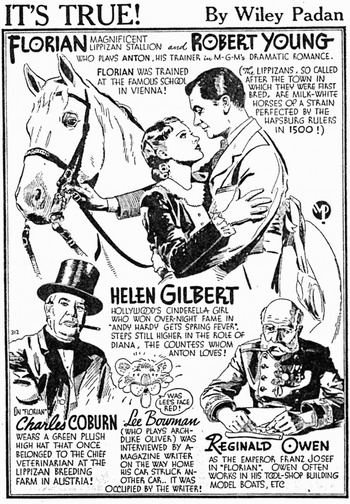
By portraying Austria as being like the United States, the film suggested that the newcomers were already almost de facto Americans, that they embodied traits that made them potentially model citizens of the United States. Even their speech habits made them seem native. Although many involved in making the film were European and often Jewish, the major “Austrian” protagonists were played by very Anglo-Saxon sounding actors. Robert Young starred as Anton, Charles Coburn played Hofer, and Helen Gilbert assumed the role of the Duchess Diana. Even those Austrians who died in Europe were played by American or British actors with Reginald Owen as Emperor Francis Joseph and Lee Bowman as Archduke Oliver. The only person who spoke with foreign accent was the court ballet dancer played by the Russian dancer Irina Baronova. By contrast, the Hungarian-born actor Szöke Szakáll, a waiter in the film, had no lines whatsoever.
Although this may seem like a coincidence, MGM documents on the film suggest otherwise. An early screenplay dated 1 September 1938 includes the following instructions for the director: “[n]o hand kissing, no courtly bows, no extreme, formal etiquette, and avoid burlesque impression in all parts of the picture story. We want it to be completely acceptable and easily understood by American and English audiences. Dialects in any language to be avoided. We should not cast foreign speaking actors who will give audiences an awful mixture of speech as well as distract and confuse.”Footnote 53 Although on-screen authenticity was not a goal, the promise of easy assimilation was.
The professions chosen for the new screen immigrants also did not pose a threat to those held by “real” Americans. Because the United States had been plagued by unemployment since the Depression, many Americans felt the market could not accommodate new job seekers, and ethnic and political refugees were hardly welcomed. As historian David S. Wyman points out, “[t]hrough 1938 and much of 1939 unemployment stood at between eight and ten million. The economy did not again reach the level attained in mid-1937 before World War II. Against this background restrictionists had little difficulty making credible their allegation that every refugee who entered the United States and found employment put an American out of work.”Footnote 54 In early versions of the screenplay, Anton worked in a mine in the United States before he found Florian, and Diana was slated to work as a waitress and later as a governess. In the final version, however, Anton is employed as a riding instructor in a New York City stable. How Diana has survived is not clear, and Hofer appears to be independently wealthy, as he had wisely invested his money in a Dutch bank.
The film lays bare several contradictions within American society, counterposing America's professed democratic values to its fascination with an imperial court; a society that touts diversity, but diversity based on the eradication of difference. The ways in which the film presents its messages further expose the implicit tensions during the Depression between a capitalist imperative to make money and a moral imperative to combat the vehemence of racist and nativist sentiments within the United States.
If the references to the contemporary world in the film can only be intimated, the proposed advertising campaign explicitly mentioned the contemporary situation in post-Anschluss Austria. This campaign already prefigured Sheehan's goal of distinguishing between Austrians and Germans by expressly intimating Austria's status as a victim of Nazi Germany. Even before filmgoers had left their homes, the studio set out to steer viewers’ expectations through radio scripts and articles proposed in the Exhibitor's Service Sheet for Florian, which MGM distributed to movie theaters (see Figure 1).
Fun Facts Promotional in Exhibitor's Service Sheet.

Several of the texts written by the studio to help distributors sell the film follow a pattern; they highlight the clichés of an imaginary Austria (“the Imperial Ball,” the town festival [sometimes designated as Tirolean]), emphasize the novelty of the film (the horses), provide an abbreviated version of Austrian history, and mention the situation in present-day “Austria.” A radio script prepares the audience for its “trip” to a fictitious Austria:
LADIES AND GENTLEMEN; every now and then there comes to the screen a picture so great, so gripping in theme, that it writes a new page in screen history. Such a picture is coming to the … . Theater. It is “Florian,” cavalcade of the pomp of Austria and fall of the Empire. It takes you to Vienna in its glamorous days before the World War. You see Emperor Franz Josef's Imperial Ball, the review of the magnificent Lippizan horses, the gaiety of a happy land. Then war, revolution, world reorganization.Footnote 55
As in so many films, Hollywood's imperial Austria is associated with glamour and gaiety. Equally typical is Hollywood's unique and abbreviated take on Austrian history. Even more than in the film, 1918 and 1938 appear conflated; and the fate of Austria and the Austrian people in 1938 is suggested by the fate of the Lipizzaner. After hearing a brief version of the Austrian past, the listeners are introduced to the actors and learn what else is in store for them—a dance sequence at the imperial castle, performances of the white stallions, “gay festivals,” and “Viennese music.” The radio announcement also includes a personal note, divulging that the star stallion in the film belongs to the producer himself. Indeed, Florian is “one of the only five Lippizans, or Imperial horses in this country.”Footnote 56 Tangentially, the text dramatizes the filming of Florian in post-Anschluss Austria. Listeners are told that a portion of the film was shot in Nazi Austria, where the cameraman was imprisoned for a month. “You will also see Lippizans filmed in their native Austria, a feat accomplished by Richard Rosson who was held by the Nazis for a month until cleared of suspicion and allowed to bring home his film.”Footnote 57
Rosson's arrest, which is mentioned in the prepared radio text, was deemed important enough to highlight in several articles in the Exhibitor's Service Sheet.Footnote 58 The reports are often combined with other news, preparing viewers for a visual feast, while at the same time suggesting the great difficulty under which the film was made. The article entitled “Cameraman Who Filmed Scenes of Lippizan Horses in Austria Held Prisoner for Month by Germans,” highlights the imperial elements before turning to the Rosson's misadventure:
[g]orgeous costumes, gay uniforms, settings that are a replica of Vienna's most picturesque spots, the Imperial breeding farm, the great Riding School, the Imperial Palace, sequences in replicas of Paris streets and buildings [left out in film], are among the spectacular details of the story. Actual scenes with Lippizan horses in Austria were filmed for the picture by Richard Rosson, who was seized by the Nazi police on spy charges after Austrian occupation by the Germans. He was held for more than a month, then cleared and allowed to return to America with the film.Footnote 59
The article paints the Anschluss in black-and-white terms—German Nazis are occupying the once magnificent Austria. The juxtaposition of the description of imperial Austria with the tale of Rosson's arrest further suggests that the Nazi government had directly followed the fall of the monarchy.
The fate of the horses is used to highlight the contemporary situation in the new Ostmark. Readers learn more about the white stallions and their connection to the producer:
[t]he only Lipizzans in this country, imported and bred by Winfield [Sheehan] were filmed at Sheehan's breeding farm in Hidden Valley, California. In the review sequence the splendidly trained animals literally perform an equine ballet as trained to do in Europe where the Imperial Lippizan used to appear in all capitals in exhibitions prior to the outbreak of the World War.Footnote 60
Whereas this article only suggests that the future of the noble horses is uncertain, another prepared article from the packet—“Celebrated Lippizan Steeds Presented to Maria Jeritza Appear in ‘Florian’”—maintains that the Lipizzans are endangered by the German occupation and ensuing war. “Under present war conditions their fate in the Old World is uncertain, but Lippizans imported from Austria are being bred at the ranch of Winfield Sheehan, picture producer, near Hollywood. His are the only Lippizans in America.” After a synopsis of the white stallions’ history and other film details, the writer returns to the role Lipizzaner in the film:
[i]ntimate details of breeding and training at the School and Imperial Stud Farm at Piber are shown in scenes actually filmed in Austria and the Vienna school. Hundreds of people appear. A village festival with its gay old Austrian customs and pastimes, probably never to be seen again in the reorganized nation, is reproduced in detail.Footnote 61
The suggestion that traditional Austria has been wiped out by its German conquerors prepares audiences for the distinction between Austria and Germany and seeks to arouse sympathy both for the lost Austria and for emigrants from the gay old world. Yet, the film's makers obviously knew that the Riding School and the Lipizzaner did not disappear from Austria after World War I.Footnote 62 Sheehan himself possessed a translation of the history of the Riding School written in 1935, which closes with the lines “[t]oday its renown goes around the world and justifies the farsightedness of those who, in spite of so many obstacles, have fought to preserve it.”Footnote 63 They were also aware that the horses lived on in Vienna under National Socialist rule. However, the article implies there is no place in the new Austria for such a treasure, and if the Riding School is not doomed under Nazi rule, it will at least be lost to the free world.
Those preparing the publicity saw an additional opportunity to underscore differences between Germany and Austria in an article on the film's music entitled “Making a Musical Score Take Place of Dialogue” by quoting the film's composer Franz Waxman.Footnote 64 “‘We took only Austrian and Hungarian themes,’ states Waxman, ‘avoiding the Germanic, as the spirit is entirely different, just as the spirit of American music differs from Italian. Historically, Austria for centuries was separated from the Prussians, hence the wide difference in the spirit of the music in the two countries, which has continued down to today. Musically they have nothing in ‘common.’”Footnote 65 By means of such references, the opposition between the two German-speaking countries suggested in the film is “pre-enforced.” Moreover, by maintaining that Germany and Austria share nothing musically, Waxman intimates the illegitimacy of the country's union with Germany.
In its strategies for marketing the film, the publicity department suggested the possibility of capitalizing on the contemporary situation in Europe. Under the heading “Cash in on European War Interest,” the exploitation department proposed creating a pseudo-exhibition for theater lobbies that sought to take advantage of the conflict in Europe. “With the European war occupying the thoughts of many Americans, you can capture their interest in sensational fashion by making a special lobby display shown at the right or by reproducing some of them in your newspaper.”Footnote 66 The suggested display consists of six pictures under the heading “Horse Rescues Man on World War Battlefield!” accompanied by an explanation of each picture and a short description of the film. Nowhere in the text is there an explicit reference to the exact war being portrayed.
By highlighting known tropes in Hollywood's imperial Austria, those working on the advertising clearly meant to create interest in the film and to increase revenue. However, in doing so they simultaneously reinforced Sheehan's efforts to differentiate between Austrians and Germans. Moreover, by not distinguishing between 1918 and 1938 and by conflating Communists and Nazis, the advertising frames the ways in which the film seeks to condemn German politics and elicit sympathy for those the Nazis persecuted. The simplistic view of history evident in the advertising and the film, as well as in other Hollywood films, set the stage for Hollywood narratives that later confirmed Austrian victimhood and avoided questions of complicity.
Despite the efforts put into the advertising, MGM's Florian was a commercial and artistic failure. Earning only $386,000 in domestic revenues and $323,000 in foreign revenues, it fell far short of its production cost of $1,029,000.Footnote 67 With a loss of some $594,000, it is safe to say that the political and humanitarian messages in this horse's tale reached relatively few viewers. In his review of 6 June 1940, the day after the film's New York premiere, Bosley Crowther, the New York Times film critic, addressed the film's potential and its artistic shortcomings:
It was a great idea with which Mr. Sheean [sic] started out—the story, derived from a novel by Felix Salten, of a fine white Lippizan stallion, bred in the famed stables maintained by old Emperor Franz Josef of Austria-Hungary, which became a sensational ring horse in the years before the first World War and then went into exile and equine slavery when the war and revolution had done for the empire. In brief, through the fate of this blooded animal would be symbolized the decline of the old aristocracy and graceful living.Footnote 68
Although he praised the acting of the four-legged creatures, Crowther criticized the “tedious posing” by the bipeds “who act with such solemn reticence that you might think they were afraid of stealing the picture from the horse, if that were possible.” There is indeed much to criticize in the film. The superficial story, the film's shallow humor, the wooden dialogue, the poor acting, and—for those in the audience who are not horse lovers—the long sequences with the horses make for a tedious movie.
Yet, the story behind Florian's making, the film itself, and the marketing campaign reveal a documented desire to distance Austrians from Germans, highlighting the considerable effort MGM put into producing an entertainment movie that combined humanitarian and political messages. Felix Salten's Florian was adapted aesthetically and thematically both to fit a new medium and to fit the American sociopolitical context of the late 1930s. Austrian history is rewritten to address the events of 1938–1940, dramatizing the desperate situation of those persecuted because of birthright or political beliefs and praising their potential as new Americans. Made at a time when Austria had disappeared from the world map and its future was uncertain, the film offers insight into Hollywood's ambivalent commitment to refugees and taking an anti-Nazi stance where possible. At the same time, the many limitations on the ways in which the story of Florian was told dramatize Hollywood's ultimate acquiescence to its own fears about the influence of racist and nativist circles on the general public.