1. Introduction
Open Syllable Lengthening (OSL) has continued to be a much debated topic in Germanic phonology.Footnote 1 Although all WGmc languages underwent OSL during the medieval period, it is still not entirely clear when the process was finalized in individual languages. This includes ME, MHG, MLG and MNL (see Minkova Reference Minkova1982, Reference Minkova1985; Lahiri & Dresher Reference Lahiri and Elan Dresher1999 and references therein). ModD still shows evidence of OSL, particularly in a set of singular–plural noun pairs with a short vowel in closed syllables and a long vowel in open syllables, for example, god [xɔt]–goden [xoːdə] ‘god–gods’, dag [dax]–dagen [daːxə] ‘day–days’. It is generally assumed that at some point during the MNL period, short vowels in stressed open syllables were lengthened in disyllabic forms, and that ensuing paradigmatic alternations still prevail.Footnote 2 Lengthening in open syllables also occurred in English and German. In ME, for instance, OSL did take place but was obscured in words of three syllables due to Trisyllabic Shortening, as in hāmor–hamores ‘hammer–hammers’ (cf. Lahiri & Fikkert Reference Lahiri and Elan Dresher1999). In contrast, in MHG, medial geminate fricatives resulting from the Second Consonant Shift blocked OSL in cases where English and Dutch show lengthening in open syllables, for example, OE open [o], ME and ModE open [oː], MNL and ModD open [oː], but OHG and MHG offen short [ɔ].Footnote 3
Since we focus on Dutch, we should note that almost all the vowels in words with no nominative singular suffix, such as dag~dagen, show a V~Vː pattern in ModD. OSL was not obscured by any other obvious phonological processes, and so Dutch has the clearest set of examples of heterosyllabic words in which the original short vowels became lengthened. There has been no systematic leveling as in English, other than in a few cases, such as sap~sappen ‘juice–juices’.Footnote 4 Furthermore, since Dutch did not have a rule of Trisyllabic Shortening, all disyllabic words with open stressed syllables underwent lengthening, and all of these have long vowels in ModD, as in vogel [ō] ‘bird’, hamer [ā] ‘hammer’, water [ā] ‘water’, koning [ō] ‘king’, weduwe [ē] ‘widow’, etc.
Nevertheless, the timing of OSL in the history of Dutch remains uncertain. Generally, grammars have assumed that OSL was complete by the time the earliest MNL texts were written (Franck Reference Franck1910:§13; Schönfeld Reference Schönfeld1970:§30; Van Loey Reference Van Loey1968:II, 2; Van Bree Reference Van Bree1987:86, 91; Zonneveld Reference Zonneveld2000; Van Loon Reference Van Loon2014). However, the MNL texts cover a period of approximately 350 years (1200–1550; see, for example, Pijnenburg et al. Reference Pijnenburg, van Dalen-Oskam, Schoonheim and van der Horst1997 and Willemyns & Van der Horst Reference Willemyns and van der Horst1997). It is not obvious if evidence in support of OSL is available through the entire period. Indeed, Fikkert (Reference Fikkert and Lahiri2000) argues that OSL cannot have taken place in the 13th-century Life of St. Lutgart, one of the earliest texts in this period.Footnote 5 She concludes, on the basis of rhyme, that there is no clear evidence that original long vowels rhyme with original short vowels that could have undergone OSL. Our intention here is to examine a range of texts in rhyming verse written in this period, to glean further evidence (from orthography, rhyme, and metrical structure) that allows us to pinpoint more precisely the onset of OSL. The chosen texts cover a period of approximately 75 years.
The earliest text is the Life of St. Lutgart along with two 14th-century texts attested in Manuscript Marshall 29—King Saladijn by Hein van Aken and Mellibeus by Jan van Boendale. The Life of St. Lutgart, based on Thomas de Cantimpré's Vita piae Lutgardis, was written in MNL by Willem van Afflighem (born in 1210), who was the abbot of the monastery of St. Truiden. He completed the Life of St. Lutgart in 1274. This work is known from just one manuscript dating back to around 1300, which contains books 2 and 3.Footnote 6 Lutgart, a mystic born in Tongeren in 1182, entered the monastery in Aywières near Lièges in 1206. In a vision, the Holy Virgin granted her request never to be able to speak French, so that she did not have to become an abbess in a French-speaking monastery. The book is the story of St. Lutgart's life.
The second text, Van den coninc Saladijn ende van Hughen van Tabaryen ‘About King Saladijn and Hughen van Tabaryen’, is based on an Old French work Ordène de chevalerie, par Hues de Tabarie. It relates the story of the captured crusader and knight Hughe van Tabaryen, who is brought before King Saladijn. The King has an earnest desire to become a knight and requests the captured knight to make him one. Since only a free man is allowed to grant knighthood, King Saladijn releases his captive. This “sproke”, or tale, by Hein van Aken perhaps goes back to the late 13th or early 14th century. Finally, Mellibeus is a dialogue between Mellibeus and his wife Prudentia concerning leading a moral life, based on Liber consolationis et consilii by Albertanus van Brescia. The work was completed in 1342.
Manuscript Marshall 29, in which Saladijn and Mellibeus are handed down, dates back to around 1375 and is about 75 years younger than the Lutgart manuscript (Kienhorst Reference Kienhorst2005:799). This enables us to compare texts from different points in time and from a reasonably small geographical area.Footnote 7 All three texts are written in rhyming verse, which allows us to draw conclusions from rhyme and meter. Lutgart is written in iambic verse (see Fikkert Reference Fikkert and Lahiri2000, Zonneveld Reference Zonneveld2000), and, as we show, Saladijn is also iambic. In contrast, the Mellibeus text is written in trochaic verse. In terms of the original versions of the manuscripts, the Lutgart manuscript available to us is dated around 1300, while van Afflighem has been known to have written it in 1274. The Manuscript Marshall is dated around 1375, while the original texts are from around 1332 (Mellibeus) and 1300 (Saladijn).
For each text, we draw evidence from orthography, rhyme, and meter: Each aspect on its own would be insufficient. Since OSL almost definitely began during the medieval period of all the WGmc languages, for purposes of comparison with earlier periods we refer not only to reconstructed PGmc forms but also to OE and OHG where relevant, particularly since hardly any documented evidence of Old Dutch exists in literary texts.
The structure of the article is as follows: In section 2, we begin with a recapitulation of OSL effects in ModD and then trace them back to the three texts. In section 3, we discuss spelling evidence, in section 4—evidence from rhyme, and in section 5—evidence from meter. Section 6 is a conclusion.
2. OSL Effects in ModD
ModD contrasts short and long vowels, and vowel length is clearly reflected in writing, as shown in 1. Short stressed vowels are indicated by a single grapheme and are always followed by two consonants in heterosyllabic words. Long vowels are written with two graphemes in closed syllables, but with just one grapheme in open syllables. In 1, we present pairs of nouns ending with an obstruent or a sonorant, four with short vowels and two with long vowels.
(1)


In general, other than showing the effects of OSL, the quantity of PGmc vowels has largely remained constant in ModD. In 1a, both vowels are short because the medial consonant in the plural was originally a geminate, which blocked OSL. Degemination occurred throughout the phonological grammar later in MNL (Van Loey Reference Van Loey1968:109, Schönfeld Reference Schönfeld1970:58, Van Bree Reference Van Bree1987:155; see also Lahiri & Dresher Reference Lahiri and Elan Dresher1999). We discuss this in more detail later. In 1b, the vowel is underlyingly long and remains so in both singular and plural. In 1c, however, one can see the effects of OSL in the plural: The vowel in the singular is short, but long in the plural. Consequently, there is a short/long vowel alternation in some words in the nominal paradigm.Footnote 8 Evidence that PGmc original long vowels were retained in Dutch is provided in 2.Footnote 9
(2)
The examples in 3 show reflexes of PGmc short and long stressed vowels in di- and trisyllabic stems in ModD. That OSL applied whenever possible is obvious from original disyllabic words. Whenever the stressed vowel was in an open syllable, as in 3a,b, this vowel was lengthened irrespective of the quality of the following syllable. The long vowel has generally survived in ModD even when the word has become monosyllabic, as in 3a,f. Original short vowels in closed syllables remain short as predicted, as in 3c,d. In contrast, as we mentioned earlier, in English analogical restructuring took place, particularly due to the interaction with Trisyllabic Shortening. As a result, in many words originally long OE vowels became short, as shown in 3e. In 3a, one can see the effect of OSL maintained in ModE.
(3)
Original disyllabic words were not the only ones affected by OSL. Monosyllabic words would become disyllabic if a suffix was added that began in a vowel. In a new disyllabic word, the original stressed vowel would appear in an open (first) syllable. This is particularly evident in nominal paradigms, when a plural suffix is added. It is precisely this category of monosyllabic nouns where one would expect OSL to have applied, leading to a vowel length alternation in the nominal paradigm. If, however, the noun stems ended with a consonant cluster or a geminate, the vowel would remain short. Examples of PGmc monosyllabic CVC- and CVCC-stems ending in a geminate are given in 4, and a list of words is provided in note 8.
(4)
Thus, short vowels that were followed by an original geminate or one that was derived by a rule of gemination never underwent OSL and have remained short even now in ModD. Examples of underlying geminates are visible in, for example, OE moððe in 4d. These short vowels would not have escaped OSL if degemination had preceded it. After degemination, double consonants were used in orthography in later stages of Dutch to indicate that these vowels remained short.
OSL was also evident in original disyllabic nouns with single medial consonants in both singular and plural forms. Apocope of final schwa, which followed degemination, was morphologically determined: All final vowels in the nominative singular were deleted (with very few exceptions such as weduwe ‘widow’). Once apocope occurred after OSL, one would expect long vowels to appear in monosyllabic forms. This is precisely what one finds in 5. Both singular and plural forms underwent OSL in MNL—for example, in talusg–talapl > tālesg–tāle(n)pl, the final schwa was deleted, and the word was reanalyzed with a long vowel: taal ‘language’. The long vowel of the singular form can only be explained under the assumption that OSL applied in MNL when the word was still disyllabic.
(5)
What remains uncertain is the period at which OSL really began in MNL. In the following sections, we investigate three types of evidence to determine whether OSL had indeed taken place in the Brabantic texts discussed above: evidence from orthography (spelling), rhyme, and meter. We found clear evidence from rhyme and meter that OSL is established in Saladijn and Mellibeus, but not in Lutgart. Evidence from spelling suggests that OSL had just begun in Lutgart.
3. Spelling Evidence
In the texts we have examined, vowel length was indicated in different ways in closed and open syllables. In closed syllables, length was marked by double graphemes or as a single grapheme followed by a lengthening <e>. Short vowels were always written with only one grapheme, for example, dag ‘day’, spel ‘play’, appel ‘apple’, bedde ‘bed’. The double consonants were geminates. However, in open syllables—which are the focus of our investigation—vowel length was marked differently. Unlike the ModD spelling, the spelling in the texts we have examined allowed for variation in open syllables. Recall that in ModD, single vowels in open syllables are always long but are not written with a lengthening marker, as in maag–magen ‘stomach’, boom–bomen ‘tree’, dag–dagen ‘day’, god–goden ‘god’. If OSL had taken place, one might expect vowel length to be indicated consistently in open syllables—either by a single grapheme or by lengthening markers. Furthermore, one would also expect that original long vowels and vowels that have undergone OSL would be written in the same fashion. Comparing closed and open syllables, we found a difference in orthography between Lutgart on the one hand and Mellibeus and Saladijn on the other.
We first examine Mellibeus and Saladijn, whose spelling is very similar to ModD. Each text is written in a different hand but both show consistency in their spelling (Sytsema et al. Reference Sytsema, Grijzenhout and Lahiri2014).Footnote 11 The only variation that occurs across the texts is confined to the orthography of a specific vowel in closed syllables, namely, the descendent of PGmc †/au/, which is written as <oe> in Mellibeus but as <oo> in Saladijn. Thus, ModD groot ‘great’ and dood ‘dead’ are written as groet and doet in Mellibeus, but as groot and doot in Saladijn.
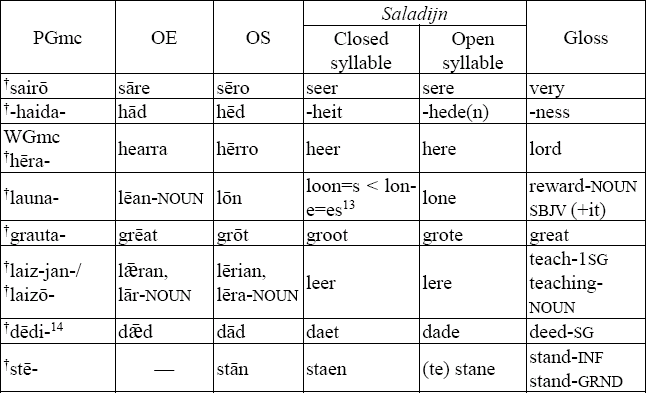
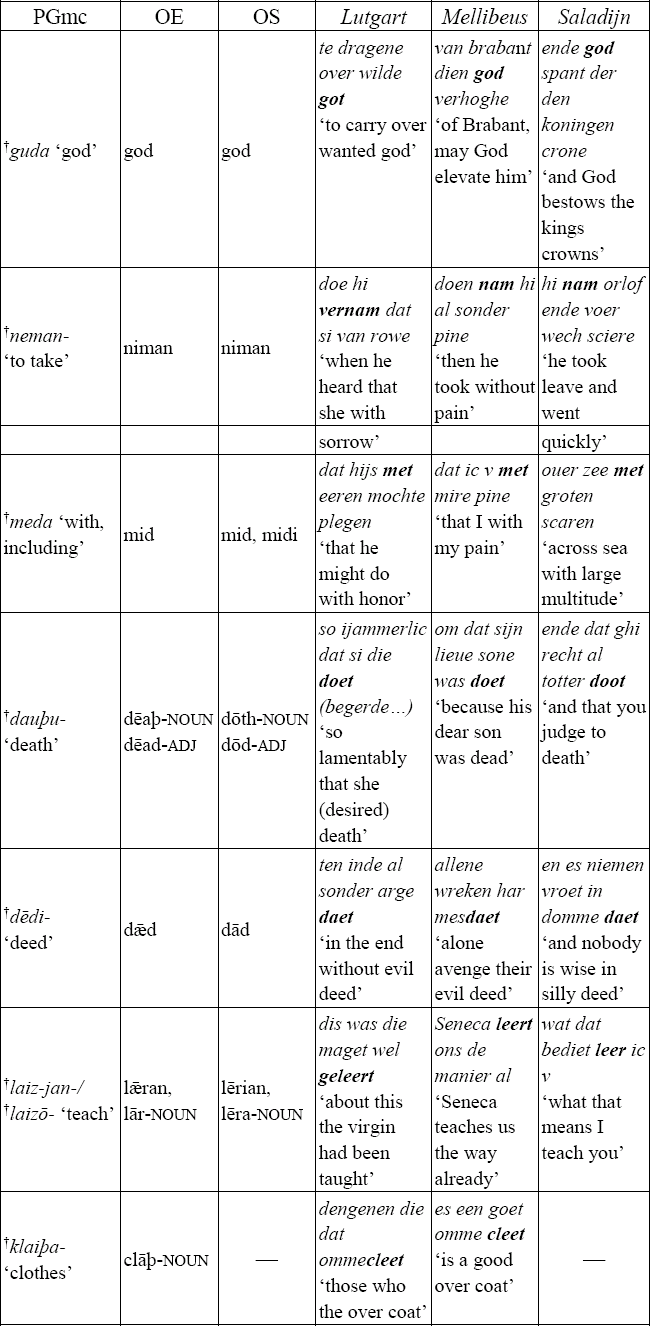
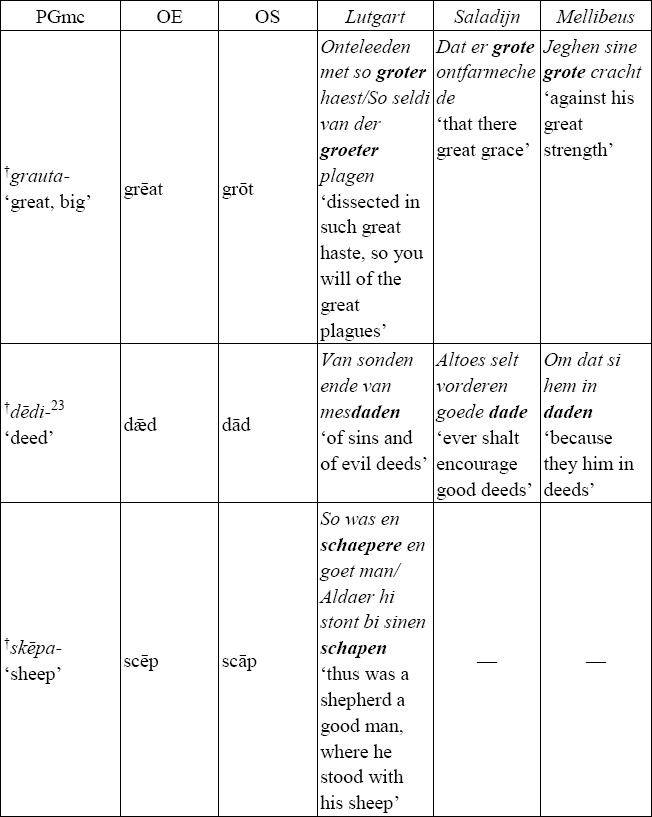
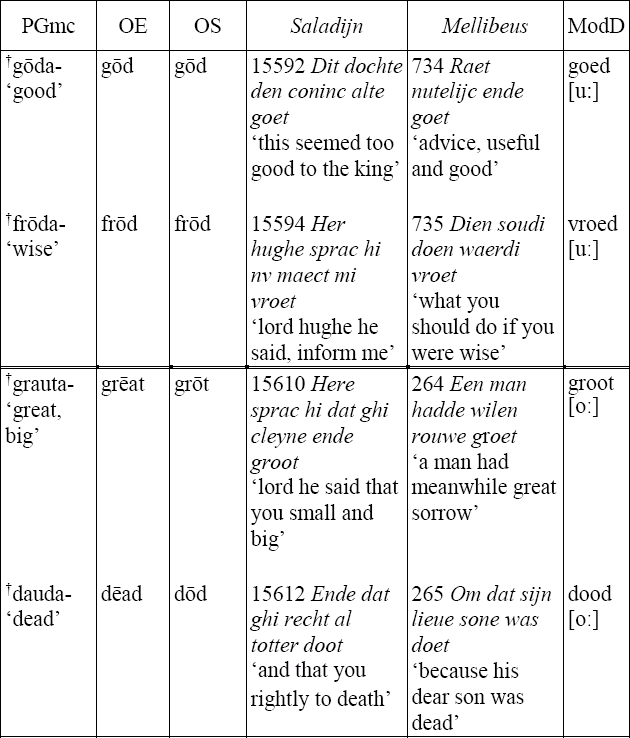
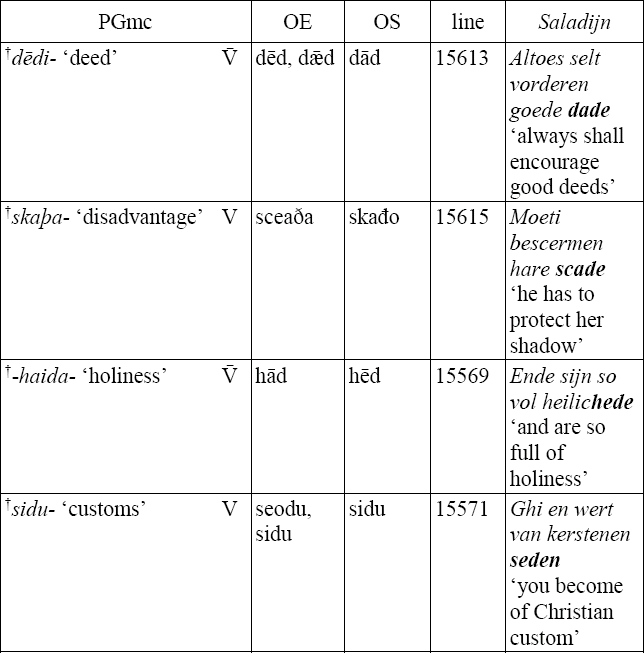
We first look at Saladijn. In this text, original long vowels in closed syllables are always written with two graphemes—either as identical vowels or with an additional lengthening <e>, as in 6a. See below for discussion. In open syllables, original long vowels are consistently written with a single grapheme; the only exception is when <r> follows <a>, so jaere ‘year’ (1x), scaere ‘multitude’ (1x), vaere ‘fare, sail’ (1x) are found alongside iaren (1x), scaren (2x), and varen (1x).Footnote 12 Apocope was not yet obligatory, and therefore one finds the same word with and without a final schwa, as in table 1, for example, sere~seer ‘very’ in row 1, dade~daet ‘deed’ in row 7. Thus, long vowels in closed syllables were always written with two graphemes, while long vowels in open syllables—with one grapheme. One finds the same alternation when a suffix is added, for example, groot~grot-e ‘great’ in row 5. Clearly, a single vowel in an open syllable could represent an original long vowel. The word lone ‘reward’ in row 4 is interesting: When es ‘it’ encliticizes to the host word, the ensuing form remains monosyllabic and the length of the vowel is indicated by two graphemes.
Reflexes of PGmc long vowels in Saladijn.
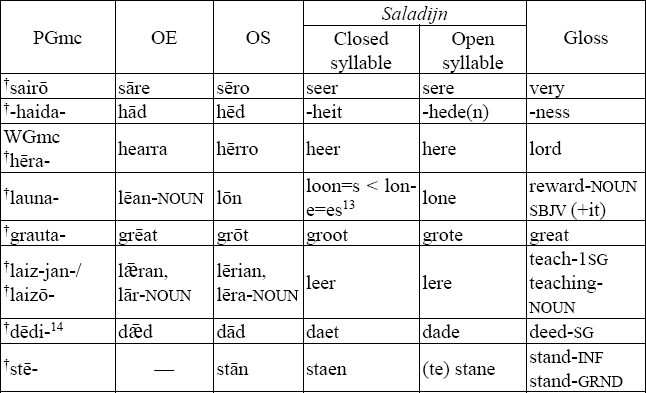
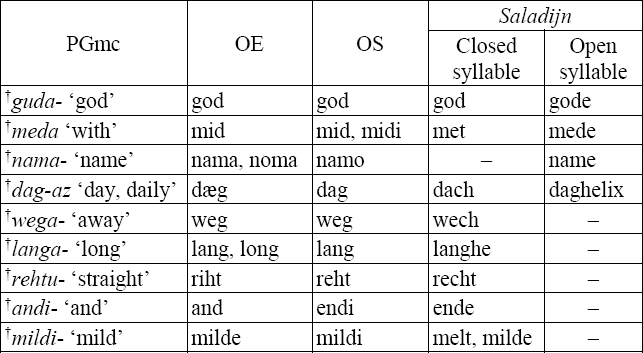
The original short vowels in open syllables in Saladijn exhibit the same pattern as the original long vowels. In open syllables, the short vowel in PGmc †guda ‘god’ (row 1 in table 2 below) as well as the long vowel in PGmc †dēdi ‘deed’ (row 7 in table 1) are both written with a single grapheme: gode, dade. In closed syllables, however, these vowels are spelt differently. In closed syllables, one expects the original short vowel to be spelt with a single grapheme, but the long vowel to surface with two graphemes. This is exactly what one finds: The short vowel in PGmc †guda (row 1 in table 2) is spelt with a single grapheme (god), whereas the long vowel in PGmc †dēdi (row 7 in table 1) is spelt with two graphemes (daet). Thus, one finds the orthography in Saladijn to be similar to that of ModD; PGmc short vowels remain short in closed syllables but long in open syllables: god~gode. To distinguish vowel length in closed syllables, the original long vowels are written with two graphemes. This leads to orthographic alternations found also in ModD: PGmc †au is reflected in Saladijn as /o~oo/ groot~grote.Footnote 15
Reflexes of PGmc short vowels in Saladijn.

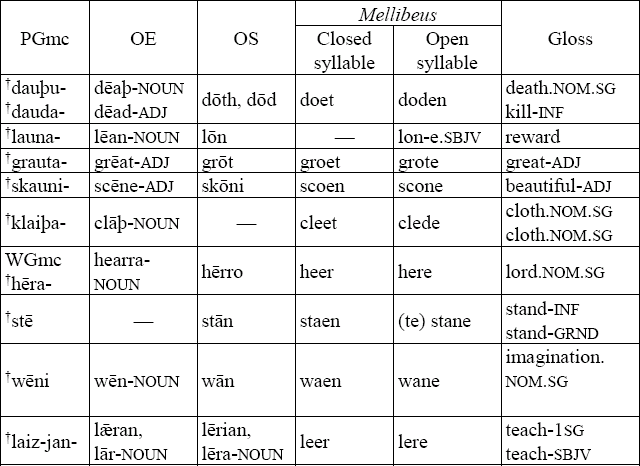
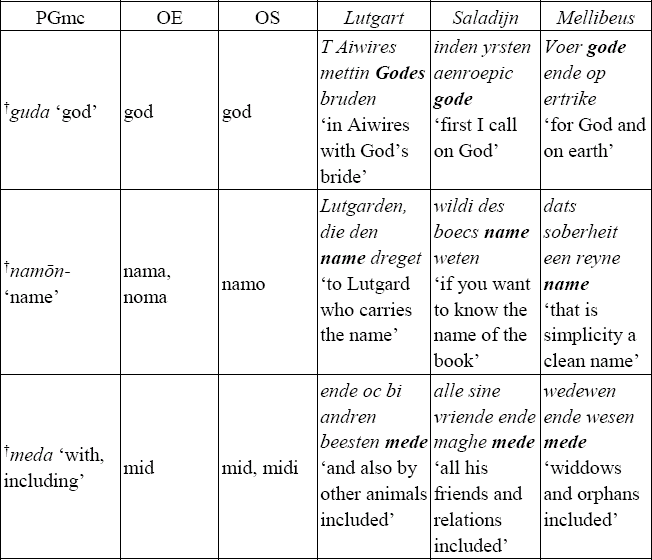
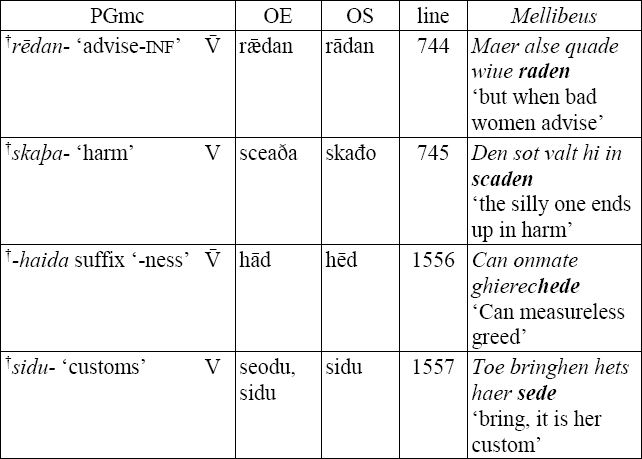
We find the same evidence in Mellibeus (see tables 3 and 4). In closed syllables, the original long vowels are spelt either with two identical graphemes or with a single grapheme followed by a lengthening <e>. In open syllables, however, these vowels are invariably spelt with a single grapheme. The crucial comparison is as follows. PGmc long vowels or diphthongs such as †/au/ appear in Mellibeus as two graphemes in closed syllables (for example, doet) but as a single grapheme in open syllables (for example, dode). In contrast, the PGmc short vowel †/o/ is written in Mellibeus with a single grapheme in both open and closed syllables: god, gode. The fact that both short and long vowels are written with a single grapheme in open syllables suggests they were of the same length. Note that in closed syllables, where the length is contrastive, the original long vowels are always written with a lengthening grapheme, as in doet, seer, while the original short vowels are never written with such a grapheme, as in god, spel. Footnote 16
Reflexes of PGmc long vowels in Mellibeus.

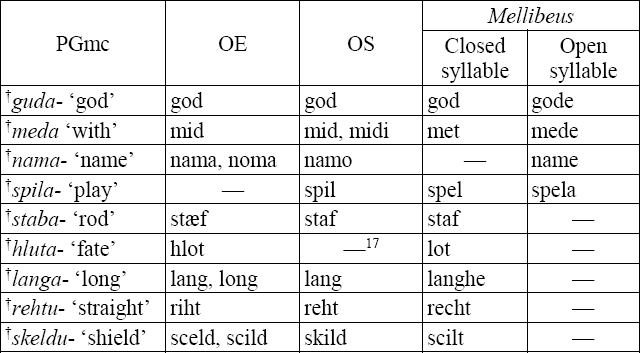
As in Saladijn, the original short vowels are always written with one grapheme: god~gode versus cleet~clede ‘cloth’. Thus, vowels lengthened by OSL in open syllables were consistently written with a single grapheme, exactly like the original long vowels in open syllables.
Original short vowels in Mellibeus.

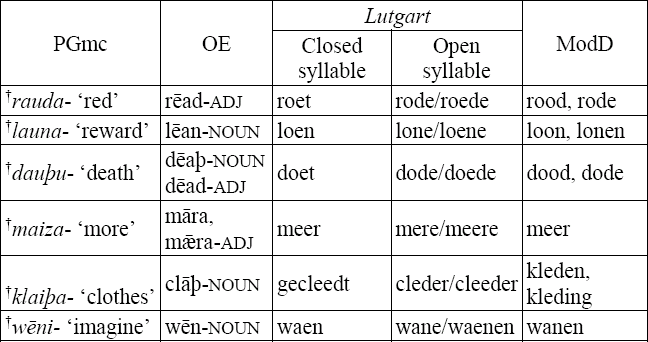
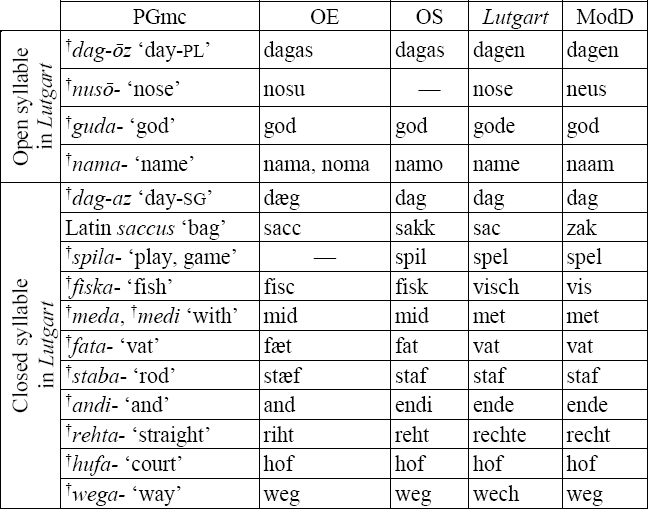
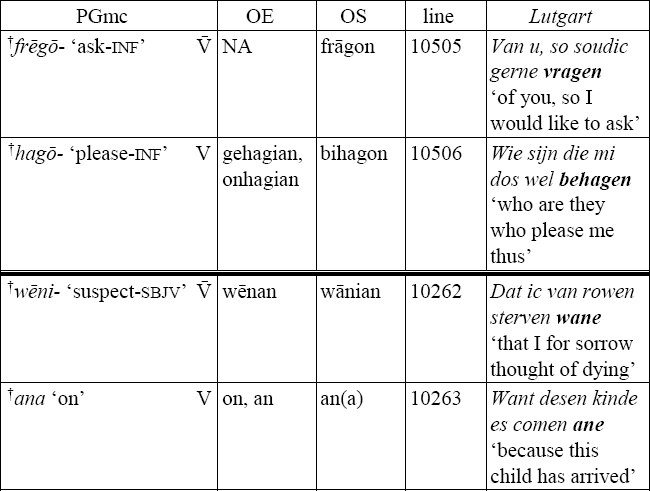
A much more interesting pattern is found in Lutgart, the oldest of our three texts. Fikkert (Reference Fikkert and Lahiri2000) claims that spelling is not really of much assistance and concludes that this text shows little evidence that OSL had already applied. Indeed, we found consistent graphemic differences between Lutgart and the other two texts, as we show below. First, in closed syllables, vowel length was exactly parallel to that in Saladijn and Mellibeus. Original short vowels are written with one grapheme, while original long vowels are written with an additional grapheme, a lengthening <e> (see tables 5 and 6): In short syllables, one finds god, dag, whereas in long syllables—loen ‘reward’, doet ‘death’, etc. Second, in open syllables, original short vowels are also written with a single grapheme, as in Saladijn and Mellibeus, for example, gode, dage.Footnote 18
Orthographic variants of PGmc long vowels in Lutgart.

Orthographic variants of PGmc short vowels in Lutgart.
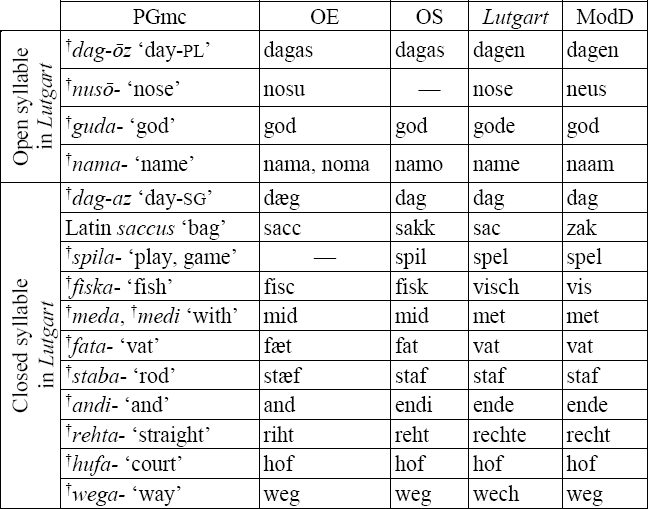
However, a different pattern emerges with respect to original long vowels in open syllables, which are the only ones that show variability in spelling. Recall that in closed syllables, these vowels are always written with a lengthening marker, while in open syllables, both spellings are available, as shown in table 5. Thus, both rode/roede ‘red’ were permitted, while monosyllabic roet ‘red’ is always written with an <oe>. This alternation, however, does not apply to original short vowels in open syllables. In the following tables, where possible we have given OE and OS forms, which were probably closer in age to the ancestor of MNL. Our focus here is on the length of the vowels, not necessarily on the quality, which varies across languages.
Why should the length marking of original long vowels in open syllables be variable? Understandably, in closed syllables, contrastive vowel length was indicated graphemically by adding a lengthening <e> to mark a long vowel. Thus, a vowel length contrast existed in Lutgart. We have also established that the length contrast is neutralized in spelling in Saladijn and Mellibeus as in ModD, which probably suggests that the length of the vowel in open syllables is the same for both underlying short and long vowels. The question remains, what happens in Lutgart?
We propose that unlike in Saladijn and Mellibeus, OSL had not been fully established in Lutgart, but one can see its commencement. Overt marking of length in open syllables suggests an effort to distinguish between short and long vowels in this position: loene (originally long) versus gode (originally short). However, the very fact that the original long vowels are being marked only some of the time (loene versus lone) suggests variability and the probable onset of neutralization of length in open syllables applying in a diffuse fashion. Once OSL is fully established, it would eliminate the necessity of marking length in loene ‘reward’ and waenen ‘imagine’ to differentiate these vowels from the ones in gode and dage; both sets of words could be written without a lengthening <e>.
To reiterate, the writing system does reflect the original length of PGmc vowels.Footnote 19 This is transparent in closed syllables, as in roet, doet, etc. In addition, it is only the original long vowels as in lone/loene that show variation. If OSL had been fully established—and if this is what the lengthening marker was indicating—then its effects would have been visible in original short vowels in open syllables, as in name; such words would have shown the same variation, namely, †naeme, which they do not.Footnote 20 However, the variation is only limited to original underlying long vowels. Clearly, the neutralization of length of original long and short vowels in open syllables was not yet evident in Lutgart.Footnote 21
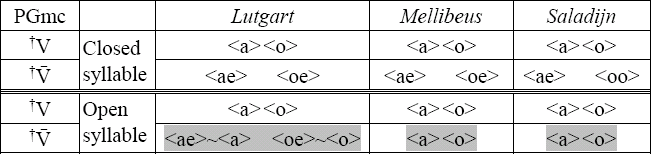
To summarize, all three texts, Saladijn, Mellibeus, and Lutgart, are consistent in the spelling of vowels in closed syllables: Original long vowels are always spelt either with two identical graphemes or with a lengthening <e>, and original short vowels are spelt with a single grapheme (see table 7). There can be no doubt about the length interpretation of these vowels, since they all have the same quantity in ModD. The difference between the texts is only apparent in open syllables: All original short vowels in open syllables are written with a single grapheme (see table 8). However, the spelling of original long vowels varies: They are spelt with single or double graphemes in Lutgart, but they are consistently written with a single grapheme in Saladijn and Mellibeus (see table 9). In Lutgart, graphemes <o> and <oe> in open syllables both represent the long vowel derived from PGmc †/au/ (as in lone/loene). The same holds for the other alternations such as <e>~<ee> and <a>~<ae> in open syllables, where these long vowels are inherited from PGmc. In contrast, original short vowels in open syllables are invariably written with one grapheme in Lutgart. Clearly, the writing system reflects the difference in the quantity of the vowels in open syllables: Original long vowels vary in graphemic representation, while original short vowels do not. This suggests that the original short vowels had begun to lengthen, and perhaps there was allophonic lengthening. Thus, a need was felt to clearly distinguish the original long vowels in open syllables (which were phonemically long) from the free variants of the short vowels (which were sometimes lengthened and sometimes not). It was not the case that the original long vowels were sometimes pronounced as short.
In contrast, Saladijn and Mellibeus are entirely consistent in their spelling of vowels in open syllables; both original long vowels and original short vowels are always written with a single grapheme (see table 8). Evidently, there was no longer a necessity to distinguish these vowels in open syllables. Thus, to establish the onset of OSL one relies crucially on the alternation in original long vowel spelling in open syllables (see table 9).Footnote 22
Spelling of original short and long vowels in closed syllables across three texts.

Spelling of original short vowels in open syllables across three texts.

Spelling of original long vowels in open syllables across three texts.

Our data show that the orthography of long and short vowels is generally regular. In Lutgart, the variation occurs in a specific category, namely, original long vowels in open syllables, which are often spelt with double graphemes. We interpret this variation as a way of ensuring that the difference in underlying length is still reflected in writing, at least some of the time, in order to distinguish any allophonic lengthening that may have begun to affect the short vowels in open syllables. In contrast, the ModD writing system is exactly parallel to the system in Saladijn and Mellibeus, where two graphemes are used in closed syllables to indicate length; in contrast, in open syllables both underlying short and long vowels are written with a single grapheme, if they are long, as in god~goden versus boom~bomen. To indicate long vowels in closed syllables in ModD as well as in our three texts, two vocalic graphemes are used. In table 10 we provide a summary of our results, where the shaded last row represents the variation context.
Graphemic representation illustrated with <a> and <o>.

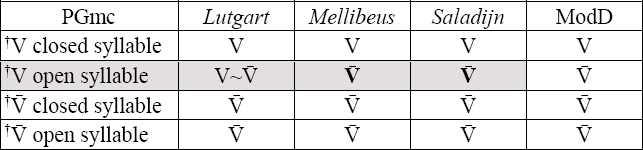
Thus, PGmc vowels in closed syllables have not altered, which is reflected in spelling in all the texts: Long vowels in closed syllables are written with two graphemes, and short vowels with one grapheme. The difference between Lutgart on the one hand, and Saladijn and Mellibeus on the other lies in long vowels in open syllables. A comparison reveals a clear attempt to ensure that original long vowels in open syllables were marked with an extra lengthening grapheme, which is not the case for original short vowels in open syllables. The spelling system used in Lutgart did provide the means to indicate vowel length, and those means were consistently used in closed syllables to mark original length. In Saladijn and Mellibeus, the lack of contrast in open syllables suggests that lengthening of short vowels has taken place. We conclude that in Lutgart, it was necessary to indicate length by adding a lengthening <e> to contrast those vowels with original short vowels in open syllables, where there could have been variable lengthening if OSL had been fully established. As we show below, further evidence suggests that OSL was securely embedded in Saladijn and Mellibeus, while it is possible that in Lutgart the difference between original long and short vowels in open syllables was in a state of fluctuation.Footnote 24
Vowel quantity: V,  . The shaded section highlights the differences across the texts.

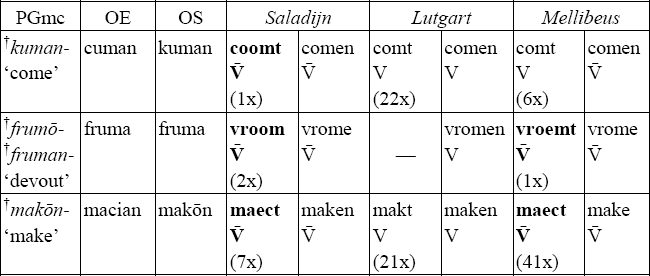
Additional spelling evidence is found in Saladijn and Mellibeus, where some original short vowels appear as long in syllables closed by an inflectional suffix, as shown in table 12. This lengthening can only be explained by an analogical restructuring of the verb root after OSL. For example, the short stem vowel in PGmc †makōn- must have undergone OSL, after which the verb root was reanalyzed as having a long /ā/. Consequently, the past tense suffix /t/ was added to the restructured lengthened verb root, maect ‘make’.Footnote 25 Saladijn and Mellibeus both contain such reanalyzed long vowels, as in vroomste/vroemt ‘devout’ and (ghe)maect ‘made’.
In contrast, in Lutgart, the original short vowels in these words are always spelt with one grapheme in closed syllables, which suggests that the root vowel has remained short, as shown in table 12. However, not all words show the same pattern. For instance, the stressed vowel of the verb comen ‘come’ is written with two graphemes in Saladijn when /t/ is added, but not in Mellibeus. However, the lengthening in vroemt ‘devout’ and maect ‘make’ is observable in both texts. As a reviewer points out, a change in underlying vowel length often occurs word by word by lexical diffusion (Labov Reference Labov1994). What is important is that OSL must have been properly established in Mellibeus and Saladijn; otherwise, these vowels would not show lengthening in a closed syllable.
PGmc short vowels manifested as long in closed syllables in Saladijn and Mellibeus.

Thus, in terms of orthography, there are two pieces of evidence to the claim that OSL had taken place in Saladijn and was nearly finished in Mellibeus, but had not yet been well established in Lutgart. First, the original long vowels are distinguished from original short vowels in open syllables only in Lutgart, where the former vary in orthography, for example, loene/lone ‘reward’. This does not occur in Saladijn and Mellibeus: In open syllables, all vowels are written with a single grapheme, whereas in closed syllables, the original long vowels are written with a lengthening <e> or as two identical graphemes.
Second, original short vowels in the infinitival forms of certain verbs, such as vromen ‘to benefit’, must have been lengthened due to OSL. Only in Saladijn and Mellibeus were these vowels reanalyzed as long. When they appear in closed syllables with consonantal inflectional suffixes, they are written with lengthening markers, as in vroomste, vroemt. This phenomenon is absent in Lutgart. A count of the variable spelling of the words with original long vowels in table 1 shows that more than half of them are marked with a lengthening marker in open syllables. It is thus possible that OSL was beginning to have an effect in Lutgart. The crucial difference, however, is that no lengthening markers in open syllables are found in Saladijn and Mellibeus—only in Lutgart, where the length of vowels in open syllables must have been neutralized after the application of OSL. As we show below, other evidence also points to the difference between Lutgart and the other two texts with regard to OSL.
4. Evidence from Rhyme
Since the texts we examine are written in verse, they provide us with the opportunity to compare rhyming words on the basis of vowel quality and vowel quantity. If OSL had already occurred, then original long vowels and vowels lengthened by OSL should rhyme. To obtain evidence from rhyme we had to distinguish between rounded and unrounded vowels. Sytsema et al. (Reference Sytsema, Grijzenhout and Lahiri2014) have shown that round vowels of the same PGmc origin rhyme in Saladijn and Mellibeus even if they are spelt differently (see tables 13 and 14), whereas vowels of different origins do not appear in rhyming pairs even if they are spelt the same (see table 14). Descendants of PGmc †/ō/ are consistently spelt <oe>, whereas descendants of PGmc †/au/ could be spelt <oe> or <oo>. Descendants of PGmc †/ō/ never appear in rhyming pairs with descendants of PGmc †/au/, from which we concluded that they must have been of different quality. This is true in all the manuscripts. Thus, in some texts in Manuscript Marshall 29, goet ‘good’ rhymes with vloet ‘flood’ (both from PGmc †/ō/) and groet ‘great’ rhymes with doot ‘dead’ (from PGmc †/au/), but groet never rhymes with vroet or goet (from PGmc †/ō/, Sytsema et al. Reference Sytsema, Grijzenhout and Lahiri2014). Later the spelling was leveled, as can be seen in ModD. Saladijn and Mellibeus are consistent in their spelling.
Descendants of PGmc †/ō/ and †/au/ in Saladijn and Mellibeus.
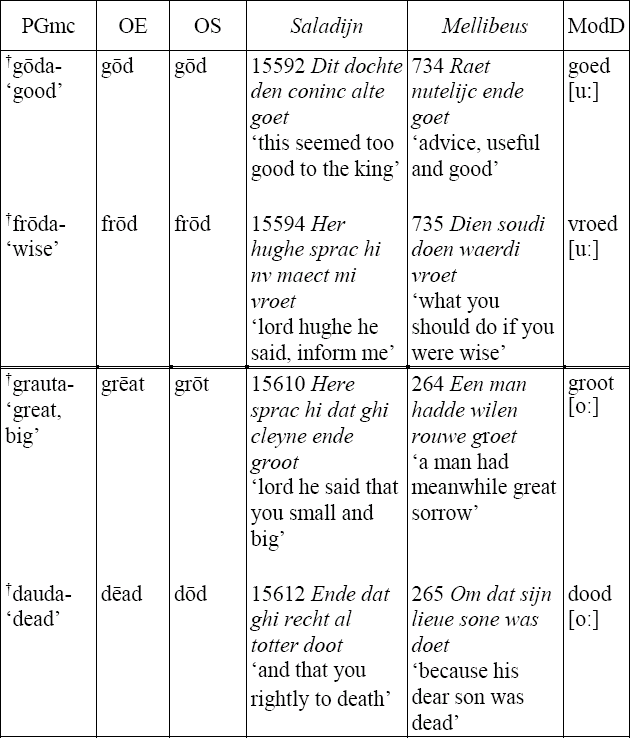
Thus, rounded vowels of different PGmc origins never appear in rhyming pairs, since they are qualitatively different, although in ModD, these vowels are identical and do rhyme, as in table 14.Footnote 26
No rhyming pairs with vowels of different origins in Saladijn and Mellibeus.

In contrast, unrounded vowels do allow one to establish if OSL had occurred or not. One would expect original unrounded long and short vowels to rhyme, if OSL had taken place, and, indeed, such evidence exists. As tables 15 and 16 show, in Saladijn and Mellibeus original /a/ and /aː/ occur in rhyming pairs, as do /e/ and /eː/.Footnote 27
Rhyming pairs in Saladijn.
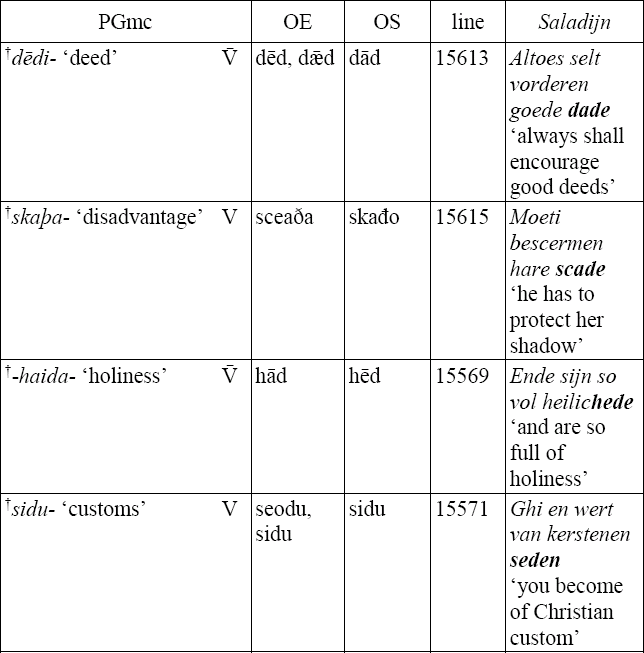
Rhyming pairs in Mellibeus.

Fikkert (Reference Fikkert and Lahiri2000) stated that in Lutgart, original short vowels in open syllables do not rhyme with original long vowels; she suggested that this was another piece of evidence against OSL having occurred in Lutgart. Her observation is probably due to the fact that she was focusing on rounded vowels. For unrounded vowels, we do find some examples in Lutgart as well, but much less than in the other texts.
Rhyming pairs in Lutgart.

Each of the rhyming pairs in the three tables above consists of an original long vowel and an original short vowel. As the short vowels rhyme with the long vowels, the former must have lengthened in order to rhyme with the original long vowels, so in these cases the original long and the lengthened vowels must have merged.Footnote 28
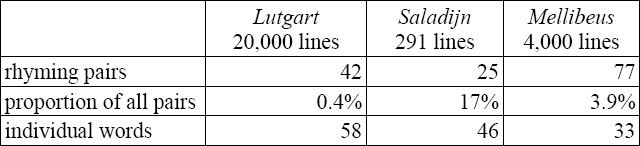
However, there are differences across the texts in the three different time periods when each of the texts was written. Although one does find rhyming pairs with original short and long unrounded vowels in Lutgart, these examples are rather limited. We sampled all rhyming words in the three texts (see table 18). Although Lutgart is the longest text, it has only 42 short/long rhyming pairs (84 lines, 42 pairs, of which 32 are different word pairs; 50 individual words). In contrast, Saladijn has 25 short/long rhyming pairs involving 31 individual words, which comes to 17%. Mellibeus is in between.
Short/long rhyming pairs in the three texts.Footnote 29

As table 18 shows, Mellibeus and Saladijn have a larger percentage of rhymes that involve original short and long vowels. In Lutgart, such rhymes constitute less than 1%. In contrast, in Saladijn, which consists of less than 300 lines and has approximately the same number of individual words as Lutgart, such rhymes constitute 17%. Not only are there more words that participate in such rhymes, but there are also other differences. In Saladijn, for instance, one finds verses of four rhyming lines with original short and long words. For example, in a single verse in Saladijn, a word ending with the suffix -hede (<†haidu) rhymes with mede (<†meda) ‘with’, sede (<†sidu) ‘custom’, and lede (<†lidu) ‘lid’, as shown in table 19.
Four rhyming lines in Saladijn.

A further point to note is that in Lutgart, the rhyming pairs almost always consist of a noun and some form of a strong verb (for example, genade < † ‘mercy’~laden < †V ‘to load’), but there are no examples of two nouns. Note that the vowel length varied in the morphology of strong verbs, for example, OE specan- inf (V) ‘to speak’, spæc- past.1 3P (V), spǣcon- past-pl (), gespecen-part (V). Given this, one could conjecture that the long/short rhyming pairs are restricted to noun-verb combinations due to morphological variation in length. In contrast, Saladijn does contain rhyming words of the same morphological class—see, for example, the rhyming nouns dade < †V− ‘deeds’~scade < †V ‘damage’ (see table 15). Such pairs are more reliable when drawing conclusions about original vowel length. In any event, as shown in table 18, Lutgart has fewer straightforward examples of rhyming pairs that contain original vowels of mismatching length.
Summarizing, for rounded vowels, one only finds rhyming pairs of the same PGmc origin. When lengthened, short PGmc †/u/ (WGmc †/o/) became MNL /ɔː/; it did not have the same quality as MNL /oː/, which developed from PGmc †/au/. PGmc †/ō/ became MNL /uː/. Sytsema et al. (Reference Sytsema, Grijzenhout and Lahiri2014) have argued that this is why rhyming pairs with original long and short rounded vowels in open syllables were not found in MNL. However, unrounded short and long vowels of different descent do have the potential to rhyme, if OSL applied, since the lengthened unrounded vowels would have the same vowel quality as the original long vowels. We found that this indeed occurred in Saladijn and Mellibeus, and to a much lesser extent in Lutgart. In Lutgart, not only are there fewer words that participate in such rhymes, but there are also no rhyming pairs that belong to the same syntactic class. This observation suggests that the process of OSL was more advanced in Mellibeus and in Saladijn, where a much greater number of unrounded vowels had undergone OSL, whereas in Lutgart the process had probably just begun.
5. Evidence from Meter
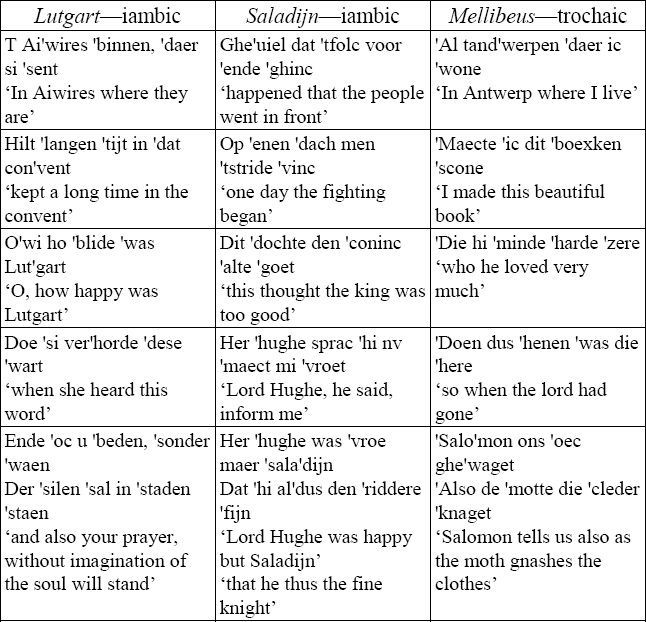
Evidence from meter is possibly the most interesting indication of whether OSL had occurred. It has been assumed that Lutgart is the only text with iambic meter in MNL (see Fikkert Reference Fikkert and Lahiri2000, Zonneveld Reference Zonneveld2000). However, we found that Saladijn is also written in iambic verse, whereas Mellibeus has trochaic rhythm (see table 20). Adapting the metrical principles of Halle & Keyser Reference Halle and Keyser1966, which were drawn up to describe principles of iambic pentameter in Chaucer, Fikkert (Reference Fikkert and Lahiri2000) concludes that the same principles mutatis mutandis are applicable to Lutgart. She argues that Lutgart is written in regular iambic tetrameter, where each line consists of eight positions or syllables to which an extrametrical syllable may be appended for feminine rhymes. If there are more than nine syllables, elision of unaccented vowels, mostly schwa, takes place to maintain the number of eight or nine syllables. Metrical beats fall on even positions. Since linguistically heavy syllables or stress maxima are always in even positions, the meter is clearly iambic. A similar pattern is observable in Saladijn but not in Mellibeus. In Mellibeus, stress maxima fall on odd positions. The different metrical patterns in our texts are illustrated in table 20. Generally, there were four beats per line in all of these texts.
Rhythmic patterns in Lutgart, Saladijn, and Mellibeus.
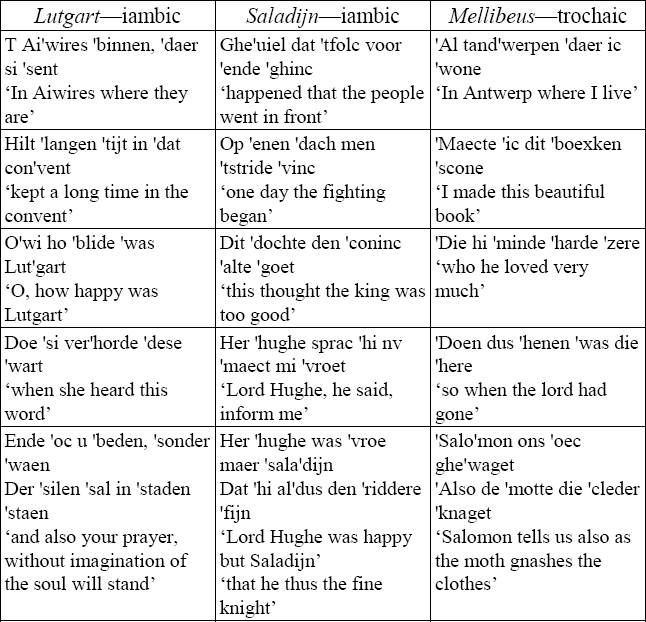
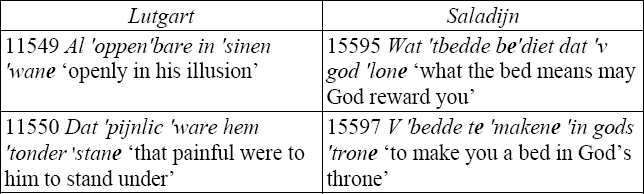
As one can see, lines in Mellibeus start and end with a stressed syllable followed by an unstressed syllable, which makes the feet trochaic. In both Saladijn and Lutgart, lines begin and end with iambic feet; the beat generally falls on the second syllable and the initial syllable is disregarded. Thus, the superheavy final syllable rhymes include ghinc ‘went’ and vinc ‘caught’ or goet ‘good’ and vroet ‘wise’. Perhaps the name Saladijn encouraged the poet to use an iambic pattern, ending his rhymes frequently with such heavy syllables. Both Saladijn and Lutgart also contain feminine rhymes ending in schwa (see Zonneveld Reference Zonneveld2000).
Feminine rhymes in Lutgart and Saladijn.

When examining metrical feet in verse to establish the presence or absence of OSL, one should focus on the syllables that can carry a beat. In Germanic in general, metrically strong syllables would be heavy; these would either be open syllables with long vowels or closed syllables with a coda consonant. However, metrical resolution occurred frequently in older Germanic languages (see OE, OHG, Gothic). Two consecutive light syllables (LL) and a sequence of one light and one heavy syllable (LH) would be treated as a single foot. This means that an LX sequence would be equal to H, where X could be either L or H (Russom Reference Russom1987, Dresher & Lahiri Reference Dresher and Lahiri1991, Fikkert et al. Reference Fikkert, Elan Dresher, Lahiri, van Kemenade and Bettelou2006, and references therein).Footnote 30 Thus, an LH sequence carries a single main stress (for example, OE wéreld ‘world’, cýning ‘king’) and would constitute a single foot; it would never amount to two feet, and so the final H in this sequence could never carry a beat. As we show below, these sequences become crucial line-finally in iambic verse, where the beat could not fall on the final H (for example, “ning” of cyning): This syllable is not a foot by itself, but the word as a whole constitutes a single LH foot. However, before we discuss the relevance of LH feet for OSL, we need to discuss the similarities and differences across the three texts, particularly with respect to de-footing.
In most verses, there are various possibilities of de-footing in words with HH sequences, as shown in 6 (H = de-footing, H = stress). Words with two heavy syllables need not carry two beats, and one heavy syllable could be de-footed for rhythmic purposes (examples of verses are given later).
(6)
However, where open syllables are concerned, there are varying possibilities. To appreciate the differences across the three texts, we need to discuss them with respect to the two metrical patterns, iambic and trochaic. We first turn to Lutgart and Saladijn, and then discuss Mellibeus.
Fikkert (Reference Fikkert and Lahiri2000) argued that the LX = H type of resolution was still in effect in Lutgart. Our contention is that the words with LX feet are crucial for establishing whether OSL has occurred or not. The argument proceeds as follows: If OSL has occurred, then original short vowels in open syllables would become heavy and would pattern with other heavy syllables; that is, the original light syllables would be treated as heavy. Thus, before OSL, a word with ‘CVCVC structure would be treated as one foot, with a light syllable followed by a heavy syllable (for example, LH = LX) and with the first syllable carrying the only beat. The second syllable cannot bear a beat since it is part of a single foot and thus cannot bear stress. If, due to OSL, the first vowel is lengthened as in ‘CVːˌCVC, then the word would have two feet, HH, with potentially two beats. Alternatively, after de-footing only one H would carry a beat. However, without OSL, a ‘CVCVC word could only be a single trochaic foot.
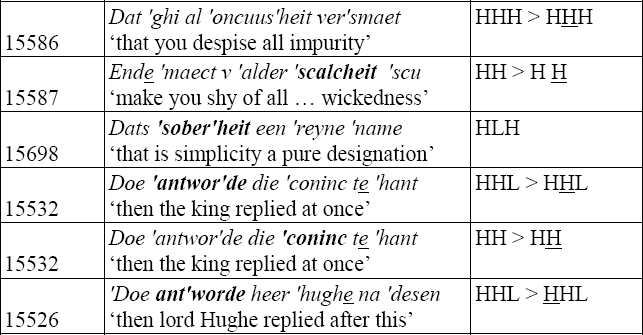
Let us first consider footing possibilities in line-medial positions in Lutgart and Saladijn. Typically, whenever two consecutive closed syllables could potentially form two monosyllabic H feet, as in 6, one syllable could be de-footed for rhyming purposes. In line-final position, there are other possibilities. An LL foot was permissible sentence-finally with a final schwa, as shown in 7. However, Fikkert noticed that in Lutgart, words with a closed penultimate syllable, such as coninc ‘king’ (LH) and coninge ‘king’ (LHL), are always comprised of a single foot. In contrast, words such as erming(e) ‘poor person’ (HHL) consist of two feet, one of which could be de-footed, if needed. Examples of footing of LH and HH feet line-medially in Lutgart are given in 7.
(7)
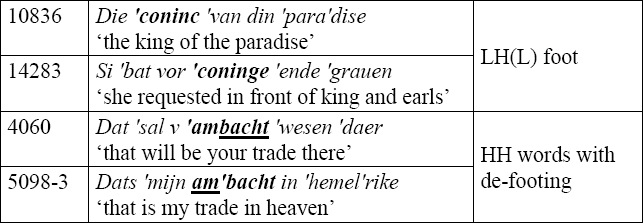
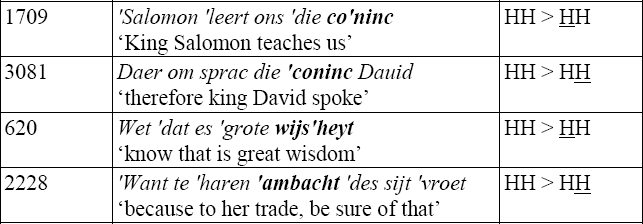
Thus, in Lutgart, “ninc” can appear in a weak position, but never in a strong position, while ambacht ‘trade’ can consist of (H) (H) or (H) (H), allowing the final syllable to be strong. Although the final syllable in coninc ‘king’ is heavy, the word has an LH sequence, which is resolved into a single foot. That is, it carries only a single stress, which falls on the light syllable, not on the heavy one. Thus, “ninc” in coninc can never carry a beat since the main stress is on “co” and the entire word constitutes a single foot. The final schwa in coninge can of course be ignored. The contrast between coninc and ambacht exists because the first syllable in the former must have been light. In 8 and 9, and in tables 22 and 23, we provide examples of both words in Lutgart. It is obvious that in ambacht, either syllable can carry a beat, whereas in coninc and coninge, the main beat is always on “co” and never on “ninc”.Footnote 32 As shown in 8, in Lutgart de-footing can apply to H in HH but not in LH.
(8)
(De)footing of HH and LH sequences in Lutgart.

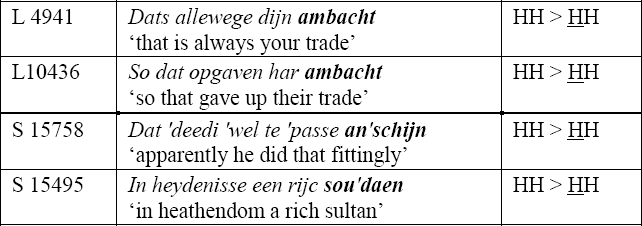
One finds similar patterns of footing and de-footing in HH sequences line-medially in Saladijn:
(De)footing of HH sequences in Saladijn.

Now we turn to the end of a line. Here we draw attention to the lack of certain types of end rhymes in Lutgart, which were perfectly acceptable in Saladijn, and argue that this is because OSL did not apply in Lutgart. In iambic meter, the final foot in the end rhyme can consist of one heavy (H) syllable, possibly with a final schwa (HL), which is extrametrical. In iambic meter, as we observed above, the ideal final foot would be [L'H (ǝ)]. Fikkert observed that words such as coninc/coninge ‘king’ never occur sentence-finally in Lutgart, whereas words such as ambacht ‘trade’ clearly do. Since the final syllable can be either a de-footed (H) or an (H) that carries a metrical beat, an (H)(H) sequence can appear sentence-finally, where one syllable could be de-footed due to clash, for example, ‘ambacht (‘HH) versus am‘bacht (H‘H). In contrast, “ninc” in coninc (‘LH) has a heavy unstressed syllable and could not be ignored. Thus, several issues arise. First, “ninc” is a heavy syllable, but it could not bear stress since its preceding light syllable bore stress, ‘LH. Second, “ninc” could not be ignored, since the final H is not a schwa. Finally, it could not be de-footed since it is not a foot. Consequently, words such as coninc/coninge were incompatible with the iambic line-final position and so they never appear there. In contrast, if a word consists of two heavy syllables, such as ambacht, it may carry two stresses, or one syllable can be de-footed. When it appears line-finally, the first syllable is de-footed, and the iambic metrical pattern is satisfied.
Such a gap—the absence of LH(L) words (where the initial L was an open syllable consisting of only a vowel) at the end of a line in iambic rhythm—can only be explained if OSL had not yet taken place. Long vowels would constitute heavy syllables. Consequently, had OSL taken place, the initial syllable in coning, “co”, would have been long, [coː], and the subsequent (H)(H) sequence would not have been treated as a single foot. Thus, with OSL, cōning would have behaved exactly like ambacht. We argue that OSL is well established in Saladijn but not in Lutgart, which explains why words such as coninc are allowed line-finally in the former but not in the latter. Examples of original LH and HH words are provided in 9.
(9)
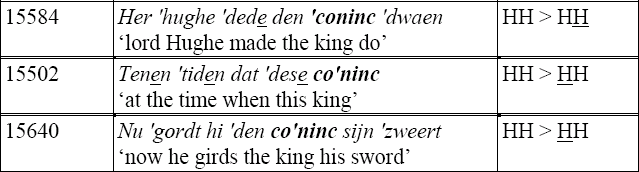
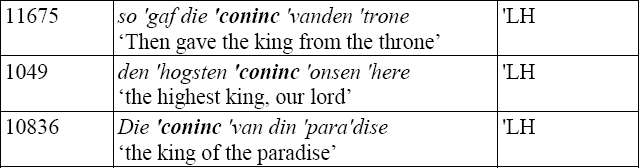
To support our hypothesis, in table 24 we present examples with line-final original HH sequences in a disyllabic word from Lutgart and Saladijn (where one H is de-footed). Then in table 25 we present examples of original LH sequences from Saladijn, which have become HH, but which do not occur in Lutgart.Footnote 33 We predict that words such as coninc, with a final beat on “ninc”, would be allowed at the end of the line in Saladijn, where OSL had occurred, but not in Lutgart. This is exactly what one finds: Coninc never occurs line-finally in Lutgart, whereas it does in Saladijn. This contrast suggests that OSL had taken place in the latter, but probably not in the former. However, in Saladijn, all original LH sequences behave like HH, where either syllable can be de-footed, and the second H can be strong. This is impossible in Lutgart.Footnote 34
Examples of final HH feet in Lutgart and Saladijn with final de-footing.

Original LH words sentence-medially and finally in Saladijn, following the application of OSL.

As we can see in table 25, in Saladijn, coninc can occur at the end of a line, where -ninc gets a beat in iambic meter (row 2), rhyming with ghinc, or coninc can occur line-medially with a beat on -ninc and with a defooted coː (row 3). This suggests that OSL must have lengthened the initial vowel, such that the word no longer consisted of one foot.
Furthermore, an ‘LH word is a single foot; so even when it appears line-medially, it can only bear a beat on its first syllable, because its second (heavy) syllable is treated as light. Thus, in Lutgart, unlike in Saladijn, the word coninc occurs with a beat only on “co” and never on “ninc”, as shown in table 26.
Original LH words sentence-medially in Lutgart, before the application of OSL.

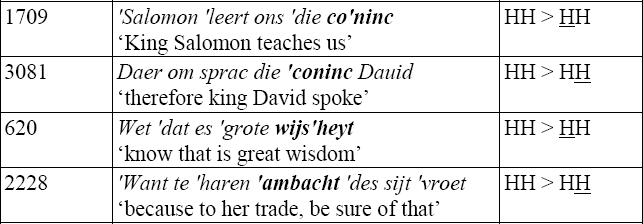
Now we turn to Mellibeus. In this text, words such as coninc ‘king’ clearly consist of two heavy syllables, either one of which can be de-footed, exactly as in original HH sequences in words such as ambacht ‘trade’ and wijsheyt ‘wisdom’.
Examples of HH feet from Mellibeus.
In sum, an initially stressed (‘LH) foot could never occur sentence-finally in an iambic verse, since the final foot in iambic meter had to be (L'H). In Lutgart, words such as ‘coninc could not be placed sentence-finally, where the final heavy syllable had to remain unstressed. Such words, however, were permitted in this position in Saladijn. This can only be explained if OSL had not occurred in Lutgart, and so the parsing would lead to a single foot with resolution, as in coninc ([‘LH]) or coninge ([‘L H] ǝ). Saladijn treats these words as having two feet, [‘H ̩H] or [‘H ̩H ǝ], with a possibility of de-footing the initial H.
6. Conclusion
Although it is well established that OSL occurred in MNL, the time of its commencement remains uncertain. We report evidence from ortho-graphy, rhyme, and meter in three medieval Dutch texts written in verse during the course of approximately 75 years. By carefully examining diachronic correspondences in the verses we were able to identify the synchronic systems of the 13th- and 14th- century MNL. Evidence deduced from texts written in Brabant helped us establish the timing of OSL. Of course, our evidence is based only on three texts. However, these were chosen for close scrutiny precisely because of their close geographical connections and the time in which they were written. Naturally, there are many gaps in such comparisons. Yet, for the phonological questions we are raising, rhyming texts are crucial, and in this period and area no other author is available. We could identify striking similarities and differences between the three texts in what could or could not occur in specific contexts.
Our conclusions are summarized as follows. First, there is orthographic evidence. Although orthography has been generally consi-dered to be unhelpful, a closer look at the texts suggests that Lutgart has largely escaped OSL, while Saladijn and Mellibeus have not. Compari-son between the vowels in the texts with reconstructed PGmc, as well as OE, OS, and OHG when relevant, indicated that the original long and short vowels in closed syllables were distinguished systematically in all three texts. Our examination of open syllables yielded differences in orthographic evidence. We have established that in Saladijn and Mellibeus—but not in Lutgart—the original long and short vowels in open syllables were written in the same fashion as they are in ModD (see section 3). In Lutgart, the spelling of the original long vowels varied between a single grapheme and two graphemes, suggesting that there was a need to distinguish these vowels from original short vowels in open syllables. In all probability, the original short vowels had the tendency of becoming long, and this allophonic lengthening needed to be distinguished from the so-called real long vowels in open syllables. Saladijn and Mellibeus, in contrast, must have neutralized the length contrast in open syllables such that all vowels were written with a single grapheme in this context.
Second, there is evidence from rhyme. Once again there appears to be a difference between Lutgart on the one hand, and Saladijn and Mellibeus on the other. We hypothesized that had OSL taken place, the original unrounded short vowels in open syllables would rhyme with the original unrounded long vowels. For independent reasons, it was not possible to compare rounded vowels: When these were lengthened, the vowel quality altered (see Sytsema et al. Reference Sytsema, Grijzenhout and Lahiri2014). However, the original short unrounded vowels in open syllables rhymed with the original long vowels in Saladijn and Mellibeus, but this is much less evident in Lutgart (see section 4).
Third, there is evidence from metrical parsing. Here we found clear evidence of the lack of OSL in Lutgart compared to Saladijn and Mellibeus. Saladijn and Lutgart are written in iambic verse, which requires a heavy stressed foot at the end of a line. Final light syllables are not tolerated unless they are schwas. Thus, original LH words such as coninc with only initial stress (and no stress on “ninc”) were impossible at the end of a line in an iambic verse, which is observed in Lutgart. In Saladijn, however, such words were permitted, indicating that the initial light syllable in coninc must have lengthened by OSL. As a result, the initial syllable became heavy, leading to an HH syllabic sequence, just as in ambacht. Such sequences were allowed line-finally, since one of the syllables could be de-footed (see section 5). Thus, original LH syllables must have been lengthened by OSL, since they follow the same metrical pattern as words with original HH syllables in Saladijn but not in Lutgart. Furthermore, in Saladijn, after coninc acquired an HH syllabic sequence as a result of OSL, one H could be de-footed, and either syllable could bear a beat, even line-medially. Again, this is not found in Lutgart, where only the initial syllable could carry a beat, the word remained an LH sequence, and thus a single foot. Thus, there is evidence that OSL had been more established by the time of Saladijn and Mellibeus than of Lutgart. Whether this is due to minor dialectal differences or to the individual authors is hard to conclude. Crucially, the authors come from the same area, and the manuscripts were produced within a period of approximately 75 years. It is likely, then, that during this period, OSL was gradually taking root in MNL: It had become well entrenched in the language by the time of the latter texts, but it was just beginning to apply in the time of the early one.