Introduction
Death anxiety (DA) has been defined as the emotional experience of fear, angst, or panic related to the awareness of one’s own death (Iverach et al. Reference Iverach, Menzies and Menzies2014; Russac et al. Reference Russac, Gatliff and Reece2007; Sussman and Liu Reference Sussman and Liu2014). DA is common in individuals with advanced cancer (Neel et al. Reference Neel, Lo and Rydall2015; Soleimani et al. Reference Soleimani, Bahrami and Allen2020) and associated with physical, psychological, and existential distress and psychiatric disorders (Cordova et al. Reference Cordova, Riba and Spiegel2017; Singer et al. Reference Singer, Das-Munshi and Brähler2010; Smith Reference Smith2015). It has also been reported that DA can hinder shared care planning and end-of-life preparation in both patients and family members (Krause et al. Reference Krause, Rydall and Hales2015; Lau and Cheng Reference Lau and Cheng2011).
Relief of DA has been considered an important goal of palliative and cancer care (Singer et al. Reference Singer, Das-Munshi and Brähler2010; Smith Reference Smith2015), and research has demonstrated that it can be alleviated by targeted psychotherapeutic interventions in individuals with advanced cancer (Rodin et al. Reference Rodin, Lo and Rydall2018). However, research on DA assessment and treatment in advanced cancer has been relatively neglected compared to that on psychological symptoms, such as research on depression (Krebber et al. Reference Krebber, Buffart and Kleijn2014; Saracino et al. Reference Saracino, Weinberger and Roth2017). This relative neglect in research and clinical practice may be partly related to the lack of a reliable and validated tools to assess DA in individuals with advanced disease (Neimeyer Reference Neimeyer1994). The availability of such a measure of DA would be of great value in facilitating research and clinical attention to this symptom.
The Death and Dying Distress Scale (DADDS) is a brief questionnaire developed to assess the level of distress related to the process of dying and death (Lo et al. Reference Lo, Hales and Zimmermann2011). A preliminary Canadian validation study (Krause et al. Reference Krause, Rydall and Hales2015) of the DADDS using exploratory factor analysis (EFA) found a single-factor structure as did a validation study of the German version of the DADDS (Engelmann et al. Reference Engelmann, Scheffold and Friedrich2016). A more recent validation study with a larger sample conducted by the original Canadian researchers, using a confirmatory factor analysis, supported a 2-factor structure (Shapiro et al. Reference Shapiro, Mah and Li2021). These factors were “Finitude,” related to awareness of the shortness of time (items 1–10: not having done the things I wanted to do; not having said all that I wanted to say; not having achieved my live goals; not having a future; the missed opportunities; out of time; the impact of my death on loved ones; and my own death and dying), and “Dying,” related to the process of dying (items 11–15: [death] happen suddenly or unexpectedly; be prolonged or drown out; happen when I am alone; happen with pain; and happen very soon).
Studies carried out in Italy document that patients with advanced and terminal disease show high levels of existential and spiritual distress that negatively affect quality of life and preparation for death (Bovero et al. Reference Bovero, Leombruni and Miniotti2016; Bovero et al. Reference Bovero, Sedghi and Opezzo2018; Grassi et al. Reference Grassi, Costantini and Caruso2017a). To our knowledge, however, no specific measure of DA has been validated in Italian-speaking individuals with advanced or terminal disease.
The aim of the present study was to evaluate the psychometric properties of an Italian adaptation of the DADDS (DADDS-IT) in a sample of patients with advanced cancer. Specifically, we aimed to evaluate the DADDS-IT factor structure, internal consistency, and construct validity. Based on previous findings (Andrea Reference Bovero, Sedghi and Opezzo2018; Bovero et al. Reference Bovero, Leombruni and Miniotti2016; Engelmann et al. Reference Engelmann, Scheffold and Friedrich2016; Grassi et al. Reference Grassi, Costantini and Caruso2017a; Lo et al. Reference Lo, Hales and Zimmermann2011; Shapiro et al. Reference Shapiro, Mah and Li2021), we hypothesized that distress related to death and dying would be positively correlated with demoralization, depression, anxiety, and impairment in physical functioning and negatively correlated with spiritual well-being.
Methods
Participants and procedure
Ethical approval of the study was obtained from the Hospital Ethics Committee for Human Research of Turin (protocol number 0034403). Each patient included in the study was informed about the aims of the research and provided written informed consent. A convenience sample of patients with advanced cancer was recruited from March 2019 to December 2020 at the Città della Salute e della Scienza Hospital and at the Vittorio Valletta Hospice in Turin, Italy. Inclusion criteria were ≥18 years old, having a diagnosis of cancer, able to provide informed consent, and meeting eligibility criteria to access palliative care (National Law on Palliative Care and Pain Treatment, No. 38/2010). These criteria include being terminally ill with no available or appropriate curative treatment, having an unfavorable prognosis with a presumed life expectancy of 4 months or less, and scoring 50 or lower in the Karnofsky Performance Status (KPS). Exclusion criteria included having a diagnosis of any severe psychiatric disorder and cognitive impairment with an inability to provide informed consent or to complete the study procedures.
Patients were approached by a research assistant to complete the self-report scales; sociodemographic and clinical data were collected from medical records and clinical charts.
Measures
Death anxiety
Death-related distress was assessed using the DADDS, a 15-item scale that was developed for use in advanced cancer care. The DADDS rates the intensity of death-related distress symptoms on a 6-point Likert scale (0 = “I haven’t been distressed by this thought or preoccupation” and 5 = “I have been extremely distressed”). Higher scores indicate more severe death-related distress (scores range from 0 to 75). A native Italian speaker who is fluent in both languages and familiar with the measure translated the DADDS from English to Italian in consultation with the main author (R.C.) and with the developers (Lo et al. Reference Lo, Hales and Zimmermann2011). The measure was backtranslated into English by an external translator who was not familiar with the measure. The resulting English version was checked against the original English measure and discrepancies were resolved by a panel of experts.
Demoralization
The validated Italian version (Costantini et al. Reference Costantini, Picardi and Brunetti2013) of the Demoralization Scale (DS) (Kissane et al. Reference Kissane, Wein and Love2004) was used to assess demoralization symptoms. The DS is a 24-item measure, widely used in cancer and medical setting (Battaglia et al. Reference Battaglia, Zerbinati and Piazza2020; Belvederi Murri et al. Reference Belvederi Murri, Caruso and Ounalli2020a, Reference Belvederi Murri, Zerbinati and Ounalli2020b), that rates the frequency of symptoms of demoralization during the past 2 weeks on a 5-point Likert scale (0 = never and 4 = all the time), with higher scores indicating more severe demoralization symptoms. In a sample of Italian cancer patients, the Italian version of the DS showed good internal consistency and a factor structure comprising 4 factors, namely Dysphoria, Loss of Meaning and Purpose, Disheartenment, and Sense of Failure (Grassi et al. Reference Grassi, Costantini and Kissane2017b).
Depressive symptoms
The Italian validated version (Rizzo et al. Reference Rizzo, Piccinelli and Mazzi2000) of the 9-item Patient Health Questionnaire (PHQ-9) (Spitzer et al. Reference Spitzer, Kroenke and Williams1999) was used to assess the severity of depressive symptoms during the last 2 weeks. For each item, patients were asked to assess how much they were bothered by the symptoms over the last 2 weeks. There are 4 answer options: not at all (0), several days (1), more than half of the days (2), and nearly every day (3). The sum score (range 0–27) indicates the degree of depression, with scores of ≥5, ≥10, and ≥15 representing mild, moderate, and severe levels of depression.
Anxiety symptoms
Anxiety symptoms were assessed using the General Anxiety Disorder (GAD-7) (Spitzer et al. Reference Spitzer, Kroenke and Williams2006), a self-report questionnaire composed of 7 items investigating GAD. Each of the 7 items is scored from 0 (i.e. “Not at all”) to 3 (i.e. “Nearly every day”); the GAD-7 score ranges from 0 to 21. For our study, we used the official Italian version freely downloadable on the PHQ Web site (http://www.phqscreeners.com).
Spiritual well-being
Spiritual well-being was assessed using the validated Italian version (Rabitti et al. Reference Rabitti, Cavuto and Iani2020) of the Functional Assessment of Chronic Illness Therapy – Spiritual Well-Being Scale (FACIT-Sp) (Brady et al. Reference Brady, Peterman and Fitchett1999). It is a 12-item scale, which comprises 3 factors, meaning, peace, and faith. It is widely used in cancer settings where it has been shown to be a valid self-report tool (Canada et al. Reference Canada, Murphy and Fitchett2008). Higher scores indicate better spiritual well-being.
Symptom burden and physical functioning
The presence of cancer-related physical distress was assessed using the Edmonton Symptom Assessment System (ESAS-Revised) (Bruera et al. Reference Bruera, Kuehn and Miller1991), in its Italian validated version (Ripamonti et al. Reference Ripamonti, Leporati and De Feo2022). It rates the severity of physical (i.e., pain, tiredness, nausea, drowsiness, lack of appetite, feeling of not well-being, and shortness of breath) and psychological (i.e., depression and anxiety) symptoms on a 11-point visual analog scale, ranging from 0 (no symptom) to 10 (the worst symptom). In our analysis, we computed the sum of physical symptoms (ESAS-Physical) and excluded psychological symptoms because of redundancy with the distress measures. Higher scores indicate higher physical symptom burden.
The KPS is a clinician-rated scale measuring functional impairment (Schag et al. Reference Schag, Heinrich and Ganz1984). High scores indicate better physical functioning and more ability to perform work activities, activities of daily living, and personal care. Scores on the KPS range from 100 (no signs of functional impairment) to 0 (death) in decrements of 10.
Statistical analysis
We approached our investigation of the DADDS structure with the following steps. First, confirmatory factor analyses (CFAs) were conducted to estimate the fit of available factor structures.
CFAs were conducted using the cfa function of the lavaan R package using diagonally weighted least squares; variables were treated as ordinal categorical data using the ordered argument. We selected the following CFA indices to evaluate the model fit: (1) the comparative fit index (CFI), (2) Tucker–Lewis index (TLI), and 3) the root mean square error of approximation (RMSEA) with its confidence interval. Factor models showing CFI ≥ 0.95, TLI ≥ 0.95, and RMSEA ≤ 0.06 were considered to show good model fit. We tested both the single-factor structure (Engelmann et al. Reference Engelmann, Scheffold and Friedrich2016; Krause et al. Reference Krause, Rydall and Hales2015; Lo et al. Reference Lo, Hales and Zimmermann2011) and the 2-factor structure (Shapiro et al. Reference Shapiro, Mah and Li2021).
Second, we evaluated the factor structure of the DADDS in our sample using EFA with the principal factor method and Promax rotation, since significant correlations between factor scores were expected. The EFA was conducted using Statistical Package for Social Sciences (SPSS) version 22. The optimal number of factors was fixed according to the results of a parallel analysis with 1,000 resampling iterations, which we conducted using the fa.parallel function of the psych R package. Adequate sampling was assured by Kaiser–Meyer–Olkin > 0.9 (Kaiser Reference Kaiser1970) and a significant Bartlett’s α value that confirmed sphericity (Bartlett Reference Bartlett1954).
Third, we estimated the internal consistency by calculating Cronbach’s α for the total scale as well as for each factor. Cronbach’s α ≥ 0.70 is generally considered an index of good internal consistency (Cortina Reference Cortina1993). Cronbach’s α with item deletion for each item was also calculated.
Analysis of variance, t-test, and chi-square were used to determine the differences between groups when comparing DADDS total and factors scores and its subscales with clinical and sociodemographic variables. Construct validity was analyzed by using spearman correlation test between DADDS and the total scores of the PHQ-9, GAD-7, FACIT-Sp-12 and its factors, DS and its factors, KPS and ESAS-Physical. The SPSS version 22 was used for these analyses, with the level of statistical significance set at p < 0.05.
Results
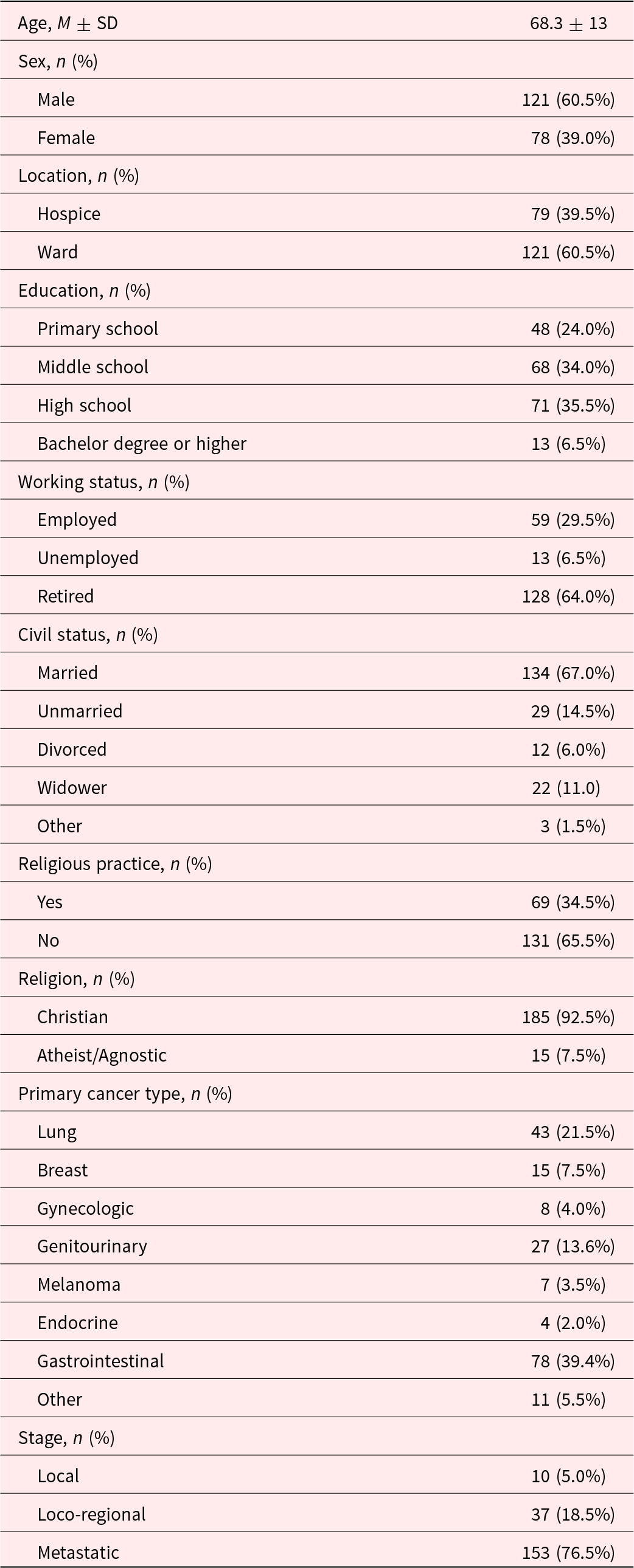
A total of 268 patients meeting the inclusion criteria were approached and asked to participate in the study. Of these, 68 (25.4%) did not enter the study (25 of these patients refused to participate because of severe distress resulting from the disease and 43 passed away before the interview). The final sample comprised 200 patients (74.6% of those approached) with a mean age of 68.3 years; the majority of participants were male (60.5%) and had metastatic cancer (76.5%) (Table 1).
Sample sociodemographics (N = 200)

CFAs, exploratory factor structure and internal consistency of the DADDS
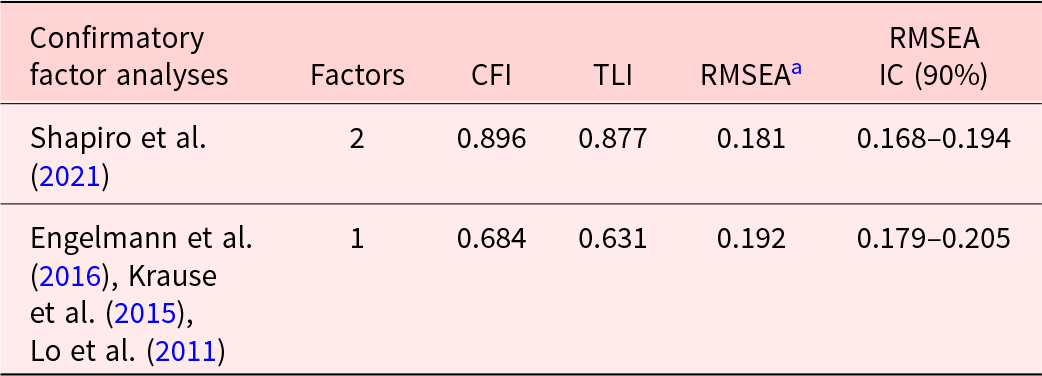
CFAs showed that both the single- and the 2-factor structures from previous studies produced poor model fit (CFI = 0.896, TLI = 0.877, and RMSEA = 0.181 for the 2-factor model, and CFI = 0.684, TLI = 0.631, and RMSEA = 0.192 for the single-factor model; Table 2).
Confirmatory factor analysis

CFI, comparative fit index; TLI, Tucker–Lewis index; and RMSEA, root mean square error of approximation.
a Factor models with a good fit on factor analyses show CFI, TLI ≥ 0.95, and RMSEA < 0.08.
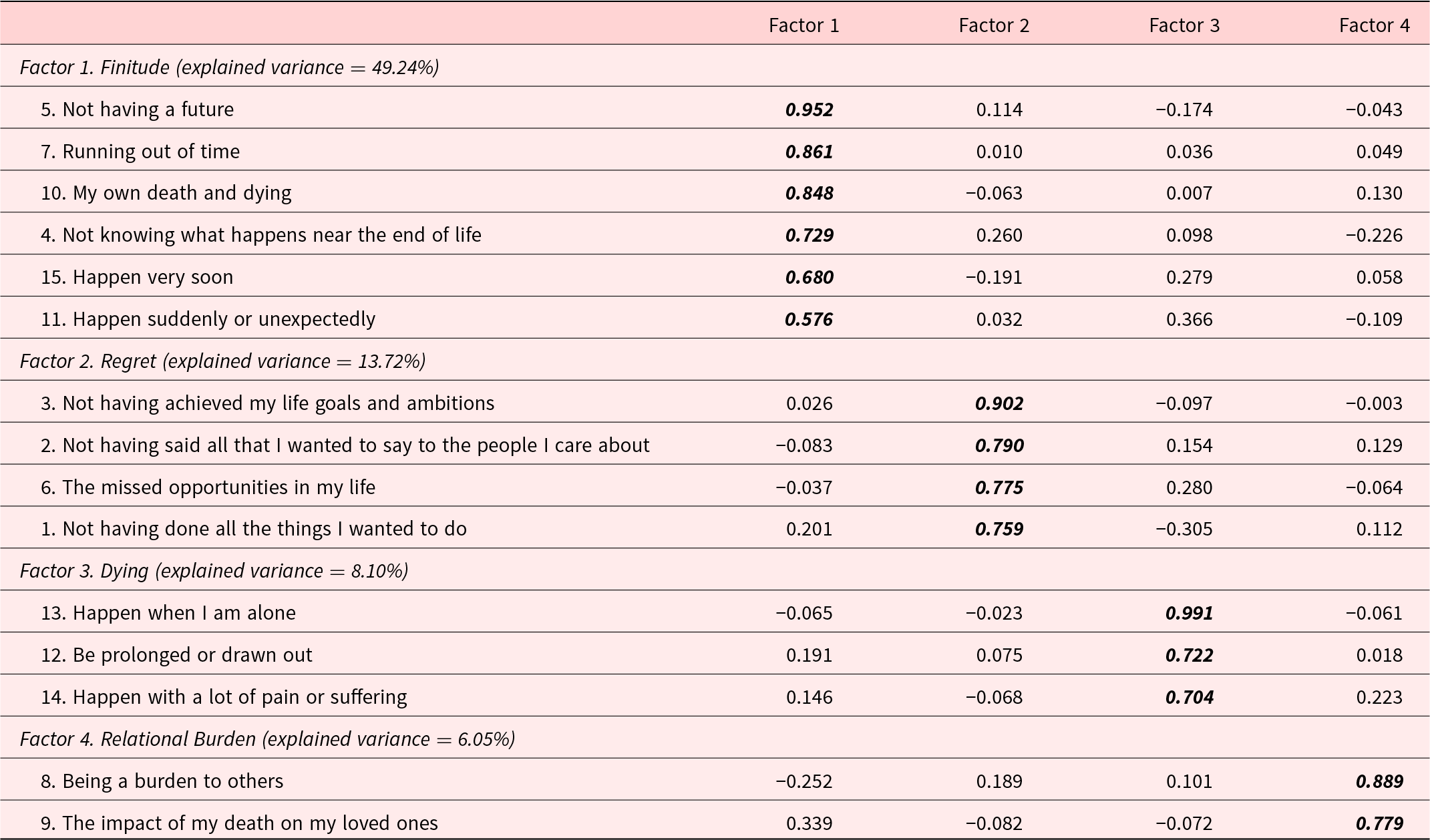
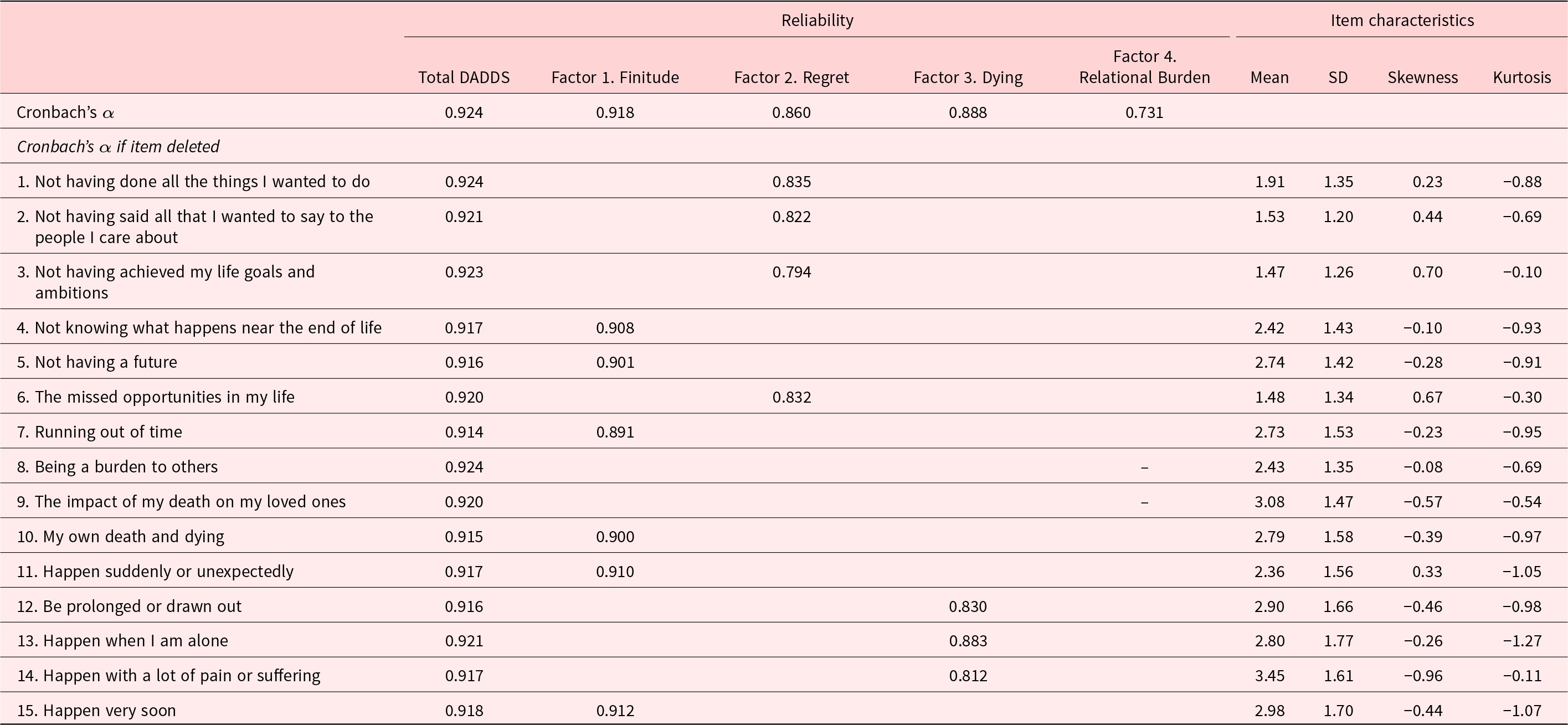
Parallel analysis suggested a 4-factor extraction. Table 3 shows the results of the EFA with the 4-factor solution, which explained the 77.1% of the variance. The Kaiser–Meyer–Olkin measure of sample adequacy was 0.892, indicating sample adequacy. The first factor, Finitude, consisted of 6 items (items 4, 5, 7, 10, 11, and 15) and reflected the awareness of shortness of time. The second factor, Regret, comprised items 1, 2, 3, and 6 and referred to distress related to unaccomplished existential goals. The third factor, Dying, consisted of 3 items (items 12, 13, and 14) and reflected distress related to the process of dying, while the fourth factor, Relational Burden, comprised 2 items (item 8 and 9) and described distress related to the concern about being a burden to others. Correlations among factors ranged from weak (r = 0.33) to strong (r = 0.69) (Table 5). Cronbach’s α coefficients indicated good levels of internal consistency for DADDS total and Finitude, Regret, and Dying subscales (DADDS total, α = 0.924; Finitude, α = 0.918; Regret, α = 0.860; Dying, α = 0.888) and acceptable levels of internal consistency for Relational Burden subscale (α = 0.731) (Table 4).
Exploratory factor analysis

Parallel analysis suggested that the 4-factor EFA solution was optimal.
Factor loadings are displayed in bold character.
KMO = 0.892. Bartlett’s test of sphericity χ 2 = 2125.992, df = 105, p < 0.001.
Internal consistency and item‐total statistics of 15‐item DADDS

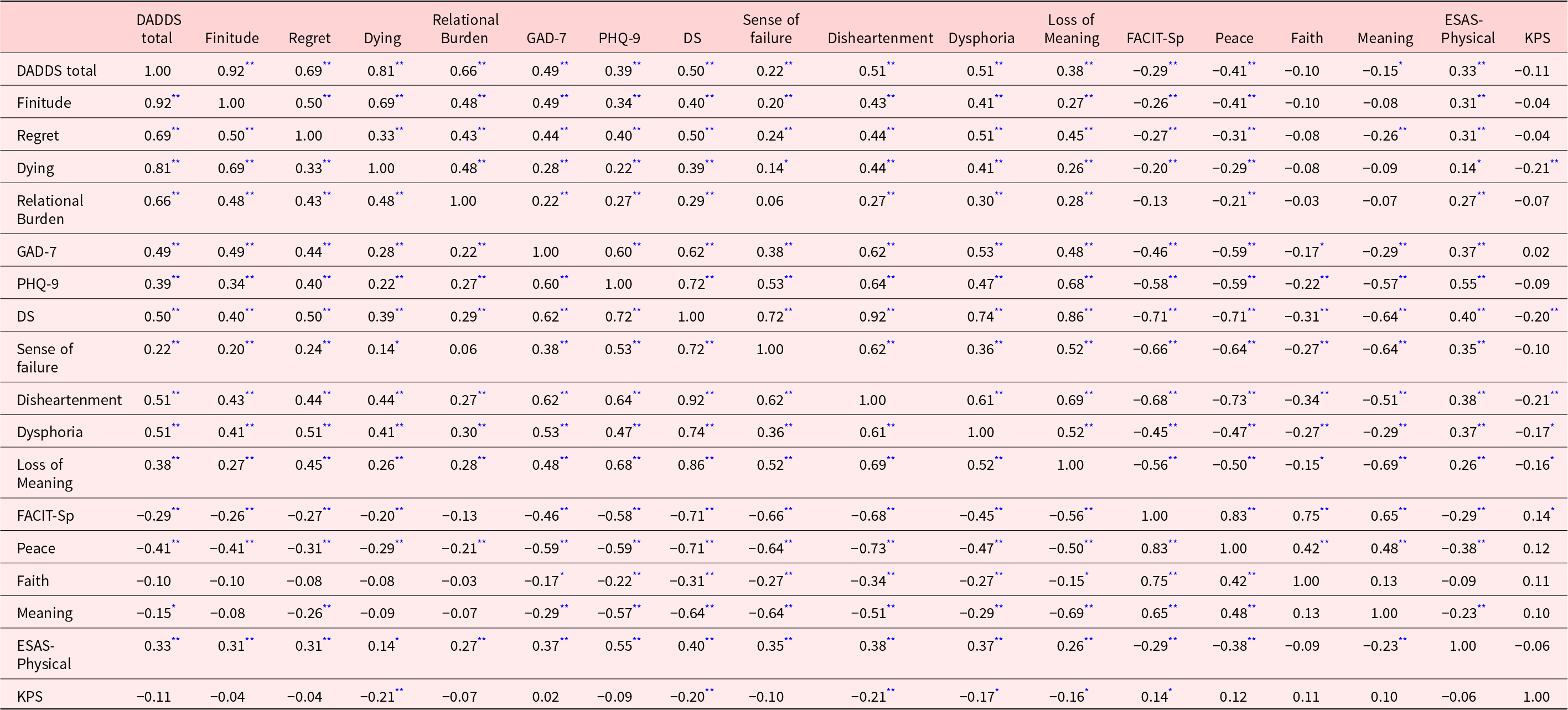
Correlations between DADDS scores and validity measures

DADDS, Death and Dying Distress Scale; GAD‐7, Generalized Anxiety Disorder‐7; PHQ‐9, Patient Health Questionnaire; KPS, Karnofsky Performance Status; DS, Demoralization Scale; FACIT-Sp, Functional Assessment of Chronic Illness Therapy – Spiritual Well-Being; ESAS-Physical, Edmonton Symptom Assessment System – Physical symptom total score.
** 0.01 level.
* 0.05 level.
Descriptive characteristics of the DADDS
Skewness and kurtosis scores of the items suggest a normal distribution (Table 4). The most reported distressing concern was related to the fear of dying with a lot of pain and suffering (M = 3.45, SD = 1.61), while the least distressing concern was related to not having achieved goals and ambitions in life (M = 1.47, SD = 1.26). The mean score of DADDS total was 37.07 (SD = 15.06). The Finitude (M = 1.06, SD = 0.52) and Regret (M = 1.20, SD = 0.42) standardized mean subscores were higher than the 2 other DADDS factors’ mean subscores, Dying (M = 0.60, SD = 0.30) and Relational Burden (M = 0.67, SD = 0.36).
Construct validity
No differences were found according to gender, working status (employed vs. unemployed), social status (married/cohabiting partner vs. unmarried/widowed), religious practice (practicing vs. not practicing), and disease stage (all p > 0.05). The only significant difference was found in Dying subscore, which was higher in hospice patients (M = 10.89, SD = 4.61) than in those recruited from a medical ward (M = 8.0, SD = 4.17; t = 4.6, df = 198, p < 0.01).
Pearson correlations between DADDS total, DADDS factors, and validity measures are shown in Table 5. High intercorrelations were found among the single DADDS dimensions. The DADDS total score was moderately correlated with demoralization (r = 0.5, p < 0.01), PHQ-9 total score (r = 0.39, p < 0.01), and GAD-7 total score (r = 0.49, p < 0.01). Lower correlations were found between DADDS total and FACIT-Sp total score (r = −0.29, p < 0.01) and ESAS-Physical (r = 0.33, p < 0.05), while no significant correlation was found between DADDS total score and KPS (p > 0.05).
Overall, the Finitude and Regret subscale scores were more strongly correlated with anxiety symptoms (respectively, r = 0.49, p < 0.01 and r = 0.44, p < 0.01) than Dying and Relational Burden subscale scores (r = 0.28, p < 0.01 and r = 0.22, p < 0.01).
This was also the case for depressive symptoms (r = 0.34, p < 0.01 for Finitude and r = 0.40, p < 0.01 for Regret vs. r = 0.22, p < 0.01 for Dying and r = 0.27, p < 0.01 for Relational Burden) and ESAS-Physical symptoms (respectively, r = 0.31, p < 0.01 and r = 0.31, p < 0.01 vs. r = 0.14, p < 0.05 and r = 0.27, p < 0.01).
Finitude, Regret, and Dying showed a moderate correlation with DS total score (respectively, r = 0.40, p < 0.01; r = 0.50, p < 0.01; and r = 0.39, p < 0.01), while Relational Burden showed the lowest correlations with DS total score (r = 0,29, p < 0.01). Finitude was moderately correlated with DS subscale Disheartenment (r = 0.43, p < 0.01) and Dysphoria (r = 0.41, p < 0.01) but more weakly correlated with Sense of Failure (r = 0.20, p < 0.01) and Loss of Meaning (r = 0.27, p < 0.01). Regret was moderately correlated with Disheartenment (r = 0.44, p < 0.01), Dysphoria (r = 0.51, p < 0.01), and Loss of Meaning (r = 0.45, p < 0.01) and weakly correlated with Sense of Failure (r = 0.24, p < 0.01); Dying was moderately correlated with Disheartenment (r = 0.44, p < 0.01) and Dysphoria (r = 0.41, p < 0.01) and to a lesser degree with the other factors. No significant correlations were found between Relational burden and Sense of Failure, while low to moderate correlations were found with Disheartenment (r = 0.27, p < 0.01), Dysphoria (r = 0.30, p < 0.01), and Loss of Meaning (r = 0.30, p < 0.01).
Spiritual well-being, as measured by FACIT-Sp, was negatively correlated with Finitude, Regret, and Dying (respectively, r = −0.26, p < 0.01; r = −0.27, p < 0.01; and r = −0.20, p < 0.01). Regarding FACIT-Sp subscales, the strongest correlations were found with FACIT-Sp Peace (r = −0.41, p < 0.01 and r = −0.31, p < 0.01, respectively). No correlations were found between any DADDS-IT subscale and FACIT-Sp Faith, while FACIT-Sp Meaning was weakly correlated only with Regret (r = −0.26, p < 0.01), while except for Dying (r = 0.21, p < 0.01), no DADDS-IT subscale was correlated to KPS scores.
Discussion
The present study aimed to evaluate the psychometric properties of the Italian version of the DADDS (DADDS-IT) in terminally ill patients with a life expectancy of a few weeks. This validation study of the DADDS-IT, the first of its kind, identified a 4-factor model. These factors are “Finitude,” consisting of items assessing distress related to reflections on the shortness of time; “Regret,” including items assessing distress about what will be left unaccomplished; “Dying,” reflecting distress and fears related to the process of death and dying; and “Relational Burden,” accounting for distress about being a burden to others or causing them to suffer. The last factor is consistent with the suggestion of Shapiro et al. (Reference Shapiro, Mah and Li2021) on the presence in the DADDS of a dimension of death distress related to concern about the burden on others.
The findings of the present study shed light on the different facets of DA in patients with advanced and terminal disease. We found good internal consistency of DADDS-IT and its subscales. Unlike the findings of Shapiro et al. (Reference Shapiro, Mah and Li2021), we did not detect sociodemographic differences related to scores on DADDS-IT and its factors. We found differences in Dying scores between hospice and hospital patients, indicating greater distress related to the process of dying in hospice patients who may have been closer to the end of life. As in the Canadian research, moderate mean levels of DA have been found. Greater endorsement of the Regret and of the Finitude factors suggests that reflections on death and on the past primarily contribute to DA in patients with advanced medical conditions and support the need for tailored psychotherapeutic interventions addressing these neglected themes (Caruso et al. Reference Caruso, Sabato and Nanni2020; Mah et al. Reference Mah, Shapiro and Hales2020; Rodin Reference Rodin2018).
The DADDS-IT showed good construct validity based on its significant positive correlations with the severity of symptoms of demoralization, anxiety, and depression, as has been found in previous research on the DADDS (Engelmann et al. Reference Engelmann, Scheffold and Friedrich2016; Krause et al. Reference Krause, Rydall and Hales2015; Lo et al. Reference Lo, Hales and Zimmermann2011; Shapiro et al. Reference Shapiro, Mah and Li2021). In particular, the DADDS-IT and the Finitude and Regret subscale scores were positively correlated with scores on the PHQ9, GAD7, and ESAS-Physical. This was also true, at a weaker level, for Dying and Relational Burden subscales. DADDS-IT total score was also positively correlated with DS total score, while Finitude, Regret, and Dying subscales were significantly correlated with Failure subscale. All DADDS-IT subscales correlated positively with DS Disheartenment, Dysphoria, and Loss of Meaning subscales. These findings confirm previous research indicating an association and mutual reinforcement between DA and other existential dimensions of suffering in advanced medical conditions (Neel et al. Reference Neel, Lo and Rydall2015; Rodin Reference Rodin2018; Scheffold et al. Reference Scheffold, Philipp and Koranyi2018).
The significant inverse correlation between scores on the DADDS-IT and FACIT-Sp-12 and, in particular, with the Peace subscale of the FACIT-Sp-12 suggests that spiritual well-being may protect against end-of-life despair (Bovero et al. Reference Bovero, Tosi and Botto2019). This is consistent with findings that a sense of purpose and meaning at the end of life reduces the desire for a hastened death (Bovero et al. Reference Bovero, Opezzo and Botto2021; Daneault et al. Reference Daneault, Lussier and Mongeau2016; Eun et al. Reference Eun, Hong and Bruera2017).
The positive association between DA and symptom burden, as assessed with the ESAS, supports a previous finding that death-related distress may be heightened by the severity of physical symptoms at the end of life (An et al. Reference An, Lo and Hales2018). This finding supports the recommendation that integrated treatments that address both physical and psychological distress may be needed to ameliorate DA in this population (Kaasa et al. Reference Kaasa, Loge and Aapro2018; Neel et al. Reference Neel, Lo and Rydall2015; Oechsle Reference Oechsle2019; Rodin et al. Reference Rodin, Lo and Mikulincer2009).
A strength of the present study is that it validates in a large sample an Italian language measure of distress related to death and dying in patients with advanced cancer. Four factors of the DADDS-IT were identified in this study, which may have clinical value. A limitation in the results is that the Relational Burden factor consists of only 2 items, while subscales should optimally consist of at least 4 to 6 items. However, the Relational Burden factor appeared to fully meet the criterion of internal consistency. Further, the cross-sectional design of this study in patients near the end of life did not allow determination of whether changes in DA could be identified with increasing proximity to death or in response to therapeutic interventions. Longitudinal studies are needed to address such questions and to determine to what extent study findings can be replicated in other cultures and languages. Further studies should be carried out to improve knowledge about the relations between DA and other domains of end-of-life care.
Clinical implications
The DADDS-IT can be of value to assess death-related distress in patients with advanced cancer and to determine the impact of psychosocial and palliative interventions on this outcome. The factor structure of this measure covers a wide spectrum of existential distress and therefore might provide new opportunities to examine and better understand the different facets of suffering in patients with advanced cancer. The DADDS-IT may also be of value as an outcome measure of a wide range of therapeutic interventions that may have a therapeutic effect on DA in this population (Breitbart et al. Reference Breitbart, Rosenfeld and Pessin2015; Caruso et al. Reference Caruso, Sabato and Nanni2020; Chochinov et al. Reference Chochinov, Kristjanson and Breitbart2011; Rodin et al. Reference Rodin, Lo and Rydall2018; Rodin and Zimmermann Reference Rodin and Zimmermann2008).
Conclusions
For the first time, a DADDS validation study has been carried out in Italy. The findings of this study suggest that the DADDS-IT is a reliable and valid instrument for assessing DA in individuals with advanced cancer near the end of life. Four factors were identified that showed good internal consistency and construct validity, suggesting that the DADDS -IT and its factor scores could be useful to assess death-related distress in this population and its responsiveness to therapeutic interventions. Future research should include longitudinal studies to identify such effects and to determine changes in death-related distress.
Funding
This research did not receive any specific grant from funding agencies in the public, commercial, or not-for-profit sectors.
Conflicts of interest
The authors declare no conflicts of interest.