





In May 2016, I arrived at a military camp in Tripoli, in the Peloponnese, to begin compulsory service as a conscripted airman. Greece was, and at the time of writing remains, one of a minority of EU member states to retain mandatory military service for its male population; thousands of young men pass through its training camps every year. After a month of basic instruction, I was—through a combination of degrees in history, archaeology and heritage management, and the kinds of processes through which such postings are made—assigned to the Athens War Museum, a public institution belonging to the Hellenic Republic’s Ministry of National Defence. The posting involved service at the museum’s front and ticket office, alongside duties as a uniformed guide and visitor-survey researcher inside an institution whose displays, routines, and silences I had not chosen to study and would not, under any other circumstances, have been positioned to observe from inside.
Being assigned to the front/ticket office allowed me to observe movement across most directions within the museum. Every visitor began at my desk and followed my directions to the exhibitions; most conscripts and guards on duty would at least pass by, or report any unusual movement within the establishment via walkie-talkie.
The front office sat with its back to the atrium (Figure 1). To the left of the front office lay the Saroglos Room, displaying original weapons from the seventeenth to the nineteenth centuries assembled by the Greek artillery officer Petros Saroglos (1864–1920), who bequeathed his collection to the Officers’ Club of the Armed Forces, only for it to be transferred later to the museum in 1973 as one of its most significant donations.Footnote 1 I directed visitors towards the mezzanine and first floor, where the main exhibition unfolds as a diachronic account of the war history of the Greeks from antiquity through to the Greek participation in the Korean War (1950–1953).Footnote 2
Simplified plans of the Athens War Museum (A-D). Digitised by the author with the assistance of Claude (Anthropic). For more detailed plans and additional content, see the museum’s website: https://warmuseum.gr/en/.

Figure 1. Long description
A four-panel architectural layout. All plans are oriented with North pointing up toward Vas. Sofias Street and entrances at the bottom from Rizari Street.
Panel A. Basement: Conference Halls and Auxiliary Rooms.
1. Conference centre entrance at the bottom center.
2. Snack bar to the left of the entrance.
3. Multiple-use area in the center.
4. Amphitheatre in the top-left.
5. Saroglos B collection on the right side.
6. Lecture hall at the top center.
Panel B. Ground Floor: Saroglos Collection and Outdoor Exhibits.
1. Main entrance at the bottom.
2. Saroglos weapons collection on the right.
3. Outdoor aircraft exhibition at the top, indicated by three plane icons.
4. Library and reading room in the top-left.
5. Outdoor artillery exhibition on the left.
6. Central Atrium.
7. Publications exhibit just inside the entrance.
Panel C. Mezzanine: Modern Warfare.
This level surrounds a central Atrium Void. The path moves clockwise from the bottom: Hellenic Force in Korea, Cyprus Hall, Sacred Squadron, Battle of El Alamein, Battle of Rimini, Hellenic Navy, Hellenic Air Force, Nazi Occupation, Resistance, and Liberation.
Panel D. First Floor: Main Exhibition.
This level also surrounds the Atrium Void. The chronological path starts at the top with Antiquity, then moves down the right side through Alexander the Great, Byzantium, The National Uprising, and Greek War of Independence. It continues across the bottom with New Hellenic State and up the left side through Balkan Wars, World War I, Greek-Italian War, German Invasion, and Battle of Crete.
The sequence carefully avoids signs of internal conflict, whether ancient (e.g., the Peloponnesian War), or modern (i.e., the Greek Civil War) and is punctuated at intervals by interludes of classical replicas that read more as national assertion than as military history. Such replicas were valued by the institution as “three-dimensional tools for interpreting history” serving “both practical and pedagogical purposes.”Footnote 3 Copies of the Parthenon frieze embedded in the antiquity section, or the copies of artefacts from the Greek Orthodox past presented in the Cyprus Hall arguing latently for the Greekness of the island’s history from the ancient past to the present, are two eloquent examples. Conscript duties also included guiding school groups through the museum and the design and implementation of a visitor study to understand visitor profiles.Footnote 4
The position ran from June 2016 to January 2017 and combined routine surveillance, visitor interaction, and institutional mediation in ways that exposed the museum’s everyday operations unusually closely. Access followed a fixed rotation: the ground floor and the exhibition halls daily, the courtyard and the basement areas regularly but for shorter periods, the offices and storage areas rarely. Instead of comprehensive access to the institution, the position offered low-level circulation through the spaces visitors used, together with parts of the building accessible only to staff. Revisiting my notes, tours, and visitor-study material from 2016, I find an ambivalence between the core and marginal narratives of the Athens War Museum.Footnote 5 This article argues that while the museum presented a solid, nationalist museological account of the war history of the Greeks, its omissions, the patterns of visitor flow within it, and the objects and spaces left beyond the master exhibition narrative revealed deeper narratives far more telling of the ideology of its construction, and of contemporary Greek society.
The three sites discussed below share a single characteristic: none of them lies on the route the museum directs its visitors to take. The courtyard is mostly visited in passing, the building’s silhouette is legible only from outside, and the Saroglos Room, although the first space encountered at the entrance, was mostly excluded from the itinerary of school groups. These sites were not selected in advance. Each surfaced through the pragmatics of practice within the posting—the napalm bomb through a colleague’s remark during a shift, the atomic mushroom through discussions among staff, the Saroglos Room through the results of the visitor survey—and each was reassessed afterwards against the notes, the survey material, the photographic documentation and the autoethnographic method (see Footnote note 5).
1. School visits as rituals
A striking feature of the museum was the sheer number of school visits it hosted each day within the school year. Primary and secondary classes arrived in steady succession, from Athens and from across the country, slotting the museum into their brief excursions to the capital. One might expect that the historical armour of the Saroglos Room, or the aircraft and artillery displayed in the courtyard, would furnish the obvious material for an engaging guided tour. In practice, it was the main exhibition that formed the basis of every visit (Figure 1a–d).
The few of us in my cohort who served as guides were trained in the strategies of tour-guiding by ranked officers or by longer-serving conscripts. We were handed printed notes highlighting the important material in each hall. Tours were adapted on a grade-to-hall basis, each year of schooling matched to its allotted period of the national past.Footnote 6 The correspondence was not the museum’s own. The printed notes followed a sequence already prescribed by the national curriculum, and the halls were used to accommodate it. Neither of the two groups involved in the tour was present by choice: the pupils attended because the school programme included the excursion, the conscripts guided because they had been assigned to the museum for the duration of their service.
The few conscripts in each cohort capable of giving the tour were often assigned more than four tours a day. The museum’s one-way chronological sequence is, before anything else, an architectural one. The building organises the master narrative spatially (Figure 1c–d), routing visitors from antiquity on the first floor through to the Korean War on the mezzanine at the circuit’s end, with no alternative path through the halls. The same architecture serves the institution’s daily operation in two more practical ways. It enables crowd control, as, at closing time, conscripts and guards walked the chronological route in sequence to ensure no visitor was left behind. Furthermore, it makes school visits unusually easy to manage, since the single circuit contains a class group without need for active supervision—which is why class escorts would sometimes retreat to the basement foyer for the duration of the visit, leaving the conscripts to guide the children on their own. At the time, we conscripts frequently spoke of this arrangement with contempt: it was understood as one of the reasons the War Museum was favoured for school visits in the first place—over, say, the neighbouring Byzantine Museum with its established and carefully curated educational programmes—since it let the escorts rest while the tour ran its course.Footnote 7 In retrospect, I reinterpret it as something more constitutive. For the length of the tour, pedagogical authority passed from the teacher to the soldier, and the school’s curriculum was, quite literally, narrated by the army.Footnote 8
Within this setting, silence, don’t touch, and respect the museum were the orders most often issued to the students, frequently uttered without being consciously chosen. Conscripts thus functioned as conduits, reproducing the linear national-historical chronology taught in Greek schools. What emerged was less a series of separate institutions than an integrated army–school–museum apparatus: a triangle whose object was to revisit the school curriculum through an “animated” visit to a museum that, largely by means of replicas, restaged the textbook narrative the children had already encountered in print.
The process resembled a routinised performance of national history.Footnote 9 The one-way circuit through the halls, the prescribed phrases, the postures of silence and non-touching, the predictable cadence of question and answer, rehearsed the national past onto new bodies through repetition and a kind of practised inattention to what was actually being said. A history lesson through an incorporating practice, a museum visit performing the school curriculum.Footnote 10
The difficulty I have in recalling any individual school visit is itself revealing. Repetition and intensification can be read as ideological mechanisms that secure conformity to the master narrative, and the moments that remain in my memory (or in my notes) are those when children’s questions broke that conformity. When students asked what had happened after the Liberation from Nazi Occupation in October 1944, the answer was the Civil War, and the evasions of the curatorial sequence briefly opened up. When students challenged the geographic accuracy of the 1797 Charta of Rigas (Χάρτα του Ρήγα) depicting the imaginary expansion of the Greek Nation before the Greek Revolution of 1821, the tour opened onto discussions of perception, positionality, and orientalism—with children who were, more often than not, eager to encounter something different from what they had already been taught.
2. The museum the Junta built and its “architectural folklore”
The school visits, then, took their shape from a routine the museum did not invent. The grade-to-hall mapping, the chronological one-way circuit, the omissions around the Civil War, the bellum iustum framing of Hellenism’s diachronic defensive struggle against foreign invaders, none of these were 2016 features. They were 1969 features, inherited intact across the regime change of 1974 from the nationalist and right-wing Colonels’ dictatorship (1967–1974) to the democratic Metapolitefsi and reproduced through the bodies of pupils and conscripts ever since. To understand why the routine has the particular shape it does, and why it is precisely these silences that the routine reproduces, we need to return to the moment of the museum’s conception, and to the institution it was conceived to be.
The decision to establish the museum was finalised in 1969, two years into the Colonels’ dictatorship, by founding decree. Its conceptual agenda had been set the year before by the regime’s first-anniversary exhibition at the Zappeion Palace, The Military History of the Greeks, a 31-room display whose chronology ran from mythical times to 1967 and explicitly tied the continuity of national valour to the so-called “National Revolution of April 21st.”Footnote 11 The construction of the museum proper began in August 1970, under a Board of Directors chaired by the same officer, Major-General Stefanos Doukas, who had staged the Zappeion exhibition.Footnote 12 The building was inaugurated only on 18 July 1975, after the restoration of democracy, but its conceptual scaffolding was firmly Junta-built and survived intact.
What the post-Junta Board pruned was the regime’s most overt propaganda. The Zappeion propaganda subsection Greece under Anarchy 1964–1967, which had cast the pre-coup period as a chaos redeemed by the dictatorship’s “salvation,” was excised. So were the December 1944 clashes between the leftist forces of the National Liberation Front and the Greek People’s Liberation Army (EAM-ELAS) and the British-backed government forces, and any reference to the 1946–1949 Civil War.Footnote 13 Dermitzaki reads these exclusions as part of a broader museological “strategy of exit,” the decision to leave contested issues out rather than work through them.Footnote 14
Building on the observation that exhibiting the National Resistance against the Axis occupation during the Second World War was politically delicate in post-Civil-War Greece, where the Left, despite its wartime role, had been the losing side in the subsequent conflict, and reading this alongside an account of the Greek post-war as a continuation of the Civil War, the Junta that founded the museum appears not as the war’s aftermath but as its terminal phase.Footnote 15 The museum it conceived can thus be read as victors’ architecture: a national monument whose omissions are not gaps in the record but the consolidation of a victory the regime had inherited and was completing. The 1975 Board removed the regime’s most overt accretions, but the underlying chronology, the defensive grammar and the silences remained, not as oversights but as elements foundational to the museum’s narrative structure.
That interpretation helps to explain the building’s public reception in 1975. Akropolis described the building as “an unrefined gray shape,” a “penitentiary,” a “fort”; MPs in 1975 and 1976 called for its demolition; even ministers of the transitional government (Government of National Unity) referred to it as an architectural monstrosity. As Dermitzaki suggests, it is plausible that this aesthetic complaint was displaced anti-army feeling: the museum, “as a symbol of the Armed Forces, was inevitably linked to the dictatorship.”Footnote 16 Criticism of the building often reflected wider anxieties about the military’s public role after the dictatorship.
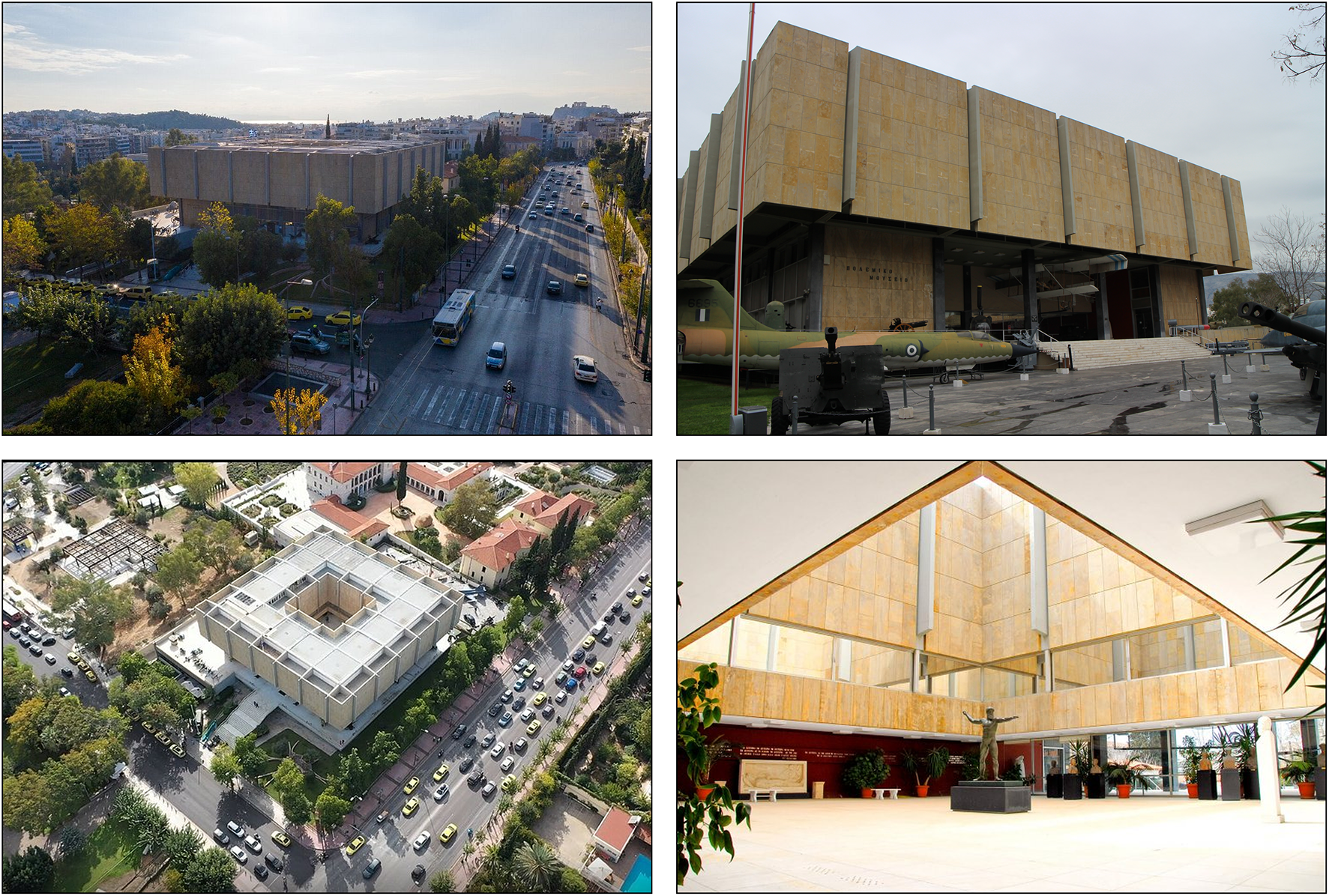
The internal museum folklore tells a different story. Archival correspondence shows the building was the product of a team led by architect Evangelos Apostolides, in consultation with the prominent architect Thoukydides Valentis.Footnote 17 Oral information transmitted by the museum’s own staff, recorded in an unpublished BA study and in my own notes, attributes the design to Valentis alone.Footnote 18 Within that same oral tradition, the architect himself had declared that the building was inspired by the explosion of the atomic bomb, its form evoking a cubic atomic mushroom (Figure 2).
The War Museum from different vantage points. The thin ground floor, the voluminous overhanging first floor and the atrium, as a hollow core, produce the silhouette that the institution’s own folklore reads as an atomic mushroom.

Figure 2. Long description
The figure consists of four panels arranged in a two-by-two grid.
* Top-left panel: An elevated wide-angle photo showing the museum in its urban context. The building is a large, tan, rectangular block situated next to a multi-lane city road with traffic. Green trees surround the base of the structure.
* Top-right panel: A low-angle street-level photo focusing on the museum’s cantilevered design. The heavy, windowless upper floor overhangs a recessed ground level. Military aircraft and artillery are displayed on the paved plaza beneath the overhang.
* Bottom-left panel: A high-angle aerial photo looking down at the museum. This view reveals the building’s square footprint and a large, square open-air atrium at its center. The surrounding landscape includes a dense grid of city streets and parked cars.
* Bottom-right panel: An interior photo from the central atrium looking upward. The space is a hollow core with tan stone walls. A bronze statue of a figure with outstretched arms stands on a pedestal in the center of the courtyard, framed by the geometric lines of the overhanging upper floors.
Read through a framework of cultural intimacy, this was an internal narrative the institution would never officially endorse but which staff offered privately, and which carried more affective weight than the official architectural defence on functional-modernist grounds.Footnote 19 While the chronological halls were silent on nuclear weapons, the Cold War and Greece’s place in the post-1945 atomic order, the building—in the institution’s own militarised folklore—supplied what the displays withheld: the totality of military violence was not exhibited but built, carried in the silhouette rather than narrated in the rooms.
3. The napalm bomb and the disruption of a latent no politica
While the exhibition logic excised the Civil War from its rooms, the staff folklore appended the atomic bomb, the point de départ of the Cold War, to its silhouette. The Junta founded a museum whose halls erased internal conflict and whose form, in the institution’s own retelling, became the emblem of the military Cold War. What the main displays cannot say, the building has been quietly assigned to mean. Within this context, a third site, an object the curated route could not absorb, sat outdoors in plain sight. In 2016, the bomb initially escaped my notice amid the routines of front-office duty, until a fellow conscript pointed in its direction. Only then did the napalm bomb emerge as a significant object within the courtyard display (Figure 3).Footnote 20 The conversations that followed, conducted during shifts and in the intervals between them, turned on what the object was doing there. An American-supplied weapon deployed in the most brutal stages of the Greek Civil War (1949), uncaptioned as such and standing outside the halls from which that war had been removed. It was in those exchanges that the courtyard first appeared as something other than an exhibition area for large-scale armament.
The napalm bomb, as exhibited in the courtyard of the Athens War Museum. Photographed in December 2016.

Such conversations were not typical. Of the conscripts serving at the museum during those eight months, only three of us had the disciplinary formation that made the object legible in these terms; the remainder passed the bomb daily without remarking on it, as did the visitors and the school groups whose route did not include the courtyard. The object’s capacity to sit in plain view depends on not being read, and the relocation of the Civil War from the halls to the courtyard works only so long as the weapon circulates as one exhibit among others. What the conscripted museologist registers is precisely the gap between what the object is and what it is taken to be.
Dropped by the Greek government against the remaining units of the Democratic Army in the mountains of Grammos and Vitsi when the outcome of the war had already been decided, it was a vessel communicating the values of the conflict’s victors. Against the main exhibition’s seeming no politica and national unity set against its avoidance of internal conflict in favour of the diachronic excellence of Greek military history, that object in the courtyard latently evoked what the displays, framed in their post-Junta neutrality, could not incorporate in plain sight. It was the ideology of the victors, encountered spontaneously, supposedly as an empty signifier, a weapon among the many in the courtyard.
The most comprehensive museological account of the Athens War Museum to date concentrates, by design, on the curated halls, drawing on the museum’s archive and the relevant minutes.Footnote 21 The present discussion takes up the courtyard as a complementary site: outside the curatorial sequence, and thus outside the archive that documents it, but central to what the museum visibly was on the ground.
Read ethnographically, the napalm bomb broke the no politica and the museological “strategy of exit” deployed by most Greek national museums when dealing with the difficult heritage that is the product of Greece’s modern history.Footnote 22 Here, silence and harmonisation were not the preferred response. The iconic symbol of the Greek Civil War and the Truman Doctrine sat in plain view, beyond the main museological narrative.Footnote 23
The main exhibition, as we have seen, was designed to start with antiquity and to end at the section on the Korean War (1950–1953). One year after the conclusion of the Civil War, Greek troops were sent to Korea explicitly as anti-communist signalling, in the immediate aftermath of the battles of Grammos.Footnote 24 Framed as a homogenising expedition of Greeks against an external enemy, Greece’s participation in the Korean War was in fact an offensive war undertaken in the wake of the bomb that had won the anti-communist war at home.
Read together, the main exhibition halls and the napalm bomb in the courtyard suggest that the strategy of exit is less a curatorial response than a curatorial misnomer. The Civil War was not so much withdrawn as relocated. Removed from the chronological sequence, where it would have demanded narration, the war was displayed without comment outdoors, where its weapon could circulate as one armament among many. If, as scholars have argued, the Junta that founded the museum was the Civil War’s terminal phase rather than its aftermath, then the courtyard was the site at which the museum’s logic admitted as much. The Athens War Museum can thus be read as one institutional afterlife of the Greek Civil War, a museum whose halls narrate the war’s victors’ history of themselves, whose silhouette has been narrated by interlocutors within as a symbol of total war and a Cold War icon, and whose courtyard quietly exhibited the US-supplied weapon with which the war at home was won.
4. Saroglos, or the room that does not fit
We return to the front/ticket office. To the left lay the Saroglos Room, the only collection acquired after the main exhibition’s structure had already been determined. It was the first room visitors encountered upon entering, yet it sat outside the chronological route—and, owing to spatial constraints (Figure 4), stood outside the itinerary of most school visits.
View of the Saroglos Room.

Figure 4. Long description
The photo shows a long, symmetrical museum hall with a white marble floor and a grid-patterned ceiling.
* Central Axis: A series of low, horizontal glass vitrines are aligned in the center of the room, receding into the distance. The closest vitrine in the foreground contains ornate silver or metallic boxes on a red velvet base.
* Left Side: A row of tall, vertical glass cabinets with dark wood frames. These cases are illuminated from within and display various bladed weapons, including curved sabers and swords mounted against dark red backdrops.
* Right Side: A mirroring row of tall glass cabinets. These contain a variety of firearms, including flintlock pistols and rifles, as well as additional swords arranged in fan-like patterns.
* Background: At the far end of the hall, a large horizontal display case spans the width of the wall, filled with numerous long-barreled rifles.
* Lighting and Ceiling: The ceiling features recessed circular vents and square panels with small spotlights. Green exit signs are visible hanging from the ceiling in the distance.
The collection is divided across two rooms, on the ground floor and in the basement, and presents the personal collection of Petros Saroglos (1864–1920), bequeathed to the Officers’ Club and transferred to the War Museum in 1973.Footnote 25 Even the museum’s own promotional self-description in the 1990s names the twelve chronological halls as the “spine” (épine dorsale) of the institution and the Saroglos collection as appended (s’y ajoutent).Footnote 26
The collection broke the three core values of the master narrative. Its holdings are predominantly non-Greek, drawn largely from Europe and Asia, although nineteenth-century weapons from the era of the Greek Revolution are also present. It is non-chronological, organised around the trajectory of one artillery officer’s collecting rather than the diachrony of the nation. And it is non-defensive, unrelated to the linear historical narrative of national historiography promoted by the Greek Army that frames every other section of the museum. In that sense, the Saroglos Room sits closer in spirit to the imperial arms collections of Western capitals than to the rest of the institution that houses it. Yet, displayed beyond the main curatorial sequence, it offers a breadth of original material to a museum otherwise structured around replicas that, as we saw earlier, were valued for their pedagogical purposes. The room containing the greatest concentration of original artefacts, in other words, is the one with the least to do with the national narrative it is housed within.
While the Saroglos Room was not favoured in the context of the school visits, which focused on the master exhibition, the 100-respondent survey I designed and conducted in 2016 (see Footnote note 4) yielded a contrary result: the room emerged as the most praised space across every visitor profile category. The contradiction is worth dwelling on. The museum’s most ideologically targeted audience, the schoolchildren whose national-historical formation the institution was designed to perform, were systematically routed around the room visitors most responded to. The room adult tourists most admired was the room Greek children were least likely to see.
The exclusion appeared to be the condition of the room’s affective power. Saroglos remained charged precisely because it had not been absorbed into the pedagogical script. What its visitors were responding to, however, was not the official narrative the rest of the museum performed but something older and more cosmopolitan: the spirit of nineteenth-century weapons collecting, of the gentleman-officer’s cabinet of arms drawn from across the colonial world. Saroglos contains the residue of a different practice of collection, closer to the universal-survey museum than to the national one, and it survives at the centre of an institution whose every other room operates on opposed principles.
5. Beyond the main itinerary: The conscript and the margins
Where the curator analyses the exhibition halls and the archival historian works through Board minutes, founding decrees and contemporary press, the “conscripted museologist,” positioned at the desk that everyone passed, recorded the routines and silences from a vantage rarely available to either. Habits, in the context of the Athens War Museum’s daily life in 2016, favoured visits to the master exhibition: the one-way, chronological circuit that left no way to read the nation backwards, sideways or against the narrative of unity excluding internal military conflicts. The school visits made this routing visible at its most condensed. The visitor body was moved through the halls in a single direction; the information was rigid, grade-matched to chronological period; the curriculum was rehearsed by conscripts on behalf of teachers who had withdrawn to the foyer. The army narrated the school’s history through the bodies of children walking a route the architecture itself prescribed.
Within this staging, the three margins analysed in the paper cracked the master narrative of national reconciliation and the no politica of avoiding internal conflict. The courtyard broke the narrative on the axis of politics: the napalm bomb exhibited the instrument of the National Army’s total victory in the Civil War, and with it the ideology of the war’s victors. The building’s silhouette broke it on the axis of iconography. The militarised folklore of the atomic mushroom names, internally, the Cold War the institution would not name in its halls. The Saroglos collection broke it on the axes of geography, chronology and form. Predominantly non-Greek, non-defensive and international in scope, it could not be confined within a curatorial logic that required its war exhibits to be national and linear. The paradox sharpens when one considers that among international visitors in my survey, the Saroglos Room was consistently named as the kind of display they would expect a war museum to be. The room the master narrative could not absorb is the room visitors recognised as the museum’s most legible military collection.
The three margins were produced by a single structural logic, the master narrative’s need to maintain a linear and chronological account of Greece’s history at war, excluding what would disturb it. For that reason, they were more telling of the museum’s identity and life than its curated centre, built to narrate through concealment. Reading the Athens War Museum from its paratextual edges, rather than through its curated sequence, is one way of recovering what the institution has been built to keep at the margin of view.
Acknowledgements
I would like to thank the three anonymous reviewers for their insightful feedback. I dedicate this article to the memory of Dr Mike Corbishley (1943–2025), who, at the time of my military service, supervised my MA thesis on the design of heritage educational programmes for Greek military conscripts–a project that remained on paper.
Conflict of interests
The author declares no competing interests.



 Open access

