INTRODUCTION
Heavy exposure to amphetamines has been associated with central nervous system (CNS) disturbances involving primarily dopamine (DA), but also serotonin, gamma-aminobutyric acid (GABA), and glutamate-dependent systems, leading to cerebrovascular (Citron, Halpern, McCarron, Lundberg, McCormick, & Pincus, Reference Citron, Halpern, McCarron, Lundberg, McCormick and Pincus1970; Rumbaugh, Bergeron, Scanlan, Teal, Segall, & Fang, Reference Rumbaugh, Bergeron, Scanlan, Teal, Segall and Fang1971) and neural pathology. Proposed processes for neurotoxicity include quinone formation, induction of transcription factors and oxidative stress, hyperthermia, and activation of neurochemical pathways implicated in neuronal apoptosis (Cadet, Jayanthi, & Deng, Reference Cadet, Jayanthi and Deng2003; Quinton & Yamamoto, Reference Quinton and Yamamoto2006). Methamphetamine (meth) use has become increasingly more prevalent throughout the United States and has been a commonly abused drug in Japan and other parts of Asia. Meth has been linked to abnormalities on brain imaging (Iyo, Namba, Yanagisawa, Hirai, Yui, & Fukui, Reference Iyo, Namba, Yanagisawa, Hirai, Yui and Fukui1997), decreased DA receptor and transporter densities (McCann, Wong, Yokoi, Villemagne, Dannals, & Ricaurte, Reference McCann, Wong, Yokoi, Villemagne, Dannals and Ricaurte1998; Sekine, Iyo, Ouchi, Matsunaga, Tsukada, & Okada, Reference Sekine, Iyo, Ouchi, Matsunaga, Tsukada and Okada2001; Volkow, Chang, Wang, Fowler, Ding, & Sedler, Reference Volkow, Chang, Wang, Fowler, Ding and Sedler2001), and neuropsychological (NP) deficits consistent with alterations in abilities subserved by frontostriatal systems (Kalechstein, Newton, & Green, Reference Kalechstein, Newton and Green2003; McKetin & Mattick, Reference McKetin and Mattick1997, Reference McKetin and Mattick1998; Rippeth, Heaton, Carey, Marcotte, Moore, & Gonzalez, Reference Rippeth, Heaton, Carey, Marcotte, Moore and Gonzalez2004; Sim, Simon, Domier, Richardson, Rawson, & Ling, Reference Sim, Simon, Domier, Richardson, Rawson and Ling2002; Volkow, Chang, Wang, Fowler, Leonido-Yee, & Franceschi, Reference Volkow, Chang, Wang, Fowler, Leonido-Yee and Franceschi2001). A recent meta-analysis by our group showed that meth dependence is most consistently associated with deficient executive functions, attention, information processing speed, episodic memory, verbal fluency, and motor skills (Scott, Woods, Matt, Meyer, Heaton, & Atkinson, Reference Scott, Woods, Matt, Meyer, Heaton and Atkinson2007).
In a cohort of abstinent meth-dependent subjects, our group found that meth use characteristics, such as lifetime exposure, chronicity of use, mode of delivery, etc, did not predict who was found to have cognitive impairment (Cherner, Heaton, Gonzalez, Rippeth, Carey, & Grant, Reference Cherner, Heaton, Gonzalez, Rippeth, Carey and Grant2002; Cherner, Suarez, Casey, Deiss, Letendre, & Marcotte, Reference Cherner, Suarez, Casey, Deiss, Letendre and Marcotte2010). The low predictive value of meth exposure parameters suggests that there are individual differences in vulnerability to meth-related neurocognitive deficits. Thus, the identification of factors that render some individuals vulnerable and others protected under conditions of similar drug exposure deserves investigation.
One such factor may be genetic differences in meth metabolism. The enzyme Cytochrome P450, family 2, subfamily D, polypeptide 6 (CYP2D6) is responsible for oxidative metabolism of several psychoactive substances, including methamphetamine (Lin, Di Stefano, Schmitz, Hsu, Ellis, & Lennard, Reference Lin, Di Stefano, Schmitz, Hsu, Ellis and Lennard1997; Wu, Otton, Inaba, Kalow, & Sellers, Reference Wu, Otton, Inaba, Kalow and Sellers1997). In humans, depending on urinary pH, approximately 30–50% of meth is excreted unchanged. Hydroxylation by CYP2D6 yields the most abundant metabolite: 4-hydroxymethamphetamine, both as sulfate and glucuronide conjugates. N-methylation by CYP2D6 yields amphetamine, which is further metabolized into 4-hydroxyamphetamine and its conjugates, norephedrine, phenylacetone, benzoic acid, and hippuric acid (Caldwell, Dring, & Williams, Reference Caldwell, Dring and Williams1972; Shima, Kamata, Katagi, & Tsuchihashi, Reference Shima, Kamata, Katagi and Tsuchihashi2006).
Variants of the CYP2D6 gene have been well characterized, with over 80 polymorphisms identified (Dorado, Berec, Caceres, Gonzales, Cobaleda, & Llerena, Reference Dorado, Berecz, Caceres, Gonzalez, Cobaleda and Llerena2005). These variants can make their carrier a “poor metabolizer” (PM) “intermediate metabolizer” (IM), or “extensive metabolizer” (EM). Ultra-rapid metabolizer (UM) phenotypes have also been described. Although research to date is not definitive, in humans some of these polymorphisms have been associated with motor neuron disease (Skvortsova, Slominskii, Shadrina, Levitskii, Levitskaia, & Alekhin, Reference Skvortsova, Slominskii, Shadrina, Levitskii, Levitskaia and Alekhin2006), tardive dyskinesia (de Leon, Susce, Pan, Koch, & Wedlund, Reference de Leon, Susce, Pan, Koch and Wedlund2005; Tiwari, Deshpande, Rao, Bhatia, Lerer, & Nimgaonkar, Reference Tiwari, Deshpande, Rao, Bhatia, Lerer and Nimgaonkar2005), and extrapyramidal symptoms in association with higher neuroleptic concentrations in plasma (Inada, Senoo, Iijima, Yamauchi, & Yagi, Reference Inada, Senoo, Iijima, Yamauchi and Yagi2003), as well as vulnerability to Parkinson’s disease (Singh, Khan, Shah, Shukla, Khaanna, & Parmar, Reference Singh, Khan, Shah, Shukla, Khanna and Parmar2008), each implicating effects on dopaminergic systems. Therefore, its role in methamphetamine metabolism and potential dopaminergic involvement makes CYP2D6 a candidate for explaining individual differences in susceptibility to meth exposure that are manifested as cognitive impairment.
CYP2D6 Phenotypes
CYP2D6 phenotyping is increasingly indicated clinically to determine optimal dosing of pharmaceutical agents that use this metabolic pathway. Alteration of alleles from the normal wild-type (EMs) fall into several categories: one amino acid change or deletion, frameshift, splicing defect, stop codon, insertion, and entire gene deletion (Gonzalez, Vilbois, Hardwick, McBride, Nebert, & Gelboin, Reference Gonzalez, Vilbois, Hardwick, McBride, Nebert and Gelboin1988; Gough, Miles, Spurr, Noss, Gaedigk, & Eichelbaum, Reference Gough, Miles, Spurr, Moss, Gaedigk and Eichelbaum1990; Kimura, Umeno, Skoda, Meyer, & Gonzalez, Reference Kimura, Umeno, Skoda, Meyer and Gonzalez1989; Marez, Legrand, Sabbagh, Guidice, Spire, & Lafitte, Reference Marez, Legrand, Sabbagh, Guidice, Spire and Lafitte1997). PMs have no active CYP2D6 alleles or only one that is partially active. As a result, they are at greater risk of drug-induced side effects due to diminished drug elimination. Approximately 5 to 14% of Caucasians are poor metabolizers. The four most common mutant alleles are CYP2D6*3, CYP2D6*4, CYP2D6*5, and CYP2D6*6 and account for 93–97% of the PM phenotypes in Caucasian populations. Individuals who are homozygous for PM alleles do not display CYP2D6 enzyme activity, nor do any of those who carry combinations of these inactive alleles (Sachse, Brockmoller, Bauer, & Roots, Reference Sachse, Brockmoller, Bauer and Roots1997). IMs have one active and one inactive CYP2D6 allele or two partially active alleles. Approximately 30% of Caucasians fall in the IM category (Raimundo, Fischer, Eichelbaum, Griese, Schwab, & Zanger, Reference Raimundo, Fischer, Eichelbaum, Griese, Schwab and Zanger2000). EMs correspond to the normal functional activity alleles, designated CYP2D6*1 and CYP2D6*2. Genotypes consistent with the EM phenotype include two active CYP2D6 alleles or one active and one partially active allele. This phenotype represents approximately 65 to 71% of Caucasians (Bradford, Reference Bradford2002). Ultra-rapid metabolizers have higher than normal rates of drug metabolism, and have three or more active alleles due to duplication or multi-duplication. Between 1 and 3% of Europeans fall in this category (Dahl, Johansson, Bertilsson, Ingelman-Sundberg, & Sjoqvist, Reference Dahl, Johansson, Bertilsson, Ingelman-Sundberg and Sjoqvist1995; Johansson, Lundqvist, Bertilsson, Dahl, Sjoqvist, & Ingelman-Sundberg, Reference Johansson, Lundqvist, Bertilsson, Dahl, Sjoqvist and Ingelman-Sundberg1993). Ethnic and racial differences in the prevalence (Aklillu, Herrlin, Gustafsson, Bertilsson, & Ingelman-Sundberg, Reference Aklillu, Herrlin, Gustafsson, Bertilsson and Ingelman-Sundberg2002; Aklillu, Persson, Bertilsson, Johansson, Rodrigues, & Ingelman-Sundberg, Reference Aklillu, Persson, Bertilsson, Johansson, Rodrigues and Ingelman-Sundberg1996; Bernal, Sinues, Johansson, McLellan, Wennerholm, & Dahl, Reference Bernal, Sinues, Johansson, McLellan, Wennerholm and Dahl1999; Cascorbi, Reference Cascorbi2003; Dahl, Yue, Roh, Johansson, Sawe, & Sjoqvist, Reference Dahl, Yue, Roh, Johansson, Sawe and Sjoqvist1995; Gaedigk, Bhathena, Ndjountche, Pearce, Abdel-Rahman, & Alander, Reference Gaedigk, Bhathena, Ndjountche, Pearce, Abdel-Rahman and Alander2005), and possibly functionality (Gaedigk, Bradford, Marcucci, & Leeder, Reference Gaedigk, Bradford, Marcucci and Leeder2002; Inada et al., Reference Inada, Senoo, Iijima, Yamauchi and Yagi2003) of specific alleles have been described in the literature. However, as the majority of the current study participants are of European Caucasian origin, we are limiting the description of population rates for the various phenotypes to those for that racial group.
In the present study, we set out to examine whether CYP2D6 phenotype is related to cognitive impairment among meth-dependent individuals. We hypothesized that those with PM phenotype would exhibit worse neuropsychological performance and greater likelihood of cognitive impairment than phenotypes corresponding to higher CYP2D6 activity because it was speculated that low or delayed clearance of meth would result in greater net exposure in poor metabolizers for the same actual amount consumed, compared with extensive metabolizers. To our knowledge, this is the first investigation of this relationship.
MATERIALS AND METHODS
Participants
We analyzed retrospective data and fluids collected on 52 study participants who were evaluated at the HIV Neurobehavioral Research Center (HNRC) in San Diego, California, USA, as part of a federally funded, institutionally approved project on neuroAIDS effects of methamphetamine. Subjects were selected from a larger sample to be free of HIV or hepatitis C infection, as well neurologic, metabolic, or psychiatric conditions that might confound interpretation of neuropsychological findings. All gave written informed consent to participate in accordance with our Institutional Review Board requirements. To be eligible for the parent study, participants had to meet lifetime criteria for meth dependence, with use within the previous 18 months. Other substance dependence, except alcohol or cannabis, within 5 years, or abuse within the past 12 months was an exclusion. Alcohol dependence within 12 months was also exclusionary. No restrictions were placed on cannabis use, given its high prevalence in this population and minimal long-term effects on neuropsychological function (Grant, Gonzalez, Carey, Natarajan, & Wolfson, Reference Grant, Gonzalez, Carey, Natarajan and Wolfson2003). Participants were requested to be abstinent for at least 10 days before testing and show negative urine toxicology for any nonprescribed substances except cannabis, as well as negative Breathalyzer test for alcohol on the day of NP testing.
Neurobehavioral and Drug Use Characterization
The methods of neurobehavioral and drug use characterization have been described elsewhere (Gonzalez, Rippeth, Carey, Heaton, Moore, & Schweinsburg, Reference Gonzalez, Rippeth, Carey, Heaton, Moore and Schweinsburg2004; Rippeth et al., Reference Rippeth, Heaton, Carey, Marcotte, Moore and Gonzalez2004). Briefly, participants were characterized as meth (and other substance) dependent based on DSM-IV criteria using a structured psychiatric interview (First, Spitzer, Gibbon, & Williams, Reference First, Spitzer, Gibbon and Williams1994; Robins, Wing, Wittchen, Helzer, Babor, & Burke, Reference Robins, Wing, Wittchen, Helzer, Babor and Burke1988). History of mood disorder, attention deficit/hyperactivity disorder, and antisocial personality disorder were also evaluated according to DSM-IV criteria. A detailed history of meth and other substance use was gathered with a semistructured instrument covering onset, quantity, frequency, duration, and route of drug use over the participant’s lifetime, previous 12 months, and previous 30 days. NP functioning was determined with a validated comprehensive battery of tests covering 7 ability domains (Learning, Memory, Attention/Working Memory, Verbal Fluency, Processing Speed, Abstraction/Problem Solving, and Motor Speed) with measures that have shown sensitivity to meth-related impairments. The specific tests in the battery are listed in the appendix. Raw scores were converted to demographically adjusted T-scores (M = 50, SD = 10), including adjustments for age, education, gender, and ethnicity as available for each test (Cherner, Suarez, Casey, Deiss, Letendre, & Marcotte, Reference Cherner, Suarez, Casey, Deiss, Letendre and Marcotte2007; Heaton, Miller, Taylor, & Grant, Reference Heaton, Miller, Taylor and Grant2004; Heaton, Taylor, & Manly, Reference Heaton, Taylor, Manly, Tulsky, Saklofske, Heaton, Cheline, Ivnik, Bornstein, Prifitera and Ledbetter2003). T-scores for each test were then converted into deficit scores based on half standard deviation (SD) increments, which reflect degree impairment by setting performances within the normal range at zero. The deficit scores range from 0 (T-score > 39; no impairment) to 5 (T-score < 20; severe impairment). The individual deficit scores were averaged to derive the Global Deficit Score (GDS), which reflects the number and the severity of deficits across the test battery (Carey, Woods, Gonzalez, Conover, Marcotte, & Grant, Reference Carey, Woods, Gonzalez, Conover, Marcotte and Grant2004; Heaton, Grant, Butters, White, Kirson, & Atkinson, Reference Heaton, Grant, Butters, White, Kirson and Atkinson1995). For example, a GSD of 0.5 corresponds to scoring –1 SD on half the tests in the battery. Domain-specific deficit scores were also derived by averaging tests within an area of functioning. This method of data reduction is useful in avoiding multiple comparisons, as would be the case when considering individual tests, and has shown robust relationships with documented brain injury (Moore, Masliah, Rippeth, Gonzalez, Carey, & Cherner, Reference Moore, Masliah, Rippeth, Gonzalez, Carey and Cherner2006). Finally, level of premorbid ability was estimated with the Reading subtest of the Wide Range Achievement Test-3.
Genotyping and Phenotyping
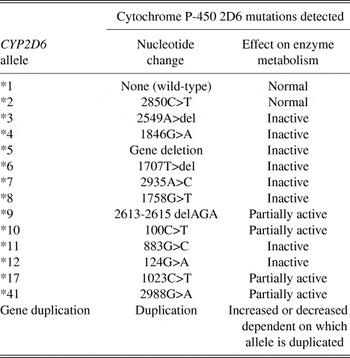
CYP2D6 phenotype characterization was performed by an accredited commercial laboratory (Genelex, Seattle, WA, CLIA No. 50D0980559), using their standard CYP2D6 mutation panel (Table 1). DNA was extracted from peripheral blood mononuclear cells that were stored at –70ºC, using a commercially available DNA extraction kit, QIAamp DNA Mini kit (Qiagen, Valencia, CA; Catalog #51185). Specimens were analyzed using the Tag-ItTM Mutation Detection System for P450-2D6, which detects 12 nucleotide variants and two gene rearrangements in a multiplex polymerase chain reaction and allele-specific primer extension format. This method identifies 93–97% of PM phenotypes. Genelex provided the genotype, as well as the interpreted phenotype for each participant (see Appendix).
Details of cytochrome P450-2D6 genetic analysis

Statistical Analyses
Group differences in NP domain performance were analyzed with Wilcoxon Rank Sum tests, given the non-normal distribution of the variables. As individual NP test data were reduced by combining into ability domains, and given the exploratory nature of the study, we did not make experiment-wise adjustments for multiple comparisons. Other continuous variables were analyzed with Student’s t tests. Group differences in the proportions of NP impaired participants and discrete background variables were analyzed using Fisher’s exact tests and χ2 tests. Nonparametric correlations were computed between CYP2D6 activity and NP performance.
RESULTS
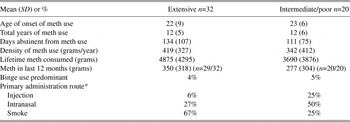
Analyses yielded genotypes consistent with three meth metabolism phenotypes: EM (n = 32), IM (n = 17), and PM (n = 3). Given the small sample sizes and preliminary nature of the study, the IM and PM groups were combined for analyses. There were no significant differences in meth use characteristics between the groups (Table 2), with the exception of primary route of administration: The most prevalent mode among EMs was smoking, whereas the IM/PM group more often reported intranasal administration. Additionally, the IM/PM group had a greater proportion of injection users. Values for the PM group alone were comparable to those of the IM group alone, and results were essentially unchanged when PMs were excluded from analyses.
Methamphetamine use parameters by cytochrome P450-2D6 metabolic phenotype

* Overall Chi Square p < .05.
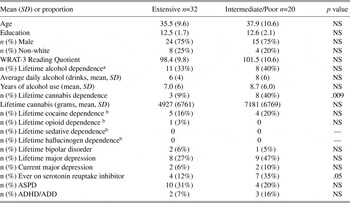
The EM and combined IM/PM groups were comparable with respect to demographic characteristics and estimated premorbid cognitive ability (Table 3).
Participant characteristics by cytochrome P450-2D6 metabolic phenotype

a Greater than 12 months prior to assessment.
b Greater than 5 years prior to assessment and episodic in nature.
ASPD = antisocial personality disorder; ADHD/ADD = attention deficit disorder with/without hyperactivity; SSRI = Selective serotonin reuptake inhibitor; WRAT-3 = Wide-Range Achievement Test-3, estimate of premorbid ability; NS = not significant.
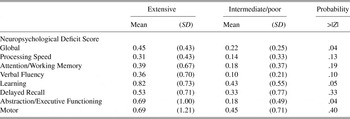
Contrary to the initial hypothesis, EMs showed significantly worse overall NP performance, including significantly poorer scores in the areas of processing speed, abstraction/executive functioning, and learning (Table 4).
Global and domain-specific neuropsychological performance by cytochrome P450-2D6 phenotype

Note
Where differences are present, extensive metabolizers show worse performance.
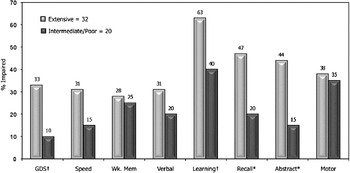
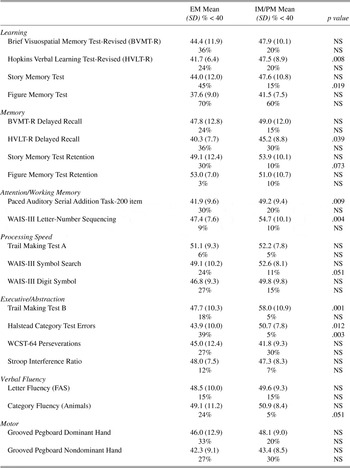
EMs were also more likely to obtain scores in the impaired range of cognitive functioning (Figure 1) compared with the combined IM/PM group, with significant differences in abstraction/executive functioning, and delayed recall, as well as trend level differences in learning, and global functioning. Although several of the comparisons did not reach statistical significance (which may be attributable to low power from small sample sizes), there was a consistent trend in the same direction in all domains, both in terms of level of performance, as well as proportion of subjects performing in the impaired range. Individual test T-scores and the proportion of participants in each group that performed at least one standard deviation below the mean appear in Table 5. In every case where statistically significant differences were detected, EMs showed worse performance.
Proportion of subjects performing within the impaired range of global and domain specific neuropsychological performance. Extensive metabolizers tend to have a greater likelihood of neuropsychological impairment than intermediate/poor metabolizers. *p < .02 †p < .10. GDS = Global Deficit Score; Speed = Speed of information processing; Att/Wk. Mem = Attention/working memory; Verbal = Verbal fluency; Abstr = Abstraction/problem-solving/executive functioning.

Demographically adjusted T-scores for neuropsychological tests and proportion performing within the impaired range (T-score < 40) in each group

EM = Extensive metabolizer; IM/PM = Intermediate/poor metabolizer; NS = not significant; WAIS III = Wechsler Adult Intelligence Scale-III; WCST-64 = Wisconsin Card Sorting Test 64-item computerized version.
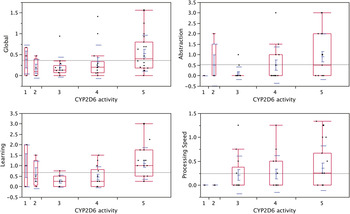
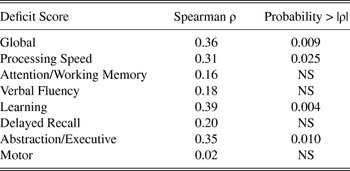
As a post hoc exploratory analysis, we also investigated the strength of the relationship between participants’ neuropsychological performance and their theoretical metabolic activity based on the combination of active, partially active, or inactive alleles present in their genotype. We recognize that this approach is speculative given the absence of data on the subjects’ actual metabolic activity, but we believed that this exploration could be fruitful in corroborating our general finding that higher metabolic activity is associated with worse NP outcome. To this end, we used the data generated by Zanger, Raimundo, and Eichelbaum (Reference Zanger, Raimundo and Eichelbaum2004) to rank-order metabolic activity from lowest to highest (1 to 5), as follows: 1 = two non-functional alleles; 2 = one decreased function and one non-functional allele; 3 = one normal function and one non-functional allele, or two decreased function alleles; 4 = one normal function and one decreased function allele; 5 = two normal function alleles. The appendix shows the number of participants with the various genotypes, corresponding phenotypes, and metabolic activity ranks. As shown in Table 6, and illustrated in Figure 2, higher purported metabolic activity was associated with worse cognitive functioning overall and in the areas of processing speed, learning, and abstraction/executive functioning.
Examples of the relationship between cytochrome P450-D6 (CYP2D6) activity and neurocognitive performance. The panel on the upper left shows increasing global impairment (GDS) with increasing CYP2D6 activity. The remaining panels show a similar relationship in learning, abstraction, processing speed.

Non-parametric correlations between neuropsychological deficit Scores and CYP2D6 metabolic activity based on combination of alleles coded ordinally between 1 and 5

Note
Positive correlations indicate that higher metabolic activity is related to greater neurocognitive deficit. NS = not statistically significant.
Because the IM/PM group had a greater prevalence of lifetime cannabis dependence, as well as somewhat greater lifetime exposure (not statistically significant), we explored the possible effects of cannabis on cognitive performance. In addition, we modeled the effects of meth exposure, given that EMs tended to have consumed greater amounts over their lifetime (again, not statistically significant). In linear regressions with phenotype, lifetime grams of meth consumption, and lifetime grams of marijuana consumption, only phenotype was a significant predictor of the global deficit score (t = 2.05; p < .05).
DISCUSSION
To our knowledge, this study is the first to suggest differences in vulnerability to methamphetamine-associated brain dysfunction linked to CYP2D6 genotype in human users. The finding that the genotype associated with high metabolic activity is related to poorer cognitive performance was not expected, but it is consistent with the possibility that the metabolic products of methamphetamine oxidation may be a greater source of neurotoxicity than the parent compound. In fact, this has been demonstrated in vitro, where the metabolite 4-hydroxymethamphetamine showed significantly more cytotoxicity than unmetabolized meth (Clement, Behrens, Moller, & Cashman, Reference Clement, Behrens, Moller and Cashman2000). In cultures exposed to other substituted amphetamines typically sold as “ecstasy” (methylenedioxy-methamphetamine: MDMA, methylthioamphetamine: MTA), cells expressing the active form of CYP2D6 showed significantly greater toxicity than cells with less active forms or those devoid of CYP2D6 activity. In these studies, toxicity was dependent on the formation of the oxidative metabolite N-methyl-α-methyldopamine, which was found to be 100-fold more cytotoxic than the parent substance (Carmo, Brulport, Hermes, Oesch, de Boer, & Remiao, Reference Carmo, Brulport, Hermes, Oesch, de Boer and Remiao2007; Carmo, Brulport, Hermes, Oesch, Silva, & Ferreira, Reference Carmo, Brulport, Hermes, Oesch, Silva and Ferreira2006). Furthermore, it has been demonstrated that stimulation of the P450 system in mice not only potentiates metabolism of MDMA but also increases the magnitude of neurotoxicity that can be observed (Monks, Jones, Bai, & Lau, Reference Monks, Jones, Bai and Lau2004). These findings are discordant with results derived from an investigation of Dark Agouti rats, in which the females, considered a model for PM phenotype, exhibited greater acute MDMA-induced toxicity than males (Colado, Williams, & Green, Reference Colado, Williams and Green1995), and similarly in PM rats exposed neonatally to meth (Vorhees, Morford, Inman, Reed, Schilling, & Cappon, Reference Vorhees, Morford, Inman, Reed, Schilling and Cappon1999f). However, translation of CYP2D6 neurotoxicity findings from animals to humans has been criticized (de la Torre & Farre, Reference de la Torre and Farre2004) as a result of evidence linking metabolism of amphetamines in rats to CYP2D1, which, while homologous to human CYP2D6, may be functionally different (Kobayashi, Murray, Watson, Sesardic, Davies, & Boobis, Reference Kobayashi, Murray, Watson, Sesardic, Davies and Boobis1989). Additionally, significant inter-species differences have been described in the proportion of the various metabolites that are excreted in urine (Caldwell, Dring, Franklin, Koster, Smith, & Williams, Reference Caldwell, Dring, Franklin, Koster, Smith and Williams1977; Dring, Smith, & Williams, Reference Dring, Smith and Williams1970; Shima et al., Reference Shima, Kamata, Katagi and Tsuchihashi2006). Thus, extrapolation of neurotoxicity findings involving the P450 system from animals to humans must be done cautiously. While no studies, to our knowledge, have investigated links between amphetamine metabolite concentrations and neurotoxicity in humans, it has been demonstrated that EM have greater urinary excretion of the hydroxy metabolite, followed by IM, and then by PM (Miranda, Sordo, Salazar, Contreras, Bautista, & Rojas Garcia, Reference Miranda, Sordo, Salazar, Contreras, Bautista and Rojas Garcia2007).
Although our findings are intriguing, several limitations must be considered. First, the small sample size makes our results preliminary. For instance, because our sample only included three truly poor metabolizers, we were not able to test whether there is a “U” shaped function in CYP2D6 effects on meth-related neurocognition. It could be that extensive metabolism is deleterious because it results in the formation of large quantities of toxic metabolites, while complete lack of CYP2D6 activity could also be harmful because there is delayed clearance of the parent compound. Additionally, while meth consumption differences were not statistically significant, there tended to be a stair step increase in density of use (grams/year) with increasing metabolic efficiency. This raises the possibility that, although meth exposure was not related to NP deficits in these and previous analyses (Cherner et al., Reference Cherner, Suarez, Casey, Deiss, Letendre and Marcotte2010), EMs evidence more impairment because they are indeed consuming larger amounts of meth. Future studies with larger samples will be required to address these possibilities with confidence.
Second, the lack of a drug-free control group precludes testing the possibility that CYP2D6 genotype affects neurocognitive performance independently of meth use, for example, through some developmental effect. While it cannot be ruled out, there is no clear a priori reason to suspect such an effect, particularly because the EM phenotype is the most commonly occurring. Using our methods for determining cognitive impairment, which are based on the normal distribution of test performance, we would expect approximately 16% of a healthy normal population to perform in the impaired range (i.e., 1 SD below the mean). If the affected phenotype were the more rare poor metabolizers then we could not rule out that those members of a normative sample performing below 1 SD did so because of an underlying genotype effect alone (i.e., in the absence of methamphetamine). However, between 65 and 70% of a Caucasian normative population would be expected to be extensive metabolizers. Thus, the norms that we use to interpret test performance ought to already reflect an underlying effect of genotype, given that EM would compose a majority of the normative sample. Nevertheless, future studies would benefit from including a control group to increase confidence in the findings.
Third, although several possible confounders of neuropsychological effects were controlled by use of demographic adjustments and careful exclusion criteria, factors that could potentially affect meth pharmacokinetics or pharmacodynamics, such as tobacco, herbal supplement, and prescription and non-prescription drug consumption, as well as diet (Wijnen, Op den Buijsch, Drent, Kuipers, Neef, & Bast, Reference Wijnen, Op den Buijsch, Drent, Kuipers, Neef and Bast2007) were not accounted for. These extrinsic factors may significantly affect the absorption, distribution, metabolism, and/or excretion of meth and thus should be examined in future work. For example, there was a higher proportion of lifetime depression in the IM/PM group, with an accompanying higher lifetime prevalence of serotonin reuptake inhibitor (SSRI) use. Because most SSRIs are substrates and inhibitors of CYP2D6, it would be important to determine the effects of concomitant meth and SSRI use, as this would presumably result in lower formation of meth metabolites. We unfortunately did not have the information required for this type of analysis but hope to tackle this question in future work.
Along the same lines, no study to our knowledge has examined how chronic exposure to meth may affect CYP2D6 metabolic activity. Although we have found that chronicity of meth use does not appear to predict cognitive impairment (Cherner et al., Reference Cherner, Heaton, Gonzalez, Rippeth, Carey and Grant2002, Reference Cherner, Suarez, Casey, Deiss, Letendre and Marcotte2010), it is possible that chronic exposure to meth may alter metabolic activity and consequently our findings may not apply to the current literature, which has focused on acute exposure.
One factor on which the groups differed was history of cannabis dependence, with a greater prevalence among IMs/PMs (although 100% of study participants reported lifetime use). It is possible that cannabis conferred a protective effect on neurocognition. At least one study has shown that among meth-dependent subjects, those with coexisting marijuana dependence had somewhat better neuropsychological performance (Gonzalez et al., Reference Gonzalez, Rippeth, Carey, Heaton, Moore and Schweinsburg2004). While further research will be needed to elucidate the effects of concurrent or historic cannabis exposure, analyses in our sample did not show evidence relating lifetime amount of cannabis consumed to global neurocognitive performance.
Another difference between groups that should be noted was route of meth administration. Although no study to our knowledge has examined the effect that different routes of administration may have on meth metabolism, recent work (Hendrickson et al., 2008) with pigeons suggests that administration of meth either intramuscularly or intravenously does not affect metabolism. Nevertheless, route of administration should be examined in future investigations, given that it results in differences in bioavailability.
Additionally, in this retrospective study of abstinent users, we were unable to test actual metabolic rates or metabolite concentrations. Such information would be useful to substantiate our hypothesis that meth metabolites are responsible for the neuropsychological manifestations observed. Finally, as individuals of Asian and African descent have a higher percentage (40–50%) of reduced function and non-functional CYP2D6 compared with Caucasians (25–30%) (Bradford, Reference Bradford2002), generalization of these results to other racial/ethnic groups is not possible at this time.
These limitations notwithstanding, the current study found clear differences in neurocognitive impairment in meth-dependent adults in relation to their CYP2D6 genotype and corresponding phenotype. While preliminary, our findings suggest differential vulnerability to meth-induced neurocognitive impairment in extensive metabolizers, specifically in learning, delayed recall, and executive ability domains, as well as overall global functioning. This differentiation was further demonstrated for these domains, along with performance in processing speed, during post hoc analysis using a linear measure of hypothetical metabolism. We also observed similar differential vulnerability at the trend level for the remaining ability domains, including attention/working memory, verbal fluency, and motor speed. Failure to find a significant association in these latter ability domains may be a consequence of the small sample size and limited power to detect significant differences. Again, further research with larger sample sizes will be required to determine whether a Type II error was committed.
If replicated, our findings may be of particular importance in guiding future development in the early identification of vulnerability to and prevention of neurocognitive impairment among meth-dependent individuals. Given the relatively high prevalence of extensive metabolizers in the general population and their putative vulnerability to meth-related neurocognitive dysfunction, there is potential public health impact in interventions to address brain injury in meth users. To date, several CYP2D6 inhibitors have been identified, including sertraline, fluoxetine, paroxetine, quinidine and ticlopidine (Hemeryck & Belpaire, Reference Hemeryck and Belpaire2002). Studies have investigated the efficacy of sertraline (Shoptaw, Huber, Peck, Yang, Liu, & Jeff, Reference Shoptaw, Huber, Peck, Yang, Liu and Jeff2006), fluoxetine (Batki, Moon, Bradley, Hersh, Smolar, & Mengis, Reference Batki, Moon, Bradley, Hersh, Smolar and Mengis1999), and paroxetine (Piasecki, Steinagel, Thienhaus, & Kohlenberg, Reference Piasecki, Steinagel, Thienhaus and Kohlenberg2002) on reduction of meth use, albeit with no significant effect. Thus, even though CYP2D6 inhibitors may not be efficacious for reducing meth use, future work might examine their influence on neurocognitive functioning.
Finally, future studies seeking to investigate or replicate relationships between meth use and indicators of brain disturbance may benefit from understanding the phenotypic makeup of their study groups to help interpret their findings as well as discrepancies among studies.
DISCLOSURE/CONFLICTS OF INTEREST
The authors declare that this work was funded entirely by NIH grants P01-DA12065 and P30-MH62512. The authors declare that, except for income received from their primary employer, no financial support or compensation has been received from any individual or corporate entity over the past 3 years for research or professional service and there are no personal financial holdings that could be perceived as constituting a potential conflict of interest for Mariana Cherner, Chad Bousman, Daniel Barron, Florin Vaida, Robert Heaton, Ian Everall, and Igor Grant. The authors declare that, over the past 3 years, J. Hampton Atkinson has received compensation from Eli Lilly Pharmaceuticals; Scott Letendre is an advisor for Abbott Labs, GlaxoSmithKline, and Schering-Plough, has given CME accredited talks funded by Abbott Labs and GlaxoSmithKline, and has received research funding from GlaxoSmithKline, Schering-Plough, Merk, Tibotec, and Gilead Sciences.
ACKNOWLEDGMENTS
This manuscript has never been published either electronically or in print. Portions of the information contained in the manuscript have been previously presented at the International Neuropsychological Society Mid-Year Meeting, July 2008, Buenos Aires, Argentina and the XVth World Congress on Psychiatric Genetics, Oct 2008, Osaka, Japan. The authors wish to acknowledge support from the United States National Institutes of Health (grant numbers R03-DA27513, P01-DA12065, and P30-MH62512) and the contributions of study participants and staff at the HIV Neurobehavioral Research Center (HNRC) and Translational Methamphetamine AIDS Research Center, San Diego, CA, USA.
The HNRC Group is affiliated with the University of California, San Diego, the Naval Hospital, San Diego, and the Veterans Affairs San Diego Healthcare System, and includes: Director: Igor Grant, M.D.; Co-Directors: J. Hampton Atkinson, M.D., Ronald J. Ellis, M.D., Ph.D., and J. Allen McCutchan, M.D.; Center Manager: Thomas D. Marcotte, Ph.D.; Assistant Center Manager: Jennifer Marquie-Beck; Business Manager: Melanie Sherman; Naval Hospital San Diego: Braden R. Hale, M.D., M.P.H. (P.I.); Neuromedical Component: Ronald J. Ellis, M.D., Ph.D. (P.I.), J. Allen McCutchan, M.D., Scott Letendre, M.D., Edmund Capparelli, Pharm.D., Rachel Schrier, Ph.D.; Terry Alexander, R.N.; Neurobehavioral Component: Robert K. Heaton, Ph.D. (P.I.), Mariana Cherner, Ph.D., Steven Paul Woods, Psy.D., David J. Moore, Ph.D.; Matthew Dawson, Donald Franklin; Neuroimaging Component: Terry Jernigan, Ph.D. (P.I.), Christine Fennema-Notestine, Ph.D., Sarah L. Archibald, M.A., Marc Jacobson, Ph.D., Jacopo Annese, Ph.D., Michael J. Taylor, Ph.D.; Neurobiology Component: Eliezer Masliah, M.D. (P.I.), Ian Everall, FRCPsych., FRCPath., Ph.D., Cristian Achim, M.D., Ph.D.; Neurovirology Component: Douglas Richman, M.D., (P.I.), David M. Smith, M.D.; International Component: J. Allen McCutchan, M.D., (P.I.); Developmental Component: Cristian Achim, MD, Ph.D. (P.I.), Stuart Lipton, M.D., Ph.D.; Clinical Trials Component: J. Allen McCutchan, M.D., J. Hampton Atkinson, M.D., Ronald J. Ellis, M.D., Ph.D., Scott Letendre, M.D.; Participant Accrual and Retention Unit: J. Hampton Atkinson, M.D. (P.I.), Rodney von Jaeger, M.P.H.; Data Management Unit: Anthony C. Gamst, Ph.D. (P.I.), Clint Cushman (Data Systems Manager); Statistics Unit: Ian Abramson, Ph.D. (P.I.), Florin Vaida, Ph.D., Tanya Wolfson, MS, Reena Deutsch, Ph.D.
The views expressed in this article are those of the authors and do not reflect the official policy or position of the Department of the Navy, Department of Defense, nor the United States Government.
APPENDIX
Cytochrome P450-2D6 genotype, phenotype, and rank-ordered hypothetical metabolic activity level for study cases
Metabolic activity was assigned as follows, based on data from Zanger et al (Reference Zanger, Raimundo and Eichelbaum2004):
5: two normal function alleles
4: one normal function and one decreased function allele
3: one normal function and one non-functional allele, or two decreased function alleles
2: one decreased function and one non-functional allele
1: two non-functional alleles
Normal Function Alleles: *1, *2, *33, *35
Decreased Function Alleles: *9, *10, *17, *36, *41
Increased Function Alleles: *1xN, *2xN, *35xN
Non-Functional Alleles: *3, *4, *5, *6, *7, *8, *11, *12, *13, *14, *15, *16, *18, *19, *20, *21, *38, *40, *42

Note
EM = extensive metabolizer; IM = intermediate metabolizer; PM = poor metabolizer.