Understanding the macroeconomic effects of democratization is an important enterprise for students of comparative politics and political economy, yet more than 30 years of research on this relationship has not yielded even a basic consensus. Numerous studies report a positive effect (Feng Reference Feng1997; Rodrik Reference Rodrik1999; Heo and Tan Reference Heo and Tan2001; Baum and Lake Reference Baum and Lake2003; Fidrmuc Reference Fidrmuc2003; Rodrik, Subramanian and Trebbi Reference Rodrik, Subramanian and Trebbi2004; Gerring, Thacker and Moreno Reference Gerring, Thacker and Moreno2005; Hausmann, Pritchett and Rodrik Reference Hausmann, Pritchett and Rodrik2005; Rodrik and Wacziarg Reference Rodrik and Wacziarg2005; Papaioannou and Siourounis Reference Papaioannou and Siourounis2008; Acemoglu et al. Reference Acemoglu, Naidu, Restrepo and Robinson2014); others argue that it is negative (Przeworski and Limongi Reference Przeworski, Alvarez, Cheibub and Limongi1993; Barro Reference Barro1996; Tavares and Wacziarg Reference Tavares and Wacziarg2001; Glaeser et al. Reference Glaeser, La Porta, Lopez-de-Silanes and Shleifer2004); and still others suggest there is no association between democratic reform and aggregate economic performance (Acemoglu et al. Reference Acemoglu, Johnson, Robinson and Yared2008). Similar disagreement is evident in studies of democratic reform in Sub-Saharan Africa, the region on which our analysis focuses (Feng Reference Feng1996; Minier Reference Minier1998; Bates Reference Bates2006; Fosu, Bates and Hoeffler Reference Fosu2006; Fosu Reference Fosu, Bates and Hoeffler2008; Bates, Fayad and Hoeffler Reference Bates, Fayad and Hoeffler2012).
We contribute to this empirical debate by addressing two methodological shortcomings in the field. First, we relax the strong identification assumptions associated with the panel-data regression methods most researchers employ. Specifically, we circumvent the need to define a causal model of economic output, opting instead for an approach that requires only a predictive one. Second, instead of focusing on a single economic effect of democratic transitions, we allow this effect to vary by country. We accomplish both inferential tasks using the synthetic control method, due to Abadie and Gardeazabal (Reference Abadie and Gardeazabal2003) and Abadie, Diamond and Hainmueller (Reference Abadie, Diamond and Hainmueller2010), which enables us to compare the individual economic performances of reformed states to their unique counterfactual economic outputs absent these changes. In addition, these individual counterfactuals are constructed in a manner that, under reasonably weak and readily verifiable conditions, eliminates cross-sectional and time-varying confounds.
To demonstrate the virtues of the synthetic control method, we first use it to conduct a focused inquiry into Mali’s democratic transition. We show that in this context, reform increased per capita gross domestic product (GDP) by an amount substantially different from what either a simple cross-country comparison or regression suggests. We then apply the method to a sample of 28 Sub-Saharan African states, 19 of which remained autocratic throughout the sample period (1975–2008) and nine of which experienced democratic reform in the 1980s and 1990s. The country-specific effects we draw from this analysis exhibit heterogeneity in sign and magnitude reflective of the dissensus in the literature. In four cases, we find that the introduction of multi-party elections had a negligible or negative influence. In Zambia, the most extreme country of this type, annual GDP per capita was reduced by an average of 19 percent between 1992 and 2008. An additional five countries showed positive effects. Among these, Mali demonstrated the greatest returns, equivalent to a 42 percent average annual increase in per capita output.
While our study cannot thoroughly interrogate the mechanisms underlying this heterogeneity, we do examine whether it is explained by factors that, according to current theory, moderate democratization’s economic effect. The factors on which we focus are the type of democracy created by reform, foreign pressure for democratization, pre-reform income inequality, and the sequencing of economic and political liberalization. This analysis, while merely exploratory, suggests that only the fourth condition is a relevant moderating variable. We find that democratic reform was most likely to increase economic output in countries where economic liberalization was already underway.
Overall, this study makes two main contributions. First, it demonstrates the utility of the synthetic control method in uncovering country-specific economic effects of democratic transitions in Sub-Saharan Africa. This method generates estimates that are causally identified under conditions more plausible and more transparent than those associated with the standard suite of panel-data methods. Our second contribution is to the empirical debate over the national economic effects of democratization. We find that that in Sub-Saharan Africa, this relationship is not uniform but rather varies tremendously, ranging from large annual losses to even larger annual gains and including most values in-between. Our results consequently break both empirical and methodological ground in the study of democratization and economic outcomes.
Research Design
Weaknesses in Current Panel-Data Methods
Identifying the effect of democratic governance structures on economic output is an extremely difficult statistical task. Perhaps the most common technique used to tackle the issue is country-fixed effect panel regression. Although this procedure controls for unobserved time-invariant confounders, it does not yield an identified effect of a discrete shift to democratic governance unless the researcher selects and correctly models all time-variant determinants of national economic output that are also causally related to democratic governance. Given the vast number of candidate covariates and specifications, this appears all but impossible. For example, in their review of the existing empirical literature on economic output, Durlauf, Johnson and Temple (Reference Durlauf, Johnson and Temple2005) find support for no fewer than 43 different classes of determinants.
A closely related approach, difference-in-differences estimation, is similarly hampered. Causal identification in this framework requires juxtaposed democratizing and non-democratizing states to exhibit extended parallel trends in their economic output before reform takes place. Such trends are rarely observed in country-level economic data and seldom reported in analyses that employ difference-in-differences estimation.Footnote 1 Much of the work on the economic effects of democracy that leverages this technique consequently cannot be defended against the charge that it is biased by time-variant confounders.
Instrumental variable (IV) regression represents another identification strategy used in the literature. In this method, the variable that defines a country’s status as a democracy is instrumented for with a variable that predicts this status but is uncorrelated with unobserved determinants of economic output (Angrist, Imbens and Rubin Reference Angrist and Krueger1996). While many variables meet the first of these two criteria, the second is neither easily satisfied nor formally provable in observational data. It is therefore incumbent on researchers using IV methods to present a strong argument for their instrument’s ignorability and excludability using context, theory, or other means. In our reading of the literature, we see few if any instruments satisfactorily buttressed by such justifications.Footnote 2
A second major empirical shortcoming in this literature is its poor accommodation of possible heterogeneous effects of democratization. Almost all extant work assumes a uniform economic impact despite the fact that the process of political liberalization often takes very different forms and occurs in diverse national settings. Even in the condensed time period and single geographic region we consider in this paper, the course of events that culminated in reform varied greatly in the degree of attendant popular agitation, the process by which a new constitution was brought into force, and the types of legislative institutions ultimately selected. Generally speaking, scant effort has been made to explore the possibility that treatment effects vary across countries according to these or other dimensions.Footnote 3 By contrast, the synthetic control method we use is catered specifically to uncovering this variation as it separately estimates effects for each instance of democratic reform under unique identification conditions for each case. What is more, as the following section describes, these identification assumptions are more plausible and generally more examinable than those associated with fixed effects, difference-in-differences, or IV regression.
The Synthetic Control Method
If conventional statistical approaches are poorly suited to studying the relationship between democratization and economic output, how best to proceed? The synthetic control method offers an appealing alternative because it combines within a single procedure the attractive inferential aspects of both regression and comparative case studies. In contrast to standard statistical approaches, which implicitly assume that all untreated units are equally useful in estimating each treated unit’s outcome under control, the synthetic control method generates unique counterfactual observations for each treated unit using different weighted combinations of control cases. What is more, the weights that define these synthetic control observations are selected using an explicit optimization routine. In this sense, the method is also more transparent than small-n comparative case study methods, which typically leave the choice of comparison cases to researchers’ discretion. In what follows we provide an intuitive description of the synthetic control approach and outline the assumptions that must be satisfied for the effects it uncovers to be causally identified. A more detailed explication of the mechanics and identification assumptions can be found in the study by Abadie, Diamond and Hainmueller (Reference Abadie, Diamond and Hainmueller2010).
We begin by choosing a population within which to evaluate our outcome of interest, GDP per capita, and partitioning this population into treated units and control units.Footnote 4 The treated units are those about which we will be drawing inferences and the control units are those that will enable us to make these inferences. In this paper, we focus on Sub-Saharan Africa and define treatment as instances of democratization that took place in the late 1980s and early 1990s.Footnote 5 This creates a set of J-treated cases that underwent democratic reform and a complementary set of K control cases that did not. Among the treated units, treatment varies across time periods t=1, …, T. Thus, for each treated unit j=1, …, J, there is a unique pre-treatment period 1≤ t<T j , 0, a one-time treatment event at time T j,0, and a post-treatment period T j,0<t≤T.
The statistical analysis we conduct centers on a relatively simple model of per capita economic output with two important deviations from common econometric practice. First, this model is strictly predictive; we do not draw any causal inferences from it directly. Our specification is therefore tailored to maximize model fit in the pre-treatment period, rather than to satisfy any assumptions about the conditional distribution of errors. Second, because we aim to estimate a unique effect of democratization for each state in the treatment group, we do not estimate this model using our entire population of cases. We instead fit J potentially unique models to J different samples, each of which consists of a single state j that democratized, and the entire set of K consistently autocratic control units.
It is from these models we build our synthetic control cases. The information each provides about the covariates that are most predictive of pre-treatment per capita output in a given country j permits us to measure which non-democracies are most similar to j on these important dimensions. These measures in turn are translated to a K-length vector of weights, w j , in which relatively comparable control units are assigned a higher weight than less comparable ones. The synthetic counterfactual for country j is then calculated, using w j , as the weighted average of all control units. By construction, this synthetic hybrid country mirrors not just j’s per capita output in the pre-treatment period, but also predictive covariate values, and, crucially, unobserved unit-specific time-varying confounders. A per capita income effect of democratization can thus be obtained simply by comparing the treated country’s actual GDP per capita in the post-treatment period to the projected output of its particular synthetic counterfactual in that same period.
An intuitive understanding of the conditions under which this estimate represents an identified causal effect of democratization on output can be gleaned by comparing the synthetic control method to the difference-in-differences approach. Application of the latter for the purpose of causal inference requires one to define the outcome of interest as a linear combination of time-varying observable, and time-invariant unobservable factors. Further, unobserved time-varying factors must have no simultaneous influence on the outcome of interest and treatment assignment. If the true data-generating process is of this form, it is possible to use first differences across time to cancel out all unobserved confounders. After conditioning on the relevant observable confounders, a simple post-treatment difference-in-means returns an identified estimate of the treatment effect.
The synthetic control procedure is similar to difference-in-differences estimation in that it too involves a simple comparison of treated and control units’ outcome levels after treatment assignment. However, because the statistical model on which it is premised accommodates both time-variant and time-invariant unobservables, one cannot subtract off all confounders by taking first differences. Abadie, Diamond and Hainmueller (Reference Abadie, Diamond and Hainmueller2010) show that causal identification is instead achieved where the true model of the outcome is comparable for all units in the population and there is a close correspondence in outcomes between a treated unit and its synthetic counterfactual during the pre-treatment period. In keeping with other applications of the synthetic control method, we aim to satisfy the first of these conditions by restricting the geographic and temporal scope of our analysis (Abadie and Gardeazabal Reference Abadie and Gardeazabal2003; Abadie, Diamond and Hainmueller Reference Abadie, Diamond and Hainmueller2010; Abadie, Diamond and Hainmueller Reference Abadie, Diamond and Hainmueller2015). We consider only transitions in Africa associated with the “third wave” of democratization and include in our set of control cases only other similar Sub-Saharan states. The second identification criterion, similar paths of pre-treatment output for treated units and synthetic controls, can be verified empirically. It holds insofar as there is good fit between the democratized states in our sample and their respective synthetic controls.
Democratization, Economic Output, and the “Third Wave” in Sub-Saharan Africa
In the late 1980s and early 1990s a number of African countries underwent significant political transitions. The wave of political liberalization that followed comprises a major part of the third wave of global democratization. Where one-party states and military regimes once dominated, a new, albeit nascent, era of political pluralism began. Benin was the first to undertake reforms in response to strong public pressure in 1989. In the country’s first-ever multi-party elections held two years later, the incumbent, General Mathieu Kérékou, became the first African leader to willingly resign his position after being defeated at the polls. Of course, not all democratizing African states experienced such sharp breaks. In Kenya, the president who initiated reforms in 1991, Daniel Arap Moi, won two subsequent elections marred by widespread fraud. Democratic transitions in Africa thus varied greatly in their course and degree. Economic experiences in the 1990s and 2000s have been equally divergent. Some countries, such as Ghana, grew rapidly after democratization. Others, including Zambia, suffered serious economic downturns.
Within existing scholarship on the relationship between democracy and economic output, there is no single theory that explains this variation. The dominant view, which posits a positive link, rests on three main lines of argument. The first is that democratic polities tend to prevent rulers from exercising power in an overtly predatory, welfare-reducing fashion (Olson Reference Olson1993; Evans Reference Evans1995; Bueno de Mesquita et al. Reference Bueno de Mesquita, Smith, Siverson and Morrow2003; Acemoglu and Robinson Reference Acemoglu and Robinson2006a). Elections and horizontal checks on executive authority are the principle institutions thought to inhibit this behavior (Dahl Reference Dahl1956; North and Weingast Reference North, Wallis and Weingast1989; O’Donnell Reference O’Donnell1999).Footnote 6 Democratic rules of political competition also create incentives for governments to deliver public goods that may accelerate growth (Tavares and Wacziarg Reference Tavares and Wacziarg2001; Baum and Lake Reference Baum and Lake2003; Stasavage Reference Stasavage2005; Doucouliagos and Ulubasoglu Reference Doucouliagos and Ulubasoglu2008). According to this second rationale, infrastructure, education, and healthcare are not necessarily sensible fiscal outlets for a self-interested autocrat whose “selectorate” may be only a small segment of society (Bueno de Mesquita et al. Reference Bueno de Mesquita, Smith, Siverson and Morrow2003). However, for a leader whose political survival depends on a popular election, providing these resources can be a highly efficient means of creating political capital. This is especially true where the median voter otherwise lacks such amenities (Przeworski and Limongi Reference Przeworski, Alvarez, Cheibub and Limongi1993; Boix Reference Boix2003). Finally, democratic regimes may facilitate technological growth and adaptation (Romer Reference Romer1990; Przeworski et al. Reference Przeworski and Limongi2000; Rodrik Reference Rodrik2000; North Reference North2005; North, Wallis and Weingast Reference North and Weingast2009). By sharing political power among a variety of actors and maximizing freedom of organization and debate, new ideas may not only be more readily discovered, they may also be more likely to find practical expression (Halperin, Siegle and Weinstein Reference Halperin, Siegle and Weinstein2005; Knutsen Reference Knutsen2011).
The notion that democratic governance in fact hinders economic output is similarly multi-faceted. One possible adverse influence is the “crowding-out” effect of government spending (Huntington 2016 [Reference Huntington1968]; Przeworski and Limongi Reference Przeworski, Alvarez, Cheibub and Limongi1993; Alesina and Rodrik Reference Alesina and Rodrik1994; Rodrik Reference Rodrik1999; Tavares and Wacziarg Reference Tavares and Wacziarg2001). As noted above, democratic rulers have comparatively strong incentives to deploy government revenues for costly, far-reaching public projects. Insofar, as these expenditures are debt financed, they are likely to sap a country’s capital stock and thereby increase the costs of private borrowing. Economic production, in turn, is liable to suffer, particularly if the public goods government offers take the form of consumption instead of investment.Footnote 7 Democratic regimes’ predilection for directly delivering material benefits to the masses is also hypothesized to adversely influence economic output by weakening private property rights (Przeworski and Limongi Reference Przeworski, Alvarez, Cheibub and Limongi1993). Such effects are thought to be most apparent where the distribution of wealth is skewed such that the median voter’s property is less valuable than that of the average voter, and the costs of redistributing property are not too high (Boix Reference Boix2003; Acemoglu and Robinson Reference Acemoglu and Robinson2006b). Under these probably common conditions, a democratic leader seeking the support of a national electorate will stand to gain politically by appropriating capital from wealthy individuals to the detriment of private investment. A third posited cause of weak economic production under democracy is political capture of the legislative process by well-organized interest groups (Olson Reference Olson1982; Przeworski and Limongi Reference Przeworski, Alvarez, Cheibub and Limongi1993; Barro Reference Barro1996). Open governmental institutions where these actors wield agenda-setting or de facto veto authority may make it difficult for broadly beneficial policies to pass (Tsebelis Reference Tsebelis2002; Krieckhaus Reference Krieckhaus2006). Autocrats with “autonomy” from these constraints have comparatively greater scope to pursue growth-maximizing legislation (Przeworski and Limongi Reference Przeworski, Alvarez, Cheibub and Limongi1993; Evans Reference Evans1995).
A separate position in this debate is that democratization neither positively nor negatively affects subsequent economic output. Some scholars of this persuasion contend that causality instead runs in the opposite direction, from economic growth and modernization to democratic transformation (Lipset Reference Lipset1959; Barro Reference Barro1999; Przeworski et al. Reference Przeworski and Limongi2000; Boix and Stokes Reference Boix and Stokes2003; Inglehart and Welzel Reference Inglehart and Welzel2005; Epstein et al. Reference Epstein, Bates, Goldstone, Kristensen and O’Halloran2006). Others argue that democratic rule and robust economic output are jointly determined by deep historical antecedents, including colonial institutions, the presence of exploitable primary commodities, and population densities (Acemoglu, Johnson and Robinson Reference Acemoglu, Johnson and Robinson2001, Acemoglu et al. Reference Acemoglu, Johnson, Robinson and Yared2008; Dunning Reference Dunning2008; Fayad, Bates and Hoeffler Reference Fayad, Bates and Hoeffler2011; Cervellati et al. Reference Cervellati, Jung, Sunde and Vischer2014). For example, mercantilist colonizers left in their wake successor states with rigid social hierarchies, a depleted stock of natural endowments, and legal institutions ill-suited to either political or economic liberalism (Lipset Reference Lipset1994; Engerman and Sokoloff Reference Engerman and Sokoloff1997; Acemoglu, Johnson and Robinson Reference Acemoglu, Johnson and Robinson2001; Mahoney Reference Mahoney2010). Yet another divergent view is that economic policies tailored to specific national contexts are more important for economic production than democratic institutions per se (Easterly Reference Easterly2002). Recognized policies of this variety include the public–private enterprise and two-track pricing model deployed by the Chinese state to bridge the gap between its command economy and the liberal market (Rodrik Reference Rodrik2004).
One commonality between these three schools of thought is that they are essentially “general;” they suppose a uniform effect of democratic reform on subsequent economic production. Not only is this at intuitive odds with the varied economic trajectories of third-wave African states, it is also difficult to reconcile with the large volume of empirical analyses in the field. Over the past 20 years, the accumulated evidence has provided no convincing basis for determining whether democratization is beneficial, detrimental, or inconsequential for aggregate economic output. Feng (Reference Feng1996), Fosu, Bates and Hoeffler (Reference Fosu2006), Fosu (Reference Fosu, Bates and Hoeffler2008), and Bates, Fayad and Hoeffler (Reference Bates, Fayad and Hoeffler2012) find small positive effects in the African context. By contrast, Minier (Reference Minier1998) and Bates (Reference Bates2006), respectively, report negligible gains from democratization and an increased likelihood of violent instability. The same disagreements exist in works that make use of broader samples (e.g., Przeworski and Limongi Reference Przeworski, Alvarez, Cheibub and Limongi1993; Barro Reference Barro1996; Tavares and Wacziarg Reference Tavares and Wacziarg2001; Rodrik and Wacziarg Reference Rodrik and Wacziarg2005; Acemoglu et al. Reference Acemoglu, Johnson, Robinson and Yared2008; Papaioannou and Siourounis Reference Papaioannou and Siourounis2008; Acemoglu et al. Reference Acemoglu, Naidu, Restrepo and Robinson2014). Doucouliagos and Ulubasoglu (Reference Doucouliagos and Ulubasoglu2008, 62), in a meta-analysis of 483 studies, find that 15 percent of estimates are negative and statistically significant while 27 percent are positive and significant.
Our analysis differs from extant empirical work and the theoretical discourse on which it is premised by explicitly investigating effect heterogeneity. In other words, we accommodate the possibility that contextual, country-specific details may moderate the economic consequences of democratic reform. For example, rather than assume a priori that patterns of government spending under democracy affect economic output unidirectionally, our study acknowledges that incentives for consumption- versus investment-oriented expenditure may vary cross-nationally, perhaps because of idiosyncrasies in the preferences of electorates. Similarly, we do not presume that checks against predatory executives are equally utile in all countries, or that early democratic leaders’ personal preferences and beliefs cannot exert persistent effects on countries’ capacity for technological advancement. Although in this study we are unable to assess whether these causal logics or others like them obtain in particular national circumstances, our results do demonstrate that democratization’s effects in Sub-Saharan Africa are decidedly non-uniform.
Data
The measurement of democracy has motivated a large volume of scholarship and data collection. Students of comparative politics tend to rely on indices published by the Polity Project and Freedom House, though these suffer from well-documented problems (Bollen and Paxton Reference Bollen and Paxton2000; Glaeser et al. Reference Glaeser, La Porta, Lopez-de-Silanes and Shleifer2004; Treier and Jackman Reference Treier and Jackman2008). Papaioannou and Siourounis (Reference Papaioannou and Siourounis2008) add considerable rigor to these data in documenting their dichotomous measurement of “democratization events” by cross-checking major deviations across indices and reviewing qualitative sources on the substantive aspects of countries’ political reforms. Broadly speaking, answers to the following four questions must be true for countries for a country to be designated a democracy in their scheme (Papaioannou and Siourounis Reference Papaioannou and Siourounis2008, 1527):
1. Are the legislative or presidential elections free and fair?
2. Are civil liberties and political rights respected?
3. Is the franchise inclusive for the majority of the population?
4. Do the elected officials enjoy real governing capacity?
We view these as accurate indicators of the strength of a state’s formal democratic institutions. Our measure of democratization is therefore based largely on the categorization in Papaioannou and Siourounis (Reference Papaioannou and Siourounis2008) with some revisions due to our own reading of available historical texts on our cases of interest. Appendix A lists our complete coding of countries that enacted democratic reforms in the late 1980s and early-to-mid-1990s, their approximate date(s) of democratization, and the comparison group of countries that did not liberalize.Footnote 8
In keeping with the general purpose of the synthetic control method, we only retain in our set of control cases those autocratic states that could plausibly contribute to synthetic counterfactuals of recently liberalized states as they existed before democratization. States that persisted as democracies throughout our sample period were therefore excluded. We also omitted states whose observable characteristics were not measured consistently across the data sets we sourced, and those that experienced the onset of civil war within the span of years that our treated units underwent democratization. This leaves a total of 19 untreated units in the population from which to construct counterfactuals for nine democratized states.
Chronologically, our analysis is bounded between 1975 and 2008 as this is the longest period over which the most important predictors in our model of economic output are recorded. It therefore affords us the best possible opportunity to achieve causal identification via a close and extended fit between treated units and synthetic controls in the pre-treatment period. For each case of democratization we evaluate, the precise year of treatment is taken to be the year political reforms began, although our results are not appreciably affected by using an alternate method to mark the beginning of democratic rule.Footnote 9
Our dependent variable, logged annual real GDP per capita adjusted for purchasing power parity, was constructed from figures collected by Maddison (Reference Maddison2010).Footnote 10 While the quality of most African macroeconomic data pertaining to the mid-1980s or before is generally considered suspect, Maddison’s (Reference Maddison2010) Historical Statistics of the World Economy is among the most reliable, particularly for cross-national comparison (Jerven Reference Jerven2013; Bolt and Van Zanden Reference Bolt and Van Zanden2014). The predictive model of logged GDP per capita that we utilize relies on the following variables: population, investment, trade openness, civil war initiation and termination, and current as well as lagged measures of the exchange rate, export and import value indices, active world bank loans, and active International Monetary Fund (IMF) structural adjustment facilities. Other covariates, including ethnic fractionalization, inflation, government spending, rainfall, and oil revenues were collected, but did not enhance the predictive power of our model.Footnote 11
Results
In this section, we present our estimates of democratization’s economic effects in nine Sub-Saharan African countries: Benin, Ghana, Kenya, Madagascar, Malawi, Mali, Senegal, Tanzania, and Zambia. We begin with a detailed review of Mali’s transition so as to illustrate the intuitive and inferential merits of the synthetic counterfactual analysis in the context of a single-case study. We then draw some general conclusions about the effects of transition across all of our democratizing states and discuss how these results both confirm and extend other analyses of the economic effects of democratic reform.Footnote 12
Case Study: Mali
To the casual observer Mali’s pre- and post-reform economic performance is a strong example of the positive economic effect of democratic institutions. In the late 1980s popular dissatisfaction with Mali’s military regime began to mount. Ten years of almost perpetual drought and gross fiscal mismanagement had ruined the country’s finances. In 1990, with discipline in the army slipping and autocratic regimes across eastern Europe teetering on collapse, President Moussa Traoré deviated from his usual practice of repressing and intimidating his opponents. His effort at rapprochement only further inflamed the country: the revisions he announced to the charter of the ruling Malian People’s Democratic Union (UDPM) were dismissed as trivial, while his unqualified refusal to legalize other parties increased the determination of those calling for his ouster.
In March 1991, anti-regime demonstrations and riots erupted across the country. President Traoré responded by declaring a state of emergency and authorizing the use of deadly force against protestors, but was ultimately unable to retain control. On March 25, the second-ranking member of the UDPM resigned, and on March 26, Traoré was forcibly removed from power by Lt. Col. Amadou Touré. Touré’s stated intention upon seizing power was to establish a military caretaker regime that would eventually be replaced by a civilian government; however, he was quickly swayed by opposition leaders to instead form a mixed military–civilian transitional authority. The Committee for the Well-Being of the People, as this body was called, worked swiftly to organize a national conference of the country’s leading political, commercial, and cultural figures. Within six months, electoral rules were drafted, a new constitution was ratified by referendum, and five rounds of national elections were completed without incident. Mali’s third republic, while nascent, was firmly in place.
What were the true economic repercussions of this rather abrupt and unique transition? Many scholars contend that the change in leadership it brought about had a marked positive effect (Clark Reference Clark1995; Smith Reference Smith2001; Pringle Reference Pringle2006; Wing Reference Wing2008). Traoré’s successor, Dr. Alpha Oumar Konaré, acceded to the presidency with strong credentials as an advocate of grass-roots democracy and development. He was also a highly popular figure as a consequence of his outspoken criticism of the ancien regime (Clark Reference Clark1995). These attributes made Konaré a relatively attractive partner for the world’s international financial institutions. Over the course of his ten years in office, the World Bank made several long-term commitments to improve the country’s education and health services while the IMF maintained an uninterrupted structural adjustment facility (van de Walle Reference van de Walle2012).Footnote 13 These investments, many claim, could only have redounded to country’s economic benefit.
Nevertheless, the hypothesis that democratization in fact had negligible macroeconomic effects in Mali is not without support. Although he earned high praise nationally and globally, Konaré left many of Mali’s structural problems largely unresolved when he stepped down as president. Education, health, and overall human development increased only marginally in the decade after 1992 (UNDP 2011). Perceived levels of corruption and the security situation in the North also saw relatively little improvement (Bender et al. Reference Bender, Diarra, Edoh and Ziegler2007; van de Walle Reference van de Walle2012). There are even strong reasons to believe that the accelerated output the country experienced beginning in the mid-1990s had little to do with democratization. The devaluation of the West African CFA franc and subsequent discovery of major gold deposits in 1995 may account for most of this expansion (van de Walle Reference van de Walle2012).
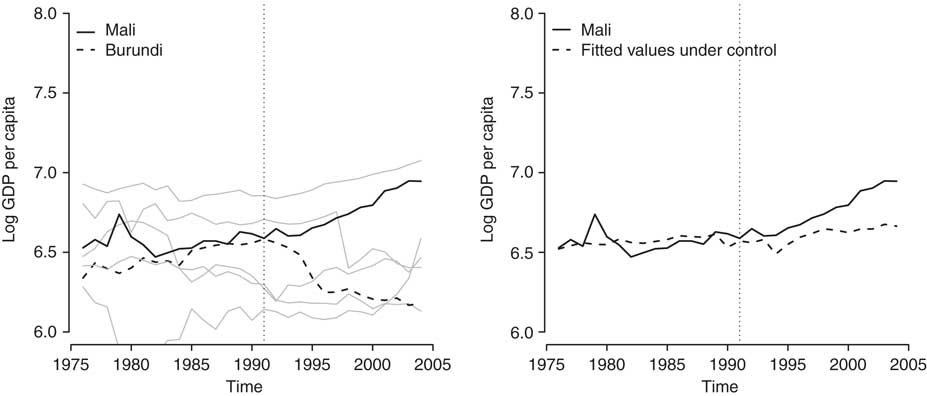
Given these competing claims, what tools can researchers use to determine whether democratization helped or hindered the Malian economy, and to what degree? A common informal approach is to compare Mali’s economic performance with that of another state similar to it along all major dimensions determinative of gross national product but which did not democratize. The left-hand panel of Figure 1 plots the per capita output of such candidate comparison states, selected on the basis of their geographic location, population, and level of development. Among the six shown, only one appears to provide a reasonable, though by no means perfect counterfactual estimate of Malian economic output under persistent autocratic rule: Burundi. Besides being poorer than Mali to varying degrees throughout the pre-treatment period, Burundi is naturally also dissimilar in size, location, ecology, and ethnic composition, among other dimensions; however, no better single-case approximation is available. If one assumes from this basis that Burundi’s economic performance after 1992 illuminates what Malian output would have been absent democratization, then the conclusion one must draw is that Mali’s reforms had enormously positive economic effects. Mathematically, the cumulative difference between 1991 and 2005 amounts to >$6700 per capita.
Single-case comparison and regression Note: GDP=gross domestic product.

Were one to instead model the effect of Mali’s democratization using regression, a very different picture emerges. According to this method, which we use to generate the right-hand panel of Figure 1, the average Malian gained a total of only $1700 in the post-treatment period as a consequence of political reform. Yet, this estimate too is not especially persuasive. For one, even though it is drawn from a highly flexible specification, the fitted values it is based on do not match the true levels of Malian output before democratization very closely.Footnote 14 More importantly for the purposes of causal inference, we have no way of knowing whether the model that underlies these fitted values is even reasonably close to the true model of Malian GDP. The estimated post-treatment effects of Malian democratization gleaned from this approach are therefore correspondingly questionable. What is more, the process of comparison implicit in this analysis lacks intuitive appeal. In effect, it projects Mali’s unobserved post-treatment GDP from all consistently autocratic states included in the regression regardless of these countries’ apparent utility as comparison cases.Footnote 15 Regression thus presents real limitations in establishing a counterfactual of Mali’s output absent democratic reform, and thus the economic effect of this transition.
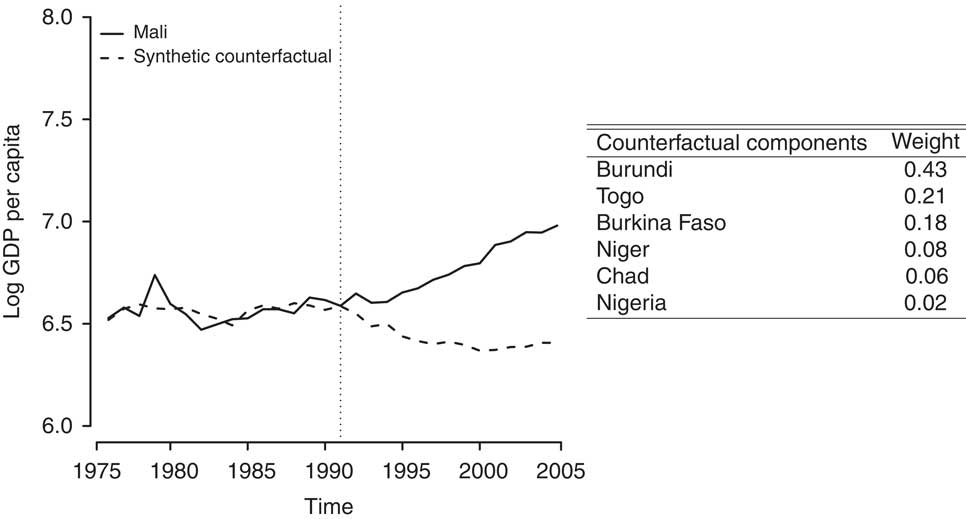
Figure 2 shows the results of using the synthetic control method to conduct this analysis. It suggests a cumulative difference in the post-treatment period equal to $5300 per capita—20 percent less than our estimate from a naïve comparison with Burundi and more than three times that from regression. More importantly, the inferential basis for this estimate is sounder than those that underly either of our preceding results. Not only is the pre-treatment fit between Mali and its synthetic counterfactual closer in Figure 2 than in either panel of Figure 1, but this correspondence satisfies the key condition for causal identification in synthetic counterfactual analysis. Finally, the countries that comprise this synthetic unit are together a more intuitive set of comparison cases than either Burundi on its own or the full array of African autocracies in our sample. The synthetic control method thus appears to aid considerably in discerning the economic effects of democratization in Mali. The following section examines what further insights can be garnered from applying it to the full set of third-wave democracies in Africa.
Mali and a synthetic comparison unit Note: GDP=gross domestic product.

Aggregate Results
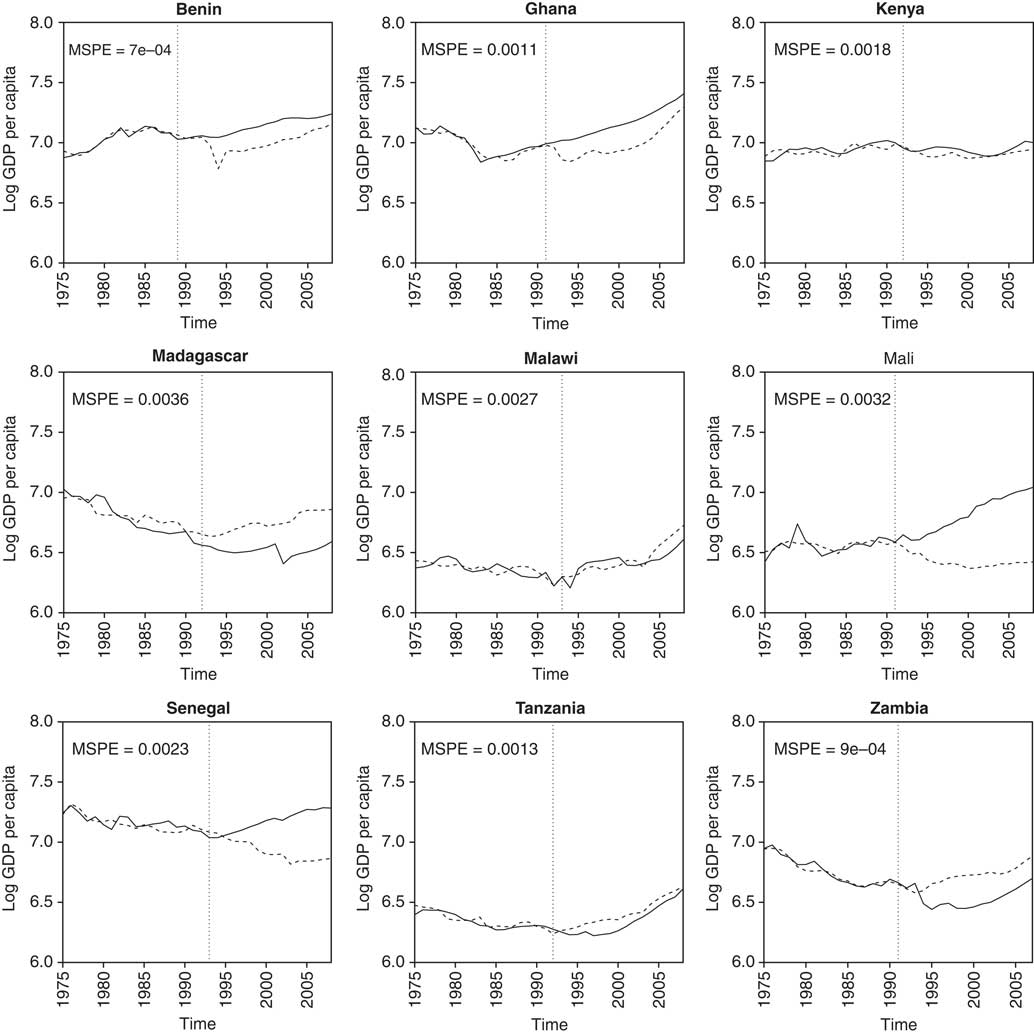
Figure 3 shows a separate synthetic counterfactual analysis for each of the nine democratizing states we take as treated units in this study. At first glance, one is struck by the variety of effects it depicts across these cases. Some show clear positive annual effects of democratic reform, others show equally clear negative effects, and still others indicate mixed or negative returns to democratization. Also evident in these plots is the degree to which these estimates are causally identified by virtue of a close correlation between actual and synthetic counterfactual output before democratization. This condition is measurable both visually and in the mean squared prediction errors (MSPEs) we report in each plot. In general, though not uniformly, it seems largely to be met. More importantly, we see that using this method it is possible to gauge causal identification separately for each democratized country in our sample, something which could not be done using standard regression techniques.
Aggregate effects of democratization on income Note: GDP=gross domestic product; MSPE=mean squared prediction error.

To interpret the substantive magnitude of our country-specific estimates, we construct time-averaged annual differences in economic output between each observed case (Y j 1) and its corresponding synthetic counterfactual (Y j 0) for time periods after treatment, T j,0:Footnote 16
 $$\bar{\alpha }_{j} \,{\equals}\,{{\mathop{\sum}\limits_{t\,{\equals}\,T_{{j,0{\plus}1}} }^T {\!\!(Y_{{j,t}}^{1} {\minus}Y_{{j,t}}^{0} )} } \over {T{\,\minus\,}T_{{j,0{\plus}1}} }}.$$
For Mali, the country in our sample with the largest positive estimated effect of democratization,
 $$\bar{\alpha }_{j} $$
is $310, or 30 percent of per capita income in 2008. In Zambia, these figures are, respectively, negative $140 and minus 16 percent. Their uncertainty notwithstanding, these estimates are substantively important. Were Mali 30 percent poorer today than it actually is, the country would be more akin to war-torn Chad or Sierra Leone than a state that has never experienced a civil war. The apparent economic losses associated with Zambian democratization are also non-trivial. In the American context, it is equivalent to $5000 of foregone income per capita.
In all, three of our treated cases suggest negative income effects as a result of their reforms (Madagascar, Tanzania, and Zambia), four show sizable positive effects (Benin, Ghana, Mali, and Senegal), and two show a null effect (Kenya, Malawi).Footnote
17
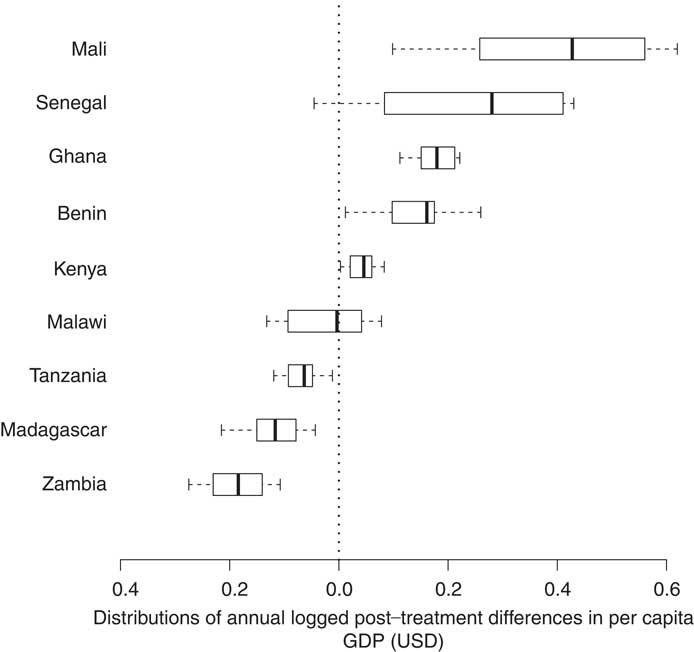
The distributions of annual logged effects for each of these cases are presented as box plots in Figure 4, with thick vertical lines indicating
 $$\bar{\alpha }_{j} $$
. In our view, these results strongly suggest that democratization is an important causal force, but that the nature and consequences of reform may be fundamentally dissimilar across states, at least in the African context. In addition, Figure 4 suggests a reason why regression analyses that dominate the study of democracy and economic output often yield mixed or weakly positive estimates. The average annual effect of democratization across each of the nine treated cases in our sample is analogously positive and small—8 percent of GDP per capita, or ~$80. What is more, if we apply standard panel-data regression to our data, the effects we estimate match this result closely, as Table 1 shows. The synthetic control method thus appears to uncover important heterogeneities in the effect of democratization that regression typically conceals.
Heterogeneous effects of democratization Note: GDP=gross domestic product.

Panel Regression Estimates of the Effect of Democratization on Gross Domestic Product (GDP) Per Capita, Logged

Note: Point estimates show the estimated percentage effect of democratization on per capita output. The models used to generate these estimates include all of the covariates from our synthetic control estimates except lagged measures of the dependent variable. Hausman tests were used to choose between fixed and random effects for models with coefficients varying by country and year. All p-values correspond to block-bootstrapped standard errors.
OLS=ordinary least squares.
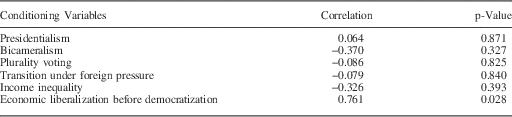
Using simple correlational analysis, we can evaluate the patterns in this country-level variation against extant theories that posit a conditional relationship between democratization and economic output. The first set of moderating conditions we examine are those that broadly define two competing models of democratic government (Gerring, Thacker and Moreno Reference Gerring, Thacker and Moreno2005). Decentralized democracies, structured on the premise that limited government is optimal, are characterized by a presidential executive, bicameral legislatures, and majoritarian voting systems. So-called centripetal polities that instead concentrate political power in a single body via multiple layers of interest aggregation feature unicameral parliaments and closed-list proportional voting. Interestingly, as Table 2 shows, our results indicate little support for the notion that either model of democracy is associated with superior economic performance in the African context.
Correlation Coefficients for Conditioning Variables and Estimated Effects

Note: Measures of post-transition political institutions are from Beck et al. (Reference Beck, Clarke, Groff and Keefer2001). Inequality and economic liberalization data are from Solt (Reference Solt2009) and Tavares and Wacziarg (Reference Tavares and Wacziarg2001), respectively. Data on whether democratization took place under foreign pressure is coded directly by the authors.
The second conditional hypothesis tested in Table 2 is that the original impetus for democratization moderates its economic consequences. Specifically, transitions undertaken in large part at the behest of foreign patrons inclined to reward reform efforts with increased financial assistance may, by virtue simply of these flows, be more likely to boost subsequent economic output than democratic transitions borne principally of domestic unrest (Hariri Reference Hariri2013). This hypothesis too finds little support in our data. We also find scant evidence that aggregate economic inequality is a statistically significant moderating variable despite the pressure this distribution of wealth creates for growth-reducing redistributive policies (Przeworski and Limongi Reference Przeworski, Alvarez, Cheibub and Limongi1993; Boix Reference Boix2003; Acemoglu and Robinson Reference Acemoglu and Robinson2006b).
We do, however, find some evidence that the sequencing of political and economic liberalization helps explain heterogeneity in democratization’s effects. Our results suggest that states that removed price controls, import quotas, interest rate restrictions, and other distortionary economic policies before democratization were more likely to garner an economic benefit from the latter reforms than those that undertook economic and political liberalization in the opposite order. This result is by no means definitive on account of sample size, coarse measurement, and the non-ignorability of the moderating variable; nevertheless, in light of the relative paucity of theoretical scholarship to explain it, we believe further investigation is merited.Footnote 18
Inference
Treatment effects generated using the synthetic control method are not amenable to evaluation using regular confidence interval estimators. Thus, while we may be optimistic that the effects presented above are reasonably well identified for most cases, it is less clear how precisely they are estimated or, at the extreme, whether they are distinguishable from chance. Following Abadie, Diamond and Hainmueller (Reference Abadie, Diamond and Hainmueller2010), we use placebo tests to conduct statistical inference in lieu of more standard procedures. The across-unit test on which we focus artificially assigns treatment status to each control case in our sample and runs the synthetic control procedure on each “placebo-” treated case one by one. The performance of the control cases in contrast to their synthetic counterparts is then compared with the analogous performance of a given treated case. Much like Fisher’s exact test, this produces a distribution of treatment effects that permits one to assess the likelihood that the true estimated treatment effect is distinguishable from randomness.
We begin by calculating a MSPE for each instance of placebo treatment and comparing these measures of pre-treatment fit to those associated with the set of true treated cases. Placebo cases with an MSPE exceeding the largest MSPE among the treated by a factor greater than ten are excluded from our analysis. For the remaining 15 placebo cases and nine treated cases, we calculate cumulative annual post-treatment effects and use the resulting distributions to draw inferences.
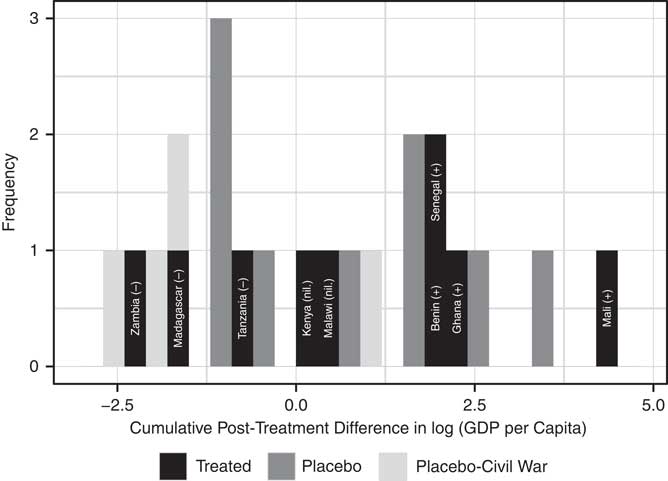
Figure 5 plots this distribution, with treated cases’ cumulative effects represented as black bars and placebo units’ effects as gray ones. It is evident from these results that a number of the democratizations we identify in preceding sections as demonstrating a clear positive or negative effect lie in the middle of this distribution, suggesting that in these countries, democratization did not influence economic output in a systematic fashion. Nevertheless, three of our nine treated cases do show divergent, statistically large effects. In Mali, the cumulative effect of democratization is resoundingly positive. In Zambia and Madagascar there is equally clear evidence that political liberalization had an adverse effect. This is particularly true if one excludes from consideration those placebo cases in Figure 5 that experienced war, and associated economic collapse, in the post-treatment period.Footnote 19 In all, we take from these results and our preceding causal estimates that third-wave democratizations did, in fact, have mixed results in Sub-Saharan Africa, ranging from robustly positive to equally resoundingly negative and including most values in-between.
Cumulative effects for treated and placebo cases Note: GDP=gross domestic product.

Conclusion
How does democracy affect economic output? This paper applies a new empirical approach to answer this long-standing question. Using the synthetic control method and new balanced panel data for the period 1975–2008 we estimate unique treatment effects for every African country that democratized in the late 20th century. As importantly, our approach takes significant steps toward resolving inferential problems that compromise existing country-level, cross-national research on the economic consequences of political regimes. We obviate the need to correctly specify all time-varying confounds in a causal model of economic output or to adduce thorough positive evidence for the excludability of an instrument for democratization. We instead rely only on a predictive model and straightforward measures of pre-treatment fit to achieve causal identification.
The results we draw from this new method of estimation suggest that attempts to estimate a single effect of democratic reform on economic output in Africa are misguided. Third-wave democratizations on the continent appear to have produced highly divergent economic outcomes. There is considerable variation in both the substantive size of the effects we show and their level of uncertainty. One interpretation of this heterogeneity is that democratization may not be sufficient in and of itself to generate increases in economic output. Given the nature of our particular study we are hesitant to draw so strong a conclusion; however, it does appear that democratization’s economic effects are not straightforward (Mahoney Reference Mahoney2008). Indeed, many of the factors posited in the theoretical literature as moderators of the economic effect of democratization are uncorrelated with our results. Only pre-treatment, as opposed to post-treatment economic liberalization shows a significant small-sample association. The synthetic control method thus makes an important empirical contribution to the study of democratization in addition to bringing a novel methodological approach to the field.
Moving forward, we hope students of democratic reform will build upon these results with further inquiries into democracy’s effects on outcomes other than economic output.Footnote 20 Though in this paper our empirical focus is on GDP per capita, an important but admittedly narrow dependent variable, there is also reason to believe that democratization will influence income inequality (Sirowy and Inkeles Reference Sirowy and Inkeles1990), protection of human rights (De Mesquita et al. Reference De Mesquita, Cherif, Downs and Smith2005), or the allocation of resources to public goods including education, healthcare, and physical infrastructure (Stasavage Reference Stasavage2005; Kramon and Posner Reference Kramon and Posner2013; Harding and Stasavage Reference Harding and Stasavage2014). Similarly, democratization may have consequences for economic stability and long-term growth that are not measured by annual GDP per capita figures (Goldsmith Reference Goldsmith1995; Leblang Reference Leblang1996). These are all fields of inquiry in which the data, methods, and results we introduce in this paper can be employed aptly to further our understanding of democracy’s causal effects.
Appendix A: Treatment and Control Cases

†Years indicate the period in which we code democratization as haven taken place. Parenthetical numerals indicate the period in which the elections that followed democratization occurred. For example, in Benin, one-party rule ended in 1989, while the country’s first multi-party elections took place in 1991.
Appendix B: Data and Data Sources
Regressors Retained in Final Predictive Model
Gross domestic product (GDP) per capita, logged**: logged real GDP per capita in 1990 US dollars, controlled for purchasing power parity (Maddison Reference Maddison2010).
Population: logged total population (Papaioannou and Siourounis Reference Papaioannou and Siourounis2008).
Investment: investment share of GDP per capita (Heston, Summers and Aten Reference Heston, Summers and Aten2011).
Trade Openness: sum of exports and imports divided by GDP (Heston, Summers and Aten Reference Heston, Summers and Aten2011).
Civil War Initiation/Termination: initiation/termination of a civil war in which at least 1000 cumulative battle deaths occur (Gleditsch et al. Reference Gleditsch, Wallensteen, Eriksson, Sollenberg and Strand2002; Themner and Wallensteen Reference Themner and Wallensteen2013).
Exchange Rate*: exchange rate relative to the US dollar (Heston, Summers and Aten Reference Heston, Summers and Aten2011).
Export/Import Values*: export and import value indices from the UN Conference on Trade and Development (UNCTAD 2015).
International Monetary Fund (IMF)*: The number of structural adjustment loans administered by the IMF and in place for at least five months in a given country-year (Dreher and Gassebner Reference Dreher and Gassebner2012).
World Bank*: the number of World Bank projects in place for at least five months in a given country-year (Dreher and Gassebner Reference Dreher and Gassebner2012).
Regressors Omitted from Final Predictive Model
Government Spending: government expenditure as a fraction of GDP (Heston, Summers and Aten Reference Heston, Summers and Aten2011).
Consumer Prices: annual price inflator for national expenditure on consumption (Heston, Summers and Aten Reference Heston, Summers and Aten2011).
Oil: oil export revenue as a percentage of GDP (Bank Reference Bank2015).
Legal Origin: a binary indicator whether a government’s legal system is of British origin (Papaioannou and Siourounis Reference Papaioannou and Siourounis2008).
Rainfall: long-run average annual rainfall (Devitt and Tol Reference Devitt and Tol2012).
Landlocked: dummy variable indicating whether the country is landlocked (Bolt and Bezemer Reference Bolt and Bezemer2009).
Under-5 Mortality Rate: mortality rate per thousand children under the age of 5 (Organization 2015).
**One-, two-, three-, and four-year lags used.
*One-, and two-year lags used.