Optimism is a relevant construct within positive psychology and is gaining importance in other fields of psychology due to its association with mental health (Lai, Reference Lai2009), self-efficacy, social support, and well-being (Karademas, Reference Karademas2006). High levels of optimism constitute desirable characteristics in children, adolescents, and adults, given the overlap with psychological and physical well-being (Scheier & Carver, Reference Scheier and Carver1992). The results of some studies emphasize the importance of family relations on optimism development (Ben-Zur, Reference Ben-Zur2003; Orejudo, Puyuelo, Fernández-Turrado, & Ramos, Reference Orejudo, Puyuelo, Fernández-Turrado and Ramos2012), while others emphasize intrinsic variables (Marshall, Wortman, Kusulas, Hervig, & Vickers Reference Marshall, Wortman, Kusulas, Hervig and Vickers1992; Milligan, Reference Milligan2003). Research that investigates the impact of environmental variables, (e.g. parenting styles) or more genetically determined ones (e.g. personality), provide insight into the etiology of optimism. Previous studies have not evaluated the roles of personality and parenting styles on optimism. This research is intended to provide information on this issue.
An optimistic person believes that good things will happen. Two major theoretical frameworks have been used to conceptualize optimism: dispositional (Scheier & Carver, Reference Scheier and Carver1985) and the situational approach (Peterson, Reference Peterson2000; Seligman, Reference Seligman1998). The former states that optimism represents a stable personal tendency to have positive expectations about future outcomes. The latter states that optimism represents a way a person thinks about the causes of bad events and is related to an explanatory style of thinking. This research will study the dispositional form of optimism because it is conceptualized as a trait (thus, it is likely more stable) and may be more associated with personality factors.
Growing up in a family whose parents present more or less warmth and strictness may have a direct influence in adolescent`s perceptions of life event (Orejudo et al., Reference Orejudo, Puyuelo, Fernández-Turrado and Ramos2012). Stressful or positive events may also impact on the expected future outcomes. The combination of different levels of parental responsiveness (e.g. the degree they display warmth) and demandingness (e.g., the degree they display restrictiveness) produces the four most studied parental styles: authoritative— the environment is responsive and demanding, neglectful— the environment is neither responsive nor demanding, indulgent— the environment is responsive and not demanding, and authoritarian— the environment is demanding and not responsive (Lamborn, Mounts, Steinberg, & Dornbusch, Reference Lamborn, Mounts, Steinberg and Dornbusch1991; Maccoby & Martin, Reference Maccoby, Martin, Mussen and Heatherington1983). Parental styles have an important influence on self-esteem, life satisfaction, positive and negative affect, and memories of emotional abuse (Brodski & Hutz, Reference Brodski and Hutz2012). Optimism, in turn, presents positive correlations with self-esteem, dispositional hope, hope-self and hope-others (Pacico, Zanon, Bastianello, & Hutz, Reference Pacico, Zanon, Bastianello and Hutz2011), reinforcing the significance of parenting styles to a positive or negative self-perception. Parenting styles also impact the development of self-concept, psychosocial maturity, moral development, independence, social skills, cooperation with adults and peers, cognitive competence, and academic success (Johnson, Reference Johnson1998).
Positive relationships between parents and their children are related to optimism among adolescents (Ben-Zur, Reference Ben-Zur2003). Thus, the types of interactions established within families from early childhood to adolescence may impact the way teenagers view the world and their expectations of the future. The quality of communication between parents and their children is related to optimism, what stresses the importance of healthy family relationships to the development of optimistic beliefs (Orejudo et al., Reference Orejudo, Puyuelo, Fernández-Turrado and Ramos2012). Once parenting styles play an important role in personal growth, it is reasonable to assume that different parental styles are associated with different life expectations (Ben-Zur, Reference Ben-Zur2003). In other words, parental styles may impact expectations for good or bad outcomes.
Some studies focus on the relationships between optimism and personality factors (Boland & Cappeliez; Reference Boland and Cappeliez1997; Smith, Pope, Rhodewalt, & Poulton, Reference Smith, Pope, Rhodewalt and Poulton1989; Williams, Reference Williams1992). One`s personality colors the way they perceive and interpret events, thoughts, and feelings (McCrae & Costa, Reference McCrae, Costa, John, Robins and Pervin2010). An understanding of the relevance of environmental and personality variables on optimism may advance our understanding of the construct of optimism and impact intervention strategies designed to promote optimism.
The big five model is internationally accepted and used to describe personality (John, Naumann, & Soto, Reference John, Naumann, Soto, John, Robins and Pervin2010; McCrae & John, Reference McCrae and John1992). It states that personality traits can be clustered within five comprehensive factors: neuroticism, extraversion, openness, agreeableness, and conscientiousness. Each factor reflects basic tendencies that can be inferred from one`s behavior (McCrae & Costa, Reference McCrae, Costa, John, Robins and Pervin2010). The factors describe behaviors, attitudes, preferences, and feelings.
Results from studies of personality and optimism present positive relationships with extraversion and a negative relationship with neuroticism (Marshall et al., Reference Marshall, Wortman, Kusulas, Hervig and Vickers1992; Milligan, Reference Milligan2003). Such findings support that persons with high scores on neuroticism (e.g. are irritable, nervous, and sad persons) are more inclined to be pessimist, while persons with high scores on extraversion (e.g. are active, assertive, and positively emotional) are inclined to be optimistic. Using multiple measures of optimism and the big five model, Sharpe, Martin, and Roth (Reference Sharpe, Martin and Roth2011), verified that agreeableness and conscientiousness contributed significant amounts of variance to optimism after controlling for neuroticism and extraversion. The results suggest that, beyond high positive and low negative emotionally, traits related to persistence and friendship are associated with optimism. The adolescents’ tendency to be more or less optimistic might be an expression of their personality traits, but also could be related to their parents’ positive or negative behaviors. Strong evidence supports the relation of parenting styles to optimism, thus suggesting that family relations play an important role on optimism development. Results from studies that examine personality emphasize the relevance of intrinsic variables to the development of positive or negative future expectations. Both sets of results (e.g. Ben-Zur, Reference Ben-Zur2003; Orejudo et al., Reference Orejudo, Puyuelo, Fernández-Turrado and Ramos2012; Sharpe et al, Reference Sharpe, Martin and Roth2011; Smith et al., Reference Smith, Pope, Rhodewalt and Poulton1989; Williams, Reference Williams1992;) provide evidence that optimism is a multifactorial caused construct. Nevertheless, parenting styles, more specifically responsiveness and demandingness, may also be related to parents` personality, and their expressions, in part, are determined by their personality. If so, the personality factors play an important role on family relationships and, as an outcome of these interactions, on optimism.
Adolescent personality displays inheritance (Tellegen et al., Reference Tellegen, Lykken, Bouchard, Wilcox, Segal and Rich1988), and may be somewhat associated with parenting styles. In early infancy, relationships between parents and infants produce attachment patterns that are likely to influence adolescent and adult behaviors (Jensen-Campbell, Knack, & Rex-Lear, 2009). Other evidences indicate that parent’s personality influence parenting (Blanch & Aluja, Reference Blanch and Aluja2011; Huver, Otte, de Vries, & Engels, Reference Huver, Otten, de Vries and Engels2010), and both influence contextual support and stress in the relationships (Belsky, Reference Belsky1984).
The way that adolescents and parents communicate and interact may express their personalities that may be associated with optimism. This paper aims to advance this topic. Thus we conjecture that more extraverted, sociable, and secure adolescents establish more kindly relationships with their parents. In contrast, more irritable, unstable, and those with less impulse control develop more hostile relations. The type of relationship determined by the combination of responsiveness and demandingness may be associated with different levels of optimism. The purposes of this study are: (a) to evaluate how optimism is related to personality factors in adolescents and to their parents` responsiveness and demandingness, and (b) to assess how much the variance in optimism is explained to the parents` responsiveness and demandingness and by parental styles after controlling for the variance associated with for adolescent personality factors (e.g. neuroticism, extraversion, agreeableness, conscientiousness). The personality factor of openness is not related to optimism (Sharpe et al., Reference Sharpe, Martin and Roth2011), and thus was not included in this study.
Method
Participants
Participants were 344 Brazilian high school students (44% male) with mean age of 16.2 years (SD = 1). Students were from public schools, 99% had no kids, 97% were living with their parents, and 84% were not working. The refusal rate was less than 1%. This convenience sample was made up of volunteers whose parents consented to their participation in this study.
Instruments
Revised Life oriented test (LOT-R: Scheier, Carver, & Bridges, Reference Scheier, Carver and Bridges1994) it is a self-report measure of dispositional optimism. It was adapted recently for the use with Brazilian adolescents (Bastianello, Zanon, Pacico, & Hutz, unpublished results, 2013). In Brazil, the test has a similar internal consistency (α = .70) to the original test (α = .70 to .80). The test is comprised by 10 items, three about optimism and three about pessimism, in addition to four distractors whose scores are not computed. All participants respond to the statements according to their degree of agreement using a 5-point Likert scale in which 1 indicates “completely disagree”, and 5, “completely agree”. For statistical analysis, the negative scores were reversed so that values close to 5 always indicate a greater degree of optimistic expectations according to the respondent.
Factorial Personality Battery (FPB: Nunes, Hutz, & Nunes, Reference Nunes, Hutz and Nunes2010) is a self reporting instrument comprised of 126 items modeled on the Five Factor Personality Model. This scale provides an efficient and objective evaluation of extroversion, neuroticism, agreeableness, conscientiousness, and openness. This test was developed for use with Brazilians. It was built based on personality descriptors used by Brazilians (Hutz et al., Reference Hutz, Nunes, Silveira, Serra, Anton and Wieczoreck1998) and comprises part of the content and structure of other available Brazilian developed factorial personality scales used to assess neuroticism (Hutz & Nunes, Reference Hutz and Nunes2001), extraversion (Nunes & Hutz, Reference Nunes and Hutz2006), agreeableness (Nunes & Hutz, Reference Nunes and Hutz2007), and openness (Vasconcellos & Hutz, Reference Vasconcellos and Hutz2008).
Items in the PFB were constructed in the form of sentences that describe the participant`s attitudes, beliefs, and feelings. They are answered on a seven- point Likert type scale where 1 represents does not describe me at all and 7 represents describes me at all. The PFB showed adequate internal consistency, alpha coefficient, for each one of the factors: neuroticism .89, extroversion .84, agreeableness .85, conscientiousness .83, and openness .74.
Parenting Demandingness and Responsiveness Scale (PDRS: Lamborn et al., (Reference Lamborn, Mounts, Steinberg and Dornbusch1991) is composed by two subscales, one to measure responsiveness and one for demandingness. When combined, they provide an assessment of the parenting styles perceived by adolescents. Each of the two subscales has twelve items. They are based on the Lamborn`s et al., (1991) study and adapted for use in Brazil. Its internal consistency indices are .78 for demandingness and .92 for responsiveness (Teixeira, Bardagi, & Gomes, Reference Teixeira, Bardagi and Gomes2004).
Procedure
Adolescents completed the measures from their classrooms. They were informed that participation in the study was voluntary, and that all information shared would remain confidential. The participants were asked to carefully read the questions and respond to items according to their personal feelings. Data collection was performed in a single session for each class of students, and the total time taken to complete the test was approximately 40 minutes.
Data analysis
Descriptive statistics, correlations, and multiple regression analyses were conducted to investigate the research objectives. The first regression model included maternal and paternal demandingness and responsiveness after the personality factors to predict optimism, and the second regression model included the parenting styles (the combinations of demandingness and responsiveness) after the personality factors to predict optimism.
The parenting styles were created from the combination of demandingness and responsiveness. The medians were used to classify participants as high or low on both variables. Thus, adolescents with higher scores than the median on demandingness and responsiveness were classified as having paternal or maternal authoritative relations. Participants with scores lower than the medians on demandingness and responsiveness were classified as having paternal or maternal neglective relations. Participants with scores higher than the median on demandingness and lower scores than the median on responsiveness were classified as having paternal or maternal authoritarian relations. Participants with scores higher than the median on responsiveness and scores lower than the median on demandingness were classified as having paternal or maternal indulgent relations. Each parenting style was introduced to the regression models as dummy variables.
Results
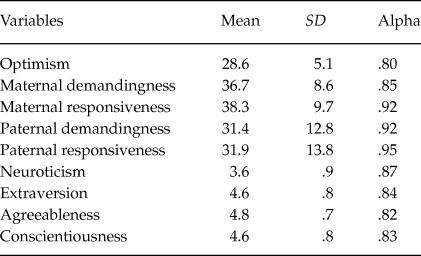
Initially, descriptive statistics were calculated along with alpha coefficients of the variables: optimism, maternal demandingness, maternal responsiveness, paternal demandingness and paternal responsiveness, neuroticism, extraversion, agreeableness, and conscientiousness (Table 1). All alpha coefficients are appropriate.
Descriptive statistics and alpha coefficients

Pearson correlations were determined to examine the relationship between optimism, personality, demandingness and responsiveness. Optimism presented correlation higher with the personality factors than with demandingness and responsiveness. Thus, optimism is more strongly associated with personality than with demandingness and responsiveness (Table 2). As expected, demandingness and responsiveness also were correlated with personality. Similar and small correlations were found among optimism, maternal and paternal demandingness and responsiveness, thus suggesting that optimists have parents who display higher scores on demandingness and responsiveness.
Correlations among optimism, personality factors, demandingness and responsiveness

* p < .01
Dem.Mother = maternal demandingness
Resp.Mother = maternal responsiveness
Dem.Father = paternal demandingness
Resp.Father = paternal responsiveness
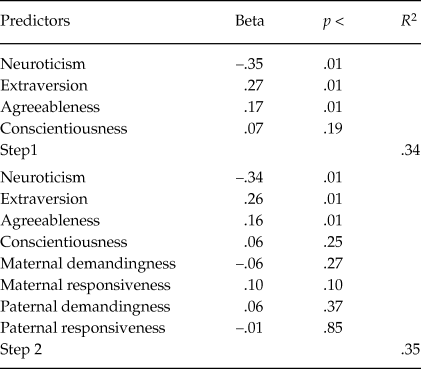
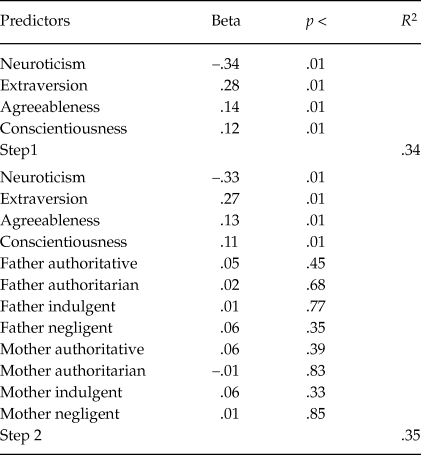
Two hierarchical multiple regression analyses were conducted to assess if parental styles add variance to optimism after controlling for personality. The first model included maternal and paternal demandingness and responsiveness after personality. The second model included the four parenting styles of mothers and fathers after personality. Table 3 and 4 present both models respectively.
Hierarchical regression model to predict optimism from personality and demandingness and responsiveness

Hierarchical regression model to predict optimism from personality and parenting styles

Data from the first model show that personality factors predict collectively approximately 34% of the optimism variance. The inclusion of maternal and paternal demandingness and responsiveness along with the personality variables, collectively, predicted 35% of the variance on optimism. Thus only 1% of the additional variance is due to maternal and paternal demandingness and responsiveness. Neuroticism, extraversion, and agreeableness were the only significant variables.
Data from the second model present similar results. Personality factors account for 34% of the variance on optimism and the inclusion of the maternal and paternal parenting styles increase this variance by 1%. Thus, only 1% of the additional variance is due to maternal and paternal parenting styles. Again, neuroticism, extraversion, and agreeableness were the only significant variables.
Discussion
This study aimed to evaluate how optimism is related to personality factors in adolescents and to their parents` responsiveness and demandingness. Another goal of this study was to assess how much the variance in optimism is explained to the parents` responsiveness and demandingness and by parental styles after controlling for the variance associated with for adolescent personality factors. This study contributes to the debate of the impact of personality and other environmental variables on optimism. Intrinsic variables, such as extraversion, neuroticism, conscientiousness, and agreeableness are far more relevant to positive or negative worldview development than situational ones such as responsiveness and demandingness.
Personality factors comprise important constructs used to explain optimism. The results of this study corroborate previous findings (Boland & Cappeliez; Reference Boland and Cappeliez1997; Marshall et al., Reference Marshall, Wortman, Kusulas, Hervig and Vickers1992; Milligan, Reference Milligan2003). As expected, the two more important relations found were a negative and moderate correlation of optimism with neuroticism, and positive and moderate correlation of optimism with extraversion. Nevertheless, agreeableness and conscientiousness also developed a positive (albeit smaller) relationship with optimism, a finding also reported by Sharp et al., (2011). However, conscientiousness did not contribute significant variance on the regression models, suggesting that its variance is already accounted by other personality factors. These findings suggest that optimism is considerably predicted by personality factors and possibly are a consequence of them.
Responsiveness and demandingness determine different types of parenting styles and are related to optimism. Previous studies state that good communication and positive family relationships may be associated with optimism development (Ben-Zur, Reference Ben-Zur2003; Orejudo et al., Reference Orejudo, Puyuelo, Fernández-Turrado and Ramos2012). The present study verified that paternal and maternal responsiveness also are associated with optimism. Despite its small correlations, parental characteristics (e.g. to care about children, try to help and encourage them to surpass adversities or challenges) may contribute to their future positive or negative expectations. Paternal demandingness correlated modestly with optimism, suggesting that children`s perception of paternal strictness may be important to them. Paternal demonstration of any interest, even ordinarily undesired one as control, could be interpreted as healthy preoccupations or as a necessary evil.
Responsiveness and demandingness do not add considerable and exclusive variance associated with optimism. Thus their relationships with optimism seemingly are explained by personality. The consequences of these findings suggest that the relevance of environmental aspects related to family relationships to optimism may be somewhat trivial when compared with the importance of personality factors. The importance of family relations for healthy development and for positive worldview is not rejected. However, responsiveness and demandingness (and the parenting styles) may not be the most relevant aspects to adolescents` optimism development.
Limitations of this research are that responsiveness and demandingness (and consequently the parenting styles) were measured in terms of adolescents` perception and not using direct measures or multiple methods. Thus, these perceptions may be influenced by adolescents` personalities. For example, more extraverted adolescents may perceive their parents more positively, and more neurotic ones might perceive them more negatively. Additional new studies are suggested to investigate this possibility. Another shortcoming is that the results are correlational, thus the direction of relations among the variables (e.g. personality is the responsible for parenting styles and optimism) cannot be stated, just supposed. For this reason, another possibility includes a model in which optimism influences personality and family relationships through bidirectional relations.