Research on anxiety in children has considerably increased over the last decade. According to epidemiological studies on mental health conducted in several Western countries, this disorder is the most common form of psychological distress during childhood. Prevalence rates ranging from 2.6% to 23.9% have been reported in samples of children aged 11 or under (Costello, Mustillo, Erkanli, Keeler, & Angold, Reference Costello, Mustillo, Erkanli, Keeler and Angold2003; Ford, Goodman, & Meltzer, Reference Ford, Goodman and Meltzer2003; Kroes et al., Reference Kroes, Kalff, Kessels, Steyaert, Feron and Van Someren2001). If forms of anxiety that do not fully meet the diagnostic criteria of an anxiety disorder (i.e., subsyndromic symptoms) were taken into account, the total prevalence would be even higher (Cartwright-Hatton, McNicol, & Doubleday, Reference Cartwright-Hatton, McNicol and Doubleday2006; Zahn-Waxler, Klimes-Dougan, & Slattery, Reference Zahn-Waxler, Klimes-Dougan and Slattery2000).
Anxiety is a natural emotion that is an integral part of children's normal development (Kendall & Suveg, Reference Kendall, Suveg and Kendall2006). This emotional reaction, however, can have debilitating effects in everyday life, particularly if it leads to avoidance behaviors, excessive fears, and major physiological symptoms (American Psychiatric Association, 2000). Such manifestations are likely to seriously handicap the child's social and academic functioning (Duchesne, Larose, Guay, Tremblay, & Vitaro, Reference Duchesne, Larose, Guay, Tremblay and Vitaro2005; Strauss, Lease, Kazdin, Dulcan, & Last, Reference Strauss, Lease, Kazdin, Dulcan and Last1989), to be accompanied by concomitant disorders (Brady & Kendall, Reference Brady and Kendall1992; Tannock, Reference Tannock and Brown2000) and to extend to other developmental periods (Bernstein & Borchardt, Reference Bernstein and Borchardt1991; Last, Perrin, Hersen, & Kazdin, Reference Last, Perrin, Hersen and Kazdin1996).
Despite these findings, empirical evidence related to the emergence and continuity of anxiety during childhood, as well as to the personal and familial factors behind this anxiety, remains limited (McLeod, Wood, & Weisz, Reference McLeod, Wood and Weisz2007; Visser, van der Ende, Koot, & Verhulst, Reference Visser, van der Ende, Koot and Verhulst1999; Zahn-Waxler et al., Reference Zahn-Waxler, Klimes-Dougan and Slattery2000). In particular, it is necessary (a) to better understand how anxiety develops during the first years of schooling for different groups of children, (b) to isolate the risk factors contributing to the emergence and continuity of this anxiety, and (c) to identify the factors that moderate the effects of these risk factors. To address these issues, the present longitudinal study pursued three goals. The first goal was to explore the developmental trajectories of anxiety during the elementary-school years using a group-based trajectory method. For this paper, anxiety refers to nonspecific symptoms such as fear or worry, and other negative emotions that are not specific to a single anxiety disorder. The second goal was to determine whether these trajectories can be associated to certain children's behavioral characteristics (i.e., inattention, hyperactivity, aggressiveness, and prosociality) as assessed during the first year of schooling. Finally, the third goal was to determine whether maternal parenting behaviors (i.e., warmth and discipline) could moderate the association between children's behavioral characteristics and their trajectories of anxiety.
Developmental Psychopathology Perspective and Trajectories of Anxiety During Childhood
The developmental psychopathology perspective has given rise to numerous studies on the development and prediction of children's psychopathology, including anxiety (Cicchetti & Rogosch, Reference Cicchetti and Rogosch2002; Cummings, Davies, & Campbell, Reference Cummings, Davies and Campbell2000; Rutter, Reference Rutter2002; Vasey & Dadds, Reference Vasey, Dadds, Vasey and Dadds2001). This paradigm is structured around the premise that children's development reflects patterns of adjustment that emerge from multiple and continuous transactions between their own characteristics and those of the social contexts in which they evolve (Cicchetti & Rogosch, Reference Cicchetti and Rogosch2002; Rutter, Reference Rutter2002). This dynamic interface between children and their environment is the cause of their internal reactions (e.g., fear, worry, joy) and external reactions (e.g., agitation, aggressiveness, obedience), which affect their adjustment qualitatively, thus contributing to guiding their developmental trajectory toward a psychopathological outcome or otherwise (Cummings et al., Reference Cummings, Davies and Campbell2000). Given that a trajectory can vary from one child to the next, it is possible that different groups of children follow different trajectories with respect to anxiety (Cicchetti & Rogosch, Reference Cicchetti and Rogosch2002). For example, some children might follow a stable trajectory, either high or low, whereas others might outgrow their anxious reactions over time. However, it is unlikely that nonanxious children will become increasingly anxious over time, although this pattern should not be discarded a priori.
Recognizing that developmental trajectories might be heterogeneous has an effect on the statistical analysis method chosen to draw up distinct and potentially opposing trajectories. In recent years, a group-based nonparametric method has established itself in follow-up studies as a method by which to model individual trajectories of development (Jones, Nagin, & Roeder, Reference Jones, Nagin and Roeder2001; Nagin, Reference Nagin1999). This method considers the natural heterogeneity in a population by grouping individuals according to the similarity of their trajectories, describing the shape of these trajectories (e.g., constant, quadratic) and estimating the proportion of individuals belonging to each trajectory.
Three studies based on a longitudinal approach have used this method to describe manifestations of anxiety among children. In a study assessing fearfulness among elementary-school children (kindergarten to Grade 6), Côté, Tremblay, Nagin, Zoccolillo, and Vitaro (Reference Côté, Tremblay, Nagin, Zoccolillo and Vitaro2002) identified three separate groups for boys and girls: low fearfulness group (16% of boys, 13% of girls), moderate fearfulness group (75% of boys, 70% of girls), and (c) high fearfulness group (9% of boys, 17% of girls). In another study conducted on a sample of boys who were followed from age 2 to 10, Feng, Shaw, and Silk (Reference Feng, Shaw and Silk2008) identified four groups based on their anxiety symptoms: low (51%), low-increasing (8.8%), high-declining (32.5%), and high-increasing (7.9%) groups. Finally, Duchesne, Vitaro, Larose, and Tremblay (Reference Duchesne, Vitaro and Tremblay2008) recently described manifestations of anxiety from kindergarten (5 years old) to Grade 6 (11 years old) for four groups, including boys and girls: low (10.2%), moderate (39%), high (41%), and chronic groups (9.7%). On the whole, these studies suggest that anxious children do not form a homogeneous group and that the emergence of anxious symptoms varies not only over time but also in terms of severity for different groups of children.
By building on these studies, our understanding of these trajectories can be enriched in at least three ways. First, except for the study by Duchesne et al. (2008), the analyses of trajectories of anxiety were conducted for boys and girls separately. In addition, Côté et al. (Reference Côté, Tremblay, Nagin, Zoccolillo and Vitaro2002) were the only researchers who used teachers to assess anxiety in children. Thus, no study has examined trajectories of anxiety by including both boys and girls, and by using the viewpoint of teachers. Methodologically speaking, this combination appears to be justified because (a) the gender gaps in the total prevalence of anxiety are observed mainly toward the age of 13–14, with higher prevalence rates in females than in males (Bittner et al., Reference Bittner, Egger, Erkanli, Costello, Foley and Angold2007; see Kendall et al., Reference Kendall, Hedtke, Aschenbrand, Wolfe and Mash2006), (b) the trajectories of anxiety among boys and girls seem to be similar before puberty (Côté et al., Reference Côté, Tremblay, Nagin, Zoccolillo and Vitaro2002), (c) some children do not have the cognitive and verbal tools to understand and describe their emotions accurately (see Duchesne et al., Reference Duchesne, Vitaro and Tremblay2008), and (d) teachers have proved to be a valid source of information for recognizing children with anxiety symptoms in the school setting (Layne, Bernstein, & March, Reference Layne, Bernstein and March2006).
Second, none of these studies focused on drawing up the behavioral profile of these children. Behavioral measures such as attention deficit/hyperactivity (Tannock, Reference Tannock and Brown2000), aggressiveness (Serbin, Moskowitz, Schwartzman, & Ledingham, Reference Serbin, Moskowitz, Schwartzman, Ledingham, Pepler and Rubin1991; Zoccolillo, Reference Zoccolillo1992) and social behavior (Fox, Henderson, Marshall, Nichols, & Ghera, Reference Fox, Henderson, Marshall, Nichols and Ghera2005; Olson & Rosenblaum, Reference Olson and Rosenblaum1998) have nevertheless been associated with anxiety disorders and/or shy-inhibited behavior (Fox et al., Reference Fox, Henderson, Marshall, Nichols and Ghera2005; Olson & Rosenblaum, Reference Olson and Rosenblaum1998; Serbin et al., Reference Serbin, Moskowitz, Schwartzman, Ledingham, Pepler and Rubin1991; Tannock, Reference Tannock and Brown2000; Zoccolillo, Reference Zoccolillo1992). Establishing the behavioral profiles that characterize different trajectories of anxiety could increase the capacity to identify anxious children in the school setting and to better plan the development and application of preventive measures aimed at these children.
Third, in the only study that examined the contribution of the family environment to explaining the trajectories of anxiety (Feng et al., Reference Feng, Shaw and Silk2008), the family factors that were chosen were conceptualized in terms of risk (insecure attachment, maternal depression, and negative control). To prevent anxiety among school-aged children, it also appears necessary to focus on the protective factors deriving from the family and to determine the extent to which they can compensate for or buffer the harmful effects of certain behavioral characteristics potentially linked with these trajectories. These protective factors might be particularly relevant for children who follow a declining trajectory.
Behavioral Characteristics and Anxiety
Studies examining children's personal characteristics associated with the development of anxiety have mainly focused on temperament (Feng et al., Reference Feng, Shaw and Silk2008; Lonigan, Vasey, Philips, & Hazen, Reference Lonigan, Vasey, Phillips and Hazen2004), emotion regulation (Bosquet & Egeland, Reference Bosquet and Egeland2006; Feng et al., Reference Feng, Shaw and Silk2008), and information processing (Vasey & Macleod, Reference Vasey, MacLeod, Vasey and Dadds2001). No reviewed study has established the particular behavioral profile related to the existence of individual trajectories of anxiety. This study concentrated on four behavioral characteristics empirically associated with anxiety during childhood, that is, inattention, hyperactivity, aggressiveness, and low prosociality. Although these characteristics appear to develop concomitantly with anxiety, it is likely that they may pervade the development of anxious manifestations during the first years of schooling. Through its increasing demands for self control, its academic requirements and the values it conveys, school could intensify children's problem behaviors, handicap their social and academic functioning, and thus affect their emotions (e.g., Eccles & Roeser, Reference Eccles, Roeser, Adams and Berzonsky2003). Moreover, as these characteristics can be easily identified, they constitute targets for potential interventions on the part of teachers who can take action to prevent or reduce anxiety (Duchesne et al., Reference Duchesne, Vitaro and Tremblay2008).
Inattention and hyperactivity
Inattention in children is characterized by an inability to sustain attention, to memorize information, to persevere in accomplishing demanding tasks, and to resist distractions, whereas hyperactivity is expressed mainly in the form of excessive motor or verbal agitation (Barkley, Reference Barkley2005). The association between the manifestation of these behaviors and anxiety has been demonstrated in both community and clinical samples of children (Crystal, Ostrander, Chen, & August, Reference Crystal, Ostrander, Chen and August2001; Faraone et al., 2004; Öncü et al., Reference Öncü, Öner, Erol, Aysev and Canat2004; Power, Costigan, Eiraldi, & Leff, Reference Power, Costigan, Eiraldi and Leff2004). In general, these studies have shown that children with clinical symptoms of inattention and/or hyperactivity tend to express high levels of anxiety. In the present study, we examined the contribution of inattention and hyperactivity symptoms to the trajectories of anxiety in elementary school. The probability of belonging to the high anxiety trajectory group was expected to be greater for children who exhibited inattention and signs of agitation in kindergarten. These children's inability to sustain their attention and control their agitation in the classroom could limit their capacity for quality learning (DuPaul et al., Reference DuPaul, Volpe, Jitendra, Lutz, Lorah and Gruber2004), while jeopardizing their relationships with other children (Barkley, Reference Barkley2005). Such consequences could then create fertile ground for anxiety to appear.
Aggressiveness
It has been well established that aggressiveness in children is expressed in different forms (e.g., physical, proactive, reactive, relational), and can reveal itself as part of a syndrome or a clinical disorder such as conduct disorder (Little, Brauner, Jones, Nock, & Hawley, Reference Little, Brauner, Jones, Nock and Hawley2003; Tremblay, Reference Tremblay2000; Vitaro & Brendgen, Reference Vitaro, Brendgen, Tremblay, Hartup and Archer2005). Empirical evidence has supported the association between this class of behaviors and anxiety (or constructs closely related to it). For example, reactive aggressiveness (i.e., emotional responses to external events) has been related to anxiety and shyness in children (Little et al., Reference Little, Brauner, Jones, Nock and Hawley2003; see Vitaro & Brendgen, Reference Vitaro, Brendgen, Tremblay, Hartup and Archer2005). In addition, aggressive behaviors in the classroom have been found to be significantly and positively associated with anxiety symptoms in children (Epkins, Reference Epkins1995). Similarly, parents and teachers' ratings of internalizing symptoms in children have been linked to aggressiveness both at home and at school (Kolko, Baumann, Bukstein, & Brown, Reference Kolko, Baumann, Bukstein and Brown2007). Finally, children with a conduct disorder, characterized by the repeated manifestation of violent behaviors (e.g., threats, intimidation, fights), also appear to be at risk of exhibiting high levels of anxiety (Zoccolillo, Reference Zoccolillo1992). In light of these data, we formulated the hypothesis that children exhibiting physical aggressiveness in kindergarten will belong to the group characterized by a high anxiety trajectory. Because aggressive children run the risk of having difficult relationships with their peers, being repeatedly scolded by their teachers and experiencing academic failure (see Van Acker & Mayer, Reference Van Acker, Mayer, Mayer, Van Acker, Lochman and Gresham2009), it is likely that these numerous negative experiences could lead to the development of negative feelings such as anxiety.
Prosociality
Prosociality generally refers to the set of attitudes and behaviors in children (e.g., sensitivity, helpfulness, comforting others, cooperation) that allow them to initiate and maintain harmonious social interactions (Eisenberg & Fabes, Reference Eisenberg, Fabes and Eisenberg1998; Walker, Ramsey, & Gresham, Reference Walker, Ramsey, Gresham, Walker, Ramsey and Gresham2004). It has been found that prosocial orientation and/or patterns of social adaptation (e.g., sociability, social acceptance, social skills, social competence) are associated with anxiety or internalizing problems in children (Fox et al., Reference Fox, Henderson, Marshall, Nichols and Ghera2005; Morgan & Banerjee, Reference Morgan and Banerjee2006; Olson & Rosenblaum, Reference Olson and Rosenblaum1998; Strauss, Lahey, Frick, Frame, & Hynd, Reference Strauss, Lahey, Frick, Frame and Hynd1988; Vitaro, Brendgen, Larose, & Tremblay, Reference Vitaro, Brendgen, Larose and Tremblay2005). Even though the nature of the association between social behaviors and anxiety has not been clearly demonstrated, it seems that children who are attentive toward others, socially competent and accepted by their peers, and who have a set of solutions to prevent or settle conflicts are less likely to feel anxious. Based on these findings, we expected that low prosocial behaviors among children in kindergarten would be related to a high anxiety trajectory. Children who have not fully developed this set of behaviors could be deprived of positive socialization experiences with peers, thus making them more vulnerable to anxious feelings (Fox et al., Reference Fox, Henderson, Marshall, Nichols and Ghera2005; Olsen & Rosenblaum, Reference Olson and Rosenblaum1998).
Parenting and anxiety
Research on parenting has for a long time identified warmth and discipline as essential factors in human development (Barber, Reference Barber2002; Barber, Olsen, & Shagle, Reference Barber, Olsen and Shagle1994; Baumrind, Reference Baumrind1971; Cummings, et al., Reference Cummings, Davies and Campbell2000; Duchesne et al., Reference Duchesne, Larose, Guay, Tremblay and Vitaro2005; Maccoby & Martin, Reference Maccoby, Martin, Hetherington and Mussen1983; Masia & Morris, Reference Masia and Morris1998; Vitaro et al., Reference Vitaro, Brendgen, Larose and Tremblay2005). Warmth refers to a set of parental behaviors characterized by sensitivity, acceptance, affection, and support (Maccoby & Martin, Reference Maccoby, Martin, Hetherington and Mussen1983). These behaviors protect children by communicating interest in them and helping them regulate their emotional states. Conversely, discipline is reflected through the setting and application of rules, the use of inductive reasoning, and the use of frequent feedback on a child's behavior (Barber et al., Reference Barber, Olsen and Shagle1994; Cummings et al., Reference Cummings, Davies and Campbell2000). This type of control encourages children to internalize rules and social values leading to healthy and responsible self-regulation.
The role of parental warmth in the etiology of anxiety in children has been particularly well documented in the literature (Barber et al., Reference Barber, Olsen and Shagle1994; McLeod et al., Reference McLeod, Wood and Weisz2007; Moore, Whaley, & Sigman, Reference Moore, Whaley and Sigman2004; Scott, Scott, & McCabe, Reference Scott, Scott and McCabe1991; Wood, McLeod, Sigman, Hwang, & Chu, Reference Wood, McLeod, Sigman, Hwang and Chu2003). For example, in a recent meta-analytic review, parental warmth was linked with fewer child anxiety symptoms (McLeod et al., Reference McLeod, Wood and Weisz2007). Others studies have also shown that, compared to nonanxious children, anxious children appear to be exposed to parents who show less warmth (Moore et al., Reference Moore, Whaley and Sigman2004; Scott et al., Reference Scott, Scott and McCabe1991). In general, these studies conclude that parental warmth is beneficial for children's adjustment by preventing or limiting certain anxious manifestations.
In contrast to parental warmth, few studies have examined the contribution of discipline to the development of anxiety during childhood (see Ballash, Leyfer, Buckley, & Woodruff-Borden, Reference Ballash, Leyfer, Buckley and Woodruff-Borden2006). The few studies reviewed have nevertheless shown that this form of control appears to be associated with anxiety. For example, parental limit setting (a key component of discipline) has been associated with fewer internalizing problems among children in the classroom setting (Mattanah, Reference Mattanah2001). Similarly, parental discipline has been negatively associated with internalizing problems in samples of adolescents (Barber et al., Reference Barber, Olsen and Shagle1994; Galambos, Barker, & Almeida, Reference Galambos, Barker and Almeida2003). In addition, parental warmth and discipline (as assessed by an authoritative parenting style) was significantly linked to lower test anxiety in adolescents (Chapell & Overton, Reference Chapell and Overton1998). Thus, these few studies suggest that the use of appropriate discipline by parents could reduce the appearance of anxiety symptoms in their children.
To date, no study has tested the contribution of parental warmth and discipline to the prediction of trajectories of anxiety during the elementary-school years. In the current investigation, two hypotheses were derived from the preceding studies on parenting. First, children who have been exposed to maternal warmth and to mothers who have fostered their self-regulation by setting clear limits will have a greater probability of belonging to the lowest anxiety trajectory group (compensatory effect hypothesis). Second, the association between children's behavioral characteristics and their trajectories of anxiety may be moderated by the quality of maternal parenting to which they have been exposed (protective effect hypothesis). This hypothesis is based on the developmental psychopathology perspective that suggests that the effects of parenting on children's developmental trajectories are often understood based on their interaction with the children's personal characteristics (Cummings et al., Reference Cummings, Davies and Campbell2000). Thus, children who are vulnerable based on their behavioral characteristics will be less likely to belong to a high anxiety trajectory group, if they have been exposed to positive socialization experiences with their mothers.
The Present Study
The longitudinal study reported here addressed three goals. The first goal was to identify and describe different possible teacher-rated trajectories of anxiety from kindergarten to Grade 6. The second goal was to examine the contribution of the children's behavioral characteristics, as assessed in kindergarten, to the prediction of their trajectories of anxiety during their elementary-school years. The third goal was to determine the possible direct or interactive role of maternal parenting. Sociofamily adversity (including family status, the mother's education level, and age at birth of first child) served as a control variable based on its known links with both the predictors (i.e., children's behavioral characteristics, maternal behaviors) and the outcomes (i.e., anxiety; Duchesne et al., Reference Duchesne, Vitaro and Tremblay2008; Vitaro et al., Reference Vitaro, Brendgen, Larose and Tremblay2005).
Method
Participants and procedure
The sample used in the present study comes from the Quebec Longitudinal Study of Kindergarten Children, a study made up of children who were representative of boys and girls attending kindergarten in a French-speaking public school in the province of Quebec in 1986–1987 and 1987–1988. The aim of that study was to identify the risk and protective factors associated with academic success and social adjustment over the schooling years. The children were chosen randomly and proportionally from the 11 administrative regions of Quebec based on a list prepared by the Quebec Ministry of Education, Leisure and Sport. At the starting point of the study, the sample was made up of 6,397 children. Subsequently, a random subsample of 2,000 children (1,001 boys, 999 girls) was systematically followed up until Grade 6 (longitudinal subsample). Every spring, a questionnaire was mailed to the parents of these children and their teacher (for more details, see Zoccolillo, Vitaro, & Tremblay, Reference Zoccolillo, Vitaro and Tremblay1999).
The majority of children in the longitudinal subsample were French-speaking Caucasians (>94%) and their mean age at Time 1 (kindergarten) was 5.99 years (SD = 0.29). Eighty-three percent (82.9%) of these children lived with both biological parents, and the remaining percentage lived in different family structures (e.g., single-parent families, blended families, foster families). Their mothers had received 11.97 years of schooling (SD = 2.56), and their mean age at the birth of their first child was 24.54 (SD = 3.83).
Missing data
Among the sample of 2,000 children, complete data on all measures were available for 1,339 of them (62.05%). Addressing the issue of missing observations is important because it can impact both the analysis and interpretation of the results. In the present study, missing observations were estimated using the expectation–maximization algorithm from the SPSS statistical software, version 13.0. This procedure, which is applicable when values are missing at random, replaces the missing data with the expected values.
Measures
Kindergarten
Sociofamilial adversity index
Based on data gathered from mothers on family structure (i.e., two-parent, single, blended), the mother's education level and age at birth of first child, a sociofamilial adversity index was created. Each of these indicators was assigned a score of 0 or 1, according to the degree of adversity that it represented for the child. In the case of family structure, a child living with both biological parents obtained a score of 0 (low risk), whereas a child living in a single-parent or blended family received a score of 1 (higher risk). The others indicators (mother's education level and age at birth of first child) were assigned a score of 1 when the respective values were in the bottom quartile and a score of 0 for higher values. At least two of these indicators were needed to make up the index. A higher score indicated greater risk or adversity for the child. This sociofamilial adversity index has recently been associated with parental discipline as well as aggressiveness, anxiety, hyperactivity, low prosociality, and high school noncompletion (Duchesne et al., 2008; Vitaro et al., Reference Vitaro, Brendgen, Larose and Tremblay2005). In the present study, the overall average score was 0.24 (SD = 0.31).
Behavioral characteristics in the classroom
Children's behavioral characteristics were assessed by their teacher using four subscales of the teacher version of the Social Behavior Questionnaire (SBQ; Tremblay et al., Reference Tremblay, Loeber, Gagnon, Charlebois, Larivée and LeBlanc1991): hyperactivity (two items: restless, squirmy), inattention (three items: unable to concentrate, inattentive, gives up easily), aggressiveness (nine items: e.g., threatens or bullies others, bites, hits, and kicks), and prosociality (eight items: e.g., praises others, helps other children with difficult tasks, invites bystanders to join the group). These subscales were assessed using a 3-point scale ranging from 0 (never applies) to 2 (frequently applies). For each behavioral characteristic, an overall score was obtained by averaging the responses to their corresponding items. Previous research (e.g., Duchesne et al., Reference Duchesne, Larose, Guay, Tremblay and Vitaro2005; Tremblay et al., 1992; Vitaro et al., Reference Vitaro, Brendgen, Larose and Tremblay2005) supported the psychometric qualities of the SBQ. Indices of internal consistency for these subscales ranged from 0.82 (inattention) to 0.90 (aggressiveness).
Parenting
Mothers completed a French version of the Emotional Climate for Children Questionnaire (Falender & Mehrabian, Reference Falender and Mehrabian1980) when her child was 6 years old. Two dimensions assessed by this questionnaire were retained: pleasure and discipline. The pleasure dimension was assessed using 18 items to estimate the warmth of the mother–child relationship based on the mother's assessment of the pleasure she experienced in caring for her child (e.g., “I never regret having a child”; “I like to be with my child”; “Having a child to care for is a lot of fun”). The discipline dimension was assessed using 16 items to estimate the mother's attitude about the importance of applying rules and regulating her child's behavior (e.g., “It is important for a child to have a fixed bedtime”; “I don't tolerate temper tantrums”; ‘Parents should not back down once they have told the child not to do something”). The items in these two subscales were rated using a 9-point numeric scale ranging from −4 (very strong disagreement) to +4 (very strong agreement). After reversing scales where necessary so that high scores indicated high levels for each scale, the total scores were computed for each scale by summing up the responses for the respective underlying items. The theoretical ranges for these scores could vary from −72 to 72 for the pleasure dimension and from −64 to 64 for the discipline dimension. Acceptable internal consistency coefficients were reported by Falender and Mehrabian (Reference Falender and Mehrabian1980; pleasure = 0.79; discipline = 0.77). In the present study, the α coefficients were 0.79 for pleasure (i.e., warmth) and 0.63 for discipline.
Kindergarten to Grade 6
Anxious symptoms in the classroom
The children's anxious symptoms were rated annually from kindergarten to Grade 6 using the Anxiety Scale from the SBQ (Tremblay et al., Reference Tremblay, Loeber, Gagnon, Charlebois, Larivée and LeBlanc1991). Different teachers served as raters every year. This scale included three items (worries about many things, tends to be fearful or afraid of new things or new situations, cries easily). The possible ratings for the items ranged from 0 (never applies) to 2 (frequently applies). The Cronbach α values for this scale ranged from 0.66 to 0.75.
Statistical analyses
There were two main parts to the analyses. First, trajectories of anxiety were modeled using the kindergarten to Grade 6 scores from the Anxiety Scale. Semiparametric mixture models for anxiety symptoms were estimated for boys and girls using the SAS TRAJ procedure (Jones et al., Reference Jones, Nagin and Roeder2001; Nagin, Reference Nagin1999). To decide which model best fit the data, the Bayesian information criterion (BIC) was used. For every child, the procedure calculates the probability of belonging to each trajectory group, based on the observed longitudinal pattern of anxious symptoms and determines the assigned trajectory group membership using the highest classification probability across groups on a scale of 0–1. Probabilities of approximately .70, .80, or higher imply a good fit (Nagin, Reference Nagin2005).
Second, multinomial logistic regression analyses were performed to test the predictive value of children's behavioral characteristics (hyperactivity, inattention, aggressiveness, prosociality), maternal parenting (warmth, discipline), and their potential interactive effects on group-based membership above and beyond sociofamily adversity. These analyses helped to examine the respective contribution of these two categories of predictors to the development of trajectories of anxiety, and to determine whether a mother's socialization practices could reduce the predictive link between a child's behavioral characteristics in kindergarten and his or her membership in a given anxiety trajectory group or else compensate their effects by producing a main effect in the opposite direction.
Results
Trajectories of anxiety symptoms
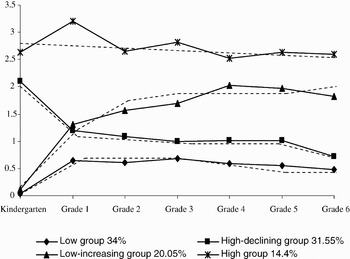
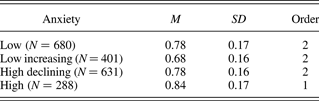
Models from two to four groups were estimated using the TRAJ procedure. A four-group solution was found to be optimal (BIC = −21,786.98) compared to the two-group model (BIC = −21,928.88), and the three-group model (BIC = −21,852.20). Figure 1 illustrates trajectories of anxiety where solid lines represent actual trajectories (i.e., mean scores for children in groups identified) and dotted lines represent predicted trajectories, calculated using the model's coefficient estimates. Children within each trajectory group shared similar patterns of variation and levels of anxiety during their elementary school years. Table 1 presents mean assignment probabilities, which were conditional on assignment based on the maximum probability rule. Probabilities of belonging to each group varied from .68 to .78.
Anxiety trajectories during elementary-school years.

Mean assignment probabilities to group trajectories for anxiety (conditional on assignment by maximum probability rule)
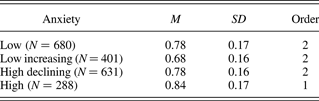
Note: The order indicates whether the trajectory was fit with a linear (1) or cubic (2) function.
The first group (N = 680) comprised 34% of the sample. This group, labeled the “low group,” included children who experienced slight fluctuations in symptoms of anxiety from kindergarten to Grade 6, but at continually lower levels than those of other children. The cubic parameter was statistically significant (p < .001). The second group (N = 401) constituted 20.05% of the sample and was labeled the “low-increasing group.” The level of anxiety experienced by these children increased markedly from kindergarten to the end of Grade 2, peaking in Grade 4 and then remaining more or less stable until the end of elementary school. The cubic trajectory was statistically significant (p < .001). The third group (N = 631) constituted 31.55% of the sample and was labeled the “high-declining group.” These children's level of anxiety was high in kindergarten, declined considerably as of the following year (Grade 1) and remained stable until Grade 5. In Grade 6, these children's level of anxiety was comparable to that of children in the low group. Again, the cubic parameter for this trajectory was statistically significant (p < .001). Finally, the fourth group included an estimated 14.4% of the sample (N = 288) and was labeled the “high group.” This group of children followed a trajectory indicating a high level of anxiety that slowly declined across measurement times. The linear trajectory was statistically significant (p < .001).
A contingency analysis was conducted to determine whether the distribution of boys and girls was similar in each trajectory group. The results of a chi-square difference test showed that trajectory groups did not differ significantly for boys and girls (χ2 = 6.37, df = 3, p = .10), indicating that trajectories were invariant across gender.
Predicting trajectory group membership
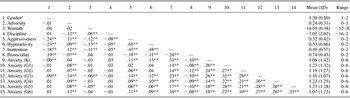
Preliminary analyses were conducted to determine the bivariate correlations among gender, sociofamily adversity, maternal parenting, children's behavioral characteristics, and anxiety. As Table 2 indicates, except for moderate correlations involving aggressiveness, hyperactivity, and inattention (rs = .47–.65), the magnitude of relations between the predictive variables was modest (rs = −.24–.36), thus suggesting that these variables were relatively independent of each other, although their correlations were all in the expected directions.
Bivariate correlations, means (standard deviations), and range of control, predictive, and outcome variables

aGirls serve as the reference group.
*p < .05. **p < .01.
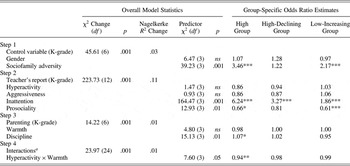
A series of multinomial logistic regression analyses were performed to examine the contribution of children's behavioral characteristics and mothers’ socialization practices, as assessed at the beginning of schooling, that is, kindergarten. Contrasts between the trajectory groups were defined beforehand such that a given group could be compared to a reference group. In this case, the low anxiety group was compared with the groups exhibiting higher levels of anxiety (i.e., low-increasing, high-declining, and high groups). Logistic regressions were then performed on these groups while respecting the variables' order of entry, involving four steps: in the first step, the children's gender and sociofamily adversity were included as control variables; in the second step, the children's behavioral characteristics in kindergarten were added to the control variables; in the third step, the mothers' socialization practices were inserted into the previous variables; and last, two-way interactions were added to the equation to determine whether the children's behaviors contributed in a different way to the prediction of anxiety groups based on the degree of warmth and discipline shown by the mother. Eight interaction terms were performed: Aggressiveness × Warmth, Aggressiveness × Discipline, Hyperactivity × Warmth, Hyperactivity × Discipline, Inattention × Warmth, Inattention × Discipline, Prosociality × Warmth, and Prosociality × Discipline.Footnote 1 The results of these analyses are presented in Table 3.
Summary of multinomial logistic regression analyses predicting developmental trajectories of anxiety

Note: Girls serve as the reference group. The low group serves as comparison group for model test and odds ratios.
aOnly significant interaction terms are shown in the table.
*p < .05. **p < .01. ***p < .001.
High group (vs. low group)
The results of the multinomial logistic regression analyses indicated that the probability of belonging to the high group was greater for children facing adversity within their families (odds ratio = 3.46, p < .001) and who were perceived by their teachers to be inattentive in the classroom (odds ratio = 6.24, p < .001). In contrast, the probability of belonging to this group was lower for children who were perceived to be socially competent (odds ratio = 0.66, p < .05). Finally, children whose mothers tended to apply rules and control their behaviors had a strong probability of belonging to the high group (odds ratio = 1.07, p < .05). The children's gender, their manifestations of hyperactivity and aggressiveness, as well as maternal warmth did not make any significant contribution.
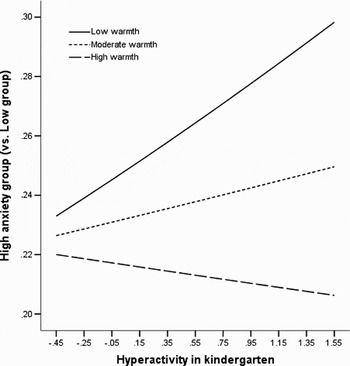
Furthermore, the interactions also affected the probability of belonging to the high group. More specifically, one effect proved to be significant: Hyperactivity × Warmth (odds ratio = 0.94, p < .01). This effect was analyzed in detail using the procedure put forward by Flom and Strauss (Reference Flom and Strauss2003) to interpret the interactions in logistic regression. This procedure determined the warmth level(s) reported by the mother (i.e., low or 25th percentile, moderate or 50th percentile, and high or 75th percentile) at which the child's hyperactivity was associated with the probability of belonging to the group of most anxious children. Figure 2 shows that the probability of belonging to the high group was higher for hyperactive children interacting with mothers who showed little affective warmth.
The probability of belonging to the high-anxiety group as a function of children's hyperactivity and mothers' warmth behaviors.

High-declining group (vs. low group)
Multinomial logistic regression analyses revealed that the probability of belonging to the high-declining group was greater for children who were perceived to be inattentive in kindergarten (odds ratio = 3.27, p < .001), over and beyond gender and sociofamilial adversity. No additional information was provided by the children's gender, hyperactivity, aggressiveness, prosocial behaviors, mothers' socialization practices, or even by interaction terms.
Low-increasing group (vs. low group)
The results of the last series of analyses showed that sociofamilial adversity, inattention, and low prosociality contributed to the probability of belonging to the low-increasing group. Specifically, a high level of sociofamilial adversity and a high level of inattention in the classroom increased the probability of belonging to the low-increasing anxiety trajectory group (odds ratio = 2.17, p < .001, and odds ratio = 1.86, p < .001, respectively). In contrast, the probability of following this trajectory was lower for children who were less inclined to adopt prosocial behaviors toward their peers (odds ratio = 0.61, p < .001). No additional information was provided by other variables and interaction terms.
Discussion
This study contributes in at least three ways to the advancement of knowledge related to the manifestations of anxiety in school-aged children. First, the results support the existence of different trajectories of anxiety from kindergarten to the end of Grade 6. Second, anxious children are different from their less anxious peers, based on certain behavioral characteristics that can be observed in the classroom. Third, the results partially support the hypothesis of a moderating effect of maternal parenting in the association between children's behavioral characteristics and the development of anxiety during the first years of schooling.
Trajectories of anxiety during childhood
The presence of multiple trajectories of anxiety is consistent with the developmental psychopathology perspective that highlights the heterogeneous nature of development (Cicchetti & Rogosch, Reference Cicchetti and Rogosch2002; Rutter, Reference Rutter2002). In this study, the good news is that slightly more than 6 out of 10 children exhibited low anxiety symptoms at the end of elementary school. Slightly more than half of these children exhibited very little anxiety from kindergarten to Grade 6 (low group), whereas the others showed some anxious reactions to kindergarten, which gradually declined as of Grade 1 (high-declining group). In contrast, slightly more than one-third of children left elementary school with some signs of anxiety exhibited in the classroom. Some of these children belonged to the high-anxiety trajectory group in kindergarten, and this situation remained unchanged throughout their elementary school years. For others, anxiety seemed rather to appear in Grade 1 and insidiously increase right through to the end of elementary school (low-increasing group). These results are compatible with those reported in other longitudinal studies that applied a group-based approach to model the trajectories of anxiety (Côté et al., Reference Côté, Tremblay, Nagin, Zoccolillo and Vitaro2002; Duchesne et al., Reference Duchesne, Vitaro and Tremblay2008; Feng et al., Reference Feng, Shaw and Silk2008). Moreover, the trajectories identified in this study seem to apply equally to girls and boys, which is consistent with the data reported by Duchesne et al. (Reference Duchesne, Vitaro and Tremblay2008) and with studies showing that the difference in the gender ratio of anxiety disorders does not occur before age 13 or 14 (see Bittner et al., Reference Bittner, Egger, Erkanli, Costello, Foley and Angold2007; Kendall et al., Reference Kendall, Hedtke, Aschenbrand, Wolfe and Mash2006). Finally, although we cannot affirm that teachers are more valid informants than mothers in assessing children's anxiety, our results converge with those of other studies that suggest that the teacher's viewpoint appears to be relevant in identifying anxious children (Côté et al., Reference Côté, Tremblay, Nagin, Zoccolillo and Vitaro2002; Layne et al., Reference Layne, Bernstein and March2006).
Behavioral characteristics and maternal parenting of anxious children
The results reveal that children perceived by their teachers to be inattentive have a greater probability of belonging to the high, high-declining, and low-increasing anxiety trajectory groups than to the low group. The existence of a particular link between inattention and the high- and low-increasing anxiety trajectory groups could be explained by the academic difficulties encountered by these children. It has been well established that children with a limited capacity for attention (e.g., poor concentration, distractibility) are likely to perform less well at school (DuPaul et al., Reference DuPaul, Volpe, Jitendra, Lutz, Lorah and Gruber2004; Fergusson & Horwood, Reference Fergusson and Horwood1992). For these children, it is possible that these poor performances become a source of anxiety and excessive worries. A reinforcement mechanism that operates as continual performance feedback could gradually set in such that these anxious manifestations interfere with the capacity for attention, which in return, contributes to developing, maintaining, or aggravating anxiety.
The association between inattention and the high-declining trajectory of anxiety is intriguing, to say the least, considering that, from Grade 1 to Grade 6, these children's level of anxiety is comparable to that of children who are less anxious. However, this result could be partly attributed to the stress caused by the transition to kindergarten. For most children, starting school involves not only being in a completely new physical environment, but also having to deal with unfamiliar peers and meeting the expectations of strangers in a position of authority (Coplan & Ardeau, Reference Coplan and Arbeau2008; Duda & Minick, Reference Duda and Minick2006). It is therefore plausible that this period of adjustment could generate, among some children, enough stress to affect their level of attention and lead to the manifestation of anxious feelings. Taking into account the symptoms of anxiety before the start of kindergarten would allow this hypothesis to be validated.
The results also show that children who exhibit few prosocial behaviors toward their classmates are more likely to belong to the high- and low-increasing anxiety trajectory groups rather than the low group. Other researchers have also shown that children's social adjustment problems were associated with anxiety (e.g., Fox et al., Reference Fox, Henderson, Marshall, Nichols and Ghera2005; Olsen & Rosenblaum, Reference Olson and Rosenblaum1998; Strauss, et al., Reference Strauss, Lahey, Frick, Frame and Hynd1988; Vitaro et al., Reference Vitaro, Brendgen, Larose and Tremblay2005). This association might reflect these children's difficulty in initiating and participating in positive socialization experiences with their peers, which foster the establishment of a mutual support system (Chen & French, Reference Chen and French2008; Eisenberg & Mussen, Reference Eisenberg and Mussen1989; Godde & Engfer, Reference Godde, Engfer, Nestmann and Hurrelmann1994). Because they are deprived of such a source of support at school, it is plausible that these children are less immunized to deal with the stress of daily life, thus predisposing them to develop anxiety symptoms. Once anxiety sets in, it can then gradually crystallize as a result of the negative responses communicated by the child's peers, in particular, in the form of exclusion (Chen & French, Reference Chen and French2008; Rubin, Bukowski, & Parker, Reference Rubin, Bukowski, Parker and Eisenberg1998).
Furthermore, present findings indicate that children who exhibit signs of hyperactivity are more likely to belong to the high-anxiety trajectory group than the low-anxiety trajectory group. This probability, however, is greater for children who interact with mothers who show little affective warmth. This result supports the hypothesis of the mitigating effect of maternal warmth. This result can be compared with a statement stemming from the developmental psychopathology perspective to the effect that parental behaviors appear to interact with some of the child's attributes, and that these two factors combine to influence his or her development trajectory (Cummings et al., Reference Cummings, Davies and Campbell2000). Thus, the hypothesis of a tripartite association involving hyperactivity, adjustment, and parenting can be envisaged to account for the intensity of anxious symptoms in children throughout their elementary school years. Research has often associated hyperactivity (and attention-deficit/hyperactivity disorder) symptoms with major social and academic problems (e.g., Barkley, Reference Barkley2005). Thus, children's manifestations of anxiety could be the indirect result of adjustment problems, following excessive agitation. The severity with which anxiety will be manifested depends, partly, on the warm behaviors adopted by the mother. By being accessible, sensitive, and supportive, the mother fosters the establishment of an emotional climate that may reduce her child's anxiety that might result from poor academic performance and negative experiences of socialization with peers. However, further research is needed to confirm this hypothesis.
Finally, the results indicate that mothers whose children follow a high-anxiety trajectory seem to exert a higher level of discipline in kindergarten than mothers whose children manifest little or no anxiety. This finding goes against the hypothesis formulated in this study, which suggested that parental discipline could act as a protective factor in the development of anxious symptoms. This same hypothesis was based on studies that have demonstrated that the setting and application of rules at home were associated with a decrease in anxiety (e.g., Barber et al., Reference Barber, Olsen and Shagle1994; Galambos et al., Reference Galambos, Barker and Almeida2003; Mattanah, Reference Mattanah2001). However, it is useful to point out that the estimation coefficient of the probabilities of this factor is barely greater than 1, thus suggesting that maternal discipline plays a relatively modest role. Nevertheless, this result can be interpreted in relation to the developmental psychopathology perspective, which argues that children's adjustment is the result of the interaction between their personal characteristics and those of their environment (Cicchetti & Rogosch, Reference Cicchetti and Rogosch2002). Thus, the child's anxious behaviors could make the mother tighten her disciplinary strategies (e.g., autocratic decisions, overprotection), reflecting her intention to protect the child from some threats or to help ease the child's distress (DiBartolo & Helt, Reference DiBartolo and Helt2007; Wood et al., Reference Wood, McLeod, Sigman, Hwang and Chu2003). Such efforts could unfortunately contribute to stabilizing the child's anxiety by limiting the exploratory behaviors needed to acquire the cognitive and social skills that make it easier to deal with stressful life events.
Implications
The identification of trajectories of anxiety has significant implications in terms of intervention, especially for children belonging to the high- and low-increasing anxiety trajectory groups. These children are not only anxious during elementary-school years, but are also at risk of lacking the capacity to maintain their attention and to enter into a relationship with their classmates. In addition, mothers of children who follow a high anxiety trajectory (high group) seem to use discipline at home to a greater extent than mothers of less anxious children. They also appear to show less warmth when their children exhibit signs of hyperactivity at school. The identification of these groups of children has raised the need to intervene early and over a long period of time, especially because early manifestations of anxiety tend to persist over many years (Bernstein & Borchardt, Reference Bernstein and Borchardt1991; Last et al., Reference Last, Perrin, Hersen and Kazdin1996) and predict unfavorable consequences such as high school noncompletion (Duchesne et al., Reference Duchesne, Vitaro and Tremblay2008). Thus, the school setting is a highly appropriate place to identify these children, implement preventive activities, and structure psychosocial interventions that include various services to respond to their needs (Duchesne et al., Reference Duchesne, Vitaro and Tremblay2008; Tomb & Hunter, Reference Tomb and Hunter2004).
Limitations
Although the current investigation contains several methodological strengths (e.g., longitudinal approach, repeated assessments, large sample, multiple informants), future research designs should address some limitations. First, the results can be generalized only for a nonclinical sample of children who are mostly Caucasian, French-speaking, and from a middle socioeconomic background. Further research should be conducted on clinical samples of children exhibiting more severe anxiety symptoms. Second, it has been argued that certain behavioral characteristics in kindergarten (aggressiveness, hyperactivity, inattention, and low prosociality) may be associated with the development of anxiety among children over time. It is possible that these characteristics also reflect certain manifestations of anxiety. Among young children, agitation, fits of anger, inattention, and social withdrawal are all typical manifestations of anxiety (American Psychiatric Association, 2000). However, in this study, the examination of correlations revealed that symptoms of anxiety were weakly associated with children's behavioral characteristics, thus suggesting that these constructs are relatively distinct. Further studies are nevertheless needed to clarify the nature of the association between these constructs. Third, the trajectories of anxiety were assessed starting in kindergarten, when the children were 6 years old. Given that anxiety can manifest itself earlier in child development (Feng et al., Reference Feng, Shaw and Silk2008; Zahn-Waxler et al., Reference Zahn-Waxler, Klimes-Dougan and Slattery2000), it would be useful to conduct assessments before children enter school so that anxious children can be identified as rapidly as possible. Fourth, some studies have provided evidence that anxiety tends to be a family phenomenon, such that anxious children tend more to have parents who are anxious themselves and who adopt inappropriate parental behaviors (see Ballash et al., Reference Ballash, Leyfer, Buckley and Woodruff-Borden2006; Kendall & Suveg, Reference Kendall, Suveg and Kendall2006). It would be relevant to consider the presence of anxious symptoms in the mother as a potentially confounding variable. Fifth and finally, only maternal parenting was retained as a variable. Future research should explore the father's role in the development of anxiety during childhood.
Conclusion
This study aimed to examine the trajectories of anxiety in children who were followed from kindergarten to the end of elementary school, to identify the behavioral characteristics associated with these trajectories, and to determine whether positive maternal parenting could modulate or compensate for the association between these characteristics and the trajectories of anxiety. By examining the trajectories, it was possible to isolate a group of children who were more anxious (14% of the sample) than their peers. The children belonging to this group were more likely to be inattentive and not very prosocial at the beginning of their schooling. They also appeared to be more exposed to disciplinary practices at home. In addition, children who exhibited signs of hyperactivity in kindergarten were less at risk of belonging to this group, only if their mothers showed affective warmth. For these children, this type of maternal behavior seems to constitute a significant protective mechanism in preventing the appearance of high levels of anxiety throughout the elementary school years. These results make a good case for a multimodal intervention involving both the school and the parents of these children.