Implications
Animal welfare assessment at abattoirs has several advantages over traditional farm-based assessments. However, the extent to which routine carcass processing either masks or enhances the visibility of key welfare lesions is unclear. This research has confirmed that the visibility of loin bruising and tail lesions is improved by scalding and dehairing of carcasses. Mild apparent aggression-related skin lesions are less visible, but severe skin lesions appear to become more visible following these processes. This research also reinforces earlier findings, which suggest a link between welfare-related carcass damage and both increased carcass condemnations and reduced carcass weight, strengthening the argument that reducing these lesions will have economic benefits.
Introduction
There is increasing interest in developing abattoir-based measures to assist in determining the welfare status of pigs (Harley et al., Reference Harley, Boyle, O’Connell, More, Teixeira and Hanlon2012b). In addition to avoiding biosecurity issues associated with entering farms, abattoir-based welfare assessment avoids potential problems associated with having to assess animals in crowded, dirty or poorly-lit conditions (Edwards et al., Reference Edwards, Johnston and Mead1997; Velarde et al., 2005). However, the extent to which routine carcass processing, in the form of scalding and dehairing, either masks or unveils key welfare-related skin lesions in pigs is unclear. Understanding these effects may help to answer questions such as whether ante- or postmortem lesion inspection is the best option for abattoir-based welfare assessment in pigs.
Stärk et al. (Reference Stärk, Alonso, Dadios, Dupuy, Ellerbroek, Georgiev, Hardstaff, Huneau-Salauen, Laugier, Mateus, Nigsch, Afonso and Lindberg2014) note that bruising to the skin of pigs is more likely to be observed at postmortem rather than antemortem inspection. This suggests that the scalding and dehairing of pig carcasses make bruising to the skin more visible, and it is possible that other types of skin damage will also become more visible on the carcass after it has been subjected to these processes. On the other hand, it has been suggested that scalding and dehairing of the carcass may remove evidence of mild skin damage (Aaslyng et al., Reference Aaslyng, Brandt, Blaabjerg and Støier2013) and tail lesions (Taylor et al., Reference Taylor, Main, Mendl and Edwards2010). These theories have yet to be tested in a controlled manner.
Assessing the prevalence of welfare issues in farm animals is important, as it can be used as a point of reference for benchmarking purposes. Tail lesion prevalence data collected on farms is seldom used to determine nation-wide prevalence (Taylor et al., Reference Taylor, Main, Mendl and Edwards2010). Furthermore, only a handful of isolated studies have examined tail lesion prevalence by carrying out abattoir-based assessments (Hunter et al., Reference Hunter, Jones, Guise, Penny and Hoste1999; Valros et al., Reference Valros, Ahlstrom, Rintala, Hakkinen and Saloniemi2004; Harley et al., Reference Harley, More, Boyle, O’Connell and Hanlon2012a). Similarly, information on loin bruising prevalence is limited, perhaps due to the fact that it has only recently been identified as a welfare issue (Harley et al., Reference Harley, More, O’Connell, Hanlon, Teixeira and Boyle2014). Skin lesions, on the other hand, have been studied for decades. Despite this, few studies have examined skin lesion prevalence, particularly in an animal welfare context (Nielsen et al., Reference Nielsen, Michelsen, Jensen, Barington, Opstrup and Agger2014). Skin lesions are a concern as they can reflect poor social and physical environments (Dalmau et al., Reference Dalmau, Temple, Rodriguez, Llonch and Velarde2009). Indeed, along with tail lesions, skin lesions were recently deemed to be one of the most important indicators of pig welfare status by a panel of international animal welfare experts (European Food Safety Authority, 2012). In addition to determining prevalence of welfare-related lesions, understanding how they relate to production traits may also be important in establishing priorities for addressing them.
The primary aim of this study was to determine the most appropriate place on the slaughter line to conduct assessments of welfare-related lesions, namely apparent aggression-related skin lesions (hereafter referred to as ‘skin lesions’), loin bruising and apparent tail biting damage (hereafter referred to as ‘tail lesions’). This research also lent itself to an assessment of the prevalence of these lesions. Furthermore, relationships between the presence of welfare-related lesions and production parameters such as carcass weight and level of carcass condemnation were explored.
Material and methods
This research was conducted over 6 days in each of two commercial pig abattoirs on the island of Ireland in July 2014. One abattoir was located in Northern Ireland (NI) (abattoir A) and one in the Republic of Ireland (ROI) (abattoir B). Pigs from both NI and ROI were slaughtered in abattoir A, whereas only pigs from ROI were slaughtered in abattoir B. The presence and severity of different welfare-related lesions was recorded in 1950 pigs in abattoir A and 1939 pigs in abattoir B. Only finishing/fattening pigs were assessed.
Determination of sample size
Sample size determination was based on requirements to assess prevalence of skin lesions. This was because pig skin lesion prevalence had not yet been determined on the Island of Ireland to our knowledge, and therefore was the main focus when examining welfare lesion prevalence. Sample size was determined by considering the total number of pig farms on the island of Ireland (~400 pig farms account for the vast majority of the pig population (Teagasc, 2011; Department of Agriculture and Rural Development, Reference D’Eath2013) and the frequency of skin lesions (~70% of the pig population on average have skin lesions, based on previous studies, Warriss et al., Reference Warriss, Brown, Gade, Santos, Costa, Lambooij and Geers1998; Guardia et al., Reference Guardia, Estany, Balasch, Oliver, Gispert and Diestre2009; Aaslyng et al., Reference Aaslyng, Brandt, Blaabjerg and Støier2013). Population size (400), average proportion of pigs with skin lesions (0.70), 95% confidence level and a standard error of 0.05 were entered into the National Statistics Service sample size calculator (National Statistics Service, 2014). Based on this information, the required number of farms was 70. Previous research showed that the average batch size of pigs submitted to abattoirs on the island of Ireland was 142 (Harley et al., Reference Harley, More, Boyle, O’Connell and Hanlon2012a). It was decided that one-third of pigs in each batch (~47 pigs) would be assessed. This figure was chosen as: (a) it would allow the assessment of every third pig on the slaughter line (which seemed practically feasible), and (b) it was similar to the figure of 50 pigs that is used in commercial pig health assessment schemes (BPEX, 2010) and has been deemed adequate for detection of health and welfare issues postmortem (Sanchez-Vazquez et al., Reference Sanchez-Vazquez, Strachan, Armstrong, Nielen and Gunn2011). The required number of pigs for assessment was thus calculated to be 3313. This figure was increased by 15% to account for clustering effects. Thus, the final required sample size was 3810 pigs. As a result of scoring carcasses at varying line speeds between abattoirs, there was variation in the number of farms that were assessed between abattoir A and B. However, as abattoir A processed pigs from both regions of Ireland, there were a comparable number of farms from both regions in the final data set.
Abattoir handling and slaughter practices
At both abattoirs, pigs were unloaded from the lorry and driven into lairage pens using a pig board and a paddle when deemed necessary. In abattoir A, pigs exited the lairage through a horizontal gate, and were driven to a CO2 chamber in small groups by moveable walls. One operator used a paddle to move the pigs into the final holding position preceding the CO2 chamber. In abattoir B, pigs exited the lairage through vertically moving gates that doubled as moving walls. Pigs were driven from this area by one operator using a paddle and pig board. A second operator used a paddle to separate the pigs into smaller groups by moving them through a second vertical gate. Two more operators moved pigs to the final holding position preceding the CO2 chamber using a paddle. In both abattoirs, pigs were lowered into the CO2 chambers and stunned. After stunning, pigs were hung by their hind legs for exsanguination.
Pigs were submerged in the scalding tank for 7.5 min in abattoir A, in water heated to between 58.5°C and 62°C. At abattoir B, pigs were submerged in the scalding tank for 10 min in water heated to 62°C. Pigs passed through a singeing furnace followed by a scraping tunnel where rubber scrapers removed residual hair.
Data collection
Data were collected at each abattoir for 6 consecutive days in July 2014 (excluding weekends). Data collection began at 0900 h and continued for ~5 h each day until the required sample size was reached. Total required sample size was divided evenly among the data collection days (346 pigs/day) with day 1 dedicated to inter-rater reliability scoring (see the next section). Two trained researchers took positions on the slaughter line; Researcher 1 was positioned at the beginning of the line immediately following the exsanguination area (slaughter stage 1 (SS1)). Researcher 2 was positioned on the line following scalding and dehairing of the carcass (slaughter stage 2 (SS2)). The researchers alternated between positions SS1 and SS2 daily, and both spent an equal amount of time scoring at each position. Each carcass took ~25 min to pass from SS1 to SS2. An assistant was located at SS1. The assistant gave each pig an individual ink tattoo number to ensure that it was identifiable at both data collection points. These numbers were placed on the upper back area of the pig so as not to disguise or be confused with the farm identification number which was usually tattooed on the shoulder region. As stated previously, it was initially planned to assess every 3rd carcass on the slaughter line at both abattoirs. However, this was not practically possible due to the substantial differences in line speed between the two abattoirs. Every 4th pig to pass along the slaughter line was scored at abattoir A, and every 2nd pig was scored at abattoir B.
Dark-haired pig breeds were rarely seen. However, when present, the pig succeeding the dark-haired pig was scored. These pigs were avoided as lesion visibility at SS1 would have been significantly reduced.
Injury scoring measures
Loin bruises
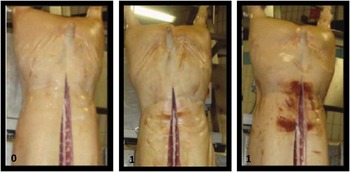
A simplified version of Harley et al.’s (Reference Harley, More, O’Connell, Hanlon, Teixeira and Boyle2014) loin bruise scoring system was used whereby ‘mild’ and ‘severe’ bruise categories were combined. Therefore, loin bruises were recorded as being either present (when observed in either mild or severe form) or absent (Figure 1).
Pig loin bruise scoring system used at slaughter stage 1 and slaughter stage 2. (0) Absent, (1) present.

Tail lesions
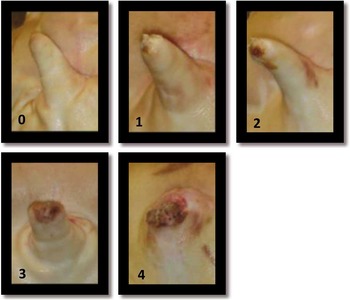
Tail lesions were scored using an adapted version of Kritas and Morrison’s (Reference Kritas and Morrison2007) tail scoring system used by Harley et al. (Reference Harley, More, Boyle, O’Connell and Hanlon2012a) (Figure 2).
Pig tail lesion scoring system used at slaughter stage 1 and slaughter stage 2. (0) No evidence of tail biting, (1) mild/healed lesions, (2) evidence of chewing or puncture wounds, but no evidence of swelling, (3) evidence of chewing or puncture wounds, with swelling and signs of possible infection, and (4) partial or total loss of tail.

Skin lesions
A skin lesion scoring system developed by Aaslyng et al. (Reference Aaslyng, Brandt, Blaabjerg and Støier2013) was used in this study. Scores ranged from 0 to 3; (0) no damage, or a little superficial damage; (1) some superficial damage, clearly marked or up to three short (2 to 3 cm) and deep lesions; (2) clear deep and/or long damage (>3 cm) including much superficial damage or circular areas; (3) much deep damage. More information on this scoring system can be found at http://www.dti.dk/international/icomst-2013/assessment-and-incidence-of-skin-damage-in-slaughter-pigs/33756,2
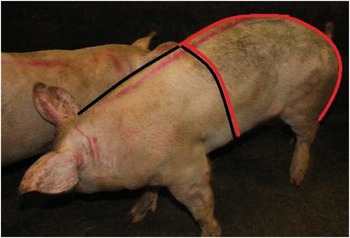
The carcass was scored for skin lesions in two parts (Figure 3), the ‘rear’ region and the ‘front’ region. The ‘rear’ region was defined as the loin and everything below it. The ‘front’ region was defined as everything above the loin. Both sides of the carcass were scored as the carcass passed along the slaughter line. Each animal was given an overall skin lesion score based on the highest score assigned to that animal in either body region. Tails were not included in the scoring of skin lesions (as they were scored separately).
Front (everything above the loin) and rear (the loin and everything below it) body regions of the pig used for assessing skin lesions at slaughter stage 1 and slaughter stage 2.

Inter-rater reliability
In order to ensure that any differences in skin lesions, tail lesions and loin bruising scores were due to varying levels of lesion visibility as opposed to rater effects, inter-rater reliability tests were carried out before data collection. The scoring system for each welfare-related lesion was first viewed by both raters and discussed to gain consensus in the scores that should be assigned to each lesion type. Previous literature suggests that levels of agreement become stable after the 5th scoring event (March et al., Reference March, Brinkmann and Winkler2007; D’Eath, 2012). Therefore, five sessions were each conducted at SS1 and SS2. Sample sizes of 300 (60 pigs×5 sessions) and 150 (30 pigs×5 sessions) were used for the testing and training sessions, respectively. In each training session, both researchers jointly scored every 3rd carcass passing on the slaughter line until the required number of pigs had been assessed. Any disagreements in assigned scores were discussed. Each testing session involved blind scoring of every 3rd carcass passing on the slaughter line until 60 carcasses were assessed. During testing sessions the researchers scored the same carcasses independently. Levels of agreement between raters was analysed using the interclass correlation coefficient test. Very good (>0.80) levels of agreement were reached by the final scoring event.
Other measures
For individual pigs, information on the sex (entire male or female) and farm of origin was taken from the carcass at SS2. Tail-dock status was recorded at both slaughter stages. Meat inspection data were collected at the end of each day. This included information on the number of whole and partial condemnations for each batch of pigs with a particular farm identification number on a given day. In addition, average cold carcass weights (CCW) for each batch of pigs were obtained at abattoir B. This information was unavailable at abattoir A.
Statistical analysis
In a repeated measures design, the effects of slaughter stage (SS1 v. SS2) on skin lesion, tail lesion and loin bruise scores were examined at the individual animal level using McNemar and McNemar-Bowker tests for dichotomous (loin bruising) and ordinal (skin and tail lesions) variables, respectively. The prevalence of skin lesions, tail lesions and loin bruising (i.e. >0) was determined using descriptive statistics. Prevalence of skin lesions was based on values recorded at SS1, and prevalence of tail lesions and loin bruising was based on values recorded at SS2 (please see the ‘Results’ section for explanation), and these data were also used for calculations below. Using Pearson’s correlations, associations were examined between the batch-level percentage of animals with welfare-related carcass damage (skin lesions, tail lesions and loin bruising) and the batch-level percentage of pigs whose carcasses were partially or fully condemned. The batch-level percentage of animals with skin lesions, tail lesions and loin bruising was also compared with average batch-level CCW for pigs slaughtered at abattoir B. Relevant data met the assumptions of the Pearson’s correlation test. All statistical analysis was carried out using SPSS version 20.
Results
In total, 110 batches of pigs from 96 farms were assessed. The number of batches was greater than the number of farms assessed due to some farms sending pigs to both abattoirs. The average batch size was 127 pigs. A slight majority of pigs assessed were male (52.1% v. 47.9%), and all pigs, excluding one, appeared to be tail-docked.
The effect of scalding and dehairing of carcasses on the visibility of lesions
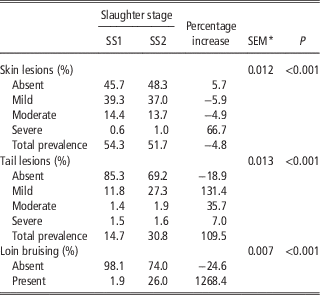
Average skin lesion, tail lesion and loin bruise scores changed significantly between SS1 and SS2 (P<0.001, see Table 1). The percentage of animals with a detectable skin lesion decreased, whereas those with loin bruising or a detectable tail lesion increased. It is worth noting, however, that the percentage of pigs observed to have severe skin lesions increased numerically between SS1 and SS2.
Effects of slaughter stage (SS1 v. SS2) on prevalence of skin lesions, tail lesions and loin bruising in pigs

SS1=slaughter stage 1; SS2=slaughter stage 2.
* SEM is based on the lesion scores from the slaughter stage with the highest level of lesion detection, that is SS1 for skin lesions and SS2 for tail lesion and loin bruising.
Welfare-related carcass lesion prevalence
The prevalence of skin lesions, tail lesions and loin bruising is based on the slaughter stage with the highest level of lesion detection that is SS1 for skin lesions and SS2 for tail lesion and loin bruising (Table 1).
Relationship between welfare-related carcass lesions, and carcass parameters
Partial carcass condemnations were moderately correlated with the batch-level frequency of skin lesions (r=0.358, P<0.001), tail lesions (r=0.413, P<0.001) and loin bruising (r=0.499, P<0.001). Associations between whole carcass condemnations and skin lesions, tail lesions and loin bruising were not statistically significant (P>0.05). Average CCWs were strongly and negatively associated with the percentage of pigs per batch with skin lesions (r=−0.667, P<0.001), tail lesions (r=−0.615, P<0.001) and loin bruising (r=−0.739, P<0.001).
Discussion
Effect of slaughter processes on visibility of skin lesions, tail lesions and loin bruising
There are conflicting suggestions on the effects of routine processing of carcasses at abattoirs (such as scalding and dehairing) on the visibility of skin lesions, tail lesions and loin bruising. Some researchers argue that these processes could make welfare-related carcass damage difficult to detect (Taylor et al., Reference Taylor, Main, Mendl and Edwards2010; Aaslyng et al., Reference Aaslyng, Brandt, Blaabjerg and Støier2013). However, others suggest that this damage may be more detectable after these processes (Harley et al., Reference Harley, More, O’Connell, Hanlon, Teixeira and Boyle2014; Stärk et al., Reference Stärk, Alonso, Dadios, Dupuy, Ellerbroek, Georgiev, Hardstaff, Huneau-Salauen, Laugier, Mateus, Nigsch, Afonso and Lindberg2014). It appears that the current study is the first to actually investigate this in a controlled way.
The findings show that tail lesions of every severity category become more visible after scalding and dehairing. The percentage increase in the visibility of mild tail lesions from SS1 to SS2 was particularly high (131.4% increase). Tail lesions, particularly more serious lesions, are related to secondary conditions such as abscessation and pleuritic lesions of the lungs (Huey, Reference Huey1996; Marques et al., Reference Marques, Bernardi, Coelho, Almeida, Morales, Mores, Borowski and DESN2012), and are associated to a greater extent with trimming of the carcass than milder lesions (Kritas and Morrison, Reference Kritas and Morrison2007). Nonetheless, even mild tail lesions are associated with carcass condemnations and reduced carcass weights (Harley et al., Reference Harley, More, Boyle, O’Connell and Hanlon2012a and Reference Harley, More, O’Connell, Hanlon, Teixeira and Boyle2014). Therefore, scoring of tail lesions after, rather than before, scalding and dehairing of carcasses offers clear advantages if the information is to be used to inform herd health and welfare management plans. It is possible that damage caused to the carcass by the scalding and dehairing processes could have been misinterpreted for tail biting injuries, however this is unlikely. Informal observations suggested that machinery-related damage to the carcass manifested as shredding and peeling of the skin. These lesions lacked colour which most likely reflected the fact that they occurred after exsanguination. Tail lesions, on the other hand, were coloured (even in mild cases), had visible bite marks or, in the case of healed tail lesions, had significant scar tissue.
The results clearly showed that loin bruising was much more evident at SS2 than at SS1, and should therefore be recorded at this point. It follows from this that bruising to other areas of the body may also become more visible subsequent to scalding and dehairing of the carcass. The removal of dirt and hair that was present at exsanguination could perhaps explain the increased visibility of bruising. However, given the almost 13-fold increase in bruise visibility from SS1 to SS2, it is likely that other factors are influencing its perceptibility. Bruises are formed when blood leaks from capillaries and becomes trapped under the skin (Robin et al., Reference Robin, Courderot-Masuyer, Tauzin, Harbon, Chavagnac-Bonneville, Cadars, Jourdan, Trompezinski and Humbert2015). A possible factor contributing to the increased visibility of bruises at SS2 was a greater contrast in colour with non-bruised skin as time since exsanguination increased. At SS1 the process of exsanguination had just begun, and it is reasonable to assume that the (non-bruised) skin tone of pigs become lighter as this process completed. This explanation is merely speculative, however, and further research is required to explain why bruise visibility increased following processing of the carcass.
The best stage for assessing skin lesions on the slaughter line was less clear. The prevalence of mild and moderate skin lesions decreased between SS1 and SS2 by 5.9% and 4.9%, respectively. This suggests that some evidence of milder skin lesions is removed by scalding and dehairing. However, the prevalence of severe skin lesions increased by 66% between SS1 and SS2, suggesting that they may previously have been concealed by hair and dirt. Therefore, scoring of skin lesions at SS2 appears more effective in detecting serious skin damage. The severity of skin lesions scored on the carcass has been found to be positively associated with the levels of aggressive interactions that pigs have been subject to (Teixeira and Boyle, Reference Teixeira and Boyle2014). Thus, it could be argued that scoring of skin lesions subsequent to scalding and dehairing of carcasses gives the best indication of the levels of aggressive interactions on farm.
Skin lesions, tail lesions and loin bruising prevalence
Only a limited number of previous studies have examined skin lesion prevalence in pigs (e.g. Nielsen et al., Reference Nielsen, Michelsen, Jensen, Barington, Opstrup and Agger2014). The current study appears to be the first to assess the prevalence of skin lesions on pigs on the island of Ireland. The relatively high percentage of pigs in this study with serious skin lesions warrants further investigation into methods of prevention. In addition, over a quarter of pigs assessed in the current study appeared to have some degree of loin bruising. A key step in reducing the prevalence of both type of skin lesion will be to gain a greater understanding of the point, or points, at which pigs sustain this damage. Distinguishing between levels of skin lesions and loin bruising attributable to general on-farm conditions, and those associated with the marketing process will be particularly important in this respect. This may be a difficult task, particularly with regard to loin bruising, the aetiology of which remains uncertain. It has been theorised that mounting behaviour contributes to loin bruising (Harley et al., Reference Harley, More, O’Connell, Hanlon, Teixeira and Boyle2014). However, there has been no conclusive evidence to date that this is the case. It is also possible that loin bruising occurs due to the handling practices employed on farm or during marketing of the animals.
Tail lesion prevalence in the current study was approximately half the prevalence reported in previous studies examining tail lesions in pig herds on the island of Ireland (Harley et al., Reference Harley, More, Boyle, O’Connell and Hanlon2012a; Harley et al., Reference Harley, More, O’Connell, Hanlon, Teixeira and Boyle2014). It is possible that this reflects a decrease in the prevalence of tail lesions in pig herds on the island of Ireland. However, the prevalence of severe tail lesions is similar between this and previous studies (i.e. Harley et al., Reference Harley, More, Boyle, O’Connell and Hanlon2012a and Reference Harley, More, O’Connell, Hanlon, Teixeira and Boyle2014).
Relationship between welfare-related carcass lesions and carcass condemnation and weight
The statistical link between welfare-related lesions and partial carcass condemnations that was shown is not evidence of a causal relationship. It is clear that on-farm management factors could independently have affected both measures, however more direct relationships can also be speculated. For example, welfare-related lesions are associated with chronic stress (e.g. hypocortisolism, Valros et al., Reference Valros, Munsterhjelm, Puolanne, Ruusunen, Heinonen, Peltoniemi and Poso2013) which can weaken the immune system, leading to greater susceptibility to disease (Reimert et al., Reference Reimert, Rodenburg, Ursinus, Kemp and Bolhuis2014). Furthermore, abscessation, the most common cause of partial carcass condemnation in Irish pig herds (Harley et al., Reference Harley, More, Boyle, O’Connell and Hanlon2012a), is directly related to welfare lesions. For example, infections originating in the tail can spread to other body regions via the blood stream and cerebrospinal fluid (Huey, Reference Huey1996), resulting in secondary abscessation. Similarly, skin lesions can lead to the spread of secondary infection (Pluym et al., Reference Pluym, Van Nuffel, Dewulf, Cools, Vangroenweghe, Van Hoorebeke and Maes2011) and may be the source of single-site abscessation in the limbs, flank and shoulders of pigs (Huey, Reference Huey1996). In general, information on the cause of partial and whole carcass condemnation in pigs is limited (Garcia-Diaz and Coelho, Reference Garcia-Diaz and Coelho2014), and improved knowledge of the risk factors involved is needed if they are to be reduced.
The association between welfare-related carcass lesion frequency and average CCW is unsurprising; previous research has found that skin and tail lesions are associated with reduced feed intake and growth due to the effects of infection and stress (Wallgren and Lindahl, Reference Wallgren and Lindahl1996; Ruis et al., Reference Ruis, te Brake, Engel, Buist, Blokhuis and Koolhaas2002; Marques et al., Reference Marques, Bernardi, Coelho, Almeida, Morales, Mores, Borowski and DESN2012). Lower carcass weights are a source of indirect financial loss to producers (Harley et al., Reference Harley, More, O’Connell, Hanlon, Teixeira and Boyle2014). Coupled with direct losses associated with carcass condemnation, the possible economic benefits of reducing skin lesions, tail lesions and loin bruising in pig populations becomes evident and should be investigated further.
Conclusion
Findings from this study indicate that tail lesions and loin bruising increase in visibility subsequent to scalding and dehairing of the carcass. Overall, skin lesion visibility is reduced. However, given the considerable increase in tail lesion and loin bruise visibility from SS1 to SS2, in addition to the greater detectability of severe skin lesions at SS2, there is a clear advantage to lesion scoring subsequent to scalding and dehairing of carcasses. Skin lesion prevalence, detected at this stage, should be adjusted in order to account for the removal of milder skin lesions.
The prevalence of skin lesions in pig herds on the island of Ireland was established for the first time in this study. Overall levels of tail lesions appear to have declined from previous similar surveys, but levels of severe lesions remain similar. The associations demonstrated between welfare-related lesions and both carcass condemnations and reduced carcass weight concur with previous research. This suggests both welfare and economic advantages to reducing harmful social and aggressive behaviour in pigs. This is speculative, however, as the nature of the relationship between welfare-related lesions and production performance was not investigated in this study.
Acknowledgements
The authors would like to thank Nora Roussel and Alessia Diana for help with data collection. The authors also thank the two abattoirs for their much appreciated help and co-operation. The authors thank the Irish Department of Agriculture, Food and the Marine for funding this research (Research Stimulus Fund (Grant 11/S/107)).