

1 Introduction
The sustainability of the pension system is being challenged in most developed countries. While the system was set up at a time of economic growth, policymakers are facing both economic slowdown and aging of the population. To correct for further long-term imbalances, policymakers can only take unpopular measures such as increasing the retirement age, increasing contributions on the current working population or decreasing pensions.
The problem is further accentuated in a small open economy where the future is much harder to predict. Some economies benefited from a strong migration of young workers which helped to balance pensions, but this may not be replicated to the same magnitude in the future. Similarly, the size of the workforce and the age pyramid are moving targets, as the comparative attractiveness of the local economy and wages can create strong inflows of workers in both directions from larger neighboring countries.
As a result, it is rather difficult for policymakers to first forecast the future and the magnitude of the challenges and then to decide which policy is currently the best to implement. The issues may look far away and less tangible, especially for social welfare and aging issues such as pensions with a 20–30 year horizon and a large time gap between decision making, policy implementation, and observed outcomes.
There is an incentive mis-match between short to medium term popularity and re-election and taking necessary decisions to affect the long-term sustainability of the system. Besides, there are multiple theoretical political reasons explaining why it is difficult to influence policies and put in place reforms such as the fear or public opinion, the ‘free rider theory’Footnote 1 (Alesina and Drazen, Reference Alesina and Drazen1991; Velasco, Reference Velasco2000), lobbyist activity (Tornell, Reference Tornell1998), the ‘pork barrel’Footnote 2 problem or the ‘optimism bias’.Footnote 3
The ‘Planning Fallacy’ theory first developed by Kahneman and Tversky (Reference Kahneman and Tversky1979) underlines the phenomenon in which the predictions about how much time would be needed to complete a future task display an optimism bias and underestimate the time needed. This phenomenon occurs regardless of the individual's knowledge that similar previous tasks have taken longer to complete than generally planned (Buehler et al., Reference Buehler, Griffin and Ross1994; Koole and van't Spijker, Reference Koole and van't Spijker2000). The bias only affects predictions about one's own tasks; when outside observers predict task completion times, they show a pessimistic bias, overestimating the time needed (Buehler et al., Reference Buehler, Dale and Ross1995, Reference Buehler, Griffin, Ross, Gilovich, Griffin and Kahneman2002). Lovallo and Kahneman (Reference Lovallo and Kahneman2003) proposed an expanded definition as the tendency to underestimate the time, costs, and risks of the future actions and at the same time overestimate the benefits of the same actions. According to this definition, the planning fallacy results in not only time over-runs, but also cost over-runs and benefit shortfalls.
The theories behind ‘reference class forecasting’ were developed by Kahneman and Tversky.Footnote 4, Footnote 5 They found that human judgment is generally optimistic due to overconfidence and insufficient consideration of distributional information about outcomes. Therefore, people tend to underestimate the costs, completion times, and risks of planned actions, whereas they tend to overestimate the benefits of those same actions. Such an error is caused by actors taking an ‘inside view’, where the focus is on the constituents of the specific planned action instead of the actual outcomes of similar ventures that have already been completed.
Kahneman and Tversky concluded that regardless of the distributional information, the risk is perhaps the major source of errors in forecasting. Based on this, they recommended that fore- casters ‘should, therefore, make every effort to frame the forecasting problem to facilitate utilizing all the distributional information that is available’ (Kahneman and Tversky, Reference Kahneman, Tversky, Kahneman, Slovic and Tversky1982). Using distributional information from previous ventures like the one being forecasted is called taking an ‘outside view’. Reference class forecasting is a method for taking an outside view on the planned actions.
In our paper, we use the ‘reference class forecasting’ approach to study the evolution of a small open economy's pension's equilibrium between 2016 and 2060, to reduce the policy-making biases. This involves the following three steps. First, we start by identifying a reference scenario of past, similar, continuous economically successful visible trend: the Continued Economic Outperformance. Then, we establish a probability distribution for our reference scenario and create two alternative scenarios: the Approaching Normality, and the Economic Blast. We then assess a set of policy actions and assess their impacts in each of these scenarios. It leads to discussions on risk assessment under uncertain outcomes, where policymakers can have a rationale debate about ‘insuring’ for the future economic volatility.
This paper also addresses a modeling issue specific to small open economies: how to forecast and assess future contribution and liabilities when a large proportion of the workforce is made of either cross-border workers or recent emigrants. These migrants or cross-border workers work for a short period of time, yet are entitled to receive pensions and other social benefits at least partially. It is further challenging as the churn of cross-border commuters is very important. For example, assuming 100 cross-border workers in year N and the same number in year N + 1, a large proportion of the 100 workers in the 2 years will be different persons.
To address this challenge of forecasting future liabilities, we use a highly innovative modeling considering not only population aging but also a yearly cohort of cross-border workers and their entitlement to a partial pension in the future. It not only allows us to assess the state liabilities but also the evolution of age pyramid with a significant portion of new migrants.
The purpose of this paper is to provide a unique modeling of pensions in high-income small open economies to make decisions under high volatility and uncertainties.
The remainder of this paper is organized as follows. Section 2 describes the model. Section 3 takes the model and scenario-based approach to the applied case of Luxembourg pensions reform.
2 The model
2.1 The demographics
2.1.1 Total population
Total population P at year t is defined as the sum of the total population being aged from 0 to 95 years at year t.
 $$P_t = \mathop \sum \limits_{a = 0}^{95} P_{a,t}$$
We assume a country with an open labor market economy. The population in this country is made up of residents and cross-borders. We call ‘residents’ or ‘home population’ citizens who officially live in the country. We call ‘cross-borders’ citizens who live in the bordering countries and may supply the labor force in the home country. We denote residents and cross-borders by the superscripts r as resident and c as cross-border respectively hereafter.
2.1.2 Forecasting resident population
To determine the number of resident pensioners, we must know the structure of the total population in the home country, which is calculated from the survival probability rate, the fertility rate and the number of net migrations.
The resident population aged of a years at year t is forecast by
 $$P_{a,t}^r = P_{a,t - 1}^r \beta _{a,t}^r \varphi _{a,t}^r + B_{a,t}^r + X_{a,t}^r $$
where β is the survival probability rate, ϕ a coefficient reflecting the longer life expectancy, B the number of births, and X the number of net migrations.Footnote 6 The number of net migrations is split proportionally across the ages of 25–40 (15 years).
2.1.3 Structure of population
To determine the number of retired resident people, we must determine the structure of the population. We assume people aged less than 15 years do not work and people aged more than 65 years to be retired.
We determine the number of people who contribute to financing the pension system with the participation rate. We take the participation rate as it refers to the number of people who are either employed or are actively looking for work and both workers and people benefiting from unemployment allowances contribute to financing the pension system.
2.1.4 Forecasting cross-border population
Cross-borders may come from several countries. For simplicity, we will consider that cross-borders come from a large closed economy.
Similarly, the cross-border population aged of a years at year t is forecast by
 $$P_{a,t}^c = P_{a,t - 1}^c \beta _{a,t}^c \varphi _{a,t}^c + B_{a,t}^c $$
where β is the survival probability rate, ϕ a coefficient reflecting the longer life expectancy and B the number of births.
2.2 The demographics
2.2.1 Key categories
There are three different type of agents:
1. People who neither contribute nor benefit from pension allowances such as individuals below 15, as they are either enrolled at school or nursery.
2. People in the labor force who contribute to financing the pension system (people aged from 15 to 65 who work or are unemployed).
3. People who benefit from a pension allowance, for example, all individuals aged 65 or above are inactive, so that 65 is the legal and compulsory retirement age.
We assume the population aged from 55 to 65 can either contribute to the pension system or benefit from a pension allowance. As our objective is not to explain participation rates of individuals of working age across time or over the life cycle, we take the participation rate to be exogenous.
 $$P_{a,t} = S_{a,t} + L_{a,t} + N_{a,t}$$
where 0 ≤ a ≤ 95, P is the population, S is the number of people enrolled at school (or nursery), L is the number of people in labor force, and N is the number of retired people.
 $$L_{a,t} = U_{a,t} + E_{a,t}$$
where U is the number of unemployed people, and E is the number of employed people.
2.2.2 Resident population
The resident population is defined by
 $$P_{a,t}^r = S_{a,t}^r + L_{a,t}^r + N_{a,t}^r $$
where 0 ≤ a ≤ 95, P r is the resident population, Sr is the number of people enrolled at school (or nursery), Lr is the number of people in the labor force, and Nr is the number of retired people.
 $$L_{a,t}^r = U_{a,t}^r + E_{a,t}^r $$
where Ur is the number of unemployed people, and Er is the number of employed people.
2.2.3 Cross-border population
The cross-border population is made of employed, unemployed and retired people only. There are no people in education, unlike in the resident population. The cross-border workers are defined by
 $$P_{a,t}^c = E_{a,t}^c + U_{a,t}^c + N_{a,t}^c $$
where 0 ≤ a ≤ 95, Pc is the total number of cross-borders employed, unemployed and retired, Ec is the number of employed people in the home country from another country, Uc is the number of unemployed people, and Nc is the number of retired people having worked in the home country and benefiting from a pension allowance.
2.3 Pension payments
2.3.1 Forecasting pensions quantum
The total number of pensions awarded by the home country government is the sum of the pensions of residents and the pensions of cross-borders.
 $$N^{tot} = N^r + N^c$$
where N tot is the total number of pensions granted, N r is the number of pensions granted to residents and N c is the number of cross borders pensions.
Primary spending is the sum of the number of a retired resident by the average resident pension and the number of retired cross-bordersFootnote 7 by the average cross-borders pensions.
As a result, primary spending is defined as
 $$S_t = \left( {N_t^r W_t^r} \right) + \left( {N_t^c W_t^c} \right)$$
where S stands for primary spending, N the number of pensions granted and W the average pension allocation. The subscripts r and c refer to the resident and the cross-border populations.
2.3.2 Forecasting resident pension
Pension Laws distinguish between, on the one hand, the adjustment of pensions to the cost of living, based on the evolution of the price index for domestic consumption (IPCN) and, on the other hand, the adjustment of pensions to the living standard, based on the increase in real wages (not indexed) due to productivity gains. To sum up, pension allowance is calculated as follows
 $$b_t = b_{t - 1}\tau _tt\left( {SR_t} \right)R_t$$
where b is the pension allowance, τ is the inflation growth rate, SR is the real wage growth rate and r is the impact of the 2013 pension reform.
To forecast pension allowance, we depart from the previous year's average pension allowance published. The forecast of the average pension is made from the average pension of the previous year, the expected real wage growth, the anticipated rate of inflation and a corrective factor taking the most recent reform into account. We assume the real wage growth to rise in line with the nominal gross domestic product (GDP) and inflation growth rates.
2.3.3 Forecasting cross-border pension
Most cross-border workers only work for a few years in the home country and hence are entitled to a partial pension when they retire. We model the yearly cohort of cross-border workers and the partial entitlement of each cohort when it retires after a few years, considering the high volatility of workers and this is the most suited model of the underlying future liability for the home country pension system.
For each year worked, the average pension as percentage of 1 year revenues is approximated by
 $$\displaystyle{{\hbox{average pension}} \over {\hbox{average revenue}}} \hbox{average career length}$$
2.4 Pension financing
2.4.1 Number of workforce population
The total number of the workforce in the home country is the sum of the resident workforce and the cross borders.
 $$L^{tot} = L^r + L^c$$
where L tot is the total labor force in the home country, L r is the number of residents’ workforce and L c is the number of cross borders workers. Both workers and unemployed people contribute to the pension system.
2.4.2 Contribution per worker
Primary revenue is made up of pension contributions and excludes net assets. It is defined as
 $$R_t = \delta _t\left( {W_t^r L_t^r + W_t^c L_t^c} \right)$$
where R stands for primary revenue and δ the pension contribution rate.Footnote 8
3 Illustration
3.1 Economic context
Small open high-income economies share several important macroeconomic similarities, such as net migrations, cross-border workers, scarcity of land, high exposure to international business cycles. Also, the main driverFootnote 9 of economic activity in many small open high-income economies is the financial sector (e.g. Andorra, Singapore, Hong Kong, Luxembourg, Cayman Islands, Bermuda, Jersey, British Virgin Islands, Bahrain). A combination of favorable tax treatment and efficiency within a liberal economic world order that experienced an unprecedented and uninterrupted period of growth allowed these small open economies to establish themselves as regional and global financial service hubs.
With an aging population and a slowdown in the economic growth, the implicit debt of small open high-income economies may strongly increase over the coming decades. Public pensions will consume a large proportion of government budgets. In turn, this could affect the future capacity to pay generous pensions.
We will study the potential economic scenarios on the Luxembourg pension system as an illustrative case study of public finance pensions challenge faced by high-income small open economies. As most of high-income small open economies, Luxembourg accounts for a significant share of net migrations and cross-border workers commuting every day to work from France, Belgium, and Germany to Luxembourg and its main activities relate to financial services. We will analyze three different scenarios for the future evolution of Luxembourg's pension system.
In the first scenario Continued Economic Outperformance, Luxembourg manages to succeed its strategic business reorientation from financial services towards aeronautical and spatial research and wealth management. This reorientation results in a sustained economic growth and a continued increase of net migrations from now till 2060.
In the second scenario Approaching Normality, Luxembourg's financial activities slow down due to the end of secret banking and firms relocate their businesses to other countries. Investments in new economic activities are not sufficient to maintain a strong economic outperformance.
In the third scenario Economic Blast, Luxembourg's competitive advantage as a headquarter of banks and e-commerce companies is vanishing and no strong relay of growth is found. Not only does the economy converges to its neighboring countries but also suffers from a correction. This scenario strongly impacts the prospects of net migration and cross-border workers.
3.2 Calibration and data sources
Our aim is to use the model to (i) forecast expenditure and revenue of the pension system in Luxembourg; and (ii) prescribe policy recommendations regarding the sustainability of the long-run pension system.
In this paper, we use a time series from 2001 to 2016 depending on availability from the Luxembourg National Statistical OfficeFootnote 10 (STATEC) and the European Commission databaseFootnote 11 (AMECO). Actual numbers for the total population by age and year and survival probability rates are from the STATEC; effective exit age is published by the General Inspectorate of Social Security (IGSS); average pension allowance is available in the 2015 IGSS General Report.
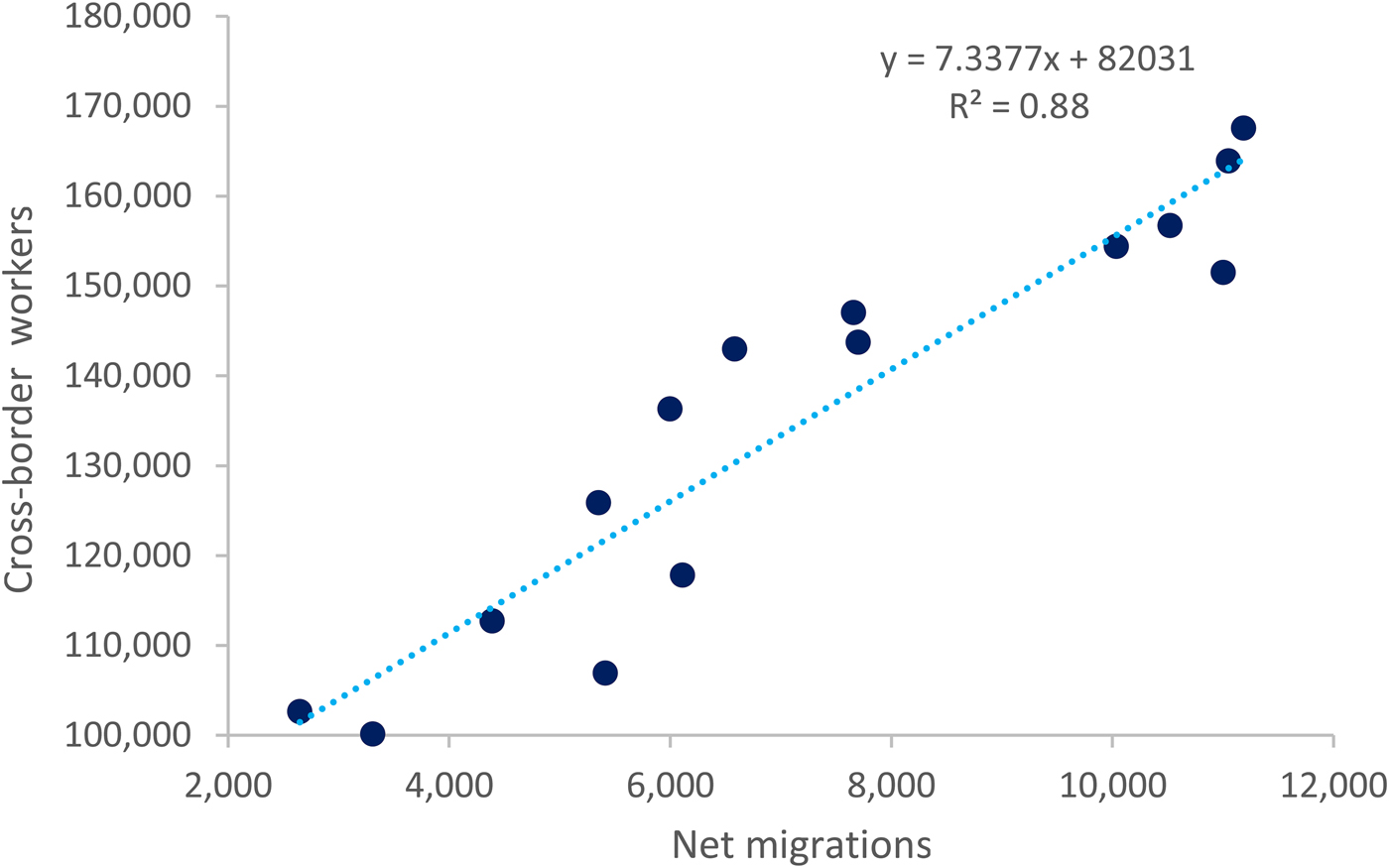
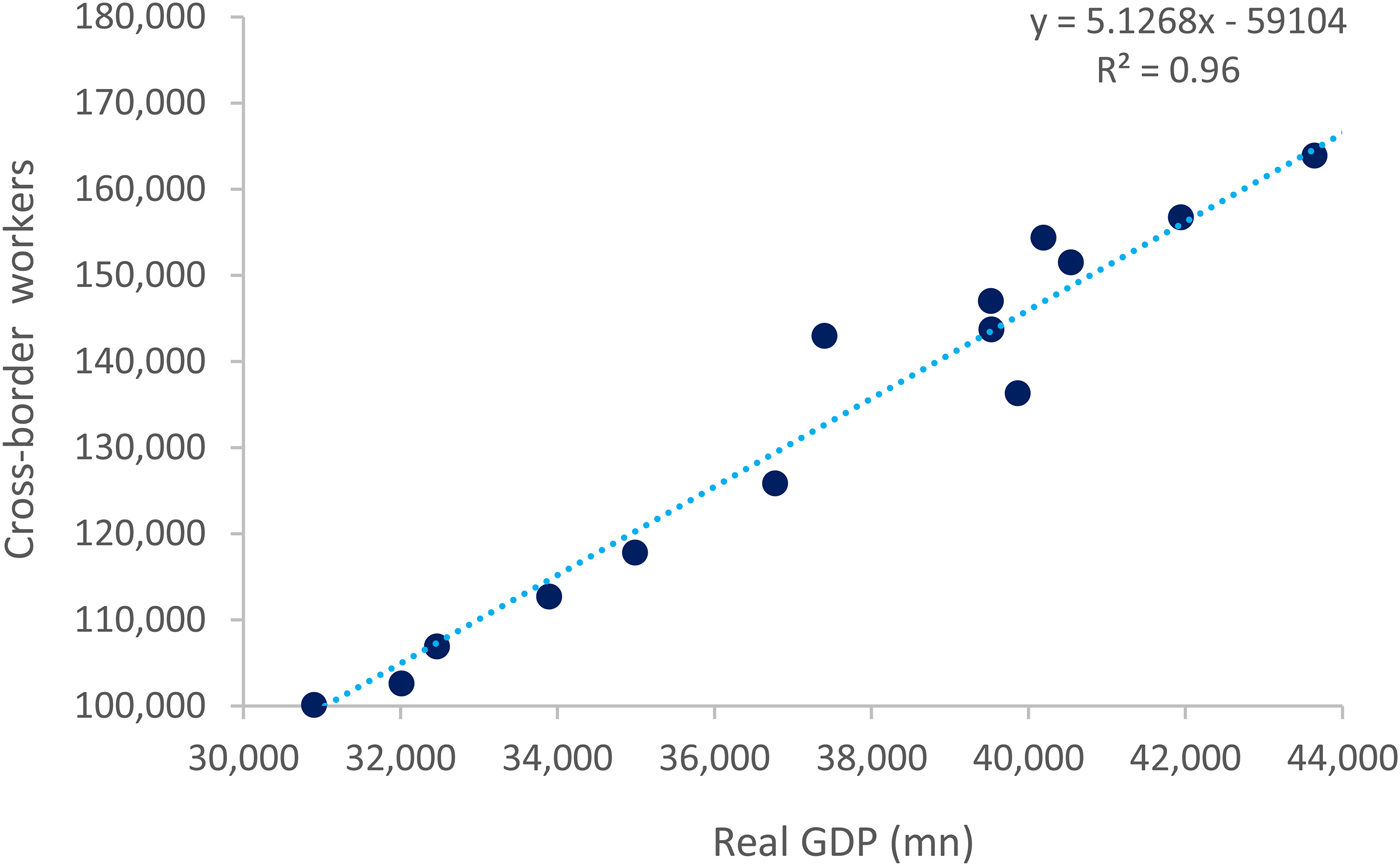
For the forecast, we take the following approach based on Laboure (Reference Laboure2017). First, we model the development of the economy such as economic growth and inflation. Second, we set the demographics of the ‘stable’ population: life expectancy, mortality, and fertility rate per woman. Third, we model the numbers of net migrations and cross-border workers. In this paper, conversely to (Laboure, Reference Laboure2017), we use economic development to forecast cross-borders workers and net migrations. Population in the high-income small open economy is highly correlated to the country economic performance and so net migrations as well as shown in Figure 1. Cross-borders as well are closely related to economic growth as shown in Figure 2. We use the regression coefficient to forecast net migrations and cross-border workers. Finally, we model the policy in place: average effective departure age, pension contribution as a percentage of gross income and the average level of pensions.
Net Migrations & GDP. Sources: Statec and author's own calculations.

Cross-Border Workers and GDP. Sources: Statec and author's own calculations.

The model is highly innovative in the way it models cross-border workers’ contributions and impacts. Most cross-border workers only work for a few years in Luxembourg and hence are entitled to a partial pension when they retire. In this paper, we model the yearly cohort of cross-border workers and the partial entitlement of each cohort when it retires after a few years. This model considers the high volatility of workers and is the most suited model of the underlying future liability for the Luxembourg pension system.
3.3 Baseline assumptions on the future
Luxembourg's pay-as-you-go pension system is generous and currently generating surpluses. Its effective retirement age is low while its replacement rate (average pension benefit as a share of average wage at retirement) is amongst the highest in Europe. This system is at equilibrium because the population has nearly doubled in the past 40 years, with new population inflows coming as contributors and not beneficiaries.
However, pension expenditures are expected to increase significantly over time as the recent migrants are retiring. The population growth may also slow down. The core value of this model is to assess the potential future scenarios for the economy and its impact on pension sustainability. The most impacting variables (that are also correlated) are (i) economic activity; (ii) net migrations (residents); and (iii) cross-border workers (non-resident). We briefly describe these different assumptions below.
We do a bottom-up forecast with three main components determining demography;Footnote 12 (i) organic growth of the current population (driven by fertility rate and life expectancy), (ii) net migrations and (iii) cross-border inflows. While the first is relatively predictable, the second and the third are less so and are highly volatile and correlated with economic activity.
We take the following approach for each of the components:
(i) Organic growth of the current population: we make similar assumptions as made by most of the state agencies.Footnote 13 Life expectancy and fertility rate are in line with forecasts of other countries and fluctuates relatively little over the years. In our model, regarding fertility rate and life expectancy, we take similar assumptions than in the 2015 European Commission Ageing Report. We assume the fertility rate per woman to increase from 1.6 in 2016 to 1.8 in 2060 and the life expectancy at 65 to rise from 21 in 2016 to 24 in 2060 in all the three scenarios.
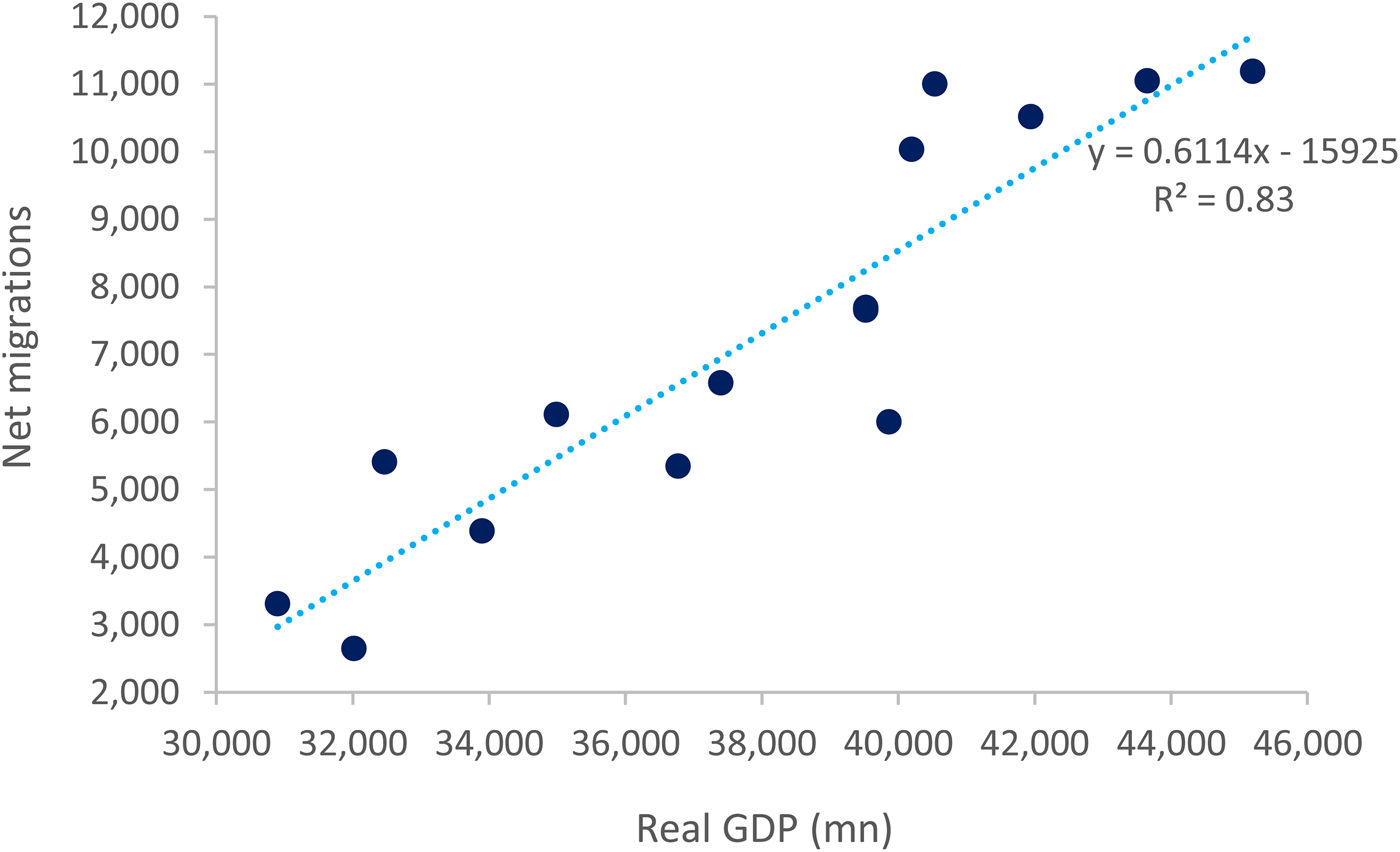
Migrations, cross-border workers, and economic growth are closely correlated as shown in Figure 3. Economic growth drives activity and migrations and the other way around holds true too. Potential GDP depends on two components, namely, demography and activity. While it is relatively acknowledged that with the aging of the population, the working share of the working population will decrease; the total population is expected to rise till 2060 due to an expected increase in economic growth. Projecting these subcomponents is possible and necessitates taking a view on the activity and the success of the country to make the strategic business reorientation.
(ii) Net migrationsFootnote 14: to find out the size and direction of migration flows, we use the correlations with economic growth. Figure 1 shows that economic growth and net migrations are highly and positively correlated. The higher the economic growth, the better the economic activity, and thus the higher the number of net migrations will be. We take three scenarios with a different economic outlook resulting in net migrations growing at 8,500 per year in case of the Continued Economic Outperformance scenario, 3,500 per year in case of the Convergence to Normal scenario and 300 in case of the Perfect Storm scenario.
(iii) Cross-border workers inflows: in the case of high-income small open economies, the evolution of cross-border worker inflows is key, with direct effects on the labor supply in the model. To find out the size and direction of cross borders flows, we proceed the same way than for net migrations above: we use the correlations with economic growth. Figure 2 shows that economic growth and cross-border workers are highly and positively correlated. In this paper, we model three different scenarios with various economic stances and assumptions regarding economic growth directly impacting cross-border inflows. In the most optimistic economic scenario, cross-border commuters are expected to increase to 327,824 in 2060, in the median scenario only to rise to 160,000 and in the perfect storm scenario to decrease to 130,000.
Net Migrations and Cross-Border Workers. Sources: Statec and author's own calculations.

3.4 Three alternative scenarios
Luxembourg is a wealthy country in Europe with a robust economy, which benefited from strong economic growth in the past 20 years. In 2015, Luxembourg was ranked as having the second highest per capita GDP (after Qatar) in the world at $98, 987 (International Monetary Fund, 2016). Luxembourg developed as a banking and an administrative center and currently is a key financial center in Europe and globally with 46% of its GDP generating from the financial services. Luxembourg also hosts the headquarters of several European institutions such as the European Investment Bank, the European Investment Fund, and the European Stability Mechanism, to name a few.
This economic success was due to its capacity to rebalance the economy. In the 1970s, Luxembourg redirected its economy from industrial focus and metallurgy towards administrative and financial services. This highly successful reconversion resulted in economic growth and has attracted new workers in Luxembourg. According to the World Bank, the population has nearly doubled in 35 years from 364,150 in 1980 to 569,676 in 2015. The role played by the financial sector in the Luxembourg economy kept growing since the 1980s to become the main driver. From 1986 to 2007, the average annual growth rate of GDP was 5.7%, more than twice the average growth recorded in the neighboring countries. Financial activity resulted in migration and cross-border workers coming especially from France, Belgium, and Germany. Currently, the employment market is competitive compared with the neighboring countries (the unemployment rate stood at 7.1% in 2014). Public finance situation is in a strong shape with a net surplus (of 1.2% of GDP in 2015) and a low public debt (21.4% of GDP in 2015).
The global financial crisis of 2008, affected the Luxembourg economy and, primarily its financial sector as banks in Luxembourg were exposed to the performance of their parent banks abroad (International Monetary Fund, 2011). At the beginning of the 21st century, Luxembourg was forced with the end of the secret banking area, like other high income small open economy, to redirect (again) its economy from financial services towards aeronautical and spatial research and wealth management. Given the size of its small open economy, a strategic reorientation is possible and could significantly impact the economy.
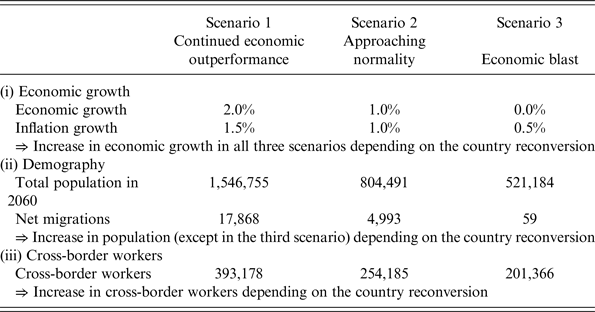
The three scenarios are summarized in Table 1. The key differentiator between them is the level of economic success in the reorientation and the impact it has on economic growth, net migrations and cross-border workers.
Assumptions on the future in the three scenarios

Source: Author's own assumptions and calculations.
Note: the numbers in this table are an average per year over the period 2015–2060 unless specified.
3.4.1 Scenario 1 Continued economic outperformance
In this first scenario Continued Economic Outperformance, the economy does not suffer from the end of secret banking area. Despite a slow drop in financial activities, the economic climate is strong since Luxembourg manages to succeed its strategic business reorientation from financial services towards innovation, research and wealth management. In our view, Luxembourg already started this reconversion and could prove to be successful as it was in the 1970s. This reorientation will result in sustained economic growth and continued to attract many net migrations and cross-border workers until 2060.
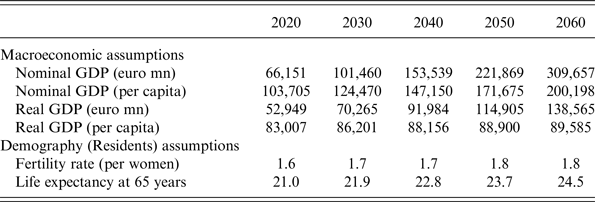
As a result, this scenario forecasts a strong potential economic growth (2.0% on average over the period 2015–2060). This strong and positive economic climate is expected to attract 17,868 net migrations per year on an average between 2015 and 2060 and 393,178 cross-border workers. The resident population is expected to amount to 1,546,755 inhabitants. The assumptions of this scenario are summarized in Table 2.
Assumptions in Scenario 1 Continued economic outperformance

3.4.2 Scenario 2 Approaching normality
In this second scenario Approaching Normality, financial activities slow down due to the end of secret banking and firms relocate their businesses to other countries. Investments in new economic activities are not sufficient to maintain strong economic outperformance. Luxembourg's competitive advantage erodes due to an expensive labor market which is no longer competitive, leading to an increase in unemployment and a low working force. This scenario is an extension of the actual visible trend with a slower economic growth than before the previous crisis level and a slow net migration.
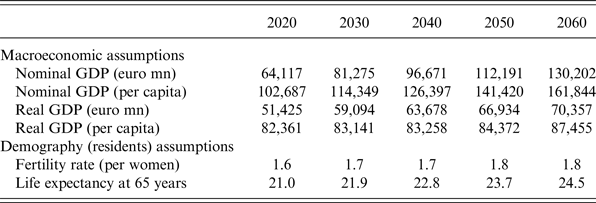
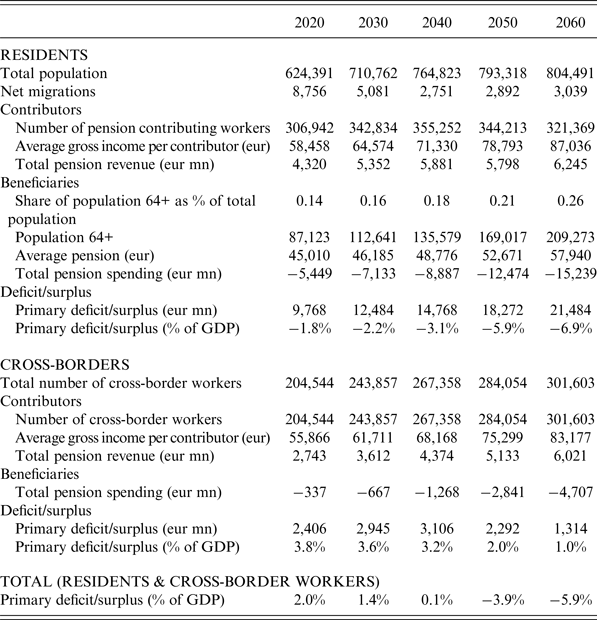
This scenario forecasts a slower potential GDP growth (1.0% on average over the period 2015–2060) than in the first scenario. The economic climate is still favorable, though at a lower extend than scenario 1, and Luxembourg is expected to attract 4,993 net migrations per year on average between 2015 and 2060 and 254,0185 cross-border workers on average. The resident population should reach 804,491 inhabitants in 2060. The assumptions of this scenario are summarized in Table 3.
Assumptions in Scenario 2 Approaching normality

3.4.3 Scenario 3 Economic blast
In this third scenario Economic Blast, Luxembourg's competitive advantage as a headquarter of banks and e-commerce companies is vanishing and no strong relay of growth is found. Not only does the economy converge to its neighboring countries but it also suffers from a correction. This scenario also strongly impacts the prospects of net migration and cross-border workers as banking activity ceased and few much-specialized jobs are created in the aerospace industry.
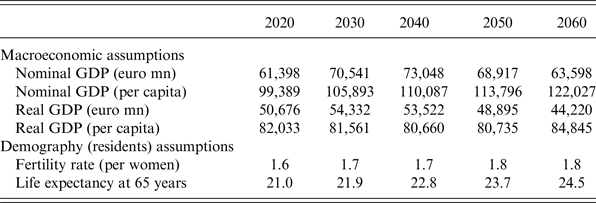
This scenario forecasts a lower potential GDP growth (0% on average over the period 2015–2060). As fewer jobs are created the numbers of net migration and cross-border workers drop significantly from the current level to 59 net migrations and 201,366 cross-border workers per year on an average between 2015 and 2060. The assumptions of this scenario are summarized in Table 4.
Assumptions in Scenario 3 Economic blast

3.5 Results
Overall, the three scenarios result in a significant imbalance of the pension system over time, the best being scenario 1 Continued Economic Outperformance and the worst being scenario 3 Economic Blast. Scenarios with higher growth (resulting in a higher number of net migrations and cross-border workers) have fewer problems. Immigration is buying time for the pension system that means delaying a problem for the future.
Looking forward, we expect cross-border workers to account between 47% (in scenario 1) to 53% (in scenario 3) in 2060 of the contributions’ revenue and to account between 14% (in scenario 1) to 29% (in scenario 3) of pensions’ beneficiaries. In other words, they positively contribute to fund the pension system while residents already contribute negatively to the pension finance with more payments than contributions. At the 2060 horizon, we expect payments to be higher than contributions for both residents and cross-border commuters in scenario 3 but only to be negative for residents in scenarios 1 and 2.
3.5.1 Continued economic outperformance scenario
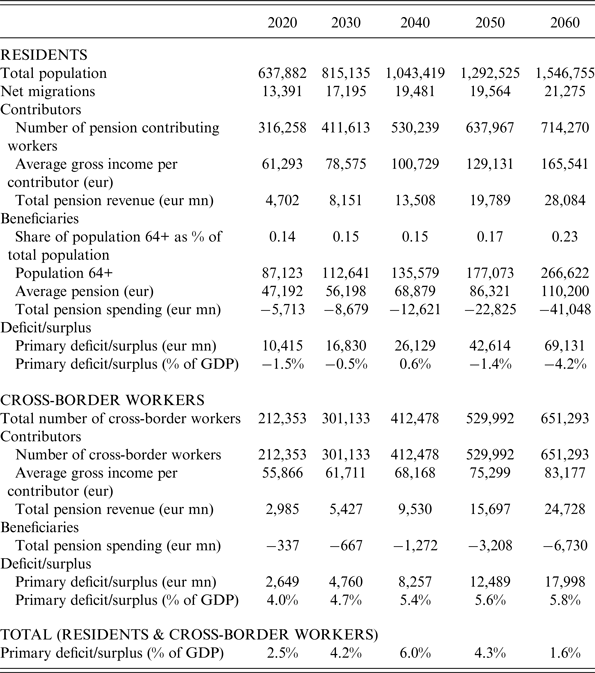
The first scenario Continued Economic Outperformance, presented in Table 5, is by far the best economic outcome in terms of public finance, with a pension surplus of 1.6% of GDP in 2060. In this scenario, immigration is buying time for the pension system that means delaying a problem for the future. This outcome is in line with current equilibrium and results from a robust economic growth and a record high number of cross-border workers.
Results in Scenario 1 Continued economic outperformance

While residents contribute negatively (see Table 5) to the pension system to 2060 with an expected deficit of 4.2% of GDP in 2060, cross-border workers contribute positively with an expected surplus of 5.8% of GDP in 2060, over the period resulting in an overall pension deficit of 1.6% in 2060. Residents contribution is higher than in the two other scenarios due to a higher economic growth explaining a higher number of net migrations and cross-border workers. Thus, more workers contribute to fund the pension system. The amount granted to residents’ pensions is also higher than in the two other scenarios due to a higher population and to a robust economic climate resulting in higher population, inflation, wage and pension benefits.
Cross-border workers’ pensions surplus are also expected to surge over the period and remain in the surplus from 4.0% of GDP in 2020 to 5.8% of GDP in 2060. The strong rise in the number of cross-border workers counterbalance pension beneficiaries. The number of cross-border commuters is expected to rise until 2060 and, thus, we expect the number of contributors and the pension revenue to rise significantly but at a faster pace than cross-border workers’ pension spending.
3.5.2 Approaching normality scenario
In the second scenario Approaching Normality, presented in Table 6, the overall pension deficit is higher and is expected to reach 5.9% in 2060. This scenario reflects an extension of the visible trend and forecasts a slowdown in the activity with a more modest economic growth, lower inflation, higher net migrations, and cross-border commuters.
Results in Scenario 2 Approaching normality

Residents pensions deficit will increase over the whole period to reach 6.9% of GDP in 2060 due to a strong rise in resident pension benefits and a slower rise in the contribution amount. In this scenario, the economic growth is more modest resulting in a slower population growth. As a result, the number of workers contributing to finance the pension system gain momentum, the number of net migrations and the number of people contributing to fund the pension system slow.
Cross-border workers pensions surplus is also expected to deteriorate over the term from a surplus in 2015 to 3.8% of GDP in 2020 and then to a slight surplus of 1.0% of GDP in 2060. This slight surplus is the consequence of a surge in the number of cross-border commuters pensions to be paid and a lower increase in the number of cross-border workers over the period (and so a lower number of contributors).
3.5.3 Economic blast scenario
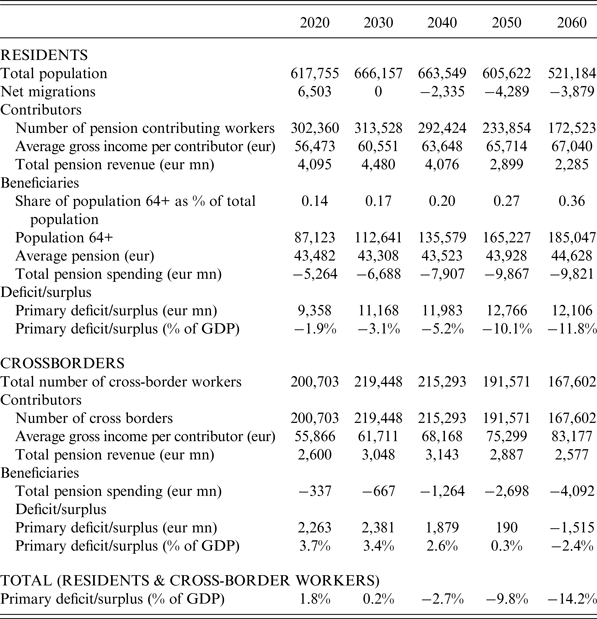
The third scenario Economic Blast, presented in Table 7, is by far the worst scenario as pension deficit is expected to reach 14.2% of GDP in 2060. This scenario mirrors a worsening of the economic situation with job destructions and economic growth drop impacting net migrations and cross-border inflows.
Results in Scenario 3 Economic blast

This high deficit of 14.2% of GDP in 2060 is mainly the result of the resident pension deficit. Residents pensions deficit is expected to worsen significantly and reach 11.8% of GDP in 2060. This is, first, due to a lower amount of contributions explained by a drop in economic growth and the number of workers, and second, to a strong rise of the number of beneficiaries.
The cross-border workers’ pension deficit is also expected to deteriorate from a surplus of 3.7% of GDP in 2020 to reach −2.4% of GDP in 2060. In this scenario, the number of cross-border commuters is expected to decrease towards 2060. We do not expect the contribution of cross-border workers to rise but to broadly remain stable over the period. However, the number of cross-borders benefiting from a pension should increase and the cross-border pensions amount should rise.
3.6 Potential policy actions and impact
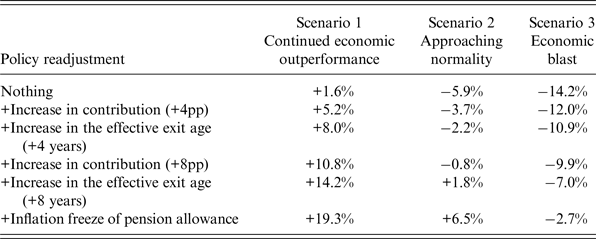
Continued reform of the pension system is advisable. The very strong population growth projection, through long-term net migrations, should be treated with caution. Additional pension reforms should be considered, as previous reforms are not sufficient for system equilibrium in particular if the economic outperformance is not sustained. We present several set of reforms for the three scenarios in Table 8.
Pension deficit/surplus in 2060 in the three scenarios with Mildest, Medium, and Extreme Policy Readjustments

Source: Author's own calculations. Note: the numbers in this table relate to the pensions deficit/surplus as % of GDP.
Potential reform levers include an increase in contribution, re-indexation of pension benefits and postponing of the retirement age. Each of these policy actions has a different level of impact and implementation time.
The increase in contribution is the fastest policy to implement, and probably the most likely given that citizen protestation against this measure is assumed to be low contrary to a drop in the level of pension or an extension of the retirement age, as it can be implemented almost immediately. However, there is a natural cap to how much it can be increased to maintain the competitiveness of the local workplace (gross to net income ratio).
Indexation of pensions’ benefit will take time if policymakers want to avoid making a straight haircut (in this case it will re-adjust over time by freezing pension indexation vs. inflation). In extreme cases of the deficit, it can be implemented quickly and significantly re-adjust deficit.
Postponing of the retirement age has a large impact, as it theoretically increases the number of contributors while decreasing the number of pensioners. However, implementing the policy does not immediately solve the issue of senior employment rate, as it takes time to implement on a cohort-by-cohort basis.
We have modeled a set of policy readjustment from mild to important, from the easiest to implement for policymakers to the most difficult one, and tested it against each scenario. We have analyzed the impact of each reform-set on current scenarios.
To sum up, without any policy reform, pension budget in 2060 is expected to reach:
• Scenario 1 Continued Economic Outperformance:+1.6% of GDP
• Scenario 2 Approaching Normality: −5.9% of GDP
• Scenario 3 Economic Blast: −14.2% of GDP
First, the mildest and easiest reform for policymakers to implement would probably to slightly and gradually increase the contribution rate.Footnote 15 This measure could also pass with little protestation from citizens. Taking into consideration a gradual rise of 4p.p. in the contribution rate to 2060, pension budget in 2060 is expected to decrease in all the three scenarios to:
• Scenario 1 Continued Economic Outperformance: −5.2% of GDP
• Scenario 2 Approaching Normality: −3.7% of GDP
• Scenario 3 Economic Blast}: −12.0% of GDP
Second, other measures will be acted once the contribution rate has been raised. The second most likely measure will probably be to raise the effective exit age. With an aging population, it would be rational to align the effective exit age on lifespan, or at least postpone the exit age. Adding these two policy reforms, pension budget is expected to reach
• Scenario 1 Continued Economic Outperformance:+8.0% of GDP
• Scenario 2 Approaching Normality: −2.2% of GDP
• Scenario 3 Economic Blast: −10.9% of GDP
Third, the next policy reform likely to be implemented would be another increase in the contribution rate, but at a higher level, than the one implemented previously. Instead of +4p.p., it would be +8p.p. to 2060. Taking the two measures into consideration (increase of the effective exit age by 4 years associated with an increase in the contribution rate by 8p.p.) would yield a pension budget of:
• Scenario 1 Continued Economic Outperformance: +10.8% of GDP
• Scenario 2 Approaching Normality: −0.8% of GDP
• Scenario 3 Economic Blast: −9.9% of GDP
Fourth, the next policy reform likely to be implemented would be another increase in the effective exit age, but at a higher level than the one previously implemented. Instead of 4 years, the effective exit age will rise by 8 years to 2060. Taking the two measures into consideration (increase of the effective exit age by 8 years associated with an increase in the contribution rate by 8p.p.) would yield a pension budget of:
• Scenario 1 Continued Economic Outperformance: +14.2% of GDP
• Scenario 2 Approaching Normality: +1.8% of GDP
• Scenario 3 Economic Blast: −7.0% of GDP
Fifth, the last and least popular pension measure is likely to be a drop-in pension benefits. As this measure is rather unpopular, the likely way to implement it would be to freeze pension benefits from inflation and to stop automatically adjusting pension benefit levels taking into consideration inflation rate. Given that the inflation rate is the highest in the first scenario and the lowest in the third scenario, we can expect this measure to have a wider impact in the first scenario than in the last one. Taking into account the three measures (inflation freeze of pension benefits, increase of the effective exit age by 8 years associated with an increase in the contribution rate by 8p.p.) would yield a pension budget of:
• Scenario 1 Continued Economic Outperformance: +19.3% of GDP
• Scenario 2 Approaching Normality:+6.5% of GDP
• Scenario 3 Economic Blast}: −2.7% of GDP
Obviously, policymakers are reticent to make unpopular reforms, given their interest to be (re)elected. Of course, at this stage, it is hard to predict which scenario is the most likely.
4 Conclusion
In our paper, we use the ‘reference class forecasting’ approach to study the evolution of a high-income small open economy's pension's equilibrium between 2016 and 2060 to reduce policy making biases and gut feeling. We assess a set of policy actions and their impact in three different scenarios: the Continued Economic Outperformance, the Approaching Normality, and the Economic Blast. It leads to risk assessment discussion under uncertain outcomes, where policymakers can have a rationale debate about ‘insuring’ for the future economic volatility.
This paper addresses a modeling issue specific to small open economies - how to forecast and assess future contribution and liabilities when a large proportion of the workforce is made of either cross-border workers or recent emigrants.
To overcome these challenges, we built a highly innovative model in the way it models cross-border workers’ contribution and impact. Most cross-border workers only work a few years in the home economy and hence are entitled to a partial pension when they retire. It is further challenging as the churn of cross-border workers is very important and strongly varies over the years. We model yearly cohort of cross-border workers and the partial entitlement of each cohort when it retires after a few years. It allows us to not only assess the state liabilities but also the evolution of age pyramid with a significant portion of new migrants. This considers the high volatility of workers and is the most suited model of the underlying future liability for a small open economy's pension system.
As a result, we built a model allowing policymakers to navigate in a strongly volatile small open economy. Also, we paved the way for healthy debate between policymakers and on how to present the challenges to the population with a collective ‘call for action’ with several economic and policy reform scenarios.
Though in this paper, we focus on pensions in a small open economy, our approach is highly relevant and can be easily tailored to model other areas that are highly impacted by employment migration and demographic balance such as unemployment benefits or social welfare. The model can also be used to reflect any country's pension reforms, assess the need for reforms, and provide an update with several economic scenarios depending on the cyclicality.
A. Annex
A.1 Luxembourg – background information
Luxembourg is a wealthy country in Europe with a robust economy, which benefited from strong economic growth in the past 20 years. In 2015, Luxembourg was ranked as having the second highest per capita GDP (after Qatar) in the world at $98, 987 (International Monetary Fund, 2016). Luxembourg developed as a banking and an administrative center and currently is a key financial center in Europe and globally with 46% of its GDP generating from the financial services. Luxembourg also hosts the headquarters of several European institutions such as the European Investment Bank, the European Investment Fund, and the European Stability Mechanism, to name a few.
This economic success was due to its capacity to rebalance the economy. In the 1970s, Luxembourg redirected its economy from industrial focus and metallurgy towards administrative and financial services. This highly successful reconversion resulted in economic growth and has attracted new workers in Luxembourg. According to the World Bank, the population has nearly doubled in 35 years from 364,150 in 1980 to 569,676 in 2015. The role played by the financial sector in the Luxembourg economy kept growing since the 1980s to become the main driver. From 1986 to 2007, the average annual growth rate of GDP was 5.7%, more than twice the average growth recorded in the neighboring countries. Financial activity resulted in migration and cross-border workers coming especially from France, Belgium, and Germany. Currently, the employment market is competitive compared with the neighboring countries (the unemployment rate stood at 7.1% in 2014). Public finance situation is in a strong shape with a net surplus (of 1.2% of GDP in 2015) and a low public debt (21.4% of GDP in 2015).
The global financial crisis of 2008, affected the Luxembourg economy and, primarily its financial sector as banks in Luxembourg was exposed to the performance of their parent banks abroad (International Monetary Fund, 2011). At the beginning of the 21st century, Luxembourg was forced, with the end of the secret banking area, to redirect (again) its economy from financial services towards aeronautical and spatial research and wealth management. Given the size of its small open economy, a strategic reorientation was possible and could significantly impact the economy.
With a slowdown in the economic growth and an aging population, the implicit debt of Luxembourg may explode in the coming decades. This could affect the future capacity to pay generous pensions. The government has already started reforms. According to the Working Group of Aging set up by the European Commission (Directorate-General for Economic and Financial Affairs, 2015a), pension spending in Luxembourg is expected to record the strongest growth in the European Union from 9.4% of GDP in 2013 to 13.4% of GDP in 2060. This will pose some risk regarding the sustainability of the current system.
Moreover, the current balance in the healthcare and pension system is largely the result of a manifest imbalance under which the non-residents account for twice of the contributions’ revenue compares with their pensions cost (Le Gouvernement du Grand-Duché de Luxembourg, Ministère de la Sécurité sociale, 2015). It means that with unchanged policies, the active population will have to double every 30–40 years to keep the system viable.
Luxembourg government made a pension reform in 2013, but limited the scope and did not substantially address the threat posed to the long-term sustainability of public finances. For instance, the reform only partially addressed the large gap between the statutory and the effective retirement age. Against a background of an effective-retirement age that stood at 58.9 in 2012 compared with the statutory retirement age fixed at 65, the reform still maintained the possibility of an early retirement at 57 or 60.